
Defending the Undefendable II: Freedom in All Realms
9. The Daycare Provider
9.
THE DAYCARE PROVIDER
Daycare for profit? In the minds of some, the very concept boggles the imagination.
According to these people, on the one hand we have the nation’s children—tender, sweet, cuddly, cute, and lovable. On the other hand we have the evil profit system, hard-hearted, cold, and calculating at best, with a cash register for a soul.
Are we to deliver our little kiddies to the “tender mercies of the profit-mongering capitalist system?” Not if the usual socialist suspects have anything to say about it. In their view, when money becomes the first consideration, quality takes a poor second. You can do that with a product, but not with children. Children are the major resource of the future.
But this dichotomy between money and quality, between profits and care, is a sheer fabrication. First of all, there have been numerous cases throughout recorded history of faithful rendition of service—for money! Examples from the health field include doctors, psychiatrists, psychologists, and nurses. But members of every profession, mechanics and babysitters, plumbers and even economists, both provide and charge for their services.
Secondly, the argument completely misconstrues the role of profits in our society. Far from being an impediment to high quality service, profits are almost always a spur to exemplary conduct and evidence of its existence. It is no coincidence that companies which are practically synonymous with high profits are also well known for providing reliable products and service. It is rather a lack of profits that is correlated with failure to provide the public with a good or service deemed more valuable than its cost. How else could it be? Do we really expect low profits to be linked with exemplary service or high profits with unsatisfied customers? (I am now ignoring firms that earn profits not through market transactions, but, rather, on the basis of government largesse: subsidies, special privileges, tariff protections, etc.)
In any case, whether private or public, daycare cannot be contrived without the intermediation of the monetary nexus. In the private system, parents can contract on a voluntary basis with the childcare workers of their choice, or they can form cooperatives based on voluntary donations. But with public daycare, funds would be forcibly taken from all citizens via taxes, whether or not they were interested in this service or even had children.
Advocates of nationalized daycare would have us believe that they are disinterested parties, concerned only with the welfare of the children. Such, however, is hardly the case. They are rather an organized economic pressure group, who aim to maximize their own incomes in competition with alternative suppliers of the service: namely nannies, babysitters, daycare purveyors who work at home (often with children of their own), as well as with, dare I say it, private, commercial daycare concerns.
The proponents of the “Big Brother—let government do it” school of thought have already succeeded in setting up arbitrary and discriminatory rules which discourage private daycare alternatives. For example, in some jurisdictions, a private daycare company must pay $150 for a development permit issued by the municipality—while a nonprofit center, registered as a society, need pay only one dollar! Moreover, private firms must invest their own money in the endeavor, while nonprofit centers may receive government grants (paid for, of course, out of tax revenues received from private enterprise). And then there are the limitations on the number of children each center is allowed to serve, and the staff-hiring restrictions, which impose a discriminatory and irrelevant “credentialism” on private daycare owners. It is easy to see how these requirements serve the professional-oriented daycare service association, but not the parents of the children enrolled in private daycare. These restrictions also violate the rights of the qualified personnel who might staff such institutions—without benefit of the sometimes artificial and needless advanced university degrees in child care.
Some governments threaten to do worse than this. There are plans, even, to take away tax concessions from married women staying at home, and use the proceeds to increase deductions for money spent on outside daycare. The state, in other words, would take money away from those women who care for their children at home, and give it to mothers who use daycare facilities. What possible justification could there be for government giving families financial incentives to increase the number of hours per week that children are cared for outside the home?
In looking for explanations, one must not be paranoid. On the other hand, it would not do to overlook any explanation out of fear of appearing alarmist.
So let us consider one possible explanation: that the institutions of the centralizing, interventionist state and that of the family have historically been at odds with one another, and that this present threat is but another chapter in this unfolding saga.
A government bent on taking an ever larger role in the life of its citizenry sooner or later runs into conflict with other institutions—churches, voluntary clubs, the family—which also command the strong loyalty of the people. And when this occurs, the government must either give up its totalitarian aspirations, or determine to enter a give-no-quarter war with these alternative institutions.
In the countries that languished behind the Iron Curtain, the war was fought long ago, and institutions such as churches, clubs, the family, and the ethnic group were long ago vanquished.
In North America, the battle is yet to be fought in its entirety. That is to say, there is still hope for private institutions such as the family.
But every time the government successfully promotes daycare above the natural level that would otherwise ensue, or artificially entices women out of the home and into the workforce, or attacks the tax treatment of married women living at home in favor of those who give up their children to the tender mercies of the state, to that extent it weakens the family as an alternative to government.
The logical extension of such a procedure would be family life as it has been lived for generations in Central and Eastern Europe—a less viable institution than we have been able to maintain at home—so far.
In order to preserve and protect the North American family, it is not necessary to take a “maximalist” position: that the government should do everything in its power to artificially strengthen the family, by penalizing alternative institutions such as unmarried status or childlessness. To do this smacks of putting the fox in charge of the chicken coop.
It is enough to adopt a “minimalist” position: that the state merely refrains from adopting policies which lead to family disruption. That is what “laissez faire” is all about.
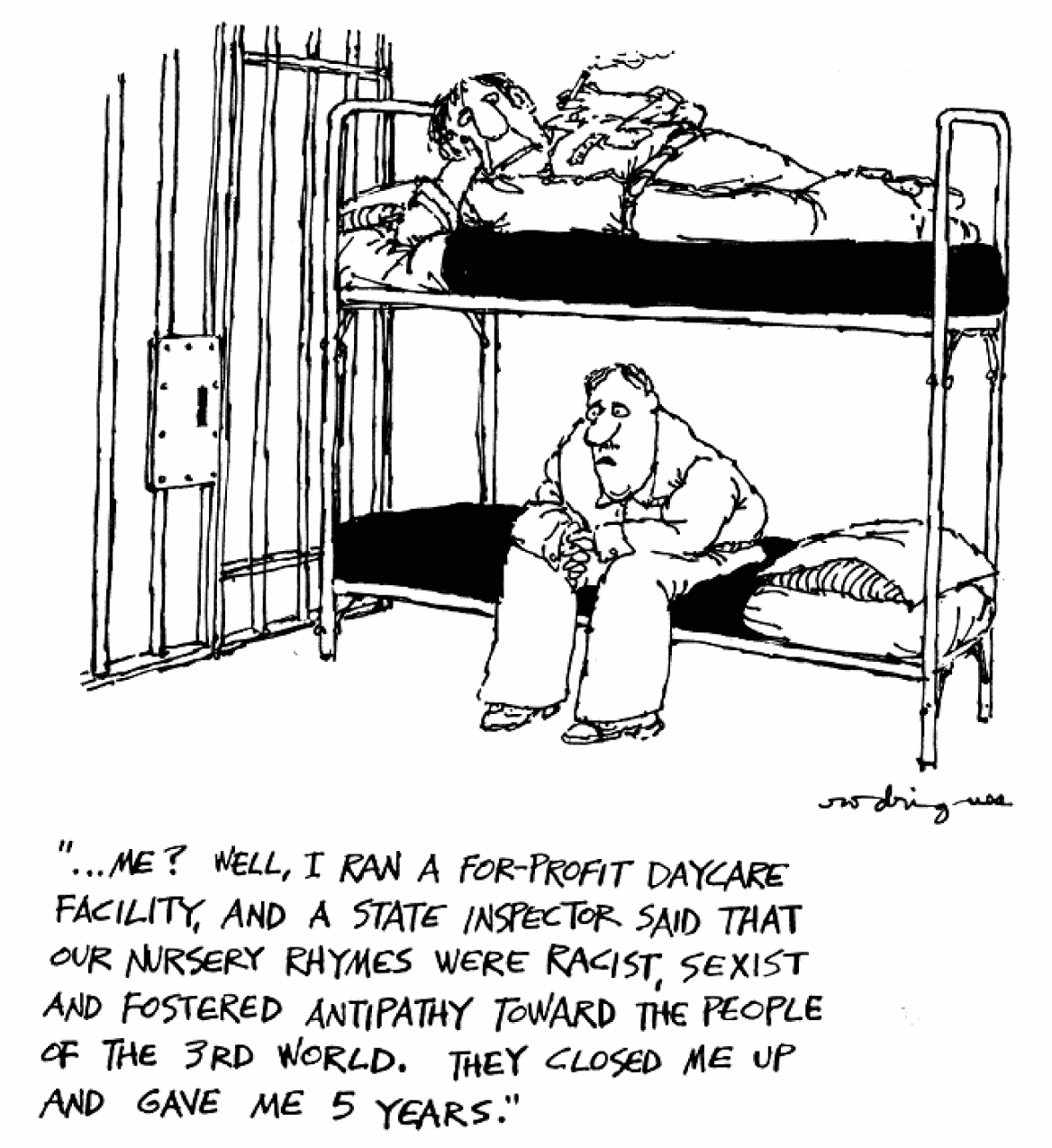
This chapter is dedicated to all those dedicated childcare providers who were jailed by governmental authorities on trumped-up charges.

