
Defending the Undefendable II: Freedom in All Realms
2. The Smuggler
2.
THE SMUGGLER
A smuggler is a person who imports goods without paying the taxes (usually known as customs duties or tariffs) imposed on these goods by government. He also transfers goods whose importation or exportation has been forbidden entirely by government.
But ought government to be prohibiting any sort of international trade? Should the state impose any sorts of taxes on the goods that cross national boundaries?
There is a lot of talk nowadays about free trade. But this very concept tends to drive political leaders into such a tizzy of fear that they substitute it with phrases like “freer trade” or “enhanced trade” or “fair trade” or some other such circumlocution. In that way the dread name never has to pass their lips in its pure form.
We the people, however, need not labor under this apprehension. Instead, we would do well to understand the theory of free trade, in all its pristine glory, and realize that it is in the best interests of the people.
The United States, the land of the free and the home of the brave, is supposed to be the bastion of free enterprise in this regard. The less said about this during the Bush (I and II) and Obama administrations, the better. But even during the presidency of Ronald Reagan, who constantly crooned about the “magic of the marketplace” in solving economic problems and bringing prosperity to all, the United States was far from a living embodiment of the principles of Adam Smith. In point of fact, the United States is a rather protectionist country even under the rule of those who employ free trade rhetoric. And in recent years, it has increased tariffs or set quotas on a wide range of goods and products, including motorcycles, steel, autos, and textiles.
Yet self-imposed banishment from the benefits of specialization and the international division of labor is a serious mistake even for a large country like the United States, which contains within its own borders a global-scale market, many skills and raw materials and much of the world’s available capital; for small nations to pursue such policies, is folly indeed.
The very term “protectionist” is a vast misnomer. It implies that the citizens are being defended against economic exploitation which is somehow made even more sinister by its foreign genesis. In fact, nothing could be further from the truth.
In order to see this clearly, let us start not with a nation which refuses to trade with others, but with an individual who sets up trade barriers between himself and all other people. Such a person, of course, will have to provide for all of his needs: for each and every one of them. He will have to grow his own food, make and mend his own clothing, build a house for himself, minister to himself when he falls ill, entertain himself, etc. Not being able to specialize in any one thing, his productivity will not be able to attain livable levels. His life will be “nasty, brutish and short.” If everyone tried the path of economic solipsism, this fertile Earth, which today can support the lives of more than six billion people, might possibly be able to keep at most a few million snarling savages living on a miserable, semi-starvation basis.
On a national level, one argument for protectionism is that a policy of free trade would mean the loss of domestic jobs. Those who fear elimination of all government-imposed barriers to trade cite prospective job losses in such callings where foreigners can produce goods at a fraction of the local costs. And this is indeed realistic. An end to laws which protect such industries from foreign competition would mean a wholesale cutback—or perhaps even an entire elimination—of employment in these sectors.
But this is all to the good. For why should precious local labor be expended on jobs which produce less than they might? The farmer who works at tasks that could be done as well by an animal or by mechanical means (plowing, hauling, lifting) will have less to show for his efforts than if he concentrated on doing things that he could do far better (running a mechanical plow, hauling by tractor, using a forklift). In just the same manner, and for the same reasons, locals would be far better off if people now employed in producing domestic products on an inefficient basis shifted themselves into job slots where they could be more productive.
For “any old employment” cannot and should not be our goal. Millions of farm jobs, heck, billions of them for that matter, could be created if people used teaspoons to dig up our rich earth, instead of plowing. What we want, what we need, as a country if we are to successfully negotiate our economic way into the twenty-first century, are jobs in which people are freed up to do more productive things.
This was the free trade message of Adam Smith, who inveighed against the mercantilists, the economic “nationalists” of his day. He saw clearly that the “wealth of nations” was dependent upon productivity, that is, labor directed to its most efficient employment. And as a necessary corollary, he demonstrated that this could only take place under a regime of full free trade, where government placed no obstacles in the way of international cooperation, specialization, and a worldwide division of labor.
We see this clearly in the case of maple syrup and bananas (see the attached table on absolute advantage towards the end of this chapter). Sure, bananas could be produced in Canada. All it would take is thousands, or perhaps hundreds of thousands, of gigantic and stupendously costly hothouses. And just as certainly, a tropical country such as Costa Rica could produce maple syrup. They could do this by erecting large refrigerators, in which they would keep their maple trees. (We’re talking big refrigerators here.)
The very idea is ludicrous, of course. We all see the fallacy. Far better for the Canadians to produce maple syrup, for the Costa Ricans to grow bananas, and for each to trade for the item the other specializes in—to mutual advantage. What is the best way for a piano teacher to get a car? To build one herself? Or, to give piano lessons, and purchase an auto with the proceeds? To ask this is to answer it; of course, she should stick to what she does well, and not foray off into the very uncertain world (for her) of vehicle manufacture. Very few people, however, see that the same principle applies to textiles, shoes, autos, and electronic goods like television sets; indeed, to everything under the sun. But it does, it does.
Consider textiles for a moment. If buyers are offered the choice between a locally made pair of denim jeans for fifty dollars and an identical one manufactured in Southeast Asia—Hong Kong, let us say—for ten dollars, there is little doubt that virtually all consumers will choose to be thrifty and save forty of their hard-earned dollars. And the inevitable result will be the loss of domestic jobs in denim production.
But let us not stop here, as do the protectionists, for there are several more effects to be considered. What, pray tell, will the consumers do with that extra forty dollars? They may spend it on other local products, and if they do, some of the now unemployed denim workers can find jobs in these other lines. They may save the money instead, but then the banks will be able to make loans on easier terms, thus creating additional jobs in domestic construction, home building, and heavy industry. Alternatively, they may purchase four additional pairs of foreign jeans (or other imports from other countries) for that same fifty dollars.
So we must now ask, what will the foreign suppliers do with the ten dollars (or the fifty dollars) paid to them by the people in the domestic country? American dollars are no more acceptable in Hong Kong than are dollars of that Chinese colony in the U.S. If the new owners of these American dollars want to use them, there is only one place in the world, ultimately, where they are acceptable: the home country. And when these funds come back to our nation, they will be for the purchase of goods and services. And that will create still additional jobs here.
If the inhabitants of Hong Kong are perverse, and refuse to spend their American dollars here—if they stuff them in mattresses or burn them, for example—this will greatly benefit our economy. For by this policy, they would present us with valuable commodities and receive in return pieces of paper which their own actions had rendered worthless. It would be as if Hong Kong had granted the U.S. a gift, or foreign aid, consisting of denim jeans. And it could hardly hurt the Americans to be the recipients of such largesse. (If the Hong Kong exporters spent their U.S. currency in a third country where they were acceptable to certain sellers, such as France, then the French would either turn around and spend the funds in America, creating jobs here, or keep them, in effect making a free gift to us.) This form of “foreign aid” would, of course, make our denim industry superfluous, but all citizens saving on their clothing bills would now be able to afford additional goods—and new jobs would be created in the industries catering to these new desires.
No matter how you slice it, trade between consenting adults benefits both parties to the deal. Otherwise it would not take place. The exchange of U.S. dollars for Hong Kong denim is no exception.
Nor is the exchange of U.S. dollars for cloth and clothing from the People’s Republic of China. Yet, a major dispute erupted only a few years ago between those two nations, with Peking threatening to retaliate against Washington for U.S. protectionist interference with textile trade. According to the official Chinese news agency, Xinhua, the Chinese ambassador was unhappy with the U.S. “country of origin” rules. Under these regulations, U.S. customs agents had been authorized to reject clothing manufactured in Hong Kong but based on materials and semi-completed garments originating in mainland China. The Chinese protested that this rule would threaten several billion dollars worth of textile exports to the U.S. A spokesman said that “hundreds of factories and about sixty thousand jobs would be harmed in [his country’s] southern provinces alone, and this would be a grievous blow to China’s industry, employment, trade, and economic development.”
Adam Smith must have been spinning in his grave. Imagine a country supposedly devoted to the principles of capitalism and free markets (that’s us) erecting barriers to trade and the (ex?) communists (China) protesting!
The main sufferers from a policy of free trade, by the way, are not the lower paid workers with generalized training, which is as applicable to denim production as to anything else. They will find alternative employment at comparable wages. The real losers are the protected factory owners, and the highly paid, heavily unionized workers with a great investment in skills specific to denim manufacture. It is mainly they who will suffer losses unless retrained. As a result, the unions typically support the manufacturers in their bid for more protection and more assistance.
One of the biggest limitations on further exports from North America to the less developed countries is the fact that they don’t have enough dollars with which to buy our exports. And they can’t get our currency unless we allow them to trade with us. Foreign aid, the time-honored socialistic alternative solution to Third World poverty, is not the answer. Experience and logic suggests that “aid” money will only be used to purchase limousines for the rulers, weapons to keep them in power, useless steel mills and statues to promote their vain glory (the three M’s: machine guns, monuments, and Mercedes) and money with which to further centralize and socialize their economy and thus plunge the people into further and deeper misery. The motto for those really concerned with the plight of the downtrodden Third World peoples ought to be: “millions in foreign trade, not a penny in foreign aid.”
If another country can make denim more cheaply than we can, it makes sense to concentrate on what we do best, allow them to do the same, and then to trade—utilizing the special skills and factor endowments of each region of the globe. We will never be as rich a nation as we could be if we force people to work at jobs others can do more cheaply. The high-priced lawyer who insists on doing all his own typing, office cleaning and errand running will soon learn that he can do far better solely as an attorney (see table attached at the end of this chapter). The tragedy is that our country continues to waste valuable labor inputs on tasks that can only be considered menial—from a worldwide and economic perspective.
There are other tragedies caused by protectionism, of course. One of them is the growth of something called “countertrade.”
Suppose you had a used car that for some reason you no longer liked and you wanted instead to own a rowboat, a radio and a clock. In the ordinary course of events you would simply sell the automobile, whether through the want ads or to a used car dealer, take the money, and go out and purchase the rowboat, the radio and the clock. What could be more simple?
But suppose you were told that there was no money in society and that you would have to accomplish this task through barter. Do you have any idea how difficult that would be? Can you just imagine the odds of finding someone who wants a used car and has a rowboat, a radio, and a clock he wants to trade? In technical economic language, this is called the “double coincidence of wants.” Economists use this phenomenon to show the importance of buying and selling with money because it would be a real coincidence indeed if such a trade could be conducted through barter.
But there is a fascinating change occurring in the international trade arena. It is called countertrade, and it’s really only the bartering of one good, or set of goods or services, for another.
For example, Ford Motor Company of Detroit trades automobiles for Uruguayan sheepskins. Or Italy barters ships for Iraqi oil. Or Pierre Cardin receives Oriental silks in return for providing consulting services to China. Or a Mexican law firm gets woolen hats and noodles for giving legal advice to a Third World country.
Why have we been moving from trade, through the intermediation of money, to such international barter? One possibility is that with barter, countries can continue to import despite inadequate foreign exchange reserves and without risking additional balance of payments crises. This is a situation afflicting many Third World countries, which have, thanks to centralized and socialized planning, mismanaged their economies. Then too, countertrade is a way for these nations to deflect the austerity programs being imposed upon them by the International Monetary Fund, a lending source for the Third World made up of a consortium of institutions from the developed Western democracies.
A third reason is that bilateral countertrade arrangements can sometimes be used to evade tariff and non-tariff barriers to trade. If so, consider the plight of a country frozen out of a lucrative market in this manner. If it engages in countertrade, it will lose out through the inefficiency of barter. But it may make up for this, or perhaps even exceed it, by being able to jump over the tariff barrier.
The problem, in both these cases, is what economists call the “second best” solution. Barter may pay, but only because of governmental mismanagement or tariffs. The “first best” solution would be to bring the decentralized marketplace to the nations of the world, and to reduce or eliminate tariffs. Then, countertrade would no longer be needed, and the world could get back to more efficient utilization of the monetary system.
Another tragedy sometimes caused by protectionism is the flagrant waste of economic resources, other than labor, in order to get around government-imposed barriers to free trade. A case in point is the opening of Japanese auto plants in North America.
When I was a very young lad, my mother arranged a job for me with the neighborhood greengrocer. I was to count the string beans filled to the brim of a very large bin. The purpose of this “employment,” of course, was not to create a good or service, or to help with sales or promotion or to be productive in any of the usual senses of that word. Rather, this “job” was a disguised form of babysitting, and my wage was a negative one: my mother paid the grocer to keep me busy and out of her hair. (Some of my detractors have gone so far as to wish me similar employment in my adulthood.)
In like manner, this opening of a new automobile manufacturing plant cannot be understood as a typical business decision. True, the factory resembled those built for economic reasons. But this resemblance was only coincidental. The only reason for the location of this plant was to hop over the steep tariff wall imposed on Japanese and other foreign cars, and to escape various non-tariff barriers erected in front of importers of such cars by the domestic authorities. In a word, the government succeeded—through extortion—in forcing the Japanese to build a plant they would never have agreed to build otherwise.
As a nation, we should hang our heads in shame that such an evil deed was perpetrated in our names. The location of this plant was not based on efficiency grounds, nor can it possibly accomplish this end. One need only consider the fact that a significant amount of the output of this plant is shipped back to Japan for assembly. That being the case, it follows that these companies would have been able to more cheaply produce their cars with an additional (equivalent) plant in Japan, rather than this one. As a result of bullying, these manufacturers have produced a more costly product, and American consumers have had to pay higher prices for their automobiles.
Since this bit of economic coercion, we have been perceived as even more interventionistic and, thus, even more inhospitable to foreign investment. As well, to a greater degree than before, we have been seen as a country that cannot attract foreign investment on its own merits, and instead must resort to economic strong-arm tactics to achieve this end.
Why is it, then, if the case for free trade makes so much sense, that we nonetheless find ourselves barricaded from greater affluence by high tariff walls?
Part of the answer seems to be that too often even those who see how much sense free trade makes are overly concerned that it be not only free, but also “fair.”
In the past few years, as a result, a new phrase has entered the common lexicon: “the level playing field.” It sounds rather like sports jargon, but it is not. Instead it refers to a rather technical aspect of international trade. In this sense, the “level playing field” alludes to a situation in which the citizens of neither country have an unfair competitive advantage over the other. If trade between nations can be represented by a playing field, then, according to this doctrine, it should tilt neither one way nor the other, nor should the wind be at the back of either team, or the sun more in the eyes of one side than the other. In sports such as football, basketball, hockey, and soccer, the goals are switched around halfway through the match so as to equalize any disadvantage which might result from an uneven playing field.
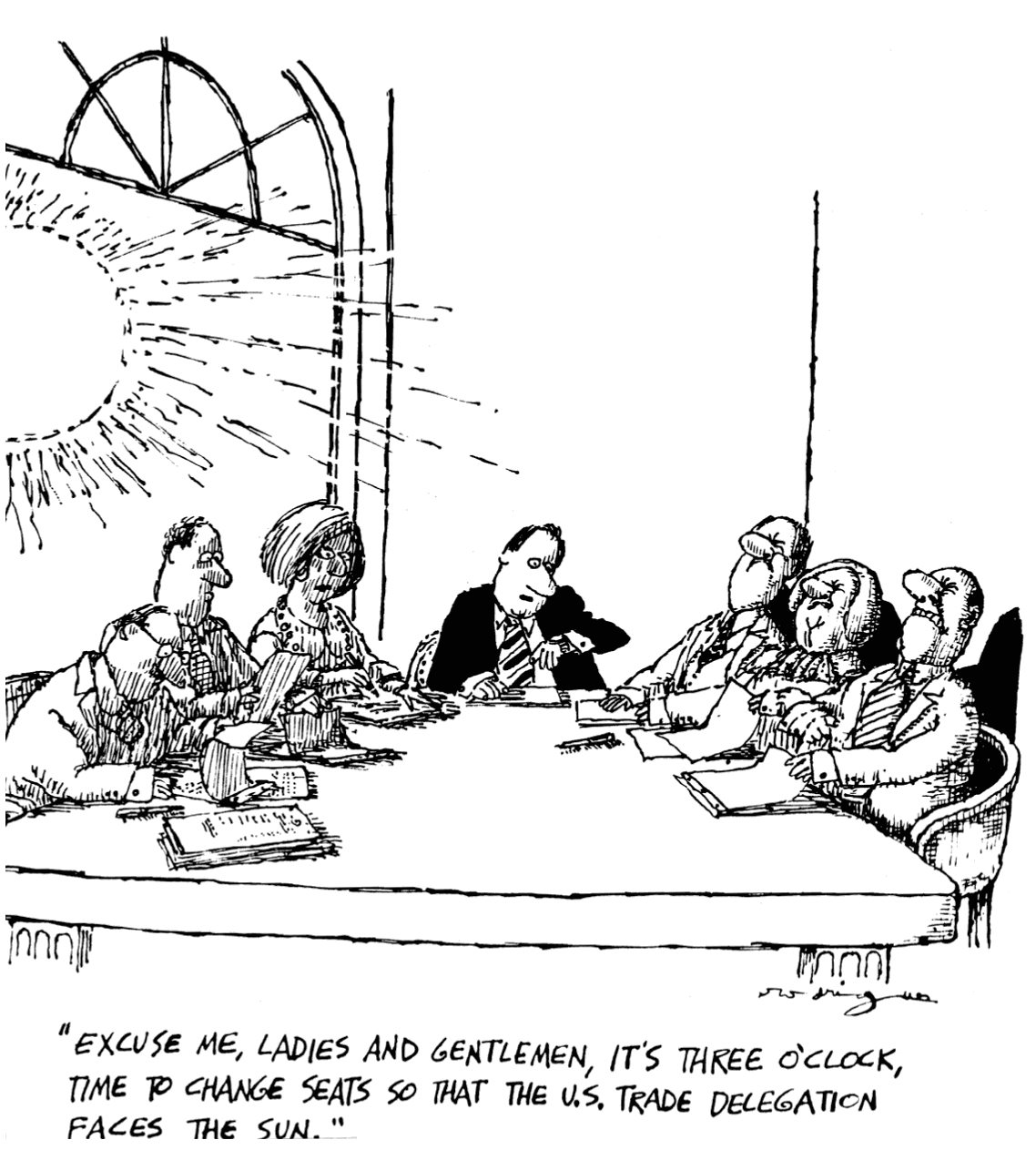
The practice of greatest concern to advocates of the level playing field in international trade is that of subsidizing exports. U.S. advocates of the level playing field, for example, have worried a lot in recent years about the cheap fish sent to their country from Canada. This is a result, they contend, of Canada’s unemployment insurance scheme, which pays people all winter for what is only a summer job. In the view of these U.S. worrywarts, this is only a thinly disguised form of subsidy for Canadian fishermen, one that harms their own maritime industry. For without this advantage, the fishing industry to our north would not be able to compete so efficiently. Therefore, U.S. trade negotiators have demanded a “level playing field,” on which the Canadian government does not help its citizens to compete “unfairly” against Americans.
In a superficial analysis, this point of view is reasonable. After all, there are specific losers—the New England fishermen—who suffer directly from Canadian unemployment insurance. But if we look a little deeper, we can see that insisting on a “level playing field” makes no economic sense at all. In order to prove this, let us not dwell on situations where Canadian bureaucrats pursue a policy which, in effect if not by intention, allows citizens of that country to sell products more cheaply to Americans than would otherwise be possible. Let us consider instead an extreme hypothetical case in which that government encourages or even compels its citizens to give away their goods to Americans free of charge!
For example, suppose that a law were passed tomorrow permanently subsidizing at the rate of one hundred, ten percent of all free gifts of lumber to the United States. That is, for every $100 worth of wood products Canadian citizens sent across the border at a zero price, the Canadian government would give those citizens $110. Pass lightly over the objection that this would bankrupt our northern neighbor in short order, and ask only what effect this would have on the economy of the United States.
Here, it is easy to see that although this policy would drive into bankruptcy the entire U.S. forest industry, in would be a boon to the U.S. economy as a whole. For now, the Americans could have just as much wood as before, compliments of Canada, while freeing up large numbers of workers and whatever capital could be transferred to other occupations. Our standard of living would therefore rise, with no additional inputs on our part. This is roughly how the war-torn economies of Europe were rebuilt after World War II, thanks to the generosity of Marshall Plan aid. If they wished to remain logically consistent, the Americans could hardly turn around now and refuse such aid, were it offered to them.
For this is all the “uneven” playing field consists of: an offer from one country to subsidize the economy of another. Instead of objecting to other nations pursuing such policies, each should encourage others to “tilt” the playing field in the direction of subsidizing exports. And yet, the conventional economic wisdom in North America holds the very opposite, i.e., that each nation should protest when its neighbors subsidize it.
Lunacy is not to be found only in the psychiatric wards. Nor, unfortunately, is it limited to the advocates of the level economic playing field. It is every bit as prevalent among economic nationalists, those who claim that free trade threatens the cultural identity, or, even worse, the political sovereignty of any nation that dares to embrace it. A while ago we heard much absurd talk of the Japanese “invasion” of North America—a reference to the sale of cars, stereo components, computers, and other goods within North America by Japanese companies. We have heard even more asinine assertions that the Japanese have belatedly taken our victory over their forces in World War II away from us, using economic, rather than military, means to do so.
But what about the arts? Under free trade, music and art and culture from other countries will come swooping in, it is charged, and will overcome the homegrown variety. Nonsense. It is silly to think that only homegrown art can express the culture of a nation. Mozart and Bach were not Americans. The Bible, the works of Shakespeare and Rembrandt were not composed in the Land of the Free, Home of the Brave.
Consider the following illustration of what economists call “absolute advantage.” We assume two years, two products and two countries. If there is no trade between the two countries, Canada will produce 500 units of maple syrup and 15 bananas for a GDP of 515 (we make the simplifying assumption that these two items can be added up). Costa Rica will grow 400 bananas and 25 maple syrup units for a GDP of 425.
| Table I: Absolute advantage | |||
|---|---|---|---|
| Maple Syrup | Bananas | GDP | |
| Canada | 500 | 15 | 515 |
| Costa Rica | 25 | 400 | 425 |
| No trade | 525 | 415 | 940 |
| Trade | 1,000 | 800 | 1,800 |
World GDP (consisting of just these two countries) will be 940, figured either as the total of all bananas (415) and all maple syrup buckets (525), or as the addition of the GDPs of these two countries (515 + 425). In the last line, we depict what happens when trade between these two nations opens up, and each spends both “years” on the product in which it has an absolute advantage. Canada doubles its annual production of 500 maple syrup bottles to 1,000, eschewing bananas entirely, and Costa Rica puts all its resources into bananas, ignoring the other product, and doubles its previous output of 400 to 800. World GDP rises from 940 to almost double, at 1,800. Surely, both countries are better off under such an arrangement; if not, they can always refuse to trade, and return to the economic autarky of the first iteration.
| Table II: Comparative Advantage | |||
|---|---|---|---|
| Wheat | TV Sets | GDP | |
| U.S. | 125 | 300 | 425 |
| Japan | 200 | 1,500 | 1,700 |
| No trade | 325 | 1,800 | 2,125 |
| Trade | 250 | 3,000 | 3,250 |
But suppose one nation is “better” at producing all products. Does the case for full free trade fall apart? It does not. In order to see this, we introduce the concept of comparative advantage, where one country is more efficient than another across the board. Again, we assume two “years,” two products and two countries. Only this time we endow one of these nations with an absolute advantage in both products. Here, the supermen from Japan can produce more wheat than we can in America and, also, more televisions! Let us go through the numbers. With no trade, U.S. GDP consists of 125 bushels of wheat and 300 televisions, for a total of 425 (again, we make the simplifying assumption that these apples and oranges can be meaningfully added up). Japan produces 200 wheat units and 1,500 televisions, for a GDP of 1,700. There are 325 bushels of wheat in existence at the end of the two-year period and 1,800 TV sets, for a world GDP of 2,125 = 325 wheats + 1,800 TVs, or a GDP of 425 in the U.S. and 1,700 in Japan.
Now, in the second round of analysis, again trade between the two occurs. This time, each country specializes in the item for which it has a comparative advantage (remember, Japan has an absolute advantage in both items, so this cannot be used to generate trade). So, who has a comparative advantage in what? Japan is five times better than us in television manufacture, but only 1.6 times better than its American counterparts in wheat. Or, to turn this around, the U.S. can produce 62.5% of the amount of wheat forthcoming from Japan, but only 20% of the TV sets. So, Japan has a comparative advantage in the electronic equipment, and the U.S. has a comparative advantage in farm goods. In the fourth line, we see the results of this sort of specialization. America pulls out of electronic manufacturing and throws all of its energies into farming. If we can produce 125 wheat units with half of our resources, we can attain 250 if we will focus on this product; Japan, too, can double its TV production from 1,500 to 3,000 sets if it focuses solely on that product. As a result of this trade between two very different countries, one “developed,” the other not, world GDP rises from 2,125 to 3,250, a gigantic increase attributable to this law of comparative advantage, discovered by David Ricardo in 1817. Would those modern politicians absorb this knowledge, which has been around some two centuries.
Consider one last numerical example of the benefits of trade, even between partners of very different circumstances. Here, we have a lawyer who can produce legal services at the rate of $1,000 per day, from which is generated $150 worth of secretarial services daily. If the lawyer works solo, he garners, after two days, $1,000 plus $150 for a total of $1,150. However, if the attorney obtains the help of a legal secretary, in the same two days he can earn $2,000 in court; and although he will have to pay his assistant $300 for the two days, he has still earned more than if he worked alone. When he subtracts $300 from the $2,000 he earned in court, he still has $1,700 left, which is more than the $1,150 he would have if he had worked alone at two occupations. Free trade benefits both parties, irrespective of their financial circumstances, QED.
| Table III: More comparative advantage | ||
|---|---|---|
| No Trade | ||
| Secretary | Lawyer | |
| Day 1 | 150 | 1,000 |
| Day 2 | 150 | 150 |
| Total | 300 | 1,150 |
| Trade | ||
| Secretary | Lawyer | |
| Day 1 | 150 | 1,000 |
| Day 2 | 150 | 1,000 |
| Total | 300 | 2,000 − 300 = 1,700 |

