
Defending the Undefendable II: Freedom in All Realms
17. The Sexist
17.
THE SEXIST
In the good old days, the idea of human rights was clear. We all had the right not to be murdered, not to be tortured, not to be raped, not to be kidnapped, not to be robbed, not to be trespassed upon, and not to be victimized by other crimes such as assault and battery, fraud, pickpocketing, and other such felonies. These were all negative rights; others had the obligation to refrain from violating our persons or properties.
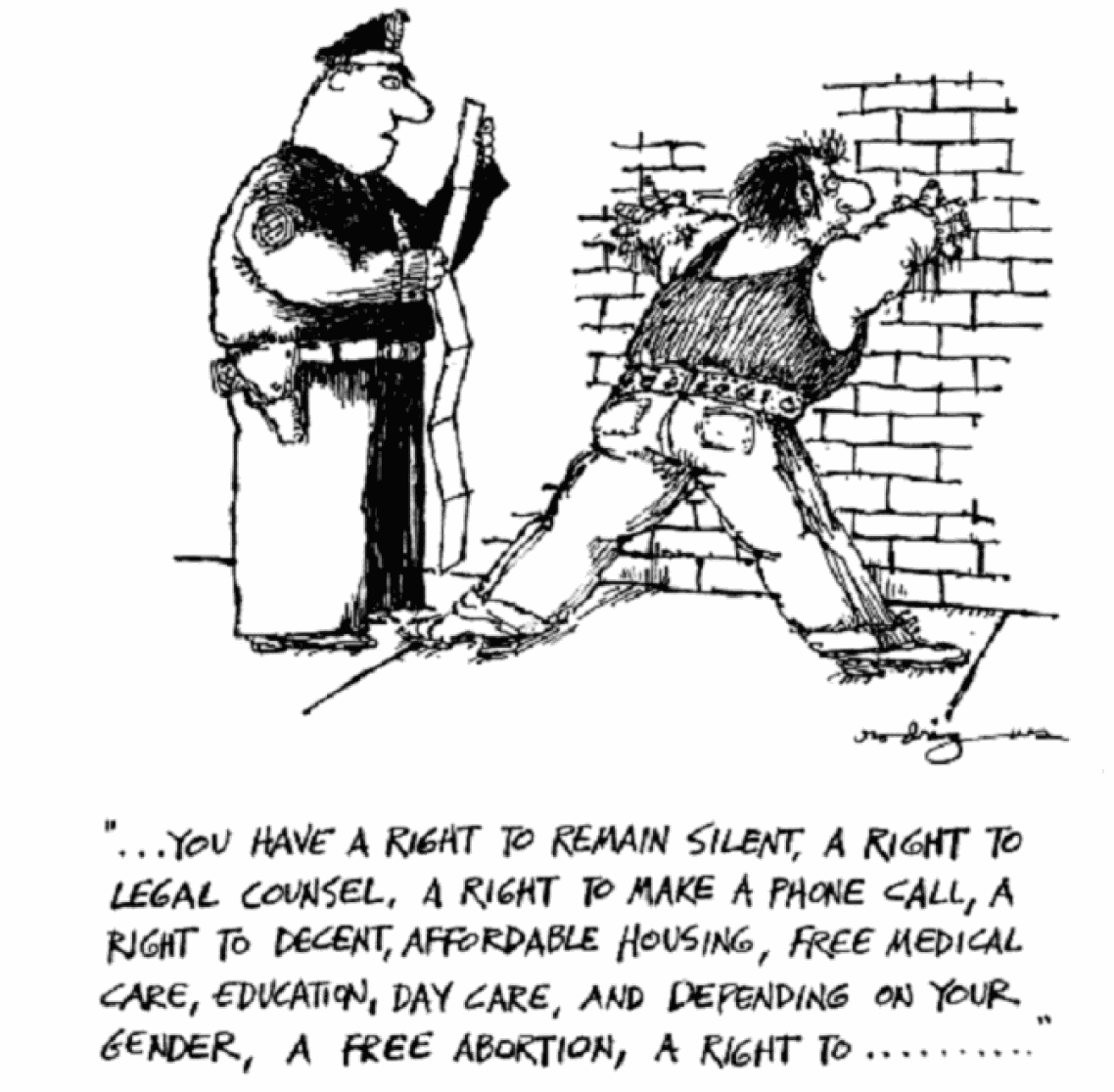
But nowadays, we are under the influence of the new so-called human rights philosophy. These activists have introduced an entirely new set of positive rights. According to this view, we now have a right to medical care, to decent housing, to adequate schooling and to a certain level of income. There are even “welfare rights” organizations organized to demand welfare payments from the rest of society, not as a form of charity, but as a “right.”
All of this new human rights blather really has nothing at all to do with rights. Instead, it is a fraudulent attempt to trade in on a widely respected concept—rights—and to try to smuggle in under this guise an entirely different and hidden agenda, that of egalitarianism or wealth redistribution. Let us consider how very different the two concepts are: the old view of negative rights and the new one concerning positive rights.
Under the old concept, people were asked only to refrain from certain antisocial and pernicious actions. They could not murder, rape or steal. Under the new concept, individuals are not asked to refrain from anything. Rather, they are forced to give of themselves, their time and their money, in order to make their own wealth available for the purposes of other people.
Another difference. If all of mankind were so inclined, it could, at one fell swoop, end all violations of negative rights. That is, through a sheer act of will, we could all resolve to end murder, rape, and theft, instantaneously. All it would take is a decision on the part of all of us. In contrast, no such thing is possible in the realm of positive rights. Even with the best will in the world, there is no possibility of ending the miserable, grinding poverty—most of which is brought about, I might add, by an excess of this egalitarian philosophy—in many of the countries of the Third World.
A third difference. If I have more of my positive rights met, you have less of yours met. If more money is spent for food for you, less remains to be spent for me. For positive rights are really a demand for wealth redistribution. In contrast, if less theft is perpetrated on me, it is not at all necessary that more be perpetrated on you. As we have seen, robbery can be reduced merely by an act of will. Similarly, if I have more free speech or more freedom to worship, you need not have less of these things.
A fourth. There is no reductio ad absurdum for negative rights. All their advocate has to do is refrain from invasions, uninvited border crossings. In contrast, the proponent of positive rights—who has more wealth than the average person on earth—has to explain why he has not voluntarily followed his own proscription and donated this “excess” amount to the poor. Presumably, the blind man who has no eyes would benefit from the receipt of this body part more than would the donor lose from such a transaction. And, yet, there are proponents of positive rights who have not made this transfer. So, the next time you see an egalitarian, look him straight in the eye. If he has two of them, he is a hypocrite.
When you hear anyone complaining about our vanishing human rights, ask yourself if they are talking about real (negative) rights violations or are they just unhappy that there are now fewer coerced transfers of wealth?
Whenever there is a discussion about reducing the power of a so called human rights commission, the trendy lefties typically unleash such sound and fury that you might be excused for thinking that Genghis Khan was now in charge of rights and liberties.
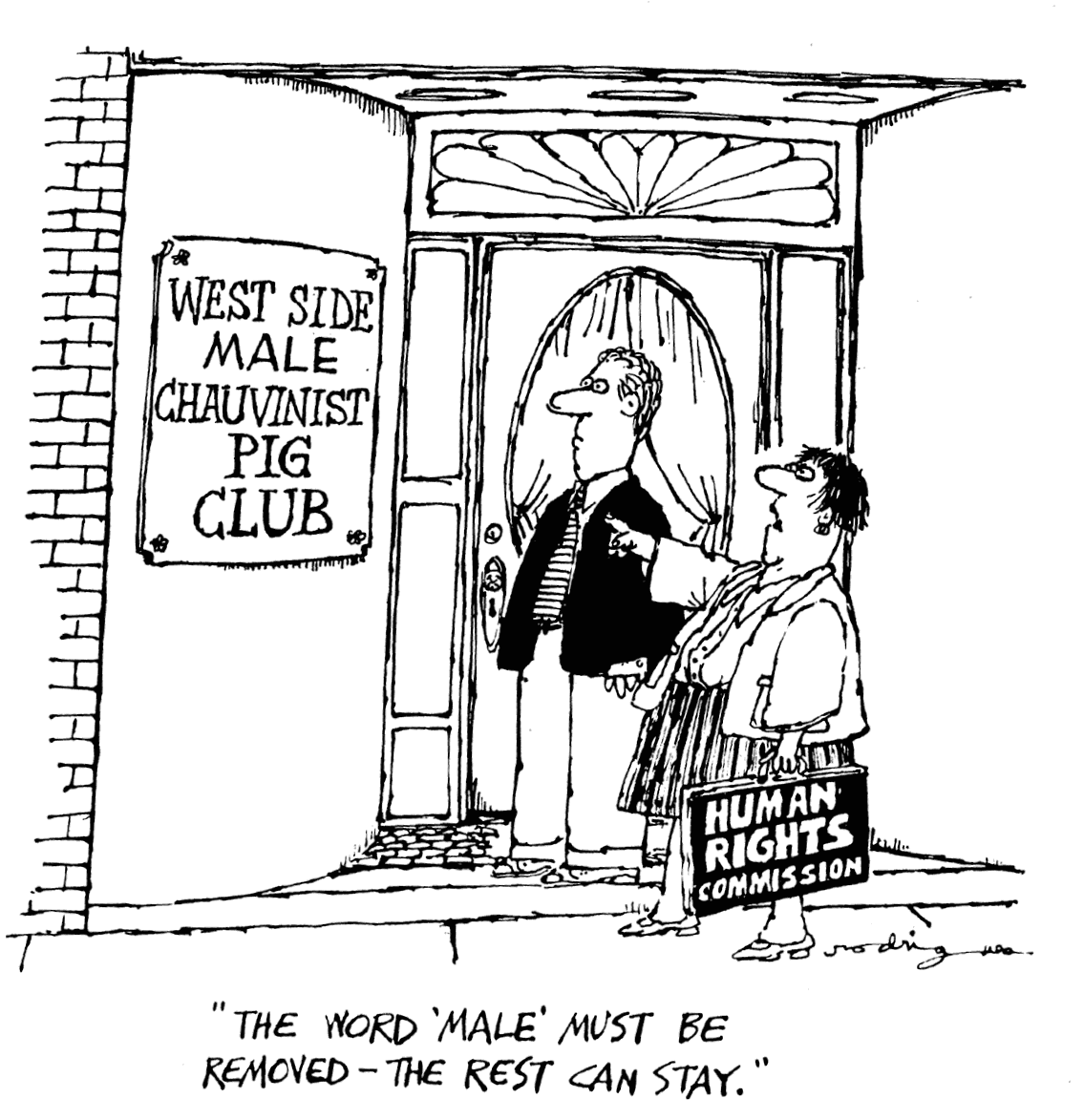
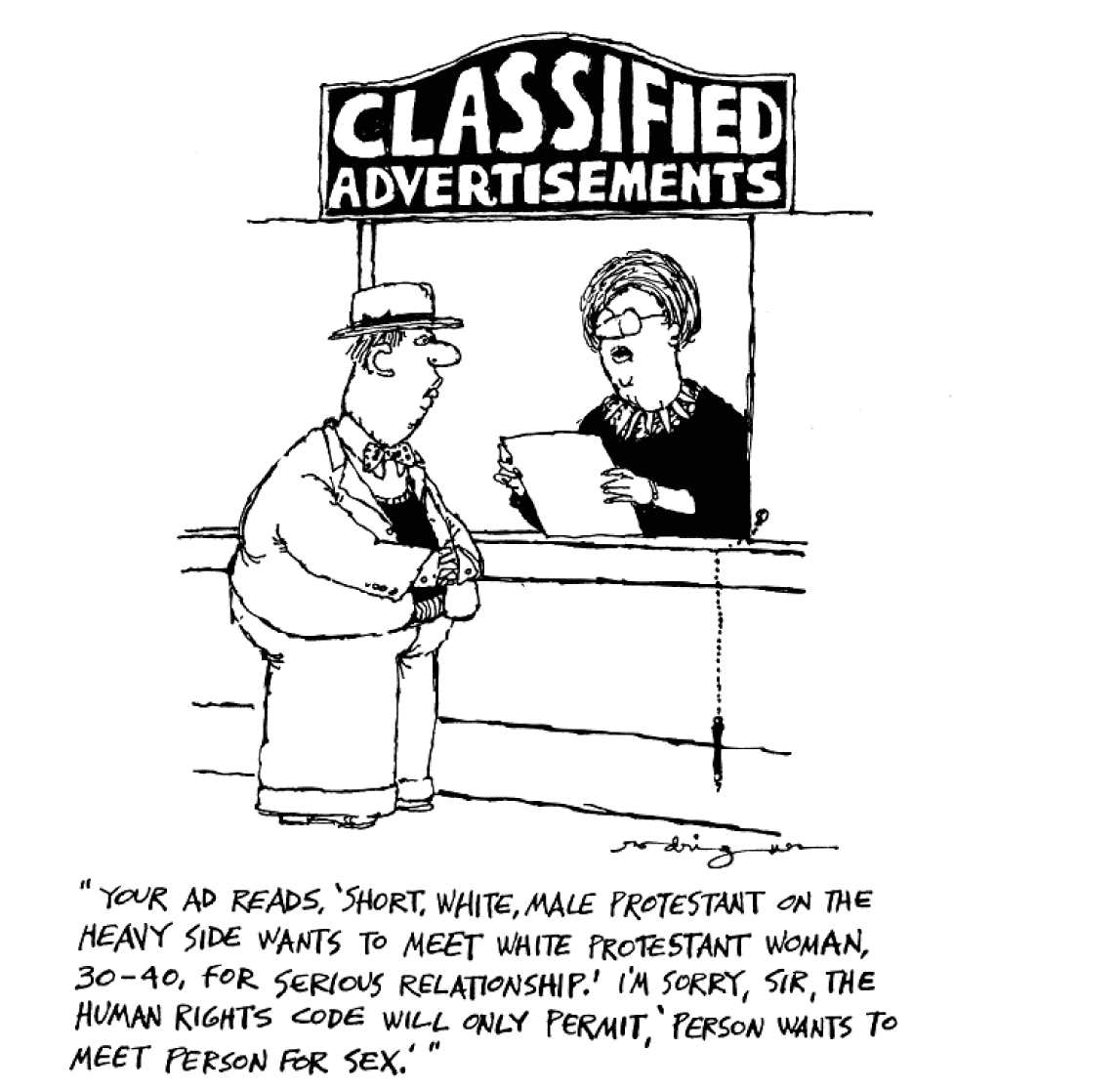
An example of this is the “human rights” industry’s refusal to allow an old lady to advertise for a “good Christian boarder,” on the grounds, presumably, that this discriminated against bad, non-Christian boarders. But doesn’t she have the right to choose anyone she wants as a boarder? What will be next: telling women who they have to befriend? Who they must marry? Another example, this one from Canada, is their hounding of one small Vancouver business, Hunky Bill’s Perogies, whose proprietor’s only “crime” was to insist on his right to name his own enterprise in any manner he chose. (It would appear that the name “Hunky” is offensive to some; well, if so, let them not patronize the establishment.) Moreover, these so called “human rights” boards refused to allow a private golf club to reserve the course for men only on one day per week. One commission even refused to allow a shop selling clothing for tall women to advertise for a tall female salesclerk. Presumably, this discriminates against salesclerks who are short and male. It is interesting to note, however, that no similar objection is typically made to feminist conferences—which prohibit attendance by men.
Feminists are hypocritical. They are sometimes intent, not in acting on behalf of a discrimination-free society, as one might expect, but in favor of a society segregated on the basis of gender. To wit, a female-only conference on the media, organized by groups ostensibly opposed to sexual segregation. But according to a conference organizer, men were excluded because a number of male journalists had already been interviewed on the subject of the media. Evidently, the male reporter who had tried to cover a weekend session, but was told to leave, was not one of those who had “already been interviewed.” According to a spokesman [sic!] for this event, this occurrence “was an attempt to include women rather than exclude men.” Put that in your pipe and smoke it, male chauvinist pigs of the world!
Nor did this bit of illogic exhaust the explanatory powers of the women’s movement. According to a managing editor of Herizons [sic], a women’s news magazine, the decision to exclude men was a form of affirmative action: “It’s really important that women catch up in this field, and of course the logical place to give them opportunity is at a women’s conference.”
Can anyone imagine what the response of the professional feminists, and all others in the “human rights” biz, would have been had a group of male Anglo-Saxon protestants used a similar line of argument to justify the exclusion of females, or homosexuals, or native peoples, or handicapped persons, or, indeed, any other group favored by current fashions?
The very use of the phrase “human rights” by these people is an outrageous presumption. These exercises in frivolity have as much to do with human rights as fish do with bicycles—to mention an aphorism beloved of the so called feminists. For people do have a human right to discriminate. Must the homosexual nightclub be forced to hire women? Must the lesbian restaurant or social club be forced to hire men? Must Chinese restaurants be forced to hire non-oriental cooks and waiters?
And what of Catholics, Orthodox Jews, and members of the Russian Orthodox Church? Their religious principles forbid the ordination of women. But this is incompatible with the human rights legislation which compels hiring irrespective of sex. It is the sheerest effrontery to link legislation denying these religious freedoms with “human rights.”
Heterosexuals are truly disgusting in that they discriminate against half the human race in terms of love-interest candidates. Male heterosexuals eliminate all men in this regard; female heterosexuals disregard all other members of the fairer sex. The same is true for the equally repulsive and discriminating homosexuals. They, too, are equally repulsive. Lesbians will not contemplate a romantic relationship with a man. Male homosexuals will not consider such with a woman. It is only the bisexual who passes muster as far as sexism is concerned. They are open to relationships with anyone. Thus, the case against sexism is really a not-so-hidden call for compulsory bisexuality, at least insofar as its advocates wish to write it into law. Of course, they, too, are despicable persons; bisexuals discriminate on the basis of “lookism,” sense of humor, intelligence, accomplishments and other such attributes. Where, oh where, are we to find even one fully honest man on the basis of this perverted criterion?

