
Defending the Undefendable II: Freedom in All Realms
4. Nuclear Energy
4.
NUCLEAR ENERGY
The deaths on April 20, 2010, pursuant to the explosion on British Petroleum’s Deepwater Horizon oil rig, were a great tragedy. The blast killed eleven employees, and unleashed hundreds of millions of gallons of oil into the Gulf of Mexico.
That human and environmental tragedy provides all the more reason to re-examine the widely publicized misgivings about nuclear energy foisted upon us by the “ecology” movement.
The Deepwater Horizon tragedy was not, unfortunately, the first energy-related accident to claim numerous lives. Rather, the non-nuclear energy field has been plagued with a series of similar disasters.
Other offshore oil drilling rig mass fatalities include:
- the deaths of eighty-four men with the sinking of the oil drilling rig Ocean Ranger off Newfoundland;
- the capsizing of the ten thousand-ton Alexander Kielland accommodation rig off Norway in the North Sea in March 1980, with the catastrophic loss of 123 lives;
- a November 1979 oil rig collapse during a storm in the Bohai Gulf off northeast China, which killed 72 workmen;
- a blowout in October 1980 of the U.S.-owned rig Tappmeyer off Saudi Arabia in which 18 people perished.
Coal mining, too, has been marred by numerous large-scale accidents, the world over:
- in Canada, the Nova Scotia coal mine “Springhill” was the site of a disaster that claimed 39 lives in 1956 and another 74 in 1958;
- in the U.S., roughly 300 coal miners die in the line of duty every year;
- in addition to cave-ins, coal miners have long been subject to the dreaded “black-lung” disease which has crippled many, and, directly or indirectly, killed many others.
If this past record looks bleak, the future bodes ill as well. Despite ever-improving technologies, as the quest for offshore oil continues apace into evermore inhospitable environments, the only rational expectation is for more of the same.
The same holds true for coal mining. If energy prices continue their recently interrupted upward path, one source of additional coal supplies may be to dig deeper—into increasingly more dangerous terrain. Strip-mining of coal nearer to the surface brings in its wake the risk of water runoffs and slides and other hazards—vociferously pointed out to us by the self-styled “ecologists.” And other alternative energy supplies come with dangers of their own. A hydroelectric dam eruption that drowned thousands of people in India is a chilling case in point.
What of nuclear power? Despite the widespread media-ted wailing and gnashing of teeth that accompanied the meltdown at Three Mile Island in Pennsylvania, the plain fact is that not a single solitary radiation-related death has occurred in the quarter century of commercial nuclear power generation. As the famous bumper sticker has it: “More people died at Chappaquiddick than at Three Mile Island.”
And yet the litany goes on. Protesters at nuclear power stations continually attempt to halt operations—and are accorded a respectful-to-fawning hearing by the nation’s press. Although trespassers on private property, the protesters are given credit for “morality” and “concern.”
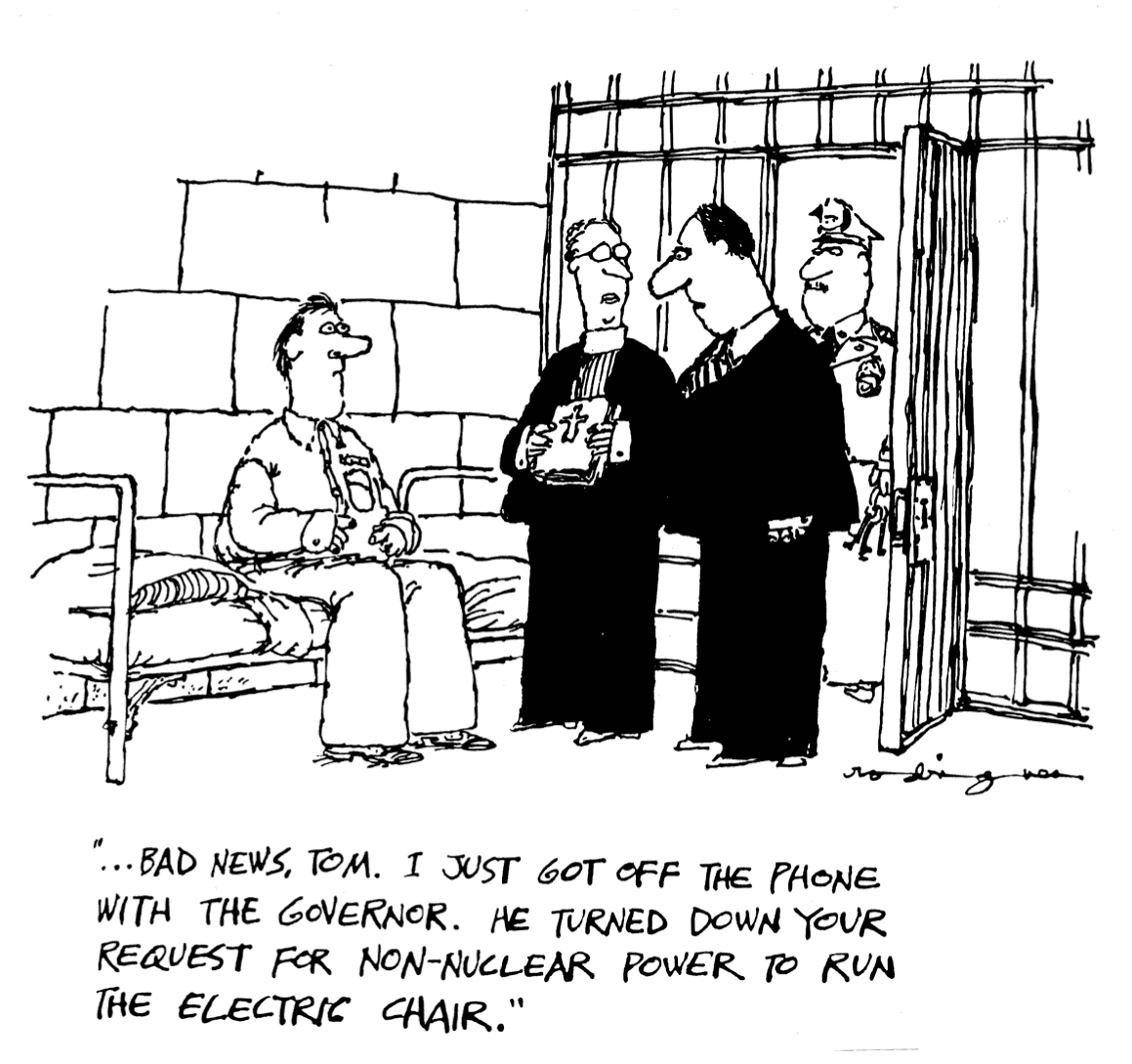
Now, this is not to say that the government should place its big fat thumb on the scale and tip the economy in the direction of nuclear power. Not at all. It should not have any dog in this fight; it should pick no favorites at all. In this regard, the Price-Anderson Act, which limits liability in the case of a mishap in this industry, should be repealed forthwith. If and to the extent that oil and coal are guilty of property rights violations in the form of trespassing smoke particles, this should be stopped. The libertarian response is thus one of fair competition. Allow all of the energy sources, oil, coal, nuclear, wind, solar, water, wind, etc., to compete with each other, without fear or favor. And let the market decide which ones, and in what proportions, will best serve mankind. That is the way we do things, roughly, with fruits and vegetables, or, at least, the way we should manage these competing foodstuffs (don’t remind me of sugar subsidies, taxes on beer, regulations of “fatty” foods, etc.).
Why not for energy sources too?

