
Defending the Undefendable II: Freedom in All Realms
10. The Automator
10.
THE AUTOMATOR
It’s called many things—artificial intelligence, the microdot electronic revolution, the Age of Robotics.
Whatever the name, it can perform numerous and amazing tasks. Modern computers, coupled with silicon chip-based integrated circuits, can now diagnose lung diseases, locate mineral deposits, play chess at better than a grandmaster level, cut logs, assemble autos, and do other industrial tasks far more efficiently than human beings.
These electronic servants, moreover, work twenty-four hours a day, seven days a week, fifty-two weeks a year, with no time off for coffee breaks, holidays or gossip. They never call in sick or talk back to the boss (unless programmed to do so); nor do they file legal grievances against their employers.
Wondrous and marvelous as these accomplishments are, there is, according to some, quite a large worm in the apple. The complaints are numerous:
- Millions of clerical, sales, and service workers—in banking, insurance, and general business offices—have lost their jobs to automatic word processors and related office automation.
- When a steel corporation opens a fully automated plant, it can produce the same amount of output with fifty percent of the workers used in an older type of operation.
- New robots will take more of the places of humans on automobile assembly lines; the Japanese are the worst offenders in this regard; they are already up to a fifth generation of such artificially intelligent machines.
- There have been widespread claims that the new automation has increased the degree of anomie suffered by the human beings who work alongside it. Complaints include failing morale, depersonalization, and alienation from the workplace.
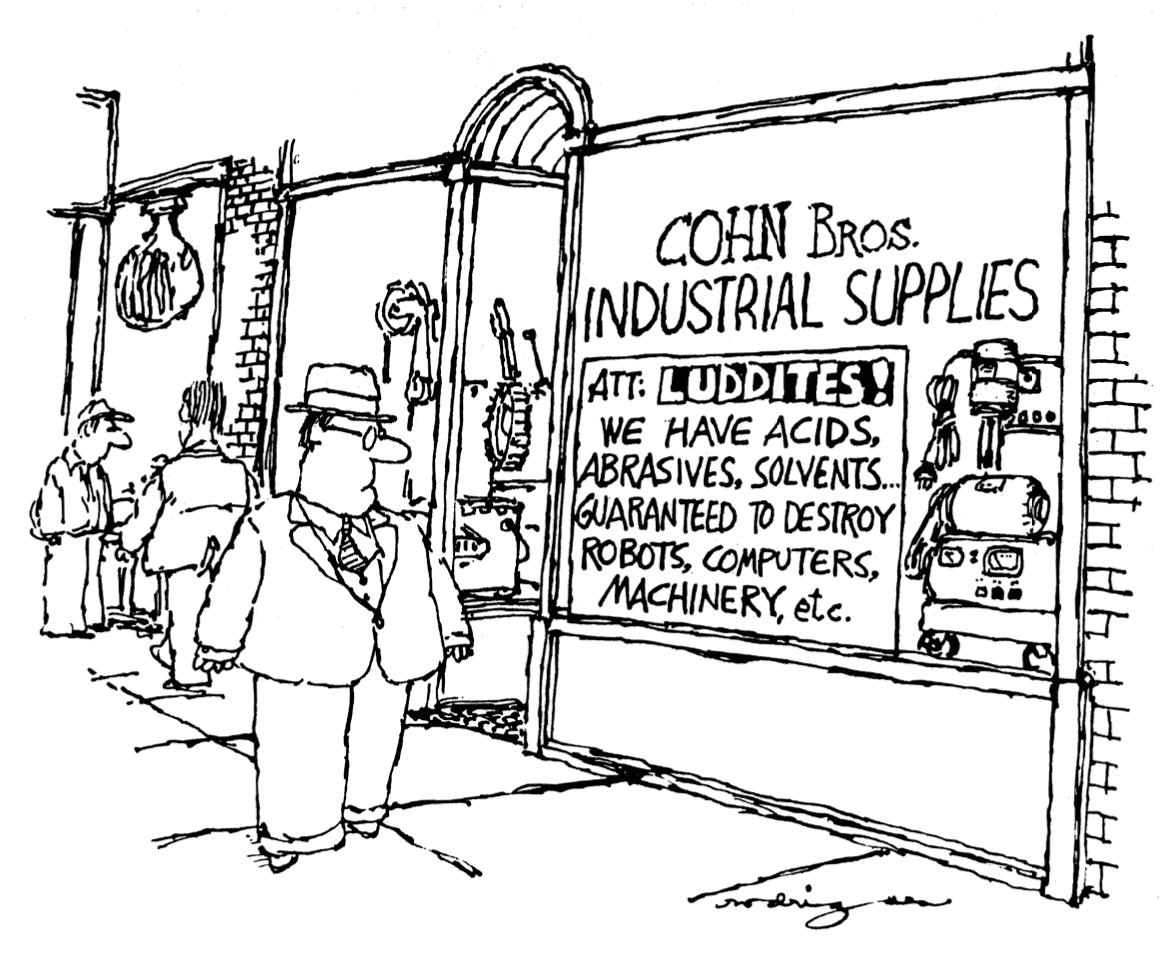
Based on these and other horror stories, a reaction to the new generation of computers has set in. In addition to growth restrictions, there is a threatened technological moratorium in the offing. Worse, a new generation of Luddites (the original Luddites were the people in the eighteenth century who burned newly invented knitting looms out of fear for their jobs) stands ready to fight the artificially intelligent computers—with sabotage.
Given this specter, a more measured response would appear to be indicated. We must realize that as long as there are unmet needs and people willing to work to attain these ends, there will be new positions created. From the vantage point of our agricultural economy of 200 years ago, it would have been impossible to predict precisely what kinds of jobs would come into existence today. In like manner, we cannot now predict which occupations will arise to take the place of those shown to be unnecessary by the new computer revolution.
However, we know that they will be created, and we know why. If a robot, at both minimal outlay and subsequent maintenance cost, is really able to replace a thousand workers (to take the “worst” possible scenario), then some truly monumental results will ensue, and each of them will create new employment opportunities.
In the first instance, immense profits will be earned by such companies. Their shareholders (and/or private owners) will either spend or save their newfound wealth. Spending will boost other industry, while saving will drive down interest rates (naturally, that is; not by the central planning Federal Reserve), creating new loan opportunities and new employment.
But such profit levels cannot long endure. In a reasonably free market system, new entrants will swarm in, to take advantage of the greater than ordinary returns. By purchasing additional robotic factors of production (and hence raising their prices), and by selling more such products at lower prices, profit levels will soon be dissipated. The former will encourage more employment in robot production, and the latter will enable consumers to purchase yet even more with a given dollar, thus again raising their standard of living. This will lead to still more employment in those areas where the new purchasing power is spent.
It was through a process such as this that large employment shifts took place in the past, amid the same hysterical worry. There is no doubt that it will continue to work in the same way. It was once feared that automatic spinning mills would permanently unemploy the entire hand-weaving industry. Instead, the results were cheaper clothing and more jobs in cloth making. First-generation computers were supposed to create a permanent “army of the unemployed” among office workers. Instead, companies like IBM, Microsoft, Google, and Yahoo have created millions of jobs throughout the economy, with lower prices and higher standards of living to boot.
No less will be true of the new artificial intelligence revolution. The worm in the apple will not be a cold, faceless computer-robot, taking the bread away from the workers’ tables. Instead it will be modern Luddites who once again threaten progress.
The Luddites are continually engaging in destruction, hooliganism, and vandalism against any and all introductions of automatic equipment, ranging from automated shuttles at airports to Light Rapid Transit that runs without benefit of (live) conductors on board. Part of this is motivated by the fact that these machines cannot join unions. But a greater part of these nefarious activities is engendered by peoples’ fear that this machinery will supplant human effort. After all, goes their “reasoning,” if robots do the work, what will remain for people to do?
The original Luddite, one Ned Ludd, went on the first such Luddite rampage, burning knitting looms because they enabled one person to do the work of twenty. Ludd was entirely well-intentioned. Who, after all, wants to see nineteen people unemployed, even if the twentieth can thereby increase his productivity to match the entire group working with inferior technology? This would be no less than a tragedy—economically, morally, spiritually, and socially.
In like manner, the philosophy underlying more modern vandalism may well have been benevolent in origin, even if its methods left something to be desired. Those behind the destruction may have feared that unemployment rates would rise, at least compared to the situation in which each train or shuttle had a human driver. In this view, these machines had supplanted several hundred job slots, the number of train engineers who might otherwise have been used.
But a moment’s reflection will convince us that an automated system has not lost us these jobs, nor any other jobs. First of all, additional employees, skilled at computer technology, were needed to construct the equipment at the outset. Secondly, there are the salaries for human motormen that will not be paid. These monies can be used instead for other purposes: for creating still more “robots,” in order to accomplish new and additional tasks which would have been impossible to finance, or for extra consumption of already existing goods. Whichever of these options is chosen, it will mean increased employment in these other fields.
But the core myth here is the assumption that there is only so much work to be done in the world. Sometimes called the “lump of labor” fallacy, this economic view holds that the people of the world only require a limited amount of labor on their behalf. When this amount is surpassed, there will be no more work to be done, and hence, there will be no more jobs for the workers. In this perspective, making sure that automatic equipment is not employed is of overriding importance. For if these machines do too much, they will ruin things for everyone; there will be exactly that amount no longer available for people to do. By “hogging up” the limited amount of work which exists, they leave too little for human beings. It is as if the amount of work that can be done resembles a pie of a fixed size. If robots are allowed to seize some of it, we Homo sapiens will have to make do with less.
If this economic view of the world were correct, there might indeed be something to be said for the philosophy of vandalism. At least, there would be some justification for insisting that automatic machines not be put into operation.
However, there is as much work to be done as there are unfulfilled desires. Since human wants are, for all practical purposes, limitless, the amount of work to be done is also without end. Therefore, no matter how much work the robot completes, it cannot possibly exhaust or even make any kind of dent in the amount of work to be done, let alone an appreciable one.
If it does not “take work away from people” (because there is a limitless amount of work to be done), what effect does computer technology have? It increases production. Because of the efforts of the robots, the size of the pie increases—the pie that will then be shared among all those human beings who took part in its production or who benefit from its use.
Consider in this regard the plight of a family shipwrecked in the tropics. When the Swiss Family Robinson sought refuge on an island, their store of belongings consisted only of what was salvaged from the ship. The meager supply of capital goods, plus their own laboring ability, determined whether—and how well—they survived. Any Swiss Family Robinson faces an unending list of desires, while the means at their disposal for the satisfaction of these desires is extremely limited.
If we suppose that all the members of the family set to work with the material resources at their disposal, we will find that they can satisfy only some of their desires.
What would be the effect of having a robot at their disposal in such a situation? Suppose that, with the aid of technology, the family becomes able to produce twice as much per day as before. Will this be the ruination of the family? Will it “take work away” from the other family members, and wreak havoc upon the mini-society they have created?
It is obvious that this will not be the outcome. On the contrary, the machinery will be seen as the benefit it is, since there is no danger that the increased productivity it brings about will cause the family to run out of work to do.
If the new technology can produce ten extra units of transportation services, it may become possible for other members of the family to be relieved of such chores. New jobs will be assigned to them. Clearly, the end result will be greater satisfaction for the family. In like manner, because of robotics, society as a whole will move toward greater satisfaction and prosperity.
Thus the reasoning underlying the philosophy of vandalism is flawed. There are indeed problems with a government initiative which utilizes automation for mass transit, but the lack of human motormen is not one of them.
Still, the vandals who damage modern machinery are far from alone in their thinking. I recently looked down at my morning newspaper and saw a headline in bold black letters: “Women Battle Robots.” “What’s this?” I said to myself. “Have robots landed from outer space, and are they attacking our womenfolk?” Greatly concerned, I turned to read the newspaper account. I am happy to report that all the brouhaha was just a false alarm. No extra-terrestrial robots had been burning, pillaging, and raping. Rather, the newspaper story was about the introduction of new fish-cleaning machinery by a local fish processing company. The union was vociferously protesting the introduction of new automated equipment. And since most of the fish washers in the union are women, this accounted for the rather hysterical headline.
At first glance, these unionized women seem to have had a case. After all, many of their jobs were being made obsolete by robots that can clean fish faster and more cheaply than they. But, of course, there were benefits as well, although these particular women only participated in them in their role as consumers. With lower costs in the industry, the savings will either lead to greater profits or be passed on to the ultimate buyers of fish in the form of decreased prices. But extra profits mean more jobs—as this money will tend to be invested—and decreased prices will encourage consumers to buy more fish, also potentially creating additional employment.
As a matter of fact, the union undoubtedly owes many of its present jobs to past introductions of more efficient technology. After all, if fish were still caught by dangling a worm at the end of a string off the end of a dock, there would be precious few jobs in the fish processing industry—and precious little fish to feed the world’s hungry populations.
But science-fiction writer Isaac Asimov saw the truth half a century ago, in the famous I, Robot stories which have recently been adapted to film: robots are a blessing to humankind, not a menace. If politicians really have the interests of the consuming public in mind, they will adopt a laissez-faire policy in this matter.

