
Defending the Undefendable II: Freedom in All Realms
12. The Human-Organ Merchant
12.
THE HUMAN-ORGAN MERCHANT
In the days of yore, there was no crisis in spare body parts. Organ transplants were an utter impossibility, the stuff of science fiction. Only Dr. Frankenstein and his literary ilk had any need for live organs.
But nowadays, thanks to the magnificent discoveries and new techniques of modern medicine, these possibilities are upon us. At present it is possible to transplant hearts, kidneys, livers, eyes, corneas, blood, bone marrow, and many other body parts. People who would have been consigned to death, or lingering, tenuous, and painful lives only a few short years ago can now avail themselves of these medical miracles and lead healthy, happy, productive lives.
All is not well, however, on the transplant front. Instead of being the occasion for unrelieved rejoicing, these new breakthroughs have brought in their train a whole host of problems.
First of all, there is a shortage of body organs suitable for transplant. Disease makes some of what is available unusable, along with incompatibility because of incompatible recipients’ blood types.
This has led to a set of problems that has strained what passes for medical ethics in this country to the breaking point. For, given the limited supply of body parts, our doctors have had to pick and choose—on no criteria other than their own arbitrary whims—which of the many needy recipients shall have this life-giving aid, and which of them shall be denied. To this end, they place smokers, old people, and others less likely to benefit most from these operations at the end of the queue. In no other commercial setting, does anything like this occur. For example, the purveyors of groceries, automobiles, and books do not make such invidious distinctions between those more or less likely to gain advantage from their products.
The difficulty here is that our legal-economic system has not kept up with advancing medical technology. The law has prohibited people from using the property rights we each have in our own bodies. Specifically, it has banned trade, or a marketplace, in blood, bone marrow, and other live spare body parts.
I maintain that deregulation of this market is the solution to the transplant problem. But before I explain how free enterprise would work in this connection, let me lay a few fears to rest.
Yes, it is gory, disgusting, and very uncomfortable to discuss allowing profit incentives to work in this field. The very idea involves images of grave robbers, Frankenstein monsters, and gangs of “organ thieves” stealing people’s hearts, livers, and kidneys in the manner described in several novels by Robin Cook. It seems cruel and unfeeling to discuss the market for used body parts in much the same manner we might use to describe the used-car market. But this is only because in our present society, while we can appreciate the miracles of modern medicine without necessarily comprehending them, we have such a poor understanding of the miracles of the marketplace that we cannot even begin to appreciate them. So let us sit back, relax, and calmly and dispassionately consider this idea on its own merits, all preconceptions and biases to one side. Let our only criteria be not our prejudice, unjustified in this case, but our assessment of whether this idea will really increase the number of donors, save lives and free doctors from the onerous decision of picking which needy people will be saved and which consigned to a lingering and painful death.
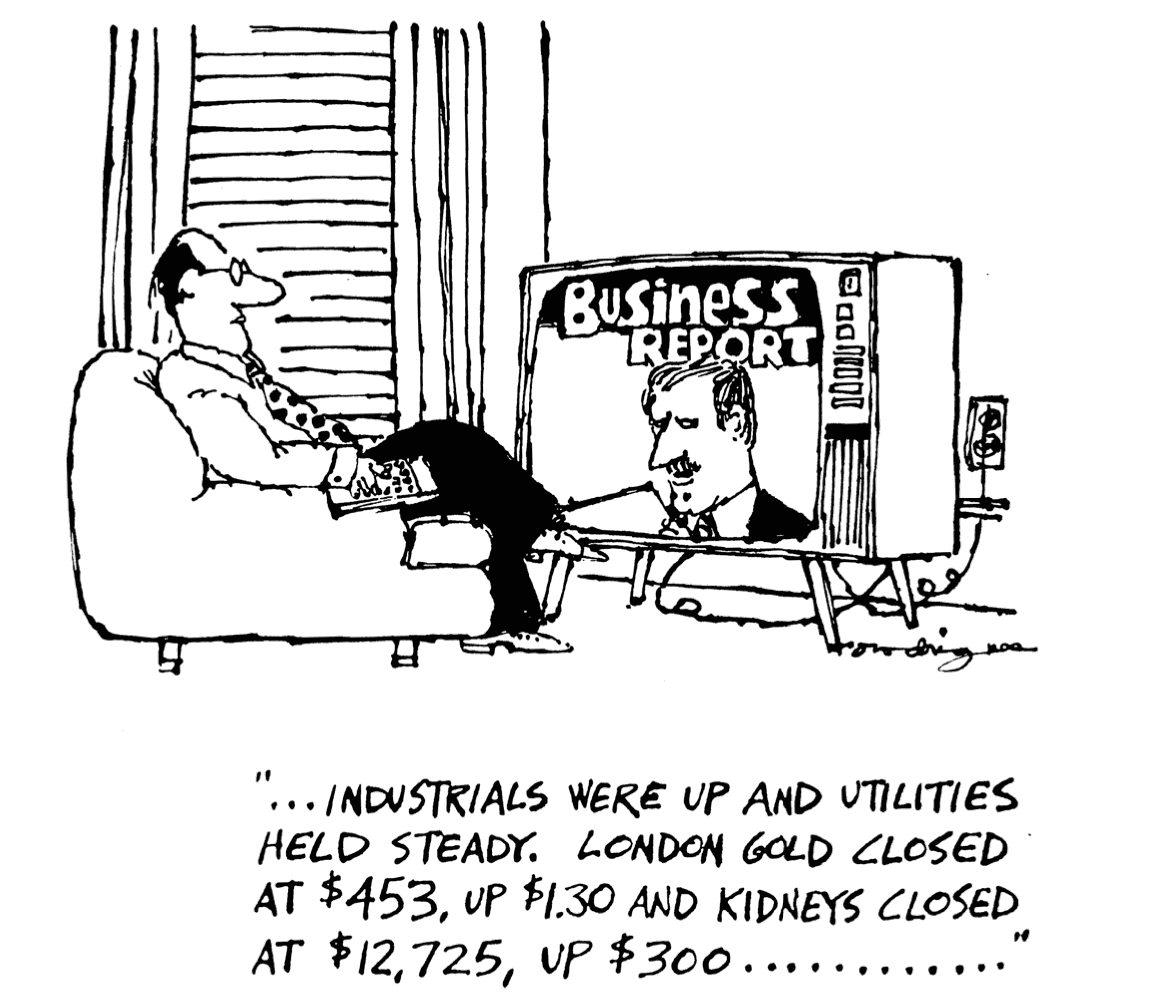
As any first year student in economics can tell you, whenever a good is in short supply, its price is too low. And the case of human organs is no exception. On the contrary, it is a paradigm case of this phenomenon. For our laws on this question, by prohibiting a marketplace from developing, have effectively imposed a zero price on these items.
But at a zero price, it should come as no surprise that the demand should vastly outstrip the supply. This, after all, is one of the most basic laws in all of economics. If the price were allowed to rise to its market clearing level, there might not be too great a change in the number of used body parts demanded. This is called by economists, “inelastic demand.” All it means is that if you need a blood, bone marrow or organ transplant at all, price, no matter how high (within limits, of course), is not likely to deter you. No. The main effect of a free market in used body parts and fluids will be on the amount supplied.
How would such a marketplace actually work?
It is never possible to fully anticipate the functioning of an industry now prohibited by government edict. However, a few general principles become clear upon consideration.
We know that the major source of preferred organ donations will be young, healthy people who are cut down in the prime of life—by traffic accident, murder, war, heart attack, or in myriad other ways that leave their organs intact and reusable.
Were the industry to be legalized, new firms would spring up. Or perhaps, insurance companies or hospitals would expand their existing bases of operation. These firms would offer thousands of dollars to people who met the appropriate medical criteria and who would agree that, upon their demise, certain of their bodily organs would be owned by the businesses in question. Then they would turn around and sell these organs, at a profit, to people in need of transplants. In addition, these new firms would operate, as at present, to try to obtain consent from the relatives of newly deceased persons for use of their organs. Only now, under economic freedom, these firms would be in a position to offer cash incentives—as well as the chance to save another human life. In the case of blood, the Red Cross does, of course, pay for its supply. But its prices are too low, as shown by the fact that only insufficient quantities are brought forth. As well, it has failed to adopt a policy of differential prices to reflect the relative shortages of the various types of items needed. And there is no reason to believe that these private companies would not be able to increase the supply of this factor in accord with demand. Entrepreneurs in every other field of endeavor—some mundane, some exotic—have been able to accomplish this task with no fuss or fanfare.
Similarly, entrepreneurs in the human-organ business would be able to vastly increase the supply of donor organs. Certainly, many people all over the world would be happy to take advantage of the opportunity to cash in, while still alive, on the use of their vital organs after they had passed away. No one who objected—on religious grounds, for example—would have to cooperate with the venture. As a result, no longer would potential recipients have to make do without transplants. We need not even fear that those who engaged in this practice would earn “exorbitant” profits. For any such tendency would call forth new entrants into the field who would act so as to increase supply even further and reduce profits to levels which could be earned elsewhere.
There are hundreds, even thousands of people whose lives could be vastly improved today if they could but have the use of a healthy kidney. There are thousands of other people who die each year, taking perfectly healthy kidneys to the grave with them, who have no financial incentive at all to bequeath those organs to people in need. Why couldn’t potential donors be given a pecuniary reward for doing the right thing?
Instead, our society must resort to all sorts of inefficient stratagems in an effort to get the transplantable organs to those who need them. Famous personages exhort us, in the event that we suffer untimely death, to make a posthumous gift of our kidneys. Medical schools coach their students on the best techniques for approaching next-of-kin; the difficulty is that they must ask permission at the precise time when they are least likely to be given it—upon the sudden demise of a loved one.
As a result, all of this has been to little avail. While potential recipients languish on painful kidney-dialysis machines, waiting ghoulishly for a traffic fatality that might spell life for them, the public refuses to sign cards in sufficient numbers giving permission for automatic posthumous donation of their kidneys. Things have even come to such a pass that there are grotesque and fascistic plans now being bruited about which would allow the government to seize the kidneys of accident victims unless they have signed cards denying permission for such seizure. The idea here is that if someone hasn’t specifically demanded that he keep his property, then we can take it from him. But this justifies mugging, rape, theft, if the victim is too afraid to protest. When the state employs this vicious doctrine, there is also the implicit threat that government will turn against anyone who signs off from this list of “willing” donors. Critics of statist tyranny have often claimed that they are treated as if they are slaves of this institution. Seldom has any policy come closer to embodying this fear. This policy is predicated on the assumption that all organs (people?) really belong to the state.
The free enterprise system, were it allowed to operate in this instance, would be a Godsend to the unfortunate who suffer from diseased kidneys. A legal marketplace could encourage thousands of donors. Given free enterprise incentives, we would be—pardon the pun—up to our armpits in kidneys.
This is the tried and true process we rely upon to bring us all the other necessities of life: food, clothing, and shelter. We do not depend upon voluntary donations for the provision of these goods and services.
Neither do we depend upon black markets to provide us with food, clothing, and shelter. But under present circumstances, when voluntary donations prove inadequate, we do have to depend upon illegal sales for transplantable organs. According to some estimates, the black market value of a transplantable kidney is between $50,000 and $100,000—worth much more than its weight in gold.
The question is, is such an underground body-parts supplier a benefit or a detriment? One argument for the latter view is that the black marketeer, if successful, will tend to undermine respect for law and order. He is, after all, thumbing his nose at the duly constituted authorities, who have so far remained adamant in declaring such “ghoulish” sales and purchases illegal. As against that, it could be argued that any legal code which, in effect if not by intention, consigns innocent individuals to death or to lives of misery on kidney-dialysis machines richly deserves to be ignored.
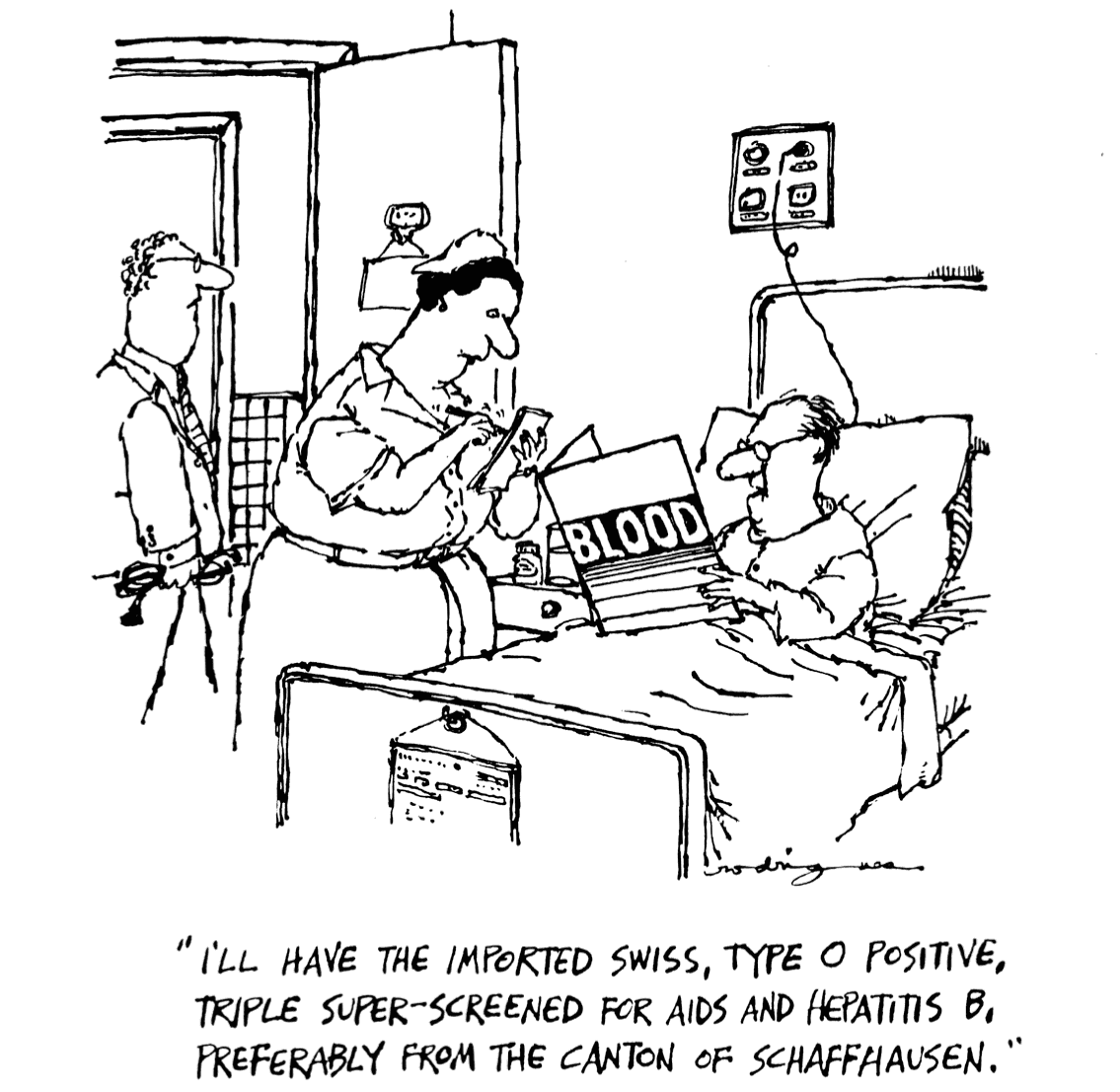
But one point is clear. Our black market “ghoul” benefits organ donors by offering them financial remuneration as well as the satisfaction of knowing that the organs they may donate upon their demise will enable others to live. By doing this, he will also, as we have seen, increase the number of organs available, and this will be of inestimable benefit to those who might otherwise have been forced to go without.
Let’s allow free enterprise to work in the field of blood, bone marrow, and transplantable organs and save us all a lot of pain, sorrow, suffering, and tragedy.
One objection to the foregoing is that if we allowed market prices for these commodities, organ thieves would arise. They would steal into our bedrooms in the dead of night and seize our livers, lungs, hearts, etc. This objection is based upon economic illiteracy, however. The payoff to and therefore the temptation for such body snatching will depend upon the price of the goods in question. But, the present black market price of these body parts is much higher than would be the free market price. Why so? Because while demand would stay the same, the supply of the organs would be greater in a regime of economic freedom. Thus, if there is any danger of these ghoulish goings-on, it is right now, with a price control of zero. That is to say, the risk of body snatching would be lower in a regime of economic freedom than at present.
Let me conclude this chapter with the only argument I have ever been able to uncover in favor of the present vicious system. (They don’t call me Walter “Fair and Balanced” Block for nothing, you know.) It is this: the extant prohibition of a free market in human organs creates great drama for movies and television. Will the cute little boy get his heart transplant before he dies or not? Will the potential recipient be able to stop smoking, so that the nanny state doctors will give him a new liver? Without price controls of zero, these occurrences will be part and parcel of our medieval system. Playwrights will have one less source of drama.

