
Defending the Undefendable II: Freedom in All Realms
22. The War Toy Manufacturer
22.
THE WAR TOY MANUFACTURER
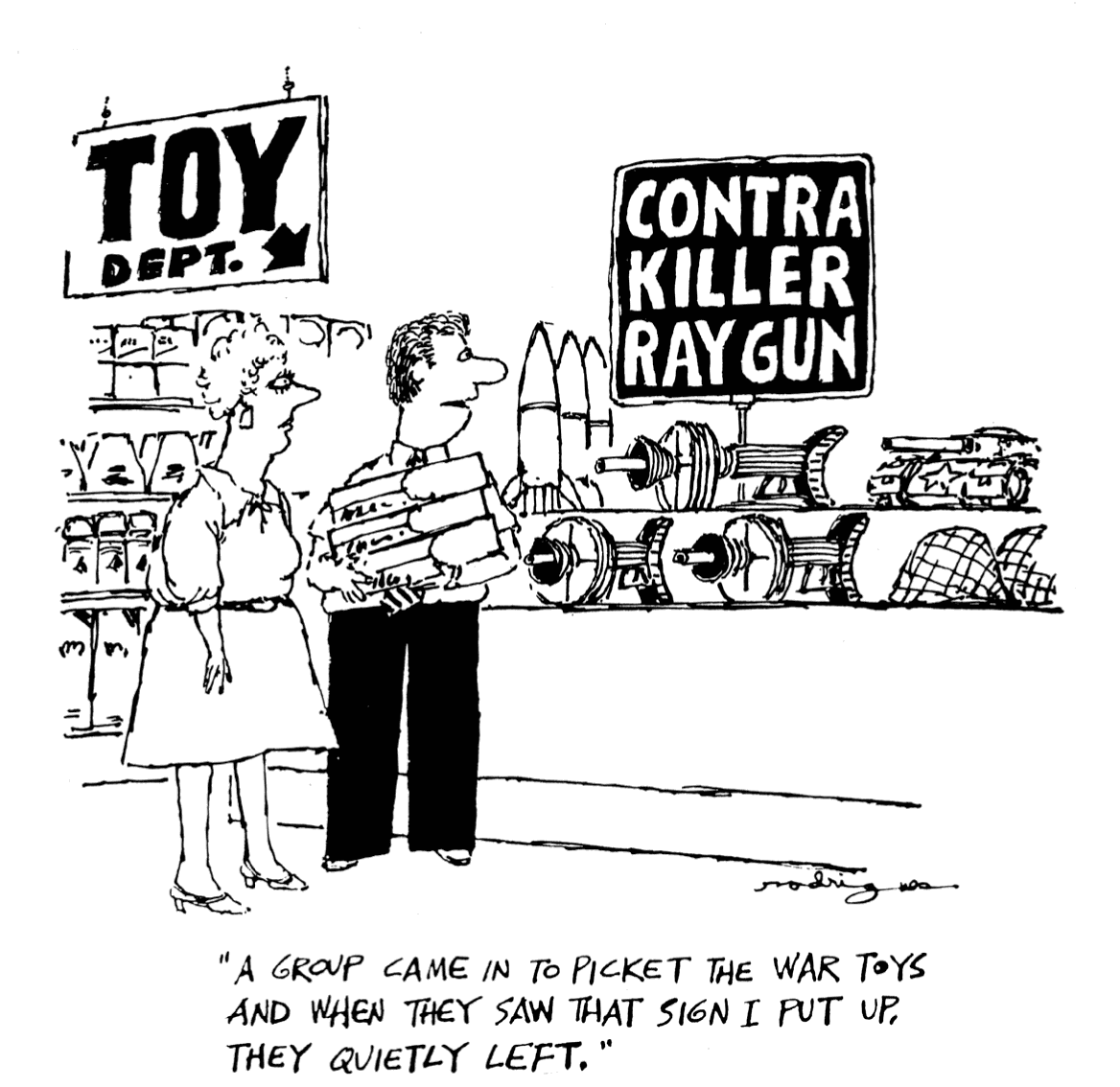
What do some peace groups, religious organizations, feminists, and child care experts have in common? They are up in arms (pardon the pun) against war toys.
The Council of Churches has published a brochure urging the creation of “war-toy-free zones.” The Mennonite Central Committee has organized a letter-writing campaign to protest against firms manufacturing these playthings. The Voice of Women and the Alliance for Non-Violent Action have attempted to organize a consumer boycott of war toys. Parents for Peace conducts study groups on the topic of war toys, publishes a list of alternative toys, and creates strategies for parents whose children demand war toys instead of the recommended alternatives. Child care expert Benjamin Spock, author of Baby and Child Care, which has sold more than thirty million copies since 1946, was a leader of this protest as well. In his view, “when we buy (children) machine guns and bombs and helmets and encourage them to play war, we are saying to them that war is all right.” The Alliance for Non-Violent Action, in addition to conducting a boycott of the non-toy products of war toy manufacturers, has initiated the first International Day Against War Toys complete with vigils, leaflets, and a door-to-door campaign. In the most bizarre incident of all, the top editors of the magnificent libertarian website antiwar.com, railed against J. C. Penney for daring to market a war toy called Forward Command Post. (See http://www.antiwar.com/comment/jcpenney.html and http://www.antiwar.com/justin/j122502.html.) These critics make the point that Forward Command Post (FCP) depicts a middle-class home in the U.S., not a foreign country, and that seems “sinister” to them. Well, maybe it is; I respect the radar of these writers. But, this game is for five year olds. It is greatly to be doubted that any of these tykes would see the FCP scenario in the very sophisticated manner of the antiwar.com analysts.
Whatever the merits of their case, it is clear that these groups and individuals have their work cut out for them. No longer is it a simple matter of fighting off only the G.I. Joe dolls. (The Council of Churches advocated that these be redesigned as the “Builder Joes, Creators of the Universe.”) Nowadays, the protest movement must fend off such creations as toy Uzis, M-16s, submarine super pistols, lasers, Luger P-128s, and a horde of armed-to-the-teeth robots, gobots, transformers, inceptors, Star Wars animals, He-Men, She-Ras, and so on. A few decades ago, the Rambo insignia was brought to market on at least seventy separate items, including pajamas, bubble gum, watches, and flashlights. And in the years since, violent, war-centered video games, the brain children of computer geniuses like Nolan Bushnell (Atari) and John Carmack (the man behind Doom) have been making news and spurring commentary and denunciations.
High tech has long been a part of the war toy scene. The Tech Force robots, for example, could be remote controlled, said Newsweek, “by audio signals encoded in the sound tracks of television programs or video cassettes. A child will be able to pit a robot he is controlling against one responding to TV signals. The robots, six to eight inches tall, will move, make sound and fire infrared beams at each other on command; a direct hit will temporarily disable the enemy robot.”
Let us move on from the toys and the protesters and look at the arguments put forth by each side to the controversy.
Exhibit “A” in the case against war toys is the view that they desensitize children to war. In a nuclear era, it is particularly important not to pass on warlike values, is the contention made by the protesters.
But there are several objections to be made. First, there is no hard and fast evidence linking war toys for children to warlike behavior as adults. War toys so permeate our society that it would be difficult to even imagine finding subjects upon whom truly double blind longitudinal experiments could be performed. The Board of Education of a major city studied the incidence of violence and the macabre in student essays from grades four to seven, and concluded that these graphic depictions of bloodshed and murder were “often influenced by violence in television and movies.” But there are numerous objections to this interpretation. Other sources of this behavior were not ruled out. It was not a longitudinal study; no adult warlike activities were thereby explained. If true, however, this is actually evidence against the thesis that war toys help foment war; for we now have an alternative hypothesis: violent movies do so.
Secondly, there is the argument that some measure of desensitization greater than zero is optimal. War, after all, is a grisly business, but there are defensive and therefore justified wars. Even if war toys do indeed desensitize what would otherwise be “natural” anti-war feelings, they may still be appropriate. An alternative explanation is that toy guns have little to do with war in the minds of children, but much to do with good against evil.
A third objection is that if war toys are banned, children may possibly remain unprepared for real life, which does contain an aspect of violence, even in modern, supposedly civilized times. War toys, in this analysis, are simply a means of preparing children for adulthood.
A second arrow in the quiver of the protest faction is the idea that dolls like G. I. Joe, with their predefined roles of good and bad guys, inhibit creativity. According to one childhood education specialist, “Before (war toy) marketing, children were free to play in their own way. But now a child does not have to build his own structures.” This claim, too, must be taken with a grain of salt, as there is no independent verification of it. As well, most creative men played with guns when they were boys. This hardly amounts to a controlled experiment, but it would appear to be a common sense refutation of the idea that war toys stifle creativity. Rather, in the view of many adult males, the protest amounts to little more than a sort of feminist plot to turn little boys into wimps. However, given the argument from ignorance (e.g., that there are so many other toys for children to play with, why choose the debatable ones) it may be the better part of valor for parents to go along with the boycott.
The defenders of war toys are not without a defense of their own, however. One argument put forth is that these playthings are a positive way for youngsters to channel their aggressions. If so, war toys ought to be negatively correlated with the incidence of juvenile delinquency—another untested, not to say untestable, proposition.
This view, however, has not gone uncriticized. According to one author, if war toys prevent or at least lessen aggressive impulses, then why not advocate “break and enter” kits to reduce criminality, or, as one columnist suggested not long ago, “Kids’ Fix Kits,” which would include “a small plastic hypodermic needle, a piece of rubber tube, and a little spoon and candle” in order to decrease drug addiction?
This, it must be admitted, is a very clever attempt at a reductio ad absurdum, but ultimately it fails. This is because it does not logically follow that just because a “B & E Kit” will not diminish juvenile delinquency, or a “Kids’ Fix Kit” retard drug addiction rates, that war toys cannot reduce aggression. Conceivably, they can; whether they do or not is a so-far undetermined empirical question not answerable by resort to reductio ad absurdum, no matter how clever. The analogy between these three types of activities is also somewhat suspect. Little children, especially boys, like to say “bang, bang” while pointing their fingers in the form of a gun. They do this practically from the age at which they can first speak—but small tots typically don’t play B & E games, or “shoot up” anything into their veins, even when given doctor sets.
Having discussed the pros and cons, then, how can we evaluate the case put forth by each side? This all depends upon the type of analysis we are considering. If we are giving advice to parents, who want to bring up their children as best they can, we must unfortunately leave them to their own devices. This is because, while there is quite a lot of heat shed by both parties to the dispute, there is little light, in the form of hard evidence. And for the same reason, we cannot determine if it is in the interests of children that war toys be boycotted. People have the right to buy whatever products they wish in a free society; whether it is wise to do so in any particular case is an entirely different manner. But it cannot be overly emphasized that those who wish to boycott war toys have a perfect right to do so in a free society—even if it can’t be proven, somehow, that these implements are harmful to children. This right flows solely from the law of free association (we all have the right to engage in commercial or any other voluntary interaction with other people solely at our own discretion). It is not at all based on the wisdom or the efficacy of the actions undertaken.
There is, however, an entirely different perspective from which this debate can be approached. We can ask not if it is wise to boycott war toys, but if it is justified that war toys be prohibited by legislative enactment.
It might be thought that such a question could have only theoretical interest, because no one has gone so far as to call for the legal prohibition of war toys. That, unfortunately, is not the case. According to one advocate of this very position, “It is dreadful to leave our children’s needs to the marketplace.” And both consumer groups and church councils have already petitioned government to prohibit TV commercials for war toys, and also violent cartoon shows featuring such weapons.
This disquieting development is certainly an attack on the free speech rights of toy purveyors. Were it not for the fact that children are involved as the ultimate consumers, the case for overriding the marketplace by banning such advertising would be far weaker than it is. But children are involved here. We must thus face head-on the challenge that these interferences may be justified by that fact.
The case seems strong when we pit the intelligence of the adult would-be regulators against that of the toy users. But bureaucrat jokes about intelligence aside, it must be readily admitted that the toy banners are adults, and the children are not. Thus, in any dispute between them, the presumption is that the views of the former must prevail over those of the latter.
But this is only a presumption. Taken too much to heart, it leads inexorably to a certain view of justice, according to which the faculty of Harvard University should be able to bend other people to its will, for based on many conventional definitions of the phenomenon, the members of the faculty are more intelligent than most other people. But it would be rather difficult to prove that the more intelligent have a right to rule over the rest of us.
The case for banning war toys unravels further when we realize that it is not adult (presumably intelligent) bureaucrats ranged against mere children with too little experience of the world to be able to choose wisely for themselves. On the contrary, it is the parents of these “helpless” children versus the do-gooders. The argument for prohibition fails, even on merely utilitarian grounds, unless it can be shown that in general the state has a better interest in the children than do the parents themselves. Given the lack of evidence one way or another, this would appear to be an insuperable barrier against a legal prohibition.
We must conclude that despite the possible dangers of war toys, there is no case for banning them through legislative enactment. Further, these manufacturers, in having the courage to persevere in their course of action, despite all the calumny foisted upon them, deserve the characterization “heroic.”

