
Defending the Undefendable II: Freedom in All Realms
27. The Duelist
27.
THE DUELIST
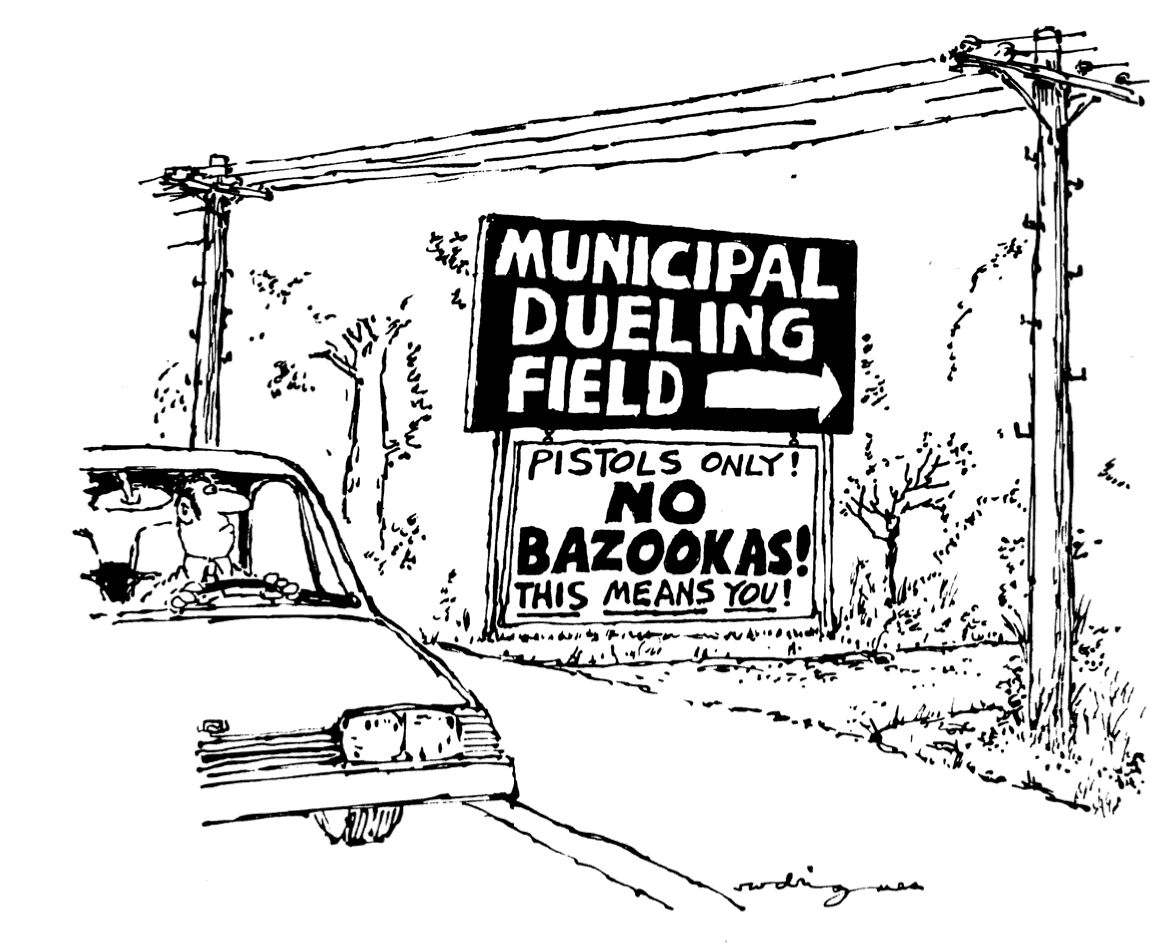
The common view on dueling is that it is a relic of a bygone era—an uncivilized, primitive, savage, bygone era. All modern, progressive, forward-looking societies now prohibit this practice. And for good reason, it is alleged. For with the duel, the strong would kill off the weak, big bully types would run over everyone else, and the meek would never live long enough to inherit anything at all, let alone the entire Earth.
However, this widely accepted view is nothing but a tissue of fallacies. The critiques of settling matters through combat are without substance; its great benefits have been ignored.
The first thing to be made clear about dueling, though, is that it is an offer, not a threat. For a duel to take place, both parties must agree. In other words, a duel can only take place between consenting adults, and, as such, should command the tolerance that men of good will give to all such actions.
Consider a case in which A says to B, “If you don’t voluntarily duel with me, I’m going to kick your ass anyway.” Now this statement is clearly a threat. As such, it would be prohibited by the libertarian legal code.
An offer is something you are just as free to accept as to reject; no force, or threat of force, will be applied to you if you reject the offer. Thus, in the case of an offer of a duel, if the invited person refuses to participate, that is the end of the matter. The initiator of the duel cannot persist. If he does, this only shows that the original “offer” was no such thing. Rather, it was really a threat; the “request” was really a demand. As long as it is a bona fide offer, a mere refusal is an end to the matter.
If B refuses an “offered” duel, and A uses or threatens violence against him, thus showing up the original “offer” for the threat that it was, A is just as guilty of aggressive behavior in the present system, which outlaws voluntary dueling, as he would be in a system of law that allowed it. We must therefore reject the claim against legalized voluntary dueling that force is involved.
Of course, if you refuse a duel, you may be subjected to all sorts of nonaggressive, nonviolent sanctions. You may be called a coward. Strictly speaking, however, this can in no way violate anyone’s rights. Sticks and stones can surely break your bones and violate your rights, but mere name calling can do neither.
It is true, of course, that being called a coward can cause psychological harm, but whether it does so or not is to a very great degree under the control of each individual person. Thanks to the pioneering work of the psychologist Albert Ellis, and his colleague, Dr. Michael Edelstein, author of Three Minute Therapy, the ability of the individual to avert harm from coming to himself in situations such as these is becoming more widely recognized.
Dr. Albert Ellis is a twentieth century follower of Epictetus, a philosopher of the first century A.D. At the core of the philosophy of Epictetus is the view that “men are disturbed not by things, but by the views which they take of them.” Thus it is that Dr. Ellis holds that psychological harm is caused not so much by being called a coward as by the view you take of being subjected to such name calling.
If you take an irrational view of being called a coward, you will harm yourself. If you take a rational view of it, you will not harm yourself. The point that cannot be stressed too strongly is that the choice of which view to take is completely up to you. In other words, it is completely up to the individual to choose whether or not to be psychologically harmed by being called a coward.
An irrational view would be the following: “Oh horrors, it’s awful to be called a coward. This shouldn’t be. It’s unfair. I can’t stand this. I’ll never be able to face people. They’ll hate me. They’ll despise me. And that will be even more awful, even more intolerable. I’ll have to keep hidden. But how will I even be able to face myself? I’ll have to commit suicide.” Thinking thoughts such as these will lead straight to psychological harm.
On the other hand, one could choose to take a more sane approach. One could choose to say something like: “It is true that I will have to pay a penalty for refusing to duel. When the duelist calls me a coward for refusing to fight him, there will be several people who will refuse to have anything further to do with me. This is unfortunate, regrettable, and a pain in the ass. But life is full of just such occurrences. And even though I won’t like it, I will be able to stand it. Actually, I could tolerate much worse, should it come to that. Limiting though these penalties may be, I have judged in a calm, rational mood, that it would be still worse to risk death by engaging in combat. So I’ll accept the penalties attached to refusing to do so. I won’t like them, but I’ll make the best of them.”
It is, of course, true that it is no small task to be able to really mean it, when one takes the rational approach to a thing like this. It is all too easy to merely mouth the rational words. And this is what Dr. Ellis’ “Rational-Emotive-Behavior” therapy is all about: through much practice and a sort of Socratic dialogue with the therapist, really internalizing the rational view, and then learning how to apply it to all sorts of situations. This lesson is so straightforward, that Ellis’ colleague, Dr. Michael Edelstein, has demonstrated that it can be done in “three minutes.”
Dueling is a legitimate activity that should be legalized; the offer of a duel cannot hurt anyone (except possibly in a psychological way); the demand for a duel should be illegal, just as it now is.
Now consider the vantage point of the masochist. All too often, the rights of the masochist are completely ignored; the case of dueling is no exception. As the law stands now, with dueling prohibited, the masochist is completely stripped of his right to engage in a duel. It is, of course, true that the motivation of a masochist for entering a duel is virtually the opposite of the motivation most people would have for doing such a thing. Instead of aiming to wound or kill his antagonist, the masochist aims to be himself injured. This should make no difference, however, as far as the rights and wrongs of the case are concerned. If we but grant the right of suicide to the masochist—and it is hard to see how any libertarian could refuse to do so—then his right to be killed in a duel would seem to follow logically. The right to commit suicide, it will be remembered, follows directly from the self-ownership we each have in our own persons. Once the right of self-ownership is granted, suicide and dueling follow directly. The masochist should have the right of any adult to do anything whatever, provided mutual consent is involved, and provided the action concerns only those consenting adults involved in it.
A possible criticism of this case is based on questioning the claim that any such masochistic action necessarily concerns “only one person.” Suppose, it is argued, that the masochist who duels is a husband and father who has a wife and children dependent upon him. In this case, would it not be illegitimate for the masochist to duel? And since almost everyone has someone at least partially dependent upon him for support, then it would follow that it is wrong for almost everyone to duel (or otherwise unnecessarily to risk his life). Therefore, the prohibition can be justified.
There are several things wrong with this criticism. First of all, it flies in the face of the doctrine of self-ownership. If a person may not risk his life legally because there are people dependent upon him, then to that extent he is not free. But if he is not, then those who are dependent upon him are his owners, or slave masters, since they control him. So this criticism of dueling amounts to the advocacy of slavery.
Moreover, if the family is dependent upon the breadwinner, he is also dependent upon them. (How else can we explain his frequent willingness to abide by their decisions as to what vocations he should enter and what risks he should take?) But if he is dependent upon them, then for the same reasons that he has to follow their orders about risky behavior, they have to follow his views on risky behavior. In other words, if he can be construed as a slave of theirs, then they can with equal logic (or lack of logic) be construed as slaves of his.
And if they are truly slaves of his, then he can order them to allow him to do any risky thing they fear. They must obey his order that they allow him to duel; otherwise they would be disobedient slaves, and that would never do. But by the same token, they can order him not to give them the order to allow him to duel. And so on. The point here is that it is an entirely illogical situation for one person to be both a slave and an owner of another person—the same other person. And this illogic is logically derivable from the criticism of voluntary dueling on the ground that a potential duelist has “responsibilities.”
What of the choice of weapons? Presumably, this should lie with the person challenged, not with the challenger. Traditionally, this was always the case. However, it was typically limited to swords, fisticuffs or pistols. There is no justification for this, however, none at all. Rather, this decision should be broadened; and when I say broadened, I mean just that. Consider now the case of A, who is a crack shot, a mean man with a sword and a boxing champ; he stands at 6’8” and weighs 250 pounds, not an ounce of it fat. He challenges B who is the proverbial 90-pound weakling. B wears glasses as thick as the bottom of Coke bottles, and can hardly see through them. At pistols, he would be more of a danger to himself than anyone else. Swords? B can hardly lift one, let alone fight with it. However, he is a chess grandmaster, a world champion at tiddlywinks and a graceful ballerina to boot. It would have to be a particularly brave A who would challenge any such B, given that the latter could choose the skill in which he is expert. The point is, everyone is better than someone else at something. If this doesn’t put the kibosh on most dueling, then nothing will. In my own case, I am a champion whiner. Let anyone challenge me to a duel, and he is a goner.

