
Defending the Undefendable II: Freedom in All Realms
25. Heritage-Building Destroyer
25.
HERITAGE-BUILDING DESTROYER
There is a small but highly organized and influential group of people who are trying to force their views on aesthetics and history down the throats of the rest of us—whether we like it or not.
I refer to those vociferous busybodies who try to impose historical landmark status on old and decaying buildings in the central city.
These people are usually highly educated, sophisticated, and cultured. They want to indulge their own tastes, and protect the older buildings that people of that ilk enjoy. But this is at the expense of those who might benefit from the jobs and homes that could be created if modern office towers or large apartment blocks were erected on those sites instead.
If these busybodies want to save the buildings they admire, well and good. Let them buy these heritage structures themselves—just as they purchase their antique furniture and vintage cars. But it is entirely unfair to force other people, many of them poorer, to pay for this particular enjoyment of theirs.
Actually, leaving the preservation of heritage buildings up to the marketplace and the price system, rather than forcing the poor to pay for it through government action, might well have a result far better than the one the vociferous busybodies say they expect. For, although it is not widely realized, the price system tends to promote optimal preservation of past relics, as it does of everything else.
Consider the situation with regard to antique furniture. If too few of these relics from the past had been saved, the price system could be counted upon to remedy this situation. Extremely high prices would encourage people to forage around in dumps, etc., in hopes of uncovering more marketable antiques, hence meeting the great demand. The movement would be toward discovery and increased supply.
But it is no less true that an oversupply of artifacts would also create problems. If our homes were too burdened with antiques, then there would be less room for the modern conveniences we also enjoy. If such a situation were somehow to arise, many antiques would lose value and would be summarily destroyed.
Neither of these scenarios is remotely likely, of course. Indeed, the proof that the price system is working well is that both are ludicrous: there is no antique “problem,” at least with regard to furniture or automobiles. We have no noticeable over- or under-supply.
Things are entirely different, however, with regard to historical monuments and buildings. The market has all but been banished, and governmental zoning has instead held sway. Consequently, there are indeed serious problems.
Were a price system fully in effect for time-honored buildings, with no zoning interferences, some of them, those worth more in situ than demolished, would be preserved. But without a market, the costs of maintaining such structures in pristine condition are ignored. There is no way of telling which are worth more as is, and which are more valuable for the space they release for new construction.
Why would the owner of an antique building preserve it, when he could sell it for millions to a developer? Given that this particular edifice is one that deserves preservation, consumers must value it more for its historical character than for the space it could cede to a skyscraper. (I assume away the possibility of moving the entire building to a different site as too costly.) If so, then the revenue the owner could extract via admission charges, plus his own psychic enjoyment, should more than offset alternative revenues.
Why are so few historical buildings preserved on the market? For one thing, costs are relevant to present economic decision-making. This explains why small relics from the past have a greater chance of being preserved, other things being equal, than larger ones. Old stamps and coins, jewelry and children’s toys can be preserved at less cost than can automobiles, locomotives, sailing ships, and buildings. Consequently, unless the larger artifacts are more valuable in proportion to the cubic space they occupy (abstracting from additional maintenance costs), fewer of them will be saved for posterity.
But there is another difficulty posed for a market solution to the historic building question: externalities. Before we deal with objections based on this concept, let us offer a scorecard, so that we can tell one ball player, so to speak, from another. Externalities are costs or benefits undertaken by one economic actor, call him A, that spill over onto, or affect, another market participant, call him B. For example, A takes a shower, or washes his car, or trims his lawn. This makes A’s neighbor’s B’s life more enjoyable, and increases the value of B’s home. A may have undertaken his actions solely to suit himself, but this has repercussions on B’s welfare. So much for positive externalities, or external economies. Now, consider negative externalities, or external diseconomies. A likes to play his stereo, loudly, at 3 a.m. and burns his garbage, right next door to B. A need not intend to impose any costs on B. And if B is deaf and doesn’t care about smoke particles invading his lungs, A will not have done so. But, in the more ordinary case, we say that A has indeed imposed costs, some physical, some pecuniary, on B. What most economists make of all this is that the government should subsidize external economies, sometimes called neighborhood effects, and tax or prohibit external diseconomies. For the Austro-libertarian, in sharp contrast, positive externalities are the earmark of civilization, and there is no warrant for government interfering with this boon which is not a market failure, at all. As for negative externalities, these, too, do not constitute a market failure. Rather, they are a violation of property rights, and courts should deal with them. With this introduction to these concepts, let us return to the subject at hand.
There may not be any feasible way for consumers to see the inside of the building without paying for the privilege, but the main attraction may be the facade, and all passers-by can enjoy this without charge. How could an entrepreneur internalize this externality and convert the outside of the building into a paying proposition?
The problem arises because not all elements of the situation are part of the competitive market. The streets are government controlled, for example. If they were privately owned, one significant aspect of the externality problem would disappear. The owners of the historic building and of the surrounding streets and sidewalks would presumably come to some agreement concerning the sharing of the revenues collected from the passers-by. Possibly one would buy the other out.
There would remain the question of the surrounding skyscrapers, however. Their owners might well charge admission to their windows or roofs for the purpose of viewing the neighboring attraction. This, of course, could severely hamper the monument owner’s efforts to maintain his building as a paying proposition.
But there are several countermeasures he could adopt. He could erect (or threaten to do so) a large fence around the building to cut off a view from the lower floors of neighboring buildings; or a large shield above the roof so that no one on the upper stories of those buildings could enjoy the vista either. Given these possibilities, the surrounding skyscraper owners might be willing to negotiate a payment for the viewing rights. Alternatively, the historic and surrounding structures might come under the same ownership—from one landlord selling to the other, or both to a third party. In any of these eventualities, the externalities would be no more; they would be internalized. The facade of the building, as well as the inside, would be brought into the economic nexus.
Both could be charged for, thus allowing people to register the importance they place upon historicity. The antique monument would remain so, as long as the market value of remaining so continued to be greater than any alternative use of the property. In other words, there is indeed such a thing as private zoning. This process need not at all be a monopoly of government.
It is important to realize, however, that not all external benefits need to be internalized. Many, if not most, viable commercial establishments release external benefits for which they are unable to collect. Many people benefit merely from knowing about certain amenities in their city—the local symphony orchestra or professional sports team, for example—even if they never patronize them. The owners of such establishments cannot, of course, send a bill to everyone who merely appreciates their existence, but they can still earn enough profit to stay in business despite this “failure.” It is not necessary to ensure that each and every person who enjoys a historic monument pays for it. All that is necessary for that monument’s continued existence is that more dollars be collectable from that use of the property than would be from some other use.
There is always the possibility, if there are enough “free riders” anxious to see the monument, but not willing to pay for the privilege, that the monument might be used for advertising purposes. The most obvious way would be to erect billboards on and about the edifice. But this might well detract from its beauty or its historic character. Alternatively, the commercial message could be delivered far away from the structure itself—on the radio, on TV or in print. Hey, perfection is denied us on this side of the Garden of Eden. The market is not perfect in the sense of fully satisfying each and every one of our desires, fully. It is just that all market transactions are mutually beneficial, at least in the ex ante sense, and no other institution can even come close to making this claim; certainly not government, which might be defined as economics at the point of a bayonet.
Under governmental zoning, when property felt to be of historical interest is declared a landmark, it may not be altered, improved, or demolished. Although it is (or was) private property, the owner has been relieved of valuable rights.
Costs, or the alternative uses of the space occupied by the building, are not considered. Sufficient antiquarianism is the only criterion. Unlike antiques on the market, such monuments need not be more valuable as relics than when put to other uses; they need only have some worth from a historical perspective in order to be saved.
Thus, there is little likelihood that consumer welfare will be increased by landmark zoning. Instead, a small group of antiquarian elitists can ignore the desires of the rest of the population and impose the preservation of an excessive number of historical buildings.
Perhaps one reason people accept such a policy is that it is difficult to discern the “might-have-beens.” The historic landmark is there; people see it, enjoy it, photograph it, touch it. It is more difficult to appreciate the factory that might have taken its place, or to envision the extra employment its construction would have meant or the lower-priced consumer goods it could have produced. It is all but impossible to envision the high-rise apartment house that might have occupied that real estate instead, thus pushing rents down. These possibilities are no less important, however, despite the difficulty of imagining them.
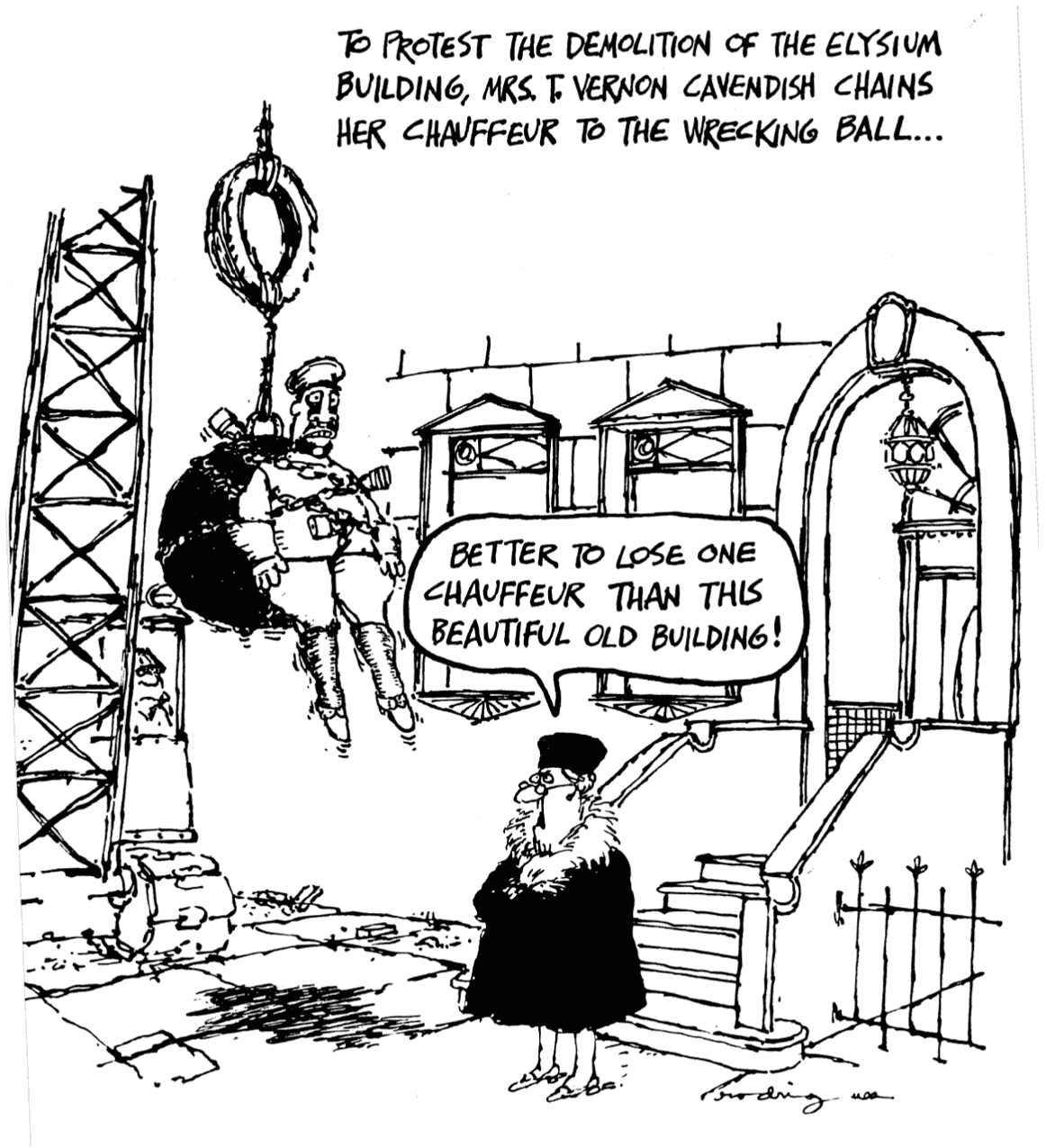
In a case in Berkeley, California, an antiquarian elitist group took action to save an utterly undistinguished small house slated for demolition on the city’s blue-collar, industrial west side. It was to have been replaced by a multiunit, multistory apartment building. Then, a neighborhood busybody learned that the single-family house on Fifth Street had been built in 1878, making it one of Berkeley’s oldest structures. The antiquarian elitists in the area, who signed the busybody’s petition and began agitating to have the current owners of the building deprived of their property rights, have acknowledged that even at its birth, this building would have been plain, quite different from its gingerbread cousins of the period, that it had long since been altered from its original design, and that it was described as blight by some neighbors. Nevertheless, they maintain, pompously, that the rich should not be able to buy and destroy the history of the poor. By attempting to prevent the demolition of the old house, however, they themselves are helping to destroy the future of the poor who might have benefited from the new employment and the new wealth the project would bring to their community.
This issue is also of great relevance to my home town, New Orleans. This city, perhaps, has more historic buildings than any other, at least proportionately to its total. Yes, if these homes were to be demolished, en masse, an important part of the character of the Big Easy would be lost. Tourism, to say the least, would decline. What is at present largely responsible for preventing such an alteration are statist building codes aimed at historical preservation. But, as this chapter demonstrates, this sledge hammer approach constitutes a violation of private property rights; there is no suggestion that this bureaucratic modality will lead to the optimal number of historical buildings; rather, that their number will never change (barring bribes, graft, etc.). But, with the private alternatives sketched out above, these externalities can be internalized with the scalpel technique of the marketplace. If all the streets in the French Quarter, for example, were privatized, that would go a long way toward an association comprising all the owners of this area of the city tying each other up with restrictive covenants, ensuring the preservation of heritage buildings. Had this sort of thing been in operation when this real estate was first developed, the problems of the “hold out” would be greatly attenuated.

