
Defending the Undefendable II: Freedom in All Realms
1. The Multinational Enterpriser
1.
THE MULTINATIONAL ENTERPRISER
As never before, multinational corporations are under attack both at home and abroad. Foreign host governments have imposed a panoply of restrictions including export and import quotas, limitations on remittance of profits, convertibility controls, demands for participation in management, requirements that foreign nationals be hired, and mandatory reinvestment of earnings. Lurking in the background is the ever-present threat of nationalization and expropriation—with inadequate compensation, of course.
Here at home . . . well, just recall the huge public protests whenever the World Trade Organization meets. Multinational firms are accused of exporting jobs and thus creating unemployment; of avoiding their fair share of taxes and thus placing burdens on those who are less able to pay. They are charged with exploiting underdeveloped countries, monopolizing, profiteering, and ruining our balance of payments. It sometimes almost appears that they are accused of everything bad under the sun, with the possible exceptions of bad breath and body odor.
The charge is often made, both here and abroad, that the size, wealth, power, mobility, and efficiency of international enterprise places it beyond the sovereign control of any nation. Thus a Frankenstein monster of business, one that is not an ordinary corporate citizen, is said to be aborning and is or will soon be a law unto itself.
Not unexpectedly, the response to this sort of thinking has been fear, suspicion, and resentment. Dozens of governments around the world are proposing or creating laws with the express purpose of emasculating these firms.
Despite this well orchestrated assault, I do not find the case against multinational enterprisers compelling. I see little justification for the great and ever-growing number of constraints placed on international commerce. On the contrary, I look upon this movement with great trepidation. I fear that if it succeeds, we shall witness the passing of an institution that is uniquely capable of preserving an international division of labor, worldwide trade, and the tranquility that must always accompany such universal economic cooperation.
Let us make no mistake about this. For no less than the future of world peace may depend upon decisions we will have to make over the next several years in this regard.
One of the most important determinants of success in the quest for peace will be our ability to bridge the gap between the “have” and the “have not” nations. Great disparities in wealth have always been a source of envy and jealousy, a destabilizing phenomenon in world affairs. But private international business firms, unlike our multitudinous governmental giveaway programs, have been one of the very few successful forces contending with large international wealth differentials. World-based corporations bring new technologies, education, training, and higher wages to the underdeveloped areas of the world. More important, they bring a realistic hope and expectation that important progress can be made.
Let us consider then, in some detail, several of the most often mentioned criticisms leveled against international corporations. In this way, we can show just how flimsy is the case against these firms.
The complaint is often made that American companies are responsible for “exporting” jobs and should be stopped. For example, employment loss is blamed on investment abroad, on imports from foreign parents of American corporations, on the transfer of our technology to other countries, and on the growth of multinational corporations, which are said to be responsible for all these factors.
There are serious flaws in this argument. If it is true that American investment overseas creates unemployment here, then it must be equally true that investment in one state by a company located in another ought to create unemployment in the company’s home state. If an investment by Ford in Germany causes unemployment in the United States, then an investment by a Los Angeles company in Texas must cause unemployment in California. If one should be prohibited, so should the other. Neither prohibition, however, is acceptable.
The analysis can be carried still further. If it is true for a nation and a state, then it must be true for a city, a neighborhood, and even a street. To carry this argument to its logical conclusion, we must say that any resident of Elm Street who invests on River Street deprives his neighbors of employment; and that these Elm Street neighbors have as much justification to prohibit his export of capital to River Street as the government has to shackle the foreign investment policies of worldwide corporations. If carried to its logical conclusion, the opposition to foreign investment would prevent any individual investing with anyone else! (Note the parallels between this case and international trade.)
But it is not true that American concerns have decreased domestic employment. The fact is that very little of the foreign production undertaken by parents of American corporations would have been possible to launch domestically. Such activity would have had to surmount foreign tariff barriers, import controls, and transportation costs. Like it or not, the choice faced by our companies is not between creating jobs here with local production or creating jobs overseas with production abroad. Rather, it is often between our building a foreign plant or not building one at all, anywhere—and losing out to foreign competition. Any attempt, therefore, to throttle the American firm in the hope of shifting jobs to our country is not likely to succeed.
And it is misleading to think about employment solely in quantitative terms. International enterprises play a far more important role than that of merely increasing the number of jobs at home. The goal of economic policy is not simply an increase in employment per se. If it were, we could reach it overnight by merely tearing up the roads between New York and Los Angeles, and hiring workers to carry the usual load of freight on their backs in the form of 50 pound sacks. This would keep us “fully employed” (and impoverished) for the next 10,000 years.
Every new labor saving device destroys jobs. But this is of great benefit to mankind. It frees labor for tasks that were impossible to accomplish previously! At the time of the founding of our nation, more than 95 percent of the labor force had to work on the farm to keep us fed; nowadays, less than 5 percent is so employed. Had we known that this would happen, should we have worried about the loss of jobs in agriculture? Should we have tried to stop the advances in technology that obliterated 90 percent of the jobs in existence at the time? On the contrary, it was the freeing of 90 percent of the labor force from farm work that allowed us to take the gigantic steps forward we have made in the past two centuries.
So it is not just any old employment, but productive employment, that is the goal of economic policy. And here is where international firms come in. For all the hue and cry against them, these companies are unequaled masters of creating the most productive employment the world has ever known. Before their entrance on the scene, the deployment of labor to its most productive uses was all but limited to a single nation. Now it has been widened to include the entire world.
Should space travel ever become commercially feasible, there will undoubtedly arise multiplanetary corporations, which will earn profits by carrying the principles of comparative advantage to the very edges of the universe. Although the complainers of the future will protest that the multiplanetary corporations are exporting jobs to Mars, or some such nonsense, universal well-being will be maximized, not harmed, by a system that allows Martians and Earthlings to do what they do best, and then to trade with one another; and one which allows a corporation formed on one planet to have subsidiaries on the other.
A related complaint made against international corporations is that they open plants in foreign countries in order to take advantage of cheap labor. The issue seems particularly galling to unions in this country. Worse, the business community is in such a state of disarray on this question that many spokesmen who ought to know better have actually conceded the need for remedial legislation—laws, that is, that would hamper the opening of branches in low-wage areas.
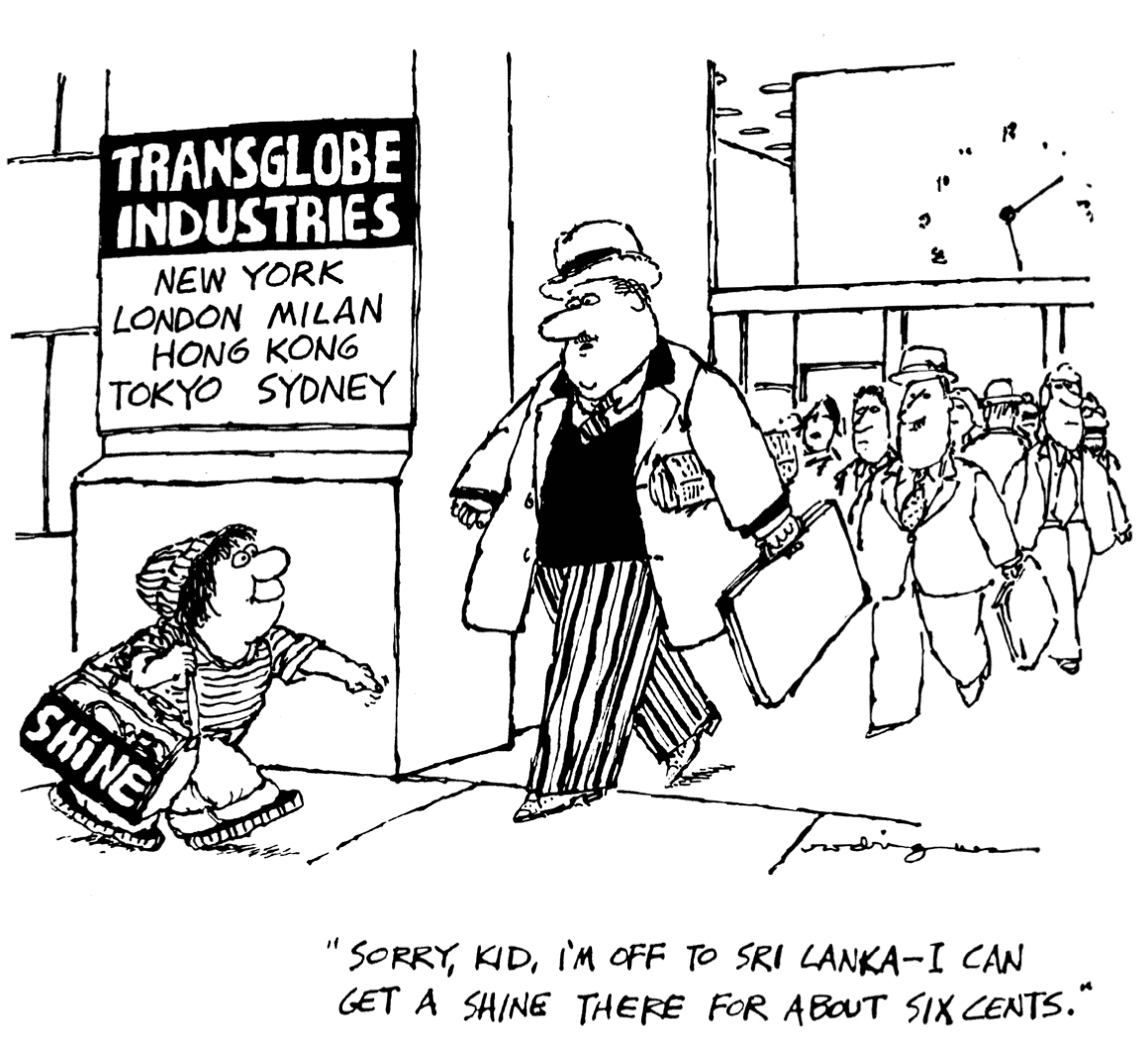
First of all, it is impossible for international corporations to take advantage of low-wage laborers. A corporation can only offer a wage above, below or equal to the one prevailing before it came upon the scene. If the offered wage is higher, the worker must gain; if lower, he need not accept the offered employment; if the same, his condition is unchanged, except that he now has one additional option that was previously unavailable to him. In no case, then, can the labor force of the undeveloped country be exploited except by being offered and by accepting better wage scales. If this be “exploitation,” this is exactly what is needed in the Third World. Far from exploiting underdeveloped countries, international firms have done more than anyone else, including all the world welfare organizations put together, to drag them forward into the twenty-first century. Indeed, the main complaint heard from the underdeveloped world is that they receive too little multinational investment, not that they receive too much.
Nor are the multinational companies’ foreign hiring practices motivated only by a search for cheap labor, although that is no doubt a significant part of the equation. The most often mentioned reasons for foreign investment are savings on transportation costs, proximity to raw materials and markets, avoidance of quotas, tariffs, and excessive taxation, procurement of foreign skills and technology, and any other advantages offered by host governments.
But even if foreign investment in low-wage areas were to occur on a massive scale, new employment would arise here to take the place of the work farmed out. Although this may be difficult to comprehend at a time of high and persistent unemployment, it is true. The reasons for our present high unemployment rate are many and complex, but they do not include the hiring of cheap foreign labor. The proof? If foreign labor is truly cheaper than domestic, even when productivity and all other economic differentials are taken into account, then costs would have to fall if an American corporation were to fire some of its workers at home in order to hire cheaper ones abroad. In turn, prices to the consumer would decrease, output would expand and profits would rise. Any of these consequences—and certainly the combination of all three—would create jobs here.
Consider a decrease in the final price of the goods. Consumers who would have been willing to buy the product at the old price, now have extra money in their pockets. Some of this will be saved, creating jobs in construction, basic industries and investment, depending upon how the money is loaned out by banks. Some of it will be spent in this country for unrelated goods, creating new job opportunities in other fields. And some of the money will be spent to buy more of the same good. This, along with the extra purchases by people who had not bought any at the old, higher price, will ensure the expansion of output. But more output requires more workers.
The higher profits will be distributed, in part, to the stock-holders, increasing their purchasing power. This spending will create new jobs for those displaced by foreign labor. Non-distributed profits will be retained by the corporation for internal expansion. This, too, will create employment opportunities for American workers.
The spending that is done abroad will not immediately help domestic employment. But eventually, when the foreigners use their earnings, some of the money will flow back to the United States and create export jobs here.
Although it is impossible to pinpoint exactly where the new jobs will come from—new consumer spending, product expansion, profits, increased international trade—we can, with perfect certainty, conclude that they will come. For the number of employment slots that need to be filled is not finite and fixed for all time. A job is the manifestation of unmet consumer desire. As long as people want more than they have, there will be work to be done and opportunities for employment. This is the only possible explanation of the fact that more than 95 percent of our present jobs did not exist 200 years ago! Thus there is no reason to fear our employment of low-paid foreign labor. We, along with them, can only gain from cooperation, an international division of labor, and trade.
In addition, if multinationals are forbidden to start affiliates in the low-wage underdeveloped world, the totalitarians will more easily be able to make inroads and spread their sphere of influence, assuming the contrary to fact conditional that the U.S. is itself not the leading imperialist power in the world today. We are locked in a competitive ideological struggle with the forces of totalitarianism the world over—a battle the free world seems to be losing among the neutralist countries. It makes precious little sense to strip ourselves of one of our most effective weapons in our struggle with totalitarianism: our ability to demonstrate to these nations—by involving them in it—the benefits of our free enterprise system. (OK, ok, of what remains of the little economic freedom we once had; at the time of this writing, we have witnessed four years of the socialistic-fascist Bush, and almost two years of the socialistic-fascist Obama.)
Then, there is the charge of hypocrisy. Would anyone propose a domestic policy of not hiring the poor? Hardly. Public policy in the United States is at least ostensibly devoted to helping the poor: millions of dollars spent on job training, specialized schooling and other programs attest to that. Nor can men of good will object to the opening of a new plant in any of the deprived areas of our own country, in the Appalachians or the Deep South or the inner cities of Newark and Detroit. Yet, opposition to employment of foreign low-wage labor is surely the moral equivalent of these policies.
A word about business excesses. Yes, there are dishonest businessmen. And it is the duty of all of us to constantly strive to keep our own houses in order. But a few legitimate complaints have been allowed to smear the very idea of international enterprise, and this is wrong. There is also a good bit of confusion, both within and outside the economic community, as to what constitutes business malpractice.
For example, the attempt to prohibit multinational enterprise from taking advantage of “tax havens” is a dubious one. The objection is to the fact that the business concerns take the tax structures of several countries into account before opening a new plant, and, other things being equal, are more than likely to pick the one with the lowest taxes. But the tax burden is one of the many factors that every rational business must take into consideration. If anything, the countries of the world will benefit from the healthy winds of competition in tax policies. Let the world marketplace take a hand in reining in some of the more outlandish national tax policies!
To summarize, far from being the international bogeymen often depicted in the media, multinational corporations are a force for growth, prosperity, and progress—especially among the nations of the Third World, which are in the greatest need of economic development. Our thinking on these issues needs to be seriously reconsidered.

