Defending the Undefendable II: Freedom in All Realms
8. Picket-Line Crosser
8.
PICKET-LINE CROSSER
There is no such thing as a “right to unionize.” The claim that unionization is akin, or worse, an implication of the libertarian right to freely associate is entirely bogus. True, a labor organization could limit itself to organizing a mass quit unless and until they got what they wanted. That would indeed be compatible with the libertarian law of free association.
But every union with which I am familiar reserves the right to employ violence (that is, to initiate violence) against competing workers, e.g., scabs, whether in a “blue collar way” by beating them up, or in a “white collar way” by getting laws passed compelling employers to deal with them, and not with the scabs. (I once thought I had found an exception in the Christian Labor Association of Canada. But based on a telephone interview with a representative, I can say that while they eschew “blue collar” aggression, they support the “white collar” version.)
But what of the fact that there are many real life unions that have not actually engaged in the initiation of violence? Moreover, there are even people associated for many years with organized labor who have never witnessed the outbreak of actual physical aggression.
Let me clarify my position. My opposition is not merely to violence, but also to the threat of violence. Often, no actual force is needed, if the threat is serious enough, which, I contend it is under unionism as practiced in the U.S., Canada, and Western Europe.
Probably no member of the IRS ever engaged in the actual use of physical violence. This is because employees of this organization rely on the judicial and law enforcement arms of the U.S. government, which have overwhelming power (if not against the Iraqis, the Afghans nor the Iranians, then at least against their own citizenry). But it would be superficial to contend that the IRS does not engage in violence, or the threat of violence. This holds true also for the state trooper who gives you a traffic ticket. They are, and are trained to be, exceedingly polite. Yet, violence, or the threat of violence permeates their entire relationship with you.
I do not deny that sometimes management also engages in violence, or the threat of violence. My only contention is that it is possible to point to numerous cases where they do not, while the same is impossible for organized labor, at least in the countries I am discussing.
Further, the firm is always and necessarily so, in a defensive position vis-à-vis the union. If the latter would limit itself to mass quits, there would be very little reason for the company to initiate force against them. It would make far more sense for them to ignore the threat of organized labor and get on about the business of hiring replacement workers.
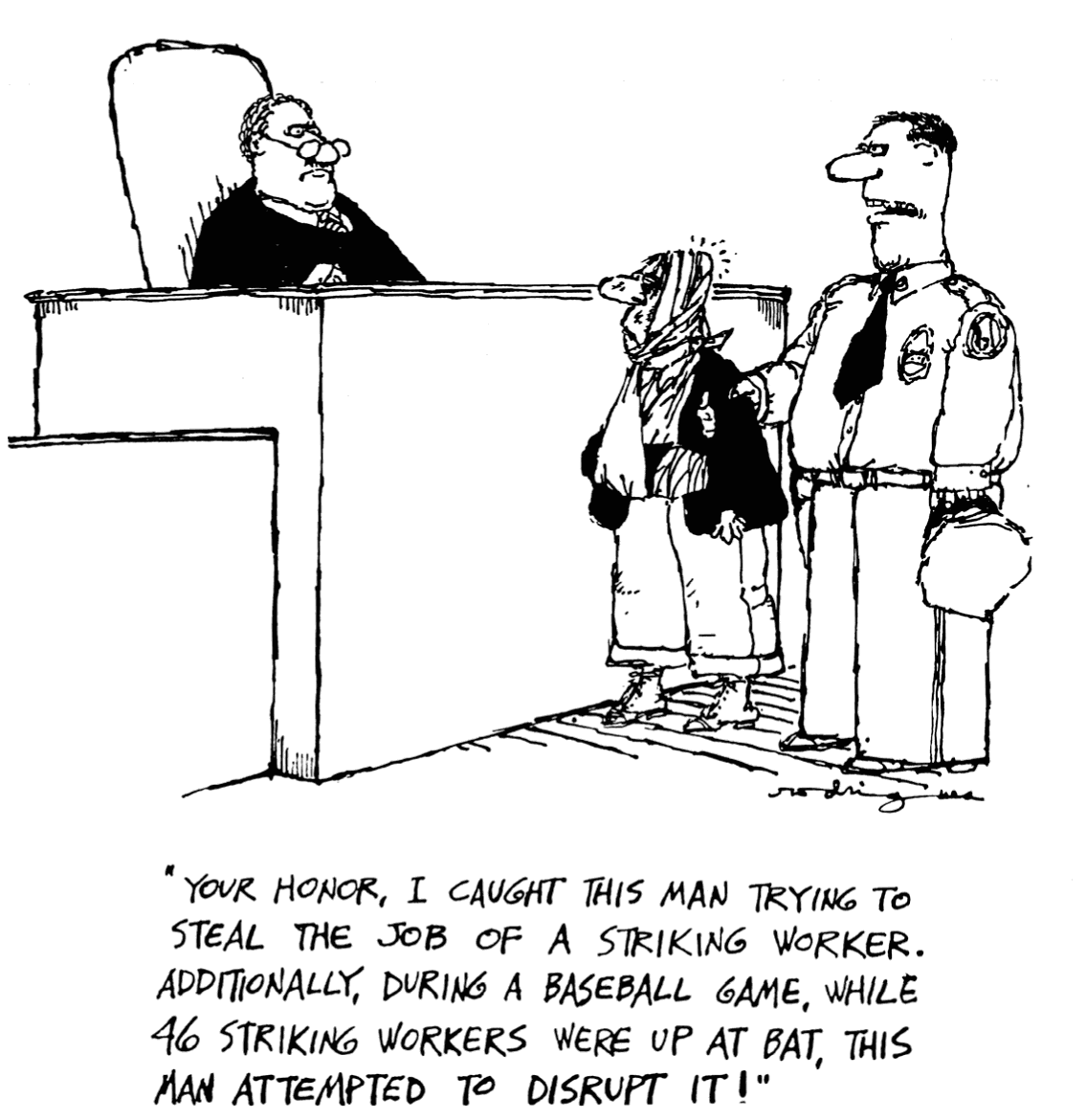
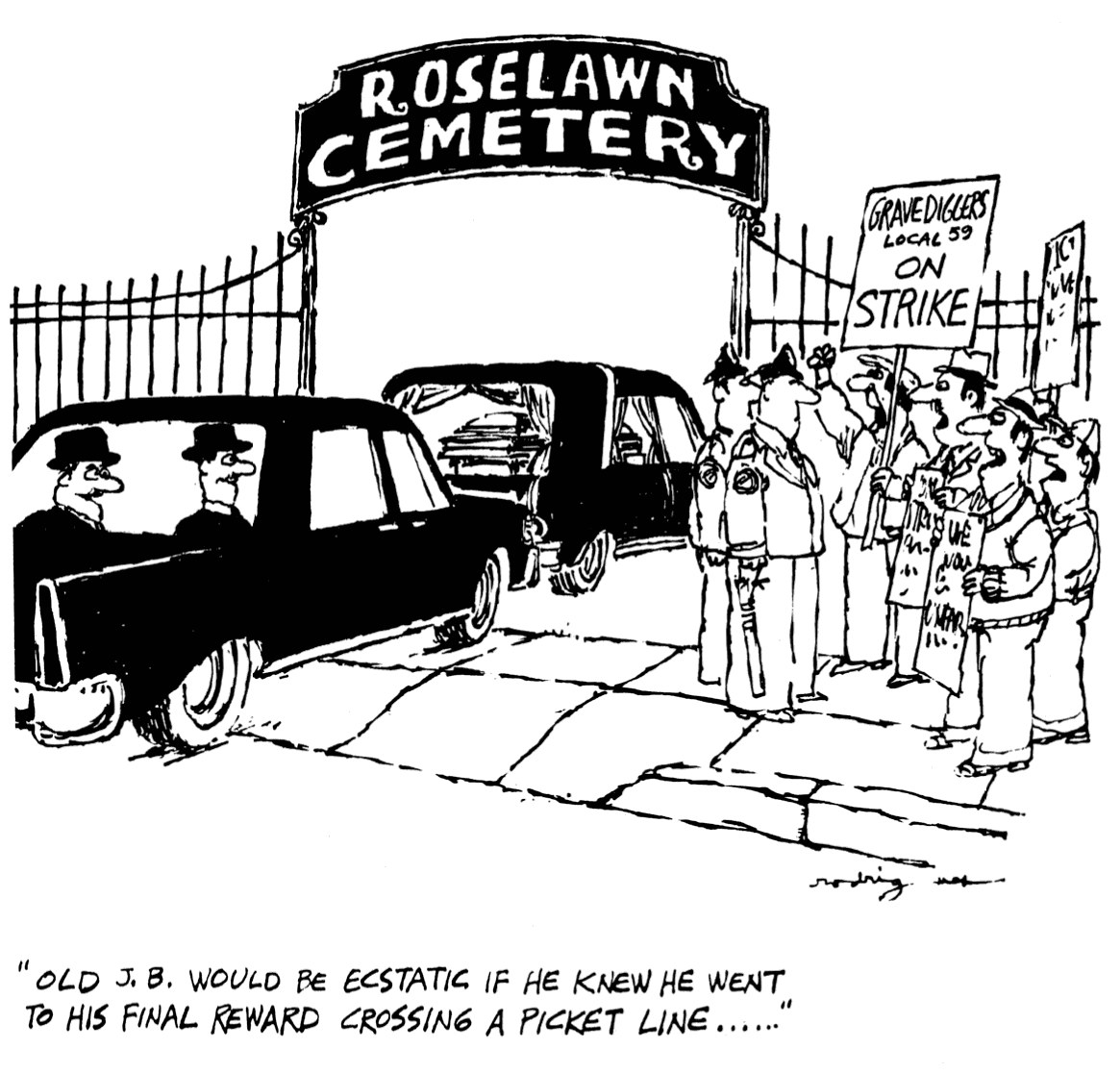
The threat emanating from unions is objective, not subjective. It is the threat, in the old blue collar days, that any competing worker, a “scab,” would be beat up if he tried to cross a picket line, and, in the modern white collar era, that any employer who fires a striking union member and substitutes a replacement worker as a permanent hire, will be found in violation of various labor laws. (Why is it not “discriminatory” and “hateful,” to describe workers willing to take less pay and compete with unionized labor as “scabs”? Should not this be considered on a par with using the “N” word for blacks, or the “K” word for Jews?)
Suppose a scrawny hold-up man confronts a burly football-player-type guy and demands his money, threatening that if the big guy does not give it up, the little guy will kick his butt. This is an objective threat, and it does not matter if the big guy laughs himself silly in reaction. Second scenario is the same as the first, only this time the little guy whips out a pistol and threatens to shoot the big guy unless he hands over his money.
Now, there are two kinds of big guys. One will feel threatened and give up his wallet. The second will attack the little guy (in self-defense, of course). Perhaps he is feeling omnipotent. Perhaps he is wearing a bullet-proof vest. It does not matter. The threat is a threat, regardless of the reaction of the big guy, regardless of his inner psychological response.
Now, let us return to labor-management relations. The union objectively threatens scabs and employers who hire them. This is necessitated, purely as a matter of law. It is a fact, not based on psychological feelings on anyone’s part. In contrast, while it cannot be denied that sometimes employers initiate violence against workers, they need not necessarily do it. Often, however, they do not employ violence at all; in contrast, given union inspired labor laws, unions are continually violating the rights of employers. Sometimes, employers utilize violence against organized labor, but in self-defense. For example, when they defend their property, or “scabs,” against strikers.
We must never succumb to the siren song of union thuggery. Let us now consider eight objections to the foregoing.
1. Legitimate unionism?
Theoretically, unions are compatible with a free society. Yes. Nothing said above should be taken to be inconsistent with this view. All such a union would have to do is to eschew both white and blue-collar crime. I only argue that it has never happened, not that it would be impossible for it to occur.
However, surely a worker’s association that totally eschews the initiation of violence, or even the threat thereof, deserves different nomenclature from organizations it only superficially resembles; e.g., unions. My suggestion is that we not characterize as a union any labor organization that strictly limits itself to the threat of quitting en masse.
What then should we call a group of workers who eschew both beating up scabs and laws compelling employers to bargain with them? Here are some possibilities: workers’ associations, employee groups, organizations of staff members, etc. Thus, are workers’ associations as defined above compatible with free enterprise? You bet your boots they are. Do unions or organized labor as they presently operate qualify in this regard? No, a thousand times no.
2. Public sector unions
What is their status? Public sector unions present theoretical libertarianism with a very complex challenge, albeit in a slightly different manner than do private sector unions. In this case, they are not necessarily incompatible with the free society, but, as it happens, there are no actual cases in existence of such employee organizations that are consistent with economic freedom.
The complexity presented by public sector unions is that, on the one hand, from a libertarian perspective they can be seen as a counterweight to illegitimate governments, while on the other hand they constitute an attack on innocent citizens. Each of these different roles calls for a somewhat different analysis.
Let us start with the first case. For the limited-government libertarian, or minarchist, the state is illegitimate if, and to the extent it exceeds its proper bounds. These, typically, include armies (for defense against foreign powers, not offense against them), police to keep local criminals in check (that is, rapists, child exploiters, and murderers, etc., not victimless “criminals” such as drug dealers, prostitutes, etc.), and courts to determine guilt or innocence. Some more moderate advocates of laissez faire add to this list agencies to build and maintain roads, treat and track communicable diseases and provide inoculations, fire protection, and mosquito control. For the anarcho-libertarian, of course, there is no such thing as a licit government.
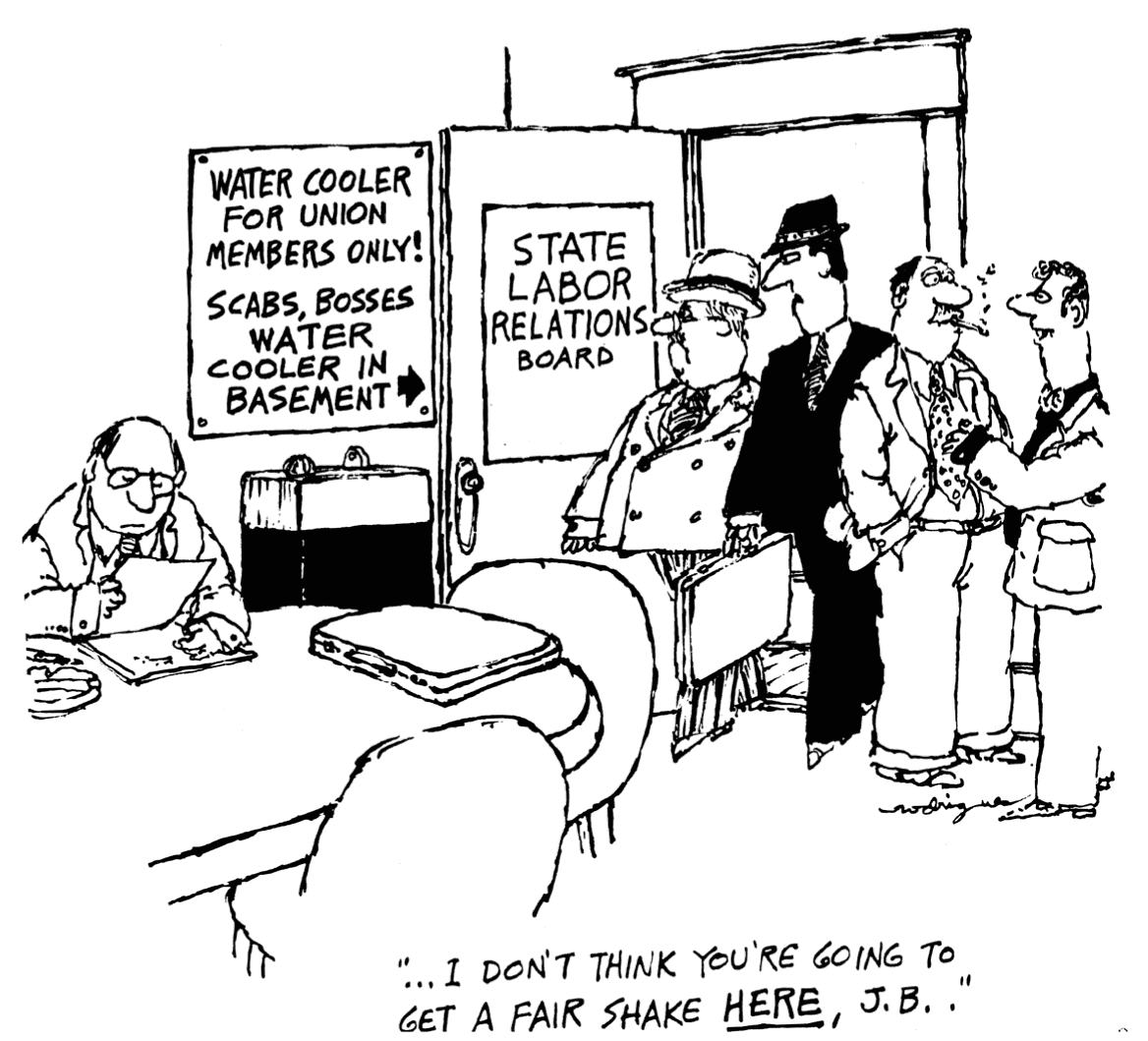
What, then, are libertarians to say about a public sector teachers’ union on strike against a state school? (A similar analysis holds for public sector unions in garbage collection, postal service, transit, or any other industry where government involvement is improper in the first place.) The correct analysis of this situation is, “A plague on both your houses.” For not one, but both of these organizations are illegitimate. There is no libertarian who can favor government schools, whether anarchist or minarchist. (Milton Friedman, who champions public schools as long as they operate under a voucher system, thus falls outside the realm of libertarianism on this question.) So, from a libertarian perspective both sides of this dispute are illegitimate. There are two contending forces, both of them in the wrong. From a strategic point of view, we may well even support the union vis-à-vis the government, since they are the weaker of our two opponents. But from a principled perspective, we must look upon the two of them as all men of good will would witness a battle between the Bloods and the Crips, or between Nazi Germany and Communist U.S.S.R. Root for both of them!
Now let us consider the second case. Here, we note that the public sector union does much more than attack illegitimate government. It also vastly inconveniences the populace. When schools are closed, garbage is not collected, the buses do not run—because public sector unions utilize violence and the threat thereof to these ends—then the libertarian response is clear: total opposition to the offending unions.
Let us take one last crack at public sector unions, which brings about a further complication. Consider an episode of the ABC news program 20/20 about how public-employee unions are fighting against people who volunteer for the public good, specifically, the “Give Me a Break” segment by host John Stossel. (See “No Good Deed Goes Unpunished: Are Volunteers Taking Workers’ Jobs?” at ABCNEWS.com.)
The general issue is that citizens have been volunteering to do things like help public sector unionists collect trash in parks, aid them in planting flowers, help them stack books in public libraries, etc., and the unions have reacted viciously, as is their custom.
Before we can shed libertarian light on this contentious issue, let us first ask: What is the libertarian analysis of ordinary people volunteering to help the government do jobs it should not be doing in the first place? To put it in this way is almost to answer the question.
There is no difference in principle between volunteering to help the state perform illegitimate acts (of course, these are not illicit per se, as are the concentration camps; rather, it is improper, in libertarian theory, for governments to take on such responsibilities) such as operating and maintaining libraries, schools, parks, etc., and sending them monetary donations for such purposes. In either case, one is aiding and abetting evil, and risking being found guilty of crimes against humanity by a future libertarian Nuremberg trial court.
Repeat after me: free enterprise, good, (excessive, for the minarchists) government, bad. Once again, from the top: free enterprise, good, (excessive) government, bad! The appellation, “libertarian,” is an honorific. It is too precious to be bestowed on all those who falsely claim it. People who support (excessive) government are simply not entitled to its use, at least in the specific context in which they violate the non-aggression axiom. Thus, John Stossel is indeed a libertarian on many other issues, but certainly not on this one.
Here is a lesson for libertarians: if you want to be worthy of this designation, and desire to contribute money to a good cause, do not give to a government that goes beyond its legitimate authority. There are many worthy causes that oppose statist depredations, not support them. If you want to be worthy of this honorific and wish to donate time to a good cause, e.g., by collecting garbage, planting flowers, or filing books, etc., then do so for the relevant private groups, whether charitable or profit-seeking, it matters not one whit.
3. Libertarians join a union?
Is it proper, if it is even logically possible, for a libertarian to join a coercive union? Much as I hate to be controversial (Okay, okay, I don’t mind it a bit), my answer is yes. There are many issues upon which I disagreed with William F. Buckley, but his decision to join ACTRA, the Alliance of Canadian Cinema, Television and Radio Artists, is not one of them. (This was the requirement imposed upon him for being allowed to air his television show, Firing Line.)
Why would I take such a seemingly perverted stance? Let me answer by indirection. Given that it is illegitimate for the government to run schools and universities, is it illegitimate for a libertarian to join them whether as a student or a professor? Given that it is illegitimate for the government to organize a post office, is it illegitimate for a libertarian to mail a letter? Given that it is illegitimate for the government to build and manage roads, streets, and sidewalks, is it illegitimate for a libertarian to utilize these amenities? Given that it is illegitimate for the government to provide currency (the Constitution allows this, but for the libertarian, only the market may properly do so), is it illegitimate for a libertarian to utilize dollar bills?
True confession time. I have been a student of public schools: grade school, high school, and college. I have even been a professor at several public colleges and universities. I regularly purchase stamps from the evil government post office, and have the audacity to mail letters. I walk on public sidewalks and avail myself of streets and highways. I have U.S. fiat currency in my wallet. Mea culpa? Not at all.
If Ayn Rand’s heroic character Ragnar Danneskjöld has taught us anything, it is that the government is not the legitimate owner of what it claims. Why, then, should we respect its “private property rights” when there is no just reason to do so? If this means that libertarians can partake of services for which they favor privatization, then so be it.
It is similar with coercive unions. If a hold-up man demands your money at the point of a gun, giving it up is not incompatible with libertarianism, even though it amounts to acquiescing in theft. If organized labor threatens you with bodily harm unless you join with it and pay dues to it, agreeing to do so does not remove the victim from the ranks of libertarianism. Buckley, to give him credit, never ceased inveighing against the injustice done to him in this way. If he had reversed field and starting defending unions, then even what little claim he had as a libertarian would have vanished. In this regard, there is all the world of difference between a Marxist professor at a public university who promotes interventionism, and a libertarian who opposes it.
4. Not aware of violence
Many members are simply not aware of any violence in their own unions. But, many employees of the IRS are probably not aware that what they are doing amounts to the threat of the initiation of violence. All union members should hardly necessarily be aware of this for the thesis of this chapter to be correct. After the British left India, the government of the latter began polling people in far removed rural villages as to their thoughts on this matter; they had to stop when they learned that the villagers were not aware that the British had been there in the first place. Heck, there are probably some people out there who still think the Earth is flat, or that socialism is an ethical and efficacious system! That does not make it so.
5. Self-defense
We now consider the objection that union violence did indeed exist, but was justified on the grounds that this was only in self-defense, against employers, scabs, or foreigners. Let us consider each of these in turn.
Yes, employers are violent too. The Pinkertons spring immediately to mind. Some of these cases were justified in self-defense, against prior union aggression, some were not. In the former case, there is certainly no warrant for invasive behavior on the part of organized labor. But even the latter cases cannot serve as justification for pervasive union aggression. At best, this can validate self-defense on the part of the rank and file in those cases of employer aggression only.
And what of “scabs?” The claim, here, is that “scabs” are stealing, or, better yet, attempting to steal, union jobs. But the scab can only “steal” a job if it is owned, like a coat or a car. However, a job is very different. It is not something anyone can own. Rather, a job is an agreement between two parties, employer and employee. But when an employer is trying to hire a scab and fire the unionist, this shows, at the very least, he no longer agrees. Do not be fooled by the expression “my job.” It does not denote ownership, any more than “my wife,” “my husband,” “my friend,” “my customer,” or “my tailor” indicates possession in any of those contexts. Rather, all of these phrases are indicative of voluntary interaction, and end (apart from marriage laws which may prohibit this) when the agreement ceases.
Then, there is the supposed “threat” imposed by Mexican workers (or Indian or Japanese workers, whoever is the economic scapegoat of the day). Remember that “giant sucking sound?” The best remedy for this bit of economic illiteracy is to read up on the case for free trade (see the chapter on the smuggler in this book).
6. But they signed a contract
Since the employer signed a labor contract, he should be forced to abide by its provisions. But why should the employer have to honor a contract that was signed under duress? There can be no such thing as a purely volitional contract between the firm and a union, with the sword of Damocles hanging over the former. Suppose I held a gun on you, threatened to shoot you unless you signed a “contract” with me, promising to give me $100 per week. Later on, when you were safe, you reneged on this “contract.” Certainly, you would be within your rights.
7. Maximize income
Unions maximize income for their members. Therefore, they are justified.
First of all, even if this were true, any criminal could say no less. A hold-up man, too, wants to maximize his return and does so by committing aggression against non-aggressors. How is the unionist any different than the hold-up man in this regard?
Secondly, it is by no means clear that organized labor is the last best chance for economic well-being on the part of the working man. Anyone ever heard of the rust belt? Unions located in places stretching from Illinois to Massachusetts demanded wages and fringe benefits in excess of productivity levels, and employers were powerless to resist. The result was “runaway shops.” Either they ran into bankruptcy, or they relocated to places like Alabama, Mississippi, and Louisiana, where unionism was seen more for the economic and moral scourge that it is, than in Taxachussetts. If organizing workers into unions is the “be all and end all” of prosperity, how is it that wages and working conditions are very good in computers, insurance, banking, and a plethora of other non-unionized industries? How is it that real wages were rising before the first advent of such labor organizations at the turn of the twentieth century? How is it that at the end of the twentieth century, union membership was falling, while wages were increasing?
8. Hierarchy, the real problem.
The real problem with unions is that they are hierarchical; the libertarian must oppose all hierarchical organizations, which certainly includes employers, too.
But this is just plain silly. Libertarians oppose the initiation of coercion or the threat thereof, not hierarchy. Yes, all groups that violate the non-aggression axiom of libertarians are hierarchical. Governments, gangs, rapists, impose their will, by force, on their victims. They give orders. And yes, in all hierarchies, people at the top of the food chain give orders to those below them. But the difference, and this is crucial, between illicit and licit hierarchy is that the recipients of orders in the latter case have agreed to accept them, but this does not at all apply in the former case.
When the rapist orders the victim to carry out his commands, this is illegitimate hierarchy. When the conductor orders the cellist to do so, this is an aspect of legitimate hierarchy. I oppose unions not because they are hierarchical, but because their victim-scabs have never agreed to carry out their orders.