
Defending the Undefendable II: Freedom in All Realms
30. Intellectual-Property Denier
30.
INTELLECTUAL-PROPERTY DENIER
Most people hold the view that just as we can legitimately own pencils, puppies, and pickles, it is proper for us to attain property rights in our ideas. After all, our thoughts emanate from inside us, from the very core of our being. It would be unjust if we could not own what we produce in this way. Certainly, our laws are now predicated on this perspective. As well, there is a utilitarian aspect of this argument: unless intellectual property is protected by law, it is contended, research and development in new ideas will atrophy and the progress of mankind will come to an abrupt halt.
There are two main protections of intellectual property (IP). In the case of patents, a new invention must be registered with the authorities, and the first inventor to do so has the right to sell or keep for his own use the entire benefits of his breakthrough for a given number of years. There are two problems with this scenario, both of them fatal to the argument. First, what about the independent inventor? A and B have both worked for years to create their identical invention. A gets to the patent office five minutes before B. A has 100% ownership over this new innovation, while B gets absolutely nothing. This state of affairs is entirely incompatible with the justification for IP in the first place: that everyone should be able to own the fruits of their own creativity. Well, what about poor B? Shouldn’t he also get to own this invention, without having to pay A any licensing fee? (We stipulate here that B was indeed an independent inventor and learned nothing from A’s efforts.)
The second flaw in the argument for patents is the time limit on ownership. With regard to my pencils, puppies, and pickles, I own them permanently, not merely for some arbitrary amount of time. Not only do I own them for as long as I want, I can give them to my heirs. If I really own my ideas as advocates of IP claim, then, I should own them forever. But this creates insuperable performative contradiction problems for that viewpoint. For, if we can all own ideas, then we can all have private property in words, given that words are merely one manifestation of ideas. In the last sentence, I used 25 words. There were 5 repeats: “can,” “all,” “we,” “words”, “ideas.” This gives a total of 20 words that I utilized. But, each of these words was originally created by someone else. For example, the word “for,” we may suppose, was first thought of by Mr. For; the word “if” by Mr. If, the word “we,” by Mr. We, etc. If IP were justified, it would be improper of me to use any of these 20 words without permission of their owners. No such permission has ever been forthcoming to me, nor to anyone else. But our problems do not end here. For each and every word in the English language was created by someone. And this does not apply merely to that one language. Rather, it transcends them all. Thus, if IP were correct, none of us could use any words. We could not speak and we could not write. We could not even grunt, since Mr. Grunt started that one up. This pertains, too, to the person who defends IP. Based on his own philosophy, he could not licitly articulate his viewpoint; for to do so would require words, and he is forbidden on the basis of his own philosophy to use any extant words. He could make up new ones, such as zxcvcxv, poiuwerkjls and lkjmwmkls, but it would be rather difficult to communicate anything in this manner, let alone defend IP. As for those of us who do not accept this perspective, we are entirely free to counter IP with the use of words. (I owe this idea of the performative contradiction to Hans Hoppe.)
It will be objected that I am carrying things too far. Hey, that’s the entire point of the reductio ad absurdum argument: to take claims seriously and to their logical conclusion. Sometimes, it is easier to see the fallacy of an argument when it is writ large in this manner. The advocate of IP has no right to say that it applies only for a certain number of years and/or not to language. If ideas should really be owned by their creators, then there is no possible logical objection to analyzing what this really means, as we have just done. It logically implies that the advocates of this view maintain silence.
The second protection for IP is copyright. This, too, is time denominated. Typically, copyrights last for some number of years, sometimes a half century after the demise of the author. Again, we note this cannot be made compatible with ownership property, which has no time limitation.
But copyrights have a better deontological (rights oriented or ethical) status than patents. There is no question of one creator receiving 100% of the benefits, and another, who also deserves credit for the innovation (based on the IP philosophy), coming away with none. Then, too, copyright benefits from being contractually based, something also missing from the patent arena.
Still, these two different means of creating property rights in ideas suffer from the same difficulty: the entire purpose of property rights is to reduce, nay, eliminate conflicts over scarce goods. If ownership over goods and services is fully specified and all are law-abiding, then no conflict can arise. But, no conflict need ever arise with ideas because once known, all parties can use them. The utilization of an idea by one person does not in the least detract from the use of that same idea by another or others. Suppose girl A is the first to put her hair up into a ponytail. Girl B sees this and arranges her own hair in the same style. Did B steal anything from A? No. B’s ponytail in no way detracts from A’s hairstyle. It is not as if B went over to A and ruined or erased her hairdo. A’s ponytail is undisturbed when B makes use of this idea. We can have our cake, here, and eat it too. My use of the Pythagorean Theorem in no way detracts from your use of it. To create property rights in ideas, then, is to substitute scarcity where no scarcity need exist. Scarcity is the enemy of well-being. A successful economy reduces scarcity, not increases it.
But what about copyright contracts? X creates a book or a song or a new machine or a formula for a drug. He sells it to Y, not outright, but with one proviso: that Y not copy it without X’s permission (for which X will charge Y). X is, in effect, selling Y the right to use this new innovation, but not to allow any third party, Z, to avail himself of it. So far, so good. But, Y loses the product and Z finds it. Or Z sees Y (or X) using it and, on the basis of that observation, copies it for his own use or to sell to still others. Has Y violated his contract with X? No. Y is only obligated to not copy what he has purchased, and he did not. Y never contractually agreed to not lose it or shield his use of it from others, such as Z. Did Z engage in any illicit behavior? Certainly he did nothing he was contractually obliged to refrain from, since it was Y, not Z, who agreed not to copy.
Let us now move from deontological considerations to utilitarian ones. Now we are concerned not with the rights of the matter, but with which system will create more wealth. At first glance, it would appear that this consideration is all on the side of IP. After all, goes the usual refrain, if inventors, artists, and creators cannot retain ownership of their own ideas they will have less or no incentive to create them in the first place. Without IP, intellectual creativity, innovation, research, invention, etc., would wither and perhaps die.
True, without this added incentive, assuming all other things equal, there would be less of this sort of activity. However, other things are decidedly not equal. Once patents are granted (and/or copyrights become the order of the day), these serve as barriers to follow up on new innovation. Yes, when the very first patents were granted, this phenomenon did not exist. But as IP piles up, new breakthroughs become harder and more difficult to come by. For now, the inventor must keep his eye not only on what he himself is trying to accomplish, but also on other IP rights, so as to not transgress upon them. That is, extant IP serves as a sort of obstacle course against the development of new knowledge. IP has also given rise to numerous lawsuits over patents and copyrights. Thus, thousands of technical people, engineers, scientists, who could have been engaged in the process of research and development, instead make it their profession to serve as expert witnesses for plaintiffs and/or defendants in IP cases.
Also interfering with the unearthing of scientific knowledge is a practice known as “submarining.” Here, a high-tech firm applies for a patent, but does not disclose it to the public. It then uses a continuation, so as to later reapply for this patent. Its strategy is to await further developments in this field and then reapply after others have filled in the gaps. It can take advantage of its earlier application date to, in effect, prevent latecomers from benefiting from their own research.
So, does IP, on balance, lead to more or less scientific breakthrough? It is difficult to say. This is an empirical question and the correct answer may change from time to time. That is, in some years, more ideas will be created as a result of IP, and in others, fewer. As we have seen, there are opposing forces that result from IP, some tending in the direction of more idea creation, others not.
What is the optimal amount of research and development? From the utilitarian point of view, it sounds as if we can never have enough of it, but, surely, that is mistaken. For if it took up anything like a majority of our income, we would die for lack of food, shelter, medical care, etc. In order to maximize expected wealth, resources should be allocated in such a manner so that no more income can be attained by switching a marginal dollar’s worth from one activity to another. Given that we cannot determine with any reasonable confidence whether IP will enhance this process or retard it, the ideal resource allocation is the one compatible with libertarian law.
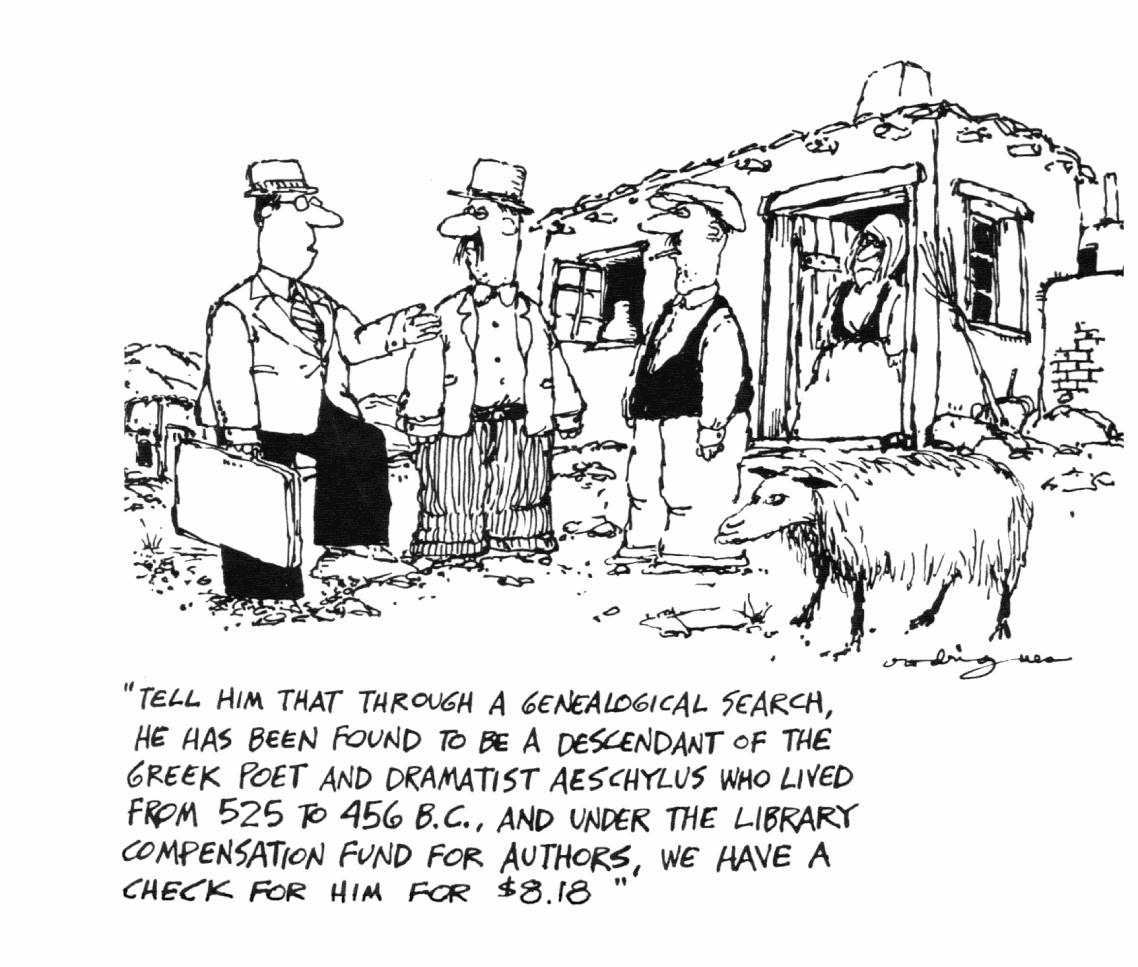
There were two elements we must address: the deontological, and the pragmatic (how much research will be done in the absence of IP “rights?”) For the libertarian, the first is crucial; the correct or optimal amount of R&D is precisely the amount that would be done if the law were just, that is, entirely without IP. So, even if zero R&D occurred under this system, that would be the proper amount.
Consider now this objection: “But what about something that has no live performance equivalent?” First, I don’t think there is any such thing. Suppose I make a great movie or game and receive zero revenue from my efforts in creating it, not even the amount I will get from having the time advantage of being first (e.g., the examples of paperback vs. hardcover books; theater movies vs. DVDs, Paris dresses vs. Macy’s knock-offs). Well, movies and games will still be produced, only not, directly, for money. What other benefits to me might there be? There are conferences of devotees of movies and games. My speaking fees at them will be elevated. I can get an endowed chair at a university in their film department. Microsoft, IBM, and Google will start a bidding war for my services. Then, there is benevolence. I might win an Oscar award for best movie. Does that pay money? I’m not sure. Even if not, I’ll still be a popular boy. Groupies will shower their favors on me, etc.
To conclude: There is no property rights violation if a company invests millions creating a piece of game software or a movie, and technology tricks allow any consumer to copy the end product at zero cost (to the consumer). This very extreme example only means that people will still make movies or games, but not based on the profit motivation.

