
Defending the Undefendable II: Freedom in All Realms
7. The Home-Worker
7.
THE HOME-WORKER
A man’s home may be his castle, but not as far as working there is concerned—at least, not according to those who advocate legislation restricting commercial activity in one’s own domicile.
Originally, such laws were placed on the books in order to enforce earlier child labor and minimum wage laws. As well, unions protested vociferously that home-workers would be very difficult to organize, and the result would be a return to sweatshop conditions.
In the modern era, however, the people who wish to work at home are more likely to be professionals, managers, and sales representatives who can work independently and/or don’t want to commute. Some may be women who are reasonably well-off and just wish to earn some extra money. For example, there was a flap a little while back over several hundred women in the New England states who were knitting snow mittens and ski caps and who justified this practice on the grounds of “freedom of enterprise.” And, as if in order to show that not only politics makes strange bedfellows, they also defended themselves on the basis of women’s liberation: being able to work at home was the only way that many of them could work at all—while continuing to watch over their children.
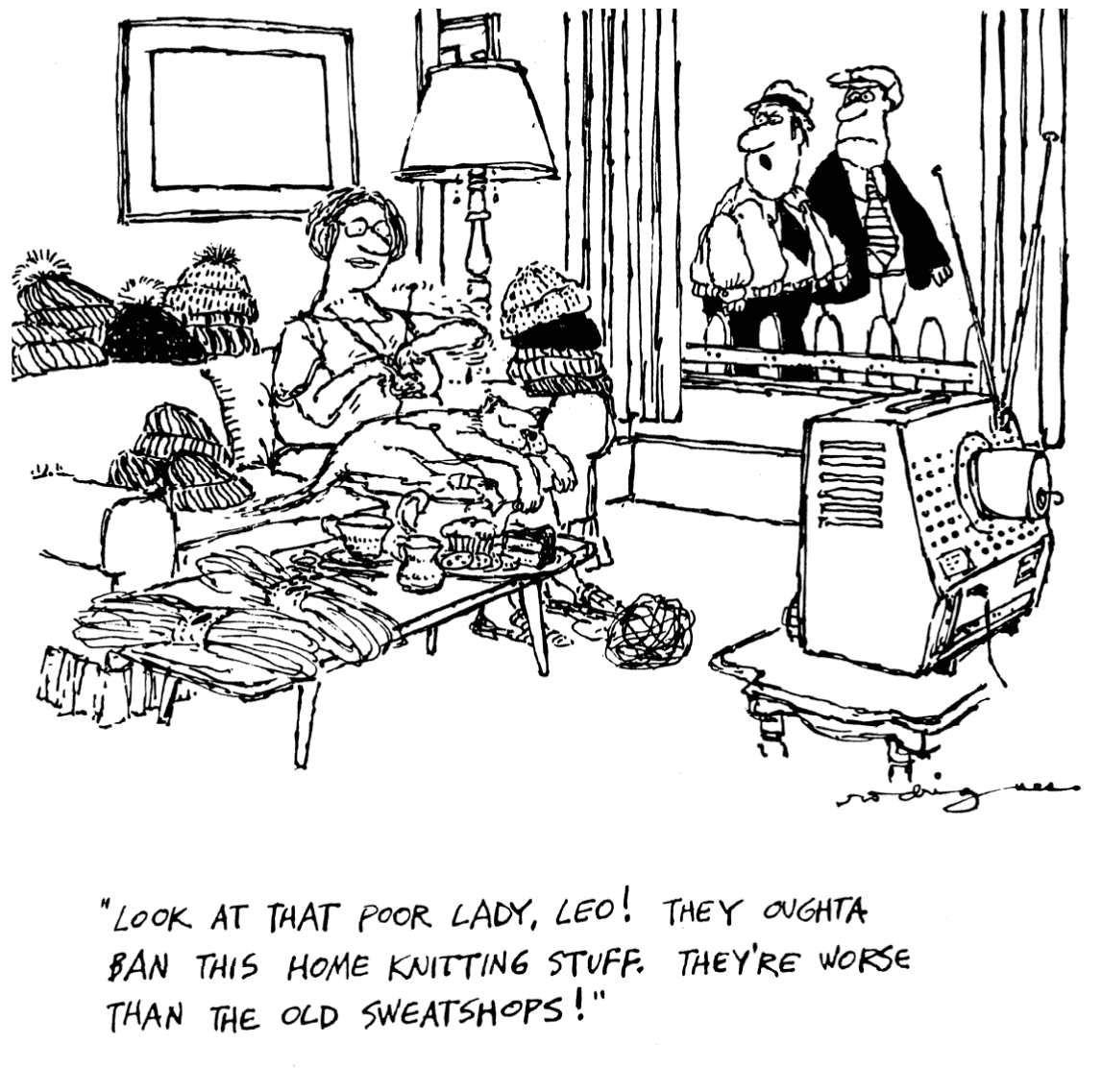
But the debate over home knitters was really only a tempest in a teapot. At most, it involved several thousand seamstresses in an industry that had been on the verge of being supplanted by technology for many years. Of far greater statistical significance is the emerging trend toward the transplantation of clerical workers from offices to their homes. This has been made possible on a significant scale by technological breakthroughs in computer engineering, but if present trends continue, it is possible that this small stream will turn into a tidal wave.
If this occurs, the union argument that cottage industry is synonymous with sweatshop conditions will be given even wider denigration. It is thus appropriate that we subject this contention to critical analysis. For it is incorrect, and public policy based upon its supposed truth will, as a result, be counterproductive.
To begin with, we must admit that there is a certain superficial attractiveness to this view. After all, in the seventeenth and eighteenth centuries, when home work was the order of the day, economic conditions were indeed deplorable. But to argue that because A (cottage industry) and B (poverty) were both found at the same time in history, therefore A caused B, is to commit the fallacy known as post hoc ergo propter hoc. It makes as much or as little sense to claim that because the wheel existed long ago that this magnificent discovery actually caused a retrogression of civilization.
In actual point of fact, the organization of labor into gigantic bargaining units cannot at all account for increased standards of living. First of all, economic improvement has been occurring for hundreds of years, and while unions were formed as early as the late nineteenth century, they had no real power until the beginning of the twentieth. Secondly, there are numerous countries around the world, especially in the Orient, which have undergone “economic miracles,” where unions are weak or non-existent. And thirdly, organized labor cannot take credit for an end to sweatshop conditions even in nations where it is well entrenched. This is because, alongside the gains that have undoubtedly been made in unionized industries, equal or greater benefits have been given to employees in the non-unionized sector, in such fields as computers, banking, and even domestic service.
If we can no longer countenance the idea that unionization is all that stands between the laborer and the sweatshop, then there is simply no case for interfering with the institution of home work, no matter how big it becomes. Moreover, it is silly to even entertain the notion that home-working is a step backward toward the sweat shop conditions of a bygone era. If it were, why would these people embrace it? From the fact that they voluntarily decide upon this step, we may logically infer that, at least in their own eyes, it betters their condition. If it didn’t, they never would have embarked upon this type of economic activity.
And there is every reason for allowing this new form of industrial organization. People have a natural right to do whatever they please, provided only that their actions do not infringe on the rights of others to do exactly the same. Those who favor both unionism and women’s liberation will have to make a choice: one or the other. As this example shows, they cannot have it both ways.

