
Defending the Undefendable II: Freedom in All Realms
6. The Hatchet Man
6.
THE HATCHET MAN
In the movie “Up in the Air,” George Clooney travels around the country firing people. He’s what’s known in the corporate world as a hatchet man. He does what the bosses at the endless stream of companies portrayed in the movie don’t have the stomach for.
It seems unfair to all right-thinking progressives that an employee could be fired without “cause”; that a man’s employment could be terminated for any reason deemed appropriate by his employer—or for no reason at all. And yet, this is precisely what traditional “at will” employment means. It seems unjust to most people to fire an employee without good cause. To some, advocates of guaranteed lifelong employment, it appears unfair to terminate employment for any cause, perhaps barring criminal or grossly immoral behavior.
The reason for the widespread popularity of this view is that most people view a job as a possession. We speak of “my job,” and we implicitly assume property rights over the employment relation. If it is disrupted—whether by a firing, a plant closing or a “scab” taking away the job during a union dispute—many people feel as victimized as they would if they were the victims of a theft.
But this analysis is faulty. A job merely describes a relationship between two parties. It is not something that can be owned by either of them, and certainly not something that is the rightful possession of only one. The possessive mode of the phrase “my job” is a highly unfortunate and misleading figure of speech.
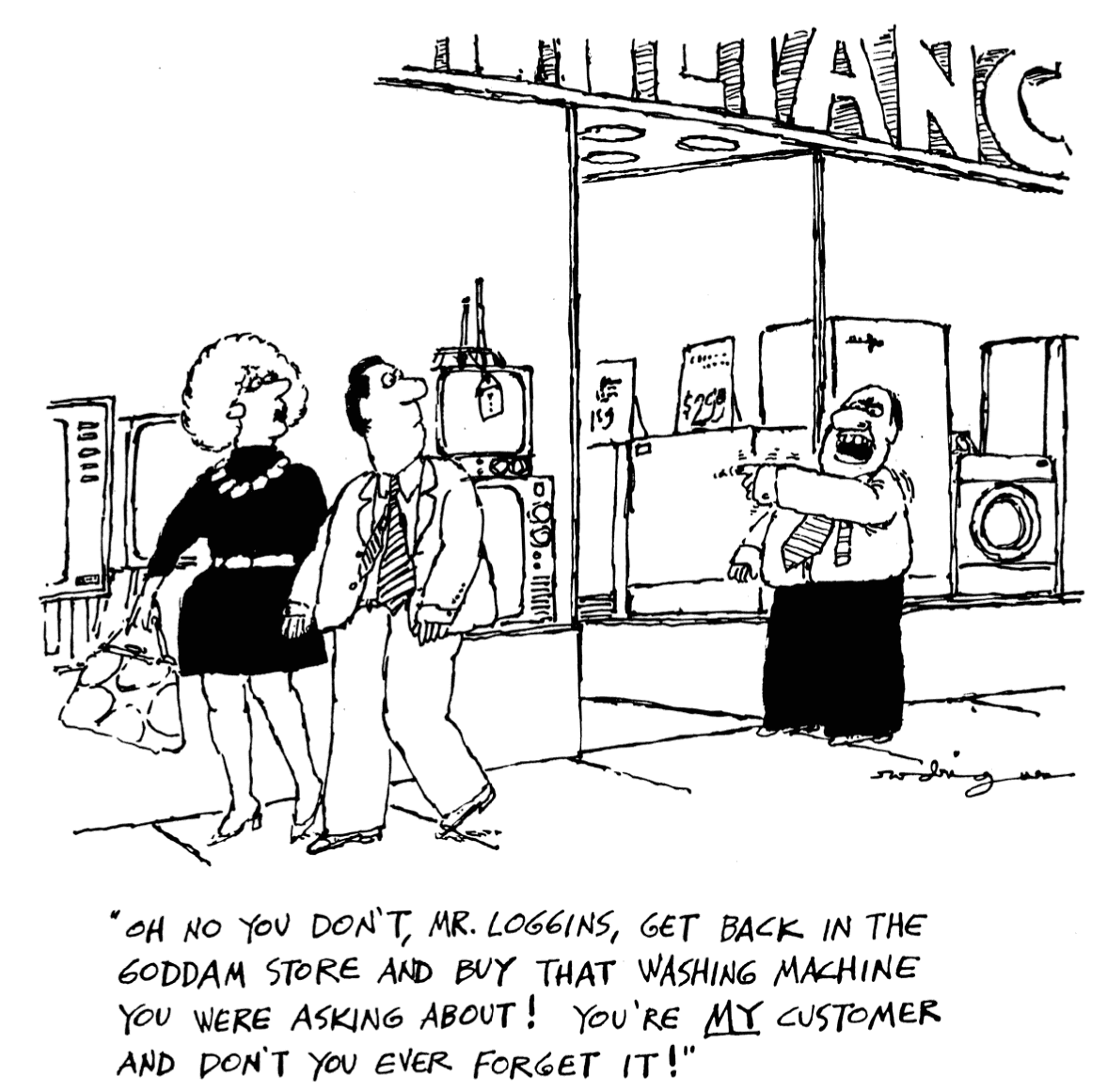
There are other such possessive phrases in the English language, but they rarely create analogous mischief. We speak, for example, of “my wife,” or “my husband,” without assuming, in this modern era at least, that such people can be held to the relationship against their will. We speak of “my tailor” or “my butcher,” without denoting any possessive quality. If the merchant in question picks up stakes and moves to another town or retires or shifts to a different occupation, we might regret the inconvenience, but scarcely feel our rights are violated. Obversely, the merchant may speak of “my customer,” but he knows he has no proprietary rights thereby. If “his customer” goes elsewhere, for any reason, cause or whim, the merchant has no case against him. Nor is it even considered unfair.
In order to see firing without cause from a correct perspective, let us consider divorcing without cause. Most people of good will see our present no-fault divorce laws as a vast improvement over the old system. Previously, in order to divorce a spouse, one had to prove cruelty, or adultery, or some such. Nowadays, one can end a marriage for any or no reason. Would our friends on the liberal left want to push back the clock on divorce law? Hardly.
In like manner, for the employer who wishes to “divorce” his employee, there should be provision for no-fault divorce. That is to say, being fired without cause is not unfair or improper, no more than is being divorced without cause. If the one is a progressive step in human relations, then so is the other.
There is still another difficulty here. This view is asymmetric. Union members and their supporters complain bitterly over being fired without cause. But what about those who quit jobs without cause? If we took this perspective to its logical conclusion, leaving an employment slot without cause should be seen in the same negative regard. After all, the employer may be counting on the continued services of the worker, and in any case, it is “his” employee. Should quitting a job without proper cause be made illegal? No; of course not. The employee should be able to divorce his employer without a by-your-leave from anyone.
Of course, both are justified. Free men have the right to quit their jobs, and they also have the right to fire others—in the complete absence of cause. In the absence of a contract specifying otherwise, employer and employee should each be able to end their relationship whenever they want, for any reason, or for absolutely no reason.
Another important factor to consider in this context is the necessarily limited supply of job security. Who among us does not desire job security for himself, his friends, his neighbors, and his family?
And yet job security is in limited supply, and if some of us have more of it, such as union members and especially those who work in the public sector, then others of us will necessarily have less. True, job security for the entire community can be increased, but only at the cost of greater economic flexibility and retarded economic growth.
How does this work?
Consider an agrarian society of two or three centuries ago, before the onset of the industrial revolution. There were no changes. No innovations. No products suddenly imported from abroad. People were born, lived their lives and died doing things in much the same way for their whole time on Earth. They ate the same food, wore the same type of clothes, lived in the same style of housing and engaged in the same entertainment as in the days of yore.
Under such a system, as can readily be imagined, pretty much everyone in society had job security. With both bankruptcy and the creation of new firms practically unknown, there was much less reason to change jobs. Everything tended to be well-ordered, unchanging and secure.
But nowadays, we live in a time of continuous change. The horse and buggy industry gave way to the automobile. The Southeast Asians can now produce textiles more cheaply than North Americans—with the consequent loss of job security in North American textiles, and other such horse-and-buggy industries. Waiting in the wings are robots, ever more sophisticated computers, genetic engineering, and a whole host of other industries that only science fiction writers would have taken seriously just a few decades ago. All of these new ways of doing things will immeasurably improve our well-being. Indeed, the lives of billions of new human beings will come to depend upon them, in just the same way that those of most people now living on Earth would be impossible were it not for the mechanical and technical breakthroughs we now already enjoy.
But these new inventions will wreak havoc on present methods of production. If we are to adapt to this life-giving progress, job security will necessarily suffer. And if some of us are given enhanced job security, through special and privileged legislative enactment, the burden of adjustment to change will be unfairly shifted to the rest of us.
If people really want additional job security, in a way that poses no threat to the rest of society, let them pay for it themselves: either by accepting lower wages, or by taking out an insurance policy and paying premiums for the privilege of extra job security. So, let us give at least a cheer or two, and, maybe three, for the character played by George Clooney in the movie “Up in the Air.”

