
The Great American Land Bubble
Chapter XVI. Florida—the Latest Phase
THE semi-tropical, semi-submerged State of Florida has ever been an inspirer of fantastic dreams. Ponce de León believed that he would find there the Fountain of Youth. Others who came after him believed that there the rainbow ends, and that merely to stake off a part of its soil would give them access to the fabulous pot of gold. Youth, health, wealth, and freedom from inheritance taxes have been the lures to the sunshine and everglades of this Riviera of America.
Yet, American speculators heard little of Florida until the Spanish king, in 1819, was induced to pass over to the control of the United States this half-sunken and troublesome peninsula. To him it was as worthless as the Sahara Desert. And his “governors” in the territory had granted away its soil with much the same feeling. Millions of acres had been donated under all sorts of pretexts. These “Spanish grants” were almost as troublesome to the United States Government as those in Louisiana and California, and the records of Congress and the courts have been cluttered with the claims to them. Some were upheld, others were denied. Whether legitimate or not, they attracted the land grabbers. Some were assigned to “companies” and “associations” and made the basis of vast land-jobbing enterprises.
One of the largest of the early land claims in Florida was known as the “Forbes Purchase.” An English firm in St. Augustine, under the name of Panton, Leslie and Company, in 1806, acquired from the Creek Indians, with the consent of the Spanish Government, a tract of land east of the Apalachicola River, and bordering on the Gulf of Mexico, in West Florida. Its area in all comprised about 1,400,000 acres. The Indians had “committed depredations” against the firm, and by way of compensation deeded them the land. John Forbes, a member of the firm of Panton, Leslie and Company, succeeded to the claim. It was later acquired by Robert Mitchel and associates. The United States Supreme Court confirmed the title in 1835.1 Soon thereafter the successful litigants organized the “Apalachicola Land Company of Florida,” and founded the town of Apalachicola. In 1842 a patent to the property was received from the United States.
In the meantime, both Indians and squatters had settled on the lands. The latter were driven off by the company, but many settled near by, to start a rival town and a rival land boom. Apalachicola (I must apologize for the name) was developed into a “Gulf port,” with streets, wharves and warehouses. Lots in the city and lands in the interior were offered for sale. Cotton could be grown on these lands and the Apalachicola River offered favorable means of transport. Both the lands and the lots were advertised in New York City. Altogether, there were about 1,800 dwelling lots, 521 business lots, and 43 wharf lots. Sales were extremely slow, however, and many who bought lots and lands on credit terms turned them back to the company. Handicaps to the proprietors were numerous. It was a period of business depression. Occasional storms, moreover, destroyed property of the company, and the neighboring Seminole Indians were from time to time on the war path. Finally, in 1845, the company, or its creditors, auctioned off parcels of its vast property in New York City.
In the meantime, the dispossessed former occupants of the Forbes Purchase were busy boosting their new city of “St. Joseph.” Unlike the Apalachicola Land Company, they had the support of local interests. Various Florida banks became interested in the “Wimico and St. Joseph Land Company.” Ben Charres, a banker and planter of Tallahassee, became its president. With this financial support, they built a short railroad, the first in Florida, from Lake Wimico to Apalachicola Bay. They established the Bank of St. Joseph with $1,000,000 capital; the St. Joseph Insurance Company was similarly capitalized. Other efforts were made to make St. Joseph a modern city and ocean port. The place grew in importance, as indicated by the fact that the first constitutional convention in Florida met there in 1838.
While all this was going on, lots in the town were being sold and resold. Local newspapers were issued as “boosting sheets.” A regular advertising warfare was carried on with the rival town of Apalachicola. The result was that every newspaper of the period in Florida and the adjacent states was filled with material relating to the Wimico and St. Joseph Company. The St. Joseph Times was “the most quoted sheet in Florida.” It had a close “follow-up” in the Apalachicola Gazette.
Conditions in the “boom town” soon began to resemble those of the recent Florida episode. Houses were insufficient to accommodate the increasing population. Rents were extortionate, wages extremely high. Everything might have continued favorable—but, Fate, then as in recent times, brought about a complete collapse. A West Indian hurricane swept over St. Joseph in the autumn of 1840, and almost completely ruined it. In 1841 an epidemic of yellow fever completed the destruction. The town was abandoned. Some of the inhabitants took their belongings and emigrated to Texas. “G.T.T.” (Gone to Texas), a common phrase at the time, as previously noted, was posted on their deserted homes. The place today is as difficult to discover as the ruin of an Aztec temple.2
There were other Florida land companies in these early days, but it is not considered essential to our story to give details regarding them. The Apalachicola Land Company and its rival, the St. Joseph Company, are briefly described merely as evidence that “land booming” and “city building” are old affairs in this region. The Florida real estate promoter in recent years, therefore, did not engage in a pioneer occupation by taking his business to this state. Florida lands and lots in Florida towns and cities have been hawked about for over a century.
Yet, in some respects, the recent glaring episode of land speculation in Florida is a new phase. True, similar outbursts of speculative fever have occurred before. But the field of speculation, when confined to a single state, at no previous period has been conducted with such whole-hearted cooperation by all other sections of the country. From the Atlantic to the Pacific, from the Great Lakes to the Gulf, the people were infected with the Florida mania. Land in Florida—anywhere in Florida—attracted the attention of the whole country, to the almost complete exclusion of land booms, elsewhere. In this respect, the recent Florida land gamble is unique.
How did it start? No one can give a completely satisfactory answer. Yet its origin is not a mystery! For several decades Florida was the nation’s winter playground. From millionaires down to farmers, all classes of the population made vacation visits there. The wheat growers of the West found it an opportune place to pass the idle and dreary months when their lands lay fallow. The capitalists of the North found it a convenient country in which to escape the rigors of severe winters, and to relax from business cares. Florida beaches and Florida camps thus became notable health resorts. The tropical vegetation, and the semi-tropical climate were alluring. It was something different from the environment of almost every other part of the nation.
What could be more natural, then, while passing hours of idleness in this national winter playground, than the purchase of a winter home or a large tract of land there? One becomes “an easy mark” during vacations, and is apt to spend more lavishly and purchase more liberally than when at home. Countless Florida tourists became Florida real estate proprietors. The millionaires bought large estates; the lesser rich bought town and beach lots.
Interest was thus accumulated in Florida real estate. Those who bought told others of their purchases. Millionaires would not be outdone by other millionaires. Rivalry and jealousy led to acquisitions of Florida “estates” and to the engrossment of large and favorably situated tracts. Moreover, the Florida waste and unoccupied lands could be bought relatively cheap, compared with land values in more settled industrial and farming sections. There were immense stretches of undeveloped coast lands and countless acres of untilled soil that were continually on the market. Much of this was held in large acreages by individual owners, and could be readily acquired at wholesale. Florida, in this respect, was “America’s last frontier.”
Because of these conditions, public attention was centered on Florida real estate. Just one large, well-advertised “promotion scheme” could set the pot of speculation boiling.
Another factor leading to the recent outburst of speculation in Florida was the creation of transportation facilities there. The Florida East Coast Railroad, a monumental enterprise conceived as a millionaire’s hobby, was completed in 1900. It opened up for settlement a vast area, relatively unoccupied, in the southern part of the peninsula. As its traffic grew, it enlarged its equipment. Other railroad lines were constructed on both east and west coasts. In addition, new and improved highways were cut through. The Everglades were in process of being drained by state and local appropriations. Steamship lines also aided. Thus, the frontier character of the territory was changed. As in the western country, a “boom” followed the creation of transportation and communication facilities.
The boom was not a sudden outburst. There were rumblings for several years. Vast schemes of development were set on foot. The draining of the Everglades, the building of a canal and harbor at Lake Worth, the development of Palm Beach, the planning of Coral Gables and a hundred other projects gave a favorable setting. The year 1924 marks the beginning of the rush period. It followed the first mass invasion of real estate promoters and “developers,” though many had arrived by means of peaceful penetration for several years previous. The climax was reached in 1925. In 1926 came the collapse.
Who were the instigators of the fiasco, and who were responsible for its execution?
The original promoters were all men of mark. There was Henry B. Plant, who came to Florida as early as 1861, and who built railroads and hotels there. He founded Plant City, a successful real estate development. Next, there is Henry M. Flagler, Standard Oil executive, who visited Florida in 1885. The possibilities of the state as a winter playground were revealed to him. He built at St. Augustine, the Ponce de León and the Alcazar hotels, dreams of massive architecture. His creative ambitions broadened. He built the Florida East Coast Railroad—a marvelous, though foolhardy engineering feat—and adorned its lines with palatial hotels. He also bought heavily of Florida lands. “Flagler Street,” the principal thoroughfare in Miami, and the headquarters of the late, though not lamented, real estate fraternity, is an adequate reminder of this master builder’s benefactions to the Peninsula State. Then, there is Barron Collier, the advertising magnate, who developed a whole county that bears his name. This county was established in 1923 and embraces over 1,200,000 acres. When he acquired it, the land had never been touched by plowshare or other human tools.
Collier started to make his vast estate a garden spot, building roads, draining swamps and establishing a town. He invested his millions in these ventures and persuaded others to do the same by this proof of his faith in them. In speaking of the great future of Collier County, and its increasing population, he once remarked, poetically: “The light of the fireflies will be dimmed by the electric lights in happy homes, and the chirp of the katydids will be chorused by the laughter of happy children.”
Many others contributed to Florida’s expected greatness. The “Great Commoner” and perennial presidential candidate, William Jennings Bryan, made his residence there. Although his limited wealth prevented him from entering upon great development schemes, his contribution was equally effective, for his pen and his masterful voice gave extremely valuable aid and encouragement. Roger W. Babson, stock market forecaster and dispenser of voluminous statistics, also lent a hand. J. C. Penney, merchant and philanthropist, and John and Charles Ringling, circus operators, likewise contributed capital and enterprise, and raised their voices in praise of the Land of the Everglades. Others of this type, such as T. Coleman DuPont, August Heckscher and Jesse Livermore, could be mentioned, but it is not necessary to furnish a full list. When millionaires, statesmen and investment counselors—men of repute, foresight and discretion—added the weight of their influence to the persuasions of ordinary professional real estate promoters, then it was no wonder that the population went mad over the fabulous possibilities of pecuniary gain in the scrub lands and everglades of the Florida peninsula.
Thus encouraged by the aid of shrewd and enterprising capitalists, and by the nascent prosperity following in the wake of the post-war depression, the Florida people vigorously laid out the groundwork of the “boom.” In March, 1925, there was convened at West Palm Beach a meeting of the representative business men from all parts of the state. Needless to say, the “real estaters” and “developers” were there in force. They organized themselves into the Florida Development Board and committed themselves to spend a million and a half dollars or more, if necessary, for publicity during the next five years. They began a series of boosting advertisements, art pamphlets, books and all other devices to attract the fortune seeker as well as the tourist to the confines of the state. Tourists and fortune seekers are almost indistinguishable. Tourists have surplus funds, otherwise they could not travel, and a goodly proportion of those who went to Florida merely for a holiday came back property owners and local taxpayers. One could hardly venture outside his hotel room in a Florida resort without stumbling over a half dozen high pressure real estate salesmen.
The advertising campaign of the Florida Development Board, assisted by the Florida land and real estate mortgage companies, brought to their aid the magazines and the press. Articles describing the allurements of the “American Riviera,” the “Nation’s Winter Playground,” “America’s Winter Paradise,” as well as the immense agricultural, mineral and industrial resources of Florida, appeared in the leading literary and business periodicals. They occupied prominent positions in the Sunday editions and “travel numbers” of the newspapers. At the height of the excited boom, the Saturday Evening Post, the most widely read of American popular periodicals, began a Florida series by Thomas McMorrow and Kenneth Roberts, and continued them at almost regular intervals throughout the period of the boom.3
Even after the “crash” came, following the hurricane which swept away the paper fortunes of multitudes, the “boosting” continued. Florida would not only recover, but a new and greater period of prosperity would be ushered in. “The suckers will not stop coming,” one could almost read between the lines. “They have made only a beginning of buying into Florida. Those who lost their ‘binders’ may be discouraged, but there are others. Suckers are born every minute, and some can still be induced to put their savings in resurrected swamp lands and wind-swept beaches.”
When the host of real estate promoters, gathered from all parts of the United States, concentrated in Florida, then the real boom was on. Most of these mongers were not “to the manor born.” They were like the “carpetbaggers” of the South in post-Civil War days. They came to fill their pockets, not to make the country rich. They cared not whom they duped, nor what became of their projects when once they had unloaded them. The foolish mortals who hung around their “offices,” and paid for “binders,” “options” and “contracts,” were merely fish in their nets. Nor were they, in many cases, merely “crooked dealers.” As already noted, the vast “developments” engineered during the boom period had the backing of great names in present-day financial circles. There were among these men many who transferred their activities from stock market operations or legitimate real estate dealings in settled communities to a field where they saw opportunities of greater profit. When the collapse came, they withdrew and resumed their former occupations.
The methods of unloading lots and farms in the Florida gamble do not differ from those described in the discussion of previous episodes in land speculation throughout the country’s history. Charles Dickens could have depicted Martin Chuzzlewit buying a lot in a Florida “development” in 1925, as readily and in the same language as he did eighty-five years earlier. Of course, every development in Florida was to be a “city,” and the lots were sold before the project was even launched. This is well described by Mr. Walter C. Hill, vice-president of the Retail Credit Company of Atlanta:
Lots were bought from blue prints. They look better that way. Then the buyer gets the promoter’s vision, can see the splendid curving boulevards, the yacht basin, the parks lined with leaning cocoanut trees, and flaming hibiscus. The salesmen can show the expected lines of heavy travel and help select a double (two-lot) corner for business, or a quiet water-front retreat suitable for a winter home. To go see the lot—well,—it isn’t done. Often it is not practicable, for most of the lots are sold “predevelopment.” The boulevards are yet to be laid, the yacht basin must be pumped out, and the excavated dirt used to raise the proposed lots above water or bog level. Then they will be staked, the planning done, and the owner can find his lot.4
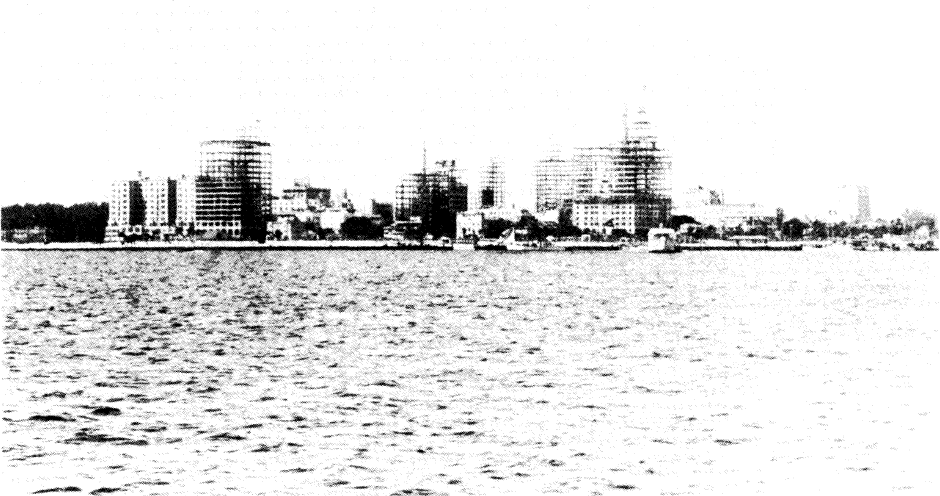
Courtesy of the “Miami Herald”
SKYSCRAPERS RISING ON THE MIAMI WATERFRONT IN NOVEMBER, 1925
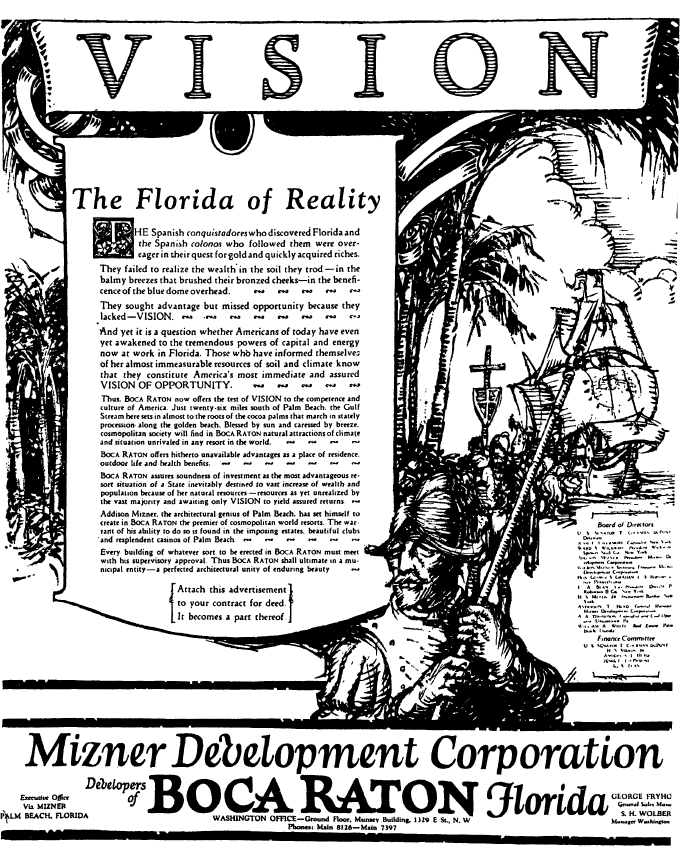
AN ALLURING AND ARTISTIC FULL-PAGE ADVERTISEMENT OF BOCA RATON
Whenever a new “development” was conceived, the promoters immediately advertised it in the newspapers and by handbills, giving descriptions of the location, extent, special features and the approximate prices of the lots. Reservations were made by depositing 10 per cent of the proposed price, and these reservations were taken up in the order received, and attended to before the regular sale of lots was opened. The holder of the reservation was thus permitted to select from a beautifully drawn plan, on which lots and prices were marked, the sites he desired. He then got a “binder,” i.e., an option on the selected lot, which he could resell immediately. This gave him a thrill, for he felt that he was the owner of Florida real estate—even if actually in a swamp—and he hoped to transfer his “purchase” at a fabulous profit to an absentee or latecomer. This quick turnover was frequently a necessity to the “binder-boy” (i.e., the “option buyer”) because he had not the cash required to make the first payment of one-fourth the purchase price within thirty days after the “binder” was issued to him. Speculation in “binders” was a leading occupation in Florida, and those who indulged in it were popularly termed “binder-boys.”
During the height of the Florida boom, the sales of the new “developments” were markedly successful. Around Miami, the “subdivisions,” with the exception of the very large ones like Coral Gables and Boca Raton, were often sold out on the first day of sale. The money values represented in such sales amounted, in many cases, to millions. Inside lots, existing on blue prints only, would sell from $8,000 to $20,000 each, and seashore sites ranged from $20,000 to $75,000. Prices were lower on the inland developments, unless they happened to be located on the Dixie Highway or some other favorite “trail”—then prices mounted again to a point approximating the Miami Beach “subdivisions.” When lots were bought by dealers or local speculators, they were almost immediately offered for resale in the “real estate offices” of the city. Non-residents eventually became the lot owners. Possibly a few may still hold them. However, they are relatively few, since in a great majority of cases the “lot” speculators have defaulted on their purchase contracts. The “developers” have received back their properties, but the sheriff in most cases has made the final distribution; or the municipality or county becomes the ultimate owner through non-payment of the taxes levied upon them. Many tracts purchased for hundreds of thousands of dollars have been released from private ownership because of nonpayment of a few hundred dollars in back taxes.
An enumeration of all the “developments” in Florida during the years 1924-26 would cover many pages. These stretched for hundreds of miles both north and south of Miami. They covered the west coast of the state from the southerly tip up to and beyond Cedar Keys. And fancy names they had, too! The Spanish language appears to have been quite an advertising asset to the “developers.” Pasadena, Santa Monica, Buena Vista, Rio Vista, and other pleasant sounding appellations, so agreeable to Californians, were adopted, as well as names from Italy, such as Naples, Venice, Indrio, Riviera, and those of other famous Mediterranean resorts. Common Spanish terms were even adopted, such as “Los Gatos” (the Cats) and “Boca Raton” (Rat’s Jaw), hideous in the vernacular but, of course, high sounding, since the real meaning was unknown to most of the speculators.
Every important city, town or “development” had its slogan. Miami was “The Magic City”; Orlando, “The City Beautiful”; Hollywood, “The Golden Gate of the South”; St. Petersburg, “The Sunshine City”; and Fort Lauderdale, “The Tropical Wonderland.” Indrio, a development that never “panned out,” was called “Florida’s Newest and Most Beautiful,” although it is still largely a wind-swept stretch of sand and scrub. And Hollywood, “Golden Gate of the South,” leads to nowhere. Coral Gables, the largest of the projected “cities,” was to be the “Venice of America.” To make the slogan effective, its promoters are said to have actually imported Venice-built gondolas, and expert gondoliers were expressly ordered to complete the architectural motif.
One of the means of luring tourists and others into making “investments” was the free motor-bus trips. It was not necessary to hire taxis or use railroad trains to travel in Florida. One could have ridden almost over all the state by merely evincing an interest in real estate. This, of course, is an old “bait,” employed by the real estate gentry of the nation for many years. Truly, the land business has long been on a low ethical plane.
As usual in excited periods of speculation, fraud, villainy and deceit prevailed in the Florida fiasco. The notorious crook, Charles Ponzi, went there to recoup the loss of his ill-gotten gains from his “get-rich-quick” scheme in Boston. He organized the “Charpon Land Syndicate” which claimed it had an option on an undeveloped tract of land “near Jacksonville” (though it was actually 65 miles from the place). He sought to obtain the capital required for “this purchase” by selling “unit certificates of indebtedness” at $310 per unit. He guaranteed a dividend of 200 per cent on each certificate within three months. His real estate activities, however, were cut short, as he was indicted and, on April 2, 1926, convicted for violating the trust laws of the State of Florida.
Another fraudulent undertaking was the “Florida Cities Finance Company,” which promoted “Fulford by the Sea.” Its founder was also apprehended and jailed, along with a number of other downright swindlers who were trailed through the efforts of the National Better Business Bureau and the United States Post Office Department. Both before and after the collapse of the boom, there were hundreds of arrests, convictions, suits and countersuits growing out of the frenzied real estate transactions of the period.
All this naturally could not go on without attracting public attention. The sober-minded element of the nation’s business men looked upon it with amazement and scorn. Occasional and sporadic warnings were issued, and attempts were made to stem the tide of wild speculation. The Massachusetts Savings Bank League, in November, 1925, issued a statement cautioning depositors not to withdraw money to speculate in Florida real estate. The Investment Bankers Association set aside a whole session of their annual convention to consider means of checking the wildcat land gambles. Their members complained of loss of business due to customers placing funds in Florida lands and in buying Florida 8 per cent mortgage bonds, advertised with the slogan “where the security is a certainty.”
To all this the Florida “boosters” naturally objected. When the secretary of the National Credit Association pointed out the danger of inflated Florida credits, the Florida Credit Association petitioned for his removal from office. The Better Business Bureau of New York City, late in 1925, began a thorough investigation of questionable Florida “developments,” and its revelations were labeled by the Florida “boosters” as malicious and false propaganda.
Thus, the Florida real estate fraternity did not stand idly by when these warnings appeared in the press and other publications. They also had their defenders. By way of outside support there was organized in New York City, in 1925, a Florida defense association, composed of speculators and dealers in Florida real estate. W. W. Rose, the president of the Florida Real Estate Association, and his associates were “on deck” whenever a statement or an address, traducing the practices and motives of his constituency, appeared. They built up elaborate defenses. A sporadic break in security prices on the New York Stock Exchange in February and March, 1926, was seized upon by them as an object lesson. “Isn’t it better,” they pointed out, “for the public to invest in sound real estate values than in fluctuating and questionable securities?” A loss of four billion dollars in stock market values occurred in one month! Such a loss, they pointed out, could never occur in Florida real estate. There, “security was a certainty.”
Special newspapers and magazines were published, and books were written and widely distributed, defending the “boom.” Charles Donald Fox, in The Truth About Florida, published in December, 1925, when the bubble had expanded to maximum proportions, (as stated by Mr. Meryle Stanley Rukeyser, who wrote his “introduction”), endeavored to perform “a useful task in making available ascertainable facts about climate, soil, other natural resources and traffic conditions.” Yet Mr. Fox boldly stated in his text: “I believe the so-called ‘boom’ will last forever, for there can be no let-up to the development of a state which offers so much to so many classes of people.”5 And he added: “Let me record once again. There is no boom in Florida. The state is merely doing in a few years what it would ordinarily take decades to do. It is doing all this on a permanent basis. It is building for the future. It is turning the tables on the usual development procedure—it is speeding up the future and making it the present.” Of course, Mr. Fox did not take into consideration hurricanes and financial panics, which retard the future and agonizingly prolong the present.
No less extravagant is the language of another inspired volume, entitled Florida in the Making, published less than a year later, and written jointly by Frank Parker Stockbridge, a Florida real estate operator, and John Holliday Perry, a journalist. In a “Foreword,” John W. Martin, then governor of Florida, pointed out that the authors have not merely written a book, “they have performed a public service, the value of which cannot be overestimated,” and he adds: “No one can read ‘Florida in the Making’ without being convinced that all which has yet been done in Florida is but a beginning towards what is to come.”
The authors, however, did not, as Charles Donald Fox had done, answer directly the question: “Will the Florida boom continue?” But they point out some pertinent facts, as follows:
The question which skeptics are asking everywhere is “When will the Florida boom collapse?”
Men asked the same question in George Washington’s day about the Ohio country, when Cincinnati was as young as Miami is today. They doubted in Lincoln’s time whether Iowa land prices were not too high. Forty years ago one could hear dire predictions of the imminent collapse of a “boom” town on Lake Michigan, called Chicago. Only recently similar forecasts were being broadcast of the ultimate fate of Los Angeles and all southern California.
Florida’s boom differs only in detail from all the other land booms which, added together, comprise practically all there is of consequence in American history. Geography and topography are different; principles and methods are unchanged. The historical test serves, then, as the horoscope to resolve one’s doubts withal. Nobody who bought and held on in Ohio, in Iowa, in Los Angeles or Chicago, lost, all made profits. “Shoestring” speculators, investors who lost faith, lost out on the temporary setbacks which all the historical land booms have experienced. Many more, those who acted on the time-honored Wall Street axiom that nobody ever went broke by taking profits, got in and got out on the successive upward waves, taking out more than they put in. But the solid backbone of every land development is the settler. Fluctuations in money value of his land do not affect him, if the land yields him the comfort of the livelihood he seeks.6
All this is very well! But land speculators do not care to wait a quarter century or more to bring real values up to the level of the inflated values which they themselves create in boom times. Fortunes have been lost, not made, by buying and paying for future values, without taking into consideration the accumulation of interest, taxes and other expenses that have only Death as a companion factor of certainty. Manhattan Island may have been worth more than the twenty-four dollars in merchandise the Dutch paid for it, but the shrewd Hollanders would never have been willing to look ahead a hundred years or so, and pay the Indians a price which it might then be worth.
The arguments of the peerless orator, William Jennings Bryan, and the renowned forecaster, Mr. Roger W. Babson, were not less convincing than those contained in the writings already mentioned. Mr. Bryan pointed out Florida’s qualities as an earthly paradise and as a place of high moral and religious culture. Mr. Babson stressed especially Florida’s wonderful economic possibilities: “Some feel that Florida is being overdone,” wrote Mr. Babson in 1926, “but, based on the history of other sections of the country, I believe that the great movement in Florida has only started and that values in many sections will double, triple, and quadruple during the next eight years.” Accordingly, he, in company with a host of other commentators, was firmly of the belief that the marvelous development of Florida in the boom years was “just a preliminary of the marvelous development that lies before it.”7
Bryan’s boosting talk was hardly less moderate. “The cities in Florida are friendly rivals,” he wrote in a companion article to Mr. Babson’s, “but they are united in the determination to make Florida one of the foremost states of the Union, and they are anxious for the State to be a leader in education and morals as they are that the State shall lead in material progress.”
Undoubtedly, some instigators of the Florida boom, especially those who bought and resold early in the proceedings, realized handsome profits. Several “millionaire winter residents,” who previously had bought estates merely for their personal enjoyment, later sold to “developers” with fabulous gains. On the other hand, others who contracted the speculation fever, and endeavored to undertake developments on their own account, lost heavily. But aside from individual gains and losses, the boom period was one of great prosperity in Florida. Its wealth, as measured in current values, increased in a short period of two years to tremendous proportions. From 1923 to 1926, the state’s population (possibly, excluding the “immigrant” real estate salesmen) increased from 1,057,400 to 1,290,350, or 22 per cent, and bank deposits from $225,000,000 to $850,000,000. Assessed valuations rose in proportion, and building operations in two years quintupled. The transportation facilities were inadequate to handle the passengers and goods which poured into the state in the excited days of rising real estate values. The effect was a high cost of living, high rates of wages and inadequate living quarters.
When these obstructions to material progress were being seriously encountered, the clouds of recession began to gather on the horizon. The frenzied activities of the summer and fall of 1925 were carried over into 1926, but the eagerness of speculators to bid up values began gradually to disappear. The “developers” and “boosters” endeavored in vain to maintain the speculative interest in their undertakings. The municipal authorities assisted, and large issues of public obligations were floated to carry out improvement plans. The borrowing “cities” were, however, soon unable to meet the interest burden on this new indebtedness.
These efforts were being strenuously put forth, when the same benign Nature which made Florida the “Land of Flowers” and “An Earthly Paradise,” reversed the process. As in years past, on September 19, 1926, a terriffic West Indian hurricane blew over the southern portion of the peninsula and interrupted the dreams of “easy money” which the very atmosphere seemed to have engendered during the preceding three years. The debacle was complete. The hordes of real estate developers, high pressure salesmen, feature writers and private “investors,” which had invaded the territory “in Pullmans and Packards,” were now confronted with desolation and despair. They hastily departed.
The banks were drawn on heavily, and their swollen deposits faded away. From a high level of $850,000,000 at the end of 1925, deposits in Florida banks dropped to $550,000,000 at the end of 1926, and reached still lower figures thereafter. An epidemic of bank failures was the result. Florida real estate mortgages, with “security a certainty,” were a drug on the market. One “development” after another lapsed. Instalment payments on lots practically ceased. The bubble had burst!
There were a few attempts at resurrection. The state authorities even decried the publication of the extent of the hurricane damage, because of its discouraging effects on land values. An effort was made to turn away the Red Cross from its relief work. Newspapers and magazines were told that Florida’s marvelous progress would continue. A typical statement was contained in the Wall Street Journal, October 8, 1926. It quoted Mr. Peter O. Knight, of Tampa, counsel of the Seaboard Air Line Railway, as saying: “The same Florida is still there with its magnificent resources, its wonderful climate, and its geographical position. It is the Riviera of America, and always will be, within twenty-four hours or less, of eighty millions of prosperous people, and the same causes which developed Florida so rapidly in the last few years, will cause a greater and more permanent Florida to be developed in the future.”
.....
Among the many magnificent schemes of modern city building, with real estate speculation as the prime motive, two projects stand out prominently in the recent Florida boom. These are “Coral Gables” and “Boca Raton.” Both are remarkable for the magnificence and the tremendous enterprise with which they were developed. Both have failed in the execution of the original grandiose conception as outlined by the promoters.
Coral Gables is the older, and was nearer to completion when the collapse came. It was originated by George Edgar Merrick—a native Floridian, who as a boy dwelt on a farm not far from Miami. According to an inspired booklet, beautifully illustrated, and under the authorship of Rex Beach, the novelist (though it is copyrighted by Merrick himself), “the boy Merrick listened, and as he grew older, his dream took shape. He built a city. His city is set among pines and palms, and flaming poincianas, and he called it Coral Gables. It is indeed a city of coral gables, and of soft tinted coral walls. Upon the fields he used to till, the stones have blossomed; those ragged stubborn rocks he used to curse, he has called to bloom into an eternal flower.”
Merrick, in his early development activities, received the financial support of local interests. His first idea was an exclusive inland suburb. As his plans developed, and as the oncoming boom caused a rapid growth of Miami,—“like a tropical weed,”—the project was expanded into a sea-front community, with forty miles of beach land. It was to be a “modified Mediterranean—a new Venice, with silent pools, canals and lagoons,” and even more beautiful, since no lot purchaser was allowed to put up a dwelling or other structure in it that would destroy the harmony of the general design. And, above all, it was to be a complete city, with business zones, with workers’ districts, and with favorite locations for the rich and well-to-do. The “development,” therefore, broke away from Miami, and received a city charter.
Thus, Coral Gables “was worked out with pencil and ruler,” and nourished with widespread publicity.8 It became the show-place of Miami. It resembled, in one aspect, a real estate exchange, and in another, a great county fair. Entertainments, concerts, lectures, all the old-time “booming” accompaniments, were resorted to. The “Hon.” William Jennings Bryan was employed to deliver his masterful orations there almost daily. In these he stressed the high moral and religious tone of Florida, along with its fine climate and its excellent resources. It was worth the price of a lot to hear him,—and if the urge to “buy at once” overtook any of his audience, the high pressure real estate salesman was near to take advantage of the psychological moment. The old “land office business” was revived in a new atmosphere. And Florida—“America’s Last Frontier”—was bursting its seams. To make more room for expansion, the “underwater” acreage was also offered for sale and settlement, and magnificent islands created out of the ocean’s depths.
George Merrick and his associates planned to spend “ten years of hard work and a hundred millions of hard money” to complete the enterprise. Every effort was made to conceal the commercial aspect by romantic and æsthetic surroundings. “Gondolas from old Venice had been ordered to this New Venice,” remarks Rex Beach. A university built in antique mission style was planned. “Beauty draws more than oxen,” exclaims (on paper) the inspired author. But he does not say that dollars are drawn in by Beauty.
When the Coral Gables enterprise expanded both in concept and in area, its promoters organized “Coral Gables Consolidated, Inc.” to take over the enterprise, with Merrick as its president. This corporation went heavily into debt. When the fever of speculation began to wane in the spring of 1926, the concern experienced difficulty in disposing of lots. Then the cruel wind came. It blew through Coral Gables and swept away hopes and fortunes. The financial difficulties of Coral Gables Consolidated, Inc. increased. Its officials sold the street railways, the golf fields, the swimming pools and other attractions to the city which they had chartered for this purpose, and which the promoters continued to operate under the guise of “a city commission.” Under its municipal charter, the city of Coral Gables was given the most liberal power to incur indebtedness of any similar body politic in the country. Its debt could equal 25 per cent of its assessed valuation. Accordingly, the “city” issued municipal bonds to pay for the “improvements” it acquired, and in this way supplied the promoters with cash. But the financial difficulties persisted. The promoters then threatened to compel the former lot purchasers, by judicial proceedings, to continue their payments. They preferred to have cash rather than the real estate, which they, but a short time before, had advertised as an investment of certain and ever-increasing value.
All this was of little avail. Bankruptcy was the outcome. Altogether, $150,000,000 is reported to have been expended on Coral Gables in building and development, about half by the development corporation and about half by private investors. The money lost by lot purchasers and speculators amounted probably to larger sums. And to these losses might be added the cash invested by the unfortunate purchasers of the Coral Gables municipal bonds.
No less magnificent in proposed splendor, in artistic conception, and in high ideals, was the second of the leading “developments”—“Boca Raton.” An architect, who had lived in Spanish America as a boy and who was attracted by the harmonious designs of the rich dwellings there in relation to the tropical surroundings, established his business in Palm Beach in 1918. He was Addison Mizner. His plans for fine residences in this luxurious and exclusive pleasure resort soon gave him a national reputation as an architect. When Coral Gables, built upon “Mediterranean models,” bid fair to become a successful and profitable undertaking, the architect and his associates conceived the idea of establishing a still more elaborate “development” twenty-four miles below Palm Beach. They organized the “Mizner Development Corporation.” Its directors comprised names of high social and financial standing. Among them were ex-United States Senator T. Coleman DuPont, Jesse L. Livermore, capitalist, Hon. George S. Graham, United States Representative from Pennsylvania, Ward S. Wickwire, prominent steel manufacturer, and L. A. Bean, vice-president of Dwight P. Robinson & Co., New York realty operators. “World leaders in finance, society and arts, establish an international resort on the Florida East Coast,” reads the headline of the first full-page newspaper display advertisement of the project. Another stated: “The public has demonstrated its faith in the men and women back of Boca Raton. Its confidence in the future is assured to Boca Raton by the social standing and financial solidarity of its sponsors . . . Your decision to invest now is justified by their investment hitherto. Act now and every day will justify your decision.”
As to the architecture and beauty of the “development,” why, it was to be entirely “mizneresque.” “Boca Raton will surpass in exclusiveness any resort on Florida’s East Coast. But the democracy of Addison Mizner has provided large and well selected bathing beaches, golf courses, and tennis courts, aviation field, polo ground and dock rights for the use of all. No existing world resort of wealth and fashion compares with Boca Raton, and never before has there been offered such opportunity of financial reward through early participation in a Florida enterprise.” And so on, until the sad end.
The lots in Boca Raton were offered in May, 1925, when the whole affair was still on paper. Purchases, the first day, are reported to have amounted to $2,100,000. In the first fourteen weeks more than $14,000,000 in value was sold, says a full-page display advertisement. It was not necessary to go to Florida to buy. Elaborate offices were opened in the principal cities. In Washington, the Mizner Development Corporation occupied the whole ground floor of a prominent office building, and its offices remained open day and evening.
The Boca Raton plan proposed the construction of a RitzCarlton Hotel, costing $6,000,000. Only a small hotel was opened in 1926. There were to be lagoons and canals, and, as in the case of Coral Gables, gondolas and gondoliers were to be brought from Venice. Every structure in the development must conform to the uniform plan of the general architecture. It was not to be “a crowded commercial center” or “an addition, however worthy, to an already existing community. It is a cosmopolitan world community.”
Difficulties, however, developed more rapidly than the building operations. In November, 1925, the Finance Committee of the Mizner Development Corporation, comprising leading capitalists, resigned. They objected to the “management.” On January 22, 1926, application was made to put the company in receivership. This was dismissed by the court, but it was merely a short delay. The insolvency was admitted soon afterwards. Thus, another “Dream City” proved to be only a “dream.”
Not all the speculation in the Florida boom was concerned with city development and beach and underwater lots. Owners of large tracts of hitherto waste lands took advantage of the opportunity to rid themselves, at tremendous profits, of their holdings. Everglade lands, which were not worth the tax payments on them, were eagerly bought up and divided and resold at from $5 to $100 or more an acre. Schemes were put on foot to encourage rural settlements in this “last American frontier.” Mr. J. C. Penney laid open to immigrants—who were expected, however, to come in Pullmans instead of covered wagons—his “Penney Farms,” located in Clay County, thirty miles from Jacksonville “in the heart of a rich agricultural district.” His was not an ordinary land settlement scheme. “I came to believe,” he stated in a public address in 1927, “that under the same principle [as conducted in his stores] men could be found to take up tracts of land, and given a certain amount of expert guidance, keep their farms up to a standard and made to succeed.” He offered plots in 2½, 5 and 20 acres, cleared and plowed at least once, and placed all under the guidance of the J. C. Penney-Guvin Institute of Agricultural Science. He also established coöperative marketing.
Thus, philanthropy, as well as profit, was back of investments in Florida. Barron G. Collier, and also the retired circus proprietors, the Ringling Brothers, likewise carried on agricultural land development projects. The growing population of Florida, the rapid increase in the size of its cities and the improvement in transportation facilities, it was pointed out, would make Florida agricultural lands of as great value as those surrounding the large population centers of the North and West. Needless to say, hundreds of land companies were born almost overnight to exploit this conception of increasing value of the soil. Many of these concerns were fraudulent or partially fraudulent in their operations. They sold everglade and waste lands which are practically worthless for immediate cultivation. Much of this soil has again become the resourceless property of the state authorities, since the private owners have been surrendering them one after another for tax arrearages.
Such is the story of the Florida Boom—the latest phase in a long series of cycles of land gambling and town jobbing, which has marked American business annals almost from the time of Columbus to the present day.
9 See Mitchel, et al, vs. United States, 9 Peters 740.
10 See Quarterly of the Florida Historical Society, April and July, 1927.
11 Mr. Roberts’ articles were subsequently published in a book entitled Florida, published by Harper & Brothers, 1926. It points out the pitfalls as well as the allurements. Mr. McMorrow, however, seems to have been infected with the “boom fever.”
12 Published by the Retail Credit Company of Atlanta, September, 1925.
13 The Truth About Florida, p. 12.
14 Florida in the Making, p. 286.
15 See “Florida, Old and New,” 1925-1926, p. xix et seq.
16 For a description of the methods of the Publicity Department of Coral Gables, see T. H. Weigall, Boom in Paradise, especially Chap. IX.
- 1During the first hundred years of North American colonization, economic conditions gave little encouragement to private land schemes. Land was too plentiful. A few such enterprises were undertaken, however. Thus, as early as 1661, the Colony of Massachusetts sold to a few individuals for £400 a large tract on the Kennebec River in Maine. This became known as the “Kennebec Purchase.” The heirs held it for nearly a century without doing anything with it. In 1753, they incorporated as the “Proprietors of the Kennebec Purchase” and proceeded to dispose of their holdings. The corporation continued in existence until 1816. “The Pejebscot Company” was another Maine land deal. None of these held out promise of profit to proprietors until about a quarter century before the Revolution.
- 2In the meantime, the “Loyal Company” group was not idle; its proprietors sent Dr. Thomas Walker, of Albermarle, Va., to make a reconnaissance, and to discover a proper place of settlement. The two “companies” then became engaged in a controversy, and neither made a survey or fixed the bounds of their grants. The apparent ease with which they obtained land donations led to other schemes, and aroused an epidemic of interest in distant western wild lands. Not only was the land ownership eagerly sought after, but the establishment of new colonies, with separate and distinct governments, was planned. Favoritism and collusion infested the Virginian colonial government, due in large part to the persistence of speculators in western land grants. Lobbyists were sent to London to obtain the crown’s sanction to land-grabbing schemes and the question of the disposal of the vast western domain won from the French infested British politics. “One half of England is now land mad,” wrote George Croghan, of Philadelphia, one of the land schemers, to Sir William Johnson, on March 30, 1766, “and everybody there has their eyes fixed on this country.”
- 3I offered in my last to join you in attempting to secure some of the most valuable lands in the King’s part, which I think may be accomplished after awhile, notwithstanding the proclamation that restrains it at present and prohibits the settlement of them at all; for I can never look upon that proclamation in any other light (but this I say between ourselves) than as a temporary expedient to quiet the minds of the Indians. It must fall, of course, in a few years, especially when those Indians consent to our occupying the lands. Any person, therefore who neglects the present opportunity of hunting out good lands, and in some measure marking and distinguishing them, for his own, in order to keep others from settling them, will never regain it.
- 4Crawford “heartily embraced” the colonel’s offer. He promised shortly to set out in search of lands. “This may be done,” he said, “under a hunting scheme.” He acknowledged that other land seekers had approached him, with similar offers, “but have not agreed to any; nor will I with any but yourself or whom you think proper.”
- 5Judge Richard Henderson of North Carolina, the employer and backer of Daniel Boone, promoted the settlement of the Kentucky region and claimed ownership to a vast unsettled tract there. He organized a group of land grabbers under the name of “The Transylvania Company.” Ignoring the British interdiction against Indian land purchases, he obtained from the Cherokees in 1773 about one-half of the present State of Kentucky, and immediately began settling the land. He advertised widely for pioneers and “shareholders.” In his announcements, Henderson waxed enthusiastic. “The country [Transylvania] might invite a prince from his palace, merely for the pleasure of contemplating its beauty and excellence, but only add the rapturous idea of property, and what allurements can the world offer for the loss of so glorious a prospect?”
- 6When the British Government began to take active measures to break up land “bootlegging,” and to put a stop to dreams of riches in western territory, Virginia’s political resentment was naturally aroused. Even Thomas Jefferson, who, in later life, frowned upon speculation and land grabbing, held the view in 1774 that the land did not belong to the British king, and that it was time for the colonies “to declare that he has no right to grant lands of himself.” So he boldly wrote in the Declaration of Independence, as one of the British king’s usurpations: “He has endeavored to prevent the Population of these States; for that purpose obstructing the Laws for Naturalization of Foreigners; refusing to pass others to encourage their migrations hither, and raising the conditions of new Appropriation of Lands.”
- 7He was for it at once. “I like the project of a colony in the Illinois Country,” he wrote his son, “and will forward it to my utmost here.” He thought that Sir William Johnson’s “approbation will go a great way in recommending it, as he is much relied upon in all affairs that may have any relationships with the Indians.” But Johnson had an eye on the Indian lands himself, and besides advising others about purchases in the outlying sections, personally through gifts from the Indians engrossed large tracts, particularly in the Mohawk Valley. The town of Johnstown, N. Y., still marks the seat of his domain.
- 8Some of the members of the Vandalia Company were concerned in other western land schemes. One of these was organized in 1775 as the “Indiana Land Company,” probably the first application of the name “Indiana” to the Northwest Territory. The claim to land was based on a grant of a large tract, made November 3, 1768, in what is now West Virginia, by the Six Nations at Fort Stanwix to “Chief” William Trent in liquidation of depredations. Among the shareholders were Samuel Wharton, Joseph Galloway, Robert Callender, Levi Andrew Levi, and David Franks, all wealthy and prominent Philadelphians. The Revolutionary War did not put an end to the “claim.” Wharton in 1776 published a pamphlet, entitled-View of the Title to Indiana, in which he defended the company’s rights to the lands. In 1781, he republished this in enlarged form, under the title Plain Facts; being an examination into the Rights of the Indian Nations of America to their respective Countries and a Vindication of the Grant from the Six United Nations to Proprietors of Indiana, etc. Although Wharton pressed the validity of the “proprietors” claims, Congress then and thereafter gave little heed thereto.
- 9Maine Historical Collections, Vol. II, pp. 268-294.
- 10The Sir William Johnson Papers, Vol. V, p. 129. See also, C. W. Alvord, The Mississippi Valley in British Politics, Cleveland, 1917.
- 11Herbert B. Adams. “Washington’s Interest in Western Lands,” Johns Hopkins University Studies, Third Series, No. 1, January, 1885. Italics are mine.—A. M. S.
- 12Adams, op, cit., p. 58.
- 13See A. Henderson, “A Pre-Revolutionary Revolt in the Old Southwest” in Mississippi Valley Historical Review, Vol. 27, p. 198 et seq.
- 14Italics are not in the original.
- 15In a letter to William Franklin, dated May 3, 1776, Johnson asserted “it has always been my practice to avoid engaging in lands to the great loss of my family, neither have I a foot of land from the Indians.” (Sir William Johnson Papers, Vol. IV, p. 197.) The large tract north of the Mohawk Valley given him by the Canajoharie Indians in 1760 was confirmed by royal grant in 1769.
- 16See Pennsylvania Magazine of History, Vol. XIV, pp. 218, 219.

