
The Great American Land Bubble
Chapter X. The Texas Fever
IT WAS mentioned in the previous chapter that the Austin family, which had resided for several decades in Missouri, became impoverished. Their mining property at Mine-a-Burton was taken away; their investment in bank shares was unfortunate, and their land speculations, including the New Madrid fiasco, were failures. Things became so bad that the father, Moses Austin, wrote his son-in-law on April 21, 1821, that he was “without a dollar to get his shirt washed.”
In this situation, the old pioneer, who had trekked from Connecticut to western Virginia, and then into Spanish Upper Louisiana, again sought a new field to repair his fortunes. He was disgusted with the American régime. It had taken away his grant and otherwise treated him unfairly. “As I am ruined in this country” [i.e., United States], he wrote his son, “I found nothing I could do would bring back my property again, and to remain in a country, where I had enjoyed wealth, in a state of poverty, I could not submit to.”
Off to a new country again! Hearing that the old Spanish system of granting land to colonizers or empresarios was still in vogue in Texas, where Spain continued to rule, he set out in October, 1820, for the southwest wilderness “with a gray horse, a mule, a slave boy, and fifty dollars in cash.” On December 23, 1820, he arrived in Bexar, then the capital of the Mexican province of Texas and there presented his petition for a land grant. He received little encouragement, however, and was about to return dejected, when he happened to meet an old Louisiana acquaintance, none other than Baron de Bastrop, who, to escape his American creditors, had fled to the Spanish domains. De Bastrop, though poor, was politically powerful in the province, and he intervened in Austin’s behalf. The petition was then received and approved, but it was necessary to await its confirmation by the Spanish governor. In the meantime, Austin set out on his return journey, and after much suffering and privation, reached home on March 23, 1821. He died shortly thereafter.
Stephen F. Austin, his eldest son, was then in New Orleans, looking for a means of livelihood. When he heard of the death of his father, and learned that the grant had been confirmed by the Spanish authorities, he decided to carry out the colonization scheme. The grant was for a tract of two hundred thousand acres on the Colorado River, about two hundred miles from Natchitoches, the American western border town. Three hundred families were to be settled on the grant, after which the unappropriated land was to go to the empresario as a premium. It was this premium land, together with the “commissions” charged settlers, that was the bait Austin sought.
But he was without funds. He needed financial backing. It came in the form of a partnership with Joseph H. Hawkins, who had befriended him in New Orleans. With money furnished by Hawkins for a half-interest in the venture, Austin bought and fitted out a small vessel and engaged a number of emigrants to sail to Texas.
In the meantime, he was advertising his proposed colony. Notices of it appeared in the newspapers of the Mississippi Valley, and aroused great interest. The news of the venture spread south, east and north. Applications from emigrants began to pour in. These came from Maryland, Virginia, Tennessee and more distant places. A large number came from the neighborhood of the Austin’s old home. Stephen Austin and his brother-in-law advertised the project in the neighborhood, and as times were then hard in the lead mining districts of Missouri, many residents were eager to join. His old mother wrote him encouragingly that “the Texas fever was raging,” and expressed a desire to join him “in Texas.”
Before leaving to take up residence among his colonists, Austin issued an open letter describing the plan and purpose of the project. The colonists were to be given land in accordance with the size of their families and the number of their slaves, if any. They must settle on the land and make improvements thereon within a year. Colonists were also expected to provide themselves with arms, materials and stores. Each was to pay $12.50 per hundred acres, payable in instalments, in return for which his land was to be surveyed and his colonization papers drawn up.
It was this “commission fee” which brought criticism upon the project as a land-jobbing scheme. The public did not know then about the “premium lands,” but there was considerable suspicion that there was a lure of this character to induce the promoters to carry out the venture. Moreover, it was generally known that one of the reasons why the Mexicans desired settlers in the wilds of Texas was to keep off the Comanches and other savage tribes which threatened the country. The Comanches were the arch enemies of the Spaniards, but were favorably inclined towards Americans. Yet, the settlers had to be continually prepared against Indian attacks, and occasionally were in Indian fights. Probably some of them liked this excitement.
Austin, from time to. time, during the early period of colonization, issued public statements denying the speculation motive. In a public address to his colonists issued June 5, 1824, he vigorously defended himself against profiteering:
It has been objected . . . that I am making an immense fortune . . . a great Speculation out of the Settlers. Let us examine carefully this subject by the application of Arithmetical calculation to it, and see what appears to be the result. The Surveying Averaging One League with Another, and taking the bends of the Rivers and Oblong Leagues, will cost about $70 per League, which for 300 would be $21,000.—The Taxes, due to the Government . . . is $165.4 cash on each league, which for 300 (is) $49,600.4 making together $70,660.4 to which I made myself personally responsible . . . To raise this sum, I should have had claims on the settlers for $555 per League, which for 300 would have made $166,500 payable in property at a distant period and in small instalments, and that property received for double or treble what it would actually bring in Cash.1
In another publication issued from San Felipe de Austin, the seat of his colony, in 1829, he again refuted the accusation of profiteering. “It is very evident,” he wrote, “that mere speculation was not the object, as some have stated, for little would be left, at best, after paying the expense of surveying, the office fees, the commissioner’s fees, the stamp paper, and defraying the necessary expense. . . . The object, therefore, must have been the general good of all, and not the private speculation of one individual.”2 Regarding the fee of $12.50 per hundred acres, he “considered that he was justly entitled to a remuneration for his labor and expense,” and he ran the risk of “not saving something for himself, out of said funds.” His father also had spent much time and money in the enterprise, “besides privations.”
However, as Austin noted incidentally, the contracts of the colonists to pay the fee for their lands were rarely carried out, so he had to depend on the “premium lands,” under the general colonization law of Mexico, to cover his costs.
Yet, in spite of these protestations, there is evidence that Austin originally undertook his colonization project as a speculative land venture. It was the “premium lands” allowed the empresario under the Mexican colonization law that he looked for as a profitable reward. In giving instructions to his surveyor in 1823, when the required 300 families had not yet arrived, Austin asked the favor that he “select some good places for me, say about six or eight league tracts. . . . It will be a real service to me if you can do this, and mark them, and let it be known that they are reserved . . . also to find the best place for a town . . . it will be valuable at some future day . . . also, I want a good situation on some creek where there is a body of good land suitable for a stock farm . . . also some good mill seats, if it can be had.” And then, by way of justification for these preëmptions, he adds, “It is no more than just that I should have a pick as well as others. . . . I have too much public business to attend to, to do anything for myself and must call on friends to aid me.”3
Austin’s partner, Joseph H. Hawkins, who financed the first colony, certainly had a profit-making view of the venture. Because of financial troubles coming a short time after he had advanced funds to Austin (estimated by his heirs at about $30,000), he was eager to cash in. On February 22, 1822, he wrote Austin, “After your 300 families are introduced, would it not be well to raise the price of your land? Perhaps my own necessities have led to this view. I am bent down almost to the ground. Of the $7,000 advanced for the Providence [a vessel], I have not one cent return. . . . If I could obtain through your efforts the means to pay my debts, I would join you immediately and spend my life plowing the soil.” And by way of encouragement to Austin, he added: “You and your colony excite more interest than the assembled sages of the Nations.”4
Austin’s many difficulties at colonizing prevented him from raising cash to meet the needs of his impoverished patron and partner. The latter died in 1824, and his widow, and children, moved to Kentucky to “accept charity of her sister.” Moreover, before Austin could settle his colony, Mexico threw off the Spanish yoke and he had to go to Mexico City, at Hawkins’ expense, to get a new confirmation of his grant. He remained there many months, and made or renewed the acquaintance of General James Wilkinson who, like himself, was in Mexico City for the purpose of obtaining a domain in Texas. A number of other American and foreign land jobbers, under the guise of promoting colonization schemes, also were present or had agents in the Mexican capital. One of these was General Arthur G. Wavell, an Englishman who had been a general in the Chilean War of Independence, and who became an officer of the same rank in the Mexican forces. At this time, however, he was seeking land. He became very friendly with the young empresario, Stephen F. Austin, and entered into an agreement with him to share equally all lands granted to either, with the exception of the grant which Austin already held jointly with Hawkins.
Thus, Austin had in view more Texas lands. Wavell set out for England to form a company to obtain the necessary capital. While at sea, his vessel was waylaid by pirates. This delayed matters somewhat, but on his arrival in London he took up the proposition with several capitalists without success. He could do nothing because Austin had no fee title to lands, so the effort to get British financial assistance failed.
When Austin returned to his colony from Mexico City in 1823, he became somewhat discouraged regarding the profitable outcome of his venture. His colony was a success. Indeed, a howling success, one might say, because the noise of it echoed far and wide and attracted land jobbers to Texas. He even took up a second grant on much the same terms as the first. But he was becoming disgusted because of the intrigues and manipulations of other scheming empresarios and gave more attention to Texas politics than to profit. On December 17, 1824, he wrote his sister in Missouri: “My lot is cast in the wilderness, but I am content. . . . I am fast losing the desire I once had to make a fortune.”5
In another letter, written about six months later, he expressed the same sentiments: “My labors, although arduous, and in every way perplexing, will not yield me anything for some years, and then not the fortune which some have supposed. . . . I shall benefit others much more than myself in the proposition . . . but, thank heaven, I am not avaricious.” And still later (December 12, 1825), he wrote prophetically: “The enterprise I undertook is better calculated to enrich those who come after me than to benefit myself.”
Stephen F. Austin’s younger brother, James Brown Austin, who was his associate, was even more eager for fortune. In 1827, when there were rumors that Mexico would sell Texas to the United States, he wrote his sister, enthusiastically: “Should this take place (which, in my opinion, will sooner or later) we would not take less than a half million dollars for our interest in this country.”
Yet neither realized much in the way of pecuniary gain from the bothersome colonizing labors in founding the State of Texas. Though Stephen lived to see the wilderness, which he inhabited and did so much to populate, develop into an independent republic, he died in 1836 (at the age of 43), a disappointed and almost heartbroken hero. He was never able to pay his indebtedness to the heirs of his friend and patron, Joseph H. Hawkins, though he made strenuous efforts to do so—and offered them a full one-half division of his “premium lands.” In this he was fulfilling the terms of his contract inasmuch as Hawkins was a joint partner in his first colonization enterprise. His own estate was never of great value. On October 6, 1834, he wrote his brother-in-law from a Mexican prison, where he had been incarcerated on a charge of sedition: “It has been hinted to me more than once that a sum of money, say $50,000, would stop my enemies and set me at liberty. All I have on earth would not bring me that sum, nor the half of it in cash, but it is reported here that I have many millions in the banks of the United States.”6
In his distress, he ordered the sale of all his land, and the settlement of all his business. “Do what you can to save my property,” he wrote. “Every honest and good man in Texas will assist you in so doing.”
In his last years, when land grabbing became a pestilence in Texas, Austin was greatly embittered against the speculators. His own secretary, Samuel M. Williams, he thought, betrayed him by entering into gigantic land deals. His defeat as the first president of Texas by Sam Houston is ascribed to the suspicion that “Williams would use him to protect the speculators.” Yet Austin himself was chiefly responsible for “booming” Texas. He lighted up the flames, and the conflagration spread beyond his powers to control it. It was he who was responsible for “the Texas fever,” which his mother informed him was raging in his old neighborhood in Missouri and which spread gradually through almost every section of the United States.
From 1820 to 1840, the Texas wilderness was the lure of land-hungry, adventurous Americans. From the swamps of Florida and Louisiana to the hills of Kentucky and Ohio, the sign “G.T.T.” (gone to Texas) could be found on many cabin doors. Some went to find new homes. But many went to get land grants, and to form Texas land companies. English translations of the Mexican colonization laws were published and freely distributed throughout the United States in order to awaken public interest. Pamphlets descriptive of Austin’s colony and the favorable features of Texas lands were published in Baltimore, Philadelphia, New York and elsewhere. “Shares” in Texas land associations, and “Texas land scrip,” were offered to speculators in all parts of the country.
One of the earliest Texas land “companies” was organized in Nashville, Tenn., about 1821. This became known as the “Texas Association.” Among its original stockholders were Sam Houston, Ira Ingram, John M. Robinson, Sterling C. Robertson and a host of other Nashville business and professional men, some of whom later became prominent as Texans. On March 2, 1822, the Texas Association addressed to the new national government of Mexico a petition for a grant of land to settle a colony in Texas. It is quite probable that the news of Austin’s venture led them into the speculation. Two of their members—Robert Leftwich and Andrew Erwin—were sent to Mexico to plead the cause of the “association” for a grant. They arrived about the time that Austin was in the Mexican capital seeking a confirmation of his colonization contract. Erwin soon returned to take his seat in the Tennessee Legislature, but Leftwich continued to urge his grant before the Mexican officials. He received the aid and encouragement of Austin because the region selected by Leftwich was just west of his own colony, and therefore offered a buffer to the fierce Tahucano, Waco and Comanche tribes of Indians. Austin himself may have selected the site. The Leftwich grant and three others were confirmed by the Mexican authorities.
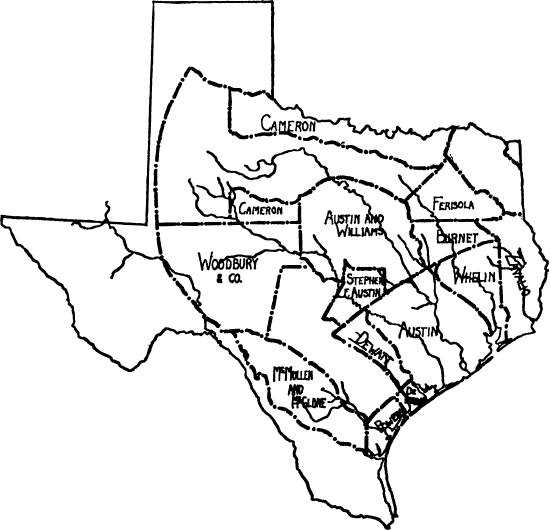
THE PRINCIPAL TEXAS GRANTS BASED ON MAP PUBLISHED IN 1836
The members of the Texas Association were overjoyed. The seventy-four shareholders forthwith divided each share into eight parts, making 592 shares in all and distributed them among their particular friends in certificates, intending that each certificate should entitle a man to a league square of land. These certificates shortly rose in value “about 100 pr. ct. advance.”7
A Dr. Felix Robertson, one of Nashville’s “most worthy citizens,” was engaged “to go out as agent and take with him a large connexion and many respectable friends.” Robertson explored the grant, but returned the next year to Tennessee without accomplishing anything. Another agent, Benjamin F. Foster, was then sent “with three or four other young men” to begin a settlement, but they also returned.
By this time the Texas Association had spent $22,000 in the process of obtaining and endeavoring to settle their grant, and the shareholders were becoming much disheartened. Their “Texas scrip” fell to almost nothing in value. A new agent, Hosea H. League, who had been associated with Austin’s colony, was then appointed. As the Texas Association’s grant had been made directly to Leftwich, it was necessary for League to get a confirmation from the Mexican authorities for its reassignment. Austin agreed to take up this task. In addition to getting a reaffirmation, he had the grant enlarged to a point north of the present city of Waco. But still settlers did not come to the colony. As the time for settlement was limited, the whole affair was in danger of lapsing. League wrote anxiously to his “directors” to send on emigrants, but one of them replied that “the Texas fever seems to have died.” “I have circulated your letters and endeavored to procure a meeting,” he wrote, “but could not succeed. Notwithstanding the apparent apathy, they [the directors] value highly their stock, and yet hope to realize fortunes from it, they know not how.”
League became discouraged, joined Austin’s colony, and turned over his agency of the Texas Association to Sterling C. Robertson. In the meantime, the Mexican authorities, becoming alarmed at the disaffection of the growing hordes of Anglo-Saxon colonists, issued an order prohibiting entrance into Texas without a passport, and forbidding new settlers, except those coming to colonies already established. This put a damper on the Texas Association’s grant. Settlers that they had sent out from Nashville had to be placed in Austin’s colony.
Austin was then accused of enticing settlers away from the Texas Association’s lands. The outcome of the controversy was that Austin, in partnership with his secretary and associate, Samuel M. Williams, took over the rival association’s rights. This was done, not by an assignment to Austin, but by a new contract with the Texas authorities by which Austin and his associates agreed to bring in colonists, and to receive “premium lands” as a reward. It is quite evident that the members of the Texas Association of Nashville had no intention of settling the land, either with their own families or with others, and consequently did nothing towards colonizing, but instead sold out their shares to speculators.
A companion colony to Austin’s, and one with which he cooperated in harmony, was that of Green De Witt, like himself a Missourian. De Witt received his grant in 1825 for the purpose of settling four hundred families on the Guadalupe River, about seventy miles from Austin’s location. It was, according to Austin, “a fine country, well watered, and very healthful.”
Austin frequently gave advice and encouragement to De Witt and assisted him in getting settlers. He was very desirous of having other colonies around him, both as means of greater protection against the Indians and as a basis for creating higher land values. Moreover, the more Americans in Texas, the less mystery there would be regarding the situation of his own project. “I have seen some distressing tales told about us in some of the newspapers in the U. S.,” he wrote his sister, October 28, 1825, “particularly in the Arkansas Gazette. That paper has always evinced most deadly hatred towards the settlement of this colony and its barking editor catches from every dirty buckskin scoundrel that has been driven from this country for his villainous acts . . . something to insert in his invaluable repository of truth and information to prevent any one from emigrating to this colony.”
While Austin, De Witt and other honest empresarios were gradually filling eastern Texas with actual settlers, a gigantic Texas land speculation was set on foot in the United States. This took the name of the “Galveston Bay and Texas Land Company.” It was organized in New York on October 16, 1830, to exploit the so-called “contracts” of Lorenzo de Zavala, Joseph Vehlein and David G. Burnett to settle colonists on land in southern Texas.
The region comprised the Galveston Bay district—a most desirable site—which Stephen F. Austin had endeavored in vain to obtain from the Mexican Government as early as 1824. The three grants were contiguous, but were made separately in 1824, 1828 and 1829. The contractors pooled their interests, and with the aid of some large New York and Boston capitalists, formed an association to take over their rights. Three members of the company, Anthony Day and George Curtis, of New York, and William H. Sumner, of Boston, were appointed trustees of the shareholders, to promote the fulfillment of the contracts and to obtain the approval of the Mexican Government.
The Board of Directors of the “company” comprised some of the leading figures of the period in New York’s financial circles. Chief among these was Lynde Catlin, president of the Merchants Bank. Catlin, at this time, was thick with the Joseph brothers, brokers, who were reputed to be representatives of the Rothschilds. The Josephs, as we shall see in the following chapter, became involved in Samuel Swartwout’s speculations. Swartwout was a favorite of President Jackson, who appointed him Collector of the Port of New York. He thus had plenty of money at his command—and in the end never accounted for over a million of government funds. It was probably through Swartwout that the Josephs assisted in financing Texas land deals along with many local New York real estate developments.
Though Samuel Swartwout’s name does not appear among the directors of the Galveston Bay and Texas Land Company, he was undoubtedly interested in it in some way. His family had started trading in Texas, and carried on a shipping business between New York and Texas ports, and are reported to have “established a cotton plantation there.”8 His interest in Texas affairs continued until the financial crash of 1837, and he was one of the subscribers, along with J. L. and S. Josephs & Co., to the Texas Republic loan floated in New York in 1836. The loan was not a success, so Swartwout wrote Austin: “Nothing but lands will satisfy the lenders, and that at a low rate. I will not advise your government but I will repeat to you what I said to you and Wharton here . . . let your lands pay the expenses of the war, if you sell them only at five cents an acre.”9
Another politician, who at this time became interested in Texas land gambles and who was identified with the Galveston Bay and Texas Land Company, was General John T. Mason of Michigan. Mason, a prominent attorney, became an agent as well as a large “scrip holder” of the association. He was sent to Mexico City as a lobbyist to obtain the consent of the government to the transfer of the grants from the original “contractors.” The petition he presented made some rash promises. The “company” agreed to settle twelve hundred families before January 1, 1838. They had already made expenditures of $125,000 in the enterprise, and would do more, but they must have encouragement. The Mexican Government must allow settlers to come, and the settlers should be given title to lands.
All this fell flat. Nothing was then done by the company to take possession of the grants beyond sending out fifty-seven “emigrants,” to prepare temporary quarters and to raise food for the European settlers they expected to bring over. Even these were not allowed to make a landing.
But, in the meantime, the promoters issued stock to themselves, and sold “Texas scrip” broadcast. In a pamphlet of more than seventy pages that they issued, it was subtly hinted that there was some uncertainty as to whether the “contractors” had the right to assign their grants, and that there was a Mexican law forbidding the admittance of American settlers.10 These handicaps, however, were only temporary. They expected shortly to get a complete affirmation of the enterprise. But what of the hindrances! “Facilities of emigration to Texas, from the Atlantic States and Europe, deserve consideration. . . . The emigrant takes a passage at a trifling expense in some vessel bound for Texas. He is landed at Galveston. By means of navigable rivers, he can ascend with his family and effects in a keel or small boat to the very spot he has selected for his future residence.” And as to excellence of climate and soil, why, Texas is incomparable!
Another pamphlet, issued about a year later, stated:
It is now the last of December, and our country is buried in ice and snow. A deep gloom is settled on the countenance of the poor, as well as on the face of Nature. General distress pervades our city . . . It is a consoling reflection that we are not bound to endure the rigors of a northern winter: that God, in mercy, has created more genial climates where there is neither snow or ice, where Nature, clad in her gayest livery always looks cheerful, and where the earth produces gratuitously for herds and flocks, and everything that can draw substance from its bosom. Such a country is Texas.11
With these perorations, they offered “Texas scrip” to speculators and settlers. Its price ranged from 5 to 10 cents an acre. It carried a “claim” to land, but gave no title to ownership. It was not even a preëmption right, except that in the event that applications from emigrants exceeded the number desired, the “contractors” then would select settlers from those among the scrip holders who desired to emigrate. But the scrip purchasers never had any idea of emigrating to Texas and becoming Mexican citizens. Nor did they wish to become backwoodsmen. They bought merely because of the raging Texas fever, and hoped to resell at a profit. As a writer in the North American Review, July, 1836, remarked: “Such is the cupidity and blindness, that anything that looks fair on paper, passes without scrutiny, for a land title in Texas.”
Stephen Austin’s cousins in New York kept him informed of the great Texas land gamble. On December 16, 1830, John P. Austin wrote him: “You will see from the enclosed that a company has been formed here to colonize the grant of Zavala, Vehlein and Burnett. . . . From what I can learn, it is the most extensive land company that was ever known in this or any other country, probably extending its interests throughout the United States; and its Board of Directors is composed of the most respectable and influential men among us, with the President of one of our banks at its head.”12
And again, on March 15, 1831, Henry Austin wrote him: “The Galveston Bay Land Company is running wild in their operations. Selling land by hundreds of thousands of acres at five cents an acre. Sending out steam machinery for mills, boats, etc. I fear they will do much harm by calling attention of the Government too much to that quarter.”13
The promoters of the Galveston Bay project endeavored to get Austin’s cooperation, but he kept his hands clear of it. He would not use his influence with the Mexican Government to permit a settlement. Without his help, however, they continued to enlist the support of powerful agencies in Mexico. Mason resigned as lobbyist of the company in 1834, when he received on his own account, “an eleven league grant.” Another was appointed in his place. Finally, in 1834, when the Mexican Government was in a turmoil, the company sent out a local agent, Jacob de Cordova, to Galveston, who began the sale of “scrip” on the spot, and who located the emigrants. These emigrants, however, were certainly not the eager “scrip” holders who rushed to buy Texas lands at 5 cents per acre. When the Panic of 1837 burst over the Galveston Bay and Texas Land Company, Lynde Catlin its president, was dead, the Josephs bankrupt. and Samuel Swartwout had absconded.
Though Stephen F. Austin did not openly oppose the deals of the Galveston Bay and Texas Land Company, he expressed the opinion that such land speculations were injurious to Texas. In a statement to the Texan Senate, December 5, 1836, he remarked: “It is well known that nothing but injury to this country has resulted from the companies who have had colonization contracts in Texas. They have uniformly made it a matter of illegal speculation by selling ‘land scrip’ and deceiving the ignorant and credulous in foreign countries. The credit of Texas and all faith in any of our land titles has been destroyed in the United States by such proceedings, and immigration has been retarded rather than promoted by them.”14
The grant of the Galveston Bay and Texas Land Company did not take in Galveston Island, on which the present city and port are located. A place of rattlesnakes, and a resort of pirates in the old days, the island remained vacant until 1836, when the Texas Legislature sold the eastern part of it to Colonel Michel B. Menard, an Indian trader residing at Nacogdoches, Texas, for $50,000. Menard then bought the remaining section from Juan M. Seguin, who had received it as a “grant” in 1832. The whole was then sold to the “Galveston City Company,” an unincorporated association, of which Menard and associates took a two-thirds interest, and Robert Triplet the remaining third. The stock, comprising 1,000 shares, was then offered to the public at $1,500 per share, 10 per cent down and the residue in six, twelve and eighteen months in equal instalments.
The first public sale of town lots was made in 1838, although a few lots had been previously disposed of. Lots continued to be offered, and holders of shares of the association could surrender their certificates for lots at face value. The company was incorporated in 1841, and continued to have lots for sale until the end of the last century. As a town-jobbing scheme it was orderly and fair—coming, as it did, immediately after the boom period preceding the crisis of 1837.
The rapid colonization by American and foreign emigrants of Texas under the empresario or contract system, whereby, in return for settling an area, the contractor was given a part of the land as a “commission,” was destined to bring about the loss of the province to Mexico. Like the Virginian colonists of old, the American-Texans became dissatisfied with “Mexican tyranny,” when this tyranny attempted to change the system of land settlement As already noted, the Mexican Government, in 1830, wishing to put a curb on the heavy influx of undesirable non-Catholic immigrants, issued an order forbidding entrance of settlers into Texas, except when destined for colonies whose loyalty had been tested. This was treated by many as a “scrap of paper,” much like the British proclamation of 1763 against western settlement.
Austin used his political influence to have the restriction law repealed. Following the repeal, the Texas authorities were more liberal than ever in distributing lands, and a whole host of land grabbers entered the province. The old empresario system was abandoned, and direct sale to speculators substituted. Thus, in 1830, James Bowie (whose name is immortalized by a weapon) went to Saltillo, the capital of the province, and returned with fifteen or sixteen “eleven league grants” which he purchased from Mexican citizens. General John T. Mason, Bowie’s associate after he resigned as lobbyist for the Galveston Bay and Texas Land Company, proposed a “foreign” millionaire company to purchase twenty million acres on the eastern frontier for a mere pittance. He failed in this large proposition, but he did receive a grant of one hundred leagues—a principality in itself. Samuel M. Williams, Stephen F. Austin’s confidential secretary, despite the disapproval of his chief, came in for splendid donations of land, receiving, in association with others, as much as four hundred leagues. Other similar grants were made to both Mexicans and Americans. The object of the sale of vast areas by the Texas authorities—then largely Anglo-Saxon—was for the purpose of replenishing the impoverished treasury of the province.
Naturally, this reckless policy in disposing of the soil aroused local indignation. The American settlers revolted. Austin was with them, for he became the bitter enemy of land grabbing. He broke with Samuel W. Williams, because the latter became actively concerned in land grabbing. “Speculation and honesty cannot contend in Texas,” he wrote Williams, when reprimanding the latter for his gigantic land steals.
“General” Sam Houston was brought in from across the border to lead the revolting Texans to victory. Houston, who, as already noted, was one of the original members of the Texas Association, had deserted Nashville soon after the formation of the company and had taken up life among the Indians along the Texas border. He knew the frontier man’s desire for free land, so when he was invited to Texas as military leader of the revolution, he promised all recruits liberal land grants. But he, like Austin, also detested the land jobbers, and among his first official acts after the liberation of Texas was the annulment of a number of the large grants or so-called purchases of Texas lands that had aroused the ire of the hardy Texas backwoodsmen.15
But the Texas fever continued even after independence. The financial interest of the American people in the soil of Texas, whether real or fictitious, was widely diffused, extending from Boston to New Orleans. It could not fail to create a sympathy and a bias for the new republic. Land grabbers continued to rush to Texas. Though many of the fraudulent grants were annulled after Texan independence was achieved, and land speculators were generally detested, the need of state funds and the desire for settlers caused a liberal sale of its large domain by the public authorities. Samuel Swartwout, so states Philip Hone in his diary, “had taken government money and engaged in wild speculations in Texas lands.” As already noted, Swartwout had advised Stephen Austin that if a Texas loan was to succeed in New York, it must have Texas land “at a very low rate per acre as a reward to lenders.” Texas, indeed, had then millions and millions of acres of unsettled lands, but in the dark days following the Panic of 1837, speculation was dormant, and the vast acres remained untouched. Mr. Louis Sterne, of Philadelphia, who, as a youth went to live in Texas in 1853, noted the cheapness of land at that time. “A large portion of the money which I earned,” he writes, “I invested in land in Texas. I bought 40,000 acres, which cost me ten cents an acre. When the title was made out, the parties from whom I bought the land, on discovering that I was still a minor, declined to complete the title or refund the money.” And he adds, mournfully, “The city of Fort Worth is now located on the site.”16
The Government of Texas, subsequent to the separation from Mexico, continued to offer “premium lands” to colonizers, though on a more restricted scale than formerly. One of the grants made in 1844, under a contract of colonization, was a tract of 6,098 square miles, or 3,902,720 acres, on the Upper Trinity River, in the present Navarro County. This became known as the “Mercer Colony,” the contract having been undertaken by General Charles Fenton Mercer, of Virginia. The contract was signed by “President” Sam Houston, just one day before he vetoed the bill passed by the Texas Congress repealing the colonization law under which the grant was made.
Mercer incorporated “the Texas Association” to take over the grant. This concern spent considerable money in surveys and in advertising. The contract with Texas required him to settle 500 families during the years 1845 to 1850 inclusive. Each family was to receive 640 acres, and for each family Mercer’s association was to receive “ten premium sections.” General Mercer made some attempt at European colonization. He organized the “German Emigration Company” for this purpose, but did not succeed in settling the grant within the required time. He subsequently sold out his interest to George Hancock, of Kentucky.
Hancock died in 1875, and his executors sued Texas for the “premium lands,” claiming that more than the required number of settlers had been brought in. It was stated that 1256 families were settled under the terms of Mercer’s contract and that the land commissioner of the state of Texas had issued patents for lands to these emigrants. The plea was denied by the United States courts and, incidentally, a judge remarked: “General Mercer, I know to be above suspicion, but he was a speculator, and unfortunately, for the interest of humanity, gentlemen of his order and class think it all laudable and right to make all they can out of governments.”
Another large Texas land grant put over by “President” Sam Houston during the interval of Texas independence was made to W. S. Peters and associates in 1842. Peters, who had the support and assistance of General Mercer, likewise organized a land company—the Texas Emigration and Land Company—but with even less success in carrying out the terms of his contract. In fact, Peters’ grant was rescinded by the Texas legislature in 1844, though Sam Houston tried to block the measure by his veto. The avenger of the Alamo was not altogether free from land grabbing influence.
After the “Texas fever” subsided, many other immense and valuable tracts could be bought there almost for a song. Today, individuals and corporations own vast domains. As cattle ranges or as goat farms, as cotton fields or oil pools, these lands have gained or lost value, creating at times millionaires and at times paupers. But none who ever entered Texas for fame and fortune has done so much for the Lone Star State, and has been rewarded so meagerly as the empresario, Stephen F. Austin, the Founder of Texas.
17 The Austin Papers, Part I, p. 820.
18 See Laws, Orders and Contract on Colonization 1821–1829, p. 7.
19 The Austin Papers, Part I, p. 690.
20 Ibid., p. 476.
21 The Austin Papers, Part I, p. 992.
22 Mississippi Valley Historical Review, Vol. XI, p. 123.
23 The Austin Papers, Part II, p. 1186
24 Dyer, Early History of Galveston, p. 14.
25 Austin Papers, Vol. III, p. 342.
26 Address to the Reader of the Documents relating to the Galveston Bay and Texas Land Company, etc., New York, January, 1831, pp. 4-7.
27 Constitutions, etc., of the Galveston Bay and Teẋas Land Company, p. 45.
28 The Austin Papers, Part III, p. 556.
29 Ibid., p. 615.
30 Eugene C. Barker, The Life of Stephen F. Austin, p. 373.
31 See Texas Historical Association Quarterly Magazine, Vol. X, pp. 76-95.
32 L. Sterne, Seventy Years of an Active Life.
- 1Maine Historical Collections, Vol. II, pp. 268-294.
- 2The Sir William Johnson Papers, Vol. V, p. 129. See also, C. W. Alvord, The Mississippi Valley in British Politics, Cleveland, 1917.
- 3Herbert B. Adams. “Washington’s Interest in Western Lands,” Johns Hopkins University Studies, Third Series, No. 1, January, 1885. Italics are mine.—A. M. S.
- 4Adams, op, cit., p. 58.
- 5See A. Henderson, “A Pre-Revolutionary Revolt in the Old Southwest” in Mississippi Valley Historical Review, Vol. 27, p. 198 et seq.
- 6Italics are not in the original.
- 7In a letter to William Franklin, dated May 3, 1776, Johnson asserted “it has always been my practice to avoid engaging in lands to the great loss of my family, neither have I a foot of land from the Indians.” (Sir William Johnson Papers, Vol. IV, p. 197.) The large tract north of the Mohawk Valley given him by the Canajoharie Indians in 1760 was confirmed by royal grant in 1769.
- 8See Pennsylvania Magazine of History, Vol. XIV, pp. 218, 219.
- 9See Memorial of the United Illinois and Wabash Land Companies, Baltimore, 1816.
- 10A copy of the deed is contained in American State Papers, “Public Lands.” Vol. I. The original copy was acquired by Cyrus H, McCormick.
- 11See J. P. Boyd, “Connecticut’s Experiment in Expansion, The Susquehannah Company, 1753-1803,” in Journal of Economic and Business History, November, 1931.
- 12See Publications of the Colonial Society of Massachusetts, Vol. XXV, PP. 33-38.
- 13Samuel W. Jones, Memoir of James Duane, 1852.
- 14P. H. Woodward, One Hundred Years of the Hartford Bank, p. 74. See also R. J. Purcell, Connecticut in Transition, p. 154.
- 15Haskins, op. cit., p. 36.
- 16Ellis Paxton Oberholtzer, Life of Robert Morris, pp. 307, 308.
- 17During the first hundred years of North American colonization, economic conditions gave little encouragement to private land schemes. Land was too plentiful. A few such enterprises were undertaken, however. Thus, as early as 1661, the Colony of Massachusetts sold to a few individuals for £400 a large tract on the Kennebec River in Maine. This became known as the “Kennebec Purchase.” The heirs held it for nearly a century without doing anything with it. In 1753, they incorporated as the “Proprietors of the Kennebec Purchase” and proceeded to dispose of their holdings. The corporation continued in existence until 1816. “The Pejebscot Company” was another Maine land deal. None of these held out promise of profit to proprietors until about a quarter century before the Revolution.
- 18In the meantime, the “Loyal Company” group was not idle; its proprietors sent Dr. Thomas Walker, of Albermarle, Va., to make a reconnaissance, and to discover a proper place of settlement. The two “companies” then became engaged in a controversy, and neither made a survey or fixed the bounds of their grants. The apparent ease with which they obtained land donations led to other schemes, and aroused an epidemic of interest in distant western wild lands. Not only was the land ownership eagerly sought after, but the establishment of new colonies, with separate and distinct governments, was planned. Favoritism and collusion infested the Virginian colonial government, due in large part to the persistence of speculators in western land grants. Lobbyists were sent to London to obtain the crown’s sanction to land-grabbing schemes and the question of the disposal of the vast western domain won from the French infested British politics. “One half of England is now land mad,” wrote George Croghan, of Philadelphia, one of the land schemers, to Sir William Johnson, on March 30, 1766, “and everybody there has their eyes fixed on this country.”
- 19I offered in my last to join you in attempting to secure some of the most valuable lands in the King’s part, which I think may be accomplished after awhile, notwithstanding the proclamation that restrains it at present and prohibits the settlement of them at all; for I can never look upon that proclamation in any other light (but this I say between ourselves) than as a temporary expedient to quiet the minds of the Indians. It must fall, of course, in a few years, especially when those Indians consent to our occupying the lands. Any person, therefore who neglects the present opportunity of hunting out good lands, and in some measure marking and distinguishing them, for his own, in order to keep others from settling them, will never regain it.
- 20Crawford “heartily embraced” the colonel’s offer. He promised shortly to set out in search of lands. “This may be done,” he said, “under a hunting scheme.” He acknowledged that other land seekers had approached him, with similar offers, “but have not agreed to any; nor will I with any but yourself or whom you think proper.”
- 21Judge Richard Henderson of North Carolina, the employer and backer of Daniel Boone, promoted the settlement of the Kentucky region and claimed ownership to a vast unsettled tract there. He organized a group of land grabbers under the name of “The Transylvania Company.” Ignoring the British interdiction against Indian land purchases, he obtained from the Cherokees in 1773 about one-half of the present State of Kentucky, and immediately began settling the land. He advertised widely for pioneers and “shareholders.” In his announcements, Henderson waxed enthusiastic. “The country [Transylvania] might invite a prince from his palace, merely for the pleasure of contemplating its beauty and excellence, but only add the rapturous idea of property, and what allurements can the world offer for the loss of so glorious a prospect?”
- 22When the British Government began to take active measures to break up land “bootlegging,” and to put a stop to dreams of riches in western territory, Virginia’s political resentment was naturally aroused. Even Thomas Jefferson, who, in later life, frowned upon speculation and land grabbing, held the view in 1774 that the land did not belong to the British king, and that it was time for the colonies “to declare that he has no right to grant lands of himself.” So he boldly wrote in the Declaration of Independence, as one of the British king’s usurpations: “He has endeavored to prevent the Population of these States; for that purpose obstructing the Laws for Naturalization of Foreigners; refusing to pass others to encourage their migrations hither, and raising the conditions of new Appropriation of Lands.”
- 23He was for it at once. “I like the project of a colony in the Illinois Country,” he wrote his son, “and will forward it to my utmost here.” He thought that Sir William Johnson’s “approbation will go a great way in recommending it, as he is much relied upon in all affairs that may have any relationships with the Indians.” But Johnson had an eye on the Indian lands himself, and besides advising others about purchases in the outlying sections, personally through gifts from the Indians engrossed large tracts, particularly in the Mohawk Valley. The town of Johnstown, N. Y., still marks the seat of his domain.
- 24Some of the members of the Vandalia Company were concerned in other western land schemes. One of these was organized in 1775 as the “Indiana Land Company,” probably the first application of the name “Indiana” to the Northwest Territory. The claim to land was based on a grant of a large tract, made November 3, 1768, in what is now West Virginia, by the Six Nations at Fort Stanwix to “Chief” William Trent in liquidation of depredations. Among the shareholders were Samuel Wharton, Joseph Galloway, Robert Callender, Levi Andrew Levi, and David Franks, all wealthy and prominent Philadelphians. The Revolutionary War did not put an end to the “claim.” Wharton in 1776 published a pamphlet, entitled-View of the Title to Indiana, in which he defended the company’s rights to the lands. In 1781, he republished this in enlarged form, under the title Plain Facts; being an examination into the Rights of the Indian Nations of America to their respective Countries and a Vindication of the Grant from the Six United Nations to Proprietors of Indiana, etc. Although Wharton pressed the validity of the “proprietors” claims, Congress then and thereafter gave little heed thereto.
- 25Notwithstanding the British Government’s edict, forbidding the private purchase of lands from the Indian tribes, William Murray, an Indian trader, and several of his business associates, in 1773 formed a plan to buy from the aborigines an immense tract of country between the Mississippi, Illinois and Ohio rivers. After a “pow-wow” lasting a month, the sale was consummated. According to the land claimants, it was attended by “many persons of both descriptions and the Indians were carefully prevented from obtaining any spiritous liquors during the whole continuation of the negotiation.” On July 5, 1773, “for a very large and valuable consideration,” the deed was delivered to the “Illinois Land Company.”
- 26Notwithstanding the British Government’s edict, forbidding the private purchase of lands from the Indian tribes, William Murray, an Indian trader, and several of his business associates, in 1773 formed a plan to buy from the aborigines an immense tract of country between the Mississippi, Illinois and Ohio rivers. After a “pow-wow” lasting a month, the sale was consummated. According to the land claimants, it was attended by “many persons of both descriptions and the Indians were carefully prevented from obtaining any spiritous liquors during the whole continuation of the negotiation.” On July 5, 1773, “for a very large and valuable consideration,” the deed was delivered to the “Illinois Land Company.”
- 27The proposition then took on a business aspect. The number of “shares” was increased, and rights to subscribe offered at from $2 to $5 per share. It attracted speculators. The shares soon rose in value. Lawyers, clergymen and politicians began buying shares. The Reverend Ezra Stiles, President of Yale College, grandfather of the poet-physician Oliver Wendell Holmes, took 2¾ shares. The Governor of Connecticut, Roger Walcott, who had become rich through local land deals, supported the project.
- 28New York, before the Revolution, also had her “land” quarrels with the other colonies. The ill-defined boundaries of the Dutch province led to constant conflicts and legal controversies with her neighbors. There was a bitter dispute with New Hampshire regarding the political jurisdiction of Vermont. New York claimed the section, but New Hampshire, in 1749, acting on the principle that possession is nine points of the law, began to make free grants to both New Hampshire and Massachusetts citizens. Whole “towns” of 23,000 acres, more or less, were granted to selected groups of individuals. It is estimated that between 1749 and 1764, Governor Benning Wentworth granted 131 townships to more than six thousand persons. Among the grantees appear the names of many prominent colonial New Englanders, who had no intention of ever settling on the lands. Samuel Adams was among them. He was known as a speculator in both Maine and New Hampshire lands in this period. The governor granted himself, in all, about 65,000 acres, and is reported to have accumulated considerable wealth from the heavy fees exacted by him for grants.
- 29Because of his land deals, while acting as the state’s attorney, Duane was the butt of political criticism. He was led to appear in person in his own defense before the state legislature in 1781. He was charged with receiving Vermont grants “under immoderate quit-rents, and excessive fees of office,” and he was also accused of “holding many thousand acres of land which had never before been granted by the Crown.” To this he merely answered that he “had never made a purchase or obtained a grant of land with any view to its sale.” He was therefore not a “land jobber.” This cleared him politically of all corruption.
- 30So popular was the western lure to the Connecticut gentry that legislation was urged to countermand it. “Young people in their plays at social gatherings marched to rude melodies which taught them to dream that toward the setting sun lay an earthly paradise with gates open to welcome them. From hill and valley the processions hurried away. Today, many of our rural towns are scarred and paralyzed by an outflow which has built up the continent to no small degree at their expense.”
- 31What is the spirit against which we now struggle and which we have vainly endeavored to stifle? A monster, generated by fraud, nursed in corruption, that in grim silence awaits its prey. It is the spirit of Federalism! That spirit which considers the many made only for the few. . . . When I behold a certain party supporting and clinging to such a measure almost to a man, I see only men faithful to their own principles. . . . But when I see associated with them, in firm compact, others who once rallied under the standard of opposite principles, I am filled with apprehension and concern. . . . If Congress shall determine to sanction this fraud upon the public, I trust in God we shall hear no more of the crimes and follies of the former administration. For one, I promise that my lips upon this subject shall be closed in eternal silence. I should disdain to prate about petty larcenies of our predecessors after having given my sanction to this atrocious public robbery.
- 32Large tracts were also freely disposed of by Georgia. Count d’Estaing, the French admiral who assisted the colonies, was granted a substantial acreage for his Revolutionary services. D’Estaing sold his land to the Count de Colbert, who resold it in England to Robert Morris, through the agency of William Constable and Gouverneur Morris. Robert Morris then proceeded to add to his Georgia possessions. In association with John Nicholson, he soon become the leading proprietor of Georgia waste lands. How these large holdings were obtained has never been satisfactorily explained. It is the “unsolved riddle of Georgia’s land history.”

