
The Great American Land Bubble
Chapter VII. Washington, America’s First Boom Town
“IN AMERICA,” wrote the Duke de La Rochefoucauld in 1797, “where more than in any other country in the world, a desire for wealth is the prevailing passion, there are few schemes which are not made the means of extensive speculations; and that of erecting the Federal City presented irresistible temptations, which were not in fact neglected.”1
Thus, observed the philosophical French émigré after he had visited the embryonic national capital located on the “banks of the Potowmack.” The framers of the Constitution, wishing to have a seat for the federal government, independent of the territory or jurisdiction of any state, provided that Congress shall “exercise exclusive legislation in all cases whatsoever, over such District (not exceeding ten miles square) as may, by Cession of Particular States, and the Acceptance of Congress, become the Seat of the Government of the United States.”
The question of a national capital had been suggested even during the dark days of the Revolution, and in the critical period following the peace with England, but no action accomplishing this end had been taken. In the meantime, however, speculation was rife as to a most suitable site. On January 29, 1783, before the news of the peace treaty had arrived, the trustees of the corporation of Kingston, N. Y., sent a memorial to the New York Legislature, praying that “their estate be erected into a separate district for the Honorable Congress of the United States,” and they offered for this purpose “a sufficient quantity of land.” The application was formally presented to Congress by Alexander Hamilton and William Floyd, the New York delegates. The corporation of Annapolis, Md., made a similar offer and tendered for the purpose 300 acres in the town. Its citizens argued that Annapolis “is more central than any other city or town in the federal states.” Both tenders were referred by Congress to the executives of the various states with a notice that the matter would be brought up for consideration the following October.
New Jerseyites also were desirous of having the seat of the Congress within the borders of their state. On June 19, 1783, their legislature expressed a willingness to invest Congress “with such jurisdiction, authority and power over a district of twenty miles square as may be required by Congress, as necessary for the honor, dignity, convenience and safety of that august body.” In addition, they proposed to grant £30,000 in specie, “for the purpose of procuring lands and erecting buildings thereon for the suitable accommodation of Congress.”
Virginia also sent in an offer, suggesting the town of Williamsburg. In addition to 300 acres of land adjoining the said city, it would “present the palace, the capitol and all the public buildings, together with a sum of money not exceeding £100,000 this state’s currency, to be expended in erecting thirteen hotels for the use of the delegates in Congress.” As an alternative, Virginia offered to cede a district at any place on the Potomac, and to appropriate a sum of £100,000 in Virginia currency for hotels, as well as 100 acres of land to be used as sites for public buildings. If Maryland also desired to cede territory for the same purpose, Virginia would coöperate and bear a share of the expense.
Thus, the hint of a location on the Potomac was given. Before Congress proceeded to the consideration of these rival offers, a mutiny of the Pennsylvania troops in Philadelphia in June, 1783, made it plain that, if this “august assembly” of the thirteen federated states was to function freely and untrammeled, it must have a seat of government independent of any other authority. No formal action was taken, however, until more than a year later, though in the meantime Congress moved to Princeton, then to Annapolis, then to Trenton, and next to New York. It seemed as if the members were “trying out” the various locations.
Speculation continued, however, as to the place of permanent abode. The passion for gain and the belief that wherever the selected “district” would be located there would take place a pronounced increment in land values, caused the deliberations of Congress to be closely watched. While convened at Trenton in December, 1784, Congress passed a resolution appointing commissioners to lay out a district on the banks of the Delaware, near the Falls, of not less than two nor more than three miles square, and to erect buildings thereon, “in an elegant manner,” for the use of Congress. Although the commissioners were empowered to expend $100,000 for this purpose, no attempt was actually made to carry the plan into effect. The next month, Congress moved to New York, where it remained until after the adoption of the Constitution.
Shortly after the passage of the resolution of Congress, authorizing a site on the Falls of the Delaware River, Robert Morris, who was one of the three commissioners appointed to execute the plan, bought a tract of 2,500 acres in the neighborhood. This site he called “Morrisville.” It was one of Morris’ first important land speculations and its purchase created the suspicion that his motive was to gain a profit at the expense of the nation. Morris’ biographers deny this, however, and point out that he never urged his site upon Congress as a location for a “federal district,” and that he continued to hold and develop the land until it was sold by the sheriff subsequent to his bankruptcy in 1798.
Moreover, it does not appear from the Morris correspondence that he was disappointed, when the Trenton site proposed by Congress in 1784 was later abandoned. William Maclay, Morris’ fellow Senator from Pennsylvania, who bore him considerable ill-will, noted in his journal on August 25, 1789, that Morris had refused his request “to bring forward all the places which had been mentioned for a permanent residence of Congress at one time.” Instead, Morris answered “rather roughly,” “Let those that are fond of them bring them forward; I will bring forward the Falls of the Delaware.” And this he did, “although the President was every moment looked for to attend the Senate session.”2 In fact, Maclay later remarked that he (Morris) “has had no other object in view than the Falls of the Delaware, since he has been Senator; at least, this has been his governing object.”
Maclay came from Harrisburg, Pa., and of course was deeply interested in having the federal site fixed on the Susquehanna River. Morris’ residence was in Philadelphia, and he therefore favored a site close to this metropolis in eastern Pennsylvania. His personal interests may have influenced his attitude, but it does not appear as Maclay declares that he was unwilling to “consent to it [the federal seat] being anywhere else, unless it be on his own grounds at the Falls of the Delaware.” In fact, Morris, a few days after Maclay penned the above, made a motion in favor of Germantown, near Philadelphia, and appears to have abandoned his support of the Falls of the Delaware.
Whatever may have been Morris’ purpose with reference to his purchase of 2,500 acres near Trenton Falls (it is possible he saw its advantages as an industrial site), he did not hesitate to enter upon a gigantic speculation in the new Federal City, after Congress, on July 16, 1790, definitely voted to locate the seat of government on the river Potomac “at some place between the mouths of the Eastern Branch and the Connogochaegue.”3 The site was selected in January, 1791.
It was some time before the commissioners, appointed to execute the plan of the Federal City, could start things going. First of all, they had to buy off the former property owners. Each of these wanted special privileges for his site, with reference to the location of buildings and the planning of the district. One, “the obstinate Mr. Burnes,” was obdurate and would not meet the terms of the commissioners. It required a patriotic address by the “Father of his Country,” to get the landholders to agree to sell out. He met them at Georgetown, the village located in the selected area, and in the course of his remarks, “represented that the contention in which they seemed engaged did not . . . comport either with the public interest or that of their own; that while each party was aiming to obtain the public buildings, they might, by placing the matter on a contracted scale, defeat the measure altogether; not only by procrastination but for want of the means necessary to effect the work” . . . and that “instead of contending,” they had better, “by combining more offers make a common cause of it.”4
Washington’s advice was heeded. As the President noted in his diary, on March 30, 1791:
The parties to whom I addressed myself yesterday evening . . . saw the propriety of my observations: and that whilst they were contending for the shadow, they might lose the substance; and therefore mutually agreed and entered into articles of surrender for public purposes one half of the land they severally possessed within bounds which were designated as necessary for the City to stand with some other stipulations, which were inserted in the instrument which they respectively subscribed.5
The “instrument” which they subscribed stated that “in consideration of the great benefit we expect to derive from having the federal city laid off upon our lands,” the subscribers agreed to convey in trust the whole of their lands upon condition that “the President shall have the sole power of directing the federal city to be laid off in what manner he pleases.”6 The lots, it was agreed, were to be divided equally between the public and the former owners, and those taken by the public were to be paid for at the rate of £25 per acre, with a deduction for streets. Thus, one-half of the area of the proposed city was acquired by the District Commissioners, representing the public, to be disposed of as they saw fit. The other half could be retained by the original owners. As the commissioners needed money for laying out the City and constructing public buildings, they soon had “lots for sale.” So did the former landowners. These were also desirous of realizing the profit that would come from the selection of the site of the Federal City on their properties.
The first public sale of lots “in the Federal City” was scheduled to begin October 17, 1791. It was expected that Major Charles L’Enfant, the City’s designer, would have his map prepared, showing the complete layout and the location of lots, but this distinguished “French gentleman” procrastinated and blustered, and finally was dismissed in disgust. When the sale began, not only was a general plan of the City lacking, but the bad weather prevented prospective buyers from meeting on the ground which was to be “auctioned off.” Yet the occasion was marked by the presence of George Washington, the incumbent President, and Thomas Jefferson and James Madison, two future Presidents of the United States.
The results were extremely disappointing. After three days of auctioning, only thirty-five lots were sold for an aggregate sum of $8,756. The actual cash received was but slightly more than $2,000, since, in accordance with common usage from that day to this, liberal credit terms were granted. Only a quarter of the purchase price was required in cash. The balance was payable in three annual installments.
The price of lots ranged from $160 to $534. Whoever bought or held the lots was required to build thereon. The promoters of the Federal City, moreover, would permit no cheap or temporary structures. Buildings must be of at least two stories, and of brick or stone. No building was to be higher than forty feet and, on the avenues, not lower than thirty-five feet, thus assuring an harmonious sky line. The idea was sanctioned, therefore, that the Federal District was to be a magnificent city—an artistic city; in other words, a modern real estate development, and not merely a “scene of speculative land operations or of the erection of buildings for the use of the Government.”7
Modern, up-to-date real estate sales methods also were used in “booming” the new city. As there was much political opposition to the selected site, and much unfavorable gossip regarding the likelihood that Congress would ever move to “the residence city,” some sort of “boostering” was deemed essential. Newspapers were used then as now. On September 30, 1791, about two weeks before the first sale was scheduled, there appeared in the Maryland Journal the following alluring account of the proposed city:
The plan [of the city] was designed and drawn by the celebrated Major L’Enfant, and it is an inconceivable improvement upon other cities of the world, combining not only convenience, regularity, elegance of prospect and a free circulation of air, but everything grand and beautiful that can possibly be introduced into the City. It will not only produce amazement in Europe but meet the admiration of all future ages.
Such it was proposed to be—and such a city it has become—but when George Washington, President of the United States, Thomas Jefferson, his Secretary of State, and a few other curious or interested spectators gathered at Suter’s Tavern in Georgetown on October 17, 1791, to sell unsurveyed city lots covered with woods and cornfields, the grandeur and beauty of the future national capital might have been conceived, but not seen. Certainly it taxed the imagination of even the most hopeful, for at the end of the third day, in spite of free “wine and wood” furnished the prospective lot purchasers, “the business seemed to flag,” as Washington stated, and the auction was called off.
But with all this, the First President, who was undoubtedly the most interested party in the proposed plan of developing the magnificent city that bears his name, was not discouraged. He informed Congress the following week, in the course of his regular message: “There is prospect, favored by the rate of actual sales which have already taken place, of ample funds for carrying on the necessary public buildings. There is every expectation of their due progress.”8
The actual prospect, nevertheless, was a poor one. In the spring of 1792 there occurred in New York and Philadelphia the first of the many financial panics with which our country has since been cursed. The speculations of William Duer, Alexander Macomb and other capitalists in New York; the reign of terror in France; and the suspension of specie payments by the Bank of England, “produced general stagnation of money contracts.” So Jefferson wrote to the District Commissioners. These officials were hard pressed for funds and desired additional lot auctions to obtain current cash. It was not until a year later, however, when the cornerstone of the “President’s palace” had been already set, that the second public sale of lots was attempted. As on the previous occasion, the sale continued for three days, but with scarcely greater success than the first offering.
The heaviest and most interested lot purchaser on this occasion was Samuel Blodget, Jr., one of the many enterprising and ingenious seekers after wealth of his generation. He was born in Woburn, Mass., in 1755, and served on the staff of General Washington in the Revolution. Subsequently, he engaged in the East Indian trade, and made visits to Europe in 1784 and 1790. In March, 1792, he founded the Tontine Association in Boston, and this proving fairly successful, he came to Philadelphia and promoted the “Universal Tontine.” As he failed to get the necessary subscribers, he suggested that the funds already in hand be applied to the establishment of a general insurance company. As a result of this suggestion, there was organized in November, 1792, the Insurance Company of North America, in Philadelphia, the oldest concern of its kind in the Western Hemisphere. Blodget took a minor part in its organization, though he and his father were among the first stockholders.
At this time, his chief activities were centered in the Federal City, whither he, in all probability, went to attend the first sale of lots in 1791. His interest in the city’s promotion, he stated years afterwards in his pamphlet,9 was stimulated by the persuasion of “his former commandant, Washington, to purchase property to the amount of above $100,000 in and adjoining the city, one day to become the noblest of the universe.”
Blodget soon became the right-hand man of the commissioners of the Federal City, and for a time was the chief manager of the enterprise. Washington consented to his appointment as “Superintendent,” though he acknowledged that he “knew very little of him, . . . and after what has happened shall be cautious about recommending.”10 The public sale of lots proving unsatisfactory as a means of obtaining funds to further the construction of public building, Blodget was despatched to Boston to negotiate a loan based on the unsold city lots as security. Nothing came of this endeavor. Blodget next suggested that agents be employed “to pass through the several states to dispose of lots,” but Washington seemed to object to this, because it appeared “to be hawking the lots about.”11
Still undaunted, Blodget’s gambling propensities were again manifested in his next suggestion to the commissioners. He proposed a lottery as a means of raising funds. The principal prize was to be “a grand hotel,” to be erected in the City at a cost of $50,000. Whether the commissioners officially sanctioned the idea or not is in dispute, but the lottery was duly advertised January 19, 1793, as “by the commissioners appointed to prepare the public building, etc., within the City of Washington,” and signed “Samuel Blodget, agent for the affairs of the city.” The drawing of prizes was scheduled to take place in the fall of 1793, about the date of the next sale of lots. Before the date arrived, however, some mix-up occurred, and the commissioners, fearing the city’s funds might be put in jeopardy, repudiated the lottery transaction and placed the entire responsibility for it on Blodget and his associates.12
This led to Blodget’s financial ruin. He was required to convey by deed to trustees all his property in the Federal District, as well as his stock of 7,160 shares (par value $10) in the Insurance Company of North America, to secure payment of the lottery prizes, and to protect the commissioners from damage suits in consequence of the lottery.
Unabashed by this outcome, he proposed still another lottery known as “Federal Lottery No. 2,” to which he also endeavored to give an official character, but which was likewise repudiated. His “former commandant,” General Washington, was seriously irritated by the audacity of the “City Agent,” as Blodget styled himself, in trying to put over a second lottery scheme after the failure of the first. “I was at a loss,” he wrote Thomas Johnson, on January 23, 1794, “how to account for a conduct so distant from any of the ideas I had entertained of the duties of a Superintendent, but it appears evidently enough now, that speculation has been his primary object from the beginning.”13
But Blodget persisted, and announced that the drawings of the lottery would commence December 22, 1794. The principal prize was to be a house to cost $30,000. The total amount to be raised was $400,000. If a surplus resulted after paying all prizes, it was to constitute a fund to be used for the proposed national university in the city, which was one of the promoter’s pet ideas.
Blodget pledged all his Washington lots to secure the prizes. As neither the hotel—the prize of the first lottery—nor the buildings constituting the principal prize of the second were ever completed, the successful ticket holders obtained judgments against him, and he was “cleaned out” entirely of his Federal City property. He was also dismissed as “Superintendent.” He continued to reside in Washington, however, where he wrote the first book that was printed there,14 and, as already noted, also prepared in later years a statistical and economic treatise on the United States. He was imprisoned for debt in 1802, but on being given “the liberty to walk out of prison (within the bounds of the District), for the preservation of his health” under a bond of $10,000, he failed to return, though he soon reappeared in Washington and busied himself in promoting a “national university.” He died in comparative poverty on April 11, 1814, at Philadelphia, “and no stone marks the grave of the founder of Washington City.”15
The failure and repudiation of Blodget’s schemes, and the inability to sell “lots” at retail as a means of raising funds to erect public buildings, brought into the Federal City the greatest land-grabbing triumvirate that ever operated in America. James Greenleaf, then a young man of but twenty-seven, had just returned from Holland, where, with the coöperation of Dutch bankers, he had engineered some profitable deals in American debts. He accounted himself wealthy and was looking about for new and speculative ventures. In some unknown manner, he was attracted to the Federal City as a field of operations. It is quite probable that Washington, the President, suggested it to him. Or perhaps, he, hearing of the financial straits of the District Commissioners, had offered to negotiate for them a loan from Dutch bankers. Whatever may have been the real reason, he came to the District Commissioners in August, 1793, armed with a letter of introduction from the President. In this letter, Washington wrote: “This gentleman has it in contemplation to make certain proposals to you for building a number of houses in the Federal City, provided he can have lots upon such terms and conditions as may correspond with his interest in the undertaking, while it tends, at the same time, to promote the object of the City . . .”
As to Greenleaf’s financial ability to execute his plans, the President would give no advice. “He has been represented to me as a gentleman of large property and having the command of much money in this country and in Europe. But I can say nothing on this head from my own knowledge.” Yet, he added, “I have reason to believe that if you can find it consistent with your duty to the public to attract Mr. Greenleaf to the Federal City, he will be a valuable acquisition.”16
The immediate result of Greenleaf’s visit was an offer by him to purchase three thousand lots at $66.50 per lot, to be paid for in seven annual installments. On these lots, during the period of the installments, he was to erect an average of ten houses annually, according to the required specifications. He agreed to make no sales prior to January 1, 1796, unless on every third lot sold a house should be erected within four years. But what was more important to the commissioners, he offered further to make them a loan of $2,200 each month at 6 per cent, until the public buildings were completed.
The President was undoubtedly pleased with Greenleaf’s bargain with the District Commissioners. “You will learn from Mr. Greenleaf,” he wrote Tobias Lear, his secretary, “that he has dipped deeply in the concerns of the Federal City—I think he has done so on very advantageous terms for himself, and I am pleased with it notwithstanding on public ground; as it may give facility to the operation at that place, at the same time that it is embarking him and his friends in a measure which although [it] could not well fail under any circumstances that are likely to happen, may considerably be promoted by men of Spirit with large Capitals.”17
Greenleaf undoubtedly had Robert Morris’ backing in this project. He, in fact, had already become an associate of Morris and Nicholson in their land speculations, and he was regarded as a valuable acquisition, since he led these two land jobbers to believe that his banking relations in Amsterdam, where he had been recently appointed American consul, would serve them as a means of obtaining loans or disposing of their properties. Morris and Nicholson, accordingly, became partners in Greenleaf’s wholesale purchase of Washington lots, each taking a one-third interest. But neither assumed responsibility for Greenleaf’s proffered loan to the District Commissioners.
Greenleaf’s first proposition was soon altered by a revised agreement. The number of lots purchased was six thousand instead of three thousand. The average price was raised from $66.50 to $80.00. In the second contract, Greenleaf openly associated with himself, as principals, both Morris and Nicholson. There was naturally no objection to this, as these two men were then reputed to be the richest capitalists and “high financiers,, in the country.
The terms accepted by the speculating syndicate were rather stiff. They were required to expend large sums for building within a seven-year period. This handicapped them in reselling because the same obligation to build was imposed on those who purchased from them. Morris, who was for “land jobbing” rather than “land holding,” did not, at the time, take the conditions seriously. “Nobody can suppose,” he wrote the President on September 25, 1795, “that Mr. Nicholson or myself entered into these engagements with an expectation of holding the property. It was from the beginning and it is now our intention to sell them when it can be done to our satisfaction and I believe the interest of the City will be more certainly promoted by interesting a number of individuals, than by any one or two men continuing to hold a large number of lots.”18
Selling, however, was not easy, and meeting installment payments or providing building costs was still more difficult. Yet, the three capitalists went ahead with their purchases. They bought also additional lots from the private owners. From Daniel Carroll and Notley Young, two of the former landowners in the District, they purchased nearly seven hundred additional lots. Washington and the commissioners were highly pleased with all this since considering “the uncertainty of settled times and embarrassed commerce,,, they were happy to have the assistance of “Mr. Morris’ capital, influence and activity.”
Altogether, the syndicate purchased 7,235 lots in the Federal District. In view of their heavy commitments in land purchases elsewhere, and the prevailing disturbed financial condition of both Europe and America, they had bitten off more than they could chew. They sought in vain for financial aid in Europe. Greenleaf attempted to get a loan in Holland, offering to pledge the city lots as security. A negotiation through Messrs. Daniel Crommelin & Sons, Amsterdam bankers, was engineered by Sylvanus Bourne, then American vice-consul at Amsterdam, but the subscriptions fell considerably below the required amounts. The fact that Greenleaf and his associates lacked a clear title to the pledged property (since title was not to pass until payment was made in full) was ignored by him, but he put up as additional collateral such amount of 6 or 3 per cent United States bonds, “as with the interest to accrue thereon will be sufficient to pay the annual interest of this loan until the final discharge of the same.” This collateral made the proposition apparently sound.19
Before the Dutch loan negotiations were assured, however, Morris and Nicholson, in their dire need of funds, began issuing and circulating drafts on Dutch bankers. The volume and amount of their bills increased enormously. “Had their success been uncurbed, they would have appreciably drained the money supply of the Dutch. The mere acceptance by the Dutch bankers of the management of a popular loan in the lots was made by the syndicate a sufficient warrant to draw.”20 These Dutch transactions not only got Morris into difficulties a few years later, but gave the District Commissioners considerable trouble in straightening out their deals with the syndicate.
No attempt appears to have been made by Morris, Nicholson and Greenleaf to unload their Federal City “lots” in England, though, as we have already seen, they tried at this time to sell there the wild lands which they had transferred to the North American Land Company.21 George Washington, however, may have had in view possible British purchasers of the Federal City lots, for his private secretary, Tobias Lear, undoubtedly with the President’s encouragement, published in New York, in 1793, and in London, in 1794, the first book ever written regarding the City of Washington. It was entitled Observations on the River Potomac, the Country Adjacent, and the City of Washington, and its pages furnished pleasing prospects and alluring commercial industrial possibilities of the proposed seat of government and its surrounding territory. As the originator of the “Potomac Company,” which was to make the Potomac River the principal highway of commerce between the western back country and the seaboard, Washington had a double interest in promoting the progress of the Federal City.
Others also had the notion that the seat of the federal government would be the nation’s chief commercial and industrial center. Writing of the proposed plan to open a passage “from the Ohio to the Potomac,” Isaac Weld, the Englishman, who visited the new Federal City, in 1795, wrote:
Considering the vastness of the territory, which is thus opened to the federal city, by means of a water communication; considering also that it is capable from the fertility of its soil, of maintaining three times the number of inhabitants that are to be found at present in all the United States; . . . there is good foundation for thinking that the federal city, as soon as navigation is perfected, will increase most rapidly in population, and that at a future day . . . it will become the grand emporium of the West, and rival in magnitude and splendor the cities of the old world.22
Though this may have sounded fanciful to jealous and incredulous Englishmen of the time, there was at least one British capitalist who was attracted by its allurements. He was Thomas Law, wealthy and aristocratic East Indian trader, who, in 1794, decided to take up residence in America. While sojourning at Philadelphia, he learned, in a conversation with the President, of the speculative prospects of the new national capital. Greenleaf then met him. The result was that Law bought a number of lots from Greenleaf’s syndicate, and with his two sons moved to the nascent city on the Potomac.
The remarkable feature of Law’s purchase is that he paid Greenleaf an average of $266 per lot for five hundred lots, which Greenleaf had, but a little over a year previous, bought for $80 per lot. Law selected his lots south and east of the site of the Capitol, and along the banks of the river, called the Eastern Branch. It was then believed that this section would become the city’s chief commercial center. It turned out otherwise, however. The sections in which Law’s properties were located developed more slowly than those in the neighborhood of the President’s “residence.” In fact, until about three decades ago, the lots south of the Capitol were covered largely by negro shacks and decaying and dilapidated warehouses.
Thomas Law’s real estate transactions in the new national capital were second only in magnitude to those of Morris, Greenleaf and Nicholson. Unlike these men, he continued solvent in spite of his financial disappointments, and he kept up his faith in the future value of his real estate. Writing to Greenleaf, on January 8, 1795, he stated enthusiastically, “You may say that I had rather sell my horses or books or anything rather than part with a foot at present of Washington City.”23 He succeeded in escaping from the effects of the subsequent failure of Morris, Greenleaf and Nicholson, to meet their instalment payments to the District Commissioners, by having received, at his own insistence, a clear title to the real estate that he purchased. For a number of years he lived as a prominent, respected and public spirited citizen of Washington City, though his real estate ventures caused him serious loss of his fortune. In 1796, he married Elizabeth Parke Curtis, granddaughter of Mrs. George Washington. This brought him into close association with General Washington, while the latter was in retirement at Mount Vernon. But the marriage was not a happy one. A separation ensued in 1802.
Aside from the resale of lots to Thomas Law and a few others, Greenleaf’s syndicate, which had agreed to furnish funds to the District Commissioners through instalment payments, soon found it impossible to sell their holdings and thereby raise the necessary funds. Nevertheless, they started in with considerable zest to erect the required buildings, and in 1796 constructed a whole city block, which was called the “Twenty Buildings.” This row of brick buildings, which was dedicated with much ceremony by the personal presence of Robert Morris, was never actually inhabited, and as late as 1824 was described as “a fallen and dilapidated ruin.”
When their funds were exhausted, the speculating triumvirate petitioned for relief from their contracts. As they could not sell lots because they had not the deeds, the commissioners decided to offset their cash payments by conveyances. In this way, they received title to about 1,000 lots, or about one-seventh of their total purchases. In the meantime, rival interests among the real estate operators in the city were causing a serious situation. Instead of concentrating building and improvements in one section, each erected structures wherever it suited his own interest. “Each began in his own quarter, with the hope of drawing thither the new-comers,” remarked La Rochefoucauld, in the diary of his travels. “Each vaunted of the advantages of that side of the city where his property lay and depreciated others. The public papers were no longer filled with the excellences of the Federal City, but with those of one or other of its quarters.” The effect was a few scattered buildings, “most of them built for speculation and remained empty,” in a territory of seventy square miles.
La Rochefoucauld lays part of the blame for this haphazard planning to the District Commissioners. “The commissioners were not altogether clear of this venal contest,” he remarked. “Two of them possessed lots near George-Town; and if that had not been the case, their habits and prejudices relative to the city would have determined their opinion as to the advantage of beginning to build in one quarter or another, and would not have permitted them to remain indifferent spectators of the emulation of the several proprietors . . . Each proprietor supported with arguments the interests of the quarter where the mass of his property lay, but he built with great caution, and with constant fear of some of the opposite interests prevailing.”
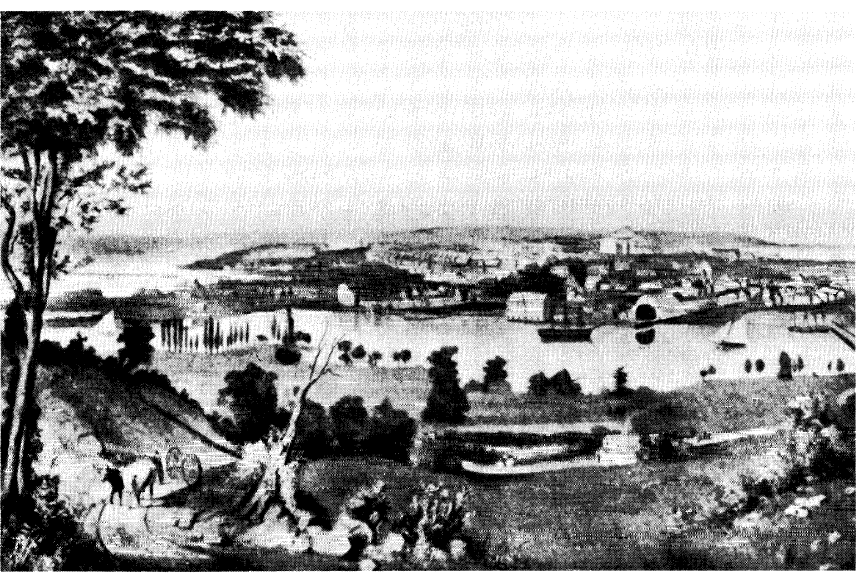
AN EARLY VIEW OF WASHINGTON
(Reproduced from an old engraving in the Library of Congress)
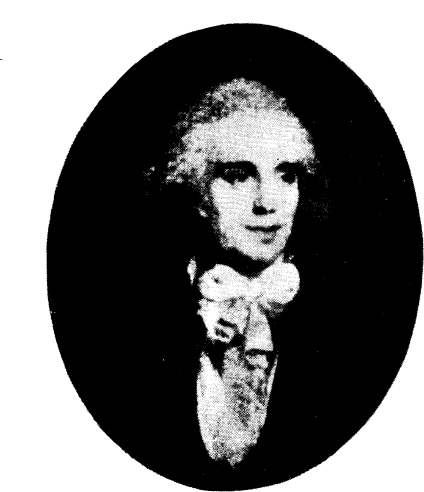
THOMAS LAW, AN ENGLISHMAN WHO BOUGHT REAL ESTATE IN THE FEDERAL CITY
(Reproduced from Clark’s Greenleaf and Law in the Federal City)
“Were the houses that have been built,” notes Isaac Weld, another contemporary commentator, “situated in one place all together, they would make a very respectable appearance, but scattered about as they are, a spectator can scarcely perceive anything like a town.” He states further:
Excepting the streets and avenues, and a small part of the ground adjoining the public buildings, the whole place is covered with trees. To be under the necessity of going through a deep wood for one or two miles, perhaps, in order to see a next door neighbor, and in the same city, is a curious, and, I believe, a novel circumstance.24
Tom Moore, the Irish poet, who visited Washington in 1804, about eight years after Weld, expressed the same sentiment in verse:
This embryo capitol, where fancy sees
Squares in morasses, obelisks in trees
Which second-sighted seers, ev’n now, adorn
With shrines unbuilt and heroes yet unborn,
Though naught but woods and Jefferson they see
Where streets should run and sages ought to be.
More than thirty-five years later, Charles Dickens, another critical and skeptical Englishman, whose proneness to exaggeration should be duly discounted in all he has written about America, gave a similar description of Washington:
It is sometimes called the City of Magnificent Distances, but it might with greater propriety be termed the City of Magnificent Intentions; for it is only on taking a birds-eye view of it from the top of the Capitol that one can at all comprehend the vast designs of its projector, an aspiring Frenchman. Spacious avenues, that begin in nothing, and lead nowhere; streets, mile-long, that only want houses, roads and inhabitants; and ornaments of great thoroughfares, which only lack great thoroughfares to ornament—are its leading features. One might fancy the season over, and most of the houses gone out of town for ever with their masters. To the admirers of cities, it is a Barmecide Feast; a pleasant field for the imagination to rove in; a monument to a deceased project with not even a legible inscription to record its departed greatness. . . . Such as it is, it is likely to remain.25
Dickens was undoubtedly a popular novelist and a pleasing satirist in his day—but judging from the above remark, he was a poor prophet.
Notwithstanding the disappointment of the projectors, the progress of the building of the Federal City in its early days was being heralded at home and abroad. La Rochefoucauld ascribes this to the speculators: “The building of a house for the President, and a place for the sittings of Congress,” he wrote, “excited, in the purchasers of lots, the hope of a new influx of speculations. The public papers were filled with exaggerated praises of the new city; in a word, with all the artifices which trading people in every part of the world are accustomed to employ in the disposal of their wares, and which are perfectly known, and amply practiced in this new world.”
George Washington was seriously concerned about the progress of the city of his name. From the day of its inception until near to the day of his death, he had its progress at heart, and it appears to have given him more worry than most other of the troublesome affairs of the state. He also had faith in it as a field of pecuniary speculation, and is known to have advised others to invest their fortunes in it. He, himself, bought some lots. A printed deed, signed by the three District Commissioners, shows that he purchased on April 23, 1794, “lot No. 4 in square 21 of the City of Washington, for £200 Maryland currency,” and that the fee was conveyed on October 3, 1798. Other lots owned by him were in square 632 (on the west side of North Capitol Street between B and C streets). On these lots, Washington constructed residences, which remained standing until 1908, when they were torn down to increase the area of the Capitol grounds.
The final outcome of Morris, Greenleaf and Nicholson’s speculations in Washington real estate and other land deals was, as already stated, disastrous to them. Their failure also almost wrecked the plans for a national capital—since their defaults put the District Commissioners into a serious financial muddle. These officials were confronted with the necessity of suspending building operations. On May 15, 1795, about a year and a half after Greenleaf made his first wholesale purchase from them, the commissioners notified him that unless the payments due them were made, they would take legal steps to enforce the obligations. But Greenleaf’s position was then almost hopeless. He was at odds with his partners. These blamed him for their unfortunate town-lots venture. He had contracted, Morris stated to Washington, “with his hand and seal to provide us with money, to carry through the operations which, at his instance, we were tempted to undertake, but the French invasion at Holland put it out of his power to fulfill his engagements.”26
Greenleaf’s retort was an offer to sell out to his partners. A bargain was struck between them. Morris and Nicholson paid Greenleaf for his share in their joint properties with their personal notes. Their bankruptcy soon followed, so the notes were uncollected. Thus, the controversy did not end. Greenleaf also soon became a bankrupt. He continued years thereafter to claim an interest in the Washington lots of Morris and Nicholson, as well as in the assets of the North American Land Company.
A controversy of rancorous bitterness was carried on in newspapers between John Nicholson on one hand and James Greenleaf on the other. Robert Morris took no direct part in it. In fact, he did not like this method of airing their differences, and wished for a “settlement with Mr. Greenleaf in the Counting House and not in the Public Prints.” But he was bitter toward Greenleaf to the end. When endeavoring within prison walls to straighten out his affairs, he penned his memorandum on Greenleaf, thus:
James Greenleaf. This is an unsettled account; and I suppose, ever will be. Here commenced that ruin which has killed poor Nicholson, and brought me to the necessity of giving an account of my affairs. But I will forbear to say more, lest I shall not know where or when to stop.
All three of the partners were fellow prisoners in the Prune Street Prison. Morris’ sojourn there was the longest. He was not released until August 26, 1801.
The struggle of Robert Morris and John Nicholson to keep out of a debtors’ prison marks one of the most tragic scenes in American financial annals. Kept within their homes for over a year by their creditors, whom they called “the cormorants” and who, armed with writs of attachment, camped in their gardens and on their doorsteps, and watched their every move, the partners maintained a communication with one another through the secret exchange of notes. Humor and pathos, rancor and regret, hope and despair, were commingled in them. “We must work like men to clear away these accursed encumbrances to satisfy the cormorants,” Morris wrote encouragingly from “The Hills,” his country place on the Schuylkill, on October 25, 1797. And again, in a despairing spirit, he informs Nicholson, “two hundred thousand acres of my land in North Carolina, which cost me $27,000 are sold for a year’s taxes. By heaven, there is no bearing of these things. I believe I shall go mad . . . God help us, for men will not. We are abandoned by all but those who want to get from us all we yet hold.”
Finally, in January, 1798, when Morris was preparing for his somber march to Prune Street Prison—that “hotel with the grated doors”—he informed Nicholson mournfully that “Confidence has furled her banners, which no longer wave over the heads of M. and N.”
Morris went to. prison, February 16, 1798. Nicholson, despite the fact that Morris taunted him for being “a great and sometimes a good lawyer,” soon joined him. Nicholson, as already pointed out, died within a year.27 Morris remained slightly more than three and a half years. Sixty-eight years old, and broken in spirit, he made no attempt to recoup his fortunes. Gouverneur Morris obtained from the Holland Company an annuity of $1,500 annually for Mrs. Morris for release of her dower rights in the Genesee lands, and this constituted his chief support in his last years. Gouverneur noted in his diary in 1803 that his old-time friend, Robert, visited him at Morrisania, his New York estate, “lean, low-spirited and as poor as a commission of bankruptcy can make a man.” “But,” he also notes, referring to the annuity, “I sent him home fat, sleek and in good spirits and possessed of the means of living comfortably for the rest of his days.” Within three years thereafter, he died.
When Greenleaf, Morris and Nicholson failed to meet their obligations on their Washington real estate, the commissioners of the Federal District decided to resell “as many of the lots sold to the syndicate as may be necessary” to make good the unpaid installment, especially “when they reflect that 95,000 pounds have been raised and actually received from sales of city lots by them [i.e., the syndicate] while they profess to be unable to pay their annual installment of only $68,500.” The commissioners did not force sales of the lots, however, and they even succeeded in receiving a portion of the installment due from the syndicate. Yet it was only after December, 1796, when the State of Maryland lent the commissioners $100,000 “in United States 6% stock” that they were able to proceed with the building plans, and put the district into shape for the “residence” of the national government in 1800.
James Greenleaf, though adjudged a bankrupt after the collapse of his Washington speculations, continued for a while to maintain a residence in the city, and became the “trustee” of the syndicate’s creditors. From this occupation he managed to get a small income for many years. He resided a few years in Allen-town, Pa., the home of his second wife, Ann Penn Allen, though he credited himself to Philadelphia. While in Allentown, he took an active part in its affairs, but made frequent visits to his old battleground in the District of Columbia, where he defended vigorously the rights of creditors of the syndicate to their property claims in the Federal City. At some time before 1831, he again took up his permanent residence in Washington, then a thriving political center, and spent the remainder of his days as a retired gentleman of taste, though of very limited means. He died September 20, 1843, obscure and alone.
The failure of James Greenleaf, Robert Morris, John Nicholson, Samuel Blodget, Jr., and Thomas Law—the most conspicuous figures in the “Federal City” speculation—to be profitably rewarded for their ventures, was not due to fantastic visions of stupendous growth in land values, or even to lack of foresight. They merely ignored the inherent and difficult problems of town building. As pointed out by the Duke de La Rochefoucauld, one of the keenest of observers of early American society: “He . . . who is engaged in the establishment of a new city, can rarely confine to himself the conduct of the enterprise. If he is not counteracted in the whole of his views, he is sure to be so in the greater part of them. The proper inhabitants that he receives on his estate are of no advantage to him. They are even burthen-some, as they occupy the space he wishes to fill with others, whose wealth may advance his fortune. Benevolence is banished from his system, by the necessary calculations of his interest. If those calculations induce him to expend sums for buildings, it is to erect taverns, shops, to open billiard tables, and to create lotteries; in a word, to furnish the means of dissipation and pleasure. . . . It is such objects as these that draw crowds of inhabitants to cities; and without them, cities will never be extensive.”28
And thus it was with the Federal City, America’s first “boom town.”
29 See Travels Through the United States of North America in the Years 1795, 1796 and 1707, by the Duke de La Rochefoucauld-Liancourt. Translated by H. Neuman, London, 1799, Vol. III, p. 622.
30 The Journal of William Maclay (1927 Edition), p. 131.
31 Wilhelmus Bogart Bryan, A History of the National Capital, pp. 38, 39.
32The Diaries of George Washington, Vol. IV, p. 154.
33Ibid.
34 Bryan, op. cit., p. 134.
35 Bryan, op. cit., p. 162.
36 The Writings of George Washington, edited by Ford, Vol. 12, p. 81.
37 Economica, a Statistical Manual for the United States, published in 1813.
38 Washington’s Writings, Vol. 12, p. 212.
39 Ibid., p. 214.
40 Bryan, op. cit., pp. 205–208.
41 Washington’s Writings, Vol. 12, p. 407.
42 The title of the work is Thoughts on the Increasing Wealth and National Economy of the United States of America.
43 A History of the Insurance Company of North America, p. 109. Blodget’s heirs sued to recover his Washington real estate, and the “descendants of the third generation” are reported to have been successful.
44 Bryan, A History of the National Capital, Vol. I, p. 215.
45 Washington’s Writings, Vol. 12, p. 329.
46 Allen C. Clark, Greenleaf and Lam in the Federal City, p. 114.
47 Clark, op. cit., p. 86.
48 Ibid., p. 89.
49 See Chapter II, p. 50.
50 Travels Through the States of North America, Etc., by Isaac Weld, Jr.
51 Clark, op. cit., p. 101.
52 Weld, Travels, etc., Fourth Edition, p. 286.
53 American Notes.
54 Bryan, op. cit., p. 257.
55 See Chapter II, p. 37.
56 Travels Through the United States of North America in the Years 1795, 1796 and 1797, Vol. III, p. 648.
- 1Maine Historical Collections, Vol. II, pp. 268-294.
- 2The Sir William Johnson Papers, Vol. V, p. 129. See also, C. W. Alvord, The Mississippi Valley in British Politics, Cleveland, 1917.
- 3Herbert B. Adams. “Washington’s Interest in Western Lands,” Johns Hopkins University Studies, Third Series, No. 1, January, 1885. Italics are mine.—A. M. S.
- 4Adams, op, cit., p. 58.
- 5See A. Henderson, “A Pre-Revolutionary Revolt in the Old Southwest” in Mississippi Valley Historical Review, Vol. 27, p. 198 et seq.
- 6Italics are not in the original.
- 7In a letter to William Franklin, dated May 3, 1776, Johnson asserted “it has always been my practice to avoid engaging in lands to the great loss of my family, neither have I a foot of land from the Indians.” (Sir William Johnson Papers, Vol. IV, p. 197.) The large tract north of the Mohawk Valley given him by the Canajoharie Indians in 1760 was confirmed by royal grant in 1769.
- 8See Pennsylvania Magazine of History, Vol. XIV, pp. 218, 219.
- 9See Memorial of the United Illinois and Wabash Land Companies, Baltimore, 1816.
- 10A copy of the deed is contained in American State Papers, “Public Lands.” Vol. I. The original copy was acquired by Cyrus H, McCormick.
- 11See J. P. Boyd, “Connecticut’s Experiment in Expansion, The Susquehannah Company, 1753-1803,” in Journal of Economic and Business History, November, 1931.
- 12See Publications of the Colonial Society of Massachusetts, Vol. XXV, PP. 33-38.
- 13Samuel W. Jones, Memoir of James Duane, 1852.
- 14P. H. Woodward, One Hundred Years of the Hartford Bank, p. 74. See also R. J. Purcell, Connecticut in Transition, p. 154.
- 15Haskins, op. cit., p. 36.
- 16Ellis Paxton Oberholtzer, Life of Robert Morris, pp. 307, 308.
- 17S. G. McLendon, History of the Public Domain of Georgia, Chap. IX.
- 18Theodore Dwight, Travels, Vol. I, p. 188.
- 19Absalom H. Chappell, Miscellanies of Georgia, Part II, p. 49.
- 20Greenleaf and Law in the Federal City, p. 26.
- 21The Winning of the West (New Knickerbocker Edition), Vol. II, p. 411.
- 22Travels Through the States of North America, Etc., by Isaac Weld, Jr.
- 23Clark, op. cit., p. 101.
- 24Weld, Travels, etc., Fourth Edition, p. 286.
- 25American Notes.
- 26Bryan, op. cit., p. 257.
- 27See Chapter II, p. 37.
- 28Travels Through the United States of North America in the Years 1795, 1796 and 1797, Vol. III, p. 648.
- 29During the first hundred years of North American colonization, economic conditions gave little encouragement to private land schemes. Land was too plentiful. A few such enterprises were undertaken, however. Thus, as early as 1661, the Colony of Massachusetts sold to a few individuals for £400 a large tract on the Kennebec River in Maine. This became known as the “Kennebec Purchase.” The heirs held it for nearly a century without doing anything with it. In 1753, they incorporated as the “Proprietors of the Kennebec Purchase” and proceeded to dispose of their holdings. The corporation continued in existence until 1816. “The Pejebscot Company” was another Maine land deal. None of these held out promise of profit to proprietors until about a quarter century before the Revolution.
- 30In the meantime, the “Loyal Company” group was not idle; its proprietors sent Dr. Thomas Walker, of Albermarle, Va., to make a reconnaissance, and to discover a proper place of settlement. The two “companies” then became engaged in a controversy, and neither made a survey or fixed the bounds of their grants. The apparent ease with which they obtained land donations led to other schemes, and aroused an epidemic of interest in distant western wild lands. Not only was the land ownership eagerly sought after, but the establishment of new colonies, with separate and distinct governments, was planned. Favoritism and collusion infested the Virginian colonial government, due in large part to the persistence of speculators in western land grants. Lobbyists were sent to London to obtain the crown’s sanction to land-grabbing schemes and the question of the disposal of the vast western domain won from the French infested British politics. “One half of England is now land mad,” wrote George Croghan, of Philadelphia, one of the land schemers, to Sir William Johnson, on March 30, 1766, “and everybody there has their eyes fixed on this country.”
- 31I offered in my last to join you in attempting to secure some of the most valuable lands in the King’s part, which I think may be accomplished after awhile, notwithstanding the proclamation that restrains it at present and prohibits the settlement of them at all; for I can never look upon that proclamation in any other light (but this I say between ourselves) than as a temporary expedient to quiet the minds of the Indians. It must fall, of course, in a few years, especially when those Indians consent to our occupying the lands. Any person, therefore who neglects the present opportunity of hunting out good lands, and in some measure marking and distinguishing them, for his own, in order to keep others from settling them, will never regain it.
- 32Crawford “heartily embraced” the colonel’s offer. He promised shortly to set out in search of lands. “This may be done,” he said, “under a hunting scheme.” He acknowledged that other land seekers had approached him, with similar offers, “but have not agreed to any; nor will I with any but yourself or whom you think proper.”
- 33Judge Richard Henderson of North Carolina, the employer and backer of Daniel Boone, promoted the settlement of the Kentucky region and claimed ownership to a vast unsettled tract there. He organized a group of land grabbers under the name of “The Transylvania Company.” Ignoring the British interdiction against Indian land purchases, he obtained from the Cherokees in 1773 about one-half of the present State of Kentucky, and immediately began settling the land. He advertised widely for pioneers and “shareholders.” In his announcements, Henderson waxed enthusiastic. “The country [Transylvania] might invite a prince from his palace, merely for the pleasure of contemplating its beauty and excellence, but only add the rapturous idea of property, and what allurements can the world offer for the loss of so glorious a prospect?”
- 34When the British Government began to take active measures to break up land “bootlegging,” and to put a stop to dreams of riches in western territory, Virginia’s political resentment was naturally aroused. Even Thomas Jefferson, who, in later life, frowned upon speculation and land grabbing, held the view in 1774 that the land did not belong to the British king, and that it was time for the colonies “to declare that he has no right to grant lands of himself.” So he boldly wrote in the Declaration of Independence, as one of the British king’s usurpations: “He has endeavored to prevent the Population of these States; for that purpose obstructing the Laws for Naturalization of Foreigners; refusing to pass others to encourage their migrations hither, and raising the conditions of new Appropriation of Lands.”
- 35He was for it at once. “I like the project of a colony in the Illinois Country,” he wrote his son, “and will forward it to my utmost here.” He thought that Sir William Johnson’s “approbation will go a great way in recommending it, as he is much relied upon in all affairs that may have any relationships with the Indians.” But Johnson had an eye on the Indian lands himself, and besides advising others about purchases in the outlying sections, personally through gifts from the Indians engrossed large tracts, particularly in the Mohawk Valley. The town of Johnstown, N. Y., still marks the seat of his domain.
- 36Some of the members of the Vandalia Company were concerned in other western land schemes. One of these was organized in 1775 as the “Indiana Land Company,” probably the first application of the name “Indiana” to the Northwest Territory. The claim to land was based on a grant of a large tract, made November 3, 1768, in what is now West Virginia, by the Six Nations at Fort Stanwix to “Chief” William Trent in liquidation of depredations. Among the shareholders were Samuel Wharton, Joseph Galloway, Robert Callender, Levi Andrew Levi, and David Franks, all wealthy and prominent Philadelphians. The Revolutionary War did not put an end to the “claim.” Wharton in 1776 published a pamphlet, entitled-View of the Title to Indiana, in which he defended the company’s rights to the lands. In 1781, he republished this in enlarged form, under the title Plain Facts; being an examination into the Rights of the Indian Nations of America to their respective Countries and a Vindication of the Grant from the Six United Nations to Proprietors of Indiana, etc. Although Wharton pressed the validity of the “proprietors” claims, Congress then and thereafter gave little heed thereto.
- 37Notwithstanding the British Government’s edict, forbidding the private purchase of lands from the Indian tribes, William Murray, an Indian trader, and several of his business associates, in 1773 formed a plan to buy from the aborigines an immense tract of country between the Mississippi, Illinois and Ohio rivers. After a “pow-wow” lasting a month, the sale was consummated. According to the land claimants, it was attended by “many persons of both descriptions and the Indians were carefully prevented from obtaining any spiritous liquors during the whole continuation of the negotiation.” On July 5, 1773, “for a very large and valuable consideration,” the deed was delivered to the “Illinois Land Company.”
- 38Notwithstanding the British Government’s edict, forbidding the private purchase of lands from the Indian tribes, William Murray, an Indian trader, and several of his business associates, in 1773 formed a plan to buy from the aborigines an immense tract of country between the Mississippi, Illinois and Ohio rivers. After a “pow-wow” lasting a month, the sale was consummated. According to the land claimants, it was attended by “many persons of both descriptions and the Indians were carefully prevented from obtaining any spiritous liquors during the whole continuation of the negotiation.” On July 5, 1773, “for a very large and valuable consideration,” the deed was delivered to the “Illinois Land Company.”
- 39The proposition then took on a business aspect. The number of “shares” was increased, and rights to subscribe offered at from $2 to $5 per share. It attracted speculators. The shares soon rose in value. Lawyers, clergymen and politicians began buying shares. The Reverend Ezra Stiles, President of Yale College, grandfather of the poet-physician Oliver Wendell Holmes, took 2¾ shares. The Governor of Connecticut, Roger Walcott, who had become rich through local land deals, supported the project.
- 40New York, before the Revolution, also had her “land” quarrels with the other colonies. The ill-defined boundaries of the Dutch province led to constant conflicts and legal controversies with her neighbors. There was a bitter dispute with New Hampshire regarding the political jurisdiction of Vermont. New York claimed the section, but New Hampshire, in 1749, acting on the principle that possession is nine points of the law, began to make free grants to both New Hampshire and Massachusetts citizens. Whole “towns” of 23,000 acres, more or less, were granted to selected groups of individuals. It is estimated that between 1749 and 1764, Governor Benning Wentworth granted 131 townships to more than six thousand persons. Among the grantees appear the names of many prominent colonial New Englanders, who had no intention of ever settling on the lands. Samuel Adams was among them. He was known as a speculator in both Maine and New Hampshire lands in this period. The governor granted himself, in all, about 65,000 acres, and is reported to have accumulated considerable wealth from the heavy fees exacted by him for grants.
- 41Because of his land deals, while acting as the state’s attorney, Duane was the butt of political criticism. He was led to appear in person in his own defense before the state legislature in 1781. He was charged with receiving Vermont grants “under immoderate quit-rents, and excessive fees of office,” and he was also accused of “holding many thousand acres of land which had never before been granted by the Crown.” To this he merely answered that he “had never made a purchase or obtained a grant of land with any view to its sale.” He was therefore not a “land jobber.” This cleared him politically of all corruption.
- 42So popular was the western lure to the Connecticut gentry that legislation was urged to countermand it. “Young people in their plays at social gatherings marched to rude melodies which taught them to dream that toward the setting sun lay an earthly paradise with gates open to welcome them. From hill and valley the processions hurried away. Today, many of our rural towns are scarred and paralyzed by an outflow which has built up the continent to no small degree at their expense.”
- 43What is the spirit against which we now struggle and which we have vainly endeavored to stifle? A monster, generated by fraud, nursed in corruption, that in grim silence awaits its prey. It is the spirit of Federalism! That spirit which considers the many made only for the few. . . . When I behold a certain party supporting and clinging to such a measure almost to a man, I see only men faithful to their own principles. . . . But when I see associated with them, in firm compact, others who once rallied under the standard of opposite principles, I am filled with apprehension and concern. . . . If Congress shall determine to sanction this fraud upon the public, I trust in God we shall hear no more of the crimes and follies of the former administration. For one, I promise that my lips upon this subject shall be closed in eternal silence. I should disdain to prate about petty larcenies of our predecessors after having given my sanction to this atrocious public robbery.
- 44Large tracts were also freely disposed of by Georgia. Count d’Estaing, the French admiral who assisted the colonies, was granted a substantial acreage for his Revolutionary services. D’Estaing sold his land to the Count de Colbert, who resold it in England to Robert Morris, through the agency of William Constable and Gouverneur Morris. Robert Morris then proceeded to add to his Georgia possessions. In association with John Nicholson, he soon become the leading proprietor of Georgia waste lands. How these large holdings were obtained has never been satisfactorily explained. It is the “unsolved riddle of Georgia’s land history.”
- 45Large tracts were also freely disposed of by Georgia. Count d’Estaing, the French admiral who assisted the colonies, was granted a substantial acreage for his Revolutionary services. D’Estaing sold his land to the Count de Colbert, who resold it in England to Robert Morris, through the agency of William Constable and Gouverneur Morris. Robert Morris then proceeded to add to his Georgia possessions. In association with John Nicholson, he soon become the leading proprietor of Georgia waste lands. How these large holdings were obtained has never been satisfactorily explained. It is the “unsolved riddle of Georgia’s land history.”
- 46To most of these “free” Georgia lands the name of “Pine Barrens” was given. Their sandy soil was covered with a luxuriant growth of pine trees, for which Georgia, for over a century, was famous, and which in later years not only afforded a lucrative article of export, but was the basis for its naval stores’ industry. But “barren” they certainly were in the post-Revolutionary days when they were sold to Robert Morris and other land jobbers. As mentioned in a previous chapter, “whatever land was offered for sale, they appeared ready to buy; and actually bought quantities which outran every sober thought.”
- 47Morris, as previously noted, endeavored to get French purchasers for these Georgia lands. There was already considerable French influence in South Carolina and Georgia, and these lands were advertised as most suitable for the émigrés. But he was brought face to face with the outspoken opposition of Joseph Fauchet, French Minister to the United States. Though the Pine Barrens were hawked about even before the second Yazoo grants were made, and it was reported that they were a profitable speculation, they lacked buyers. There was, of course, considerable doubt as to the validity of Morris’ title to them—and this point was strongly emphasized by Fauchet. Most of the grants had not been surveyed in accordance with the legal requirements. In 1798, the Georgia Legislature, with the Yazoo fiasco fresh in mind, passed a law requiring all landowners to survey and identify their holdings every ten years, beginning in 1799. The purpose was to compel holders under fraudulent grants to prove their titles. The heritors of the North American Land Company, after Morris and Nicholson’s failure, could not do this. Moreover, it was not worth the expense. As taxes were not paid, the lands went back to the state. In fact, the State Comptroller of Georgia reported in 1839 that “not more than half the land in the region was worth owning or paying taxes for.”
- 48It is a sad commentary on Robert Morris’ business judgment that lands which he eagerly acquired as a speculation and actively sought to sell were still in as wild and primeval condition almost a century after his death. But he seems never to have inquired regarding the quality or locations of properties, as long as he could obtain them cheaply and on credit. Either he had the utmost confidence in the rapid filling up of unoccupied regions in the country, or he became madly intoxicated by the prevailing wild land mania. He, Nicholson and Greenleaf purchased indiscriminately in the South, West and East—from the sluggish Savannah to the shores of Lake Erie. The modern searcher of land titles in any district east of the Alleghanies and south of New England is apt to find the name of Robert Morris or that of his partners in the early deeds. As stated by Allen C. Clark, “When a tract in the Carolinas or the Virginias is subject to negotiation, the lawyer from the metropolis must need travel through primeval forest whose solemn stillness is unbroken save by the cawing of the inhabitants of the air and the reverberating music of the axe, to the little remote brick courthouse, there to ascertain if the title is a continuous chain from the original owner—Robert Morris.”
- 49And yet, the chief exponent of the “strenuous life” admits that the land companies “did possess considerable importance at certain times in the settlement of the west, both because they in places stimulated that settlement and because in other places they kept out the actual settlers.” But, as the following chapters will show, the stimulation to settlements was a permanent force, while the retardation was but temporary and sporadic. Speculation is essential to human progress. Adventure and Cupidity, hand-in-hand, have spread civilization.
- 50Considering the vastness of the territory, which is thus opened to the federal city, by means of a water communication; considering also that it is capable from the fertility of its soil, of maintaining three times the number of inhabitants that are to be found at present in all the United States; . . . there is good foundation for thinking that the federal city, as soon as navigation is perfected, will increase most rapidly in population, and that at a future day . . . it will become the grand emporium of the West, and rival in magnitude and splendor the cities of the old world.
- 51Thomas Law’s real estate transactions in the new national capital were second only in magnitude to those of Morris, Greenleaf and Nicholson. Unlike these men, he continued solvent in spite of his financial disappointments, and he kept up his faith in the future value of his real estate. Writing to Greenleaf, on January 8, 1795, he stated enthusiastically, “You may say that I had rather sell my horses or books or anything rather than part with a foot at present of Washington City.” He succeeded in escaping from the effects of the subsequent failure of Morris, Greenleaf and Nicholson, to meet their instalment payments to the District Commissioners, by having received, at his own insistence, a clear title to the real estate that he purchased. For a number of years he lived as a prominent, respected and public spirited citizen of Washington City, though his real estate ventures caused him serious loss of his fortune. In 1796, he married Elizabeth Parke Curtis, granddaughter of Mrs. George Washington. This brought him into close association with General Washington, while the latter was in retirement at Mount Vernon. But the marriage was not a happy one. A separation ensued in 1802.
- 52Excepting the streets and avenues, and a small part of the ground adjoining the public buildings, the whole place is covered with trees. To be under the necessity of going through a deep wood for one or two miles, perhaps, in order to see a next door neighbor, and in the same city, is a curious, and, I believe, a novel circumstance.
- 53It is sometimes called the City of Magnificent Distances, but it might with greater propriety be termed the City of Magnificent Intentions; for it is only on taking a birds-eye view of it from the top of the Capitol that one can at all comprehend the vast designs of its projector, an aspiring Frenchman. Spacious avenues, that begin in nothing, and lead nowhere; streets, mile-long, that only want houses, roads and inhabitants; and ornaments of great thoroughfares, which only lack great thoroughfares to ornament—are its leading features. One might fancy the season over, and most of the houses gone out of town for ever with their masters. To the admirers of cities, it is a Barmecide Feast; a pleasant field for the imagination to rove in; a monument to a deceased project with not even a legible inscription to record its departed greatness. . . . Such as it is, it is likely to remain.
- 54The final outcome of Morris, Greenleaf and Nicholson’s speculations in Washington real estate and other land deals was, as already stated, disastrous to them. Their failure also almost wrecked the plans for a national capital—since their defaults put the District Commissioners into a serious financial muddle. These officials were confronted with the necessity of suspending building operations. On May 15, 1795, about a year and a half after Greenleaf made his first wholesale purchase from them, the commissioners notified him that unless the payments due them were made, they would take legal steps to enforce the obligations. But Greenleaf’s position was then almost hopeless. He was at odds with his partners. These blamed him for their unfortunate town-lots venture. He had contracted, Morris stated to Washington, “with his hand and seal to provide us with money, to carry through the operations which, at his instance, we were tempted to undertake, but the French invasion at Holland put it out of his power to fulfill his engagements.”
- 55Morris went to. prison, February 16, 1798. Nicholson, despite the fact that Morris taunted him for being “a great and sometimes a good lawyer,” soon joined him. Nicholson, as already pointed out, died within a year. Morris remained slightly more than three and a half years. Sixty-eight years old, and broken in spirit, he made no attempt to recoup his fortunes. Gouverneur Morris obtained from the Holland Company an annuity of $1,500 annually for Mrs. Morris for release of her dower rights in the Genesee lands, and this constituted his chief support in his last years. Gouverneur noted in his diary in 1803 that his old-time friend, Robert, visited him at Morrisania, his New York estate, “lean, low-spirited and as poor as a commission of bankruptcy can make a man.” “But,” he also notes, referring to the annuity, “I sent him home fat, sleek and in good spirits and possessed of the means of living comfortably for the rest of his days.” Within three years thereafter, he died.
- 56The failure of James Greenleaf, Robert Morris, John Nicholson, Samuel Blodget, Jr., and Thomas Law—the most conspicuous figures in the “Federal City” speculation—to be profitably rewarded for their ventures, was not due to fantastic visions of stupendous growth in land values, or even to lack of foresight. They merely ignored the inherent and difficult problems of town building. As pointed out by the Duke de La Rochefoucauld, one of the keenest of observers of early American society: “He . . . who is engaged in the establishment of a new city, can rarely confine to himself the conduct of the enterprise. If he is not counteracted in the whole of his views, he is sure to be so in the greater part of them. The proper inhabitants that he receives on his estate are of no advantage to him. They are even burthen-some, as they occupy the space he wishes to fill with others, whose wealth may advance his fortune. Benevolence is banished from his system, by the necessary calculations of his interest. If those calculations induce him to expend sums for buildings, it is to erect taverns, shops, to open billiard tables, and to create lotteries; in a word, to furnish the means of dissipation and pleasure. . . . It is such objects as these that draw crowds of inhabitants to cities; and without them, cities will never be extensive.”

