
The Great American Land Bubble
Chapter XIII. Railroad Land Jobbery
THE peerless co-author of The Gilded Age, Mark Twain, was from Missouri. But he knew Yankee characteristics as well as those of his southern neighbors, and his description of Squire Hawkins’, of Obedstown, great faith in his “Tennessee lands” was no more genuine than his characterization of Mr. Bigler’s, the eastern contractor’s ideas of railroad promotion:
Mr. Bigler’s plan this time, about which he talked loudly . . . was the building of the Tunkhannock, Rattlesnake and Youngwomenstown railroad, which would not only be a great highway to the west, but would open to the market inexhaustible coal-fields and untold millions of lumber. The plan of operations was very simple.
“We’ll buy the lands” explained he, “on long time, backed by the notes of good men; and then mortgage them for money enough to get the road well on. Then get the towns on the line to issue their bonds for stock . . . We can then sell the rest of the stock on the prospect of the business of the road, . . . and also sell the lands at a big advance, on the strength of the road.”1
Note that Mr. Bigler’s mind was on the rising real estate values. “On the strength of the road,” he argued, “there would be a big advance.” Land speculation was the lure of the railroad promoters. Land speculation and railroad construction went hand in hand.
When Congress, in 1833, gave Illinois the right to apply to railroad construction the national land that had been granted to it for the Illinois and Michigan Canal, it started something. Little was it realized then that this act was the beginning of land-jobbery promotion on a tremendous scale, and that, though resulting in economic benefit to the nation, it would carry in its wake speculation, town-site jobbing, political corruption and downright fraud.
During the fever of violent speculation which characterized the period of rapid western settlement from about 1820 to 1837, it was frequently suggested, and even importuned, that internal improvements be fostered by free gifts of public land. There was a craze for canals and turnpikes, for bridges and railroads. The land jobbers wanted these to enhance the value of their properties. The promoters of the improvements wanted land to reap the profit which they felt might not result from the public utilities they were creating. Land was the bait. Land was the quarry.
The use of the public lands to promote economic development was broadly advocated. No political party was strongly opposed to it, and no geographical section complained against it. As early as 1828, Daniel Webster, staunch “Old State” New Englander, advocated it. In a speech at Faneuil Hall, he said:
In most of the new States of the West, the United States are yet the proprietors of vast bodies of land. Through some of these States and through some of these same public lands, the local authorities have prepared to carry expensive canals for the general benefit of the country. Some of these undertakings have been attended with great expense, and have subjected the States . . . to large debts and heavy taxation. The lands of the United States, being exempted from all taxation, of course, bear no part of this burden. Looking at the United States, therefore, as a great landed proprietor, essentially benefited by these improvements, I have felt no difficulty in voting for appropriation of parts of these lands, as a reasonable contribution by the United States to these general objects.2
And with this reasoning, Webster and other statesmen of the time began to distribute, in modest quantities, parts of the national heritage of free land. River improvements, wagon roads, and canals received cessions of the public domain.
Railroads came later, but the railroad rage soon took precedence over the canal craze. As already noted, real estate development and land booming went hand-in-hand with railroad construction. Rail highways were promoted in many cases, not with the main idea of profiting from their operation, but to increase town and rural land values. Large landowners were, therefore, concerned in early railroad projects. Soon after the organization of the Baltimore and Ohio Railroad in 1825, a group of capitalists, some of whom were among its promoters, formed the Canton Company in Baltimore. They acquired a large tract of land near the city. They expected the value to increase greatly because of its access to both the railroad and the harbor. Although the Canton Company and the railroad company remained separate corporations for over a century, their interests coincided. As already noted, the Canton Company’s property only recently came under the control of the Pennsylvania Railroad, but not without the serious protest of the latter’s rival—the Baltimore and Ohio.
The right to own real estate was regarded as a special advantage by the early railroads. The original prospectus of the “Mt. Carmel and New Albany Railroad,” of Indiana, in 1838, takes note of this: “Were the company to purchase a million acres of the lands adjacent to the work, the increase alone in the price of the lands so purchased would, before the work is half completed, pay for the entire construction of the work. The bare location of the route would triple the price of every acre of land within two miles of it. All that is wanted is capital to invest in lands, and go on with the work for a short time without being compelled to make sale of them.”3
In the same belief, individuals and corporations eagerly granted rights of way over their properties to railroads so as to enhance the value of the portions retained. Donations of land, both public and private, to transportation companies, as a speculation aid, thus became an established policy. Overbuilding of railroad facilities was the logical result.
Although Congress had previously granted lands to corporations and individuals for the purpose of creating and maintaining public utilities of various kinds, the first substantial grant for a railroad enterprise was not made until 1850 when the Illinois Central Railroad was organized. As early as 1836, however, Congress was petitioned for a land grant for the same enterprise.4 A similar measure was advocated by Senator Sidney Breese in 1844. He desired to secure to the proposed “Great Western Railroad of Illinois” the right of preëmption of public land along its lines. This meant that the railroad would pay the government price for the land, if it was acquired, but, of course, the lands would only be paid for as they were sold at an advance above the government price. Hence, it is quite evident that early railroad building, even in the new and unsettled areas, was closely interlaced with land speculation.
Congress had already made a gift of public land to Illinois in 1828, in aid of the proposed construction of a canal between Chicago and the Illinois River, in order to create a “Great Lakes to Gulf” waterway. The fever of speculation that was engendered by this project was described in a previous chapter. Before the canal was even marked out, lands, supposedly adjacent to it, rose to high values. William B. Ogden, who went to Chicago in the interests of the American Land Company, wrote on May 3, 1836, that he purchased nearly two thousand acres along the proposed canal, at $5 per acre. “It is considered a good investment at $10,” he stated, “for it would not only be on the Canal, but near the flourishing town of Joliet.” In Chicago, of course, the “canal lots” brought ridiculously high prices. But most of the sales were canceled because of default in payments following the crash in May, 1837.
As the canal was slow in building, and costly, and as railroads were demonstrating their superiority over other means of transportation, Illinois sought to apply the canal land grant to railroad construction. The panic, however, had caused a bankrupt state treasury. Even with land donations, there were insufficient public funds for internal improvements. Moreover, land was then a “drug” on the market. Accordingly, although Congress consented to the diversion from canal to railroad purposes in 1833, the grant was not used.
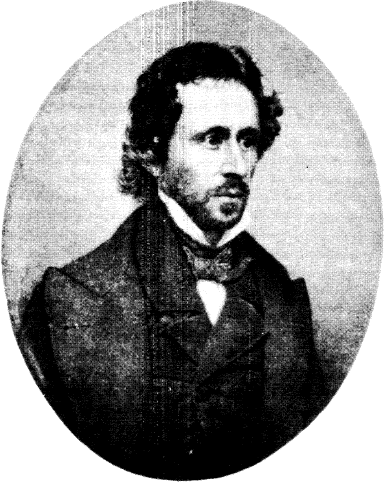
JOHN C. FRÉMONT
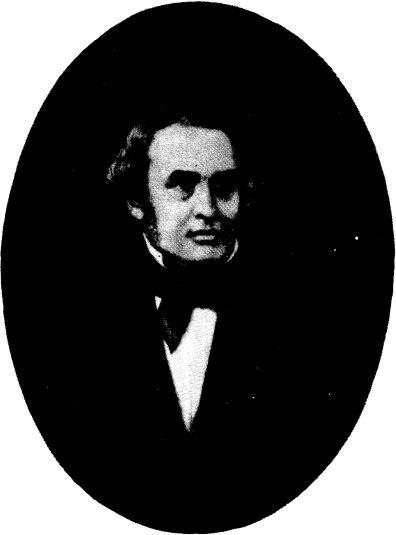
ROBERT RANTOUL, JR., WHO OBTAINED THE LAND GRANT FOR THE ILLINOIS CENTRAL RAILROAD
(From an engraving by Sartain)
In the meantime, Darius B. Holbrook, a town jobber, was eager for the success of his “Cairo City and Canal Company.” This concern grew out of a town-site speculation started by Baltimore capitalists, as far back as 1818, in Illinois, at the confluence of the Ohio and Mississippi rivers. The project lingered in obscurity for several years because the “town” was seasonally under water. The Cairo City and Canal Company, however, endeavored to offset this inconvenience by constructing “dikes, canals, levees and embankments.”
When Holbrook could not make a “go” of his town-jobbing venture, he conceived the idea of making the place a railroad terminal. In 1835, he promoted the “Illinois Central Railroad Company,” an Illinois corporation, and it was this company which petitioned Congress for a land grant, but without success. This did not discourage Holbrook. About 1840, he obtained a new Illinois charter for a railroad and again sought Congressional assistance. His petition was opposed by Stephen Douglas, then Senator from Illinois, on the ground that Holbrook’s railroad was “a stupendous private speculation to enable the Cairo Company to sell their chartered privileges in England.”
Douglas then offered a substitute plan. Instead of granting land for railroad purposes to Holbrook’s company, he proposed a grant directly to the State of Illinois, to be used in aid of private railroad construction. In the meantime, the crafty Holbrook induced the Illinois Legislature to pass an act, ceding to his proposed railroad all lands that might be granted the state by Congress. When Douglas learned of this trick, his ire was greatly stirred. He threatened to withdraw his bill for a land grant. To appease him, Holbrook was induced to release the state from the privilege given his company. Douglas regarded Holbrook and his associates as merely land grabbers and town jobbers, and he wished lands conveyed to an out-and-out railroad proposition.
Douglas’ land grant bill was enacted by Congress, September 20, 1850. It did not convey a definite acreage. It granted an alternate section of land, extending six miles on each side of a railroad to be built as part of a line between Mobile and Chicago. As each alternate section was a square mile, speculators could not obtain directly from the railroad company large contiguous tracts. Moreover, if the railroad’s lands rose in value, the government’s sections would rise proportionately. Thus, the government would participate equally with the railroad in the profits resulting from land ownership. This system—designed primarily to block monopolization of land along the railroad—was continued in all subsequent railroad land grants.
But who would build and own the railroad that was to get all that land? Surely, not the people of Illinois. They lacked the funds. This situation was undoubtedly well known to eastern capitalists, and particularly to the New England Congressmen who voted for the land donation. And they were not long in taking advantage of it! Daniel Webster was not a capitalist, but he had an eye for business and his legal services were in demand by the moneyed interests. Webster had a colleague in Congress, with whom he was friendly, even though they adhered to opposite political parties. This man was Robert Rantoul, Jr., a strong supporter of internal improvements. He was an able lawyer, a good business man, but not a successful politician. As a Democrat, he supported free trade and “state’s rights,” and accordingly was not in political harmony with Webster. Yet, it is stated on pretty good authority that Webster, almost immediately after Douglas’ land grant bill was passed, advised Rantoul to go to Illinois in the interests of a group of capitalists and seek the railroad charter, and in this way get the conveyance of the land. In fact, it is said that Rantoul drew up the charter under Webster’s supervision.
Rantoul went West, and arrived in Springfield, Ill., just in time to forestall the efforts of a young lawyer and politician—Abraham Lincoln by name—to obtain the railroad charter and the land for a group of western capitalists. Lincoln confirmed this in 1863 to Rantoul’s son, while the latter was on a visit to the White House; and remarked with characteristic jocularity and a slap on his visitor’s knee: “Your father beat me, your father beat me.”5
Rantoul obtained, without much difficulty, a charter for the Illinois Central Railroad on February 10, 1851. As stated in the Senate in 1870 by Senator James Warren Nye: “He spread out to the Legislature of Illinois the boundless advantages that would accrue from affording aid to this great enterprise. He laid that upon the altar of his country for its benefit, and the nation also was induced to extend its aid.”6
Of course, it required some “extravagant figures” and an attractive bait in the form of participation in the railroad’s revenue to induce the legislature to turn over the liberal land grant to a private corporation. But Rantoul was equal to the task. The newspapers of the time caricatured his figures for their extravagance; but he returned East with his grant. Prominent New York and Boston capitalists became his associates. These included Robert Schuyler, George Griswold, Gouverneur Morris, son of our, old land agent, William H. Aspinwall, Jonathan Sturgis, George W. Ludlow, Henry Grinnell, and John F. A. Sanford, of New York, and David A. Neal and Franklin Haven, of Boston.
Rantoul was also a member of the first board of directors of the Illinois Central Railroad Company, but death took him on August 7, 1852, when the actual work of construction had barely begun. Just before his death he wrote enthusiastically regarding the “value of the public lands of Illinois.” His sentiments were disclosed in a published letter to Robert Schuyler, the first president of the Illinois Central Railroad,—a letter, of course, designed to attract investors to the company’s securities:
“It is plain,” he said, “that all the land within fifteen miles of the Central Railroad is intrinsically worth, from its power of production, not only as much, but on average twice as high as that which we have assumed to be the selling price of Ohio lands. Such an average would be realized if the supply of such lands were not much greater than the demand for cultivation. It becomes then necessary to inquire how long will the supply exceed the demand, not for speculation, because that is too precarious and unsteady for our consideration, but the demand for actual cultivation?”7
The enthusiastic promoter had his answer to this question. The demand would soon increase beyond the supply should the population of Illinois increase only as fast as that which actually took place between 1840 and 1850. The railroad, moreover, would bring a larger number of settlers. Hence, it was a safe prediction that the Illinois Central lands would, in ten years, rise to from $10 to $12 an acre.
He was not wrong. In scarcely ten years thereafter, the Illinois Central Railroad publicly announced that it had 1,100,000 acres, or less than one-half of its original grant, for sale, in forty-acre lots and upwards, at prices ranging from $5 to $25 per acre, whereas the national domain was offered at $1.25 per acre, with not many takers. Certain tracts immediately adjoining stations, or “for other causes” especially valuable, were offered at higher prices on the familiar “canal terms,” i.e., one-fourth cash and the balance in three annual instalments, with interest. The ordinary tracts were sold on smaller cash payments, amounting usually to but one year’s interest on the purchase price. The balance could be paid in six annual instalments, secured by notes, with interest at 6 per cent. There was, moreover, the general requirement—usually disregarded—that one-half of each plot purchased be fenced and placed under cultivation.
It can be readily assumed that the speculative interest early created in the Illinois Central Railroad was based upon its land grant. An English capitalist, reporting on the company in 1856, wrote: “This is not a railroad company, it is a land company.”8 Anthony Trollope, the English novelist, who visited America during the Civil War, made a similar remark. “Railroad companies,” he wrote, “were in fact companies combined for the purchase of land. They purchased land, looking to increase the value of it fivefold by the opening of the railroad. . . . It is in this way that the thousands of miles of railroads in America have been opened.”9
The main activity of the Illinois Central Railroad promoters in this early period was to sell the lands. They advertised them extensively in alluring pamphlets both at home and abroad. Moreover, the company’s credit was based chiefly upon its land holdings. It mortgaged its land (though, of course, it had legal title only to such sections along which its lines were already constructed) and issued bonds secured by this mortgage. A large part of the land profits was expected to come from the sale of town lots in places of its own creation. A station was established every ten miles, and the surrounding plots divided into lots which were offered at various prices according to location. Town jobbing and railroad building thus went along hand in hand.
Altogether, the Illinois Central Railroad Company received about 2,600,000 acres. In less than twenty years after obtaining the grant, all except about 450,000 acres had been sold. Congress was told in 1870 that the company “was holding its lands for advance in prices, instead of offering them to settlers.” It was then offering them at the exorbitant prices of $25 and $30 per acre.
Naturally, the building of the Illinois Central and its liberal land grant stirred up a fever of land speculation in its territory. The alternate sections retained by the government were eagerly bought up by speculators. Young Grenville M. Dodge, afterwards builder of the Union Pacific, who went to Illinois as a surveyor, wrote back enthusiastically to his father: “I can double any amount of money you’ve got in six months. . . . To start with, buy a couple of Mexican [War] land warrants, send them out, and I’ll locate them in places where land is selling at this minute for $2.50 an acre. The warrants for a quarter section each, can be bought back east for about a dollar. Now this is no gun game, but the truth. Don’t tell anybody about it, but go to work.” And, referring to his father’s meager means of a livelihood, he added: “This will pay better than all the post offices and book stores in the kingdom.”10
The records of the national land office in Illinois show heavy sales along the lines of the railroad to large and influential speculators at the fixed minimum price of $2.50 per acre or a little above it. Stephen A. Douglas, John Wentworth, John S. Wright and other prominent names appear among the purchasers. Not only did politicians and land boosters buy land in the neighborhood of the company’s lines, but they sought to influence the location of the route. Jesse Fell, of Bloomington, Ill., a large western land jobber, was instrumental in getting the Illinois Central to Clinton, Decatur, Bloomington and other towns in which he held real estate. All this fostered political “wire pulling” and corruption.
The land grant to the Illinois Central led to a host of similar projects. Congress was swamped with petitions. Every town-site promoter or landed nabob put in applications. The western Congressmen, in whose states were vast stretches of public domain, were kept busy backing up the claims of their constituencies for federal aid in railroad promotion. In these activities, corruption, bribery, log-rolling, and other questionable political practices flourished.
Horace Greeley, whose slogan “Go West, Young Men,” placed him among the friends of the pioneer settlers, could see no need of “hiring or bribing capitalists to construct railroads.” He advocated limited land “ownership” as an antidote to land speculation, and he even hinted his approbation of “squatter’s rights.” “The mischiefs already entailed on the industry and business of the country by land speculation,” he wrote in his paper, the New York Tribune, “are incalculable. . . . Only those who have seen much, reflected much, have any full idea of them. Wheresover, upon a natural harbor, a bay, a head of navigation, or a water fall, a village begins or promises to spring up, there, the speculator or his agent are early on hand, and pounces upon the unoccupied land within a circuit of a mile or two. This he holds back for a price treble to sixty-fold that he paid for it.”11 By releasing capital tied up in vast tracts of unproductive land held by speculators, there would be money enough, Greeley thought, to construct railroads without the aid of land grants.
Greeley made a tour of the West in 1847, and while there, discovered the heavy traffic in military land warrants. The warrants were bought up in great wads, in both the East and the West, and the owners converted them into large tracts of vacant land of their own selection. They needed settlers to make the lands valuable, but settlers now followed railroads and canals instead of going ahead of them. Hence, the numerous railroad projects. Maps in emigrant guides to the western states, published in this period, show veritable net works of “projected railroads,” most of which were never even surveyed. All the “projectors,” however, had in mind possible land grants as a means of putting their plans over. “By stimulating the building of roads, where they are not wanted, and where the leading cause for building them is the gift of public lands, we shall throw such discredit (when the breakdown comes) on our western roads, that the building of useful roads will be retarded or indefinitely postponed.” Thus, wrote John Murray Forbes to Charles Sumner, February 14, 1853. Forbes was then engaged in the construction of the Rock Island Railroad entirely with private capital, and, of course, was opposed to the encouragement given to rival lines with land grants.12
Sober-minded statesmen realized that railroad operation in the sparsely settled areas of the Great West was not a profitable business proposition. It was different from the transportation situation in the East. Here population centers were already sufficiently large and prosperous to furnish traffic immediately. But in the new states, still in the process of pushing back the Indians and in preparing the soil for human sustenance, rail traffic must be developed. This requires a comparatively long period. Under the circumstances, the prospects of dividends on capital invested in western railroads were remote.
It was, therefore, not from choice but rather from necessity that the railroads were proffered lands amounting in extent, in some cases, to empires or principalities as a reward or a bait for their construction. On the whole, prospective profits of operating railroads in most sections of the country had little influence in inducing capital investment in these enterprises. The opportunities for making money in land speculation, in town-site projects, in construction contracts and numerous other schemes were more generally the lure than operating legitimate transportation facilities. In some cases, as, for instance, in the Illinois Central, the proprietors of the railroad could have donated the entire original cost of construction, and still have realized a capital gain from their land sales. The Illinois Central is reported to have cleared about $25,000,000 from the disposal of its domain. Its success, however, is exceptional. The largest and most richly endowed land grant railroads were financial failures. The Union Pacific and Northern Pacific are outstanding examples. The land-grabbing activities connected with these gigantic ventures will be next considered.
.....
The first plan of a transcontinental railroad, to be supported by a land grant, was proposed by Asa Whitney as early as 1843, and was considered seriously by Congress and the nation at large continuously for more than a decade. But the bickering of sectional interests as to the most desirable route prevented Congress from taking positive action to promote the enterprise. It was not until the secession of the Southern States that the opportunity was afforded to agree upon a proposed route. But even prior to the Civil War, land speculators gambled on the anticipated route. Prospectors went West to search out probable terminals and town sites along the line. Others kept their ears to the doors of Congress to get the earliest news of the location of the lines. Congressmen themselves became financially interested in what was likely to happen.
One of the shrewd Yankee engineers who had an eye out for the “most feasible route” was Grenville M. Dodge. Dodge, a native of Danvers, Mass., “went West” in 1851 to get work in railroad construction. While engaged on the Chicago and Rock Island line, he took up a “preëmption” claim to government land on the banks of the Elkhorn River, in Iowa, twenty-five miles east of Omaha. He also staked out claims in the same vicinity for his father and brother. These soon came out to put up their log cabins and make a pretense of plowing the virgin prairie soil. In this way they could claim the land as “homesteaders” and pay the government price for it. Their chief interest, however, was to hold for a rise in value, in the expectation of the Pacific Railroad passing through their properties.
Dodge was encouraged in his selection by Frederick Lander, an old friend and fellow engineer who had been appointed by Jefferson Davis, then Secretary of War, to make one of the seven or more surveys for a most feasible transcontinental route. He was in charge of the Puget Sound-Missouri River location. While on his return, he stopped at Dodge’s log cabin settlement on the Elkhorn. “The Pacific Railroad is bound to be built through this valley,” he assured Dodge, “and if it doesn’t run through your claim, I’ll be badly mistaken.”
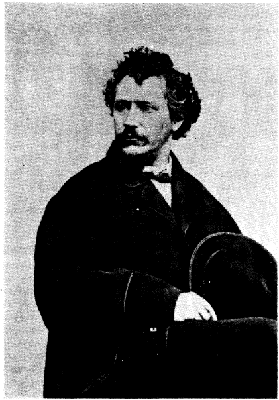
GEORGE FRANCIS TRAIN
(From a photograph taken about the time he was promoting the “Credit Foncier of America”)
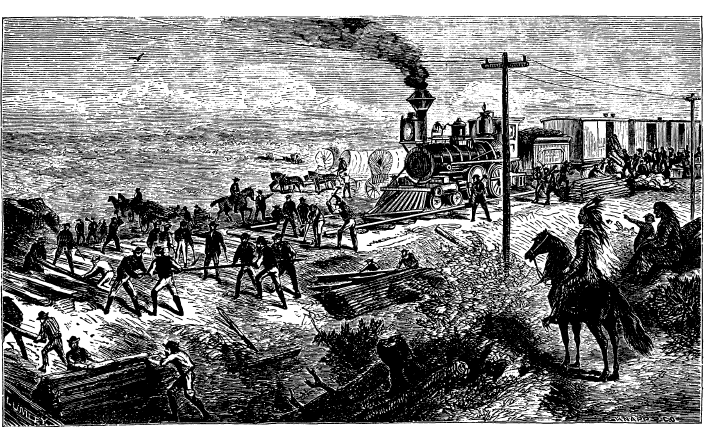
LAYING THE TRACK OF THE PACIFIC RAILROAD. FROM BOWLES’ Our New West
“I’ve already figured that it will,” Dodge replied. “How else could it go from the Missouri River if built this far north?”13
The South’s secession caused an adoption of a northern route for the Pacific Railroad, though in order to connect with the Central Pacific of California, which had been incorporated in June, 1861, the Puget Sound terminus was abandoned. The eastern end was to be “on the hundredth meridian of longitude west from Greenwich, between the south margin of the Republican River, and the north margin of the Valley of the Platte River, at a point to be fixed by the President of the United States.” The railroad was to have free right of way over government domain and, in addition, was to be given ten miles on each side in alternate sections. All this made an aggregate acreage of about 12,000,000 acres—a vast inland empire, the like of which had never been known before to be held in single private ownership.
But this was not all. The government was to furnish a construction loan in 6 per cent, thirty-year bonds, at the rate of $16,000 per mile of road through the prairies, $48,000 over the Rockies and $32,000 per mile between the Rockies and the Sierras, not to exceed, however, a total of $50,000,000.
Of course, there was opposition and cries of land grabbing. But these protests were unheeded, and the landless Atlantic States joined with the “land-poor” West in favoring the project. “I give no grudging vote in giving away either money or land,” exclaimed the Massachusetts Senator, Henry Wilson. “I would sink $100,000,000 to build the road and do it most cheerfully, and think I had done a great thing for my country. What are $75,000,000 or a $100,000,000 in opening a railroad across regions of this Continent, that shall connect the people of the Atlantic and the Pacific, and bind us together? . . . Nothing! As to the lands, I don’t begrudge them.”
Wilson was right! Why begrudge them the land? Twelve million acres was an ocean of territory that would require several decades to fill. It was offered at $2 to $10 per acre, and sold in forty-acre tracts and upward, with liberal terms of credit. But sales were exceedingly slow. A vast influx of population would have been required to have settled them during the period of construction. Moreover, the Homestead Act of 1862 made it possible to acquire government lands free of cost, and this competition was a serious handicap to the railroad company in disposing of its vast domain.
But it was not the vast stretches of vacant wild lands that attracted speculators. Mere acreage is not what the railroad promoters most desired. It was the favored town sites, the terminals and the way-stations that were the chief objects of pecuniary exploitation. Town jobbing and town-site planning began even before the work of actual railroad construction was under way.
One of the “nosy” schemers, who sought to exploit the choice lands and town sites, was the sophisticated and idiosyncratic celebrity, George Francis Train. He was a typical New England trader and adventurer. After having accumulated a fortune in the shipping business, and in trading in Australia during the gold rush there, he returned to America with great capitalistic ideas. He took a hand at railroad promotion, and represented Queen Maria Christina of Spain in furnishing capital for the construction of the Atlantic and Great Western Railway, extending from western New York to Cincinnati. When Congress passed the Pacific Railroad Bill in 1862, he took the first active steps to form a construction company. Having become fascinated, while residing in France, with the adventuresome financial methods of the brothers Emile and Isaac Perrère, he hit upon the idea of organizing finance companies similar to their two concerns: the “Crédit Mobilier” and the “Crédit Foncier.” He proceeded to organize companies with the same names. The “Crédit Mobilier of America” was to construct the railroad, and the “Crédit Foncier of America” was to capture and exploit the choice real estate along the lines.
It is George Francis Train, therefore, who is responsible for one of the most notorious names in American financial history—the Crédit Mobilier. The very term now smacks of corruption and scandal.
The enterprising Train sought the coöperation of capitalists, politicians and statesmen in the promotion of his finance companies, designed to reap the profits from the creation of a transcontinental link to the Pacific Coast. He first tried Boston, with indifferent success, putting up $150,000 of his own funds. This, he said, was “the pint of water that started the great wheel of the machinery.” “I had offered,” he continues, “an interest in the road to old and well-established merchants of New York and other cities—the Grays, the Goodhues, the Aspinwalls, the Howlands, the Grinnells, the Marshalls, and Davis Brooks & Company; and even to some of the new men, like Henry Clews—agreeing to put them in on the ground floor . . . But they were afraid. It was too big. Only two of them, William H. Macy and William H. Guion would take any stock.”14
James A. Garfield was one of the politicians whom Train endeavored to have assist him in the promotion of the “Crédit Foncier.” In the course of Garfield’s testimony at one of the Congressional hearings relating to the Crédit Mobilier scandal,—which, as is generally well known, involved prominent Congressmen,—he testified:
George Francis Train called upon me in 1866 and said he was organizing a company to be known as the Crédit Mobilier of America, to be founded on the model of the Crédit Mobilier of France; That the object of the company was to purchase lands and build houses along the line of the Pacific Railroad at points where cities and villages were likely to spring up; that he had no doubt money thus would double or treble itself each year; that subscriptions were limited to $1,000 each, and he wished me to subscribe.15
Garfield probably confused Train’s Crédit Foncier of America with the Crédit Mobilier. It was the Crédit Froncier and not the Crédit Mobilier that was to deal in town lots.
Train did not take a prominent part in the activities of the Crédit Mobilier—the construction company which undertook to build for the Union Pacific Railroad Company. His lack of resources and his eccentricities handicapped him. He did, however, take active steps to reap the benefits of the railroad’s location. As he himself expressed it: “I looked upon it [i.e., the railroad] only as the launching of a hundred other projects, which, if I had been able to carry them to completion, would have transformed the West in a few years, and anticipated its present state of wealth by more than a full generation. One of my plans was the creation of a chain of great towns across the Continent, connecting Boston with San Francisco by a magnificent highway of cities . . . Most of these plans were defeated by a financial panic; by the lack of coöperation on the part of the very people who were interested in their success. Some of them succeeded, however, and I was able to accomplish a great deal of work that has gone into the winning and making of the West.”16
Surmising that Omaha, Neb., would be the eastern terminus of the Pacific railroad, he straightway engrossed a large part of its real estate. He is said to have personally acquired about five hundred acres in Omaha “which cost him only one hundred and seventy-five dollars an acre,—a most promising investment.”17 He also built a magnificent hotel there—the Cozzens Hotel—which, he said, “was more written about than almost any other hostelry ever built in the United States.”
What became of Train’s real estate speculations in Omaha is something of a mystery. He does not mention it in his memoirs—written after he had been adjudged insane—and certainly they could not have brought him great wealth, because he died comparatively poor. In fact, during the last years of his life, he was a resident of a workingman’s hotel in New York, and his only associates in this period were “children in parks and streets.”
Little also is known of Train’s city building company, the Crédit Foncier of America, which was to develop towns along the railroad. This concern was incorporated under a special act of the Nebraska Legislature, and was publicly advertised as organized in connection with the Union Pacific Railroad to “own cities along the line.” A printed prospectus, issued by John J. Cisco and Co., who were, for a while, the bankers of the Union Pacific Railroad, indicates that this organization made an attempt to “boom” the town of Columbus, Neb.
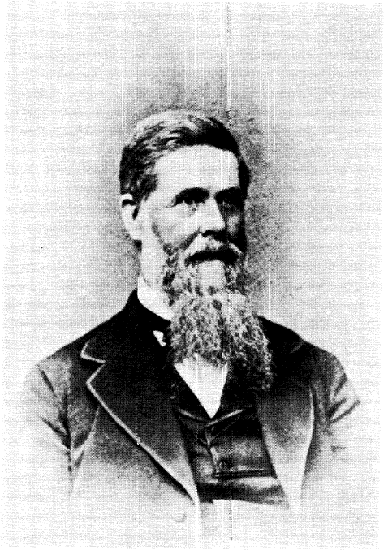
JAY COOKE
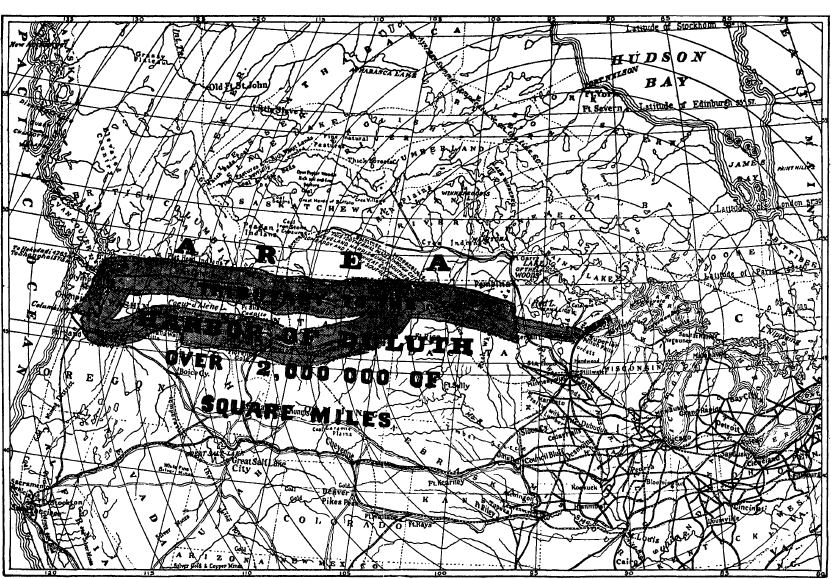
MAP OF LOCATION OF THE NORTHERN PACIFIC LAND GRANT, “BANANA BELT,” WHICH INSPIRED J. PROCTOR KNOTT’S FAMOUS SPEECH
Rings Indicate 100, 200, etc., Miles from Duluth
(From Oberholtzer’s Jay Cooke, Financier of the Civil War) (See pp. 304-305)
This prospectus contains some extravagant language.
“OMAHA ALREADY AN ACKNOWLEDGED FACT—COLUMBUS THE NEXT IMPORTANT CITY,” ran the headlines.
Other captions were: “A fifty dollar lot may prove a $5000 investment.” ‘‘Paris to Pekin in thirty days.” “Two Ocean Ferry Boats and a Continental Railway.” “Passengers for China this way!” “Money is cheap—Our national credit sound. The nation prosperous.” “The Rocky Mountain excursion of statesmen and capitalists pronounce the Pacific Railroad a great fact.” “The Crédit Mobilier a national realty, the Crédit Foncier (owning cities along the line) an American institution.”
And by way of showing the high standing of the Crédit Foncier of America, it is remarked that “Most of the directors and subscribers of the Crédit Mobilier are shareholders of the Crédit Foncier of America.”
Like many similar town-lot “booster circulars” issued before and since the creation of the Crédit Foncier, there was an accompanying sketch map showing the important geographical position of Columbus, Neb. It was “the natural point for an important station.” It was “surrounded by the finest agricultural lands in the world.” Moreover, “the Crédit Mobilier owns lands near the city; and some of the leading Generals and Statesmen are also property owners round about.”
And by way of further inducement to make a town-lot investment in Columbus, it was pointed out that others have made fortunes by similar purchases:
Would you make money easy? Find, then, the site of a city and buy the farm it is to be built on! How many regret the non-purchase of that lot in New York; that block in Buffalo; that acre in Chicago, that quarter section in Omaha. Once these city properties could be bought for a song. Astor and Girard made their fortunes that way. The Crédit Foncier by owning the principal towns along the Pacific line to California, enriches its shareholders while distributing its profits by selling alternate lots at a nominal price to the public.
The authorship of the foregoing fantastic circular is not stated, but in view of the fact that George Francis Train, a few years after its publication, was legally adjudged insane, it may be assumed that it was written by him.
The Crédit Foncier of America, despite the enthusiasm and benevolence of its projector, undoubtedly had a short and unsuccessful career. Columbus, Neb., did not become “an important station” on the Union Pacific. Neither was it ever considered as the capital of the state. True, it is still on the map. But, after fifty years in which there have been opportunities to exploit its geographical and economic advantages, its population is less than 7,000, and its growth has been slow and uncertain. In the meantime, George Francis Train, its promoter and original “booster,” has passed into the realm of celestial silence. The fire of his enthusiasm and the ring of his masterly oratory ceased thirty years before his demise. While living as a hermit at a Mills Hotel, at $3 per week rental, he saw the West grow up, and boasted that his predictions of the marvelous effect of the building of the transcontinental rail link had come true. He died in 1903.
Omaha, the chief center of Train’s operation, likewise failed to realize the vast gains he anticipated. He and his associates did not make money from their speculations in its vicinity. This may have been due to a change of location of the eastern terminus of the Union Pacific from Omaha to Council Bluffs, on the other side of the Missouri River. According to General Dodge, this change was made because of “the aim of Congress and the intention of Lincoln.” The martyred President, incidentally, owned a piece of land hard by the established terminus on the eastern side of the Missouri, and the critics of his railroad policy made capital of this. But if Lincoln selected Council Bluffs as the starting point of the Pacific Railroad merely to gain wealth from the rise in the value of his real estate there, the decision to follow his plan came rather late, for the new terminus was not selected by the directors of the railroad until ten years after his assassination.
Though the Crédit Foncier of America soon petered out as a money-making proposition, town-site jobbing along the lines of the Union Pacific persisted. Hardly a location in any way suitable as a station or a junction point that did not develop into a “mushroom city” because of the activity of land speculators.18 As soon as the location of the railroad line was determined, “a town would be plotted, streets laid out and named for the heroes of the Civil War, and lots put on sale.” The same may be said of the places along the Central Pacific in California, which, like the Union Pacific Railroad, received a similar grant of land in aid of construction. The Southern Pacific also came in for a handsome land bounty, and its promoters became deeply concerned in town-site and terminal land jobbing.19 And so with the Northern Pacific, the story of which will be told in the next chapter.
From a financial viewpoint, the land subsidies of the first transcontinental railroads did not accomplish the results expected by the promoters. The lands had no value until the roads were completed, and, even after completion, the process of disposal was exceedingly slow and costly. Direct financial aid, through cash loans, was much more serviceable as a means of successful promotion, and even with this form of assistance the profitableness of the railroad enterprises only became established many years after the lines were completed and in full operation. Nevertheless, land was the lure for undertaking the construction by private interests, and it was the bait that led many capitalists to subscribe to the project.
20 The Gilded Age, a Tale of Today, by Mark Twain and Charles Dudley Warner (Harper & Brothers), pp. 167, 168. The italics are mine.—A. M. S.
21 The Works of Daniel Webster, Vol. I, p. 169.
22 F. A. Cleveland and F. W. Powell, Railroad Promotion and Capitalization in the United States, p. 199.
23 See American State Papers, Public Lands, Vol. VIII, p. 593.
24 William K. Ackerman, Historical Sketch of the Illinois Central Railroad, P. 29.
25 Congressional Globe, April 7, 1870, p. 2480.
26 Letter on the Value of the Public Lands of Illinois, by Robert Rantoul, Jr., Boston, 1851.
27 Wm. K. Ackerman, Early Illinois Railroads, p. 75.
28 Anthony Trollope, North America, Vol. I, p. 143.
29 J. R. Perkins, Trails, Rails and War, the Life of General G. M. Dodge, p. 13.
30 New York Weekly Tribune, July 17, 1847.
31 See Henry G. Pearson, An American Railroad Builder, p. 189.
32 See J. R. Perkins, Trails, Rails and War, The Life of General G. M. Dodge p.30
33 George Francis Train, My Life in Many States and in Foreign Lands, p. 287.
34 J. B. Crawford, The Crédit Mobilier of America, p. 134.
35 Train, op. cit., pp. 293, 294.
36 See Albert D. Richardson, Beyond the Mississippi, p. 565.
37 See Building of the Pacific Railroad, by Edwin L. Sabin.
38 See Stuart Daggett, Chapters on the History of the Southern Pacific.
- 1Maine Historical Collections, Vol. II, pp. 268-294.
- 2The Sir William Johnson Papers, Vol. V, p. 129. See also, C. W. Alvord, The Mississippi Valley in British Politics, Cleveland, 1917.
- 3Herbert B. Adams. “Washington’s Interest in Western Lands,” Johns Hopkins University Studies, Third Series, No. 1, January, 1885. Italics are mine.—A. M. S.
- 4Adams, op, cit., p. 58.
- 5See A. Henderson, “A Pre-Revolutionary Revolt in the Old Southwest” in Mississippi Valley Historical Review, Vol. 27, p. 198 et seq.
- 6Italics are not in the original.
- 7In a letter to William Franklin, dated May 3, 1776, Johnson asserted “it has always been my practice to avoid engaging in lands to the great loss of my family, neither have I a foot of land from the Indians.” (Sir William Johnson Papers, Vol. IV, p. 197.) The large tract north of the Mohawk Valley given him by the Canajoharie Indians in 1760 was confirmed by royal grant in 1769.
- 8See Pennsylvania Magazine of History, Vol. XIV, pp. 218, 219.
- 9See Memorial of the United Illinois and Wabash Land Companies, Baltimore, 1816.
- 10A copy of the deed is contained in American State Papers, “Public Lands.” Vol. I. The original copy was acquired by Cyrus H, McCormick.
- 11See J. P. Boyd, “Connecticut’s Experiment in Expansion, The Susquehannah Company, 1753-1803,” in Journal of Economic and Business History, November, 1931.
- 12See Publications of the Colonial Society of Massachusetts, Vol. XXV, PP. 33-38.
- 13Because of his land deals, while acting as the state’s attorney, Duane was the butt of political criticism. He was led to appear in person in his own defense before the state legislature in 1781. He was charged with receiving Vermont grants “under immoderate quit-rents, and excessive fees of office,” and he was also accused of “holding many thousand acres of land which had never before been granted by the Crown.” To this he merely answered that he “had never made a purchase or obtained a grant of land with any view to its sale.” He was therefore not a “land jobber.” This cleared him politically of all corruption.
- 14So popular was the western lure to the Connecticut gentry that legislation was urged to countermand it. “Young people in their plays at social gatherings marched to rude melodies which taught them to dream that toward the setting sun lay an earthly paradise with gates open to welcome them. From hill and valley the processions hurried away. Today, many of our rural towns are scarred and paralyzed by an outflow which has built up the continent to no small degree at their expense.”
- 15What is the spirit against which we now struggle and which we have vainly endeavored to stifle? A monster, generated by fraud, nursed in corruption, that in grim silence awaits its prey. It is the spirit of Federalism! That spirit which considers the many made only for the few. . . . When I behold a certain party supporting and clinging to such a measure almost to a man, I see only men faithful to their own principles. . . . But when I see associated with them, in firm compact, others who once rallied under the standard of opposite principles, I am filled with apprehension and concern. . . . If Congress shall determine to sanction this fraud upon the public, I trust in God we shall hear no more of the crimes and follies of the former administration. For one, I promise that my lips upon this subject shall be closed in eternal silence. I should disdain to prate about petty larcenies of our predecessors after having given my sanction to this atrocious public robbery.
- 16Large tracts were also freely disposed of by Georgia. Count d’Estaing, the French admiral who assisted the colonies, was granted a substantial acreage for his Revolutionary services. D’Estaing sold his land to the Count de Colbert, who resold it in England to Robert Morris, through the agency of William Constable and Gouverneur Morris. Robert Morris then proceeded to add to his Georgia possessions. In association with John Nicholson, he soon become the leading proprietor of Georgia waste lands. How these large holdings were obtained has never been satisfactorily explained. It is the “unsolved riddle of Georgia’s land history.”
- 17Large tracts were also freely disposed of by Georgia. Count d’Estaing, the French admiral who assisted the colonies, was granted a substantial acreage for his Revolutionary services. D’Estaing sold his land to the Count de Colbert, who resold it in England to Robert Morris, through the agency of William Constable and Gouverneur Morris. Robert Morris then proceeded to add to his Georgia possessions. In association with John Nicholson, he soon become the leading proprietor of Georgia waste lands. How these large holdings were obtained has never been satisfactorily explained. It is the “unsolved riddle of Georgia’s land history.”
- 18To most of these “free” Georgia lands the name of “Pine Barrens” was given. Their sandy soil was covered with a luxuriant growth of pine trees, for which Georgia, for over a century, was famous, and which in later years not only afforded a lucrative article of export, but was the basis for its naval stores’ industry. But “barren” they certainly were in the post-Revolutionary days when they were sold to Robert Morris and other land jobbers. As mentioned in a previous chapter, “whatever land was offered for sale, they appeared ready to buy; and actually bought quantities which outran every sober thought.”
- 19Morris, as previously noted, endeavored to get French purchasers for these Georgia lands. There was already considerable French influence in South Carolina and Georgia, and these lands were advertised as most suitable for the émigrés. But he was brought face to face with the outspoken opposition of Joseph Fauchet, French Minister to the United States. Though the Pine Barrens were hawked about even before the second Yazoo grants were made, and it was reported that they were a profitable speculation, they lacked buyers. There was, of course, considerable doubt as to the validity of Morris’ title to them—and this point was strongly emphasized by Fauchet. Most of the grants had not been surveyed in accordance with the legal requirements. In 1798, the Georgia Legislature, with the Yazoo fiasco fresh in mind, passed a law requiring all landowners to survey and identify their holdings every ten years, beginning in 1799. The purpose was to compel holders under fraudulent grants to prove their titles. The heritors of the North American Land Company, after Morris and Nicholson’s failure, could not do this. Moreover, it was not worth the expense. As taxes were not paid, the lands went back to the state. In fact, the State Comptroller of Georgia reported in 1839 that “not more than half the land in the region was worth owning or paying taxes for.”
- 20During the first hundred years of North American colonization, economic conditions gave little encouragement to private land schemes. Land was too plentiful. A few such enterprises were undertaken, however. Thus, as early as 1661, the Colony of Massachusetts sold to a few individuals for £400 a large tract on the Kennebec River in Maine. This became known as the “Kennebec Purchase.” The heirs held it for nearly a century without doing anything with it. In 1753, they incorporated as the “Proprietors of the Kennebec Purchase” and proceeded to dispose of their holdings. The corporation continued in existence until 1816. “The Pejebscot Company” was another Maine land deal. None of these held out promise of profit to proprietors until about a quarter century before the Revolution.
- 21In the meantime, the “Loyal Company” group was not idle; its proprietors sent Dr. Thomas Walker, of Albermarle, Va., to make a reconnaissance, and to discover a proper place of settlement. The two “companies” then became engaged in a controversy, and neither made a survey or fixed the bounds of their grants. The apparent ease with which they obtained land donations led to other schemes, and aroused an epidemic of interest in distant western wild lands. Not only was the land ownership eagerly sought after, but the establishment of new colonies, with separate and distinct governments, was planned. Favoritism and collusion infested the Virginian colonial government, due in large part to the persistence of speculators in western land grants. Lobbyists were sent to London to obtain the crown’s sanction to land-grabbing schemes and the question of the disposal of the vast western domain won from the French infested British politics. “One half of England is now land mad,” wrote George Croghan, of Philadelphia, one of the land schemers, to Sir William Johnson, on March 30, 1766, “and everybody there has their eyes fixed on this country.”
- 22I offered in my last to join you in attempting to secure some of the most valuable lands in the King’s part, which I think may be accomplished after awhile, notwithstanding the proclamation that restrains it at present and prohibits the settlement of them at all; for I can never look upon that proclamation in any other light (but this I say between ourselves) than as a temporary expedient to quiet the minds of the Indians. It must fall, of course, in a few years, especially when those Indians consent to our occupying the lands. Any person, therefore who neglects the present opportunity of hunting out good lands, and in some measure marking and distinguishing them, for his own, in order to keep others from settling them, will never regain it.
- 23Crawford “heartily embraced” the colonel’s offer. He promised shortly to set out in search of lands. “This may be done,” he said, “under a hunting scheme.” He acknowledged that other land seekers had approached him, with similar offers, “but have not agreed to any; nor will I with any but yourself or whom you think proper.”
- 24Judge Richard Henderson of North Carolina, the employer and backer of Daniel Boone, promoted the settlement of the Kentucky region and claimed ownership to a vast unsettled tract there. He organized a group of land grabbers under the name of “The Transylvania Company.” Ignoring the British interdiction against Indian land purchases, he obtained from the Cherokees in 1773 about one-half of the present State of Kentucky, and immediately began settling the land. He advertised widely for pioneers and “shareholders.” In his announcements, Henderson waxed enthusiastic. “The country [Transylvania] might invite a prince from his palace, merely for the pleasure of contemplating its beauty and excellence, but only add the rapturous idea of property, and what allurements can the world offer for the loss of so glorious a prospect?”
- 25When the British Government began to take active measures to break up land “bootlegging,” and to put a stop to dreams of riches in western territory, Virginia’s political resentment was naturally aroused. Even Thomas Jefferson, who, in later life, frowned upon speculation and land grabbing, held the view in 1774 that the land did not belong to the British king, and that it was time for the colonies “to declare that he has no right to grant lands of himself.” So he boldly wrote in the Declaration of Independence, as one of the British king’s usurpations: “He has endeavored to prevent the Population of these States; for that purpose obstructing the Laws for Naturalization of Foreigners; refusing to pass others to encourage their migrations hither, and raising the conditions of new Appropriation of Lands.”
- 26He was for it at once. “I like the project of a colony in the Illinois Country,” he wrote his son, “and will forward it to my utmost here.” He thought that Sir William Johnson’s “approbation will go a great way in recommending it, as he is much relied upon in all affairs that may have any relationships with the Indians.” But Johnson had an eye on the Indian lands himself, and besides advising others about purchases in the outlying sections, personally through gifts from the Indians engrossed large tracts, particularly in the Mohawk Valley. The town of Johnstown, N. Y., still marks the seat of his domain.
- 27Some of the members of the Vandalia Company were concerned in other western land schemes. One of these was organized in 1775 as the “Indiana Land Company,” probably the first application of the name “Indiana” to the Northwest Territory. The claim to land was based on a grant of a large tract, made November 3, 1768, in what is now West Virginia, by the Six Nations at Fort Stanwix to “Chief” William Trent in liquidation of depredations. Among the shareholders were Samuel Wharton, Joseph Galloway, Robert Callender, Levi Andrew Levi, and David Franks, all wealthy and prominent Philadelphians. The Revolutionary War did not put an end to the “claim.” Wharton in 1776 published a pamphlet, entitled-View of the Title to Indiana, in which he defended the company’s rights to the lands. In 1781, he republished this in enlarged form, under the title Plain Facts; being an examination into the Rights of the Indian Nations of America to their respective Countries and a Vindication of the Grant from the Six United Nations to Proprietors of Indiana, etc. Although Wharton pressed the validity of the “proprietors” claims, Congress then and thereafter gave little heed thereto.
- 28Notwithstanding the British Government’s edict, forbidding the private purchase of lands from the Indian tribes, William Murray, an Indian trader, and several of his business associates, in 1773 formed a plan to buy from the aborigines an immense tract of country between the Mississippi, Illinois and Ohio rivers. After a “pow-wow” lasting a month, the sale was consummated. According to the land claimants, it was attended by “many persons of both descriptions and the Indians were carefully prevented from obtaining any spiritous liquors during the whole continuation of the negotiation.” On July 5, 1773, “for a very large and valuable consideration,” the deed was delivered to the “Illinois Land Company.”
- 29Notwithstanding the British Government’s edict, forbidding the private purchase of lands from the Indian tribes, William Murray, an Indian trader, and several of his business associates, in 1773 formed a plan to buy from the aborigines an immense tract of country between the Mississippi, Illinois and Ohio rivers. After a “pow-wow” lasting a month, the sale was consummated. According to the land claimants, it was attended by “many persons of both descriptions and the Indians were carefully prevented from obtaining any spiritous liquors during the whole continuation of the negotiation.” On July 5, 1773, “for a very large and valuable consideration,” the deed was delivered to the “Illinois Land Company.”
- 30The proposition then took on a business aspect. The number of “shares” was increased, and rights to subscribe offered at from $2 to $5 per share. It attracted speculators. The shares soon rose in value. Lawyers, clergymen and politicians began buying shares. The Reverend Ezra Stiles, President of Yale College, grandfather of the poet-physician Oliver Wendell Holmes, took 2¾ shares. The Governor of Connecticut, Roger Walcott, who had become rich through local land deals, supported the project.
- 31New York, before the Revolution, also had her “land” quarrels with the other colonies. The ill-defined boundaries of the Dutch province led to constant conflicts and legal controversies with her neighbors. There was a bitter dispute with New Hampshire regarding the political jurisdiction of Vermont. New York claimed the section, but New Hampshire, in 1749, acting on the principle that possession is nine points of the law, began to make free grants to both New Hampshire and Massachusetts citizens. Whole “towns” of 23,000 acres, more or less, were granted to selected groups of individuals. It is estimated that between 1749 and 1764, Governor Benning Wentworth granted 131 townships to more than six thousand persons. Among the grantees appear the names of many prominent colonial New Englanders, who had no intention of ever settling on the lands. Samuel Adams was among them. He was known as a speculator in both Maine and New Hampshire lands in this period. The governor granted himself, in all, about 65,000 acres, and is reported to have accumulated considerable wealth from the heavy fees exacted by him for grants.
- 32Samuel W. Jones, Memoir of James Duane, 1852.
- 33P. H. Woodward, One Hundred Years of the Hartford Bank, p. 74. See also R. J. Purcell, Connecticut in Transition, p. 154.
- 34Haskins, op. cit., p. 36.
- 35Ellis Paxton Oberholtzer, Life of Robert Morris, pp. 307, 308.
- 36S. G. McLendon, History of the Public Domain of Georgia, Chap. IX.
- 37Theodore Dwight, Travels, Vol. I, p. 188.
- 38Absalom H. Chappell, Miscellanies of Georgia, Part II, p. 49.

