
The Great American Land Bubble
Chapter XIV. Jay Cooke’s “Banana Belt”
WHEN Jay Cooke, “financier of the Civil War,” in 1869 consented to furnish capital to rescue the Northern Pacific Railroad from the pangs of infantile weakness, he made the following stipulation:
A Company shall be organized for the purpose of purchasing lands, improvement of town sites, or other purposes, and the same shall be divided in the same proportion; that is, the original interests shall have one-half, and Jay Cooke & Company shall have one-half.
Thus, Jay Cooke, foremost private banker in America, looked upon the great enterprise to which he lent his fame and fortune, as a land gamble. More than this! He was led into the disastrous undertaking (for him) chiefly through his large personal investments in real estate in and about the frontier town of Duluth—“the Zenith City of the Unsalted Seas.”
Having participated, as a shareholder, in the Philadelphia and Erie Land Company, a land improvement company owning property in towns along the line of the Philadelphia and Erie Railroad; and having invested with success in large tracts of real estate in Ohio and other states, Jay Cooke turned to the barren northwestern region at the head of the Great Lakes as a favorable field for fabulous wealth. He soon became one of the largest landowners in northern Minnesota. He took a share in the promotion and construction of the Lake Superior and Mississippi Railroad Company and, in this connection, he and his associates organized the Western Land Association, “to exploit Duluth and other town sites and land privileges of the proposed railroad from St. Paul to Lake Superior.” Thus, in various ways, the great financier became pecuniarily interested in the much “blessed state of Minnesota.”1
Jay Cooke had no part in the original plan and promotion of the Northern Pacific Railroad. This was the work of Josiah Perham, a Boston wool merchant who, on July 2, 1864, obtained the charter from Congress. This charter granted, in addition to free right of way, the alternate sections of public land ten miles on both sides of the tracks “to aid in the construction of a railroad and telegraph line from Lake Superior to Puget Sound on the Pacific Coast by the northern route.” Perham, whose speculations in Maine timber lands have been spoken of, associated with himself in the venture a number of prominent persons. Among these were Senator Samuel S. Fessenden, of Maine, William Sears, George Opdyke, Chauncey Vibbard, General John C. Frémont, William B. Ogden, Leonard Sweet, J. Edgar Thomson, and Henry D. Cooke, brother of Jay Cooke. They had the statutory assurance of the government that patents to the contiguous land would be issued as each twenty-five miles was constructed, and that the even numbered sections, retained by the United States, would not be sold at less than $2.50 per acre. Altogether, the total grant was to be about 47,000,000 acres—an astronomical acreage, almost beyond human comprehension.
This free donation of a domain larger than all New England attracted little public attention, and passed without much opposition. “It was a faulty measure,” wrote John Sherman afterwards, “making excessive grants of public lands. . . . It was an act of incorporation, with broad and general powers, carelessly defined, and with scarcely any safeguards to protect the government in its lavish grants of land. Some few amendments were made, but mostly in the interest of the corporation, and the bill, finally, passed the Senate without any vote by yeas and nays.”2
Perham did not delay initiating the project. He incorporated a company commonly known as “Josiah Perham’s Peoples’ Pacific Railroad.” Stock subscription books were opened in Boston and Portland, Me., almost immediately, and 20,000 shares were subscribed by November, 1864. Subscribers made a payment of only $10 per share on each $100 face value, and nothing like the $100,000,000 or more required for construction could be obtained. There was a time limit placed on the period of construction by Congress, and Perham was forced to petition repeatedly for its extension. Congress was liberal in this matter, but active construction had to be put off because of lack of capital.
Perham sought the financial aid of Jay Cooke as early as 1865, but the financier was then too busy with dealings in government bond issues to become interested. Sir Morton Peto, an English promoter, who lost millions for British capitalists in American railroad promotions, was also solicited, and it was believed for a while that he would finance the Northern Pacific Railroad. But European capital was timid about ventures in America then, and the collapse of Peto’s Atlantic and Great Western resulted in still greater caution.
In the meantime, Jay Cooke became interested in the Lake Superior and Mississippi Railroad, which was to extend 140 miles from St. Paul in a northerly direction to Duluth, and thus connect Lake Superior with the Mississippi River. This railroad also had a Congressional grant of about 1,500,000 acres, nearly all of which was heavily timbered with pine, cedar and oak. Cooke became connected with this project following a trip to Duluth, during which he inspected the proposed route of the railroad. Directly and through agents, he bought large areas in this section jointly for himself and his partner, William G. Moorehead. He chose tracts covered with pine trees which, it was anticipated, would yield timber for the saw mills and be a valuable product for eastern lumber markets. While personally investigating his prospective purchases, he traveled for days in the woods, sprained his ankle, and “wore his feet out,” but incidentally obtained, in addition to the pineries, several parcels of good farming land near Duluth. This site, he said, must “become an important point as a terminus of the road.” Though he admitted that Duluth “may not equal Chicago, there must be a large town there within a few years after the road shall be in operation.”3
Duluth, at this time, contained six or seven frame houses, a school and a land office. Superior, Wis., on the south side of the Bay, an older settlement, also presented a desolate and dilapidated appearance. John C. Breckinridge, of Kentucky, had attempted to found a resort of Southerners there after the repeal of the Missouri Compromise in 1854, believing that “it would become a watering place where they could be free to take their slaves with them, deserting Saratoga, Newport, and other northern resorts where such an accompaniment as a slave was not permitted.” The project failed and, until Jay Cooke again set the works going, Superior was merely a name on the map.
Cooke undoubtedly knew that his large land purchases in and around Duluth would bring no return unless the place had rail connections with the interior. He, therefore, assumed the task of financing the Lake Superior and Mississippi Railroad. This was difficult, as the Civil War had absorbed home capital, and the impending rupture between Bismark and Napoleon III discouraged European bankers from placing investments in American securities. However, he had faith in the Minnesota country. He continued to instruct his agent at Duluth to buy lots in this “city,” where prices were already advancing and where land, which a few years before was considered worthless, was then selling at $600 per acre. Altogether, Cooke and Moorehead became the owners of about 40,000 acres in and around Duluth. Rice Harper, his agent, in May, 1869, wrote him encouragingly: “Men are coming every day, some to purchase city lots, some to work on the railroad, and some mechanics to build the city. Every available place is filled with new shanties and houses are going up.”4
He also received encouragement in his land speculation from other sources. General George B. Sargent, who had been a government surveyor in the Northwest, and who, in 1869, abandoned his brokerage business in New York, to engage in land jobbing in Duluth, wrote to him, after his arrival there: “I give it to you as my firm conviction that the terminus of your road on Lake Superior will attain a larger growth in five years than any city . . . , in twenty. With this belief I go there to build up a general land business . . . and to assist all in my power in every way in building up a city.”5
Sargent offered his services in handling Cooke’s Duluth real estate, which were accepted. The result was an agreement between them to carry on joint operations for a period of five years. This contract was soon to have a significant bearing on the relationship of Jay Cooke & Company with the Northern Pacific Railroad.
As already noted, one of the projects growing out of Jay Cooke’s connection with the Lake Superior and Mississippi Railroad was the “Western Land Association of Minnesota.” The purpose of this company was similar to George Francis Train’s Crédit Foncier of America. It sought to exploit Duluth and the town sites and land privileges along the right of way of a projected railroad. The first published report of the Western Land Association was made in 1871. The company had received cash of $200,000 for its shares. Its receipts consisted of $97,321 for real estate sold and $21,166 in interest on deferred payments, and it paid out $182,390 for real estate purchases. But the most important item mentioned in the report is the stock interest acquired in the company by the Northern Pacific Railroad. In return for an agreement of the Northern Pacific to fix its eastern terminus at Duluth and to connect with the Lake Superior and Mississippi Railroad, the Western Land Association sold 2,000 shares of its stock for $120,000 to the “Lake Superior and Puget Sound Company,” the real estate subsidiary of the Northern Pacific.
A still more interesting item in this first report is the announcement that its shares were sold at a tremendous premium. “The Management congratulates itself on having seen its stock sold at a premium of 750%,” and “also upon the fact that the property that cost $102,270 in cash, is now, after deducting sales made, estimated by our agent, to have a cash value of $1,500,000.” This vast increase in wealth could readily be passed on to the promoters, as in 1870, the Minnesota Legislature enacted a law permitting the company to partition its land holdings among the shareholders. The president of the company, Mr. Samuel M. Felton, recommended that such apportionment be made. For, he said, “the company will soon be attacked by the Press and in the Courts as a monopoly, and being the creature of the law, may be subject to continual and expensive annoyance.” Moreover, “the Western Land Association has now accomplished, as a holder of a large number of town lots, the object for which it was organized, . . . and kept out of the hands of unprogressive speculators the property they would otherwise have held to the detriment of all large plans of improvement.”
The shareholders followed the advice of their president. Accordingly, Jay Cooke, the Northern Pacific Company and a few other “insiders” received their ratable proportion of approximately 13,416 town lots, located mostly in Duluth. These lots, together with Cooke’s other investments in Duluth and vicinity, were to stand him in good stead. He held on to them, and their sale was one of the chief means by which he succeeded in rehabilitating his fortune after the failure of his firm in 1873. Based upon the original cost to him, the profits from this Duluth real estate were enormous.
When Cooke, largely because of his engrossment of lands in Minnesota, became the banker for the Lake Superior and Mississippi Railroad, the next logical step was to acquire an interest in the Northern Pacific Railroad. This was a big proposition. But in May, 1869, he “had practically determined to take hold of it.” His partners, however, insisted on expert advice in the matter. A group of engineers and bankers was engaged to make a trip covering the whole route. The country through which they were to pass was so wild and barren that a military escort was provided. The region was described by General Sherman “as bad as God ever made or anybody can scare up this side of Africa.” After many difficulties, during which several of the exploring party deserted or were sent home, the remaining members returned. The engineers gave favorable reports. “The immense landed property of the company as a body in connection with valuable town sites and water powers will ultimately be worth more than the entire cost of the railroad,” wrote Cooke’s engineer, Mr. Milnor W. Roberts. Henry Cooke, Jay Cooke’s brother, insisted that “if successful, the financing of the Northern Pacific would be the grandest achievement of our lives.”
So Jay Cooke & Company, the leading banking house in America, became identified with the Northern Pacific. It employed all its influence to favor and forward the enterprise. Cooke personally was put in almost complete control, as the original stockholders, including Josiah Perham, sold out their interests to him. He began to offer publicly the Northern Pacific Railroad bonds, secured by mortgage on the prospective vast land grant. He used the same forceful methods that he had employed during the Civil War in selling United States bonds. He advertised extensively. He organized touring parties to go over the route. He published and widely distributed pamphlets describing in alluring and seductive language the wealth and possibilities of the great region to be traversed by the railroad. These pamphlets were embellished by a map of the proposed railroad route, set off by a wide border representing the donated lands. The picture extended from a point at Duluth to a point on Puget Sound. It resembled in shape a banana. The Northern Pacific thus became known popularly as “Jay Cooke’s Banana Belt”
But the banker did not act alone in the venture. He formed a “pool” to which he invited a selected group. The “pool” was to subscribe $5,600,000, of which $5,000,000 was represented by mortgage bonds and $600,000 by capital stock. This amount was to be divided into twelve parts, to correspond with Jay Cooke & Company’s twelve “interests” in the railroad company. Each part, therefore, represented $416,666.67 in bonds and $50,000 in stock. But the parts could be divided and subdivided to suit the various subscribers. Each subscriber was assigned a proportionate interest in the capital stock of the railroad company. This, to the amount of $40,000,000, was to be distributed as the construction work proceeded, each of the twelve “interests” ultimately to obtain $3,333,000 of capital stock.
The capital stock was really not the most important or alluring bonus to “pool” participants. Each member was to have, in addition, a share in the land company, to be organized in connection with the railroad, “to own and improve town sites, etc.” Interest in this land concern was divided into twenty-four parts, “Jay Cooke & Company receiving twelve parts.” This half interest owned by the banking house was thrown into the “pool”; the remainder went directly to the Northern Pacific Railroad Company. The land company was capitalized at $2,400,000, and the “pool” and the railroad company jointly were to supply the capital as needed. The land company was duly incorporated as the “Lake Superior and Puget Sound Company.” As already shown, its first acquisition was the shares of Cooke’s Western Land Association of Minnesota, thus assuring the fixing of the railroad’s eastern terminus at Duluth.
Needless to say, the most prominent men of the country participated in the “pool.” Politicians, financiers, clergymen and leading journalists were invited to become subscribers and participants. These hailed from all parts of the country. There were, among others: Dr. S. Weir Mitchell, novelist and nerve specialist; Hugh McCulloch, capitalist and cabinet officer; Thomas A. Scott, railroad president and real estate magnate; and Schuyler Colfax, Vice-President and Crédit Mobilier scandal victim.
Chief Justice Chase at first refused to participate because, as he remarked, “though the prospect of future profit is very inviting, it is rather too remote for one who does not expect to live longer than I do.” The Chief Justice, of course, was very friendly with Cooke, whose services he had employed in raising national loans; and when Cooke offered to supply the cash required for the proffered subscription, he finally accepted “with thanks.” Then, by way of encouragement to Cooke, he wrote while on a visit to Duluth: “Hurrah for the Northern Pacific. I wish I was able to take four times as much as has been assigned me. This is your greatest work. The world will be astonished by it.”
The land grant was the bait that attracted many of the subscribers, and this fact was kept in mind by the locating engineers. John Gregory Smith, Governor of Vermont, who assumed the direction of construction work, wrote to Cooke on January 21, 1870, that “everything possible is being done to get the work started.” Cooke then suggested to him that the locating engineers “should be accompanied by land prospectors.”6 There was difficulty, however, in following out the instruction because the snow in the woods “was too deep to make a thorough exploration of the country on each side of the line”; nevertheless, a few men who were accustomed to traveling on snowshoes, were employed as land prospectors to accompany the engineers.
There was great rejoicing among the real estate operators in Duluth. Jay Cooke’s control of the Northern Pacific assured to them the eastern terminus of the line. But Chicago, and Superior, Wis., as well as other towns in Wisconsin and Minnesota, were not satisfied, and entered their political protests. Sectional jealousy, as well as town rivalry and town jobbing, was a serious handicap to the Northern transcontinental railroad in obtaining national financial aid for the project.
Moreover, strong opposition to the town-jobbing schemes developed in Congress. James Harlan, of Iowa, on April 7, 1870, exclaimed in the Senate chamber: “Is it not enough that you give them a vast quantity of public lands to be sold for agricultural purposes? Must they be permitted to monopolize all the town sites across half a continent in addition? It is quite doubtful to my mind whether the right even to locate their depots is a proper thing to be entrusted to these companies. . . . Companies not infrequently have located their depots in the new states just far enough away from a town to ruin the existing town in order to secure enhanced value to their lots that they sell at the new location.” To this argument, Senator Stewart, of Nevada, rightfully answered that if the selection of town sites and depots were taken away from the railroad promoters “there would not be enough money realized from the whole land grant to locate their stations upon.”7
In spite of Cooke’s efforts to create a speculation fever, the countless acres of waste lands with occasional prospective town sites were not a lure to the general public as they had been to the Northern Pacific promoters. Jay Cooke & Company met with ill success, despite strenuous efforts to sell the railroad company’s mortgage bonds. The efforts abroad were even more discouraging. The Franco-Prussian War made capital scarce in Europe, and there was none to spare for a gigantic speculative project overseas. The great banking house of Rothschilds in London refused a participation in the proposition because it involved a management as well as a financing problem to them. Hugh McCulloch, on resigning from the secretaryship of the Treasury, was sent by Jay Cooke to London to open a branch of his banking house there, in the effort to dispose of “Northern Pacific 7.30 Per Cents.” He established the firm of “Jay Cooke, McCulloch & Co.,” but success was lacking, and the London house barely escaped failure along with the other Cooke banking concerns.
Thwarted at home and abroad in the endeavor to finance the land-burdened transcontinental railroad, Jay Cooke & Company finally succumbed on September 18, 1873. Not long thereafter, the Northern Pacific was also in bankruptcy. But in the three years that Jay Cooke was the authority controlling the destinies of the railroad, steps had been taken to exploit the increase in land values and the favorable town-site locations along the proposed route. This was done through the independent land holding concern, the Lake Superior and Puget Sound Company, one-half interest in which, as already noted, was acquired by Jay Cooke and his associates in the “pool.” The land company, under agreement with the railroad company, was entitled to purchase such lands within the Northern Pacific grant as it might apply for. As Cooke stated, in a letter dated September 12, 1872, to Thomas H. Canfield, president of the Lake Superior and Puget Sound Company, “I have always understood that the Puget Sound Company had purchased in their names, or had the refusal of properties at all points likely to be chosen by the Northern Pacific as its terminus.”
When the desired lands were not within the railroad’s grant, but came within the “even section” retained by the government, the land company found it expedient at times to use dummy entrymen fraudulently to acquire the property. This was occasionally done to keep off “the roughs who had earlier infested the lines of the Union Pacific.”
In 1873 difference arose between the land company and the railroad company, “and the cleavage was so great that Mr. Cooke took steps to oust Mr. Canfield from the presidency of the land company.” This led almost to the disruption of the land company, but it remained intact even during the Northern Pacific receivership. Shortly before the reorganization of the railroad in 1875, its share capital was acquired by the successor corporation by payment of $721,630 in the defaulted bonds of the old bankrupt company.
Thus, the land company became a direct subsidiary of the railroad company, and the interests of the two were then combined. Previously, the railroad company had only a 50 per cent participation in the real or prospective profits of the land company. Jay Cooke and his associates could claim the other 50 per cent. As the operations of the land company had barely begun when the railroad receivership halted construction activities, there was little opportunity for profit of any kind. It is definitely known that Jay Cooke and his associates never drew any dividends from this source.
The affairs of the land company were finally wound up in 1891. Its remaining lands and lots in Puget Sound were turned over to a local real estate concern for $72,000. Its other properties had been sold from time to time, and the proceeds invested in the securities of the railroad company. The final distribution of assets revealed little gain from the enterprise. On the whole, Jay Cooke’s idea of engrossing favorable land sites did not work out any more successfully than George Francis Train’s Crédit Foncier in connection with the Union Pacific. Cooke’s personal investments in Duluth real estate, made prior to his connection with the Northern Pacific, however, “panned out” well. This real estate was gradually sold by him after the failure of his banking house, as a means of liquidating its indebtedness.
A query here naturally arises: What became of the vast Congressional grant to the Northern Pacific? And this is an interesting story:
Jay Cooke & Company, in their efforts to dispose of the Northern Pacific lands, drew much advertising material from the magnificent land grant. The fertility, climate and resources of the lands were painted in such glowing colors as to bring forth public ridicule. Even Dr. Ellis Paxson Oberholtzer—Jay Cooke’s eulogistic biographer—felt the urge to point this out. “The people,” he wrote, “were so full of isothermal lines, comparative latitudes, and glowing facts about climates, crops and distances from New York, Liverpool and Shanghai, of new cities set in concentric circles upon the map of the American Northwest, that they were ready to enjoy the satire of J. Proctor Knott. He held a seat in Congress from Kentucky, and rose, on January 27, 1871, during the debate on the St. Croix land bill, setting the House and the whole country in a roar of laughter by a speech which was remembered for many a day.”8
Congressman Knott was well versed in English literature, for he applied to the “Banana Belt” Lord Byron’s poem, adapted from Goethe, in which the romantic Orient is depicted:
Know ye the land of the cedar and vine,
Where the flowers ever blossom, and the beams ever shine,
Where the light wings of Zephyr oppressed with perfume
Wax faint o’er the gardens of Gul in her bloom.
Where the citron and olive are fairest of fruit
And the voice of the nightingale never is mute;
Where the tints of the earth and the hues of the sky
In color though varied, in beauty may vie?
Duluth was the butt of Congressman Knott’s derision. It was a name, he said, “for which his soul panted for years as a hart panteth for the water brooks.” But where was the place? “It is situated,” he exclaimed, “somewhere near the western part of Lake Superior, but there is no dot or other mark indicating its location. I am unable to say whether it is confined to any particular spot, or whether it is just running around loose. . . . I cannot really tell whether it is one of those ethereal creations of intellectual frostwork, more intangible than the rose tinted clouds of a summer sunset; one of those airy exhalations of the speculators’ brain, which I am told are ever flitting in the form of towns and cities along the lines of railroads with government subsidies” (Laughter).
Yet he was led to believe that wherever Duluth may be “the symmetry and perfection of our planetary system would be incomplete without it.” “I see it represented on this map,” he exclaimed, in exhibiting a chart of the “Banana Belt,” “that Duluth is situated exactly half way between the latitudes of Paris and Venice, so that gentlemen who have inhaled the exhilarating airs of one, or basked in the golden sunlight of the other, may see at a glance that Duluth must be a place of untold delights, a terrestrial paradise, fanned by the balmy zephyrs of an eternal Spring, clothed in the gorgeous sheen of ever-blooming flowers, and vocal with the silver melody of the choice songsters” (Laughter).9
Newspaper editors reprinted these remarks with zest, much to the embarrassment of Cooke and other Northern Pacific “boosters.” The difficulties of these gentlemen multiplied on an increasing scale. Despite their efforts to sell land, little was actually disposed of. Owners of the Northern Pacific 7.30 per cent bonds were given the right to convert at any time their holdings into the land of the company for $2.50 per acre, at 110 per cent of face value. But few took advantage of this proposition until after the financial collapse. Jay Cooke then publicly advised bondholders to make the exchange as a way out of a bad situation. He had more faith in the future value of the lands than in the profitableness of the railroad.
Several large holders of Northern Pacific bonds, feeling that it was better to own waste lands than a doubtful equity in a partially constructed railroad, the completion of which was problematical, engrossed large tracts in the Red River Valley, N. D. Here the virgin soil was in condition for cultivation, without the expense of clearing. It was demonstrated by homesteaders that wheat could be advantageously grown in this section. Hence, the bondholders became the owners of the “bonanza farms.”
Some of these farms had acreages in excess of ten miles square. William Dalrymple was the pioneer “bonanza farm” manager. During the years 1876 to 1879, he reported yields of more than 20 bushels of wheat per acre. A homesteader, in 1874, rode into Fargo with 1,600 bushels of wheat raised on 40 acres. In this period, wheat prices were high, and net profits were made by Dalrymple of from $10 to $12 per acre. The cost of the land exchanged for bonds, even at their original offering price, was less than $2.00 per acre. At the depreciated value of the bonds, during the railroad receivership, the cost of the land was about 50 cents an acre.
General George W. Cass, B. P. Cheney, and several other officials and large investors in Northern Pacific before 1873, exchanged their bonds for Red River lands. With additional sections purchased from homesteaders, they became the lords of the “bonanza farms.” They employed managers to work them, and in a short time recovered the losses on their original investment. Corporations also engrossed the lands by buying up the bonds, so wheat-growing became a real business in Northern Pacific territory. The American and Sharon Land Company, the Baldwin Corporation and other concerns consolidated large tracts and worked them as a unit.
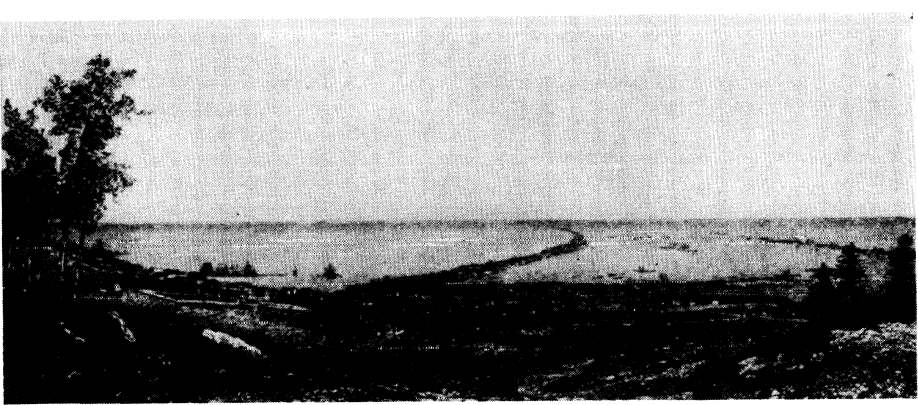
DULUTH, THE “ZENITH CITY OF THE UNSALTED SEAS,” IN 1871
(From Oberholtzer’s Jay Cooke, Financier of the Civil War)
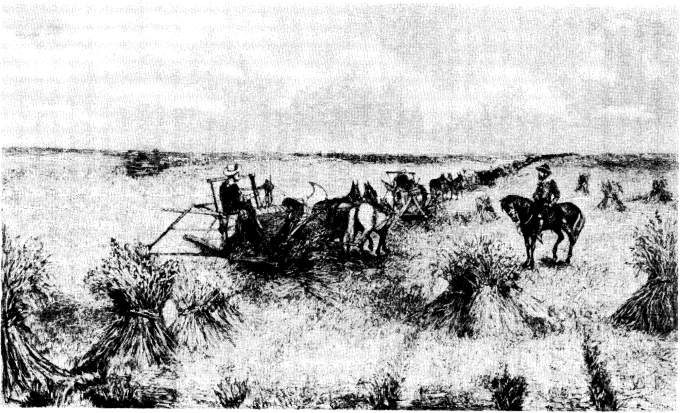
HARVESTING ON A BONANZA FARM
(From Thayer’s Marvels of the New West)
Reports of the enormous profits obtained from the soil in the region attracted speculators as well as farmers. As a result, lands that had been bought from homesteaders and from disgruntled Northern Pacific bondholders at from 50 cents to $3 per acre, were selling in the nineties at from $40 to $60 per acre. Gradually it became profitable to divide up large tracts for sale to individual farmers. In this way most of the “bonanza farms,” which flourished from 1875 to 1900, have disappeared. Large ranches in the same area also have been broken up. A few still remain, and are held for “sport” purposes, but experience has demonstrated that small acreages give better satisfaction to the owners, both politically and economically.
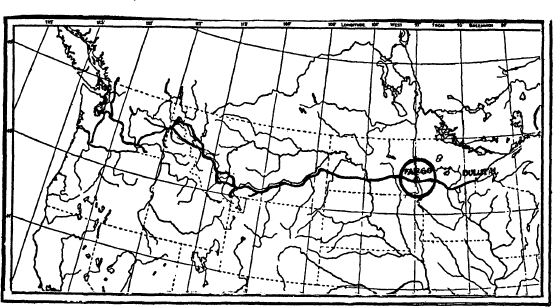
THE CIRCLE MARKS THE LOCATION OF THE “BONANZA FARMS”
Notwithstanding the beneficial effects of the policy of the Northern Pacific promoters in converting their defaulted bonds into cultivated areas, there was considerable contemporary complaint against the “bonanza farms.” William Godwin Moody, a radical writer of the time, thus stated his objections in the Atlantic Monthly, of January, 1880:
The owners of these large tracts have bonanzas, yielding great profits, not one dollar of which is expended in beautifying and permanently improving their vast estates, beyond that necessary for the care of stock and tools, nor in sustaining population. Their homes, their pleasures, their family ties are not upon the farms. Their wealth is flaunted in the gaieties and dissipations or expended in building and developing some distant city or country. But the owner and cultivator of the small farm in the neighborhood, upon which he has planted his rooftree, and around which are gathered all his hopes and ambitions, finds it impossible to pay his taxes, clothe and educate, or find any comfort for his wife and little ones. The case of the small farmer is steadily going from bad to worse. The two cannot exist together; the small farmer cannot compete with his gigantic neighbor under present conditions. He will inevitably be swallowed up. It is at best but a question of time.10
What a false prophecy—so far as the “bonanza farms” are concerned! Millionaires do not run large farms for profit or engage in the risky business of agricultural production, especially when they can sell the land for many times the sum they have paid for it.
When the Northern Pacific Railway was reorganized in 1875, it reacquired the magnificent grant which had been conditionally conveyed to its predecessor. The machinery of land colonization, which had been interrupted by the failure of Jay Cooke & Company, and the subsequent Panic of 1873, was again put in motion. The energetic land-selling campaigns which had been inaugurated by Cooke’s agents at home and abroad were intensified. A rush of population into the region followed. Lands in Minnesota and Dakota rose rapidly in value. The railroad sold land not only to settlers, but also to speculators. In numerous instances, accordingly, the condition requiring purchasers to cultivate a certain proportion of the land was omitted from the sales contract or was disregarded. The Weyerhaeusers bought immense tracts to preserve for timbering. They thus became the lumber kings of America.
Others bought tracts with a view to holding for later developing, or for town-jobbing purposes. The eagerness of the railroad company to realize cash for its patented lands in order to prosecute the construction work as far as Puget Sound led it into making sales to speculators who, while retarding immigration and settlement, became later serious competitors to the company in disposing of its lands at advanced prices.
In the summer of 1881, control of the Northern Pacific passed to Henry Villard, former German newspaper correspondent and agent of German banking interests. Villard was already in charge of extensive railroad operations in the Pacific Northwest, particularly in the Puget Sound area. In connection with these activities, he had launched upon several town-jobbing schemes. The Northern Pacific, as early as 1873, fixed upon Tacoma as its western terminus, and organized the Tacoma Land Company to do the town jobbing. This was one of the assets sought by Villard. Moreover, Villard, through his European connections, was a strong force in attracting foreign emigrants to the Northern Pacific lands, and while in charge of the company, he continued with increased vigor to dispose of the lands. Colonization projects were carried out on a scale not previously attempted. Land agents were employed in almost every country in Europe, and, with the cooperation of the transatlantic steamship companies, “assisted immigration” became so manifest as to lead to serious political opposition on both sides of the Atlantic. The extent of the colonization activities may be surmised from the statement in the Northern Pacific’s annual report to stockholders, in 1882, that it employed 831 active local land agents in the United States and Europe.
Another means of rapidly disposing of Northern Pacific lands after the reorganization in 1875, was the creation by the railroad company of a preferred stock, exchangeable at par value for the company’s lands. This was an attractive bait to speculators. The stock could be purchased at a depreciated value, making the cost of the land at from $1.00 to $1.25 per acre. If the lands rose in value above the minimum price of $2.50 per acre, at which price the company was selling directly to the public, the preferred shareholders could thus realize a profit in making the exchange, since they were entitled to land at the minimum price for their stock. The continuous resale of lands obtained in this way by speculators created a serious competition against direct sales by the company, until the entire preferred stock issue was redeemed. Thus, land gambling followed the Northern Pacific throughout most of its history.
The vigorous land disposal policy was fruitful in its results. It was reported to the Interstate Commerce Commission in 1917 that the gross receipts from land sales by the Northern Pacific had amounted to $136,118,533, and there was a large acreage still retained. The total cost of originally constructing the road was estimated at $70,000,000.11 Accordingly, the prophecy of Mr. Milnor Roberts, Jay Cooke’s engineer, was correct: “The immense landed property of the company will be ultimately worth more than the entire cost of construction.”
But this is stating it mildly! The receipts reported by the company from its land sales constitute only a part—and probably a minor part—of its gains from its donated domain. The land and “improvement” companies, created as subsidiaries of the railroad and owned by it, also made vast profits, which trickled into the coffers of the company or its stockholders. These subsidiary companies, consisting of coal, mining and other enterprises, have constituted the mysterious “hidden assets” of the Northern Pacific Railway Company, by means of which its shares were boosted by stock manipulators.
The Northwestern Improvement Company has been an important land-holding subsidiary of the Northern Pacific. What business this company has been actually engaged in, or what it owns, has been largely withheld from the public. Its operations, however, have been profitable. In 1908 it declared a dividend from accumulated surplus directly to the stockholders of the Northern Pacific Railroad equal to 11.26 per cent on the capital stock of that company. In recent years it has paid at times as much as $5,000,000 a year into the railroad company’s treasury, and the Northern Pacific still owns the Northwestern Improvement Company, so that more may be expected.
Certainly, Jay Cooke was not very wrong, after all, in his belief that, given free lands and engrossed town sites, the construction of the Northern Pacific would be a good business proposition. Though faith in this belief led to his financial ruin within three years after backing it, he lived to see his expectations realized. The remarkable growth of Duluth—his pet “Zenith City of the Unsalted Seas”—materialized when it was linked by rails with the Pacific Northwest. It then became an emporium of a vast inland empire. As previously told, this permitted Cooke to convert his real estate there into the cash which, in time, restored him to solvency. And the citizens of Duluth have acknowledged a debt of gratitude to its prime promoter, who was chiefly responsible for its remarkable growth, by erecting a suitable statue to him within its limits. Thus, future generations may gaze on the kindly countenance of the great financier whose bold and progressive spirit, in combination with human cupidity, helped to put down civil strife and to build up a united nation from coast to coast.
12 Ellis Paxson Oberholtzer, Jay Cooke, Financier of the Civil War, Vol. II, p. III.
13 Forty Years in the House, Senate and Cabinet, Vol. I, p. 325.
14 Oberholtzer, op. cit., Vol. II, p. 105.
15 Ibid., Vol. II, p. 109.
16 Ibid., Vol. II, p. 110.
17 Ibid., Vol. II, p. 167.
18 Congressional Globe, “Senate,” April 7, 1870, p. 2491.
19 Oberholtzer, op. cit, Vol. II, p. 308.
20 Congressional Globe, Appendix, January 27, 1871, pp. 66–68.
21 William Godwin Moody, Land and Labor, p. 58.
22 “See Hearings before the Joint Congressional Committee on the Investigation of the Northern Pacific Land Grants (March 18, 1925), p. 2020.
- 1During the first hundred years of North American colonization, economic conditions gave little encouragement to private land schemes. Land was too plentiful. A few such enterprises were undertaken, however. Thus, as early as 1661, the Colony of Massachusetts sold to a few individuals for £400 a large tract on the Kennebec River in Maine. This became known as the “Kennebec Purchase.” The heirs held it for nearly a century without doing anything with it. In 1753, they incorporated as the “Proprietors of the Kennebec Purchase” and proceeded to dispose of their holdings. The corporation continued in existence until 1816. “The Pejebscot Company” was another Maine land deal. None of these held out promise of profit to proprietors until about a quarter century before the Revolution.
- 2In the meantime, the “Loyal Company” group was not idle; its proprietors sent Dr. Thomas Walker, of Albermarle, Va., to make a reconnaissance, and to discover a proper place of settlement. The two “companies” then became engaged in a controversy, and neither made a survey or fixed the bounds of their grants. The apparent ease with which they obtained land donations led to other schemes, and aroused an epidemic of interest in distant western wild lands. Not only was the land ownership eagerly sought after, but the establishment of new colonies, with separate and distinct governments, was planned. Favoritism and collusion infested the Virginian colonial government, due in large part to the persistence of speculators in western land grants. Lobbyists were sent to London to obtain the crown’s sanction to land-grabbing schemes and the question of the disposal of the vast western domain won from the French infested British politics. “One half of England is now land mad,” wrote George Croghan, of Philadelphia, one of the land schemers, to Sir William Johnson, on March 30, 1766, “and everybody there has their eyes fixed on this country.”
- 3I offered in my last to join you in attempting to secure some of the most valuable lands in the King’s part, which I think may be accomplished after awhile, notwithstanding the proclamation that restrains it at present and prohibits the settlement of them at all; for I can never look upon that proclamation in any other light (but this I say between ourselves) than as a temporary expedient to quiet the minds of the Indians. It must fall, of course, in a few years, especially when those Indians consent to our occupying the lands. Any person, therefore who neglects the present opportunity of hunting out good lands, and in some measure marking and distinguishing them, for his own, in order to keep others from settling them, will never regain it.
- 4Crawford “heartily embraced” the colonel’s offer. He promised shortly to set out in search of lands. “This may be done,” he said, “under a hunting scheme.” He acknowledged that other land seekers had approached him, with similar offers, “but have not agreed to any; nor will I with any but yourself or whom you think proper.”
- 5Judge Richard Henderson of North Carolina, the employer and backer of Daniel Boone, promoted the settlement of the Kentucky region and claimed ownership to a vast unsettled tract there. He organized a group of land grabbers under the name of “The Transylvania Company.” Ignoring the British interdiction against Indian land purchases, he obtained from the Cherokees in 1773 about one-half of the present State of Kentucky, and immediately began settling the land. He advertised widely for pioneers and “shareholders.” In his announcements, Henderson waxed enthusiastic. “The country [Transylvania] might invite a prince from his palace, merely for the pleasure of contemplating its beauty and excellence, but only add the rapturous idea of property, and what allurements can the world offer for the loss of so glorious a prospect?”
- 6When the British Government began to take active measures to break up land “bootlegging,” and to put a stop to dreams of riches in western territory, Virginia’s political resentment was naturally aroused. Even Thomas Jefferson, who, in later life, frowned upon speculation and land grabbing, held the view in 1774 that the land did not belong to the British king, and that it was time for the colonies “to declare that he has no right to grant lands of himself.” So he boldly wrote in the Declaration of Independence, as one of the British king’s usurpations: “He has endeavored to prevent the Population of these States; for that purpose obstructing the Laws for Naturalization of Foreigners; refusing to pass others to encourage their migrations hither, and raising the conditions of new Appropriation of Lands.”
- 7He was for it at once. “I like the project of a colony in the Illinois Country,” he wrote his son, “and will forward it to my utmost here.” He thought that Sir William Johnson’s “approbation will go a great way in recommending it, as he is much relied upon in all affairs that may have any relationships with the Indians.” But Johnson had an eye on the Indian lands himself, and besides advising others about purchases in the outlying sections, personally through gifts from the Indians engrossed large tracts, particularly in the Mohawk Valley. The town of Johnstown, N. Y., still marks the seat of his domain.
- 8Some of the members of the Vandalia Company were concerned in other western land schemes. One of these was organized in 1775 as the “Indiana Land Company,” probably the first application of the name “Indiana” to the Northwest Territory. The claim to land was based on a grant of a large tract, made November 3, 1768, in what is now West Virginia, by the Six Nations at Fort Stanwix to “Chief” William Trent in liquidation of depredations. Among the shareholders were Samuel Wharton, Joseph Galloway, Robert Callender, Levi Andrew Levi, and David Franks, all wealthy and prominent Philadelphians. The Revolutionary War did not put an end to the “claim.” Wharton in 1776 published a pamphlet, entitled-View of the Title to Indiana, in which he defended the company’s rights to the lands. In 1781, he republished this in enlarged form, under the title Plain Facts; being an examination into the Rights of the Indian Nations of America to their respective Countries and a Vindication of the Grant from the Six United Nations to Proprietors of Indiana, etc. Although Wharton pressed the validity of the “proprietors” claims, Congress then and thereafter gave little heed thereto.
- 9Notwithstanding the British Government’s edict, forbidding the private purchase of lands from the Indian tribes, William Murray, an Indian trader, and several of his business associates, in 1773 formed a plan to buy from the aborigines an immense tract of country between the Mississippi, Illinois and Ohio rivers. After a “pow-wow” lasting a month, the sale was consummated. According to the land claimants, it was attended by “many persons of both descriptions and the Indians were carefully prevented from obtaining any spiritous liquors during the whole continuation of the negotiation.” On July 5, 1773, “for a very large and valuable consideration,” the deed was delivered to the “Illinois Land Company.”
- 10Notwithstanding the British Government’s edict, forbidding the private purchase of lands from the Indian tribes, William Murray, an Indian trader, and several of his business associates, in 1773 formed a plan to buy from the aborigines an immense tract of country between the Mississippi, Illinois and Ohio rivers. After a “pow-wow” lasting a month, the sale was consummated. According to the land claimants, it was attended by “many persons of both descriptions and the Indians were carefully prevented from obtaining any spiritous liquors during the whole continuation of the negotiation.” On July 5, 1773, “for a very large and valuable consideration,” the deed was delivered to the “Illinois Land Company.”
- 11The proposition then took on a business aspect. The number of “shares” was increased, and rights to subscribe offered at from $2 to $5 per share. It attracted speculators. The shares soon rose in value. Lawyers, clergymen and politicians began buying shares. The Reverend Ezra Stiles, President of Yale College, grandfather of the poet-physician Oliver Wendell Holmes, took 2¾ shares. The Governor of Connecticut, Roger Walcott, who had become rich through local land deals, supported the project.
- 12Maine Historical Collections, Vol. II, pp. 268-294.
- 13The Sir William Johnson Papers, Vol. V, p. 129. See also, C. W. Alvord, The Mississippi Valley in British Politics, Cleveland, 1917.
- 14Herbert B. Adams. “Washington’s Interest in Western Lands,” Johns Hopkins University Studies, Third Series, No. 1, January, 1885. Italics are mine.—A. M. S.
- 15Adams, op, cit., p. 58.
- 16See A. Henderson, “A Pre-Revolutionary Revolt in the Old Southwest” in Mississippi Valley Historical Review, Vol. 27, p. 198 et seq.
- 17Italics are not in the original.
- 18In a letter to William Franklin, dated May 3, 1776, Johnson asserted “it has always been my practice to avoid engaging in lands to the great loss of my family, neither have I a foot of land from the Indians.” (Sir William Johnson Papers, Vol. IV, p. 197.) The large tract north of the Mohawk Valley given him by the Canajoharie Indians in 1760 was confirmed by royal grant in 1769.
- 19See Pennsylvania Magazine of History, Vol. XIV, pp. 218, 219.
- 20See Memorial of the United Illinois and Wabash Land Companies, Baltimore, 1816.
- 21A copy of the deed is contained in American State Papers, “Public Lands.” Vol. I. The original copy was acquired by Cyrus H, McCormick.
- 22See J. P. Boyd, “Connecticut’s Experiment in Expansion, The Susquehannah Company, 1753-1803,” in Journal of Economic and Business History, November, 1931.

