
The Great American Land Bubble
Chapter XV. “Main Streets” and “Broadways”
THAT caustic commentator and caricaturist of American characteristics, Charles Dickens, when he visited the United States in 1842 could not have failed to notice the prevalence of town jobbing and “city building.” Picturing himself as Martin Chuzzlewit, he is told, soon after landing, by Major Pawkins, “a most distinguished genius for swindling, who could start a bank, or negotiate a loan or form of land-jobbing company, (entailing ruin, pestilence, and death on hundreds of families) with any gifted creature of the Union”:
“You have come to visit our country, sir, at a season of great commercial depression,”
to which the journalist, Mr. Jefferson Brick, added:
“at a period of unprecedented stagnation.”
This was then undoubtedly true, and it is also true, as Dickens pointed out, that in America, if “individual citizens, to a man, are to be believed, it always is depressed, and always is stagnated, and always is at an alarming crisis, and never was otherwise.”
Certainly, at the period whereof Dickens describes the adventures of the naïve Martin Chuzzlewit in the Land of Liberty, many individual citizens of the type of Major Pawkins could have looked back just a few years earlier, when they accounted themselves millionaires and land magnates. But Americans, in their business affairs; in their chase after the dollar; in their extravagant greed, which Dickens and other of his traveling compatriots have caricatured to the pleasure and satisfaction of their own countrymen, always look ahead. Things will get better! Prosperity is coming! The country will grow! Lands will rise in value! Buy now, and take advantage of low prices in the present depression, and get rich in the approaching days of prosperity!
Such was the feeling when the disastrous collapse of 1837 had run its course. Land jobbing and town-site booming were stifled, but they were not dead. Land speculation still remained as an American business, and though full recovery did not come until after a decade, it began to be manifested after only a few years of almost complete cessation.
That Martin Chuzzlewit should be made a victim of American optimism and faith in the rapid growth and development of an expanding territory is not a mere fictional concept of a successful satirist. Chuzzlewit invested in New Eden,—a boom “city,” mind you, not a town or a colony, as was wont to be the practice in the earlier period of land speculation. Eden was a city project. This surprised the credulous Martin:
“Why, I had no idea it was a city,” he exclaimed, glancing at the map on the wall.
“Oh, it’s a city,” [answered the agent].
A flourishing city, too! [remarks Dickens, in his own language] An architectural city! There were [on the map] banks, churches, cathedrals, market places, factories, hotels, stores, mansions, wharves; an exchange, a theatre, public buildings of all kinds down to the office of the Eden Stinger, a daily journal,—all faithfully depicted in the view before them.
All this, of course, was put down for literary effect. But the hyperboles connected with real estate developments have persisted down to the present. And there is no necessary intention of fraud or deceit on the part of the many city boosters, past and present, who start out with great ideas of what they can accomplish in placing on the map a new metropolis, bearing usually their own names or those of old-world centers, and having their “Main Streets” and “Broadways.”
Ambitious capitalists, imbued with optimism, have not only innocently plotted great emporiums on shallow creeks, rocky bays or country crossroads, but they have projected canals, railways, waterworks and other “internal improvements” in the fond belief that their ideas of future growth and prosperity were correct. “Internal improvements” were political bywords in the early days of the Republic. Though the phrase is rarely used in these modern times, projects of a similar nature, to be accomplished with public or private funds, are constantly on the American calendar. “Although,” as Jefferson Brick remarked, “unprecedented stagnation exists,” yet the speculative and adventuresome genius in American character always plans great and fantastic things.
.....
Following the recuperative period produced as an aftermath of the ’37 Panic, the Middle Southwest, now comprising Kansas, Oklahoma and Nebraska, took up the old mania with the old-time vigor. This territory had been neglected prior to 1850, for several reasons. Its settlement had been delayed because of the slavery controversy. Northerners would not go there because of their dislike for the institution. Southerners were not attracted because cotton did not thrive on its alluvial soil. They were not grain growers. The adherents of both parties were deterred by the presence of the large Indian tribes. These occupants kept the government from making the land available for settlers. But the rush began when the Indians were forced out and the section opened up for settlement. Then, the free-staters strove against the pro-slavery party for ascendancy in the disputed region. There followed a perfect mania for town sites among the first settlers.
“All wanted to get rich in town speculations,” wrote H. Miles Moore, himself a city promoter in this region, “and every chap who had squatted upon a decent quarter section near a creek or a crossroad, turned it into a town site, and if he could only succeed in roping in a half dozen other fools, who had a little money or were like himself, town-crazy, they had a company formed, the town surveyed and laid off into blocks, lots, streets, alleys, public squares, etc., and several hundred lithographic maps struck off; and their pockets full of town shares of this great city in embryo,—they were happy.” And he adds:
Of houses and improvements in the town,—that important part of the necessary and future success and prosperity of the town—never entered their heads, or if it did, they only reasoned that the suckers and gudgeons who bought their shares and lots, could build if they wanted to. These schemes generally lasted from three to six months, sometimes a little longer, depending somewhat upon how successful the proprietors had been in disposing of shares and lots to “greenies” from the other States.1
Albert D. Richardson, in his once famous book, Beyond the Mississippi, gave a similar description of the city building mania in Kansas about 1857:
When Themistocles at a feast was asked to play upon a musical instrument, he replied, “I cannot fiddle, but I know how to make a small town a great city!” Every Kansan thought himself a Themistocles . . . The genie of real estate speculation touched them with his wand . . . Young men, who never before owned fifty dollars at once, a few weeks after reaching Kansas, possessed full pockets, with town shares by the score.
On paper all these towns were magnificent. Their superbly lithographed maps adorned the walls of every place of resort. The stranger studying one of these fancied that New Babylon was surpassed only by its namesake of old. Its great parks, opera houses, churches, universities, railway depots and steamboat landing made New York and St. Louis insignificant in comparison. But if the new-comer had the unusual wisdom to visit the prophetic city before purchasing lots, he learned the difference between fact and fancy . . . In most cases he would find one or two rough cabins, with perhaps a tent and an Indian canoe in the river.2
It was under conditions such as are described by these contemporary observers that Leavenworth, Topeka, Lawrence and other towns or “cities” in Kansas were started. Leavenworth was laid out by the Leavenworth Association, a group of land jobbers who, in 1854, pooled their squatter claims. They surveyed and laid out the city, and then sold off the lots. By December 6, 1856, they had completed the sale and closed out the town-jobbing business. Like other similar town-site plans, they erected public buildings and set aside lots for educational and religious purposes.
In a similar way, Topeka, which later became the capital of Kansas, was founded in 1854. This city was partially the result of the efforts of the Emigrant Aid Society of Boston to flood Kansas with “free-staters.” The society made it generally known that its purpose was not to foster land speculation. As Amos Lawrence, one of its philanthropic founders, remarked, “It did not propose to stand between the squatter and the government.” But the “settlers” sent there through its financial assistance, soon contracted the land and town-jobbing fever.
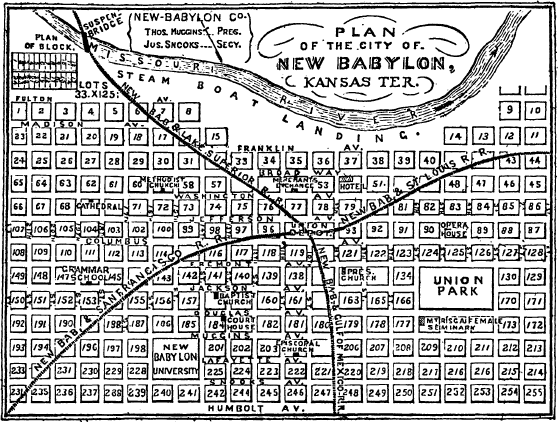
(From Richardson’s Beyond the Mississippi)
THE CITY OF NEW BABYLON ON PAPER
The actual founder of Topeka was Cyrus K. Holliday, who came from Pennsylvania to Kansas in 1854 with $20,000, and began to speculate in town lots. He was later the promoter of the Santa Fé Railroad. He purchased a tract near Tecumseh, Kan., and secured it by a Wyandotte “float.” This was a government warrant authorizing a Wyandotte Indian or his assigns to locate on a piece of unoccupied land wherever he might select it. He then formed the Topeka Town Association, and became its first president. “The selection of the site,” according to Holliday’s own story, “was not an accident; it offered every advantage of a town site. Here was a great river, plenty of water, and above all, two great trails of the continent, Fort Leavenworth and St. Joe to Santa Fé, and Independence to California, crossed at this point.”
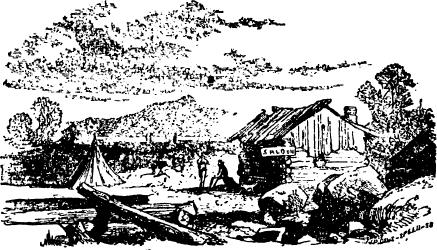
(From Richardson’s Beyond the Mississippi)
THE CITY OF NEW BABYLON IN FACT
Holliday had high ideas of city development. The shareholders of the Topeka Association provided that lots were to be sold only with the condition that “ornamental trees were to be planted in front, and that no liquor was to be sold on the premises.” They were especially liberal in donating ground for educational and religious purposes. The Emigrant Aid Society obtained large holdings in the city as a reward for its colonizing efforts. Such colonization afforded prospective lot purchasers to the city promoters.
A road to California from the city was planned, and a charter was drawn up for a railroad line from the place to St. Joseph, Mo. This was the forerunner of the Atchison, Topeka and Santa Fé system. Moreover, Holliday, through his political influence with the free-staters, succeeded, in 1859, in establishing the territorial capital at Topeka. All this was done or planned in the short space of five years. Such was, and still is, the intense Yankee energy, when incited both by anti-slavery sentiments and by the lure of land speculation.
.....
City building thus became the standard form of real estate speculation in the middle of the nineteenth century. The nation was becoming mature. It began to clothe itself in an industrial garb. Agriculture was no longer the predominent occupation of its citizens. It was displaced by the use of mechanical power, the invention of machinery, the extraction of raw materials, the building of great factories, the construction of vast transportation systems, and by constantly broadening markets. All this required coöperation of large human aggregates, and a concentration of population within narrow limits. Vacant land speculation had gradually declined. City planning has taken its place. Martin Chuzzlewit, English architect, may have been deluded in the prospect of finding professional work in Eden in the early eighteen-forties, but he could have had many opportunities since that time, for “city builders” had much use for his services.
City building found its most fertile field in the Far West. A great deal of it was associated with railroad construction. Chicago, Milwaukee, Duluth, Omaha, Council Bluffs, Tacoma, Seattle, Spokane and a host of pioneer settlements took on a genuine urban aspect after railroad communication was acquired. Some had their periods of rapid advance culminating in a boom. Others expanded and developed gradually. Several have declined. Some are still in the ascendant—and still others await the rod of the real estate promoter and speculator to give them a conspicuous place on the map.
Following the rail movement westward, the “city builders” wended their way through the plains and deserts to the Rocky Mountains, and then beyond. Population centers in the Dakotas, Iowa, Nebraska, Kansas, Wyoming, Colorado, New Mexico, Arizona and all the “Great West” received at their births the title of “cities.” When, through cuts in the mountain passes, the iron bands were carried beyond the Rockies and the Sierras, the city builders moved along with them. They reached the neighborhood of the Pacific Coast in the early eighties. The work of these “boomers” in and around Los Angeles may be taken as typical.
As early as 1868, the former “pueblo” of Los Angeles, in Southern California,—once the seat of a Spanish mission,—gave financial assistance towards the construction of the Los Angeles and San Pedro Railroad. When, shortly thereafter, the Southern Pacific was planning a railroad from San Francisco by a southerly route to the East, the citizens of Los Angeles were desirous of having this line pass through their town. The place, moreover, was a port and could be made a Pacific outlet for this new transcontinental venture. At this time, however, its total population was less than 6,000. The promoters of the Southern Pacific demanded a large payment for the privilege of bringing their tracks to the place. Collis P. Huntington, the company’s promoter, insisted that the railroad be given 5 per cent of the assessed valuation of all Los Angeles County. To this proposition the citizens agreed. They passed over to the Southern Pacific $200,000 in stock of the Los Angeles and San Pedro Railroad, and about $377,000 in cash, acquired by an issue of the municipality’s 7 per cent bonds. In addition, the city of Los Angeles donated 60 acres of ground for a depot. These donations amounted to more than $100 for each inhabitant of the place, but they were satisfied. The groundwork was laid for a real estate boom.
Then the Panic of 1873 came and caused a delay. Although the Southern Pacific was completed to Los Angeles before 1882, and the city had started “to grow” in consequence, it was not until five years thereafter that a veritable “boom” took place. In the meantime, the Atchison, Topeka and Santa Fé Railroad had stretched rival tracks across the Sierras and had also reached Los Angeles. A railroad war ensued. Tickets were sold from the Missouri River to the Pacific Coast from $1 to $15. The town jobbers thus found it convenient to transfer their operations from the Middle West to the Pacific Coast.
If these “developers” had any honest scruples in their dealings prior to their arrival in California, they certainly lost them before they crossed the Rockies. They mapped out new mushroom cities all over Los Angeles County. Within three months no less than thirteen town sites were plotted along the rails of the Santa Fé, in Los Angeles and San Bernardino counties in California—a distance of 136 miles. At the same time, almost as many new ones were marked off on the line of the Southern Pacific. The boundaries of each new “city” almost overlapped those of its neighbors. The wooden street markers and lot pegs gave the appearance of a battlefield cemetery. Lots were offered in large quantities and just as eagerly bought, both on the spot and at other places.
The founding of the “city” of Azusa may be taken as typical. When the day was fixed for the first sale of the lots in this place, anxious buyers waited before the office of the real estate company all through the preceding night. The advance places in line were sold by those holding them at prices ranging from $300 to $1,000. The sale, of course, was a complete success to the promoters. But today the “City of Azusa,” Cal., is a mere hamlet. “Like most others of these phantom cities, it soon faded almost from view.” In many cases, within two years the white stakes that marked off the boulevards and avenues “have been buried by the plowshare or gnawed away by the teeth of time.”3
The county recorde’s office of Los Angeles furnishes evidence of the extent of the boom. Its files of subdivisions and resubdivisions of tracts and blocks, in addition to the cities and towns, for the single year of 1887, fill twenty large map books. In that year real estate transactions, as recorded by deeds in Los Angeles alone, approximated $100,000,000. This, however, does not tell half the story, since the bulk of the sales were merely contracts or options to buy. As is usual in land speculations, liberal terms of payment were granted, and when the collapse occurred in 1888, thousands of contracts were defaulted, and thus do not appear on the records of real estate transactions. Land which sold at $100 per acre in 1886, changed hands at $1,500 an acre the following year. City lots, .which in 1886 brought $500, sold for $5,000 in 1887, and fell back again to the old price at the end of the following year. Between January 1, 1887, and July 1, 1889, sixty new towns and cities, covering about 80,000 acres, were laid out in Los Angeles County, and these at the end of the boom period had an aggregate population of less than 3,500.4
This Los Angeles boom, like so many others before and since, was carried on by professional town jobbers. It was not a native product. At this time, immigration into the region consisted of a few souls, but many “real estate operators.” These, taking advantage of the tourist travel to Southern California induced by cheap railroad rates, advertised the section far and wide as a favorable health resort and a coming commercial emporium. Alluring lithographed posters were displayed in Los Angeles and other places, and “land offices” were set up not only in the new “cities,” but in distant towns. Charles Dickens’ description of the Eden City office, in which Martin Chuzzlewit made his unfortunate real estate investment, is an ungarnished prototype of those which have been set up from that day to this. The furnishings of the offices may have been improved and the agents may have become more polished in behavior, but the purpose and the methods have always been the same.
And to show that Dickens’ “Eden City,” back in the forties, was not so much an exaggerated fictitious conception as patriotic Americans, who took offense at the English novelist’s characterizations, have maintained, one merely has to refer to the operations of Simon Homberg, the most unprincipled speculator in the Los Angeles boom of 1887. Homberg bought from the government two separate quarter sections of land bordering on the Mojave Desert. One of these he correctly named “Border City,” the other he called “Manchester.”5 Without going to the expense of having either site surveyed into lots and staked off, he plotted it in squares and blocks. He then offered the lots in various eastern cities whose inhabitants were ignorant of their barren nature, and sold about 4,000 of them. He had the deeds already printed, so that all that was necessary was the insertion of names, and the consideration. The lots cost Homberg about 10 cents each, but he sold them for as much as $250. “Border City” has disappeared from the map of California, and “Manchester” is today so small as to be almost unknown.
T. S. Van Dyke, the southern California author, seems to deride the idea that the Los Angeles boom of the eighties was “analogous to any South Sea Bubble, or oil or mining stock swindle.” In his fanciful account of the speculation, he states: “The actors in this great game were not ignorant or poor people, and from end to end there was scarcely anything in it that could be called a swindle. With a few exceptions, the principal victims were men of means. Most of them, and certainly the most reckless of them, were men who in some branch of business had been successful . . . All had the amplest time to revise their judgments and investigate the conditions . . . Some of the silliest of the lot were men who, during the first three-fourths of the excitement kept carefully out of it, and did nothing but sneer at the folly of those who were in it”6
Of course, Los Angeles County is marked out by nature to be a wonderful country, and in the years subsequent to its first great boom it has taken its place in the sun. In fact, the county today is one large aggregation of cities and towns. But its rapid growth, though accompanied by real estate boosting and town jobbing, has been placed on a firm foundation. Tourist tales, moving picture progress and petroleum projects, together with a magnificent port development, have combined to make it the most populous portion of the Golden State. Unlike Florida, neither epidemics nor hurricanes have yet marred its marvelous rise in real estate values.
.....
But the growth and grandeur of Los Angeles as a Pacific port, fostered by real estate booms, may be matched to some extent by the rival cities located on Puget Sound. As San Francisco has looked with jealous eyes on the preponderant material advance of the once inconspicuous “pueblo”, six hundred miles to the south, so Tacoma, the original terminus and Pacific gateway of that stupendous railroad undertaking, the Northern Pacific, now looks upon Seattle, its neighbor, twenty-four miles up the Sound. These two constantly “boosted” ports have watched each other like opposing prize fighters in the ring. Real estate operators and “land companies” were largely responsible for this.
The Northern Pacific promoters, we have seen, were on the lookout for profits from town-site speculation. When Tacoma was selected as the western end of the transcontinental rail line, the Tacoma Land Company was forthwith organized and acquired 3,000 acres of tide lands in the town, and 13,000 acres of additional neighboring lands. Like the Lake Superior and Puget Sound Company, which engrossed valuable properties in Duluth, one-half of the capital stock of the Tacoma Land Company was retained by the Northern Pacific promoters and one-half taken by the railroad corporation. Town booming was begun by the company long before the rails reached the shores of Puget Sound. A magnificent hotel was built and the lots offered for sale.
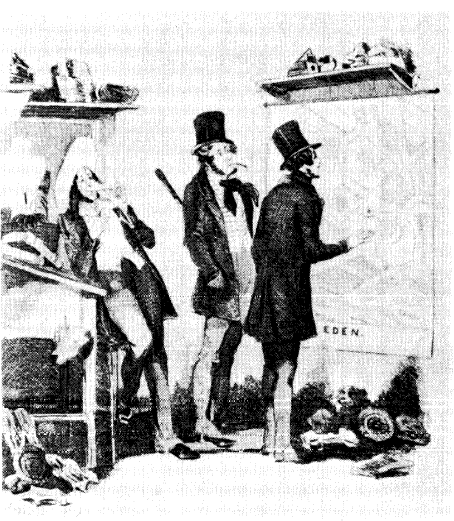
MARTIN CHUZZLEWIT SELECTS HIS LOT IN THE THRIVING CITY OF EDEN
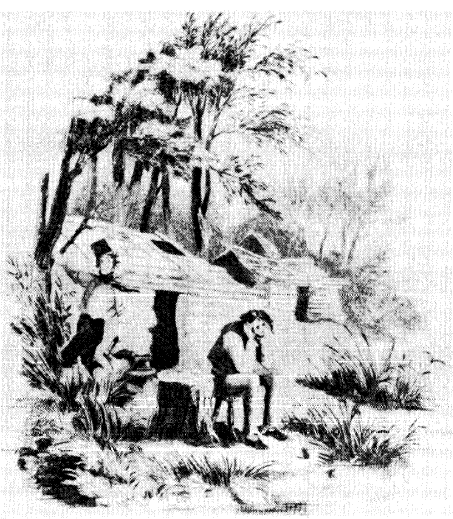
THE THRIVING CITY OF EDEN “IN FACT”
“PHIZ,” THE DICKENS ILLUSTRATOR, DEPICTS AMERICAN TOWN JOBBING
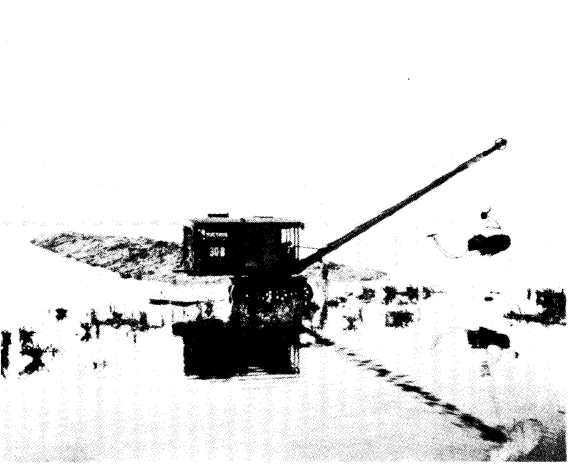
MAKING MORE LAND IN FLORIDA TO MEET THE DEMAND OF SPECULATORS
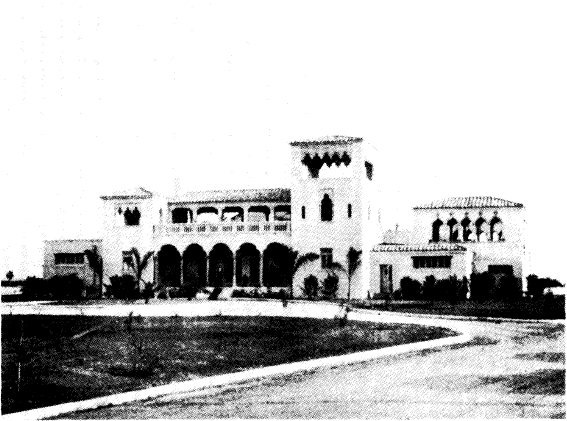
THE DAVIS ISLAND COUNTRY CLUB BUILT ON LAND THAT A YEAR PREVIOUS WAS UNDER WATER
There were no wild efforts, however, to dispose of the company’s holdings. It pursued a conservative policy in its sales to newcomers, avoiding a strong semblance of excited town jobbing. Its operations were handicapped by the slow construction progress of the Northern Pacific. Before the lines of this railroad were extended to the coast, a rail connection was already made with the Columbia River, by which, with water navigation, the interior country could be reached. The slow growth of the city, and the gradual advance of its rival, Seattle, which became the terminus of Jim Hill’s Great Northern Railroad, did not permit highly profitable real estate transactions.
Finally, in 1899, the Tacoma Land Company underwent a reorganization. It sold its water front lots to the Northern Pacific Railroad Company, but retained its real estate in and about Tacoma to the value of about $1,500,000. This property has been largely closed out, and the Tacoma Land Company is now inoperative.
While the original town-site concern was thus gradually going out of business, the City of Tacoma was in a stagnant situation. It was adversely affected by the business depression following 1893. The title to nearly all the real estate in the city had passed, under foreclosure proceedings, to eastern mortgagees. Its population dwindled. In the meantime, Seattle, its rival, was being pushed into a boom. The Great Northern came there in 1892, and Henry Villard—who had taken the Northern Pacific in tow in 1881—extended a branch line to the place. So Seattle had two rail lines to play against each other. Its real estate mongers could say to the Northern Pacific, “If you make improvements in Tacoma, we will give business to the Great Northern”; and to the Great Northern, “If you build to Tacoma, we will favor the Northern Pacific.”
Thus, Seattle and Tacoma became deadly rivals. The opposing real estate boosters carried on a continuous warfare. Both had their Chambers of Commerce, and their “Booster Clubs,” and both had developers of “subdivisions” and “suburbs.” Large sums were expended in advertising. Industries were enticed to locate within the city limits of each. Their lots were widely offered on easy terms to all comers.
A boom for both cities came with the gold rush to Alaska in 1897. Their respective populations increased after that, and along with it the number of real estate agents. Visitors and prospective lot purchasers were urged to invest in Seattle, because that was the “Chicago of the Pacific”; and, if they chanced to cross over to Tacoma, why, there was the place to get rich with “lots” because (as the conspicuous sign over the town’s harbor indicated) “you could just watch Tacoma grow.” They certainly did some business, too, those real estators. Sales doubled, tripled and quadrupled during the years 1905, 1906 and 1907. Then came the financial panic. The “whooping up” of the cities continued, but sales of lots were at a standstill.
Lyman C. Smith, Syracuse, N. Y., typewriter manufacturer, was one of the eastern capitalists who was attracted to Seattle real estate soon after the Klondike gold discovery in 1897. Henry Whitcomb, an envelope manufacturer of Worcester, Mass., was another. Whitcomb is said to have invested $113,000 in city lots in Seattle. He soon sold at a handsome profit, then increased his investments and again sold off much of his holdings. He built a large office building in the city as a token of his interest in the locality.
Smith would not be outdone by Whitcomb. With the advice of his son, Burns Lyman Smith, he erected the tallest office structure outside of New York City—a sort of replica of the Wool-worth Building in the nation’s metropolis. It stands now like a central tombstone in a soldiers’ cemetery—and looks as much out of place as a bay tree in a cabbage patch. But it is a lasting memorial of the great wealth which may be acquired in quiet and cautious real estate dealings in a boom town.
.....
Not all the important speculative schemes of city building can be covered in this survey. Time and space would hardly suffice for that. Neither would it be worth while to list and describe fully the many land booms that have been, throughout almost a century, a common occurrence in American social and industrial evolution. A citation of a few of the conspicuous speculations of this nature will be given by way of illustration rather than attempt to cover the whole field.
One of the most interesting, if not the most successful, of “city building” ventures in recent times is that of Newport News, Va. The development of this important southern seaport and industrial center is largely the work of Collis P. Huntington, California pioneer millionaire and railroad builder. Huntington, after the successful completion of his western railroad ventures, came East and acquired control of the Chesapeake and Ohio Railroad Company. In order to obtain a satisfactory tidewater terminus for his railroad, he conceived the idea of building a port in Hampton Roads, Va., at a site having a harbor sufficiently deep to accommodate large ocean steamers. The place selected was given the name of “Newport News.” It is reported that prior to the Civil War, Huntington, while traveling through Virginia, chanced to visit the site and at once realized its possibilities. A company, incorporated as the “Old Dominion Land Company,” was organized in 1880 to acquire the site. A boom was started. Not only was the terminus of the Chesapeake and Ohio fixed at the place, but Huntington constructed one of the largest drydocks and shipbuilding plants on the Atlantic seaboard.
All this sounds unromantic, but the Sierra poet, Joaquin Miller, immortalized it in pleasing verse:
NEWPORT NEWS
The huge sea monster, the “Merrimac,”
The mad sea monster, the “Monitor,”
You may sweep the sea, peer forward and back,
But never a sign or a sound of war.
A vulture or two in the heavens blue,
A sweet town building, a boatsman call,
The far sea song of a pleasure crew
The sound of hammers. And that is all.
And where are the monsters that tore this main?
And where are the monsters that shook this shore?
The sea grew mad! And the shore shot flame!
The mad sea monsters they are no more.
The palm, and the pine, and the sea sands brown,
The far sea-songs of the pleasure crews;
The air like balm in the building town—
And that is a picture of Newport News.
The Old Dominion Land Company continued to operate Newport News until 1895, when a city charter was obtained from the State of Virginia. The president of the company, in referring to the change of municipal status, remarked in his annual report that, in the interests of the company, the charter was “reasonable as to its nature, care having been taken to avoid the imposing of extreme taxation or other burdens.” At that time the company still owned 156 lots in the city, and a thirty-acre farm. In addition, it owned the Newport News Lighting and Water Company. Most of the company’s lots had been sold on deferred payments, so with high taxes they were likely to revert to the company; but with a city charter, the expenses previously incurred by the land company in keeping the streets of the town in order would be borne by the taxpayers.
The Old Dominion Land Company, regarded in the light of present-day high capitalization, would be considered a puny affair. In 1896 its total capitalization was but $1,962,736. The cost of its real estate was put down at $1,585,289, and its buildings, including its hotel, cost but $1,118,564. Its other investments hardly exceeded $500,000. Profits, moreover, were not large. Only recently has it practically wound up its affairs. In 1930 the assessed valuation of taxable property in the city of Newport News was about $35,000,000. Thus, real estate values there have increased marvelously.
Elaborate suburban development is probably the most conspicuous phase of real estate speculation in recent times. And there has been enough of it, too! So much, in fact, that no one investigator can reasonably attempt to cover the whole story. Every large city is encrusted with its “grand subdivisions” and “suburban developments.” Some have been successful. Some have fared indifferently. But many have failed.
As a rule, these suburban developments have been the work of a single capitalist, or of a small group of promoters. Occasionally, they have been a means of stock speculation. The “Ocean View Land Improvement Company” of Staten Island, incorporated in New York in the early seventies, is an instance of a combination of land and stock speculation. Its capital was only $120,000, but each of the 1,200 shares represented one lot of land. In order to attract purchasers of the shares, a lottery scheme was devised. “As soon as the stock is all taken,” the pamphlet advertising the plan announced, “a distribution will be made among the stockholders by lot of the property of the company in a manner described by its laws. Immediately upon conclusion of such distribution, the stockholders, upon surrendering their certificates of stock, will be entitled to receive a warranty deed of the lot or lots to which they are entitled.” The prize lot to be drawn in the lottery comprised the “late owner’s homestead.” The “late owner” agreed to pay $20,000 in cash to the person drawing it, or to lease it until May, 1872, at $1,500 per year. Thus, as stated in the pamphlet, “The temptation to speculate is very great,” and in order to encourage those inclined towards speculation, an offer of free transportation to the location was made.
This, of course, is but one case, selected largely by way of illustration. There have been thousands similar to it, and the “prize lot” or “free lot” to the lucky ticket holder has been used as a bait innumerable times. Auctioning off city and suburban lots, accompanied by brass bands, oratorical and athletic contests, theatrical performances and the like, have been common occurrences in modern real estate operations. The appetite for town-lot speculation, like religious revivals and political propaganda, must be sharpened by sweetmeats and garnishments, or it is likely to vanish.
One of the largest real estate corporations in America, in recent times, which fostered elaborate suburban development schemes, was the American Real Estate Company. This concern was organized in 1888, with the insignificant capital of $100,000. Operating under this small capitalization, held by the “insiders,” it gradually unloaded on the public millions of dollars of its “real estate bonds” and “certificates.”
The American Real Estate Company adopted the so-called “thrift scheme” of obtaining funds, i.e., selling its bonds on instalment payments. In this way, the investing public bore practically the whole risk of its operations. It never built up reserves to cover contingencies or possible losses. In 1913, at the height of its prosperity, its total surplus was but $2,147,789; its capital (including $1,000,000 of 7 per cent preferred stock sold to “bondholders and clients”) was $1,100,000 and its bonded indebtedness $13,660,900. In addition to this indebtedness, all its real estate was mortgaged. At this time, against total assets consisting of real estate and improvements carried at about $26,000,000, its total indebtedness was almost $25,000,000. Its cash resources were generally below $1,000,000.
All went well with the company until 1914, when real estate values in and around New York began to slump. Without reserves and with large “developments” under way in Yonkers, in the Bronx, and in Queens, the concern was forced into bankruptcy in 1917. Soon after taking charge of the company’s affairs, the receivers discovered underhanded transactions inuring to the benefit of the officers, and suits for recovery were instituted against them. Notwithstanding efforts at reorganization to preserve the equities of the bondholders, the affairs of the company underwent complete liquidation, a matter requiring more than a decade. Its security holders, of course, fared badly.
Although the American Real Estate Company’s securities were sold throughout the country, it confined its real estate operations to New York and vicinity. Its most ambitious undertaking was a development in the city of Yonkers known as “Park Hill on the Hudson.” A carefully edited pamphlet, undoubtedly written by a “literary expert,” revealed the beauties and allurements of this splendid suburb. In bold letters on the first page, the reader is informed:
Without romance or exaggeration we have set forth herewith as simply and as briefly as possible some of the essential features of the “Suburb Beautiful.” No words can adequately describe its charm. Our only hope is that the story which word and picture herein present may attract you to see and know it for yourself.
Yet, “word and picture” did not bring desired results. When the company failed, it still held more than 1,300 lots in Yonkers. In addition, it had purchased a tract comprising almost 3,000 lots in Astoria, on Long Island, opposite New York—few of which were sold. It also owned office buildings, apartment houses and vacant lots in New York City, all heavily mortgaged, and all acquired with funds received through high pressure salesmanship from “innocent investors.”
No record of modern suburban real estate speculation in the United States would be complete without the story of the Van Sweringens’ masterful creation of Shaker Heights, situated on a plateau just east of Cleveland, Ohio. It is said that, as poor newspaper boys, Oris P. and Mantis J. Van Sweringen were accustomed to tramp over the pasture country overlooking the busy city of Cleveland, where a Shaker community was once established. When “Oris P.,” the elder of the two, reached the age of twenty-one, he became a free-lance real estate speculator, and took in his younger brother as a partner. They obtained control of a 1,500-acre tract on Shaker Heights which a syndicate of Buffalo capitalists had tried in vain for eighteen years to sell. They innovated the idea of reselling parts of this property in small blocks, with a guarantee to repurchase at a slightly higher price, if buyers were dissatisfied. Thus, the buyers helped to finance their deal. Through cash received from the sale of additional options and contracts, they expanded their holdings until they finally obtained the whole acreage of Shaker Heights.
They carried out vast development operations. They built broad boulevards; they laid out elaborate golf links; excavated lakes, and donated spacious plots for parks and playgrounds. All this was regarded as visionary by the old-fashioned real estate dealers of Cleveland. But the method of wholesaling lots by the Van Sweringens on a guaranteed repurchase basis seemed to work well. It accelerated sales and gave them funds to carry out further purchases, and as their customers soon resold at a profit, they again came back for more “blocks.”
But the Van Sweringens lacked one important real estate factor to make their project a complete success. They needed cheap and rapid transportation to the heart of Cleveland. The city street railways would not extend their lines to Shaker Heights. The traffic from this suburb did not warrant the expense. The Van Sweringens, however, got the transportation facilities. They offered to donate the right of way through the section and to pay interest for a limited period on the cost of construction.
The offer was accepted. The railway construction was expensive, because grade crossings were eliminated, and excellent physical equipment installed, but it gave the residents high speed express transportation and attracted many working in Cleveland to make their homes on Shaker Heights.
As a suburban real estate development, the Van Sweringen venture is the outstanding success of its kind. In 1900 the land was appraised at $240,000. In 1924 it was valued, without buildings, at $30,000,000. Its projectors became nationally famous. They were greatly encouraged. They extended their real estate operations into the city of Cleveland. Here they encountered some competition. The Nickel Plate Railroad, in contemplation of the construction of a terminal, was buying up land in their neighborhood. And Cleveland needed a Union passenger station.
This gave the Van Sweringens an idea. Because the Interstate Commerce Commission had ordered the New York Central to part with the ownership of the Nickel Plate, the railroad could be bought. They offered to buy it. The bid was accepted, and partly with their own capital, and partly with borrowed funds, they graduated from real estate developers to railroad magnates. But they continued to buy up Cleveland real estate and construct magnificent buildings. What is more, they continued, on a still larger scale, to buy up and develop railroads. All this was well and good. Their names became bywords for successful railroad combinations. Wall Street gave them assistance and “Van Sweringen babies” were jerked up to high price levels among railroad shares. Moreover, their own securities, by means of which they financed their manifold railroad acquisitions, were eagerly absorbed by investors and speculators.
Then the 1929 crash came! It drastically shrunk the value of their real estate and their railroad shares.
The final outcome is still in the lap of the gods!
7 H. Miles Moore, Early History of Leavenworth, p. 60.
8 Beyond the Mississippi, p. 58. See the cuts showing New Babylon as planned and New Babylon as it really was on the following pages.
9 J. M. Guinn, History of California, and an extended History of Los Angeles, Vol. I, pp. 260, 261.
10Ibid., p. 263.
11Ibid., Vol. I, pp. 262, 263.
12T. S. Van Dyke, Millionaires of a Day: The Inside History of the Great Southern California Boom, pp. 2-3.
- 1During the first hundred years of North American colonization, economic conditions gave little encouragement to private land schemes. Land was too plentiful. A few such enterprises were undertaken, however. Thus, as early as 1661, the Colony of Massachusetts sold to a few individuals for £400 a large tract on the Kennebec River in Maine. This became known as the “Kennebec Purchase.” The heirs held it for nearly a century without doing anything with it. In 1753, they incorporated as the “Proprietors of the Kennebec Purchase” and proceeded to dispose of their holdings. The corporation continued in existence until 1816. “The Pejebscot Company” was another Maine land deal. None of these held out promise of profit to proprietors until about a quarter century before the Revolution.
- 2In the meantime, the “Loyal Company” group was not idle; its proprietors sent Dr. Thomas Walker, of Albermarle, Va., to make a reconnaissance, and to discover a proper place of settlement. The two “companies” then became engaged in a controversy, and neither made a survey or fixed the bounds of their grants. The apparent ease with which they obtained land donations led to other schemes, and aroused an epidemic of interest in distant western wild lands. Not only was the land ownership eagerly sought after, but the establishment of new colonies, with separate and distinct governments, was planned. Favoritism and collusion infested the Virginian colonial government, due in large part to the persistence of speculators in western land grants. Lobbyists were sent to London to obtain the crown’s sanction to land-grabbing schemes and the question of the disposal of the vast western domain won from the French infested British politics. “One half of England is now land mad,” wrote George Croghan, of Philadelphia, one of the land schemers, to Sir William Johnson, on March 30, 1766, “and everybody there has their eyes fixed on this country.”
- 3I offered in my last to join you in attempting to secure some of the most valuable lands in the King’s part, which I think may be accomplished after awhile, notwithstanding the proclamation that restrains it at present and prohibits the settlement of them at all; for I can never look upon that proclamation in any other light (but this I say between ourselves) than as a temporary expedient to quiet the minds of the Indians. It must fall, of course, in a few years, especially when those Indians consent to our occupying the lands. Any person, therefore who neglects the present opportunity of hunting out good lands, and in some measure marking and distinguishing them, for his own, in order to keep others from settling them, will never regain it.
- 4Crawford “heartily embraced” the colonel’s offer. He promised shortly to set out in search of lands. “This may be done,” he said, “under a hunting scheme.” He acknowledged that other land seekers had approached him, with similar offers, “but have not agreed to any; nor will I with any but yourself or whom you think proper.”
- 5Judge Richard Henderson of North Carolina, the employer and backer of Daniel Boone, promoted the settlement of the Kentucky region and claimed ownership to a vast unsettled tract there. He organized a group of land grabbers under the name of “The Transylvania Company.” Ignoring the British interdiction against Indian land purchases, he obtained from the Cherokees in 1773 about one-half of the present State of Kentucky, and immediately began settling the land. He advertised widely for pioneers and “shareholders.” In his announcements, Henderson waxed enthusiastic. “The country [Transylvania] might invite a prince from his palace, merely for the pleasure of contemplating its beauty and excellence, but only add the rapturous idea of property, and what allurements can the world offer for the loss of so glorious a prospect?”
- 6When the British Government began to take active measures to break up land “bootlegging,” and to put a stop to dreams of riches in western territory, Virginia’s political resentment was naturally aroused. Even Thomas Jefferson, who, in later life, frowned upon speculation and land grabbing, held the view in 1774 that the land did not belong to the British king, and that it was time for the colonies “to declare that he has no right to grant lands of himself.” So he boldly wrote in the Declaration of Independence, as one of the British king’s usurpations: “He has endeavored to prevent the Population of these States; for that purpose obstructing the Laws for Naturalization of Foreigners; refusing to pass others to encourage their migrations hither, and raising the conditions of new Appropriation of Lands.”
- 7Maine Historical Collections, Vol. II, pp. 268-294.
- 8The Sir William Johnson Papers, Vol. V, p. 129. See also, C. W. Alvord, The Mississippi Valley in British Politics, Cleveland, 1917.
- 9Herbert B. Adams. “Washington’s Interest in Western Lands,” Johns Hopkins University Studies, Third Series, No. 1, January, 1885. Italics are mine.—A. M. S.
- 10Adams, op, cit., p. 58.
- 11See A. Henderson, “A Pre-Revolutionary Revolt in the Old Southwest” in Mississippi Valley Historical Review, Vol. 27, p. 198 et seq.
- 12Italics are not in the original.

