
The Great American Land Bubble
Chapter XI. Generating the Panic of 1837
IN Niles Register, that renowned weekly compendium of American political and economic information during the first half of the nineteenth century, there appeared in the issue of May 9, 1835, the following headlines:
SPECULATION! SPECULATION!! SPECULATION!!!
We offer a selection of articles as to what is going on in the way of speculation. Verily, the people are mad.
Then follows this excerpt from the Baltimore Advocate:
All the world is going mad after timber land, Canton stock, South Cove Company, and like speculations, which are taking the place of the lottery mania that used to possess the community. One gentleman, the other day, pocketed his $20,000 by selling out Canton [land] Company shares, and this, with the stories of sudden riches made by speculations in the timber lands of Maine, is making industrious people neglect their steady business.
Another excerpt deals with stock speculation in New York. It “became so extravagant that the Board of Brokers’ room was not large enough for their accommodations. Some one suggested that there were excellent accommodations in the lunatic asylum.”
Whether in land or in securities, the mania was having a tremendous sweep. It carried away all classes—workers, farmers, bankers and statesmen. Michael Chevalier, the French economist who visited America in 1834, was amazed by it. He compared it to Law’s Mississippi Bubble. “Everybody is speculating,” he wrote, “and everything has become an object of speculation. The most daring enterprises find encouragement; all projects find subscribers. From Maine to the Red River, the whole country is an immense rue Quincampoix. Thus far, every one has made money, as is always the case when speculation is in the ascendant. . . . The American, essentially practical in his views, will never speculate in tulips, even in New York, although the inhabitants have Dutch blood in their veins. The principal objects of speculation are those subjects which chiefly occupy the calculating minds of the Americans, that is to say, cotton, land, city and town lots, banks and railroads.”1
Lands, city and town lots, indeed, took up a large share of the speculative ventures. It comprised the public domain, timber lands, suburban developments, city real estate and town-site jobbing.
.....
As already noted, the national government had instituted a land policy which discouraged the sale of large tracts to speculators. Lands were sold through local land offices in small plots at public auction, or privately to settlers. The price was fixed, first at $2.00 per acre and later at $1.25 per acre. This system, combined with the steady offering of immense quantities of the public domain, checked for a time the purchase of public lands for resale at a profit. It was only when new “ranges” were surveyed and opened for settlement that speculators were offered opportunity of gainful purchases of favorable sites. But all sections in new ranges must first be offered at public auction, so that competitive bidding sometimes drove up the price of choice sites to a high level.
It was this competitive system of disposing of the national domain, during the first three decades after 1800 that placed a damper on speculation in public lands. In fact, “jobbing” in uncultivated lands was not a lucrative business. Many purchasers found it advantageous or necessary to forfeit their first payments and return their acquisitions to the government.
Moreover, the national land business became a national burden. As Andrew Jackson pointed out to Congress in December, 1833: “From the origin of the land system down to the 30th September, 1832, the amount expended [on the public lands] . . . has been about $49,701,280, and the amount received from sales, deducting payment on accounts of roads, etc., about $38,386,624. The revenue arising from the public lands, therefore, has not been sufficient to meet the general charges on the Treasury, which have grown out of them, by about $11,314,656.”2
But when, in the early thirties, the speculative fever raged throughout the country, and government lands, as well as other property, could be purchased with “rag money,” created by “wildcat banks,” then “the land office business” began in earnest. The auctions were attended by veritable mobs. They were scenes of great excitement. Premiums were paid for choice places near the auctioneers, and bribery and corruption in the process of receiving and registering bids were common.
The irregularities in bidding at public land auctions were numerous, and space does not permit details. A common form of fraud was a secret agreement among the bidders to withhold offers for a selected section. Another was to bid up choice sites to abnormally high figures to scare away competitors. The effect of this, wrote an official investigator, in 1834, “would be to enable one man to monopolize the entire sales, and bid off the lands at whatever price he might put down competition; of course, the people attending the sales will have dispersed in a few days after the sales have been closed. They have no idea but that all things in regard to the transaction are fair. A short time after the sales, the person thus purchasing by agreement, forfeits the land; the whole affair is cancelled; the receipts destroyed, and the land becomes subject to entry in the usual manner, and this being known only to a few privileged individuals, of course they can then enter the land at the minimum price.”3
Another kind of public land fraud and corruption was in relation to preëmption claims. Certificates entitling certain individuals, such as soldiers, settlers and Indians, to the preëmption or selection of lands in a location were commonly called “floats,” because anyone claiming land under a preëmption right was said to have a “floating” claim to it. Such claimants, of course, were required to be bona fide cultivators and occupiers under the PreëMption Act of 1834. Many individuals taking up land with “floats,” however, were merely “fake” settlers, and soon sold out to speculators. Whole towns were planned or built up on these “floats.” In 1836, Benjamin F. Linton, the United States District Attorney of Western Louisiana, reported that there was in his district one “notorious speculator in floats” whom, however, he does not name. But we may surmise that it might have been John McDonogh, whose land acquisitions in this section have already been referred to.
Because of the great excitement attending the national land office sales during the speculation fever just prior to the 1837 financial panic, “doing a land office business” became a common expression for great commercial activity and merchandising success. The tremendous increase in the public land sales indicates the extent of the virulent speculation fever. In 1825, receipts from public land sales amounted to but $1,216,090. They rose to $2,329,356 in 1830, then continued as follows:
| YEARS | ACRES SOLD | RECEIPTS |
| 1831 | 2,777,857 | $3,557,024 |
| 1832 | 2,462,342 | 3,115,376 |
| 1833 | 3,856,227 | 4,972,285 |
| 1834 | 4,658,219 | 6,099,981 |
| 1835 | 12,564,479 | 15,999,804 |
| 1836 | 20,074,871 | 25,167,833 |
| 1837 | 5,601,103 | 7,007,523 |
Thus, the big bulge occurred in 1835 and 1836. President Jackson noted it anxiously. He appeared not pleased with the heavy receipts from land sales, for he and his cabinet soon realized that the land was paid for in “rag money,” i.e., in bank notes that were in many cases irredeemable and worthless. Accordingly, he issued on July 11, 1836, his celebrated “Specie Circular.” It simply ordered that the land offices should accept only gold or silver or “land scrip” (i.e., soldiers’ warrants) in payment for public lands.
What a foolish idea, protested the land grabbers! Pay with specie? Who has specie? Not even the banks kept it in their tills. Surely, those who wished to speculate in government lands could not pay in specie, when there was none circulating in the country.
Thus, the excitement of speculation in public lands abated. The land sales fell off. The land offices were deserted. When the crash came in the ensuing year, the Treasury found that instead of “cash” for lands already sold, the “old cat” was returned to its doorstep. Millions of acres reverted to the government because of default in required payments. Congress, by a large majority, passed a bill annulling the “Specie Circular,” but Jackson was firm in his “hard cash” policy. He permitted Congress to adjourn without signing the bill.
Daniel Webster took a keen interest in public land speculation both for political and for personal reasons. As a true statesman, he traced its cause and effect. The government itself was partly responsible, he said, because it did not raise the price of its lands when everything else was going up in price. But, in his estimation, land speculation is not necessarily an evil. With characteristic oratory, he told the Senate, May 31, 1836:
In everything else, prices have run up; but here [i.e., public land], price is chained down by statute. Goods, products of all kinds, and indeed all other lands may rise, and many of them have risen, some twenty-five and some forty and fifty per cent; but government lands remain at $1.25 per acre; and vast portions of this land are equal, in natural fertility, to any part of the globe . . . The government land, therefore, at the present prices, and at the present moment, is the cheapest safe object of investment. The sagacity of capital has found this out, and it grasps the opportunity. Purchase, it is true, has gone ahead of emigration; but emigration follows it, in near pursuit, and spreads its thousands and its tens of thousands close on the heels of the surveyor and the land-hunter . . . Nor are we to overlook, in this survey of the causes of the increase in the sales of public lands, the effects, almost magically, of the great and beneficent agent of prosperity, wealth and power, internal improvement.4
The optimism of the Senator from Massachusetts was not without personal bias. That he was concerned in western land deals is not so well known as his other personal affairs, for his biographers have passed over it, possibly as a “shady,” if not a purely private matter. He was accused by Senator Hayne of South Carolina, and other southern statesmen of seeking to hinder the westward movement for the sake of maintaining eastern political influence, and his “Reply” to this brought forth the greatest bit of oratory and the soundest exposition of the Federal Union that ever echoed through the halls of the Capitol. Webster did not oppose the rapid development of the West, even though it brought land speculation and fraud in its wake. He saw in it a fertile field for Yankee investment, and pointed out that with railroads, canals and other public improvements, they, in the East, “could almost see the smoke of the settlers’ cabins.”
Webster’s western land purchases were in Illinois and Wisconsin. In partnership with Caleb Cushing, a Massachusetts attorney and politician, who furnished the funds, he acquired from John S. Haight, a tract of 600 acres near Rock Island, Ill., “on the branches of the Rock River, which (he thought) was the choice spot in that country.” Haight had bought it at a government land auction, but was unable to pay for it in cash, following the announcement of the “Specie Circular.” It was valued at five dollars an acre, which Webster informed Cushing was “probably not too high.” “I have not the least doubt that the investment will prove an advantageous one,” he wrote enthusiastically. Yet, after holding it until 1850, he could not sell at a profit, and offered it to Cushing in settlement of a debt. Cushing did not accept at once, and in the meantime, the land was sold to cover a tax bill of $300. The purchaser then offered the right to redeem it for $400, but Cushing, after investigation, found that it was not worth the price. Such were the fleeting and changeable land values in those days.
Webster’s investment in public lands is reported to have been as much as $60,000, but this is doubtful. Webster probably never had that much money. He certainly did not have the $3,000 cash to meet the bill of exchange which Haight drew on him for the purchase price, and requested that Cushing advance the amount. However, had the land been held, its value would more than cover this sum, as the property is now a part of the town site of Rock Island.5
Henry Clay, like Webster, feared no evil from land grabbing. In defending the national land policy in the Senate in 1832, he pointed out that “To supply the constantly increasing demand [for land], the policy has been highly liberal. . . . Large tracts, far surpassing the demands of purchasers, in every climate and situation, are brought into the market at moderate prices. . . . For $50 any poor man may purchase forty acres of first rate land.”6
“Yet,” he exclaimed, in referring to the land speculators, “a friend of mine . . . bought in Illinois last fall about two thousand acres of refuse land at the minimum price, for which he has lately refused $6.00 per acre. An officer of this body [the Senate] now in my eye purchased a small tract of 160 acres at second or third hand, entered a few years ago, and which is now estimated at $1,950. It is a business—a very profitable business, at which fortunes are made in the new States, to purchase these refuse lands, and, without improving them, to sell at large advances.”7
Aside from the speculation in public lands, which was killed by the “Specie Circular” (much to the satisfaction of Andrew Jackson, who wanted, as Webster remarked to Cushing, “to keep money out of the Treasury”), there was a rampant rage for all sorts of landed property in all parts of the country. Perhaps there is no better description of the mania of the time than that given by Michael Chevalier:
The amateurs in the land at the north dispute with each other the acquisition of the valuable timberlands of that region; at the southern extremity, the Mississippi swamps and the Alabama and the Red River cotton lands are the subject of competition, and in the West, the corn fields and pastures of Illinois and Michigan. The unparalleled growth of some new towns has turned the heads of the nation, and there is a general rush upon all points advantageously situated; as if, before ten years, three or four Londons, as many Parises, and a dozen Liverpools were about to display their streets and edifices . . . In New York, building lots have been sold sufficient for a population of two million souls, and at New Orleans, for at least a million. Pestilential marshes and nakéd precipices of rock have been bought and sold for this purpose. In Louisiana, the quagmires, the bottomless haunts of alligators, the lakes and cypress-swamps, with ten feet of water or slime, and in the North, the bed of the Hudson, with 20, 30 or 50 feet of water, have found numerous purchasers.8
Though there may be some exaggeration in all this, there can be no doubt that in the five years just prior to the 1837 panic, the fever of land speculation was the most virulent the United States has ever experienced. As Chevalier noted, it was not confined to any class of real estate. Wild lands, swamp lands, improved agricultural lands, town lots and city real estate were all included.
.....
One of the conspicuous fields of speculation at this time was in Maine timber lands. Reference has already been made to the post-Revolutionary gamble in Maine lands.9 Massachusetts owned this territory, and because of its impoverishment during the War for Independence, was desirous of realizing cash for it. Accordingly, the Maine lands were put on the market, in competition with the western New York domain and the Ohio lands. “Eastern Lands for Sale,” was placarded throughout the state. Notwithstanding the sales efforts, however, less than 5,000,000 of the 17,000,000 acres of unoccupied lands in the “Maine District” were disposed of up to 1821. Considerable portions, moreover, were donated for charitable and educational purposes. Altogether, Massachusetts received only about $800,000 net for its sales.
When Maine was incorporated into the Union as a separate state in 1819, an arrangement was made with Massachusetts whereby the unappropriated areas were to be gradually sold, and the net proceeds divided on a “fifty-fifty” basis between the two commonwealths. But the property was regarded as of such doubtful value that Massachusetts made a proposal to sell her share for $150,000, payable in 40 years at 5 per cent. Maine accepted, but the Upper House of the Old Colony failed to ratify the agreement.
It will be recalled that one of the large speculative purchases in the Maine district was made jointly by General Henry Knox and William Duer.10 Knox, who had become President Washington’s first Secretary of War, wished to conceal his land-jobbing activities, and he feared the exposure that would result because of his inability to make the required payments. He therefore gladly dumped the tract on William Bingham of Philadelphia, and it thus became known as “Bingham’s Million Acres.”
Bingham died in 1806, and his estate was divided among his five sons-in-law. These desired hard cash rather than wild acres burdened with annual tax assessments, so they appointed agents to settle the lands. Actual settlements were required before patents could be granted. The agents were selected from both political parties, in order to get “extensions” of the period in which settlers were to be placed on the land, as well as other favors from the State of Massachusetts. One of these agents was the well-known statesman, General Harrison Gray Otis. With all his skill and political influence, General Otis could not settle enough land to pay the taxes. Otis’ successor, General William King, experienced so much worry from the estate that he was driven to insanity and was placed under a guardian. After spending the cash of the “heirs” in building roads and making other improvements, the agents, one after another, gave up their jobs.11
By using methods bordering on bribery the heirs of Bingham finally obtained a patent for the land from Massachusetts. They then proceeded to offer both the timber and the lands for sale. In September, 1828, whole “townships” were offered at auction, at a minimum price of 75 cents an acre. This move started the wild speculation in Maine timber lands. Some townships were bought at the minimum price one day, and resold at an advance of 25 per cent the next. Purchasers flocked from Boston and elsewhere to bid for townships. Rumors were spread that there would be a shortage of timber. Maine woodlands, with their fine growth of merchantable timber, would, therefore, become extremely valuable.
“The wildest speculation that ever prevailed in any part of the United States,” says Hugh McCulloch, a native son of Maine, “was in the timber lands of Maine. In 1832, or about that time, it became known to the people of Massachusetts that a good deal of money was being made by a few investors in Maine timber lands. . . . These lands were offered for sale . . . at very low prices, and those who bought early and judiciously did make what were considered large fortunes. . . . The desire became so strong, and the excitement so great, that a courier line was established between Boston and Bangor, by which orders to buy, and subsequently to sell, were rapidly transmitted, and for months little was talked about but Maine lands. Brokers offices were opened in Bangor, which were crowded from morning till night, and frequently far into the night, by buyers and sellers. Not one in fifty knew anything about the lands he was buying, nor did he care to know so long as he could sell at a profit. . . . The same lands were sold over and over again until lands which had been bought for a few cents were sold for half as many dollars. As is always the case when speculation is rampant, and inexperienced men become speculators, dishonesty was in the ascendant. . . . It happened, strangely enough, that the largest losers in the Maine land speculation were prudent men, who kept aloof from it until it had reached its highest point, and the tide was ready to turn.”12
The tide did turn, and thousands of speculators were defrauded or ruined. The craze spread beyond the limits of New England. An issue of the Baltimore Advocate, in May, 1835, stated that “The timber lands are all the go in this market, and even the worthy Catholic Bishop, it is understood, is dipping in, having purchased a whole township which he is selling to the Irish to make a Catholic State somewhere in the woods of Maine.”13
Fraud and corruption accompanied the excitement. Tracts were sold that did not exist. “In the interest of large holders, maps were prepared, on which lands were represented as lying upon water courses which were scores of miles away from them.” Notes were given and endorsed without the least expectation of making payment. In one of the lawsuits arising out of these Maine land transactions, the defendants denied the validity of a debt on the ground that “eastern land speculation in general was so tainted with fraud, deception, cheating, lying and swindling, that the very term had become proverbial for these vices.” And on this ground the jury failed to return a verdict.14
One of the Boston capitalists caught in the trap of the Maine speculation was Josiah Perham, the original promoter of the Northern Pacific Railroad. Perham thought he had amassed a fortune in the speculation, but he held on to his purchases until the crash came. Then he lost all. With characteristic optimism, that later developed his ideas for promoting transcontinental transportation through free land grants, he set about to regain wealth and pay off his creditors. This he did in time, through his profits as a Boston wool merchant. And in this way he acquired the confidence and support of those who joined in his railroad enterprises.15
.....
While New Englanders were running wildly after Maine timber lands, they were equally concerned in the western land fever. As in previous boom periods, a vast number of land companies were organized to foster speculation. One of the boldest enterprises of this nature was the “American Land Company.” This was organized in 1835 by prominent New York capitalists, though it included in its management several Bostonians. Among its chief promoters was Charles Butler, of Geneva, N. Y. It will be recalled that Butler originated the plan whereby the western New York farmers who purchased from the Holland Land Company on credit could obtain deeds to their properties by mortgaging them, and applying the proceeds to pay up their debts due the land company. He thus became involved in the land business, and casting his eyes westward to the boundless unoccupied acres, was lured into the current land gambles.
Butler’s optimism regarding western land opportunities was intensified by a journey to this region in 1833, “attended with great privations, fatigue, exposure, and difficulty.” He returned to New York thoroughly infected with the “Michigan fever.” His interest in the West was to continue long after the American Land Company faded into nothingness, for in the years following the Panic of 1837 he, in conjunction with his brother-in-law, William B. Ogden, was active as a promoter of western railroads and other large enterprises.
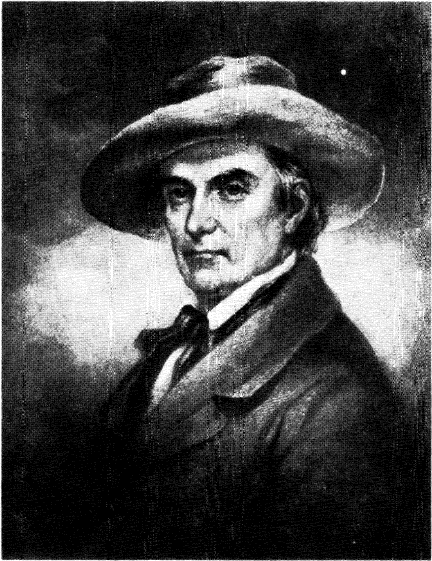
DANIEL WEBSTER, WHOSE INTEREST IN WESTERN LANDS WAS BOTH PRIVATE AND PUBLIC
(From a portrait by J. Ames)
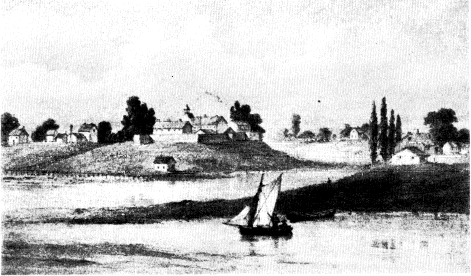
CHICAGO IN 1831
(From an old print)
Butler had associated with him other prominent eastern capitalists. This is indicated in the list of trustees and directors of the American Land Company. They included Erastus Corning, wealthy merchant of Albany and one of the promoters of the Mohawk and Hudson Railroad (the first to furnish a journey on rails in America), Campbell Bushnell, a prominent attorney, and John B. Jones and John W. Sullivan of Boston. The largest shareholders, in addition to the trustees, were William B. Ogden, Herman Le Roy, wealthy New York banker, J. L. & S. Josephs & Co., the brokers already referred to as interested in Texas land gambles, and J. D. Beers and Co., another prominent New York brokerage house. The first annual report of the company lists over 150 shareholders, among whom was the celebrated American historian, William H. Prescott. He was down for twenty shares.
The authorized capital of the American Land Company was $1,000,000—quite a large sum in those days. The shares were $100 par value. About 80 per cent of this capital was subscribed in less than a year, though the company received only about $500,000, the unpaid subscriptions being represented by “accepted drafts from agents for purchase of lands.” The purpose of organization is stated thus:
The specific object of this Association is the investment and employment of its capital in the purchase of land situated in the United States, particularly in the western states and territories.
It seems, however, that the main purpose was the “purchase of cotton lands in the southwestern states, at or near the Government price,” and that this “was the leading motive of a large number of subscribers.” Anyhow, about 70 per cent of the company’s capital was applied to this purpose in the first year. Local agents were appointed to make purchases, and William B. Ogden (descendant of the “Jersey Ogdens”), destined to become Chicago’s leading citizen and capitalist, was appointed “general agent to look after local agents.”
No time was lost in making purchases. In less than a year, the company not only exhausted its cash capital, but went heavily into debt. It did not buy outright, but “under contract sales.” Thus, it contracted to buy for $400,000 cotton lands in Mississippi, “lately occupied by the Chickasaw Indians” and title was to be obtained “directly from the Indians,” but “to be approved by the President.” They also made a similar purchase for $250,000 of cotton lands in Arkansas. If the agents resold at a satisfactory price they were to get one-eighth of the profit, Lands were also purchased in Florida on the St. Johns River at $5 per acre. But the most significant purchases were made in town lots in Chicago, Toledo and elsewhere.
These additional investments in the northern field were believed to be equally as safe as those made in the southwest, since “they have been made through the agency of judicious and prudent men.” The company’s directors reported that “with the facts which are daily transpiring before our eyes in that portion of the United States, we have the surest guaranty that good land, well located, will continue a safe investment. The foreign and domestic emigration to the west is daily increasing—and in a short time, we shall see as dense a population covering the northern part of Ohio, Indiana and Illinois, as we now find in the western part of New York.”16
It is quite evident that the American Land Company did a general land-jobbing business, so prevalent at this period. Though in its first annual report, there is the explicit statement that it was not the purpose “to speculate in urban lands,” it bought and resold to James L. Curtis and Silas M. Stilwell (two heavy real estate “plungers” and town jobbers of the time), a tract in the “boom town” of Toledo. It gave $50,000 for this land, payable in one year, and resold it at $80,000, but payable in ten annual instalments at 7 per cent interest. The profit, of course, was on paper—as the New Yorkers never completed the required payments, though “the purchasers were said to be highly responsible.” Yet, Stilwell, who was prominent in New York politics, had to refuse an offer in 1839 from President William Henry Harrison of a cabinet appointment, because the loss of his fortune in the 1837 Panic “did not permit him to bear the expense.”17
A similar deal in Chicago real estate was made on the same basis. On an investment of $18,803 the company made within a few months a paper profit of $12,837. But they allowed the purchasers five years to complete payments. As will be shown, hardly a real estate sale on credit in Chicago at this time was consummated by the purchaser meeting all the required payments.
Probably the most spectacular purchase of the American Land Company was 2,525 acres in Orleans County of New York, for which it paid $22 per acre; meeting one-half the purchase price in cash. On this, they expected shortly to make an enormous profit. “The lowest estimate which is put upon it by judicious men is $35 per acre. . . . The trustees [of the company] have reason to believe that, after carrying out their plan of improvements, the property will yield a rent equal at least to the interest on the capital invested, and that within five years it may be sold at $50 per acre.”18 In five years, however, land and real estate in New York State were as difficult to sell as snowballs to the Eskimos.
The American Land Company made purchases through appointed local agents. Under this plan “the investing agent agrees to take entire care and charge of purchased property until sold.” When sold, the agent is to get a percentage of the clear net profit; this percentage to be from one-fourth to one-third of the net gain. “If there are no net profits, then the Agent gets nothing for his services.” Of course, “the trustees” in common with shareholders assumed the risk of investment, and “risk [they stated] is inseparable from enterprise.” The company, moreover, did not propose to hold property. Its aim was to “sell quickly at a fair profit.”
The foregoing details regarding the American Land Company’s operations are given largely with a view to showing the methods, aims and principles of the land-jobbing concerns of the time. Numerous other and smaller companies operated in the same way. Nor did they all originate on American soil. Several were owned and financed by British and Scotch capitalists. George Smith, who later became a multimillionaire—not, however, through land speculation, but by issuing his “circulating notes”—came from Scotland to Chicago “as a prospector” in 1834. Greatly impressed with the immense possibilities of gain the country offered, he organized the “Scottish Illinois Land Investment Company” and acted as its agent. He also took on other agencies for both land companies and private bankers. Though he, personally, became a large real estate owner in Chicago and other sections of Illinois—probably through purchases made after the debacle in 1837—he was attracted to banking and note shaving, and during his stay in America until 1857, he waxed extremely wealthy. He is reported to have returned to Scotland with enough “dollars” to purchase a kingdom.19 But his Scottish Illinois Land Investment Company appears to have “gone by the boards.”
.....
Of all the various fields of speculation just previous to the Panic of 1837, none were more flagrantly exploited than urban real estate and town jobbing. Due to currency inflation, real estate, of course, rose in value with all other forms of wealth and immense fortunes were being made in real estate transactions. This was to be expected in a period of buoyant optimism created by constantly expanding currency; a craze for public improvements; and a regime of liberal and cheap credit. But the amazing manner in which the whole explored territory of the United States was converted into “paper” cities, towns, ports and suburbs, during the period between 1830 and 1837, is unparalleled in history. There was hardly a county (East or West, North or South), in which new towns and new settlements were not laid out.
Speculative furor was most pronounced in the Northwest. Here raged the “Michigan fever,” as land speculation in this territory was then called. All along the Ohio, Missouri and Mississippi rivers; all along the Great Lakes from Buffalo to Superior, and even beyond, were new towns or plans for new towns. Almost every nook, every bay on Lake Erie and Lake Michigan was taken up for a town site. Town lots and more town lots! This was the commonest form of merchandise then in the country. As an English traveler remarked, “towns would be advertised and trumpeted forth in the moon” if there was a chance of selling lots.20
Here again, Hugh McCulloch, who in 1833 had removed from New England to Indiana, offers us a good contemporary description: “Hundreds of tracts,” he wrote in 1890, “were laid off in town lots where the original forests were still standing. What took place under my own observation seems now to be too absurd to be real. On the Maumee River, from its mouth on Lake Erie, there were for miles a succession of towns; some of them like Maumee City, Perrysburg, Manhattan, and Toledo were realities, but most of them existed on paper only. In the spring of 1836, a young man whom I met in Maumee City, said to me that he had made a great deal of money in a few months buying and selling lots. “Maumee City,” says he, “lies, as you know, at the foot of the Rapids; and is destined to be one of the great cities of the West; property is rising rapidly in value and I am buying and selling every day.”21
When McCulloch asked him, “How did you raise the money to commence with?” he replied: “Oh, very little money is required in this business. I pay when I buy, and I require, when I sell a lot, a few dollars to bind the bargain; but nearly everything is done on credit.”
McCulloch thus describes the system of the wild speculation in Toledo, in 1836, which may be taken as typical:
On my way from New York to Fort Wayne . . . I stopped overnight at a hotel in Toledo. After dinner, I noticed that there was a gathering of gentlemen in the parlor, and in the course of the evening, I was waited upon by one whom I knew, and invited to join it. “Our rule,” he said, “is to admit no one to these meetings who is not worth $100,000. As you are a banker, you must be worth at least that” . . . I accepted the invitation. The company consisted of politicians, scholars, writers and one or two of them, authors of considerable renown, but not one was there whom I recognized as being engaged in regular business pursuits. It was a sort of private exchange, at which the members made themselves rich by buying and selling to each other lands and town lots. There was at times a good deal of excitement, much like that which is witnessed in the New York Stock Exchange. When the meeting closed, everyone felt that he was richer than when it opened. In a few brief months, there was not one of these hundred-thousand-dollar-men who was worth a hundred thousand cents.22
The greatest “boom town” of this period was Chicago. It was a village in 1833, surrounding a frontier fort. In 1836, it was the fastest growing “metropolis” in all Christendom.
When the coastwise steamship lines ran special excursions to Florida during the “boom” in 1925-26 it was regarded as a novel experiment. But there was nothing new in it! Similar trips by lake steamers were made to Chicago and Milwaukee in the boom years of 1835 and 1836. Whole boatloads of speculators, infected with the “Michigan fever,” flocked to the region.
So great was the demand for “lots” that almost all northeastern Illinois was laid out in towns. Chicago grew in population from 550 inhabitants in 1832 to over 5,000 in 1836, to say nothing of the perambulating speculators and real estate vendors. The value of taxable property rose in the same period from $19,560 to several millions. So utterly reckless had the city grown that the people “chased every bubble that floated on the speculative atmosphere.” The more absurd the project, the more madly was it pursued.” The government land office in the city was besieged from morning till night with eager speculators. Those who bought anywhere within hundreds of miles, even before seeing the plot, laid it out into city lots, “in the most approved rectangular position, emblazoned in glaring colors, and exhibiting the public spirit of the proprietor in the multitude of their public squares, church lots and school lot reservations.” The whole Chicago area was infested with strangers, capitalists, clerks and even greedy clergymen. The hotels, inns and boarding houses also did “a land office business.”23
The greatest excitement prevailed in 1836, when the Illinois Legislature ordered the Illinois and Michigan Canal trustees to sell the “canal lots.” These constituted a part of the land gift of the federal government to foster the construction of an internal waterway between Lake Michigan and the Mississippi River. The sale was thought to be a wonderful success. Single lots brought from $9,000 to $21,400. Aggregate sales from June to September amounted to $1,359,465, but only $401,042 was received in cash. In nearly every instance the sales were never completed. In 1837 there was hardly one important purchaser who did not prefer to forfeit his lots, rather than complete the payments. After the crash, lots that had sold for more than $1,000 would not fetch $100 in specie.
The whole Chicago population was in the real estate business when the boom was on. There is a story that a prominent physician was busy selling “town lots,” when a messenger informed him that a lady urgently required his professional services. He reluctantly left his office and made the call. He diagnosed the case hurriedly and made out a prescription, then proceeded to leave.
“Why, doctor,” the lady called after him, “you don’t state here how I shall take the medicine.”
“Oh,” he called back, over his shoulder, “Canal terms. One-quarter down, and the balance in one, two and three years.”
He had “town lots” impressed on his brain, and even professional practice could not erase the usual terms of sale.
All sorts of advertising media and entertainment were employed by the town jobbers. No better description of this is afforded than that given by Harriet Martineau, in her delightful account of Society in America:
I never saw a busier place than Chicago was at the time of our arrival [in 1836]. There streets were crowded with land speculators hurrying from one sale to another. A negro dressed up in scarlet, bearing a scarlet flag and riding a white horse, with housings of scarlet, announced the times of sale. At every street corner, where he stopped, the crowd flocked around him; and it seemed as if some prevalent mania infected the whole people . . . As the gentlemen of our party walked the streets, storekeepers hailed them from their doors, with offers of farms and all manner of land-lots, advising them to speculate before the price of land rose higher. A young lawyer realized $500 per day by merely making out titles to land.
And the great English lady added prophetically: “Of course, this rapid money-making is a merely temporary evil. A bursting of the bubble must soon come. The absurdity is so striking, that the wonder is that the fever should have attained such height as I witnessed.”24
And the bubble did burst! For it was ridiculous, as Miss Martineau remarked, that “wild land on the banks of a canal, not even yet marked out, should sell in Chicago for more than the rich land, well improved in the finest part of the Valley of the Mohawk.”
When the bubble burst, and ruin was brought to almost every inhabitant and sojourner, the very mention of “town lots” exasperated the Chicago populace. It is stated on good authority that at a political meeting in 1837, which was urging upon the legislature the grant of a city charter to Chicago, one speaker “launched into the future and predicted that the place would one day have a population of 50,000.” He was howled down with yells of “town lots, town lots,” the audience suspecting that he had lots to sell them and was’ humbugging the people as to the town’s future greatness, merely to help along his sales.
Chicago was but an exaggerated replica of what then happened in many other new western cities. The speculation craze also affected the more settled eastern regions. It was especially violent in New York City and in Buffalo. Philip Hone, noted in his diary, on February 23, 1836, that “Twenty lots in the ‘burned district’ of New York . . . were sold at auction this day . . . at most enormous prices, greater than they would have brought before the fire in 1835, when covered with valuable buildings.”
On March 8, he again wrote: “I have this day sold my house in which I live, No. 255 Broadway . . . for $60,000. . . . I made a large profit, but the rage for speculation is at present so high that it will prove an excellent purchase.”
Suburban lots in Manhattan and on Long Island rose enormously in value. “Lots two miles from City Hall,” Hone noted, “are worth $8,000 or $10,000. Even in the eleventh ward toward the East River, where they sold two or three years ago for $2,000 or $3,000, they are held now at $4,000 and $5,000. Everything is in the same proportion. The market is higher now than I have ever known it.” Yet, about a year later (May 26, 1837), he remarks, facetiously: “Lots which a year ago were rough edge guineas, and brought any price for fear they might run away, stand now in the same places and do not look nearly so pleasant nor so valuable as they did then.”
Mr. Guy H. Salisbury, Buffalo historian, states that by comparing the prices of lots in that city in 1836, as shown by the Buffalo Land Register, with what the same property would bring in 1863 (the year he was writing), “our prices at this time are less than one-half as high as they were then.” The number of Buffalo real estate transactions during the boom was enormous. “As far as the records show,” says Mr. Salisbury, “there were some twelve thousand deeds (in 1836) mostly for city property.” The deeds do not cover contract sales, which were probably much more numerous. Following the 1837 collapse, lands in and around Buffalo “were a drug on the market and could hardly be disposed of at any price. Sales were made mostly for outer lots at from one-tenth to one-twentieth of the prices they bore in ’36.”25
Even in the secluded inland town of Auburn, N. Y., the craze was severely felt. William H. Seward, whose home was in Auburn, and who built up a larger fortune in land deals than in law practice or in politics, wrote on February 8, 1835: “A great rage for speculation in real estate has arisen here. Property has advanced about 25 per cent, and sells readily. This gives me reputation of increase of property. Whether I realize it or not will depend upon whether I sell while the fever is upon us.”26 Yet Seward, in 1835, was modest in his estimate of the rise in real estate values in his home town, for his son and collaborator mentions that the next year “houses and village lots advantageously located rose suddenly to seven times their former values,” and that the town of Auburn was extended on paper to over four times its previous space.27
Not all the “booming” was in town lots. Suburban developments also participated in the spectacular speculation of this period. J. L. & S. Joseph & Co. diversified their activities in land promotions. In addition to fostering deals in “Texas scrip,” they, together with George A. Ward and other New Yorkers, in 1836, organized the “New Brighton Company.” Its purpose was to develop an aristocratic suburban community on Staten Island. The proposition soon perished, however. The banks foreclosed a mortgage of $470,000 on the property, and it was sold for a song. The Stevens family, famous for engineering ingenuity, also made efforts to attract population to their lands in Hoboken near Castle Point, and in addition to spending large sums in improving this Jersey suburb, and lowering the ferry rates, made offers from time to time, of prizes for oratory and other contests of skill in order to popularize the resort. The Swartwouts, famous in New York City political annals, acquired a part of the Hackensack meadows from the Stevens family, and in imitation of their Dutch ancestors, made large outlays to reclaim the lands from salt water. “They made seven and a half miles of embankment. . . . They dug 120 miles of ditches. They reclaimed 1,300 acres. . . . It was expected that all the vegetables that would ever be needed in New York could grow upon these fields. They had reason to hope for success when they saw before them 4,000 acres of garden within sight of Trinity steeple.”28
They conceived the idea that these swamps could be made into suburban plots as well as cattle grazing grounds and truck gardens. They organized a dairy company, and offered shareholders twenty-five gallons of milk a share annually, in lieu of dividends. They soon discovered, however, that mosquitoes drive away human beings, that cows can’t swim, and vegetables don’t thrive in salt marshes. They sought loans from the City of New York and in Holland without success, and before Samuel Swartwout ended his turbulent political career by abstracting funds belonging to the national till, the whole project floundered. A portion of the Swartwout swamps came into possession of the United States. It was held for a number of years, in the expectation that it would increase in value, but was finally disposed of.
Some of the suburban developments of this period met with fair success and still survive. Noteworthy among these is the Canton Company, of Baltimore. This concern, created in 1828, to develop an industrial and shipping section of the Monumental City, has attracted speculative interest for more than a century. Peter Cooper was early concerned in it, and when its success seemed doubtful, because the Baltimore and Ohio Railroad could not find a suitable means of propelling cars, the New York capitalist applied his inventive genius to the construction of the first genuine American locomotive—the Tom Thumb. Later, the Canton Company had its shares listed on the New York Stock Exchange, and in this way old “Uncle” Daniel Drew obtained an influential interest in its affairs. Its progress has been slow, however, and after a century of plodding, its property has been finally taken over by the Pennsylvania Railroad at the neat sum, according to reports, of $13,000,000.
The East Boston Company is another industrial suburban development, organized in 1835, which has also survived the changing conditions of a century and still is in existence. Its shareholders had a rocky road to travel, however, in the years immediately following the panic. In 1835, the shares of the East Boston Company were quoted at 185. In 1838, the price slumped to 7¾ and later reached as low as $4 per share.
It is not meant to create the impression that all who were concerned in the wild real estate and land schemes just prior to the Panic of 1837 met with misfortune. Many realized large profits, and were started on the road to further wealth. Charles Butler and William B. Ogden both came out ahead of the game, though their American Land Company went to pieces. Butler bought a plot in Chicago from Arthur Bronson (who paid $20,000 for it) for $100,000, and soon sold a one-third parcel of it in lots for the same amount. He also made other profitable sales before the crash. Gardner S. Hubbard, in 1834, purchased 80 acres near Chicago at $5,000. He then made it into an “addition” to the town, went to New York and sold one-half of it, which he had plotted into lots, at auction, for $80,000. Similar tales of fabulous gain may be told of others, but compared with the more numerous cases of lost fortunes, these successful “profiteers” are the exception rather than the rule.29
William B. Ogden, the “general agent,” of the American Land Company, was not discouraged by the financial collapse which he personally witnessed at Chicago. At least, he did not abandon the place. Instead, he remained there, and became the first mayor of the “city” and its most prominent citizen. He continued to buy land and lots, and became the most progressive and active railroad promoter in the West. He subsequently was elected president of the Union Pacific Railroad, and this is the reason why its western terminal in Utah bears his name. Regarding his successful real estate operations after the 1837 debacle, Ogden’s notebook states: “I purchased in 1845 property [in Chicago] for $15,000, which twenty years thereafter [in 1865] was worth ten millions of dollars. In 1844, I purchased for $8,000, what eight years thereafter sold for three millions of dollars, and these cases could be extended almost indefinitely.”30
But, of course, all these purchases were made in a period when speculation had been crushed, and when the pendulum of property values swung an equal distance in the downward direction. It took almost a decade for the country to recover from the shock of the 1837 collapse. In the intervening period, convalescence was slow, and land speculators were so much disheartened that it required a new generation to prepare the stage for another boom period.
31 Michael Chevalier, Society, Manners and Politics in the United States (1839), p. 305.
32 Messages and Papers of the Presidents, Vol. III, p. 63.
33 American State Papers, Public Lands, Vol. VII, p. 524.
34 The Works of Daniel Webster, Vol. IV, p. 262.
35 See Claude F. Feuss, Caleb Cushing, Vol. I, pp. 230-232, and Vol. II, pp. 85-88.
36 Colton, et al., The Works of Henry Clay, Vol. V, p. 429.
37 Ibid., p. 503. Italics are mine.—A. M. S.
38 Chevalier, op. cit., pp. 305, 306.
39 See Chapter II, p. 39.
40 See Chapter II, p. 39.
41 Maine Historical Society Collections, Vol. VII (1876), p. 359.
42 Hugh McCulloch, Men and Measures of Half a Century, pp. 214-216.
43 Niles Register, May 9, 1835, p. 168.
44 Hunt’s Merchants Magazine, Vol. 2, p. 496.
45 See Chapter XIV, p. 295.
46 The Annual Report of the Trustees of the American Land Company (1836), p. 25.
47 See Appleton’s Cyclopedia of American Biography, Vol. V, p. 690.
48Ibid., p. 22.
49 Huston and Russell, Banking in Illinois, p. 107.
50 William Oliver, Eight Months in Illinois, p. 41.
51 Hugh McCulloch, Addresses, Speeches, and Letters upon Various Subjects, p. 384.
52 Ibid., pp. 384, 385.
53 See Moses and Kirkland, History of Chicago, Vol. I, p. 98.
54 Society in America, Vol. II, pp. 259, 260.
55 Buffalo Historical Society Publications, Vol. IV, pp. 317-336.
56 Autobiography of Frederick W. Seward, Vol. I, p. 251.
57 Ibid., p. 316.
58 Walter Barrett, The Old Merchants of New York (1855), Vol. IV, p. 253.
59 Moses and Kirkland, op. cit., p. 98.
60 William B. Ogden and Early Days in Chicago, by Hon. Isaac N. Arnold, Fergus Historical Series, No. 17, p. 22.
- 1Maine Historical Collections, Vol. II, pp. 268-294.
- 2The Sir William Johnson Papers, Vol. V, p. 129. See also, C. W. Alvord, The Mississippi Valley in British Politics, Cleveland, 1917.
- 3Herbert B. Adams. “Washington’s Interest in Western Lands,” Johns Hopkins University Studies, Third Series, No. 1, January, 1885. Italics are mine.—A. M. S.
- 4Adams, op, cit., p. 58.
- 5See A. Henderson, “A Pre-Revolutionary Revolt in the Old Southwest” in Mississippi Valley Historical Review, Vol. 27, p. 198 et seq.
- 6Italics are not in the original.
- 7In a letter to William Franklin, dated May 3, 1776, Johnson asserted “it has always been my practice to avoid engaging in lands to the great loss of my family, neither have I a foot of land from the Indians.” (Sir William Johnson Papers, Vol. IV, p. 197.) The large tract north of the Mohawk Valley given him by the Canajoharie Indians in 1760 was confirmed by royal grant in 1769.
- 8See Pennsylvania Magazine of History, Vol. XIV, pp. 218, 219.
- 9See Memorial of the United Illinois and Wabash Land Companies, Baltimore, 1816.
- 10A copy of the deed is contained in American State Papers, “Public Lands.” Vol. I. The original copy was acquired by Cyrus H, McCormick.
- 11See J. P. Boyd, “Connecticut’s Experiment in Expansion, The Susquehannah Company, 1753-1803,” in Journal of Economic and Business History, November, 1931.
- 12See Publications of the Colonial Society of Massachusetts, Vol. XXV, PP. 33-38.
- 13Samuel W. Jones, Memoir of James Duane, 1852.
- 14P. H. Woodward, One Hundred Years of the Hartford Bank, p. 74. See also R. J. Purcell, Connecticut in Transition, p. 154.
- 15Haskins, op. cit., p. 36.
- 16Ellis Paxton Oberholtzer, Life of Robert Morris, pp. 307, 308.
- 17S. G. McLendon, History of the Public Domain of Georgia, Chap. IX.
- 18Theodore Dwight, Travels, Vol. I, p. 188.
- 19Absalom H. Chappell, Miscellanies of Georgia, Part II, p. 49.
- 20Greenleaf and Law in the Federal City, p. 26.
- 21The Winning of the West (New Knickerbocker Edition), Vol. II, p. 411.
- 22Travels Through the States of North America, Etc., by Isaac Weld, Jr.
- 23Clark, op. cit., p. 101.
- 24Weld, Travels, etc., Fourth Edition, p. 286.
- 25American Notes.
- 26Bryan, op. cit., p. 257.
- 27See Chapter II, p. 37.
- 28Travels Through the United States of North America in the Years 1795, 1796 and 1797, Vol. III, p. 648.
- 29Moses and Kirkland, op. cit., p. 98.
- 30William B. Ogden and Early Days in Chicago, by Hon. Isaac N. Arnold, Fergus Historical Series, No. 17, p. 22.
- 31During the first hundred years of North American colonization, economic conditions gave little encouragement to private land schemes. Land was too plentiful. A few such enterprises were undertaken, however. Thus, as early as 1661, the Colony of Massachusetts sold to a few individuals for £400 a large tract on the Kennebec River in Maine. This became known as the “Kennebec Purchase.” The heirs held it for nearly a century without doing anything with it. In 1753, they incorporated as the “Proprietors of the Kennebec Purchase” and proceeded to dispose of their holdings. The corporation continued in existence until 1816. “The Pejebscot Company” was another Maine land deal. None of these held out promise of profit to proprietors until about a quarter century before the Revolution.
- 32In the meantime, the “Loyal Company” group was not idle; its proprietors sent Dr. Thomas Walker, of Albermarle, Va., to make a reconnaissance, and to discover a proper place of settlement. The two “companies” then became engaged in a controversy, and neither made a survey or fixed the bounds of their grants. The apparent ease with which they obtained land donations led to other schemes, and aroused an epidemic of interest in distant western wild lands. Not only was the land ownership eagerly sought after, but the establishment of new colonies, with separate and distinct governments, was planned. Favoritism and collusion infested the Virginian colonial government, due in large part to the persistence of speculators in western land grants. Lobbyists were sent to London to obtain the crown’s sanction to land-grabbing schemes and the question of the disposal of the vast western domain won from the French infested British politics. “One half of England is now land mad,” wrote George Croghan, of Philadelphia, one of the land schemers, to Sir William Johnson, on March 30, 1766, “and everybody there has their eyes fixed on this country.”
- 33I offered in my last to join you in attempting to secure some of the most valuable lands in the King’s part, which I think may be accomplished after awhile, notwithstanding the proclamation that restrains it at present and prohibits the settlement of them at all; for I can never look upon that proclamation in any other light (but this I say between ourselves) than as a temporary expedient to quiet the minds of the Indians. It must fall, of course, in a few years, especially when those Indians consent to our occupying the lands. Any person, therefore who neglects the present opportunity of hunting out good lands, and in some measure marking and distinguishing them, for his own, in order to keep others from settling them, will never regain it.
- 34Crawford “heartily embraced” the colonel’s offer. He promised shortly to set out in search of lands. “This may be done,” he said, “under a hunting scheme.” He acknowledged that other land seekers had approached him, with similar offers, “but have not agreed to any; nor will I with any but yourself or whom you think proper.”
- 35Judge Richard Henderson of North Carolina, the employer and backer of Daniel Boone, promoted the settlement of the Kentucky region and claimed ownership to a vast unsettled tract there. He organized a group of land grabbers under the name of “The Transylvania Company.” Ignoring the British interdiction against Indian land purchases, he obtained from the Cherokees in 1773 about one-half of the present State of Kentucky, and immediately began settling the land. He advertised widely for pioneers and “shareholders.” In his announcements, Henderson waxed enthusiastic. “The country [Transylvania] might invite a prince from his palace, merely for the pleasure of contemplating its beauty and excellence, but only add the rapturous idea of property, and what allurements can the world offer for the loss of so glorious a prospect?”
- 36When the British Government began to take active measures to break up land “bootlegging,” and to put a stop to dreams of riches in western territory, Virginia’s political resentment was naturally aroused. Even Thomas Jefferson, who, in later life, frowned upon speculation and land grabbing, held the view in 1774 that the land did not belong to the British king, and that it was time for the colonies “to declare that he has no right to grant lands of himself.” So he boldly wrote in the Declaration of Independence, as one of the British king’s usurpations: “He has endeavored to prevent the Population of these States; for that purpose obstructing the Laws for Naturalization of Foreigners; refusing to pass others to encourage their migrations hither, and raising the conditions of new Appropriation of Lands.”
- 37He was for it at once. “I like the project of a colony in the Illinois Country,” he wrote his son, “and will forward it to my utmost here.” He thought that Sir William Johnson’s “approbation will go a great way in recommending it, as he is much relied upon in all affairs that may have any relationships with the Indians.” But Johnson had an eye on the Indian lands himself, and besides advising others about purchases in the outlying sections, personally through gifts from the Indians engrossed large tracts, particularly in the Mohawk Valley. The town of Johnstown, N. Y., still marks the seat of his domain.
- 38Some of the members of the Vandalia Company were concerned in other western land schemes. One of these was organized in 1775 as the “Indiana Land Company,” probably the first application of the name “Indiana” to the Northwest Territory. The claim to land was based on a grant of a large tract, made November 3, 1768, in what is now West Virginia, by the Six Nations at Fort Stanwix to “Chief” William Trent in liquidation of depredations. Among the shareholders were Samuel Wharton, Joseph Galloway, Robert Callender, Levi Andrew Levi, and David Franks, all wealthy and prominent Philadelphians. The Revolutionary War did not put an end to the “claim.” Wharton in 1776 published a pamphlet, entitled-View of the Title to Indiana, in which he defended the company’s rights to the lands. In 1781, he republished this in enlarged form, under the title Plain Facts; being an examination into the Rights of the Indian Nations of America to their respective Countries and a Vindication of the Grant from the Six United Nations to Proprietors of Indiana, etc. Although Wharton pressed the validity of the “proprietors” claims, Congress then and thereafter gave little heed thereto.
- 39Notwithstanding the British Government’s edict, forbidding the private purchase of lands from the Indian tribes, William Murray, an Indian trader, and several of his business associates, in 1773 formed a plan to buy from the aborigines an immense tract of country between the Mississippi, Illinois and Ohio rivers. After a “pow-wow” lasting a month, the sale was consummated. According to the land claimants, it was attended by “many persons of both descriptions and the Indians were carefully prevented from obtaining any spiritous liquors during the whole continuation of the negotiation.” On July 5, 1773, “for a very large and valuable consideration,” the deed was delivered to the “Illinois Land Company.”
- 40Notwithstanding the British Government’s edict, forbidding the private purchase of lands from the Indian tribes, William Murray, an Indian trader, and several of his business associates, in 1773 formed a plan to buy from the aborigines an immense tract of country between the Mississippi, Illinois and Ohio rivers. After a “pow-wow” lasting a month, the sale was consummated. According to the land claimants, it was attended by “many persons of both descriptions and the Indians were carefully prevented from obtaining any spiritous liquors during the whole continuation of the negotiation.” On July 5, 1773, “for a very large and valuable consideration,” the deed was delivered to the “Illinois Land Company.”
- 41The proposition then took on a business aspect. The number of “shares” was increased, and rights to subscribe offered at from $2 to $5 per share. It attracted speculators. The shares soon rose in value. Lawyers, clergymen and politicians began buying shares. The Reverend Ezra Stiles, President of Yale College, grandfather of the poet-physician Oliver Wendell Holmes, took 2¾ shares. The Governor of Connecticut, Roger Walcott, who had become rich through local land deals, supported the project.
- 42New York, before the Revolution, also had her “land” quarrels with the other colonies. The ill-defined boundaries of the Dutch province led to constant conflicts and legal controversies with her neighbors. There was a bitter dispute with New Hampshire regarding the political jurisdiction of Vermont. New York claimed the section, but New Hampshire, in 1749, acting on the principle that possession is nine points of the law, began to make free grants to both New Hampshire and Massachusetts citizens. Whole “towns” of 23,000 acres, more or less, were granted to selected groups of individuals. It is estimated that between 1749 and 1764, Governor Benning Wentworth granted 131 townships to more than six thousand persons. Among the grantees appear the names of many prominent colonial New Englanders, who had no intention of ever settling on the lands. Samuel Adams was among them. He was known as a speculator in both Maine and New Hampshire lands in this period. The governor granted himself, in all, about 65,000 acres, and is reported to have accumulated considerable wealth from the heavy fees exacted by him for grants.
- 43Because of his land deals, while acting as the state’s attorney, Duane was the butt of political criticism. He was led to appear in person in his own defense before the state legislature in 1781. He was charged with receiving Vermont grants “under immoderate quit-rents, and excessive fees of office,” and he was also accused of “holding many thousand acres of land which had never before been granted by the Crown.” To this he merely answered that he “had never made a purchase or obtained a grant of land with any view to its sale.” He was therefore not a “land jobber.” This cleared him politically of all corruption.
- 44So popular was the western lure to the Connecticut gentry that legislation was urged to countermand it. “Young people in their plays at social gatherings marched to rude melodies which taught them to dream that toward the setting sun lay an earthly paradise with gates open to welcome them. From hill and valley the processions hurried away. Today, many of our rural towns are scarred and paralyzed by an outflow which has built up the continent to no small degree at their expense.”
- 45What is the spirit against which we now struggle and which we have vainly endeavored to stifle? A monster, generated by fraud, nursed in corruption, that in grim silence awaits its prey. It is the spirit of Federalism! That spirit which considers the many made only for the few. . . . When I behold a certain party supporting and clinging to such a measure almost to a man, I see only men faithful to their own principles. . . . But when I see associated with them, in firm compact, others who once rallied under the standard of opposite principles, I am filled with apprehension and concern. . . . If Congress shall determine to sanction this fraud upon the public, I trust in God we shall hear no more of the crimes and follies of the former administration. For one, I promise that my lips upon this subject shall be closed in eternal silence. I should disdain to prate about petty larcenies of our predecessors after having given my sanction to this atrocious public robbery.
- 46Large tracts were also freely disposed of by Georgia. Count d’Estaing, the French admiral who assisted the colonies, was granted a substantial acreage for his Revolutionary services. D’Estaing sold his land to the Count de Colbert, who resold it in England to Robert Morris, through the agency of William Constable and Gouverneur Morris. Robert Morris then proceeded to add to his Georgia possessions. In association with John Nicholson, he soon become the leading proprietor of Georgia waste lands. How these large holdings were obtained has never been satisfactorily explained. It is the “unsolved riddle of Georgia’s land history.”
- 47Large tracts were also freely disposed of by Georgia. Count d’Estaing, the French admiral who assisted the colonies, was granted a substantial acreage for his Revolutionary services. D’Estaing sold his land to the Count de Colbert, who resold it in England to Robert Morris, through the agency of William Constable and Gouverneur Morris. Robert Morris then proceeded to add to his Georgia possessions. In association with John Nicholson, he soon become the leading proprietor of Georgia waste lands. How these large holdings were obtained has never been satisfactorily explained. It is the “unsolved riddle of Georgia’s land history.”
- 48To most of these “free” Georgia lands the name of “Pine Barrens” was given. Their sandy soil was covered with a luxuriant growth of pine trees, for which Georgia, for over a century, was famous, and which in later years not only afforded a lucrative article of export, but was the basis for its naval stores’ industry. But “barren” they certainly were in the post-Revolutionary days when they were sold to Robert Morris and other land jobbers. As mentioned in a previous chapter, “whatever land was offered for sale, they appeared ready to buy; and actually bought quantities which outran every sober thought.”
- 49Morris, as previously noted, endeavored to get French purchasers for these Georgia lands. There was already considerable French influence in South Carolina and Georgia, and these lands were advertised as most suitable for the émigrés. But he was brought face to face with the outspoken opposition of Joseph Fauchet, French Minister to the United States. Though the Pine Barrens were hawked about even before the second Yazoo grants were made, and it was reported that they were a profitable speculation, they lacked buyers. There was, of course, considerable doubt as to the validity of Morris’ title to them—and this point was strongly emphasized by Fauchet. Most of the grants had not been surveyed in accordance with the legal requirements. In 1798, the Georgia Legislature, with the Yazoo fiasco fresh in mind, passed a law requiring all landowners to survey and identify their holdings every ten years, beginning in 1799. The purpose was to compel holders under fraudulent grants to prove their titles. The heritors of the North American Land Company, after Morris and Nicholson’s failure, could not do this. Moreover, it was not worth the expense. As taxes were not paid, the lands went back to the state. In fact, the State Comptroller of Georgia reported in 1839 that “not more than half the land in the region was worth owning or paying taxes for.”
- 50It is a sad commentary on Robert Morris’ business judgment that lands which he eagerly acquired as a speculation and actively sought to sell were still in as wild and primeval condition almost a century after his death. But he seems never to have inquired regarding the quality or locations of properties, as long as he could obtain them cheaply and on credit. Either he had the utmost confidence in the rapid filling up of unoccupied regions in the country, or he became madly intoxicated by the prevailing wild land mania. He, Nicholson and Greenleaf purchased indiscriminately in the South, West and East—from the sluggish Savannah to the shores of Lake Erie. The modern searcher of land titles in any district east of the Alleghanies and south of New England is apt to find the name of Robert Morris or that of his partners in the early deeds. As stated by Allen C. Clark, “When a tract in the Carolinas or the Virginias is subject to negotiation, the lawyer from the metropolis must need travel through primeval forest whose solemn stillness is unbroken save by the cawing of the inhabitants of the air and the reverberating music of the axe, to the little remote brick courthouse, there to ascertain if the title is a continuous chain from the original owner—Robert Morris.”
- 51And yet, the chief exponent of the “strenuous life” admits that the land companies “did possess considerable importance at certain times in the settlement of the west, both because they in places stimulated that settlement and because in other places they kept out the actual settlers.” But, as the following chapters will show, the stimulation to settlements was a permanent force, while the retardation was but temporary and sporadic. Speculation is essential to human progress. Adventure and Cupidity, hand-in-hand, have spread civilization.
- 52Considering the vastness of the territory, which is thus opened to the federal city, by means of a water communication; considering also that it is capable from the fertility of its soil, of maintaining three times the number of inhabitants that are to be found at present in all the United States; . . . there is good foundation for thinking that the federal city, as soon as navigation is perfected, will increase most rapidly in population, and that at a future day . . . it will become the grand emporium of the West, and rival in magnitude and splendor the cities of the old world.
- 53Thomas Law’s real estate transactions in the new national capital were second only in magnitude to those of Morris, Greenleaf and Nicholson. Unlike these men, he continued solvent in spite of his financial disappointments, and he kept up his faith in the future value of his real estate. Writing to Greenleaf, on January 8, 1795, he stated enthusiastically, “You may say that I had rather sell my horses or books or anything rather than part with a foot at present of Washington City.” He succeeded in escaping from the effects of the subsequent failure of Morris, Greenleaf and Nicholson, to meet their instalment payments to the District Commissioners, by having received, at his own insistence, a clear title to the real estate that he purchased. For a number of years he lived as a prominent, respected and public spirited citizen of Washington City, though his real estate ventures caused him serious loss of his fortune. In 1796, he married Elizabeth Parke Curtis, granddaughter of Mrs. George Washington. This brought him into close association with General Washington, while the latter was in retirement at Mount Vernon. But the marriage was not a happy one. A separation ensued in 1802.
- 54Excepting the streets and avenues, and a small part of the ground adjoining the public buildings, the whole place is covered with trees. To be under the necessity of going through a deep wood for one or two miles, perhaps, in order to see a next door neighbor, and in the same city, is a curious, and, I believe, a novel circumstance.
- 55It is sometimes called the City of Magnificent Distances, but it might with greater propriety be termed the City of Magnificent Intentions; for it is only on taking a birds-eye view of it from the top of the Capitol that one can at all comprehend the vast designs of its projector, an aspiring Frenchman. Spacious avenues, that begin in nothing, and lead nowhere; streets, mile-long, that only want houses, roads and inhabitants; and ornaments of great thoroughfares, which only lack great thoroughfares to ornament—are its leading features. One might fancy the season over, and most of the houses gone out of town for ever with their masters. To the admirers of cities, it is a Barmecide Feast; a pleasant field for the imagination to rove in; a monument to a deceased project with not even a legible inscription to record its departed greatness. . . . Such as it is, it is likely to remain.
- 56The final outcome of Morris, Greenleaf and Nicholson’s speculations in Washington real estate and other land deals was, as already stated, disastrous to them. Their failure also almost wrecked the plans for a national capital—since their defaults put the District Commissioners into a serious financial muddle. These officials were confronted with the necessity of suspending building operations. On May 15, 1795, about a year and a half after Greenleaf made his first wholesale purchase from them, the commissioners notified him that unless the payments due them were made, they would take legal steps to enforce the obligations. But Greenleaf’s position was then almost hopeless. He was at odds with his partners. These blamed him for their unfortunate town-lots venture. He had contracted, Morris stated to Washington, “with his hand and seal to provide us with money, to carry through the operations which, at his instance, we were tempted to undertake, but the French invasion at Holland put it out of his power to fulfill his engagements.”
- 57Morris went to. prison, February 16, 1798. Nicholson, despite the fact that Morris taunted him for being “a great and sometimes a good lawyer,” soon joined him. Nicholson, as already pointed out, died within a year. Morris remained slightly more than three and a half years. Sixty-eight years old, and broken in spirit, he made no attempt to recoup his fortunes. Gouverneur Morris obtained from the Holland Company an annuity of $1,500 annually for Mrs. Morris for release of her dower rights in the Genesee lands, and this constituted his chief support in his last years. Gouverneur noted in his diary in 1803 that his old-time friend, Robert, visited him at Morrisania, his New York estate, “lean, low-spirited and as poor as a commission of bankruptcy can make a man.” “But,” he also notes, referring to the annuity, “I sent him home fat, sleek and in good spirits and possessed of the means of living comfortably for the rest of his days.” Within three years thereafter, he died.
- 58The failure of James Greenleaf, Robert Morris, John Nicholson, Samuel Blodget, Jr., and Thomas Law—the most conspicuous figures in the “Federal City” speculation—to be profitably rewarded for their ventures, was not due to fantastic visions of stupendous growth in land values, or even to lack of foresight. They merely ignored the inherent and difficult problems of town building. As pointed out by the Duke de La Rochefoucauld, one of the keenest of observers of early American society: “He . . . who is engaged in the establishment of a new city, can rarely confine to himself the conduct of the enterprise. If he is not counteracted in the whole of his views, he is sure to be so in the greater part of them. The proper inhabitants that he receives on his estate are of no advantage to him. They are even burthen-some, as they occupy the space he wishes to fill with others, whose wealth may advance his fortune. Benevolence is banished from his system, by the necessary calculations of his interest. If those calculations induce him to expend sums for buildings, it is to erect taverns, shops, to open billiard tables, and to create lotteries; in a word, to furnish the means of dissipation and pleasure. . . . It is such objects as these that draw crowds of inhabitants to cities; and without them, cities will never be extensive.”
- 59It is not meant to create the impression that all who were concerned in the wild real estate and land schemes just prior to the Panic of 1837 met with misfortune. Many realized large profits, and were started on the road to further wealth. Charles Butler and William B. Ogden both came out ahead of the game, though their American Land Company went to pieces. Butler bought a plot in Chicago from Arthur Bronson (who paid $20,000 for it) for $100,000, and soon sold a one-third parcel of it in lots for the same amount. He also made other profitable sales before the crash. Gardner S. Hubbard, in 1834, purchased 80 acres near Chicago at $5,000. He then made it into an “addition” to the town, went to New York and sold one-half of it, which he had plotted into lots, at auction, for $80,000. Similar tales of fabulous gain may be told of others, but compared with the more numerous cases of lost fortunes, these successful “profiteers” are the exception rather than the rule.
- 60William B. Ogden, the “general agent,” of the American Land Company, was not discouraged by the financial collapse which he personally witnessed at Chicago. At least, he did not abandon the place. Instead, he remained there, and became the first mayor of the “city” and its most prominent citizen. He continued to buy land and lots, and became the most progressive and active railroad promoter in the West. He subsequently was elected president of the Union Pacific Railroad, and this is the reason why its western terminal in Utah bears his name. Regarding his successful real estate operations after the 1837 debacle, Ogden’s notebook states: “I purchased in 1845 property [in Chicago] for $15,000, which twenty years thereafter [in 1865] was worth ten millions of dollars. In 1844, I purchased for $8,000, what eight years thereafter sold for three millions of dollars, and these cases could be extended almost indefinitely.”

