
The Great American Land Bubble
Chapter VIII. Filling Up the “Old Northwest”
WHEN the year 1800 ushered in the new century, land speculation in America was at low ebb. The wild land mania had subsided, and those who participated in it, if not already bankrupt, were compelled to hold their acquisitions or proceed slowly to dispose of their tracts at retail. The tendency was toward speculations on a more moderate scale.
This move was fostered by the national land policy. Congress, after the disappointments of the Ohio grants, provided for the sales of western public lands in small allotments, instead of in large tracts. Through the suggestion of William Henry Harrison, son-in-law of John Cleves Symmes, Congress in 1800 passed a law reducing the minimum area of tracts allotted to single purchases from 640 acres to 320 acres.1 Harrison was the Congressional delegate from Ohio, and his residence in that unsettled region brought home to him the difficulties of the pioneers in endeavoring to pay for large tracts. He urged the sale of the public lands in alternate half and quarter sections on an instalment payment basis.
The adoption of this policy gave a new impetus to western migration. It discouraged the engrossment of large areas by fixing the price of public land at $2.00 per acre regardless of the quantity purchased. Payments could be made in instalments covering a period of four years.
To facilitate sales to all comers, land offices were established at accessible places in districts where surveys had been made and the unappropriated lands made available for settlement. Accordingly, land offices were established at Cincinnati, Chillicothe, Marietta and Steubenville, to serve the Ohio country. Whenever a new tract was surveyed and opened up for settlement, a public auction of sections and half sections was held for a period of three weeks. Thereafter the unsold portions could be obtained at the minimum government price.
The lure of fertile sections in the new “ranges” drew actual settlers to the West. Of course, the private land companies and individual speculators continued to offer their lands, but to meet the competition of the government land offices, and still make a profit on their sales, they had to offer more liberal terms of credit or some other special inducement to attract purchasers. The prospect of fancy profits in private land deals was thus considerably reduced. It was only through town-site building and the construction of internal improvements that the interest in land speculation could be maintained.
Yet, the old “land grabbers,” who still held large areas of unsold wild lands, endeavored to keep up a speculative interest both at home and abroad. Gouverneur Morris, that prince of land agents, was kept on the job. In 1806 he published a small pamphlet, in the form of a series of letters entitled Notes on the United States of America,2 which was manifestly for the purpose of attracting land purchasers from abroad. “Judicious speculations in land,” he wrote, “have yielded more in the last ten years than in the twenty preceding on the antecedent forty.” And, he added, “It is reasonable to believe that they will continue to be advantageous.”
In answering the question whether the best speculation is in acquiring large rather than small tracts, he states emphatically that “experience favors the purchase of large tracts at a moderate price.”
Of course, Morris was biased in his opinion. He was still selling the northern New York lands and other large areas acquired by wealthy speculators during the wild land mania. “He who purchases a small tract of choice land, must pay a large price, but, [he admits] he has the moral certainty of a speedy sale. He who purchases a large tract unexplored, pays less, but much of it may be bad, and the sales will not speedily be completed.” In large tracts, however, “there is much less to be apprehended from the mistakes or misrepresentations of surveyors, and frequently the proportion of good land is so great that if made to bear the whole price, it will be as cheap as a small tract leaving the inferior quality a clear profit. Moreover, when the best lands are sold and in cultivation, those which adjoin them find as good, and sometimes, a better market”3
Gouverneur Morris, as a wealthy New York landlord and as a “wild land” speculator, was qualified to give advice. We have already shown how he put over sales to Madame de Staël, David Parish, Le Ray de Chaumont, and other distinguished foreigners. To these, and to other purchasers, he advised the disposition of their lands at retail to settlers, though the wholesale method was the easiest, if not the most profitable mode of disposal.
He also discussed the advantages and risks of making improvements on lands to attract settlers. “The landholder,” he said, “who gives a salary to his agent, is certain of nothing but the expense. He will generally be pestered with costly projects of roads, mills, and villages which seldom answer any good purpose.” He advocated, therefore, a commission basis of payment to agents. But he also suggested that purchasers of large tracts may profit by “settling in the center of their domain,” and developing it for the purpose of gradual disposal. Judge William Cooper at Cooperstown, N. Y., and the Wadsworths in the Genesee country had done this with success.
Undoubtedly, Gouverneur Morris was a man of eminent shrewdness and foresight, and his writings indicate him to have been one of the keenest minds that the United States has ever produced. It was he who first proposed the construction of the Erie Canal, and it was he who was largely responsible for the land development activities which assisted in the rapid settlement of the unoccupied areas of northern New York.
But he was, nevertheless, visionary, and somewhat mistaken in holding that speculators would be attracted to the more settled eastern sections of the United States in preference to the undeveloped West. The tide of emigration surged over the Alleghanies, and though settlers gradually filled in the vacant lands in the western portions of New York and Pennsylvania, the chief attraction was the Ohio and the upper Mississippi valleys. This section has since become known as “the Old Northwest.”
This westward movement, in the early nineteenth century, was in large part induced by land speculation, though the opportunities of buying large tracts for speedy resale at a profit had almost vanished. Speculation, therefore, had to take a different course.
What was commonly called “town jobbing” in these early days became the new form of land grabbing. Choice sites for communities became the land speculator’s dream. Whenever a government land office opened up a new district for settlement, business men, surveyors, lawyers, politicians, territorial officers and others scrutinized the maps in the hope of discovering the possibilities of a favorable town site. When individuals decided that a certain section or half section was a desirable location for a “town,” they sought to preëmpt it. If they learned that others were after the same site and would offer competitive bids, they would endeavor to buy them off. Bribery and corruption became rife. “Town jobbing” became a common practice.
The important beginnings of town jobbing west of the Alleghanies can be traced to the large Ohio grants. All three of the principal “companies,” i.e., the Ohio Associates, the Symmes Purchase, and the Connecticut Land Company, laid out towns. The Ohio Associates founded Marietta; Symmes selected the site for the city of Cincinnati; the Connecticut speculators laid out the “village” of Cleveland. All these towns were divided into squares and lots. The central part of the town plot was composed of the “in-lots” and the surrounding sections were designated “out-lots.” Both classes of lots were generally offered for sale simultaneously.
From such beginnings originated the “townsite mania.” It has continued with little interruption ever since. When Symmes thought he had done a good job with Cincinnati, he encouraged Jonathan Dayton, Governor Arthur St. Clair, and General James Wilkinson, in 1796, to select a site (which he believed was within the bounds of his grant) for the town of Dayton. “The in-lots of the new town called Dayton,” Symmes wrote, on January 20, 1796, to Jonathan Dayton, “are selling in Cincinnati at ten dollars per lot.” Then, referring to Dayton’s election to the speakership of the House of Representatives, he added, “I hope you will find ‘honor’s easy chair’ both agreeable and profitable, for $12 a day is very pretty.” Thus a lot in a new town was worth almost as much as the Speaker’s daily pay, and since in the same year a favorably located lot in Cincinnati (which was then but partly built) sold for $150, the new “in-lots” in the proposed town appeared cheap. “Out-lots” naturally sold for less, but as the town boomers generally owned the neighboring land, the success of the town project meant also an enhancement of the agricultural lands for sale by the same owners.
It would be tiresome to relate the tales of the numerous cities, towns, ports, and emporiums which were planned and fostered in the unsettled western country. Many were started, continued for a brief space of time, and then disappeared. Others thrived, and became great centers of population. But the number of those that survived and progressed, compared with the total number projected, is very small.
Some towns were the outgrowth of colonizing efforts. In a number of instances whole groups moved from a New England community to a new location in the Ohio country. The Licking Land Company, formed in 1804 by citizens of Granville, Mass., was but one of the many ventures of this kind. They bought a part of a tract in Ohio which was reserved for holders of military warrants. They acquired these warrants from the original holders. They then moved as a single caravan across Pennsylvania into the Ohio Valley and took possession of their purchase in 1805. Two years later they formed Granville township, and laid out in the middle the town of Granville, “with 100 acre farms around it.”4
Other towns as in the case of Cleveland, Chillicothe and Cincinnati, were the result of careful and deliberate site selection and town planning. Most frequently, however, the aim was town-lot selling, and nothing else. “Gain! Gain! Gain!” exclaimed Morris Birkbeck, the Illinois pioneer, while journeying through the Northwest in 1817. “Gain is the beginning, the middle, and the end, the alpha and omega of the founders of American towns, who, after all, are bad calculators, when they omit the important element of salubrity in their choice of situations.”5 He noted that wherever there was a small cluster of houses, a town was laid out by some one who named it after himself, and who sold lots at auction:
On any spot where a few settlers cluster together . . . some enterprising proprietor finds in his selection what he deems a good site for a town: he has it surveyed and laid out in lots, which he sells, or offers for sale by auction. . . . The new town then assumes the name of its founder:—a store-keeper builds a little framed store, and sends for a few cases of goods; and then a tavern starts up . . . as the boarding-house of the weary traveller; soon follows a blacksmith; a schoolmaster, who is also a minister of religion becomes an important accession to this rising community. Thus the town proceeds, if it becomes the metropolis of the neighborhood. Hundreds of these speculations may have failed but hundreds prosper; and thus trade begins and thrives around these lucky spots.6
The founding of Toledo, Ohio, on Lake Erie, may be taken as a typical example of early Ohio town jobbing. Located at the mouth of a sluggish stream, the Maumee River, it was originally purchased from the government in February, 1817, by two groups of speculators from Cincinnati, each of which began laying off lots on different sides of the river. One group, because of some unknown association, named their side “Toledo” the other “town” was called “Port Lawrence.” These two rivals began selling lots at about the same time. In order to avoid competition, they soon combined as the “Port Lawrence Company.” They attracted few purchasers, however, and failing to make the final payment to the government, the land was forfeited. In 1821, however, the surviving promoters succeeded in making an arrangement with the land office, whereby they received back a part of their original purchase (i.e., the “Toledo” side). They again advertised their “town lots.” This time the venture was more successful, and Toledo remained on the map. It did not begin to thrive, however, until the boom days prior to the Panic of 1837. The town of “Port Lawrence” on the opposite side of the river, was also revived—and the lots, which had been neglected for almost twenty years, were again put up for sale.7
An English traveler, by the name of Joseph Biggs, whose diary was discovered a few years ago, thus describes the process of town jobbing in the Old Northwest:
A speculator makes out a plan of a city with its streets, square and avenues, quays and wharves, public buildings and monuments. The streets are lotted, the houses numbered, and the squares called after Franklin or Washington. The city itself has some fine name, perhaps Troy or Antioch. This is engraved and forthwith advertised and hung up in as many steamboats and hotels as the speculator’s interest may command. All this time the city is a mere vision. Its very site is on the fork of some river in the far West, 500 miles beyond civilization, probably under water or surrounded by dense forests and impassable swamps. Emigrants have been repeatably defrauded out of their money by transactions so extremely gross as hardly to be credited.
It must not be thought, because of the prevalence of town jobbing in this period, that agricultural or wild land speculation was totally absent. There was plenty of it. It did not, however, have the “wholesale” character of the post-Revolutionary land deals; nor did it involve as many persons of social and political prominence. At this period, certain large tracts of western land were set aside as soldiers’ bounties. By buying up the military land warrants, individual speculators could acquire large areas, and some capitalists took advantage of this land-grabbing opportunity.
An outstanding figure in early Ohio land speculation was General Duncan McArthur, an early governor of the state. McArthur was born in Dutchess County, N. Y., in 1772, but when still a boy moved to western Pennsylvania. He later became an Indian fighter and surveyor in Ohio, and assisted General Nathaniel Massie, in 1796, in laying out the town of Chillicothe—one of the most successful town-jobbing ventures in early Ohio. While still occupying a log cabin in Chillicothe, he commenced surveying and locating lands in the Virginia Military Reserve. He soon acquired a reputation for land jobbing superior to any in this business. Through accumulation of Virginia military warrants, he began to reap the advantage of personal knowledge of the most accessible and fertile sections. Fortune favored his land speculations. Though he was confronted with numerous lawsuits regarding his titles, he in time became by far the largest land holder in the Scioto Valley.
Politics and war also appealed to him. He volunteered in the War of 1812 and joined General Hull in his defense of Detroit. He learned of Hull’s surrender of the post on his return from a reconnoitering expedition, and before becoming a prisoner of war, “tore off his epaulets, and broke his sword” in indignation. He was paroled and returned to Ohio. He later became a major-general of the militia and the successor of General William Henry Harrison to the command of the American forces in the Northwest Territory.
McArthur continued his land acquisitions after the war with all the adroitness and dexterity with which he could take advantage of the defects in the locations and surveys of other land speculators. In these successful land deals he took as much pride as an ambitious general in outmaneuvering his adversary on the field of battle. His land manipulations were evidently emulated by others in his home town. “My landlord at Chillicothe,” noted William Faux, an English traveler in Ohio in 1818, “states he recently bought seventy-five acres of good land in Ohio, at the small price of 75 cents per acre. It was at a forced sale, and the land has been privately resold at three dollars an acre.” “The General,” he added in speaking of McArthur, “looks dirty and butcher-like—very unlike a soldier in appearance, seemingly half-savage, and dressed as a backwoodsman.” Perhaps this appearance was due to the contempt in which land jobbers in Ohio were then held. “Land here gives a man no importance,” Faux remarks. “Storekeepers and clerks rank much above farmers, who are never seen in genteel parties.”8
General McArthur’s lands were largely in the section of the Virginia Military Reserve, in which there had been a mix-up in the surveys. Two surveys of this area had been made, each of which fixed different boundary lines, leaving a vacant area between. In this vacant section, McArthur bought about 14,000 acres from settlers who had originally located there under Virginia warrants. His titles to these lands were contested, but the United States Supreme Court, in 1829, gave him a favorable decision.
These “shady” land deals gained for the general a host of political enemies. Yet he succeeded in 1824 in getting into Congress and was elected Governor of Ohio in 1830. McArthur’s own brother-in-law and biographer notes in referring to the general’s land speculations, “his conduct is not worthy of imitation and though he acquired great wealth, it brought to him more vexations and enemies than all other acts of his life.” It may have been by way of Divine retribution, that the roof of a building fell on him, causing his death in 1839. He died rich in land, but detested and scorned, for “notwithstanding that he was liberal in feeding the hungry and clothing the naked, he was admitted to be a close and severe dealer.”9
Chillicothe, McArthur’s home town, together with Cincinnati, and Lexington, Ky., were the chief centers of land speculation in the Old Northwest during the first three decades after 1800. In this section, the unoccupied public lands were rapidly filling up. The New Englanders were settling along the borders of Lake Erie; Virginians and Pennsylvanians were taking up the southern areas; and foreign immigrants were preëmpting half sections or buying from speculators throughout the whole region.
As in former years, both speculators and settlers conducted their operations on a credit basis. Farms and town lots were sold “on liberal terms,” and “wild cat” banks were organized to afford loans. The Second Bank of the United States, which was chartered in 1816, did a large business in granting loans secured by mortgages on land. At one time it had under pledge almost all the area of Cincinnati. In 1823, defaulted real estate loans in that city alone exceeded two million and a half dollars. When interest was regularly paid, the debtors were not disturbed. When the arrears accumulated, the mortgage was foreclosed and the property sold, only to be repurchased by the bank.
All this brought on bitter political opposition to Nicholas Biddle’s “money monopoly” and finally defeated the request for a renewal of the bank’s charter. Voicing the western sentiment against the bank, “Old Bullion” Thomas Hart Benton, in the United States Senate, exclaimed: “I know towns, yea, cities . . . where this bank already appears as an engrossing proprietor . . . All the flourishing cities of the West are mortgaged to this money power. They may be devoured by it at any moment. They are in the jaws of the monster! A lump of butter in the mouth of a dog! One gulp, one swallow, and all is gone.”10
Individual capitalists, as well as the banks, prospered by the pecuniary needs of real estate debtors. Foremost among those who became rich by buying up the holdings of distressed speculators was Nicholas Longworth, grandfather of the late Speaker of the House of Representatives. Coming from Newark, N. J., to Cincinnati in the wake of Symmes’ settlers, Longworth took up the practice of law. From the beginning of his business career, he displayed confidence in the future of his adopted city. He bought up every piece of land and every town lot that his cash permitted. He even accepted land in payment of legal fees.
On one occasion (so the story runs) he defended a man accused of horse stealing. His client had no cash, but offered, in payment for legal services, two second-hand copper stills which were in the possession of a friend. Longworth learned that the friend had a lot of several acres near the city, and proposed that this be given him in lieu of the copper kettles. The substitution was gladly made. On this transaction alone, Longworth is reported to have made a fortune, for in 1856 the “kettle land” was estimated to be worth two million dollars.
Longworth’s other property in and near Cincinnati and in the region extending from Hamilton to Sandusky was worth still more. When he died in 1863, he was reputed to be the richest real estate owner in the United States, with the possible exception of William B. Astor, of New York City.
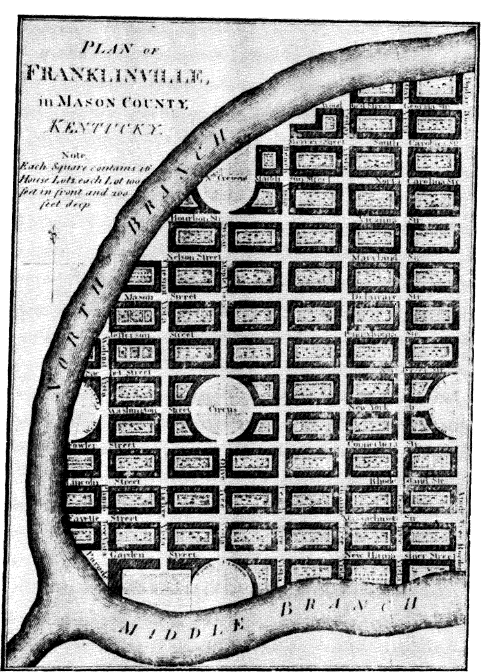
AN ILLUSTRATION OF EARLY WESTERN TOWN JOBBING, TAKEN FROM WILLIAM WINTERBOTTOM’S, An Historical and Geographical and Philosophical View of the United States of America, LONDON, 1795. THE PLACE DOES NOT EXIST TODAY
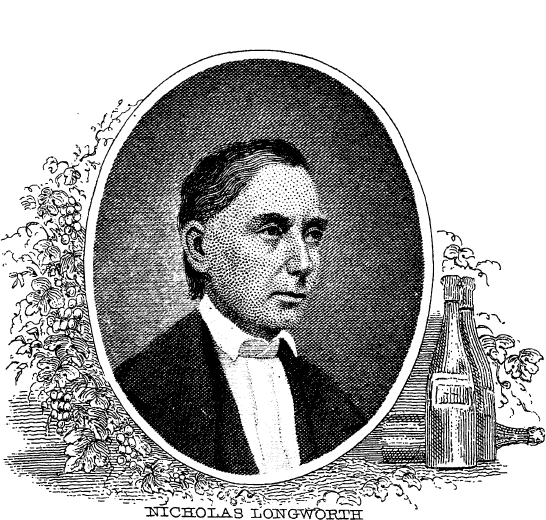
A CONTEMPORARY PORTRAIT OF NICHOLAS LONGWORTH EMBELLISHED WITH HIS FAVORITE FRUIT AND BEVERAGE
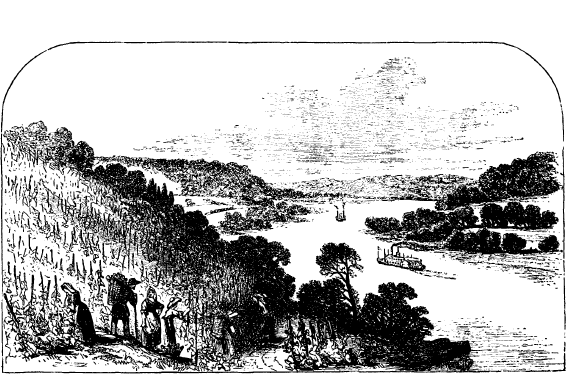
THE BANKS OF THE OHIO. MR. LONGWORTH’S VINEYARDS
The original Nicholas Longworth had two hobbies: land grabbing and vine growing. He devoted much of his time to grape and strawberry culture. His vineyard on the Ohio River was a showplace for travelers. He worked zealously to encourage the manufacture of wine in the Ohio Valley, and in this he then had government encouragement. Bounties of public land were offered to those who would cultivate the vine and the olive. Persons skilled in the manufacture of Rhenish and Moselle wines were imported from Europe and given responsible positions in Long-worth’s wineries. His addresses and papers on grape growing and horticulture were widely read and much appreciated. To him may be ascribed the inspiration of the hymn in praise of “American Catawba”:
Ohio’s green hill-tops
Glow bright in the sun,
And yield us more treasure
Than Rhine or Garonne.
They give us Catawba,
The pure and the true,
As radiant as sunlight,
As soft as the dew.
In the course of a few decades following the first settlements, the Ohio and Kentucky waste lands were rapidly converted into farms. So land jobbing moved westward into the Indiana and Illinois country. Here was a different type of soil and topography: the prairie. Strange to relate in these times, “grass lands” were not looked upon favorably by the early American cultivators. Any ground which could not grow trees was regarded as of little value, and was passed over even by those who selected home sites east of the Alleghanies.
This prejudice had to be overcome. It was a handicap to western land jobbing. However, when it was proven that bountiful corn and wheat crops could be raised on the Illinois lands without the difficult preliminary work of clearing and grubbing; and when sleek cattle thrived by feeding on the native grasses, the ancient prejudice departed. New settlers began to move into the fertile western plains beyond the Mississippi and Illinois rivers.
It will be recalled by the reader that just prior to the Revolution, the Indiana and Illinois lands were “preëmpted” by a group of politicians and Indian traders through spectacular purchases from the supposed Indian owners. Largely to offset opposing claims to the territory, Virginia, during the Revolutionary War, sought possession of the region and sent George Rogers Clark to drive out both the Indians and the English. In 1780, the Virginia authorities established a court at Vincennes (then a well-established French settlement) which assumed the right of granting lands freely to every applicant whom they approved.
The members of the court naturally were kind to themselves. “An arrangement was made,” notes William Henry Harrison, Governor of Indiana Territory in 1802, “by which the whole country, to which the Indian title was supposed to be extinguished, was divided between the members of the court.” Most of them, however, abandoned the land in a few years, because they could find no purchasers. When settlement in the territory began, however, after 1800, the claims of these “grantees” were bought up by speculators who infested the western country. These resold to others in different parts of the United States. “The price at which the land is sold,” wrote Governor Harrison to James Madison, “enables anybody to become a purchaser; one thousand acres being frequently given for an indifferent horse or a rifle gun.”
Many ignorant persons were induced to buy these fraudulent titles, and a number began to settle upon the land. “I should not be surprised,” wrote Harrison, “to see five hundred families settling under these titles the ensuing Spring.” He feared that upon learning of their invalid titles, the settlers would petition Congress to confirm their ownership. “The extent of these speculations was unknown to me until lately,” the governor stated. “I am now informed that a number of persons are in the habit of repairing to this place [Vincennes] where they purchase two or three thousand acres of this claim, for which they get a deed properly authenticated and recorded, and then disperse themselves over the United States to cheat the ignorant and credulous. To check this practice, I have forbidden the recorder and prothonotary of this county from recording or authenticating any of these papers.”11
.....
Though William Henry Harrison, hero of Tippecanoe, railed against the unprincipled land jobbers that “infested” his Indiana territory, he, himself, participated in one of the questionable and corrupt speculations in the Old Northwest. When George Rogers Clark, and his Virginians, took possession of the Illinois country and drove out the British, he found French colonies established along the Kaskaskia River. These simple-minded French pioneers feared the Americans because of both their pillaging and their Protestantism. Some fled the country and settled in Louisiana. Others who remained were sought to be appeased by grants of land. Thus, in Vincennes, each head of a family was given 400 acres, drawn by lot. After the Ordinance of 1787, many again became frightened, as they were told they would be required to change their religion—and left their settlements.
As might be expected, they sold their land titles for almost anything. Their claims were eagerly bought up by both resident and non-resident land grabbers. Among those who bought these titles were William Henry Harrison, the first secretary, and General Arthur St. Clair, the first governor of the Northwest Territory. Neither, however, went into this business of land grabbing on a large scale.
But Harrison’s name appears several times, in the lists of those who presented claims to the Frenchmen’s lands in Kaskaskia.12 St. Clair personally presented no claims, but it is clearly evident that his son, John Murray St. Clair, was closely associated with one John Edgar, merchant of Illinois, who garnered more land claims in this region than any other individual. St. Clair, as governor of the territory, passed upon the validity of these claims, and he seems to have approved a vast number held by John Edgar and, jointly, by Edgar and his son.
John Edgar settled in Kaskaskia in 1784. He was a native of Ireland, and brought with him to the Illinois country a stock of merchandise, useful to the pioneer inhabitants. He soon built up an extensive trade, established a flour mill, and entered local politics. He was also appointed a “Major General of Militia” as well as a “judge” in the Northwest Territory. He became very friendly with Governor Arthur St. Clair, whom he occasionally entertained in his sumptuous backwoods palace.
In the St. Clair Papers, published in 1883, there is a letter written by Edgar to Governor St. Clair, which indicates their close association. On April 11, 1801, after congratulating the governor on his reappointment “in spite of the opposition of your enemies,” he wrote, “I must now take the liberty of refreshing your memory concerning the deeds for the three surveys which I sent you last Spring, for which I now begin to feel myself anxious.” And, in a more familiar vein, he added: “Present if you please, Mrs. Edgar’s and my compliments to Mrs. Dill, Mrs. Vance and the rest of the family.”13
St. Clair brought upon himself severe criticism because, among other things, of his approval of several Kaskaskia claims. He was rebuked by Washington for his actions, and finally was removed by Jefferson in November, 1802. His confirmation of a grant of 30,000 acres to John Edgar and his son was subsequently annulled on the ground that it was made after St. Clair had authority to act as a land commissioner. St. Clair’s son, however, remained in Illinois, but the general returned to western Pennsylvania after his dismissal, where he died in 1818, a poor and broken-down old man. He acquired no wealth because of his political position in the Old Northwest; though, when surrounded by ravenous land jobbers in this back country, he undoubtedly was under great temptation to join in their schemes. But he seems to have passed up the opportunity.
Next to Edgar, to whom were confirmed 49,200 acres, the largest jobbers in the Kaskaskia claims were William Morrison and Nicholas Jarrot. Jarrot was a jobber of no political importance, but Morrison, like Edgar, was prominent in early Illinois politics. He was a native of Pennsylvania, who emigrated to Kaskaskia in 1790. He also was a leading merchant in the Illinois country, and operated stores in several of the settlements, and became a large land holder. Like Edgar, he advocated the establishment of slavery in Illinois, probably in the belief that this institution would enhance the value of his lands. He died in 1837.
The determination of the Kaskaskia claims gave Congress and the government land officials an almost endless amount of trouble. The matter was under consideration for many years. It was brought out in the proceedings that several of the leading land grabbers had employed false and corrupt witnesses in support of their claims. Thus, John Edgar was accused of forging deeds and of buying forged deeds. François Vigo, William and Robert Morrison, Nicholas Jarrot, and Robert Reynolds also presented claims which were considered fraudulent and invalid. Vigo was a lieutenant of George Rogers Clark’s in the winning of the Northwest, and for many years he and his heirs prosecuted a claim before Congress for compensation for military supplies and loss of his property in the French settlements.
A goodly number of the claims presented by the Kaskaskia jobbers was rejected. However, out of a total of 2,294 claims presented, 1,171 or about one-half were confirmed. But it was not until about 1820 that the clearing up of old land titles in the Kaskaskia district ceased to take up the time of Congress and the land officials.
.....
The rapid growth of the Old Northwest and the consequent rise in real estate values there did not fail to attract British speculators. Of course, during the Napoleonic Wars, the Britishers could spare very little capital to send abroad. They found better use for it as subsidies to their allies in the conflict with the Continental conqueror.
Conditions were different after 1815. The London banking house of Baring kept up close business relations with American firms. The Barings, however, appear to have avoided commitments in American lands. But they acted as agents and advisers of Englishmen, who desired profit and riches from rising American land values.
How much capital was invested in this period by British speculators in our soil may never be known. No one has even tried to estimate it, but there is much evidence indicating that British speculative interest in American growth and prosperity was greatly aroused in this period and that agents were employed by British capitalists to acquire both agricultural lands and urban real estate in the United States.
The interest of the British was stimulated by the letters and publications of Morris Birkbeck, a distinguished British immigrant, who proposed the establishment of English farm colonies in America. Despairing of improvement in the condition of English tenant farmers, Birkbeck came to America with his son in 1817. Before sailing, he issued a prospectus or “proposals for the establishment of a colony of English,” in which he stated that he intended to acquire one or more entire townships of government land. These lands he proposed “to offer on terms proportionately favorable to a number of our countrymen.”
Arriving at Norfolk, in May, 1817, Birkbeck almost immediately began a journey westward via Washington and Richmond. He was unable to buy a tract in the Ohio country, because of the prevailing high land prices, and because, as he noted, “the best locations were already taken up.” Good Ohio lands were then selling at $20 to $30 per acre, representing a tenfold increase in twenty years.
Birkbeck proceeded into Indiana and Illinois. He described this region in his Notes on a Journey in America, published in both London and Dublin in 1818. This was followed shortly by his Letters from Illinois, issued in London and in Philadelphia. These publications attracted considerable attention both in Great Britain and in the United States.
In these publications Birkbeck described the methods of purchase and settlement of western public lands and the prevalent speculation in town sites. “Land Jobbers traverse this fine country,” he wrote back home, “like a pestilent blight. Whenever they see the promise of a thriving settlement from a cluster of entries being made in any neighborhood, they purchase large tracts of the best land and lock it up in real mortmain, for it is death to all improvement.”
“One of the greatest calamities,” he exclaims, “to which a young colony is liable, is this investment of the property of nonresidents, who speculate on their prosperity, whilst they are doing all they can to impede it. . . . This holding back from cultivation of millions of acres, tends to scatter the population of these new countries; increasing the difficulties of the settlers manifold. . . . The western States are suffering greatly from this evil.”14
Birkbeck had, as a partner and companion, George Flower, a wealthy and well-known English writer on rural economics. Flower arrived in America a year in advance of Birkbeck, and was advised by Thomas Jefferson to settle in Virginia. He went west, however, with Birkbeck, and each took up 1,500 acres of government lands at “Big Prairie” in Edwards County, Ill., just south of Vincennes. They paid more than they intended to, and blamed the high price on “the invasion of speculators” into the region. Flower, in his History of the English Settlement in America, thus described their attitude toward the speculator:
Having expended all the money we could then command, by securing but little more than half the land we intended for our own families, we were fearful, as the point of our settlement was designated, that speculators might buy the lands immediately around those we purchased, and thus defeat our object in preserving lands at the Government price to those we hoped to induce to come from Great Britain.
Immediately following the selection of the site for their colony, the two partners sent alluring letters home, advertising the virtues of the soil, the topography and the climate. These letters were given wide publicity in the British press, and threatened to cause a rush of English farmers to the Illinois country. “No man, since Columbus,” remarked William Faux in 1819, “has done so much toward peopling America as Mr. Birkbeck, whose publications, and the authority of whose name had effects truly prodigious; and if all could have settled in Illinois whom he had tempted to cross the Atlantic . . . it had now been the most populous state in the Union.”15
And here are some of the allurements pointed out by Birkbeck in his Letters from Illinois, which “tempted” so many British to cross the Atlantic:
I am so well satisfied with the election [of the site] we have made, that I have not for a moment felt a disposition to recede; and much as I should lament that our English friends should stop short of us, some amends even for that would be made by the higher order of settlers, whom similar motives bring constantly into our very tract. Society we shall not want, I believe; and with the fear of that want every other fear has vanished. The comforts and luxuries of life we shall obtain with ease and in abundance; pomp and state will follow quickly.
A few months later, he wrote:
As to the comforts and accommodations of life, we have our books, our music, our agreeable and kind neighbors, good food and clothing, and before two years are ended we expect to have as good and well furnished a house as we left. It is astonishing how small are the privations we are subject to. . . .
I own here a far better estate than I rented in England, and am already more attached to the soil. Here, every citizen, whether by birthright or adoption, is part of the government, indentified with it, not virtually, but in fact. . . . I love this government. . . . I am becoming a patriot in my old age; thus a new virtue will spring up in my bosom.
He was enthusiastic about America as a field of investment. “The power of capital here,” he wrote, “is great almost beyond calculation; the difficulty seems to be in the choice of objects out of the various ways of doubling and redoubling it, which present themselves to the enterprising. . . . We have no rent, tithes, or poor rates and scarcely any taxes. . . . For about half the capital that is required for the mere cultivation of our worn-out soils in England, a man may establish himself as a proprietor here, with every comfort belonging to a plain and reasonable mode of living.” And finally, in an appeal to the British gourmandizing impulse, he wrote: “We are now feasting on wild turkeys. We have not sat down to dinner for the last month, I believe, without a fine roast turkey. They weigh about twelve pounds, and are sold five for a dollar.”
William Cobbett, the radical British politician, who resided in the United States in 1818, and made a short visit to Birkbeck’s colony, issued a public statement that Birkbeck’s account of the fertility and salubrity of Illinois was overdrawn.16 Birkbeck made a scathing reply, showing up Cobbett’s ignorance. He accused Cobbett of “lending his active aid to eastern land speculators, who wish to see Illinois in ruin and utterly discarded.”
These controversies whetted the curiosity of the English. Several investigators left for America to verify the situation. Among these were William Faux, “an English farmer,” Adlard Welby and Henry Bradshaw Fearon, all of whom published accounts of Birkbeck’s settlement.17
Faux admits that his account was written “to show men and things as they are . . . and to discourage British emigration.” To quote from his preface:
When I saw thousands of my countrymen hurrying thither, as though they fled for life, and from the city of destruction, I became very anxious to know the real nature of their prospects. . . . I may truly say, that throughout the whole of this enterprise, I have) been in a high degree influenced by a sense of patriotic duty. The same sentiment impels me to the completion of my task, in the hope that the truth, so long perverted and concealed, may contribute to destroy the illusions of transatlantic speculation.
While on his way to Illinois, Faux gathered here and there discouraging accounts of Birkbeck’s venture from persons who professed to have been there. One informer even accused Mr. Birkbeck and his family of eating “the rattlesnake, the flesh of which is fine, sweet and white as an eel.” That Faux was credulous of these wild stories is indicated in his note: “By the papers, today, I see that Miss Courtney, the daughter of an emigrant in Mr. Birkbeck’s settlement, was killed in a few hours by the bite of a huge spider.”18 But when he finally arrived at Birkbeck’s settlement, he did not find conditions as bad as had been painted to him, and he speaks highly of some of its aspects. His descriptions, however, did not encourage British emigration to Illinois.
Both Birkbeck and Flower were pestered by letters from land speculators in England and in eastern United States. “As early as 1817,” wrote Flower in his memoirs, “I was solicited to purchase land from persons living in Eastern cities—I was reluctant to do so, though regretting to disappoint some friends.”
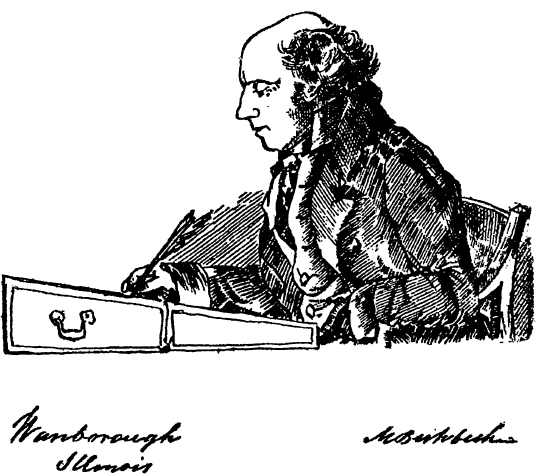
MORRIS BIRKBECK
Neither of the two Illinois colonizers prospered. Because of rivalry in a love affair, which resulted in Flower marrying a young lady who had accompanied them to the West, the partners separated. Birkbeck’s colony became known as “Albion.” At first it had fair prospect of success under his guidance. He became interested in politics, took up the fight against introducing slavery into Illinois, and in 1822 became Secretary of Illinois. He had endeavored to acquire the preëmption right to 40,000 additional acres, and petitioned Congress for a grant, but the Illinois representative in Congress politely informed him that it would be refused because of “the fear of speculation.” His colony in the end was not successful, and after his death in 1825 it began to disintegrate. Even his sons deserted the place and settled elsewhere.
George Flower likewise met with financial reverses in his colonization schemes. His settlement called “Wanborough” has disappeared altogether. Flower, having wasted his resources in the experiment, took refuge in Robert Owen’s colony at New Harmony, in 1849, whither he removed “with household furniture, some plate, and $250 in cash to begin life anew.” He died January 15, 1862.19
.....
While in the opening years of the nineteenth century, land grabbers and town-site jobbers were operating in the western country, the eastern capitalists were not idle in reaping the benefits of rising land values in cities and towns. It was in this period that John Jacob Astor, Nicholas Emmerich, Henry Brevoort, Stephen Whitney, Peter Goelet and a host of other “old merchants of New York” were accumulating fortunes in urban real estate. Their example was followed by Jacob Ridgeway and Stephen Girard in Philadelphia. These men were merchants, shippers and bankers. They did not make a business of their real estate transactions. It was merely a means of placing their surplus funds acquired in the course of trade. They bought largely for cash, and they rarely mortgaged their properties. They left their estates free and clear to their descendants, and these, through long term leases, which freed them from taxes, obtained incomes affording lives of luxury.
John Jacob Astor, it is true, entered upon one or two speculative schemes. He bought up the claims to the confiscated lands of departed Loyalists. Chief among these were the claims of Roger and Mary Morris, whose ancestors owned an estate comprising 51,100 acres, or nearly one-third of the area of Putnam County, N. Y. Astor is said to have paid the heirs $100,000 for their rights. The confiscated land had been divided into more than seven hundred farms, on which 3,500 people were settled. Astor threatened suit to oust them. This created consternation among the settlers. Most of them had obtained their titles from the state. It was the state’s duty to defend them.
The New York Legislature appointed a commission to treat with Astor. They had to acknowledge the legality of his claim, and asked for a redemption price. Astor at first named $667,000, one-half of the estimated market value. This was considered extortionate and no settlement of the dispute was made.
Astor did not press the case, but the owners of the land were kept in a state of suspense and clamored for a settlement. Their titles were questionable. They could not mortgage or sell their lands. They hesitated to make improvements thereon. Finally, after ten years of bickering, the legislature passed a law providing for a settlement. Astor was to bring five separate suits, and if the United States Supreme Court decided three in his favor, he was to be paid $450,000, subject to a deduction of $200,000, should the court hold that the value of buildings and other improvements placed upon the land by title holders under the state could not be claimed by the contestant.
Astor accepted the offer. The state employed Daniel Webster and Martin Van Buren to plead its cause. Astor’s attorneys were Emmet & Ogden, the leading law firm then in New York, though it is suspected that Aaron Burr acted secretly as his counsel. Astor won the necessary three cases, and in 1830 there was issued to him, in lieu of cash, $500,000 in New York State bonds. As more than twenty years elapsed between Astor’s payment of $100,000 and his award, his actual profit, allowing for interest accumulations at 6 per cent, and attorneys’ fees, was probably less than 100%—in fact, less than the profit on his urban real estate during the same period.
But Astor did not buy real estate for a profit on “turnover.” He bought to hold indefinitely, for income, and his descendants still live from the rentals of scores of lots and plots, obtained at bargain prices by their ingenious and farseeing progenitor. Land-poor individuals, institutions and estates found him a willing purchaser of vacant and non-income producing properties, provided he thought they were cheap. He bought numerous lots from the Trinity Corporation—the largest landowner in early New York. He bought from distressed traders and merchants, and from defaulting mortgagors, and when the crash of 1837 came he still had cash to buy at ridiculously low prices.
Nor did he care to sell, until he obtained a price with which he could make a better investment. And he did not spend money on building and improving property, unless he could reap the immediate reward of such expenditure. Occasionally he asked for and received grants of city land, and though political corruption or graft may have been at the bottom of some of these transactions, he generally rewarded, the community by undergoing the expense of cutting streets, draining or filling in the donated plots or the surrounding areas.
America, in the first two decades of the nineteenth century, recovered from the collapse of the visionary schemes of wholesale land grabbing, which marked the post-Revolutionary period. It was in these decades that the European immigration and the western movement, which the earlier speculators had prematurely expected, began to take place. This “filling-in” process was mainly fostered by native speculative enterprise, rather than the leadership of wealthy and politically prominent promoters. A keen observer of American institutions in this period, Michael Chevalier, a Frenchman who visited the United States in 1834, aptly remarked that “inasmuch as speculation in the United States created utilities, it was beneficial.” “Here,” he says, “one lives a hundred fold more than elsewhere. All is circulation, motion, and boiling agitation. Experiment follows experiment, enterprise succeeds to enterprise. Riches and poverty follow on each other’s traces, and each in turn occupies the place of the other.”
20 Payson Jackson Treat, The National Land System, p. 94. In 1804 the minimum acreage that could be purchased was reduced to 160 acres, i.e., a quarter section.
21 Philadelphia, 1806, 48 pp.
22 Ibid., p. 37,
23 Hubert Howe Bancroft, Retrospection, p. 77. See also The Old Northwest Genealogical Quarterly, Vol. 8, p. 241.
24 Morris Birkbeck, Notes of A Journey in America, (Dublin Edition, 1818), p. 71.
25 Ibid., p. 105.
26 See Clark Waggoner, History of Toledo, Ohio, pp. 370–372.
27 William Faux, Memorial Days in America, pp. 183–193.
28 John McDonald, Biographical Sketches of General Nathaniel Massie, General Duncan McArthur, etc. This book was written in 1838, one year before McArthur’s death.
29 Ralph C. H. Catterall, The Second Bank of the United States, p. 67.
30 American State Papers, “Public Lands,” Vol. I, p. 123.
31 Ibid., Vol. II, p. 125 et seq.
32 William Henry Smith, The St. Clair Papers, Vol. II, p, 533.
33 Letters from Illinois, by Morris Birkbeck (Philadelphia, 1818), pp. 81, 82.
34 William Faux, Memorial Days in America, p. 298.
35 See “Letters to Morris Birkbeck, Esq.,” in Cobbett’s A Year’s Residence in the United States of America, Third Edition, 1822.
36 William Faux, Memorial Days in America; and Tour of the United States to ascertain the condition and probable prospect of British Emigrants, 18120;’ Adlard Welby, Visit to North America and the English Settlements in Illinois, with a Winter Residence in Philadelphia, London, 1821; Henry Bradshaw Fearon, Sketches of America, etc., with remarks on Mr. Birkbeck’s Notes and Letters, London, 1818.
37 Op. cit, p. 138.
38 History of the English Settlement in Edwards County, by George Flower, Chicago Historical Society Collections, Vol. I.
- 1Maine Historical Collections, Vol. II, pp. 268-294.
- 2The Sir William Johnson Papers, Vol. V, p. 129. See also, C. W. Alvord, The Mississippi Valley in British Politics, Cleveland, 1917.
- 3Herbert B. Adams. “Washington’s Interest in Western Lands,” Johns Hopkins University Studies, Third Series, No. 1, January, 1885. Italics are mine.—A. M. S.
- 4Adams, op, cit., p. 58.
- 5See A. Henderson, “A Pre-Revolutionary Revolt in the Old Southwest” in Mississippi Valley Historical Review, Vol. 27, p. 198 et seq.
- 6Italics are not in the original.
- 7In a letter to William Franklin, dated May 3, 1776, Johnson asserted “it has always been my practice to avoid engaging in lands to the great loss of my family, neither have I a foot of land from the Indians.” (Sir William Johnson Papers, Vol. IV, p. 197.) The large tract north of the Mohawk Valley given him by the Canajoharie Indians in 1760 was confirmed by royal grant in 1769.
- 8See Pennsylvania Magazine of History, Vol. XIV, pp. 218, 219.
- 9See Memorial of the United Illinois and Wabash Land Companies, Baltimore, 1816.
- 10A copy of the deed is contained in American State Papers, “Public Lands.” Vol. I. The original copy was acquired by Cyrus H, McCormick.
- 11See J. P. Boyd, “Connecticut’s Experiment in Expansion, The Susquehannah Company, 1753-1803,” in Journal of Economic and Business History, November, 1931.
- 12See Publications of the Colonial Society of Massachusetts, Vol. XXV, PP. 33-38.
- 13Samuel W. Jones, Memoir of James Duane, 1852.
- 14P. H. Woodward, One Hundred Years of the Hartford Bank, p. 74. See also R. J. Purcell, Connecticut in Transition, p. 154.
- 15Haskins, op. cit., p. 36.
- 16Ellis Paxton Oberholtzer, Life of Robert Morris, pp. 307, 308.
- 17S. G. McLendon, History of the Public Domain of Georgia, Chap. IX.
- 18Theodore Dwight, Travels, Vol. I, p. 188.
- 19Absalom H. Chappell, Miscellanies of Georgia, Part II, p. 49.
- 20During the first hundred years of North American colonization, economic conditions gave little encouragement to private land schemes. Land was too plentiful. A few such enterprises were undertaken, however. Thus, as early as 1661, the Colony of Massachusetts sold to a few individuals for £400 a large tract on the Kennebec River in Maine. This became known as the “Kennebec Purchase.” The heirs held it for nearly a century without doing anything with it. In 1753, they incorporated as the “Proprietors of the Kennebec Purchase” and proceeded to dispose of their holdings. The corporation continued in existence until 1816. “The Pejebscot Company” was another Maine land deal. None of these held out promise of profit to proprietors until about a quarter century before the Revolution.
- 21In the meantime, the “Loyal Company” group was not idle; its proprietors sent Dr. Thomas Walker, of Albermarle, Va., to make a reconnaissance, and to discover a proper place of settlement. The two “companies” then became engaged in a controversy, and neither made a survey or fixed the bounds of their grants. The apparent ease with which they obtained land donations led to other schemes, and aroused an epidemic of interest in distant western wild lands. Not only was the land ownership eagerly sought after, but the establishment of new colonies, with separate and distinct governments, was planned. Favoritism and collusion infested the Virginian colonial government, due in large part to the persistence of speculators in western land grants. Lobbyists were sent to London to obtain the crown’s sanction to land-grabbing schemes and the question of the disposal of the vast western domain won from the French infested British politics. “One half of England is now land mad,” wrote George Croghan, of Philadelphia, one of the land schemers, to Sir William Johnson, on March 30, 1766, “and everybody there has their eyes fixed on this country.”
- 22I offered in my last to join you in attempting to secure some of the most valuable lands in the King’s part, which I think may be accomplished after awhile, notwithstanding the proclamation that restrains it at present and prohibits the settlement of them at all; for I can never look upon that proclamation in any other light (but this I say between ourselves) than as a temporary expedient to quiet the minds of the Indians. It must fall, of course, in a few years, especially when those Indians consent to our occupying the lands. Any person, therefore who neglects the present opportunity of hunting out good lands, and in some measure marking and distinguishing them, for his own, in order to keep others from settling them, will never regain it.
- 23Crawford “heartily embraced” the colonel’s offer. He promised shortly to set out in search of lands. “This may be done,” he said, “under a hunting scheme.” He acknowledged that other land seekers had approached him, with similar offers, “but have not agreed to any; nor will I with any but yourself or whom you think proper.”
- 24Judge Richard Henderson of North Carolina, the employer and backer of Daniel Boone, promoted the settlement of the Kentucky region and claimed ownership to a vast unsettled tract there. He organized a group of land grabbers under the name of “The Transylvania Company.” Ignoring the British interdiction against Indian land purchases, he obtained from the Cherokees in 1773 about one-half of the present State of Kentucky, and immediately began settling the land. He advertised widely for pioneers and “shareholders.” In his announcements, Henderson waxed enthusiastic. “The country [Transylvania] might invite a prince from his palace, merely for the pleasure of contemplating its beauty and excellence, but only add the rapturous idea of property, and what allurements can the world offer for the loss of so glorious a prospect?”
- 25When the British Government began to take active measures to break up land “bootlegging,” and to put a stop to dreams of riches in western territory, Virginia’s political resentment was naturally aroused. Even Thomas Jefferson, who, in later life, frowned upon speculation and land grabbing, held the view in 1774 that the land did not belong to the British king, and that it was time for the colonies “to declare that he has no right to grant lands of himself.” So he boldly wrote in the Declaration of Independence, as one of the British king’s usurpations: “He has endeavored to prevent the Population of these States; for that purpose obstructing the Laws for Naturalization of Foreigners; refusing to pass others to encourage their migrations hither, and raising the conditions of new Appropriation of Lands.”
- 26He was for it at once. “I like the project of a colony in the Illinois Country,” he wrote his son, “and will forward it to my utmost here.” He thought that Sir William Johnson’s “approbation will go a great way in recommending it, as he is much relied upon in all affairs that may have any relationships with the Indians.” But Johnson had an eye on the Indian lands himself, and besides advising others about purchases in the outlying sections, personally through gifts from the Indians engrossed large tracts, particularly in the Mohawk Valley. The town of Johnstown, N. Y., still marks the seat of his domain.
- 27Some of the members of the Vandalia Company were concerned in other western land schemes. One of these was organized in 1775 as the “Indiana Land Company,” probably the first application of the name “Indiana” to the Northwest Territory. The claim to land was based on a grant of a large tract, made November 3, 1768, in what is now West Virginia, by the Six Nations at Fort Stanwix to “Chief” William Trent in liquidation of depredations. Among the shareholders were Samuel Wharton, Joseph Galloway, Robert Callender, Levi Andrew Levi, and David Franks, all wealthy and prominent Philadelphians. The Revolutionary War did not put an end to the “claim.” Wharton in 1776 published a pamphlet, entitled-View of the Title to Indiana, in which he defended the company’s rights to the lands. In 1781, he republished this in enlarged form, under the title Plain Facts; being an examination into the Rights of the Indian Nations of America to their respective Countries and a Vindication of the Grant from the Six United Nations to Proprietors of Indiana, etc. Although Wharton pressed the validity of the “proprietors” claims, Congress then and thereafter gave little heed thereto.
- 28Notwithstanding the British Government’s edict, forbidding the private purchase of lands from the Indian tribes, William Murray, an Indian trader, and several of his business associates, in 1773 formed a plan to buy from the aborigines an immense tract of country between the Mississippi, Illinois and Ohio rivers. After a “pow-wow” lasting a month, the sale was consummated. According to the land claimants, it was attended by “many persons of both descriptions and the Indians were carefully prevented from obtaining any spiritous liquors during the whole continuation of the negotiation.” On July 5, 1773, “for a very large and valuable consideration,” the deed was delivered to the “Illinois Land Company.”
- 29Notwithstanding the British Government’s edict, forbidding the private purchase of lands from the Indian tribes, William Murray, an Indian trader, and several of his business associates, in 1773 formed a plan to buy from the aborigines an immense tract of country between the Mississippi, Illinois and Ohio rivers. After a “pow-wow” lasting a month, the sale was consummated. According to the land claimants, it was attended by “many persons of both descriptions and the Indians were carefully prevented from obtaining any spiritous liquors during the whole continuation of the negotiation.” On July 5, 1773, “for a very large and valuable consideration,” the deed was delivered to the “Illinois Land Company.”
- 30The proposition then took on a business aspect. The number of “shares” was increased, and rights to subscribe offered at from $2 to $5 per share. It attracted speculators. The shares soon rose in value. Lawyers, clergymen and politicians began buying shares. The Reverend Ezra Stiles, President of Yale College, grandfather of the poet-physician Oliver Wendell Holmes, took 2¾ shares. The Governor of Connecticut, Roger Walcott, who had become rich through local land deals, supported the project.
- 31New York, before the Revolution, also had her “land” quarrels with the other colonies. The ill-defined boundaries of the Dutch province led to constant conflicts and legal controversies with her neighbors. There was a bitter dispute with New Hampshire regarding the political jurisdiction of Vermont. New York claimed the section, but New Hampshire, in 1749, acting on the principle that possession is nine points of the law, began to make free grants to both New Hampshire and Massachusetts citizens. Whole “towns” of 23,000 acres, more or less, were granted to selected groups of individuals. It is estimated that between 1749 and 1764, Governor Benning Wentworth granted 131 townships to more than six thousand persons. Among the grantees appear the names of many prominent colonial New Englanders, who had no intention of ever settling on the lands. Samuel Adams was among them. He was known as a speculator in both Maine and New Hampshire lands in this period. The governor granted himself, in all, about 65,000 acres, and is reported to have accumulated considerable wealth from the heavy fees exacted by him for grants.
- 32Because of his land deals, while acting as the state’s attorney, Duane was the butt of political criticism. He was led to appear in person in his own defense before the state legislature in 1781. He was charged with receiving Vermont grants “under immoderate quit-rents, and excessive fees of office,” and he was also accused of “holding many thousand acres of land which had never before been granted by the Crown.” To this he merely answered that he “had never made a purchase or obtained a grant of land with any view to its sale.” He was therefore not a “land jobber.” This cleared him politically of all corruption.
- 33So popular was the western lure to the Connecticut gentry that legislation was urged to countermand it. “Young people in their plays at social gatherings marched to rude melodies which taught them to dream that toward the setting sun lay an earthly paradise with gates open to welcome them. From hill and valley the processions hurried away. Today, many of our rural towns are scarred and paralyzed by an outflow which has built up the continent to no small degree at their expense.”
- 34What is the spirit against which we now struggle and which we have vainly endeavored to stifle? A monster, generated by fraud, nursed in corruption, that in grim silence awaits its prey. It is the spirit of Federalism! That spirit which considers the many made only for the few. . . . When I behold a certain party supporting and clinging to such a measure almost to a man, I see only men faithful to their own principles. . . . But when I see associated with them, in firm compact, others who once rallied under the standard of opposite principles, I am filled with apprehension and concern. . . . If Congress shall determine to sanction this fraud upon the public, I trust in God we shall hear no more of the crimes and follies of the former administration. For one, I promise that my lips upon this subject shall be closed in eternal silence. I should disdain to prate about petty larcenies of our predecessors after having given my sanction to this atrocious public robbery.
- 35Large tracts were also freely disposed of by Georgia. Count d’Estaing, the French admiral who assisted the colonies, was granted a substantial acreage for his Revolutionary services. D’Estaing sold his land to the Count de Colbert, who resold it in England to Robert Morris, through the agency of William Constable and Gouverneur Morris. Robert Morris then proceeded to add to his Georgia possessions. In association with John Nicholson, he soon become the leading proprietor of Georgia waste lands. How these large holdings were obtained has never been satisfactorily explained. It is the “unsolved riddle of Georgia’s land history.”
- 36Large tracts were also freely disposed of by Georgia. Count d’Estaing, the French admiral who assisted the colonies, was granted a substantial acreage for his Revolutionary services. D’Estaing sold his land to the Count de Colbert, who resold it in England to Robert Morris, through the agency of William Constable and Gouverneur Morris. Robert Morris then proceeded to add to his Georgia possessions. In association with John Nicholson, he soon become the leading proprietor of Georgia waste lands. How these large holdings were obtained has never been satisfactorily explained. It is the “unsolved riddle of Georgia’s land history.”
- 37To most of these “free” Georgia lands the name of “Pine Barrens” was given. Their sandy soil was covered with a luxuriant growth of pine trees, for which Georgia, for over a century, was famous, and which in later years not only afforded a lucrative article of export, but was the basis for its naval stores’ industry. But “barren” they certainly were in the post-Revolutionary days when they were sold to Robert Morris and other land jobbers. As mentioned in a previous chapter, “whatever land was offered for sale, they appeared ready to buy; and actually bought quantities which outran every sober thought.”
- 38Morris, as previously noted, endeavored to get French purchasers for these Georgia lands. There was already considerable French influence in South Carolina and Georgia, and these lands were advertised as most suitable for the émigrés. But he was brought face to face with the outspoken opposition of Joseph Fauchet, French Minister to the United States. Though the Pine Barrens were hawked about even before the second Yazoo grants were made, and it was reported that they were a profitable speculation, they lacked buyers. There was, of course, considerable doubt as to the validity of Morris’ title to them—and this point was strongly emphasized by Fauchet. Most of the grants had not been surveyed in accordance with the legal requirements. In 1798, the Georgia Legislature, with the Yazoo fiasco fresh in mind, passed a law requiring all landowners to survey and identify their holdings every ten years, beginning in 1799. The purpose was to compel holders under fraudulent grants to prove their titles. The heritors of the North American Land Company, after Morris and Nicholson’s failure, could not do this. Moreover, it was not worth the expense. As taxes were not paid, the lands went back to the state. In fact, the State Comptroller of Georgia reported in 1839 that “not more than half the land in the region was worth owning or paying taxes for.”

