
The Great American Land Bubble
Chapter VI. The Georgia “Yazoo” Land Frauds
NOW we come to the most notorious and widespread of the early American land gambles.
The State of Georgia, at the southern end of the colonial confederacy, had performed its share in bringing about political independence, and following the Revolution, like its sister states, laid claim to the immense territory lying immediately to the west. South Carolina, however, contended that a part of this land was comprised within her original charter limits, while the federal authorities maintained that it was national domain, because it had been obtained directly from the British crown. The Spanish king also asserted political authority over much of the region as a part of Louisiana ceded to him by the French.
While all these competing and conflicting claims were being debated, the Chickasaws, Choctaws, Cherokees and Creeks roved over the region at will. It was in their possession, and few white settlers dared to invade their ancient hunting grounds. Over these tribes, the United States had established a protectorate, and forbade Georgia or any other state to deal with them directly or to take any action to dispossess them. In view of these difficulties and uncertainty of title, the impoverished State of Georgia was quite ready to accept any financial consideration for her doubtful claim, and sought to dispose of the lands at the earliest and most favorable opportunity.
Nor were purchasers lacking! Despite its primeval condition, and the fierce savage tribes, the territory had distinct commercial advantages. It bordered on the Mississippi River, that Father of Waters which afforded the chief means of commercial intercourse between the interior settlements and the Gulf of Mexico. It contained numerous well-watered streams emptying into the Mississippi, and therefore gave accessibility to trade and barter, a prime factor in creating land values. One of these tributary streams was the Yazoo River. For some reason or other, the name “Yazoo” originally was applied to the whole territory, which now comprises the entire areas of Alabama and Mississippi.
In 1785, some enterprising citizens of South Carolina and Georgia, with an eye to business, planned to get possession of a favorable section of the Yazoo country. As customary, an effort was made to buy off the Indians. John Wood, one of the promoters, succeeded in “purchasing” from the Choctaws a tract of two or three million acres lying near the mouth of the Yazoo River. The exact quantity was of little concern. Application was then made to Georgia for a grant of the lands. But the state did not yet feel ready to dispose of the territory, when its title was so strongly doubted. However, the legislature of Georgia organized the territory into a county, and gave it the then popular French name of “Bourbon.” Settlers were invited to move there. To these settlers, lands were to be granted at not more than 25 cents an acre. Few settlers came, however. They preferred not to run the danger of Indian tomahawks and Spanish bullets. One John Holder, a captain in the Revolution, however, in 1789, proposed to conduct four hundred Kentucky settlers to the present site of Vicksburg, but failed utterly.
The Georgia land speculators were not discouraged. Through the influence of an unprincipled character, styling himself Thomas Washington, but whose real name was Walsh (and who eventually was hanged at Charleston for counterfeiting South Carolina debt certificates), a “land association” was formed to acquire the region. It was called the “South Carolina Yazoo Company.” The original promoters, in addition to Thomas Washington, were Alexander Moultrie, William Clay Snipes and Isaac Huger of South Carolina. Among those who joined later was Alexander McGillivray, a famous chief of the Creek tribe. The “association,” on November 20, 1789, presented an elaborate petition to the Georgia Legislature urging the confirmation of a grant of land. They announced that they had already begun settlements in the region “as well from a motive of general good to mankind and of happiness and prosperity to Georgia and the union; as their own.” This, they thought, would please the authorities of Georgia, who wished settlers as a buffer against the unfriendly Indian tribes. They also appealed on the ground of commercial development. They had, they claimed “established Connections in Europe, America and in this State; whereby an affrican trade and European Commerce” would “take place at the Yazoo to an immense and vast amount.”1
In view of the wild land mania of the period, it would be expected that others would also seek “grants.” Three other companies presented petitions. These were “the Virginia Yazoo Company,” in which Patrick Henry is reputed to have been the moving spirit; the “Tennessee Yazoo Company” and the “Georgia Yazoo Company.” Each of these offered compensation for the lands, the Georgia Company bidding the highest price. But the Georgia Company’s bid was ignored despite efforts to make it the favored applicant, and little heed was given to a motion to demand a higher price than was offered for the region. Thus far, the promoters or “jobbers” were exclusively Southerners, though it is possible that northern capitalists had a hand in the business.
Georgia was evidently desirous of getting rid of the territory regardless of the price that might be obtained for it. Perhaps it was because the legislators were influenced by personal pecuniary awards. At least, it is recorded that without much opposition or debate, an act was passed by the Georgia Legislature, with the sanction of the governor, on December 21, 1789, granting the South Carolina Yazoo Company a western tract “bounded by the Mississippi River, the thirty-third parallel, the Tombigbee River and a line drawn from a point just above Natchez.” This grant contained over 10,000,000 acres, covering the southern section of Mississippi and Alabama. The Virginia Yazoo Company received a grant, north of that given to the South Carolina Company, estimated to contain 11,400,000 acres. The Tennessee Company’s grant bordered on the southern boundary of Tennessee, and contained 4,000,000 acres. Thus, more than twenty-five million acres were disposed of. The total compensation to be received by Georgia was slightly more than $200,000, or less than one cent per acre, payable in the state’s depreciated debt certificates. Moreover, immediate payment was not demanded, but a period of two years was allowed the purchasers in which to tender compensation. But, in the purchase contracts, the state relieved itself of the expense of keeping peace between the grantees and the Indians while extinguishing the Indian titles.2
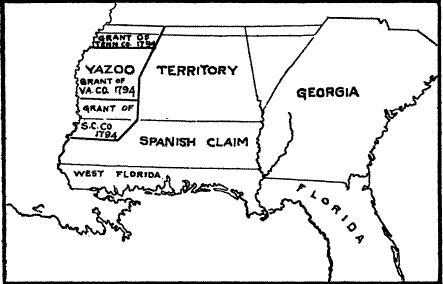
FIRST PARTITION OF THE YAZOO TERRITORY
What a bargain for these southern land grabbers! After the sale was made, the three “companies” set to work to secure their grants. The South Carolina Company, which was the most active in pushing its purchase, appointed Dr. James O’Fallon, a Revolutionary soldier, its agent, to proceed to New Orleans and secure the favor of the Spanish Government. On his way, O’Fallon visited Tennessee and Kentucky. He secured the coöperation of John Sevier, Governor of Tennessee, whose land grabbing was largely responsible for the settlement of that state,3 and of General James Wilkinson, then in Kentucky, who was carrying on intrigues with the Spanish Governor of Louisiana regarding the separation of Kentucky from the Union. Both these adventurers were won over with promises of shares in the company’s purchase. Colonization plans were laid, and a “battalion” of militia was organized, “these troops being intended to insure the great security of the Company’s rights.”
It was expected that Wilkinson and Sevier would each lead hundreds of families to take up lands in the purchase. George Rogers Clark, the western Revolutionary hero, and conqueror of the Northwest Territory, also was probably concerned in this venture, as it was rumored that he would be chief in command of the “battalion.”4
The act of Georgia in disposing of territory, the claim to which was not recognized, and the prospect of consequent Indian warfare disturbed the peace of mind of the First President of the United States. On Friday, April 30, 1790, he entered in his diary:
Conversed with the Secretary of the Treasury, on the Report of the Secretary at War’s propositions, respecting the Conduct of the State of Georgia, in selling to certain companies large tracts of their Western territory and a proclamation which he conceived expedient to issue in consequence of it. But as he had doubts of the clearness of the ground in which it was proposed to build this proclamation, and do other acts which were also submitted in the report I placed it in the hands of the Secretary of State to consider and give me an opinion thereon.5
Jefferson, the Secretary of State, who was outspoken in his denunciation of land grabbing, and who, besides, disliked Patrick Henry, was firm in his opinion that the grants were illegal.6 The President accordingly, issued his proclamation on August 25, 1790. It warned the purchasers of the Georgia lands from interfering at all with the treaty rights of the Indians, or in any way disturbing the ownership of their lands.
But the intrepid O’Fallon persisted with his plans to establish the South Carolina Yazoo Company on its lands. He even wrote to Estéban Mero, Spanish Governor of Louisiana, that he “had insensibly prevailed” upon the members of the South Carolina Yazoo Company “to get their consent to be the slaves of Spain, under the appearance of a free and independent colony, forming a rampart for the adjoining Spanish territories and establishing with them an eternal, reciprocal alliance, offensive and defensive.”7
O’Fallon’s persistence brought another proclamation from the President, and the United States District Attorney was directed to arrest him, if necessary. At this, O’Fallon’s courage failed, and he gave up the enterprise. Wilkinson had deserted him, and his associates declined to share responsibility for his actions. So he returned to Kentucky, where he married a sister of George Rogers Clark, and settled down. Moreover, the shares of the South Carolina Yazoo Company did not attract purchasers. There was difficulty in raising the required funds. Although the agent of the company offered to settle with Georgia in “debt certificates,” the state treasurer refused to accept them, as the legislature had passed a resolution requiring that debts due the state be received in specie only.
The Virginia Yazoo Company, likewise, died abortively. There is considerable historical evidence that Patrick Henry, who we have already shown had been active in grabbing western lands in the pre-Revolutionary period, was deeply concerned in this speculation. His name appears among the shareholders, and it was even thought that he intended to desert Virginia and depart to the wild Yazoo territory.
Before entering upon the deal, Henry endeavored to assure himself that Georgia had title to the lands. When convinced of this, he, together with David Ross, Abraham B. Venable, Francis Watkins and other prominent Virginians, formed the “Virginia Yazoo Company.” Before presenting their petition for a grant, they made overtures for a consolidation with the South Carolina Company. When this move failed, they purchased direct from the State of Georgia. Unlike the directors of the South Carolina Company, however, the Virginians made no colonization plans. They preferred “to complete their payments to the State for the lands purch’d; next to quiet the Indian claims agreeable to Law, and to have the permission and approbation of the General Govern’t for settlement and that the first Emigrants shall be accompanied with Civil and Militia officers Legally appointed.”8
Patrick Henry, however, was for settlement, even though federal approbation was lacking. Thus, Washington, on April 8, 1791, entered in his diary:
Was informed by Jno. Lewis, who had, not long since been in Richmond, that Mr. Patrick Henry had avowed his interest in the Yazoo Company; and made him a tender of admission to it, which he declined; but asking him if the Company did not expect the Settlement of the lands would be disagreeable to the Indians, was answered by Mr. Henry that the Co. intended to apply to Congress for protection, which, if not granted, they would have recourse to their own means to protect the settlement.9
It never became necessary for the Virginia Company to take this action, for their offer of payment to Georgia in depreciated debt certificates was not accepted. Patrick Henry had bought up a large amount of this paper at about 10 per cent of the face value in preparation for the payment. He profited greatly by this, because Hamilton’s funding scheme, whereby the federal government assumed the state’s obligations, soon raised the value of the debt certificates. Thus, Hamilton became the political idol of Henry, much to the disgust of Thomas Jefferson.
The promoters of the Virginia Company attempted again to secure the same grant in 1794, when Robert Morris, Wade Hampton, a wealthy South Carolina planter, and other capitalists already immersed in other land speculations agreed to furnish the funds. This move was also unsuccessful, and the threat to sue the State of Georgia was never carried out. When the Virginia Yazoo Company’s claim came before Congress in later years, it was thrown out on the ground that its perpetrators were concerned in the fraudulent Georgia sales of 1795. Thus, the Virginians received nothing for their trouble, and the money advanced by them in preparation for the speculation was lost though they probably profited by the advance in the market price of the Georgia debt certificates.
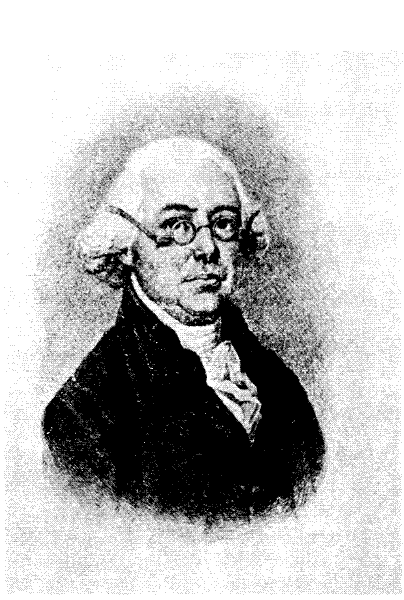
JAMES WILSON, ASSOCIATE JUSTICE OF THE U. S. SUPREME COURT
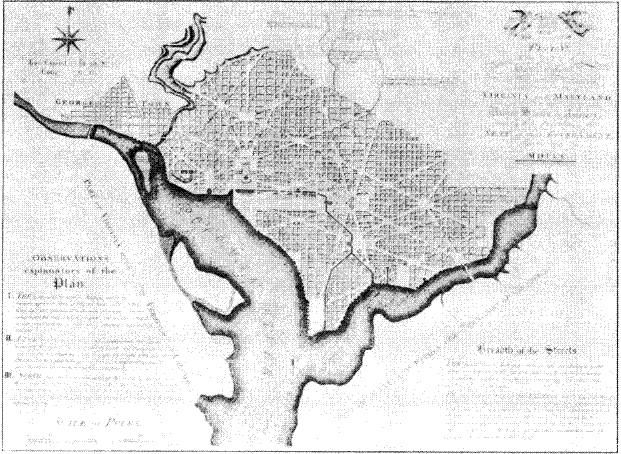
THE FIRST PLAN OF THE CITY OF WASHINGTON, ENGRAVED IN 1792 AND USED IN SELLING THE “LOTS”
The outcome of the Tennessee Yazoo Company’s purchase did not differ much from that of the other two companies. Zachariah Cox, one of the boldest adventurers and entrepreneurs of the old Southwest, was the leading spirit of this concern. He had an eye for business and saw clearly the advantages of commercial settlements in promoting trade between the upper Mississippi River region and the Gulf. After the Tennessee Company received its grant, he, in coöperation with John Sevier, attempted to form a settlement at Muscle Shoals. Cox was warned off by both the Indians and the federal government. In 1795, he and his associates again renewed their efforts to settle the territory. He was arrested by federal troops at Natchez for opening a land office, escaped, and was recaptured at Nashville, but was soon released. He next planned the construction of a canal to connect the Mississippi with the Mobile River, and thus open up commerce between the interior and the Gulf of Mexico, without molestation by the Spanish authorities. In this enterprise he was also unsuccessful. He finally ended his restless life in New Orleans.
Thus, the first attempts of southern land jobbers to profit by Georgia’s disposal of her disputed western domain ended in a complete fiasco. George Washington, during a tour South in 1791, remarked in his diary that the “people in South Carolina and Georgia appear to have abundant means to live on grounds where they are settled,” and that they “appear to be happy, contented and satisfied with the general government under which they are placed.” He noted, however, that:
In Georgia, the dissatisfied part of them at the late treaty with the Ck. Indians were evidently Land Jobbers, who maugre every principle of Justice to the Indians, and policy to their Country, would, for their own immediate emolument, strip the Indns of all their territory if they could obtain the least countenance to the measure; but it is to be hoped the good sense of the State will set its face agains such diabolical attempts. And it is also to be wished—and by many it was said it might be expected—that the sales by the State to what are called the Yazoo Companies will fall through.10
The President’s wish and expectation were not realized. The fever of wild land speculation was prevalent. At this time, Robert Morris and his associates, as noted below, were carrying on their Georgia “Pine Barrens” speculation, with reputed enormous profits. The fertile Yazoo lands were, therefore, a tempting morsel. The Georgia legislators were again importuned to sell the state’s western domain. Nay, more! They were bribed to do so. This time the jobbers were not merely small groups of southern gentlemen arranged by states. They comprised the leading northern capitalists and statesmen, too numerous to list. They hailed from Boston, Hartford, New York and Philadelphia, as well as from lesser known sections in both the North and the South. Their participation involved the common folk of every commercial center in their speculations.
The first proposal for a resale of the Georgia lands was made November 12, 1794, by John Wereat, agent of a triumvirate, consisting of Albert Gallatin, Alexander J. Dallas and Jared Ingersoll, all prominent Pennsylvanians. They offered to purchase the former grant of the South Carolina Yazoo Company, at the original price. This price was insignificant, however, when compared with rival bids. Gallatin’s agent then raised his bids, but they were again rejected. The Pennsylvania speculators then apparently withdrew, and disclaimed further connection with their agent’s proposals.
Next, four separate companies made an offer of $500,000 payable in specie for a region comprising the bulk of Georgia’s western lands. The legislature considered this proposal and a committee brought in a favorable report. The bill was passed without much opposition, but the governor vetoed it. He doubted whether it was a proper time for disposing of the domain. The price, moreover, was too low, and the sale to large “companies” smacked of land jobbing and monopoly. He insisted also that in any sale, proper provision should be made to give Georgia citizens preference in settling in the territory.
In the meantime, John Wereat, probably acting on his own account and in the expectation of being “bought off” by other bidders, continued to raise his bids, but, as he had not reached the pockets of the legislators, they paid no attention to his offers. They gave the excuse that he did not furnish sufficient security. A new bill of purchase, embodying some of the governor’s suggestions, was then introduced and hurriedly passed. The governor yielded. The act was signed on January 7, 1795. By its terms, approximately 30,000,000 acres of American soil, comprising the bulk of the States of Alabama and Mississippi, were sold for $500,000 or about a cent and a half an acre.
The purchasers were four separate companies, to each of which was allotted a definite stretch of territory. To the “Upper Mississippi Company” was assigned the northwest section, comprising about 3,000,000 acres for $35,000. The “Tennessee Company” obtained for $60,000 practically the same territory as that granted the former concern of the same name, containing 4,000,000 acres. The southwestern section comprised approximately 7,000,000 acres, and was sold to the “Georgia Mississippi Company” for $155,000. The “Georgia Company” received the largest grant of all, about 17,000,000 acres, for $250,000. One-fifth of the purchase price, in each case, was deposited with the state treasurer. Undoubtedly, additional but unknown sums went to individual legislators before the passage of the act.
The unpaid balance of the purchase price in each case was required before November 1, 1795, and was secured by a mortgage on the land. There was reserved in the purchase 2,000,000 acres for the citizens of Georgia, who were entitled to membership in any one of the companies, and whose subscriptions counted as part of the purchase price. Georgia did not guarantee title against other claimants, and disclaimed responsibility for the acts or the claims of the Indians. The Indian title was to be extinguished in each instance by the purchasers, with the approbation of the federal government. Within five years after such title was secured, each company was required to begin colonization within its respective purchase.
They were not small fry or common land jobbers who consented to these provisions. Among those chiefly concerned in the deal was a noted United States Senator, General James Gunn, of Georgia. He was the leading member of the Georgia Company. General Wade Hampton, richest of southern planters, and grandfather of the Congressman and Confederate general of the same name, was a large shareholder in two of the companies. Robert Morris and James Greenleaf were also heavily concerned. Greenleaf is reported to have participated financially in the deal more than any other one individual. He was soon forced to assign his proprietorship to others, however, because of approaching bankruptcy. Among his assignees were Nathaniel Prime, the New York banker, James Wilson and Andrew Craigie. Oliver Phelps, whose land-jobbing activities have already been described, also was a participant in the Yazoo deals. Congressman Robert Goodloe Harper, who was associated with Morris, Greenleaf and Nicholson in the North American Land Company, and who prepared the prospectus of this company, was also a participant. So was Congressman Thomas P. Carnes, another heavy “investor.” The Honorable James Wilson, Judge of the United States Supreme Court, though at this time heavily involved in Pennsylvania land “scrip” speculations was a large subscriber. He held ten shares, representing 750,000 acres in the Georgia Company alone. He also obtained about 2,000,000 additional acres through assignment from Greenleaf. Zachariah Cox, despite his disappointment at the outcome of his first Tennessee Company, was again a prominent member of the second purchase. He held, on his own account, 450 shares in the new Tennessee Company, and was the agent of a number of other shareholders. He had as fellow shareholders his former land jobbing associates, John Sevier and William Blount, both pioneer Tennessee politicians and land grabbers.
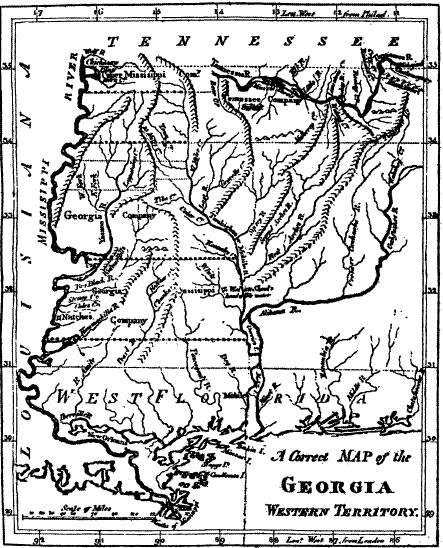
THE SECOND PARTITION OF THE YAZOO LANDS AS SHOWN BY JEDIDIAH MORSE IN HIS American Gazetteer, PUBLISHED IN 1797
Arrangements were quickly made, by the speculators, to divide the shares of each company into subshares for resale, and to subdivide the tracts for wholesale distribution. As Theodore Dwight, a contemporary observer, noted: “The territory was split up into endless divisions and sold in almost every part of the Union. On the ocean of speculation great multitudes of sober and industrious people launched the earnings of their whole lives, and multitudes became indebted for large sums which they never possessed.”11
Almost immediately after the law authorizing the sale was passed, a part of the Georgia Mississippi Company’s grant was resold for $1,138,000 (a great advance in price over the original cost of $155,000) to the “New England Mississippi Land Company,” for consumption among the land-hungry Yankee gentry. James Greenleaf engineered the deal, and it was to him that the deed was first conveyed. It was in this subdivision that Gideon Granger, Jr., the Postmaster-General, who was active in Ohio land deals, and Perez Morton, prominent Massachusetts statesman, were concerned. For this connection, Granger had to bear the gibes and jokes of his political enemies, particularly John Randolph, of Roanoke, the bitter foe of the Yazoo gamblers.
The “Mississippi scrip,” as the shares of the New England Mississippi Company were commonly called, were scattered throughout this section. Its land office in Boston for a while resembled John Law’s “Mississippi Company’s” home in the Rue de Quincampoix, Paris. Speculators vied with each other to get first in line to enter subscriptions for their shares. The “company” had bought its tract on credit, and sold on equally liberal terms. The “scrip” passed from hand to hand. The holders, in blissful ignorance for a time of what was going on in Georgia, indulged in fanciful dreams of fabulous wealth.
But their hopes were soon to be dispelled. When the Georgia folk began to realize the rotten deal put over by their legislators, a howl of protest arose. There was indignation from the mountains to the sea. The grand juries of every county but two presented the act authorizing the Yazoo sale as a public grievance. The state constitutional convention which assembled in May “had its table heaped with petitions, memorials and remonstrances. Hardly a freeman in the state but put his name to some such document. Every member of the Legislature of 1796 came solemnly pledged to repeal the Act.”12
Vengeance was sought on the speculators, and Georgia became a perilous residence for all concerned in the deal. James Gunn, the United States Senator from the state, and leader of the “Georgia Company,” was repeatedly burned in effigy. Other legislators, who were accused of bribery in connection with the deal, were threatened with violence, and subjected to the most scurrilous newspaper attacks.
The new legislature that met in January, 1796, immediately proceeded to the question of repeal. In three weeks’ time, a bill was reported, denying the validity of the grants, and recommending their repudiation. Accordingly, on February 13, 1797, the Georgia Legislature unanimously announced the sale unconstitutional and void. “The two Houses then formed in procession, marched to the front of the State House, and drew up before a bonfire in the road. The Committee handed the paper, on which the hated act was printed, to the President of the Senate. The President passed it to the Speaker of the House. The Speaker gave it to the Clerk. The Clerk delivered it to the doorkeeper, and he flung it into the flames.”13
The hopes of the Yazoo speculators were not so easily extinguished. They looked for protection to the clause in the United States Constitution reciting that “no State shall pass any law impairing the obligation of a contract.” But the embittered Georgia freemen did not “give a rap” for the Constitution. They ordered the bartered territory surveyed and cut up into small plots, and decreed its distribution among Georgia citizens by means of a lottery. This was slow work, and before it was completed Georgia had agreed to cede its Yazoo territory to the United States for the sum of $1,250,000. A reservation was made, however, that 5,000,000 acres should be set aside by the federal government to satisfy the claims of the former purchasers.
Although subsequent to the repudiation, Georgia officials offered to refund the payments that had been made to land purchasers, few took advantage of the offer. Instead, they made haste to sell their lands. Prospectuses were distributed throughout New England, and the Middle States. The lands of the Upper Mississippi Company were sold mostly in South Carolina. The Georgia and Mississippi companies disposed of many of their shares and “scrip” even before the newspapers announced the repeal of the grants. Speculators in these shares lost heavily. Boston alone is said to have sunk over two million dollars in Georgia “scrip.” La Rochefoucauld, in his Travels, thus describes the mania: “Every class of men, even watch makers, hairdressers, and mechanics of all descriptions, eagerly ran after this deception.”
Imagine the disappointment of the “scrip” holders when the newspapers announced the repudiation of the grants. “The shock throughout the Union cannot be described,” remarked Theodore Dwight, who was then President of Yale College and a witness of the spectacle. Men gathered on street corners to discuss it. Newspapers and pamphleteers arrayed themselves for and against the speculators, and a remarkable stream of controversial literature resulted. In one of these pamphlets the author gives some sound advice to the “scrip” holders. He recommended that these refuse to honor the notes they gave for payment. “By your success,” he says, “millions of dollars now pledged on this speculation, will be restored to the channels of industry,” and he ended by calling the speculation “a system of fraud and swindling, more complicated in its machinery and varied in its operations than any which has disgraced the character of man in this or any age.”14
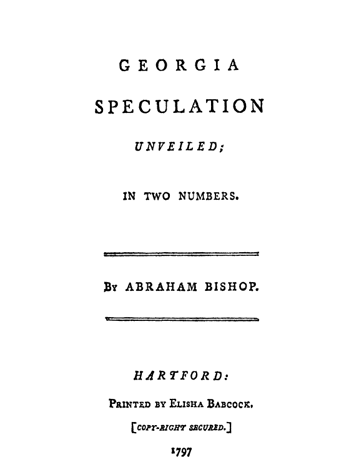
ONE OF THE “YAZOO FRAUDS” PAMPHLETS
It is quite evident, from the pamphlets issued by the defenders of the land companies, that their chief reliance for protection was upon the United States courts. Several suits were entered against the State of Georgia, and in one Patrick Henry was employed as attorney. Congress was soon embroiled in the muddle. When word of the second sale reached President Washington, he immediately announced it to Congress with the admonition that unless something was done about it, Indian troubles might be expected.
Congress was slow in acting, but on the advice of the Attorney General regarding Georgia’s doubtful title to western lands, a law was passed, authorizing a commission to settle the disputed ownership. The hopes of the “scrip” holders were revived. Now they could deal with Congress. Surely, a just and democratic body of national representatives, an organization that was always known to uphold property rights, would not deny them indemnification!
The “scrip” and “shares” of the various companies again became an object of speculation. They began to flow into the coffers of rich capitalists. These had in mind the government “debt certificates” and “indents” issued during the previous decade, which were paid off at par. The Yazoo claims may likewise some day be paid off at face value! What a great chance for speculative profit for those who could afford to tie up their money for a while!
These wealthy “scrip” holders, while garnering the floating supply from the impoverished owners, began to “pull wires” to have their claims recognized by the federal government. Among the “humble” petitioners who repeatedly importuned “the Honorable Congress” for a consideration of their Yazoo claims were such well-known capitalists as Nathaniel Prime, who organized the first American private banking house; Leonard Bleecker, a founder of the New York Stock Exchange; James Perkins and Leonard Jarvis, New York capitalists; James Sullivan, eminent attorney of Boston; James Strawbridge, of Philadelphia, and a host of others, who, though not participating in the original purchase, had acquired thousands of dollars in claims from others.
But their speculations did not result in “easy money.” There was at this time no Alexander Hamilton to put through a funding plan, and settle their claims in full. Instead, there developed the most determined opposition, both in and out of Congress. These “Yazoo claims” became a bugbear to the national legislature. They popped up at each session of Congress from 1800 to 1814. At first a proposition was made to compensate the “scrip” holders at 25 cents per acre, but Congress would not stand for this “profiteering.” When compromises were proposed, the fiery and bombastic Virginian, John Randolph, of Roanoke, resisted them at every point. Throughout the rest of his political career, he was “Anti-Yazoo” to the core. Because James Madison and the northern Democrats favored settling the claims, they won Randolph’s bitter enmity, and brought about the first split in the Democratic Party. In one of his “fire and brimstone” orations, delivered in 1804, Randolph soundly berated his fellow Democrats who were supporting the Yazoo claims as abettors of the Federalist cause:
What is the spirit against which we now struggle and which we have vainly endeavored to stifle? A monster, generated by fraud, nursed in corruption, that in grim silence awaits its prey. It is the spirit of Federalism! That spirit which considers the many made only for the few. . . . When I behold a certain party supporting and clinging to such a measure almost to a man, I see only men faithful to their own principles. . . . But when I see associated with them, in firm compact, others who once rallied under the standard of opposite principles, I am filled with apprehension and concern. . . . If Congress shall determine to sanction this fraud upon the public, I trust in God we shall hear no more of the crimes and follies of the former administration. For one, I promise that my lips upon this subject shall be closed in eternal silence. I should disdain to prate about petty larcenies of our predecessors after having given my sanction to this atrocious public robbery.15
Congress dilly-dallied with the “Yazoo Claims” until after March 16, 1810, when Chief Justice John Marshall rendered his opinion in the case of Fletcher vs. Peck. There could be no doubt, Marshall claimed, that the Georgia legislation rescinding the sale of the Yazoo lands was an act impairing the obligation of a contract and was therefore contrary to the Constitution. That the act secured its passage through corruption and bribery was immaterial to the Chief Justice, and, even if a court had examined the title and set it aside because of fraud, it could not cause innocent third parties to suffer. Thus, it was manifestly the duty of Congress to indemnify the Yazoo claimants.
After a delay of four years, Congress finally agreed to a settlement, and thus the curtain was rung down on the final act of the Yazoo Frauds. In 1815, the Secretary of the Treasury reported a total payment by the United States to the Yazoo claimants, of $4,282,151.12, in a new but reliable kind of “Mississippi scrip,” bearing the seal of the national government. The amount was divided in accordance with the payments made by the original “scrip” and “share” holders. All who voluntarily surrendered the evidences of their claims, or who had received back any of the purchase money, were, to this extent, barred from participation in the award. However, as it is quite evident that most of those who presented their claims were not the original purchasers, but had acquired them cheaply from distressed and disgusted holders, the benefits of the settlement, therefore, accrued to wealthy speculators and not to those who first sought a profit from an ownership of the wild Georgia back lands.
.....
The western territory of Georgia was not the only section of that state that figured prominently in the early wild land manias. Georgia, like most of the other colonies at the outbreak of the Revolution, became possessed of immense tracts of waste lands without inhabitants. These had been the property of the colonial proprietor, General Oglethorpe, who, unlike the Penns and the Calverts, did not take up his residence on his boundless domains. Before the Revolutionary War was over, the state government endeavored to dispossess itself of its proprietary heritage. It was land poor, and needed taxable resources. As early as 1777, when its first state constitution was adopted, an act was passed, granting 200 acres to every white head of a family, and 50 acres for each member and for each slave, but limiting the maximum “head right” to 500 acres. Of course, ownership was not recognized unless the land was settled. This right to free land was, in 1780, extended to non-residents.
The “head right” system, however, did not accomplish the desired result of populating the state, so in 1789 the law was amended, by giving authority to justices of the peace to issue warrants for unappropriated land. All that was required of claimants was a survey of the land at their expense. This liberality resulted in a raid on Georgia lands, located principally in the present counties of Franklin, Washington and Montgomery. Warrants for small plots were easily obtained and resold, and most of them got into the hands of land jobbers.
Large tracts were also freely disposed of by Georgia. Count d’Estaing, the French admiral who assisted the colonies, was granted a substantial acreage for his Revolutionary services. D’Estaing sold his land to the Count de Colbert, who resold it in England to Robert Morris, through the agency of William Constable and Gouverneur Morris.16 Robert Morris then proceeded to add to his Georgia possessions. In association with John Nicholson, he soon become the leading proprietor of Georgia waste lands. How these large holdings were obtained has never been satisfactorily explained. It is the “unsolved riddle of Georgia’s land history.”17
Yet, it is known that four early governors of the state granted lands in large quantities to single persons without the slightest authority under the law, and contrary to all laws on the subject of “head right” grants. It is quite possible that Morris and Nicholson purchased from the grantees, who had received their titles in this way. It is also possible that they may have received patents direct from the state authorities. There are early records which show that Morris and Nicholson paid state taxes on the land for a few years. It was the taxes that the Georgia government desired.
To most of these “free” Georgia lands the name of “Pine Barrens” was given. Their sandy soil was covered with a luxuriant growth of pine trees, for which Georgia, for over a century, was famous, and which in later years not only afforded a lucrative article of export, but was the basis for its naval stores’ industry. But “barren” they certainly were in the post-Revolutionary days when they were sold to Robert Morris and other land jobbers. As mentioned in a previous chapter, “whatever land was offered for sale, they appeared ready to buy; and actually bought quantities which outran every sober thought.”18
The Pine Barrens, though of so little value that neither Indians nor white settlers could be attracted to them, became an important part of the lands of the North American Land Company, which was organized in 1795, when Morris, Greenleaf and Nicholson pooled their holdings. The inventory of the company showed that out of a total of 6,000,000 acres, Georgia lands comprised 2,314,796 acres.
Morris, as previously noted, endeavored to get French purchasers for these Georgia lands. There was already considerable French influence in South Carolina and Georgia, and these lands were advertised as most suitable for the émigrés. But he was brought face to face with the outspoken opposition of Joseph Fauchet, French Minister to the United States. Though the Pine Barrens were hawked about even before the second Yazoo grants were made, and it was reported that they were a profitable speculation, they lacked buyers. There was, of course, considerable doubt as to the validity of Morris’ title to them—and this point was strongly emphasized by Fauchet. Most of the grants had not been surveyed in accordance with the legal requirements. In 1798, the Georgia Legislature, with the Yazoo fiasco fresh in mind, passed a law requiring all landowners to survey and identify their holdings every ten years, beginning in 1799. The purpose was to compel holders under fraudulent grants to prove their titles. The heritors of the North American Land Company, after Morris and Nicholson’s failure, could not do this. Moreover, it was not worth the expense. As taxes were not paid, the lands went back to the state. In fact, the State Comptroller of Georgia reported in 1839 that “not more than half the land in the region was worth owning or paying taxes for.”19
Yet, large tracts of it, in after years, were offered privately for sale or colonization. In 1801, George Sibbald issued a pamphlet in Augusta, Ga., entitled Notes and Observations on the Pine Lands of Georgia, showing the advantages they possessed. It was specifically addressed to persons emigrating. Sibbald stated that he owned large bodies of pine land in Washington, Montgomery and Bullock counties, beginning about 30 miles south of Savannah. “The surveys I hold,” he said, “are well known in this State to be the first land surveyed in large tracts.” Although he names some of the original grantees, he does not divulge how he obtained title to them, but it may be assumed that he bought them in at tax sales. He petitioned for, and received, an exemption from taxes on the land until 1805 “on condition that he leave the State and seek emigrants.” The land was offered to settlers and immigrants at 50 cents per acre.
It is not known to the author whether Sibbald’s lands constituted part of the Pine Barrens of Morris and Nicholson. But a later proffer of lands in the region shows conclusively what became of the Pine Barrens speculation. In a pamphlet printed in Kingston, N. Y., in 1865, entitled, An Account of the Lands belonging to Robt. L. Pell, in the State of Georgia, it is stated specifically that among the original grantees were John Nicholson, Robert Morris, Jr., James Greenleaf, James Wilson, R. L. Pell, James Cooper and John Shorter, and trustees of the North American Land Company. Pell published the pamphlet in order to sell the lands. He claimed ownership to four million acres of “valuable land for timbering.” His holdings, therefore, included other tracts besides those acquired by the North American Land Company. The district in which the property was located underwent rapid exploitation by timber magnates after the Civil War. Among those who invested heavily here in timbering projects was William E. Dodge, one of the founders of Phelps, Dodge & Company, renowned in the annals of the American copper industry. Dodge County in Georgia was created as a testimonial of his large interest in the Georgia “Pine Barrens.”
It is a sad commentary on Robert Morris’ business judgment that lands which he eagerly acquired as a speculation and actively sought to sell were still in as wild and primeval condition almost a century after his death. But he seems never to have inquired regarding the quality or locations of properties, as long as he could obtain them cheaply and on credit. Either he had the utmost confidence in the rapid filling up of unoccupied regions in the country, or he became madly intoxicated by the prevailing wild land mania. He, Nicholson and Greenleaf purchased indiscriminately in the South, West and East—from the sluggish Savannah to the shores of Lake Erie. The modern searcher of land titles in any district east of the Alleghanies and south of New England is apt to find the name of Robert Morris or that of his partners in the early deeds. As stated by Allen C. Clark, “When a tract in the Carolinas or the Virginias is subject to negotiation, the lawyer from the metropolis must need travel through primeval forest whose solemn stillness is unbroken save by the cawing of the inhabitants of the air and the reverberating music of the axe, to the little remote brick courthouse, there to ascertain if the title is a continuous chain from the original owner—Robert Morris.”20
.....
To the story of the “Yazoo” and “Pine Barrens” speculations could be added others of a similar nature, also concerned with distant and unsettled regions along the moving frontiers of American territory. As noted by Lord Dunmore, the last Virginia colonial governor, an “engrafted trait” of Americans is “to forever imagine that the lands further off are still better than those upon which they are already settled.” This trait undoubtedly has been a potent force promoting rapid national expansion, and, despite its tragedies of feverish speculation, it has been an important factor in America’s economic progress.
But historians with their minds concentrated on politics have belittled or ignored this force. Thus, Theodore Roosevelt, in his early work, The Winning of the West, when commenting on the activities of the land companies in the old Southwest, remarked: “These land companies possessed on paper a weight which they did not have in actual history. They occasionally enriched and more often impoverished the individual speculators; but in the actual peopling of the waste lands they counted for little in comparison with the steady stream of pioneer farmers who poured in, each to hold and till the ground he in fact occupied.”
And yet, the chief exponent of the “strenuous life” admits that the land companies “did possess considerable importance at certain times in the settlement of the west, both because they in places stimulated that settlement and because in other places they kept out the actual settlers.”21 But, as the following chapters will show, the stimulation to settlements was a permanent force, while the retardation was but temporary and sporadic. Speculation is essential to human progress. Adventure and Cupidity, hand-in-hand, have spread civilization.
22 Charles Homer Haskins, The Yazoo Land Companies, pp. 6, 7.
23 Haskins, op. cit., p. 8.
24 “All the settlers [in Tennessee], who had any ambition to rise in the world were absorbed in land speculations. . . . They were continually in correspondence with one another about the purchase of land warrants and about laying them out in the best localities.”—Theodore Roosevelt, The Winning of the West (New Knickerbocker Edition), Vol. II, p. 360.
25 See Claiborne’s “Mississippi” etc. Vol. I, p. 157, note.
26 The Diaries of George Washington, Vol. IV, pp. 124, 125.
27 See Jefferson’s Works, edited by H. A. Washington, Vol. VII, pp. 467-469.
28 Haskins, op. cit., p. II.
29 Letter of David Ross to Governor Randolph, April 10, 1791, quoted in Haskins, op. cit., p. 19.
30 The Diaries of George Washington, Vol. IV, p. 157.
31 The Diaries of George Washington, Vol. IV, p. 196.
32 Theodore Dwight, Travels, Vol. I, p. 188.
33 McMaster, History,of the People of the United States, Vol. II, p. 480
34 Ibid. Vol. II, p. 480.
35 Abraham Bishop, Georgia Speculation Unveiled, Hartford, 1797.
36 Haskins, op. cit., p. 36.
37 Ellis Paxton Oberholtzer, Life of Robert Morris, pp. 307, 308.
38 S. G. McLendon, History of the Public Domain of Georgia, Chap. IX.
39 Theodore Dwight, Travels, Vol. I, p. 188.
40 Absalom H. Chappell, Miscellanies of Georgia, Part II, p. 49.
41Greenleaf and Law in the Federal City, p. 26.
42The Winning of the West (New Knickerbocker Edition), Vol. II, p. 411.
- 1Maine Historical Collections, Vol. II, pp. 268-294.
- 2The Sir William Johnson Papers, Vol. V, p. 129. See also, C. W. Alvord, The Mississippi Valley in British Politics, Cleveland, 1917.
- 3Herbert B. Adams. “Washington’s Interest in Western Lands,” Johns Hopkins University Studies, Third Series, No. 1, January, 1885. Italics are mine.—A. M. S.
- 4Adams, op, cit., p. 58.
- 5See A. Henderson, “A Pre-Revolutionary Revolt in the Old Southwest” in Mississippi Valley Historical Review, Vol. 27, p. 198 et seq.
- 6Italics are not in the original.
- 7In a letter to William Franklin, dated May 3, 1776, Johnson asserted “it has always been my practice to avoid engaging in lands to the great loss of my family, neither have I a foot of land from the Indians.” (Sir William Johnson Papers, Vol. IV, p. 197.) The large tract north of the Mohawk Valley given him by the Canajoharie Indians in 1760 was confirmed by royal grant in 1769.
- 8See Pennsylvania Magazine of History, Vol. XIV, pp. 218, 219.
- 9See Memorial of the United Illinois and Wabash Land Companies, Baltimore, 1816.
- 10A copy of the deed is contained in American State Papers, “Public Lands.” Vol. I. The original copy was acquired by Cyrus H, McCormick.
- 11See J. P. Boyd, “Connecticut’s Experiment in Expansion, The Susquehannah Company, 1753-1803,” in Journal of Economic and Business History, November, 1931.
- 12See Publications of the Colonial Society of Massachusetts, Vol. XXV, PP. 33-38.
- 13Samuel W. Jones, Memoir of James Duane, 1852.
- 14P. H. Woodward, One Hundred Years of the Hartford Bank, p. 74. See also R. J. Purcell, Connecticut in Transition, p. 154.
- 15Haskins, op. cit., p. 36.
- 16Ellis Paxton Oberholtzer, Life of Robert Morris, pp. 307, 308.
- 17S. G. McLendon, History of the Public Domain of Georgia, Chap. IX.
- 18Theodore Dwight, Travels, Vol. I, p. 188.
- 19Absalom H. Chappell, Miscellanies of Georgia, Part II, p. 49.
- 20Greenleaf and Law in the Federal City, p. 26.
- 21The Winning of the West (New Knickerbocker Edition), Vol. II, p. 411.
- 22During the first hundred years of North American colonization, economic conditions gave little encouragement to private land schemes. Land was too plentiful. A few such enterprises were undertaken, however. Thus, as early as 1661, the Colony of Massachusetts sold to a few individuals for £400 a large tract on the Kennebec River in Maine. This became known as the “Kennebec Purchase.” The heirs held it for nearly a century without doing anything with it. In 1753, they incorporated as the “Proprietors of the Kennebec Purchase” and proceeded to dispose of their holdings. The corporation continued in existence until 1816. “The Pejebscot Company” was another Maine land deal. None of these held out promise of profit to proprietors until about a quarter century before the Revolution.
- 23In the meantime, the “Loyal Company” group was not idle; its proprietors sent Dr. Thomas Walker, of Albermarle, Va., to make a reconnaissance, and to discover a proper place of settlement. The two “companies” then became engaged in a controversy, and neither made a survey or fixed the bounds of their grants. The apparent ease with which they obtained land donations led to other schemes, and aroused an epidemic of interest in distant western wild lands. Not only was the land ownership eagerly sought after, but the establishment of new colonies, with separate and distinct governments, was planned. Favoritism and collusion infested the Virginian colonial government, due in large part to the persistence of speculators in western land grants. Lobbyists were sent to London to obtain the crown’s sanction to land-grabbing schemes and the question of the disposal of the vast western domain won from the French infested British politics. “One half of England is now land mad,” wrote George Croghan, of Philadelphia, one of the land schemers, to Sir William Johnson, on March 30, 1766, “and everybody there has their eyes fixed on this country.”
- 24I offered in my last to join you in attempting to secure some of the most valuable lands in the King’s part, which I think may be accomplished after awhile, notwithstanding the proclamation that restrains it at present and prohibits the settlement of them at all; for I can never look upon that proclamation in any other light (but this I say between ourselves) than as a temporary expedient to quiet the minds of the Indians. It must fall, of course, in a few years, especially when those Indians consent to our occupying the lands. Any person, therefore who neglects the present opportunity of hunting out good lands, and in some measure marking and distinguishing them, for his own, in order to keep others from settling them, will never regain it.
- 25Crawford “heartily embraced” the colonel’s offer. He promised shortly to set out in search of lands. “This may be done,” he said, “under a hunting scheme.” He acknowledged that other land seekers had approached him, with similar offers, “but have not agreed to any; nor will I with any but yourself or whom you think proper.”
- 26Judge Richard Henderson of North Carolina, the employer and backer of Daniel Boone, promoted the settlement of the Kentucky region and claimed ownership to a vast unsettled tract there. He organized a group of land grabbers under the name of “The Transylvania Company.” Ignoring the British interdiction against Indian land purchases, he obtained from the Cherokees in 1773 about one-half of the present State of Kentucky, and immediately began settling the land. He advertised widely for pioneers and “shareholders.” In his announcements, Henderson waxed enthusiastic. “The country [Transylvania] might invite a prince from his palace, merely for the pleasure of contemplating its beauty and excellence, but only add the rapturous idea of property, and what allurements can the world offer for the loss of so glorious a prospect?”
- 27When the British Government began to take active measures to break up land “bootlegging,” and to put a stop to dreams of riches in western territory, Virginia’s political resentment was naturally aroused. Even Thomas Jefferson, who, in later life, frowned upon speculation and land grabbing, held the view in 1774 that the land did not belong to the British king, and that it was time for the colonies “to declare that he has no right to grant lands of himself.” So he boldly wrote in the Declaration of Independence, as one of the British king’s usurpations: “He has endeavored to prevent the Population of these States; for that purpose obstructing the Laws for Naturalization of Foreigners; refusing to pass others to encourage their migrations hither, and raising the conditions of new Appropriation of Lands.”
- 28He was for it at once. “I like the project of a colony in the Illinois Country,” he wrote his son, “and will forward it to my utmost here.” He thought that Sir William Johnson’s “approbation will go a great way in recommending it, as he is much relied upon in all affairs that may have any relationships with the Indians.” But Johnson had an eye on the Indian lands himself, and besides advising others about purchases in the outlying sections, personally through gifts from the Indians engrossed large tracts, particularly in the Mohawk Valley. The town of Johnstown, N. Y., still marks the seat of his domain.
- 29Some of the members of the Vandalia Company were concerned in other western land schemes. One of these was organized in 1775 as the “Indiana Land Company,” probably the first application of the name “Indiana” to the Northwest Territory. The claim to land was based on a grant of a large tract, made November 3, 1768, in what is now West Virginia, by the Six Nations at Fort Stanwix to “Chief” William Trent in liquidation of depredations. Among the shareholders were Samuel Wharton, Joseph Galloway, Robert Callender, Levi Andrew Levi, and David Franks, all wealthy and prominent Philadelphians. The Revolutionary War did not put an end to the “claim.” Wharton in 1776 published a pamphlet, entitled-View of the Title to Indiana, in which he defended the company’s rights to the lands. In 1781, he republished this in enlarged form, under the title Plain Facts; being an examination into the Rights of the Indian Nations of America to their respective Countries and a Vindication of the Grant from the Six United Nations to Proprietors of Indiana, etc. Although Wharton pressed the validity of the “proprietors” claims, Congress then and thereafter gave little heed thereto.
- 30Notwithstanding the British Government’s edict, forbidding the private purchase of lands from the Indian tribes, William Murray, an Indian trader, and several of his business associates, in 1773 formed a plan to buy from the aborigines an immense tract of country between the Mississippi, Illinois and Ohio rivers. After a “pow-wow” lasting a month, the sale was consummated. According to the land claimants, it was attended by “many persons of both descriptions and the Indians were carefully prevented from obtaining any spiritous liquors during the whole continuation of the negotiation.” On July 5, 1773, “for a very large and valuable consideration,” the deed was delivered to the “Illinois Land Company.”
- 31Notwithstanding the British Government’s edict, forbidding the private purchase of lands from the Indian tribes, William Murray, an Indian trader, and several of his business associates, in 1773 formed a plan to buy from the aborigines an immense tract of country between the Mississippi, Illinois and Ohio rivers. After a “pow-wow” lasting a month, the sale was consummated. According to the land claimants, it was attended by “many persons of both descriptions and the Indians were carefully prevented from obtaining any spiritous liquors during the whole continuation of the negotiation.” On July 5, 1773, “for a very large and valuable consideration,” the deed was delivered to the “Illinois Land Company.”
- 32The proposition then took on a business aspect. The number of “shares” was increased, and rights to subscribe offered at from $2 to $5 per share. It attracted speculators. The shares soon rose in value. Lawyers, clergymen and politicians began buying shares. The Reverend Ezra Stiles, President of Yale College, grandfather of the poet-physician Oliver Wendell Holmes, took 2¾ shares. The Governor of Connecticut, Roger Walcott, who had become rich through local land deals, supported the project.
- 33New York, before the Revolution, also had her “land” quarrels with the other colonies. The ill-defined boundaries of the Dutch province led to constant conflicts and legal controversies with her neighbors. There was a bitter dispute with New Hampshire regarding the political jurisdiction of Vermont. New York claimed the section, but New Hampshire, in 1749, acting on the principle that possession is nine points of the law, began to make free grants to both New Hampshire and Massachusetts citizens. Whole “towns” of 23,000 acres, more or less, were granted to selected groups of individuals. It is estimated that between 1749 and 1764, Governor Benning Wentworth granted 131 townships to more than six thousand persons. Among the grantees appear the names of many prominent colonial New Englanders, who had no intention of ever settling on the lands. Samuel Adams was among them. He was known as a speculator in both Maine and New Hampshire lands in this period. The governor granted himself, in all, about 65,000 acres, and is reported to have accumulated considerable wealth from the heavy fees exacted by him for grants.
- 34Because of his land deals, while acting as the state’s attorney, Duane was the butt of political criticism. He was led to appear in person in his own defense before the state legislature in 1781. He was charged with receiving Vermont grants “under immoderate quit-rents, and excessive fees of office,” and he was also accused of “holding many thousand acres of land which had never before been granted by the Crown.” To this he merely answered that he “had never made a purchase or obtained a grant of land with any view to its sale.” He was therefore not a “land jobber.” This cleared him politically of all corruption.
- 35So popular was the western lure to the Connecticut gentry that legislation was urged to countermand it. “Young people in their plays at social gatherings marched to rude melodies which taught them to dream that toward the setting sun lay an earthly paradise with gates open to welcome them. From hill and valley the processions hurried away. Today, many of our rural towns are scarred and paralyzed by an outflow which has built up the continent to no small degree at their expense.”
- 36What is the spirit against which we now struggle and which we have vainly endeavored to stifle? A monster, generated by fraud, nursed in corruption, that in grim silence awaits its prey. It is the spirit of Federalism! That spirit which considers the many made only for the few. . . . When I behold a certain party supporting and clinging to such a measure almost to a man, I see only men faithful to their own principles. . . . But when I see associated with them, in firm compact, others who once rallied under the standard of opposite principles, I am filled with apprehension and concern. . . . If Congress shall determine to sanction this fraud upon the public, I trust in God we shall hear no more of the crimes and follies of the former administration. For one, I promise that my lips upon this subject shall be closed in eternal silence. I should disdain to prate about petty larcenies of our predecessors after having given my sanction to this atrocious public robbery.
- 37Large tracts were also freely disposed of by Georgia. Count d’Estaing, the French admiral who assisted the colonies, was granted a substantial acreage for his Revolutionary services. D’Estaing sold his land to the Count de Colbert, who resold it in England to Robert Morris, through the agency of William Constable and Gouverneur Morris. Robert Morris then proceeded to add to his Georgia possessions. In association with John Nicholson, he soon become the leading proprietor of Georgia waste lands. How these large holdings were obtained has never been satisfactorily explained. It is the “unsolved riddle of Georgia’s land history.”
- 38Large tracts were also freely disposed of by Georgia. Count d’Estaing, the French admiral who assisted the colonies, was granted a substantial acreage for his Revolutionary services. D’Estaing sold his land to the Count de Colbert, who resold it in England to Robert Morris, through the agency of William Constable and Gouverneur Morris. Robert Morris then proceeded to add to his Georgia possessions. In association with John Nicholson, he soon become the leading proprietor of Georgia waste lands. How these large holdings were obtained has never been satisfactorily explained. It is the “unsolved riddle of Georgia’s land history.”
- 39To most of these “free” Georgia lands the name of “Pine Barrens” was given. Their sandy soil was covered with a luxuriant growth of pine trees, for which Georgia, for over a century, was famous, and which in later years not only afforded a lucrative article of export, but was the basis for its naval stores’ industry. But “barren” they certainly were in the post-Revolutionary days when they were sold to Robert Morris and other land jobbers. As mentioned in a previous chapter, “whatever land was offered for sale, they appeared ready to buy; and actually bought quantities which outran every sober thought.”
- 40Morris, as previously noted, endeavored to get French purchasers for these Georgia lands. There was already considerable French influence in South Carolina and Georgia, and these lands were advertised as most suitable for the émigrés. But he was brought face to face with the outspoken opposition of Joseph Fauchet, French Minister to the United States. Though the Pine Barrens were hawked about even before the second Yazoo grants were made, and it was reported that they were a profitable speculation, they lacked buyers. There was, of course, considerable doubt as to the validity of Morris’ title to them—and this point was strongly emphasized by Fauchet. Most of the grants had not been surveyed in accordance with the legal requirements. In 1798, the Georgia Legislature, with the Yazoo fiasco fresh in mind, passed a law requiring all landowners to survey and identify their holdings every ten years, beginning in 1799. The purpose was to compel holders under fraudulent grants to prove their titles. The heritors of the North American Land Company, after Morris and Nicholson’s failure, could not do this. Moreover, it was not worth the expense. As taxes were not paid, the lands went back to the state. In fact, the State Comptroller of Georgia reported in 1839 that “not more than half the land in the region was worth owning or paying taxes for.”
- 41It is a sad commentary on Robert Morris’ business judgment that lands which he eagerly acquired as a speculation and actively sought to sell were still in as wild and primeval condition almost a century after his death. But he seems never to have inquired regarding the quality or locations of properties, as long as he could obtain them cheaply and on credit. Either he had the utmost confidence in the rapid filling up of unoccupied regions in the country, or he became madly intoxicated by the prevailing wild land mania. He, Nicholson and Greenleaf purchased indiscriminately in the South, West and East—from the sluggish Savannah to the shores of Lake Erie. The modern searcher of land titles in any district east of the Alleghanies and south of New England is apt to find the name of Robert Morris or that of his partners in the early deeds. As stated by Allen C. Clark, “When a tract in the Carolinas or the Virginias is subject to negotiation, the lawyer from the metropolis must need travel through primeval forest whose solemn stillness is unbroken save by the cawing of the inhabitants of the air and the reverberating music of the axe, to the little remote brick courthouse, there to ascertain if the title is a continuous chain from the original owner—Robert Morris.”
- 42And yet, the chief exponent of the “strenuous life” admits that the land companies “did possess considerable importance at certain times in the settlement of the west, both because they in places stimulated that settlement and because in other places they kept out the actual settlers.” But, as the following chapters will show, the stimulation to settlements was a permanent force, while the retardation was but temporary and sporadic. Speculation is essential to human progress. Adventure and Cupidity, hand-in-hand, have spread civilization.

