
The Great American Land Bubble
Chapter V. The Ohio Land Lure
“I HAVE learnt from experience,” wrote Lord Dunmore, Colonial Governor of Virginia, to his chief, Lord Dartmouth, on December 24, 1774, “that the established authority of any government in America, and the policy at home, are both insufficient to restrain the Americans, and they do and will remove as their avidity and restlessness incite them . . . They acquire no attachment to a place, but wandering about seems engrafted in their nature, and it is a weakness incident to it that they should forever imagine that the lands further off are still better than those upon which they are already settled.”
Thus, the lure of the wooded hills and fertile plains west of the Alleghanies, as we have already seen, dates back to colonial times. This vast, inland empire stretching as far west as the Mississippi, threatened to disrupt the incipient union of the thirteen states, but the spirit of compromise prevailed. The conflicting and overlapping claims to territory were gradually surrendered to the national government. The question arose: “What is to be done with it?” “Give it to the soldiers,” demanded some. “Use it to pay off the national debt,” said others. “Keep it for future use,” still others counseled, and there were those who held that any who desired should have the right to settle on it.
Before deciding on a policy of disposal of its western domain, Congress adopted a plan of government for it, and a system of administrative control. It passed the Ordinances of 1784, 1785 and 1787. It created the Northwest Territory. It prohibited slavery and guaranteed religious liberty in it, and provided that the primary disposal of the soil should be left to the federal government without interference or hindrance by local, state or territorial authorities.
As early as 1784, Congress took up the question of disposing of western lands. It was provided that no areas were to be sold until after they had been surveyed. All surveys were to make provisions for “ranges,” “townships,” and “sections.” As soon as a sufficient number of ranges were surveyed and the maps prepared, one-seventh of the land therein was to be reserved for the soldiers, and the remainder could be sold or otherwise disposed of by acts of Congress.
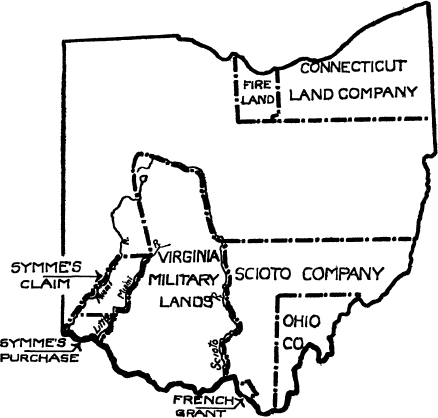
THE OHIO LAND GRANTS
Little time was lost in waiting for bids for land. In 1785, Nathaniel Sackett, in behalf of himself and his associates, petitioned the Congress for a grant of land, the boundaries of which would now cover most of the present State of Ohio. Sackett offered no consideration “except an ear of Indian corn annually as rental, if demanded.” He did, however, make it a condition of the proposed grant that the land be settled and cultivated by those who obtained it. To effectually prevent land jobbing, none of the settlers were to be permitted to sell their land for a space of years.
But the Continental Congress was too heavily in debt to give away the land freely. No heed, therefore, was given to Sackett’s petition. In the meantime, a reverend gentleman from Massachusetts, Dr. Manasseh Cutler, had been pondering over a colonization scheme in the Ohio country. He was desirous of providing the hard-pressed New England yeomen with better and cheaper lands, and incidentally, he may have had ideas of pecuniary gain. He was born at Killingly, Conn., May 28, 1742, and graduated from Yale College in 1765. He then studied law and began the practice of his profession at Martha’s Vineyard, but soon gave this up for theology. Becoming a Congregational minister, he served as chaplain in the American army during the Revolution. It is quite probable that he became interested in the Ohio country through his friend, Rufus Putnam, a hardy Revolutionary soldier, who had made a trip beyond the Alleghanies, and returned an enthusiast. Anyway, in 1786, Cutler, together with Putnam, formed a colonization association, which he called the “Ohio Company of Associates.”
Of course, they offered shares in this enterprise “for a consideration.” The capital was to be a million dollars in Continental certificates. It required a full year before one-fourth of this capital was subscribed, but it was thought the remainder could be readily obtained if Congress would give the “associates” an option on a compact body of land on reasonable terms. This required a modification of the land ordinance of 1785. Accordingly, the Reverend Manasseh Cutler journeyed to New York to treat with Congress. Here, it is said, he was largely instrumental in shaping the Ordinance of 1787, which established the government of the Northwest Territory.
If the Reverend Dr. Cutler had no dreams of pecuniary gain or “land grabbing” deals when he came to New York to present his petition to Congress, he probably caught the fever then, or at least was subjected to a severe risk of contagion. For at that time, Colonel William Duer was secretary of the Board of the Treasury. This “Board,” composed of three members, managed the depleted finances of the new republic. Duer, therefore, would have a hand in arranging terms with Cutler regarding the purchase of western lands. He dined and wined Cutler on his arrival, and promised him assistance. In fact Duer put a business slant on Cutler’s undertaking, and proposed a partnership.
Cutler’s negotiations with Congress were discouraging, however. Cash was demanded, and the poor New England clergyman did not have this in sufficient amount. A minimum price of one dollar an acre had been placed on the public lands, payable within three months after purchase. As the “Ohio Associates” petitioned for 1,000,000 acres, Cutler knew that his shareholders could not raise the required sum in so short a period. Duer then advised that, as a bait to the impoverished government, Cutler should increase his application to 4,000,000 acres, and that 3,000,000 acres be assigned to a “company,” composed “of a number of the principal characters of the City” of which he, Duer, would, “in profound secret,” be the head. With so large a sum in prospect, Congress would be willing to grant liberal credit terms. As a further inducement, Duer proposed to give Cutler a large personal share in his land concern which was to take over the excess acreage. This excess acreage, as shown on the accompanying map, comprised the territory east of the Scioto River and west of the actual grant to the “Ohio Associates.”
Cutler acceded to the proposition, and a bargain was struck with Duer, July 20, 1787, following “an elegant oyster dinner” in Brooklyn. In accordance with its terms, William Duer, together with Samuel Osgood and Walter Livingston, close friends and associates on the Board of the Treasury, used their influence (as Cutler noted in his diary), “to bring over my opposers in Congress.” The outcome was the approval by Congress of a purchase by Cutler and associates of a tract in Ohio, covering five or six million acres, at one dollar per acre payable in specie, or in “loan office certificates reduced to specie value, or certificates of liquidated debts of the United States.” Payments were to be $500,000 on the execution of the contract, another half million dollars when the tract was surveyed, and the balance in six equal semiannual instalments with interest. Whenever the aggregate sum of $1,000,000 was paid, a patent for a million acres was to be given. The title to the remainder was to pass upon such conditions as the Board of the Treasury might agree with the purchasers.1
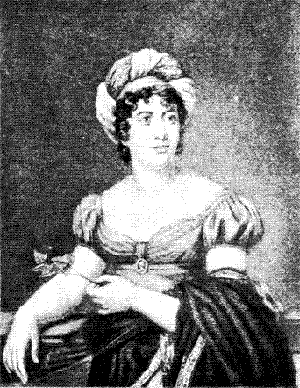
MADAME DE STAËL, WHO SPECULATED IN NORTHERN NEW YORK LANDS
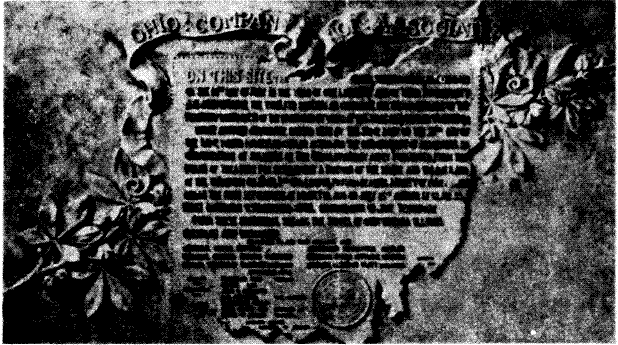
BRONZE TABLET COMMEMORATING THE GRANT TO OHIO COMPANY OF ASSOCIATES, ON THE PORTAL OF THE SUB-TREASURY BUILDING, NEW YORK CITY
Thus, the Ohio Company and William Duer’s so-called “Scioto Project” were launched as a joint proposition. The former may have been primarily a colonizing scheme, without the stigma of speculation, but the Scioto Project was an out-and-out land gamble. In order to put the proposition through, Duer had promised to advance $100,000 to Cutler to enable him to effect the first payment of a half million dollars. He also was to obtain assistance, if necessary, for the Ohio Company to complete the payments required of it in order to obtain full title to the quantity of land the “associates” actually desired. The payment for the remaining three to four million acres was to be made by the “Scioto Associates,” and if these payments were not made, the Ohio Company would still have full title to its lands, and would not be injured by such failure. In fact, the Ohio Company shareholders were kept in blissful ignorance of the real connection of the Scioto speculation with their own enterprise.
Cutler returned to Boston in August, 1787, and reported his success to his associates. He had, he said, “arranged the greatest contract ever made in America.” Some of the “shareholders,” however, objected to the option on the additional 3,000,000 acres included in the contract with Congress, and “declared that they would withdraw from the company if anything beyond the original purchase was undertaken.”2 No action on the proposition was necessary, however, and the matter was allowed to stand. The principal efforts of the “Directors and Agents” of the Ohio Company were to complete the list of shareholders and obtain the first half million dollars (in depreciated government debt certificates) required for the initial payment. For this purpose handbills were circulated, traveling agents employed, and newspaper articles were published throughout New England.
An appeal was made to both investors and “settlers” with such good effect that despite the extreme scarcity of money at the time, a large part of the sum was acquired. Duer and associates, in accordance with the private arrangement with Cutler, made up the deficit, amounting to $143,279. Duer personally subscribed for $30,000 of the “shares” of the Ohio Company. On October 27, 1787, Cutler paid over to the Board of the Treasury a half million dollars in debt certificates of the United States then worth anywhere from $60,000 to $130,000.
From this time on, the affairs of the Ohio Company were severed from those of the Scioto Project. Its history has been recorded in glowing eulogies as the earliest phase of the westward movement. A commemoration tablet in bronze to this effect has been placed on the old Sub-Treasury building in Wall Street, New York. It notes that under an ordinance “passed here,” Manasseh Cutler, acting for “The Ohio Company of Associates, an organization of soldiers of the Revolutionary Army, purchased from the Board of the Treasury for settlement, a portion of the waste and vacant lands of the (Northwest) territory.” On April 7, 1788, it continues, “Rufus Putnam, heading a party of fifty-eight, began the first settlement at Marietta, and on July 15th, Arthur St. Clair, as first Governor, established civil government in the territory. From these beginnings sprang the States of Ohio, Indiana, Illinois and Wisconsin.”
So runs the legend. The project was free from the stigma of speculation. “No land Company in America,” enthusiastically writes Archer B. Hulbert, an American historian, “was ever formed with an eye more single in the welfare of the poorest investor; no land company in our history surpassed the Ohio Company in its manifold efforts to better the causes of the common people.”3
Such acclamations, to be swallowed whole, must be taken with a grain of salt. Undoubtedly, the Ohio Company was more of a colonization scheme than a land speculation. But a plain appeal to human cupidity was made in the original prospectus. Among the “shareholders,” moreover, were many who had not the least intention of emigrating west and who had not the slightest personal interest in fostering land settlement for the downtrodden and impoverished Revolutionary soldiery. Thus, Alexander Macomb, the great land plunger of New York, held five shares in 1796. Alexander Hamilton was down for five and a half shares. William Duer put in $30,000 (in debt certificates) as “an investment.” The Scioto “trustees” originally held one hundred and forty-three shares, representing about 200,000 acres, which shares, however, were forfeited for non-payment. Many other of the “investors” also had their holdings forfeited because of failure to meet payments when called for. They were not interested in acquiring western wild lands. They wanted merely to profit from the rising market value of their “shares.”
Measured by the financial outcome, the Ohio Company was not much of a success. In March, 1792, the company petitioned Congress for relief. It had made one payment of $500,000 in debt certificates, which, computed at the then market value, was equal to less than 33 ⅓ cents per acre; but before the second payment was due, the rise in the value of federal securities, due to Hamilton’s funding scheme, together with the Indian war in the Ohio country, and the proposals of Congress to reduce the price of western lands to settlers, threatened the company with ruin. If the second payment could not be made, the title to the lands would not pass, and the settlers could be evicted. Congress yielded to the petition by reducing the average price of the lands to 50 cents per acre. The Ohio Company, therefore, received about 1,000,000 acres of land for $500,000 in government debts, worth during the time of purchase from 12½ to 50 cents on the dollar. For about 215,000 acres it presented soldiers’ warrants.
Despite the Ohio Company’s strenuous colonization efforts, when the directors of the company endeavored to make final assignments of the lands to settlers and shareholders in July, 1793, there were but 230 males of 18 years and upwards on the purchase. Indian warfare and frontier hardships had discouraged emigrants. Yet, the venture was of inestimable value to American progress. “It extinguished a half million of the public debt at a time when the treasury was all but bankrupt; it was a concrete example of the wealth of the western lands; it seemed to pave the way for other remunerative sales, and better than all this, it placed on the frontier a most desirable body of settlers, many of them veterans of the Revolution.”4
.....
Though the Ohio Company’s success, from a financial viewpoint, was disappointing, that of the Scioto Project, its illegitimate half-sister, was a complete fiasco. Two days after the purchase contract was signed with the Board of the Treasury on behalf of the “Ohio Company of Associates,” Colonel William Duer, on behalf of himself and a small “inside” group of speculators, entered into an agreement with Manasseh Cutler and his assistant, Major Winthrop Sargent, by the terms of which the Ohio Company’s option on the Ohio lands, exclusive of the 1,000,000 acres to be taken up directly by the settlers, was divided into thirty equal shares, “thirteen to belong to Duer and his assignees, thirteen similarly to Cutler and Sargent, and the remaining four to be disposed of abroad for joint account.” The two groups were to share equally in profits which might accrue in attempting to negotiate the sale or mortgage of the same, “either in Europe or America . . . and in paying the purchase money due to the United States.”5
This contract formed the sole basis of the Scioto Project. The concern was never chartered. It was not even a recognized “association.” When Duer was hard pressed by his French investors for an explanation of the real character and composition of his “company,” he is reported to have made the following statement:
The company known under the name of the Company of the Scioto, was originally composed of thirty (30) shares belonging to as many owners. The persons who held these shares were for the most part those who had much influence in the formation of the Company of the Ohio at Marietta, or in the Legislative or Executive branches of the Government. The original shares have since been much sub-divided, but the general management of the Company’s affairs, as well in America as abroad, has been entirely trusted to myself alone, and I have for aid and counsel, two agents, who are Messrs. Royal Flint and Andrew Craigie.6
Thus it was William Duer’s “bubble.” He seems to have interested, both financially and otherwise, a group of prominent capitalists and land jobbers in New York and Boston. Besides Royal Flint and Andrew Craigie, there were Christopher Gore, of Boston, Nalbro Frazier, a Philadelphia merchant; James Jarvis, John Holker, William Constable, Melancthon Smith and Seth Johnson of New York. Several others were probably concerned in it, but the real “proprietors” may never be known, as the whole affair was conducted in an underhanded manner without responsible officers or offices, and without minutes or records of proceedings. No attempt was made to interest the public in the venture, and no efforts were employed to attract home settlers to the lands, though there was an abortive plan of French colonization.
William Duer, like Robert Morris, Alexander Macomb, William Constable and other land jobbers of the epoch, believed that American waste lands could be readily sold in Europe. And he attempted to follow the practice the speculators then called “dodging,” i.e., selling the land in Europe before paying for it here.7 The “Scioto Associates” certainly acted on this principle. All they had was a contract to take over a portion of the option of the Ohio Company, an option not originally desired by Manasseh Cutler and his associates, but forced upon them through the need of Duer’s political influence in obtaining a land grant from Congress. On the basis of this option they despatched to France the young Hartford editor and poet, Joel Barlow, to offer the lands. They thus expected to attract the hard-pressed and persecuted aristocracy as purchasers.
Barlow’s task was not easy, and his expense to the “Scioto Associates” was heavy. Despairing, after many efforts, of selling large tracts to individuals, he decided to form a French subsidiary company, called the “Compagnie du Scioto.” This company agreed to purchase from the “Scioto Associates” 3,000,000 acres at about $1.00 per acre, payable in instalments. It was given the privilege of reselling in large or small tracts, and could send out settlers to take possession of the land. Barlow acted as its agent and manager. Because he gave “shareholders” and land purchasers the right of immediate settlement, he expected “to raise the reputation of the lands to such a degree that they will sell them all off in the course of one year at a great profit.”
With this object in view the “Compagnie du Scioto” issued in Paris a glowing prospectus for “an Establishment on the Ohio and Scioto Rivers in America.” It contained much the same material used by Manasseh Cutler in his advertisement of the Ohio Company’s project. The rough maps exhibited were seriously misleading, and the statements and plans of the enterprise highly overdrawn. Barlow, however, was “furnished with testimonies of so flattering a nature, and with credentials of the first authority to the most respectable houses in Paris” that he aroused the cupidity of the intelligent Frenchmen and created a flood of public enthusiasm for the speculation. His land office in Paris became so popular that he wrote his principals that they might reckon their profits at “above a million,” and he even suggested a proposal that the French Government exchange its American securities for shares in the “Compagnie du Scioto.” “The present circumstances are so favorable,” he added, “and the object so popular, many portions are already sold, and the people are preparing to embark in January.”
This news was not entirely pleasing to the “Scioto Associates.” They had no intention of establishing colonies and had made no provision for receiving foreign settlers. They had hoped that some opulent French capitalists would take their property off their hands “en bloc” at a great pecuniary profit to themselves. In fact, they never intended that Barlow should divide up the tract into “shares,” and they certainly could not back up Barlow’s warranty clause in his sales to Frenchmen, guaranteeing purchasers against every kind of eviction and attacks.
However, they were overjoyed at the prospect of a handsome profit, and made some preparation to receive the émigrés. Barlow was fearful, however, that he had gone too far in making outright sale of lands that his principals did not possess. On January 15, 1790, he wrote Duer:
Don’t for God’s sake fail to raise money enough to put the people in possession. . . . Make every sacrifice rather than fail in this essential object. If it fails, we are ruined. All our fortunes, and my character will be buried in the ruins.8
The first shipload of the French settlers arrived in Alexandria, Va., in March, 1790. Duer had sent an agent, Colonel David Franks, one of the proprietors of the old Illinois Company, to remove them as quietly and as secretly as possible, to a site selected for their settlement. They and their wares were placed in wagons and carted off to the Ohio country, but not without difficulties. Franks notified Duer they complained bitterly against the cheap claret furnished them, and demanded French wines. Near Winchester, Va., they entered into a fistic encounter with the native farmers. Moreover, Franks was not furnished by Duer with sufficient funds to pay the cost of cartage, and the wagoners threatened to have him jailed for debt.
The discontent was increased by the heterogeneous character of the human consignment. Among the Frenchmen who arrived were several ci-devant notables who had purchased large tracts. They had organized themselves into an association called the “Society of Twenty-four.” These included the Marquis de Lezay-Marnésia, Count de Barth, Viscount de Malartic, and Madame de Leval. They brought with them renters and sub-purchasers, and “indentured servants of the worst class—even taken from the prisons.” When they arrived at the place of settlement, euphoniously called “Gallipolis,” they were painfully disappointed, and sent home letters denouncing the promoters of the speculation. They were unfitted for and could not endure the hardships of pioneer life. Many soon deserted.
Some of the “notables” went to New York and presented their bitter protests to Duer. They were appeased for a while by assurance of protection from prominent government officials to whom Duer had introduced them. Duer also entertained them well and placed them into the best society. He succeeded partly in interesting them in his Maine lands. But the poorer immigrants were not so easily stalled. They experienced hunger and other privations as well as Indian attacks. The few that remained suffered miserably. In the meantime, Duer, together with Alexander Macomb and Andrew Craigie, and others of the “Associates” had become involved in a disastrous speculation in government bonds and bank shares. Several, including Duer, took up their residence in the debtors’ prison. And they never paid for the Scioto lands.
But Joel Barlow, poet and diplomat, who was really responsible for the colonization scheme that brought scandal into the Scioto deal, speculated successfully in France following its collapse, became rich, and returned to America. Here, he purchased an estate near the national capital; endeavored to establish a national university, and ended his career in Cracow, Poland, in 1812, while United States Minister to France.
Congress, merely as a charitable act, later made provision for the few Frenchmen who remained in the Gallipolis colony. A law was passed giving them patents to small allotments of land in the Scioto Valley. Thomas Ashe, an Englishman, who visited the Ohio country, in 1806, describes the wretched French colony, and concludes that “never was a place chosen, or rather approved of with less judgment.” Of an estimated number of 500 families, not more than sixteen families were left in 1800.9 Thus ended the Scioto fiasco. It was conceived in the iniquity of avarice, nurtured in secret and underhanded dealings, and was closed out as a national disgrace. John Bach McMaster, the eminent American historian, who, despite his exaggeration and inaccuracy in his short account of the project, aptly described it as “the most shameful piece of land jobbery that ever disgraced our country.”10
.....
Aside from Cutler’s purchase on behalf of the “Ohio Company of Associates,” in which the Scioto Project was involved—Congress made only one other sale of a large tract of public land for colonization purposes. This is known as the Symmes’ “Miami Purchase.” In its outward aspects, it is an Ohio land venture very similar to that of Manasseh Cutler and his associates.
John Cleves Symmes, in his application for a western land grant, pictured himself, as Cutler had done before him, a friend of the Revolutionary soldier and a promoter of western settlement. He was born in 1742, at Southold, L. I., of old American pioneer stock. He was the fifth generation of the Symmes, and the fourth generation of the Cleves family in America. As a young man he took up the work of a surveyor, which may account partly for his later interest in lands. It is not known definitely whether he read law, but his letters indicate that he possessed considerable learning, and as an associate justice of the Supreme Court of New Jersey and a pioneer federal judge in the Northwest Territory, he acquitted himself well.
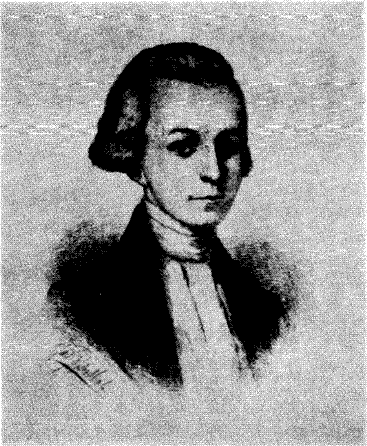
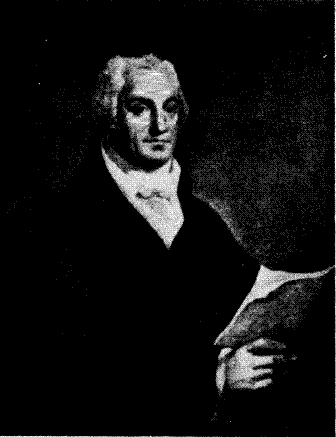
WILLIAM DUER
(From an etching by Max Rosenthal)
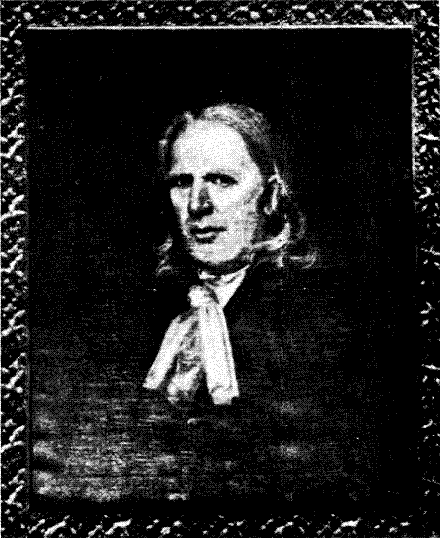
JOEL BARLOW
(From a portrait by R. Fulton)
JOHN CLEVES SYMMES
(Reproduced from Bond’s The Correspondence of John Cleves Symmes)
In 1770, Symmes moved to Sussex County, then on the western frontier of New Jersey. He joined the patriotic cause at the outbreak of the Revolution, and served in the New Jersey militia. His military record commended him as a tried and able leader. His record in the civil service of his adopted state was also honorable. Removing to Morristown, N. J., in 1780, he was elected to the Continental Congress in 1785. Here he acquired the political influence and the personal contacts which were of valuable assistance to him in putting over his scheme of western colonization.
Jonathan Dayton, who became Symmes’ partner in the Ohio land deal, was also a Revolutionary veteran and a member of Congress from New Jersey. Dayton remained in Congress after the adoption of the Constitution, and was Speaker of the House during the years 1793-1797. The strength of his political influence, together with his superior business acumen, helped Symmes in his negotiations with Congress. Although at times the two partners were somewhat at loggerheads in their business relations, they never suffered a complete rupture of their friendship.
Such is not the case of Symmes’ relationship with Elias Boudinot, his third partner in the Ohio land purchase. Boudinot also was a Jerseyite, and of greater political prominence than either Symmes or Dayton. He was at one time President of the Continental Congress, and was a member of Congress under the new Constitution, from 1785 to 1795. Like Symmes, he became very much interested in western lands. It was his powerful political influence which was largely instrumental in putting through Symmes’ “Miami Purchase.” He also acquired a half interest in the tract which Symmes reserved for himself as a speculation, and, in addition, became the owner of large sections in other parts of the purchase. Toward the end, Boudinot and Symmes had a dispute regarding the division of the “reserve lands” and the former took legal action to compel Symmes to furnish him with deeds for his portion.
Although Boudinot and Dayton, as members of Congress, pushed through the Miami Purchase, and became active participants in the deal, the origination of the idea and the execution of the plan must be credited to John Cleves Symmes alone. It is said that the “western urge” was communicated to Symmes by his neighbor, Benjamin Stites, who went on a trading trip down the Ohio River in 1786. Stites became an enthusiast regarding the prospects of the Ohio country, and selected the region between the two Miami rivers as offering the best locations for settlement. In the spring and summer of 1787, Symmes himself visited the region and was likewise impressed with its resources and prospects.
At first he planned a colony on the Wabash River above Vincennes, in the region formerly claimed by the United Illinois and Wabash Land Companies, and went as far as to issue a “prospectus” addressed to the people of Kentucky. This is described “as a masterpiece of its kind in the inducement it offered to settlers.” In this document, Symmes announced that he hoped to “induce Congress to lend a favorable ear” to his petition, since he meant “not to solicit a grant merely for himself, but on behalf of all those who will signify to him their wishes to become adventurers, and will subject themselves to a proper system for safe settlement and the government which it is expected will be established by Congress.”11
Notwithstanding his proposal of adherence to the government “which is expected to be established by Congress,” the fact that Symmes addressed his appeal to the “People of Kentucky”—then strongly dissatisfied with the federal administration—and invited settlement, “with artillery and military stores” before he ever had title to the land, led General Josiah Harmar, who was the military governor of the district, to send a copy of the prospectus to the Secretary of War for the information of Congress. Congress did nothing about the matter, however, and on his return to the East, Symmes gave up the idea of the Wabash settlement, and turned his attention to obtaining a grant in the Miami section.
Doubtless, he was influenced in this choice by the Congressional grant that had just been made to the Ohio Company in the Muskingum Valley. The lands bordering on the west of this grant, comprising the district between the Scioto and Miami rivers, had been reserved by Congress for the holders of Virginia military land warrants, so the section nearest to the Ohio Company’s land available for private purchase was the region lying on the Ohio River between the Miami and the Little Miami rivers. It was an ideal location for a settlement, since the rivers afforded navigation for commerce with the southwest. Symmes impetuously petitioned Congress for the whole of this region, comprising about 2,000,000 acres. He later reduced his demand to 1,000,000 acres, but was particular to designate the most favorable boundaries. He insisted upon, and he received, the same terms as Manasseh Cutler and Winthrop Sargent had been granted, when acting for the Ohio Associates. The contract was signed October 15, 1788, and the first payment of $82,198 in debt certificates and soldiers’ warrants was made.
In the meantime, Symmes, in a determined effort to secure settlers, and in order to make the required initial payment, had been issuing prospectuses, pamphlets and advertisements. He invited Revolutionary veterans with land warrants, and owners of federal debt certificates, to enter the deal. One of his advertisements which appeared in the Brunswick Gazette, January 7, 1788, reads, in part, as follows:
The subscriber having succeeded with Congress in obtaining that most excellent tract of land on the northwest bank of the Ohio, between the great and little Miami rivers, begs leave to state some particulars to those gentlemen who may not meet with a small pamphlet already published on the subject.
In the first place it ought to be observed, that no dispute respecting titles in the first instance, can possibly arise, these will be clear and certain, as the whole purchase will be surveyed into sections of one mile square, and every line well marked, and the sections numbered, and every number which may be sold shall be recorded to the first person applying to the subscriber therefor. The land is allowed (all circumstances considered) to be the best tract in the federal country: It lies in north latitude thirty-eight degrees, and the same with Virginia. Horses, cattle and hogs can live well in the woods, where there is abundance of food through the winters, which are very moderate: Every kind of grain and vegetable raised in the middle states grows here, with the addition of cotton and indigo, which may be raised in sufficient quantities for family use. The land is generally free from stone and a rich, easy soil for tillage. There are no mountains and few hills, so that the country for the most part is level: It is extremely well watered throughout, and surrounded on three sides by rivers navigable in the boating seasons; vessels may be built here of two hundred tons burden, and being fully freighted may be navigated with safety to New York, or any other sea-port. The finest timber of every kind known in the middle states, with many other sorts of more southerly production, grow in plenty here, but there is very little underwood or brush. Millstones and grindstones are found in some of the hills. Wild game and fish may be taken in abundance. Salt is now made to any quantity, in Kentucke, opposite this tract on the south-east side of the Ohio, where seven counties are already considerably settled and where any number of neat-cattle may be had very cheap.
As payment was to be made in “debt certificates,” Symmes exchanged land warrants for this currency. He also made actual sales of land prior to the grant, something which was destined to cause him considerable trouble. But the important transaction which concerns us, as a land speculation, was his reservation of the most valuable section of the grant for himself. This reserved section, consisting of over 40,000 acres, bordering on the Ohio River, and covering the present city of Cincinnati, he divided up into twenty-four shares. He made Elias Boudinot an equal partner in this territory and then offered and sold to speculators a considerable part of these shares on their joint account, even before he started west with his settlers. All this was done in advance of the signing of the definite purchase contract. Symmes was so anxious to launch his undertaking that he actually set out for Ohio in July, 1788, three months before he obtained the right to the land, leaving to Boudinot and Dayton the task of completing the legal formalities.
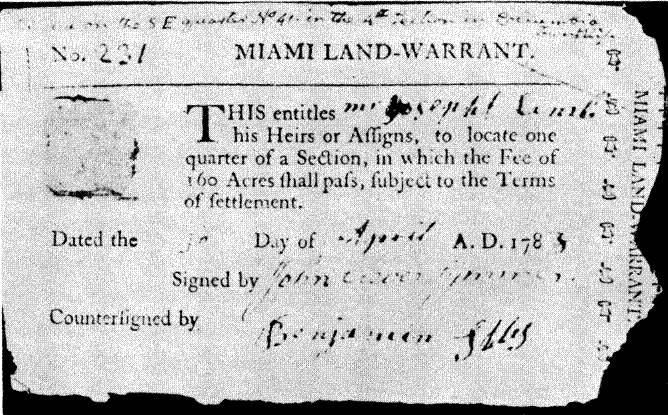
A MIAMI LAND-WARRANT
(Collection of the Historical and Philosophical Society of Ohio)
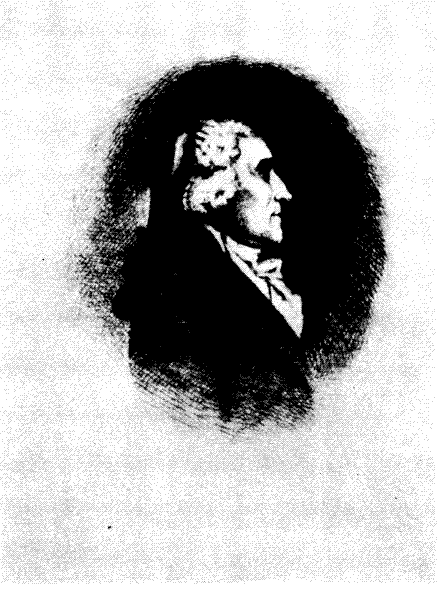
JONATHAN DAYION
It is generally believed that Symmes’ object was patriotic and idealistic, and that it was free from the stigma of land speculation. That this is an erroneous view is proven by his correspondence and his activities subsequent to making the purchase. The fact that, from the very inception of his enterprise, he made a reservation of the best section for the benefit of himself and partners is an indication that his humanitarianism was diluted with personal avarice. In his Trenton circular, addressed, “To the Respectable Public,” issued November 26, 1787, he openly stated:
The subscriber hopes that the respectable public will not think it unreasonable for him, when he informs them that the only privilege which he reserves for his trouble in the business, is the exclusive right of electing or locating that entire and exclusive township which will be the lowest point in the point of land formed by the Ohio and Miami Rivers, and those three branching parts of townships which may be northwest and south of such entire township.
When this reservation, together with his hasty departure west before the contract was signed, became known, it aroused considerable political opposition to his grant. Both Dayton and Boudinot had much difficulty in overriding the opposition. Competitive land companies insidiously attacked the idea of a “proprietor’s reserve” by advertising that their own projects permitted all to come in on equal terms. Judge Symmes met their attacks in a public statement, published in the New Jersey Journal, March 19, 1788, in which he denied that the proprietors’ lands along the Ohio and Miami Rivers were the most desirable. The suspicion persisted, however, and an unsigned squib, in the same newspaper, ironically described Symmes’ emigrants as “going west to the emolument of certain gentlemen who have a particular genius for land jobbing.” In a letter to Dayton, dated August 21, 1788, Symmes boldly stated:
My appropriation of a township at the confluence of the two Rivers, and the mode adopted by me in disposing of the same, I still conceive, to have been my province alone, and of which no one with propriety can complain.12
The proprietors’ “reserve” selected by Symmes, despite his public statement to the contrary, covered the most accessible and fertile lands in the Miami Purchase. It includes today within its limits the City of Cincinnati, that Queen City of the West, in which Symmes originated the “town-jobbing” business, which became a mania in the Northwest Territory for many years thereafter. Each owner of the twenty-four shares representing the “proprietors’ reserve” was required to pay £200 per share into a joint account of the original proprietors, i.e., Symmes and Boudinot. For this payment, each share was to receive “a square” in the proposed city (i.e., Cincinnati) and a proportionate part of the remaining reserved section. In later years, some dispute arose among the shareholders over the divisions of the lands, and, as already noted, Boudinot was impelled to enter suit against Symmes to obtain his allotment.
Symmes lost no time in pushing land sales. For this purpose, he engaged a number of agents in New Jersey as well as in the new settlement. Sales continued for some time on a moderate scale in all parts of his purchase. When final surveys of the tract were made, however, they revealed that it contained only slightly more than one-half of the expected million acres. The proprietors soon discovered that they had “oversold.”
This, at first, did not seriously disturb Symmes. He persisted continuously to make demands on Congress for the full million acres designated in the contract. One of his handbills, dated January 20, 1797, almost ten years after the date of his purchase, reads as follows:
TO THE PUBLIC
It being a matter, no longer doubtful, that Congress will establish their Contract with the Subscriber, in the fullest extent of One Million of Acres of Miami Lands, It is hoped that all who wish to become purchasers, will not longer suffer themselves to be amused with the idle reports against the Contract, but purchase immediately from some Persons who have a right to sell. And those Gentlemen who have already contracts for Miami Lands, are desired to make payment as soon as possible to Wm. H. Harrison at Fort Washington, as the Secretary of War has agreed to receive Twenty Thousand Dollars at Fort Washington from the Subscriber, if the money be paid immediately for the use of the Army.
JOHN CLEVES SYMMES
Jan. 20, 1797.
Thus Symmes was confident that he would get his million acres. He accordingly continued to sell lands lying outside his grant. This caused him considerable annoyance later, and ultimately led to his financial ruin. Numerous suits were filed against him by purchasers whose titles were rejected by the government. The judgments obtained by them brought him into a condition of bankruptcy. His large land holdings were seized and sold piecemeal under the hammer.
Moreover, after 1790, Congress adopted Hamilton’s plan of disposing of the public domain in small plots on easy terms to individual purchasers, and steadfastly refused to accede to Symmes’ petitions for the unpatented sections of his million acres. He had contracted to pay for his grant at the rate of only 66 ⅔ cents per acre, payable in depreciated debt certificates. As Congress had placed a minimum price of $2.00 per acre on public lands, Symmes saw a remarkable opportunity for profit in his land deal with Congress. But Congress was obdurate. The agitation against land grabbing was too strong to be politically ignored. The petition of two designing land grabbers—Royal Flint and Joseph Parker—for an Ohio grant was rejected. A similar petition for a tract on the Mississippi River just south of Ohio, made by Colonel George Morgan, one of the proprietors of the old Indiana Company, was also given little heed. Henceforth, public land was not to be sold at wholesale to speculators.
The total acreage that Symmes had patented to him amounted to but 311,862 acres. The actual cost in specie was probably less than $50,000, but, of course, Symmes and his associates incurred other expenses in acquiring and improving the tract. Naturally, he was much embittered by his inability to receive all the acreage he contracted for. This is reflected in his last Will and Testament, in which he complains of having been treated “with the blackest ingratitude” by the United States. “Many of those,” he stated, “who now laugh at my calamity, . . . would this day be toiling in poverty had not my enterprise to this country, my benevolence on the property that they have plundered from me, have made them rich.”
Symmes undoubtedly served the country well in settling the Miami lands on the Ohio. He took up his residence on his grant and was active in the administration of its welfare. His difficulties were many. Indian attacks, settlers’ complaints, shortage of provisions, riots and disease were prevalent. He bore all with indomitable courage. He is described by Thomas Ashe in 1806 as living in a noble stone mansion, surrounded by improved farms, villages, and country seats. “The banks of the River,” noted Ashe, “are settling with unparalleled success, and the title to all the adjacent lands is bought up by individuals and speculators who propose selling again at an advance price. Most of the prairie ground are now as high as from twenty to fifty dollars per acre, and the woodland adjoining the river at from five to sixteen dollars per acre.”13 Symmes had paid Congress for the same land less than twenty years previous but a few cents an acre.
As is customary in human experience, the pioneer and promoter did not profit. Symmes died February 26, 1814, in almost hopeless poverty. Though his venture was a great financial disappointment to him, due, as he claimed to “the unjust claims against him founded upon the deepest conspiracy that had ever destroyed the earnings of an industrious, frugal and adventurous life,” be brought to completion his dream of a western colony which gave a fresh impetus to American territorial growth and expansion at the beginning of the nineteenth century. His claims to fame rest not alone on his enterprise in western settlement, but because of his emigration to the frontier. Through his western venture he became the father-in-law of the warrior President, William Henry Harrison, and a great-grandfather of Benjamin Harrison, also a President of the United States.
Symmes had associated with him a number of prominent land jobbers, whose cupidity and zeal were attracted by the speculation. In addition to Jonathan Dayton and Elias Boudinot, there was James Wilkinson, soldier of the Revolution, who had settled in Lexington, Ky., where, in addition to carrying on an extensive trade with Louisiana, he speculated heavily in western lands. Reentering the army in 1791, he continued his land deals, and later was suspected of treasonable intrigues with the Spanish, and of complicity in Burr’s Conspiracy. Even after his removal from the army in 1815, he kept up his interest in land speculation. He died in Mexico City in 1825, when on a mission to obtain a Texas land grant.
Israel Ludlow, prominent land surveyor in the Ohio country, who laid out the Symmes patent, also became mildly infected with the land mania. Still another was General Arthur St. Clair, first governor of the Northwest Territory.
Jonathan Dayton, together with St. Clair, Ludlow and Wilkinson, jointly purchased from Symmes the tract between the Miami and the Mad rivers. On this, Ludlow laid out the town of Dayton in 1795. The proprietors offered in Cincinnati the “in-lots” at ten dollars a lot, and the “out-lots” at still lower prices. The town jobbing proposition gave fair promise of success, until the site was declared to lie outside the area of Symmes’ original grant. At this time, Jonathan Dayton was speaker of the House of Representatives, occupying, as Symmes expressed it, “honor’s easy chair” at $12 a day. His great political influence and his “wire-pulling,” however, were not powerful enough to lead Congress to yield to the petition to have the town bearing his name placed within the Symmes Purchase. The “lot purchasers,” therefore, had to pay the “government price” to the national land office, if they desired a clear title. Some of them did this, but many of the purchasers of the “out-lots” abandoned their properties.
.....
Symmes’ Miami Purchase was the last sale of government land at wholesale. But it was not the last of the wholesale Ohio land gambles. The State of Connecticut had persistently claimed title under its charter grant to territory beyond its eastern boundary. After much haggling and bickering with the federal government, a compromise plan was adopted whereby Connecticut in 1786 ceded to the nation all lands beyond the Alleghanies, but reserving a strip of territory, comprising about 3,500,000 acres, bordering on Lake Erie. This became known as the “Connecticut Western Reserve.” A part, covering about one-half million acres, was set aside by the state and allotted to the residents of New London and other Connecticut towns that had suffered from British depredations. These were known as the “Fire Lands.” But the greater portion was left undisturbed.
The state authorities did not press its disposal. Its citizens, however, already intoxicated by their profits from speculation in government debt certificates, and seeking for further opportunities for gain, were eager to get possession of this fertile and accessible western domain. In order to obtain the support of the dominant Congregational Church, a bill was introduced in the Connecticut Legislature in 1791, proposing the sale of the land and using the proceeds for the support of the ministry, thus dispensing with a portion of the state tax which was then levied for their maintenance. Two years later, the bill was again introduced in amplified form, allotting the proceeds to the support of all ecclesiastics in the state. Though it passed, it created such strong opposition that in May, 1795, an amendment to the measure was passed, applying the proceeds to the establishment of a general school fund.
A committee was then appointed to effect the sale of the Western Reserve. Rival bids were received. One group of bidders was headed by John Livingston, of New York City, and another by Oliver Phelps, both previously concerned in the western New York speculation. Phelps succeeded in buying off Livingston by proposing to turn over to the latter’s syndicate all the land in the Western Reserve in excess of 3,000,000 acres. The “Excess Company” was organized to receive this surplus. This bubble concern was later sold for $50,000 to General William Hull, the surrenderer of Detroit to the British. When the final survey proved there was no excess acreage, Hull was threatened with the total loss of his investment at one fell swoop. In order to avoid trouble with him, the successful bidders for the Western Reserve gave him a share in their purchase.
Having eliminated competitive bidders, a syndicate, headed by Oliver Phelps, struck a bargain with the Connecticut commission appointed to dispose of the Western Reserve. For an aggregate sum of $1,200,000, the entire unappropriated Ohio, lands of Connecticut were sold to a group of thirty-five individuals, each of whom gave a separate bond to secure his portion of the purchase. Payment in cash was to be made September 2, 1800, with interest at 6 per cent computed from September, 1797. Thus, the purchasers had ample time to raise the required funds before their payments fell due. Oliver Phelps, however, because of the magnitude of his individual participation, agreed to pay on demand. It is quite evident that Phelps, who had safely crawled out of his gigantic New York land venture, was the chief promoter as well as the chief participant of the deal. Of the total sum of $1,200,000, he subscribed for $168,185 on his own account, and jointly with Gideon Granger, Jr., he assumed $80,000 additional. The remaining thirty-three subscribers took up various amounts ranging from $85,000 downward. All were New Englanders, and the chief participants were stockholders and “managers” of the recently organized Bank of Hartford.
The purchasers immediately organized themselves into an association called the “Connecticut Land Company.” The shares numbered 400 and were distributed in accordance with the portion of the purchase price paid by each subscriber. Each share, therefore, represented $3,000 of the purchase money, but it was convertible into an indefinite quantity of land based upon the results of a survey. It was the apparent intention of the shareholders to take over this land and dispose of it at a profit. As a survey had not been made at the time of the purchase, the separate proprietors deeded their respective claims to the land in trust to John Caldwell, Jonathan Brace and John Morgan. Moreover, it was required of the purchasers that they extinguish the Indian title, and also stand the cost of the surveys. Accordingly, each share was assessed $10 to cover these costs. In order to prevent the largest shareholders from dominating the affairs of the association, a limitation was placed on the voting power, but in the partition of the territory, every share was entitled to its proportionate quantity of land. Isaac Cleaveland, a Connecticut surveyor, and also one of the proprietors, was appointed the general agent of the company. He went west to make the surveys, and, incidentally, he laid out the city of Cleveland.
When surveys of the purchase were completed, it revealed a total of 2,841,471 acres. Although some townships were sold in units to speculators, a large part of the lands were drawn by lot by the individual proprietors, the last drawing taking place in 1809. The resolution originally adopted by the proprietors to resell only to actual settlers was not generally carried out.
It is quite evident that both the Connecticut state authorities and the purchasers tried to avoid the appearance of “speculation” or “land jobbing” in the deal. The sale was made to the “subscribers” individually, though no definite “plots” could be assigned to each. Each bought a “pig in a poke.” But this was not uncommon in those days of “wild land” sales. Moreover, the question of the title and jurisdiction of the purchase was not settled. Connecticut’s claim to western territory was never fully acknowledged by the other states. Neither did the federal government consent to the political suzerainty of Connecticut in the Western Reserve. When the agents of the Connecticut Company began to survey the region, General Arthur St. Clair, Governor of the Northwest Territory, claimed authority over it. A dispute arose. This seriously handicapped the resale in Connecticut of the proprietors’ preëmption rights. They grew impatient, and demanded that the status of their purchases be fixed. Finally, in 1800, in return for a surrender by Connecticut of all claim to territory west of her eastern boundary, Congress acknowledged her ownership right of the Western Reserve, and accepted the political jurisdiction over it.
Then began the Connecticut trek to the west! It threatened to depopulate the state. A rage for moving seized rich and poor alike. The Connecticut Company’s lands were eagerly sought after and sold at favorable prices for the proprietors. In 1809, they divided up the little that remained unsold and disbanded. A small group of the shareholders pooled their plots, and under the cognomen of the “Erie Company,” continued to dispose of lands to settlers until 1812.
So popular was the western lure to the Connecticut gentry that legislation was urged to countermand it. “Young people in their plays at social gatherings marched to rude melodies which taught them to dream that toward the setting sun lay an earthly paradise with gates open to welcome them. From hill and valley the processions hurried away. Today, many of our rural towns are scarred and paralyzed by an outflow which has built up the continent to no small degree at their expense.”14
Washington Irving’s description, in his charming Legend of Sleepy Hollow, of Ichabod Crane’s desire to marry the fair Katrinka Van Tassel, and, with her dowry, purchase supplies, oxen and a covered wagon and move westward, is a contemporary delineation of the Connecticut Yankee’s urge:
As the enraptured Ichabod rolled his great green eyes over the fat meadow-lands, the rich fields of wheat, of rye, of buckwheat, and Indian corn, and the orchard burdened with ruddy fruit, which surrounded the warm tenement of Van Tassel, his heart yearned after the damsel who was to inherit these domains, and his imagination expanded with the idea how they might be readily turned into cash and the money invested in immense tracts of wild land, and shingle palaces in the wilderness. Nay, his busy fancy realized his hopes, and presented to him the blooming Katrina, with the whole family of children, mounted on top of a wagon, loaded with household trumpery, with pots and kettles dangling beneath; and he beheld himself bestriding a pacing mare, with a colt at her heels, setting out for Kentucky, Tennessee, or the Lord knows where.
But it was not Kentucky or Tennessee that Ichabod Crane’s Connecticut brethren sought as a place of prosperous abode in the early part of the nineteenth century. Many cleared wild tracts in the Holland Purchase in western New York, but a large number passed by way of the “Pittsburgh Pike,” or the Buffalo gateway, to the fertile plains of the Western Reserve. Here they laid out farms, built roads, planned canals and started the city of Cleveland and other flourishing communities. Here came the ancestors of the Shermans, the Bancrofts, the Hayes, the Garfields, and the Cookes. Here in a space of ten years were settled 150,000 white inhabitants, sturdy and steady, zealous to undertake great things; and, when the land further west offered profitable gain or a promise of a larger supply of material goods, they, like their ancestors, took up the westward march and went.
15 See Joseph Stencliffe Davis, Essays in the Earlier History of American Corporations, Vol. I, pp. 132-136.
16 See Cutler, Manasseh Cutler, Vol. I, p. 496.
17 Archer B. Hulbert, The Records and Proceedings of the Ohio Company, Vol. I, p. lxxvi.
18 Payson Jackson Treat, The National Land System, pp. 57, 58.
19 J. S. Davis, Essays in the Earlier History of American Corporations, Vol. I, p. 139.
20 Ibid., p. 231.
21 See Chapter II, p. 36.
22 Davis, op. cit., p. 221.
23 Thomas Ashe, Travels in America, Performed in 1806, Vol. II, p. 86.
24 John Bach McMaster, History of the American People, Vol. II, p. 146.
25 Beverley W. Bond, Jr., The Correspondence of John Cleves Symmes, pp. 278-281.
26 Bond, op. cit., p. 38.
27 Thomas Ashe, Travels in America, Performed in 1806 First Edition, Vol. II, p. 248.
28 P. H. Woodward, One Hundred Years of the Hartford Bank, p. 74. See also R. J. Purcell, Connecticut in Transition, p. 154.
- 1Maine Historical Collections, Vol. II, pp. 268-294.
- 2The Sir William Johnson Papers, Vol. V, p. 129. See also, C. W. Alvord, The Mississippi Valley in British Politics, Cleveland, 1917.
- 3Herbert B. Adams. “Washington’s Interest in Western Lands,” Johns Hopkins University Studies, Third Series, No. 1, January, 1885. Italics are mine.—A. M. S.
- 4Adams, op, cit., p. 58.
- 5See A. Henderson, “A Pre-Revolutionary Revolt in the Old Southwest” in Mississippi Valley Historical Review, Vol. 27, p. 198 et seq.
- 6Italics are not in the original.
- 7In a letter to William Franklin, dated May 3, 1776, Johnson asserted “it has always been my practice to avoid engaging in lands to the great loss of my family, neither have I a foot of land from the Indians.” (Sir William Johnson Papers, Vol. IV, p. 197.) The large tract north of the Mohawk Valley given him by the Canajoharie Indians in 1760 was confirmed by royal grant in 1769.
- 8See Pennsylvania Magazine of History, Vol. XIV, pp. 218, 219.
- 9See Memorial of the United Illinois and Wabash Land Companies, Baltimore, 1816.
- 10A copy of the deed is contained in American State Papers, “Public Lands.” Vol. I. The original copy was acquired by Cyrus H, McCormick.
- 11See J. P. Boyd, “Connecticut’s Experiment in Expansion, The Susquehannah Company, 1753-1803,” in Journal of Economic and Business History, November, 1931.
- 12See Publications of the Colonial Society of Massachusetts, Vol. XXV, PP. 33-38.
- 13Samuel W. Jones, Memoir of James Duane, 1852.
- 14P. H. Woodward, One Hundred Years of the Hartford Bank, p. 74. See also R. J. Purcell, Connecticut in Transition, p. 154.
- 15During the first hundred years of North American colonization, economic conditions gave little encouragement to private land schemes. Land was too plentiful. A few such enterprises were undertaken, however. Thus, as early as 1661, the Colony of Massachusetts sold to a few individuals for £400 a large tract on the Kennebec River in Maine. This became known as the “Kennebec Purchase.” The heirs held it for nearly a century without doing anything with it. In 1753, they incorporated as the “Proprietors of the Kennebec Purchase” and proceeded to dispose of their holdings. The corporation continued in existence until 1816. “The Pejebscot Company” was another Maine land deal. None of these held out promise of profit to proprietors until about a quarter century before the Revolution.
- 16In the meantime, the “Loyal Company” group was not idle; its proprietors sent Dr. Thomas Walker, of Albermarle, Va., to make a reconnaissance, and to discover a proper place of settlement. The two “companies” then became engaged in a controversy, and neither made a survey or fixed the bounds of their grants. The apparent ease with which they obtained land donations led to other schemes, and aroused an epidemic of interest in distant western wild lands. Not only was the land ownership eagerly sought after, but the establishment of new colonies, with separate and distinct governments, was planned. Favoritism and collusion infested the Virginian colonial government, due in large part to the persistence of speculators in western land grants. Lobbyists were sent to London to obtain the crown’s sanction to land-grabbing schemes and the question of the disposal of the vast western domain won from the French infested British politics. “One half of England is now land mad,” wrote George Croghan, of Philadelphia, one of the land schemers, to Sir William Johnson, on March 30, 1766, “and everybody there has their eyes fixed on this country.”
- 17I offered in my last to join you in attempting to secure some of the most valuable lands in the King’s part, which I think may be accomplished after awhile, notwithstanding the proclamation that restrains it at present and prohibits the settlement of them at all; for I can never look upon that proclamation in any other light (but this I say between ourselves) than as a temporary expedient to quiet the minds of the Indians. It must fall, of course, in a few years, especially when those Indians consent to our occupying the lands. Any person, therefore who neglects the present opportunity of hunting out good lands, and in some measure marking and distinguishing them, for his own, in order to keep others from settling them, will never regain it.
- 18Crawford “heartily embraced” the colonel’s offer. He promised shortly to set out in search of lands. “This may be done,” he said, “under a hunting scheme.” He acknowledged that other land seekers had approached him, with similar offers, “but have not agreed to any; nor will I with any but yourself or whom you think proper.”
- 19Judge Richard Henderson of North Carolina, the employer and backer of Daniel Boone, promoted the settlement of the Kentucky region and claimed ownership to a vast unsettled tract there. He organized a group of land grabbers under the name of “The Transylvania Company.” Ignoring the British interdiction against Indian land purchases, he obtained from the Cherokees in 1773 about one-half of the present State of Kentucky, and immediately began settling the land. He advertised widely for pioneers and “shareholders.” In his announcements, Henderson waxed enthusiastic. “The country [Transylvania] might invite a prince from his palace, merely for the pleasure of contemplating its beauty and excellence, but only add the rapturous idea of property, and what allurements can the world offer for the loss of so glorious a prospect?”
- 20When the British Government began to take active measures to break up land “bootlegging,” and to put a stop to dreams of riches in western territory, Virginia’s political resentment was naturally aroused. Even Thomas Jefferson, who, in later life, frowned upon speculation and land grabbing, held the view in 1774 that the land did not belong to the British king, and that it was time for the colonies “to declare that he has no right to grant lands of himself.” So he boldly wrote in the Declaration of Independence, as one of the British king’s usurpations: “He has endeavored to prevent the Population of these States; for that purpose obstructing the Laws for Naturalization of Foreigners; refusing to pass others to encourage their migrations hither, and raising the conditions of new Appropriation of Lands.”
- 21He was for it at once. “I like the project of a colony in the Illinois Country,” he wrote his son, “and will forward it to my utmost here.” He thought that Sir William Johnson’s “approbation will go a great way in recommending it, as he is much relied upon in all affairs that may have any relationships with the Indians.” But Johnson had an eye on the Indian lands himself, and besides advising others about purchases in the outlying sections, personally through gifts from the Indians engrossed large tracts, particularly in the Mohawk Valley. The town of Johnstown, N. Y., still marks the seat of his domain.
- 22Some of the members of the Vandalia Company were concerned in other western land schemes. One of these was organized in 1775 as the “Indiana Land Company,” probably the first application of the name “Indiana” to the Northwest Territory. The claim to land was based on a grant of a large tract, made November 3, 1768, in what is now West Virginia, by the Six Nations at Fort Stanwix to “Chief” William Trent in liquidation of depredations. Among the shareholders were Samuel Wharton, Joseph Galloway, Robert Callender, Levi Andrew Levi, and David Franks, all wealthy and prominent Philadelphians. The Revolutionary War did not put an end to the “claim.” Wharton in 1776 published a pamphlet, entitled-View of the Title to Indiana, in which he defended the company’s rights to the lands. In 1781, he republished this in enlarged form, under the title Plain Facts; being an examination into the Rights of the Indian Nations of America to their respective Countries and a Vindication of the Grant from the Six United Nations to Proprietors of Indiana, etc. Although Wharton pressed the validity of the “proprietors” claims, Congress then and thereafter gave little heed thereto.
- 23Notwithstanding the British Government’s edict, forbidding the private purchase of lands from the Indian tribes, William Murray, an Indian trader, and several of his business associates, in 1773 formed a plan to buy from the aborigines an immense tract of country between the Mississippi, Illinois and Ohio rivers. After a “pow-wow” lasting a month, the sale was consummated. According to the land claimants, it was attended by “many persons of both descriptions and the Indians were carefully prevented from obtaining any spiritous liquors during the whole continuation of the negotiation.” On July 5, 1773, “for a very large and valuable consideration,” the deed was delivered to the “Illinois Land Company.”
- 24Notwithstanding the British Government’s edict, forbidding the private purchase of lands from the Indian tribes, William Murray, an Indian trader, and several of his business associates, in 1773 formed a plan to buy from the aborigines an immense tract of country between the Mississippi, Illinois and Ohio rivers. After a “pow-wow” lasting a month, the sale was consummated. According to the land claimants, it was attended by “many persons of both descriptions and the Indians were carefully prevented from obtaining any spiritous liquors during the whole continuation of the negotiation.” On July 5, 1773, “for a very large and valuable consideration,” the deed was delivered to the “Illinois Land Company.”
- 25The proposition then took on a business aspect. The number of “shares” was increased, and rights to subscribe offered at from $2 to $5 per share. It attracted speculators. The shares soon rose in value. Lawyers, clergymen and politicians began buying shares. The Reverend Ezra Stiles, President of Yale College, grandfather of the poet-physician Oliver Wendell Holmes, took 2¾ shares. The Governor of Connecticut, Roger Walcott, who had become rich through local land deals, supported the project.
- 26New York, before the Revolution, also had her “land” quarrels with the other colonies. The ill-defined boundaries of the Dutch province led to constant conflicts and legal controversies with her neighbors. There was a bitter dispute with New Hampshire regarding the political jurisdiction of Vermont. New York claimed the section, but New Hampshire, in 1749, acting on the principle that possession is nine points of the law, began to make free grants to both New Hampshire and Massachusetts citizens. Whole “towns” of 23,000 acres, more or less, were granted to selected groups of individuals. It is estimated that between 1749 and 1764, Governor Benning Wentworth granted 131 townships to more than six thousand persons. Among the grantees appear the names of many prominent colonial New Englanders, who had no intention of ever settling on the lands. Samuel Adams was among them. He was known as a speculator in both Maine and New Hampshire lands in this period. The governor granted himself, in all, about 65,000 acres, and is reported to have accumulated considerable wealth from the heavy fees exacted by him for grants.
- 27Because of his land deals, while acting as the state’s attorney, Duane was the butt of political criticism. He was led to appear in person in his own defense before the state legislature in 1781. He was charged with receiving Vermont grants “under immoderate quit-rents, and excessive fees of office,” and he was also accused of “holding many thousand acres of land which had never before been granted by the Crown.” To this he merely answered that he “had never made a purchase or obtained a grant of land with any view to its sale.” He was therefore not a “land jobber.” This cleared him politically of all corruption.
- 28So popular was the western lure to the Connecticut gentry that legislation was urged to countermand it. “Young people in their plays at social gatherings marched to rude melodies which taught them to dream that toward the setting sun lay an earthly paradise with gates open to welcome them. From hill and valley the processions hurried away. Today, many of our rural towns are scarred and paralyzed by an outflow which has built up the continent to no small degree at their expense.”

