
The Great American Land Bubble
Chapter XII. California’s Golden Land Gambles
“IN ALL the new states of the Union, land monopolization has gone on at an alarming rate,” wrote Henry George, California philosopher and economist, in 1870, “but in none of them so fast as in California, and in none of them, perhaps, are the evil effects so manifest.”1
Henry George, though a native of Philadelphia, spent the golden years of his life in California. Here he noted growth in land values in the progress of time. Here he witnessed land grabbing dating back to the Spanish period, and here he saw the evils—but ignored the benefits—of speculation. The ardent single taxer undoubtedly absorbed his economic philosophy from the landed property situation in the Golden State. Had he been reared in the midst of the violent land speculations of post-Revolutionary times, had he personally witnessed the loss of great fortunes, the utter collapse of great land schemes, and the fiascos of town-jobbing just prior to 1837, he might have adopted different views.
California occupies an exceptional situation as an episode in American land speculation. At the time of its occupation by American forces, the country was still suffering from the effects of the speculative debauches culminating in the Panic of 1837. Feverish enterprise was stifled. Moreover, the Pacific Coast was then too inaccessible to make the region a playground for land booms. There were places in Texas, Florida, Kansas, Iowa and the great Northwest, which were nearer home, and to which settlers and immigrants could be attracted as a bait for the land shark.
But more than all this! Another sort of fever displaced that of land speculation in California, at the most opportune moment, i.e., when it became a new and frontier territory. It was the lure of gold—precious gold—actual, movable merchandise extracted from its soil, that almost obliterated all other gainful endeavors.
Gold was discovered in California, January 18, 1848. The reports of it reached the Atlantic States a short time thereafter. The rush of “Forty-Niners” then took place. “Land grants,” land titles or patents, were not required. Or, if they were, they were ignored. The ruling passion was to dig out the yellow metal. “Squatter sovereignty,” which under the national preëmption laws had already gained much headway in the frontier regions, was merely transferred to California. Who owned the soil from which gold was sifted or dug mattered little. The fortune seekers of all classes went there for it, and they insisted on their rights to take it. Anyone moving to California during the first two decades after the gold rush with the object of acquiring wealth through the purchase and sale of lands would have been regarded as insane.
Yet, more fortunes were made in California lands and real estate than in gold mining. And land grabbing became as prevalent in the Golden State as in the other new territories of the Federal Union. The old “Spanish grants,” which had been a disturbing political factor and a serious legal problem in the Louisiana territory, became here also a source of speculation and legal controversy. The period was characterized by the same sorts of fraud, villainy and corruption as have already been described.
It is quite conceivable that, even if gold had not been discovered in California just after the American conquest, real estate and land speculation would have flourished in the territory. San Francisco was a scene of town-lot manipulation as early as 1847. General S. Watts Kearny, American military commander of California, issued, on March 10, 1847, a proclamation, granting to the municipality of San Francisco “the right and title of the Government of the United States, and of the new territory, to the beach and water-lots on the eastern part of the town.” Within a week thereafter this property was ordered to be sold and the proceeds used by the town authorities. In that year, also, an important section of the town was laid out into streets by the public authorities and the vacant area converted into town lots.
A public sale of these lots took place. Speculators and investors bought altogether 450 lots at $12 per lot. Each purchaser was required to fence the lot, and erect a building thereon, within a year. At this time, the chief source of income of the city authorities was the receipts from the sales of public lots. Corruption prevailed, and it is reported that the choice sites were secured by speculators “under the old regulations” or by private agreements with the city officials.2
The next year (1848), another great public sale of town lots took place. Values had advanced, but owing to the best selections having already been engrossed, prices were disappointing. The price of lots ranged from $16 to $50, averaging about $22.50 each.
At this time, San Francisco was buzzing with the excitement of the gold discovery. A “boom” was on. The best locations had been snapped up by astute buyers, and they were demanding high prices on resale. In the meantime, immigration was rapidly adding to the population. “Squatting” became a general nuisance, both in the city and in the outlying districts. The “squatters” organized themselves into associations, and resisted efforts to oust them. In fact, “squatting” was the popular method of acquiring real estate even in the old Spanish days, and with “preëmption,” the byword for settlers on the United States public domain, the newcomers from “the states” set up their tents or cabins wherever they found a suitable vacant plot and defied those who claimed title to the property to dispossess them.
But the sale of “city lots” in San Francisco continued with increasing vigor. Speculation and corruption became intensified. Members of the City Council, i.e., the “Ayuntamiento,” and other political favorites figured largely as buyers. Horace Hawes, the recently elected “prefect,” i.e., mayor, protested that the best city lots were being taken by the speculators and politicians at ridiculously low prices. On his recommendation, the governor of the territory intervened and ordered the sales to stop. But the “Ayuntamiento” merely passed a formal resolution protesting that the governor had no legal right to interfere with the sale of city property. It then announced another sale of desirable “water lots” on March 15, 1850.3
Thus, the city for a while was bountifully supplied with revenue, and the land grabbers had a veritable feast. Among the “city councilors,” who obtained choice parcels of real estate were Samuel Brannen and J. W. Osborn, business partners; William H. Davis, Gabriel B. Post, Talbert H. Green, and Rodman Price. “The names of some of this delectable lot,” remarks a local historian, “are still perpetuated and honored by the people of San Francisco.”4
The prefect’s protests naturally angered the speculators. Their political influence, combined with the territorial governor’s own personal interests in the matter, led to the prefect’s suspension. He was accused of having corruptly granted land and having accepted fees illegally. But Horace Hawes, even after he was removed from office, continued to reiterate his accusation of fraud, in which he implicated the governor. He brought charges for impeachment, but the legislators threw out his petition. So the corruption in the sale of city lots proceeded undisturbed. Subsequent sales, however, brought increasing prices. In December, 1853, the city again offered the “water lots” it had received as a gift from the military representative of the national government. Some of these were far out in the bay and were covered with water. The size of individual lots was cut down one-half, but several brought as high as $16,000. “Four small size building blocks alone produced the enormous sum of $1,200,000.”5
There were apparently good reasons in this period for the rapid rise in real estate values in San Francisco, though, of course, speculation carried it beyond prudent heights. The town was the only good port accessible to the gold regions. It became the landing place of thousands of fortune seekers. It was the chief emporium for an immense back country where real money was being sifted from the soil by the increasing hordes of prospectors. As a contemporary annalist noted: “In two years space, the financier doubled his capital, without risk to himself; and the accumulation went on in geometrical progression. But chiefly it was the holders of real estate that made the greatest fortunes. The possession of a small piece of building ground in and about the center of business was a fortune in itself. Those lucky people who held lots from times before the discovery of gold, or who shortly afterwards managed to secure them, were suddenly enriched beyond their most sanguine hopes. The enormous rents paid for the use of ground and temporary buildings in 1849 made all men covetous of real estate. By far, the greater part had originally belonged to the city, formerly the so-called pueblo, or village of Yerba Buena, but the guardians of its interests from the conquest downwards, liberally helped themselves and their friends to the choice lots.”6
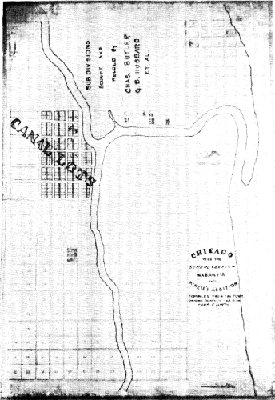
MAP OF CHICAGO, DATED 1836, SHOWING LOCATION OF THE “CANAL LOTS,” AND TRACTS BOUGHT AND RESOLD BY CHARLES BUTLER, G. B. HUBBARD, AND ASSOCIATES
(See pp. 248-249)
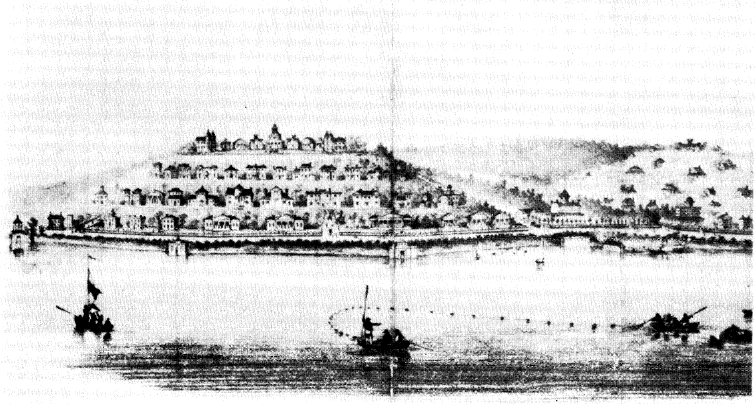
THE “PROPOSED” NEW BRIGHTON, STATEN ISLAND, DEVELOPMENT
(Reproduced from G. A. Ward’s Description of New Brighton on Staten Island, opposite the City of New York, 1836)(See pp. 251-252)
Retribution for this real estate mania—induced by the inflation of the gold rush—was soon to come. Hardly had the lot sale of 1853 ended, when real estate values collapsed. The market was glutted with the offerings of recent purchasers, who needed cash to complete their payments. The bottom seemed to have fallen out. The contemporary annalist thus describes the situation in March 1854:
Looking disinterestedly at the great extent of the ground around the city, still unbuilt upon, the number of empty stores, the acknowledged overdoing of commercial business, and, above all, the comparatively slow rate at which, of late, the population of the State and city is increasing, it appears to be highly probable that many years will pass before recent high prices will again be witnessed. Most likely, the present reduced prices for all kinds of real estate, but more particularly for unimproved lots, will continue for some months to fall lower. When the population of the State, and by consequence, that of its great Port, are materially increased, prices of real estate in San Francisco may be expected to rise far above the present, or even the recent high prices.7
One of the most adventuresome spirits during the early Frisco boom, who was carried down by the crash, was “Harry” Meiggs. He was a New York lumber merchant, who came to California in the early gold days—and, incidentally—he was a relative of the Texas Austins. Soon after arriving in San Francisco, he started a lumber business at North Beach, a section of San Francisco. He caught the “land fever,” and started a “development” there. He thought his title to the property secure, and began to buy and sell lots at one-fourth of the prevailing prices for lots in the central district. He argued that the city must grow toward North Beach, and as the water front lots along Yerba Buena Cove had made millions for those who bought them from the city, there was equally as good chance that his lots would prove as profitable purchases.
Accordingly Meiggs bought over 2,000 front feet of water lots at North Beach. Some of these he had no difficulty in selling. He had a pleasing manner, and a faculty for making friends. They called him “Honest Harry.” Moreover, he was a member of the City Council. The fever for water front lots, however, greatly subsided in 1854, and Meiggs found himself loaded down with a large part of his lots, on which he owed an unpaid balance on the purchase price, as well as unpaid assessments and taxes. His cash ran out. In order to obtain funds, he purloined signed city treasury warrants from the City Hall, and offered them as collateral for loans. Other dishonest acts were ascribed to him. But before his fraudulent practices were discovered, he had loaded a schooner and at early dawn, on October 6, 1854, secretly sailed out the bay, never again to return to California.
He was next heard of in Chile, where he had become a successful building contractor. But his greatest service to humanity—if it can be called such—was as virtual dictator of Peru, and as the most enterprising railroad builder in the western hemisphere. Charles R. Flint, in his interesting Memoirs of an Active Life, thus describes Meiggs’ remarkable career:
Don Enrique (as Meiggs was known in Peru) was a builder. He made millions, but it was the adventure and the power that lured him,—“el empresa,” the undertaking, as he expressed it. As a railroad builder, I should say he was fully in Hill’s class, and as a financier, in a class in himself. He remained an American, and although the money he was spending came from Europe, he bought most of his material for the railroads in the United States.
Meiggs died in 1877, and before his death, it is reported he “made good” many of his San Francisco forgeries, and paid those to whom he owed money when he absconded.
James Lick, another California pioneer and real estate magnate, furnished a good contrast to Meiggs. Instead of going from San Francisco as a bankrupt to Peru, Lick came to San Francisco from Peru, with considerable capital to invest. He was of Pennsylvania Dutch stock, and had left Lebanon County, Pa., to seek a livelihood in the piano business in South America. He arrived in San Francisco in 1847, and being “unlovable, eccentric, solitary, selfish and avaricious,” soon made money. He had an abiding faith in the future growth of his adopted city, and bought its real estate in immense amounts. His first acquisition was the ugly sand dunes back of the straggly village of Yerba Buena. But his business acumen kept him from the snares of speculation. He did not buy when prices were high, but waited until distressed owners were forced to sell. Though no one knew the extent of his acquisitions, or the prices he paid, it may be assumed that his largest purchases were made following the collapse of the boom, in 1854. He held on to his properties. In his real estate deals, he encountered many resistances over titles, and, it is said, was “often obliged to enforce his rights against squatters with a leveled pistol.”8
Lick did not confine his investments to city real estate, but purchased large tracts in the country around San Francisco. He did much to improve the city, however. He built the Lick House, for a time its largest and finest hotel. He also built, in the Santa Clara Valley, a “mahogany mill”—for no other purpose, it is said, than to carry out an oath that some day he would have a finer mill than his sweetheart’s father, who had refused him a daughter in marriage because of his poverty. His monumental contribution to humanity, of course, is the Lick Observatory on Mount Hamilton, under the dome of which he is buried.
“James Lick was not a bad man, as bad men go, nowadays,” remarks Hubert Howe Bancroft. “He made his money honestly, kept no corruption fund, and left it decently when he died, left it with regret, not so much from love of it, as because it troubled him that any one should be benefited by it.”9 His fortune at his death in 1876 was estimated as seven millions, all of it acquired through judicious real estate transactions.
Peter Smith was another interesting character in the early “boom” days of San Francisco. He became land rich, not by buying lots from the city or from speculators in straitened circumstances, but by accumulating “city scrip.” As in other boom towns, the corrupt local government of San Francisco went beyond its financial means in promoting public improvements. It could not meet its current indebtedness, and its warrants or “scrip” accordingly depreciated in value. In fact, the city’s treasury was bankrupt in 1851.
Smith bought up large quantities of this “scrip.” He subsequently used it to obtain, through execution of judgments, the unsold real estate still held by the city. In these operations, it is suspected that he was assisted by a “political ring” composed of municipal officials. The city property was sold at ridiculously low prices to satisfy the judgments. The transactions, popularly known as the “Peter Smith sales,” naturally created a scandal, which involved a number of San Francisco’s reputable citizens. Among these was David C. Broderick, United States Senator from California from 1857 to 1859. He bought, under judgment executions, sixteen beach-and-water lots, two south beach blocks and one “one-hundred vara” lot. These purchases and others bought in under the “Peter Smith” judgments, despite the political opposition and the outcry of “fraud,” were validated by court decisions after several years of litigation. The acquisitions included, besides the beach-and-water lots, the public wharves and the city “underwater” lands not previously disposed of. Today their monetary value is enormous.10
.....
Land speculation in early California was not confined to city lots and other real estate in San Francisco. The lure of the large estates obtained under Mexican grants also was the cause of considerable excitement. As happened previously in Texas, the Mexican Government and its appointees were exceedingly liberal in California in giving away parts of the public domain. It is estimated that prior to the American conquest, there were approximately 800 “grants” to individuals. These comprised a total of about 8,000,000 acres and embraced more than one-quarter of the cultivable area of the whole state. What a grand opportunity for land jobbers to acquire these “grants” from the reputed holders, and to resell at a profit!
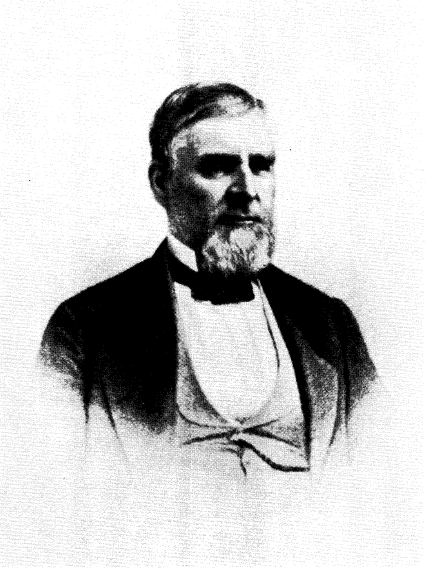
WILLIAM B. OGDEN, FIRST MAYOR OF CHICAGO, AND A LARGE REAL ESTATE PROPRIETOR THERE
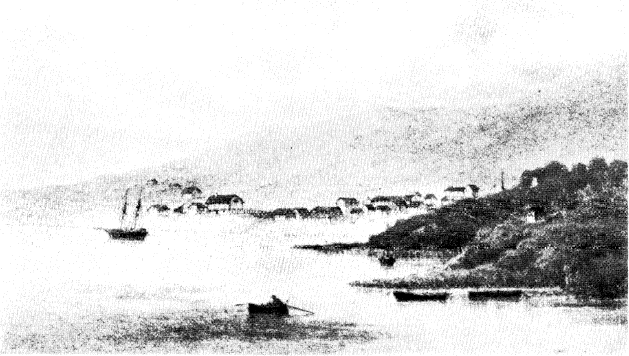
SAN FRANCISCO IN 1848
(From an old print)
Many of these grants were of a conditional nature, and legal titles in most instances were doubtful. Here again Congress was required to take a hand. The treaty of Guadaloupe Hidalgo, which ended hostilities between the United States and Mexico in 1848, provided that in the ceded territories all prior property rights should be upheld. The problem immediately arose as to how these rights were to be determined. As in Louisiana, a half century previous, Congress appointed a commission to investigate land titles. Owners of grants were called upon to prove their titles. This, many of them could not do. They had received no deeds or patents. Verbal “gifts” by governors, prefects and other officials had been quite common.
It was a wonderful harvest for lawyers, speculators and politicians! “The usual fee for securing to the occupant a title was half the land, while with a bill of extras he [the attorney] might easily sweep up the other half,” says Hubert Howe Bancroft, the profuse historian of early California. “He was not much of a lawyer in those days,” he adds, “who had not a Mexican grant in his pocket, the title to which his client had paid for,”11
In order to simplify the problem of quieting the titles of “pueblo” and mission lands, and of Mexican grants, the archives of the villages, towns and missions were ordered sent to the United States Surveyor-General’s office at San Francisco, and the land papers retained there. Three hundred bulky volumes which resulted from this gleaning and collating are an indication of the enormous task undertaken in validating California land titles. The work extended over many years, and there are cases still pending. Needless to say, there were many instances of gross fraud and deceit in the prosecution of the rights of alleged owners.
It would be exceedingly tiring to attempt to cover even a substantial portion of the schemes of villainy and speculation that prevailed in the settlement of titles to California lands. The field became a battleground for lawyers, adventurers and capitalists. A group of Philadelphia speculators are reported to have established headquarters in San Francisco for the purpose of gambling in the Mexican grant claims. Local politicians and financiers also attempted to increase their wealth by buying rights to grants, or by backing up claimants. The numerous reports submitted to Congress by the land office officials and the special commissioners appointed to investigate the claims contain frequent references to these fraudulent land-grabbing operations.
One of the most notorious of the fraudulent Mexican grants is known as the “Limantour Claim.” Edwin M. Stanton, who was sent to California as special counsel of the United States in the land cases, calls it “the most stupendous fraud ever perpetrated since the beginning of the world.” Limantour, a resident Mexican, claimed title to about 600,000 acres, part of which covered the present city of San Francisco. This and other grants, he averred, were given him for aid furnished the Mexican Government. The claim was at first upheld by the California land commission, and for this reason Limantour is said to have collected, during the years 1856 to 1858, about $300,000 from Frisco property owners to quiet their titles. Many prominent lawyers defended the Limantour claims, and many opposed them. The United States District Court declared them all fraudulent, and Limantour fled to Mexico, much to the chagrin of the property holders who had paid to buy him off.12
The “Santillan Grant” was another conspicuous forgery. This claim was acquired by a group of land grabbers, styling themselves the “Philadelphia Association.” They succeeded, “by hook or by crook,” in having the title confirmed by the California land commission, but in subsequent proceedings the “grant” was declared a forgery, and the association wasted its funds and the efforts in prosecuting it.
Santillan’s claim, called the “Mission Dolores Grant” also covered “three leagues” within San Francisco. It was reputed to have been donated in 1846 to Santillan, “a poor parish priest on condition of paying the mission debt.” The claim was finally rejected in 1859, by the United States Supreme Court, as a preposterous payment for the small sum owed by a mission. The Philadelphia Association, however, continued to petition Congress to ignore the court’s decision, and even succeeded in 1878 in getting a favorable report from the House Committee on private land claims. The next year, however, when a bill was brought in to compensate the “Trustees of the San Francisco Association of Philadelphia” for the Santillan grant, it was defeated. There is no evidence that monetary compensation for the alleged grant was ever made.
A national interest attaches to one of the most widely known of California land claims. “General” John Sutter, was not a land speculator. Neither did he crave land for the purpose of gain. He was an “enterpriser”—a man of indomitable courage and skill in the execution of great undertakings. Until gold was discovered on his Sacramento property in 1848, he conducted a vast and prosperous colony, of which he alone was lord and master. But gold on his lands proved his undoing. The squatters overwhelmed him. In vain did he appeal to Congress year after year for just compensation. But compensation never was granted. His descendants are still pressing their claim for something like $50,000,000 as the rightful award to the enterprising pioneer and colonizer whose northern California empire was destroyed by the “Curse of Gold.”
Though he was not primarily a land jobber, Sutter did not stand idly by and merely protest against the gold rush about him. Like others, he sought to exploit the situation. He organized the Sacramento Town Company, and surveyed a site into town lots in the autumn of 1848. The sales were rapid and at good prices. With the receipts, Sutter was enabled to pay off some pressing debts. But in the excitement of town-jobbing and land sales, he made conveyances of sections to which his title was doubtful, and as afterwards proven, worthless. Moreover, the squatters on his land began to resist ejection and organized a revolt. There was disorder and bloodshed. All this caused an abatement of Sacramento town lot sales. It caused also a collapse of real estate values and general financial embarrassment in the new northern California metropolis. Thereafter, Sutter was too busy defending the validity of his enormous land grants personally to engage in real estate transactions. The years he spent on the doorsteps of Congress cost him a vast sum. He died in Washington, on June 17, 1880, a poor, disheartened man. Justice by state and nation had been denied him.
Sutter’s land in recent years has been the scene of another development similar to that first attempted by the original grantee. The fertile Feather River delta in the Sacramento Valley lay fallow for many years after Sutter was forced out of it. During the rainy season much of it was under water, and useless, but at other seasons it was covered with a luxuriant plant growth. An idea was conceived of diking the banks of the stream and thus making possible the cultivation of the rich surrounding lands. Through irrigation, and a favorable climate, these lands could be made to produce almost any crop.
The wealthy meat packer and grain plunger, J. Ogden Armour, became interested in the scheme. The Sutter Basin Company was incorporated in 1913, with $6,000,000 of capital stock. It also issued, in 1922, $7,500,000 of mortgage bonds. These bonds were personally endorsed by J. Ogden Armour, who guaranteed payment of interest and principal. He also expended something like $17,000,000 on the property. The project was not a success. The interest on the bonds was defaulted. Armour died bankrupt—and thus the region in California where gold was discovered was responsible for a second great financial disaster.
Another Mexican grant, for several years in the public eye, and which attracted the attention of even Wall Street for a while, was known as the “Mariposa Estate.” When General John C. Fremont “conquered” California in 1847, his small band of American scouts, he was not unmindful of the opportunities for acquiring vast personal wealth in this region. In his “path-finding” activities, he was led into a highway, which was destined to hold out promises—but only promises—of great profits both to himself and to others. In February, 1847 (only a few months after the surrender of California), he purchased from the grantee, Alvalardo, for $3,000, a large tract of land, comprising ten leagues square, on Mariposa Creek, between the Sierra Nevada Mountains and the Joaquin River. As the land was mountainous, it was not highly regarded by the Mexicans, but, by a peculiar trick of fortune, it was the only large grant which was comprised in the region of the gold mines.
Frémont became a California resident and was elected United States Senator in December, 1851. According to Hubert Howe Bancroft, Fremont “was in a sense the representative of the Spanish grantees,” and in this capacity he had the support, in the same Senate chamber, of his father-in-law, Thomas Hart Benton, of Missouri. Accordingly, as Bancroft points out, “there was a feeling among Senators that this Benton-Frémont-Jones combination might not be acting from disinterested motives.”13
At least, Fremont proceeded to fix the boundaries of his ill-defined estate, swinging “it around in such a manner as to locate the auriferous mountain regions and the famous Pine Tree and Josephine mines.”14 Others who had been in quiet possession of these mining claims, protested—but Fremont persisted in demanding his rights, and succeeded, after some open warfare, in securing property in which others had invested.
Of course, all this brought political obloquy upon the famous explorer who was twice a presidential candidate. But it bade fair to make him one of America’s wealthiest men. His personal resources were not sufficient for the exploitation of the mines, so he sought financial assistance in Europe. While his agent, David Hoffman, was in London organizing “mining companies,” out of his estate, and offering the shares to British investors, Fremont gave Thomas D. Sargent an option on the whole grant for $1,000,000. Sargent then went to England and resold at an enormous advance.
In the meantime, however, Hoffman raised a “hue and cry” against the act of his principal. He published a pamphlet addressed “to the British Public” in which he asserted that he alone had a power of attorney to sell or lease the Mariposa property, and that Sargent’s purchasers were likely to have trouble.
Hoffman’s protest was effective. The English refused to take over the grant. Moreover, legal complications about the grant developed, because the original conveyance did not specify that the grantee possessed the mining rights. As a result of all this, Fremont could not raise the money to pay his presidential campaign debts. At this time, he is reputed to have made the facetious remark: “When I came to California I was worth nothing—but now I owe two million dollars.”15 Judgments were obtained by his creditors against him. On September 9, 1859, the sheriff sold his Mariposa Estate. With this sale all the foreign companies holding leaseholds and mining rights in the property faded into thin air.
The “investing public,” however, was to hear more of the “Pathfinder’s” land grabbing venture. Fremont succeeded in obtaining a part interest in the property from his chief creditor, to whom it was assigned under a sheriff’s deed. With the assistance of several New York capitalists, he organized the Mariposa Land and Mining Company, and, inasmuch as the United States Supreme Court had, in 1858, upheld the right to mine the land, it was expected that the new venture would be profitable. Nothing much ever came of it, however, although, after repeated “sell outs,” the shares of the company were listed on the New York Stock Exchange. It did not prove a success.
Frémont lost his financial interest in the Mariposa property shortly after the organization of his stock company. All he obtained from it was worry, vexation and public hatred. The old Californians seemed to have shed no tears because of this. Bancroft, in his reminiscences, in commenting on Fremont and his “Mariposa mine,” remarked that “when he was in Paris the man would have been sent to the Bastile as a royal fraud if pre-adventure that edifice had not been closed for repairs.”16
During a half century following the American conquest of California, the United States Supreme Court’s records were cluttered with the Mexican land grant claims. The foremost legal authorities in the country were employed in these cases. Some are still unsettled and every now and then Congress and the courts are called upon to decide on disputed titles or to unravel the frauds growing out of “original Mexican grants.” In most cases, of course, the grantees or their heirs are not concerned in the controversies. As pointed out by Bancroft, “the estates have passed for the most part into the hands of speculators, who were shrewd enough or rich enough to keep them.” “Land monopoly in California,” he further remarks, “is due less to the original extent of the Mexican grants than to the iniquitous methods adopted by our government; and as to the fraudulent claims it is believed that the worst ones were concocted, or at least mainly fortified with supports of forgery and perjury, after the commission and the courts were fairly at work, and after the concocters learned by experience what supports were likely to prove effective.”17
Moreover, the Mexican grants were not profitable propositions to those who were successful in defending them. “Very few of the old Californians, notwithstanding the principalities in the shape of lands, were enriched by them. As an illustration, it may be stated that though over 326,000 acres were confirmed to the De La Guerra family, they were miserably poor, and so were the brothers Pio and Andre Pico, to whom 532,000 acres were confirmed.”18
Yet, California, according to Henry George and later investigators, has more large landed estates than any other state in the Union. From statistics furnished by the California Tax Commission in 1916, it appears that 310 landed proprietors owned over four million acres, “capable of intensive cultivation and of supporting a dense population.” “One firm owns nearly a million acres; one railroad 500,000 acres. In Kern County four companies own over 1,000,000 acres or more than half the land held in private ownership. The Kern County Land Company alone owns 356,000 acres. In Mercer County, Miller and Lux own 250,000 acres. The evil of such ownership is each year becoming more apparent. We have at one end of the social scale a few rich men who as a rule do not live on their estates, and at the other end either a body of shifting laborers or farm tenantry.”19
A number of the large California estates were acquired by wealthy capitalists, neither for speculative nor for development purposes, but largely for the glory of being great landed proprietors. Thus, Jerome O’Neil, James Irvine, William Randolph Hearst, E. L. Doheny, and several other millionaires acquired large single tracts. More often than otherwise, these “parks” are a financial burden. The lands, unless underlaid with oil or precious metals, cannot be made productive. Taxes and interest eat heavily into income from other sources. Rich Americans, as a whole, are not content to become “land poor.” Occasionally, a ranch, a vineyard or an orchard is held as a pleasure ground or place or retreat, but this, as a rule, is expensive sport—and our millionaires, like the English, pay heavily for their sports and pastimes.
.....
The story of jobbing in Mexican grants would not be complete without some reference to the land deals in California’s twin-sister state, New Mexico. The grants in New Mexico, like those in California, generally covered large areas of vacant lands, and the boundaries were indifferently described. The grantees also, as a rule, claimed a larger acreage than the patents called for. The conveyances, moreover, were made much earlier than those west of the Sierras.
Following the cession of the Mexican territory to the United States, American speculators stepped in and acquired the most important claims. Thus, the Armendaris Grant of 4,000 acres lying on the west bank of the Rio Grande, in which the town of San Marcial is located, was deeded to Hugh N. Smith, and Thomas Biggs, Santa Fé traders, largely for aid in defending its validity. The property was subsequently sold to the San Marcial Land and Improvement Company. The title to the Canada de Cochiti Grant which dated back to 1728, was acquired by James G. and Joel P. Whitney, and the Sandoval Grant in Valencia County, was also bought by Joel P. Whitney, who conveyed a half interest in it to Franklin H. Story. The valuable Oritz Mine grant, comprising about 70,000 acres, was also conveyed to Americans, and was finally acquired in 1864, through Charles E. Sherman, by the New Mexico Mining Company.20
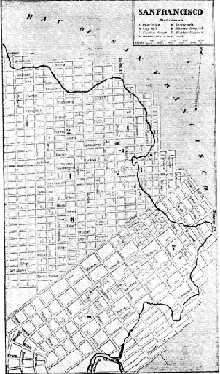
MAP OF SAN FRANCISCO ABOUT 1851
(The lots lying outside the black line, known as “the water lots,” were the chief objects of speculation)
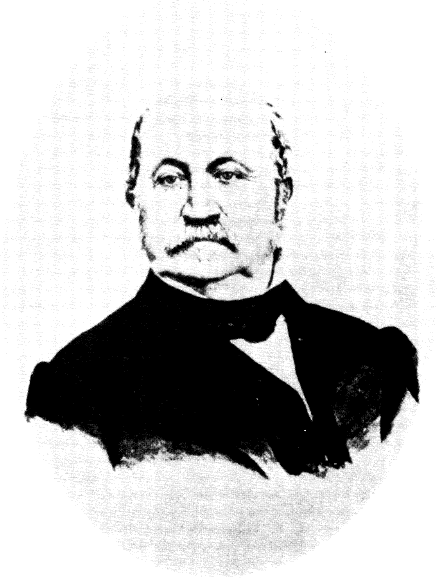
JOHN AUGUSTUS SUTTER, ON WHOSE ESTATE GOLD WAS DISCOVERED
The titles to these and other New Mexican land claims were as troublesome to settle as those in California. Congress, however, did not take up the problem until a decade or more after the California mess was attended to. The courts, moreover, were slow in adjusting New Mexico claims, and as late as 1890 there were still 107 claims pending, covering 8,704,785 acres. It was not until 1904 that most of these were settled.
Here, also, the lawyers found the land claim business highly lucrative. One, who became exceedingly wealthy, was Stephen B. Elkins, in later life a West Virginia millionaire, cabinet officer and United States Senator. Elkins went to New Mexico in 1863. He learned the Spanish language, entered politics, was then sent to the state legislature and later to Congress. His chief occupation in New Mexico, however, was in defending the titles to lands granted under the Mexican régime—and incidentally, he acquired a substantial financial interest in them.
George W. Julian, who in 1868 was appointed United States Surveyor-General of New Mexico, in a speech at Indianapolis on September 14, 1892, thus characterized the land dealings of Elkins:
Elkins’ dealings were mainly in Spanish grants, which he bought for a small price. Elkins became a member of the land ring of the territory, and largely through his influence, the survey of these grants was made to contain hundreds of thousands of acres that did not belong to them. He thus became a great land holder, for through the manipulation of committees in Congress, grants thus illegally surveyed were confirmed with their fictitious titles. . . . By such methods as these, more than 10,000,000 acres of public domain in New Mexico became the spoil of land grabbers.21
As in the case of California, excessive claims were the rule rather than the exception in New Mexico. Although under the Mexican regime the maximum acreage granted to an individual was eleven leagues (about 50,000 acres), several claims embraced a much larger area. The Las Vegas grant comprised a million acre tract, and the so-called “Maxwell Grant” almost two million acres, i.e., about 3,000 square miles.
The Maxwell Grant was one of the most notorious of the New Mexico land claims, and in this Elkins “made himself particularly conspicuous as the hero.” Lucien Benjamin Maxwell, a native of Kaskaskia, Ill., and one of the most striking early figures along the Rocky Mountain frontier, acquired it in 1864, from Carlos Beaubien and Guadelupe Miranda, the original grantees. It was adjacent to the Red River in northern New Mexico and contained almost the whole of the present Colfax County. In extent, it would make three states the size of Rhode Island. Here Maxwell, while living in barbaric splendor, attempted to found an American barony, but his principal business was raising sheep.
He probably would have continued as America’s greatest sheep herder, had it not been for the discovery of gold on his domain. This gave him plenty of excitement. By disposition a gambler, he forthwith invested large sums in developing placer mining. The results were negative. Like Sutter in California, he was met by an army of squatters and free-lance miners, who refused to be ousted except by force. In order to save a remnant of his fortune, he sold his grant to an English syndicate for $1,250,000—one-half of which sum was paid to his sales agents.
The syndicate formed the Maxwell Land Grant and Railroad Company and tried to unload its obligations on the public. It did succeed in selling bonds to Dutch investors, who were undoubtedly influenced by the fact that the “Hon.” Stephen B. Elkins was president of the company. All this was done before the validity of the grant was fully established. In the meantime, the finances of the company went from bad to worse, and by 1875 it was bankrupt. Its lands were sold for unpaid taxes, and its personal property disposed of at sheriff’s sale to satisfy creditors.
After the Maxwell Land Grant failure, Stephen B. Elkins left for West Virginia, where he married the daughter of its wealthiest citizen and statesman, Senator Henry Gassaway Davis, and where he also became a United States Senator. Maxwell’s subsequent career was less fortunate. He invested a large part of the proceeds from the sale of his land in the bonds of the Texas and Pacific Railroad. Through subsequent bankruptcy of the railroad, the bonds became almost worthless. He also essayed banking, and organized the First National Bank of Santa Fé. As its first president, he pictured himself on its notes with a cigar in his mouth. He died in comparative poverty, July 25, 1875. Sheep raising on his New Mexico property would have been more profitable to him and more beneficial to the country than the exploitation of its gold mines.
Another notorious New Mexico land claim which became a securities gamble, and which was, in 1895, adjudged a criminal forgery, was the so-called “Peralta-Reavis Grant.” This fraudulent scheme to obtain title to about 1,300,000 acres under a supposed gift from the King of Spain dating back to 1748, was concocted by James Addison Reavis, a St. Louis real estate dealer. Reavis, in 1871, met George M. Willing, Jr., who represented himself as the proprietor of an immense tract of land on the borders of New Mexico and Arizona, that he had purchased from the heirs of Don Miguel de Peralta. Reavis visited the location with Willing, and while at the latter’s home, it is charged, stole a deed to the property made out in blank and signed by Willing. Armed with this document, he proceeded, in 1883, to seek the validation of his land claim under the Act of Congress of July 22, 1854. In the meantime, he married a squaw, who, he claimed, was the direct heir and descendant of the original grantee. He then assumed the name of Addison Peralta-Reavis.
While awaiting the results of his petition, he proceeded to sell “releases” to the numerous “squatters” who had settled on the lands. He also organized a mining company, called the “Casa Grande Land and Improvement Company,” which he incorporated under the laws of three states. For these three corporations he received $65,000. In addition, the Southern Pacific Railway Company paid him $50,000 for right of way through his mythical grant and the Silver King Mining Company paid him $25,000 for a release of title to their mining property. He received similar revenue from other sources, based on his supposed ownership of the land, and in this way waxed rich and financially influential He is said to have had the backing of the wealthy promoters of the Southern Pacific Railroad, among whom was Collis P. Huntington.
But retribution was to come. In 1889 both the grant and the conveyances were declared by the Surveyor-General to be forgeries. Reavis, however, did not give up the fight. About 1890 he entered suit in the United States Court of Claims for $10,000,000 on account of injury he had suffered through the illegal disposition of his grant. He went to great expense and exercised great ingenuity in collecting documents in Spain and in Mexico to support his case, and presented numerous supposed transcripts to the court at Santa Fé. Discrepancies in these soon became apparent, however, with the result that Reavis was convicted for criminal forgery, spent two years in prison, and lost all his property. After his release, he settled in California, where, it is reported, his ingenuity as a litigant was further enhanced by the study of law.
Regarding the Reavis case, the United States Attorney, who opposed the claim, comments: “In all the annals of crime there is no parallel. This monstrous edifice of forgery, perjury and subornation was the work of one man. No plan was ever more ingeniously devised; none ever carried out with greater patience, industry, skill or effrontery.”22
23 Henry George, Our Land Policy, National and State, p. 13.
24 Frank Soulé, John H. Gihon, and James Nisbet, The Annals of San Francisco (1855), pp. 180-184. Also Theodore H. Hittell, A History of California, Vol. III, p. 116.
25 John P. Young, San Francisco, A History of the Pacific Coast Metropolis, Vol. I, pp. 186, 187.
26Ibid.
27 Soulé, op. cit., p. 182. See also Hittell, History of California, Vol. III, pp. 390, 391.
28 Soulé, op. cit., pp. 498, 499.
29 Ibid., p. 520.
30 Pennsylvania German Magazine, Vol. 6, p. 155.
31 Hubert Howe Bancroft, Retrospection, p. 457.
32 Young, op. cit., p. 192. See also Hittell, History of California, Vol. III, p. 400.
33 Retrospection, p. 309.
34 Hubert Howe Bancroft, Works, Vol. 23, p. 554. See also article “Limantour,” by J. S. Hittell, Overland Monthly, February, 1869.
35 Ibid., p. 538.
36 Theodore H. Hittell, History of California, Vol. III, p. 133.
37 See Samuel Bowles, Our New West, p. 425.
38 Bancroft, Retrospection, p. 234.
39 Bancroft, Works, Vol. 23, p. 578.
40 Theodore H. Hittell, History of California, Vol. II, p. 753.
41 Report of the Commission on Land Colonization and Rural Credits of the State of California, 1916, p. 7.
42 See “History of New Mexico, Its Resources and People” (1907), Vol. I, pp. 170-178.
43 Ibid., p. 186.
44 See Land of Sunshine, Los Angeles, February and March, 1898. Also, History of New Mexico (Pacific States Publishing Co.), pp. 210-220.
- 1Maine Historical Collections, Vol. II, pp. 268-294.
- 2The Sir William Johnson Papers, Vol. V, p. 129. See also, C. W. Alvord, The Mississippi Valley in British Politics, Cleveland, 1917.
- 3Herbert B. Adams. “Washington’s Interest in Western Lands,” Johns Hopkins University Studies, Third Series, No. 1, January, 1885. Italics are mine.—A. M. S.
- 4Adams, op, cit., p. 58.
- 5See A. Henderson, “A Pre-Revolutionary Revolt in the Old Southwest” in Mississippi Valley Historical Review, Vol. 27, p. 198 et seq.
- 6Italics are not in the original.
- 7In a letter to William Franklin, dated May 3, 1776, Johnson asserted “it has always been my practice to avoid engaging in lands to the great loss of my family, neither have I a foot of land from the Indians.” (Sir William Johnson Papers, Vol. IV, p. 197.) The large tract north of the Mohawk Valley given him by the Canajoharie Indians in 1760 was confirmed by royal grant in 1769.
- 8See Pennsylvania Magazine of History, Vol. XIV, pp. 218, 219.
- 9See Memorial of the United Illinois and Wabash Land Companies, Baltimore, 1816.
- 10A copy of the deed is contained in American State Papers, “Public Lands.” Vol. I. The original copy was acquired by Cyrus H, McCormick.
- 11See J. P. Boyd, “Connecticut’s Experiment in Expansion, The Susquehannah Company, 1753-1803,” in Journal of Economic and Business History, November, 1931.
- 12See Publications of the Colonial Society of Massachusetts, Vol. XXV, PP. 33-38.
- 13Samuel W. Jones, Memoir of James Duane, 1852.
- 14P. H. Woodward, One Hundred Years of the Hartford Bank, p. 74. See also R. J. Purcell, Connecticut in Transition, p. 154.
- 15Haskins, op. cit., p. 36.
- 16Ellis Paxton Oberholtzer, Life of Robert Morris, pp. 307, 308.
- 17S. G. McLendon, History of the Public Domain of Georgia, Chap. IX.
- 18Theodore Dwight, Travels, Vol. I, p. 188.
- 19Absalom H. Chappell, Miscellanies of Georgia, Part II, p. 49.
- 20Greenleaf and Law in the Federal City, p. 26.
- 21The Winning of the West (New Knickerbocker Edition), Vol. II, p. 411.
- 22Travels Through the States of North America, Etc., by Isaac Weld, Jr.
- 23During the first hundred years of North American colonization, economic conditions gave little encouragement to private land schemes. Land was too plentiful. A few such enterprises were undertaken, however. Thus, as early as 1661, the Colony of Massachusetts sold to a few individuals for £400 a large tract on the Kennebec River in Maine. This became known as the “Kennebec Purchase.” The heirs held it for nearly a century without doing anything with it. In 1753, they incorporated as the “Proprietors of the Kennebec Purchase” and proceeded to dispose of their holdings. The corporation continued in existence until 1816. “The Pejebscot Company” was another Maine land deal. None of these held out promise of profit to proprietors until about a quarter century before the Revolution.
- 24In the meantime, the “Loyal Company” group was not idle; its proprietors sent Dr. Thomas Walker, of Albermarle, Va., to make a reconnaissance, and to discover a proper place of settlement. The two “companies” then became engaged in a controversy, and neither made a survey or fixed the bounds of their grants. The apparent ease with which they obtained land donations led to other schemes, and aroused an epidemic of interest in distant western wild lands. Not only was the land ownership eagerly sought after, but the establishment of new colonies, with separate and distinct governments, was planned. Favoritism and collusion infested the Virginian colonial government, due in large part to the persistence of speculators in western land grants. Lobbyists were sent to London to obtain the crown’s sanction to land-grabbing schemes and the question of the disposal of the vast western domain won from the French infested British politics. “One half of England is now land mad,” wrote George Croghan, of Philadelphia, one of the land schemers, to Sir William Johnson, on March 30, 1766, “and everybody there has their eyes fixed on this country.”
- 25I offered in my last to join you in attempting to secure some of the most valuable lands in the King’s part, which I think may be accomplished after awhile, notwithstanding the proclamation that restrains it at present and prohibits the settlement of them at all; for I can never look upon that proclamation in any other light (but this I say between ourselves) than as a temporary expedient to quiet the minds of the Indians. It must fall, of course, in a few years, especially when those Indians consent to our occupying the lands. Any person, therefore who neglects the present opportunity of hunting out good lands, and in some measure marking and distinguishing them, for his own, in order to keep others from settling them, will never regain it.
- 26Crawford “heartily embraced” the colonel’s offer. He promised shortly to set out in search of lands. “This may be done,” he said, “under a hunting scheme.” He acknowledged that other land seekers had approached him, with similar offers, “but have not agreed to any; nor will I with any but yourself or whom you think proper.”
- 27Judge Richard Henderson of North Carolina, the employer and backer of Daniel Boone, promoted the settlement of the Kentucky region and claimed ownership to a vast unsettled tract there. He organized a group of land grabbers under the name of “The Transylvania Company.” Ignoring the British interdiction against Indian land purchases, he obtained from the Cherokees in 1773 about one-half of the present State of Kentucky, and immediately began settling the land. He advertised widely for pioneers and “shareholders.” In his announcements, Henderson waxed enthusiastic. “The country [Transylvania] might invite a prince from his palace, merely for the pleasure of contemplating its beauty and excellence, but only add the rapturous idea of property, and what allurements can the world offer for the loss of so glorious a prospect?”
- 28When the British Government began to take active measures to break up land “bootlegging,” and to put a stop to dreams of riches in western territory, Virginia’s political resentment was naturally aroused. Even Thomas Jefferson, who, in later life, frowned upon speculation and land grabbing, held the view in 1774 that the land did not belong to the British king, and that it was time for the colonies “to declare that he has no right to grant lands of himself.” So he boldly wrote in the Declaration of Independence, as one of the British king’s usurpations: “He has endeavored to prevent the Population of these States; for that purpose obstructing the Laws for Naturalization of Foreigners; refusing to pass others to encourage their migrations hither, and raising the conditions of new Appropriation of Lands.”
- 29He was for it at once. “I like the project of a colony in the Illinois Country,” he wrote his son, “and will forward it to my utmost here.” He thought that Sir William Johnson’s “approbation will go a great way in recommending it, as he is much relied upon in all affairs that may have any relationships with the Indians.” But Johnson had an eye on the Indian lands himself, and besides advising others about purchases in the outlying sections, personally through gifts from the Indians engrossed large tracts, particularly in the Mohawk Valley. The town of Johnstown, N. Y., still marks the seat of his domain.
- 30Some of the members of the Vandalia Company were concerned in other western land schemes. One of these was organized in 1775 as the “Indiana Land Company,” probably the first application of the name “Indiana” to the Northwest Territory. The claim to land was based on a grant of a large tract, made November 3, 1768, in what is now West Virginia, by the Six Nations at Fort Stanwix to “Chief” William Trent in liquidation of depredations. Among the shareholders were Samuel Wharton, Joseph Galloway, Robert Callender, Levi Andrew Levi, and David Franks, all wealthy and prominent Philadelphians. The Revolutionary War did not put an end to the “claim.” Wharton in 1776 published a pamphlet, entitled-View of the Title to Indiana, in which he defended the company’s rights to the lands. In 1781, he republished this in enlarged form, under the title Plain Facts; being an examination into the Rights of the Indian Nations of America to their respective Countries and a Vindication of the Grant from the Six United Nations to Proprietors of Indiana, etc. Although Wharton pressed the validity of the “proprietors” claims, Congress then and thereafter gave little heed thereto.
- 31Notwithstanding the British Government’s edict, forbidding the private purchase of lands from the Indian tribes, William Murray, an Indian trader, and several of his business associates, in 1773 formed a plan to buy from the aborigines an immense tract of country between the Mississippi, Illinois and Ohio rivers. After a “pow-wow” lasting a month, the sale was consummated. According to the land claimants, it was attended by “many persons of both descriptions and the Indians were carefully prevented from obtaining any spiritous liquors during the whole continuation of the negotiation.” On July 5, 1773, “for a very large and valuable consideration,” the deed was delivered to the “Illinois Land Company.”
- 32Notwithstanding the British Government’s edict, forbidding the private purchase of lands from the Indian tribes, William Murray, an Indian trader, and several of his business associates, in 1773 formed a plan to buy from the aborigines an immense tract of country between the Mississippi, Illinois and Ohio rivers. After a “pow-wow” lasting a month, the sale was consummated. According to the land claimants, it was attended by “many persons of both descriptions and the Indians were carefully prevented from obtaining any spiritous liquors during the whole continuation of the negotiation.” On July 5, 1773, “for a very large and valuable consideration,” the deed was delivered to the “Illinois Land Company.”
- 33The proposition then took on a business aspect. The number of “shares” was increased, and rights to subscribe offered at from $2 to $5 per share. It attracted speculators. The shares soon rose in value. Lawyers, clergymen and politicians began buying shares. The Reverend Ezra Stiles, President of Yale College, grandfather of the poet-physician Oliver Wendell Holmes, took 2¾ shares. The Governor of Connecticut, Roger Walcott, who had become rich through local land deals, supported the project.
- 34New York, before the Revolution, also had her “land” quarrels with the other colonies. The ill-defined boundaries of the Dutch province led to constant conflicts and legal controversies with her neighbors. There was a bitter dispute with New Hampshire regarding the political jurisdiction of Vermont. New York claimed the section, but New Hampshire, in 1749, acting on the principle that possession is nine points of the law, began to make free grants to both New Hampshire and Massachusetts citizens. Whole “towns” of 23,000 acres, more or less, were granted to selected groups of individuals. It is estimated that between 1749 and 1764, Governor Benning Wentworth granted 131 townships to more than six thousand persons. Among the grantees appear the names of many prominent colonial New Englanders, who had no intention of ever settling on the lands. Samuel Adams was among them. He was known as a speculator in both Maine and New Hampshire lands in this period. The governor granted himself, in all, about 65,000 acres, and is reported to have accumulated considerable wealth from the heavy fees exacted by him for grants.
- 35Because of his land deals, while acting as the state’s attorney, Duane was the butt of political criticism. He was led to appear in person in his own defense before the state legislature in 1781. He was charged with receiving Vermont grants “under immoderate quit-rents, and excessive fees of office,” and he was also accused of “holding many thousand acres of land which had never before been granted by the Crown.” To this he merely answered that he “had never made a purchase or obtained a grant of land with any view to its sale.” He was therefore not a “land jobber.” This cleared him politically of all corruption.
- 36So popular was the western lure to the Connecticut gentry that legislation was urged to countermand it. “Young people in their plays at social gatherings marched to rude melodies which taught them to dream that toward the setting sun lay an earthly paradise with gates open to welcome them. From hill and valley the processions hurried away. Today, many of our rural towns are scarred and paralyzed by an outflow which has built up the continent to no small degree at their expense.”
- 37What is the spirit against which we now struggle and which we have vainly endeavored to stifle? A monster, generated by fraud, nursed in corruption, that in grim silence awaits its prey. It is the spirit of Federalism! That spirit which considers the many made only for the few. . . . When I behold a certain party supporting and clinging to such a measure almost to a man, I see only men faithful to their own principles. . . . But when I see associated with them, in firm compact, others who once rallied under the standard of opposite principles, I am filled with apprehension and concern. . . . If Congress shall determine to sanction this fraud upon the public, I trust in God we shall hear no more of the crimes and follies of the former administration. For one, I promise that my lips upon this subject shall be closed in eternal silence. I should disdain to prate about petty larcenies of our predecessors after having given my sanction to this atrocious public robbery.
- 38Large tracts were also freely disposed of by Georgia. Count d’Estaing, the French admiral who assisted the colonies, was granted a substantial acreage for his Revolutionary services. D’Estaing sold his land to the Count de Colbert, who resold it in England to Robert Morris, through the agency of William Constable and Gouverneur Morris. Robert Morris then proceeded to add to his Georgia possessions. In association with John Nicholson, he soon become the leading proprietor of Georgia waste lands. How these large holdings were obtained has never been satisfactorily explained. It is the “unsolved riddle of Georgia’s land history.”
- 39Large tracts were also freely disposed of by Georgia. Count d’Estaing, the French admiral who assisted the colonies, was granted a substantial acreage for his Revolutionary services. D’Estaing sold his land to the Count de Colbert, who resold it in England to Robert Morris, through the agency of William Constable and Gouverneur Morris. Robert Morris then proceeded to add to his Georgia possessions. In association with John Nicholson, he soon become the leading proprietor of Georgia waste lands. How these large holdings were obtained has never been satisfactorily explained. It is the “unsolved riddle of Georgia’s land history.”
- 40To most of these “free” Georgia lands the name of “Pine Barrens” was given. Their sandy soil was covered with a luxuriant growth of pine trees, for which Georgia, for over a century, was famous, and which in later years not only afforded a lucrative article of export, but was the basis for its naval stores’ industry. But “barren” they certainly were in the post-Revolutionary days when they were sold to Robert Morris and other land jobbers. As mentioned in a previous chapter, “whatever land was offered for sale, they appeared ready to buy; and actually bought quantities which outran every sober thought.”
- 41Morris, as previously noted, endeavored to get French purchasers for these Georgia lands. There was already considerable French influence in South Carolina and Georgia, and these lands were advertised as most suitable for the émigrés. But he was brought face to face with the outspoken opposition of Joseph Fauchet, French Minister to the United States. Though the Pine Barrens were hawked about even before the second Yazoo grants were made, and it was reported that they were a profitable speculation, they lacked buyers. There was, of course, considerable doubt as to the validity of Morris’ title to them—and this point was strongly emphasized by Fauchet. Most of the grants had not been surveyed in accordance with the legal requirements. In 1798, the Georgia Legislature, with the Yazoo fiasco fresh in mind, passed a law requiring all landowners to survey and identify their holdings every ten years, beginning in 1799. The purpose was to compel holders under fraudulent grants to prove their titles. The heritors of the North American Land Company, after Morris and Nicholson’s failure, could not do this. Moreover, it was not worth the expense. As taxes were not paid, the lands went back to the state. In fact, the State Comptroller of Georgia reported in 1839 that “not more than half the land in the region was worth owning or paying taxes for.”
- 42It is a sad commentary on Robert Morris’ business judgment that lands which he eagerly acquired as a speculation and actively sought to sell were still in as wild and primeval condition almost a century after his death. But he seems never to have inquired regarding the quality or locations of properties, as long as he could obtain them cheaply and on credit. Either he had the utmost confidence in the rapid filling up of unoccupied regions in the country, or he became madly intoxicated by the prevailing wild land mania. He, Nicholson and Greenleaf purchased indiscriminately in the South, West and East—from the sluggish Savannah to the shores of Lake Erie. The modern searcher of land titles in any district east of the Alleghanies and south of New England is apt to find the name of Robert Morris or that of his partners in the early deeds. As stated by Allen C. Clark, “When a tract in the Carolinas or the Virginias is subject to negotiation, the lawyer from the metropolis must need travel through primeval forest whose solemn stillness is unbroken save by the cawing of the inhabitants of the air and the reverberating music of the axe, to the little remote brick courthouse, there to ascertain if the title is a continuous chain from the original owner—Robert Morris.”
- 43And yet, the chief exponent of the “strenuous life” admits that the land companies “did possess considerable importance at certain times in the settlement of the west, both because they in places stimulated that settlement and because in other places they kept out the actual settlers.” But, as the following chapters will show, the stimulation to settlements was a permanent force, while the retardation was but temporary and sporadic. Speculation is essential to human progress. Adventure and Cupidity, hand-in-hand, have spread civilization.
- 44Considering the vastness of the territory, which is thus opened to the federal city, by means of a water communication; considering also that it is capable from the fertility of its soil, of maintaining three times the number of inhabitants that are to be found at present in all the United States; . . . there is good foundation for thinking that the federal city, as soon as navigation is perfected, will increase most rapidly in population, and that at a future day . . . it will become the grand emporium of the West, and rival in magnitude and splendor the cities of the old world.

