
The Great American Land Bubble
Chapter III. Parceling Out the Empire State at Wholesale
WHEN the Revolutionary War was over, New York State was a mere skeleton of its present self. The white inhabitants were settled, for the most part, along the shores of the Hudson River, but pioneers had already moved westward along the Mohawk River as far as “the German Flats.” Here, the sturdy Herkimer and his fellow Germans beat back Major St. Leger and his Indian and Tory allies, thus making possible the victory of Saratoga. Beyond these regions, to the west and north, was wilderness. The once powerful Six Nations had been decimated to a few scattered Indian villages. Though they still occupied the territory they could offer no resistance to the oncoming white man. The dangers of savage warfare which retarded the settling of the land were, therefore, removed.
But the ownership and control of the unsettled region west of the Mohawk Valley was still in dispute. Both Connecticut and Massachusetts claimed it. New York maintained that it was within its domain, and resisted the claims of the New England colonies to the region. The Indians, of course, had legal title to it—but that was no great obstacle. A few barrels of rum, and a supply of shawls, blankets and trinkets, could buy them off.
The Continental Congress, the only cementing force that held the young republic together, was anxious to promote harmony at home as well as abroad. It succeeded in having the sister states, Massachusetts and New York, negotiate a peaceful settlement of the controversy. On December 16, 1786, New York, in return for political authority over the territory, ceded to Massachusetts the preëmption right to “all that part of the state lying west of a line beginning at a point in the north line of Pennsylvania, eighty-two miles west of the northeast corner of the state, and running from thence due north through Seneca Lake to Lake Ontario.” Within this vast domain, comprising more than six million acres, New York reserved for itself the ownership right of merely a strip of land one mile wide along the Niagara River.1
Massachusetts thus became the possessor—subject to the extinguishment of the Indian title—of a vast western empire, for which she had no earthly need, and which she would gladly dispose of at a price. Impoverished by the war, and with her treasury “scrip” passing current at about 30 per cent of its par value, Massachusetts in April, 1788, eagerly accepted an offer from Nathaniel Gorham and Oliver Phelps, two of her citizens, to purchase the entire tract for $1,000,000, payable in Massachusetts “consolidated scrip” in three annual instalments. The sale was made subject to the extinguishment of the Indian title, the cost of which was to be borne by the purchasers. In July, 1788, Phelps and Gorham, “by treaty” at Canandaigua, “purchased” from the Indians the easterly portion comprising about 2,600,000 acres, or slightly more than one-third of the total region. Payment for this section, which has since been known as the “Phelps and Gorham Purchase,” was covered by the first of the three annual instalments, so that, on November 21, 1788, the title to the land was conveyed by Massachusetts to Phelps and Gorham. The other two-thirds still remained unpaid for. A sharp rise in the market value of Massachusetts “scrip,” due to Alexander Hamilton’s plan to have the federal government assume the states’ indebtedness, was unfavorable to the two land jobbers. They were unable to meet the second instalment and so the unpaid-for portion reverted to Massachusetts.
The Phelps and Gorham acquisition did not pass without rivalry and opposition. Previous to the cession of the territory to Massachusetts, a group of prominent New Yorkers at Hudson, N. Y., formed the “New York Genesee Land Company.” Among the promoters and shareholders were John Livingston, Peter Schuyler, Dr. Caleb Benton, Robert Troup and other politicians. They leased, or claimed to have leased, the Massachusetts lands from the Indians for 999 years at an annual rental of $2,000 in Spanish dollars. In February, 1788, just two months before the sale to Phelps and Gorham, and before the extinguishment of the Indian title, Benton and Livingston petitioned the New Lork Legislature to recognize the lease. The petition was peremptorily rejected, and Massachusetts also denied the validity of the lease.
The promoters, however, would not be downed. They employed agents to go about the state, lavishing presents on the politicians and the Indians to win their favor. They even suggested the formation of a separate state. For this, one of the members was jailed on a charge of treason. Livingston and his associates then proposed a settlement by presenting a proposition to the New York commission for holding treaties with the Indians to obtain from the state a direct conveyance of all the Indian lands, the Genesee Company to be remembered by a grant of 1,000,000 acres. Since Massachusetts had already been granted the preëmption right to the territory, this was likewise rejected. However, in 1793, the New York Legislature passed an act for the relief of the Genesee Company, by conveying to its members certain lands in the northern part of the state known as the “Old Military Tract,” but there is no record that the land was ever claimed or a deed granted.
Phelps and Gorham were not without the assistance of others in their purchase from Massachusetts. Each originally associated with himself a group of speculators, and these were contemplating rival bids for the domain. They soon came to an agreement to present a joint bid in order to avoid competition. It is believed that Robert Morris had a hand in the deal. He certainly knew of what was going on, for when the purchasers were unable to meet the second instalment of the agreed price, Morris stepped in and made the purchase of the unpaid-for portion.
In the meantime, Phelps, acting as the agent of his associates, was making efforts to dispose of the land they had acquired. He immediately began surveys. To him may be ascribed credit for first employing the method of laying out the lands into rectangular townships of six miles square, though most authorities ascribe the inauguration of the system to Thomas Jefferson.2 As soon as townships were surveyed, they were offered for sale in whole or in part. By 1790, about fifty townships had been sold to individuals and companies, about half of the area. The largest purchase was made by General Jeremiah Wadsworth, wealthy capitalist of Hartford and New York, with whom both Phelps and Morris had been closely associated during the Revolution in the Quartermaster’s Department of the Army.
Wadsworth acquired a strip of land of about 30,000 acres, bordering on the Genesee River. Its chief settlement was a place called by the Indians “Big Tree,” but later known as Geneseo, located not far from the present site of Rochester. Jeremiah Wadsworth conveyed some of the land to his young cousins, James and William Wadsworth, and appointed them his land agents. The tract comprised one of the choice sections of the Phelps and Gorham purchase, and was considered the most valuable. For this, Jeremiah Wadsworth paid one dollar per acre. Like other land purchasers of the time, he bought on credit, giving bond and mortgage as security for the debt.
James and William Wadsworth, accompanied by axmen, and provided with crude agricultural implements, moved to the tract in 1790, and took steps to settle it and to dispose of the neighboring lands. They imported cattle, and began the growing of staple crops. They also erected grist and lumber mills. Both fell ill with a fever—“the ague,” for which this section was noted—and “became low-spirited,” but not discouraged. It was soon found, however, that little could be accomplished at their place of settlement in Geneseo. Accordingly, James made repeated trips to Connecticut and New York City to effect sales both for himself and for other landowners. But he accomplished little. His next step was to draw up an elaborate prospectus of “the Genesee lands,” and take it with him to England, in the hope of negotiating sales. Here he ran against the competition of the agents of Robert Morris and others who also were peddling American lands. The rivalry between them resulted in James Wadsworth’s duel with two of the Kane brothers, whose sister was the wife of Robert Morris’ son, Thomas Morris.3
James Wadsworth remained in England from February, 1796, to November, 1798. His prospectus, which made a strong point of a republican form of government as the only sure basis of prosperity, did not gain many friends for him among the English, and he returned somewhat embittered and prejudiced against all things British. He did, however, adopt, through necessity rather than choice, the British practice of settling lands through leaseholds rather than sales. Moreover, he and his brother used their “land” profits and commissions in extending their acreage, and thus became the largest individual owners of cultivated lands in New York State. The estate would have been considered a magnificent principality in Europe. The result of this policy was that the Wadsworths, almost alone among the early American landholders, retained their estates. Through generations of soldiers, statesmen and scholars, they have resided in the Genesee Valley as “Lords of Geneseo.”
As already indicated, when Phelps and Gorham surrendered the unpreëmpted two-thirds of their purchase of the western part of the Empire State, Robert Morris became the purchaser. The sale was made to Samuel Ogden, March 8, 1791, by “deed poll, reciting that the purchase therein mentioned was made by him at the special insistence and request of Robert Morris.” Previous to this deed, Morris, on November 18, 1790, had also acquired from Phelps and Gorham all their unsold lands, about 1,200,000 acres. Accordingly, Phelps and Gorham were “cleaned out,” and Robert Morris became nominally the sole owner of about 5,000,000 acres of the soil of New York. Nathaniel Gorham died a bankrupt soon afterwards, but Oliver Phelps, as we shall see, continued in the land-grabbing business. In his deed to Morris, Phelps reserved a small tract for himself where the village of Canandaigua is located. Here he later took up his residence, erected the first “land office” in the state, and became prominent in local politics. He was joined in 1816 by his old friend and associate in land deals, Gideon Granger, who also emigrated from Connecticut to the wilds of western New York. Phelps died in 1809, a comparatively poor man. Granger lived until December 31, 1822.
Robert Morris, despite his reputed affluence, was not in a position to carry through his Genesee purchases alone. Like Phelps and Gorham, he had unnamed associates. These comprised the leading New York land jobbers of the period. Samuel Ogden, whose purchase of the state lands along the St. Lawrence will be described below, is reported to have had a share in the deal. He participated to the extent of 300,000 acres; Gouverneur Morris assumed responsibility for 250,000 acres; R. Loderston and William Constable took 100,000 and 50,000 acres, respectively. As the aggregate participation of these four associates amounted to but 700,000 acres of a total of about 4,000,000 acres, Morris, after all, bore the chief burden of the purchase. The price he paid to Massachusetts was £45,000 (in the state’s currency), or approximately $200,000. In addition, Morris paid Phelps and Gorham £30,000 Massachusetts currency, for the 1,200,000 acres which he purchased from them directly.4
In those days these were large sums. Morris’ resources were unequal to the burden so he made haste to dispose of his “Genesee lands.” As the Indian title had not been extinguished on the tract acquired by him directly from Massachusetts, cash sales of this region were out of the question. Accordingly, his efforts were directed towards the sale of the Phelps and Gorham tract, which had already been “purchased” from the aborigines. This he accomplished apparently without much difficulty, for his London agent, William Temple Franklin, grandson of Benjamin Franklin, sold the whole section to an association, comprising Sir William Pulteney, John Hornby and Patrick Colquhoun for £75,000, or about twice as much as it cost Morris.
In later years, Morris regretted the bargain, claiming that he sold too cheaply. But he needed the cash to settle with Massachusetts for the western section of the Genesee lands, and to procure the Indian title. His shortage of ready money may be surmised from the fact that soon after his Genesee purchase he mortgaged a portion of the acreage to W. S. Smith, as agent of Sir William Pulteney, for a loan of $100,000.
Having disposed of the “Phelps and Gorham Tract,” Morris next proceeded to offer his remaining Genesee lands. He could not give a clear title to prospective purchasers because he himself had acquired only the “right of preëmption” from Massachusetts. It was necessary to get a bill of sale from the Indian owners. Before accomplishing this, however, Morris dispatched his son, Robert Morris, Jr., to offer the lands in England and Holland. He also continued to employ William Temple Franklin as a foreign sales agent.
While these were searching for purchasers, a group of Dutch bankers, some of whom had amassed fortunes from speculations in American government debts, sent to America a confidential agent to seek out money-making opportunities. This agent was Theophile Cazenove, a Swiss, who had taken up residence in Amsterdam, and who, through his brother’s banking house in London, J. Henry Cazenove & Co., had influential British connections. He was “an expansive, jovial person, of infinite affability and bonhomie, and a man who knew the world and how to get on with it.”5
Coming from the moneyed gentry of prosperous Holland, Cazenove was eagerly sought after and importuned by the numerous land jobbers of the time. That he was socially entertained by them, in both New York and Philadelphia, is without question. Before making any land purchases, however, he reported from time to time to his Dutch principals, furnishing them with details of money-making opportunities that were brought to his attention. He at first bought heavily of American government debts, but soon concluded that more money could be made in land purchases. Naturally, he was tempted to this conclusion when large tracts were offered him at less than a dollar an acre. In Holland land could be obtained only at prices a hundredfold higher.
Moreover, at this time, the numerous tribe of land jobbers, particularly those who were unable to meet maturing payments on their contracts, looked upon him as a godsend. James Wilson, Alexander Macomb, William Duer, Andrew Craigie, and the whole Connecticut group of “wild land” grabbers, applied to him for loans. As Cazenove made his headquarters in Philadelphia, he was brought into close contact with Robert Morris, and soon came under his influence. Morris pointed out to him the great advantages of the “Genesee Country.” He argued that, without the slightest difficulty, the purchase of a million acres would soon produce a profit of a million and a half dollars. The country offered remarkable resources in pot and pearl ashes, maple sugar and whiskey. Cazenove sent two Dutch engineers there to make a personal investigation. These convinced him that the territory was extremely favorable as to both climate and natural resources.
Accordingly, Cazenove, on December 13, 1792, contracted to purchase conditionally from Morris the two most westerly tracts of his Genesee lands, totaling 1,500,000 acres. For one tract of a million acres he agreed to pay £75,000 sterling cash. This amount was to be considered a three-year loan, secured by the land, if Cazenove’s Dutch masters decided not to hold it. The remaining half million acres was to be paid at the same rate, i.e., £37,500 sterling, or about 1½ shillings an acre, provided the Dutchmen decided to take it. Morris agreed to make the necessary surveys and to extinguish the Indian title.6
When this deal had been completed and the papers signed, word was received that Robert Morris, Jr., had already sold in Holland 1,500,000 of the remaining acres of the Genesee lands directly to Cazenove’s Dutch masters. This caused the elder Morris considerable consternation, since he had intended to retain a part of the Genesee lands for later sale at a higher price. However, he had already launched upon further wild land speculations and was greatly in need of cash. So he confirmed the sale. Thus, Dutch bankers had obtained an option to 3,000,000 acres of New York State soil, comprising a region one half as large as Holland and of greater prospective wealth and resources.
The Dutch evidently thought they had made a good bargain, for they immediately consolidated their purchases, formed a company (the “Hollandshe Land” company), divided the shares among themselves and set about to dispose of a part of their holdings. They also, through the enthusiasm of their agent, Cazenove, acquired about one million acres additional lands in Pennsylvania. These came largely from Judge James Wilson, who, in his eagerness to corner the Pennsylvania land warrants, “bit off more than he could chew.” One of the chief Dutch speculators, Peter Stadnitzki, published in Holland a prospectus entitled, Information Concerning a Negotiation of Lands in America.7 This was for home consumption, as there is no record of an English or German translation, and it was never circulated on this side of the Atlantic. It may be assumed that it was read with great interest by Dutch speculators, since its author had, on previous occasions, pointed out to them the large profits gained from dealings in United States debt certificates. Similar profits, of course, could be made in speculations in American lands.
Robert Morris had thus disposed of all except about a half million acres of his Genesee lands. This unsold tract was, for a while, known as “Morris’ Reserve.” It was soon sold to W. & J. Willink, also Dutch bankers. As a result of Morris’ efforts, all of New York State, lying west of Seneca Lake, with the exception of the mile strip along the Niagara River (that had been reserved to New York State in the compromise agreement with Massachusetts), was acquired by Dutch and English land speculators. This is all the more remarkable because when these foreign capitalists made their purchases, the New York laws prohibited alien ownership of lands. But in 1798, largely through Aaron Burr’s influence, the statute was amended so as to give the Dutch and the English owners legal title to their Genesee purchases.
It took Morris some time to extinguish the Indian title. The delay was attributed to the Indian wars in Ohio. Finally, in 1797, Thomas Morris, Robert’s oldest son, with the aid of the Wadsworths of Geneseo, gathered the Indians together at the Wadsworth homestead at Big Tree. Here also assembled representatives of the United States Government, of Massachusetts and of the Holland Land Company. Robert Morris personally could not be present, since at this time he was kept a prisoner by his creditors, in his country place on the Schuylkill, known as “The Hills.” He could not satisfy “these cormorants,” who eventually had him marched off to jail. The father, however, had sent a speech to be read to the Indians. But the redskins insisted on dealing only with the “white man with the big belly.” With whooping and yelling, they declared that the council fires were covered up. They were actually on the point of scattering, when young Thomas Morris, by the diligent use of his persuasive powers, helped along by a plentiful supply of whisky and of feminine trinkets—and with promises never fulfilled—again brought back both warriors and squaws. He finally induced them to sell their lands for $100,000.
Thus ended Robert Morris’ first great land deal. It was the beginning of a number of similar gigantic speculations, which finally landed “the Financier” in a debtors’ prison. In later years, Morris felt that he had been too hasty in selling this valuable territory. In 1800, when writing of his affairs while in the Prune Street Prison, he noted:
If I had contented myself with these Genesee purchases, and employed myself in disposing of the land to the best advantage, I believe that at this day I should have been the wealthiest citizen of the United States. That things may have gone otherwise, I lament more on account of others than on my own account.
The Dutch purchasers, after some legal entanglements in which Aaron Burr figured conspicuously, were put in possession of their New York lands. They almost immediately set up an organization for disposing of them in small tracts. Before following this part of the story, however, we will turn to other gigantic land transactions which came about through the early parceling out of the Empire State.
.....
When New York State became a free and independent commonwealth, it acquired title to the unpatented crown lands within its territory. It also took over the confiscated properties of the loyalists. These lands comprised vast domains lying north of the upper reaches of the Hudson River and westward to the section ceded to Massachusetts. Along with the other colonies who had struggled for seven years against the mother country, the state government had become impoverished. Cash funds were urgently needed. So when peace returned, the plan of raising money by sale of state lands was favorably received. The state legislature, on May 5, 1785, passed “An Act for the Speedy Sale of the Unappropriated Lands of the State.” It empowered a land commission, comprising the principal state officials, to dispose of any unsold lands as it might deem proper.
As a preliminary step to offering lands, the commissioners ordered a survey made of two ranges of townships on the south side of the St. Lawrence River. It then offered these tracts at public auction. The proposed sale was advertised in the Albany Gazette, June 7, 1787; to take place at the “Merchants Coffee House” in New York City. An “upset price” of a shilling an acre was fixed by the commissioners. Another condition was that an actual settlement should be made on each forty acres within seven years after patents were granted to purchasers.
The auction commenced July 10, 1787. An endeavor was first made to sell in small tracts, but through agreement among the expectant purchasers, or possibly by collusion with the land commissioners, no bids were received. Moreover, it was agreed that successful bidders to any part of the tract would immediately convey their purchases to Alexander Macomb, who was the designated agent of the conspiring group of land jobbers contemplating the purchase of the entire section.
The deal was successfully carried out. Macomb’s bids were accepted and his purchases forthwith conveyed, for a consideration of £3,200, to Samuel Ogden and associates “in trust” for himself. The transaction thus became known as the “Ogden Purchase.” The principal participants in the deal, besides Alexander Macomb and Samuel Ogden, were General Henry Knox, Washington’s Secretary of War, and Robert and Gouverneur Morris. The associates divided up the land among themselves, Ogden and Macomb taking 90,000 acres, Knox taking 44,114 acres, and Robert and Gouverneur Morris, 60,641 acres each. Macomb, because of insolvency, was later compelled to sell out his holdings to William Constable. Knox and Robert Morris also appear to have disposed of their commitments shortly after the sale.
As the territory comprised in the “Ogden Purchase” was still claimed by the British at the time of its sale by New York State, and a Canadian garrison still held Oswegatchie, on the present site of Ogdensburg, the purchasers could do practically nothing with their acquisition until after the signing of Jay’s Treaty in 1795. In this compact, Great Britain definitely assigned the southern bank of the St. Lawrence to the United States.
In the meantime, the New York land commission was advertising for bids for other tracts in the northern Adirondack section, so that Ogden and his associates had opportunities to amplify their acquisitions. By 1792, the land commissioners had disposed of 5,542,173 acres for a sum slightly in excess of $1,500,000. Some small tracts brought three shillings an acre, some two and a half shillings, but the bulk of the lands went for less. Alexander Macomb, pioneer New York “plunger” and a friend of Governor George Clinton, one of the land commissioners, bid for a tract of 3,635,200 acres at eight pence per acre, payable in six annual instalments, and got it. His acquisition is still designated in deeds as “Macomb’s Great Purchase.” It now comprises most of St. Lawrence, Jefferson and Franklin counties, and constitutes today the heart of the wonderful Adirondack Reserve, the pride of every New Yorker.
Macomb made two applications for the land he wanted. The first, made in April, 1791, was rejected on the ground that it comprised too great an area. The second, made the next month, merely described more definitely the territory desired, but was about as large in area. It comprised almost all the unappropriated land between the St. Lawrence River and Lake Champlain, including the Thousand Islands. Its extent may be inferred from the map on page 70.
In his formal application, Macomb named his price and terms as follows:
I will give eight pence per acre, to be paid in the following manner, to wit: One sixth part of the purchase money at the end of one year from the day on which this proposal shall be accepted, and the residue in five equal annual instalments on the same day, in the five next succeeding years. The first payment to be secured by bond, to the satisfaction of your honorable Board, and if paid on the time limited and new bonds to the satisfaction of the Board executed for another sixth of the purchase money, then I shall be entitled to a patent for one sixth part of said tract, to be set off in a square, in one of the corners thereof, and the same rule to be observed as to the payments and securities and grants or patents, until the contract shall be fully completed. But if at any time I shall think fit to anticipate the payments, in whole or in part, in that case I am to have a deduction on the sum so paid, of an interest at the rate of six per cent, per annum, for the time I shall have paid any such sum before the time herein before stipulated.
Of course, Macomb in bidding for the vast acreage was acting in conjunction with other capitalists. His silent partners appear to have been William Constable and Daniel McCormick, wealthy New York merchants. Shortly after the purchase, when Macomb became bankrupt and was forced into a debtors’ prison, he conveyed his interests to Constable and McCormick. In fact, there are letters of Constable which tend to show that the whole “Macomb Purchase” had been planned by him, and his name appears in connection with the earliest resales of the acquired properties.8 Other land jobbers were also undoubtedly interested in the deal, among whom was Jonathan Dayton, speaker of the House of Representatives from 1797 to 1799, and a partner of John Cleves Symmes in an Ohio land purchase. Dayton has a “township” named after him in the “purchase.” It is quite probable also that Gouverneur Morris may have had a hand in it, although he was abroad at the time. Macomb, we know, as early as April 16, 1791, appointed Morris as his attorney to sell the lands in France, but no sales appear to have been made. He also tried to sell his interest in the purchase to Cazenove, the Dutch emissary, but the latter was too shrewd to be enticed into the deal. He considered the location too remote, the climate too cold, and the soil of too poor quality.9
The sale of a big chunk of the Empire State at a price per acre of a loaf of bread did not pass without notice even in those early days. Cries of treason and fraud arose. One Dr. Josiah Pomeroy made oath that it was merely a scheme to annex New York to Canada. Handbills protesting against the grab were publicly distributed. Governor George Clinton, who was chairman of the state land commission, was bitterly attacked for approval of the sale, and was threatened with impeachment. Aaron Burr, who as the state’s attorney-general was one of the land commissioners, also had to endure much political abuse.
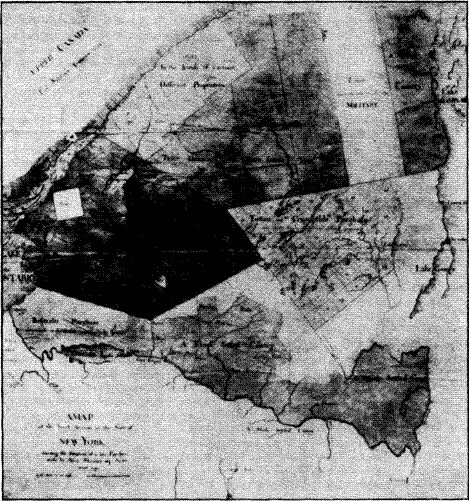
THE MAP OF MACOMB’S PURCHASE WHICH JAMES CONSTABLE TOOK TO EUROPE. THE ADJOINING TRACTS ARE MARKED AS “THICK SETTLED SECTIONS” WHEN THEY WERE STILL WILDERNESS
(Reproduced from a copy in the National Library of Paris)
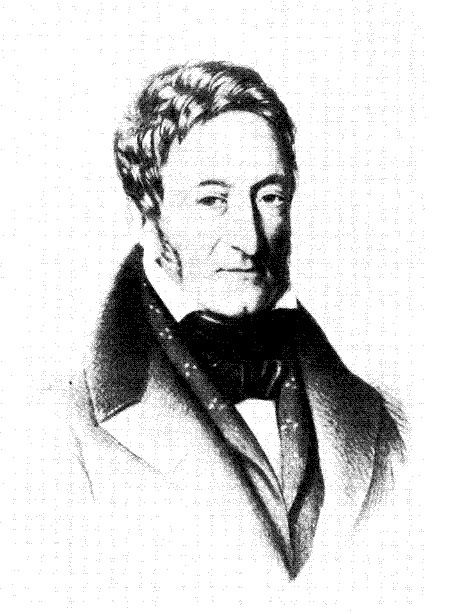
LE ROY DE CHAUMONT, PROPRIETOR OF NORTHERN NEW YORK LANDS
Philip Schuyler, a Federalist opposed to the democratic administration of Clinton, wrote his son-in-law Alexander Hamilton, January 29, 1792:
I have been pressed by several persons to draft a bill for the future conduct of the Commissioners of the Land Office, in the preamble of which they wish to convey a censure on the board for the conduct of the sale to Mr. Macomb. Considering a measure of this kind as a two-edge sword, I have advised that if even it were proper, it would not be prudent until matters more important to the state have been decided upon.
Thus, Schuyler feared he might involve his own party adherents in the scandal. Or he regarded the land as of so little value as not to be worth making its loss a political issue. Melancthon Smith, one of the wild land jobbers of the period who then had a seat in the legislature, strongly urged legislative approval of the deal and won out. In April, 1792, after an acrimonious debate, the New York Legislature “highly approved of the conduct of the Commissioners of the Land Office in the judicious sales by them.” Consequently, when Constable and McCormick paid the required instalments of the purchase price, they received the state patents to the immense tracts.
On May 31, 1796, in New York City, in the presence of Constable and McCormick, “purchasers under Alexander Macomb,” the Indian title to the property was extinguished. Under the purchase treaty, “the people of the State of New York agreed to pay the Indians, styling themselves, the Seven Nations of Canada, on the third Monday of August next the sum of one thousand two hundred and thirty-three pounds, six shillings and eight pence, and the further sum of two hundred and thirteen pounds, six shillings, and eight pence, lawful money of the state on the third Monday in August, yearly, thereafter”—if the five chiefs cared to come for it.
Macomb’s purchase had hardly been officially confirmed when Constable sailed for Europe in the hope of disposing of the vast acreage to British and French speculators. At this time France was in the throes of revolution, and it appeared that the ci-devant aristocrats, robbed of their native estates, would be glad to exchange their valuables for American lands. America was pointed out to them as a haven of refuge. Constable, accordingly, through his friend Gouverneur Morris, advertised his lands among the hard-pressed aristocrats. His partial success in disposing of large parcels to several French notables is reserved for later consideration.
In addition to the Ogden and Macomb purchases; the State of New York, during the decade between 1790 and 1800, by various means, disposed of other sections of its unappropriated public domain. The political outcry against the land jobbers, however, put an end to the wholesale disposal of large tracts after the turn of the century. Subsequent sales were on a much smaller scale. Those who purchased tracts ranging from 1,000 to 100,000 acres comprised almost all the leading capitalists and politicians then in the state. The list of names of the “bidders” could have constituted the social register of the time. There were the Cuttings, the Lows, the Roosevelts, the Ludlows, the Fenimore Coopers, the Watkins and the Livingstons, names which survive not only in their living descendants but are still retained by the villages and townships comprised in their land purchases. Few of these held on to their acquisitions and large acreages were returned to the counties for non-payment of taxes. The bankruptcy of the chief land operators, together with the abundance of wild lands for actual settlements in the fertile western territory then being opened up by the federal government, discouraged speculation in eastern waste lands, with the result that after 1795 prominent New York capitalists returned to trading, banking and shipping as sources of wealth and income.
A contemporary opinion of the futility of land speculation, together with the reasons for its existence, is well stated in a letter written by William Henderson to William Constable, dated February 6, 1795. Henderson wrote:
The room for speedy profit on waste lands in general above a dollar an acre, I do not, for my part, think very great. Indeed, the sudden rise which they have taken may be considered in a great degree artificial! You will say perhaps, “Why then do you purchase?” I reply, “because they have been an article in which there is great speculation,” and therefore may answer “to sell again.”
Such has been the psychology of land speculation in America from that day to this. Land purchases were made with a view to resale while a speculation fever was on, and not for permanent investment. Purchasers did not care much where or what were the areas they bought. They traded in land deeds as if they were parcels of merchandise. They bought, sold, traded and mortgaged without surveys, and without adequate description of boundary limits. Deeds to purchases, in many cases, were never filed, and titles were frequently never claimed. When taxes became burdensome, the land reverted to the state for non-payment.
We cannot well pass over to the secondary phase of the parceling out of the Empire State without briefly telling the story of an interesting episode in the annals of early New York and Connecticut land speculation. A strip of land, 2½ miles wide and over 200 miles long, bordering the whole length of the Pennsylvania-New York boundary, and once known as “The Gore,” had been claimed for many years prior to 1800 by Connecticut under her original charter grant. This claim was disputed by both Pennsylvania and New York. Notwithstanding Connecticut’s doubtful title, a group of native speculators offered to purchase it from their state.
This was in 1795. Connecticut at that time, though much impoverished, desired to build an imposing statehouse at Hartford. Various means of raising funds for this purpose, such as public subscriptions, lotteries, and the like, were tried without success. An offer was made by two contractors, Andrew Ward and Jeremiah Halsey, to complete the construction of the statehouse in return for a conveyance of land “comprised within the original charter limits of this state, and extending on the north line of Pennsylvania from the northeast boundary to the northwest boundary.” This offer was made notwithstanding that part of the land in question had already been sold by Massachusetts to Phelps and Gorham and the remainder to Robert Harper, James Watson, William Bingham, and others, by the New York commissioners of the Land Office.
The offer was accepted by the Connecticut Legislature, and the contractors immediately organized the “Gore Company” to claim possession of the slender strip of territory. Sundry new members were admitted as partners in the association. The whole deal was soon swept into the flames of the current Connecticut land gambles. “If we are able to erect our public buildings, school our children and expound our Bible through wild lands with a dubious title, at a vast distance and covered with Indians, we are certainly a most favored people.” Thus, wrote Samuel Hopkins to his friend, Oliver Wolcott. “The prospect pleases us,” he added, “but the lapse of time only can show how much they are magnified by the fog of speculation.”10
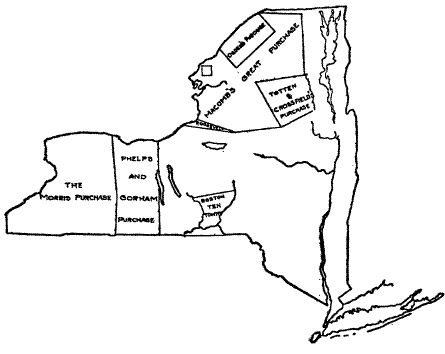
NEW YORK STATE PARCELED OUT AT WHOLESALE
The Gore Company lost no time in offering the lands for sale. In this way the promoters expected to get funds to pay for the work on the statehouse. About twenty-five deeds for tracts in the “Gore” were passed within a few months after its organization. In the meantime, the land was advertised as having increased in value about tenfold. Five trustees were appointed to hold the land, and “scrip” and shares were issued to those who chose to buy them. Altogether 384 shares were distributed among Connecticut residents.
The “proprietors” soon had their troubles, however. The New York Legislature, hearing of the deal, passed an act directing the governor to remove all those who settled under the Gore Land Company claims, “and cause all the buildings of such persons to be destroyed.” In accordance with this legislation, Governor John Jay issued a proclamation expressly charging and commanding all the magistrates and other citizens of New York “to oppose and prevent, by all legal means in their power, any such intrusion, entry, sale or purchase . . . and to give due notice of all such practices as may come to their knowledge; to the end that proper measures may thereupon be immediately taken to maintain the authority of the laws, and to bring the offenders to exemplary punishment.”
In May, 1796, the “proprietors” memorialized the Connecticut Legislature to declare the state’s right to the land as “they were unjustly impeded from making settlement.” Connecticut then appointed James Sullivan, James Wadsworth and Alexander Wolcott to treat with New York regarding the title to “the Gore,” but without avail. The offer to grant New York “the judicial right to the land on condition that a settlement be made with the “proprietors” of the Gore Land Company, was rejected. The dispute then was brought into the United States Courts. Alexander Hamilton appeared for New York and James Sullivan of Massachusetts for the Gore Land Company. The “proprietors” were assessed $12.50 per share for legal expenses; the case was dragged along without decision, and in 1799 an additional tax of $10.00 was levied on shareholders. Many declined to pay and their shares were resold at auction. A quietus was given to the whole gamble in 1800 when Connecticut renounced her claim to all lands west of her eastern boundary, except her “Western Reserve” in Ohio. In the meantime, the shares of the Gore Company had dropped from $1,000 to $70 per share and many innocent Connecticut speculators were ruined. After repeated appeals, in which it was stated that “many of the proprietors have been reduced from a state of affluence to penury and a state of bankruptcy,” the Connecticut Legislature in May, 1805, finally awarded the company $40,000 payable in four installments, on condition that the state be given a complete release from the shareholders. Thus ended the Connecticut Gore Land Company. It was but one of the many wild schemes of wasteful speculation that infested the New England region in the early post-Revolutionary period.
11 Massachusetts also was granted 230,000 acres lying upon the Susquehanna River between the Owego and Chenango Rivers. This tract, known as the “Boston Ten Towns,” was sold to Samuel Brown and associates of Stockbridge, Mass., in November, 1787. Several of the purchasers moved to the region and settled on the land.
12 See Payson Jackson Treat, The National Land System, p. 180.
13 See Henry Greenleaf Pearson, James S. Wadsworth of Geneseo, pp. 8-11.
14 See William Graham Sumner, The Financier and Finances of the Revolution, Vol. II, pp. 258, 259.
15 Paul Demund Evans, The Holland Land Company, Buffalo Historical Society Publications, 1924, p. 5.
16 Evans, op. cit, p. 25.
17 This pamphlet is very rare. A copy is in the Library of Congress.
18 Alfred Lee Donaldson, History of the Adirondacks, Vol. I, p. 66.
19 Evans, The Holland Land Company, p. 12.
20 See “The Connecticut Gore Land Company,” in Annual Report of the American Historical Association, 1898, p. 162.
- 1Maine Historical Collections, Vol. II, pp. 268-294.
- 2The Sir William Johnson Papers, Vol. V, p. 129. See also, C. W. Alvord, The Mississippi Valley in British Politics, Cleveland, 1917.
- 3Herbert B. Adams. “Washington’s Interest in Western Lands,” Johns Hopkins University Studies, Third Series, No. 1, January, 1885. Italics are mine.—A. M. S.
- 4Adams, op, cit., p. 58.
- 5See A. Henderson, “A Pre-Revolutionary Revolt in the Old Southwest” in Mississippi Valley Historical Review, Vol. 27, p. 198 et seq.
- 6Italics are not in the original.
- 7In a letter to William Franklin, dated May 3, 1776, Johnson asserted “it has always been my practice to avoid engaging in lands to the great loss of my family, neither have I a foot of land from the Indians.” (Sir William Johnson Papers, Vol. IV, p. 197.) The large tract north of the Mohawk Valley given him by the Canajoharie Indians in 1760 was confirmed by royal grant in 1769.
- 8See Pennsylvania Magazine of History, Vol. XIV, pp. 218, 219.
- 9See Memorial of the United Illinois and Wabash Land Companies, Baltimore, 1816.
- 10A copy of the deed is contained in American State Papers, “Public Lands.” Vol. I. The original copy was acquired by Cyrus H, McCormick.
- 11During the first hundred years of North American colonization, economic conditions gave little encouragement to private land schemes. Land was too plentiful. A few such enterprises were undertaken, however. Thus, as early as 1661, the Colony of Massachusetts sold to a few individuals for £400 a large tract on the Kennebec River in Maine. This became known as the “Kennebec Purchase.” The heirs held it for nearly a century without doing anything with it. In 1753, they incorporated as the “Proprietors of the Kennebec Purchase” and proceeded to dispose of their holdings. The corporation continued in existence until 1816. “The Pejebscot Company” was another Maine land deal. None of these held out promise of profit to proprietors until about a quarter century before the Revolution.
- 12In the meantime, the “Loyal Company” group was not idle; its proprietors sent Dr. Thomas Walker, of Albermarle, Va., to make a reconnaissance, and to discover a proper place of settlement. The two “companies” then became engaged in a controversy, and neither made a survey or fixed the bounds of their grants. The apparent ease with which they obtained land donations led to other schemes, and aroused an epidemic of interest in distant western wild lands. Not only was the land ownership eagerly sought after, but the establishment of new colonies, with separate and distinct governments, was planned. Favoritism and collusion infested the Virginian colonial government, due in large part to the persistence of speculators in western land grants. Lobbyists were sent to London to obtain the crown’s sanction to land-grabbing schemes and the question of the disposal of the vast western domain won from the French infested British politics. “One half of England is now land mad,” wrote George Croghan, of Philadelphia, one of the land schemers, to Sir William Johnson, on March 30, 1766, “and everybody there has their eyes fixed on this country.”
- 13I offered in my last to join you in attempting to secure some of the most valuable lands in the King’s part, which I think may be accomplished after awhile, notwithstanding the proclamation that restrains it at present and prohibits the settlement of them at all; for I can never look upon that proclamation in any other light (but this I say between ourselves) than as a temporary expedient to quiet the minds of the Indians. It must fall, of course, in a few years, especially when those Indians consent to our occupying the lands. Any person, therefore who neglects the present opportunity of hunting out good lands, and in some measure marking and distinguishing them, for his own, in order to keep others from settling them, will never regain it.
- 14Crawford “heartily embraced” the colonel’s offer. He promised shortly to set out in search of lands. “This may be done,” he said, “under a hunting scheme.” He acknowledged that other land seekers had approached him, with similar offers, “but have not agreed to any; nor will I with any but yourself or whom you think proper.”
- 15Judge Richard Henderson of North Carolina, the employer and backer of Daniel Boone, promoted the settlement of the Kentucky region and claimed ownership to a vast unsettled tract there. He organized a group of land grabbers under the name of “The Transylvania Company.” Ignoring the British interdiction against Indian land purchases, he obtained from the Cherokees in 1773 about one-half of the present State of Kentucky, and immediately began settling the land. He advertised widely for pioneers and “shareholders.” In his announcements, Henderson waxed enthusiastic. “The country [Transylvania] might invite a prince from his palace, merely for the pleasure of contemplating its beauty and excellence, but only add the rapturous idea of property, and what allurements can the world offer for the loss of so glorious a prospect?”
- 16When the British Government began to take active measures to break up land “bootlegging,” and to put a stop to dreams of riches in western territory, Virginia’s political resentment was naturally aroused. Even Thomas Jefferson, who, in later life, frowned upon speculation and land grabbing, held the view in 1774 that the land did not belong to the British king, and that it was time for the colonies “to declare that he has no right to grant lands of himself.” So he boldly wrote in the Declaration of Independence, as one of the British king’s usurpations: “He has endeavored to prevent the Population of these States; for that purpose obstructing the Laws for Naturalization of Foreigners; refusing to pass others to encourage their migrations hither, and raising the conditions of new Appropriation of Lands.”
- 17He was for it at once. “I like the project of a colony in the Illinois Country,” he wrote his son, “and will forward it to my utmost here.” He thought that Sir William Johnson’s “approbation will go a great way in recommending it, as he is much relied upon in all affairs that may have any relationships with the Indians.” But Johnson had an eye on the Indian lands himself, and besides advising others about purchases in the outlying sections, personally through gifts from the Indians engrossed large tracts, particularly in the Mohawk Valley. The town of Johnstown, N. Y., still marks the seat of his domain.
- 18Some of the members of the Vandalia Company were concerned in other western land schemes. One of these was organized in 1775 as the “Indiana Land Company,” probably the first application of the name “Indiana” to the Northwest Territory. The claim to land was based on a grant of a large tract, made November 3, 1768, in what is now West Virginia, by the Six Nations at Fort Stanwix to “Chief” William Trent in liquidation of depredations. Among the shareholders were Samuel Wharton, Joseph Galloway, Robert Callender, Levi Andrew Levi, and David Franks, all wealthy and prominent Philadelphians. The Revolutionary War did not put an end to the “claim.” Wharton in 1776 published a pamphlet, entitled-View of the Title to Indiana, in which he defended the company’s rights to the lands. In 1781, he republished this in enlarged form, under the title Plain Facts; being an examination into the Rights of the Indian Nations of America to their respective Countries and a Vindication of the Grant from the Six United Nations to Proprietors of Indiana, etc. Although Wharton pressed the validity of the “proprietors” claims, Congress then and thereafter gave little heed thereto.
- 19Notwithstanding the British Government’s edict, forbidding the private purchase of lands from the Indian tribes, William Murray, an Indian trader, and several of his business associates, in 1773 formed a plan to buy from the aborigines an immense tract of country between the Mississippi, Illinois and Ohio rivers. After a “pow-wow” lasting a month, the sale was consummated. According to the land claimants, it was attended by “many persons of both descriptions and the Indians were carefully prevented from obtaining any spiritous liquors during the whole continuation of the negotiation.” On July 5, 1773, “for a very large and valuable consideration,” the deed was delivered to the “Illinois Land Company.”
- 20Notwithstanding the British Government’s edict, forbidding the private purchase of lands from the Indian tribes, William Murray, an Indian trader, and several of his business associates, in 1773 formed a plan to buy from the aborigines an immense tract of country between the Mississippi, Illinois and Ohio rivers. After a “pow-wow” lasting a month, the sale was consummated. According to the land claimants, it was attended by “many persons of both descriptions and the Indians were carefully prevented from obtaining any spiritous liquors during the whole continuation of the negotiation.” On July 5, 1773, “for a very large and valuable consideration,” the deed was delivered to the “Illinois Land Company.”

