
The Great American Land Bubble
Chapter I. Pre-Revolutionary Precedents
AMERICA, from its inception, was a speculation. It was a speculation to Columbus. It was considered a speculation by the kings of Spain, France and England. They looked upon it as a source of riches in gold, silver and pelts. It was from the land that these precious goods were produced, and the ownership of the land was as essential to them as the political jurisdiction over it. Royal favorites were accordingly given vast territories, and land was distributed to individuals and companies as royal rewards.
The colonial charters granted in England to individuals and companies gave proprietorship of the soil, but the king reserved political jurisdiction and control, as well as the mineral rights. Thus, Penn and Calvert and Oglethorpe received merely grants of land. The governing and feudal rights which they assumed were revocable at the royal will, and as the colonies became more densely settled and advanced in political status, the king appointed governors to rule over them. When the proprietary right to the soil had been given, the possessors of these rights or their assigns continued to hold the land originally allotted to them. James, Duke of York, to whom his affectionate brother had presented the whole Dutch province of New Amsterdam, and more besides, began to sell or otherwise dispose of his vast domain. He granted to Lords Carteret and Berkeley most of the province of New Jersey. These sold out to two companies,—the “Proprietors of East Jersey” and the “Proprietors of West Jersey” respectively,—companies which continued in existence during the eighteenth century, though they lost their feudal rights as early as 1702. James also made other lavish grants. Some of these were revived in later years, causing serious trepidation to property owners whose titles were threatened by new claimants.
Thus, the conveyance of unoccupied lands to private individuals or companies, which undertook the management, settlement and resale, was a common practice in colonial times. In fact, much of the early English settlement of America was conducted on this plan. The London and Plymouth companies were ostensibly trading companies, but the motive of land speculation, though not openly expressed, was an important factor in the settlement of the colonies. As population began to fill up the accessible regions within colonial charter grants, the acquisition of large unsettled tracts for pecuniary gain came more and more into vogue.
During the first hundred years of North American colonization, economic conditions gave little encouragement to private land schemes. Land was too plentiful. A few such enterprises were undertaken, however. Thus, as early as 1661, the Colony of Massachusetts sold to a few individuals for £400 a large tract on the Kennebec River in Maine. This became known as the “Kennebec Purchase.” The heirs held it for nearly a century without doing anything with it. In 1753, they incorporated as the “Proprietors of the Kennebec Purchase” and proceeded to dispose of their holdings. The corporation continued in existence until 1816.1 “The Pejebscot Company” was another Maine land deal. None of these held out promise of profit to proprietors until about a quarter century before the Revolution.
About this time, wealth had accumulated in the colonies. Free land, obtained under crown grants, or “head rights,” had ceased. Cities and channels of trade were established and population gradually pushed forward to the Alleghany foothills. The vast unoccupied tracts beyond became a lure. Few dared to settle in the region. Actual ownership was held by the Indians, and claimed by the French. This was not a discouragement, however. Did not the territories occupied by the flourishing colonies once belong to the Indians? And was it not bought from them for mere trifles? Why not, then, establish similar colonies to the west, and start anew in building up land values. To the descendants of the pioneer colonials, the backwoods, Indians, and hostile Frenchmen presented no serious obstacles.
Proprietorship of large landed estates, moreover, was highly regarded by the colonials. It was an emblem of nobility. It carried with it political as well as pecuniary preferment. This was particularly characteristic of the South. There, during the colonial days the presence of large landed estates, engrossed in comparatively few hands, fostered a landed aristocracy. Land ownership, therefore, was desirable for social and political, as well as for pecuniary reasons. The Virginian was not much of a “gentleman” unless he lived in the midst of countless acres. If he was a non-resident owner, or a large “patentee” of the crown, he employed land agents on the spot to look after his estates or to sell and lease his holdings. Grants of land in the southern colonies were a source of continual political intrigues. In fact, land grabbing in the South began before the importance of either negroes or tobacco was recognized.
As the areas east of the Alleghany Mountains were gradually engrossed, and as towns and plantations spread out to the Piedmont sections, covetous eyes were pointed toward the vast unsettled domain to the westward. The political sovereignty and administrative control of the territory were in doubt. Various colonies claimed a share of the westward area as part of their original charter grants. The charter limits were not fixed, so that the conflicting claims overlapped. This brought about disputes regarding ownership and right to the control of the soil. Intercolonial jealousy and territorial greed led the rival claimants to take measures, secretly and openly, to assert their rights by actual occupation or by royal conveyances.
.....
The first definite move to obtain a large grant of western land was made in 1748, when a group of Virginians, styling themselves the “Ohio Company,” obtained a crown grant of 500,000 acres west of the Alleghanies adjacent to Virginia. The next year another group of forty-six Virginia gentlemen styling themselves “The Loyal Company” received an additional 800,000 acres near by. Both grants were made by the Governor and Council of Virginia. The locations were not surveyed nor definitely marked out. That of the Ohio Company was to be located “south of the Ohio River,” and the Loyal Company’s grant was to be “in one or more surveys beginning on the bounds between Virginia and South Carolina and running westward to the North Seas.” The companies were to locate their lands, and make return of surveys within four years’ time.
Both set about to secure their grants. Christopher Gist, one of the noted surveyors of Virginia, was sent in October, 1750, to “search out” and to discover the Ohio Company’s lands. He went down the Ohio as far south as the present site of Louisville. During his journey he made strong overtures of friendship with the Indians. He was enthusiastic about the project. “Nothing,” he said, “is wanting but cultivation to make it a most delightful country.”
In the meantime, the “Loyal Company” group was not idle; its proprietors sent Dr. Thomas Walker, of Albermarle, Va., to make a reconnaissance, and to discover a proper place of settlement. The two “companies” then became engaged in a controversy, and neither made a survey or fixed the bounds of their grants. The apparent ease with which they obtained land donations led to other schemes, and aroused an epidemic of interest in distant western wild lands. Not only was the land ownership eagerly sought after, but the establishment of new colonies, with separate and distinct governments, was planned. Favoritism and collusion infested the Virginian colonial government, due in large part to the persistence of speculators in western land grants. Lobbyists were sent to London to obtain the crown’s sanction to land-grabbing schemes and the question of the disposal of the vast western domain won from the French infested British politics. “One half of England is now land mad,” wrote George Croghan, of Philadelphia, one of the land schemers, to Sir William Johnson, on March 30, 1766, “and everybody there has their eyes fixed on this country.”2
George Washington and his half-brothers, Augustine and Lawrence Washington, were concerned in the Ohio Company. Thus, Washington, early in his political career, was brought into contact with land grabbing. From this time on, until the outbreak of the Revolution, his interest in western lands was supreme. He was one of the most active land speculators of colonial times. He was, moreover, a surveyor by profession. As a “land agent” of Lord Fairfax, whose estates comprised over 5,000,000 acres, he became infected with the “wild land” virus. Besides taking an active part in pressing the claims of the Ohio Company, he, together with his neighbors, the Lees, formed “The Mississippi Company” and petitioned, in 1768, for an additional large grant.
The French and Indian War interrupted for a while Washington’s land schemes, but following the peace treaty in 1763, he entered whole-heartedly into western land acquisitions. Virginia had set aside a large section of territory west of the Alleghanies as bounties for its soldiers in the war, and Washington eagerly set about to secure the claims of the veterans. While thus garnering the means of acquiring lands, he secretly employed an agent, his old frontier friend, Captain William Crawford, to seek out and preëmpt the best locations. He had even entered upon plans of colonization and thought of importing Germans from the Palatinate as settlers.
Nor was he dismayed or discouraged, when, in 1763, a royal proclamation arrived from London, forbidding the colonial governors from granting patents for land beyond the sources of any of the rivers which flow into the Atlantic from the west and northwest. This he scornfully treated as a “scrap of paper.” In writing to his friend and agent, Crawford, who had taken up his residence in the back country on the Youghiogheny River, the future Father of his Country set forth definitely his speculation aims:
I offered in my last to join you in attempting to secure some of the most valuable lands in the King’s part, which I think may be accomplished after awhile, notwithstanding the proclamation that restrains it at present and prohibits the settlement of them at all; for I can never look upon that proclamation in any other light (but this I say between ourselves) than as a temporary expedient to quiet the minds of the Indians. It must fall, of course, in a few years, especially when those Indians consent to our occupying the lands. Any person, therefore who neglects the present opportunity of hunting out good lands, and in some measure marking and distinguishing them, for his own, in order to keep others from settling them, will never regain it.3
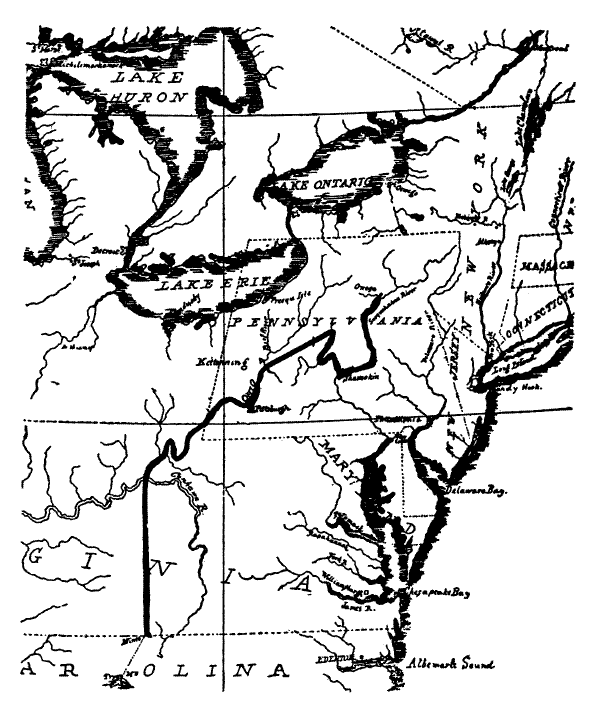
THE BLACK LINE MARKS THE “INDIAN BOUNDARY” BEYOND WHICH THE COLONISTS WERE ORDERED NOT TO GO
“If you will be at the trouble,” he adds, “of seeking out the lands, I will take upon me the part of securing them, as soon as there is a possibility of doing it, and will, moreover, be at all the cost and charges of surveying and patenting the same.”
George Washington had an eye for business. Had he not become a great general and the Father of his Country, he probably would have been a foremost colonial financier and landlord. “It may be easy for you to discover,” he wrote Crawford, “that my plan is to secure a good deal of land. You will consequently come in for a very handsome quantity; and as you will obtain it without any cost or expenses, I hope you will be encouraged to begin your search in time.” He directed that “if it were practical, to get large tracts together,” and suggested the neighborhood of Fort Pitt (Pittsburgh) but “not to neglect others of a greater distance, if fine bodies of it lie in one place.” In fact, he had “no objection to a grant of land upon the Ohio, a good way below Pittsburgh, but would first willingly secure some valuable tracts nearer at hand.”
Washington had some apprehension of conflict with the Ohio Company, but he promised Crawford to make inquiries “so we may know what to apprehend from them.” Above all, he cautions the utmost secrecy: “I recommend,” he added, as a final admonition, “that you keep the whole matter a secret, or trust it only to those in whom you can confide, and who can assist you in bringing it to bear by their discoveries of land. This advice proceeds from several very good reasons, and in the first place, because I might be censured for the opinion I have given in respect to the King’s proclamation, and then, if the scheme I am now proposing to you were known, it might give the alarm to others, and by putting them upon a plan of the same nature before we could lay a proper foundation for success ourselves, set the different interests clashing, and probably, in the end, overturn the whole.”
Crawford “heartily embraced” the colonel’s offer. He promised shortly to set out in search of lands. “This may be done,” he said, “under a hunting scheme.” He acknowledged that other land seekers had approached him, with similar offers, “but have not agreed to any; nor will I with any but yourself or whom you think proper.”4
In view of the caution required in carrying out the location of lands, the matter proceeded slowly. It was not until October 5, 1770, that Washington left his comfortable country seat at Mount Vernon ostensibly on a hunting trip in the western wilderness. In his diary he carefully noted the physical features of the terrain over which he passed. He was not lacking in a knowledge of land values. On October 15 he wrote:
Went to view some land, which Captain Crawford had taken up for me near the Youghiogheny. . . . This tract, which contains about one thousand six hundred acres, includes some as fine land as ever I saw, and a great deal of rich meadow. . . . The lands, which I passed over today, were generally hilly, and the growth chiefly white oak, but very good notwithstanding; and, what is extraordinary, and contrary to the property of all other lands I ever saw before, the hills are the richest land; the soil upon the sides and summits of them being as black as coal and the growth walnut and cherry. The flats are not so rich, and a good deal more mixed with stone.
He next took a trip down the Ohio, with a small company of white men and Indians, to view some tracts along the Great Kanawha River, which had been set aside by Virginia as bounty land to officers and soldiers. Here again he carefully noted the qualities of the soil:
The land on both sides this [the Great Kanawha] river, just at the mouth, is very fine, but on the east side, when you get towards the hills, it appears wet, and better adapted for meadow than tillage.
Returning to the confluence of the Kanawha and Ohio rivers, he “marked two maples, an elm and hoop-wood tree, as a corner of the soldiers’ land (if we can get it), intending to make all the bottom from hence to the rapids in the Great Bend into one survey.” “I also marked, at the mouth of another river,” he added, “an ash and hoop-wood for the beginning of another of the soldier’s surveys.”
Part of these “soldiers’ lands” not long afterwards came into Washington’s possession. On August 20, 1773, less than three years after his exploration, there appeared the following advertisement in the Maryland Journal and Baltimore Advertiser:
Mount Vernon in Virginia, July 15, 1773.
The subscriber having obtained patents for upwards of twenty thousand acres of land on the Ohio and Great Kanawha (ten thousand of which are situated on the banks of the first-mentioned river, between the mouths of the two Kanawhas, and the remainder on the Great Kanawha, or New River, from the mouth or near it, upwards, in one continued survey) proposes to divide the same into any sized tenements that may be desired, and lease them upon moderate terms, allowing a reasonable number of years rent free, provided, within the space of two years from next October, three acres for every fifty contained in each lot, and proportionably for a lesser quantity, shall be cleared, fenced, and tilled; and that, by or before the time limited for the commencement of the first rent, five acres of every hundred, and proportionably, as above, shall be enclosed and laid down in good grass for meadow; and moreover, that at least fifty fruit trees for every like quantity of land shall be planted on the Premises. Any person inclinable to settle on these lands may be more fully informed, of the terms by applying to the subscriber, near Alexandria, or in his absence to Mr. Lund Washington; and would do well in communicating their intentions before the 1st of October next, in order that a sufficient number of lots may be laid off to answer the demand.
As these lands are among the first which have been surveyed in the part of the country they lie in, it is almost needless to premise that none can exceed them in luxuriance of soil, or convenience of situation, all of them lying upon the banks either of the Ohio or Kanawha, and abounding with fine fish and wild fowl of various kinds, as also in most excellent meadows, many of which (by the bountiful hand of nature) are, in their present state, almost fit for the scythe. From every part of these lands water carriage is now had to Fort Pitt, by an easy communication; and from Fort Pitt, up the Monongahela, to Redstone, vessels of convenient burthen, may and do pass continually; from whence by means of Cheat River, and other navigable branches of the Monongahela, it is thought the portage to Potowmack may, and will, be reduced within the compass of a few miles, to the great ease and convenience of the settlers in transporting the produce of their lands to market. To which may be added, that as patents have now actually passed the seals for the several tracts here offered to be leased, settlers on them may cultivate and enjoy the lands in peace and safety, notwithstanding the unsettled counsels respecting a new colony on the Ohio; and as no right money is to be paid for these lands, and quitrent of two shillings sterling a hundred, demandable some years hence only, it is highly presumable that they will always be held upon a more desirable footing than where both these are laid on with a very heavy hand. And it may not be amiss further to observe, that if the scheme for establishing a new government on the Ohio, in the manner talked of, should ever be effected, these must be among the most valuable lands in it, not only on account of the goodness of soil, and the other advantages above enumerated, but from their contiguity to the seat of government, which more than probable will be fixed at the mouth of the Great Kanawha.
GEORGE WASHINGTON.
It appears from the foregoing announcement, that Washington proposed to settle the lands and not to sell them. He wished settlers to “clear, fence and till the tenements,” and make other improvements, for which a period of free rental would be granted. How like the English practice! And how much opposed to democratic principles! But Washington, until he set out to lead the embattled farmers in the struggle for political freedom, was a Virginian landlord. These gentry were fast assuming all the traits, characteristics and privileges of the landed aristocracy of the mother country. Land was not only the badge of wealth. It was the emblem of nobility. The first families of Virginia not only sought land, but they sought to retain it. When the King’s proclamation restricted the settlement of the western wild lands, and forbade all land purchases from the Indians, it not only created resentment against the British Government, but it gave an opportunity to the common folk, the landless yeomanry, to assert themselves and take a hand in the determination of the popular will. The Revolutionary War eventually resulted in abolishing land ownership as a basis of political prestige. To this movement, Washington and his landed associates of Virginia slowly and calmly yielded. True patriot that he was, he ungrudgingly sacrificed his personal interests in the common cause.
While engaged in war and in politics, Washington’s western lands remained much as he had obtained them. His interest in the western country, however, did not abate. When peace released him from his commission, and he returned to his Mount Vernon estate, he revived his dreams of western settlements. He had become “land-poor” and possibly, with the hope of bringing value to his distant holdings, he fostered schemes of public improvements. The Potomac Company, which sought to improve navigation to the heights of the Alleghanies, and by a canal or portage open up water communication with the region beyond, was a child of his brain. But his western lands brought him little satisfaction, though at the time of his death he still owned about seventy-one thousand acres, more than half of which were wild lands lying west of the Alleghanies. Some of this he had received as bounty for his military services. Robert Morris and other land jobbers, subsequent to the Revolution, sought in vain to interest the “General” in their various deals, but he refused.
Judging by his correspondence and his diaries, Washington had incurred a strong dislike of “land jobbing,” both for political and for pecuniary reasons. “From a long experience of many years,” he wrote Presley Neville, in 1794, “I have found distant property in land more pregnant of perplexities than profit. I have therefore resolved to sell all I hold on the western waters, if I can obtain the prices which I conceive their quality, their situation, and other advantages would authorize me to expect.”
Washington, while President, however, on advice of George Clinton, of New York, did purchase 3,000 acres in the Mohawk Valley for £1,800. He borrowed the money from Clinton. Subsequently, he sold about two-thirds of the property at a profit of £1,500 and repaid the debt. He also bought lots in the City of Washington. At his death these were valued at $19,132.
.....
Washington and his brothers, in their land deals, had many rivals and associates among prominent Virginians. These banded together, either in groups or in “companies.” There were the Lees, the Nicholsons, the Carters, the Masons and the Byrds. Patrick Henry, as well as Peter Jefferson, a surveyor and the father of Thomas Jefferson, were deeply concerned in it. Further south, in the Carolinas, there were also men who eagerly grasped for the fertile regions sloping towards the Mississippi.
Judge Richard Henderson of North Carolina, the employer and backer of Daniel Boone, promoted the settlement of the Kentucky region and claimed ownership to a vast unsettled tract there. He organized a group of land grabbers under the name of “The Transylvania Company.” Ignoring the British interdiction against Indian land purchases, he obtained from the Cherokees in 1773 about one-half of the present State of Kentucky, and immediately began settling the land. He advertised widely for pioneers and “shareholders.” In his announcements, Henderson waxed enthusiastic. “The country [Transylvania] might invite a prince from his palace, merely for the pleasure of contemplating its beauty and excellence, but only add the rapturous idea of property, and what allurements can the world offer for the loss of so glorious a prospect?”5
Henderson and his associates ran into a noose of intercolonial conflict. They endeavored, during the Revolution, to get the Continental Congress to erect their territory into another state, but Patrick Henry and Thomas Jefferson, in the interests of Virginia, had their Indian purchase declared illegal. The Kentuckians, however, threatened to fight, and to appease the irate speculators, Virginia granted land to actual settlers, and finally closed out the Transylvania claim by giving Henderson’s company 200,000 acres.
Though small tracts were granted freely to Kentucky settlers, land jobbing soon became general in this new territory. The widespread tendency towards engrossment resulted in large importations of slaves into Kentucky, the redundant descendants of which, in later years, had to be sold “down the river.”
As Kentucky was settled by zeal for land ownership and by the greed of land grabbers, so, also, was Tennessee. John Sevier, a hero of King’s Mountain, the colonizer and first governor of the new “State of Franklin” (which later became Tennessee), held title to immense tracts in that region, and, still unsatisfied, continuously grasped for more.
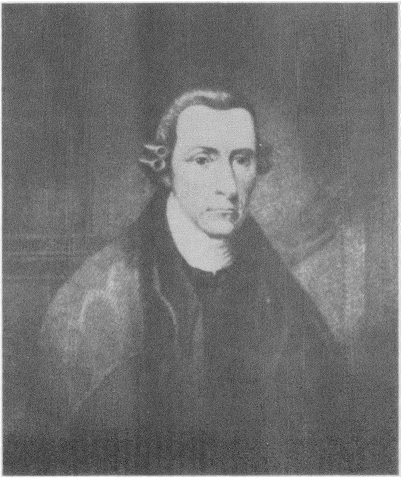
Patrick Henry is generally held to have been one of the most violent of the Revolutionary Fathers in his denunciation of British tyranny. Every schoolboy knows his slogan “Give me Liberty or give me Death.” But was there a selfish personal motive in this defiance? Could he not have said, “Give me Liberty or give me Death”—(and then, under his breath)—“let me have western lands.” Jefferson described Henry as being “insatiable in money”—and his participation in the Georgia land frauds described in Chapter VI may bear this out.
Aside from this cupidity, however, there is strong historical proof that Henry was actively engaged in western land deals when the British proclamation against western settlement, as well as other “acts of tyranny,” materialized. With Dr. Thomas Walker, agent of the “Loyal Company,” also a notorious colonial land grabber, he became identified, beginning in 1767, in speculations in western lands. And in conjunction with William Byrd, a member of the Virginia Governor’s Council, he conducted secret negotiations with the Cherokee tribes for land in the forbidden area. Moreover, he was the personal counsel of the Earl of Dunmore, colonial governor of Virginia, when the latter became a participant in the Illinois land schemes, described below. Following the Revolution, Henry continued to be active in land deals and died possessed of a large landed estate.
Patrick Henry, like Washington, was a man of business as well as a patriot. He was said to be “peculiarly a judge of the value of lands.” When the Revolutionary War broke out, he realized that the Indian purchases were likely to be nullified. In a deposition made by him in 1777, and now contained in the Virginia Calendar of State Papers, he states that on becoming a member of the first Continental Congress he determined “to disclaim all concern and connection with Indian purchases, although shares were frequently offered him.” The reasons given for this resolution were the enormous extent of the purchases, the probability of being called upon to settle disputes over such claims, and, in the event of war, the likelihood of the soil being claimed by the American states. Because of this attitude, Henry, together with Jefferson, during the Revolution vigorously opposed the private claims to western lands. The land fever, however, again took hold of him when peace was restored.
When the British Government began to take active measures to break up land “bootlegging,” and to put a stop to dreams of riches in western territory, Virginia’s political resentment was naturally aroused. Even Thomas Jefferson, who, in later life, frowned upon speculation and land grabbing, held the view in 1774 that the land did not belong to the British king, and that it was time for the colonies “to declare that he has no right to grant lands of himself.” So he boldly wrote in the Declaration of Independence, as one of the British king’s usurpations: “He has endeavored to prevent the Population of these States; for that purpose obstructing the Laws for Naturalization of Foreigners; refusing to pass others to encourage their migrations hither, and raising the conditions of new Appropriation of Lands.”6
There is nothing reprehensible in the land hunger of the southern patriots. The British laws discouraged manufacture in America, and hampered colonial trade. Virginian capitalists were restricted in their private enterprises chiefly to raising tobacco and corn, or trading in negroes. Tobacco frequently furnished little or no profit, and slave driving was distasteful to the best families of the landed aristocracy. Speculation in lands was the chief source of rapid rise to wealth, and it was considered an honorable and respectable occupation. “It does not detract from Washington’s true greatness for the world to know the material side of his character,” wrote Professor Herbert Adams, of Johns Hopkins University, in 1885. “To be sure, it brings Washington nearer to the level of humanity to know that he was endowed with the passions common to men, and that he was as diligent in business as he was fervent in his devotion to country. It may seem less ideal to view Washington as a man rather than as a hero or statesman, but it is the duty of history to deal with great men as they actually are.” And let us accept this judgment in considering the participation of Washington and his compatriots in colonial land-jobbing schemes.
.....
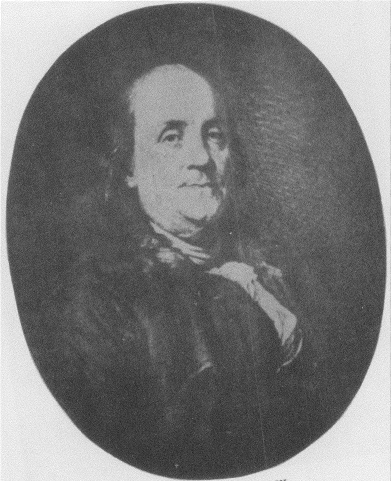
Another great American—the “First Civilized American,” a biographer calls him—also contracted the western land fever. Benjamin Franklin’s many-sided occupations—printer, philosopher, diplomat, postmaster, statesman—did not keep his mind from gainful pursuits or desires for gain. Be it said of him, however, that he was induced by his son to participate in one of the largest western land deals ever concocted in the American continent. He was not a prime mover of the proposition. But he willingly and eagerly promoted it.
During Franklin’s second visit to England in 1766, as agent of Pennsylvania, his enterprising son, William Franklin, then Governor of New Jersey, in association with Sir William Johnson, the British Government’s Indian Agent in the northern colonies, together with several wealthy Philadelphians, conceived the idea of buying the claims of French settlers to land in Illinois. They later expanded their proposed purchase to an immense tract west of the Ohio River. They wrote Benjamin Franklin, requesting him to use his influence to get the British Government’s permission.
He was for it at once. “I like the project of a colony in the Illinois Country,” he wrote his son, “and will forward it to my utmost here.” He thought that Sir William Johnson’s “approbation will go a great way in recommending it, as he is much relied upon in all affairs that may have any relationships with the Indians.” But Johnson had an eye on the Indian lands himself, and besides advising others about purchases in the outlying sections, personally through gifts from the Indians engrossed large tracts, particularly in the Mohawk Valley. The town of Johnstown, N. Y., still marks the seat of his domain.7
Franklin’s reward for his services was a share in the deal. “I thank the company for their willingness to take me in, and one or two others that I may nominate,” he wrote his son, on September 12, 1766. “I wish,” he added, “you had allowed me more [nominees], as there will be in the proposed country, by my reckoning, nearly sixty-three million acres, and, therefore, enough to content a great number of reasonable people, and by numbers we might increase the weight of our interest here.”
Franklin thus knew the frailties of politicians, or else he knew human nature. Like John Law, in his “Mississippi Bubble,” he sought to gain political approbation by distributing “shares” to the powers that be. He interested a prominent London banker, one Thomas Walpole, who became the nominal head of the affair. The deal thus became known as the Walpole Grant. In Philadelphia, it was called the “Vandalia Company.” The members included, besides William Franklin and Sir William Johnson, Colonel George Croghan, his assistant, and Joseph Galloway, the richest merchant of Philadelphia, who, as a Tory, escaped to England at the outbreak of the Revolution. Other prominent members were John Sargent, and Samuel and Joseph Wharton of Philadelphia. The Whartons were influential Indian traders in the Illinois country. Colonel Croghan, like his superior, Sir William Johnson, was an active land grabber, and engrossed large tracts of wild land south of the Mohawk Valley. A part of his lands in this section was acquired from him by William Cooper, progenitor of James Fenimore Cooper, and founder of Cooperstown, N. Y.
The shares in the Vandalia Company were distributed in all to about thirty-two persons, some of whom were in England. Shares were privately offered to selected persons. Writing to John Foxcroft, February 4, 1772, Franklin stated “that he had advanced for your share [i.e., Foxcroft’s share], what has been paid by others, . . . and I shall in the whole affair, take the same care of your interest as my own.”
Franklin’s proposal for “a new colony” dragged along for six years without definite results. The matter was referred by the British Cabinet to the Board of Trade. The president of this board was Lord Hillsborough. He was secretly opposed to it, but deluded Franklin in pretending that it met his approval. It was he who suggested that the originally proposed tract of 2,500,000 acres be expanded into “enough to make a province.” When he finally disapproved it and received the support of the board in this decision, Franklin’s resentment was bitter. “Witness his [Hillsborough’s] duplicity,” he wrote his son, “in encouraging us to ask for more land, pretending to befriend our application.”
But Franklin won out, notwithstanding Hillsborough’s objection. It may have been due to the remarkable arguments he employed in his printed reply to the Board of Trade’s decision; or it may have been the belief of the British Cabinet that, by acceding to the petition for a new colony, the outraged and revolting colonists might be appeased.
The grant came too late. On March 2, 1775, Franklin departed for America, never again to set foot in England. When he arrived in Philadelphia, the colonists had already revolted, and land schemes were temporarily set aside. The Vandalia Company never thereafter pressed its claims, and nothing is known regarding the disposition of its shares. The region of the proposed “new colony” was, after the Revolution, formed into the Northwest Territory, and this section, as shall be shown later, became the favorite field of the post-Revolutionary land gamblers.
Some of the members of the Vandalia Company were concerned in other western land schemes. One of these was organized in 1775 as the “Indiana Land Company,” probably the first application of the name “Indiana” to the Northwest Territory. The claim to land was based on a grant of a large tract, made November 3, 1768, in what is now West Virginia, by the Six Nations at Fort Stanwix to “Chief” William Trent in liquidation of depredations. Among the shareholders were Samuel Wharton, Joseph Galloway, Robert Callender, Levi Andrew Levi, and David Franks, all wealthy and prominent Philadelphians.8 The Revolutionary War did not put an end to the “claim.” Wharton in 1776 published a pamphlet, entitled-View of the Title to Indiana, in which he defended the company’s rights to the lands. In 1781, he republished this in enlarged form, under the title Plain Facts; being an examination into the Rights of the Indian Nations of America to their respective Countries and a Vindication of the Grant from the Six United Nations to Proprietors of Indiana, etc. Although Wharton pressed the validity of the “proprietors” claims, Congress then and thereafter gave little heed thereto.
.....
Another alleged “purchase from the Indians,” on a still more elaborate scale, which was effected just prior to the Revolution, was the basis of a larger and more enduring western “land claim.” It was destined to worry Congress for more than a generation.
Notwithstanding the British Government’s edict, forbidding the private purchase of lands from the Indian tribes, William Murray, an Indian trader, and several of his business associates, in 1773 formed a plan to buy from the aborigines an immense tract of country between the Mississippi, Illinois and Ohio rivers. After a “pow-wow” lasting a month, the sale was consummated. According to the land claimants, it was attended by “many persons of both descriptions and the Indians were carefully prevented from obtaining any spiritous liquors during the whole continuation of the negotiation.”9 On July 5, 1773, “for a very large and valuable consideration,” the deed was delivered to the “Illinois Land Company.”10
There is some evidence that the “purchasers” when they secured the “deed” from the Indians knew of the British Government’s opposition to the acquisition of Indian lands. But they endeavored to obtain political influence to support their title. Thus, William Murray wrote Bernard Graetz, his associate, soon after the purchase, that he was assured by Colonel George Croghan, the British Deputy Indian Agent, “that Lords Camden and York personally confirmed to him the opinion of Lord Mansfield respecting the Indian title.” “So courage, my boys!” he added. “I hope we shall yet be satisfied for our past vexations attending our concern in Illinois.”
PATRICK HENRY
BENJAMIN FRANKLIN
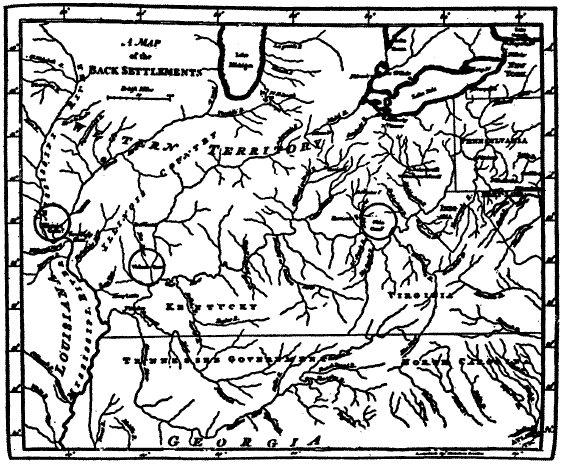
TAKEN FROM JEDIDIAH MORSE’S, The American Geography, PUBLISHED IN LONDON, 1794. CIRCLES SHOW CLAIMS OF THE OHIO, ILLINOIS AND WABASH COMPANIES. INDIANA IS PLACED JUST WEST OF MARYLAND.
Not content with the large purchase in the Illinois country, Murray commenced another negotiation. This time it concerned a tract on the Wabash River. Everything connected with the transaction, it was asserted, “was conducted openly and fairly,” and the contract concluded October 8, 1775, by the “Wabash Land Company,” “for a very large and valuable consideration.”
The Revolutionary War prevented the purchasers from “taking possession.” In the meantime, the two companies were combined into “The United Illinois and Wabash Land Companies,” and under this high-sounding name the proprietors sold their shares during and subsequent to the period of hostilities.
In reading through the reputed Indian deeds assigned to the United Illinois and Wabash Land Companies, we come upon some familiar Philadelphia names of Revolutionary times. Among them are the Franks, the Graetzes, and the Levis, all prominent Jewish merchants and Indian traders, and staunch supporters of the Revolution—patriots who are today a pride to their descendants. Several of these were members of the Indiana Company referred to above. In addition, there were Robert Callender, William Murray, Alexander Ross and David Sproat, James Milligan, John Ingles, and Andrew and William Hamilton of Philadelphia, Thomas Minshall of York, Pa., and Joseph Campbell of Pittsburgh. The purchasers of the Wabash lands included, in addition to the above, several prominent personages. There were, first, “the Right Honorable John Earl of Dunmore, Governor of the colony and dominion of Virginia,” and “the Honorable John Murray, son of the said Earl.” Like Washington, these colonial officials treated the king’s proclamation against purchasing lands from the Indians as a “scrap of paper.”
Maryland citizens also were participants, as were also several from “the Illinois country.” Other prominent persons, who were not direct purchasers, became shareholders in the “United” companies. Among these were James Wilson, learned Philadelphia jurist, and subsequent Justice of the United States Supreme Court; Robert Morris, financier of the Revolution; and Silas Deane, merchant of Wethersfield, for a time the confidential agent of the Continental Congress in France. Both Wilson and Morris, as shown in the following chapters, became immersed in land-grabbing deals after the Revolution. Morris’ participation in the Illinois and Wabash Companies, however, was not large. He held an 84th share of the purchase in 1781, and he did not take an active part in pressing the claims of “the companies.” But Wilson became its head. As late as 1797, he was president of the “United” companies. The extent of his holdings is not revealed, but it may be assumed that it was quite large. Silas Deane’s correspondence with him, when the former was in London, following his dismissal from his French mission by Congress, shows that Wilson was very desirous of selling “shares.” On April 1, 1783, Deane wrote Wilson, “I could not do anything with the Illinois lands during the War, and now, when much might be done with them, if a tolerable chance for a title appeared, I dare not venture to attempt anything.” He later (July 24, 1783) inquired of Wilson regarding the affairs of the company, since the lack of information has “prevented my doing anything either with my own interest or with the shares put into my hands for sale in Europe.”
Deane’s previous efforts to unload “shares” in France were equally unsuccessful. Writing from Paris, September 4, 1780, to John Shee, a shareholder, he said, “I have a prospect of doing something with the shares of the Illinois and Wabash lands, but I fear your limits are rather higher than they will go at”; and he added, “I shall from time to time acquaint you, through our mutual friends, Messrs. Morris and Wilson, of my proceeding in this affair,” thus showing that these two “land jobbers” were backing his merchandising efforts.
Before hostilities with the British had ceased, the “proprietors” of the Illinois and Wabash Companies petitioned Congress for a recognition of their title. It received meager consideration, and was thrown out on the ground that the Indians who sold the land never owned it. In 1791, after the establishment of the federal government, Congress was again memorialized. And again, in 1797, in 1804, in 1810 and in 1811. Each time the petitioners comprised new and prominent names. Thus, in 1810, the name of Robert Goodloe Harper, former Congressman, Senator and eminent jurist, and an associate of Robert Morris and others in post-Revolutionary land speculations, appears as one of the “proprietors and agents.” Solomon Etting, a prominent-Jewish merchant of Baltimore, also became a “proprietor” and signed the petitions.
Finally, on January 30, 1811, a committee of the House of Representatives definitely reported against recognition of the grant on the ground that the deed from the Indians was without the sanction of the government and that “any recognition of the claim would encroach upon the great system of policy wisely introduced to regulate intercourse with the Indians.” Thus ended the “Illinois and Wabash” speculation.
.....
It must not be assumed that the New Englanders, as a group, were not concerned in the pre-Revolutionary land-grabbing schemes. Yankee land greed is proverbial. Unlike the southern speculators, however, they did not, in colonial days, seek out immense regions west of the Alleghanies, though in later times they were caught in the maelstrom of western land speculation. Before the colonists took up arms against the authority of George III, the settled portions of New England were already overcrowded, and modest fortunes had been accumulated as a result of rising land values. Connecticut, in particular, felt the need of an outlet for surplus population. Packed within narrow limits and confined to rocky hills, the sturdy Yankee farmers looked with envious eyes upon the rich unoccupied lands to the westward. Silas Deane, who, as a young man, collected material for a history of his native state, Connecticut, repeatedly urged the need of an outlet for her people, and pointed out to Robert Morris and others that the western unoccupied lands would thus become the most valuable to speculators.
The desire of possession was strengthened by the belief that these lands came within the charter limits of the Connecticut colony. Did not their royal grant read, “westward to the South Sea”? Then why wait before moving westward for the sanction of the other colonies, who also claimed an endless extension of their boundaries into unknown regions? By the middle of the eighteenth century, Connecticut farmers and merchants were already emigrating into New York, Pennsylvania, Nova Scotia and even into the Floridas. The urge for new soil was strong in them even at this early period.
The adventuresome spirit of the Connecticut pioneers was fostered by the fever of speculation, as well as by desire for new land. In one colonial “land settlement” episode, at least, speculation played an important role. This was the “Susquehannah Company” project, a bold attempt to possess a strip in western Pennsylvania lying in what was then known as the Wyoming country.
In May, 1753, a group of 150 persons petitioned the Connecticut Legislature for a tract on the Susquehanna River, sixteen miles square, and containing 163,840 acres. The legislature refused the grant, but this did not dishearten the petitioners. They formed, on July 18, 1753, at Windham, Conn., an association “to spread Christianity as also to promote their own Temporal Interest.” And they distributed “shares” among themselves.
The proposition then took on a business aspect. The number of “shares” was increased, and rights to subscribe offered at from $2 to $5 per share.11 It attracted speculators. The shares soon rose in value. Lawyers, clergymen and politicians began buying shares. The Reverend Ezra Stiles, President of Yale College, grandfather of the poet-physician Oliver Wendell Holmes, took 2¾ shares. The Governor of Connecticut, Roger Walcott, who had become rich through local land deals, supported the project.
Without legal sanction, the promoters boldly declared that they would form a new western state. They, accordingly, hired John Henry Lydius, a Dutch trader, to buy the tract from the Indians. Lydius invited some chiefs of the Six Nations to his home in Albany, got them gloriously drunk, and got a “deed” for the land. In the meantime, two rival companies, called the “Delaware Companies,” also claimed to have acquired land on the Susquehanna. Like rival banks in modern days, they were soon merged. Some settlers were quietly sent to take possession of the claim. But before they could be ordered away by the Pennsylvania proprietors, they were massacred or dispersed by the hostile Indians.
Governor Penn, of Pennsylvania, endeavored to forestall another “squatting” attempt, by leasing the Susquehanna lands to Indian traders and local land jobbers. But still the Yankees were not discouraged. The next batch of “settlers” sent out were well supplied with arms and ammunition. Open warfare ensued between “the Company” and the “Penemites.” Under these disturbing circumstances, it was difficult to sell the lands for profit. Whole townships had to be offered free to get actual settlers. “Shares” had to be given away in order to obtain political support. The Connecticut governor, Jonathan Trumbull, as well as Pelatiah Webster, and Joseph Galloway, the wealthy Philadelphian, were granted shares “for their kind services.” Moreover, the Connecticut Legislature finally validated the company’s land claims. This helped some, for, in spite of the military opposition of Pennsylvania, there were already settled in the region about two thousand of the company’s adherents at the outbreak of the Revolution.
The warfare did not cease when Pennsylvania and Connecticut were united by the bond of political union. It was, however, more literary than military in character. Various pamphlets, broadsides and newspaper articles for and against the “Connecticut Claims” appeared. Pennsylvania, in 1786, formed Luzerne County of the region and appointed Timothy Pickering, a venturesome land speculator, to treat with the Connecticut settlers. Their squatters’ titles were confirmed, but nothing was allowed “shareholders” for unoccupied lands. Incidentally, Pickering acquired a large share of the lands for himself.
The Connecticut speculators did not accede to this arrangement. A group of the “shareholders” threatened actual revolt. They selected “General” Ethan Allen—this time inspired not by “the Great Jehovah” or “the authority of the Continental Congress,” but by a liberal gift of “shares”—to fight the “Penemitish land thieves.” Allen was to bring down his Green Mountain boys to chase away the “Penemites.” But he merely issued a fiery proclamation of advice to the settlers. “Crowd your settlements,” he wrote; “add to your numbers and strength; procure firearms and ammunition; be united among yourselves . . . Nor will I give up my interest to usurpers without trying it out by force of arms. . . . If we have not fortitude enough to face danger in a good cause, we are cowards indeed, and must in consequence of it be slaves, and our posterity, to Penemitish land thieves. Liberty and Property, or slavery and poverty are now before us, and our wisdom and fortitude, or Timidity and folly must terminate the matter.”
It was a judicial decision, and not fortitude nor folly, that terminated the matter. Both Congress and the United States courts denied the validity of the Connecticut claims. Whatever may have been the wisdom of the outcome, it is certain that the “Susquehannah Company” speculators lost out. Yet, in after years, the lands they defended so courageously in relentless border warfare were engrossed by anthracite coal concerns, who reaped fortunes by extracting the precious mineral underlying the soil.
.....
The colonial New Yorkers were conspicuously absent from participation in the early western land-grabbing schemes. This was due, however, primarily to the geographical location of the colony, wedged in between New England and the controversial territory lying westward, rather than to freedom from the manias that affected the rest of the colonies. The lack of definite boundaries, the presence of strong Indian tribes in the wild and unallotted regions, and the reluctance of the New York colonial governors to make “crown grants,” in a large measure, prevented a westward movement of New York’s colonial population.
However, the wild mountainous region which lay directly north of the Hudson was an attraction to the land grabbers, particularly after its liberation from the menace of the French invaders. Sir William Johnson, as already noted, preëmpted large and valuable tracts north of the Mohawk River, and divided it up among his half-breed children. As the Indian Agent of the British Government, however, he jealously guarded the Indian lands in the province against encroachment by the speculators. He, nevertheless, as we have already seen, was one of the promoters of the Vandalia project. He died in 1774 on the eve of the Revolution—a bitter foe of the colonists’ cause for freedom. His lands, though divided among his large progeny, reverted to the state, because of his heirs’ disloyalty to the Revolutionary cause.
Shortly before Sir William Johnson’s death, Joseph Totten and Stephen Crossfield, ship carpenters in New York, under a probable pretense of seeking a source of fine shipmasts, petitioned the governor of the province for the right to buy the Indian title to a tract of about 800,000 acres, lying north of Sir William Johnson’s lands, and comprising a large part of the present Warren and Hamilton counties.
The petition was granted and the purchase made at “Johnson Hall” with the solemnity usual when Indian chiefs were present. It was soon discovered, however, that Totten and Crossfield were merely a screen for land jobbers. This displeased the crown’s officers, and the patent to the grant was withheld, though preliminary fees, estimated at $10,000, had been paid by the petitioners. The “proprietors” (some thirty in number), however, did not delay in making surveys in the tract, and divided the “townships” among themselves. These proprietors included Joseph and Ebenezer Jessup, already large landowners in the same region, Philip Livingston, Jacob Watson, Christopher Duyckink, and Peter Van B. Livingston, prominent business men of colonial New York.
Most of the land in the Totten and Crossfield grant reverted to the state, following the Revolutionary War. Several of the proprietors, notably the Jessups, were Tories and escaped to Canada and England. Their property was confiscated. The claims of the Tory “proprietors” who had remained in the state during hostilities were subsequently upheld. Robert and Philip Livingston, scions of Livingston Manor, were each granted a township of 24,000 acres. Effingham Lawrence received a township in 1786, as did John Thurman and Jacob Watson. Alexander Macomb, whose “Great Purchase” of Adirondack lands is described in Chapter III, acquired five townships in 1787, through assignment of other claims. A half million acres that had reverted to the state was sold to the Saratoga and Sacketts Harbor Railroad as late as 1855, at five cents an acre. Even at this low price, the railroad company, which endeavored to construct a rail highway over the mountains to Lake Ontario, could not “make a go” of it, and much of the land was later sold under foreclosure proceedings or for taxes. A part is today comprised in the Adirondack State Park.
.....
New York, before the Revolution, also had her “land” quarrels with the other colonies. The ill-defined boundaries of the Dutch province led to constant conflicts and legal controversies with her neighbors. There was a bitter dispute with New Hampshire regarding the political jurisdiction of Vermont. New York claimed the section, but New Hampshire, in 1749, acting on the principle that possession is nine points of the law, began to make free grants to both New Hampshire and Massachusetts citizens. Whole “towns” of 23,000 acres, more or less, were granted to selected groups of individuals. It is estimated that between 1749 and 1764, Governor Benning Wentworth granted 131 townships to more than six thousand persons. Among the grantees appear the names of many prominent colonial New Englanders, who had no intention of ever settling on the lands. Samuel Adams was among them. He was known as a speculator in both Maine and New Hampshire lands in this period. The governor granted himself, in all, about 65,000 acres, and is reported to have accumulated considerable wealth from the heavy fees exacted by him for grants.12
New York’s protest against this high-handed business was brought before a British commission and received a favorable decision. Vermont was allotted to the future Empire State. The attorney for New York in the case was James Duane, a young politician, whose father owned an estate of 6,000 acres of wild land lying just west of Albany, in the present town of Duanesburg. Duane, possibly because of his connection with the Vermont controversy, contracted the wild land mania. He not only bought out his brother’s interest in Duanesburg, but also acquired other large tracts in the Mohawk Valley and elsewhere. He proceeded to settle his lands with Germans from Pennsylvania. He also bought heavily of Vermont “grants” after 1764, when the territory was allotted to New York. Altogether he is said to have acquired more than 65,000 acres, at a cost of about $100,000.
His speculations, however, were highly unsuccessful. When, Vermont was granted its “independence,” following the Revolutionary War, and became the fourteenth state, Duane’s title to the lands was not upheld. All that his heirs received was a sum of $2,621.29 from the total amount of $30,000 which the “Vermonters” paid to New York for a quit claim of all rights of the latter’s citizens in the Green Mountain State.
Because of his land deals, while acting as the state’s attorney, Duane was the butt of political criticism. He was led to appear in person in his own defense before the state legislature in 1781. He was charged with receiving Vermont grants “under immoderate quit-rents, and excessive fees of office,” and he was also accused of “holding many thousand acres of land which had never before been granted by the Crown.” To this he merely answered that he “had never made a purchase or obtained a grant of land with any view to its sale.” He was therefore not a “land jobber.” This cleared him politically of all corruption.13
Duane, who had married a daughter of Colonel Robert Livingston, a “lord” of Livingston Manor and a participant in the Totten and Crossfield Purchase, gave up land grabbing as a business, after the failure of his Vermont deals. He was successful in other fields, however. He was the first Mayor of the City of New York, and the first United States Circuit Court Judge appointed by President Washington.
.....
Colonial land grabbing, as a whole, was merely an advance chapter in the epic of American land speculation. The fever abated during the Revolution, but was not eradicated. It broke out with more violent and more sustained fury almost immediately after hostilities with the mother country had ceased. It is to this new phase of land speculation to which we now turn.
14 Maine Historical Collections, Vol. II, pp. 268-294.
15 The Sir William Johnson Papers, Vol. V, p. 129. See also, C. W. Alvord, The Mississippi Valley in British Politics, Cleveland, 1917.
16 Herbert B. Adams. “Washington’s Interest in Western Lands,” Johns Hopkins University Studies, Third Series, No. 1, January, 1885. Italics are mine.—A. M. S.
17 Adams, op, cit., p. 58.
18 See A. Henderson, “A Pre-Revolutionary Revolt in the Old Southwest” in Mississippi Valley Historical Review, Vol. 27, p. 198 et seq.
19 Italics are not in the original.
20 In a letter to William Franklin, dated May 3, 1776, Johnson asserted “it has always been my practice to avoid engaging in lands to the great loss of my family, neither have I a foot of land from the Indians.” (Sir William Johnson Papers, Vol. IV, p. 197.) The large tract north of the Mohawk Valley given him by the Canajoharie Indians in 1760 was confirmed by royal grant in 1769.
21 See Pennsylvania Magazine of History, Vol. XIV, pp. 218, 219.
22 See Memorial of the United Illinois and Wabash Land Companies, Baltimore, 1816.
23 A copy of the deed is contained in American State Papers, “Public Lands.” Vol. I. The original copy was acquired by Cyrus H, McCormick.
24 See J. P. Boyd, “Connecticut’s Experiment in Expansion, The Susquehannah Company, 1753-1803,” in Journal of Economic and Business History, November, 1931.
25 See Publications of the Colonial Society of Massachusetts, Vol. XXV, PP. 33-38.
26 Samuel W. Jones, Memoir of James Duane, 1852.
- 1Maine Historical Collections, Vol. II, pp. 268-294.
- 2The Sir William Johnson Papers, Vol. V, p. 129. See also, C. W. Alvord, The Mississippi Valley in British Politics, Cleveland, 1917.
- 3Herbert B. Adams. “Washington’s Interest in Western Lands,” Johns Hopkins University Studies, Third Series, No. 1, January, 1885. Italics are mine.—A. M. S.
- 4Adams, op, cit., p. 58.
- 5See A. Henderson, “A Pre-Revolutionary Revolt in the Old Southwest” in Mississippi Valley Historical Review, Vol. 27, p. 198 et seq.
- 6Italics are not in the original.
- 7In a letter to William Franklin, dated May 3, 1776, Johnson asserted “it has always been my practice to avoid engaging in lands to the great loss of my family, neither have I a foot of land from the Indians.” (Sir William Johnson Papers, Vol. IV, p. 197.) The large tract north of the Mohawk Valley given him by the Canajoharie Indians in 1760 was confirmed by royal grant in 1769.
- 8See Pennsylvania Magazine of History, Vol. XIV, pp. 218, 219.
- 9See Memorial of the United Illinois and Wabash Land Companies, Baltimore, 1816.
- 10A copy of the deed is contained in American State Papers, “Public Lands.” Vol. I. The original copy was acquired by Cyrus H, McCormick.
- 11See J. P. Boyd, “Connecticut’s Experiment in Expansion, The Susquehannah Company, 1753-1803,” in Journal of Economic and Business History, November, 1931.
- 12See Publications of the Colonial Society of Massachusetts, Vol. XXV, PP. 33-38.
- 13Samuel W. Jones, Memoir of James Duane, 1852.
- 14During the first hundred years of North American colonization, economic conditions gave little encouragement to private land schemes. Land was too plentiful. A few such enterprises were undertaken, however. Thus, as early as 1661, the Colony of Massachusetts sold to a few individuals for £400 a large tract on the Kennebec River in Maine. This became known as the “Kennebec Purchase.” The heirs held it for nearly a century without doing anything with it. In 1753, they incorporated as the “Proprietors of the Kennebec Purchase” and proceeded to dispose of their holdings. The corporation continued in existence until 1816. “The Pejebscot Company” was another Maine land deal. None of these held out promise of profit to proprietors until about a quarter century before the Revolution.
- 15In the meantime, the “Loyal Company” group was not idle; its proprietors sent Dr. Thomas Walker, of Albermarle, Va., to make a reconnaissance, and to discover a proper place of settlement. The two “companies” then became engaged in a controversy, and neither made a survey or fixed the bounds of their grants. The apparent ease with which they obtained land donations led to other schemes, and aroused an epidemic of interest in distant western wild lands. Not only was the land ownership eagerly sought after, but the establishment of new colonies, with separate and distinct governments, was planned. Favoritism and collusion infested the Virginian colonial government, due in large part to the persistence of speculators in western land grants. Lobbyists were sent to London to obtain the crown’s sanction to land-grabbing schemes and the question of the disposal of the vast western domain won from the French infested British politics. “One half of England is now land mad,” wrote George Croghan, of Philadelphia, one of the land schemers, to Sir William Johnson, on March 30, 1766, “and everybody there has their eyes fixed on this country.”
- 16I offered in my last to join you in attempting to secure some of the most valuable lands in the King’s part, which I think may be accomplished after awhile, notwithstanding the proclamation that restrains it at present and prohibits the settlement of them at all; for I can never look upon that proclamation in any other light (but this I say between ourselves) than as a temporary expedient to quiet the minds of the Indians. It must fall, of course, in a few years, especially when those Indians consent to our occupying the lands. Any person, therefore who neglects the present opportunity of hunting out good lands, and in some measure marking and distinguishing them, for his own, in order to keep others from settling them, will never regain it.
- 17Crawford “heartily embraced” the colonel’s offer. He promised shortly to set out in search of lands. “This may be done,” he said, “under a hunting scheme.” He acknowledged that other land seekers had approached him, with similar offers, “but have not agreed to any; nor will I with any but yourself or whom you think proper.”
- 18Judge Richard Henderson of North Carolina, the employer and backer of Daniel Boone, promoted the settlement of the Kentucky region and claimed ownership to a vast unsettled tract there. He organized a group of land grabbers under the name of “The Transylvania Company.” Ignoring the British interdiction against Indian land purchases, he obtained from the Cherokees in 1773 about one-half of the present State of Kentucky, and immediately began settling the land. He advertised widely for pioneers and “shareholders.” In his announcements, Henderson waxed enthusiastic. “The country [Transylvania] might invite a prince from his palace, merely for the pleasure of contemplating its beauty and excellence, but only add the rapturous idea of property, and what allurements can the world offer for the loss of so glorious a prospect?”
- 19When the British Government began to take active measures to break up land “bootlegging,” and to put a stop to dreams of riches in western territory, Virginia’s political resentment was naturally aroused. Even Thomas Jefferson, who, in later life, frowned upon speculation and land grabbing, held the view in 1774 that the land did not belong to the British king, and that it was time for the colonies “to declare that he has no right to grant lands of himself.” So he boldly wrote in the Declaration of Independence, as one of the British king’s usurpations: “He has endeavored to prevent the Population of these States; for that purpose obstructing the Laws for Naturalization of Foreigners; refusing to pass others to encourage their migrations hither, and raising the conditions of new Appropriation of Lands.”
- 20During the first hundred years of North American colonization, economic conditions gave little encouragement to private land schemes. Land was too plentiful. A few such enterprises were undertaken, however. Thus, as early as 1661, the Colony of Massachusetts sold to a few individuals for £400 a large tract on the Kennebec River in Maine. This became known as the “Kennebec Purchase.” The heirs held it for nearly a century without doing anything with it. In 1753, they incorporated as the “Proprietors of the Kennebec Purchase” and proceeded to dispose of their holdings. The corporation continued in existence until 1816. “The Pejebscot Company” was another Maine land deal. None of these held out promise of profit to proprietors until about a quarter century before the Revolution.
- 21Some of the members of the Vandalia Company were concerned in other western land schemes. One of these was organized in 1775 as the “Indiana Land Company,” probably the first application of the name “Indiana” to the Northwest Territory. The claim to land was based on a grant of a large tract, made November 3, 1768, in what is now West Virginia, by the Six Nations at Fort Stanwix to “Chief” William Trent in liquidation of depredations. Among the shareholders were Samuel Wharton, Joseph Galloway, Robert Callender, Levi Andrew Levi, and David Franks, all wealthy and prominent Philadelphians. The Revolutionary War did not put an end to the “claim.” Wharton in 1776 published a pamphlet, entitled-View of the Title to Indiana, in which he defended the company’s rights to the lands. In 1781, he republished this in enlarged form, under the title Plain Facts; being an examination into the Rights of the Indian Nations of America to their respective Countries and a Vindication of the Grant from the Six United Nations to Proprietors of Indiana, etc. Although Wharton pressed the validity of the “proprietors” claims, Congress then and thereafter gave little heed thereto.
- 22Notwithstanding the British Government’s edict, forbidding the private purchase of lands from the Indian tribes, William Murray, an Indian trader, and several of his business associates, in 1773 formed a plan to buy from the aborigines an immense tract of country between the Mississippi, Illinois and Ohio rivers. After a “pow-wow” lasting a month, the sale was consummated. According to the land claimants, it was attended by “many persons of both descriptions and the Indians were carefully prevented from obtaining any spiritous liquors during the whole continuation of the negotiation.” On July 5, 1773, “for a very large and valuable consideration,” the deed was delivered to the “Illinois Land Company.”
- 23Notwithstanding the British Government’s edict, forbidding the private purchase of lands from the Indian tribes, William Murray, an Indian trader, and several of his business associates, in 1773 formed a plan to buy from the aborigines an immense tract of country between the Mississippi, Illinois and Ohio rivers. After a “pow-wow” lasting a month, the sale was consummated. According to the land claimants, it was attended by “many persons of both descriptions and the Indians were carefully prevented from obtaining any spiritous liquors during the whole continuation of the negotiation.” On July 5, 1773, “for a very large and valuable consideration,” the deed was delivered to the “Illinois Land Company.”
- 24The proposition then took on a business aspect. The number of “shares” was increased, and rights to subscribe offered at from $2 to $5 per share. It attracted speculators. The shares soon rose in value. Lawyers, clergymen and politicians began buying shares. The Reverend Ezra Stiles, President of Yale College, grandfather of the poet-physician Oliver Wendell Holmes, took 2¾ shares. The Governor of Connecticut, Roger Walcott, who had become rich through local land deals, supported the project.
- 25New York, before the Revolution, also had her “land” quarrels with the other colonies. The ill-defined boundaries of the Dutch province led to constant conflicts and legal controversies with her neighbors. There was a bitter dispute with New Hampshire regarding the political jurisdiction of Vermont. New York claimed the section, but New Hampshire, in 1749, acting on the principle that possession is nine points of the law, began to make free grants to both New Hampshire and Massachusetts citizens. Whole “towns” of 23,000 acres, more or less, were granted to selected groups of individuals. It is estimated that between 1749 and 1764, Governor Benning Wentworth granted 131 townships to more than six thousand persons. Among the grantees appear the names of many prominent colonial New Englanders, who had no intention of ever settling on the lands. Samuel Adams was among them. He was known as a speculator in both Maine and New Hampshire lands in this period. The governor granted himself, in all, about 65,000 acres, and is reported to have accumulated considerable wealth from the heavy fees exacted by him for grants.
- 26Because of his land deals, while acting as the state’s attorney, Duane was the butt of political criticism. He was led to appear in person in his own defense before the state legislature in 1781. He was charged with receiving Vermont grants “under immoderate quit-rents, and excessive fees of office,” and he was also accused of “holding many thousand acres of land which had never before been granted by the Crown.” To this he merely answered that he “had never made a purchase or obtained a grant of land with any view to its sale.” He was therefore not a “land jobber.” This cleared him politically of all corruption.

