
The Great American Land Bubble
Chapter II. The Post-Revolutionary Wild-land Mania
LORD CORNWALLIS surrendered on October 19, 1781, and the British troops sailed away from New York shortly thereafter. This left the struggling colonists free from enemy armed forces on their soil and relieved the strain on their master business minds of the successful conduct of the war. Their thoughts accordingly turned again to gainful ventures. Trade and shipping projects had almost ceased during the hostilities. Aside from privateering, little profit and much risk were involved in overseas trading. Accordingly new fields for material gain must be opened up. Before the Revolution, the colonists had been kept free from the unsavory stockjobbing schemes that beset England in the early part of the eighteenth century. Corporations, as a form of business enterprise, were practically unknown on American soil, and joint stock associations were few, and usually frowned upon. There were no securities in America, except possibly the state and federal debts—which for the most part were not interest bearing and were of little present or prospective value. The bulk of permanent wealth was in ships and land. Due to the ravages of war, ships were relatively few. Land there was in plenty.
Colonial experience also gave proof of the profitableness of land ownership. Many early settlers who had taken up tracts of land for development and resale had become rich. On July 24, 1783, Silas Deane wrote from London to James Wilson:
It clearly appears to me that the two great objects of America must be the settlement and cultivation of good lands and the establishment of manufactures. If we review the rise and progress of private fortunes in America, we shall find that a very small proportion of them has arisen or been acquired by commerce, compared with those made by prudent purchases and management of lands.
There was, therefore, a revival of land speculation schemes. These multiplied with renewed and intensified energy, particularly after the nation was established under the Constitution. In fact, the new machinery of government gained strong adherents from the capitalist classes, because of the belief that the value of lands “must be greatly increased by an efficient Federal Government.”1 The early land lust, which the colonists inherited from their European forebears, was not diminished by the democratic spirit of the Revolutionary fathers. Large estates, indeed, could no longer be a badge of nobility, but the growth of colonial fortunes through land acquisitions and sales led to the belief that this would continue to be an important means toward affluence as well as political and social prestige.
The spirit of speculation seemed to pervade the whole population. Foreigners then traveling in America took note of it. “Were I to characterize the United States,” wrote William Priest in 1796, “it would be by the appellation of the land of speculations.” The French nobleman and scholar, La Rochefoucauld, in his monumental work on the social and political life in the newly created states, gives detailed and vivid descriptions of some of the vast land schemes of the time. He concluded that, “though land speculations have given rise to great fortunes in America, they have also been the cause of total financial ruin and disastrous bankruptcy.”
Theodore Dwight, Richard Parkinson, Isaac Weld and others give similar accounts of the widespread land mania. “You are concerned about my land speculations,” wrote Timothy Pickering, a soldier of the Revolution, to his sister in 1796. “All I am now worth was gained by speculations in land. In 1785 I purchased about twelve thousand acres in Pennsylvania which cost me about one shilling in lawful money an acre . . . The lowest value of the worst tract is now not below two dollars an acre.”2
Others as eagerly counted their prospective profits. It was thought that half or more of the Europeans would eventually remove to the United States to enjoy the blessings of liberty and independence. “There is at this time,” Silas Deane wrote to James Wilson in 1783, “a general spirit for emigration from Europe to America, which I think ought to be improved by the Wabash and Illinois proprietors to settle their lands.”3 This impending immigration would tend to increase land values. The population of the states must soon double.
As the settled areas along the Atlantic seaboard were already occupied, the new immigrants would be forced to take up the wild lands at constantly increasing prices. “It clearly appears,” wrote Robert Goodloe Harper, “that the population of the United States doubles in about twenty years, but to show there is no desire to exaggerate any favorable circumstances, suppose it takes twenty-five years to effect this. Now of these states, many are full of inhabitants who occupy all lands, and of the others it is supposed that they are half settled; but supposing half of each state to be unoccupied, it follows that in twenty-five years there would be an increase of inhabitants sufficient to settle this vacant half. The average price of the lands in the settled half of the United States uncultivated, cannot be at less than eight dollars an acre—sixteen times the price at which the lands of the [North American Land] company are sold for its shareholders.”
But it was not land greed alone that led to the wild speculative deals following the establishment of our national government. Several of the individual states, after their separation from the mother country, became the proprietors of vast unsettled domains, the limits of which in some cases they themselves could not ascertain. These same states had become heavily involved in debt through maintaining their troops and answering the calls for funds from the Continental Congress. They had issued “debt certificates” and other “scrip,” which they could neither redeem nor meet the interest payments thereon. In this impoverished condition they sought to relieve themselves of their obligations by offering lands in settlement of their debts. Thus, private land speculation grew out of public poverty. It furnished a lever to the general optimism regarding the need for additional territories to provide for the expected rapid increase in population.
The post-Revolutionary land speculation was further fostered by the floating supply of military land warrants. Several of the states, particularly New York, Pennsylvania and Virginia, rewarded their soldiers with allotments of their public domains. Virginia issued warrants covering sections now comprised in Kentucky, West Virginia and Ohio. Pennsylvania issued two classes of warrants, reserving separate areas for each. One, given for losses due to currency depreciation, was designated as the “Depreciation Lands.” The other, granted to Pennsylvania soldiers, were known as “Donation Lands.” New York and Georgia likewise set aside “military tracts.” The warrants representing these land claims were eagerly bought up by speculators and, in some cases, such warrants formed the basis of large land development schemes.
Philadelphia appears to have been the center of the land warrant business. The large land holdings of Robert Morris, John Nicholson, James Wilson, William Bingham and Timothy Pickering arose chiefly through the wholesale purchase of warrants. Henry Lee, the father of Robert E. Lee, Wilson Cary Nicholas, a Virginia governor, and George Keith Taylor, brother-in-law of John Marshall, obtained tracts in a similar manner, which they marketed among Philadelphia and New England speculators. These land-hungry individuals, living far from the regions to which they endeavored to acquire title, employed local agents, called “discoverers,” to select and survey lands purchased by means of military warrants. Naturally, the system fostered fraud, villainy and deceit. As stated by a shrewd contemporary observer, Timothy Dwight, in speaking of the gamble in Virginia military warrants, “several patents were often placed successively on the same tracts. These patents were sold again and again in other states, where the nature of the measures pursued were perfectly unknown. When the purchaser went to look for his land, he found it already occupied . . . and himself the purchaser of a mere bit of paper.”4
Then there was the vast national domain! When the states agreed to settle their conflicting claims to the immense territory lying west of the Alleghanies by ceding this region to the newly created government, they made the young federal republic perhaps the largest possessor of landed property in the civilized world.
Yet it was a bankrupt national government. Its notes, “scrip,” “certificates,” “indents” and other forms of floating indebtedness were overdue and unpaid. The public land was proposed as a means of debt liquidation. Jefferson in 1782 estimated that 5,000,000 acres could readily be sold at a dollar per acre in government debt certificates and the whole national debt soon paid with the proceeds from additional sales. Hamilton, more astute in business affairs, however, had a better idea of values. He opposed the issue of currency based on land as security, and held firmly to the belief that wild lands in the immense tracts could afford little relief from the national debt burden. He was satisfied to pledge the lands as security for national obligations, but desired to withhold their wholesale disposal until conditions created sound values and a genuine demand for them. Indeed, Hamilton, as we shall see later, was one of the few outstanding statesmen of his time who was not lured into the maelstrom of wild land speculation.
After the Ordinance of 1787, when Congress provided a government organization for the Northwest Territory—then a howling wilderness overrun by Indian tribes—speculators or “land jobbers,” as they were then called, again cast their eyes on the back country beyond the Alleghanies. Petitions for grants of vast tracts at nominal prices poured into Congress. But, despite the feebleness and poverty of the national government at the time, only two large grants—those to the Ohio Company, and the Symmes Purchase—were actually made. The establishment of a new government under the Constitution, in 1790, together with the success of Alexander Hamilton’s scheme for funding the national debt, relieved the nation from the necessity of sacrificing its domain to the “land jobbers.”
These land jobbers, as a group, were men of large caliber. Many had been prominent in public affairs during the war—as soldiers, as statesmen, as diplomats. Many were men of business who had engaged actively in trading and shipping before the war, and who were eager to regain the wealth the war had denied them. They possessed a spirit of boldness inherited from their pioneer ancestors. They feared not to assume risks in the hope of large gains. The very atmosphere about them seemed to favor their speculations. Although “speculation” was a term of contempt, and popular hatred was nourished against the “jobber,” the “get-rich-quick” fever was engendered. It spread throughout the length and breadth of the thirteen states. As stated by Timothy Dwight, “The splendor of the object fascinated the eye of every rich adventurer and vast purchases were made by various individuals.”
The principal centers of the wild land mania were in the large towns, notably Philadelphia, New York, Hartford and Boston. Each town had its own “deals,” but the big operators did not confine themselves to any particular territory or district. “Whatever land was offered for sale,” again comments Timothy Dwight, “they appeared ready to buy and actually bought quantities which outran every sober thought.” Their purchases extended from the shores of Lake Erie to the Gulf of Mexico, from the woodlands of Maine to the prairies of the Mississippi. The outlying lands allotted to the new republic, as well as the less remote sections east of the Alleghanies, were comprised in their operations.
Foremost among the principal actors in the post-Revolutionary wild land mania was the patriot and financier, Robert Morris. No other business man in America was better known in his time, at home or abroad. His large commercial adventures before the colonies were separated from the mother country, and his relationships with the leading foreign financiers, peculiarly fitted him for the office of Superintendent of Finance, to which Congress appointed him in 1781. No man ever had a more difficult task than he in raising funds for the bankrupted colonies joined together in a patchwork nation. Yet he was called “Bobby, the cofferer,” and the meager newspapers of the time caricatured him unmercifully.
Though Morris deserves undying homage as a public official, as a financier in private life he has little claim to greatness. He engaged in the wildest speculative adventures. He was a high liver, displaying his extravagance with the utmost ostentation. He caused the financial ruin of numerous friends and associates. And he spent several years in a debtors’ prison. He died in 1806, at the age of seventy-two, “lean, low spirited and poor.”
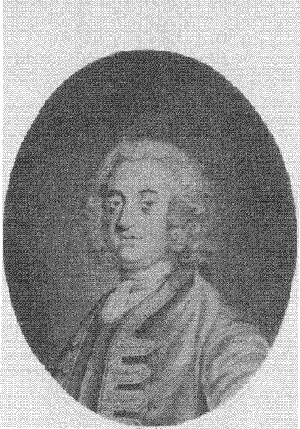
SIR WILLIAM JOHNSON,
BRITISH INDIAN AGENT IN THE NORTHERN COLONIES
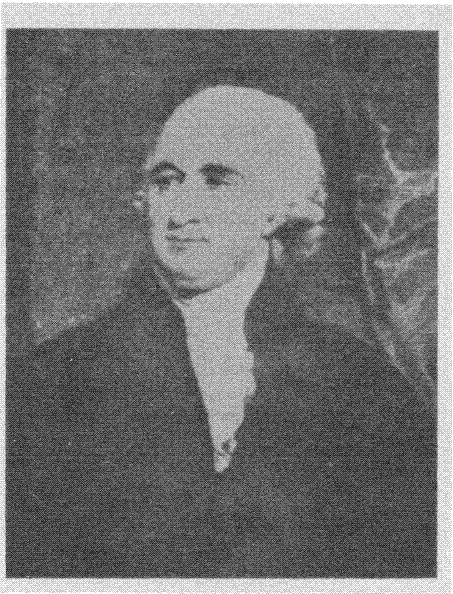
JAMES DUANE
(From A Godchild of Washington, by Catherine Schuyler Baxter)
TWO COLONIAL NEW YORK LAND PROPRIETORS
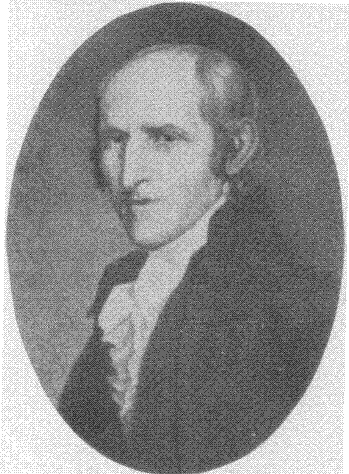
TIMOTHY PICKERING
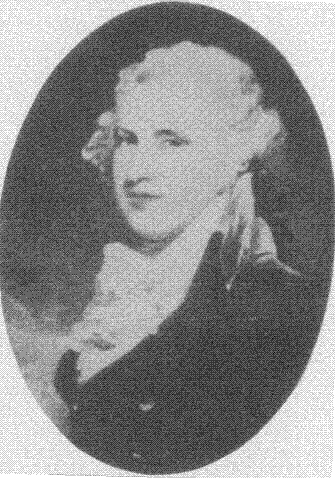
JAMES GREENLEAF
TWO POST-REVOLUTIONARY LAND JOBBERS
Like most wealthy Americans of pre-Revolutionary times, Morris invested in estates and plantations. With Thomas Willing, his partner in the shipping business, he had purchased before the Revolution an indigo plantation in Louisiana, but this was soon abandoned. Busy with public finances during the war, he had little time for schemes of personal gain. Yet even during this period, he took an occasional “flyer” in privateering or in land grabbing. Thus (as shown in the previous chapter), in 1781 he bought an interest in the United Illinois and Wabash Companies. He also acquired a tract of land at Trenton Falls on the Delaware River, which he called Morrisville. In this deal he had been accused of purchasing with a view to speculating on its selection as a site for the federal capital, but as will be shown later, there is no clear evidence of this motive.
Just how Morris began his wild schemes of land speculation may probably never be known. Undoubtedly, as one of his biographers states, he was led into these ventures by his belief in the rapid growth of the country. There is clear evidence from his correspondence with Silas Deane, the American commissioner to France, that during the Revolutionary War, land speculation was in his mind. In writing to Deane from Philadelphia, March 31, 1780, he requests him to determine “whether it is practicable to make sale [in Europe] of vacant lands in America by sending out drafts or surveys, descriptions and certificates, to ascertain the situation, qualities of land, titles, etc., and in what part of the continent lands are most desired by such persons as would be inclined to speculate, for I am ready to join you in any operations of this kind that would turn advantageously to ourselves.”5
It was not until ten years later, however, when he was United States Senator from Pennsylvania, that Morris entered into the land business on a large scale. Regarding this, William Maclay, who was then Morris’ senatorial colleague, wrote in his Journal, March 16, 1790:
Mr. Morris, after sitting awhile, turned to me and began a familiar chat. At last, he asked me to walk to one side, from our seats, and asked me if back lands could still be taken up. I told him, yes. He immediately proposed to me to join him in a speculation in lands, which, he thought that he, from his connections in Europe, could sell at one dollar per acre. I paused a moment. Said as our waste lands were totally unproductive, such a thing ought be beneficial to the public as well as ourselves, that in these points of view I saw no objection.6
The hint of using his European connections to sell at a profit the Pennsylvania back lands, which could then be bought from the state at a few cents per acre, led Maclay to believe that Morris “is for what the speculators call ‘dodging’—selling the land in Europe before he buys it here.”
There is no proof, however, that Morris intended operating in this manner. He generally acquired his holdings before he offered to resell them and, although he solicited foreign purchasers, his European connections as an aid in his land speculations proved a keen disappointment to him and finally led to his ruin.
It seems probable that Morris became deeply interested in wild lands through the success and persuasion of a brilliant and energetic young Pennsylvanian, John Nicholson. When still a youth, with no known antecedents or family connections, Nicholson in 1785 was appointed Comptroller-General of Pennsylvania. In this office he supervised the disposal of state lands, by means of which Pennsylvania was endeavoring to repay its citizens and soldiers for losses due to currency inflation and for unpaid war services. Nicholson, through his official position, was able to make the best selections of these lands. He soon became the largest landowner in Pennsylvania, acquiring title to about four million acres. Like Morris, he extended his purchases to other states. The burden of carrying this vast acreage was undoubtedly too much for the young speculator. It was natural, therefore, that he should turn for help to Morris, reputed to be the most affluent person in Pennsylvania.
Morris became an active associate of Nicholson in 1793. Their confidence in each other lasted to the bitter end. Nicholson died December 5, 1800, at the age of forty, while a fellow prisoner of Morris in the “Prune Street Prison” in Philadelphia—Morris called it “the hotel with the grated doors.” Even while in jail, Nicholson was active. To pay his prison expenses he published for a while a paper with the appropriate title, The Supporter or Daily Repast. But prison life was fatal to him. At his death, his debts, it was said, aggregated twelve million dollars.7
Another partner of Morris, who joined with him about 1794, was James Greenleaf, contemporaneously known as the “celebrated land jobber.” Greenleaf, scion of a prominent and prolific New England Huguenot family, of which the poet Whittier was also a member, had, when still young, amassed a comfortable fortune in his mercantile operations. For a time following the Revolutionary War, he was a partner in the shipping business of James Watson, a prominent capitalist of both Hartford and New York. Both partners individually speculated sporadically in “wild lands,” and participated in various gigantic land schemes of the time. But the shipping business required Greenleaf’s presence abroad, so in 1786 he went to Holland. Here, he cultivated close business relationships with Dutch speculators in American debts. Through the Amsterdam banking house of Daniel Crommelin & Sons, he negotiated several loans aggregating $1,300,000 on pledge of United States bonds and United States Bank shares. In 1793 he was made American consul at Amsterdam, but returning the same year to America, he was lured away from trade by the prospects of profitable land speculation, particularly in the new federal city of Washington. His partner, Watkins, refused to join him in these ventures, so Greenleaf sought a new connection. He endeavored to get Alexander Hamilton to join him but without success. In his letter to Hamilton, dated July 27, 1796, he represented himself as having a net estate, which “with ease could be liquidated and made to produce five million dollars.”
Greenleaf succeeded in interesting Morris and Nicholson in his Washington speculations, and became their partner in other land deals. He left New York and took up his residence in Philadelphia and Washington where he personally attended to the affairs of the land-jobbing triumvirate. Failure of their schemes led to discord and litigation. All three were imprisoned in Prune Street, but Greenleaf succeeded in obtaining his release after a few months. Soon thereafter, he married Ann Allen, a descendant of the Penns. His last years were spent in Washington, on the growth of which he had staked his whole fortune, and lost. Old Washingtonians may still recall that the present site of the United States arsenal, in the southern part of the city, where the Eastern Branch runs into the Potomac, was for many years called “Greenleaf’s Point”—a reminder of the city’s pioneer promoter.
In accordance with the common practice of large land dealers of the time, Morris, Nicholson and Greenleaf formed “companies” to put through their land schemes. As their associations were unincorporated, the lands they owned were usually assigned to trustees. “Shares” were then issued, each representing a pro rata equity in the trusteed property. It was these “shares” or “scrip” which was generously offered to the land-hungry public.
The first company formed by Nicholson was the “Pennsylvania Population Company,” which controlled about 450,000 acres lying north and west of the Alleghany River. It was years afterward discovered to be richly underlaid with coal. The “Asylum Company” of Pennsylvania, designed for purchase by French émigrés was another concern of Morris and Nicholson. Their greatest venture, in association with Greenleaf, was the “North American Land Company,” the largest land trust ever known in America, if the railroad land grants following the Civil War are excluded from this category. Of this venture we shall speak later.
Morris and Nicholson were located in Philadelphia, where Greenleaf had joined them in 1794. In this “City of Brotherly Love” there were others almost equally prominent as land speculators, but, unlike Morris and Nicholson, several succeeded in disposing of their speculative purchases before succumbing to bankruptcy. James Wilson, Associate Justice of the United States Supreme Court, who, as already shown, was a large shareholder in the Illinois and Wabash Companies, bought up quantities of soldier warrants, took up large tracts, but happily for him, resold much of this to other speculators. He did not gain wealth from his numerous land deals, however, and died a bankrupt. Thomas McKean, who in 1808 was Governor of Pennsylvania, also owned many tracts in western Pennsylvania. While governor, he deeded a princely estate consisting of 300,000 acres to his daughter who had married the Marques de Yrujo, minister from Spain to the United States. She could do nothing with it, so that most of her land was sold in later years for non-payment of taxes.
Perhaps the most successful of the Philadelphia capitalists of Revolutionary fame, who indulged in land purchases on a large scale, was William Bingham. Bingham, like Morris, was a wealthy shipper, trader and politician. But unlike Morris he retained his shipping business after the Revolution, and therefore did not succumb entirely to the land lure. He was a large purchaser of land in the “Erie triangle”—the northwest strip of Pennsylvania bordering on Lake Erie. He plastered New England with offers of these tracts, but without success, and finally sold them to a group of Dutch capitalists. He also purchased a large part of the southern strip of New York, known as the “ten townships” in which the city of Binghamton is now located. His largest acquisition, however, was a 2,000,000-acre tract in Maine, which he obtained for a mere pittance from William Duer and General Henry Knox, Washington’s first War Secretary. This became known as “Bingham’s Million Acres.” It was willed to his five daughters, among whom was the wife of Alexander Baring, the English banker. The land was held almost intact until about 1828 when, through the skill of a land agent, it was sold in small lots and engendered one of the wildest wild land manias that has ever infected New England.8
Prominent New York and New England capitalists vied with their Philadelphia brethren in land-jobbing schemes. In 1784, just one year after American independence was acknowledged, a group of New York capitalists organized the first bank in the city, the “Bank of New York.” It was originally intended that this institution should be a “land bank.” The subscribers were to pay one-third of their subscriptions in cash, and for the other two-thirds land security was to be given. Alexander Hamilton, who prepared the bank’s constitution, was opposed to this idea. He knew the dangers of issuing paper money without a specie backing. So through his influence the bank was established “on liberal principles, the stock to consist of specie only.” Yet there were numbered among its organizers the leading land jobbers and manipulators of New York State. Prominent among these were William Constable, a wealthy trader and shipper, Alexander Macomb, his partner in land deals, Jeremiah Wadsworth, of Hartford, James Watson, partner of James Greenleaf, William Remsen, Aaron Burr, Nichols Low, and others. But the bank itself, under the guidance of Hamilton, kept clear of land deals and thus maintained its position as a “specie bank” to this day.
Among the prominent New Yorkers of post-Revolutionary days who were severely infected with the “wild land” virus were the brothers, David and Samuel Ogden, and Abraham and Thomas Ludlow Ogden, respectively the son and grandson of David Ogden. They were members of the numerous “Jersey Ogdens,” and were related to Gouverneur Morris by marriage. The town of Ogdensburg, on the St. Lawrence River, is a reminder of the part they played in developing this section. They appear, however, not to have gone beyond their means in engrossing lands, as there is no record of their insolvency, though in 1816 a William Ogden became bankrupt and assigned to his creditors lands located in various counties of Northern New York. David Ogden became one of New York’s prominent attorneys and resided in Whitestone, L. I., from 1789 until his death in 1800. A Tory during the Revolutionary War, he succeeded in having his Jersey estates, valued at $100,000, restored to him after the cessation of hostilities.
Alexander Macomb, who was associated in land deals with the Ogdens and who became a leading New York “land grabber,” was born in Ireland in 1748, emigrated to America in his youth, and became a fur merchant in Detroit. His travels along the Great Lakes and the St. Lawrence River acquainted him with the vast extent of the northern New York wilderness, of which he became, in name at least, the “great purchaser.” But his career as a land speculator was short-lived, for soon after his “great purchase” in 1791, he became involved with William Duer in security speculation, and landed in a debtors’ prison. After his release he attempted to recoup his fortune by acquiring land on the Harlem River near Spuyten Duyvil, at a place still known as “Macomb’s Dam.” He died in 1832, in Georgetown, D. C., at the home of his son, General Alexander Macomb. By a queer twist of fate General Macomb defended from the British at Plattsburg, N. Y., the very territory that his father had acquired from New York State twenty-three years earlier for a shilling an acre—land for which New York State is now paying many millions of dollars to reacquire as a forest reserve.
Of William Duer, Macomb’s partner in a bold attempt to corner the federal debt, we shall speak much hereafter. Like many other of the post-Revolutionary land speculators, he had been a purveyor for the American army. He was born in Devonshire, England, in 1747, the son of a rich West Indian planter, and came to New York in 1768. During the Revolution he served as a member of the Continental Congress, and in 1785 was appointed to the Board of Treasury, which was created to manage the national finances after Robert Morris resigned as Superintendent of Finance. As the husband of “Lady Kitty,” the daughter of the self-styled “Lord Sterling,” Duer was socially prominent in New York where he dined and wined in lavish style with the aristocratic gentry of the day. Speculative ventures appealed to him. He did not confine his operations to land, but entered boldly into security deals, buying heavily of United States Government bonds and the stock of the First Bank of the United States.
Duer borrowed heavily to further his speculative aims, and when the market for federal securities collapsed in March, 1792, he was forced into a debtors’ prison. He had caused the ruin of many of his friends, and so great was the public rancor against him that a mob attacked the jail in which he was confined and threatened to hang the gambler. It was then that Duer appreciated the strength of prison walls, from which he, like Robert Morris in Philadelphia, sought in vain to escape. Although it is believed that through the influence of Alexander Hamilton he succeeded in obtaining a release temporarily, he remained in prison until his death on May 7, 1799. One of his sons, William A. Duer, became president of Columbia College, and another, John Duer, was a judge of the New York Supreme Court and a leading authority on insurance law.
Gouverneur Morris, jovial statesman, diplomat and financier, occupied a peculiar position in the field of early American land speculation. There is no evidence that he bought heavily on his own account, though he participated in the New York wild land deals and undoubtedly sought great riches from this source. But, at the end of the Revolution, he was already land poor with his extensive Morrisania estate abutting on New York city. This he had inherited from his ancestors. He certainly knew the expense and difficulties of land development. Yet, like his friend and namesake, Robert Morris, in the latter years of his long life he was deeply engrossed in land deals. He did not own all the lands in which he was interested, however, but acted as the sales agent of others. To him was assigned the task of caring for and disposing of the many large tracts of wild land in New York State.
Gouverneur Morris undoubtedly became active in land deals through his official association and friendship with Robert Morris. As will be shown later, he is suspected of having been a silent partner of Robert when the latter entered upon his first great speculation in western New York lands, in 1789. He soon thereafter went to England and France with “lands for sale.” Later Gouverneur was appointed American minister to France. Here, in the midst of his official duties, he was active in endeavors to dispose of lands. Monroe, arguing in the Senate against Morris’ confirmation as minister, hinted that he (Morris) “was the agent of speculators in lands and debt certificates.” Even after his resignation in 1794 as minister, Morris remained in Europe several years attending to his land business. He succeeded, however, in disposing of only a few tracts. One of his customers was the great financier, Jacques Necker, father of Madame de Staël, who bought a large parcel in northern New York. Following his return to America, in 1798, Morris continued to act as general sales agent for the owners of New York wild lands.
Concerning William Constable, who for a number of years was probably the largest individual owner of tracts of land in New York State, not a great deal is known. He was born in Dublin in 1752, the son of an English army surgeon. In the years immediately following the Revolutionary War, he was one of New York’s leading merchants, doing a large shipping and trading business with Europe. He was among the first Americans to send ships to China. Unlike other large land operators of his time, he was not prominent politically, and does not appear to have held public office. He was associated with Macomb in the “Great Purchase,” of northern New York lands and, after the latter’s failure, he, together with Daniel McCormick, took over Macomb’s contract. In 1792, he made a trip to Europe to dispose of the lands, but was only partially successful.
It is quite evident that Constable’s speculations were not very profitable, for in July, 1801, he and his brother, James Constable, were compelled to convey some of their northern New York lands to creditors in payment of notes. Among these creditors were John Jacob Astor, who received 15,000 acres, but soon resold to Hezekiah B. Pierrepont, Constable’s wealthy son-in-law. Later, all of Constable’s lands were assigned in trust to the Bank of New York, but after his death, in 1803, his heirs appear to have recovered a considerable portion thereof. His three executors were his brother, James Constable, and his two sons-in-law, James McVickar and Hezekiah B. Pierrepont. The latter, a resident of Long Island, who became rich through buying up Revolutionary debt certificates, acquired most of the lands from the heirs. A son, William Constable, took up his residence in northern New York at a place named Constableville (in Lewis County), still to be located, but with much difficulty, on the map of New York State.
New Englanders were ever by nature bold adventurers, so that following the Revolutionary War, Hartford and Boston were hotbeds of land speculation. The fever swept through the whole population, and “land scrip” floated about almost everywhere in this section. For generations many of these certificates were stowed away in garrets or strong boxes, to be resurrected as curiosities of bygone days. The New Englanders did not confine their land greed to any one region or territory. They bought heavily in both the East and the West, in the North and the South. Many could never identify the location of their purchases—and in some cases the land acquired was fictitious. Surveys, if made at all, were made carelessly, and land frauds were as prevalent then as in later years.
A notorious case of fraud, swallowed by the gullible and land-hungry New England gentry, was brought to light in 1897 by James N. Granger, who published an account of the journey made in 1786 by Judge Erastus Granger, brother of Gideon Granger, Washington’s Postmaster-General.9 The journey was made into the wilds of western Virginia, for the purpose of locating tracts of land sold to Connecticut speculators by a group of prominent Virginian land warrant jobbers. Among the sellers were Wilson Cary Nicholas, who, in 1814, became Governor of Virginia, Henry Carter Lee (“Light Horse Harry”), the father of Robert E. Lee, General John Preston of Smithfield, and George Keith Taylor of Petersburg, a brother-in-law of John Marshall. These men conveyed deeds to a tract of 300,000 acres to Connecticut capitalists for $30,000. When the survey was made it figured out only 133,874 acres. The deception was blamed on “Harry” Lee, and this popular Virginia hero and progenitor of the Confederacy’s greatest general was arrested in Boston just as he was preparing to embark for the West Indies. He soon compromised by giving up some of his Pennsylvania land holdings to his victims. His partners, Preston and Nicholas, were also prosecuted in Virginia, but there is no record of the outcome. They probably also compromised the claims of the irate Connecticut Yankee speculators.
There were other similar cases of fraud and deceit. Thus, Oliver Phelps purchased 100,000 acres near the present site of Charleston, W. Va. The land was located, however, 100 miles from the nearest settlement, and no title whatever was ever held by the sellers. As stated by James N. Granger: “Speculation of a more crazy type cannot be found. The best of New England capitalists and business men placed hundreds of thousands of dollars in schemes they had never investigated and did not take the trouble to explore.”
A mere enumeration of the land speculators in New England following the Revolutionary War would fill pages. Foremost among them, however, was Oliver Phelps of Hartford. He was born in Windsor, Conn., in 1749, and later moved to Suffield in the same state. During the Revolutionary War he acted as a deputy for Jeremiah Wadsworth in procuring supplies for the Continental and French armies. Settling for a while in Massachusetts, he became a member of the General Court, and one of the Governor’s Council. With this political influence he, in association with Nathaniel Gorham, of Cambridge, succeeded in purchasing from Massachusetts in 1788 that state’s title to the western portion of New York State. Though, as we shall see later, the partners were unable to fulfill the terms of the purchase contract, Phelps grew rich rapidly, estimating his wealth at $1,000,000 by 1795. Land lust then intoxicated him. He bought heavily in wild lands in Virginia, Georgia and elsewhere. He was also the chief promoter of the Connecticut Company which acquired the Connecticut Western Reserve in Ohio. But his land deals availed him little in the end. He took up his residence at Canandaigua in western New York in 1802, later becoming a Congressman and judge. He died in 1809, in comparative poverty, and only a small village in New York State bears his name as a reminder of the man, who had the ambition and the boldness to purchase a territory comprising about one-sixth of the Empire State.
Associated in deals with Phelps were the “Connecticut Wadsworths”—Jeremiah and James—who bought and held land around Rochester and became “Lords of Geneseo.” They, also reached far and wide for land holdings, acquiring land in Michigan and Ohio, as well as in the Genesee country. They were prominent in business affairs both in Hartford and in New York. Jeremiah Wadsworth, who during the war had been an intimate associate of Robert Morris, Alexander Hamilton, and other financiers, was one of the founders of the Bank of New York, to which he was elected president in 1785. He was also influential in the establishment of the Bank of Hartford in 1781, most of whose directors were prominent land gamblers. The Wadsworths, like other wild land speculators, at first attempted to sell their holdings in small tracts, but this appearing unprofitable, they followed the English practice of granting long-term leases. Since they had paid cash for their lands, they could afford to hold on to them. To this day their heirs and descendants possess numerous acres of the richest agricultural lands in New York State.
Massachusetts post-Revolutionary politicians and capitalists, like those of Connecticut, were also infected with land greed. Among those who acquired extensive holdings for a time were Postmaster-General Gideon Granger, Jr., General Henry Knox, first Secretary of War, and Timothy Pickering of Salem, Mass.; also James Sullivan, Rufus Putnam, and Andrew Craigie, all prominent politicians and business men. Of Granger—who was deeply concerned in the Georgia land frauds, which are described in a later chapter—John Randolph, of Virginia said, “His gigantic grasp embraces with one hand the shores of Lake Erie, and stretches with the other to the Bay of Mobile.” Knox was more moderate. He participated in New York purchases, and was concerned with William Duer in speculation in Maine lands, but fearing the adverse political effect arising from the popular hatred of land jobbers, he crawled out by selling his interest to William Bingham, of Philadelphia.
In their land dealings these men, almost without exception, had one object in view, viz., to dispose of their holdings at a profit in a short time. Unlike European land grabbers they did not acquire land as a badge of wealth or as an emblem of nobility. They did not seek to own large estates; to work them and thereby obtain a source of income or riches. The social prestige of landed property had begun to fade in North America even in pre-Revolutionary days. Although in the South large plantations were common and agriculture was the chief source of income for rich and poor alike, in the northern regions, particularly along the Atlantic coast, the tilling of the soil was merely a necessary supplement to the economic life of the people. It was not a source of wealth as were trading and shipping. Only in the notable case of “the Wadsworths of Geneseo” were large tracts acquired and held for leasing and development. Others sought to sell their lands as best they could—at a profit, if possible. Hence, the speculators, instead of drawing wealth from the land directly, aimed merely to extract wealth indirectly from their fellows’ pockets.
Thus, the early land schemes, unlike many modern ventures of the same class, were not conducted on the principle of enhancing land values by making improvements and other applications of capital to bring out the natural resources and productive qualities of the soil. Their main idea was to obtain the advantages of the “unearned increment”—the added value which comes from growth of population and material wealth.
The national public land policy had much of the same motive. Both the individual states and the national government looked upon their public domains as assets to be cashed as quickly as possible and the proceeds to be applied to the extinguishing of their debts or for current use to meet government expenditures. This accounts for the important sales of large tracts of public land soon after the Revolution. The policy was changed in later years when land was disposed of in Small quantities as encouragement towards settling rather than for immediate pecuniary gain.
Having acquired large acreages, the post-Revolutionary speculators were generally at their wits’ ends to dispose of them. Three methods were generally followed. They would offer to resell in large tracts to wealthy men in Europe or America. Or they would set up “land offices” and offer parcels to individuals or small groups for settlements; or they might hold them as an investment for resale when lands were less abundant. The first method, as we shall see in the following chapter, met with success in very few instances. Wild lands in large tracts were too plentiful to invite purchases at enhanced prices by the wealthy seeking investment. Moreover, there were expenses attached to land ownership. This, the “land-poor” aristocracy of both Europe and America have sadly experienced. The land must be developed, roads must be built, and, worst of all, taxes must be paid. When the owners are wealthy non-residents, the local communities are likely to tax them unmercifully.
Robert Morris and his contemporaries failed to see all this in their manifold land deals—though they were made to realize it in the end. In the prospectus advertising the “North American Land Company,” it was boldly stated:
The proprietor of back lands gives himself no other trouble about them than to pay taxes, which are inconsiderable. As nature left them, so they lie till circumstances give them value. The proprietor is then sought out by the settler who has chanced to pitch upon them, or who has made any improvement thereon, and receives from him a price which fully repays his original advance with interest.
How utterly misleading! First of all, the settler is slow in coming. Moreover, he is generally poor and must be given credit. He must also struggle against nature and savages, must build roads, clear rivers, construct schools and churches, pay taxes, and maintain his family against starvation and disease. History proves that the pioneer unlike the city immigrant cannot readily be made the object of exploitation.
Strenuous efforts were put forth by the early land jobbers to dispose of their holdings in Europe. A number of agents were sent abroad for this purpose, but they accomplished little. As already stated, Gouverneur Morris, in spite of his popularity and sociability, made relatively few sales of importance in France—though he did sell some land to Jacques Necker, Le Ray de Chaumont and a few other French émigrés. Joel Barlow, the Connecticut poet, whom William Duer sent to France during the revolutionary political upheavals there to dispose of his “Scioto lands” before he actually owned them, had hard sledding—and almost all of the French settlers he sent over to settle in Ohio returned to their native land, poorer and disgusted. William Constable was successful in selling a part of his Adirondack lands to Louis Chassanis and Le Ray de Chaumont, French noblemen, but this sale represented only a small part of Macomb’s Great Purchase. Robert Morris’ sales of Genesee lands to English and Dutch capitalists were made mainly in America through the agents of the purchasers.
As an aid to their efforts to dispose of lands in Europe, the speculators made use of edifying literature. Periodicals, pamphlets and treatises were published giving alluring descriptions of America, its resources and its advantages. Several of these were written on this side of the Atlantic. Thus, Tench Coxe, the prominent Philadelphia attorney, published in 1794 his View of the United States of America, for circulation in England. Robert Goodloe Harper, a Congressman from South Carolina, and interested with Morris in land speculation, published a spirited defense of the North American Land Company (see illustration on next page). Similarly, Judge William Cooper, prominent as a land agent in New York State, wrote an alluring description, entitled Guide to the Wilderness, and Manasseh Cutler published in French and English his Description of Ohio. Brissot de Warville, about the same time, published in Paris and London his New Travels in America, which bristled with descriptions of investment opportunities in the new republic.
British writers were also employed. William Winterbottom published in 1795 an elaborate work of four volumes, entitled An Historical, Geographical and Commercial View of the American United States, in which he described several tracts of lands for sale and mentioned an American land agency office in Thread-needle Street, London. Gilbert Imlay, a former captain in the American army, and “commissioner in laying out lands in the back settlements” published in London, in 1797, his Topographical Description of the Western Territory of North America. This work went through several editions. The 1797 edition contained a description and plan of organization of the North American Land Company, promoted by Morris, Greenleaf and Nicholson, an account of which is reserved for later chapters.
A shorter and more direct appeal to the land-hungry English was made by one John Dewhurst in a pamphlet published in 1794, entitled Observations on the Present Situation of American Landed Property. Dewhurst was plainly a land agent. He begins with the bold statement that “there exists at the present crisis, the means of employing money to greater advantage and upon principles (when facts are known) more obviously secure than has occurred at any former period in any country in the world. It is by the purchase of lands in America.” He deplores the British prejudice against America and the fear of settling in distant places, and offers information on tracts of land principally situated in New York, Pennsylvania and New Jersey to all who will come to his office at 17 Norfolk Street, Strand.
The propaganda spread abroad by American land agents naturally invited opposition. Richard Parkinson, an Englishman, made a tour of America during 1798-1800, and published in 1805 a book strongly condemning the purchase of American lands: “If a man wishes to obtain property [in America] to any great extent,” he remarked, “he cannot do it with comfort or satisfaction. He may purchase a considerable portion for a small sum of money, but he will derive little or no income from it. As he cannot let it out to rent, he must cultivate it himself with a great number of negroes, for white men are not only expensive, but ungovernable.” When speaking of the English “boosters” of America, among whom he includes Tom Paine, William Cooper, Imlay, Priestley, and others, Parkinson states:
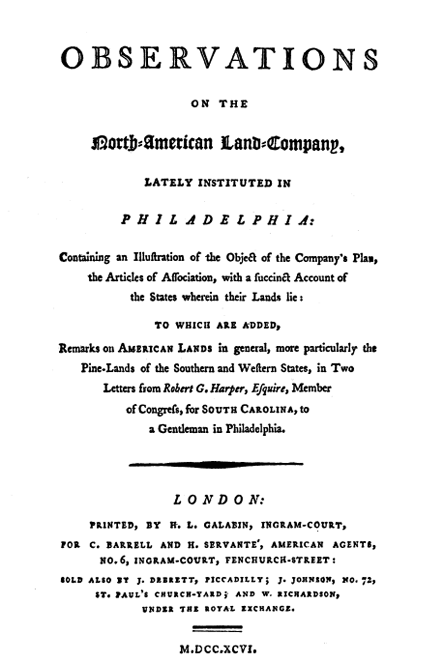
THE PROSPECTUS OF THE NORTH AMERICAN LAND COMPANY ISSUED IN LONDON.
MORRIS’ EFFORT TO INTEREST BRITISH SPECULATORS
(Courtesy of the New York Public Library)
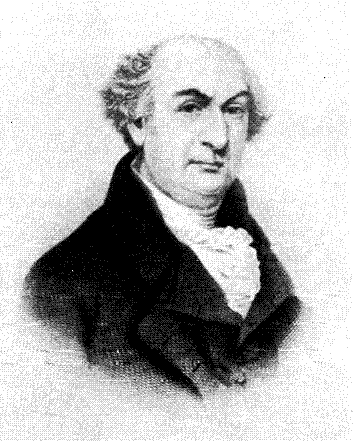
GOUVERNEUR MORRIS, STATESMAN, DIPLOMAT AND LAND AGENT
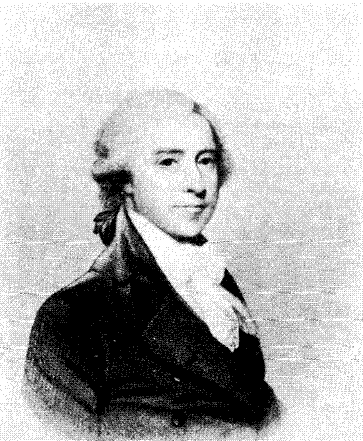
WILLIAM CONSTABLE, PRINCIPAL PROPRIETOR OF MACOMB’S PURCHASE
(From a portrait by Gilbert Stuart)
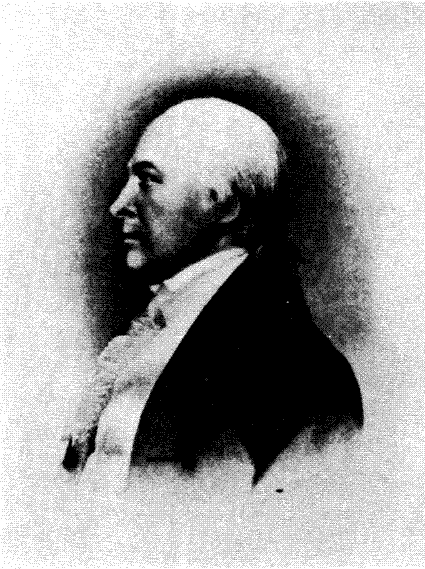
JEREMIAH WADSWORTH
Those authors who have represented America as possessing peculiar advantages, are all men who have left this kingdom in anger, and described the plausible benefits likely to be obtained by adventurous speculators before they knew any more of the country than those who have never seen it: they write with a determination to do all the harm they can to their mother country.10
Considerable opposition also developed from French sources. The French minister in the United States, Joseph Fauchet, representing the new revolutionary government, in his official and private letters uttered warnings to his countrymen against investments in American lands. The agents of “les grands proprietaires” he wrote from Philadelphia, “are vile deceivers,” and their efforts to get Frenchmen to emigrate is furthered by such émigrés as Talleyrand and the Due de Noailles, who “thus hope to cause a considerable part of the French population to desert their country.” Fauchet was particularly unfriendly to Robert Morris, whom he called le plus grand agioteur de ce pay-ci (the greatest of American speculators). In 1794, he published two letters in France attacking Morris, especially respecting the character of the latter’s Georgia lands, called the “Pine Barrens.” Fauchet claimed that he had evidence, that the title to these lands was worthless and that Morris was “selling them to innocent French investors.” Morris in the same antagonistic vein replied in a letter published in the Philadelphia American Advertiser, denying that he invited the French to buy his lands. At this, the minister of the French Republic became further incensed and complained bitterly to his government of the “indecent diatribe” of Mr. Morris against him.11
Thwarted and hampered in efforts to attract large purchasers of their holdings at home and abroad, most of the speculators were either compelled to abandon their lands to their creditors or turn them back to the states for non-payment of taxes. As shall be shown later, only a few awaited the slow process of piecemeal disposal. For this purpose they employed land agents and opened up “land offices.” Oliver Phelps who moved to Canandaigua is credited with opening there the first private land office in America. Traveling land agents, it appears, became a general nuisance. William Priest, an English musician, in his Travels in the United States, written in 1797, thus describes a harangue of a land agent:
When we made our stay at the tavern on the road [from New York to Boston] I observed one of my fellow travellers (who was very eloquent on this subject) take every opportunity of singing forth the praises of New Virginia (a rich tract of country west of the Alleghany mountains). . . . The northwest wind continuing . . . the morning was very cold; and we breakfasted with a number of strangers. Our orator does not lose this opportunity of holding forth on his favorite topic. I recollect the latter part of his harangue was to the following effect: “There,” says he, (while the New Englanders were staring with their mouths open) “when I clear a fresh lot of land on any of my plantations, I am obliged to plant in six or seven years with hemp, or tobacco before it is sufficiently poor to bear wheat. My Indian corn grows twelve to thirteen feet high: I’ll dig four feet deep on my best land, and it shall then be sufficiently rich to manure your barren hills; and as to the climate, there is no comparison; this cursed cold north-west wind loses all its severity before it reaches us: our winters are so mild that our cattle require no fodder, but range the woods all winter: and our summers are more moderate than on your side of the Alleghany.”12
These “agents” in most cases did not sell parcels of land or give clear title and deed to property. They marketed merely the “shares,” “scrip,” or “warrants” of “companies” and “associations” organized by the land jobbers. The “scrip”and “warrants” represented usually a claim to a definite acreage, but the “shares,” though having a face value expressed in currency, were a claim to nothing in particular. Thus, Timothy Pickering, of Salem, who occupied various posts in Washington’s cabinet, and who plunged deeply into land speculation, disposed of twenty-six tracts of land in Pennsylvania, aggregating about 19,000 acres to an “association” of thirty-four “subscribers,” for $33,300. The “association” was divided into 333 shares of $100 each, eighty-three of which Pickering reserved for himself. Pickering was given power of attorney to take care of the lands and to dispose of them “according to his judgment.”13 The same method of land disposal, as we shall see later, was also used by Oliver Phelps, Robert Morris, John Nicholson, William Duer, John Cleves Symmes, Manasseh Cutler and others of the prominent land promoters of the period. Failure to sell the lands in a reasonable time generally made the “shares” worthless—since the usual outcome of the land deal was reversion to the state for non-payment of taxes.
The wild land speculation in America, which reached its zenith soon after the establishment of the new government under the Constitution, steadily and rapidly declined after 1795. At the beginning of the new century, public interest in land speculation had greatly subsided. The collapse of most of the large land companies, together with the adoption of a national policy to distribute the vast western public domain in small parcels at a nominal price, discouraged private land-jobbing schemes. The popular contempt for land speculators, however, persisted, so that statesmen and financers for many years thereafter refrained from openly associating themselves with wild schemes of land development. In the meantime, also, other fields of speculative endeavor such as commodities and securities had come into vogue. Land speculation, however, was again and again to play its part in the annals of pecuniary avarice and greed in the United States. We now pass on to the leading episodes in this drama of American cupidity.
14 See Charles A. Beard, An Economic Interpretation of the Constitution of the United States, p. 50.
15 Pickering, The Life of Timothy Pickering, Vol. Ill, p. 296.
16 The Deane Papers, Vol. V, p. 164, published in Collections of the New York Historical Society, 1890.
17 Dwight, Travels, Vol. IV, p. 185.
18 Deane Papers, Vol. IV, p. 117.
19 Journal of William Maclay (1927 Edition), p. 209.
20 See Allen C. Clark, Greenleaf and Law in the Federal City, p. 42.
21 See pages 240, 241.
22 See Connecticut Quarterly, Vol. III (1897), p. 101.
23 Richard Parkinson, A Tour in America, Vol. II, p. 642.
24 See the Annual Report of the American Historical Association, 1903, Vol. II, p. 678 et seq.
25 William Priest, Travels in the United States of America, p. 155.
26 Pickering, The Life of Timothy Pickering, Vol. IV, p. 28.
- 1Maine Historical Collections, Vol. II, pp. 268-294.
- 2The Sir William Johnson Papers, Vol. V, p. 129. See also, C. W. Alvord, The Mississippi Valley in British Politics, Cleveland, 1917.
- 3Herbert B. Adams. “Washington’s Interest in Western Lands,” Johns Hopkins University Studies, Third Series, No. 1, January, 1885. Italics are mine.—A. M. S.
- 4Adams, op, cit., p. 58.
- 5See A. Henderson, “A Pre-Revolutionary Revolt in the Old Southwest” in Mississippi Valley Historical Review, Vol. 27, p. 198 et seq.
- 6Italics are not in the original.
- 7In a letter to William Franklin, dated May 3, 1776, Johnson asserted “it has always been my practice to avoid engaging in lands to the great loss of my family, neither have I a foot of land from the Indians.” (Sir William Johnson Papers, Vol. IV, p. 197.) The large tract north of the Mohawk Valley given him by the Canajoharie Indians in 1760 was confirmed by royal grant in 1769.
- 8See Pennsylvania Magazine of History, Vol. XIV, pp. 218, 219.
- 9See Memorial of the United Illinois and Wabash Land Companies, Baltimore, 1816.
- 10A copy of the deed is contained in American State Papers, “Public Lands.” Vol. I. The original copy was acquired by Cyrus H, McCormick.
- 11See J. P. Boyd, “Connecticut’s Experiment in Expansion, The Susquehannah Company, 1753-1803,” in Journal of Economic and Business History, November, 1931.
- 12See Publications of the Colonial Society of Massachusetts, Vol. XXV, PP. 33-38.
- 13Samuel W. Jones, Memoir of James Duane, 1852.
- 14During the first hundred years of North American colonization, economic conditions gave little encouragement to private land schemes. Land was too plentiful. A few such enterprises were undertaken, however. Thus, as early as 1661, the Colony of Massachusetts sold to a few individuals for £400 a large tract on the Kennebec River in Maine. This became known as the “Kennebec Purchase.” The heirs held it for nearly a century without doing anything with it. In 1753, they incorporated as the “Proprietors of the Kennebec Purchase” and proceeded to dispose of their holdings. The corporation continued in existence until 1816. “The Pejebscot Company” was another Maine land deal. None of these held out promise of profit to proprietors until about a quarter century before the Revolution.
- 15In the meantime, the “Loyal Company” group was not idle; its proprietors sent Dr. Thomas Walker, of Albermarle, Va., to make a reconnaissance, and to discover a proper place of settlement. The two “companies” then became engaged in a controversy, and neither made a survey or fixed the bounds of their grants. The apparent ease with which they obtained land donations led to other schemes, and aroused an epidemic of interest in distant western wild lands. Not only was the land ownership eagerly sought after, but the establishment of new colonies, with separate and distinct governments, was planned. Favoritism and collusion infested the Virginian colonial government, due in large part to the persistence of speculators in western land grants. Lobbyists were sent to London to obtain the crown’s sanction to land-grabbing schemes and the question of the disposal of the vast western domain won from the French infested British politics. “One half of England is now land mad,” wrote George Croghan, of Philadelphia, one of the land schemers, to Sir William Johnson, on March 30, 1766, “and everybody there has their eyes fixed on this country.”
- 16I offered in my last to join you in attempting to secure some of the most valuable lands in the King’s part, which I think may be accomplished after awhile, notwithstanding the proclamation that restrains it at present and prohibits the settlement of them at all; for I can never look upon that proclamation in any other light (but this I say between ourselves) than as a temporary expedient to quiet the minds of the Indians. It must fall, of course, in a few years, especially when those Indians consent to our occupying the lands. Any person, therefore who neglects the present opportunity of hunting out good lands, and in some measure marking and distinguishing them, for his own, in order to keep others from settling them, will never regain it.
- 17Crawford “heartily embraced” the colonel’s offer. He promised shortly to set out in search of lands. “This may be done,” he said, “under a hunting scheme.” He acknowledged that other land seekers had approached him, with similar offers, “but have not agreed to any; nor will I with any but yourself or whom you think proper.”
- 18Judge Richard Henderson of North Carolina, the employer and backer of Daniel Boone, promoted the settlement of the Kentucky region and claimed ownership to a vast unsettled tract there. He organized a group of land grabbers under the name of “The Transylvania Company.” Ignoring the British interdiction against Indian land purchases, he obtained from the Cherokees in 1773 about one-half of the present State of Kentucky, and immediately began settling the land. He advertised widely for pioneers and “shareholders.” In his announcements, Henderson waxed enthusiastic. “The country [Transylvania] might invite a prince from his palace, merely for the pleasure of contemplating its beauty and excellence, but only add the rapturous idea of property, and what allurements can the world offer for the loss of so glorious a prospect?”
- 19When the British Government began to take active measures to break up land “bootlegging,” and to put a stop to dreams of riches in western territory, Virginia’s political resentment was naturally aroused. Even Thomas Jefferson, who, in later life, frowned upon speculation and land grabbing, held the view in 1774 that the land did not belong to the British king, and that it was time for the colonies “to declare that he has no right to grant lands of himself.” So he boldly wrote in the Declaration of Independence, as one of the British king’s usurpations: “He has endeavored to prevent the Population of these States; for that purpose obstructing the Laws for Naturalization of Foreigners; refusing to pass others to encourage their migrations hither, and raising the conditions of new Appropriation of Lands.”
- 20He was for it at once. “I like the project of a colony in the Illinois Country,” he wrote his son, “and will forward it to my utmost here.” He thought that Sir William Johnson’s “approbation will go a great way in recommending it, as he is much relied upon in all affairs that may have any relationships with the Indians.” But Johnson had an eye on the Indian lands himself, and besides advising others about purchases in the outlying sections, personally through gifts from the Indians engrossed large tracts, particularly in the Mohawk Valley. The town of Johnstown, N. Y., still marks the seat of his domain.
- 21Some of the members of the Vandalia Company were concerned in other western land schemes. One of these was organized in 1775 as the “Indiana Land Company,” probably the first application of the name “Indiana” to the Northwest Territory. The claim to land was based on a grant of a large tract, made November 3, 1768, in what is now West Virginia, by the Six Nations at Fort Stanwix to “Chief” William Trent in liquidation of depredations. Among the shareholders were Samuel Wharton, Joseph Galloway, Robert Callender, Levi Andrew Levi, and David Franks, all wealthy and prominent Philadelphians. The Revolutionary War did not put an end to the “claim.” Wharton in 1776 published a pamphlet, entitled-View of the Title to Indiana, in which he defended the company’s rights to the lands. In 1781, he republished this in enlarged form, under the title Plain Facts; being an examination into the Rights of the Indian Nations of America to their respective Countries and a Vindication of the Grant from the Six United Nations to Proprietors of Indiana, etc. Although Wharton pressed the validity of the “proprietors” claims, Congress then and thereafter gave little heed thereto.
- 22Notwithstanding the British Government’s edict, forbidding the private purchase of lands from the Indian tribes, William Murray, an Indian trader, and several of his business associates, in 1773 formed a plan to buy from the aborigines an immense tract of country between the Mississippi, Illinois and Ohio rivers. After a “pow-wow” lasting a month, the sale was consummated. According to the land claimants, it was attended by “many persons of both descriptions and the Indians were carefully prevented from obtaining any spiritous liquors during the whole continuation of the negotiation.” On July 5, 1773, “for a very large and valuable consideration,” the deed was delivered to the “Illinois Land Company.”
- 23Notwithstanding the British Government’s edict, forbidding the private purchase of lands from the Indian tribes, William Murray, an Indian trader, and several of his business associates, in 1773 formed a plan to buy from the aborigines an immense tract of country between the Mississippi, Illinois and Ohio rivers. After a “pow-wow” lasting a month, the sale was consummated. According to the land claimants, it was attended by “many persons of both descriptions and the Indians were carefully prevented from obtaining any spiritous liquors during the whole continuation of the negotiation.” On July 5, 1773, “for a very large and valuable consideration,” the deed was delivered to the “Illinois Land Company.”
- 24The proposition then took on a business aspect. The number of “shares” was increased, and rights to subscribe offered at from $2 to $5 per share. It attracted speculators. The shares soon rose in value. Lawyers, clergymen and politicians began buying shares. The Reverend Ezra Stiles, President of Yale College, grandfather of the poet-physician Oliver Wendell Holmes, took 2¾ shares. The Governor of Connecticut, Roger Walcott, who had become rich through local land deals, supported the project.
- 25New York, before the Revolution, also had her “land” quarrels with the other colonies. The ill-defined boundaries of the Dutch province led to constant conflicts and legal controversies with her neighbors. There was a bitter dispute with New Hampshire regarding the political jurisdiction of Vermont. New York claimed the section, but New Hampshire, in 1749, acting on the principle that possession is nine points of the law, began to make free grants to both New Hampshire and Massachusetts citizens. Whole “towns” of 23,000 acres, more or less, were granted to selected groups of individuals. It is estimated that between 1749 and 1764, Governor Benning Wentworth granted 131 townships to more than six thousand persons. Among the grantees appear the names of many prominent colonial New Englanders, who had no intention of ever settling on the lands. Samuel Adams was among them. He was known as a speculator in both Maine and New Hampshire lands in this period. The governor granted himself, in all, about 65,000 acres, and is reported to have accumulated considerable wealth from the heavy fees exacted by him for grants.
- 26Because of his land deals, while acting as the state’s attorney, Duane was the butt of political criticism. He was led to appear in person in his own defense before the state legislature in 1781. He was charged with receiving Vermont grants “under immoderate quit-rents, and excessive fees of office,” and he was also accused of “holding many thousand acres of land which had never before been granted by the Crown.” To this he merely answered that he “had never made a purchase or obtained a grant of land with any view to its sale.” He was therefore not a “land jobber.” This cleared him politically of all corruption.

