
The Great American Land Bubble
Chapter IV. Parceling Out the Empire State at Retail
“IF THE whole Holland Purchase was brought to the condition of a garden, capable of yielding agricultural products to any given extent, it might be the means of affording a very comfortable support to the inhabitants, but would never enable them to pay for their farms, until capital is invested in rearing towns and manufacturies to purchase and consume the surplus products, and thus react upon the value of the land.”
The foregoing statement was made by Benjamin Barton, in February, 1827, at a convention of delegates from the several counties comprising the Holland Purchase to consider “the relations subsisting between the Holland Company and the settlers on the said Purchase, and to propose some remedy by which the settlers may be alleviated.” It illustrates correctly the difficulty in the way of filling up rapidly large areas of unoccupied waste lands with settlers whose single occupation is agricultural production. It points out, moreover, the desirability, if not the necessity, of the investment of large sums (in addition to the primary cost of the soil) by the owners of undeveloped sections, to foster and encourage the growth of the country.
The post-Revolutionary wild land speculators in New York and other states for the most part neglected this condition. As they were speculators or “land jobbers” and not “land developers,” they did not buy to hold and develop, and thereby gain a profit from the added values arising from making their properties more desirable as homesteads and settlements. Their aim was a “quick turnover” with as large a profit on as small an investment as possible.
When the wild land mania had subsided, however, and large tracts fell into the hands of those who purchased for actual real estate investment, the business side of the proposition took on a different aspect. It was now a matter of slow disposal—a complicated and continuous undertaking covering many decades. It is these experiences of the great New York State landholders in retailing and parceling out their properties after they were acquired from the original “speculators,” which now concern us.
.....
As stated in the previous chapter, Robert Morris, soon after taking over from Phelps and Gorham the unsold portion of their patent from Massachusetts, resold it almost immediately to a syndicate of Britishers, comprising Sir William Pulteney, John Hornby and Patrick Colquhoun. These organized themselves into the Pulteney Association, and in 1792 sent over Captain Charles Williamson as their agent to dispose of the land. Naturally, Williamson, on his arrival in America, went to Morris in Philadelphia for advice and assistance. What Morris advised is not definitely known, but, as he stated in a letter to W. & J. Willink, Dutch bankers, March 16, 1795, “I chalked out his [Williamson’s] plan and line of march. He has succeeded far beyond his expectations and I glory in it—notwithstanding I sold the property so cheap and knew at the time the sacrifice I was making.”
Williamson, at the expense of his employers, soon began extensive schemes of development. He first built a road from Williamsport, Pa., on the Susquehanna River to Williamsburg on the Genesee River, so as to give a commercial outlet to his tract. He next planned the town of Bath, N. Y., “as a handsome progressive city.” Here he constructed a theater, laid out a race track, and built a sumptuous hotel. He introduced the printing press to the town and published a weekly, The Bath Gazette. He also constructed a pretentious hotel at Geneva, N. Y., lying in the northeastern part of the Pulteney Purchase.
Thus the agent of the Pulteney Company seems to have been given a free hand with unlimited resources by the proprietors. Between 1792 and 1799, he had expended $1,374,470 but had received only $147,974 for lands sold.1 Of course, he made efforts both at home and abroad to sell and colonize his lands. With this in view, he prepared and circulated anonymously a descriptive pamphlet entitled Description of the Settlement of the Genesee Country, in a Series of Letters from a Gentleman to a Friend. It was intended to entice the wealthy British as well as the immigrant settlers to take up parcels of land in his domain. “You will find the Genesee Country,” he wrote, “abounding with situations both valuable to the farmer and amusing to the gentleman and man of leisure.”
The place was a paradise for sportsmen. The newly created settlement at Sodus on Lake Ontario, he pointed out, stood unrivaled for “fishing, fowling, sailing or hunting, and perhaps no place in America can equal it.” “Fish of various kinds, many of them from the ocean, can be had at pleasure, and a species of soft shell green turtle may be procured in plenty, little inferior to the green turtle brought from the West Indies.” With such appetizing allurements, he hoped to create a British sporting center in the wilds of America.
In order to “hurry civilization,” Williamson attempted “hothouse settlements” within the Pulteney Purchase. In “Coral Gables fashion,” he furnished pastime and amusement to the inhabitants. One of his stunts was the holding of country fairs near the site of his “land office” in Bath. Here his lands were “boomed” between intervals of horse racing, dances and theatrical performances. To these affairs he invited the sporting gentry of the country, and entertained guests coming from as far south as Virginia. Those who attended these events came away with “terraphobia” (as land speculation was then derisively termed), just as “tourists” did in Florida more than a century later. A letter to the Wilkesbarre Gazette, in October, 1796, quoted by Isaac Weld, the English traveler, thus describes the allurements of Bath:
Gentlemen:
It is fearful to reflect that speculation has raged to such a degree of late, that honest industry and all the humble virtues that walk in her train are discouraged, and rendered unfashionable. It is to be lamented, too, that dissipation is sooner introduced in new settlements than industry and economy.
I have been led to these reflections by conversing with my son, who has just returned from the Lakes of the Genesee. . . . He has been to Bath, the celebrated Bath, and has returned both a speculator and a gentleman, having spent his money, swapped away my horse, caught the fever and ague, and, what is infinitely worse, that horrid disorder which some call the “terraphobia.”
We hear nothing from the poor creature now (in his ravings) but of the captain and Billy, of ranges, of townships, numbers, thousands, hundreds, acres, Bath, fairs, races, heats, bets, purses, silk stockings, fortunes, fevers, agues, etc., etc. My son has part of a township for sale, and it’s diverting enough to hear him narrate its pedigree, qualities, and situation. In fine, it lies near Bath, and the captain himself once owned, and for a long time reserved, part of it. It cost my son but five dollars per acre; he was offered six in half a minute after his purchase; but he is positively determined to have eight, besides some precious reserves. One thing is very much in my boy’s favor—he has six years’ credit. Another thing is still more so—he is not worth a sou, and never will be, at this rate. . . .—A Farmer.2
It will be noted from the above that Captain Williamson, like other land agents of that day and this, sold land on liberal credit terms. All this brought in little cash to the proprietors. Consequently, they grew impatient. They became tired of constant capital outlays and small receipts from land sales. They protested to Williamson, and eventually refused to honor his drafts.
Finally, in 1801, the Pulteney Association was split up. Sir William Pulteney took over three-fourths of the unsold land, and the other partners the remainder. Captain Williamson was dismissed as the resident land agent, and returned to England. Robert Troup, a prominent New York politician, was appointed in his stead. He held the office for thirty years. Although the race track at Bath disappeared under a growth of scrub oak, and the theater was dismantled, the Pulteney lands rose steadily in value during Troup’s administration, and sales were more frequent. An advertising campaign was carried on in New England and elsewhere to attract settlers. The War of 1812 brought new money into the region from the army supplies it furnished to the troops guarding Lake Ontario. Later, the building of the Erie Railroad through Steuben County, in which the estate was located, added materially to its importance and increased the sales to actual sellers.
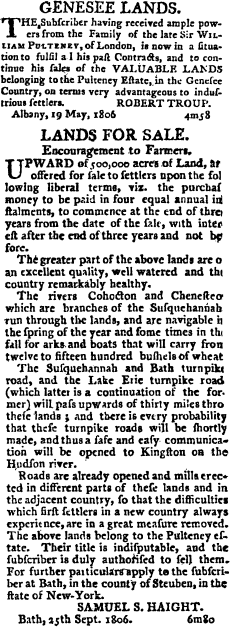
ADVERTISEMENT OF THE PULTENEY ESTATE IN THE Hartford Courant, JANUARY 14, 1807
However, when the affairs of the Pulteney Association were finally wound up about a century after its creation, it was estimated that if the sums represented by the original purchase price had been invested at the lowest prevailing interest rates, it would have been a more profitable investment of the proprietors.3
.....
Theophile Cazenove, to whom was assigned the task of disposing of the vast domain of the Holland Land Company, was not permitted by his Dutch masters to follow a policy of land booming such as was attempted by the agent of the English purchasers of a part of the Genesee Country. Instead of entering upon schemes of development, he quietly and unostentatiously set about to offer small tracts here and there to settlers.
Moreover, the Dutch, in spite of their vast acreage, acquired from Morris, did not appear to be in a hurry to get rid of their enormous commitment. They even sought and obtained more land. In 1791, through Cazenove, they purchased a thousand out of a total of 2,500 shares of the Pennsylvania Population Company, an association which had been organized by John Nicholson, to take over about 450,000 acres of Pennsylvania lands lying just south of the Holland purchase. As stated in the previous chapter, they also acquired about a half million additional acres in the same region from Judge James Wilson, who had preempted tracts through speculation in Pennsylvania land warrants, but who was unable to make payments thereon when due.
The tract of the Pennsylvania Population Company was incorporated with those of the Holland Land Company, and for a time the two concerns were generally regarded as one. However, disputes regarding the titles and other difficulties in Pennsylvania led to the dissolution of the Population Company in 1813. Its lands were sold to Judge William Griffith, of New Jersey, and J. B. Wallace, a Philadelphia attorney, for $180,000. Griffith later sold his interest to Wurtz Brothers, merchants of Philadelphia, for $150,000, payable in English goods. These Wurtz Brothers were interested in buying up lands containing coal, and a decade later were instrumental in organizing the Delaware & Hudson Canal Company. When their anthracite speculations proved a success, they withdrew from partnership with Wallace, receiving $310,000 for their interest, two-thirds of which, however, was in debts due from settlers.
Difficulties beset Cazenove and his Dutch masters in trying to profit from their land deals. Since the owners were aliens, they were not legally permitted to hold lands in New York State. Williamson had avoided this handicap for his English employers, by becoming an American citizen soon after his arrival at Philadelphia, and by receiving in his own name title to the Pulteney Purchase directly from Morris. The Dutch, however, tried to get around the law by placing their holdings in the name of “trustees,” but this was a clumsy expedient. Accordingly, measures were taken to obtain exemption from the New York law against alien ownership of landed property. As already stated, it was accomplished on April 2, 1798, largely through the political influence of Aaron Burr.
In his early political career, Burr endeavored to get rich along with the other land jobbers of the time by buying large tracts on credit. He was a shareholder in the Pennsylvania Population Company, owning one hundred shares, which, however, he forfeited for non-payment. He also had contracted under a bond with Cazenove to purchase 100,000 acres in the northern part of the Holland Purchase, but he soon found payments beyond his financial means. He was, therefore, threatened with suit against his sureties. In the hopes of bettering a bad situation, he had united with other hard-pressed land speculators, in commissioning James Wadsworth, who was then in England trying to sell Genesee lands, to find English purchasers for their insecure holdings. To make the task easier, Burr, who was a member of the New York Assembly, put through a bill granting aliens the conditional right to hold land in New York.
The correspondence of Cazenove with his Dutch masters confirms the belief that Burr obtained the passage of the law through bribes furnished by the Dutch owners. They paid altogether $10,500, of which $3,000 went to Josiah Ogden Hoffman, the attorney-general, and $5,500 went to Burr himself, albeit as a two-year loan. Burr never repaid the loan, but his contract for the purchase of land from the Holland Land Company was canceled. So he escaped from a bad financial situation.4
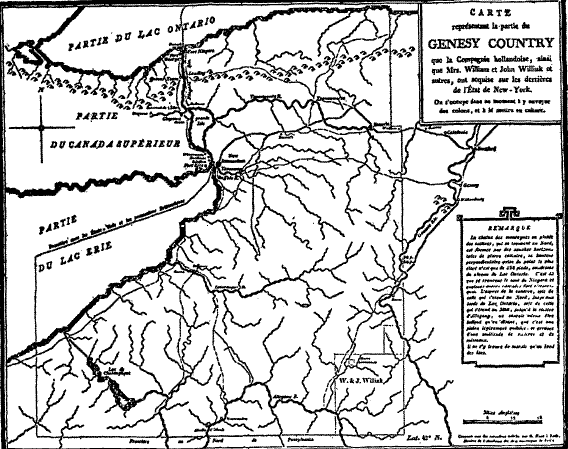
AN EARLY MAP OF HOLLAND PURCHASE, PUBLISHED IN FRANCE IN 1803 IN JEAN PHILLIPPE LOUIS BRIDEL’S Le pour et le contre, ou avis à ceus qui se proposent de passer dans les Etats-Unis d’Amerique
Although the New York law permitted the Dutch proprietors to take title to the land, it did not give them the right to reenter lands once the title had passed from their hands. This prohibition was a serious handicap to the alien owners. They dared not sell land on credit by taking a mortgage for the unpaid portion of the sale price, since, as aliens, they could not bid in the land under foreclosure. This led to sales conditioned on the final payment being made. Hence, no deeds were granted to purchasers until they had paid in full. Settlers on the lands were for the most part poor, and few could keep up their interest payments, to say nothing of the required instalments of the principal. The result was a permanent condition of vassalage on the part of the purchasers. These could not sell their farms and reap the benefits of the improvements made thereon, because they possessed no deeds confirming title. As late as 1802, in all Genesee County, there were only thirty freeholders—in fact, “not enough to make up a jury.”
The State of New York in 1817, however, had begun the construction of the Erie Canal. The Holland Land Company was asked to donate the necessary right of way through its property. When this was promised, a law was passed on March 5, 1819, repealing the restriction of reëntry of aliens on property sold by them. Even with the prohibition removed, the Holland Company continued its old practice of making contract sales, and deeds were offered at time of purchase only in special cases.
When the “boom” in the wild land mania collapsed after the Morris-Greenleaf-Nicholson failure in 1795, Cazenove realized that it was impossible to dispose of large tracts of the enormous territory under his control. He accordingly built up an organization for retail disposal. Land agents and subagents were employed in eastern towns and seaports as well as abroad. Land offices were opened in various settlements within the purchase. The principal office was set up in the newly created town of Batavia, N. Y. (located at about the central point of the domain), and Joseph Ellicott was placed in charge.
Ellicott was a renowned, though an eccentric surveyor. He was a brother to Andrew Ellicott, the engineer, who completed the plan of Washington, the “Federal City.” He held the office as resident land agent of the Holland Land Company for twenty-one years. In this capacity he laid out the city of New Amsterdam, now Buffalo, gave its streets the jaw-breaking names of the Dutch proprietors and made it a flourishing town. He was careful enough to take the choice lots for himself. Through a series of roads built through different parts of “the Purchase,” he made the lands accessible to new settlers.
Through these means settlers came in steadily, though slowly. Every encouragement was given them when no expense was involved. Little cash payment was required of land purchasers and if instalments of interest and principal were not paid when due, the defaults were added to the capital of the debt, and the interest computed on the total amount. In some cases when cash could not be paid, cattle and produce were accepted. As the Dutch owners had paid cash for their lands, they did not press remittances from their debtors and appear to have been satisfied to allow balances due them to accumulate at 7 per cent interest, when the prevailing rate in Holland was 3 per cent. With this liberality to new settlers the wild lands were gradually converted into farms.
Theodore Dwight, President of Yale College, who passed through the Genesee country in 1810, wrote enthusiastically of its rapid settlement: “It is questionable,” he says, “whether mankind has ever seen so large a tract changed so suddenly from a wilderness into a well-inhabited and well-cultivated country.”5 He estimated the white inhabitants then at between two and three hundred thousands “all planted within 26 years.” And Captain Williamson also wrote in 1799, ten years earlier:
A wilderness changed, in so few years, to the comfortable residence of a numerous body of industrious people, who enjoy the comforts and conveniences of life in a degree superior to most parts of the United States, affords matter of curiosity to the intelligent traveler, and many respectable characters undertake the journey for no other motives.
Though the liberality of the Holland Land Company toward its creditors is generally admitted, this very liberality in time became a cause of great discontent. The purchasers, unable to pay in full for their lands, practically became tenants-at-will of the company. Complaints of this condition poured in. The proprietors themselves grew tired of the situation, and in 1820 offered to resell to the state all of their lands in the Genesee country. Gideon Granger, as their attorney, submitted the proposiion to Governor DeWitt Clinton, who passed it on to the legislature, with the remark: “This measure from a financial point of view may be rendered beneficial. It will relieve a considerable portion of our population from evils which are actually experienced, and from influence which may be injuriously exercised. It will enable the State to extend encouragement to the meritorious settlements which have already taken place.”6
Granger argued that “eighty to one hundred thousand people were subject to the will of the Hollanders for their prosperity,” and inasmuch as the unsold lands could be acquired at about one dollar per acre, and the bonds, mortgages, contracts, etc., at a considerable reduction from face value, the state would be making a good bargain by accepting the proposition. It was estimated that about 1,750,000 acres (about one-half of the original acreage) still remined unsold, “much of it considerably valuable.”
The legislature did not take kindly to the proposition, so that conditions remained unchanged. Wearied of steadily growing defaults and of inadequate cash receipts, the proprietors appointed, in 1821, a new agent, Jacob S. Otto, to replace Joseph Ellicott. Otto abandoned the former policy of leniency. Many of the settlers were served with threats of dispossession. During the next ten years, these dissatisfied debtors held public meetings, distributed pamphlets and had “almost weekly conventions.” All this engendered political opposition to the Holland Company. It resulted in the repeal of the company’s exemption from state taxation on its unsold land, and to legislative threats to tax debts due on land sales contracts for land belonging to non-residents.
Charles Butler, who at this time lived in Geneva, N. Y., and who in later life became a wealthy New York capitalist through speculation in western lands, sought a remedy for the situation. In March, 1830, the New York Life Insurance and Trust Company was incorporated and empowered to lend on mortgages, up to one-half of the value of the land. Butler went to New York and made application to it for loans on behalf of the debtors of the Holland Land Company. He then became the Holland Company’s land agent. In this way mortgages were substituted for unpaid balances on sales contracts. Other New York trust companies also granted loans, so that many of the farmers in the section, instead of being tenants-at-will, became freeholders.
But the political animosity against the Holland Land Company continued. Moreover, the law requiring the payment of taxes on its unsold lands made its business unprofitable. Efforts were then made to wind up its affairs. The lands and sales contracts were offered to local capitalists. In the meantime, real estate and farm lands were booming throughout the country, and the Dutch proprietors were thus given the long sought for opportunity to dispose of their holdings. A syndicate headed by Trumbull Cary and George Say of Batavia, N. Y., acquired early in 1835 the unsold lands and purchase contracts of the Holland Land Company in Chautauqua County for about $1,000,000. The transfer of ownership, however, did not allay the dissatisfaction of the debt burdened settlers. In fact, the efforts of the new proprietors to force payment from them, led to actual riots. A mob set fire to the company’s land office at Maysville in Chautauqua County and another threatened to destroy the main office at Batavia. For a while the latter place was surrounded with block houses and a constant guard kept on hand.
In order to mend matters, Cary and Say called upon William H. Seward, prominent politician and later Lincoln’s Secretary of State to treat with their discontented tenants. Seward resided in Auburn, just east of the Holland Purchase. He knew the calibre of the up-state farmer, and when the agency of the proprietors in Chautauqua County was offered him, in 1836, he accepted. He immediately began to follow the plan of Charles Butler in converting the outstanding sales contracts into mortgages.
When Seward was running for Governor of New York in 1838, his political opponents accused him of selling the debts owed by the settlers “to Wall Street,” and of using Nicholas Biddle to raise money in England at 5 per cent, whereas the settlers were made to pay 7 per cent. This accusation was answered in a brilliant address to the citizens of Chautauqua County. In this, Seward made a vigorous defense of his policy as agent of the Cary land syndicate. “In less than eighteen months,” he said, “four thousand persons whom I found occupying lands, chiefly under expired and legally enforceable contracts of sale, and excited and embarrassed alike by the oppression and uncertainty of ever obtaining titles, became freeholders.” Seward was elected governor in 1838, and again in 1840, so that his land dealings proved in the end no detriment to his political ascendancy.
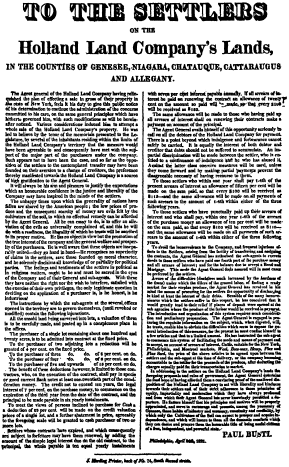
BROADSIDE OF HOLLAND LAND COMPANY, APRIL 24, 1821, ANNOUNCING THE FAILURE TO PLAN TO SELL OUT TO THE STATE, AND OFFERING NEW TERMS TO SETTLERS
While Seward was endeavoring to adjust the delicate situation of the new proprietors in Chautauqua County, Jacob Le Roy and Herman Redfield, in behalf of the Farmers Loan and Trust Company of New York, were negotiating for the purchase of the Holland Company’s lands and securities in other counties. An agreement was finally reached in December 31, 1835, whereby about 90,000 acres of unsold wild lands, and a mass of mortgages, unexpired sales contracts and other indebtedness, were sold for $2,282,382, payable one-half in cash and the remainder within two years.7
This left but a few remaining properties of the company in two other counties. These were likewise sold to New York capitalists, who raised the necessary funds through loans from the Farmers Loan and Trust Company of New York City. Thus, by 1836, the Holland Land Company faded entirely from the picture. Only its old stone “land office,” still standing at Batavia as a local “landmark,” and a few boundary posts, now kept in local museums, are a reminder that a group of Dutch capitalists once owned about a seventh of the total area of the Empire State.
And little profit came from their speculation! According to Paul Evans, the historian of the Holland Land Company, the original investment of the company “was retrieved with interest of five to six per cent,” but he gives this estimate “merely for what it is worth.”8
.....
The story of the disposal of the northern New York lands comprised in the Ogden and Macomb purchases is further proof of the futility of waste land speculations. In this section, the lands were sold and resold in large tracts, usually in townships or parts of townships. The original purchasers, as a rule, attempted to be relieved of their acquisitions at a profit as soon as possible, and in many cases, when profits were not forthcoming, they either turned their titles over to their creditors or permitted their holdings to revert to the state for unpaid taxes.
William Constable and Gouverneur Morris had the largest hand in the disposal of these properties. Morris, as stated in the previous chapter, became a “general land agent” both at home and abroad. When he returned from France in 1798, he continued to occupy himself with numerous land deals and remained in this business to the end of his long career as lawyer, author, statesman, diplomat, and financier. He died in 1816.
When Constable arrived in France in 1792, to offer his vast empire of waste woods and mountains to distressed émigrés, he naturally sought the aid of the astute American minister, who could bring him into contact with prospective purchasers. It was undoubtedly through Morris’ assistance that Constable sold a tract of “Macomb’s Great Purchase,” comprising 630,000 acres, to Pierre Chassanis, just a few days before Louis XVI was guillotined. Chassanis was a brother-in-law of James Donatien Le Ray de Chaumont, who in turn was the son of Donatien Le Ray de Chaumont, the host in France of Benjamin Franklin. These French noble gentlemen formed a company, called the “Compagnie de New York,” and issued a prospectus, the title page of which is shown herewith. According to this document, “The subscribers agreed to emigrate to America and establish a settlement on the north side of the Black River, near Lake Ontario.” The territory was to be known as “Castorland” which was translated into English as “Beaverland.” A seal bearing a cut of a beaver was adopted as the concern’s insignia.
The six hundred thousand acres mentioned in the prospectus were reduced to 200,000 acres in 1793, and were represented by two thousand shares, all of which were sold at the original offer of 800 livres per share. The price received by Constable for this tract was £25,000 in English currency.
The prospectus of “Castorland” gave an alluring description of the country, describing trees, plants, roots, birds and fish. There were very favorable conditions for producing maple sugar and potash, two important and necessary articles of commerce at the time. The success of similar colonies recently established was pointed out, particularly Judge Cooper’s venture on Lake Otsego. Each “share” of the company was to be an “integral part and fraction of the purchase” and no money was to be paid to Constable, the vendor, “until after the title was received from America, clothed with all the formalities required by the usages of the country.”
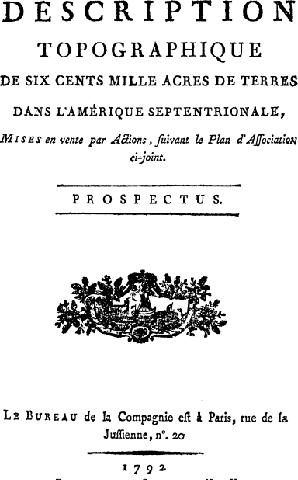
PROSPECTUS OF THE COMPAGNIE DE NEW YORK
(Courtesy of the New York Public Library)
The proprietors of Castorland lost no time in sending two agents to America. These men, after many delays and hardships of travel, reached the location of the purchase. As at this time real estate in New York could not be legally held by non-resident aliens, the agents returned to New York City and sought the aid, first, of Alexander Hamilton, and subsequently of Aaron Burr, to get the legislature to remove this obstacle. This accomplished, the two agents again visited Castorland with a corps of surveyors, but sickness and hardships severely hampered their activities. In the meantime, the guillotine in Paris had ended the careers of several of the original shareholders. One of the agents, Pharoux, was drowned in the Black River in 1795, and the other, through sale of a part of the company’s property, received sufficient cash to pay his bills, and so returned to France. The colony was not long afterward abandoned, and the lands passed to other proprietors—chiefly to Gouverneur Morris, in payment of commissions, and to Le Ray de Chaumont, who had become an American citizen and had taken up his residence in this back country.
When Chassanis and his associates could only obtain subscriptions to about a third of the 600,000 acres that they had agreed to buy from Constable, the latter in April, 1793, resold the returned portion, about 400,000 acres, to Charles J. Michael de Wolf, of Antwerp, for 300,000 florins ($125,356). De Wolf then transferred the land for 680,000 florins to a group of Belgian capitalists who called themselves the “Antwerp Company.” They, however, did not propose a colonization scheme similar to that attempted by Chassanis. In 1800, they appointed Le Ray de Chaumont and Gouverneur Morris their joint agents to hold and dispose of the land, “in trust.” Their agents could accomplish little in making sales, and most of the land was later acquired by Le Ray de Chaumont.
Thus, James Le Ray, as he was known in the United States, was the residual legatee of large tracts in the original Macomb purchase. He was an enterprising émigré, who came to America in 1789, to collect the debts owing to his father by the Revolutionary Government. The land mania took a strong hold on him. He acquired tract after tract in northern New York. Much of it he resold, but his generosity, combined with his inability to make large profits in land deals, as well as other difficulties, kept him “land poor.” Like his father in France before him, he became a bankrupt, and was compelled in 1824 to surrender his estates to his son for the benefit of his creditors. His landed property at the time of making the assignment consisted of:
| 30,759 acres in Franklin County | appraised at | $22,500 |
| 73,947 acres in St. Lawrence County | appraised at | 106,000 |
| 143,500 acres in Jefferson County | appraised at | 574,000 |
| 100,000 acres in Lewis County | appraised at | 133,000 |
_______ |
|
________ |
| 348,206 acres | appraised at | $835,500 |
Strange to relate, the affairs of Le Ray’s estate were so well managed by his son that all American claims were satisfied in full. While his property was being liquidated, Le Ray abandoned his land office at LeRaysville, and retired to France.
Le Ray was a noteworthy French-American citizen. His activities in settling the northern area of New York State are far surpassed by his contributions to the economic and social welfare of the inhabitants of the region. He was very much interested in scientific agriculture, and in other progressive developments, and endeavored to introduce new crops and new industries in the land of his adoption. He was instrumental in bringing to his lands the finest breed of merino sheep, taking these from the celebrated sheepfold of Rambouillet. He built roads, established schools, endowed churches. He was fond of his children, and has perpetuated their Christian names in such places as “Alexandria Bay” (named after his daughter) and “Cape St. Vincent” (after his son), both on the St. Lawrence River, where he was for a time a dominating spirit. He died in Paris in 1840, at the age of eighty-one.
Le Ray was associated in land deals with Gouverneur Morris, and it is undoubtedly through his influence that Morris succeeded in selling several tracts to Jacques Necker. Necker bought this land ostensibly for his daughter and her children. Like Morris, he feared that “all kinds of property in Europe are uncertain and wavering” and wished to transfer part of his wealth to peaceful America. Madame de Staël, his daughter, later added purchases made on her own account. One purchase comprised 23,000 acres in the town of Clare, St. Lawrence County. The total acreage owned at her death was estimated at 30,000 acres.
The Duke of Rochefoucauld, who had witnessed the many tragedies of land speculation in America, cautioned Madame de Staël against her speculations, but Le Ray assured her that they would prove profitable undertakings. Morris also aided in allaying her fears. As Madame de Staël, who was hard pressed by Napoleon, and chased all over Europe, had expressed a wish to settle with her family in America, Morris encouraged her by pointing out that “with us [in America] it is within the reach of every one to attain the objects of his desire, and he who is successful, enjoys the consciousness of possessing an influence over the course of affairs.” Though he admitted that building castles in the United States was a folly as ruinous as building castles in the air, the setting up of “a little summer establishment in a new country, which is rapidly advancing, and to pass there from three to five months of the fine season; to remain four months more either in Philadelphia or New York, and to spend the remainder of the year traveling, is a mode of life by no means repugnant of common sense.” But despite the allurement held out by Morris and Le Ray, and an expenditure of $20,000 in building roads and other improvements on her property, Madame did not come to America. Her wilderness estate passed to her children at her death in 1817. These ordered it sold, and the land reverted to American ownership.
Madame de Staël was not the only French celebrity whom Le Ray induced to risk a fortune in an American land venture. It was he who was responsible for the purchase, in 1816, of a large tract of the northern wilds of New York by Joseph Bonaparte, elder brother of the emperor. How it was brought about is thus related by Vincent Le Ray:
Mr. Le Ray de Chaumont was at his estate in Touraine in 1815, when he heard of Joseph Bonaparte’s arrival at Blois. He had known this prince before his great elevation, and was his guest at Mortefontaine when the treaty of September 30, 1800, between the United States and France was signed there, but he had ceased meeting him afterwards. Seeing, however, that misfortune had assailed the prince, he remembered the man and hastened to Blois. The prince, having invited Mr. Chaumont to dinner, said suddenly to him: “Well, I remember you spoke to me formerly of your great possessions in the United States. If you have them still, I should like very much to have some in exchange for a part of that silver I have there in those wagons, and which may be pillaged any moment. Take four or five hundred thousand francs and give the equivalent in land.” Mr. Le Ray objected that it was impossible to make a bargain where one party alone knew what he was about. “Oh,” said the prince, “I know you well, and I rely more on your word than on my own judgment.” Still Mr. Le Ray would not be satisfied by his flattering assurances, and a long discussion followed, which was terminated by the following propositions, immediately assented to by the prince: Mr. Le Ray Chaumont would receive four hundred thousand francs, and would give the prince a letter for Mr. Le Ray’s son, then on the lands, instructing him to convey a certain designated tract if, after having visited the country, (whither he was then going) the prince confirmed the transaction; otherwise, the money to be refunded.”9
Joseph Bonaparte, in time, came to America, visited the tract, and accepted it. This, however, may have been from necessity rather than choice, as Le Ray was unable to repay the loan. The former King of Spain could not take title to the estate, since he was an alien, so the deed was made out to Peter Duponceau, the learned Philadelphia lawyer of French extraction.
The original Bonaparte purchase was estimated at 150,000 acres, but it later was reduced to 26,840 acres, valued at $40,260. As “Count Survilliers,” Joseph Bonaparte took up his residence in America at Bordentown, N. J. But he occasionally visited his vast woodland estate in the Adirondacks. He recognized the qualities of the lands as a hunting preserve, but complained that he could not find 200 acres of level ground to build a lodge on. In honor of his favorite deity, the goddess of the hunt, he named his township “Diana.” A beautiful lake in his domain still retains the name of Bonaparte. He petitioned the New York Legislature for the privilege of acquiring title to the land, and the Act of March 31, 1835, which conferred upon him this right, is evidence that he meant to retain it. He did not hold it long thereafter, however, but sold the whole property for $80,000 to John La Farge, a merchant of Havre and New Orleans. La Farge took up his residence for awhile at Penets Square near the tract, but about 1838 he moved to New York where he engaged extensively in real estate and other business transactions and amassed considerable wealth. He was the confidential agent of Louis Philippe who, as King of the French, realized the instability of his job and invested heavily in America.
Although Joseph Bonaparte made but few and infrequent visits to his Adirondack estate, a local poet of the region, Caleb Lyon, memorialized the occasions in pleasing verse, thus:
Here he forgot La Granja’s glades,
Escurial’s dark and gloomy dome,
And sweet Sorrento’s deathless shades
In his far off secluded home.
The hunter loved his pleasant smile
The backwoodsman his quiet speech
And the fisher’s cares would he beguile
With ever kindly deeds for each.
He lived for others not in vain
His well kept memory still is dear.
Once King of Naples and of Spain
The friend of Bernardin St. Pierre.10
Gouverneur Morris, to whom may be ascribed the interest of Le Ray de Chaumont, Jacques Necker and Madame de Staël in the northern wilderness of New York, is also responsible for the large land venture of another prominent European capitalist. It was he who persuaded David Parish, scion of a prominent Scotch family, “The Lairds of Rossie,” (who for several generations successfully conducted international banking at various European centers), to buy a large estate in northern New York.
Morris, while in Europe, became intimate with John Parish of Antwerp, whose son, David, came to America in 1804 on a financial mission. When Morris returned to America in 1798, and continued his occupation as leading American land hawker, he urged John Parish, through correspondence, to place a part of his fortune in American estates. “Your oldest son,” he wrote November 12, 1806, “should own a large tract. This is the way to become a real baron without a name.”
Accordingly, David Parish, after taking up his residence in America, became a land baron. Through Morris’ advice he purchased the whole township of Ogdensburg, comprised in the original Ogden purchase, together with many hundreds of acres in the vicinity. For this he paid about $2 per acre. After the tract was bought David Parish did not know what use to make of it. Morris and Le Ray suggested that the land might be used for raising merino sheep. The soil, they said, was an exact repetition of the Spanish district where sheep produce the most wool.
Parish, therefore, commenced operations by importing about 3,000 merino sheep from Spain at heavy cost. Merino sheep were then selling at fabulously high prices. He also built a “baronial mansion” at Ogdensburg, “the Red Villa” designed by the French architect, Renée, whom Parish brought over with him in 1811. This villa he equipped in European style, and visited it occasionally.
The wool raising idea, for awhile, took a strong hold on him. Vincent Nolte, who in 1853 wrote an entertaining account of his American experiences,11 relates that while traveling with Parish from Philadelphia to Baltimore, he noted some merino sheep in a field. “Look,” Parish exclaimed, “how they jump about. They yield splendid wool.” But success does not seem to have attended Parish’s wool-raising scheme. Aside from building a fine residence and a church at Ogdensburg and laying out the towns of Parishville and Rossie (where he attempted to establish iron works), he allowed the estate to retain its primeval condition. Yet, Nolte estimates that he invested more than $350,000 in the proposition. He brought over his nephew, George Parish, to take charge of it, and returned to his banking business in Europe. George occupied the “baronial mansion” for a number of years, bringing there his mistress, Madame Vespucci, a Tuscan beauty, who had gained social prominence from her claim of descent from Americus Vespucci. After George was recalled to Germany as “Baron von Softenburg,” in 1834, Madame Vespucci retained possession of the mansion for a few years. But she also wearied of the monotony of northern life, and returned to Europe. The “old red villa” at Ogdensburg was allowed to become a ruin. Its grounds were later cut up and the whole Parish estate was offered for sale, and gradually parceled out.
Thus, David Parish failed to realize his ambition to become an American baron. Though hardly a trace of his ownership of a vast northern New York barony remains, his sojourn in America was not without substantial benefit to his adopted land. It was he who suggested, in 1813, to Stephen Girard and John Jacob Astor that they, in cooperation with him, purchase the entire issue of $16,000,000 United States bonds, and thereby enabled the nation to carry on successfully the “Second War for American Independence.”
Not all the prominent purchasers of the northern New York wild lands were of foreign nationality. Both William Constable and Gouverneur Morris, following their attempts to dispose of large tracts of the Macomb Purchase in Europe, made offerings of large and small parcels to native capitalists. Constable, who seems to have been a persuasive real estate salesman, as well as a great shipper and trader, succeeded in selling, for £ 100,000, in June, 1792, about 1,280,000 acres, or almost one-third of the total purchase, to Samuel Ward, a prominent private banker in New York. This tract was located in the westerly portion of the Macomb Purchase and is designated in the maps as the Boylston Tract. Aaron Burr is reported to have been a silent partner in the purchase transaction, but upon ascertaining that there was no prospect of quick profit, he withdrew; so Ward completed the purchase alone. Ward, however, did not want to hold the land, and soon returned a large part of it to Constable. He tried to make out of it a quick “turnover” of his money. The portion he retained (668,000 acres) he soon resold in parcels to others.
James Greenleaf made a beginning of his vast land-jobbing business, by buying 210,000 acres from Samuel Ward for £24,000, in New York currency. Greenleaf mortgaged his entire tract to Philip Livingston for $38,000, to effect the required payment. He then proceeded to seek a purchaser. He was fortunate in finding one in John Francis, the son-in-law and partner of John Brown, a wealthy Providence shipper and manufacturer. Francis had come to New York City, where Greenleaf then resided, to dispose of a cargo of goods which was expected to arrive at the port. While awaiting the arrival of the vessel, he was entertained in “high society” by Greenleaf and Livingston, who were constantly talking of their land speculations. Whether they purposely got the young merchant under the influence of liquor or not is, of course, not recorded—but there is pretty good evidence that Francis, without consulting his rich father-in-law, turned over to Greenleaf $210,000, or some such sum, of the proceeds of the cargo money, for an imperfect claim to the same number of acres of the northern wilderness of New York.
It is reported by an eyewitness that when John Brown, the richest man in Providence, learned of the foolish transaction put over on his son-in-law, “he dropped his head into his hands and wept bitter tears of mortification and disappointment.”12 The son-in-law died about four years thereafter, probably also from mortification, so John Brown was left to struggle along with his wilderness estate. In 1798, he obtained clear title to the property, at an aggregate cost of about $250,000. He was required to buy off Livingston’s first mortgage, and made other outlays to perfect his title. The estate became locally known as “John Brown’s Tract,” and covers the most delightful section of the Adirondacks, as it comprises the Fulton Chain of Lakes.
Brown retained the tract until his death in 1803. And he sought to exploit it. He built a road into the region and endeavored to encourage settlements therein, but with little success. At Old Forge, a saw mill, a grist mill, a few houses, and a frontier tavern and schoolhouse were built. The whole estate was divided into eight townships. To each of these townships, Brown, in the hope that they would inspire good New England morals in the wilderness, gave such names as “Industry,” “Perseverance,” “Frugality,” “Sobriety,” “Economy,” and the like. When he died, he willed one or more townships to each of his heirs. Some of these soon gave up the land rather than pay the taxes due thereon.
After John Brown’s death, his son-in-law, Charles Frederick Herreschoff, the progenitor of the famous yacht builders of Bristol, took over the management of the Adirondack estate. He offered strong inducements to settlers to come to the tract, and allotted them farms, on condition that they clear and cultivate the land. By this means, he hoped to sell neighboring parcels to later comers.
Of course, he didn’t succeed. The country was fine for hunting, fishing and camping, but farming on it was out of the question. Accordingly, about 1815, Herreschoff, like David Parish, indulged in the sheep-raising mania. A herd of fine merinos were driven over the Berkshires all the way from Rhode Island to take up a domicile in the northern wilderness. But no profit came from this venture. Herreschoff next tried iron mining. The name of “Old Forge,” where his smelting operations were carried on, is all that remains of this venture. Finally, in 1818, when financially ruined, and utterly discouraged in trying to exploit the John Brown Tract, Herreschoff blew out his brains. This is but one of the many tragedies growing out of the wild land mania which infested the Empire State in the decades following the Revolutionary War.13
Thus, the great wild land purchases in northern New York, as a whole, brought little satisfaction to those who originally or subsequently acquired them. The area bordering along the St. Lawrence River, due to its water power facilities, it is true, has become an industrial and commercial region of moderate importance, but its progress has been slow. Much of the region elsewhere is still barren waste land. Some of it has been cut over for lumber, and much of it denuded for pulp. Some of it is still held as private game preserves and woodland estates of the very rich, but the greater part has again been taken over, albeit at heavy expense, by the people of the State of New York, as their public domain—a playground and forest reserve for all time.
14 O. Turner, History of the Pioneer Settlement of the “Phelps and Gorham’s Purchase” p. 274.
15 Isaac Weld, Travels in America, (Fourth Edition), Vol. II, pp. 336, 337.
16 See “The Pulteney Purchase,” by Paul D. Evans, in the Quarterly Journal of the New York State Historical Association, Vol. III, p. 102.
17 Evans, The Holland Land Company, p. 209; also Wandell and Minnigerode, Aaron Burr, Vol. I, p. 178.
18 Theodore Dwight, Travels, Vol. III, p. 510.
19 See New York Assembly Journal, 43rd Session (1820), p. 581.
20 Evans, The Holland Land Company, p. 393.
21 Evans, op. cit., p. 435.
22 See Franklin B. Hough, History of Lewis County, N. Y., p. 71.
23 Abstracted from Franklin B. Hough’s History of Lewis County, N. Y., P. 79.
24 Fifty Years in Both Hemispheres, or Reminiscences of the Life of a Former Merchant.
25 Alfred Lee Donaldson, History of the Adirondacks, Vol. I, p. 101
26 Donaldson, op. cit., pp. 89-110.
- 1Maine Historical Collections, Vol. II, pp. 268-294.
- 2The Sir William Johnson Papers, Vol. V, p. 129. See also, C. W. Alvord, The Mississippi Valley in British Politics, Cleveland, 1917.
- 3Herbert B. Adams. “Washington’s Interest in Western Lands,” Johns Hopkins University Studies, Third Series, No. 1, January, 1885. Italics are mine.—A. M. S.
- 4Adams, op, cit., p. 58.
- 5See A. Henderson, “A Pre-Revolutionary Revolt in the Old Southwest” in Mississippi Valley Historical Review, Vol. 27, p. 198 et seq.
- 6Italics are not in the original.
- 7In a letter to William Franklin, dated May 3, 1776, Johnson asserted “it has always been my practice to avoid engaging in lands to the great loss of my family, neither have I a foot of land from the Indians.” (Sir William Johnson Papers, Vol. IV, p. 197.) The large tract north of the Mohawk Valley given him by the Canajoharie Indians in 1760 was confirmed by royal grant in 1769.
- 8See Pennsylvania Magazine of History, Vol. XIV, pp. 218, 219.
- 9See Memorial of the United Illinois and Wabash Land Companies, Baltimore, 1816.
- 10A copy of the deed is contained in American State Papers, “Public Lands.” Vol. I. The original copy was acquired by Cyrus H, McCormick.
- 11See J. P. Boyd, “Connecticut’s Experiment in Expansion, The Susquehannah Company, 1753-1803,” in Journal of Economic and Business History, November, 1931.
- 12See Publications of the Colonial Society of Massachusetts, Vol. XXV, PP. 33-38.
- 13Samuel W. Jones, Memoir of James Duane, 1852.
- 14During the first hundred years of North American colonization, economic conditions gave little encouragement to private land schemes. Land was too plentiful. A few such enterprises were undertaken, however. Thus, as early as 1661, the Colony of Massachusetts sold to a few individuals for £400 a large tract on the Kennebec River in Maine. This became known as the “Kennebec Purchase.” The heirs held it for nearly a century without doing anything with it. In 1753, they incorporated as the “Proprietors of the Kennebec Purchase” and proceeded to dispose of their holdings. The corporation continued in existence until 1816. “The Pejebscot Company” was another Maine land deal. None of these held out promise of profit to proprietors until about a quarter century before the Revolution.
- 15In the meantime, the “Loyal Company” group was not idle; its proprietors sent Dr. Thomas Walker, of Albermarle, Va., to make a reconnaissance, and to discover a proper place of settlement. The two “companies” then became engaged in a controversy, and neither made a survey or fixed the bounds of their grants. The apparent ease with which they obtained land donations led to other schemes, and aroused an epidemic of interest in distant western wild lands. Not only was the land ownership eagerly sought after, but the establishment of new colonies, with separate and distinct governments, was planned. Favoritism and collusion infested the Virginian colonial government, due in large part to the persistence of speculators in western land grants. Lobbyists were sent to London to obtain the crown’s sanction to land-grabbing schemes and the question of the disposal of the vast western domain won from the French infested British politics. “One half of England is now land mad,” wrote George Croghan, of Philadelphia, one of the land schemers, to Sir William Johnson, on March 30, 1766, “and everybody there has their eyes fixed on this country.”
- 16I offered in my last to join you in attempting to secure some of the most valuable lands in the King’s part, which I think may be accomplished after awhile, notwithstanding the proclamation that restrains it at present and prohibits the settlement of them at all; for I can never look upon that proclamation in any other light (but this I say between ourselves) than as a temporary expedient to quiet the minds of the Indians. It must fall, of course, in a few years, especially when those Indians consent to our occupying the lands. Any person, therefore who neglects the present opportunity of hunting out good lands, and in some measure marking and distinguishing them, for his own, in order to keep others from settling them, will never regain it.
- 17Crawford “heartily embraced” the colonel’s offer. He promised shortly to set out in search of lands. “This may be done,” he said, “under a hunting scheme.” He acknowledged that other land seekers had approached him, with similar offers, “but have not agreed to any; nor will I with any but yourself or whom you think proper.”
- 18Judge Richard Henderson of North Carolina, the employer and backer of Daniel Boone, promoted the settlement of the Kentucky region and claimed ownership to a vast unsettled tract there. He organized a group of land grabbers under the name of “The Transylvania Company.” Ignoring the British interdiction against Indian land purchases, he obtained from the Cherokees in 1773 about one-half of the present State of Kentucky, and immediately began settling the land. He advertised widely for pioneers and “shareholders.” In his announcements, Henderson waxed enthusiastic. “The country [Transylvania] might invite a prince from his palace, merely for the pleasure of contemplating its beauty and excellence, but only add the rapturous idea of property, and what allurements can the world offer for the loss of so glorious a prospect?”
- 19When the British Government began to take active measures to break up land “bootlegging,” and to put a stop to dreams of riches in western territory, Virginia’s political resentment was naturally aroused. Even Thomas Jefferson, who, in later life, frowned upon speculation and land grabbing, held the view in 1774 that the land did not belong to the British king, and that it was time for the colonies “to declare that he has no right to grant lands of himself.” So he boldly wrote in the Declaration of Independence, as one of the British king’s usurpations: “He has endeavored to prevent the Population of these States; for that purpose obstructing the Laws for Naturalization of Foreigners; refusing to pass others to encourage their migrations hither, and raising the conditions of new Appropriation of Lands.”
- 20He was for it at once. “I like the project of a colony in the Illinois Country,” he wrote his son, “and will forward it to my utmost here.” He thought that Sir William Johnson’s “approbation will go a great way in recommending it, as he is much relied upon in all affairs that may have any relationships with the Indians.” But Johnson had an eye on the Indian lands himself, and besides advising others about purchases in the outlying sections, personally through gifts from the Indians engrossed large tracts, particularly in the Mohawk Valley. The town of Johnstown, N. Y., still marks the seat of his domain.
- 21Some of the members of the Vandalia Company were concerned in other western land schemes. One of these was organized in 1775 as the “Indiana Land Company,” probably the first application of the name “Indiana” to the Northwest Territory. The claim to land was based on a grant of a large tract, made November 3, 1768, in what is now West Virginia, by the Six Nations at Fort Stanwix to “Chief” William Trent in liquidation of depredations. Among the shareholders were Samuel Wharton, Joseph Galloway, Robert Callender, Levi Andrew Levi, and David Franks, all wealthy and prominent Philadelphians. The Revolutionary War did not put an end to the “claim.” Wharton in 1776 published a pamphlet, entitled-View of the Title to Indiana, in which he defended the company’s rights to the lands. In 1781, he republished this in enlarged form, under the title Plain Facts; being an examination into the Rights of the Indian Nations of America to their respective Countries and a Vindication of the Grant from the Six United Nations to Proprietors of Indiana, etc. Although Wharton pressed the validity of the “proprietors” claims, Congress then and thereafter gave little heed thereto.
- 22Notwithstanding the British Government’s edict, forbidding the private purchase of lands from the Indian tribes, William Murray, an Indian trader, and several of his business associates, in 1773 formed a plan to buy from the aborigines an immense tract of country between the Mississippi, Illinois and Ohio rivers. After a “pow-wow” lasting a month, the sale was consummated. According to the land claimants, it was attended by “many persons of both descriptions and the Indians were carefully prevented from obtaining any spiritous liquors during the whole continuation of the negotiation.” On July 5, 1773, “for a very large and valuable consideration,” the deed was delivered to the “Illinois Land Company.”
- 23Notwithstanding the British Government’s edict, forbidding the private purchase of lands from the Indian tribes, William Murray, an Indian trader, and several of his business associates, in 1773 formed a plan to buy from the aborigines an immense tract of country between the Mississippi, Illinois and Ohio rivers. After a “pow-wow” lasting a month, the sale was consummated. According to the land claimants, it was attended by “many persons of both descriptions and the Indians were carefully prevented from obtaining any spiritous liquors during the whole continuation of the negotiation.” On July 5, 1773, “for a very large and valuable consideration,” the deed was delivered to the “Illinois Land Company.”
- 24The proposition then took on a business aspect. The number of “shares” was increased, and rights to subscribe offered at from $2 to $5 per share. It attracted speculators. The shares soon rose in value. Lawyers, clergymen and politicians began buying shares. The Reverend Ezra Stiles, President of Yale College, grandfather of the poet-physician Oliver Wendell Holmes, took 2¾ shares. The Governor of Connecticut, Roger Walcott, who had become rich through local land deals, supported the project.
- 25New York, before the Revolution, also had her “land” quarrels with the other colonies. The ill-defined boundaries of the Dutch province led to constant conflicts and legal controversies with her neighbors. There was a bitter dispute with New Hampshire regarding the political jurisdiction of Vermont. New York claimed the section, but New Hampshire, in 1749, acting on the principle that possession is nine points of the law, began to make free grants to both New Hampshire and Massachusetts citizens. Whole “towns” of 23,000 acres, more or less, were granted to selected groups of individuals. It is estimated that between 1749 and 1764, Governor Benning Wentworth granted 131 townships to more than six thousand persons. Among the grantees appear the names of many prominent colonial New Englanders, who had no intention of ever settling on the lands. Samuel Adams was among them. He was known as a speculator in both Maine and New Hampshire lands in this period. The governor granted himself, in all, about 65,000 acres, and is reported to have accumulated considerable wealth from the heavy fees exacted by him for grants.
- 26Because of his land deals, while acting as the state’s attorney, Duane was the butt of political criticism. He was led to appear in person in his own defense before the state legislature in 1781. He was charged with receiving Vermont grants “under immoderate quit-rents, and excessive fees of office,” and he was also accused of “holding many thousand acres of land which had never before been granted by the Crown.” To this he merely answered that he “had never made a purchase or obtained a grant of land with any view to its sale.” He was therefore not a “land jobber.” This cleared him politically of all corruption.

