
The Great Austrian Economists
9. Frank A. Fetter: A Forgotten Giant
A FORGOTTEN GIANT JEFFREY M. HERBENER
IN THE PERIOD between the founders of the Austrian School (Menger, Böhm-Bawerk, and Wieser) and its next generation (led by Mises and Hayek), Frank Albert Fetter was the standard-bearer of Austrian economics. His 1904 treatise, Principles of Economics,1 constructed a general theory of economics in the Austrian tradition that went unsurpassed until Ludwig von Mises’s treatise of 1940, Nationalökonomie. Yet Fetter, an American Austrian long before the interwar migration from Austria, has not received due recognition for his many contributions to this school of thought.
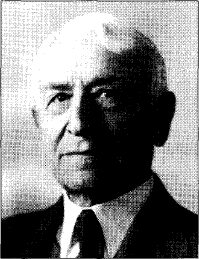
Frank A. Fetter
1863–1949
Using the axiomatic-deductive method, Fetter traced economic laws to individual human action. In so doing, he demonstrated that just as the price of each consumer good is determined solely by subjective value, so is the interest rate determined solely by time preference. The rental price of each producer good is imputed to it by entrepreneurial demand, and is equal to its discounted marginal value product. The capital value of each durable good is equal to the discounted value of its future rents. Fetter showed how this uniform, subjective theory of value implies the demise of socialist theories of labor exploitation, Ricardian theories of rent, and productivity theories of interest.
Building on the Austrian theories of capital, money, interest, and entrepreneurship, Fetter even developed a rudimentary theory of the trade cycle, arguing that the boom period is characterized by the artificial swelling of capital values as money and credit expand. The crisis follows when the inflation ceases which causes the mistaken capital values of the boom to suddenly correct downward and, in turn, results in the bankruptcy, unemployment, and retrenchment of the depression.
His work on capital and interest has yet to be surpassed or even fully appreciated, even by Austrians; much more than a correction of Eugen von Böhm-Bawerk’s lapse into a productivity theory of interest, it is the foundation for all work on capitalization and the definitive refutation of the claim that productivity has any role in determining the interest rate.
BACKGROUND
Born on March 8, 1863, in the farming community of Peru in north-central Indiana, Fetter enrolled at Indiana University at the age of sixteen. He left college after his junior year to operate the family’s bookstore while his father was ill. During eight years as a successful entrepreneur, he read the books and periodicals provided to him on the job, including Henry George’s Progress and Poverty, the book that influenced his decision to choose economics as a career.
He returned to Indiana University in 1890, and obtained his bachelor of arts degree in 1891. In this respect, too, his self-sacrificing delay in his formal studies proved momentous, for he finished his degree under the influence of Jeremiah W. Jenks. The following year, Jenks, who was then at Cornell University, obtained a fellowship for Fetter, who earned the degree of master of philosophy from Cornell that same year. Jenks then encouraged him to study under Johannes Conrad, as he himself had done, and, after attending lectures at the Sorbonne in Paris, Fetter earned a Ph.D. in 1894 under Conrad from the University of Halle in Heildelberg. He wrote his dissertation on population theory, which he saw as part of a larger theory of welfare, and devoted himself thereafter to the development of a general theory of value and welfare.2
Fetter returned from his formal studies to Cornell as instructor for one year, and then accepted a position as professor of economics and social sciences at Indiana University until 1898. For the next three years, he taught at Stanford University and, from 1901–1911, he became Jenks’s colleague at Cornell University as professor of political economy and finance. In 1911, Fetter accepted the chairmanship of the interdisciplinary department incorporating history, politics, and economics at Princeton University and, beginning in 1913, he served as chairman of the newly configured economics department for eleven years. He attained emeritus status in 1931 under Princeton’s forced retirement regulations, but his popularity and productivity were so great that he was kept on to teach graduate-level courses until he reached the age of seventy in 1933.
Fetter taught on a visiting or exchange basis at Harvard, Columbia, The Johns Hopkins and Northwestern Universities, the University of Illinois, and the Claremont Colleges. In every post, he was a revered professor and beloved mentor. He was awarded the honorary degree of doctorate of laws from Colgate University in 1909, Occidental College in 1930, and Indiana University in 1934. Intellectually active until his death in 1949, Fetter is the author of eight books, more than a hundred scholarly articles, and more than fifty book reviews. He gave a dozen major addresses, and testified before Congress and federal government agencies several times in his long and productive life.
THEORY OF SUBJECTIVE VALUE
Prior to the advent of a mature Ludwig von Mises, Fetter was the world’s leading subjective-value theorist. While Mises would bring the theory of money within a subjective-value, general theory of economics in 1912, Fetter had by 1904 already extended the principle of subjective value to bring factor prices and the rate of interest into a unified theory.3
The distinctiveness of his contribution was not lost on the profession at large, and it was widely recognized as an Austrian one. A twenty-page article assessing Fetter’s treatise appeared in 1905 in the prominent Quarterly Journal of Economics. The author, Robert F. Hoxie, wrote that Fetter had removed “the lack of harmony . . . in the eclectic union of the Austrian doctrines with the older classical theory.” Hoxie noted that Fetter had rejected the profession’s “return towards the objective cost explanation” from the “purely psychic explanation of economic phenomena in terms of utility.” Instead, Fetter held, according to Hoxie,
that the Austrians were, after all, on the way towards a true and consistent interpretation of economic activity. They failed in this, not because they had departed too far from the classical preconceptions, but because they could not wholly emancipate themselves from the older economic notions.4
Hoxie claimed that Fetter had taken up again “the initial conceptions of the Austrians” and attempted “to push their characteristic line of thought to its just and ultimate conclusions.” Fetter saw “economics as essentially the study of value, and has viewed all economic phenomena as the concrete expression, under varied circumstances, of one uniform theory of value.”5
Fetter himself was so adamant about the subjective nature of value in economic theory that he disdained referring to the watershed of economic thought in the 1870s as the Marginalist Revolution, preferring the adjectives “subjective” or “psychological” to describe the new theory. He even rejected Léon Walras in the standard trilogy of revolutionaries because he thought Walras, unlike the other mathematical marginalist William Stanley Jevons, did not agree that the essence of the revolution was the reintroduction of subjective value into value theory. In Fetter’s revisionist account, the correct trilogy is Carl Menger (whose “unusual vigor, independence, and originality of his mind seem to have been felt and esteemed by all those who came in contact with him”), Jevons (whose “versatility, originality, and vigor of thought are evident on every page”), and J.B. Clark (who “is classed by his friendly American critics in the list of the six ablest Anglo-American economists [and] is apparently conceded by all foreign critics the deanship of American theorists”).6
THEORY OF WAGES
Fetter also recognized the larger significance of a subjective-value theory’s replacing an objective one in the history of economic thought. He said that, “the labor theory of value had been adopted by Adam Smith after only the most superficial discussion,” which led him to “his confusion of ideas regarding labor embodied and labor commanded, labor as the source and as the measure of value, rent and profits now forming a part and now not a part of price.” Fetter concluded that “the resulting confusion was felt by all of the next generation of economists.”7
In particular, David Ricardo, because he accepted Smith’s concept of embodied labor, exerted
a tremendous and evil influence in ways then all unforeseen. Labor is the source of value; . . . labor is the cause of value; labor produces all wealth. Naturally follows the ethical and political conclusion: if labor produces all wealth then labor should receive all wealth.8
This was a conclusion “the Ricardian socialists” were all too eager to embrace, and which Karl Marx later used to great effect.
The Ricardo-Mill theory put a potent weapon in the hands of Marxists who, by basing their theory of exploitation on the labor theory of value, paralyzed bourgeois economists whose own cherished theories were founded on the same conception of value. Fetter knew this by personal experience:
Well I remember the confidence and gusto with which this demonstration of the truth of Marxism was still presented by socialist speakers in the nineties, as I listened to it from Berlin to San Francisco, when it was generally though mistakenly assumed that all bourgeois economists were still orthodox Ricardians.9
It was not, however, solely Marxism that inspired the marginalists to strike a blow for reason and welfare. “Henry George’s semi-communistic doctrine of land confiscation, based on the labor theory, or rent feature of it,” argued Fetter, “impelled [economists of the 1860s] to re-examine the theory of value.” Fetter knew that “the evasive and self-contradictory labor-theory as left by J.S. Mill . . . was a broken reed against the surplus-value attack upon the system of private industry and private property.”10 The subjective-value rejoinder to the Marxist and Georgist attack was to be found, said Fetter, in the capital value concept of John Bates Clark, and “more prominently and explicitly” in Wieser’s Natural Value and in Böhm-Bawerk’s Karl Marx and the Close of His System.11 A demonstration of this process of value imputation from products back to labor formed the first part of Fetter’s Principles of Economics.
Fetter’s method of explaining these principles was Misesian. He wrote:
The aim . . . has been to proceed by gradual steps, as in a series of geometrical propositions, from the simple and familiar acts and experiences of the individual’s every-day life, through the more complex relations, to the most complex, practical, economic problems of the day.12
In addition to employing successive approximation, he was, like Mises, a strict logician in method. As Fetter saw it, “Every theory must ultimately meet two tests: one, that of internal consistency, the other that of consistency with reality.” And the latter referred not to empiricism, but the “Rude contact with the world of events [which] is often what tests or betrays theory, and forces thought out of the conventional ruts.”13 Hoxie, writing about Principles, said of Fetter,
he has presented to economic students a system which, for logical consistency, is without precedent; a system which from the first fundamental conception advances without a break to the end. . . . The logical sequence and harmonious symmetry of this work affords, at least, a strong presumption of its essential truth.14
Fetter began with the “simple” and “almost self-evident” proposition that “the motive force in economics is found in the feelings of men.” It is man’s wants that urge him to action, first in primitive pursuits, but eventually “wants develop and transform the world” by propelling man to accumulate wealth and upon wealth to build civilization. Moreover, wants are not limited to the narrow self-interest of man or to desires for merely material attainments, but span the full range of man’s “social and spiritual” desires.15
When studying the problem of value, Fetter saw that one must “recognize any motive that leads men to attach importance to acts and things” because “value is in the closest relation with wants,” and “from the meeting and comparison of the estimates [of value] of individuals, arise market values or prices.”16 A man’s demand for a consumer good is formed from the law of diminishing utility (a proposition whose truth is found “in the very nature of man”), which refers to the “marginal utility” or “gratification afforded by the added portion of the good.”17 Since the term “marginal utility” expresses “by a single phrase the idea both of demand and supply,” prices “are built up on subjective valuations” alone and “correspond closely with the subjective estimates” of the marginal buyer and seller, i.e., “the least eager buyer and the least eager seller.”18
Fetter divided the value of production goods into two categories: the problem of rent (which explains the value of temporary use) and the problem of capitalization (which explains the value of permanent control and ownership).19 The rent of a factor of production depends on the universal principle of diminishing returns.20 Like the law of diminishing marginal utility, “the concept of diminishing returns is one aspect of the great law of proportionality” which is the “fundamental, axiomatic truth, that there is a best or proper adjustment of means and ends” in man’s action. “Out of it grow the important economic theories of rent and capitalization.”21
Since gratification is the basis of all values, what is implied about the prices of consumer goods must be true of factor prices as well. The price of a unit of “a group of consumption goods, all of the same quality” is dictated solely by diminishing marginal utility given the “quantity of an article capable of ministering to man’s wants.” Although, units of a good of the same quality will have the same price, a series of consumption goods of different qualities will differ in price. If a good has no marginal utility, it will be a “free” good, and goods of similar kind but higher quality will have prices “measured from zero upward.” The extent to which the “lower grades acquire value” and come into use depends on “scarcity of the higher grades.”22
The rent of productive factors “varies with the quality of the products yielded” and with “the quantities of goods yielded by them.” The concept of “differential advantage” is no more efficacious for explaining factor prices than it is for explaining prices of consumer goods. And as with the latter, the use of a factor is extended to satisfy the degree of scarcity of the factor, i.e., its value relative to its stock. Finally, the problem of pricing complementary factors which “are necessary to secure a product” is solved “according to the principle of marginal utility at every moment in every market” as “the different uses . . . bid for an agent and thus, its marginal utility is determined just as is the price of a good by the bidding of buyers.”23
Competitive bidding for labor results in the law of wages; that is, that any labor or class of labor is equal to the marginal value of its products. “Each agent in industry, whether it be a horse, a plough, or a man, is valued in connection with other agents.” Thus, “it is not the total service any one of them performs” that determines its pay, but the value attributed to the last unit of supply. For Fetter, their marginal contribution determines their importance, and thus, their rental prices. This “law of wages is but the general law of value, working itself out amid the special conditions accompanying the gratification of wants by human effort.”24
Fetter went further than marginal value product theory, arguing that the rental price of a factor would be equal to its discounted marginal value product. Since the application of labor services to different tasks has “much diversity in their nearness to the gratification for which they are destined,” very different intervals of time must elapse before the gratification matures. The expected value of all products but those immediately available is discounted in advance, Fetter argued, since all gratifications disparate in time “are compared at one and the same moment”; that is, in the present.
In the market, “labor is distributed according to the prevailing rate of time-value, which . . . is approximately expressed by the rate of interest.” “Hence, all wages paid for help on products that are remote,” Fetter concluded, “are based on the present worth, or discounted value, of the future gratification to which the labor contributes.” While noting the implication of the theory for the socialist doctrine of exploitation, Fetter extended the theory to all factors. Time-value is a different genus of the general value problem: “it must be found in connection with every use that is not immediate. . . . Its application to rent is more frequent and obvious, as only the uses of material agents are capitalized; that is, sold in perpetuity.”25
THEORY OF CAPITALIZATION
Turning to the theory of capitalization, Fetter defined capital as “economic wealth expressed in terms of the general unit of value.” And while capital, at any moment in time, includes all economic goods in existence, Fetter said that most capital is “composed of things durable.” For this reason, “when interest is defined as the payment for the use of capital, it is connected with all wealth that is expressed in the capital form.”26
For Fetter, interest permeated all time-consuming action, and the determination of its rate was a prerequisite to, not a result of, the calculation of capital value. To make a rational account of the market value of anything, including a durable good, “its importance must be traced back to ‘gratification.’” The buyer of durable wealth pays a “definite sum in return for the right to enjoy a series of future rents.” It then becomes impossible that capital value could precede income, and therefore, “the mere mention of a capital sum implies the interest problem, and assumes the interest rate.”27
Interest, no matter how it is manifested, is fundamentally based on time-value, which is omnipresent. Time-value is “the premium rate on present goods,” and its manifestation as a rate of interest is “unlike the ordinary market price of goods only in the special nature of the utilities exchanged” which derive from “present and future goods.” Capitalization (that is, “the discounting of future rents in goods”) is necessary because of scarcity of present gratifications; it implies the emergence of a surplus, or “a net yield, over and above the value of the capital.” Because their future uses have been discounted, newly-produced agents will have a price “less than they will be when realized as actual rents.” Not only does this rebut the socialist exploitation theory, it also shows that “to explain the rate of interest as due to the process of ‘producing’ capital agents out of other materials, is to beg the question” of interest rate determination.28
No one has appreciated Fetter’s performance on capital, rent, and interest more than Murray N. Rothbard. Fetter, according to Rothbard, filled in the “great many lacunae in the [Austrian] theories of capital, rent, and interest.” His “imaginative contribution to rent theory was to seize upon the businessman’s commonsense definition of rent as the price per unit of service of any factor.” “For Fetter,” as Rothbard said, “the marginal productivity theory of distribution becomes the marginal productivity theory of rent determination for every factor of production.” Then “Fetter demonstrated that the [net return to an investor in capital goods] can only be found by separating the concept of marginal productivity from that of interest” because “marginal productivity explains the height of a factor’s rental price, but another principle is needed to explain why and on what basis these rents are discounted to get the present capitalized value of the factor.” That other principle is time preference, prompting Rothbard to claim that Fetter “was the first economist to explain interest rates solely by time-preference.29 But Fetter’s contributions to a subjective-value, general theory of economics did not end with capital and interest.
THEORIES OF GROWTH, MONEY, AND CYCLES
Based on his view that “the rate of interest” is “a ratio of exchange between present and future,” Fetter argued that time-preference affects the accumulation of wealth because of “a close relation between saving and the rate of time-discount.” Savers put aside present wants only when the future good has at least the value of the present good. By converting savings into durable indirect agents, man achieves accumulation of wealth, a process that depends on “the successful competition of forethought with present desire.” “Savings,” according to Fetter, “lifts society from poverty to wealth by the progressive enlargement of the sources of future utilities.” In modern industry, saving often takes the form of money, which is then loaned to productive borrowers who are “thus empowered to increase [their] stock of productive agents in the measure that the lender has limited his consumption.” A lower rate of interest means a higher capitalization of all incomes which stimulates the production of capital goods. A lower rate also makes it “advantageous to apply newly formed capital to uses which before did not justify the investment,” which include expansion of present investments and “putting new links into the chain of technical production.” The benefits of saving not only accrue “to the owner of the wealth saved,” but are “diffused throughout society” because they raise the efficiency of production.30
Although Fetter did not extend the concept of subjective value as completely as Mises did to the topic of money, his views foreshadow the latter’s subjective-value analysis. Fetter saw money’s value as part of the general problem of value. After distinguishing between “primary money,” which was gold and silver coin, and “money substitutes,” which were bank notes (“redeemable in gold on demand”), and government money or “political money” (founded on “legal tender” laws and “political power”), Fetter argued that under a system of free coinage, money presents no special problem of value. “The value of gold as bullion and money is fixed by marginal demand” among “the several uses of gold [that] are constantly competing for it.”
The exchange value of a dollar (for Fetter, the term dollar is “a convenient name applied to twenty-three and twenty-two hundredths grains of fine gold”) will vary in different times and places. Money “is a valuable good kept on hand as the best possible provision against emergency” whose “use is subject to the law of diminishing utility.” For this reason, “other things being equal, the value of money falls as its quantity increases, and vice versa.” Any time increasing gold supplies brings about larger stocks of money the optimal proportion between money incomes and money is altered. Individuals respond to the “surplus money” by buying goods to reduce their stock of money; this will bid up prices until the optimal proportion is restored.31
Fetter also worked out a rudimentary theory of the business cycle. Noting first that “a crisis is a decisive moment or turning point; hence, in industry, a collapse of prosperity,” he divided the trade cycle into three phases: prosperity, crisis, and depression. Every crisis is financial at its root, and “a jolt to prices which shatters the credit of some banks, brokers, merchants, and manufacturers.” The phase of prosperity is characterized by increasing money, confidence, and credit which cause “old enterprises [to be] resumed and new ones [to be] undertaken.” During prosperity, “profits are apparently great” but “partly illusory” since they “exist only on paper.” Greater profits stimulate the purchase of materials in larger quantities which “causes a rise in prices and an increase in costs” and the “surplus labor on the margin of efficiency gets employment, and wages begin to rise.” A reversal of monetary and credit expansion caused by a “large and continued exportation of specie” is inevitable “when foreign prices [calculated in dollars] do not rise in as great a proportion as domestic prices.” Monetary deflation and credit contraction bring on the crisis which reduces “the specie reserves of banks” and “the value of many stocks and securities held by the banks.” Banks become cautious, and brokers and speculators are forced to convert resources into cash. The falling prices, the shattered credit, and the financial losses cause bankruptcy, unemployment, and retrenchment.
For Fetter “crises must be explained essentially as the forcible and sudden movement of readjustment in the mistaken capitalization of productive agents.” That “capitalization runs through all industry” coupled with the enormous extension of investment in “new machinery and processes” implies a disturbance of “the equilibrium of prices both in time and space.” “When the balance between the capitalization of various industries and between the rents of the various periods proves to be false,” Fetter concluded, “the inevitable readjustment causes suffering and loss to many, but particularly in the inflated industries.”32
ENTREPRENEURSHIP
Fetter recognized the importance of the “enterpriser” as the organizer of the division of labor. The enterpriser’s main skill was judgment, which referred to accurate predictions about future events. Everyone possesses and exhibits this skill to some degree, but “as men differ in judgment,” the market will establish a division of labor in enterprisers by “the ceaseless working of competition,” which ensures that “the higher places are taken by those most capable of filling them, and the efficiency both of the employers and of the workmen is increased.”33
In like manner, the enterprisers arrange the division of labor and establish “methods of organization” which are “tested by their results.” For their services of “foresight” and “judgment” enterprisers earn profit. Profit is not “contract wages, not being paid by agreement . . . but economic wages or earning of services,” which are uncertain. The enterpriser guarantees to the capitalist-lender a fixed return, and likewise he gives to workers a definite amount for services applied to distant ends while he “risks his own services and accepts an indefinite chance instead of a definite amount for them.” The enterpriser is “the specialized risk-taker, he is the spring or buffer, which takes up and distributes the strain of industry” and his “profits are due not to risks, but to superior skill in taking risks. They are not subtracted from the gains of labor but are earned, in the same sense in which the wages of skilled labor are earned.”34
THE THEORY OF WELFARE AND THE STATE
Fetter recognized that just as resources differ in their capacity to gratify wants, so do men differ in their powers of labor. Because the “variety and inequality of human talent” is biological, Fetter chided Adam Smith for “discussing wages on the assumption that all men had equal natural ability,” and criticized “radical social reformers” who thought that “all the differences in success result from political injustice.” He concluded that “to those who ignore the inequality of men, the whole problem of industrial remuneration must remain a mystery. A crude socialism is possible only to those who are blind to the enormous differences in human capacity.”35 The division of labor “beginning because of such natural differences” among individuals will extend to “trades, territories, and nations” causing “increases [in] efficiency” in a host of ways and giving opportunity for “the individual worker to attain his highest economic efficiency” by selecting the occupation “for which his talents are best fitted” in the division of labor. “It is of importance to society as well as to the individual,” according to Fetter, “that each member of society should attain to his highest efficiency.”36
Fetter also recognized that “the organization of industry where some men, owning and directing capital, buy at their competitive value the services of men without capital” relieves the worker of “the risk as to the future selling price of the product” and puts it on the employer. “Wage payment, therefore, is a form of insurance to the workingman” for Fetter and “a form of credit” to him “whose labor has not yet produced the distant gratification.” Also, the worker “gets the competitive value of his services” which, Fetter claimed, is “much more than a bare subsistence” in most cases and the market system by “insuring a higher return” to increasing efficiency “appeal[s] to the ambition of each man” and his desire for a rising standard of living. Most importantly, “the present wage system is the freest condition for the mass of men ever has existed” and has driven “real wages . . . [higher] than ever before” debunking the claim that “with the wage system, there must go a steady depression in the welfare of workingman.” The rise in standards of living are accompanied by an “increased proportion of workers in the higher occupations” implying “a further rise in the average condition of the masses” proving that “the diffused advantages of progress mean relatively more to the masses than to the rich.37
Fetter’s admiration for capitalism was tempered by his theory of welfare. In contrast to wealth, “the collective term for those things which are felt to be related to the gratification of wants,” Fetter saw welfare as “the abiding condition of well-being.” This distinction is “very much like that often made between pleasure and happiness” by philosophers and refers to the difference between “momentary gratification” and “ultimate, or abiding, welfare.” It is the difference between “the thoughtlessness and impulsiveness of a child or savage” and “the more rational life of those with foresight and patience.” Although Fetter did not deny an overlap between the two concepts in human action, he asserted that wealth was the appropriate concept in value theory while “the question of social prosperity” can be answered only by taking “the standpoint of the social philosopher” and considering “the more abiding effects of wealth.”38 Based on this distinction Fetter argued that private property, which he defined as individual “ownership” or “control” of “the sources of economic income” and saw as a prerequisite for value theory, must be judged in welfare theory by this test: “Does it further the welfare of society better than would any alternative plan for the control of economic wealth?” And although it “furthers the progress of society” generally speaking, “social expediency implies the need of a readjustment of the institution of private property.”39
Fetter thought that “the belief that the economic interests of all men are in harmony,” i.e., “if men are left entirely free to do as their interest dictates the highest and best efficiency for all will follow,” and the resulting social order gave men “the benefits of competition and the virtues of economic freedom” was an “exaggerated expression” of a “truth in political philosophy.” To the contrary, “experience shows that the economic interests of men are only partly, not wholly, in harmony.” From which Fetter concluded that “wherever economic interests are not in harmony and it is possible to further the social welfare” society is “justified in acting.” “The state regulates and limits,” according to Fetter, with “its aim to preserve the benefits of competition without its evils, to lift the competition to a higher plane, and . . . to give a higher and truer economic freedom.40
In the 1920s, Fetter believed that welfare theory was transcending value theory in economics, presumably giving greater impetus to his project of “rational” interventionism.41 “The larger, truer political economy,” he wrote, “is a theory of welfare and not a theory of value.” Far from implying that “value theory is to be scrapped,” instead “it takes its place within the larger conception” of economics as a theory of “human welfare.” Only in the “many cases where the result of private competition is not demonstrably an increase of wealth and welfare,” do the “value- and price-rules lose their justification as social policy.” This failure can occur when “competition . . . as a method” is faulty, or when the “bidders for goods” are “ignorant,” i.e., “their foolish desires are out of accord with their own true welfare and that of the nation,” or when “the motive of private gain” increases scarcity “instead of . . . production and plenty.” For Fetter, “whenever the value rule and the welfare (utility) rule diverge, it is value that must give way, and utility that must dominate in true political economy.”42
The sufficient requisite for designing the optimal social system, for Fetter, was the scientific, impartial mind. “The scientific spirit” can be acquired only “by prolonged effort and training” and is “essential to social progress and to the preservation of civilization.” He lamented that such economists were not held in high enough esteem among the public for only they could dictate policy without “partisan feelings” and with a “fair and judicial spirit.” Fetter claimed, in 1925, that “the danger that threatens the world can be averted only by drafting all the powers of science, and all the finer possibilities of human nature, into the service of a new statesmanship.” The role of the scientifically-spirited economists was to supply “wisdom in the art of using wealth toward rational aims,” which would “make economics not the slave of industry” but “industry the servitor of mankind.”43
Twenty years after offering this vision of political economy, he reiterated his admiration for capitalism in a highly favorable review of Mises’s Bureaucracy in which he also discussed F.A. Hayek’s The Road to Serfdom. In contrasting the German Historical School led by Gustav Schmoller with the Austrian Theoretical School of Carl Menger, Fetter noted that the former “pointed the way to the totalitarian state” while the latter led “to a greater and better liberalism in economic and political affairs.” He called Mises and Hayek “two of the most effective contemporary critics of socialism and most valiant defenders of free enterprise” and claimed that their books are “essentially harmonious formulations of the present issue between freedom (political as well as economic) and the trend toward totalitarianism.” Of Bureaucracy he wrote, “the case for free enterprise versus socialism has nowhere been more ably and readably stated in brief compass.”44
CONCLUSION
Deservedly, Fetter rose to the top of the American economics profession. His work was routinely published in the major journals: American Economic Review, Quarterly Journal of Economics, Journal of Political Economy. He held professorships at several prestigious colleges and universities, was invited to speak at major events held by prominent economic associations, wrote commentary for the Encyclopedia of the Social Sciences on the discipline, and wrote for European scholars on American economic thought.45 He was an officer and eventually president of the American Economic Association, and was a member of the American Philosophical Society.46 In a rare tribute, he received a note commemorating his eightieth birthday in the American Economic Review and a Memorial, in the same publication, upon his death.47
At the turn of the century, Frank A. Fetter was elevating the Austrian banner to greater heights than any other scholar. He constructed a uniform general theory of economics based on the principle of subjective value and his work on capital and interest fully-integrated these difficult subjects into his general theory. Frank A. Fetter was one of the brightest stars in the golden era of Austrian economics.
SELECTED READINGS
Fetter, Frank A. 1977. Capital, Interest, and Rent: Essays in the Theory of Distribution. Murray N. Rothbard, ed. Kansas City: Sheed Andrews and McMeel.
——. 1945. “Economic Systems: Post-War Planning.” American Economic Review 35 (June): 445–46.
——. 1923. “Value and the Larger Economics I: Rise of the Marginal Doctrine.” Journal of Political Economy 31 (October): 594.
——. 1920. “Price Economics versus Welfare Economics.” American Economic Review 10 (September): 483–86.
——. 1913. “Population and Prosperity.” American Economic Review, Supplement 3 (March): 5–19.
——. 1904. Principles of Economics. New York: Century.
——. 1895. “Theories of Value in Their Application to the Question of the Standard of Deferred Payments.” American Economic Association Publications, Supplement 10 (March): 101–03.
Hoxie, Robert F. 1905. “Fetter’s Theory of Value.” Quarterly Journal of Economics 19 (February): 210–11.
________________
48Frank A. Fetter, The Principles of Economics (New York: Century, 1904).
49Fetter’s dissertation was published as Versuch einer Bevolkerungslehre ausgehend von einer Kritik des Malthus’schen Bevolkerungsprincips (An essay on population doctrine based on a critique of the population principles of Malthus) (Jena: Gustav Fischer, 1894). After writing a few articles on population before the end of the century and one in 1907, he made it the topic of his Annual Address of the President of the American Economic Association; see his “Population and Prosperity,” American Economic Review, supplement, 3 (March 1913): 5–19. His thesis was that civilizations are born and mature only by overcoming the Malthusian population problem. This is done by “volitional control” which includes institutional measures, like supplanting communal property with private property, and “psychic” or “social” motives, like caring for offspring, and attaining a higher standard of living and a higher social class. See Fetter, Principles, pp. 184–94. His first writings on value theory were “Theories of Value in Their Application to the Question of the Standard of Deferred Payments,” American Economic Association Publications, supplement, 10 (March 1895): 101–03; and “The Exploitation of Theories of Value in the Discussion of the Standard of Deferred Payments,” Annals of the American Academy of Political and Social Science 5 (May 1895): 882–96.
50Ludwig von Mises, The Theory of Money and Credit (New Haven, Conn.: Yale University Press, [1912] 1953) and Frank A. Fetter, The Principles of Economics. As Fetter explains in the Preface, he “sought to give merely a summary of widely accepted economic theory.” But, “his attempt to unify the statement of principles” led to “a new conception of the theory of distribution” which is “a consistently subjective analysis of the relations of goods to wants, in place of the admixture of objective and subjective distinctions found in the traditional conceptions of rent, interest, and price. . . . The hope has long been entertained by economists that a conception of the whole problem of value would be attained that would coordinate and unify the various ‘laws,’—those of rent, wages, interest, etc.” Both men extended subject value beyond the point that Eugen von Böhm-Bawerk was willing to go. Böhm-Bawerk, who was Mises’s mentor, rejected much of Mises’s analysis during his extended treatment of The Theory of Money and Credit in his famous seminar. Neither could Fetter, who became Böhm-Bawerk’s friend during a long visit to Europe in 1910 and corresponded frequently with him until his untimely death in 1914, convince Böhm-Bawerk of his insights about time preference and interest.
51Robert H. Hoxie, “Fetter’s Theory of Value,” Quarterly Journal of Economics 19 (February 1905): 210–11.
52Ibid.
53About the marginalists, Fetter wrote, “The names of Jevons, Menger, and J.B. Clark are most fully representative of the three creative sources of the marginal theory, though Böhm-Bawerk and Wieser have outstanding importance in some respects fully as great.” See Fetter, “Value and the Larger Economics I: Rise of the Marginal Doctrine,” Journal of Political Economy 31 (October 1923): 594. It was the combination of adherence to logic and concern for mankind that Fetter claimed led to the Marginalist Revolution. “When both intellectual power and humanitarian interest are united in one person as in Jevons, or Menger, or J.B. Clark,” said Fetter, “it is not surprising that something noteworthy happens in the history of economic thought” (p. 600). Fetter strove to emulate these men both in rigor of thought and depth of concern.
54Ibid., p. 596.
55Ibid., pp. 596–97. See also Frank Fetter, “Price Economics versus Welfare Economics,” American Economic Review 10 (September 1920): 483–86.
56Fetter, “Value and the Larger Economies I: Rise of the Marginal Doctrine,” Journal of Political Economy 31 (October 1923): 601.
57 Ibid. Though “deeply moved” by Henry George’s Progress and Poverty, Fetter was a stern critic of George’s theories and policies. See, Joseph Dorfman, The Economic Mind in American Civilization (New York: Viking Press, 1959), vol. 3, p. 360.
58Fetter, “Value and the Larger Economies I,” p. 604.
59In another place, Fetter said his method “begins with introspection and pursues the analysis of man’s nature and wants by observing and comparing the impressions, the hopes, and the motives that determine acts in relation to gratification.” Cited in Dorfman, The Economic Mind, vol. 3, p. 361. These statements are akin to Mises’s on method. See Ludwig von Mises, Human Action: A Treatise on Economics, 3rd rev. ed. (Chicago: Henry Regnery, 1966).
60Fetter, “Value and the Larger Economics I,” pp. 601–02. Of the two tests, he wrote:
Each of these is impersonal, logical, non-partisan, and not simply an adjustment of beliefs to preconceived ends. And it will hardly be disputed even by its severest critics that the subjective school in much of its work reached the highest level yet attained in economics in critical methods and impersonal reasoning. (Ibid. p. 602)
About his own, more strictly praxeological, view of the relationship between experience and logic Mises said, in Human Action,
The end of science is to know reality. . . . Therefore, praxeology restricts its inquiries to the study of acting under those conditions and presuppositions which are given in reality. . . . However, this reference to experience does not impair the aprioristic character of praxeology and economics. Experience merely directs our curiosity toward certain problems and diverts it from other problems. It tells us what we should explore, but it does not tell us how we could proceed in our search for knowledge, (p. 65)
For Fetter, experience was an ex post “reality check” for a poorly thought out theory that would force the economist back to the drawing board of logical construction. For Mises, experience established assumptions which constrained logical construction so that the resulting theory conformed to reality.
61Hoxie, “Fetter’s Theory of Value,” p. 230.
62Fetter, Principles, pp. 9–14.
63Ibid., pp. 17–20.
64Ibid., pp. 22–23. The similarity with Rothbard’s view on “ordinal marginal utility” is striking. See Murray N. Rothbard, “Toward a Reconstruction of Utility and Welfare Economics,” in The Logic of Action One: Method, Money, and the Austrian School (Cheltenham, U.K.: Edward Elgar). Also Fetter makes the same distinction as Rothbard between consumption of “immediate” goods—“those things which are immediately at the point of gratifying man’s desires”—and production of “intermediate” goods—“those things which are not yet ready to gratify desires.” Fetter, Principles, p. 20; and Murray N. Rothbard, Man, Economy, and State (Auburn, Ala.: Ludwig von Mises Institute 1993), pp. 6–7.
65Fetter, Principles, pp. 32–35.
66Ibid., pp. 53–60.
67Ibid., pp. 62–64.
68Ibid., pp. 71–72.
69Ibid., pp. 73–75.
70Ibid., pp. 75–78.
71 Ibid., pp. 213–14.
72Ibid., pp. 219–22. As with ordinal marginal utility, it is Rothbard who accepts and develops Fetter’s concept of discounted marginal value product. See Rothbard, Man, Economy, and State, pp. 387–409.
73Fetter, Principles, p. 115.
74Ibid., pp. 122–24.
75Ibid., pp. 141–51.
76So impressed was Rothbard with Fetter’s contributions to capital and interest that he collected Fetter’s scattered articles on the subjects, and edited the resulting book, Capital, Interest, and Rent: Essays in the Theory of Distribution (Kansas City: Sheed Andrews and McMeel, 1977). Rothbard’s claims, quoted above, are in his Introduction to the collection, pp. 2–4.
77Fetter, Principles, pp. 160–69.
78Ibid., pp. 431–42.
79Ibid., pp. 345–55.
80Ibid., pp. 265–72.
81Ibid., pp. 282–91.
82Ibid., pp. 177–82.
83Ibid., pp. 202–04.
84Ibid., pp. 229–34.
85Ibid., pp. 17–18.
86Ibid. pp. 360–66. Fetter was charting a different course in welfare theory than would be taken by pioneers of the Pareto Rule approach. Both the Austrian and “new” welfare theorists accepted the Pareto Rule on the impossibility of objective interpersonal utility comparisons, a position that defines social welfare in terms of the subjective valuations of individuals, and developed their welfare theories with this constraint. In contrast, Fetter defined welfare by an objective standard which is an approach more akin to Mises’s use of the concept of “rightly understood interests” which he used to justify laissez-faire as the best social system and education as the means of achieving it. See Mises, Human Action, pp. 673–82. Fetter’s “abiding welfare” led him to justify interventionism as the optimal system and social custom and government coercion as appropriate methods of attaining it.
87Ibid., pp. 426–30.
88Fetter, “Value and the Larger Economics II: Value Giving Way to Welfare,” Journal of Political Economy 31 (December 1923): 790–803, and Fetter, “Price Economics versus Welfare Economics,” American Economic Review 10 (December 1920): 719–37.
89Fetter “Value and the Larger Economics II,” p. 801.
90Fetter, “The Economists and the Public,” American Economic Review 15 (March 1925): 24–26. Fetter’s concrete contribution to this effort was in anti-monopoly theory. He played a prominent role, with John R. Commons of the University of Wisconsin and William Z. Ripley of Harvard University, in the “Pittsburgh-plus” or base-point pricing-system antitrust case. His two major theoretical works on this issue are “The Economic Law of Market Areas,” Quarterly Journal of Economics 38 (May 1924): 520–29, and “Exit Basing Point Pricing,” American Economic Review 38 (December 1948): 815–27. The role he suggested for the state in curbing monopoly was strictly limited. “The remedies at hand” for the ills of monopoly are laws requiring “a posted price” to prevent “discriminatory” pricing and uneconomical “dumping” of goods across regional territories and enforcement of antitrust statutes to prevent mergers that “stifle competition.” The goal of these measures “is the fostering and creating of open markets where traders in each line of products could and would meet to buy and sell goods fairly in free competition.” He likened this role for the state to “the well-grounded public purpose of the medieval fairs and markets with their ‘merchant law.’” See Frank Fetter, The Masquerade of Monopoly (New York: Harcourt, Brace, 1931), pp. 410–25.
91Frank A. Fetter, “Economic Systems: Post-War Planning,” American Economic Review 35 (June 1945): 445–46. In this review, Fetter also wrote of John Maynard Keynes that it was no “mystery or chance that [he] . . . found it necessary when he became an advocate of national planning, to abandon the ‘classical’ doctrines, and to make the state the arbiter of prices.
92Fetter gave the Annual Address of the President of the American Economic Association in 1912, “Population or Prosperity,” and the address at the unveiling of Richard T. Ely’s portrait at the University of Wisconsin in 1924, “The Economists and the Public.” He also delivered a speech in honor of J.B. Clark, “Tribute to Professor John Bates Clark at Dinner in His Honor,” American Economic Review, supplement, vol. 17 (June 1927): 11–13, and addressed a gathering of the American Philosophical Society, “The Early History of Political Economy in the United States of America,” American Philosophical Society Proceedings 87 (July 14, 1943): 51–60. Fetter wrote three entries for the Encyclopedia of the Social Sciences (New York: MacMillan, 1930–1935): “John Elliot Cairnes,” vol. 3, p. 140; “Capital,” vol. 3, pp. 187–190; and “Rent,” vol. 13, pp. 289–92. He visited Europe for extended periods in 1910, 1914, 1931, and 1932 and was invited to contributed a long article on the state of America economic thought for the Wieser Festschrift in 1927, “Amerika,” Die Wirtschaftstheorie der Gegen-wart, Friedrich Wieser in Memoriam, in Gestembild der Forschung in den einselnen Landern (Vienna: Julius Springer, 1927), pp. 31–60 and on his concept of economic theory in 1930, “The New Conceptual Basis of Economics,” Economia Politica contemporanea, saggi di economia efinanza in onore del Prof Camillo Supino 1 (Padova: A. Milani, 1930), pp. 93–102.
93Fetter served as Secretary–Treasurer for the American Economic Association from 1901–1906, on the Executive Committee from 1906–1911 and 1944–1945, and as President in 1912. He joined the American Philosophical Society in 1935 and was a member of its Council and Committee on Research. Fetter was also a member of the American Academy of Arts and Sciences and was awarded the Carl Menger Medal of the Austrian Economics Societyin 1927.
94Stanley E. Howard and E.W. Kemmerer, “Frank Albert Fetter, A Birthday Note,” American Economic Review 33 (March 1943): 233–34, and J. Douglas Brown, “Memorial: Frank Albert Fetter, 1863–1949,” American Economic Review 39 (1949): 979.
- 1Two recent examples are the review article by Israel M. Kirzner, “Entrepreneurial Discovery and the Competitive Market Process: An Austrian Approach,” Journal of Economic Literature 35, no. 1 (March 1997): 60–85; and Sherwin Rosen, “Austrian and Neoclassical Economics: Any Gains From Trade?” Journal of Economic Perspectives 11, no 4. (Fall 1997): 139–52. Both of these journals are publications of the American Economic Association, indicating the degree to which Austrian ideas are at least recognized, if not embraced, by the profession’s mainstream.
- 2See Leland B. Yeager, “Austrian Economics, Neoclassicism, and the Market Test,” Journal of Economic Perspectives 11, no. 4 (Fall 1997): 153–65, for an insightful discussion on the challenges that an alternative to mainstream ideas faces in the academic marketplace.
- 3See Karen I. Vaughn, Austrian Economics in America: The Migration of a Tradition (New York: Cambridge University Press, 1994), for a good discussion of the development of the modern Austrian School. Also see Murray N. Rothbard, “The Present State of Austrian Economics,” Money, Method, and the Austrian School, vol. 1, The Logic of Action (Cheltenham, U.K.: Edward Elgar, 1997).
- 4The first edition of Menger’s Principles of Economics was published in German in 1871. While it was generally recognized as a landmark contribution in economics, an English translation was not published until 1950.
- 5Murray N. Rothbard, in Ludwig von Mises: Scholar, Creator, Hero (Auburn, Ala.: Ludwig von Mises Institute, 1988), p. 13, notes that Mises’s early work on monetary theory, while controversial, was published in the Economic Journal, one of the leading mainstream economic journals of the time.
- 6Paul A. Samuelson, Economics, 9th ed. (New York: McGraw-Hill, 1973), p. 883.
- 7Diego de Covarrubias y Leyva, Omnia Opera (Venice, 1604),vol. 2, chap.4, p.131.
- 8Luis Saravia de la Calle, Instrucción de mercaderes (1544); republished in Colección de Joyas Bibliográficas (Madrid, 1949), p. 53. Saravia’s book addresses the business entrepreneur (in Spanish mercaderes) following a continental Catholic tradition that can be traced back to San Bernardino de Siena (1380–1444). See Rothbard, Economic Thought Before Adam Smith, pp. 81–85.
- 9Juan de Lugo (1583–1660), Disputationes de iustitia et iure (Lyon, 1642), vol. 2, d. 26, s. 4, n. 40, p. 312.
- 10Juan de Salas, Commentarii in secundam secundae D. Thomae de contractibus (Lyon, 1617), vol. 4, no. 6, p. 9.
- 11Jerónimo Castillo de Bovadilla, Práctica para corregidores (Salamanca, 1585), vol. 2, chap. 4, no. 49. See also the important comments on the scholastics and their dynamic concept of competition written by Oreste Popescu, Estudios en la historia del pensamiento económico latinoamericano (Buenos Aires: Plaza and Janés, 1987), pp. 141–59.
- 12Luis de Molina, De iustitia et iure (Cuenca, 1597), vol. 2, disp. 348, no. 4, and La teoría del justo predo, Francisco Gómez Camacho, ed. (Madrid: Editora Nacional, 1981), p. 169. Raymond de Roover, ignoring the work of Castillo de Bovadilla, acknowledges how “Molina even introduces the concept of competition by stating that concurrence or rivalry among buyers will enhance prices.” See his article “Scholastic Economics: Survival and Lasting Influence from the Sixteenth Century to Adam Smith,” Quarterly Journal of Economics 69, no. 2 (May1955): 169.
- 13Included in Covarrubias, Omnia Opera, vol. 1, pp. 669–710.
- 14Carl Menger, Principles of Economics (New York: New York University Press, 1981), p. 317.
- 15Martín Azpilcueta Navarro, Comentario resolutorio de cambios (Madrid: Consejo Superior de Investigaciones Científicas, 1965), pp. 74–75.
- 16See Jesús Huerta de Soto, “New Light on the Prehistory of the Theory of Banking and the School of Salamanca,” Review of Austrian Economics 9, no. 2 (1996): 59–81.
- 17Luis de Molina, Tratado sobre los cambios, Introduction by Francisco Gómez Camacho (Madrid: Instituto de Estudios Fiscales, 1990), p. 146. Also James Pennington’s memo dated February 13, 1826, “On the Private Banking Establishments of the Metropolis,” included as an Appendix in Thomas Tooke, A Letter to Lord Grenville; On the Effects Ascribed to the Resumption of Cash Payments on the Value of the Currency (London: John Murray, 1826).
- 18However, according to Father Bernard W. Dempsey, if the members of this second group of the School of Salamanca had had a detailed theoretical knowledge of the functioning and implications of the economic process to which fractional-reserve banking gives rise, it would have been described as a perverse, vast and illegitimate process of institutional usury, even by Molina, Lessius, and Lugo themselves. See Father Bernard W. Dempsey, Interest and Usury (Washington, D.C.: American Council of Public Affairs, 1943), p. 210.
- 19Quoted in ibid., p. 214, n. 31.
- 20Mariana, Discurso de las enfermedades de la Compañía, pp. 151–55, 216.
- 21See Leland B. Yeager, “Book Review,” Review of Austrian Economics 9, no. 1 (1996): 183, where he says:
- 22Jaime Balmes, “Verdadera idea del valor o reflexiones sobre el origen, naturaleza y variedad de los precios,” en Obras Completas (Madrid: B.A.C., 1949), vol. 5, pp. 615–24. Balmes also described the personality of Juan de Mariana with the following graphic words:
- 23Ibid., p. 51.
- 24Cantillon laid the groundwork for Turgot and the theory of profit. See Renee Prendergast, “Cantillon and the Emergence of the Theory of Profit,” History of Political Economy 23 (Fall 1991): 429.
- 25Cantillon, Essai, p. 49. His use of the word “naturally” shows that the changes he refers to cause a predictable change in price.
- 26Ibid., p. 53.
- 27Ibid., p. 31. When he refers to well-organized societies, Cantillon seems to be referring to an advanced market economy in which monetary exchange and banking services have been long and thoroughly established.
- 28Ibid., p. 97.
- 29Hülsmann, “Cantillon as a Proto-Austrian,” p. 3, defends Cantillon by noting he clearly did not think that market prices were determined by cost, in terms of land and labor, and that intrinsic value is merely being used as a measure of the quantity of land and labor. Cantillon thus avoided the errors of later economists who claimed that land and labor were measures of value. His views are similar to Austrian economists who hold that only exchange ratios and market prices permit economic calculation.
- 30Cantillon, Essai,p. 107.
- 31Hayek, “Richard Cantillon,” p. 263.
- 32Cantillon, Essai, p. 115. He does note, however, that a specific intrinsic value is one that does not change.
- 33This point was first suggested to me by Professor Hébert; see Hébert, “Was Richard Cantillon an Austrian Economist?” p. 272. Spengler also hints at this in Joseph J. Spengler, “Richard Cantillon: First of the Modems II,” Journal of Political Economy 62, no. 5 (October 1954): 407; also see Michael D. Bordo, “Some Aspects of the Monetary Economics of Richard Cantillon,” Journal of Monetary Economics 12, no. 2 (August 1983): 235–58.
- 34Cantillon, Essai, p.83.
- 35Brewer, “Cantillon and the Land Theory of Value,” p. 452; and Cantillon, Essai, p. 85.
- 36What Frenchman wouldn’t be concerned with this issue? Cantillon is clearly not against luxury per se, as he defines wealth as consumption on the first page of the Essai, including the conveniences and superfluities of life. What he is concerned with is production. It is not possible to continue to consume, or to consume greater amounts, without production. According to Cantillon, the comparative greatness of States is their reserve stock, which is savings measured in both money and materials in order to improve the State and to offset bad harvests and wars. For the State, gold is the true reserve stock, because with gold you can even buy the implements of war from your enemy. See Cantillon, Essai, pp. 89, 91.
- 37Vincent J. Tarascio, “Cantillon’s Theory of Population Size and Distribution,” Atlantic Economic Journal 9, no. 2 (July 1981): 12–18, is perceptive in noticing that Cantillon’s contribution was lost, and that neoclassical economics did not adopt the classical-population theory because real wages were clearly rising for a long time before the origins of neoclassical economics.
- 38See Cantillon, Essai, pt. 1, chaps. 7 and 8.
- 39See ibid., pt. 1, chap. 9; esp. Higgs, p. 25.
- 40Robert F. Hébert, “Richard Cantillon’s Early Contributions to Spatial Economics,” Economica 48, no. 189 (February 1981): 71–77.
- 41Hayek, Economic History, p. 264.
- 42See Bordo, “Some Aspects,” p.236; and Cantillon, Essai, pp. 111, 113.
- 43Likewise, if the money comes into the hands of spenders first, the increased consumption will stimulate investment demand and raise interest rates (as prices rise, the nominal rate will increase as well).
- 44Remember Cantillon was a banker. When he was charged with usury in the wake of the South Sea Bubble, part of his defense was to defend high interest rates.
- 45“Nothing is more amusing than the multitude of Laws and Canons made in every age on the subject of the Interest of Money, always by Wiseacres who were hardly acquainted with trade and always without effect.” Cantillon, Essai, p. 211.
- 46Anthony Brewer, “Cantillon and Mercantilism,” History of Political Economy 20, no. 3 (Fall 1988): 447–60.
- 47Hume was published before Cantillon, but we now know that Cantillon wrote before Hume, and that Hume had probably read Cantillon.
- 48AT THE END of the twentieth century, the Austrian School of economics is exerting a significant influence both on the development of academic economics and on the application of economic theory to public policy. An increasing number of economics professors are sympathetic with the fundamental ideas of Austrian economics, and academic journals are taking more account of the Austrian School. A half century ago, few academic economists would even have been familiar with the Austrian School, except superficially, and among those who were, most would have disagreed with its methods and conclusions. Today, the ideas of Austrian economics are closer to the mainstream of economic thought, not because Austrian economics has changed, but because mainstream economics has moved toward the Austrian point of view. A similar shift has occurred in the public-policy arena. The policy implications of Austrian economics, once rejected as extreme, are now embraced as true. In the process, the Austrian School has become increasingly visible as an intellectual force.
- 49If the ideas of Austrian economics have made such inroads, one might wonder why, in the academic arena, Austrian economics does not play a bigger role. Part of the answer has to do with academic institutions themselves. Most university faculty teach at state institutions, which by itself may bias them toward supporting the state and being suspicious of laissez-faire ideas. Most university faculty have tenure, which slows the turnover of personnel, and perhaps of ideas. Furthermore, academic ideas find their outlets largely in academic journals, and the editorial boards of those journals tend to be controlled by the academic mainstream, further promoting mainstream ideas over alternative schools of thought. Because publication in academic journals is often a prerequisite for promotion and tenure in a university environment, academic survival often pushes young scholars in the direction of the mainstream methods and ideas in their discipline.
- 50Austrian economics has fought an uphill battle for acceptance for several reasons, but at the same time, the Austrian School has been gaining in strength, and is becoming more accepted in academia. A growing number of economics professors align themselves with the Austrian School, and even among those who do not, Austrian ideas are becoming more recognized and respected. Interestingly enough, the late-twentieth-century resurgence of interest in the Austrian School has been concentrated in the United States. This is largely due to Ludwig von Mises’s migration, and his Austrian economics seminar at New York University. One might go so far as to argue that the modern Austrian School would not exist were it not for the influence of Ludwig von Mises on his American students.
- 51Carl Menger is generally regarded as the founder of the Austrian School, but prior to about 1920, Austrian economics was not very different from economics in general. Economic theory had taken a great leap forward in the 1870s when the concept of marginal utility was independently discovered by Léon Walras, William Stanley Jevons, and Carl Menger. Each of these three individuals pushed the concept in different directions, but the integration of the marginal theory of value into economics was a major leap for all of economics. Eugen von Böhm-Bawerk’s capital theory, now seen as Austrian, was viewed more generally as a part of economics when it was published in the 1880s and 1890s, and Ludwig von Mises’s Theory of Money and Credit, published in 1912, established him as a leading authority on monetary economics.
- 52Carl Menger is generally regarded as the founder of the Austrian School, but prior to about 1920, Austrian economics was not very different from economics in general. Economic theory had taken a great leap forward in the 1870s when the concept of marginal utility was independently discovered by Léon Walras, William Stanley Jevons, and Carl Menger. Each of these three individuals pushed the concept in different directions, but the integration of the marginal theory of value into economics was a major leap for all of economics. Eugen von Böhm-Bawerk’s capital theory, now seen as Austrian, was viewed more generally as a part of economics when it was published in the 1880s and 1890s, and Ludwig von Mises’s Theory of Money and Credit, published in 1912, established him as a leading authority on monetary economics.
- 53From its low point in the middle of the twentieth century, Austrian economics has continued to gain visibility both inside academia and out. F.A. Hayek won the Nobel prize in economics in 1974, giving the Austrian School attention and respectability. By then, a small Austrian revival was already underway, led by Kirzner and Rothbard, and Hayek’s Nobel prize gave the revival additional momentum. Still, the Austrian School was branded by being on the losing side of the socialist calculation debate. In 1973, the year Mises died, Paul Samuelson, another Nobel laureate in economics and among the most prominent of mainstream academic economists, argued in his introductory textbook that even though the Soviet Union had roughly half the per capita income of the United States, their superior economic system based on central planning gave them faster growth. Based on this, Samuelson projected that per capita income in the Soviet Union could catch up to that of the United States as early as 1990, and almost surely by 2015. Keep in mind that Samuelson’s projection was in his best-selling introductory college textbook, and was the standard line taught in college classrooms at the time. Clearly, the mainstream had not accepted the ideas of Austrian economics.
- 54We should note how Mariana refers to the fact that the “common estimation” of men is the origin of the value of things, thus following the traditional subjectivist doctrine of the scholastics, which was initially proposed by Diego de Covarrubias y Leyva. Covarrubias (1512–1577), the son of a famous architect, became bishop of the city of Segovia and a minister to King Philip II. In 1554, he set forth better than anyone before the subjectivist theory of value, stating that “the value of an article does not depend on its essential nature but on the subjective estimation of men, even if that estimation is foolish,” illustrating his thesis with the example that “in the Indies wheat is dearer than in Spain because men esteem it more highly, though the nature of the wheat is the same in both places.”
- 55Covarrubias’s subjectivist conception was completed by another of his scholastic contemporaries, Luis Saravia de la Calle, who was the first to demonstrate that prices determine costs, not vice versa. Saravia de la Calle also had the special distinction of writing in Spanish, not in Latin. Its title was Instrucción de mercaderes (Instruction to merchants), and there we can read that “those who measure the just price by the labor, costs and risk incurred by the person who deals in the merchandise are greatly in error. The just price is found not by counting the cost but by common estimation.”
- 56The subjectivist conception initiated by Covarrubias also allowed other Spanish scholastics to get a clear insight of the true nature of market prices, and of the impossibility of attaining an economic equilibrium. Thus, the Jesuit Cardinal Juan de Lugo, wondering what the price of equilibrium was, as early as 1643 reached the conclusion that the equilibrium depended on such a large number of specific circumstances that only God was able to know it (“Pretium iustum mathematicum licet soli Deo notum”). Another Jesuit, Juan de Salas, referring to the possibilities of knowing specific market information, reached the very Hayekian conclusion that it was so complex that “quas exacte comprehendere et ponderare Dei est non hominum” (only God, not men, can understand it exactly).
- 57The subjectivist conception initiated by Covarrubias also allowed other Spanish scholastics to get a clear insight of the true nature of market prices, and of the impossibility of attaining an economic equilibrium. Thus, the Jesuit Cardinal Juan de Lugo, wondering what the price of equilibrium was, as early as 1643 reached the conclusion that the equilibrium depended on such a large number of specific circumstances that only God was able to know it (“Pretium iustum mathematicum licet soli Deo notum”). Another Jesuit, Juan de Salas, referring to the possibilities of knowing specific market information, reached the very Hayekian conclusion that it was so complex that “quas exacte comprehendere et ponderare Dei est non hominum” (only God, not men, can understand it exactly).
- 58Furthermore, the Spanish scholastics were the first ones to introduce the dynamic concept of competition (in Latin concurrentium), which is best understood as a process of rivalry among entrepreneurs. For instance, Jerónimo Castillo de Bovadilla (1547–?) wrote that “prices will go down as a result of the abundance, rivalry (emulación), and competition (concurrencia) among the sellers.”
- 59This same idea is closely followed by Luis de Molina. Covarrubias also anticipated many of the conclusions of Father Mariana in his empirical study on the history of the devaluation of the main coin of that time, the Castilian Maravedí. This study contained a compilation of a large number of statistics on the evolution of prices in the previous century and was published in Latin in his book Veterum collatio numismatum (Compilation on old moneys). This book was highly praised in Italy by Davanzaty and Galiani and was also quoted by Carl Menger in his Principles of Economics.
- 60This same idea is closely followed by Luis de Molina. Covarrubias also anticipated many of the conclusions of Father Mariana in his empirical study on the history of the devaluation of the main coin of that time, the Castilian Maravedí. This study contained a compilation of a large number of statistics on the evolution of prices in the previous century and was published in Latin in his book Veterum collatio numismatum (Compilation on old moneys). This book was highly praised in Italy by Davanzaty and Galiani and was also quoted by Carl Menger in his Principles of Economics.
- 61This same idea is closely followed by Luis de Molina. Covarrubias also anticipated many of the conclusions of Father Mariana in his empirical study on the history of the devaluation of the main coin of that time, the Castilian Maravedí. This study contained a compilation of a large number of statistics on the evolution of prices in the previous century and was published in Latin in his book Veterum collatio numismatum (Compilation on old moneys). This book was highly praised in Italy by Davanzaty and Galiani and was also quoted by Carl Menger in his Principles of Economics.
- 62as can be seen from experience, in France, where there is less money than in Spain, bread, wine, clothing, labor, and work cost much less; and even in Spain, at the time when there was less money, the things which could be sold and the labor and work of men were given for much less than after the Indies were discovered and covered her with gold and silver. The cause of which is that money is worth more where and when it is lacking than where and when it is in abundance.
- 63It is obvious that if Father Mariana had known the economic mechanisms that lead to the credit expansion process generated by banks and the effects of this process, he would have condemned these as robbery. He would have condemned not only the government debasement of coins but also the even more disturbing credit inflation created by banks. However, other Spanish scholastics were able to analyze the credit expansion of banks. Thus, de la Calle was very critical of fractional-reserve banking. He maintained that receiving interest was incompatible with the nature of a demand deposit, and that, in any case, a fee should be paid to the banker for keeping the money under his custody. A similar conclusion is reached by the more famous Navarro.
- 64Molina was sympathetic to fractional-reserve banking and confused the nature of two different contracts, loans and deposits, which Azpilcueta and Saravia de la Calle had clearly differentiated from each other previously. A more relevant aspect is that Molina was the first theorist to discover, in 1597 (therefore much earlier than Pennington in 1826), that bank deposits are part of the monetary supply. He even proposed the name “chirographis pecuniarium” (written money) to refer to the written documents that were accepted in trade as bank money. Our scholastics included, therefore, two incipient schools. The first is a kind of “Currency School,” formed by Saravia de la Calle, Azpilcueta Navarro, and Tomás de Mercado, who were very distrustful of banking activities, for which they implicitly demanded a one-hundred-percent reserve should be held. The second was a kind of “Banking School,” headed by the Jesuits Luis de Molina and Juan de Lugo, who were much more tolerant toward fractional-reserve banking. Both groups were to a certain extent the forerunners of the theoretical developments which were to arise three centuries later in England as a result of the debate between the Currency School and the Banking School.
- 65Molina was sympathetic to fractional-reserve banking and confused the nature of two different contracts, loans and deposits, which Azpilcueta and Saravia de la Calle had clearly differentiated from each other previously. A more relevant aspect is that Molina was the first theorist to discover, in 1597 (therefore much earlier than Pennington in 1826), that bank deposits are part of the monetary supply. He even proposed the name “chirographis pecuniarium” (written money) to refer to the written documents that were accepted in trade as bank money. Our scholastics included, therefore, two incipient schools. The first is a kind of “Currency School,” formed by Saravia de la Calle, Azpilcueta Navarro, and Tomás de Mercado, who were very distrustful of banking activities, for which they implicitly demanded a one-hundred-percent reserve should be held. The second was a kind of “Banking School,” headed by the Jesuits Luis de Molina and Juan de Lugo, who were much more tolerant toward fractional-reserve banking. Both groups were to a certain extent the forerunners of the theoretical developments which were to arise three centuries later in England as a result of the debate between the Currency School and the Banking School.
- 66that future goods are not valued so highly as the same goods available at an immediate moment of time, nor do they allow their owners to achieve the same utility. For this reason, it must be considered that they have a more reduced value in accordance with justice.
- 67Mariana concludes that, when there are many laws, “as not all of them may be kept or known, respect for all of them is lost.”
- 68Indeed, we could say that the greatest merit of Carl Menger was to rediscover and take up this continental Catholic tradition of Spanish scholastic thought that was almost forgotten and cut short as a consequence of the black legend against Spain and the very negative influence on the history of economic thought of Adam Smith and his followers of the British Classical School.
- 69It is not difficult to explain. Being the value of a thing its utility . . . if the number of units of this means increases, the need of any one of them in particular decreases; because being possible to choose among many units, none of them is indispensable. For this reason there is a necessary relation between the increase or decrease in value, and the shortage or abundance of a thing.
- 70The role of the entrepreneur is one of Cantillon’s great contributions to economic understanding. He speaks of the entrepreneur in the classic sense of the undertaker of great business adventures, but Cantillon also has a theoretical distinction between those who work for a fixed return or wages and those who face uncertain returns, including farmers, independent craftsmen, merchants, and manufacturers. These entrepreneurs purchase inputs at a given price to produce and sell later at an uncertain price. In the pursuit of profit, the entrepreneur must bear risks as he faces the pervasive uncertainty of the market. For example, the farmer has fixed expenses but:
- 71The role of the entrepreneur is one of Cantillon’s great contributions to economic understanding. He speaks of the entrepreneur in the classic sense of the undertaker of great business adventures, but Cantillon also has a theoretical distinction between those who work for a fixed return or wages and those who face uncertain returns, including farmers, independent craftsmen, merchants, and manufacturers. These entrepreneurs purchase inputs at a given price to produce and sell later at an uncertain price. In the pursuit of profit, the entrepreneur must bear risks as he faces the pervasive uncertainty of the market. For example, the farmer has fixed expenses but:
- 72The price of these products will depend partly on the weather, partly on demand; if corn is abundant relative to consumption it will be dirt cheap, if there is scarcity it will be dear. Who can foresee the number of births and deaths of the people in a State in the course of the year? Who can foresee the increase or reduction of expense that may come about in the families? And yet the price of the Farmer’s produce depends naturally upon these unforeseen circumstances, and consequently he conducts the enterprise of his farm at an uncertainty.
- 73The unsuccessful entrepreneur will live poorly or go bankrupt, while the successful entrepreneur will obtain a profit or advantage and cause entry into the market, “and so it is that the Undertakers of all kinds adjust themselves to risks in a State.” The entrepreneur brings prices and production into line with demand; in well organized societies, government officials can even fix prices of basic items without too much complaint.
- 74The unsuccessful entrepreneur will live poorly or go bankrupt, while the successful entrepreneur will obtain a profit or advantage and cause entry into the market, “and so it is that the Undertakers of all kinds adjust themselves to risks in a State.” The entrepreneur brings prices and production into line with demand; in well organized societies, government officials can even fix prices of basic items without too much complaint.
- 75Cantillon has a sophisticated understanding of the price system containing most of the elements of modern Austrian analysis. Price is determined by demand and relative scarcity. Demand is a subjective concept based on the “humors” and “fancies” of the people. It is the “consent of the people” along with the relative scarcity of a product that determines the market price, where market price is understood to be the price paid to the seller. Likewise, the market value of metals “varies with their plenty or scarcity, according to the demand.”
- 76Cantillon makes an important distinction between price and market price, and between value and market value, that has served as a source of confusion concerning the meaning of his economics. Market price and market value are the real prices that occur in the market based on forces of supply and demand. Price and value are separate and distinct concepts from market prices. They are related to Cantillon’s term “intrinsic value,” and are used to describe the opportunity cost of resources used to produce the particular good in question, the specific land and labor that were sacrificed to produce the good.
- 77in this Essai I have always used the term Intrinsic Value to signify the amount of Land and Labor which enter into Production, not having found any term more suitable to express my meaning. I mention this only to avoid misunderstanding.
- 78What is most significant about Cantillon’s achievement in the field of value and price theory is his down-playing the quest for rules and formulae that might account for the “normal” relationship between the value or price of various goods, and concentrating instead on the forces and mechanisms that are consistently at work in restoring these normal relationships.
- 79Cantillon’s conception of cost as the sacrifice of land and labor foregone is far more advanced than the land theory of cost and value advanced by the Physiocrats, or the labor theory of cost and value advanced by the classical economists. But Cantillon had a far richer understanding of cost than a simple measure of the quantity of land and labor that went into production. Cantillon stressed two important concepts throughout the Essai that provide greater depth to his conception of cost. First, Cantillon viewed all resources as heterogeneous. Each piece of land was of a different quality, and each laborer was also of a different quality. Therefore, while intrinsic value was a measure of cost, it was not possible in fact to simply count the number of hours and acres except in an abstract way or in simple illustrations. In fact, after establishing a preliminary land-and-labor theory of value in part one, he notes at the very beginning of part two that for specific goods in the real economy, it is “impossible to fix their respective intrinsic values.”
- 80The other concept that he stressed was the alternative use of resources. Land could be used to grow corn or to provide hay for horses. Labor could toil on the farm or be trained in a craft. Cantillon clearly saw that when a landlord chose to own more horses, what he was giving up was the production (and sale) of grain, and that if France wished to import fine lace, then she would have to forego a large amount of wine produced from her vineyards. Cantillon understood the concept of opportunity cost, and his Essai was an attempt to construct the concept to explain economic choice. The discovery of opportunity cost by this important precursor of the Austrian School truly marks the origin of economic theory.
- 81Cantillon took a scientific approach to population. He recognized that humans might multiply like “mice in a barn if they have unlimited means of subsistence,” or that population might fall substantially over time. Cantillon even recognized that international trade would affect the level and distribution of population, as land-poor countries could export manufactured goods to land-rich countries in return for food, fiber, and raw materials, and thus support a larger population than otherwise. Here, Cantillon is often mistakenly labeled a mercantilist, but Cantillon remains a value-free economist on the subject of population size. However, he does offer the prince technical advice of a nationalist nature on how to achieve a greater population, which supposedly is good for national defense. For example, he bemoans the export of large amounts of French wine in order to pay the very high market price of a small amount of lace imported from Brussels.
- 82Cantillon took a scientific approach to population. He recognized that humans might multiply like “mice in a barn if they have unlimited means of subsistence,” or that population might fall substantially over time. Cantillon even recognized that international trade would affect the level and distribution of population, as land-poor countries could export manufactured goods to land-rich countries in return for food, fiber, and raw materials, and thus support a larger population than otherwise. Here, Cantillon is often mistakenly labeled a mercantilist, but Cantillon remains a value-free economist on the subject of population size. However, he does offer the prince technical advice of a nationalist nature on how to achieve a greater population, which supposedly is good for national defense. For example, he bemoans the export of large amounts of French wine in order to pay the very high market price of a small amount of lace imported from Brussels.
- 83Cantillon took a scientific approach to population. He recognized that humans might multiply like “mice in a barn if they have unlimited means of subsistence,” or that population might fall substantially over time. Cantillon even recognized that international trade would affect the level and distribution of population, as land-poor countries could export manufactured goods to land-rich countries in return for food, fiber, and raw materials, and thus support a larger population than otherwise. Here, Cantillon is often mistakenly labeled a mercantilist, but Cantillon remains a value-free economist on the subject of population size. However, he does offer the prince technical advice of a nationalist nature on how to achieve a greater population, which supposedly is good for national defense. For example, he bemoans the export of large amounts of French wine in order to pay the very high market price of a small amount of lace imported from Brussels.
- 84Despite this, Cantillon’s analysis is far superior to those he influenced, like Malthus and Smith. They were concerned about population because, in their thinking, economic growth would result in a larger population of miserable people living at the subsistence level. According to Professor Tarascio, “Smith and Malthus do not reflect the spirit of Cantillon’s Essai. Hence the message has been lost to subsequent readers of the later authors.” Smith and Malthus extended the idea of the subsistence wage to industrial workers, while Cantillon recognized that there would be a tendency towards higher wages for trained workers or for those in risky occupations. In fact, Cantillon generally wrote of a maintenance wage that was not a subsistence wage at all, but rather a wage sufficient to maintain the worker in his current job. In his model, economic growth led to higher wages and a better standard of living.
- 85Despite this, Cantillon’s analysis is far superior to those he influenced, like Malthus and Smith. They were concerned about population because, in their thinking, economic growth would result in a larger population of miserable people living at the subsistence level. According to Professor Tarascio, “Smith and Malthus do not reflect the spirit of Cantillon’s Essai. Hence the message has been lost to subsequent readers of the later authors.” Smith and Malthus extended the idea of the subsistence wage to industrial workers, while Cantillon recognized that there would be a tendency towards higher wages for trained workers or for those in risky occupations. In fact, Cantillon generally wrote of a maintenance wage that was not a subsistence wage at all, but rather a wage sufficient to maintain the worker in his current job. In his model, economic growth led to higher wages and a better standard of living.
- 86Despite this, Cantillon’s analysis is far superior to those he influenced, like Malthus and Smith. They were concerned about population because, in their thinking, economic growth would result in a larger population of miserable people living at the subsistence level. According to Professor Tarascio, “Smith and Malthus do not reflect the spirit of Cantillon’s Essai. Hence the message has been lost to subsequent readers of the later authors.” Smith and Malthus extended the idea of the subsistence wage to industrial workers, while Cantillon recognized that there would be a tendency towards higher wages for trained workers or for those in risky occupations. In fact, Cantillon generally wrote of a maintenance wage that was not a subsistence wage at all, but rather a wage sufficient to maintain the worker in his current job. In his model, economic growth led to higher wages and a better standard of living.
- 87Another area in which Cantillon made an important contribution was spatial economics, a subject that permeated much of the Essai. Cantillon explained the economic geography of a state, the center of which was the capital city where the prince and government resided. Cities are regional centers with large markets and population, surrounded by market towns where the produce of the villages and farms are brought for sale. Cantillon explained that villagers bring their output to market in order to get the best price and to reduce transaction costs. He was masterful in using the role of transportation costs to explain why raw materials were more expensive near the cities, why heavy manufacturing was located near the source of raw materials, and why perishables should be produced near population centers. The role of transportation costs is a central issue in his writing on money and banking because the banker (like Cantillon himself) served as an intermediary to reduce the risk and transportation costs of shipping large amounts of money over great distances. Cantillon was the first economist to apply the principles of spatial economics in a general economic treatise. He “made original and lasting contributions to spatial economics . . . in the nature of first principles readily applicable to the fields of location theory and spatial pricing.”
- 88Cantillon’s successful career in banking played a major role in his monetary economics, which Hayek considered his greatest achievement. Cantillon was a hard-money man who understood that the nature of money as a medium of exchange drove the evolution of money to precious metals, and that princes cannot introduce imaginary money or successfully debase money. Central to his Austrian-style analysis was his rejection of the aggregate approach of the naive quantity theory of money in favor of a microeconomic-process approach to the study of the money. He showed that the type of change in the money supply and where it entered the economy were crucial to determining what the effects would be. A big gold discovery would raise the prices of goods demanded by gold mine owners and miners. Any large increase in money will give a new turn to consumption, thus changing relative prices, velocity, and the distribution of income.
- 89Cantillon’s successful career in banking played a major role in his monetary economics, which Hayek considered his greatest achievement. Cantillon was a hard-money man who understood that the nature of money as a medium of exchange drove the evolution of money to precious metals, and that princes cannot introduce imaginary money or successfully debase money. Central to his Austrian-style analysis was his rejection of the aggregate approach of the naive quantity theory of money in favor of a microeconomic-process approach to the study of the money. He showed that the type of change in the money supply and where it entered the economy were crucial to determining what the effects would be. A big gold discovery would raise the prices of goods demanded by gold mine owners and miners. Any large increase in money will give a new turn to consumption, thus changing relative prices, velocity, and the distribution of income.
- 90New money can also affect the interest rate if the money comes into the hands of lenders. Cantillon rejected the Lockean–mercantilist view that the rate of interest was a purely monetary phenomenon. Like Mises, he found that the interest rate was based on the forces of supply and demand in the market for loanable funds, and that if the new money increased supply it would lower the interest rate.
- 91Cantillon thoroughly describes the forces that cause changes in interest rates, and shows the interest rate to be a normal and important aspect of the economy. He defends the earning of high rates of interest via comparison to earning profits and rents of even higher rates. On the basis of his description of interest rates and what causes rates to be high, Cantillon ridicules the notion that government should regulate interest rates with usury laws.
- 92Cantillon thoroughly describes the forces that cause changes in interest rates, and shows the interest rate to be a normal and important aspect of the economy. He defends the earning of high rates of interest via comparison to earning profits and rents of even higher rates. On the basis of his description of interest rates and what causes rates to be high, Cantillon ridicules the notion that government should regulate interest rates with usury laws.
- 93Cantillon presented a theory of the business cycle very similar to the Austrian theory when he analyzed changes in the money supply. Increased money supply is the boom phase that kicks off the business cycle. His descriptions of this phase of the cycle are what many commentators have used to label Cantillon a mercantilist, because more money is seen as leading to a higher level of economic activity However, problems sooner or later arise. The basic problem revolves around price inflation and the collapse of domestic industry. Cantillon’s Austrian lesson is that mercantilist policy is a shortrun expediency that fails in the long run.
- 94Cantillon was the first to describe the workings of the famous specie-flow price mechanism, a crucial component of the Austrian theory of the business cycle, normally attributed to Hume. Here he analyzes changes in the domestic money supply brought about by changes in the balance of payments in a similar fashion to changes in the domestic gold supply described above. He suggests ways in which the prince might try to offset the negative effects of monetary inflation or to forestall them, but theoretically the reversal is inevitable, and Cantillon is not confident in the government’s ability to micromanage the adjustment process.

