
The Great Austrian Economists
8. Eugen von Böhm-Bawerk: Capital, Interest, and Time
CAPITAL, INTEREST, AND TIME ROGER W. GARRISON
EUGEN VON BÖHM-BAWERK was in the right place at the right time to contribute importantly to the development of Austrian economics. Studying at the University of Vienna, he was twenty years old when Carl Menger’s Principles of Economics appeared in print in 1871. His formal university training was in law (and thus he was not actually a student of Menger’s), but after completing his doctorate in law in 1875, he began preparing himself both at home and abroad to teach economics in his native Austria. A parallel progression from law to economics characterized the career of his classmate (and, later, brother-in-law) Friedrich von Wieser, best known for his Natural Value published in 1893. The strong influence of Menger’s writings on Böhm-Bawerk’s thinking, together with a lifetime relationship with Wieser, made him a natural for expositing and developing the Austrian theory.1
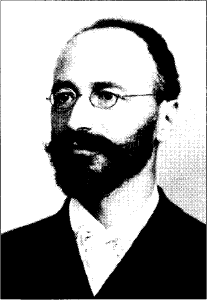
Eugen von Böhm-Bawerk
1851–1914
Böhm-Bawerk’s career as a scholar, however, was an intermittent one. The most significant span of scholarly activity was his years at the University of Innsbruck (1881–1889). It was during the 1880s that he first published two of the three volumes of his magnum opus, Capital and Interest. His later years were dominated by his duties as the Austrian Minister of Finance, a position he held, though not continuously, throughout the 1890s and beyond—and for which he is fittingly honored by having his likeness on Austria’s one hundred schilling note. After serving in this capacity and assuming other governmental duties, he returned to teaching in 1904. With a chair at the University of Vienna, he became a colleague of Wieser, successor to the retired Menger. Students who passed through the university during the last decade of Böhm-Bawerk’s career (and life—he died in 1914) included Joseph Schumpeter and Ludwig von Mises.
In 1959, the twelve hundred pages of Capital and Interest were translated into English by Hans Sennholz and George Huncke and were published as a single volume. Reviewing this new translation, Mises described this “monumental work” as “the most eminent contribution to modern economic theory.”2 He indicated that no one could claim to be an economist unless he was perfectly familiar with the ideas advanced in this book, and he even went so far as to suggest—as only Mises could—that no citizen who takes his civic duties seriously should exercise his right to vote until he has read Böhm-Bawerk!
The first volume of Capital and Interest, titled History and Critique of Interest Theories (1884), is an exhaustive survey of the alternative treatments of the phenomenon of interest: use theories, productivity theories, abstinence theories, and many more. Most significant in this early work is his devastating critique of the exploitation theory, as embraced by Karl Marx and his forerunners: capitalists do not exploit workers; rather, they accommodate workers by providing them with income well in advance of the revenue from the output they helped to produce. More than a decade later, Böhm-Bawerk was to revisit the issues raised by the socialists. In Karl Marx and the Close of His System,3 Böhm-Bawerk established that the question of how income is distributed among the factors of production is fundamentally an economic—rather than a political—question. And the Austrian answer effectively rebutted the labor theory of value as well as the so-called “iron law of wages.”
Böhm-Bawerk’s Positive Theory of Capital (1889) offered as the second volume of Capital and Interest, contains his most substantial and profound contribution to our understanding of the economy’s time-consuming production processes and of the interest payments they entail. But this volume offers much more. Its treatment of “Value and Price” builds on Menger’s Principles to present a distinctly Austrian version of marginalism. It is here that we find Böhm-Bawerk’s celebrated discussion of the pioneer farmer faced with decisions about the allocation of his sacks of grain among the various uses—as basic feed for himself, his chickens, and his parrots, and as an ingredient for making brandy. The essence of Austrian marginalism is conveyed with his telling the story of what would happen (Parrots beware) if the farmer were to suffer the loss of one sack of grain. This story and many variations on it, told countless times by textbook writers over the decades since, stand in contrast to the twice-differentiable total-utility functions that evolved from William Stanley Jevons’s marginalism and the general-equilibrium equations that dominate in Léon Walras’s works.
Appendices to the third edition of the second volume (1909–1912) appeared as a separate third volume in 1921 with the title Further Essays on Capital and Interest. Here, Böhm-Bawerk offers clarifications, qualifications, and extensions to his theory, as well as responses to his critics. These essays, which contain much of substance, also reveal much about their author’s scholarly and rhetorical methods. Böhm-Bawerk reasons like an economist and argues like a lawyer; his most critical remarks are directed towards those whose theories most closely resemble his own. For instance, Gustav Cassel’s theory, in which the interest rate brings the supply and demand for “waiting” into balance, is flatly rejected. And despite the fact that the Austrian School is noted for its attention to methodological matters, Böhm-Bawerk took a no-holds-barred approach. Schumpeter articulates the implicit maxim: “Write little or nothing on method, and instead work the more energetically with all available methods.”4
Modern economics is notorious for its inattention to capital in the sense of an intertemporal structure of intermediate goods. Production takes time, and the time that separates the formulation of multiperiod production plans and the satisfaction of consumer demands is bridged by capital. If mentioned at all in modern textbooks, these aspects of economic reality are introduced as “the thorny issues of capital,” a tell-tale phrase that portends a dismissive treatment of this critical subject area. Though a lacuna in mainstream economics, Austrian economics has, almost from its beginnings, given a special prominence to capital theory. With a full awareness of all the thorns, Böhm-Bawerk built his academic career around the goals of understanding the relationship between capital and interest and extending value theory to the context of intertemporal allocation.
Early in his career, Böhm-Bawerk took up a central question that was much discussed by his contemporaries and predecessors. “Is there any justification for the payment of interest to the owners of capital?”5 The justification, in his view, rests on a simple fact of reality: people value present goods more highly than future goods of the same quantity and quality. Future goods trade at a discount, or alternatively, present goods trade at a premium. The payment of interest is a direct reflection of this intertemporal value differential. This interest, or agio, paid to capitalists allows workers to receive income on a more timely basis than would otherwise be possible. Böhm-Bawerk’s “agio theory” and its implications for the alternative “exploitation theory” were undoubtedly enough to win him recognition by historians of economic thought. But with it he broke new ground and was able to parlay his refutation of socialist doctrine into a new understanding of the capitalist system. His Positive Theory culminates in a macroeconomic model of general equilibrium that serves to illuminate the classical issues of capital accumulation and technical progress, to resolve the neoclassical problem of the existence and the determination of the rate of interest, and to do still more.
He combined his agio theory of interest with Menger’s theory of marginal value to show that given the wage rate that the market establishes, profit-maximizing capitalist-entrepreneurs will engage in production activities that not only employ the labor force to the fullest but also fully absorb the economy’s subsistence fund.6 Making use of the earliest and most foundational Austrian insights, and taking an economy-wide perspective, Böhm-Bawerk linked the intertemporal structure of production to the intertemporal preferences of workers and other income earners. Nearly a half-century before John Maynard Keynes made assertions to the contrary and offered them up as a General Theory, the Positive Theory showed that the market for labor and the market for loanable funds—or, more broadly, the market for subsistence—could simultaneously find their respective equilibria.
We have it, then, that Böhm-Bawerk was a macroeconomist—and a self-reflective one at that. The classical economists, especially Ricardo, could in retrospect be considered macroeconomists in an era that predates any hint of the modern distinction. The actual word “macroeconomics,” of course, is a relatively modern one. Paul Samuelson, who reorganized the subject matter of economics on the basis of a first-order distinction between microeconomics and macroeconomics, traces the distinction itself to Ragnar Frisch and Jan Tinbergen, and dates the word’s debut in print to Erik Lindahl in 1939.7 But in his 1891 essay on “The Austrian Economists,” Böhm-Bawerk wrote that “One cannot eschew studying the microcosm if one wants to understand properly the macrocosm of a developed economy.”8 Packed into this understated methodological maxim is both his desire to understand the macroeconomy and his recognition that microeconomic foundations are essential for a viable macroeconomics—a view that, in the mainstream, dates only to the mid-1960s.
To aid in his exposition of the macroeconomics of capital and interest, Böhm-Bawerk introduced his bull’s-eye figure—a pattern of concentric rings intended to depict the time structure of production. Production begins in the center with the use of the original means (land and labor); the process emanates outward over time; and the final product emerges at the outermost ring to satisfy the consumers’ ultimate ends. Two bull’s-eye figures appearing on consecutive pages are used to contrast a well-developed economy with a less-developed one.9
This idiosyncratic depiction can be seen as a forerunner of the more straightforward representation of the means-ends framework introduced by F.A. Hayek during the interwar period. The Hayekian triangle captures the essential linearity—not to deny that there are significant non-linearities—in the structure of production. The triangle, which is divided along the time axis into “stages of production,” corresponds closely with the bull’s eye figure, which is divided along the radius into “maturity classes.”
Though static by its very construction, the bull’s-eye figure, as well as the better known Hayekian triangle, is intended to facilitate the analysis of change. What is the nature of the market forces that govern the allocation of resources among the various rings? Böhm-Bawerk’s formal analysis—and the simple graphics plus some arithmetic illustrations are the extent of the formalities—helps the reader in “getting the picture.” For Böhm-Bawerk, however, “getting the picture” is but a prelude to “telling the story.” His storytelling, his informal analysis of the nature of the process of change, breaks free of the static representation.
In the case of the stationary state, the concentric rings have two interpretations: (1) the production process can be seen as proceeding over time from earliest input to final output, and (2) the areas of the rings can represent the amounts of the different kinds of capital (goods in process) that exist at a given point in time.
But to depict the stationary state is only to establish a starting point for a discussion of change. Böhm-Bawerk briefly considered the question: “what is the procedure if we wish just to preserve the amount of capital in its previous magnitude?” His answer, given in short order, is followed by the more important question: “what must be done if there is to be an increase in capital?” The answer to this key question, which distinguishes Austrian macroeconomics from what would later become mainstream macroeconomics, involves a change in the configuration of the concentric rings. Several types of changes are suggested, each entailing the idea that real saving is achieved at the expense of consumption and of capital in the outer rings, and that the saving makes possible the expansion of capital in the inner rings. Böhm-Bawerk indicates that in a market economy it is the entrepreneurs who bring about such structural changes, and that their efforts are guided by changes in the relative prices of capital goods in the various rings.
Formal or informal, the message is clear: an expansion of the capital structure is not to be viewed as a simultaneous and equiproportional increase in capital in each of the maturity classes; it is to be viewed as a reallocation of capital among the maturity classes. Overlooked by his predecessors and largely ignored by the modern mainstream, this is the market mechanism that keeps the economy’s intertemporal production plans in line with the intertemporal preferences of consumers. The significance of this market mechanism was at issue in his debate with John Bates Clark, who held that once capital is in place, the maintenance of capital is automatic, and that production and consumption are, in effect, simultaneous. Although a modern reader may conclude that Böhm-Bawerk won the debate, and that in later years Hayek was similarly victorious in his debate with Frank Knight, the development of mainstream macroeconomics reflects the implicit belief that it was Clark and Knight who won.10
It is easy for modern Austrian economists to see that Böhm-Bawerk was just a step away from articulating the Austrian theory of the business cycle. This step, which was actually taken by Mises and Hayek, would have involved a comparison of changes in the configuration of the rings on the basis of whether those changes were preference-induced or policy-induced. A change in intertemporal preferences in the direction of increased saving reallocates capital among the rings such that the economy experiences capital accumulation and sustainable growth; a policy-induced change in credit conditions, that is, a lowering of the interest rate achieved by the lending of newly created money, misallocates capital among the rings such that the economy experiences unsustainable growth and economic crisis.
Development of the theory in this direction was beyond Böhm-Bawerk for the simple reason that he would not allow himself to venture into monetary theory. His attitude toward this subject matter is revealed in the letters to Swedish economist, Knut Wicksell,11 whose ideas about the divergence of the market rate of interest and the natural rate would become an important part of the Austrian theory. In 1907, Böhm-Bawerk wrote: “I have not myself given thought to or worked on the problem of money as a scholar, and therefore I am insecure vis-à-vis this subject” (p. 259). In 1912, he added: “You know that I do not really feel competent as regards the extremely difficult theory of money” (p. 268). Also in 1912, referring to The Theory of Money and Credit, in which Mises first articulates the Austrian theory of the business cycle, Böhm-Bawerk mentions to Wicksell,
a book on the theory of money by a young Viennese scholar, Dr. von Mises. Mises is a student of myself and Prof. Wieser, which, however, does not mean that I would want to take responsibility for all his views. I have just begun to read his book myself, and am not yet familiar with its content. (p. 270)
And finally in 1913, a year before his death, “I have not yet included the theory of money in the subject-matter of my thinking, and I therefore hesitate to pass a judgment on the difficult questions it raises” (p. 272).
Schumpeter lists five general subject areas that Böhm-Bawerk excluded from his research agenda, one of which was money: Böhm-Bawerk endorsed the “indestructible core of truth” in the quantity theory, but accepted the idea that money is a veil. A second excluded area—in retrospect a clear corollary to the first—was business-cycle theory: Böhm-Bawerk took economic crises to be “neither an endogenous nor a uniform economic phenomenon, but rather the consequences of what are in principle accidental disturbances of the economic process.” (The other three excluded subject areas are population, international trade, and applied price and distribution theory.)12
We can easily forgive Böhm-Bawerk for these sins of omission. When a profound thinker makes a great leap forward, we are not entitled to complain that the leap was not greater still. We should recognize instead that the successive advances by Mises, Hayek, and others have made Böhm-Bawerk’s contributions look all the greater.
Early and modern literature on Böhm-Bawerk’s economics has identified many supposed sins of commission as well. Much of the criticism comes from within the Austrian School: his theory was insufficiently subjectivist; his defense of the agio theory of interest relied needlessly on psychological considerations; his reckoning of production time was backward-looking rather than forward-looking.13 Criticisms from outside the Austrian School stems largely from undue attention to Böhm-Bawerk’s arithmetic illustrations and from attempts to restate his theory in the language of formal neoclassical theory: his conclusions about the relationship between the interest rate and the degree of roundaboutness in the production process apply less generally that he would have us believe; the economy’s intertemporal structure of capital cannot be reduced to a single number; the definitional dependence of the average period of production on the rate of interest invalidates much of his theory. Fortunately, these and many other criticisms leave intact the essential ideas that were important to Böhm-Bawerk, and to the future development of Austrian theory.
As substantial an economist as Schumpeter could claim that interest is a disequilibrium phenomenon and could fantasize about a long-run equilibrium where market forces have pushed the interest rate to zero. John Maynard Keynes imagined interest to be a purely monetary phenomenon. Creating what Hayek called a “mythology of capital,” Frank Knight, following Clark, held that production and consumption occur simultaneously, that the period of production is irrelevant, and that the interest rate is wholly determined by technological considerations. These and other twists and turns in twentieth-century views of capital and interest give increased significance to the enduring wisdom of Eugen von Böhm-Bawerk.
SELECTED READINGS
Böhm-Bawerk, Eugen von. 1962. Shorter Classics of Eugen von Böhm-Bawerk. South Holland, Ill.: Libertarian Press.
——. 1959. Capital and Interest (3 vols. in one). George D. Huncke and Hans F. Sennholz, trans. South Holland, Ill.: Libertarian Press.
——. [1898] 1949. Karl Marx and the Close of His System. Alice McDonald, trans. London: T. Fisher Unwin.
——. 1895. “The Positive Theory of Capital and Its Critics.” Quarterly Journal of Economics 9 (January): 113–31.
Garrison, Roger W. 1990. “Austrian Capital Theory: The Early Controversies.” History of Political Economy, supplement to Vol. 22. Pp. 133–54. Published in Carl Menger and His Legacy in Economics, Bruce J. Caldwell, ed. Durham, N.C.: Duke University Press.
Hennings, Klaus H. 1997. The Austrian Theory of Value and Capital: Studies in the Life and Work of Eugen von Böhm-Bawerk. Brookfield, Vt.: Edward Elgar.
——. 1987. “Böhm-Bawerk, Eugen von.” In The New Palgrave Dictionary of Economics. Vol. 2. John Eatwell, Murray Milgate, and Peter Newman, eds. London: Macmillan. Pp. 254–59.
Kirzner, Israel. 1996. Essays on Capital and Interest: An Austrian Perspective. Brookfield, Vt.: Edward Elgar.
Kuenne, Robert E. 1971. Eugen von Böhm-Bawerk. Vol. 2. Columbia Essays on Great Economists. New York: Columbia University Press.
Mises, Ludwig von. 1959. “Capital and Interest: Eugen von Böhm-Bawerk and the Discriminating Reader.” The Freeman 9, no. 8 (August): 52–54.
Schumpeter, Joseph A. 1954. History of Economic Analysis. New York: Oxford University Press.
——. 1951. Ten Great Economists. New York: Oxford University Press.
_____________
14Böhm-Bawerk did receive formal training from Karl Knies of the older German Historical School, and from Albert Schäffle, who early on had written against socialist doctrine. These Viennese economists had a significant influence on Böhm-Bawerk’s thinking, according to Klaus Hennings, in The Austrian Theory of Value and Capital: Studies in the Life and Work of Eugen von Böhm-Bawerk (Brookfield, Vt.: Edward Elgar, 1997), p. 54 and passim. In the judgment of Joseph Schumpeter, in his History of Economic Analysis (New York: Oxford University Press, 1954), p. 846, Böhm-Bawerk “was so completely the enthusiastic disciple of Menger that it is hardly necessary to look for other influences.”
15Ludwig von Mises, “Capital and Interest: Eugen von Böhm-Bawerk and the Discriminating Reader,” The Freeman 9, no. 8 (August 1959): 52.
16Originally an 1896 contribution to a volume in honor of Karl Knies, this counter-offensive was translated into English and published as a book in 1898.
17Joseph Schumpeter, Ten Great Economists (New York: Oxford University Press, 1951), p.158.
18In his chapter on “The Genesis of a Theory,” Hennings establishes that this and similar questions were “in the air” at the time that Böhm-Bawerk began to write. See, The Austrian Theory of Value and Capital, pp. 53–73.
19Ibid., pp. 2 and 65; also see Schumpter, Ten Great Economists, p. 187. Böhm-Bawerk’s own assessment in 1891 of the Austrian contribution is very much to the point. Citing primarily himself and Carl Menger, he remarks that the Austrian economists “have set forth a new and comprehensive theory of capital into which they have woven a new theory of wages, besides repeatedly working out the problems of the entrepreneur’s profits and of rent.” See Eugen von Böhm-Bawerk, “The Austrian Economists,” Shorter Classics of Böhm-Bawerk (South Holland, Ill.:Libertarian Press, 1962).
20Paul A. Samuelson, “Credo of a Lucky Textbook Author,” Journal of Economic Perspectives 11, no. 2 (Spring 1997): 157.
21Hennings, The Austrian Theory of Value and Capital, p. 74. The fact that Böhm-Bawerk issued so few methodological pronouncements makes this one all the more striking.
22Though rarely reproduced or discussed in modern assessments of Böhm-Bawerk, these figures are central to his vision of a capital-using economy. They are featured in chapter 5, “The Theory of the Formation of Capital,” of Book 2, “Capital as a Tool of Production,” of vol. 2, Positive Theory of Capital. Bull’s-eye figures appear on pp. 106 and 107. One of the figures is reproduced in Hennings, The Austrian Theory of Value and Capital, p. 131.
23Clark reviewed Capital and Interest in “The Genesis of Capital,” Yale Review 11 (November 1893): 302–15. Böhm-Bawerk responded in “The Positive Theory of Capital and Its Critics,” Quarterly Journal of Economics 9 (January 1895): 113–31. For a modern discussion of the Clark–Knight view of capital, see Israel M. Kirzner, Essays on Capital and Interest: An Austrian Perspective (Brookfield, Vt.: Edward Elgar, 1996), pp. 60–64 and 75–77.
24Forty letters from Böhm-Bawerk to Wicksell (1893–1914) are included as an Appendix to Hennings, The Austrian Theory of Value and Capital.
25Schumpeter, Ten Great Economists, pp. 161–62.
26 These first three listed criticisms are the basis for Mises’s dissatisfaction with Böhm-Bawerk’s theory, according to Kirzner, Essays on Capital and Interest, pp. 125–28.
- 1Two recent examples are the review article by Israel M. Kirzner, “Entrepreneurial Discovery and the Competitive Market Process: An Austrian Approach,” Journal of Economic Literature 35, no. 1 (March 1997): 60–85; and Sherwin Rosen, “Austrian and Neoclassical Economics: Any Gains From Trade?” Journal of Economic Perspectives 11, no 4. (Fall 1997): 139–52. Both of these journals are publications of the American Economic Association, indicating the degree to which Austrian ideas are at least recognized, if not embraced, by the profession’s mainstream.
- 2See Leland B. Yeager, “Austrian Economics, Neoclassicism, and the Market Test,” Journal of Economic Perspectives 11, no. 4 (Fall 1997): 153–65, for an insightful discussion on the challenges that an alternative to mainstream ideas faces in the academic marketplace.
- 3See Karen I. Vaughn, Austrian Economics in America: The Migration of a Tradition (New York: Cambridge University Press, 1994), for a good discussion of the development of the modern Austrian School. Also see Murray N. Rothbard, “The Present State of Austrian Economics,” Money, Method, and the Austrian School, vol. 1, The Logic of Action (Cheltenham, U.K.: Edward Elgar, 1997).
- 4The first edition of Menger’s Principles of Economics was published in German in 1871. While it was generally recognized as a landmark contribution in economics, an English translation was not published until 1950.
- 5Murray N. Rothbard, in Ludwig von Mises: Scholar, Creator, Hero (Auburn, Ala.: Ludwig von Mises Institute, 1988), p. 13, notes that Mises’s early work on monetary theory, while controversial, was published in the Economic Journal, one of the leading mainstream economic journals of the time.
- 6Paul A. Samuelson, Economics, 9th ed. (New York: McGraw-Hill, 1973), p. 883.
- 7Diego de Covarrubias y Leyva, Omnia Opera (Venice, 1604),vol. 2, chap.4, p.131.
- 8Luis Saravia de la Calle, Instrucción de mercaderes (1544); republished in Colección de Joyas Bibliográficas (Madrid, 1949), p. 53. Saravia’s book addresses the business entrepreneur (in Spanish mercaderes) following a continental Catholic tradition that can be traced back to San Bernardino de Siena (1380–1444). See Rothbard, Economic Thought Before Adam Smith, pp. 81–85.
- 9Juan de Lugo (1583–1660), Disputationes de iustitia et iure (Lyon, 1642), vol. 2, d. 26, s. 4, n. 40, p. 312.
- 10Juan de Salas, Commentarii in secundam secundae D. Thomae de contractibus (Lyon, 1617), vol. 4, no. 6, p. 9.
- 11Jerónimo Castillo de Bovadilla, Práctica para corregidores (Salamanca, 1585), vol. 2, chap. 4, no. 49. See also the important comments on the scholastics and their dynamic concept of competition written by Oreste Popescu, Estudios en la historia del pensamiento económico latinoamericano (Buenos Aires: Plaza and Janés, 1987), pp. 141–59.
- 12Luis de Molina, De iustitia et iure (Cuenca, 1597), vol. 2, disp. 348, no. 4, and La teoría del justo predo, Francisco Gómez Camacho, ed. (Madrid: Editora Nacional, 1981), p. 169. Raymond de Roover, ignoring the work of Castillo de Bovadilla, acknowledges how “Molina even introduces the concept of competition by stating that concurrence or rivalry among buyers will enhance prices.” See his article “Scholastic Economics: Survival and Lasting Influence from the Sixteenth Century to Adam Smith,” Quarterly Journal of Economics 69, no. 2 (May1955): 169.
- 13Included in Covarrubias, Omnia Opera, vol. 1, pp. 669–710.
- 14AT THE END of the twentieth century, the Austrian School of economics is exerting a significant influence both on the development of academic economics and on the application of economic theory to public policy. An increasing number of economics professors are sympathetic with the fundamental ideas of Austrian economics, and academic journals are taking more account of the Austrian School. A half century ago, few academic economists would even have been familiar with the Austrian School, except superficially, and among those who were, most would have disagreed with its methods and conclusions. Today, the ideas of Austrian economics are closer to the mainstream of economic thought, not because Austrian economics has changed, but because mainstream economics has moved toward the Austrian point of view. A similar shift has occurred in the public-policy arena. The policy implications of Austrian economics, once rejected as extreme, are now embraced as true. In the process, the Austrian School has become increasingly visible as an intellectual force.
- 15If the ideas of Austrian economics have made such inroads, one might wonder why, in the academic arena, Austrian economics does not play a bigger role. Part of the answer has to do with academic institutions themselves. Most university faculty teach at state institutions, which by itself may bias them toward supporting the state and being suspicious of laissez-faire ideas. Most university faculty have tenure, which slows the turnover of personnel, and perhaps of ideas. Furthermore, academic ideas find their outlets largely in academic journals, and the editorial boards of those journals tend to be controlled by the academic mainstream, further promoting mainstream ideas over alternative schools of thought. Because publication in academic journals is often a prerequisite for promotion and tenure in a university environment, academic survival often pushes young scholars in the direction of the mainstream methods and ideas in their discipline.
- 16Austrian economics has fought an uphill battle for acceptance for several reasons, but at the same time, the Austrian School has been gaining in strength, and is becoming more accepted in academia. A growing number of economics professors align themselves with the Austrian School, and even among those who do not, Austrian ideas are becoming more recognized and respected. Interestingly enough, the late-twentieth-century resurgence of interest in the Austrian School has been concentrated in the United States. This is largely due to Ludwig von Mises’s migration, and his Austrian economics seminar at New York University. One might go so far as to argue that the modern Austrian School would not exist were it not for the influence of Ludwig von Mises on his American students.
- 17Carl Menger is generally regarded as the founder of the Austrian School, but prior to about 1920, Austrian economics was not very different from economics in general. Economic theory had taken a great leap forward in the 1870s when the concept of marginal utility was independently discovered by Léon Walras, William Stanley Jevons, and Carl Menger. Each of these three individuals pushed the concept in different directions, but the integration of the marginal theory of value into economics was a major leap for all of economics. Eugen von Böhm-Bawerk’s capital theory, now seen as Austrian, was viewed more generally as a part of economics when it was published in the 1880s and 1890s, and Ludwig von Mises’s Theory of Money and Credit, published in 1912, established him as a leading authority on monetary economics.
- 18Carl Menger is generally regarded as the founder of the Austrian School, but prior to about 1920, Austrian economics was not very different from economics in general. Economic theory had taken a great leap forward in the 1870s when the concept of marginal utility was independently discovered by Léon Walras, William Stanley Jevons, and Carl Menger. Each of these three individuals pushed the concept in different directions, but the integration of the marginal theory of value into economics was a major leap for all of economics. Eugen von Böhm-Bawerk’s capital theory, now seen as Austrian, was viewed more generally as a part of economics when it was published in the 1880s and 1890s, and Ludwig von Mises’s Theory of Money and Credit, published in 1912, established him as a leading authority on monetary economics.
- 19From its low point in the middle of the twentieth century, Austrian economics has continued to gain visibility both inside academia and out. F.A. Hayek won the Nobel prize in economics in 1974, giving the Austrian School attention and respectability. By then, a small Austrian revival was already underway, led by Kirzner and Rothbard, and Hayek’s Nobel prize gave the revival additional momentum. Still, the Austrian School was branded by being on the losing side of the socialist calculation debate. In 1973, the year Mises died, Paul Samuelson, another Nobel laureate in economics and among the most prominent of mainstream academic economists, argued in his introductory textbook that even though the Soviet Union had roughly half the per capita income of the United States, their superior economic system based on central planning gave them faster growth. Based on this, Samuelson projected that per capita income in the Soviet Union could catch up to that of the United States as early as 1990, and almost surely by 2015. Keep in mind that Samuelson’s projection was in his best-selling introductory college textbook, and was the standard line taught in college classrooms at the time. Clearly, the mainstream had not accepted the ideas of Austrian economics.
- 20We should note how Mariana refers to the fact that the “common estimation” of men is the origin of the value of things, thus following the traditional subjectivist doctrine of the scholastics, which was initially proposed by Diego de Covarrubias y Leyva. Covarrubias (1512–1577), the son of a famous architect, became bishop of the city of Segovia and a minister to King Philip II. In 1554, he set forth better than anyone before the subjectivist theory of value, stating that “the value of an article does not depend on its essential nature but on the subjective estimation of men, even if that estimation is foolish,” illustrating his thesis with the example that “in the Indies wheat is dearer than in Spain because men esteem it more highly, though the nature of the wheat is the same in both places.”
- 21Covarrubias’s subjectivist conception was completed by another of his scholastic contemporaries, Luis Saravia de la Calle, who was the first to demonstrate that prices determine costs, not vice versa. Saravia de la Calle also had the special distinction of writing in Spanish, not in Latin. Its title was Instrucción de mercaderes (Instruction to merchants), and there we can read that “those who measure the just price by the labor, costs and risk incurred by the person who deals in the merchandise are greatly in error. The just price is found not by counting the cost but by common estimation.”
- 22The subjectivist conception initiated by Covarrubias also allowed other Spanish scholastics to get a clear insight of the true nature of market prices, and of the impossibility of attaining an economic equilibrium. Thus, the Jesuit Cardinal Juan de Lugo, wondering what the price of equilibrium was, as early as 1643 reached the conclusion that the equilibrium depended on such a large number of specific circumstances that only God was able to know it (“Pretium iustum mathematicum licet soli Deo notum”). Another Jesuit, Juan de Salas, referring to the possibilities of knowing specific market information, reached the very Hayekian conclusion that it was so complex that “quas exacte comprehendere et ponderare Dei est non hominum” (only God, not men, can understand it exactly).
- 23The subjectivist conception initiated by Covarrubias also allowed other Spanish scholastics to get a clear insight of the true nature of market prices, and of the impossibility of attaining an economic equilibrium. Thus, the Jesuit Cardinal Juan de Lugo, wondering what the price of equilibrium was, as early as 1643 reached the conclusion that the equilibrium depended on such a large number of specific circumstances that only God was able to know it (“Pretium iustum mathematicum licet soli Deo notum”). Another Jesuit, Juan de Salas, referring to the possibilities of knowing specific market information, reached the very Hayekian conclusion that it was so complex that “quas exacte comprehendere et ponderare Dei est non hominum” (only God, not men, can understand it exactly).
- 24Furthermore, the Spanish scholastics were the first ones to introduce the dynamic concept of competition (in Latin concurrentium), which is best understood as a process of rivalry among entrepreneurs. For instance, Jerónimo Castillo de Bovadilla (1547–?) wrote that “prices will go down as a result of the abundance, rivalry (emulación), and competition (concurrencia) among the sellers.”
- 25This same idea is closely followed by Luis de Molina. Covarrubias also anticipated many of the conclusions of Father Mariana in his empirical study on the history of the devaluation of the main coin of that time, the Castilian Maravedí. This study contained a compilation of a large number of statistics on the evolution of prices in the previous century and was published in Latin in his book Veterum collatio numismatum (Compilation on old moneys). This book was highly praised in Italy by Davanzaty and Galiani and was also quoted by Carl Menger in his Principles of Economics.
- 26This same idea is closely followed by Luis de Molina. Covarrubias also anticipated many of the conclusions of Father Mariana in his empirical study on the history of the devaluation of the main coin of that time, the Castilian Maravedí. This study contained a compilation of a large number of statistics on the evolution of prices in the previous century and was published in Latin in his book Veterum collatio numismatum (Compilation on old moneys). This book was highly praised in Italy by Davanzaty and Galiani and was also quoted by Carl Menger in his Principles of Economics.

