
The Great Austrian Economists
5. Frédéric Bastiat: Between the French and Marginalist Revolutions
BETWEEN THE FRENCH AND MARGINALIST REVOLUTIONS THOMAS J. DILORENZO
CLAUDE FRÉDÉRIC BASTIAT was a French economist, legislator, and writer who championed private property, free markets, and limited government. Perhaps the main underlying theme of Bastiat’s writings was that the free market was inherently a source of “economic harmony” among individuals, as long as government was restricted to the function of protecting the lives, liberties, and property of citizens from theft or aggression. To Bastiat, governmental coercion was only legitimate if it served “to guarantee security of person, liberty, and property rights, to cause justice to reign over all.”1
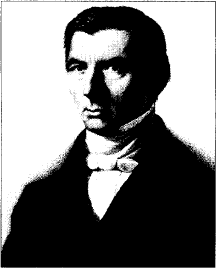
Claude Frédéric Bastiat
1801–1850
Bastiat emphasized the plan-coordination function of the free market—a major theme of the Austrian School—because his thinking was influenced by some of Adam Smith’s writings and by the great French free-market economists Jean-Baptiste Say, Françiois Quesnay, Destutt de Tracy, Charles Comte, Richard Cantillon (who was born in Ireland and emigrated to France), and Anne Robert Jacques Turgot. These French economists were among the precursors to the modern Austrian School, having first developed such concepts as the market as a dynamic, rivalrous process, the free-market evolution of money, subjective value theory, the laws of diminishing marginal utility and marginal returns, the marginal productivity theory of resource pricing, and the futility of price controls in particular and of the government’s economic interventionism in general.
BASTIAT’S INTELLECTUAL BACKGROUND
Bastiat was orphaned at age ten, and was raised and educated by his paternal grandparents. He left school at age seventeen to work in the family exporting business in the town of Bayonne, where he learned firsthand the evils of protectionism by observing all the closed-down warehouses, the declining population, and the increased poverty and unemployment caused by trade restrictions.
When his grandfather died, Bastiat, at age twenty-five, inherited the family estate in Mugron, which enabled him to live the life of a gentleman farmer and scholar for the next twenty years. Bastiat hired people to operate the family farm so he could concentrate on his intellectual pursuits. He was a voracious reader, and he discussed and debated with friends virtually all forms of literature. His closest friend was his neighbor, Felix Coudroy.
Coudroy and Bastiat, worked their way through a tremendous number of books on philosophy, history, politics, religion, travel, poetry, political economy, biography, and so on. . . . It was in these conversations that the ideas of Bastiat developed and his thoughts matured.2
Coudroy was initially a follower of Rousseau and, like most of Rousseau’s admirers, then as now, was a socialist. But Bastiat, who always said he preferred a one-on-one conversation to giving a speech to thousands of people, converted Coudroy to classical liberalism.
Bastiat’s first published article appeared in April of 1834. It was a response to a petition by the merchants of Bordeaux, Le Havre, and Lyons to eliminate tariffs on agricultural products but to maintain them on manufacturing goods. Bastiat praised the merchants for their position on agricultural products, but excoriated them for their hypocrisy in wanting protectionism for themselves. “You demand privilege for a few,” he wrote, whereas “I demand liberty for all.”3 He then explained why all tariffs should be abolished completely.
Bastiat continued to hone his arguments in favor of economic freedom by writing a second essay in opposition to all domestic taxes on wine, entitled “The Tax and the Vine,” and a third essay opposing all taxes on land and all forms of trade restrictions. Then, in the summer of 1844, Bastiat sent an unsolicited manuscript on the effects of French and English tariffs to the most prestigious economics journal in France, the Journal des Economistes. The editors published the article, “The Influence of English and French Tariffs,” in the October 1844 issue, and it unquestionably became the most persuasive argument for free trade in particular, and for economic freedom in general, that had ever appeared in France, if not all of Europe.
In this article, Bastiat first displayed his mastery of the accumulated wisdom of the economists of the pre-Austrian tradition, and established himself as a brilliant synthesizer and organizer of economic ideas. He immediately gained national and international fame and, as a fellow advocate of free trade, began a friendship with Richard Cobden, the leader of the British Anti-Corn Law League, which succeeded in abolishing all trade restrictions in England by 1850. Bastiat organized a similar organization in France—the French Free-Trade Association—which was instrumental in France’s elimination of most of its trade barriers in 1860, ten years after Bastiat’s death. Bastiat was especially effective in spreading his influence as editor of the Free Trade Association’s newspaper, Le Libre-Exchange.
After twenty years of intense intellectual preparation, articles began to pour out of Bastiat, and soon took the form of his first book, Economic Sophisms, which to this day is still arguably the best literary defense of free trade available.4 He quickly followed with his second book, Economic Harmonies,5 and his articles were reprinted in newspapers and magazines all over France. In 1846, he was elected a corresponding member of the French Academy of Science, and his work was immediately translated into English, Spanish, Italian, and German. Free-trade associations soon began to sprout up in Belgium, Italy, Sweden, Prussia, and Germany, and were all based on Bastiat’s French Free Trade Association.
BASTIAT’S AUSTRIAN SCHOOL IDEAS
While Bastiat was shaping economic opinion in France, Karl Marx was writing Das Kapital, and the socialist notion of “class conflict”—that the economic gains of capitalists necessarily came at the expense of workers—was gaining in popularity. Bastiat’s Economic Harmonies explained why the opposite is true—that the interests of mankind are essentially harmonious if they can be cultivated in a free society where government confines its responsibilities to suppressing thieves, murderers, and special-interest groups who seek to use the state as a means of plundering their fellow citizens.
Capital Theory
Bastiat contributed to Austrian capital theory by masterfully explaining how the accumulation of capital results in the enrichment of the workers by raising labor’s marginal productivity and, consequently, its remuneration. Capital accumulation, wrote Bastiat, would also result in cheaper and better quality consumer goods, which would also raise real wages. He also explained how the interest on capital declines as it becomes more plentiful.
Thus, the interests of capitalists and labor are indeed harmonious, and government interventions into capital markets will impoverish the workers as well as the owners of capital. Bastiat also explained why in a free market no one can accumulate capital unless he uses it in a way that benefits others, i.e., consumers. In reality, wrote Bastiat, capital is always used to satisfy the desires of people who do not own it. In sharp contrast to most of his predecessors, Bastiat believed that “it is necessary to view economics from the viewpoint of the consumer. . . . All economic phenomena . . . must be judged by the advantages and disadvantages they bring to the consumer.”6 Mises repeated this point in Human Action when he noted that although bankers may seem to “control” the allocation of capital by their day-by-day decisions, it is the consumers who are the “captains” of the economic ship, because it is their preferences to which successful businesses cater.
Subjective Cost
Bastiat’s greatest contribution to subjective value theory was how he rigorously applied the theory in his essay, “What is Seen and What is Not Seen.”7 In that essay, Bastiat, by relentlessly focusing on the hidden opportunity costs of governmental resource allocation, destroyed the proto-Keynesian notion that government spending can create jobs and wealth. In the first edition of Economics in One Lesson, Henry Hazlitt wrote that
My greatest debt, with respect to the kind of expository framework on which the present argument is hung, is Frédéric Bastiat’s essay, “What is Seen and What is Not Seen.” The present work may, in fact, be regarded as a modernization, extension and generalization of the approach found in Bastiat’s pamphlet.8
The Science of Human Action
The way in which Bastiat described economics as an intellectual endeavor is virtually identical to what modern Austrians label the science of human action, or praxaeology. Bastiat wrote in his Harmonies of how
The subject of political economy is MAN . . . [who is] endowed with the ability to compare, judge, choose, and act. . . . This faculty . . . to work for each other, to transmit their efforts and to exchange their services through time and space . . . is precisely what constitutes Economic Science.9
As with contemporary Austrians, Bastiat viewed economics as “the Theory of Exchange” where the desires of market participants “cannot be weighed or measured. . . . Exchange is necessary in order to determine value.”10 Thus, to Bastiat, as with contemporary Austrians, value is subjective, and the only way of knowing how people value things is through their demonstrated preferences as revealed in market exchanges. Voluntary exchange, therefore, is necessarily mutually advantageous. This was an important theoretical innovation in the history of economic theory, for many of the British economists had succumbed to the “physical fallacy”—the misguided notion that value is determined by the production of physical objects alone.
The understanding that value is created by voluntary exchange, Murray Rothbard pointed out, “led Bastiat and the French school to stress the ways in which the free market leads to a smooth and harmonious organization of the economy.”11 Rothbard himself developed Bastiat’s subjectivist theory of exchange much more fully a century later in his devastating critique of modern welfare economics.
Another Rothbardian theme in Bastiat’s work (or a Bastiat theme in Rothbard’s work) has to do with land rent. In Bastiat’s time, socialists made the argument that no one was entitled to land rent because it was God, after all, who created the land, not the current landowners. Bastiat’s response was that land rent was indeed legitimate because landowners have rendered a valuable service by clearing the land, draining it, and making it suitable for agriculture. If all these investment costs are capitalized, explained Bastiat, then it is clear that landowners were not earning an exceptional income through land rent after all, but were providing a valuable public service. Murray Rothbard would later develop this idea more fully in his defense of “homesteading” as an appropriate means of establishing property rights.
Governmental Plunder
While establishing the inherent harmony of voluntary trade, Bastiat also explained how governmental resource allocation is necessarily antagonistic and destructive of the free market’s natural harmony. Since government produces no wealth of its own, it must necessarily take from some to give to others—robbing Peter to pay Paul is the essence of government, as Bastiat described it. Moreover, as special-interest groups seek more and more of other peoples’ money through the aegis of the state, they undermine the productive capacities of the free market by engaging in politics rather than in productive behavior. “The state,” wrote Bastiat, “is the great fictitious entity by which everyone seeks to live at the expense of everyone else.”12
Bastiat is perhaps best known for his work in the field of political economy—the study of the interaction between the economy and the state—as opposed to pure economic theory. He sought to understand how the state operated—what incentives drive it—and he did so as well as anyone ever has. There is no space here for a in-depth discussion of Bastiat’s ideas on political economy, but a few examples will suffice. Government was necessary, according to Bastiat, but only if restricted to its “essential” functions. He believed that “no society can exist unless the laws are respected to a certain degree,” but at the same time that could only occur if the laws themselves were respectable.13
The moral justification for a law, moreover, can never be based on a majority vote, because “since no individual has the right to enslave another individual, then no group of individuals can possibly have such a right.”14 All income redistribution through majoritarian democracy is therefore “legal plunder” and is, by definition, immoral.
The slogan, “if goods don’t cross borders, armies will,” is often attributed to Bastiat because he so forcefully made the case that free trade was perhaps the surest route to peace as well as prosperity. He understood that throughout history, tariffs had been a major cause of war. Protectionism, after all, is an attempt by governments to inflict on their own citizens in peacetime the same kinds of harm their enemies attempt (with naval blockades) during wars.
Competitive Discovery
Bastiat understood that free-market competition was a “dynamic discovery procedure,” to use a Hayekian phrase, in which individuals strove to coordinate their plans to achieve their economic goals. All forms of government intervention interrupt and distort that process because once a law or regulation is issued,
the people no longer need to discuss, to compare, to plan ahead; the law does all this for them. Intelligence becomes a useless prop for the people; they cease to be men; they lose their personality, their liberty, their property.15
Phony Altruism
Bastiat also saw through the phony “philanthropy” of the socialists who constantly proposed helping this or that person or group by plundering the wealth of other innocent members of society through the aegis of the state. All such schemes are based on “legal plunder, organized injustice.”16
Like today’s neo-conservatives, nineteenth-century socialists branded classical liberals with the name “individualist,” implying that classical liberals are opposed to fraternity, community, and association. But, as Bastiat astutely pointed out, he (like other classical liberals) was only opposed to forced associations, and was an advocate of genuine, voluntary communities and associations. “[E]very time we object to a thing being done by government, the socialists [mistakenly] conclude that we object to its being done at all.”17
Natural Rights and Freedom of Exchange
Bastiat can also be seen as a link between the seventeenth- and eighteenth-century natural-rights theorists and some members of the modern Austrian School, most notably Murray Rothbard, who based their defense of free markets on natural rights, rather than merely on utilitarian arguments.18 To Bastiat, collectivism in all its forms was both morally reprehensible (being based on legalized theft) and an impediment to the natural harmonization of human interests that is facilitated by free markets and private property.
Bastiat not only believed that collectivism constituted legal plunder; he also believed that private property was essential to fulfill man’s nature as a free being who, by nature, acts in his own self-interest to satisfy his (subjective) wants. To argue against the right to private property would be to argue that theft and slavery were morally “correct.” Thus, the protection of private property is the primary (if not the only legitimate) function of government. The politician has “no authority over our persons and our property, since they pre-exist him, and his task is to surround them with guarantees.”19
Bastiat authored what is to this day the strongest defense of free trade ever produced. His case was built on myriad economic concepts, but what the case for free trade really comes down to,
has never been a question of customs duties, but a question of right, of justice, of public order, of property. Because [government-created] privilege, under whatever form it is manifested, implies the denial or the scorn of property rights.
And “the right to property, once weakened in one form, would soon be attacked in a thousand different forms.”20
In Economic Sophisms, Bastiat masterfully created the most complete case for free trade ever constructed up to that time, which applied such economic concepts as the mutual advantage of voluntary trade, the law of comparative advantage, the benefits of competition to the producer as well as the consumer, and the historical link between trade barriers and war. Free trade, Bastiat explained, would mean
an abundance of goods and services at lower prices; more jobs for more people at higher real wages; more profits for manufacturers; a higher level of living for farmers; more income to the state in the form of taxes at the customary or lower levels; the most productive use of capital, labor, and natural resources; the end of the “class struggle” that . . . was based primarily on such economic injustices as tariffs, monopolies, and other legal distortions of the market; the end of the “suicidal policy” of colonialism; the abolition of war as a national policy; and the best possible education, housing, and medical care for all the people.21
Bastiat was a genius at explaining all these economic principles and outcomes by the use of satire and parables, the most famous of which is “The Candlemaker’s Petition,” which “requested” a law to mandate
the covering of all windows and skylights and other openings, holes, and cracks through which the light of the sun is able to enter houses. This free sunlight is hurting the business of us deserving manufacturers of candles.
Another of Bastiat’s most memorable satires is his destruction of the protectionist argument that a “balance of trade” is necessarily desirable. A French merchant is said to have shipped $50,000 worth of goods to the U.S., sold them for a $17,000 profit, and purchased $67,000 worth of U.S. cotton, which he then imported into France. Since France had therefore imported more than it exported, it “suffered” an “unfavorable” balance of trade. A more “favorable” situation, Bastiat sarcastically wrote, would have been one where the merchant attempted a second transaction in the U.S., but had his ship sunk by a storm as it left the harbor. The customs house at the harbor would therefore have recorded more exports than imports, creating a very “favorable” balance of trade. But since storms are undependable, Bastiat reasoned, the “best” policy would be to have the government throw all the merchants’ goods into the sea as they left French harbors, thereby guaranteeing a “favorable balance of trade”! It is this kind of display of literary genius that must have motivated Henry Hazlitt to take up Bastiat’s fallen mantle a century after his death.
BASTIAT’S INTELLECTUAL LEGACY TO THE AUSTRIAN SCHOOL
Bastiat’s writing constitutes an intellectual bridge between the ideas of the pre-Austrian economists, such as Say, Cantillon, de Tracy, Comte, Turgot, and Quesnay, and the Austrian tradition of Carl Menger and his students. He was also a model of scholarship for those Austrians who believed that general economic education—especially the kind of economic education that shatters the myriad myths and superstitions created by the state and its intellectual apologists—is an essential function (if not duty) of the economist. Mises was a superb role model in this regard, as were Henry Hazlitt and Murray Rothbard, among other Austrian economists. As Mises said, the early economists “devoted themselves to the study of the problems of economics,” and in “lecturing and writing books they were eager to communicate to their fellow citizens the results of their thinking. They tried to influence public opinion in order to make sound policies prevail.”22
To this day, Bastiat’s work is not appreciated as much as it should be because, as Murray Rothbard explained, today’s intemperate critics of economic freedom “find it difficult to believe that anyone who is ardently and consistently in favor of laissez-faire could possibly be an important scholar and economic theorist.”23 It is bizarre that even some contemporary Austrian economists seem to believe that the act of communicating economic ideas—especially economic policy ideas—to the general public is somehow unworthy of a practitioner of “economic science.” For that is exactly the model of scholarship that Mises himself adopted, which was carried forward most aggressively and brilliantly by Murray Rothbard, all in the tradition of the great French Austrian economist, Frédéric Bastiat.
SELECTED READINGS
Bastiat, Frédéric. 1995. Selected Essays on Political Economy. George B. de Huszar, ed. Irvington-on-Hudson, N.Y.: Foundation for Economic Education.
——. 1966. Economic Sophisms. Irvington-on-Hudson, N.Y.: Foundation for Economic Education.
——. 1966. Economic Harmonies. Irvington-on-Hudson, N.Y.: Foundation for Economic Education.
Hazlitt, Henry. 1946. Economics in One Lesson. New York: Harper and Brothers.
Mises, Ludwig von. 1963. Human Action: A Treatise on Economics. 3rd rev. ed. Chicago: Henry Regnery.
Rothbard, Murray. 1995. Classical Economics. Vol. 2. An Austrian Perspective on the History of Economic Thought. Cheltenham, U.K.: Edward Elgar.
Russell, Dean. 1969. Frédéric Bastiat: Ideas and Influence. Irvington-on-Hudson, N.Y.: Foundation for Economic Education.
______________
24Frédéric Bastiat, “The Law,” in Selected Essays on Political Economy, George B. de Huszar, ed. (Irvington-on-Hudson, N.Y.: Foundation for Economic Education, 1995), p. 52.
25Dean Russell, Frédéric Bastiat: Ideas and Influence (Irvington-on-Hudson, N.Y.: Foundation for Economic Education, 1969), pp. 22–23.
26Ibid., p. 24.
27Frédéric Bastiat, Economic Sophisms (Irvington-on-Hudson, N.Y.: Foundation for Economic Education, 1966).
28Frédéric Bastiat, Economic Harmonies (Irvington-on-Hudson, N.Y.: Foundation for Economic Education, 1966).
29Russell, Ideas and Influence, p. 32.
30Bastiat, “What is Seen and What is Not Seen,” in Selected Essays, pp. 1–50.
31Henry Hazlitt, Economics in One Lesson (New York: Harper and Brothers, 1946), p. 1.
32Bastiat, Economic Harmonies, p. 35.
33Ibid., p. 36.
34Murray N. Rothbard, Classical Economics, vol. 2, An Austrian Perspective on the History of Economic Thought (Cheltenham, U.K.: Edward Elgar, 1995), p. 446.
35Bastiat, Selected Essays, p.144.
36Russell, Ideas and Influence, p. 5.
37Ibid.
38Ibid., p. 11.
39Ibid.
40Ibid., p. 12. Also, see Bastiat’s essay, “Justice and Fraternity,” in Selected Essays, pp.116–39.
41Because Hayek’s defense of liberty was based largely on expediency (does it promote the efficient use of knowledge in society?) and utilitarianism (do “social” benefits outweigh “social” costs, as determined by an “impartial judge”?), he came to endorse virtually all of the government interventions that define the American (or Swedish) welfare state. This is something natural-rights-based theorists, such as Rothbard and Bastiat, would never have done.
42Bastiat, “Property and Law,” in Selected Essays, pp. 97–115.
43Ibid., p. 111.
44Russell, Ideas and Influence, p. 42.
45Ludwig von Mises, Human Action: A Treatise on Economics, 3rd rev. ed (Chicago: Henry Regnery, 1963), p. 869.
46Rothbard, Classical Economics, p. 449.
- 1Two recent examples are the review article by Israel M. Kirzner, “Entrepreneurial Discovery and the Competitive Market Process: An Austrian Approach,” Journal of Economic Literature 35, no. 1 (March 1997): 60–85; and Sherwin Rosen, “Austrian and Neoclassical Economics: Any Gains From Trade?” Journal of Economic Perspectives 11, no 4. (Fall 1997): 139–52. Both of these journals are publications of the American Economic Association, indicating the degree to which Austrian ideas are at least recognized, if not embraced, by the profession’s mainstream.
- 2See Leland B. Yeager, “Austrian Economics, Neoclassicism, and the Market Test,” Journal of Economic Perspectives 11, no. 4 (Fall 1997): 153–65, for an insightful discussion on the challenges that an alternative to mainstream ideas faces in the academic marketplace.
- 3See Karen I. Vaughn, Austrian Economics in America: The Migration of a Tradition (New York: Cambridge University Press, 1994), for a good discussion of the development of the modern Austrian School. Also see Murray N. Rothbard, “The Present State of Austrian Economics,” Money, Method, and the Austrian School, vol. 1, The Logic of Action (Cheltenham, U.K.: Edward Elgar, 1997).
- 4The first edition of Menger’s Principles of Economics was published in German in 1871. While it was generally recognized as a landmark contribution in economics, an English translation was not published until 1950.
- 5Murray N. Rothbard, in Ludwig von Mises: Scholar, Creator, Hero (Auburn, Ala.: Ludwig von Mises Institute, 1988), p. 13, notes that Mises’s early work on monetary theory, while controversial, was published in the Economic Journal, one of the leading mainstream economic journals of the time.
- 6Paul A. Samuelson, Economics, 9th ed. (New York: McGraw-Hill, 1973), p. 883.
- 7Diego de Covarrubias y Leyva, Omnia Opera (Venice, 1604),vol. 2, chap.4, p.131.
- 8Luis Saravia de la Calle, Instrucción de mercaderes (1544); republished in Colección de Joyas Bibliográficas (Madrid, 1949), p. 53. Saravia’s book addresses the business entrepreneur (in Spanish mercaderes) following a continental Catholic tradition that can be traced back to San Bernardino de Siena (1380–1444). See Rothbard, Economic Thought Before Adam Smith, pp. 81–85.
- 9Juan de Lugo (1583–1660), Disputationes de iustitia et iure (Lyon, 1642), vol. 2, d. 26, s. 4, n. 40, p. 312.
- 10Juan de Salas, Commentarii in secundam secundae D. Thomae de contractibus (Lyon, 1617), vol. 4, no. 6, p. 9.
- 11Jerónimo Castillo de Bovadilla, Práctica para corregidores (Salamanca, 1585), vol. 2, chap. 4, no. 49. See also the important comments on the scholastics and their dynamic concept of competition written by Oreste Popescu, Estudios en la historia del pensamiento económico latinoamericano (Buenos Aires: Plaza and Janés, 1987), pp. 141–59.
- 12Luis de Molina, De iustitia et iure (Cuenca, 1597), vol. 2, disp. 348, no. 4, and La teoría del justo predo, Francisco Gómez Camacho, ed. (Madrid: Editora Nacional, 1981), p. 169. Raymond de Roover, ignoring the work of Castillo de Bovadilla, acknowledges how “Molina even introduces the concept of competition by stating that concurrence or rivalry among buyers will enhance prices.” See his article “Scholastic Economics: Survival and Lasting Influence from the Sixteenth Century to Adam Smith,” Quarterly Journal of Economics 69, no. 2 (May1955): 169.
- 13Included in Covarrubias, Omnia Opera, vol. 1, pp. 669–710.
- 14Carl Menger, Principles of Economics (New York: New York University Press, 1981), p. 317.
- 15Martín Azpilcueta Navarro, Comentario resolutorio de cambios (Madrid: Consejo Superior de Investigaciones Científicas, 1965), pp. 74–75.
- 16See Jesús Huerta de Soto, “New Light on the Prehistory of the Theory of Banking and the School of Salamanca,” Review of Austrian Economics 9, no. 2 (1996): 59–81.
- 17Luis de Molina, Tratado sobre los cambios, Introduction by Francisco Gómez Camacho (Madrid: Instituto de Estudios Fiscales, 1990), p. 146. Also James Pennington’s memo dated February 13, 1826, “On the Private Banking Establishments of the Metropolis,” included as an Appendix in Thomas Tooke, A Letter to Lord Grenville; On the Effects Ascribed to the Resumption of Cash Payments on the Value of the Currency (London: John Murray, 1826).
- 18However, according to Father Bernard W. Dempsey, if the members of this second group of the School of Salamanca had had a detailed theoretical knowledge of the functioning and implications of the economic process to which fractional-reserve banking gives rise, it would have been described as a perverse, vast and illegitimate process of institutional usury, even by Molina, Lessius, and Lugo themselves. See Father Bernard W. Dempsey, Interest and Usury (Washington, D.C.: American Council of Public Affairs, 1943), p. 210.
- 19Quoted in ibid., p. 214, n. 31.
- 20Mariana, Discurso de las enfermedades de la Compañía, pp. 151–55, 216.
- 21See Leland B. Yeager, “Book Review,” Review of Austrian Economics 9, no. 1 (1996): 183, where he says:
- 22Jaime Balmes, “Verdadera idea del valor o reflexiones sobre el origen, naturaleza y variedad de los precios,” en Obras Completas (Madrid: B.A.C., 1949), vol. 5, pp. 615–24. Balmes also described the personality of Juan de Mariana with the following graphic words:
- 23Ibid., p. 51.
- 24AT THE END of the twentieth century, the Austrian School of economics is exerting a significant influence both on the development of academic economics and on the application of economic theory to public policy. An increasing number of economics professors are sympathetic with the fundamental ideas of Austrian economics, and academic journals are taking more account of the Austrian School. A half century ago, few academic economists would even have been familiar with the Austrian School, except superficially, and among those who were, most would have disagreed with its methods and conclusions. Today, the ideas of Austrian economics are closer to the mainstream of economic thought, not because Austrian economics has changed, but because mainstream economics has moved toward the Austrian point of view. A similar shift has occurred in the public-policy arena. The policy implications of Austrian economics, once rejected as extreme, are now embraced as true. In the process, the Austrian School has become increasingly visible as an intellectual force.
- 25If the ideas of Austrian economics have made such inroads, one might wonder why, in the academic arena, Austrian economics does not play a bigger role. Part of the answer has to do with academic institutions themselves. Most university faculty teach at state institutions, which by itself may bias them toward supporting the state and being suspicious of laissez-faire ideas. Most university faculty have tenure, which slows the turnover of personnel, and perhaps of ideas. Furthermore, academic ideas find their outlets largely in academic journals, and the editorial boards of those journals tend to be controlled by the academic mainstream, further promoting mainstream ideas over alternative schools of thought. Because publication in academic journals is often a prerequisite for promotion and tenure in a university environment, academic survival often pushes young scholars in the direction of the mainstream methods and ideas in their discipline.
- 26Austrian economics has fought an uphill battle for acceptance for several reasons, but at the same time, the Austrian School has been gaining in strength, and is becoming more accepted in academia. A growing number of economics professors align themselves with the Austrian School, and even among those who do not, Austrian ideas are becoming more recognized and respected. Interestingly enough, the late-twentieth-century resurgence of interest in the Austrian School has been concentrated in the United States. This is largely due to Ludwig von Mises’s migration, and his Austrian economics seminar at New York University. One might go so far as to argue that the modern Austrian School would not exist were it not for the influence of Ludwig von Mises on his American students.
- 27Carl Menger is generally regarded as the founder of the Austrian School, but prior to about 1920, Austrian economics was not very different from economics in general. Economic theory had taken a great leap forward in the 1870s when the concept of marginal utility was independently discovered by Léon Walras, William Stanley Jevons, and Carl Menger. Each of these three individuals pushed the concept in different directions, but the integration of the marginal theory of value into economics was a major leap for all of economics. Eugen von Böhm-Bawerk’s capital theory, now seen as Austrian, was viewed more generally as a part of economics when it was published in the 1880s and 1890s, and Ludwig von Mises’s Theory of Money and Credit, published in 1912, established him as a leading authority on monetary economics.
- 28Carl Menger is generally regarded as the founder of the Austrian School, but prior to about 1920, Austrian economics was not very different from economics in general. Economic theory had taken a great leap forward in the 1870s when the concept of marginal utility was independently discovered by Léon Walras, William Stanley Jevons, and Carl Menger. Each of these three individuals pushed the concept in different directions, but the integration of the marginal theory of value into economics was a major leap for all of economics. Eugen von Böhm-Bawerk’s capital theory, now seen as Austrian, was viewed more generally as a part of economics when it was published in the 1880s and 1890s, and Ludwig von Mises’s Theory of Money and Credit, published in 1912, established him as a leading authority on monetary economics.
- 29From its low point in the middle of the twentieth century, Austrian economics has continued to gain visibility both inside academia and out. F.A. Hayek won the Nobel prize in economics in 1974, giving the Austrian School attention and respectability. By then, a small Austrian revival was already underway, led by Kirzner and Rothbard, and Hayek’s Nobel prize gave the revival additional momentum. Still, the Austrian School was branded by being on the losing side of the socialist calculation debate. In 1973, the year Mises died, Paul Samuelson, another Nobel laureate in economics and among the most prominent of mainstream academic economists, argued in his introductory textbook that even though the Soviet Union had roughly half the per capita income of the United States, their superior economic system based on central planning gave them faster growth. Based on this, Samuelson projected that per capita income in the Soviet Union could catch up to that of the United States as early as 1990, and almost surely by 2015. Keep in mind that Samuelson’s projection was in his best-selling introductory college textbook, and was the standard line taught in college classrooms at the time. Clearly, the mainstream had not accepted the ideas of Austrian economics.
- 30We should note how Mariana refers to the fact that the “common estimation” of men is the origin of the value of things, thus following the traditional subjectivist doctrine of the scholastics, which was initially proposed by Diego de Covarrubias y Leyva. Covarrubias (1512–1577), the son of a famous architect, became bishop of the city of Segovia and a minister to King Philip II. In 1554, he set forth better than anyone before the subjectivist theory of value, stating that “the value of an article does not depend on its essential nature but on the subjective estimation of men, even if that estimation is foolish,” illustrating his thesis with the example that “in the Indies wheat is dearer than in Spain because men esteem it more highly, though the nature of the wheat is the same in both places.”
- 31Covarrubias’s subjectivist conception was completed by another of his scholastic contemporaries, Luis Saravia de la Calle, who was the first to demonstrate that prices determine costs, not vice versa. Saravia de la Calle also had the special distinction of writing in Spanish, not in Latin. Its title was Instrucción de mercaderes (Instruction to merchants), and there we can read that “those who measure the just price by the labor, costs and risk incurred by the person who deals in the merchandise are greatly in error. The just price is found not by counting the cost but by common estimation.”
- 32The subjectivist conception initiated by Covarrubias also allowed other Spanish scholastics to get a clear insight of the true nature of market prices, and of the impossibility of attaining an economic equilibrium. Thus, the Jesuit Cardinal Juan de Lugo, wondering what the price of equilibrium was, as early as 1643 reached the conclusion that the equilibrium depended on such a large number of specific circumstances that only God was able to know it (“Pretium iustum mathematicum licet soli Deo notum”). Another Jesuit, Juan de Salas, referring to the possibilities of knowing specific market information, reached the very Hayekian conclusion that it was so complex that “quas exacte comprehendere et ponderare Dei est non hominum” (only God, not men, can understand it exactly).
- 33The subjectivist conception initiated by Covarrubias also allowed other Spanish scholastics to get a clear insight of the true nature of market prices, and of the impossibility of attaining an economic equilibrium. Thus, the Jesuit Cardinal Juan de Lugo, wondering what the price of equilibrium was, as early as 1643 reached the conclusion that the equilibrium depended on such a large number of specific circumstances that only God was able to know it (“Pretium iustum mathematicum licet soli Deo notum”). Another Jesuit, Juan de Salas, referring to the possibilities of knowing specific market information, reached the very Hayekian conclusion that it was so complex that “quas exacte comprehendere et ponderare Dei est non hominum” (only God, not men, can understand it exactly).
- 34Furthermore, the Spanish scholastics were the first ones to introduce the dynamic concept of competition (in Latin concurrentium), which is best understood as a process of rivalry among entrepreneurs. For instance, Jerónimo Castillo de Bovadilla (1547–?) wrote that “prices will go down as a result of the abundance, rivalry (emulación), and competition (concurrencia) among the sellers.”
- 35This same idea is closely followed by Luis de Molina. Covarrubias also anticipated many of the conclusions of Father Mariana in his empirical study on the history of the devaluation of the main coin of that time, the Castilian Maravedí. This study contained a compilation of a large number of statistics on the evolution of prices in the previous century and was published in Latin in his book Veterum collatio numismatum (Compilation on old moneys). This book was highly praised in Italy by Davanzaty and Galiani and was also quoted by Carl Menger in his Principles of Economics.
- 36This same idea is closely followed by Luis de Molina. Covarrubias also anticipated many of the conclusions of Father Mariana in his empirical study on the history of the devaluation of the main coin of that time, the Castilian Maravedí. This study contained a compilation of a large number of statistics on the evolution of prices in the previous century and was published in Latin in his book Veterum collatio numismatum (Compilation on old moneys). This book was highly praised in Italy by Davanzaty and Galiani and was also quoted by Carl Menger in his Principles of Economics.
- 37This same idea is closely followed by Luis de Molina. Covarrubias also anticipated many of the conclusions of Father Mariana in his empirical study on the history of the devaluation of the main coin of that time, the Castilian Maravedí. This study contained a compilation of a large number of statistics on the evolution of prices in the previous century and was published in Latin in his book Veterum collatio numismatum (Compilation on old moneys). This book was highly praised in Italy by Davanzaty and Galiani and was also quoted by Carl Menger in his Principles of Economics.
- 38as can be seen from experience, in France, where there is less money than in Spain, bread, wine, clothing, labor, and work cost much less; and even in Spain, at the time when there was less money, the things which could be sold and the labor and work of men were given for much less than after the Indies were discovered and covered her with gold and silver. The cause of which is that money is worth more where and when it is lacking than where and when it is in abundance.
- 39It is obvious that if Father Mariana had known the economic mechanisms that lead to the credit expansion process generated by banks and the effects of this process, he would have condemned these as robbery. He would have condemned not only the government debasement of coins but also the even more disturbing credit inflation created by banks. However, other Spanish scholastics were able to analyze the credit expansion of banks. Thus, de la Calle was very critical of fractional-reserve banking. He maintained that receiving interest was incompatible with the nature of a demand deposit, and that, in any case, a fee should be paid to the banker for keeping the money under his custody. A similar conclusion is reached by the more famous Navarro.
- 40Molina was sympathetic to fractional-reserve banking and confused the nature of two different contracts, loans and deposits, which Azpilcueta and Saravia de la Calle had clearly differentiated from each other previously. A more relevant aspect is that Molina was the first theorist to discover, in 1597 (therefore much earlier than Pennington in 1826), that bank deposits are part of the monetary supply. He even proposed the name “chirographis pecuniarium” (written money) to refer to the written documents that were accepted in trade as bank money. Our scholastics included, therefore, two incipient schools. The first is a kind of “Currency School,” formed by Saravia de la Calle, Azpilcueta Navarro, and Tomás de Mercado, who were very distrustful of banking activities, for which they implicitly demanded a one-hundred-percent reserve should be held. The second was a kind of “Banking School,” headed by the Jesuits Luis de Molina and Juan de Lugo, who were much more tolerant toward fractional-reserve banking. Both groups were to a certain extent the forerunners of the theoretical developments which were to arise three centuries later in England as a result of the debate between the Currency School and the Banking School.
- 41Molina was sympathetic to fractional-reserve banking and confused the nature of two different contracts, loans and deposits, which Azpilcueta and Saravia de la Calle had clearly differentiated from each other previously. A more relevant aspect is that Molina was the first theorist to discover, in 1597 (therefore much earlier than Pennington in 1826), that bank deposits are part of the monetary supply. He even proposed the name “chirographis pecuniarium” (written money) to refer to the written documents that were accepted in trade as bank money. Our scholastics included, therefore, two incipient schools. The first is a kind of “Currency School,” formed by Saravia de la Calle, Azpilcueta Navarro, and Tomás de Mercado, who were very distrustful of banking activities, for which they implicitly demanded a one-hundred-percent reserve should be held. The second was a kind of “Banking School,” headed by the Jesuits Luis de Molina and Juan de Lugo, who were much more tolerant toward fractional-reserve banking. Both groups were to a certain extent the forerunners of the theoretical developments which were to arise three centuries later in England as a result of the debate between the Currency School and the Banking School.
- 42that future goods are not valued so highly as the same goods available at an immediate moment of time, nor do they allow their owners to achieve the same utility. For this reason, it must be considered that they have a more reduced value in accordance with justice.
- 43Mariana concludes that, when there are many laws, “as not all of them may be kept or known, respect for all of them is lost.”
- 44Indeed, we could say that the greatest merit of Carl Menger was to rediscover and take up this continental Catholic tradition of Spanish scholastic thought that was almost forgotten and cut short as a consequence of the black legend against Spain and the very negative influence on the history of economic thought of Adam Smith and his followers of the British Classical School.
- 45It is not difficult to explain. Being the value of a thing its utility . . . if the number of units of this means increases, the need of any one of them in particular decreases; because being possible to choose among many units, none of them is indispensable. For this reason there is a necessary relation between the increase or decrease in value, and the shortage or abundance of a thing.
- 46The role of the entrepreneur is one of Cantillon’s great contributions to economic understanding. He speaks of the entrepreneur in the classic sense of the undertaker of great business adventures, but Cantillon also has a theoretical distinction between those who work for a fixed return or wages and those who face uncertain returns, including farmers, independent craftsmen, merchants, and manufacturers. These entrepreneurs purchase inputs at a given price to produce and sell later at an uncertain price. In the pursuit of profit, the entrepreneur must bear risks as he faces the pervasive uncertainty of the market. For example, the farmer has fixed expenses but:

