
The Great Austrian Economists
6. Carl Menger: The Founding of the Austrian School
THE FOUNDING OF THE AUSTRIAN SCHOOL JOSEPH T. SALERNO
DESPITE THE MANY illustrious forerunners in its six-hundred-year prehistory, Carl Menger was the true and sole founder of the Austrian School of economics proper. He merits this title if for no other reason than that he created, out of whole cloth, the system of value and price theory that constitutes the core of Austrian economic theory. But Menger did more than this: he also originated and consistently applied the correct, praxeological method for pursuing theoretical research in economics. Thus, in its method and core theory, Austrian economics always was and will forever remain Mengerian economics.
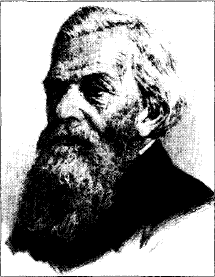
Carl Menger
1840–1921
Menger’s position as the originator of the fundamental doctrines of Austrian economics has been recognized and hailed by all eminent authorities on the history of Austrian economics. In his eulogy of Menger written upon the latter’s death in 1921, Joseph Schumpeter averred that “Menger is nobody’s pupil and what he created stands. . . . Menger’s theory of value, price, and distribution is the best we have up to now.”1 Ludwig von Mises wrote that
What is known as the Austrian School of Economics started in 1871 when Carl Menger published a slender volume under the title Grundsätze der Volkswirtschaftslehre [Principles of economics]. . . . Until the end of the [1870s] there was no “Austrian School.” There was only Carl Menger.2
For F. A. Hayek, the Austrian School’s
fundamental ideas belong fully and wholly to Carl Menger. . . . [W]hat is common to the members of the Austrian School, what constitutes their peculiarity and provided the foundations for their later contributions, is their acceptance of the teaching of Carl Menger.3
While there is no dispute regarding Menger’s role as creator of the defining principles of Austrian economics, there does exist some confusion regarding the precise nature of his contribution. It is not always fully recognized that Menger’s endeavor to radically reconstruct the theory of price on the basis of the law of marginal utility was not inspired by a vague subjectivism in outlook. Rather, Menger was motivated by the specific and overarching aim of establishing a causal link between the subjective values underlying the choices of consumers and the objective market prices used in the economic calculations of businessmen. The classical economists had formulated a theory attempting to explain market prices as the outcome of the operation of the laws of supply and demand, but they were compelled to restrict their analysis to the monetary calculations and choices of businessmen while neglecting consumer choice for the lack of a satisfactory theory of value. Their theory of “calculated action” was correct as far as it went, and was used to telling effect in demolishing the protectionist and interventionist schemes of sixteenth- and seventeenth-century mercantilists and the statist fantasies of nineteenth-century Utopian socialists.4 Thus, Menger’s ultimate goal was not to destroy classical economics, as has sometimes been suggested, but to complete and firm up the classical project by grounding the theory of price determination and monetary calculation in a general theory of human action.
LIFE AND WORK5
Carl Menger was born on February 28, 1840, in Galicia, which is today a part of Poland. He was the scion of an old Austrian family which included craftsmen, musicians, civil servants, and army officers, and which had emigrated from Bohemia a generation before his birth. His father, Anton, was a lawyer, and his mother, Caroline (née Gerzabek), was the daughter of a wealthy Bohemian merchant. He had two brothers, Anton and Max: the former, an eminent socialist author and fellow professor in the Law Faculty of the University of Vienna; and the latter, a lawyer and a Liberal deputy in the Austrian Parliament. The Menger family had been ennobled, but Carl himself dropped the title “Von” in early adulthood.
After studying economics at the Universities of Prague and Vienna from 1859 to 1863, Menger went to work as a journalist in the summer of 1863. The young Menger quickly attained prominence in the journalistic profession, writing a number of novels and comedies (which were apparently serialized for newspapers) and, in 1865, meeting and sharing confidences with the Liberal Austrian prime minister R. Belcredi. In the Fall of 1866, he left the Wiener Zeitung, an official newspaper for which he was then working as a market analyst, in order to prepare for his oral examination for a doctorate in law. After passing this examination, Menger went to work as an apprentice lawyer in May 1867, receiving his law degree from the University of Krakow in August 1867. However, he soon returned to work as an economic journalist and helped to found a daily newspaper.6
It was in September 1867, immediately after receiving his law degree, that, reported Menger, he “threw [himself] into political economy.”7 Over the next four years, he painstakingly worked out the system of thought that would so profoundly reshape economic theory when it came to fruition in 1871 with the publication of the Principles. As an economic journalist, Menger had observed a sharp contrast between the factors that classical economics had identified as most important in explaining price determination and the factors that experienced market participants believed exerted the greatest influence in shaping the pricing process. Whether or not this observation was the original inspiration for Menger’s sudden and deep absorption in economic questions after 1867, it surely is consistent with his ultimate goal of reconstructing price theory.8
In 1870, Menger obtained a civil service appointment in the press department of the Austrian cabinet (the Ministerratspraesidium), which was then composed of members of the Liberal Party. With a published work in hand and the successful completion of his Habilitation examination in 1872, Menger fulfilled the requirements for an appointment as a Privatdozent—basically an unpaid lecturer with complete professorial privileges—in the Faculty of Law and Political Science at the University of Vienna.9 Upon his promotion to the position of a paid, full-time associate professor (Professor Extraordinarius)10 in Autumn 1873, Menger resigned from the ministerial press department, but continued his private-sector journalistic activities until 1875.
In 1876, Menger won an appointment as one of the tutors of the eighteen-year-old Crown Prince, Rudolf von Habsburg. Over the course of the next two years, Menger tutored Rudolf while traveling with him throughout Europe.11 Upon his return to Vienna, Menger was appointed by the Emperor Franz Joseph, Rudolf’s father, to the Chair of Political Economy in Vienna’s Law Faculty, where he took up his duties in 1879 as a Professor Ordinarius or Full Professor.
Secure in a prominent academic position, Menger was now able to concern himself with formulating a clarification and defense of the theoretical method he had adopted in his Principles. The latter book had been ignored in Germany because, by the 1870s, German economics had come almost completely under the sway of the younger Historical School, which was led by Gustav Schmoller and was bitterly hostile to Menger’s (and the Classical School’s) “abstract” style of economic theorizing. The fruits of Menger’s methodological research were published in 1883 in a book entitled Untersuchungen über die Methode der Sozialwissenschaften und der politischen Ökonomie insbesondere (Investigations into the method of the social sciences with special reference to economics).12 Where the earlier book had been coldly ignored, the Investigations precipitated a furor among German economists, who heatedly responded with derisive attacks on Menger and the “Austrian School.” In fact, this latter term was originated and applied by the German Historicists in order to emphasize the isolation of Menger and his followers from the mainstream of German economics. Menger responded in 1884 with a scathing pamphlet, Irrthumer des Historismus in der deutschen Nationalökonomie (The errors of historicism in German economics), and the famous Methodenstreit, or methodological debate, between the Austrian School and the German Historical School was on.13
In the meantime, Menger’s writing and teaching had begun by the mid-1870s to attract a number of brilliant followers, most notably Eugen von Böhm-Bawerk and Friedrich von Wieser. Between 1884 and 1889, the works of these men and of numerous others also influenced by Menger began to pour forth in great abundance, leading to a coalescence of an identifiable Austrian School. By the late 1880s, Mengerian doctrines were also being introduced to non-German speaking economists in France, the Netherlands, the United States, and Great Britain.
After he retired from active participation in the Methodenstreit in the late 1880s, Menger’s interests shifted back from methodological concerns to questions of pure economic theory and applied economics. In 1888, he published a notable article on capital theory, Zur Theorie des Kapitals. Also during this period, Menger served as the leading member of a commission charged with reforming the Austrian monetary system, a role which stimulated him to ponder deeply problems of monetary theory and policy. The result was a spate of articles on monetary economics published in 1892, including Geld (Money), a pathbreaking contribution to monetary theory.14 Menger continued in academic life until he resigned his professorship in 1903, but, unfortunately, despite the fact that he lived until 1921, there were no more major works to come from his pen.
THE CLASSICAL SCHOOL AND THE STATE OF ECONOMIC THEORY ON THE EVE OF THE PUBLICATION OF MENGER’S PRINCIPLES
When Menger seriously turned his attention to economic theory in 1867, there existed a mighty though deeply flawed system of economic theory that had been constructed mainly by the British Classical School, namely David Hume, Adam Smith, and David Ricardo. To their undying credit, the classical economists were successful in demonstrating that price phenomena—product prices, wages, and interest rates—were not the product of historical accident or the arbitrary whim of sellers, but were determined by universal and immutable economic law, viz., the law of supply and demand. They also showed how prices, through the calculations and actions of profit-seeking businessmen, effectively regulated the production process. In those industries where the selling price exceeded the average cost of the product by a greater than normal margin, business owners were motivated by prospective profits to expand their output from existing enterprises, while additional output was forthcoming from new enterprises initiated by capitalist-investors eager to share in the supranormal profits. Conversely, in those industries where product prices failed to cover per unit costs, the universal quest for profit and aversion to loss among businessmen led existing firms to contract their output or discontinue production altogether, while discouraging entry by new competitors into the industry. Moreover, as the production of goods expanded in those industries where higher-than-normal profits were being reaped, supply increased relative to demand and the profit rate tended to diminish back to a normal level as prices declined toward their “natural” level in relation to production costs. In the case of industries where production was shrinking due to losses, the decrease in supply relative to demand drove prices up toward (and beyond) average costs to their natural level, causing losses to disappear and a normal level of profit to emerge in the process.
In the classical view, then, both prices and production behaved according to definite laws of cause and effect. Prices were determined by the interaction of all market participants, so that the actual price of any good reflected the momentary equilibrium of supply and demand; the allocation of resources to the various processes of production was governed by the calculations and choices of profit-seeking (and loss-avoiding) businessmen, which meant that, in the long run, resources were allocated among the various branches of production so as to ensure a tendency to equalize at some normal or natural level the “rate of profit” or rate of return on all capital investment. Classical economics, therefore, did indeed contain an embryonic theory of human action, which was incomplete because it focused narrowly on the calculating businessman, the proverbial “economic man” who “bought in the cheapest and sold in the dearest markets.” In other words, the classical theory of prices and production was a theory of calculable action only, i.e., of action in the marketplace, a realm where all means and ends, costs and benefits, and profits and losses could be calculated in terms of money. While this was a great achievement and a bold step forward in economic science, it left out of account the subjective and nonquantifiable valuations and preferences of the consumer, the raison d’être of all economic activity.
To explain this neglect, we turn to the aforementioned great flaw in classical economics: its value theory. In attempting to analyze the value of goods as a foundation for its theory of price, the classical economists commenced by focusing on abstract categories or classes of goods, e.g., bread, iron, diamonds, water, etc., and their general usefulness to humankind instead of focusing on a specific quantity of a concrete good and its perceived importance to a choosing individual. They were thus at a loss to resolve the famous “paradox of value”: or why the market price of one pound of bread is almost negligible compared to the price of an equal weight of gem-quality diamonds, despite the fact that bread is indispensable in sustaining human life while diamonds are useful only for aesthetic enjoyment or ostentatious display. To proceed any further in their analysis, the classical economists were thus forced to sever value into two categories, “use value” and “exchange value.” The former referred to the importance of a good in serving human wants, while the latter indicated simply the market price of the good. Dismissing use value as a given and unexplained precondition of exchange value, they went on to concentrate their analysis exclusively on exchange value. This approach to value theory naturally prevented the classical economists from developing a complete theory of human action that integrated valuations and choices of consumers with the calculations and choices of businessmen.
Unable to ground their price theory in the subjective values of consumers, the classical economists turned to objective costs of production to close their theoretical system and, in so doing, accorded the technical conditions under which goods are produced equal status with human choices as the active determinants of economic activity. This resulted in a bifurcated and contradictory price theory. According to this theory, as we noted above, market prices—prices that were actually paid in everyday transactions—are determined by supply and demand. However, only supply was actually explained, as the result of the monetary calculations of profit-maximizing businessmen, while the demands for the various consumer goods were taken as given. While human choices determined day-to-day market prices for all goods, in the long run the exchange value of “reproducible” goods was driven inexorably toward the “natural” price established by their costs of production, which themselves remained unexplained. “Scarcity” goods, those whose supplies could not be augmented by the production process, such as antiques, rare coins, paintings of the Old Masters, and so on, were treated as a separate and relatively unimportant category of goods whose exchange values were governed entirely by supply and demand. Thus, the split in classical value and price theory. But there also existed an unresolved contradiction, at least in the case of reproducible goods: although the emergence of actual prices at every moment are completely accounted for by human calculation and action, they also harbor a mysterious tendency to gravitate toward a level determined by factors wholly unrelated to human volition.
Regarding the question of the determination of the incomes of the factors of production, the classical analysis was almost completely worthless because, once again, it was conducted in terms of broad and homogeneous classes, such as “labor,” “land,” and “capital.” This diverted the classical theorists from the important task of explaining the market value or actual prices of specific kinds of resources in favor of a chimerical search for the principles by which the aggregate income shares of the three classes of factor owners—laborers, landlords, and capitalists—are governed. The Classical School’s theory of distribution was thus totally disconnected from its quasi-praxeological theory of price, and focused almost exclusively on the differing objective qualities of land, labor, and capital as the explanation for the division of aggregate income among them. Whereas the core of classical price and production theory included a sophisticated theory of calculable action, classical distribution theory crudely focused on the technical qualities of goods alone.
This was the unsatisfactory state in which Menger found economic theory in the late 1860s. It is true that a subjective-value school, which traced its roots back through J.B. Say, A.R.J. Turgot, and Richard Cantillon to the Scholastic writers of the Middle Ages, flourished on the Continent during the whole period of the Classical School’s ascendancy in Great Britain. And Menger himself, a renowned bibliophile, was nurtured and steeped in the writings of the German-language branch of this subjective-value tradition. However, while writers associated with this tradition repeatedly emphasized that “utility” and “scarcity” are the sole determinants of market prices and, in some cases, even formulated the concept of marginal utility, none before Menger was able to systematically elaborate these insights into a comprehensive theory of the pricing process and of the economy in general.15
MENGER’S RECONSTRUCTION OF ECONOMIC THEORY16
The Nature and Scope of Economic Theory
As noted above, Menger emphatically did not intend to overthrow classical economics. He was quite comfortable with its emphasis on the universality and immutability of economic law, its theory of short-run price determination, and the laissez-faire policy conclusions it derived therefrom.17 Rather, Menger’s intentions were to reconstruct classical economics on firmer foundations by grounding the supply-and-demand theory of price and the theory of monetary calculation in the choices and actions of consumers and to repair its superstructure by healing the rift between the theory of price and the theory of distribution. Menger boldly proclaimed his intention of subsuming all the branches of economics under a reconstructed price theory in his Preface to Principles, writing
I have devoted special attention to the investigation of the causal connections between economic phenomena involving products and the corresponding agents of production, not only for the purpose of establishing a price theory based upon reality and placing all price phenomena (including interest, wages, ground rent, etc.) together under one unified point of view, but also because of the important insights we thereby gain into many other economic processes heretofore completely misunderstood.18
Menger recognized that at the center of “a price theory based upon reality” and of economic theory in general is human action—and human action alone. As Menger epigrammatically put it in preliminary notes written while Principles was in preparation: “Man himself is the beginning and the end of every economy” and “Our science is the theory of a human being’s ability to deal with his wants.”19 While the centrality of human want satisfaction had been affirmed by earlier writers in the subjective-value tradition,20 Menger alone was successful in forging a method of economic theorizing—it was later to be dubbed “praxeology” by Ludwig von Mises—that was consistent with this insight. Thus, he began his scientific inquiry by meditating upon the nature of human striving to satisfy wants, and then deducing its immediate implications. By proceeding in this way, Menger was able to perceive immediately that the process of want satisfaction is not purely cognitive and internal to the human mind, but depends crucially upon the external world and, therefore, upon the law of cause and effect. This explains why Menger began his economic treatise with the statement that “All things are subject to the law of cause and effect.”21 Without reference to this great law of objective reality, the human striving to attain goals is logically inconceivable, because, as Menger argued, subjective states of satisfaction are links in the same causal chain that includes objective states of the world:
One’s own person, moreover, and any of its states are links in this great universal structure of relationships. It is impossible to conceive of a change of one’s person from one state to another in any way other than one subject to the law of causality. If, therefore, one passes from a state of need to a state in which the need is satisfied, sufficient causes for this change must exist. There must be forces in operation within one’s organism that remedy the disturbed state, or there must be external things acting upon it that by their nature are capable of producing the state we call satisfaction of our needs.22
But the direction of causation is not one-way, from objective states of the world to subjective states of satisfaction. For Menger, it is two-way, because, by conceiving the law of cause and effect, man is able to recognize his total dependence on the external world, and transform the latter into means to attain his ends. Man, himself, thus becomes the ultimate cause—as well as the ultimate end—in the process of want satisfaction. In his notes, Menger expressed and emphasized the causal interrelationships between the subjective and the objective aspects of action by means of parallel trinities of linked concepts: “ends-means-realization/ man-external world-subsistence/ wants-goods-satisfaction.”23
The Theory of Goods
Menger’s emphasis on the law of causality led him to devote the first twenty-five pages of the Principles to explicating “the general theory of the good,” in the course of which he radically reformulated the concept of a good in praxeological terms.24 For Menger, goods are those elements of the external world that are integral to the causal process of want satisfaction and upon which action operates.25 Once again, passages in Menger’s pre-Principles notebooks are illuminating:
Our general dependence on the external world: in its entirety the external world is presented to us as a whole in which we live. Dependence on certain portions of this external world, or on some relationships in it, which must be brought into certain relations to us. To this end, these portions must be particularly suited. Such things are called goods, insofar as they have the capacity to satisfy human wants (serving ends amounts to the same thing).26
Having identified the nature of a good, Menger proceeds to elucidate what he calls “the causal connections between goods,” with the goal of identifying “the place that each good occupies in the causal nexus of goods.”27 “Goods of the lowest order” are consumer goods, like bread for instance, which are used to directly satisfy human wants. In Menger’s words, “the causal connection between bread and the satisfaction of one of our needs is . . . a direct one.” Factors of production, on the other hand, are “goods of higher order,” having only “an indirect causal connection with human needs.” For example, flour and the services of ovens and bakers’ labor are second-order goods whose goods-character stems from the fact that, when they are combined in the process of production to yield a quantity of bread, they operate as an indirect cause of the satisfaction of the human want for bread. Likewise, wheat, grain mills, and millers’ labor constitute third-order goods which attain their goods-character from their usefulness in the production of second-order goods. The same applies to fourth- and fifth-order goods in the production of bread. In short, according to Menger,
The process by which goods of higher order are progressively transformed into goods of lower order and by which these are directed finally to the satisfaction of human needs is . . . not irregular but subject, like all other processes of change, to the law of causality.28
Thus, it is their position in this causal order of want satisfaction that endows elements of the external world with their goods-character.
Menger draws a further distinction: between those goods whose available quantity exceeds the amount necessary to satisfy all human wants for them, and those available in a quantity that is insufficient to fully satisfy human wants for them. The former Menger designates “non-economic goods,” and the latter, “economic goods.” In the case of non-economic goods, because of their superabundance relative to wants, people need take no definite action with regard to them. With regard to economic goods, however, an individual must undertake to economize them in order to satisfy his wants for them as fully as possible. Economizing involves, among other things, ranking the wants for a particular good according to their greatest urgency or importance and then choosing to allocate units of the good only to those uses that serve the most important wants, while leaving unsatisfied the less important wants. Also, just as in the case of their goods-character, the economic character of higher-order goods also derives from the economic character of the lower-order good which they cooperate in producing. Thus, for example, in a region where pure water is naturally superabundant for all human purposes, neither water nor man-made reservoirs and water pumps, pipes, and filters need be economized. For Menger, then, the operation of economizing is nothing more or less than purposive behavior or action, as this latter term is understood by Mises and the proponents of the modern praxeological paradigm. Both Menger’s “economizing man” and Mises’s “acting man” apply scarce means so as to attain their most highly valued ends.
Inherent in the idea of economizing is the notion of property. For Menger, “human economy and property have a joint economic origin,” which is rooted in the condition of scarcity.29 Thus, property is neither “an arbitrary invention” nor merely an aggregation of heterogeneous objects. It is a praxeological category that refers to a purposively created structure of goods that is adjusted through the operations of economizing to serve the structure of ends aimed at by an individual actor. According to Menger,
[A person’s] property is not . . . an arbitrarily combined quantity of goods, but a direct reflection of his needs, an integrated whole, no essential part of which can be diminished or increased without affecting realization of the end it serves.30
It is no exaggeration to say that Mengerian economics is as much about goods and property as it is about knowledge and expectations.31
Menger’s analyses of the order and of the economic character of goods taken together demolish the foundations of the classical cost-of-production theory. First, the proposition that the economic character of lower-order goods is derived from the fact that the goods of a higher order employed in producing them possess an economic character established prior to the causal production process, according to Menger,
contradict[s] . . . all experience, which teaches us that, from goods of higher order whose economic character is beyond all doubt, completely useless things may be produced, and in consequence of economic ignorance actually are produced.32
In other words, the cost-of-production theory is at a loss in explaining how scarce and valuable resources can be and are used to produce products whose market value is zero because they are not useful, directly or indirectly, in serving human wants. This problem aside, the fatal flaw in a theory which seeks to explain the economic character of lower-order goods in terms of the economic character of goods of a higher order is that it is merely a “pseudo-explanation.” As Menger argued,
If we explain the economic character of goods of first order by that of goods of second order, the latter by the economic character of goods of third order, this again by the economic character of goods of fourth order, and so on, the solution of the problem is not advanced fundamentally by a single step, since the question as to the last and true cause of the economic character of goods always still remains unanswered.33
THE THEORY OF VALUE
This brings us to the question of value which so vexed, and ultimately defeated, the classical economists. Because they were tragically unable to grasp that specific quantities and not entire classes of goods were the object of human action, the classical economists dropped use value from their analysis. But Menger, with his unblinking focus on individual action, easily recognized the profound significance of the concept of the marginal unit—the quantity of a good relevant to choice—for the whole of economic theory.
In his notes, Menger compared “species value,” the value of an abstract class of goods, to the “individual value” or “concrete value” attaching to specific units of a good. Dismissing the former as completely irrelevant to action in the real world, Menger argued that,
In the case of species value, we compare, on the one hand, the properties of a good without considering its quantity, and on the other, human wants without taking into account individuality. . . . In real life there are only concrete goods and concrete wants.34
In fact, the subjective ranking of the different satisfactions yielded by a definite quantity of a good is implied by the very notion of action. As Menger explained:
The varying importance that satisfaction of separate concrete needs has for men is not foreign to the consciousness of any economizing man. . . . Wherever men live, and whatever level of civilization they occupy, we can observe how economizing individuals weigh the relative importance of satisfaction of their various needs in general, how they weigh especially the relative importance of the separate acts leading to the more or less complete satisfaction of each need, and how they are finally guided by the results of this comparison into activities directed to the fullest possible satisfaction of their needs (economizing).35
By cogitating on the essence of economizing or action, Menger was thus able to conclusively demonstrate that the want for any good is actually a series of wants for a definite unit of the good to the satisfaction of which the individual is constrained by scarcity to attach differing degrees of importance. And, by implication, only actual units of a good are relevant to human choice: “Not species as such, but only concrete things are available to economizing individuals. Only the latter, therefore, are goods, and only goods are the objects of our economizing and of our valuation.”36
Having established that only specific wants and specific units of goods pertain to the valuational process, Menger proceeded to define value as “the importance that individual goods or quantities of goods attain for us because we are conscious of being dependent on command of them for the satisfaction of our needs.”37 In other words, “the value of all goods is merely an imputation of this importance [of satisfying our needs] to economic goods.”38 It follows, then, for Menger, that “value does not exist outside the consciousness of men. . . . [T]he value of goods . . . is entirely subjective in nature.”39 One would be wrong to interpret this last statement as a radical subjectivist dismissal of the realm of external reality. For Menger’s emphatic distinction between the value of a thing and the thing itself is actually intended as a means of elucidating the indissoluble ontological link between the realm of cognition and the realm of objective causal processes that comes into being by virtue of valuation and economizing. The value of goods is therefore nothing arbitrary, but always the necessary consequence of human knowledge that the maintenance of life, of well-being, or of some ever so insignificant part of them, depends upon control of a good or a quantity of goods.40
If value consists in a judgment about the significance of “concrete” things in producing satisfaction of “concrete” wants, how are such judgments arrived at? That is, what is the value of a specific thing to a person who seeks to employ it to satisfy his wants? It was in his answer to this question that Menger not only solved the paradox of value, but laid the foundations for the reconstruction of price theory, and, hence, of all of economic science.
Menger brilliantly answered the question by restating it: “[W]hich satisfaction would not be attained if the economizing individual did not have the given unit at his disposal—that is, if he were to have command of a total amount smaller by that one unit?”41 In light of Menger’s discussion of economizing, the obviously correct answer to this question is “only the least of all the satisfactions assured by the whole available quantity.” In other words, regardless of which particular physical unit of his supply was subtracted, the actor would economize by choosing to reallocate the remaining units so as to continue to satisfy his most important wants and to forego the satisfaction of only the least important want of those previously satisfied by the larger supply. It is, thus, always the least important satisfaction that is dependent on a unit of the actor’s supply of a good and, that, therefore, determines the value of each and every unit of the supply. This value-determining satisfaction soon came to be known as the “marginal utility.”42 As Menger formulated the law of marginal utility:
Accordingly, in every concrete case, of all the satisfactions secured by means of the whole quantity of a good at the disposal of an economizing individual, only those that have the least importance to him are dependent on the availability of a given portion of the whole quantity. Hence the value to this person of any portion of the whole available quantity of the good is equal to the importance to him of the satisfactions of least importance among those assured by the whole quantity and achieved with an equal portion.43
Thus, by applying the law of marginal utility, Menger was able to provide a straightforward and incontrovertible resolution to the paradox of value that had so bedeviled classical economics and prevented its development into a full-blown theory of human action. According to Menger, it is because diamonds and gold are extremely rare while water tends to be abundantly available that:
Under ordinary circumstances, therefore, no human need would have to remain unsatisfied if men were unable to command some particular quantity of drinking water. With gold and diamonds, on the other hand, even the least significant satisfactions assured by the total quantity available still have a relatively high importance to economizing men. Thus concrete quantities of drinking water usually have no value to economizing men but concrete quantities of gold and diamonds a high value.44
Having thus repaired the classical split between use value and exchange value and firmly rooted price theory in consumer valuations and choices, Menger turned his attention to the bifurcation perpetrated by the classical economists between price theory and distribution theory, or between the pricing of consumer goods and the pricing of the factors of production. Once again, Menger used the law of marginal utility to provide a solution of absolute and universal validity. He also refuted, once and for all, the classical contention that, in the long run at least, price is determined by costs of production.
Menger began by pointing out that only satisfaction of wants is directly significant to human beings.45 Consumer goods, or goods of the first order, attain value, therefore, only because people are cognizant of their dependence on specific quantities of these goods for the satisfaction of specific wants, and, hence, “impute” to these goods the importance of the satisfactions that depend upon them. Goods of higher orders, the factors of production that cooperate in the production of consumer goods, have no immediate connection with the satisfaction of human wants, but through the causal production process they do indirectly bear on the process of want satisfaction. Thus, the value of a certain quantity of consumer goods is imputed to the goods of the second order employed in its production, because the latter are a necessary, if indirect, cause of the satisfaction which is directly attributable to the stock of consumer goods. The same value-imputation analysis applies to the value of goods of the third, fourth, and higher orders. Concluded Menger:
Thus, as with goods of first order, the factor that is ultimately responsible for the value of goods of higher order is merely the importance we attribute to those satisfactions with respect to which we are aware of being dependent on the availability of the goods of higher order whose value is under consideration. But due to the causal connections between goods, the value of goods of higher order is not measured directly by the expected importance of the final satisfaction, but rather by the expected value of the corresponding goods of lower order.46
If “the value of goods of higher order is dependent upon the expected value of goods of lower order they serve to produce,” then, as Menger argued, costs of production, which are nothing but the sums of the prices paid for various kinds of higher-order goods, cannot possibly determine the prices of consumer goods, because the costs themselves are ultimately determined by these prices.47 Furthermore, as Menger pointed out, the cost-of-production theory of price determination cannot account for the prices of the services of land and of labor, which are nature given and, hence, have no costs of production themselves.48 In contrast, the Mengerian theory of value imputation easily explains these prices in the same manner as the prices of any other species of concrete goods: as proximately derived from the value of the lower-order goods or—if they themselves are goods of the first-order—of the satisfactions that are directly dependent upon them.
While up to this point Menger’s analysis succeeds in identifying consumer valuations as the general cause of the values and prices of both consumer goods and productive factors, it still leaves unexplained the prices of individual factors. The reason is that a good of a lower order can only be produced by “complementary” quantities of higher-order goods. As Menger realized, by its very nature, production must involve more than one kind of factor of production.49 Now it would appear, therefore, that it is impossible to impute partial quotas of the value of the lower-order good to each of the various higher-order goods that cooperate in its production. However, once again, with dazzling analytical acumen, Menger wielded the law of marginal utility to hit upon the correct solution.
Menger pointed out that, in most production processes, higher-order goods need not be combined in the rigidly fixed proportions that characterizes chemical reactions. In other words, if one of the complementary factors that cooperates in the production of grain, let us say, fertilizer, is partially or completely withdrawn, then there will result a reduction of the output of grain rather than a nullification of the entire production process. This implies, Menger argued, that the share of the value of a particular quantity of a higher-order good can be isolated from the aggregate value of the complementary goods combined in the given production process. Thus, if a diminution of a hundredweight of fertilizer, all other things equal, causes a drop in a grain harvest of ten sacks, then the value of this unit of fertilizer to the farmer is precisely equal to the marginal utility of ten sacks of grain, comprising the satisfactions he chooses to forego as a result of the loss of the ten sacks.
Menger summarized the “general law of the determination of the value of a concrete quantity of a good of higher order” as follows:
Assuming . . . that all available goods of higher order are employed in the most economic fashion, the value of a concrete quantity of a good of higher order is equal to the difference in importance between the satisfactions that can be attained when we have command of the given quantity of the good of higher order whose value we wish to determine and the satisfactions that would be attained if we did not have this quantity at our command.50
TIME, PROPERTY, AND ENTREPRENEURSHIP
Because Menger conceived the processes of transforming higher-order into lower-order goods (production) and of imputing value from lower-order to higher-order goods (imputation) as conjoint causal processes, he accorded time an integral role in both. According to Menger, “The idea of causality . . . is inseparable from the idea of time.”51
If, indeed, “the time period lying between command of goods of a higher order and possession of the corresponding goods of lower order can never be eliminated,” then the production process is inherently uncertain. For factors beyond the actor’s technical knowledge or control, such as changes in soil properties or in weather, may affect the quality or quantity of the first-order goods that are yielded by the production process. This technical uncertainty associated with production can be greatly mitigated but never completely extinguished by the improvement of technological knowledge, which, in effect, provides the actor with better foresight of the outcome of a time-consuming causal process.
But technological knowledge cannot ameliorate other kinds of uncertainty that are inextricably bound up with production. Since any production process is undertaken to satisfy future wants, the actor must be able to foresee these wants. Indeed, as Menger pointed out, “its success will be dependent principally upon correct foresight of the quantities of goods they [actors] will find necessary in future time periods,” while “a complete lack of foresight would make any planning of activity directed to the satisfaction of human needs completely impossible.”52 Nonetheless, despite the fact that people are unable to foresee their future circumstances with perfect certainty, Menger did not believe that they are utterly ignorant of their future wants.53 Recourse to previous experience permits them to foresee with approximate certainty many wants that they will experience during their planning period. About other wants, e.g., for medicines and fire extinguishers, they remain “more or less in doubt.” But despite their “deficient foresight,” people do act successfully to satisfy even these wants. Menger concluded that
The circumstance that it is uncertain whether a need for a good will be felt during the period of our plans does not, therefore, exclude the possibility that we will provide for its eventual satisfaction, and hence does not cause the reality of our requirements for goods necessary to satisfy such needs to be in question.54
Thus uncertainty for Menger is not an obstacle to but a condition of action.55
For Menger, “The second factor that determines the success of human activity is the knowledge gained by men of the means available to them for the attainment of the desired ends.”56 As a prerequisite of want-satisfaction, actors are concerned “to measure and take inventory of the goods at their disposal.”57 The more exact is the knowledge regarding the kinds and quantities of existing higher-order goods provided by these operations, the more accurate will be the forecasts of consumer goods forthcoming to satisfy future wants during the planning period. The acquisition of such data is especially important for production planning in a developed market economy where the ownership and location of the supplies of various higher-order goods tend to be dispersed. But even if we consider “the lowest levels of civilization . . . a complete lack of this knowledge would make impossible any provident activity of men directed to the satisfaction of their needs.”58
Now, a causal production process must be “planned and conducted . . . by an economizing individual.” The set of functions necessary for actuating such a process Menger designates as “entrepreneurial activity.”59 As we have just seen, for Menger, the entrepreneur’s most important function is anticipating future wants, estimating their relative importance, and acquiring the technological knowledge and knowledge of currently available means. In the absence of such entrepreneurial foresight and knowledge, there could be no imputing of value from satisfactions to higher-order goods, and rational resource allocation would be impossible.60
Entrepreneurial activity comprises a number of additional functions bound up with the praxeological category of property.61 These include “economic calculation,” involving the various computations needed to ensure the technical efficiency of the production process, i.e., the most valuable use of property. A third entrepreneurial function is “the act of will” by which higher-order goods are purposively allocated to the chosen production process. Finally, there is “supervision of the execution of the production plan so that it may be carried through as economically as possible.” Clearly, the last two functions entail property-ownership and, therefore, mark the Mengerian entrepreneur as a capitalist–entrepreneur. Menger states explicitly that “command of the services of capital” is a “necessary prerequisite” for performing economic activity.62 Moreover, in large firms, although he may employ “several helpers” whose activities are quite extensive, the entrepreneur himself will continue to perform all four characteristic functions enumerated above, “even if they are ultimately confined . . . to determining the allocation of portions of wealth to particular productive purposes only by general categories, and to the selection and control of persons.”63
The four functions Menger describes as the core of entrepreneurship are simply the praxeological implications of property in higher-order goods. This explains why, in Menger’s view, the knowledge an actor acquires and the expectations he forms are not autonomous but are strictly governed by the structure of goods constituting his property and his chosen ends.64 Moreover, as an “economizing man” who actuates and guides an uncertain causal process, Menger’s entrepreneur is a dynamic actor who profits by actively seeking out the most valuable uses for his property, and is not merely a passive “risk-bearer” whose profits represent a reward for investing in risky ventures.65
THE THEORY OF PRICE
We now turn to price theory, the capstone of Mengerian economics. Menger viewed the explanation of prices on the basis of the law of marginal utility as the final step in linking the classical theory of monetary calculation to the general process of human want satisfaction. For if the active element in determining the prices of goods of all orders is marginal utility, and if entrepreneurs base their economic calculations on these prices, it can then be demonstrated that purposeful actions undertaken to satisfy human wants are the ultimate determinant of resource allocation and income distribution in the market economy.
As a prelude to elaborating his theory of price, Menger was forced to clarify the cause and essence of exchange. Unfortunately, because of their tendency to conceive the human want for a good abstractly and generically rather than concretely and individually, Adam Smith and the classical economists had no alternative but to identify the motive to exchange with an alleged innate proclivity of human beings to “truck and barter.” It was thus left to Menger to elaborate a theory of exchange in terms of human wants.
Once again resorting to the law of marginal utility, Menger was able to provide a simple and definitive solution to the problem. Menger illustrated this solution with an example along roughly the following lines66: Suppose that there exist two farmers, A and B, each of whom owns a supply of a different good, horses and cows. Assuming that A possesses six horses and B, six cows, Menger posed the question: “How many horses and cows would A and B agree to exchange?” In answer, Menger argued that the two parties would continue to exchange one horse for one cow as long as the value of the good each received exceeded the value of the good he gave up, that is, as long as the two parties valued the goods they exchanged in inverse order. As Menger summed up his analysis,
This limit [to exchange] is reached when one of the two bargainers has no further quantity of goods which is of less value to him than a quantity of another good at the disposal of the second bargainer who, at the same time, evaluates the two quantities of goods inversely.67
The cessation of exchange also implies that the two parties have exhausted the mutual benefits from trade. These benefits consist in the opportunity of each trader to satisfy more important wants with his restructured property than he was able to satisfy with his initial, pre-exchange supplies of goods. Exchange, for Menger, is therefore as much a part of the causal process of want satisfaction as production is. Menger used this insight to demonstrate the fallacy of the classical position that exchange and the activities of middlemen are unproductive, arguing that
The effect of an economic exchange of goods upon the economic position of each of the two traders is always the same as if a new object of wealth had entered his possession. . . . For the end of the economy is not the physical augmentation of goods but always the fullest possible satisfaction of human needs.68
In the course of demonstrating the limits to exchange, Menger originated the praxeological method of analyzing the real-world pricing process. Since every causal process has a beginning and an end, a complete explanation of the process involves a description of the factors that precipitate it and maintain it in motion and the factors that cause its cessation. Central to this analytical method is the concept of what Böhm-Bawerk called “momentary equilibrium” and Mises called “the state of rest.”69 In the example above, the exchange process continues as along as A and B rank the values of the two goods in inverse order; the process is suspended and the state of rest emerges when the inverse valuations no longer hold. In the real world, it is true, individual valuations of goods are in constant flux due to changes in consumer wants and the technical conditions of production, thus continually recreating the conditions of further exchange. However, this does not nullify Menger’s analysis. In fact, it is precisely the notion of the state of rest that is necessary to delimit a particular act of exchange. As Menger explained:
the foundations of economic exchanges are constantly changing, and we therefore observe the phenomenon of a perpetual succession. . . . But even in this chain of transactions we can, by observing closely, find points of rest at particular times, for particular persons, and with particular kinds of goods. At these points of rest, no exchange of goods takes place because an economic limit to exchange has already been reached.70
Menger’s explanation of how prices are determined follows naturally from his analysis of exchange. Menger defined prices as “the quantities of goods actually exchanged.” As part of the overall want satisfaction process, however, “Prices are only incidental manifestations of [economic] activities, symptoms of an economic equilibrium between the economies of individuals.”71 This means that the emergence of a realized price—i.e., an actual exchange of definite quantities of two goods—coincides not only with the consummation of the exchange process but also with the attainment of a momentary state of rest by the parties involved in the exchange. In the example above, if A pays the sum of four horses for four of B’s cows, this constitutes both the realized price of the transaction and the exchange of the specific quantities of goods necessary to establish a temporary exchange equilibrium between A and B with respect to horses and cows. Similarly, in a modern monetary economy, at any moment in time, every money price actually observed indicates the exchange of the quantities of goods necessary to facilitate the achievement of catallactic states of rest by each pair of transactors. For each individual, this state takes the form of a temporary lull, of longer or shorter duration, before the market is reentered and another exchange is initiated. It is during this interlude that the mutual advantages of exchange are perceived to be exhausted. For example, a consumer exiting a supermarket is, at least momentarily, in a state of rest with respect not only to the various items of food she has purchased, but with respect to her money assets and all other species of exchangeable goods that compose her property. This state of catallactic quiescence will be disturbed, sooner or later, when she again finds herself confronting a prospective seller whose valuations of a good and its purchase price are the inverse of her own.
Menger used this method of analysis to demonstrate that prices are determined exclusively by the subjective valuations of market participants. He began with a simple analysis of exchange between two isolated individuals. Person A1 owns a horse while Person B1 owns a supply of wheat. If, based on his estimations of the relative marginal utilities of the two goods to him, B1 will pay up to a maximum of eighty bushels of wheat to obtain the horse and A1 will part with the horse for no less than ten bushels of wheat—again, based on considerations of marginal utility—then the basis for exchange exists, because, for prices between ten and eighty bushels of wheat per horse, A1 and B1 value the horse and the wheat inversely. This being the case, and assuming A1 and B1 are known to each other, the price paid under these conditions will settle somewhere in the range of ten to eighty bushels per horse. The exact price will be the subject of higgling between the two and will depend upon their relative bargaining skills. At the instant the exchange takes place, the price is realized and vanishes, and a state of rest immediately ensues for the two parties that is characterized by an improvement in the want satisfaction of each and a temporary pause in their catallactic activities.
Let us now introduce two more prospective horse buyers into this market, B2 and B3, whose maximum purchase prices for a horse are sixty and fifty bushels of wheat, respectively. Assuming B1’s maximum buying price remains constant at eighty, the equilibrium price range must contract to sixty-one to eighty bushels, as competition on the buyer’s side drives the price up to a level sufficiently high to exclude all but the single most capable buyer. Only a price of sixty-one bushels on above will cause a distribution of goods that is consistent with a state of rest for all participants in the market. For example, at a price of seventy bushels, only B1, the buyer, ranks the horse above the purchase price, while A1, the seller, and B2 and B3, the excluded buyers, all rank the purchase price above the horse and are content to depart the market without it. If the example is altered so that A1 now brings two horses to market, with minimum selling prices of thirty and ten bushels, respectively, then the equilibrium price range will fall and shrink further to fifty-one to sixty bushels of wheat, with B1 and B2 each buying a horse at this price. For it is only a realized price in this range that is capable of producing the lull in the catallactic process that follows from a redistribution of goods in accordance with the complete exploitation of the mutual benefits from exchange.
Menger summed up the general principle of price formation under “monopoly trade,” i.e., a market in which, as above, one side of the market consists of a single seller, as follows:
Price formation takes place between limits that are set by the equivalent of one unit of the monopolized good to the individual least eager and least able to compete who still participates in the exchange [B2, in the above example] and the equivalent of one unit of the monopolized good to the individual most eager and best able to compete of the competitors who are economically excluded from the exchange [B3, in the example].72
Menger recognized, moreover, that the same principle that underlies price formation in the case of monopoly does not only apply to “monopoly,” but is an absolutely true and exact law of economics that applies universally to the formation of price in all markets. According to this law, dubbed the law of “marginal pairs” by Böhm-Bawerk, in every market the actual price will always settle at a level that completely dissipates the mutual gains from additional exchange and culminates in a state of rest.73 Wrote Menger:
Each given economic situation sets definite limits within which price formation and the distribution of goods must take place, and any price and distribution of goods that is outside these limits is economically impossible. . . . Whether a given quantity of a commodity is sold by a monopolist or by several competitors in supply, and independently of the way in which the commodity was originally distributed among the competing sellers, the effect on price formation and on the resultant distribution of the commodity among the competing buyers is exactly the same.74
It is his overarching concern with the causal process of want satisfaction that explains why Menger gives equal emphasis in this passage to “price formation” and “the distribution of goods.” Goods are the proximate cause of want satisfaction and, therefore, the immediate motive for engaging in exchange. This also explains Menger’s focus on historically realized prices, because these prices are, in Menger’s words, simply “quantities of goods actually exchanged”; hence, it is their payment that generates the mutual improvement of satisfaction among market participants. The momentary “points of rest” that loom so large in Menger’s price theory are the states that prevail immediately after these prices have been paid, when there exist no further opportunities for the mutual enhancement of satisfaction among market participants.
Since the Principles was intended as the first general part of a multivolume treatise that Menger never completed, it does lack an explicit and detailed discussion of the pricing of the factors of production and, thus, of the money costs of production that are used in the economic calculations of entrepreneurs.75 This gap in Mengerian price theory was ably filled by Böhm-Bawerk who, in 1886, elaborated the “law of costs”—today we call it the law of marginal productivity—which explained pricing in factor markets in a manner fully consistent with Menger’s explanation of the pricing of consumer goods by the law of marginal utility.76 With the completion of the Mengerian theory of the pricing process, business entrepreneurship and monetary calculation are finally integrated with consumer choice into a general theory of human action.
This then is Menger’s greatest achievement and the essence of his “revolution” in economics: the demonstration that prices are no more and no less than the objective manifestation of causal processes purposefully initiated and directed to satisfying human wants. It is, thus, price theory that is the heart of Mengerian and, therefore, of Austrian economics. In a profoundly insightful passage in his eulogy, Schumpeter emphasized this aspect of Menger’s contribution:
What matters, therefore, is not the discovery that people buy, sell, or produce goods because and insofar as they value them from the point of view of satisfaction of needs, but a discovery of quite a different kind: the discovery that this simple fact and its sources in the laws of human needs are wholly sufficient to explain the basic facts about all complex phenomena of the modern exchange economy, and that in spite of striking appearances to the contrary, human needs are the driving force of the economic mechanism beyond the Robinson Crusoe economy or the economy without exchange. The chain of thought which leads to this conclusion starts with the recognition that price formation is the specific economic characteristic of the economy—as distinct from all other social, historical, and technical characteristics—and that all specifically economic events can be comprehended within the framework of price formation. From a purely economic standpoint, the economic system is merely a system of dependent prices; all special problems, whatever they may be called, are nothing but special cases of one and the same constantly recurring process, and all specifically economic regularities are deduced from the laws of price formation. Already in the preface of Menger’s work [Principles], we find this recognition as a self-evident assumption. His essential aim is to discover the law of price formation. As soon as he succeeded in basing the solution of the pricing problem, in both its “demand” and “supply” aspects, on an analysis of human needs and on what Wieser has called the principle of “marginal utility,” the whole complex mechanism of economic life suddenly appeared to be unexpectedly and transparently simple.77
Schumpeter concluded that, despite Menger’s other substantial contributions, his “theory of value and price . . . is, so to speak, the expression of his real personality.”78 If this is so, Menger’s personality lives on in the flourishing praxeological paradigm of contemporary Austrian economics.
SELECTED READINGS
Caldwell, Bruce J., ed. 1990. Carl Menger and his Legacy in Economics. Durham, N.C.: Duke University Press.
Hayek, F.A. 1992. “Carl Menger (1840–1921).” In The Fortunes of Liberalism: Essays on Austrian Economics and the Ideal of Freedom. Vol. 4. The Collected Works of F. A. Hayek. Peter G. Klein, ed. Chicago: University of Chicago Press, 1992.
Jaffé, William. 1976. “Menger, Jevons, and Walras De-Homogenized.” Economic Inquiry 14 (December): 511–24.
Kauder, Emil. 1965. A History of Marginal Utility Theory. Princeton, N.J.: Princeton University Press.
Menger, Carl. 1985. Investigations into the Methods of the Social Sciences with Special Reference to Economics. Louis Schneider, ed. Francis J. Nock, trans. New York: New York University Press.
—. 1976. Principles of Economics. James Dingwall and Bert F. Hoselitz, trans. New York: New York University Press.
Sennholz, Hans F. 1985. “The Monetary Writings of Carl Menger.” In The Gold Standard: Perspectives in the Austrian School. Llewellyn H. Rockwell, Jr., ed., Auburn, Ala.: Ludwig von Mises Institute.
Streissler, Erich W., and Monika Streissler, eds. 1994. Carl Menger’s Lectures to Crown Prince Rudolf. Cheltenham, U.K.: Edward Elgar.
Yagi, Kiichiro. 1993. “Menger’s Grundsätze in the Making.” History of Political Economy 25 (Winter).
__________________
79Joseph A. Schumpeter, “Carl Menger,” Ten Great Economists: From Marx to Keynes (New York: Oxford University Press, 1969), p. 86.
80Ludwig von Mises, The Historical Setting of the Austrian School of Economics (New Rochelle, N.Y.: Arlington House, 1969), pp. 9–10. Mises also wrote that “in 1871 the writings of Carl Menger and William Stanley Jevons inaugurated a new epoch of economic studies” (Ludwig von Mises, Theory and History: An Interpretation of Social and Economic Evolution [Auburn, Ala.: Ludwig von Mises Institute, 1985], p. 124).
81F.A. Hayek, “Carl Menger (1840–1921),” in The Fortunes of Liberalism: Essays on Austrian Economics and the Ideal of Freedom, vol. 4, The Collected Works of F.A. Hayek, Peter G. Klein, ed. (Chicago: University of Chicago Press, 1992), p. 62.
82This weakness of classical economics was noted by Mises:
Because the classical economists were able to explain only the action of businessmen and were helpless in the face of everything that went beyond it, their thinking was oriented toward bookkeeping, the supreme expression of the rationality of the businessman (but not that of the consumer). (Ludwig von Mises, Epistemological Problems of Economics, George Reisman, trans. [New York: New York University Press, 1981], p.175)
But, as Mises also recognized, this theory, though incomplete, was an essential step forward in the construction of the comprehensive system of praxeological economics:
[M]ercantilists had placed goods in the center of economics, which in their eyes was a theory of objective wealth. It was the great achievement of the Classics in this respect that beside the goods they set up economic man [i.e., the calculating businessman]. They thus prepared the way for modern Economics which puts man and his subjective valuations into the center of its system. (Ludwig von Mises, Socialism: An Economic and Sociological Analysis, J. Kahane, trans. [Indianapolis, Ind.: LibertyClassics, 1981], p. 293)
Indeed, the classical economic theory was effectively a praxeological theory that dealt narrowly with actions whose means and ends were calculable in monetary terms: “The first comprehensive system of economic theory, that brilliant achievement of the classical economists, was essentially a theory of calculated action” (Ludwig von Mises, Human Action: A Treatise on Economics , p. 231).
83Details of Menger’s life can be found in Hayek, “Carl Menger”; Erich W. Streissler, “The Influence of German Economics on Menger and Marshall,” in Carl Menger and His Legacy in Economics, Bruce J. Caldwell, ed. (Durham, N.C.: Duke University Press, 1990); Streissler, “Menger’s Treatment of Economics in the Rudolph Lectures,” in Carl Menger’s Lectures to Crown Prince Rudolf Erich, W. Streissler and Monika Streissler, eds. (Cheltenham, U.K.: Edward Elgar, 1994), pp. 3–25; and Kiichiro Yagi, “Menger’s Grundsätze in the Making,” History of Political Economy 25 (Winter 1993): 697–724.
84This was the Wiener Tagblatt. Its successor, the Neue Wiener Tagblatt, established itself as one of Vienna’s most influential newspapers for many years to come.
85Quoted in Yagi, “Menger’s Grundsätze,” p. 700.
86See Hayek, “Carl Menger,” p. 69.
87Mises describes the institution of the Privatdozent in the following terms:
A doctor who had published a scholarly book could ask the faculty to admit him as a free and private teacher of his discipline; if the faculty decided in favor of the petitioner, the consent of the Minister [of Worship and Instruction] was still required; in practice this consent was [before the early 1880s] always given. The duly admitted Privatdozent was not, in this capacity, a civil servant. Even if the title of professor was accorded to him, he did not receive any compensation from the government. A few Privatdozents could live from their own funds. Most of them worked for their living. (Mises, Historical Setting of the Austrian School, p.13)
88It is Streissler, in his “Influence of German Economics,” p. 4, who renders this academic rank as “associate professor” in English; Mises, in Historical Setting of the Austrian School, p.11, translates it as “assistant professor.”
89Menger’s lectures to the Crown Prince, as recorded in the latter’s notebooks, can be found in Streissler and Streissler, eds., Carl Menger’s Lectures to Crown Prince Rudolf.
90Carl Menger, Investigations into the Method of the Social Sciences with Special Reference to Economics, Louis Schneider, ed., Francis J. Nock, trans. (New York: New York University Press, 1985).
91On the conflict between the Austrian and German Historical Schools, see Mises, Historical Setting of the Austrian School, pp. 20–39. For a critique of historicism in all its forms, see Mises, Theory and History, pp. 198–239.
92For a survey of these and other writings of Menger on money, see Hans F. Sennholz, “The Monetary Writings of Carl Menger,” in The Gold Standard: Perspectives in the Austrian School, Llewellyn H. Rockwell, Jr., ed. (Auburn, Ala.: Ludwig von Mises Institute, 1992), pp.19–34.
93For a sweeping and erudite treatment of the entire pre-Mengerian subjective-value tradition see Murray N. Rothbard, Economic Thought Before Adam Smith, vol. 1, An Austrian Perspective on the History of Economic Thought (Cheltenham, U.K.: Edward Elgar, 1995), pp. 65–133. Alejandro A. Chafuen, Christians for Freedom: Late Scholastic Economics (San Francisco: Ignatius Press, 1986), provides the definitive account of the Scholastic pioneers in this tradition. Murray N. Rothbard, “New Light on the Prehistory of the Austrian School,” in The Foundations of Modern Economics, Edwin G. Dolan, ed. (Kansas City: Sheed and Ward, 1976), pp. 52–74, is also a noteworthy source on the Scholastic contributions. Joseph T. Salerno, “The Neglect of the French Liberal School in Anglo-American Economics: A Critique of Received Explanations,” Review of Austrian Economics 2 (1987): 113–56, deals with Say’s successors in the French Liberal School, while Streissler, “Influence of German Economics,” details the German subjectivist influences on Menger.
94The nearly simultaneous and completely independent co-discovery of the principle of marginal utility in the early 1870s by Menger, the Briton William Stanley Jevons, and the Frenchman Léon Walras is generally referred to as the “marginalist revolution.” However, although this principle played an essential role in Menger’s reconstruction of economic theory, as we shall see, the method by which he arrived at the principle and the use he made of it mark Mengerian economics as paradigmatically distinct from the theoretical systems that developed out of Jevons’s and Walras’s writings. On this point, see especially Emil Kauder, A History of Marginal Utility Theory (Princeton, N.J.: Princeton University Press, 1965); and William Jaffé, “Menger, Jevons, and Walras De-Homogenized,” Economic Inquiry 14 (December 1976): 511–24. On the marginalist revolution in general, see Richard S. Howey, The Rise of the Marginal Utility School: 1870–1889 (New York: Columbia University Press, 1989); and The Marginal Revolution in Economics: Interpretation and Evaluation, R.D. Collison Black, A.W. Coats, and Craufurd D.W. Goodwin, eds. (Durham, N.C.: Duke University Press, 1973).
95Menger’s attitude toward the Classical School is reflected in the fact that “The whole framework of the lectures [to Crown Prince Rudolf] and most of the arguments are taken from Adam Smith’s . . . Wealth of Nations.” See Streissler, “Menger’s Treatment of Economics in the Rudolf Lectures,” p. 6.
96Menger, Principles, p. 49.
97Menger, quoted in Yagi, “Menger’s Grundsätze,” pp. 720–21.
98Especially Frédéric Bastiat, William E. Hearn, Amasa Walker, and Arthur Latham Perry. See Salerno, “Neglect of the French Liberal School” for a discussion of these economists.
99Menger, Principles, p. 51.
100Ibid., pp. 51–52. As Mises points out in Human Action, pp. 22–23,
Man is in a position to act because he has the ability to discover causal relations which determine change and becoming in the universe. Acting requires and presupposes the category of causality. . . . [I]n order to act, man must know the causal relationship between events, processes, or states of affairs. And only as far as he knows this relationship, can his action attain the ends sought.
101Menger, quoted in Yagi, “Menger’s Grundsätze,” p. 704. These conceptual trinities, especially the last, reflect the influence of the French Liberal economist Frédéric Bastiat on Menger, who cited Bastiat twice in his Principles. “Wants, Efforts, Satisfaction” was the title of the second chapter of Bastiat’s unfinished treatise on political economy. See Frédéric Bastiat, Economic Harmonies, George B. de Huszar, ed., W. Hayden Boyers, trans. (Irvington-on-Hudson, N.Y.: Foundation for Economic Education, 1964), pp. 20–33. Bastiat also used these three terms in his definition of the science of political economy (p. 31). Elsewhere in the chapter, Bastiat stated that “The subject of political economy is man” (p. 25), words that resound in Menger’s statement, quoted above in the text, that “Man himself is the beginning and the end of every economy.” For Bastiat and the Liberal School’s profound influence on Continental economics in the nineteenth century, see Salerno, “Neglect of the French Liberal School,” pp. 119–24.
102It was standard practice for German textbook writers before Menger to begin by discussing “the theory of goods.” See Yagi, “Menger’s Grundsätze,” p. 703; and Streissler, “Influence of German Economics,” p. 49.
103Mises, in Human Action, p. 93, referred to goods as “the substratum of action.” From a doctrinal point of view, Hayek, in “Carl Menger,” p. 70, noted that
[Menger’s] careful initial investigation of the causal relationship between human needs and the means for their satisfaction . . . is typical of the particular attention which, the widespread impression to the contrary notwithstanding, the Austrian School has always given to the technical structure of production.
104Menger, quoted in Yagi, “Menger’s Grundsätze,” p. 705. [Emphasis is Menger’s.]
105Menger, Principles, p. 56.
106Ibid., p. 67.
107Ibid., p. 97.
108Ibid., p. 76.
109I am indebted to Hans-Hermann Hoppe for first suggesting to me that goods and property play a central, though egregiously underappreciated, role in Mengerian economics.
110Menger, Principles, p.108.
111Ibid.
112Menger, quoted in Yagi, “Menger’s Grundsätze,” p. 709.
113Menger, Principles, p.128.
114Ibid., p. 116, n. 3
115Ibid., p. 115.
116Ibid., p. 122.
117Ibid., p. 121.
118Ibid., pp.120–21.
119Ibid., p. 131.
120The term was coined by Menger’s follower and fellow Austrian economist, Friedrich von Wieser, and Menger himself appears never to have used it in his published work.
121Menger, Principles, p. 132.
122Ibid., p. 140.
123Ibid., pp.151–52.
124Ibid., p. 152.
125Ibid., p. 151.
126Ibid., p. 149.
127For a praxelogical proof of Menger’s insight, see Murray N. Rothbard, Man, Economy, and State: A Treatise on Economic Principles, 2nd ed. (Auburn, Ala.: Ludwig von Mises Institute, 1993), pp. 10–11, 28–29.
128Menger, Principles, pp.164–65.
129Ibid., p. 67.
130Ibid., p. 89.
131Ibid., pp. 81–82.
132Ibid., p. 82.
133This is implied in Hayek, “Carl Menger,” p. 71, where Hayek characterizes Menger’s view of economic activity: “To him economic activity is essentially planning for the future, and his discussion of the period, or rather different periods, to which human forethought extends as regards different wants has a definitely modern ring.”
134Menger, Principles, p. 89.
135Ibid., p. 90.
136Ibid.
137Ibid., p. 160.
138Ibid., p. 151.
139Ibid., pp.159–61.
140Ibid., p. 172.
141Ibid., pp. 160–61.
142Guido Hülsmann, in his pathbreaking article “Knowledge, Judgment, and the Use of Property,” Review of Austrian Economics 10, no. 1 (1997): 23–48, elaborates a thoroughly Mengerian perspective on knowledge. On pp. 43–44, Hülsmann says,
knowledge as such is never scarce. Knowledge problems thus do have a place in economics only insofar as knowledge has to be selected for application. Yet the selection of knowledge depends entirely on the property of the acting person. . . . [O]ur choices imply a judgment upon the importance of our technological knowledge under the expected conditions of our action. . . . Yet, without reference to our property we could not possibly select knowledge in terms of importance. Moreover once we own property we then know which kind of knowledge could be useful. It is this property that directs our learning toward useful channels.
143Thus Menger criticizes his eminent predecessor in the German subjective-value tradition, Hans von Mangoldt, for characterizing “‘risk-bearing’ as the essential function of entrepreneurship.” For Menger, risk is “only incidental” to the planning and operation of the causal production process, whose goal and driving force is the satisfaction of the actor’s most important wants. See Menger, Principles, p. 161.
Mises offered an analogous critique of the “popular fallacy” that entrepreneurial profit represents “a reward for risk-taking.” In Human Action, pp. 809–10, Mises writes,
Every word in this reasoning is false. The owner of capital does not choose between more risky, less risky, and safe investments. He is forced, by the very operation of the market economy, to invest his funds in such a way as to supply the most urgent needs of the consumers to the best possible extent. . . . The fact that a capitalist as a rule . . . prefers to spread out his funds among various classes of investment, does not suggest that he wants to reduce his “gambling risk.” He wants to improve his chances of earning profits.
Indeed the four functions that Menger associated with entrepreneurial activity are all embodied in Mises’s concept of the “promoter–entrepreneur” (ibid., pp. 289–315). The only error Menger made in his discussion of entrepreneurship was to incorrectly categorize entrepreneurial activity as (nonexchangeable) labor services. See Menger, Principles, p. 172.
144Ibid., pp. 183–87.
145Ibid., p. 187.
146Ibid., pp.184, n.4, and 190.
147See Mises, Human Action, pp. 334–35, for a description of this method, which, Mises stated, “we owe to Gossen, Carl Menger, and Böhm-Bawerk.” While Böhm-Bawerk was Menger’s student, the German writer Heinrich Hermann Gossen’s classic work appeared in 1854, well before Menger published his Principles, although it does not appear that Menger had ever read this work.
148Menger, Principles, p. 188, emphasis added.
149Ibid., pp.191–92.
150Ibid., p. 207.
151Eugen von Böhm-Bawerk, Capital and Interest, vol. 2, The Positive Theory of Capital, trans. George D. Huncke (South Holland, Ill.: Libertarian Press, 1960), p. 225. According to Mises:
The notion of the plain state of rest as developed by the elementary [i.e., Mengerian] theory of prices is a faithful description of what comes to pass in the market at every instant. Any deviation of a market price from the height at which supply and demand are equal is—in the unhampered market—self-liquidating. (Human Action, p. 762)
152Menger, Principles, pp. 216, 219.
153Hayek, “Carl Menger,” p. 69. As Hayek points out, this is “really [the] only one major point at which Menger’s exposition leaves a serious gap” (p. 73).
154Böhm-Bawerk, Positive Theory, pp. 248–56. For a discussion of Böhm-Bawerk’s unduly neglected contribution in this area, see Joseph T. Salerno “Two Traditions in Modern Monetary Theory: John Law and A.R.J. Turgot,” Journal des Economistes et des Etudes Humaines 2 (June/September 1991): 368–70.
155Schumpeter, “Carl Menger,” p. 84.
156Schumpeter, “Carl Menger,” p. 90.
- 1Two recent examples are the review article by Israel M. Kirzner, “Entrepreneurial Discovery and the Competitive Market Process: An Austrian Approach,” Journal of Economic Literature 35, no. 1 (March 1997): 60–85; and Sherwin Rosen, “Austrian and Neoclassical Economics: Any Gains From Trade?” Journal of Economic Perspectives 11, no 4. (Fall 1997): 139–52. Both of these journals are publications of the American Economic Association, indicating the degree to which Austrian ideas are at least recognized, if not embraced, by the profession’s mainstream.
- 2See Leland B. Yeager, “Austrian Economics, Neoclassicism, and the Market Test,” Journal of Economic Perspectives 11, no. 4 (Fall 1997): 153–65, for an insightful discussion on the challenges that an alternative to mainstream ideas faces in the academic marketplace.
- 3See Karen I. Vaughn, Austrian Economics in America: The Migration of a Tradition (New York: Cambridge University Press, 1994), for a good discussion of the development of the modern Austrian School. Also see Murray N. Rothbard, “The Present State of Austrian Economics,” Money, Method, and the Austrian School, vol. 1, The Logic of Action (Cheltenham, U.K.: Edward Elgar, 1997).
- 4The first edition of Menger’s Principles of Economics was published in German in 1871. While it was generally recognized as a landmark contribution in economics, an English translation was not published until 1950.
- 5Murray N. Rothbard, in Ludwig von Mises: Scholar, Creator, Hero (Auburn, Ala.: Ludwig von Mises Institute, 1988), p. 13, notes that Mises’s early work on monetary theory, while controversial, was published in the Economic Journal, one of the leading mainstream economic journals of the time.
- 6Paul A. Samuelson, Economics, 9th ed. (New York: McGraw-Hill, 1973), p. 883.
- 7Diego de Covarrubias y Leyva, Omnia Opera (Venice, 1604),vol. 2, chap.4, p.131.
- 8Luis Saravia de la Calle, Instrucción de mercaderes (1544); republished in Colección de Joyas Bibliográficas (Madrid, 1949), p. 53. Saravia’s book addresses the business entrepreneur (in Spanish mercaderes) following a continental Catholic tradition that can be traced back to San Bernardino de Siena (1380–1444). See Rothbard, Economic Thought Before Adam Smith, pp. 81–85.
- 9Juan de Lugo (1583–1660), Disputationes de iustitia et iure (Lyon, 1642), vol. 2, d. 26, s. 4, n. 40, p. 312.
- 10Juan de Salas, Commentarii in secundam secundae D. Thomae de contractibus (Lyon, 1617), vol. 4, no. 6, p. 9.
- 11Jerónimo Castillo de Bovadilla, Práctica para corregidores (Salamanca, 1585), vol. 2, chap. 4, no. 49. See also the important comments on the scholastics and their dynamic concept of competition written by Oreste Popescu, Estudios en la historia del pensamiento económico latinoamericano (Buenos Aires: Plaza and Janés, 1987), pp. 141–59.
- 12Luis de Molina, De iustitia et iure (Cuenca, 1597), vol. 2, disp. 348, no. 4, and La teoría del justo predo, Francisco Gómez Camacho, ed. (Madrid: Editora Nacional, 1981), p. 169. Raymond de Roover, ignoring the work of Castillo de Bovadilla, acknowledges how “Molina even introduces the concept of competition by stating that concurrence or rivalry among buyers will enhance prices.” See his article “Scholastic Economics: Survival and Lasting Influence from the Sixteenth Century to Adam Smith,” Quarterly Journal of Economics 69, no. 2 (May1955): 169.
- 13Included in Covarrubias, Omnia Opera, vol. 1, pp. 669–710.
- 14Carl Menger, Principles of Economics (New York: New York University Press, 1981), p. 317.
- 15Martín Azpilcueta Navarro, Comentario resolutorio de cambios (Madrid: Consejo Superior de Investigaciones Científicas, 1965), pp. 74–75.
- 16See Jesús Huerta de Soto, “New Light on the Prehistory of the Theory of Banking and the School of Salamanca,” Review of Austrian Economics 9, no. 2 (1996): 59–81.
- 17Luis de Molina, Tratado sobre los cambios, Introduction by Francisco Gómez Camacho (Madrid: Instituto de Estudios Fiscales, 1990), p. 146. Also James Pennington’s memo dated February 13, 1826, “On the Private Banking Establishments of the Metropolis,” included as an Appendix in Thomas Tooke, A Letter to Lord Grenville; On the Effects Ascribed to the Resumption of Cash Payments on the Value of the Currency (London: John Murray, 1826).
- 18However, according to Father Bernard W. Dempsey, if the members of this second group of the School of Salamanca had had a detailed theoretical knowledge of the functioning and implications of the economic process to which fractional-reserve banking gives rise, it would have been described as a perverse, vast and illegitimate process of institutional usury, even by Molina, Lessius, and Lugo themselves. See Father Bernard W. Dempsey, Interest and Usury (Washington, D.C.: American Council of Public Affairs, 1943), p. 210.
- 19Quoted in ibid., p. 214, n. 31.
- 20Mariana, Discurso de las enfermedades de la Compañía, pp. 151–55, 216.
- 21See Leland B. Yeager, “Book Review,” Review of Austrian Economics 9, no. 1 (1996): 183, where he says:
- 22Jaime Balmes, “Verdadera idea del valor o reflexiones sobre el origen, naturaleza y variedad de los precios,” en Obras Completas (Madrid: B.A.C., 1949), vol. 5, pp. 615–24. Balmes also described the personality of Juan de Mariana with the following graphic words:
- 23Ibid., p. 51.
- 24Cantillon laid the groundwork for Turgot and the theory of profit. See Renee Prendergast, “Cantillon and the Emergence of the Theory of Profit,” History of Political Economy 23 (Fall 1991): 429.
- 25Cantillon, Essai, p. 49. His use of the word “naturally” shows that the changes he refers to cause a predictable change in price.
- 26Ibid., p. 53.
- 27Ibid., p. 31. When he refers to well-organized societies, Cantillon seems to be referring to an advanced market economy in which monetary exchange and banking services have been long and thoroughly established.
- 28Ibid., p. 97.
- 29Hülsmann, “Cantillon as a Proto-Austrian,” p. 3, defends Cantillon by noting he clearly did not think that market prices were determined by cost, in terms of land and labor, and that intrinsic value is merely being used as a measure of the quantity of land and labor. Cantillon thus avoided the errors of later economists who claimed that land and labor were measures of value. His views are similar to Austrian economists who hold that only exchange ratios and market prices permit economic calculation.
- 30Cantillon, Essai,p. 107.
- 31Hayek, “Richard Cantillon,” p. 263.
- 32Cantillon, Essai, p. 115. He does note, however, that a specific intrinsic value is one that does not change.
- 33This point was first suggested to me by Professor Hébert; see Hébert, “Was Richard Cantillon an Austrian Economist?” p. 272. Spengler also hints at this in Joseph J. Spengler, “Richard Cantillon: First of the Modems II,” Journal of Political Economy 62, no. 5 (October 1954): 407; also see Michael D. Bordo, “Some Aspects of the Monetary Economics of Richard Cantillon,” Journal of Monetary Economics 12, no. 2 (August 1983): 235–58.
- 34Cantillon, Essai, p.83.
- 35Brewer, “Cantillon and the Land Theory of Value,” p. 452; and Cantillon, Essai, p. 85.
- 36What Frenchman wouldn’t be concerned with this issue? Cantillon is clearly not against luxury per se, as he defines wealth as consumption on the first page of the Essai, including the conveniences and superfluities of life. What he is concerned with is production. It is not possible to continue to consume, or to consume greater amounts, without production. According to Cantillon, the comparative greatness of States is their reserve stock, which is savings measured in both money and materials in order to improve the State and to offset bad harvests and wars. For the State, gold is the true reserve stock, because with gold you can even buy the implements of war from your enemy. See Cantillon, Essai, pp. 89, 91.
- 37Vincent J. Tarascio, “Cantillon’s Theory of Population Size and Distribution,” Atlantic Economic Journal 9, no. 2 (July 1981): 12–18, is perceptive in noticing that Cantillon’s contribution was lost, and that neoclassical economics did not adopt the classical-population theory because real wages were clearly rising for a long time before the origins of neoclassical economics.
- 38See Cantillon, Essai, pt. 1, chaps. 7 and 8.
- 39See ibid., pt. 1, chap. 9; esp. Higgs, p. 25.
- 40Robert F. Hébert, “Richard Cantillon’s Early Contributions to Spatial Economics,” Economica 48, no. 189 (February 1981): 71–77.
- 41Hayek, Economic History, p. 264.
- 42See Bordo, “Some Aspects,” p.236; and Cantillon, Essai, pp. 111, 113.
- 43Likewise, if the money comes into the hands of spenders first, the increased consumption will stimulate investment demand and raise interest rates (as prices rise, the nominal rate will increase as well).
- 44Remember Cantillon was a banker. When he was charged with usury in the wake of the South Sea Bubble, part of his defense was to defend high interest rates.
- 45“Nothing is more amusing than the multitude of Laws and Canons made in every age on the subject of the Interest of Money, always by Wiseacres who were hardly acquainted with trade and always without effect.” Cantillon, Essai, p. 211.
- 46Anthony Brewer, “Cantillon and Mercantilism,” History of Political Economy 20, no. 3 (Fall 1988): 447–60.
- 47Hume was published before Cantillon, but we now know that Cantillon wrote before Hume, and that Hume had probably read Cantillon.
- 48Cantillon, Essai, pp.185, 323.
- 49Ibid., pp. 231, 233.
- 50Ibid., p. 319.
- 51Ibid., p. 323.
- 52See Hébert, “Was Richard Cantillon an Austrian Economist?” It is worth noting that the historians of economic thought who have hailed Cantillon’s accomplishments have been Austrian economists, such as Hayek and Rothbard, or have been fellow travelers and sympathizers, such as Schumpeter. An interesting fact is that a copy of the Essai can be found in Carl Menger’s library, and also a German language edition (1931) is in Ludwig von Mises’s library. It seems clear that the Austrian School drew much of its inspiration from Cantillon.
- 53Rothbard, Classical Economics, p. 23.
- 54One might also think of this as the rate at which an individual prefers to consume now as opposed to saving for the future.
- 55Say, Treatise, p. 348.
- 56Ibid., p. 116.
- 57Ibid., pp. xxxi, xl, 287.
- 58Ibid., p. 287.
- 59For a discussion of value that bears some strong similarities to Say’s, see Menger, Principles, pp. 114–21, 295–302.
- 60Say, Treatise, p. 285.
- 61Ibid., p. 286.
- 62Ibid., p. 285.
- 63Ibid., p. 67.
- 64Murray N. Rothbard, in his Power and Market: Government and the Economy (Kansas City: Sheed Andrews and McMeel, [1970] 1977), provides a superb analysis of this issue from a modern Austrian perspective. One cannot but believe that Say would have applauded this work quite heartily.
- 65Say, Treatise, p. 144.
- 66Ibid., p. 104.
- 67Ibid., p. 455.
- 68Ibid., p. 447.
- 69Ibid., p. 448.
- 70Ibid., p. 450.
- 71Ibid., p. lii.
- 72Ibid., p. 207.
- 73Eugen von Böhm-Bawerk, Capital and Interest, vol. 2, The Positive Theory of Capital, trans. George D. Huncke (South Holland, Ill.: Libertarian Press, 1960), p. 225. According to Mises:
- 74Menger, Principles, pp. 216, 219.
- 75Hayek, “Carl Menger,” p. 69. As Hayek points out, this is “really [the] only one major point at which Menger’s exposition leaves a serious gap” (p. 73).
- 76Böhm-Bawerk, Positive Theory, pp. 248–56. For a discussion of Böhm-Bawerk’s unduly neglected contribution in this area, see Joseph T. Salerno “Two Traditions in Modern Monetary Theory: John Law and A.R.J. Turgot,” Journal des Economistes et des Etudes Humaines 2 (June/September 1991): 368–70.
- 77Schumpeter, “Carl Menger,” p. 84.
- 78Schumpeter, “Carl Menger,” p. 90.
- 79AT THE END of the twentieth century, the Austrian School of economics is exerting a significant influence both on the development of academic economics and on the application of economic theory to public policy. An increasing number of economics professors are sympathetic with the fundamental ideas of Austrian economics, and academic journals are taking more account of the Austrian School. A half century ago, few academic economists would even have been familiar with the Austrian School, except superficially, and among those who were, most would have disagreed with its methods and conclusions. Today, the ideas of Austrian economics are closer to the mainstream of economic thought, not because Austrian economics has changed, but because mainstream economics has moved toward the Austrian point of view. A similar shift has occurred in the public-policy arena. The policy implications of Austrian economics, once rejected as extreme, are now embraced as true. In the process, the Austrian School has become increasingly visible as an intellectual force.
- 80If the ideas of Austrian economics have made such inroads, one might wonder why, in the academic arena, Austrian economics does not play a bigger role. Part of the answer has to do with academic institutions themselves. Most university faculty teach at state institutions, which by itself may bias them toward supporting the state and being suspicious of laissez-faire ideas. Most university faculty have tenure, which slows the turnover of personnel, and perhaps of ideas. Furthermore, academic ideas find their outlets largely in academic journals, and the editorial boards of those journals tend to be controlled by the academic mainstream, further promoting mainstream ideas over alternative schools of thought. Because publication in academic journals is often a prerequisite for promotion and tenure in a university environment, academic survival often pushes young scholars in the direction of the mainstream methods and ideas in their discipline.
- 81Austrian economics has fought an uphill battle for acceptance for several reasons, but at the same time, the Austrian School has been gaining in strength, and is becoming more accepted in academia. A growing number of economics professors align themselves with the Austrian School, and even among those who do not, Austrian ideas are becoming more recognized and respected. Interestingly enough, the late-twentieth-century resurgence of interest in the Austrian School has been concentrated in the United States. This is largely due to Ludwig von Mises’s migration, and his Austrian economics seminar at New York University. One might go so far as to argue that the modern Austrian School would not exist were it not for the influence of Ludwig von Mises on his American students.
- 82Carl Menger is generally regarded as the founder of the Austrian School, but prior to about 1920, Austrian economics was not very different from economics in general. Economic theory had taken a great leap forward in the 1870s when the concept of marginal utility was independently discovered by Léon Walras, William Stanley Jevons, and Carl Menger. Each of these three individuals pushed the concept in different directions, but the integration of the marginal theory of value into economics was a major leap for all of economics. Eugen von Böhm-Bawerk’s capital theory, now seen as Austrian, was viewed more generally as a part of economics when it was published in the 1880s and 1890s, and Ludwig von Mises’s Theory of Money and Credit, published in 1912, established him as a leading authority on monetary economics.
- 83Carl Menger is generally regarded as the founder of the Austrian School, but prior to about 1920, Austrian economics was not very different from economics in general. Economic theory had taken a great leap forward in the 1870s when the concept of marginal utility was independently discovered by Léon Walras, William Stanley Jevons, and Carl Menger. Each of these three individuals pushed the concept in different directions, but the integration of the marginal theory of value into economics was a major leap for all of economics. Eugen von Böhm-Bawerk’s capital theory, now seen as Austrian, was viewed more generally as a part of economics when it was published in the 1880s and 1890s, and Ludwig von Mises’s Theory of Money and Credit, published in 1912, established him as a leading authority on monetary economics.
- 84From its low point in the middle of the twentieth century, Austrian economics has continued to gain visibility both inside academia and out. F.A. Hayek won the Nobel prize in economics in 1974, giving the Austrian School attention and respectability. By then, a small Austrian revival was already underway, led by Kirzner and Rothbard, and Hayek’s Nobel prize gave the revival additional momentum. Still, the Austrian School was branded by being on the losing side of the socialist calculation debate. In 1973, the year Mises died, Paul Samuelson, another Nobel laureate in economics and among the most prominent of mainstream academic economists, argued in his introductory textbook that even though the Soviet Union had roughly half the per capita income of the United States, their superior economic system based on central planning gave them faster growth. Based on this, Samuelson projected that per capita income in the Soviet Union could catch up to that of the United States as early as 1990, and almost surely by 2015. Keep in mind that Samuelson’s projection was in his best-selling introductory college textbook, and was the standard line taught in college classrooms at the time. Clearly, the mainstream had not accepted the ideas of Austrian economics.
- 85We should note how Mariana refers to the fact that the “common estimation” of men is the origin of the value of things, thus following the traditional subjectivist doctrine of the scholastics, which was initially proposed by Diego de Covarrubias y Leyva. Covarrubias (1512–1577), the son of a famous architect, became bishop of the city of Segovia and a minister to King Philip II. In 1554, he set forth better than anyone before the subjectivist theory of value, stating that “the value of an article does not depend on its essential nature but on the subjective estimation of men, even if that estimation is foolish,” illustrating his thesis with the example that “in the Indies wheat is dearer than in Spain because men esteem it more highly, though the nature of the wheat is the same in both places.”
- 86Covarrubias’s subjectivist conception was completed by another of his scholastic contemporaries, Luis Saravia de la Calle, who was the first to demonstrate that prices determine costs, not vice versa. Saravia de la Calle also had the special distinction of writing in Spanish, not in Latin. Its title was Instrucción de mercaderes (Instruction to merchants), and there we can read that “those who measure the just price by the labor, costs and risk incurred by the person who deals in the merchandise are greatly in error. The just price is found not by counting the cost but by common estimation.”
- 87The subjectivist conception initiated by Covarrubias also allowed other Spanish scholastics to get a clear insight of the true nature of market prices, and of the impossibility of attaining an economic equilibrium. Thus, the Jesuit Cardinal Juan de Lugo, wondering what the price of equilibrium was, as early as 1643 reached the conclusion that the equilibrium depended on such a large number of specific circumstances that only God was able to know it (“Pretium iustum mathematicum licet soli Deo notum”). Another Jesuit, Juan de Salas, referring to the possibilities of knowing specific market information, reached the very Hayekian conclusion that it was so complex that “quas exacte comprehendere et ponderare Dei est non hominum” (only God, not men, can understand it exactly).
- 88The subjectivist conception initiated by Covarrubias also allowed other Spanish scholastics to get a clear insight of the true nature of market prices, and of the impossibility of attaining an economic equilibrium. Thus, the Jesuit Cardinal Juan de Lugo, wondering what the price of equilibrium was, as early as 1643 reached the conclusion that the equilibrium depended on such a large number of specific circumstances that only God was able to know it (“Pretium iustum mathematicum licet soli Deo notum”). Another Jesuit, Juan de Salas, referring to the possibilities of knowing specific market information, reached the very Hayekian conclusion that it was so complex that “quas exacte comprehendere et ponderare Dei est non hominum” (only God, not men, can understand it exactly).
- 89Furthermore, the Spanish scholastics were the first ones to introduce the dynamic concept of competition (in Latin concurrentium), which is best understood as a process of rivalry among entrepreneurs. For instance, Jerónimo Castillo de Bovadilla (1547–?) wrote that “prices will go down as a result of the abundance, rivalry (emulación), and competition (concurrencia) among the sellers.”
- 90This same idea is closely followed by Luis de Molina. Covarrubias also anticipated many of the conclusions of Father Mariana in his empirical study on the history of the devaluation of the main coin of that time, the Castilian Maravedí. This study contained a compilation of a large number of statistics on the evolution of prices in the previous century and was published in Latin in his book Veterum collatio numismatum (Compilation on old moneys). This book was highly praised in Italy by Davanzaty and Galiani and was also quoted by Carl Menger in his Principles of Economics.
- 91This same idea is closely followed by Luis de Molina. Covarrubias also anticipated many of the conclusions of Father Mariana in his empirical study on the history of the devaluation of the main coin of that time, the Castilian Maravedí. This study contained a compilation of a large number of statistics on the evolution of prices in the previous century and was published in Latin in his book Veterum collatio numismatum (Compilation on old moneys). This book was highly praised in Italy by Davanzaty and Galiani and was also quoted by Carl Menger in his Principles of Economics.
- 92This same idea is closely followed by Luis de Molina. Covarrubias also anticipated many of the conclusions of Father Mariana in his empirical study on the history of the devaluation of the main coin of that time, the Castilian Maravedí. This study contained a compilation of a large number of statistics on the evolution of prices in the previous century and was published in Latin in his book Veterum collatio numismatum (Compilation on old moneys). This book was highly praised in Italy by Davanzaty and Galiani and was also quoted by Carl Menger in his Principles of Economics.
- 93as can be seen from experience, in France, where there is less money than in Spain, bread, wine, clothing, labor, and work cost much less; and even in Spain, at the time when there was less money, the things which could be sold and the labor and work of men were given for much less than after the Indies were discovered and covered her with gold and silver. The cause of which is that money is worth more where and when it is lacking than where and when it is in abundance.
- 94It is obvious that if Father Mariana had known the economic mechanisms that lead to the credit expansion process generated by banks and the effects of this process, he would have condemned these as robbery. He would have condemned not only the government debasement of coins but also the even more disturbing credit inflation created by banks. However, other Spanish scholastics were able to analyze the credit expansion of banks. Thus, de la Calle was very critical of fractional-reserve banking. He maintained that receiving interest was incompatible with the nature of a demand deposit, and that, in any case, a fee should be paid to the banker for keeping the money under his custody. A similar conclusion is reached by the more famous Navarro.
- 95Molina was sympathetic to fractional-reserve banking and confused the nature of two different contracts, loans and deposits, which Azpilcueta and Saravia de la Calle had clearly differentiated from each other previously. A more relevant aspect is that Molina was the first theorist to discover, in 1597 (therefore much earlier than Pennington in 1826), that bank deposits are part of the monetary supply. He even proposed the name “chirographis pecuniarium” (written money) to refer to the written documents that were accepted in trade as bank money. Our scholastics included, therefore, two incipient schools. The first is a kind of “Currency School,” formed by Saravia de la Calle, Azpilcueta Navarro, and Tomás de Mercado, who were very distrustful of banking activities, for which they implicitly demanded a one-hundred-percent reserve should be held. The second was a kind of “Banking School,” headed by the Jesuits Luis de Molina and Juan de Lugo, who were much more tolerant toward fractional-reserve banking. Both groups were to a certain extent the forerunners of the theoretical developments which were to arise three centuries later in England as a result of the debate between the Currency School and the Banking School.
- 96Molina was sympathetic to fractional-reserve banking and confused the nature of two different contracts, loans and deposits, which Azpilcueta and Saravia de la Calle had clearly differentiated from each other previously. A more relevant aspect is that Molina was the first theorist to discover, in 1597 (therefore much earlier than Pennington in 1826), that bank deposits are part of the monetary supply. He even proposed the name “chirographis pecuniarium” (written money) to refer to the written documents that were accepted in trade as bank money. Our scholastics included, therefore, two incipient schools. The first is a kind of “Currency School,” formed by Saravia de la Calle, Azpilcueta Navarro, and Tomás de Mercado, who were very distrustful of banking activities, for which they implicitly demanded a one-hundred-percent reserve should be held. The second was a kind of “Banking School,” headed by the Jesuits Luis de Molina and Juan de Lugo, who were much more tolerant toward fractional-reserve banking. Both groups were to a certain extent the forerunners of the theoretical developments which were to arise three centuries later in England as a result of the debate between the Currency School and the Banking School.
- 97that future goods are not valued so highly as the same goods available at an immediate moment of time, nor do they allow their owners to achieve the same utility. For this reason, it must be considered that they have a more reduced value in accordance with justice.
- 98Mariana concludes that, when there are many laws, “as not all of them may be kept or known, respect for all of them is lost.”
- 99Indeed, we could say that the greatest merit of Carl Menger was to rediscover and take up this continental Catholic tradition of Spanish scholastic thought that was almost forgotten and cut short as a consequence of the black legend against Spain and the very negative influence on the history of economic thought of Adam Smith and his followers of the British Classical School.
- 100It is not difficult to explain. Being the value of a thing its utility . . . if the number of units of this means increases, the need of any one of them in particular decreases; because being possible to choose among many units, none of them is indispensable. For this reason there is a necessary relation between the increase or decrease in value, and the shortage or abundance of a thing.
- 101The role of the entrepreneur is one of Cantillon’s great contributions to economic understanding. He speaks of the entrepreneur in the classic sense of the undertaker of great business adventures, but Cantillon also has a theoretical distinction between those who work for a fixed return or wages and those who face uncertain returns, including farmers, independent craftsmen, merchants, and manufacturers. These entrepreneurs purchase inputs at a given price to produce and sell later at an uncertain price. In the pursuit of profit, the entrepreneur must bear risks as he faces the pervasive uncertainty of the market. For example, the farmer has fixed expenses but:
- 102The role of the entrepreneur is one of Cantillon’s great contributions to economic understanding. He speaks of the entrepreneur in the classic sense of the undertaker of great business adventures, but Cantillon also has a theoretical distinction between those who work for a fixed return or wages and those who face uncertain returns, including farmers, independent craftsmen, merchants, and manufacturers. These entrepreneurs purchase inputs at a given price to produce and sell later at an uncertain price. In the pursuit of profit, the entrepreneur must bear risks as he faces the pervasive uncertainty of the market. For example, the farmer has fixed expenses but:
- 103The price of these products will depend partly on the weather, partly on demand; if corn is abundant relative to consumption it will be dirt cheap, if there is scarcity it will be dear. Who can foresee the number of births and deaths of the people in a State in the course of the year? Who can foresee the increase or reduction of expense that may come about in the families? And yet the price of the Farmer’s produce depends naturally upon these unforeseen circumstances, and consequently he conducts the enterprise of his farm at an uncertainty.
- 104The unsuccessful entrepreneur will live poorly or go bankrupt, while the successful entrepreneur will obtain a profit or advantage and cause entry into the market, “and so it is that the Undertakers of all kinds adjust themselves to risks in a State.” The entrepreneur brings prices and production into line with demand; in well organized societies, government officials can even fix prices of basic items without too much complaint.
- 105The unsuccessful entrepreneur will live poorly or go bankrupt, while the successful entrepreneur will obtain a profit or advantage and cause entry into the market, “and so it is that the Undertakers of all kinds adjust themselves to risks in a State.” The entrepreneur brings prices and production into line with demand; in well organized societies, government officials can even fix prices of basic items without too much complaint.
- 106Cantillon has a sophisticated understanding of the price system containing most of the elements of modern Austrian analysis. Price is determined by demand and relative scarcity. Demand is a subjective concept based on the “humors” and “fancies” of the people. It is the “consent of the people” along with the relative scarcity of a product that determines the market price, where market price is understood to be the price paid to the seller. Likewise, the market value of metals “varies with their plenty or scarcity, according to the demand.”
- 107Cantillon makes an important distinction between price and market price, and between value and market value, that has served as a source of confusion concerning the meaning of his economics. Market price and market value are the real prices that occur in the market based on forces of supply and demand. Price and value are separate and distinct concepts from market prices. They are related to Cantillon’s term “intrinsic value,” and are used to describe the opportunity cost of resources used to produce the particular good in question, the specific land and labor that were sacrificed to produce the good.
- 108in this Essai I have always used the term Intrinsic Value to signify the amount of Land and Labor which enter into Production, not having found any term more suitable to express my meaning. I mention this only to avoid misunderstanding.
- 109What is most significant about Cantillon’s achievement in the field of value and price theory is his down-playing the quest for rules and formulae that might account for the “normal” relationship between the value or price of various goods, and concentrating instead on the forces and mechanisms that are consistently at work in restoring these normal relationships.
- 110Cantillon’s conception of cost as the sacrifice of land and labor foregone is far more advanced than the land theory of cost and value advanced by the Physiocrats, or the labor theory of cost and value advanced by the classical economists. But Cantillon had a far richer understanding of cost than a simple measure of the quantity of land and labor that went into production. Cantillon stressed two important concepts throughout the Essai that provide greater depth to his conception of cost. First, Cantillon viewed all resources as heterogeneous. Each piece of land was of a different quality, and each laborer was also of a different quality. Therefore, while intrinsic value was a measure of cost, it was not possible in fact to simply count the number of hours and acres except in an abstract way or in simple illustrations. In fact, after establishing a preliminary land-and-labor theory of value in part one, he notes at the very beginning of part two that for specific goods in the real economy, it is “impossible to fix their respective intrinsic values.”
- 111The other concept that he stressed was the alternative use of resources. Land could be used to grow corn or to provide hay for horses. Labor could toil on the farm or be trained in a craft. Cantillon clearly saw that when a landlord chose to own more horses, what he was giving up was the production (and sale) of grain, and that if France wished to import fine lace, then she would have to forego a large amount of wine produced from her vineyards. Cantillon understood the concept of opportunity cost, and his Essai was an attempt to construct the concept to explain economic choice. The discovery of opportunity cost by this important precursor of the Austrian School truly marks the origin of economic theory.
- 112Cantillon took a scientific approach to population. He recognized that humans might multiply like “mice in a barn if they have unlimited means of subsistence,” or that population might fall substantially over time. Cantillon even recognized that international trade would affect the level and distribution of population, as land-poor countries could export manufactured goods to land-rich countries in return for food, fiber, and raw materials, and thus support a larger population than otherwise. Here, Cantillon is often mistakenly labeled a mercantilist, but Cantillon remains a value-free economist on the subject of population size. However, he does offer the prince technical advice of a nationalist nature on how to achieve a greater population, which supposedly is good for national defense. For example, he bemoans the export of large amounts of French wine in order to pay the very high market price of a small amount of lace imported from Brussels.
- 113Cantillon took a scientific approach to population. He recognized that humans might multiply like “mice in a barn if they have unlimited means of subsistence,” or that population might fall substantially over time. Cantillon even recognized that international trade would affect the level and distribution of population, as land-poor countries could export manufactured goods to land-rich countries in return for food, fiber, and raw materials, and thus support a larger population than otherwise. Here, Cantillon is often mistakenly labeled a mercantilist, but Cantillon remains a value-free economist on the subject of population size. However, he does offer the prince technical advice of a nationalist nature on how to achieve a greater population, which supposedly is good for national defense. For example, he bemoans the export of large amounts of French wine in order to pay the very high market price of a small amount of lace imported from Brussels.
- 114Cantillon took a scientific approach to population. He recognized that humans might multiply like “mice in a barn if they have unlimited means of subsistence,” or that population might fall substantially over time. Cantillon even recognized that international trade would affect the level and distribution of population, as land-poor countries could export manufactured goods to land-rich countries in return for food, fiber, and raw materials, and thus support a larger population than otherwise. Here, Cantillon is often mistakenly labeled a mercantilist, but Cantillon remains a value-free economist on the subject of population size. However, he does offer the prince technical advice of a nationalist nature on how to achieve a greater population, which supposedly is good for national defense. For example, he bemoans the export of large amounts of French wine in order to pay the very high market price of a small amount of lace imported from Brussels.
- 115Despite this, Cantillon’s analysis is far superior to those he influenced, like Malthus and Smith. They were concerned about population because, in their thinking, economic growth would result in a larger population of miserable people living at the subsistence level. According to Professor Tarascio, “Smith and Malthus do not reflect the spirit of Cantillon’s Essai. Hence the message has been lost to subsequent readers of the later authors.” Smith and Malthus extended the idea of the subsistence wage to industrial workers, while Cantillon recognized that there would be a tendency towards higher wages for trained workers or for those in risky occupations. In fact, Cantillon generally wrote of a maintenance wage that was not a subsistence wage at all, but rather a wage sufficient to maintain the worker in his current job. In his model, economic growth led to higher wages and a better standard of living.
- 116Despite this, Cantillon’s analysis is far superior to those he influenced, like Malthus and Smith. They were concerned about population because, in their thinking, economic growth would result in a larger population of miserable people living at the subsistence level. According to Professor Tarascio, “Smith and Malthus do not reflect the spirit of Cantillon’s Essai. Hence the message has been lost to subsequent readers of the later authors.” Smith and Malthus extended the idea of the subsistence wage to industrial workers, while Cantillon recognized that there would be a tendency towards higher wages for trained workers or for those in risky occupations. In fact, Cantillon generally wrote of a maintenance wage that was not a subsistence wage at all, but rather a wage sufficient to maintain the worker in his current job. In his model, economic growth led to higher wages and a better standard of living.
- 117Despite this, Cantillon’s analysis is far superior to those he influenced, like Malthus and Smith. They were concerned about population because, in their thinking, economic growth would result in a larger population of miserable people living at the subsistence level. According to Professor Tarascio, “Smith and Malthus do not reflect the spirit of Cantillon’s Essai. Hence the message has been lost to subsequent readers of the later authors.” Smith and Malthus extended the idea of the subsistence wage to industrial workers, while Cantillon recognized that there would be a tendency towards higher wages for trained workers or for those in risky occupations. In fact, Cantillon generally wrote of a maintenance wage that was not a subsistence wage at all, but rather a wage sufficient to maintain the worker in his current job. In his model, economic growth led to higher wages and a better standard of living.
- 118Another area in which Cantillon made an important contribution was spatial economics, a subject that permeated much of the Essai. Cantillon explained the economic geography of a state, the center of which was the capital city where the prince and government resided. Cities are regional centers with large markets and population, surrounded by market towns where the produce of the villages and farms are brought for sale. Cantillon explained that villagers bring their output to market in order to get the best price and to reduce transaction costs. He was masterful in using the role of transportation costs to explain why raw materials were more expensive near the cities, why heavy manufacturing was located near the source of raw materials, and why perishables should be produced near population centers. The role of transportation costs is a central issue in his writing on money and banking because the banker (like Cantillon himself) served as an intermediary to reduce the risk and transportation costs of shipping large amounts of money over great distances. Cantillon was the first economist to apply the principles of spatial economics in a general economic treatise. He “made original and lasting contributions to spatial economics . . . in the nature of first principles readily applicable to the fields of location theory and spatial pricing.”
- 119Cantillon’s successful career in banking played a major role in his monetary economics, which Hayek considered his greatest achievement. Cantillon was a hard-money man who understood that the nature of money as a medium of exchange drove the evolution of money to precious metals, and that princes cannot introduce imaginary money or successfully debase money. Central to his Austrian-style analysis was his rejection of the aggregate approach of the naive quantity theory of money in favor of a microeconomic-process approach to the study of the money. He showed that the type of change in the money supply and where it entered the economy were crucial to determining what the effects would be. A big gold discovery would raise the prices of goods demanded by gold mine owners and miners. Any large increase in money will give a new turn to consumption, thus changing relative prices, velocity, and the distribution of income.
- 120Cantillon’s successful career in banking played a major role in his monetary economics, which Hayek considered his greatest achievement. Cantillon was a hard-money man who understood that the nature of money as a medium of exchange drove the evolution of money to precious metals, and that princes cannot introduce imaginary money or successfully debase money. Central to his Austrian-style analysis was his rejection of the aggregate approach of the naive quantity theory of money in favor of a microeconomic-process approach to the study of the money. He showed that the type of change in the money supply and where it entered the economy were crucial to determining what the effects would be. A big gold discovery would raise the prices of goods demanded by gold mine owners and miners. Any large increase in money will give a new turn to consumption, thus changing relative prices, velocity, and the distribution of income.
- 121New money can also affect the interest rate if the money comes into the hands of lenders. Cantillon rejected the Lockean–mercantilist view that the rate of interest was a purely monetary phenomenon. Like Mises, he found that the interest rate was based on the forces of supply and demand in the market for loanable funds, and that if the new money increased supply it would lower the interest rate.
- 122Cantillon thoroughly describes the forces that cause changes in interest rates, and shows the interest rate to be a normal and important aspect of the economy. He defends the earning of high rates of interest via comparison to earning profits and rents of even higher rates. On the basis of his description of interest rates and what causes rates to be high, Cantillon ridicules the notion that government should regulate interest rates with usury laws.
- 123Cantillon thoroughly describes the forces that cause changes in interest rates, and shows the interest rate to be a normal and important aspect of the economy. He defends the earning of high rates of interest via comparison to earning profits and rents of even higher rates. On the basis of his description of interest rates and what causes rates to be high, Cantillon ridicules the notion that government should regulate interest rates with usury laws.
- 124Cantillon presented a theory of the business cycle very similar to the Austrian theory when he analyzed changes in the money supply. Increased money supply is the boom phase that kicks off the business cycle. His descriptions of this phase of the cycle are what many commentators have used to label Cantillon a mercantilist, because more money is seen as leading to a higher level of economic activity However, problems sooner or later arise. The basic problem revolves around price inflation and the collapse of domestic industry. Cantillon’s Austrian lesson is that mercantilist policy is a shortrun expediency that fails in the long run.
- 125Cantillon was the first to describe the workings of the famous specie-flow price mechanism, a crucial component of the Austrian theory of the business cycle, normally attributed to Hume. Here he analyzes changes in the domestic money supply brought about by changes in the balance of payments in a similar fashion to changes in the domestic gold supply described above. He suggests ways in which the prince might try to offset the negative effects of monetary inflation or to forestall them, but theoretically the reversal is inevitable, and Cantillon is not confident in the government’s ability to micromanage the adjustment process.
- 126Cantillon was the first to describe the workings of the famous specie-flow price mechanism, a crucial component of the Austrian theory of the business cycle, normally attributed to Hume. Here he analyzes changes in the domestic money supply brought about by changes in the balance of payments in a similar fashion to changes in the domestic gold supply described above. He suggests ways in which the prince might try to offset the negative effects of monetary inflation or to forestall them, but theoretically the reversal is inevitable, and Cantillon is not confident in the government’s ability to micromanage the adjustment process.
- 127In discussing the topics of foreign trade, the balance of payments, and banking, Cantillon clearly shows how countries that develop a skilled workforce in manufacturing, participate in foreign trade, and avoid national banks will prosper. However, his commentary also seems mercantilist when he laments the buying of fancy lace from Brussels as “burdensome and unprofitable to France,” and uses this as an example of how foreign trade can be usefully regulated.
- 128Cantillon showed why bimetallism would create shortages of money, and warned against the use of paper money and national banks. He also saw the problems of general banks of a public and private nature such as the South Sea Company, the Bank of England, and the yet-to-exist Federal Reserve System. He closed his Essai with an indictment of John Law and his system, which serves as a warning that continues to be important (and unheeded) to this day:
- 129It is then undoubted that a Bank with the complicity of a Minister is able to raise and support the price of public stock and to lower the rate of interest in the State at the pleasure of this Minister when the steps are taken discreetly, and thus pay off the State debt. But these refinements which open the door to making large fortunes are rarely carried out for the sole advantage of the State, and those who take part in them are generally corrupted. The excess banknotes, made and issued on these occasions, do not upset the circulation, because being used for the buying and selling of stock they do not serve for household expenses and are not changed into silver. But if some panic or unforeseen crisis drove the holders to demand silver from the Bank the bomb would burst and it would be seen that these are dangerous operations.
- 130No short essay can provide a complete picture of Richard Cantillon and his contributions to economics. For example, he presented a very good theory of prohibition; he had an excellent analysis of government debt; and he provided an interesting and useful perspective on the economics of slavery. Cantillon has been misunderstood as a mercantilist and objective (i.e., intrinsic) value theorist, but in fact he exposed the errors of mercantilism, and clearly understood the concept of opportunity cost, the fundamental principle in economic theory. Cantillon and his Essai are the origins of economic theory and that theory is clearly that of the latter-day Austrian School.
- 131It has been argued that the one glaring flaw in Say’s understanding of interest rates is his failure to anchor them on the bedrock of “time preferences,” that is, to explain interest rates as founded on the rate at which individuals prefer to trade present goods for future goods. While Say does indeed fail explicitly to connect interest rates with time preferences, he seems to possess at least an embryonic notion of time preference itself. He observes, for instance, that there often exists an “inducement to every one to consume the whole of his income . . . [during] times of political turbulence and confusion.” And when discussing the impact of increased frugality (a falling rate of time preference?) on the accumulation of capital, he even concludes that “the low rate of interest proves the existence of more abundant capital.”
- 132It has been argued that the one glaring flaw in Say’s understanding of interest rates is his failure to anchor them on the bedrock of “time preferences,” that is, to explain interest rates as founded on the rate at which individuals prefer to trade present goods for future goods. While Say does indeed fail explicitly to connect interest rates with time preferences, he seems to possess at least an embryonic notion of time preference itself. He observes, for instance, that there often exists an “inducement to every one to consume the whole of his income . . . [during] times of political turbulence and confusion.” And when discussing the impact of increased frugality (a falling rate of time preference?) on the accumulation of capital, he even concludes that “the low rate of interest proves the existence of more abundant capital.”
- 133It has been argued that the one glaring flaw in Say’s understanding of interest rates is his failure to anchor them on the bedrock of “time preferences,” that is, to explain interest rates as founded on the rate at which individuals prefer to trade present goods for future goods. While Say does indeed fail explicitly to connect interest rates with time preferences, he seems to possess at least an embryonic notion of time preference itself. He observes, for instance, that there often exists an “inducement to every one to consume the whole of his income . . . [during] times of political turbulence and confusion.” And when discussing the impact of increased frugality (a falling rate of time preference?) on the accumulation of capital, he even concludes that “the low rate of interest proves the existence of more abundant capital.”
- 134It has been argued that the one glaring flaw in Say’s understanding of interest rates is his failure to anchor them on the bedrock of “time preferences,” that is, to explain interest rates as founded on the rate at which individuals prefer to trade present goods for future goods. While Say does indeed fail explicitly to connect interest rates with time preferences, he seems to possess at least an embryonic notion of time preference itself. He observes, for instance, that there often exists an “inducement to every one to consume the whole of his income . . . [during] times of political turbulence and confusion.” And when discussing the impact of increased frugality (a falling rate of time preference?) on the accumulation of capital, he even concludes that “the low rate of interest proves the existence of more abundant capital.”
- 135For Say, the foundation of value is utility or the capacity of a good or service to satisfy some human desire. Those desires—and the preferences, expectations, and customs that lie behind them—must be taken as givens, as data, by the analyst. The task is to reason from those data. Say is most emphatic in denying the claims of Adam Smith, David Ricardo, and others that the basis for value is labor, or “productive agency.” Economists who subscribe to a labor theory of value have the matter precisely backwards. “[I]t is the ability to create the utility . . . that gives value to productive agency.”
- 136For Say, the foundation of value is utility or the capacity of a good or service to satisfy some human desire. Those desires—and the preferences, expectations, and customs that lie behind them—must be taken as givens, as data, by the analyst. The task is to reason from those data. Say is most emphatic in denying the claims of Adam Smith, David Ricardo, and others that the basis for value is labor, or “productive agency.” Economists who subscribe to a labor theory of value have the matter precisely backwards. “[I]t is the ability to create the utility . . . that gives value to productive agency.”
- 137The two categories of value are “exchange-value” and “use-value.” Exchange-value lies within the domain of economics, because it is a measure of what one must give up in order to acquire a good in the market. In economic terms, “[t]he only fair criterion of the value of an object is, the quantity of other commodities at large, that can be readily obtained for it in exchange.” Those things which possess exchange-value would today be called “economic goods,” but Say calls them “social wealth.” In contrast, some things, such as air, water, and sunlight, possess only use-value, because they are present in such abundance that they cannot command a price. These are now known as “free goods,” but Say labels them “natural wealth.”
- 138The two categories of value are “exchange-value” and “use-value.” Exchange-value lies within the domain of economics, because it is a measure of what one must give up in order to acquire a good in the market. In economic terms, “[t]he only fair criterion of the value of an object is, the quantity of other commodities at large, that can be readily obtained for it in exchange.” Those things which possess exchange-value would today be called “economic goods,” but Say calls them “social wealth.” In contrast, some things, such as air, water, and sunlight, possess only use-value, because they are present in such abundance that they cannot command a price. These are now known as “free goods,” but Say labels them “natural wealth.”
- 139The two categories of value are “exchange-value” and “use-value.” Exchange-value lies within the domain of economics, because it is a measure of what one must give up in order to acquire a good in the market. In economic terms, “[t]he only fair criterion of the value of an object is, the quantity of other commodities at large, that can be readily obtained for it in exchange.” Those things which possess exchange-value would today be called “economic goods,” but Say calls them “social wealth.” In contrast, some things, such as air, water, and sunlight, possess only use-value, because they are present in such abundance that they cannot command a price. These are now known as “free goods,” but Say labels them “natural wealth.”
- 140Unfortunately, by adhering to the above taxonomy of values, Say plunges into a most regrettable error. He concludes that since the measure of a good’s economic value is literally and precisely its market price, then all market transactions must involve the exchange of equal values. This, of course, must imply that neither buyer nor seller gains. Or, in other words, all market transactions are a “zero-sum game.” “When Spanish wine is bought at Paris, equal value is really given for equal value: the silver paid, and the wine received, are worth one the other.” Austrians are adamant in maintaining that exchanges, as long as they are voluntary, must be mutually beneficial in terms of the expected utilities of each the buyer and the seller. If that is not the case, then why would buyer and seller agree to trade?
- 141Unfortunately, by adhering to the above taxonomy of values, Say plunges into a most regrettable error. He concludes that since the measure of a good’s economic value is literally and precisely its market price, then all market transactions must involve the exchange of equal values. This, of course, must imply that neither buyer nor seller gains. Or, in other words, all market transactions are a “zero-sum game.” “When Spanish wine is bought at Paris, equal value is really given for equal value: the silver paid, and the wine received, are worth one the other.” Austrians are adamant in maintaining that exchanges, as long as they are voluntary, must be mutually beneficial in terms of the expected utilities of each the buyer and the seller. If that is not the case, then why would buyer and seller agree to trade?
- 142Nowhere is Say’s radicalism more evident than in his critique of government intervention into the economy. Most succinctly stated, he declares that self-interest and the search for profits will push entrepreneurs toward satisfying consumer demand. “[T]he nature of the products is always regulated by the wants of society,” therefore “legislative interference is superfluous altogether.”
- 143Nowhere is Say’s radicalism more evident than in his critique of government intervention into the economy. Most succinctly stated, he declares that self-interest and the search for profits will push entrepreneurs toward satisfying consumer demand. “[T]he nature of the products is always regulated by the wants of society,” therefore “legislative interference is superfluous altogether.”
- 144it is an advantage to one nation to domineer over others. . . . The love of domination never attains more than a factitious elevation, that is sure to make enemies of all its neighbors. It is this that engenders national debt, internal abuse, tyranny and revolution; while the sense of mutual interest begets international kindness, extends the sphere of useful intercourse, and leads to a prosperity, permanent, because it is natural.
- 145As for taxation, Say divides it into two types. Direct taxes are those levied on income or wealth. Indirect taxes are those such as sales taxes, excise taxes, and tariffs. Regardless of its specific form or method of collection, “all taxation may be said to injure reproduction, inasmuch as it prevents the accumulation of productive capital.” Therefore, contrary to what some economists have claimed, “[i]t is a glaring absurdity to pretend, that taxation . . . enriches the nation by consuming part of its wealth.”
- 146As for taxation, Say divides it into two types. Direct taxes are those levied on income or wealth. Indirect taxes are those such as sales taxes, excise taxes, and tariffs. Regardless of its specific form or method of collection, “all taxation may be said to injure reproduction, inasmuch as it prevents the accumulation of productive capital.” Therefore, contrary to what some economists have claimed, “[i]t is a glaring absurdity to pretend, that taxation . . . enriches the nation by consuming part of its wealth.”
- 147Today, one will find many writers who insist that high rates of taxation, and the concomitant high levels of government spending, somehow cause a society to be more prosperous. Naturally, Say knows this to be false, despite the fact that, from a statistical standpoint, prosperity and taxation may be positively correlated. He explains that such assertions commit the error of reversing cause and effect. That is, “[a] man is not rich, because he pays largely; but he is able to pay largely, because he is rich.” Prosperous nations, if they remain prosperous, do so despite heavy tax burdens, not because of them. Anyone who reads Say’s Treatise should not overlook the fact that the discussion of taxes and government appears in the section headed “consumption.” That is no accident, for Say does not hesitate to identify government spending as “unproductive consumption.” And “[e]xcessive taxation is a kind of suicide.”
- 148Today, one will find many writers who insist that high rates of taxation, and the concomitant high levels of government spending, somehow cause a society to be more prosperous. Naturally, Say knows this to be false, despite the fact that, from a statistical standpoint, prosperity and taxation may be positively correlated. He explains that such assertions commit the error of reversing cause and effect. That is, “[a] man is not rich, because he pays largely; but he is able to pay largely, because he is rich.” Prosperous nations, if they remain prosperous, do so despite heavy tax burdens, not because of them. Anyone who reads Say’s Treatise should not overlook the fact that the discussion of taxes and government appears in the section headed “consumption.” That is no accident, for Say does not hesitate to identify government spending as “unproductive consumption.” And “[e]xcessive taxation is a kind of suicide.”
- 149Jean-Baptiste Say has much to offer any reader, whether Austrian or not, whether an economist or not. He saw many important truths with clarity, and wrote of them with passion and lucidity. Say once called economics “this beautiful, and above all, useful science.” He left economics both more beautiful and more useful than he had found it.
- 150Price formation takes place between limits that are set by the equivalent of one unit of the monopolized good to the individual least eager and least able to compete who still participates in the exchange [B2, in the above example] and the equivalent of one unit of the monopolized good to the individual most eager and best able to compete of the competitors who are economically excluded from the exchange [B3, in the example].
- 151Menger recognized, moreover, that the same principle that underlies price formation in the case of monopoly does not only apply to “monopoly,” but is an absolutely true and exact law of economics that applies universally to the formation of price in all markets. According to this law, dubbed the law of “marginal pairs” by Böhm-Bawerk, in every market the actual price will always settle at a level that completely dissipates the mutual gains from additional exchange and culminates in a state of rest. Wrote Menger:
- 152Each given economic situation sets definite limits within which price formation and the distribution of goods must take place, and any price and distribution of goods that is outside these limits is economically impossible. . . . Whether a given quantity of a commodity is sold by a monopolist or by several competitors in supply, and independently of the way in which the commodity was originally distributed among the competing sellers, the effect on price formation and on the resultant distribution of the commodity among the competing buyers is exactly the same.
- 153Since the Principles was intended as the first general part of a multivolume treatise that Menger never completed, it does lack an explicit and detailed discussion of the pricing of the factors of production and, thus, of the money costs of production that are used in the economic calculations of entrepreneurs. This gap in Mengerian price theory was ably filled by Böhm-Bawerk who, in 1886, elaborated the “law of costs”—today we call it the law of marginal productivity—which explained pricing in factor markets in a manner fully consistent with Menger’s explanation of the pricing of consumer goods by the law of marginal utility. With the completion of the Mengerian theory of the pricing process, business entrepreneurship and monetary calculation are finally integrated with consumer choice into a general theory of human action.
- 154Since the Principles was intended as the first general part of a multivolume treatise that Menger never completed, it does lack an explicit and detailed discussion of the pricing of the factors of production and, thus, of the money costs of production that are used in the economic calculations of entrepreneurs. This gap in Mengerian price theory was ably filled by Böhm-Bawerk who, in 1886, elaborated the “law of costs”—today we call it the law of marginal productivity—which explained pricing in factor markets in a manner fully consistent with Menger’s explanation of the pricing of consumer goods by the law of marginal utility. With the completion of the Mengerian theory of the pricing process, business entrepreneurship and monetary calculation are finally integrated with consumer choice into a general theory of human action.
- 155What matters, therefore, is not the discovery that people buy, sell, or produce goods because and insofar as they value them from the point of view of satisfaction of needs, but a discovery of quite a different kind: the discovery that this simple fact and its sources in the laws of human needs are wholly sufficient to explain the basic facts about all complex phenomena of the modern exchange economy, and that in spite of striking appearances to the contrary, human needs are the driving force of the economic mechanism beyond the Robinson Crusoe economy or the economy without exchange. The chain of thought which leads to this conclusion starts with the recognition that price formation is the specific economic characteristic of the economy—as distinct from all other social, historical, and technical characteristics—and that all specifically economic events can be comprehended within the framework of price formation. From a purely economic standpoint, the economic system is merely a system of dependent prices; all special problems, whatever they may be called, are nothing but special cases of one and the same constantly recurring process, and all specifically economic regularities are deduced from the laws of price formation. Already in the preface of Menger’s work [Principles], we find this recognition as a self-evident assumption. His essential aim is to discover the law of price formation. As soon as he succeeded in basing the solution of the pricing problem, in both its “demand” and “supply” aspects, on an analysis of human needs and on what Wieser has called the principle of “marginal utility,” the whole complex mechanism of economic life suddenly appeared to be unexpectedly and transparently simple.
- 156Schumpeter concluded that, despite Menger’s other substantial contributions, his “theory of value and price . . . is, so to speak, the expression of his real personality.” If this is so, Menger’s personality lives on in the flourishing praxeological paradigm of contemporary Austrian economics.

