
The Great Austrian Economists
14. Wilhelm Röpke: A Humane Economist
A HUMANE ECONOMIST SHAWN RITENOUR
WILHELM RÖPKE DEVOTED his scholarly career to combating collectivism in economic, social, and political theory. As a student and proponent of the Austrian School, he contributed to its theoretical structure and political vision, warning of the dangers of political consolidation and underscoring the connection between culture and economic systems. More than any other Austrian of his time, he explored the ethical foundations of a market-based social order. He defended the free market from socialist cultural critics by pointing out that social crises and cultural decline are not the product of the free society; one needs to look to state control, political centralization, the welfare state, and inflation as primary sources of social decay. Röpke influenced the direction of postwar German economic reform, became a leading intellectual force in shaping the postwar American conservative movement, particularly its “fusionist” branch,1 and has been compared with Mises as an archetype of the individualist thinker.2
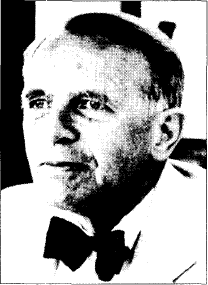
Wilhem Röpke
1899–1966
Röpke was born on October 10, 1899, at Schwarmstedt in Hanover, Germany. He was the son of a physician who brought him up in the classical and Protestant Christian tradition. Serving in the German army during World War I, he was shocked by the sheer brutality of war, and it had a profound effect on his life. He became, in his words, “a fervent hater of war; of brutal and stupid national pride, of the greed for domination and of every collective outrage against ethics.”3
Consistent with intellectual trends, Röpke initially blamed war on capitalist imperialism and was drawn toward socialism as its only alternative. But he had a change of mind after reading Ludwig von Mises’s Nation, State, and Economy, published in 1919. That work was “in many ways the redeeming answer to the many questions tormenting a young man who had just come back from the trenches.”4 A socialist economy was, necessarily, a centrally-planned economy. Such a regime would seriously hinder international trade, which generates cooperation between nations and decreases the likelihood of war. The only form of socialism compatible with international trade, he concluded, is the national variety, which Röpke could not abide. He then recognized socialism for what it is: collectivism through empowerment of the state.
A drive to understand the causes and crisis of World War I led Röpke to pursue the study of economics and sociology. He studied economics at the University of Marburg, receiving his doctorate in 1921 and the Habilitation in 1922. The following year he married Eva Finke, and they raised three children. His first academic position was at Jena in 1924. Two years later, at the Vienna Convention of the German Association for Sociology, he met Ludwig von Mises.5 Röpke moved to Graz in 1928 and became a full professor at his alma mater in Marburg in 1929.
Following the political victories of the Nazis in 1932, his uncompromising opposition to fascism earned him the honor of being one of the first professors to be forced out of his job. Röpke left Marburg for Frankfurt; and soon after giving a public address highly critical of the Nazis in early 1933,6 he and his family left his homeland. Röpke then accepted an offer to become professor of economics at the University of Istanbul.
Röpke taught at Istanbul from 1933 to 1937, when he accepted a position at the Institute of International Studies in Geneva, Switzerland. There he joined Ludwig von Mises, who had been a part of the Institute’s faculty since 1934. Although Mises left Geneva for the United States in 1940 following the beginning of World War II, Röpke chose to stay and remained at the Institute until his death in 1966. To restore the broadest possible understanding of freedom, Röpke, along with Mises and F.A. Hayek, called an international meeting of historians, philosophers, economists, and journalists who shared his concern over the steady erosion of liberty; and in 1947 this group formed the Mont Pèlerin Society.
Through the Society, Röpke was able to meet with and influence the thinking of Ludwig Erhard, economics minister and Chancellor of West Germany. Erhard later revealed that during World War II he was able to illegally obtain Röpke’s books, which he “devoured like life-giving water in the desert.”7 The product of Röpke’s influence on Erhard has been tagged the post-World War II “German Economic Miracle,” although Röpke pointed out that the economic success experienced by West Germany was not a miracle at all; it was the result of adopting correct social and legal institutions fostering the market economy. Looking back at the West German economic policies of the 1950s, he lamented that free-market reforms had not gone far enough.8
FASCISM
Röpke’s early work outlined themes that would recur throughout his career: the curses of collectivism and scientism and the central importance of moral and social institutions that sustain the free society. His 1931 analysis of fascist economics,9 published under the pseudonym Ulrich Untried, protested against anti-capitalist intellectuals who were using the world-wide depression to pave the way for national socialism. The “capitalism” that the anti-capitalists rail against, he wrote, was not free-market capitalism but state corporatism, characterized by sporadic interventions and government-business partnerships.
And in order to refloat the economy whose functioning has been so largely impaired by past interventions, those same critics of capitalism clamor for more interventions, more planning, and hence a further emasculation of our economy. It is as though one poured sand into an engine and then hoped to start it up again by pouring in more sand.10
To avoid conflicting meanings, Röpke used the term “market economy” instead of “capitalism.” He also rejected denoting socialism as a “planned economy”—every economy is planned, he said; the question is whether it is planned by entrepreneurs and free people, or by the state. Instead, he found it more accurate to refer to a collectivist system as an “office economy.”11
Röpke recognized that as a social and economic system, fascism is not a third way between the free market and communism.12 It is merely another form of totalitarianism that sought to “combine its general totalitarianism with the individualistic character of society.”13 Such a middle-of-the-road policy created an extreme interventionist state whose chief production agent was the government-created monopolist.
Fascism has a grave moral defect, Röpke argued: it fails to recognize the individual as the key social unit.14 Correct economic reasoning, he said, begins not with the nation but with human action; and correct social policy begins with the recognition that society is made up of individual souls. Fascism, on the other hand, by ignoring the individual soul, is socialism’s close cousin because it exults in the idolatry of the state.15
BUSINESS CYCLES
Much was written in the early 1930s regarding the depression, its causes, and remedies, and in 1936 Röpke gave the English-speaking world his own contribution, Crises and Cycles.16 Using the monetary and capital theories of Böhm-Bawerk, Mises, Strigl, and Hayek, Röpke backed the view that the initial downturn was the result of prior credit expansion on the part of the central bank. He noted that “modern trade-cycle theory is indeed unanimous concerning the fundamental principle that the alternation of boom and depression is first and foremost an alteration in the volume of long-term investments and thus in the activity in the industries producing capital goods.”17Röpke traced the existence of economic downturns to the existence of a complex division of labor, which makes possible the “roundaboutness” of production, combined with an overinvestment in higher-order goods spurred on by credit expansion.18
In his textbook, The Economics of a Free Society, first published in German in 1937, he further clarified his point. For such overinvestment to occur, he wrote, “some sort of compulsion will be required to loosen the bond which ties capital goods production to the voluntary savings of the population, and to raise the relative restriction of consumption above the point which the population itself is prepared to undergo via its savings.”19 In short, the boom of the boom-bust trade cycle will not occur on the free market; it is the result of state intervention in credit markets skewing investment decisions.20
A developed division of labor and capital overinvestment can also exist in a planned economy, he argued, so socialism would not be immune to economic downturns. In fact, such a system would be even more unstable. “In a socialistic society it [forced saving] maybe replaced by open force exerted by the state, with the effect that the population would be driven, directly and authoritatively, to forego possibilities of consumption in favor of accumulation.”21 Additionally, a collectivist economy will not have a mechanism by which unwise investments are liquidated, causing economic disruptions to persist. “The economic disharmony which promises to become a chronic ailment of the socialist economy will be markedly different from the temporary disharmonies of the capitalist economy.”22
To prevent business cycles, Röpke argued, requires a free market, a gold standard, and no government-created monetary inflation. At the same time, Röpke did not rule out credit expansion or reflation as possibly necessary to move the economy out of a depression,23 a policy not unlike that advanced by later monetary disequilibrium theorists.24 Demonstrating uncommon integrity, Röpke later recanted his early acceptance of this Keynesian-style policy.25
CRITIQUE OF KEYNES
In the East, collectivism took the form of full-blown socialism. In Germany and Italy, fascism rose and fell. But the post-war West was not immune to the call of collectivism, and Röpke saw Keynesian economics as paving the way. He argued that the Keynesian program was destructive in both its economic and moral consequences.
In a 1952 critique of the United Nations Report on National and International Measures for Full Employment, Röpke warned that if governments keep interest rates perpetually low, as the “new economics” recommended, chronic inflation is the necessary consequence.26 Röpke foresaw that a fully implemented “full-employment” policy would result in “stagflation,” which the United States experienced in the 1970s. Additionally, chronic inflation creates political pressure for repressed inflation.
Having lived through Germany’s hyperinflation, Röpke feared the consequences of an unrestrained monetary authority. He developed a theory of repressed inflation based on interventionism and the Austrian theory of economic calculation. The government monetary authorities first inflate the money supply and then impose price and other economic controls in order to mitigate the consequent rise in prices. This only makes things worse, for, as the Austrians demonstrated during the socialist calculation debate, market prices are crucial for rational economic planning on the part of entrepreneurs. The result is that official prices do not reflect actual economic values, and the economy is riddled with bottlenecks, sporadic unemployment, and general economic chaos.27 This repressed inflation was a major feature of post-war European economies.
Röpke viewed inflation as a Keynesian means for transferring wealth. When a central bank inflates the money supply, the new money always enters the economy in the hands of particular individuals. They are the first ones to spend the new money, making their purchases at the original price levels, happy that their wealth has seemingly increased. As the new money works itself through the economy, however, increased demand for goods results in increased prices. Those who receive the new money later or not at all must pay the higher prices and incur a decrease in their real wealth. Explaining this Austrian insight within his moral framework, Röpke argued that this amounts to little more than legalized theft and redistribution.28
For Röpke, however, Keynes’s positivistic-scientistic method was an even more damaging part of his legacy. In a critique of Keynes, included in the final 1963 edition of his revised text The Economics of a Free Society, Röpke pinpointed one of Keynes’s most dangerous ideas. Keynes and his followers saw the economic system as part of a mathematical-mechanical universe, with economic activity being the product of quantifiable aggregates, such as consumption and investment, instead of a result of actions by individuals. Keynes took the human out of “human action” and reduced the economic system to a machine.29 Man became a mere social unit, merely reacting to changed conditions according to economic instincts.30
Keynes’s focus on the management of economic aggregates fed the hubris of modern economists by justifying their role as the keepers of the keys to the economic kingdom. Keynesian economists, making Gross National Product their highest end, were advocating an economic variant of scientism.31 Such economism leads to collectivism, according to Röpke, because it banishes from consideration humane values such as liberty and peace, and justifies government coercion to tax funds from individuals in the name of “growing the economy.”32
WELFARE, DOMESTIC AND INTERNATIONAL
After the war, the United States Congress and the Truman administration passed the Marshall Plan, which pledged the largest ever transfer of foreign aid to help rebuild war-torn Europe, a plan wholly embraced by intellectual and political establishments on both sides of the Atlantic. But Röpke dissented from this conventional view on grounds that European economic recovery would not be brought about by foreign aid but through a restoration of the market economy that had been hampered during the war. The problem of economic disorder, he said, is the result of repressed inflation, a “policy that created chaos in the name of planning, confusion in the name of guidance, retrogression and autarky in the name of progress, and mass poverty in the name of justice.”33 Regardless of U.S. aid,
it will still be up to every beneficiary country in Europe whether or not to avail itself of this unique opportunity for liberating the economy from inflationary controls. Unless this is done, however, it is to be feared that the new American billions will trickle away just as the old ones did.34
What’s more, Marshall Plan aid could have the deleterious effect of forestalling market reform. The aid would not likely be used to make a transition to the market possible, but rather to subsidize and entrench the current system. In the regions of Europe for which the U.S. government was responsible—for example the American-occupied zone of Germany—the U.S. had “for two-and-a-half years applied economic principles that cannot be described otherwise than as collectivist.”35 Röpke reminds his European readers that the American economy itself was in many ways planned, inflationary, and collectivistic. “A whole generation of American economists, after all, has been brought up to think of the permanent inflationary pressure implied in the ‘full employment’ policy as an ideal and indeed a necessity.”36
In 1958, as Western economies began to replace outright planning and price control with wealth redistribution, Röpke wrote a blistering assault on the welfare state. He cited not only the costs of the welfare state, which far exceed its supposed benefits, but also the social effects. Compulsory aid “paralyzes people’s willingness to take care of their own needs,” and its financial burden makes people depend more on the state and expect more from it. “To let someone else foot the bill” is the “very essence” of the welfare state; moreover, the people who pay are “forced to do so by order of the state”—the opposite of charity.
In spite of its alluring name, the welfare state stands or falls by compulsion. It is compulsion imposed upon us with the state’s power to punish noncompliance. Once this is clear, it is equally clear that the welfare state is an evil the same as each and every restriction of freedom.37
MONOPOLY
Röpke was a relentless critic of the tendency towards bigness in economic and political life. And he was one of the earliest modern economists to point out that, like the business cycle, monopoly is not a product of the free market, but a result of government intervention.38 As early as 1936, he documented that the free market was generating competition, not monopolies. In a later defense of the market economy, Röpke maintained that market capitalism is not bigness per se. Similarly, proper legal institutions are those that foster a truly free market, not “big business” in the name of efficiency.39 He argued that monopolists were able to maintain their position in the market due to legal privileges, and he concluded that government regulation cannot work as a cure for economic concentration. On the contrary, it is the office economy that tends toward concentration. The collectivist economy leads to the politicization of all economic life, resulting in national monopolies and all economic decisions in the hands of central planners.40
It is in this context that we must consider Röpke’s remarks on the negative consequences of capitalism as it developed historically. Röpke occasionally used strident language to criticize how the rise of capitalism also fed forces of monopoly and urbanization. But these negative consequences are not, however, to be attributed to free-market capitalism, but should be seen instead as a holdover from the feudal system. Economic power was concentrated, not because the free market necessarily led to such concentration, but because pre-liberal property arrangements went largely unchanged after the free-market system developed. Feudal lords enjoyed certain social and legal privileges over the serfs, and these were not abolished with the rise of capitalism. Murray N. Rothbard has recognized a similar problem regarding desocialization in the former Soviet Union.41 While opposing some aspects of industrialization, Röpke criticized by what he called “agricultural nationalism,” the drive to keep industrialization at bay for the sake of protecting traditional ways of life at the expense of social progress.42
Röpke attacked all manner of interventionist policies not just those that stopped short of socialism. Intervention creates more problems than it solves. “The more stabilization, the less stability.”43 Like Mises, Röpke pointed out that pursuing an interventionist policy of price controls, trade quotas, and exchange controls starts “a chain of repercussions necessitating more radical acts of intervention until we finally arrive at a Collectivist Economy pure and simple.”44 Furthermore, such measures are doomed to failure because “economic life is dependent on the psychological attitude of countless individuals.”45 Economic agents make free choices. They are not cogs in a giant national economic machine.
POLITICAL THEORY
After World War II, Röpke turned his attention to promoting economic and political institutions that would prevent another world conflict. Building on his theory that centralization and decentralization are the two countervailing principles that determine all aspects of social and political life, he turned his energies to analyzing how these principles affect the international political order. Some type of international economic order is necessary. His colleague Mises had described the ideal of a classically liberal supranational state.46 But Röpke, recognizing the impracticality of such a state, attacked all plans for political integration, particularly those that called for a European-wide regulatory power.
A supranational or multinational government is not likely to embrace the liberal ideal because a political regime insulates itself from the people it rules. It grows increasingly oppressive and corrupt, raising up welfare states and trampling on private property. For this reason, the centralization of decisionmaking power is incompatible with free-market economies. As the alternative, Röpke embraced the nineteenth-century “universalist-liberal” solution to the problem of an international order: vibrant commerce between politically autonomous small states.47 In order to allow for international trade to take place, a truly international monetary system is necessary. Instead of a worldwide currency, national currencies backed by a non-political gold standard should serve as the arbiter of exchange.
Röpke agreed with other economists in the Austrian tradition regarding the importance of international trade to peaceful cooperation between nations. Protectionism undermines the division of labor, inhibits productivity, and reduces income, and, if carried far enough, transforms a nation’s economy into a type of giant firm, with all of its monopolistic drawbacks. Moreover, Röpke distinguished between international trade and international political intervention. Free trade and imperialism are not linked but are opposed to one another. It is possible to sacrifice economic liberty in the name of international trade or economic development. For example, pushing other countries to buy an exporting nation’s goods is contrary to the Röpkeian ideal.48 Government control of “investment,” whether domestically or internationally, is never a wise path, especially not in underdeveloped countries. What these countries need is not capital or technology per se, but the cultural and social conditions allowing for development (i.e., private property rights enforced by a morally just legal system).
The decentralization of the political process, Röpke argued, is incompatible with mass democracy. Under democracy, politicians are prone to be swayed by masses of privately interested voters, so that the economic system degenerates into a spoils system where the victors are the mass that can muster fifty-one percent of the vote.49 Such a system only serves to bring about and legitimize centralized power. The only legitimate government is a government by rulers that are widely recognized as competent and socially beneficial.50 If the political system is decentralized, those who are the most capable and are recognized as possessing the most integrity would be those who the various locales would allow to rule for any length of time.51
SOCIAL THEORY
During and following World War II, Röpke broadened his research interests beyond economic and political theory and into cultural and even religiously based analytics. His resulting critique of modern society developed out of his conviction that trends in the sciences and politics were undermining and even destroying the idea of the individual soul and replacing it with the concept of mass man. Röpke began to concentrate on this problem with more focus beginning in 1942 with the publication of the book that would later be translated into English as The Social Crisis of Our Time. He sought to trace the evolution of thought and action that led to the crisis of collectivism he saw, and sought to defend freedom in the face of statism of all stripes.
Röpke was also skeptical of the role of the economist as social engineer, whether in promoting “efficiency” or “social justice.” He followed Mises’s method in viewing the economic agent as homo agens, a humans who acts, rather than homo oeconomicus, an individual motivated by purely material motives. “The ordinary man is not such a homo oeconomicus,” he writes, “just as he is neither hero nor saint. The motives that drive people toward economic success are as varied as the human soul itself.”52 Because life is indeed more than food, and the body more than raiment, one cannot look only to economics to provide a life worth living.
Röpke set out to defend liberty against leftist criticism by highlighting the fundamental social problem man has to face: how can conflicting interests in society be successfully harmonized? Individuals having different value scales are not immune to the temptation of taking advantage of others when they have the chance. Freedom and voluntary exchange are crucial if the conflicting interests of different parties are to be coordinated peacefully. Collectivism, on the other hand, necessarily means coercion and conflict between competing interests. But, for an individual to be truly free, he must have control over his economic will. For a society to take advantage of the division of labor, it is necessary to have an institutional framework that allows for a freely adjusting price mechanism and the private ownership of the tools of production and competition.53 Such is the only modern economic system that maintains the integrity of the individual person.
A prime virtue of the free market is that it erects a wall of separation between politics and society. Businessmen need not rely on government privilege or a party’s favor in order to enjoy financial security. The only way for even the most greedy entrepreneur to reap profits for any length of time is by rendering a valuable service to the consumer.54 Röpke writes, “Freedom, immunity of the economic life from political infection, clean principles and peace—these are the non-materialist achievements of the pure market economy.”55 Röpke, like Mises, likened the individual’s decisions to purchase or to refrain from purchasing as a daily ballot, electing the most successful entrepreneur. In fact, Röpke thought the market election more just and efficient than a political election, because the market is not a winner-take-all mechanism.56
Although Röpke was a critic of the ethics of materialism, he did not embrace intervention as a means to suppress displays of consumerism. For example, Röpke rejected the possibility of categorizing goods into “luxuries” and “needs” because the exercise
presupposes that bureaucracy knows better than the consumers what is good and useful. . . . In other words, the government has the astonishing audacity to require of us that we should prefer its arbitrary list of priorities to our own.57
All market activity, international or otherwise, presupposes a moral, social, and institutional framework; and Röpke identified religious convictions and natural hierarchy as institutions that have historically served as effective bulwarks against state power. In order for individuals to retain their freedoms, continually expand the division of labor, and live full lives, they must own property, embrace family and community, participate in civic associations and churches, and enjoy the security of certain traditions. These points, he thought, were too often neglected in classically liberal literature. Röpke writes:
The market economy, and with it social and political freedom, can thrive only as a part and under the protection of a bourgeois system. This implies the existence of a society in which certain fundamentals are respected and color the whole network of social relationships: individual effort and responsibility, absolute norms and values, independence based on ownership, prudence and daring, calculating and saving, responsibility for planning one’s own life, proper coherence with the community, family feeling, a sense of tradition and the succession of generations combined with an open-minded view of the present and the future, proper tension between individual and community, firm moral discipline, respect for the value of money, the courage to grapple on one’s own with life and its uncertainties, a sense of the natural order of things, and a firm scale of values.58
From his earliest years, Wilhelm Röpke fought collectivist and statist power in every way an intellectual could. His tools included not only economic theory but also a vision of moral goodness rooted in Christian faith. As Hayek said of Röpke: “let me at least emphasize a special gift for which we, his colleagues, admire him particularly—perhaps because it is so rare among scholars: his courage, his moral courage.”59 If we are concerned about fostering societies where people can live more humane lives, Röpke’s advances in both Austrian economics and his vision of the good society deserve close attention.
SELECTED READINGS
Röpke, Wilhelm. 1987. “The Problem of Economic Order.” In Two Essays by Wilhelm Röpke. Johannes Overbeek, ed. Lanham, Maryland: University Press of America. Pp. 1–45.
——. [1966] 1977. “The Economics of Full Employment.” In The Critics of Keynesian Economics. Henry Hazlitt, ed. New Rochelle, N.Y.: Arlington House. Pp. 370–74.
——. 1969. Against the Tide. Chicago: Henry Regnery.
——. 1964. Welfare, Freedom, and Inflation. Tuscaloosa: University of Alabama Press.
——. 1963. Economics of the Free Society. Chicago: Henry Regnery.
——. 1960. A Humane Economy. Chicago: Henry Regnery.
——. [1942] 1978. International Economic Disintegration. Philadelphia: Porcupine Press.
——. 1959. International Order and Economic Integration. Dordrecht, Holland: D. Reidel Publishing.
——. 1950. The Social Crisis of Our Time. Chicago: University of Chicago Press.
——. 1948. Civitas Humana. London: William Hodge.
——. 1947. “Repressed Inflation.” Kyklos 1.
——. 1936. Crises and Cycles. London: William Hodge.
——. 1936. “Socialism, Planning, and the Business Cycle.” Journal of Political Economy 44, no. 3 (June).
——. 1935. “Fascist Economics.” Economica (February): 85–100.
_______________
60George H. Nash, The Conservative Intellectual Movement in America (Wilmington, Del.: Intercollegiate Studies Institute, 1996), pp. 166–67.
61W.H. Hutt, The Keynesian Episode: A Reassessment (Indianapolis, Ind.: Liberty Press, 1979), p. 265.
62Wilhelm Röpke, International Order and Economic Integration (Dordrecht, Holland: D. Reidel Publishing, 1959), p. 3.
63Quoted in Richard Ebeling, “Introduction” to Ludwig von Mises, Money, Method, and the Market Process (Norwell, Mass.: Kluwer, 1990), p. xxv.
64In Mises’s personal memoir, he listed Röpke as one of a handful of German intellectuals “whose company enriched me greatly.” See Ludwig von Mises, Notes and Recollections (Spring Mills, Penn.: Libertarian Press, 1978), pp. 104–05.
65Wilhelm Röpke, “End of an Era?” in idem, Against the Tide (Chicago: Regnery, 1969), pp. 79–97.
66Quoted in Gottfried Dietze,“Forward” to Against the Tide, p. ix.
67Wilhelm Röpke, A Humane Economy (Chicago: Henry Regnery, 1960), p. 28.
68Reprinted as “The Intellectuals and Capitalism” in Röpke, Against the Tide, pp. 25–44.
69Ibid., p. 31.
70Wilhelm Röpke, “The Problem of Economic Order,” in Two Essays by Wilhelm Röpke, Johannes Overbeek, ed. (Lanham, Maryland: University Press of America, 1987), pp. 1–45.
71Wilhelm Röpke, “Fascist Economics,” Economica (February 1935): 85–100. Röpke sums up his analysis: “Fascist Economics has nothing new to offer, whether in practice or in theory. The present position of our economic system is certainly untenable, but the alleged alternative which Fascist Economics seems to present is no real alternative at all.” Also see Ludwig von Mises, A Critique of Interventionism (New Rochelle, N.Y.: Arlington House, 1977), pp. 107–38.
72Ibid., p. 91.
73Röpke, in A Humane Economy, p. 5, explains:
[m]y picture of man is fashioned by the spiritual heritage of classical and Christian tradition. I see in man the likeness of God; I am profoundly convinced that it is an appalling sin to reduce man to a means (even in the name of high-sounding phrases) and that each man’s soul is something unique, irreplaceable, priceless, in comparison with which all other things are as naught. I am attached to a humanism which is rooted in these convictions and which regards man as the child and image of God, but not as God himself, to be idolized as he is by the hubris of a false and atheist humanism. These, I believe, are the reasons why I so greatly distrust all forms of collectivism.
74Röpke, Against the Tide, pp. 93–94. In one of his last lectures delivered before his leaving Germany, he protested that “Men are gripped by a desire to be told what to do and to be ordered about, to the point almost of masochism. The state has become the subject of unparalleled idolatry.”
75Wilhelm Röpke, Crises and Cycles (London: William Hodge, 1936). This is a revised and extended English translation of his work, Krise und Konjunktur, which was published in 1932, while Röpke was still in Germany.
76Röpke, Crises and Cycles, p. 25.
77Röpke summarizes his theory:
The cause of a major disequilibrium of the economic process is an excess of real investments in fixed and working capital in the sense that the rate of investment has increased in a great volume and in a quicker tempo than is compatible with the preservation of economic equilibrium. The proportion in which the productive forces of the economic system are being devoted to the production of consumption goods or that of capital goods, i.e., the proportion between consumption and accumulation can vary, in magnitude and tempo, only within rather narrow limits without engendering disruption and lack of coordination.
“Socialism, Planning, and the Business Cycle,” Journal of Political Economy (June 1936): 325.
78Wilhelm Röpke, Economics of the Free Society (Chicago: Henry Regnery, 1963), p. 213.
79For an application of the Röpkeian theory of the business cycle to modern finance, see James Grant, The Trouble with Prosperity (New York: Times Books, 1996), pp. 115–60.
80Wilhelm Röpke, “Socialism, Planning, and the Business Cycle,” Journal of Political Economy 44, no. 3 (June 1936): 328–29.
81Ibid., p. 321.
82Ibid., pp. 185–98. Röpke saw credit expansion during a severe crisis as a type of “conformable intervention.” On pp. 196–97, he says:
We must know that, whether we like it or not, we are dependent on the entrepreneurs and their optimistic mood, that we must not drive them to exasperation and at the same time be surprised that recovery will not come. . . . The issue between laissez-faire, a conformable trade-cycle policy [credit expansion during a crisis] and Planning [price and product controls] may be summed up as follows. In certain circumstances it is just as wrong to rely on the natural respiration of economic life resuming automatically as it is wrong to club it to death and then to make attempts at replacing the natural organism by an artificial one made of tin and wire. Both the uncompromising Liberal and the Planner—each is wrong where the other is right, and right where the other is wrong.
83Leland B. Yeager, The Fluttering Veil: Essays on Monetary Disequalibrium (Indianapolis, Ind.: Liberty Fund, 1997), pp. 15–17.
84Röpke, A Humane Economy, p. 295. In a footnote, Röpke writes,
I am ashamed to say that I must take my share of the blame for creating this concept of “functional finance” (Krise und Konjunktur [1932] and my subsequent book Crises and Cycles [1936]), but I am forced to admit now that it has stood the test neither of counter-arguments nor of experience.
85Wilhelm Röpke, “The Economics of Full Employment,” in The Critics of Keynesian Economics, Henry Hazlitt, ed. (New Rochelle, N.Y.: Arlington House [1960] 1977), pp. 370–74.
86Wilhelm Röpke, “‘Repressed Inflation’: The Ailment of the Modern Economy,” in Röpke, Against the Tide, pp. 111–31.
87Röpke, A Humane Economy, p. 191.
88Röpke, The Economics of the Free Society, p. 224. Elsewhere, Röpke writes concerning Keynesian economic policy, “economic policy would thus, indeed, attain the dignity of engineering, without regard to the fact that society can never be made into a machine nor can statistics succeed morality as a guide to behavior or policy.” “The Economics of Full Employment,” p. 369.
89F.A. Hayek, The Counter-Revolution of Science (Indianapolis, Ind.: Liberty Press, [1952] 1979).
90Regarding the connection between scientism and collectivism see Wilhelm Röpke, Civitas Humana (London: William Hodge, 1948), pp. 67–72. See also Hayek, The Counter-Revolution of Science, pp. 93–110.
91Regarding government capital formation, Röpke writes,
We are at one of the great crossroads, where decisions of almost incalculable implications have to be made. It is here that we must make our stand if we are to succeed in stemming the sinister, trampling march of a proletarianized mass society with its mechanized, compulsory social welfare system and its ultimately inevitable goal of a totalitarian mammoth state. This demands, above all else, that the center of gravity in the responsibility for people’s lives should be shifted from the state back to where it belongs by all standards of common sense and historical experience—to the individual surrounded by his family, to free organizations, to the broad masses of the people themselves. (“The Formation and Use of Capital,” in Against the Tide, p. 162.)
92Wilhelm Röpke, “Marshall Plan and Economic Policy,” in Against the Tide, p. 123.
93Ibid., p. 126.
94Ibid., p. 127.
95Ibid., p. 128.
96Wilhelm Röpke, “Robbing Peter to Pay Paul: On the Nature of the Welfare State,” Against the Tide (Chicago: Regnery, 1969), p. 212.
97Röpke’s position on this seems to have evolved over time. While he did maintain in some earlier writings that monopolists could maintain their position in a free market, and that antitrust laws were necessary (see The Social Crisis of Our Time, p. 179), he later came to the conclusion that perpetual monopoly was the product of government privilege. In his next-to-last book (A Humane Economy), pp. 241–42, he writes that
it is of no avail to look to government for new compulsion and new legislation, which would only accelerate centrism elsewhere. . . . There is a lot more to be said about economic concentration, especially with respect to taxation and company law, than I said in my earlier works. . . . [T]he government itself, by means of its laws, its tax system, and its economic and social policies, continuously and injudiciously weights the scale in favor of industrial concentration. This has nothing to do with the frequently overstated technical and organization advantages of scale.
98Röpke, Civitas Humana, p. 30.
99Röpke, “The Problem of Economic Order,” p. 21.
100In a discussion about granting ownership shares to factory workers, Rothbard writes, “A problem immediately arises in granting shares to workers in the factories. . . .Should the managing nomenklatura be cut in on the shares of ownership?” He goes on to add,
A. . . commonly suggested route to privatization deserves to be rejected out of hand: that the government sell all its assets to the public at auction, to the highest bidder. . . .[W]hy does the government deserve to own the revenue from the sale of these assets? After all, one of the main reasons for deserialization is that the government does not deserve to own the productive assets of the country. But if it does not deserve o own the assets, why in the world does it deserve to own their monetary value?
Rothbard, Murray, “How and How Not to Desocialize,” Review of Austrian Economics 6, no. 1 (1992): 74–75.
101Wilhelm Röpke, International Economic Disintegration (Philadelphia: Porcupine Press, [1942] 1978), pp. 150–61.
102Röpke, Economics of the Free Society, p. 219.
103Ibid., p. 195
104Röpke, International Economic Disintegration, p. 176.
105Ludwig von Mises, Omnipotent Government: The Rise of the Total State and Total War (Spring Mills, Penn.: Libertarian Press, [1944] 1985), pp. 265–71; Liberalism (Irvington-on-Hudson, N.Y.: Foundation for Economic Education, 1996), p. 148.
106Röpke, International Order and Economic Integration, p. 74.
107In Ibid., p. 84, Röpke says,
[I]mperialism is not only not an essential component of capitalism, but, quite apart from all the economic links in the chain of cause and effect, is a concomitant which is foreign to, and even opposed to, the capitalistic system. A bellicose policy by no means furthers the interests of capitalism, but is directly opposed to them. An economic system which rests upon division of labor and exchange needs peace if it is to flourish.
108In A Humane Economy, p. 220, Röpke writes,
Democracy . . . degenerates into arbitrariness, state omnipotence, and disintegration whenever the decisions of government, as determined by universal suffrage, are not contained by the ultimate limits of natural law, firm norms, and tradition. It is not enough that they should be laid down in constitutions; they must be so firmly lodged in the hearts and minds of men that they can withstand all onslaughts.
109Röpke, Civitas Humana, p. 86.
110This line of thought has been extended in the writings of Hans-Hermann Hoppe. See Hoppe, Natural Elites, Intellectuals, and the State, (Auburn, Ala.: Ludwig von Mises Institute, 1995); idem,” The Political Economy of Monarchy and Democracy, and the Idea of a Natural Order,” Journal of Libertarian Studies 11, no. 2 (Summer 1995): 94–121.
111Röpke, A Humane Economy, p. 121.
112Ibid., p. 102–04.
113Ibid., p. 105.
114Ibid., p. 108.
115Röpke, in The Social Crises of Our Time, p. 103, writes,
The process of the market economy is, so to speak, a plebiscite de tous les jours, where every monetary unit spent by the consumer represents a ballot, and where the producers are endeavoring by their advertising to give “election publicity” to an infinite number of parties (i.e., goods). This democracy of consumers has the . . . great advantage of a perfect proportional system: there is no nullifying of the minorities’ will by the majority, and every ballot carries its full weight. The result is a market democracy, which in its silent precision surpasses the most perfect political democracy.
See also Ludwig von Mises, “Profit and Loss,” in Planning for Freedom (South Holland, Ill.: Libertarian Press, [1952] 1980), pp. 108–50.
116Röpke, Against the Tide, p. 145.
117Röpke, A Humane Economy, p. 98.
118F.A. Hayek, The Fortunes of Liberalism: Essays on Austrian Economics and the Ideal of Freedom, vol. 4, The Collected Works of F.A. Hayek, Peter G. Klein, ed. (Chicago: University of Chicago Press, 1992), p. 197.
- 1Two recent examples are the review article by Israel M. Kirzner, “Entrepreneurial Discovery and the Competitive Market Process: An Austrian Approach,” Journal of Economic Literature 35, no. 1 (March 1997): 60–85; and Sherwin Rosen, “Austrian and Neoclassical Economics: Any Gains From Trade?” Journal of Economic Perspectives 11, no 4. (Fall 1997): 139–52. Both of these journals are publications of the American Economic Association, indicating the degree to which Austrian ideas are at least recognized, if not embraced, by the profession’s mainstream.
- 2See Leland B. Yeager, “Austrian Economics, Neoclassicism, and the Market Test,” Journal of Economic Perspectives 11, no. 4 (Fall 1997): 153–65, for an insightful discussion on the challenges that an alternative to mainstream ideas faces in the academic marketplace.
- 3See Karen I. Vaughn, Austrian Economics in America: The Migration of a Tradition (New York: Cambridge University Press, 1994), for a good discussion of the development of the modern Austrian School. Also see Murray N. Rothbard, “The Present State of Austrian Economics,” Money, Method, and the Austrian School, vol. 1, The Logic of Action (Cheltenham, U.K.: Edward Elgar, 1997).
- 4The first edition of Menger’s Principles of Economics was published in German in 1871. While it was generally recognized as a landmark contribution in economics, an English translation was not published until 1950.
- 5Murray N. Rothbard, in Ludwig von Mises: Scholar, Creator, Hero (Auburn, Ala.: Ludwig von Mises Institute, 1988), p. 13, notes that Mises’s early work on monetary theory, while controversial, was published in the Economic Journal, one of the leading mainstream economic journals of the time.
- 6Paul A. Samuelson, Economics, 9th ed. (New York: McGraw-Hill, 1973), p. 883.
- 7Diego de Covarrubias y Leyva, Omnia Opera (Venice, 1604),vol. 2, chap.4, p.131.
- 8Luis Saravia de la Calle, Instrucción de mercaderes (1544); republished in Colección de Joyas Bibliográficas (Madrid, 1949), p. 53. Saravia’s book addresses the business entrepreneur (in Spanish mercaderes) following a continental Catholic tradition that can be traced back to San Bernardino de Siena (1380–1444). See Rothbard, Economic Thought Before Adam Smith, pp. 81–85.
- 9Juan de Lugo (1583–1660), Disputationes de iustitia et iure (Lyon, 1642), vol. 2, d. 26, s. 4, n. 40, p. 312.
- 10Juan de Salas, Commentarii in secundam secundae D. Thomae de contractibus (Lyon, 1617), vol. 4, no. 6, p. 9.
- 11Jerónimo Castillo de Bovadilla, Práctica para corregidores (Salamanca, 1585), vol. 2, chap. 4, no. 49. See also the important comments on the scholastics and their dynamic concept of competition written by Oreste Popescu, Estudios en la historia del pensamiento económico latinoamericano (Buenos Aires: Plaza and Janés, 1987), pp. 141–59.
- 12Luis de Molina, De iustitia et iure (Cuenca, 1597), vol. 2, disp. 348, no. 4, and La teoría del justo predo, Francisco Gómez Camacho, ed. (Madrid: Editora Nacional, 1981), p. 169. Raymond de Roover, ignoring the work of Castillo de Bovadilla, acknowledges how “Molina even introduces the concept of competition by stating that concurrence or rivalry among buyers will enhance prices.” See his article “Scholastic Economics: Survival and Lasting Influence from the Sixteenth Century to Adam Smith,” Quarterly Journal of Economics 69, no. 2 (May1955): 169.
- 13Included in Covarrubias, Omnia Opera, vol. 1, pp. 669–710.
- 14Carl Menger, Principles of Economics (New York: New York University Press, 1981), p. 317.
- 15Martín Azpilcueta Navarro, Comentario resolutorio de cambios (Madrid: Consejo Superior de Investigaciones Científicas, 1965), pp. 74–75.
- 16See Jesús Huerta de Soto, “New Light on the Prehistory of the Theory of Banking and the School of Salamanca,” Review of Austrian Economics 9, no. 2 (1996): 59–81.
- 17Luis de Molina, Tratado sobre los cambios, Introduction by Francisco Gómez Camacho (Madrid: Instituto de Estudios Fiscales, 1990), p. 146. Also James Pennington’s memo dated February 13, 1826, “On the Private Banking Establishments of the Metropolis,” included as an Appendix in Thomas Tooke, A Letter to Lord Grenville; On the Effects Ascribed to the Resumption of Cash Payments on the Value of the Currency (London: John Murray, 1826).
- 18However, according to Father Bernard W. Dempsey, if the members of this second group of the School of Salamanca had had a detailed theoretical knowledge of the functioning and implications of the economic process to which fractional-reserve banking gives rise, it would have been described as a perverse, vast and illegitimate process of institutional usury, even by Molina, Lessius, and Lugo themselves. See Father Bernard W. Dempsey, Interest and Usury (Washington, D.C.: American Council of Public Affairs, 1943), p. 210.
- 19Quoted in ibid., p. 214, n. 31.
- 20Mariana, Discurso de las enfermedades de la Compañía, pp. 151–55, 216.
- 21See Leland B. Yeager, “Book Review,” Review of Austrian Economics 9, no. 1 (1996): 183, where he says:
- 22Jaime Balmes, “Verdadera idea del valor o reflexiones sobre el origen, naturaleza y variedad de los precios,” en Obras Completas (Madrid: B.A.C., 1949), vol. 5, pp. 615–24. Balmes also described the personality of Juan de Mariana with the following graphic words:
- 23Ibid., p. 51.
- 24Cantillon laid the groundwork for Turgot and the theory of profit. See Renee Prendergast, “Cantillon and the Emergence of the Theory of Profit,” History of Political Economy 23 (Fall 1991): 429.
- 25Cantillon, Essai, p. 49. His use of the word “naturally” shows that the changes he refers to cause a predictable change in price.
- 26Ibid., p. 53.
- 27Ibid., p. 31. When he refers to well-organized societies, Cantillon seems to be referring to an advanced market economy in which monetary exchange and banking services have been long and thoroughly established.
- 28Ibid., p. 97.
- 29Hülsmann, “Cantillon as a Proto-Austrian,” p. 3, defends Cantillon by noting he clearly did not think that market prices were determined by cost, in terms of land and labor, and that intrinsic value is merely being used as a measure of the quantity of land and labor. Cantillon thus avoided the errors of later economists who claimed that land and labor were measures of value. His views are similar to Austrian economists who hold that only exchange ratios and market prices permit economic calculation.
- 30Cantillon, Essai,p. 107.
- 31Hayek, “Richard Cantillon,” p. 263.
- 32Cantillon, Essai, p. 115. He does note, however, that a specific intrinsic value is one that does not change.
- 33This point was first suggested to me by Professor Hébert; see Hébert, “Was Richard Cantillon an Austrian Economist?” p. 272. Spengler also hints at this in Joseph J. Spengler, “Richard Cantillon: First of the Modems II,” Journal of Political Economy 62, no. 5 (October 1954): 407; also see Michael D. Bordo, “Some Aspects of the Monetary Economics of Richard Cantillon,” Journal of Monetary Economics 12, no. 2 (August 1983): 235–58.
- 34Cantillon, Essai, p.83.
- 35Brewer, “Cantillon and the Land Theory of Value,” p. 452; and Cantillon, Essai, p. 85.
- 36What Frenchman wouldn’t be concerned with this issue? Cantillon is clearly not against luxury per se, as he defines wealth as consumption on the first page of the Essai, including the conveniences and superfluities of life. What he is concerned with is production. It is not possible to continue to consume, or to consume greater amounts, without production. According to Cantillon, the comparative greatness of States is their reserve stock, which is savings measured in both money and materials in order to improve the State and to offset bad harvests and wars. For the State, gold is the true reserve stock, because with gold you can even buy the implements of war from your enemy. See Cantillon, Essai, pp. 89, 91.
- 37Vincent J. Tarascio, “Cantillon’s Theory of Population Size and Distribution,” Atlantic Economic Journal 9, no. 2 (July 1981): 12–18, is perceptive in noticing that Cantillon’s contribution was lost, and that neoclassical economics did not adopt the classical-population theory because real wages were clearly rising for a long time before the origins of neoclassical economics.
- 38See Cantillon, Essai, pt. 1, chaps. 7 and 8.
- 39See ibid., pt. 1, chap. 9; esp. Higgs, p. 25.
- 40Robert F. Hébert, “Richard Cantillon’s Early Contributions to Spatial Economics,” Economica 48, no. 189 (February 1981): 71–77.
- 41Hayek, Economic History, p. 264.
- 42See Bordo, “Some Aspects,” p.236; and Cantillon, Essai, pp. 111, 113.
- 43Likewise, if the money comes into the hands of spenders first, the increased consumption will stimulate investment demand and raise interest rates (as prices rise, the nominal rate will increase as well).
- 44Remember Cantillon was a banker. When he was charged with usury in the wake of the South Sea Bubble, part of his defense was to defend high interest rates.
- 45“Nothing is more amusing than the multitude of Laws and Canons made in every age on the subject of the Interest of Money, always by Wiseacres who were hardly acquainted with trade and always without effect.” Cantillon, Essai, p. 211.
- 46Anthony Brewer, “Cantillon and Mercantilism,” History of Political Economy 20, no. 3 (Fall 1988): 447–60.
- 47Hume was published before Cantillon, but we now know that Cantillon wrote before Hume, and that Hume had probably read Cantillon.
- 48Cantillon, Essai, pp.185, 323.
- 49Ibid., pp. 231, 233.
- 50Ibid., p. 319.
- 51Ibid., p. 323.
- 52See Hébert, “Was Richard Cantillon an Austrian Economist?” It is worth noting that the historians of economic thought who have hailed Cantillon’s accomplishments have been Austrian economists, such as Hayek and Rothbard, or have been fellow travelers and sympathizers, such as Schumpeter. An interesting fact is that a copy of the Essai can be found in Carl Menger’s library, and also a German language edition (1931) is in Ludwig von Mises’s library. It seems clear that the Austrian School drew much of its inspiration from Cantillon.
- 53Rothbard, Classical Economics, p. 23.
- 54One might also think of this as the rate at which an individual prefers to consume now as opposed to saving for the future.
- 55Say, Treatise, p. 348.
- 56Ibid., p. 116.
- 57Ibid., pp. xxxi, xl, 287.
- 58Ibid., p. 287.
- 59For a discussion of value that bears some strong similarities to Say’s, see Menger, Principles, pp. 114–21, 295–302.
- 60AT THE END of the twentieth century, the Austrian School of economics is exerting a significant influence both on the development of academic economics and on the application of economic theory to public policy. An increasing number of economics professors are sympathetic with the fundamental ideas of Austrian economics, and academic journals are taking more account of the Austrian School. A half century ago, few academic economists would even have been familiar with the Austrian School, except superficially, and among those who were, most would have disagreed with its methods and conclusions. Today, the ideas of Austrian economics are closer to the mainstream of economic thought, not because Austrian economics has changed, but because mainstream economics has moved toward the Austrian point of view. A similar shift has occurred in the public-policy arena. The policy implications of Austrian economics, once rejected as extreme, are now embraced as true. In the process, the Austrian School has become increasingly visible as an intellectual force.
- 61If the ideas of Austrian economics have made such inroads, one might wonder why, in the academic arena, Austrian economics does not play a bigger role. Part of the answer has to do with academic institutions themselves. Most university faculty teach at state institutions, which by itself may bias them toward supporting the state and being suspicious of laissez-faire ideas. Most university faculty have tenure, which slows the turnover of personnel, and perhaps of ideas. Furthermore, academic ideas find their outlets largely in academic journals, and the editorial boards of those journals tend to be controlled by the academic mainstream, further promoting mainstream ideas over alternative schools of thought. Because publication in academic journals is often a prerequisite for promotion and tenure in a university environment, academic survival often pushes young scholars in the direction of the mainstream methods and ideas in their discipline.
- 62Austrian economics has fought an uphill battle for acceptance for several reasons, but at the same time, the Austrian School has been gaining in strength, and is becoming more accepted in academia. A growing number of economics professors align themselves with the Austrian School, and even among those who do not, Austrian ideas are becoming more recognized and respected. Interestingly enough, the late-twentieth-century resurgence of interest in the Austrian School has been concentrated in the United States. This is largely due to Ludwig von Mises’s migration, and his Austrian economics seminar at New York University. One might go so far as to argue that the modern Austrian School would not exist were it not for the influence of Ludwig von Mises on his American students.
- 63Carl Menger is generally regarded as the founder of the Austrian School, but prior to about 1920, Austrian economics was not very different from economics in general. Economic theory had taken a great leap forward in the 1870s when the concept of marginal utility was independently discovered by Léon Walras, William Stanley Jevons, and Carl Menger. Each of these three individuals pushed the concept in different directions, but the integration of the marginal theory of value into economics was a major leap for all of economics. Eugen von Böhm-Bawerk’s capital theory, now seen as Austrian, was viewed more generally as a part of economics when it was published in the 1880s and 1890s, and Ludwig von Mises’s Theory of Money and Credit, published in 1912, established him as a leading authority on monetary economics.
- 64Carl Menger is generally regarded as the founder of the Austrian School, but prior to about 1920, Austrian economics was not very different from economics in general. Economic theory had taken a great leap forward in the 1870s when the concept of marginal utility was independently discovered by Léon Walras, William Stanley Jevons, and Carl Menger. Each of these three individuals pushed the concept in different directions, but the integration of the marginal theory of value into economics was a major leap for all of economics. Eugen von Böhm-Bawerk’s capital theory, now seen as Austrian, was viewed more generally as a part of economics when it was published in the 1880s and 1890s, and Ludwig von Mises’s Theory of Money and Credit, published in 1912, established him as a leading authority on monetary economics.
- 65From its low point in the middle of the twentieth century, Austrian economics has continued to gain visibility both inside academia and out. F.A. Hayek won the Nobel prize in economics in 1974, giving the Austrian School attention and respectability. By then, a small Austrian revival was already underway, led by Kirzner and Rothbard, and Hayek’s Nobel prize gave the revival additional momentum. Still, the Austrian School was branded by being on the losing side of the socialist calculation debate. In 1973, the year Mises died, Paul Samuelson, another Nobel laureate in economics and among the most prominent of mainstream academic economists, argued in his introductory textbook that even though the Soviet Union had roughly half the per capita income of the United States, their superior economic system based on central planning gave them faster growth. Based on this, Samuelson projected that per capita income in the Soviet Union could catch up to that of the United States as early as 1990, and almost surely by 2015. Keep in mind that Samuelson’s projection was in his best-selling introductory college textbook, and was the standard line taught in college classrooms at the time. Clearly, the mainstream had not accepted the ideas of Austrian economics.
- 66We should note how Mariana refers to the fact that the “common estimation” of men is the origin of the value of things, thus following the traditional subjectivist doctrine of the scholastics, which was initially proposed by Diego de Covarrubias y Leyva. Covarrubias (1512–1577), the son of a famous architect, became bishop of the city of Segovia and a minister to King Philip II. In 1554, he set forth better than anyone before the subjectivist theory of value, stating that “the value of an article does not depend on its essential nature but on the subjective estimation of men, even if that estimation is foolish,” illustrating his thesis with the example that “in the Indies wheat is dearer than in Spain because men esteem it more highly, though the nature of the wheat is the same in both places.”
- 67Covarrubias’s subjectivist conception was completed by another of his scholastic contemporaries, Luis Saravia de la Calle, who was the first to demonstrate that prices determine costs, not vice versa. Saravia de la Calle also had the special distinction of writing in Spanish, not in Latin. Its title was Instrucción de mercaderes (Instruction to merchants), and there we can read that “those who measure the just price by the labor, costs and risk incurred by the person who deals in the merchandise are greatly in error. The just price is found not by counting the cost but by common estimation.”
- 68The subjectivist conception initiated by Covarrubias also allowed other Spanish scholastics to get a clear insight of the true nature of market prices, and of the impossibility of attaining an economic equilibrium. Thus, the Jesuit Cardinal Juan de Lugo, wondering what the price of equilibrium was, as early as 1643 reached the conclusion that the equilibrium depended on such a large number of specific circumstances that only God was able to know it (“Pretium iustum mathematicum licet soli Deo notum”). Another Jesuit, Juan de Salas, referring to the possibilities of knowing specific market information, reached the very Hayekian conclusion that it was so complex that “quas exacte comprehendere et ponderare Dei est non hominum” (only God, not men, can understand it exactly).
- 69The subjectivist conception initiated by Covarrubias also allowed other Spanish scholastics to get a clear insight of the true nature of market prices, and of the impossibility of attaining an economic equilibrium. Thus, the Jesuit Cardinal Juan de Lugo, wondering what the price of equilibrium was, as early as 1643 reached the conclusion that the equilibrium depended on such a large number of specific circumstances that only God was able to know it (“Pretium iustum mathematicum licet soli Deo notum”). Another Jesuit, Juan de Salas, referring to the possibilities of knowing specific market information, reached the very Hayekian conclusion that it was so complex that “quas exacte comprehendere et ponderare Dei est non hominum” (only God, not men, can understand it exactly).
- 70Furthermore, the Spanish scholastics were the first ones to introduce the dynamic concept of competition (in Latin concurrentium), which is best understood as a process of rivalry among entrepreneurs. For instance, Jerónimo Castillo de Bovadilla (1547–?) wrote that “prices will go down as a result of the abundance, rivalry (emulación), and competition (concurrencia) among the sellers.”
- 71This same idea is closely followed by Luis de Molina. Covarrubias also anticipated many of the conclusions of Father Mariana in his empirical study on the history of the devaluation of the main coin of that time, the Castilian Maravedí. This study contained a compilation of a large number of statistics on the evolution of prices in the previous century and was published in Latin in his book Veterum collatio numismatum (Compilation on old moneys). This book was highly praised in Italy by Davanzaty and Galiani and was also quoted by Carl Menger in his Principles of Economics.
- 72This same idea is closely followed by Luis de Molina. Covarrubias also anticipated many of the conclusions of Father Mariana in his empirical study on the history of the devaluation of the main coin of that time, the Castilian Maravedí. This study contained a compilation of a large number of statistics on the evolution of prices in the previous century and was published in Latin in his book Veterum collatio numismatum (Compilation on old moneys). This book was highly praised in Italy by Davanzaty and Galiani and was also quoted by Carl Menger in his Principles of Economics.
- 73This same idea is closely followed by Luis de Molina. Covarrubias also anticipated many of the conclusions of Father Mariana in his empirical study on the history of the devaluation of the main coin of that time, the Castilian Maravedí. This study contained a compilation of a large number of statistics on the evolution of prices in the previous century and was published in Latin in his book Veterum collatio numismatum (Compilation on old moneys). This book was highly praised in Italy by Davanzaty and Galiani and was also quoted by Carl Menger in his Principles of Economics.
- 74as can be seen from experience, in France, where there is less money than in Spain, bread, wine, clothing, labor, and work cost much less; and even in Spain, at the time when there was less money, the things which could be sold and the labor and work of men were given for much less than after the Indies were discovered and covered her with gold and silver. The cause of which is that money is worth more where and when it is lacking than where and when it is in abundance.
- 75It is obvious that if Father Mariana had known the economic mechanisms that lead to the credit expansion process generated by banks and the effects of this process, he would have condemned these as robbery. He would have condemned not only the government debasement of coins but also the even more disturbing credit inflation created by banks. However, other Spanish scholastics were able to analyze the credit expansion of banks. Thus, de la Calle was very critical of fractional-reserve banking. He maintained that receiving interest was incompatible with the nature of a demand deposit, and that, in any case, a fee should be paid to the banker for keeping the money under his custody. A similar conclusion is reached by the more famous Navarro.
- 76Molina was sympathetic to fractional-reserve banking and confused the nature of two different contracts, loans and deposits, which Azpilcueta and Saravia de la Calle had clearly differentiated from each other previously. A more relevant aspect is that Molina was the first theorist to discover, in 1597 (therefore much earlier than Pennington in 1826), that bank deposits are part of the monetary supply. He even proposed the name “chirographis pecuniarium” (written money) to refer to the written documents that were accepted in trade as bank money. Our scholastics included, therefore, two incipient schools. The first is a kind of “Currency School,” formed by Saravia de la Calle, Azpilcueta Navarro, and Tomás de Mercado, who were very distrustful of banking activities, for which they implicitly demanded a one-hundred-percent reserve should be held. The second was a kind of “Banking School,” headed by the Jesuits Luis de Molina and Juan de Lugo, who were much more tolerant toward fractional-reserve banking. Both groups were to a certain extent the forerunners of the theoretical developments which were to arise three centuries later in England as a result of the debate between the Currency School and the Banking School.
- 77Molina was sympathetic to fractional-reserve banking and confused the nature of two different contracts, loans and deposits, which Azpilcueta and Saravia de la Calle had clearly differentiated from each other previously. A more relevant aspect is that Molina was the first theorist to discover, in 1597 (therefore much earlier than Pennington in 1826), that bank deposits are part of the monetary supply. He even proposed the name “chirographis pecuniarium” (written money) to refer to the written documents that were accepted in trade as bank money. Our scholastics included, therefore, two incipient schools. The first is a kind of “Currency School,” formed by Saravia de la Calle, Azpilcueta Navarro, and Tomás de Mercado, who were very distrustful of banking activities, for which they implicitly demanded a one-hundred-percent reserve should be held. The second was a kind of “Banking School,” headed by the Jesuits Luis de Molina and Juan de Lugo, who were much more tolerant toward fractional-reserve banking. Both groups were to a certain extent the forerunners of the theoretical developments which were to arise three centuries later in England as a result of the debate between the Currency School and the Banking School.
- 78that future goods are not valued so highly as the same goods available at an immediate moment of time, nor do they allow their owners to achieve the same utility. For this reason, it must be considered that they have a more reduced value in accordance with justice.
- 79Mariana concludes that, when there are many laws, “as not all of them may be kept or known, respect for all of them is lost.”
- 80Indeed, we could say that the greatest merit of Carl Menger was to rediscover and take up this continental Catholic tradition of Spanish scholastic thought that was almost forgotten and cut short as a consequence of the black legend against Spain and the very negative influence on the history of economic thought of Adam Smith and his followers of the British Classical School.
- 81It is not difficult to explain. Being the value of a thing its utility . . . if the number of units of this means increases, the need of any one of them in particular decreases; because being possible to choose among many units, none of them is indispensable. For this reason there is a necessary relation between the increase or decrease in value, and the shortage or abundance of a thing.
- 82The role of the entrepreneur is one of Cantillon’s great contributions to economic understanding. He speaks of the entrepreneur in the classic sense of the undertaker of great business adventures, but Cantillon also has a theoretical distinction between those who work for a fixed return or wages and those who face uncertain returns, including farmers, independent craftsmen, merchants, and manufacturers. These entrepreneurs purchase inputs at a given price to produce and sell later at an uncertain price. In the pursuit of profit, the entrepreneur must bear risks as he faces the pervasive uncertainty of the market. For example, the farmer has fixed expenses but:
- 83The role of the entrepreneur is one of Cantillon’s great contributions to economic understanding. He speaks of the entrepreneur in the classic sense of the undertaker of great business adventures, but Cantillon also has a theoretical distinction between those who work for a fixed return or wages and those who face uncertain returns, including farmers, independent craftsmen, merchants, and manufacturers. These entrepreneurs purchase inputs at a given price to produce and sell later at an uncertain price. In the pursuit of profit, the entrepreneur must bear risks as he faces the pervasive uncertainty of the market. For example, the farmer has fixed expenses but:
- 84The price of these products will depend partly on the weather, partly on demand; if corn is abundant relative to consumption it will be dirt cheap, if there is scarcity it will be dear. Who can foresee the number of births and deaths of the people in a State in the course of the year? Who can foresee the increase or reduction of expense that may come about in the families? And yet the price of the Farmer’s produce depends naturally upon these unforeseen circumstances, and consequently he conducts the enterprise of his farm at an uncertainty.
- 85The unsuccessful entrepreneur will live poorly or go bankrupt, while the successful entrepreneur will obtain a profit or advantage and cause entry into the market, “and so it is that the Undertakers of all kinds adjust themselves to risks in a State.” The entrepreneur brings prices and production into line with demand; in well organized societies, government officials can even fix prices of basic items without too much complaint.
- 86The unsuccessful entrepreneur will live poorly or go bankrupt, while the successful entrepreneur will obtain a profit or advantage and cause entry into the market, “and so it is that the Undertakers of all kinds adjust themselves to risks in a State.” The entrepreneur brings prices and production into line with demand; in well organized societies, government officials can even fix prices of basic items without too much complaint.
- 87Cantillon has a sophisticated understanding of the price system containing most of the elements of modern Austrian analysis. Price is determined by demand and relative scarcity. Demand is a subjective concept based on the “humors” and “fancies” of the people. It is the “consent of the people” along with the relative scarcity of a product that determines the market price, where market price is understood to be the price paid to the seller. Likewise, the market value of metals “varies with their plenty or scarcity, according to the demand.”
- 88Cantillon makes an important distinction between price and market price, and between value and market value, that has served as a source of confusion concerning the meaning of his economics. Market price and market value are the real prices that occur in the market based on forces of supply and demand. Price and value are separate and distinct concepts from market prices. They are related to Cantillon’s term “intrinsic value,” and are used to describe the opportunity cost of resources used to produce the particular good in question, the specific land and labor that were sacrificed to produce the good.
- 89in this Essai I have always used the term Intrinsic Value to signify the amount of Land and Labor which enter into Production, not having found any term more suitable to express my meaning. I mention this only to avoid misunderstanding.
- 90What is most significant about Cantillon’s achievement in the field of value and price theory is his down-playing the quest for rules and formulae that might account for the “normal” relationship between the value or price of various goods, and concentrating instead on the forces and mechanisms that are consistently at work in restoring these normal relationships.
- 91Cantillon’s conception of cost as the sacrifice of land and labor foregone is far more advanced than the land theory of cost and value advanced by the Physiocrats, or the labor theory of cost and value advanced by the classical economists. But Cantillon had a far richer understanding of cost than a simple measure of the quantity of land and labor that went into production. Cantillon stressed two important concepts throughout the Essai that provide greater depth to his conception of cost. First, Cantillon viewed all resources as heterogeneous. Each piece of land was of a different quality, and each laborer was also of a different quality. Therefore, while intrinsic value was a measure of cost, it was not possible in fact to simply count the number of hours and acres except in an abstract way or in simple illustrations. In fact, after establishing a preliminary land-and-labor theory of value in part one, he notes at the very beginning of part two that for specific goods in the real economy, it is “impossible to fix their respective intrinsic values.”
- 92The other concept that he stressed was the alternative use of resources. Land could be used to grow corn or to provide hay for horses. Labor could toil on the farm or be trained in a craft. Cantillon clearly saw that when a landlord chose to own more horses, what he was giving up was the production (and sale) of grain, and that if France wished to import fine lace, then she would have to forego a large amount of wine produced from her vineyards. Cantillon understood the concept of opportunity cost, and his Essai was an attempt to construct the concept to explain economic choice. The discovery of opportunity cost by this important precursor of the Austrian School truly marks the origin of economic theory.
- 93Cantillon took a scientific approach to population. He recognized that humans might multiply like “mice in a barn if they have unlimited means of subsistence,” or that population might fall substantially over time. Cantillon even recognized that international trade would affect the level and distribution of population, as land-poor countries could export manufactured goods to land-rich countries in return for food, fiber, and raw materials, and thus support a larger population than otherwise. Here, Cantillon is often mistakenly labeled a mercantilist, but Cantillon remains a value-free economist on the subject of population size. However, he does offer the prince technical advice of a nationalist nature on how to achieve a greater population, which supposedly is good for national defense. For example, he bemoans the export of large amounts of French wine in order to pay the very high market price of a small amount of lace imported from Brussels.
- 94Cantillon took a scientific approach to population. He recognized that humans might multiply like “mice in a barn if they have unlimited means of subsistence,” or that population might fall substantially over time. Cantillon even recognized that international trade would affect the level and distribution of population, as land-poor countries could export manufactured goods to land-rich countries in return for food, fiber, and raw materials, and thus support a larger population than otherwise. Here, Cantillon is often mistakenly labeled a mercantilist, but Cantillon remains a value-free economist on the subject of population size. However, he does offer the prince technical advice of a nationalist nature on how to achieve a greater population, which supposedly is good for national defense. For example, he bemoans the export of large amounts of French wine in order to pay the very high market price of a small amount of lace imported from Brussels.
- 95Cantillon took a scientific approach to population. He recognized that humans might multiply like “mice in a barn if they have unlimited means of subsistence,” or that population might fall substantially over time. Cantillon even recognized that international trade would affect the level and distribution of population, as land-poor countries could export manufactured goods to land-rich countries in return for food, fiber, and raw materials, and thus support a larger population than otherwise. Here, Cantillon is often mistakenly labeled a mercantilist, but Cantillon remains a value-free economist on the subject of population size. However, he does offer the prince technical advice of a nationalist nature on how to achieve a greater population, which supposedly is good for national defense. For example, he bemoans the export of large amounts of French wine in order to pay the very high market price of a small amount of lace imported from Brussels.
- 96Despite this, Cantillon’s analysis is far superior to those he influenced, like Malthus and Smith. They were concerned about population because, in their thinking, economic growth would result in a larger population of miserable people living at the subsistence level. According to Professor Tarascio, “Smith and Malthus do not reflect the spirit of Cantillon’s Essai. Hence the message has been lost to subsequent readers of the later authors.” Smith and Malthus extended the idea of the subsistence wage to industrial workers, while Cantillon recognized that there would be a tendency towards higher wages for trained workers or for those in risky occupations. In fact, Cantillon generally wrote of a maintenance wage that was not a subsistence wage at all, but rather a wage sufficient to maintain the worker in his current job. In his model, economic growth led to higher wages and a better standard of living.
- 97Despite this, Cantillon’s analysis is far superior to those he influenced, like Malthus and Smith. They were concerned about population because, in their thinking, economic growth would result in a larger population of miserable people living at the subsistence level. According to Professor Tarascio, “Smith and Malthus do not reflect the spirit of Cantillon’s Essai. Hence the message has been lost to subsequent readers of the later authors.” Smith and Malthus extended the idea of the subsistence wage to industrial workers, while Cantillon recognized that there would be a tendency towards higher wages for trained workers or for those in risky occupations. In fact, Cantillon generally wrote of a maintenance wage that was not a subsistence wage at all, but rather a wage sufficient to maintain the worker in his current job. In his model, economic growth led to higher wages and a better standard of living.
- 98Despite this, Cantillon’s analysis is far superior to those he influenced, like Malthus and Smith. They were concerned about population because, in their thinking, economic growth would result in a larger population of miserable people living at the subsistence level. According to Professor Tarascio, “Smith and Malthus do not reflect the spirit of Cantillon’s Essai. Hence the message has been lost to subsequent readers of the later authors.” Smith and Malthus extended the idea of the subsistence wage to industrial workers, while Cantillon recognized that there would be a tendency towards higher wages for trained workers or for those in risky occupations. In fact, Cantillon generally wrote of a maintenance wage that was not a subsistence wage at all, but rather a wage sufficient to maintain the worker in his current job. In his model, economic growth led to higher wages and a better standard of living.
- 99Another area in which Cantillon made an important contribution was spatial economics, a subject that permeated much of the Essai. Cantillon explained the economic geography of a state, the center of which was the capital city where the prince and government resided. Cities are regional centers with large markets and population, surrounded by market towns where the produce of the villages and farms are brought for sale. Cantillon explained that villagers bring their output to market in order to get the best price and to reduce transaction costs. He was masterful in using the role of transportation costs to explain why raw materials were more expensive near the cities, why heavy manufacturing was located near the source of raw materials, and why perishables should be produced near population centers. The role of transportation costs is a central issue in his writing on money and banking because the banker (like Cantillon himself) served as an intermediary to reduce the risk and transportation costs of shipping large amounts of money over great distances. Cantillon was the first economist to apply the principles of spatial economics in a general economic treatise. He “made original and lasting contributions to spatial economics . . . in the nature of first principles readily applicable to the fields of location theory and spatial pricing.”
- 100Cantillon’s successful career in banking played a major role in his monetary economics, which Hayek considered his greatest achievement. Cantillon was a hard-money man who understood that the nature of money as a medium of exchange drove the evolution of money to precious metals, and that princes cannot introduce imaginary money or successfully debase money. Central to his Austrian-style analysis was his rejection of the aggregate approach of the naive quantity theory of money in favor of a microeconomic-process approach to the study of the money. He showed that the type of change in the money supply and where it entered the economy were crucial to determining what the effects would be. A big gold discovery would raise the prices of goods demanded by gold mine owners and miners. Any large increase in money will give a new turn to consumption, thus changing relative prices, velocity, and the distribution of income.
- 101Cantillon’s successful career in banking played a major role in his monetary economics, which Hayek considered his greatest achievement. Cantillon was a hard-money man who understood that the nature of money as a medium of exchange drove the evolution of money to precious metals, and that princes cannot introduce imaginary money or successfully debase money. Central to his Austrian-style analysis was his rejection of the aggregate approach of the naive quantity theory of money in favor of a microeconomic-process approach to the study of the money. He showed that the type of change in the money supply and where it entered the economy were crucial to determining what the effects would be. A big gold discovery would raise the prices of goods demanded by gold mine owners and miners. Any large increase in money will give a new turn to consumption, thus changing relative prices, velocity, and the distribution of income.
- 102New money can also affect the interest rate if the money comes into the hands of lenders. Cantillon rejected the Lockean–mercantilist view that the rate of interest was a purely monetary phenomenon. Like Mises, he found that the interest rate was based on the forces of supply and demand in the market for loanable funds, and that if the new money increased supply it would lower the interest rate.
- 103Cantillon thoroughly describes the forces that cause changes in interest rates, and shows the interest rate to be a normal and important aspect of the economy. He defends the earning of high rates of interest via comparison to earning profits and rents of even higher rates. On the basis of his description of interest rates and what causes rates to be high, Cantillon ridicules the notion that government should regulate interest rates with usury laws.
- 104Cantillon thoroughly describes the forces that cause changes in interest rates, and shows the interest rate to be a normal and important aspect of the economy. He defends the earning of high rates of interest via comparison to earning profits and rents of even higher rates. On the basis of his description of interest rates and what causes rates to be high, Cantillon ridicules the notion that government should regulate interest rates with usury laws.
- 105Cantillon presented a theory of the business cycle very similar to the Austrian theory when he analyzed changes in the money supply. Increased money supply is the boom phase that kicks off the business cycle. His descriptions of this phase of the cycle are what many commentators have used to label Cantillon a mercantilist, because more money is seen as leading to a higher level of economic activity However, problems sooner or later arise. The basic problem revolves around price inflation and the collapse of domestic industry. Cantillon’s Austrian lesson is that mercantilist policy is a shortrun expediency that fails in the long run.
- 106Cantillon was the first to describe the workings of the famous specie-flow price mechanism, a crucial component of the Austrian theory of the business cycle, normally attributed to Hume. Here he analyzes changes in the domestic money supply brought about by changes in the balance of payments in a similar fashion to changes in the domestic gold supply described above. He suggests ways in which the prince might try to offset the negative effects of monetary inflation or to forestall them, but theoretically the reversal is inevitable, and Cantillon is not confident in the government’s ability to micromanage the adjustment process.
- 107Cantillon was the first to describe the workings of the famous specie-flow price mechanism, a crucial component of the Austrian theory of the business cycle, normally attributed to Hume. Here he analyzes changes in the domestic money supply brought about by changes in the balance of payments in a similar fashion to changes in the domestic gold supply described above. He suggests ways in which the prince might try to offset the negative effects of monetary inflation or to forestall them, but theoretically the reversal is inevitable, and Cantillon is not confident in the government’s ability to micromanage the adjustment process.
- 108In discussing the topics of foreign trade, the balance of payments, and banking, Cantillon clearly shows how countries that develop a skilled workforce in manufacturing, participate in foreign trade, and avoid national banks will prosper. However, his commentary also seems mercantilist when he laments the buying of fancy lace from Brussels as “burdensome and unprofitable to France,” and uses this as an example of how foreign trade can be usefully regulated.
- 109Cantillon showed why bimetallism would create shortages of money, and warned against the use of paper money and national banks. He also saw the problems of general banks of a public and private nature such as the South Sea Company, the Bank of England, and the yet-to-exist Federal Reserve System. He closed his Essai with an indictment of John Law and his system, which serves as a warning that continues to be important (and unheeded) to this day:
- 110It is then undoubted that a Bank with the complicity of a Minister is able to raise and support the price of public stock and to lower the rate of interest in the State at the pleasure of this Minister when the steps are taken discreetly, and thus pay off the State debt. But these refinements which open the door to making large fortunes are rarely carried out for the sole advantage of the State, and those who take part in them are generally corrupted. The excess banknotes, made and issued on these occasions, do not upset the circulation, because being used for the buying and selling of stock they do not serve for household expenses and are not changed into silver. But if some panic or unforeseen crisis drove the holders to demand silver from the Bank the bomb would burst and it would be seen that these are dangerous operations.
- 111No short essay can provide a complete picture of Richard Cantillon and his contributions to economics. For example, he presented a very good theory of prohibition; he had an excellent analysis of government debt; and he provided an interesting and useful perspective on the economics of slavery. Cantillon has been misunderstood as a mercantilist and objective (i.e., intrinsic) value theorist, but in fact he exposed the errors of mercantilism, and clearly understood the concept of opportunity cost, the fundamental principle in economic theory. Cantillon and his Essai are the origins of economic theory and that theory is clearly that of the latter-day Austrian School.
- 112It has been argued that the one glaring flaw in Say’s understanding of interest rates is his failure to anchor them on the bedrock of “time preferences,” that is, to explain interest rates as founded on the rate at which individuals prefer to trade present goods for future goods. While Say does indeed fail explicitly to connect interest rates with time preferences, he seems to possess at least an embryonic notion of time preference itself. He observes, for instance, that there often exists an “inducement to every one to consume the whole of his income . . . [during] times of political turbulence and confusion.” And when discussing the impact of increased frugality (a falling rate of time preference?) on the accumulation of capital, he even concludes that “the low rate of interest proves the existence of more abundant capital.”
- 113It has been argued that the one glaring flaw in Say’s understanding of interest rates is his failure to anchor them on the bedrock of “time preferences,” that is, to explain interest rates as founded on the rate at which individuals prefer to trade present goods for future goods. While Say does indeed fail explicitly to connect interest rates with time preferences, he seems to possess at least an embryonic notion of time preference itself. He observes, for instance, that there often exists an “inducement to every one to consume the whole of his income . . . [during] times of political turbulence and confusion.” And when discussing the impact of increased frugality (a falling rate of time preference?) on the accumulation of capital, he even concludes that “the low rate of interest proves the existence of more abundant capital.”
- 114It has been argued that the one glaring flaw in Say’s understanding of interest rates is his failure to anchor them on the bedrock of “time preferences,” that is, to explain interest rates as founded on the rate at which individuals prefer to trade present goods for future goods. While Say does indeed fail explicitly to connect interest rates with time preferences, he seems to possess at least an embryonic notion of time preference itself. He observes, for instance, that there often exists an “inducement to every one to consume the whole of his income . . . [during] times of political turbulence and confusion.” And when discussing the impact of increased frugality (a falling rate of time preference?) on the accumulation of capital, he even concludes that “the low rate of interest proves the existence of more abundant capital.”
- 115It has been argued that the one glaring flaw in Say’s understanding of interest rates is his failure to anchor them on the bedrock of “time preferences,” that is, to explain interest rates as founded on the rate at which individuals prefer to trade present goods for future goods. While Say does indeed fail explicitly to connect interest rates with time preferences, he seems to possess at least an embryonic notion of time preference itself. He observes, for instance, that there often exists an “inducement to every one to consume the whole of his income . . . [during] times of political turbulence and confusion.” And when discussing the impact of increased frugality (a falling rate of time preference?) on the accumulation of capital, he even concludes that “the low rate of interest proves the existence of more abundant capital.”
- 116For Say, the foundation of value is utility or the capacity of a good or service to satisfy some human desire. Those desires—and the preferences, expectations, and customs that lie behind them—must be taken as givens, as data, by the analyst. The task is to reason from those data. Say is most emphatic in denying the claims of Adam Smith, David Ricardo, and others that the basis for value is labor, or “productive agency.” Economists who subscribe to a labor theory of value have the matter precisely backwards. “[I]t is the ability to create the utility . . . that gives value to productive agency.”
- 117For Say, the foundation of value is utility or the capacity of a good or service to satisfy some human desire. Those desires—and the preferences, expectations, and customs that lie behind them—must be taken as givens, as data, by the analyst. The task is to reason from those data. Say is most emphatic in denying the claims of Adam Smith, David Ricardo, and others that the basis for value is labor, or “productive agency.” Economists who subscribe to a labor theory of value have the matter precisely backwards. “[I]t is the ability to create the utility . . . that gives value to productive agency.”
- 118The two categories of value are “exchange-value” and “use-value.” Exchange-value lies within the domain of economics, because it is a measure of what one must give up in order to acquire a good in the market. In economic terms, “[t]he only fair criterion of the value of an object is, the quantity of other commodities at large, that can be readily obtained for it in exchange.” Those things which possess exchange-value would today be called “economic goods,” but Say calls them “social wealth.” In contrast, some things, such as air, water, and sunlight, possess only use-value, because they are present in such abundance that they cannot command a price. These are now known as “free goods,” but Say labels them “natural wealth.”

