
The Great Austrian Economists
7. Philip Wicksteed: The British Austrian
THE BRITISH AUSTRIAN ISRAEL M. KIRZNER
“WICKSTEED’S PLACE IN the history of economic thought is beside the place occupied by Jevons and the Austrians.”1 Ever since this profoundly insightful 1932 comment by Lionel Robbins, Philip Wicksteed has, at least doctrinally, been identified with the Austrian tradition. Perhaps for this very reason, however, we should, at the outset of a discussion of the Austrian character of Wicksteed’s work, emphasize that, whatever the strength of Wicksteed’s Austrian doctrinal credentials, he was not a member of the Austrian School in the usual sense. This British contemporary of Menger, Böhm-Bawerk, and Wieser appears to have had no direct contact or correspondence with any of them. His biography,2 which provides detailed descriptions of Wicksteed’s trips abroad, makes no mention of his ever having visited Vienna. His work seems to have made no direct impact on the work of his Austrian contemporaries.3 He, in turn, while certainly mentioning their work,4 seems not to have drawn any of his main ideas from them.5
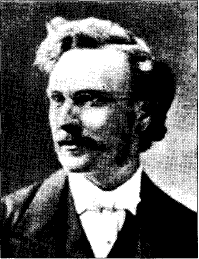
Philip Wicksteed
1844–1927
The elements in Wicksteed’s work which we shall identify as “Austrian” were, it is well-recognized, the outcome of his own careful elaboration of the insights he discovered in the work of that other British “Austrian,” William Stanley Jevons. Nor does Wicksteed’s work seem to have had seminal impact on the second generation of Austrians, although it is to its economics that Wicksteed’s own work is closest.6 Late in his life Mises refers to Wicksteed’s “great treatise”7 but it would certainly be an exaggeration to contend that Mises’s own system drew its central ideas from Wicksteed, rather than from Menger and Böhm-Bawerk.
Moreover, while, as we shall see, there is in Wicksteed’s work a considerable affinity with the Austrians in regard to the scope, character, and content of economic analysis, this affinity hardly extends to the free-market ideological perspective often held to be inextricably linked with the Austrian tradition. Where the Austrians have fairly consistently been foremost among the economic critics of socialism, Wicksteed was deeply sympathetic to it.8 If, despite all of this, Wicksteed is yet regarded by late-twentieth-century Austrians as a distinctly kindred spirit,9 this must be attributed not to any strong personal links between Wicksteed and his Austrian contemporaries, nor to any shared political or ideological perspectives, but, far more narrowly, to a common set of doctrinal insights. These insights, contrary to the thrust of the Marshallian economics dominant at the time Wicksteed was writing, clearly and starkly recognized the profoundly revolutionary character of the marginal-utility emphasis introduced into economics during the 1870s. The story of Wicksteed as an Austrian must revolve around these doctrinal insights.
THE WICKSTEED STORY
Born in 1844, the son of a Unitarian clergyman, Wicksteed was educated at University College, London, and Manchester New College, from 1861 to 1867, when he received his master’s degree, with a gold medal in classics.10 Following his father into the Unitarian ministry in 1867, Wicksteed embarked on an extraordinarily broad range of scholarly and theological explorations. His theological and ethical writings continued long after he left the pulpit (in 1897), and appear to have been the initial point of departure for a number of his other fields of scholarly inquiry. These included, in particular, his deep interest in Dante scholarship, an interest which not only produced a remarkable list of publications, but which built Wicksteed’s reputation as one of the foremost medievalists of his time. It was Wicksteed’s theologically-driven interest in and concern for the ethics of modern commercial society, with its disturbing inequalities of wealth and income, which appear to have led him into his economic studies, following on his reading of Henry George’s 1879 Progress and Poverty.11
Perhaps it was the circumstance that economics entered into Wicksteed’s field of scholarly vision in his mid-forties, and as only one of a number of areas of his interest—most of them to which he was committed for years before he began his economics—which led Schumpeter to remark that Wicksteed “stood somewhat outside of the economics profession.”12 Yet, within a few years, Wicksteed published a significant economic work of his own,13 carefully expounding on the theory he learned from Jevons, and became a lecturer on economics for the University Extension Lectures.14 In 1894, Wicksteed published his celebrated An Essay on the Co-ordination of the Laws of Distribution, in which he sought to prove mathematically that a distributive system which rewarded factory owners according to marginal productivity would exhaust the total product produced. But it was his 1910 The Common Sense of Political Economy which most comprehensively presents Wicksteed’s economic system, and which expresses most clearly and emphatically those insights which today’s Austrians find most congenial. Important elements of this Austrian side of Wicksteed’s work were concisely presented in his well-known 1913 Presidential Address to Section F of the British Association, published in Economic Journal, March 1914, under the title “The Scope and Method of Political Economy in the Light of the ‘Marginal’ Theory of Value and Distribution.” Apart from participation in a 1922 Economica symposium, Wicksteed published nothing further on economics during the last dozen years of his life, which ended in 1927. What was it in Wicksteed’s economics which later Austrians have found most similar to their own tradition?
WICKSTEED THE AUSTRIAN
Lionel Robbins’s assessment of Wicksteed as an Austrian was not only insightful of Wicksteed’s contribution to marginalist economics, it also expressed Robbins’s own understanding of the history of modern economic thought. It was no accident that the Preface to Robbins’s own enormously influential An Essay on the Nature and Significance of Economic Science (1932) concludes with an acknowledgment of his “especial indebtedness to the works of Professor Ludwig von Mises and to The Common Sense of Political Economy of the late Philip Wicksteed.”15 Robbins, at least in 1932, saw Wicksteed as a pioneer in that line of post-1879 economic writing, which clearly and cleanly directed economic thought in a direction differing drastically from that taken by classical economic thought. It was in this that Robbins identified Wicksteed’s common ground with the Austrians (and particularly with Mises). It was an interpretation of modern economics which sharply disagreed with the perspective of Alfred Marshall, so dominant in British economics.
The main stream of economic speculation in [Britain] in the last forty years has come via Marshall from the classics. . . . In intention at any rate Marshall’s position was essentially revisionist. He came not to destroy, but—as he thought—to fulfil the work of the classics. Wicksteed, on the other hand, was one of those who, with Jevons and Menger, thought . . . that complete reconstruction was necessary. He was not a revisionist, but a revolutionary.16
In what follows, we shall identify several distinct components of Wicksteed’s revolutionary approach to economic understanding.17 Each of these components bears a strong Austrian flavor, and stems arguably from Wicksteed’s subjectivist stance in economic thinking. We shall focus (a) on Wicksteed’s emphasis on a subjectivist understanding of the concept of cost; (b) on Wicksteed’s rejection of the classical view of economic analysis as concerned narrowly with the phenomena of material wealth (and with a model of homo oeconomicus intent on nothing but the gain of material wealth); and (c) on Wicksteed’s (admittedly limited but nonetheless significant) concern with the process of market equilibration (rather than exclusively with the attained equilibrium state itself). We may venture the conjecture that, in regard to these three aspects of Wicksteed’s Austrianism, it was the first which seems to have most impressed Robbins, the second which perhaps most impressed Mises, and the third which may be of greatest interest to modern Austrians, the disciples of Mises and Hayek. Space constraints preclude any but an outline discussion of each of these three Austrian aspects of Wicksteed’s work.
WICKSTEED AND THE SUBJECTIVISM OF COST
It was in regard to the role of costs in the theory of economic value that Wicksteed saw himself as most clearly departing from the Marshallian orthodoxy of his British contemporaries. He saw that orthodoxy paying lip-service to the marginal utility theory introduced by Jevons, but refusing to recognize the full implications of this theory for the final rejection of the classical cost theory of value. “The school of economists of which Professor Marshall is the illustrious head,” Wicksteed wrote in 1905,
may be regarded from the point of view of the thorough-going Jevonian as a school of apologists. It accepts . . . the Jevonian principles, but declares that, so far from being revolutionary, they merely supplement, clarify, and elucidate the theories they profess to destroy. To scholars of this school, the admission into the science of the renovated study of consumption leaves the study of production comparatively unaffected. As a determining factor of normal prices, cost of production is coordinate with the schedule of demands.18
In other words, Wicksteed rebelled against a view of production activity which sees it as a matter of strictly technical relationships, entirely distinct from the marginal-utility considerations governing consumption activity.
It was the confusion arising from this Marshallian view which was responsible for the residual classical idea that market price is in some sense the outcome of a balancing of an (objective) cost of production with (subjective) marginal utility. In Wicksteed’s own strongly-held opinion, the Jevonian view is an emphatically different one:
In no case can the cost of production have any direct influence upon the price of a commodity, if the commodity has been produced and the cost has been incurred; but in every case in which the cost of production has not yet been incurred, the manufacturer makes an estimate of the alternatives still open to him before determining whether, and in what quantities, the commodity shall be produced; and the stream of supply thus determined on fixes the marginal value and the price. The only sense, then, in which cost of production can affect the value of one thing is the sense in which it is itself the value of another thing. Thus what has been variously termed utility, ophelemity, or desiredness, is the sole and ultimate determinant of all exchange values.19
For Wicksteed, the only sense in which cost plays a role in the explanation of the market price is that in which cost is the anticipated value of a prospective alternative which is, at the moment of production decision, being rejected in favor of what it is decided to produce.
It is this view of Wicksteed which led Professor James Buchanan to write that the
opportunity-cost conception was explicitly developed by the Austrians, by the American, H.J. Davenport, and the principle could scarcely have occupied a more central place than it assumed in P.H. Wicksteed’s Common Sense of Political Economy.20
As Buchanan has emphasized,21 Wicksteed’s work “was a major formative influence on the cost theory that emerged in the late 1920s and early 1930s at the London School of Economics [LSE].” Certainly Robbins’s own recognition of the Austrian School during these years, and his own intellectual leadership at the LSE at this time must have helped cement the perception of intellectual affinity linking Wicksteed with the Austrian School.
WICKSTEED AND THE SCOPE OF ECONOMICS
Wicksteed devoted many pages of his Common Sense to the elucidation of the meaning of the adjective “economic.” And his final major restatement of his overall perspective bore the title “The Scope and Method of Political Economy in the Light of the ‘Marginal’ Theory of Value and Distribution.”22 Here, again, we find Wicksteed pursuing the radical implications of the Jevonian revolution, and being led inevitably to the rejection of classical views on the scope of economics. It is utterly incoherent, Wicksteed insisted again and again, to view the pursuit of material wealth as constituting a uniquely distinct field for economic inquiry; it is both arbitrary and analytically unhelpful, to say the least, to see the conclusions of economic science as dependent upon the dominance of selfish motives (as identified with the classical homo oeconomicus).
It is here that we find Wicksteed treading the same path as the Austrians, and, in particular as Ludwig von Mises. Both Wicksteed and Mises insisted on the universal application of the conclusions which flow from our understanding of human purposefulness and rationality in the making of decisions. “We habitually talk,” Wicksteed wrote,
of a man gaining some object “at the price of honor”; or say to some one who contemplates an action which would alienate his friends, “Oh yes! Of course you can do it, if you choose to pay the price.” “Price,” then, in the narrower sense of “the money for which a material thing, a service, or a privilege can be obtained,” is simply a special case of “price” in the wider sense of “the terms on which alternatives are offered to us.”23
“Sensitive people,” Mises wrote,
may be pained to have to choose between the ideal and the material. But that . . . is in the nature of things. For even where we can make judgments of value without money computations, we cannot avoid this choice. Both isolated man and socialist communities would have to do likewise, and truly sensitive natures will never find it painful. Called upon to choose between bread and honor, they will never be at a loss how to act. If honor cannot be eaten, eating can at least be forgone for honor.24
It is no accident that when, in 1933, Mises first comprehensively laid out his view of economics as simply a branch of a “universally valid science of human action,”25 and argued that the “laws of catallactics that economics expounds are valid for every exchange regardless of whether those involved in it have acted wisely or unwisely or whether they were actuated by economic or non-economic motives,”26 he referred, in a footnote, to the page in Wicksteed from which we have cited the passage quoted above.
For Mises, the exclusion of altruistic motives from economics is arbitrary and based on misunderstanding. What drives human behavior is simply human purposefulness. “What a man does is always aimed at an improvement of his own state of satisfaction.” Only in this sense can we accurately understand
an action directly aiming at the improvement of other people’s conditions. . . . The actor considers it as more satisfactory for himself to make other people eat than to eat himself. His uneasiness is caused by the awareness of the fact that other people are in want.27
Wicksteed elaborated on this same insight in his insistence that the “proposal to exclude ‘benevolent’ or ‘altruistic’ motives from consideration in the study of Economics is . . . wholly irrelevant and beside the mark.” The common Austrian foundational tenet is the primacy of human purposefulness, seen far more broadly than as the expression of egoistic, selfish greed. As Robbins recognized,28 it is considerations such as the dependency of economic phenomena upon “purposive action” which enables us adequately to dismiss the “oft-reiterated accusation that Economics assumes a world of economic men concerned only with money-making and self-interest.” Clearly, what Wicksteed and the Austrians were doing was consistently and subjectivistically redirecting the focus of economic analysis away from the material objects of classical inquiry, to the implications of individual human choices and decisions.
WICKSTEED AND THE MARKET PROCESS
“A market,” Wicksteed wrote,
is the machinery by which those on whose scales of preference any commodity is relatively high are brought into communication with those on whose scale it is relatively low, in order that exchanges may take place to mutual satisfaction until equilibrium is established. But this process will always and necessarily occupy time.29
No doubt modern Austrians will be able to find a number of points on which to quibble with Wicksteed’s careful and elaborate discussion30 of how markets tend toward the equilibrium to which he is here referring. What is important, however, for our assessment of Wicksteed’s Austrianism is his explicit recognition of the market as the framework within which a time-consuming equilibrating process is occurring—a process during which market participants are gradually “brought into communication” with each other—rather than as the social instrument in which initially assumed perfect mutual knowledge is instantaneously translated into an array of equilibrium prices and quantities.
Robbins perceptively drew attention to this aspect of Wicksteed’s work.
Wicksteed’s approach is by no means the same as Pareto’s. His analysis of the conditions of equilibrium is much less an end in it self, much more a tool with which to explain the tendencies of any given situation. He was much more concerned with economic phenomena as a process in time, much less with its momentary end-products.31
Admittedly, Wicksteed was not unique among the great neoclassical economists in seeing the market as a competitive process. Robbins’s above-cited observation refers to a contrast with Pareto, from whom Wicksteed had otherwise learned a good deal. But outside the Walrasian school, an understanding of the competitive process was not as rare as late-twentieth-century portrayals of neoclassical economics may seem to imply.32 Yet, one will surely find few early-twentieth-century discussions in which the details of the competitive market process (in the course of which errors come to be corrected, and mutual knowledge is derived rather than initially assumed) are as carefully worked out as they are in Wicksteed. Here we see Wicksteed, in Austrian fashion, seeing the decisions of market participants not as the implications of equilibrium conditions somehow assumed already to exist, but as the initiating causes for (and stages in) the process of equilibration itself.
In conclusion, perhaps the sense in which Wicksteed can best be seen as Austrian is captured in Mises’s remarks on the distinguishing features of the economist. “The economist,” he wrote,
deals with matters that are present and operative in every man. . . . What distinguishes [the economist] from other people is not the esoteric opportunity to deal with some special material not accessible to others, but the way he looks upon things and discovers in them aspects which other people fail to notice. It was this that Philip Wicksteed had in mind when he chose for his great treatise a motto from Goethe’s Faust: Human life—everybody lives it, but only to a few is it known.33
SELECTED READINGS
Buchanan, James M. 1969. Cost and Choice: An Inquiry in Economic Theory. Chicago: Markham Publishing.
Buchanan, James M., and G.F. Thirlby, eds. 1973. L.S.E. Essays on Cost. London: London School of Economics and Political Science.
Hayek, F.A. 1984. Money, Capital, and Fluctuations: Early Essays. Roy McCloughry, ed. Chicago: University of Chicago Press.
Herford, C.H. 1931. Philip Wicksteed: His Life and Work. London and Toronto: J.M. Dent.
Jevons, William Stanley. 1871. The Theory of Political Economy. London and New York: Macmillan.
Kirzner, Israel M. 1963. Market Theory and the Price System. Princeton, N.J.: D. Van Nostrand.
Machovec, Frank M. 1995. Perfect Competition and the Transformation of Economics. London and New York: Routledge.
Mayer, Hans. 1932. The Cognitive Value of Functional Theories of Price. (German original in H. Mayer, ed. Die Wirtschaftstheorie der Gegenwart. Vienna. 1932. Vol. 2.) English translation in Classics in Austrian Economics: A Sampling in the History of a Tradition. Israel M. Kirzner, ed. London: William Pickering. 1994. vol. 2. pp. 55–168.
Mises, Ludwig von. 1962. The Ultimate Foundation of Economic Science: An Essay on Method. Princeton, N.J.: D. Van Nostrand.
——. [1933] 1960. Epistemological Problems of Economics. Translated from the German by George Reisman. Princeton: D. Van Nostrand.
——. [1949] 1998. Human Action: A Treatise on Economics, The Scholar’s Edition. Auburn, Ala.: Ludwig von Mises Institute.
——. [1922 [1936. Socialism: An Economic and Sociological Analysis. London: Jonathan Cape. Translated from the second German edition, 1932.
Robbins, Lionel C. [1932] 1935. An Essay on the Nature and Significance of Economic Science. 2nd ed. London: Macmillan.
Rothbard, Murray N. 1962. Man, Economy, and State: A Treatise on Economic Principles. 2 Vols. Princeton, N.J.: D. Van Nostrand.
Schumpeter, Joseph A. 1954. History of Economic Analysis. New York: Oxford University Press.
Steedman, Ian. 1987. “Wicksteed, Philip Henry.” The New Palgrave: A Dictionary of Economics. John Eatwell, Murray Milgate, and Peter Newman eds. 4 Vols. New York: Macmillan.
Stigler, George J. 1941. Production and Distribution Theories: The Formative Period. New York: Macmillan.
Wicksteed, Philip H. 1888. The Alphabet of Economic Science. London: Macmillan.
——. 1933. The Common Sense of Political Economy and Selected Papers and Reviews on Economic Theory. Lionel Robbins, Introduction and editor. London: Routledge and Kegan Paul.
____________
34Lionel Robbins, Introduction to Philip H. Wicksteed, The Common Sense of Political Economy and Selected Papers and Reviews on Economic Theory, Lionel Robbins, ed. (London: Routledge and Kegan Paul, [1910] 1933), p. xv.
35C.H. Herford, Philip Wicksteed: His Life and Work (London and Toronto: J.M. Dent, 1931).
36It is, however, of some interest that Joseph Schumpeter, then a twenty-three-year-old brilliant young Austrian economist, made a point of visiting for “an hour’s chat” at Wicksteed’s home in 1906. On that occasion, Schumpeter reports, Wicksteed’s personality “radiated upon me,” leaving an impression of “repose that owed nothing to callousness, . . . benevolence that was not weakness, . . . simplicity that went so well with . . . refinement, . . . unassuming modesty that did not lack dignity.” Joseph A. Schumpeter, History of Economic Analysis (New York: Oxford University Press, 1954), p. 831. Robbins, in his Introduction to Wicksteed’s The Common Sense of Political Economy (p. viii), credits Wicksteed, The Alphabet of Economic Science (London: Macmillan, 1888), with introducing the term “marginal utility” as a translation of the Austrian Grenz-nutzen.
37See, e.g., Wicksteed, The Common Sense of Political Economy, vol. 1, p. 2 and vol. 2, pp. 765, 808, 812.
38In a 1926 paper, Hayek apparently held that Wicksteed—who devoted much of his own work to the theory of distribution—had paid little if any attention to “the principles of imputation developed by the Austrian School.” See F.A. Hayek, Money, Capital, and Fluctuations: Early Essays, Roy McCloughry, ed. (Chicago: University of Chicago Press, 1984), p. 43. At one point, Wicksteed credits the generation of economists who followed Jevons—mentioning particularly those “in Austria and in America”—with expanding on the “universal application of the theory of margins.” The statement here in the text should, moreover, also be modified by noting that Robbins refers to “influences which shaped Wicksteed’s thought” as including “Jevons and the earlier Austrians.” See Wicksteed, The Common Sense of Political Economy, vol. 2, p. 812.
39An admittedly incomplete survey of Austrian work during the 1920s has revealed few references to Wicksteed. This absence was particularly noticeable in Hans Mayer’s important 1932 paper, “The Cognitive Value of Functional Theories of Price,” in Classics in Austrian Economics: A Sampling in the History of a Tradition, Israel M. Kirzner, ed. (London: William Pickering, 1994), vol. 2, pp. 55–168.
40Ludwig von Mises, The Ultimate Foundation of Economic Science: An Essay on Method (Princeton, N.J.: D. Van Nostrand, 1962), p. 78.
41Ian Steedman concluded his article “Wicksteed, Philip Henry,” in The New Palgrave: A Dictionary of Economics, John Eatwell, Murray Milgate, and Peter Newman, eds., 4 vols. (New York: Macmillan, 1987), p. 919, by stating that Wicksteed’s The Common Sense of Political Economy is a “brilliant demonstration of a writer who . . . was friendly to the socialist and labor movements of his time, and who was sometimes a sharp critic of the market system, could yet be a purist of marginal theory.” Robbins (Introduction to Wicksteed, The Common Sense of Political Economy, p. vi), reports that “all his life” Wicksteed “retained a sympathy for the idea of land nationalization.” Despite all this, it must be emphasized that Wicksteed’s message to the would-be social reformer was consistently that of the trained neoclassical economist. Referring to the “economic forces” which “are persistent and need no tending,” Wicksteed reminds “the social reformer” that if “we can harness [these economic forces] they will pull for us without further trouble on our part, and if we undertake to oppose or control them we must count the cost” (p. 158).
42Murray Rothbard cites Wicksteed many times in Man, Economy, and State: A Treatise on Economic Principles (Auburn, Ala.: Ludwig von Mises Institute, 1993). When the present writer sought to present an Austrian restatement of price theory in the early 1960s, he found himself turning again and again to Wicksteed as a guiding source. See Israel M. Kirzner, Market Theory and the Price System (Princeton, N.J.: D. Van Nostrand, 1963).
43Herford, Philip Wicksteed, p. 25.
44See Herford, Philip Wicksteed, p. 197. George’s book led Wicksteed to discover Jevons’s book, a work which was to exercise the greatest influence on Wicksteed’s own economic thought. See William Stanley Jevons, The Theory of Political Economy (London: Macmillan, 1871).
45Schumpeter, History of Economic Analysis, p. 831.
46Wicksteed, The Alphabet of Economic Science.
47This was a kind of adult-education program initiated in Great Britain in the 1870s to extend “the teaching of the universities, to serve up some of the crumbs from the university tables, in a portable and nutritious form, for some of the multitude who had no chance of sitting there.” See Herford, Philip Wicksteed, p. 90.
48Lionel C. Robbins, An Essay on the Nature and Significance of Economic Science, 2nd ed. (London: Macmillan, 1935), p.16.
49Robbins, Introduction to Wicksteed, The Common Sense of Political Economy, pp. xvf). Stigler describes Wicksteed as one of the only two “important English economists of the period between 1870 and the World War who explicitly abandoned the classical tradition.” See George J. Stigler, Production and Distribution Theories: The Formative Period (New York: Macmillan, 1941), pp. 38–39ff. The other economist to whom Stigler is here referring is William Smart, the translator of Böhm-Bawerk and Wieser.
50It should be noted that Wicksteed consistently refrained from claiming originality for his ideas. He saw himself as expounding and elaborating on the economics he learned from Jevons.
51Wicksteed, The Common Sense of Political Economy, vol. 2, p. 812.
52Wicksteed, ibid., vol. 1, p. 391 (italics added). Wicksteed, in his celebrated 1913 paper (“The Scope and Method of Political Economy in Light of the ‘Marginal’ Theory of Value and Distribution,” Economic Journal, 1914), pursued this insight so far as to establish one of his best-known and most provocative analytical insights, viz. that there is, in reality, no such thing as an independent “supply curve.” The supply curve is merely part of what Wicksteed called the “total demand curve” which includes the schedule of quantities of a commodity which existing holders of that commodity will wish to hold for their own consumption, at different prices.
53James M. Buchanan, in L.S.E. Essays on Cost, James M. Buchanan and G.F. Thirlby, eds. (London: London School of Economics and Political Science, 1973), p. 14.
54See James M. Buchanan, Cost and Choice: An Inquiry in Economic Theory (Chicago: Markham Publishing, 1969), p. 17; also Buchanan and Thirlby, L.S.E. Essays on Cost, p. 14. For the extent to which Buchanan believes that Wicksteed attained Buchanan’s own theoretical understanding of cost, see Buchanan, Cost and Choice, p.17.
55This was also part of his 1913 Presidential Address to Section F of the British Association.
56Wicksteed, 1933, p. 28. It is noteworthy that this page is cited approvingly by Ludwig von Mises, in Epistemological Problems of Economics, George Reisman, trans. (Princeton, N.J.: D. Van Nostrand, 1960), p. 34.
57Ludwig von Mises, Socialism: An Economic and Sociological Analysis (London: Jonathan Cape, 1936), p. 116. In this early (the original German edition was published in 1922) expression of Mises’s rejection of any sharp line separating the economic from the non-economic, Mises does not cite Wicksteed.
58Mises, Epistemological Problems, p. 12.
59Ibid., p. 34.
60Ludwig von Mises, Human Action: A Treatise on Economics, The Scholar’s Edition (Auburn, Ala.: Ludwig von Mises Institute, [1949] 1998), p. 243.
61Robbins, Nature and Significance, pp. 93ff. Robbins cites Mises in regard to the purposefulness of “rational” behavior. Robbins noted the parallelism between Wicksteed and Mises in this regard (see his Introduction to Wicksteed, The Common Sense of Political Economy, p. xxiii). Arguably it was this insight which inspired the central ideas in Robbins’s first edition of Nature and Significance.
62Wicksteed, The Common Sense of Political Economy, vol. 1, p. 236.
63Ibid., pp. 219–29.
64Robbins, Introduction to Wicksteed, The Common Sense of Political Economy, vol. 1, p.xix.
65On this, see the important work of Frank M. Machovec, Perfect Competition and the Transformation of Economics (London: Routledge, 1995).
66Ludwig von Mises, The Ultimate Foundation of Economic Science: An Essay on Method (Princeton, N.J.: D. Van Nostrand, 1962), p. 78.
- 1Two recent examples are the review article by Israel M. Kirzner, “Entrepreneurial Discovery and the Competitive Market Process: An Austrian Approach,” Journal of Economic Literature 35, no. 1 (March 1997): 60–85; and Sherwin Rosen, “Austrian and Neoclassical Economics: Any Gains From Trade?” Journal of Economic Perspectives 11, no 4. (Fall 1997): 139–52. Both of these journals are publications of the American Economic Association, indicating the degree to which Austrian ideas are at least recognized, if not embraced, by the profession’s mainstream.
- 2See Leland B. Yeager, “Austrian Economics, Neoclassicism, and the Market Test,” Journal of Economic Perspectives 11, no. 4 (Fall 1997): 153–65, for an insightful discussion on the challenges that an alternative to mainstream ideas faces in the academic marketplace.
- 3See Karen I. Vaughn, Austrian Economics in America: The Migration of a Tradition (New York: Cambridge University Press, 1994), for a good discussion of the development of the modern Austrian School. Also see Murray N. Rothbard, “The Present State of Austrian Economics,” Money, Method, and the Austrian School, vol. 1, The Logic of Action (Cheltenham, U.K.: Edward Elgar, 1997).
- 4The first edition of Menger’s Principles of Economics was published in German in 1871. While it was generally recognized as a landmark contribution in economics, an English translation was not published until 1950.
- 5Murray N. Rothbard, in Ludwig von Mises: Scholar, Creator, Hero (Auburn, Ala.: Ludwig von Mises Institute, 1988), p. 13, notes that Mises’s early work on monetary theory, while controversial, was published in the Economic Journal, one of the leading mainstream economic journals of the time.
- 6Paul A. Samuelson, Economics, 9th ed. (New York: McGraw-Hill, 1973), p. 883.
- 7Diego de Covarrubias y Leyva, Omnia Opera (Venice, 1604),vol. 2, chap.4, p.131.
- 8Luis Saravia de la Calle, Instrucción de mercaderes (1544); republished in Colección de Joyas Bibliográficas (Madrid, 1949), p. 53. Saravia’s book addresses the business entrepreneur (in Spanish mercaderes) following a continental Catholic tradition that can be traced back to San Bernardino de Siena (1380–1444). See Rothbard, Economic Thought Before Adam Smith, pp. 81–85.
- 9Juan de Lugo (1583–1660), Disputationes de iustitia et iure (Lyon, 1642), vol. 2, d. 26, s. 4, n. 40, p. 312.
- 10Juan de Salas, Commentarii in secundam secundae D. Thomae de contractibus (Lyon, 1617), vol. 4, no. 6, p. 9.
- 11Jerónimo Castillo de Bovadilla, Práctica para corregidores (Salamanca, 1585), vol. 2, chap. 4, no. 49. See also the important comments on the scholastics and their dynamic concept of competition written by Oreste Popescu, Estudios en la historia del pensamiento económico latinoamericano (Buenos Aires: Plaza and Janés, 1987), pp. 141–59.
- 12Luis de Molina, De iustitia et iure (Cuenca, 1597), vol. 2, disp. 348, no. 4, and La teoría del justo predo, Francisco Gómez Camacho, ed. (Madrid: Editora Nacional, 1981), p. 169. Raymond de Roover, ignoring the work of Castillo de Bovadilla, acknowledges how “Molina even introduces the concept of competition by stating that concurrence or rivalry among buyers will enhance prices.” See his article “Scholastic Economics: Survival and Lasting Influence from the Sixteenth Century to Adam Smith,” Quarterly Journal of Economics 69, no. 2 (May1955): 169.
- 13Included in Covarrubias, Omnia Opera, vol. 1, pp. 669–710.
- 14Carl Menger, Principles of Economics (New York: New York University Press, 1981), p. 317.
- 15Martín Azpilcueta Navarro, Comentario resolutorio de cambios (Madrid: Consejo Superior de Investigaciones Científicas, 1965), pp. 74–75.
- 16See Jesús Huerta de Soto, “New Light on the Prehistory of the Theory of Banking and the School of Salamanca,” Review of Austrian Economics 9, no. 2 (1996): 59–81.
- 17Luis de Molina, Tratado sobre los cambios, Introduction by Francisco Gómez Camacho (Madrid: Instituto de Estudios Fiscales, 1990), p. 146. Also James Pennington’s memo dated February 13, 1826, “On the Private Banking Establishments of the Metropolis,” included as an Appendix in Thomas Tooke, A Letter to Lord Grenville; On the Effects Ascribed to the Resumption of Cash Payments on the Value of the Currency (London: John Murray, 1826).
- 18However, according to Father Bernard W. Dempsey, if the members of this second group of the School of Salamanca had had a detailed theoretical knowledge of the functioning and implications of the economic process to which fractional-reserve banking gives rise, it would have been described as a perverse, vast and illegitimate process of institutional usury, even by Molina, Lessius, and Lugo themselves. See Father Bernard W. Dempsey, Interest and Usury (Washington, D.C.: American Council of Public Affairs, 1943), p. 210.
- 19Quoted in ibid., p. 214, n. 31.
- 20Mariana, Discurso de las enfermedades de la Compañía, pp. 151–55, 216.
- 21See Leland B. Yeager, “Book Review,” Review of Austrian Economics 9, no. 1 (1996): 183, where he says:
- 22Jaime Balmes, “Verdadera idea del valor o reflexiones sobre el origen, naturaleza y variedad de los precios,” en Obras Completas (Madrid: B.A.C., 1949), vol. 5, pp. 615–24. Balmes also described the personality of Juan de Mariana with the following graphic words:
- 23Ibid., p. 51.
- 24Cantillon laid the groundwork for Turgot and the theory of profit. See Renee Prendergast, “Cantillon and the Emergence of the Theory of Profit,” History of Political Economy 23 (Fall 1991): 429.
- 25Cantillon, Essai, p. 49. His use of the word “naturally” shows that the changes he refers to cause a predictable change in price.
- 26Ibid., p. 53.
- 27Ibid., p. 31. When he refers to well-organized societies, Cantillon seems to be referring to an advanced market economy in which monetary exchange and banking services have been long and thoroughly established.
- 28Ibid., p. 97.
- 29Hülsmann, “Cantillon as a Proto-Austrian,” p. 3, defends Cantillon by noting he clearly did not think that market prices were determined by cost, in terms of land and labor, and that intrinsic value is merely being used as a measure of the quantity of land and labor. Cantillon thus avoided the errors of later economists who claimed that land and labor were measures of value. His views are similar to Austrian economists who hold that only exchange ratios and market prices permit economic calculation.
- 30Cantillon, Essai,p. 107.
- 31Hayek, “Richard Cantillon,” p. 263.
- 32Cantillon, Essai, p. 115. He does note, however, that a specific intrinsic value is one that does not change.
- 33This point was first suggested to me by Professor Hébert; see Hébert, “Was Richard Cantillon an Austrian Economist?” p. 272. Spengler also hints at this in Joseph J. Spengler, “Richard Cantillon: First of the Modems II,” Journal of Political Economy 62, no. 5 (October 1954): 407; also see Michael D. Bordo, “Some Aspects of the Monetary Economics of Richard Cantillon,” Journal of Monetary Economics 12, no. 2 (August 1983): 235–58.
- 34AT THE END of the twentieth century, the Austrian School of economics is exerting a significant influence both on the development of academic economics and on the application of economic theory to public policy. An increasing number of economics professors are sympathetic with the fundamental ideas of Austrian economics, and academic journals are taking more account of the Austrian School. A half century ago, few academic economists would even have been familiar with the Austrian School, except superficially, and among those who were, most would have disagreed with its methods and conclusions. Today, the ideas of Austrian economics are closer to the mainstream of economic thought, not because Austrian economics has changed, but because mainstream economics has moved toward the Austrian point of view. A similar shift has occurred in the public-policy arena. The policy implications of Austrian economics, once rejected as extreme, are now embraced as true. In the process, the Austrian School has become increasingly visible as an intellectual force.
- 35If the ideas of Austrian economics have made such inroads, one might wonder why, in the academic arena, Austrian economics does not play a bigger role. Part of the answer has to do with academic institutions themselves. Most university faculty teach at state institutions, which by itself may bias them toward supporting the state and being suspicious of laissez-faire ideas. Most university faculty have tenure, which slows the turnover of personnel, and perhaps of ideas. Furthermore, academic ideas find their outlets largely in academic journals, and the editorial boards of those journals tend to be controlled by the academic mainstream, further promoting mainstream ideas over alternative schools of thought. Because publication in academic journals is often a prerequisite for promotion and tenure in a university environment, academic survival often pushes young scholars in the direction of the mainstream methods and ideas in their discipline.
- 36Austrian economics has fought an uphill battle for acceptance for several reasons, but at the same time, the Austrian School has been gaining in strength, and is becoming more accepted in academia. A growing number of economics professors align themselves with the Austrian School, and even among those who do not, Austrian ideas are becoming more recognized and respected. Interestingly enough, the late-twentieth-century resurgence of interest in the Austrian School has been concentrated in the United States. This is largely due to Ludwig von Mises’s migration, and his Austrian economics seminar at New York University. One might go so far as to argue that the modern Austrian School would not exist were it not for the influence of Ludwig von Mises on his American students.
- 37Carl Menger is generally regarded as the founder of the Austrian School, but prior to about 1920, Austrian economics was not very different from economics in general. Economic theory had taken a great leap forward in the 1870s when the concept of marginal utility was independently discovered by Léon Walras, William Stanley Jevons, and Carl Menger. Each of these three individuals pushed the concept in different directions, but the integration of the marginal theory of value into economics was a major leap for all of economics. Eugen von Böhm-Bawerk’s capital theory, now seen as Austrian, was viewed more generally as a part of economics when it was published in the 1880s and 1890s, and Ludwig von Mises’s Theory of Money and Credit, published in 1912, established him as a leading authority on monetary economics.
- 38Carl Menger is generally regarded as the founder of the Austrian School, but prior to about 1920, Austrian economics was not very different from economics in general. Economic theory had taken a great leap forward in the 1870s when the concept of marginal utility was independently discovered by Léon Walras, William Stanley Jevons, and Carl Menger. Each of these three individuals pushed the concept in different directions, but the integration of the marginal theory of value into economics was a major leap for all of economics. Eugen von Böhm-Bawerk’s capital theory, now seen as Austrian, was viewed more generally as a part of economics when it was published in the 1880s and 1890s, and Ludwig von Mises’s Theory of Money and Credit, published in 1912, established him as a leading authority on monetary economics.
- 39From its low point in the middle of the twentieth century, Austrian economics has continued to gain visibility both inside academia and out. F.A. Hayek won the Nobel prize in economics in 1974, giving the Austrian School attention and respectability. By then, a small Austrian revival was already underway, led by Kirzner and Rothbard, and Hayek’s Nobel prize gave the revival additional momentum. Still, the Austrian School was branded by being on the losing side of the socialist calculation debate. In 1973, the year Mises died, Paul Samuelson, another Nobel laureate in economics and among the most prominent of mainstream academic economists, argued in his introductory textbook that even though the Soviet Union had roughly half the per capita income of the United States, their superior economic system based on central planning gave them faster growth. Based on this, Samuelson projected that per capita income in the Soviet Union could catch up to that of the United States as early as 1990, and almost surely by 2015. Keep in mind that Samuelson’s projection was in his best-selling introductory college textbook, and was the standard line taught in college classrooms at the time. Clearly, the mainstream had not accepted the ideas of Austrian economics.
- 40We should note how Mariana refers to the fact that the “common estimation” of men is the origin of the value of things, thus following the traditional subjectivist doctrine of the scholastics, which was initially proposed by Diego de Covarrubias y Leyva. Covarrubias (1512–1577), the son of a famous architect, became bishop of the city of Segovia and a minister to King Philip II. In 1554, he set forth better than anyone before the subjectivist theory of value, stating that “the value of an article does not depend on its essential nature but on the subjective estimation of men, even if that estimation is foolish,” illustrating his thesis with the example that “in the Indies wheat is dearer than in Spain because men esteem it more highly, though the nature of the wheat is the same in both places.”
- 41Covarrubias’s subjectivist conception was completed by another of his scholastic contemporaries, Luis Saravia de la Calle, who was the first to demonstrate that prices determine costs, not vice versa. Saravia de la Calle also had the special distinction of writing in Spanish, not in Latin. Its title was Instrucción de mercaderes (Instruction to merchants), and there we can read that “those who measure the just price by the labor, costs and risk incurred by the person who deals in the merchandise are greatly in error. The just price is found not by counting the cost but by common estimation.”
- 42The subjectivist conception initiated by Covarrubias also allowed other Spanish scholastics to get a clear insight of the true nature of market prices, and of the impossibility of attaining an economic equilibrium. Thus, the Jesuit Cardinal Juan de Lugo, wondering what the price of equilibrium was, as early as 1643 reached the conclusion that the equilibrium depended on such a large number of specific circumstances that only God was able to know it (“Pretium iustum mathematicum licet soli Deo notum”). Another Jesuit, Juan de Salas, referring to the possibilities of knowing specific market information, reached the very Hayekian conclusion that it was so complex that “quas exacte comprehendere et ponderare Dei est non hominum” (only God, not men, can understand it exactly).
- 43The subjectivist conception initiated by Covarrubias also allowed other Spanish scholastics to get a clear insight of the true nature of market prices, and of the impossibility of attaining an economic equilibrium. Thus, the Jesuit Cardinal Juan de Lugo, wondering what the price of equilibrium was, as early as 1643 reached the conclusion that the equilibrium depended on such a large number of specific circumstances that only God was able to know it (“Pretium iustum mathematicum licet soli Deo notum”). Another Jesuit, Juan de Salas, referring to the possibilities of knowing specific market information, reached the very Hayekian conclusion that it was so complex that “quas exacte comprehendere et ponderare Dei est non hominum” (only God, not men, can understand it exactly).
- 44Furthermore, the Spanish scholastics were the first ones to introduce the dynamic concept of competition (in Latin concurrentium), which is best understood as a process of rivalry among entrepreneurs. For instance, Jerónimo Castillo de Bovadilla (1547–?) wrote that “prices will go down as a result of the abundance, rivalry (emulación), and competition (concurrencia) among the sellers.”
- 45This same idea is closely followed by Luis de Molina. Covarrubias also anticipated many of the conclusions of Father Mariana in his empirical study on the history of the devaluation of the main coin of that time, the Castilian Maravedí. This study contained a compilation of a large number of statistics on the evolution of prices in the previous century and was published in Latin in his book Veterum collatio numismatum (Compilation on old moneys). This book was highly praised in Italy by Davanzaty and Galiani and was also quoted by Carl Menger in his Principles of Economics.
- 46This same idea is closely followed by Luis de Molina. Covarrubias also anticipated many of the conclusions of Father Mariana in his empirical study on the history of the devaluation of the main coin of that time, the Castilian Maravedí. This study contained a compilation of a large number of statistics on the evolution of prices in the previous century and was published in Latin in his book Veterum collatio numismatum (Compilation on old moneys). This book was highly praised in Italy by Davanzaty and Galiani and was also quoted by Carl Menger in his Principles of Economics.
- 47This same idea is closely followed by Luis de Molina. Covarrubias also anticipated many of the conclusions of Father Mariana in his empirical study on the history of the devaluation of the main coin of that time, the Castilian Maravedí. This study contained a compilation of a large number of statistics on the evolution of prices in the previous century and was published in Latin in his book Veterum collatio numismatum (Compilation on old moneys). This book was highly praised in Italy by Davanzaty and Galiani and was also quoted by Carl Menger in his Principles of Economics.
- 48as can be seen from experience, in France, where there is less money than in Spain, bread, wine, clothing, labor, and work cost much less; and even in Spain, at the time when there was less money, the things which could be sold and the labor and work of men were given for much less than after the Indies were discovered and covered her with gold and silver. The cause of which is that money is worth more where and when it is lacking than where and when it is in abundance.
- 49It is obvious that if Father Mariana had known the economic mechanisms that lead to the credit expansion process generated by banks and the effects of this process, he would have condemned these as robbery. He would have condemned not only the government debasement of coins but also the even more disturbing credit inflation created by banks. However, other Spanish scholastics were able to analyze the credit expansion of banks. Thus, de la Calle was very critical of fractional-reserve banking. He maintained that receiving interest was incompatible with the nature of a demand deposit, and that, in any case, a fee should be paid to the banker for keeping the money under his custody. A similar conclusion is reached by the more famous Navarro.
- 50Molina was sympathetic to fractional-reserve banking and confused the nature of two different contracts, loans and deposits, which Azpilcueta and Saravia de la Calle had clearly differentiated from each other previously. A more relevant aspect is that Molina was the first theorist to discover, in 1597 (therefore much earlier than Pennington in 1826), that bank deposits are part of the monetary supply. He even proposed the name “chirographis pecuniarium” (written money) to refer to the written documents that were accepted in trade as bank money. Our scholastics included, therefore, two incipient schools. The first is a kind of “Currency School,” formed by Saravia de la Calle, Azpilcueta Navarro, and Tomás de Mercado, who were very distrustful of banking activities, for which they implicitly demanded a one-hundred-percent reserve should be held. The second was a kind of “Banking School,” headed by the Jesuits Luis de Molina and Juan de Lugo, who were much more tolerant toward fractional-reserve banking. Both groups were to a certain extent the forerunners of the theoretical developments which were to arise three centuries later in England as a result of the debate between the Currency School and the Banking School.
- 51Molina was sympathetic to fractional-reserve banking and confused the nature of two different contracts, loans and deposits, which Azpilcueta and Saravia de la Calle had clearly differentiated from each other previously. A more relevant aspect is that Molina was the first theorist to discover, in 1597 (therefore much earlier than Pennington in 1826), that bank deposits are part of the monetary supply. He even proposed the name “chirographis pecuniarium” (written money) to refer to the written documents that were accepted in trade as bank money. Our scholastics included, therefore, two incipient schools. The first is a kind of “Currency School,” formed by Saravia de la Calle, Azpilcueta Navarro, and Tomás de Mercado, who were very distrustful of banking activities, for which they implicitly demanded a one-hundred-percent reserve should be held. The second was a kind of “Banking School,” headed by the Jesuits Luis de Molina and Juan de Lugo, who were much more tolerant toward fractional-reserve banking. Both groups were to a certain extent the forerunners of the theoretical developments which were to arise three centuries later in England as a result of the debate between the Currency School and the Banking School.
- 52that future goods are not valued so highly as the same goods available at an immediate moment of time, nor do they allow their owners to achieve the same utility. For this reason, it must be considered that they have a more reduced value in accordance with justice.
- 53Mariana concludes that, when there are many laws, “as not all of them may be kept or known, respect for all of them is lost.”
- 54Indeed, we could say that the greatest merit of Carl Menger was to rediscover and take up this continental Catholic tradition of Spanish scholastic thought that was almost forgotten and cut short as a consequence of the black legend against Spain and the very negative influence on the history of economic thought of Adam Smith and his followers of the British Classical School.
- 55It is not difficult to explain. Being the value of a thing its utility . . . if the number of units of this means increases, the need of any one of them in particular decreases; because being possible to choose among many units, none of them is indispensable. For this reason there is a necessary relation between the increase or decrease in value, and the shortage or abundance of a thing.
- 56The role of the entrepreneur is one of Cantillon’s great contributions to economic understanding. He speaks of the entrepreneur in the classic sense of the undertaker of great business adventures, but Cantillon also has a theoretical distinction between those who work for a fixed return or wages and those who face uncertain returns, including farmers, independent craftsmen, merchants, and manufacturers. These entrepreneurs purchase inputs at a given price to produce and sell later at an uncertain price. In the pursuit of profit, the entrepreneur must bear risks as he faces the pervasive uncertainty of the market. For example, the farmer has fixed expenses but:
- 57The role of the entrepreneur is one of Cantillon’s great contributions to economic understanding. He speaks of the entrepreneur in the classic sense of the undertaker of great business adventures, but Cantillon also has a theoretical distinction between those who work for a fixed return or wages and those who face uncertain returns, including farmers, independent craftsmen, merchants, and manufacturers. These entrepreneurs purchase inputs at a given price to produce and sell later at an uncertain price. In the pursuit of profit, the entrepreneur must bear risks as he faces the pervasive uncertainty of the market. For example, the farmer has fixed expenses but:
- 58The price of these products will depend partly on the weather, partly on demand; if corn is abundant relative to consumption it will be dirt cheap, if there is scarcity it will be dear. Who can foresee the number of births and deaths of the people in a State in the course of the year? Who can foresee the increase or reduction of expense that may come about in the families? And yet the price of the Farmer’s produce depends naturally upon these unforeseen circumstances, and consequently he conducts the enterprise of his farm at an uncertainty.
- 59The unsuccessful entrepreneur will live poorly or go bankrupt, while the successful entrepreneur will obtain a profit or advantage and cause entry into the market, “and so it is that the Undertakers of all kinds adjust themselves to risks in a State.” The entrepreneur brings prices and production into line with demand; in well organized societies, government officials can even fix prices of basic items without too much complaint.
- 60The unsuccessful entrepreneur will live poorly or go bankrupt, while the successful entrepreneur will obtain a profit or advantage and cause entry into the market, “and so it is that the Undertakers of all kinds adjust themselves to risks in a State.” The entrepreneur brings prices and production into line with demand; in well organized societies, government officials can even fix prices of basic items without too much complaint.
- 61Cantillon has a sophisticated understanding of the price system containing most of the elements of modern Austrian analysis. Price is determined by demand and relative scarcity. Demand is a subjective concept based on the “humors” and “fancies” of the people. It is the “consent of the people” along with the relative scarcity of a product that determines the market price, where market price is understood to be the price paid to the seller. Likewise, the market value of metals “varies with their plenty or scarcity, according to the demand.”
- 62Cantillon makes an important distinction between price and market price, and between value and market value, that has served as a source of confusion concerning the meaning of his economics. Market price and market value are the real prices that occur in the market based on forces of supply and demand. Price and value are separate and distinct concepts from market prices. They are related to Cantillon’s term “intrinsic value,” and are used to describe the opportunity cost of resources used to produce the particular good in question, the specific land and labor that were sacrificed to produce the good.
- 63in this Essai I have always used the term Intrinsic Value to signify the amount of Land and Labor which enter into Production, not having found any term more suitable to express my meaning. I mention this only to avoid misunderstanding.
- 64What is most significant about Cantillon’s achievement in the field of value and price theory is his down-playing the quest for rules and formulae that might account for the “normal” relationship between the value or price of various goods, and concentrating instead on the forces and mechanisms that are consistently at work in restoring these normal relationships.
- 65Cantillon’s conception of cost as the sacrifice of land and labor foregone is far more advanced than the land theory of cost and value advanced by the Physiocrats, or the labor theory of cost and value advanced by the classical economists. But Cantillon had a far richer understanding of cost than a simple measure of the quantity of land and labor that went into production. Cantillon stressed two important concepts throughout the Essai that provide greater depth to his conception of cost. First, Cantillon viewed all resources as heterogeneous. Each piece of land was of a different quality, and each laborer was also of a different quality. Therefore, while intrinsic value was a measure of cost, it was not possible in fact to simply count the number of hours and acres except in an abstract way or in simple illustrations. In fact, after establishing a preliminary land-and-labor theory of value in part one, he notes at the very beginning of part two that for specific goods in the real economy, it is “impossible to fix their respective intrinsic values.”
- 66The other concept that he stressed was the alternative use of resources. Land could be used to grow corn or to provide hay for horses. Labor could toil on the farm or be trained in a craft. Cantillon clearly saw that when a landlord chose to own more horses, what he was giving up was the production (and sale) of grain, and that if France wished to import fine lace, then she would have to forego a large amount of wine produced from her vineyards. Cantillon understood the concept of opportunity cost, and his Essai was an attempt to construct the concept to explain economic choice. The discovery of opportunity cost by this important precursor of the Austrian School truly marks the origin of economic theory.

