
The Great Austrian Economists
12. F.A. Hayek: Austrian Economist and Social Theorist
AUSTRIAN ECONOMIST AND SOCIAL THEORIST PETER G. KLEIN
FRIEDRICH AUGUST VON HAYEK ranks among the most eminent of the modern Austrian economists. Student of Friedrich von Wieser, protégé and colleague of Ludwig von Mises, and foremost among an outstanding generation of Austrian School theorists, Hayek was perhaps more successful than anyone else in spreading Austrian ideas throughout the English-speaking world. “When the definitive history of economic analysis during the 1930s comes to be written,” said John Hicks in 1967, “a leading character in the drama will be Professor Hayek. . . . [I]t is hardly remembered that there was a time when the new theories of Hayek were the principal rival of the new theories of Keynes.”1 Unfortunately, Hayek’s theory of the business cycle was eventually swept aside by the Keynesian revolution. Ultimately, however, this work was again recognized when Hayek received, along with the Swede Gunnar Myrdal, the 1974 Nobel Memorial Prize in Economic Science.
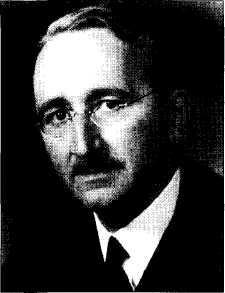
F. A. Hayek
1899–1992
LIFE AND WORK
Hayek’s life spanned the twentieth century, and he made his home in some of the great intellectual communities of the period. Born in 1899 to a distinguished family of Viennese intellectuals (one grandfather, a statistician, was a friend of Eugen von Böhm-Bawerk; the philosopher Ludwig Wittgenstein was a second cousin), Hayek attended the University of Vienna, earning doctorates in 1921 and 1923. Hayek came to the University at age nineteen, just after World War I, when it was one of the three best places in the world to study economics (the others being Stockholm and Cambridge). Though he was enrolled as a law student, his primary interests were economics and psychology, the latter due to the influence of Mach’s theory of perception on Wieser and Wieser’s colleague Othmar Spann, and the former stemming from the reformist ideal of Fabian socialism so typical of Hayek’s generation.
Like many students of economics then and since, Hayek chose the subject not for its own sake, but because he wanted to improve social conditions—the poverty of postwar Vienna serving as a daily reminder of such a need. Socialism seemed to provide a solution. Then, in 1922, Mises published his Die Gemeinwirtschaft, later translated as Socialism. “To none of us young men who read the book when it appeared,” Hayek recalled, “the world was ever the same again.”2 Socialism, an elaboration of Mises’s pioneering article from two years before, argued that economic calculation requires a market for the means of production; without such a market there is no way to establish the values of those means and, consequently, no way to find their proper uses in production. Mises’s devastating attack on central planning converted Hayek to laissez-faire, along with contemporaries like Wilhelm Röpke, Lionel Robbins, and Bertil Ohlin.
It was around this time that Hayek began attending Mises’s famed Privatseminar. For several years, the Privatseminar was the center of the economics community in Vienna. Later, Hayek became the first of this group to leave Vienna; most of the others, along with Mises himself, were also gone by the start of World War II.
Mises had done earlier work on monetary and banking theory, successfully applying the Austrian marginal-utility principle to the value of money, and then sketching a theory of industrial fluctuations based on the doctrines of the British Currency School and the ideas of the Swedish economist Knut Wicksell. Hayek used this last as a starting point for his own research on fluctuations, explaining the origin of the business cycle in terms of bank-credit expansion, and its transmission in terms of capital malinvestments. His work in this area eventually earned him an invitation to lecture at the London School of Economics and Political Science (LSE), and then to occupy its Tooke Chair in Economics and Statistics, which he accepted in 1931. There he found himself among a vibrant and exciting group: Robbins, J.R. Hicks, Arnold Plant, Dennis Robertson, T.E. Gregory, Abba Lerner, Kenneth Boulding, and George Shackle, to name only the most prominent. Hayek brought his (to them) unfamiliar views, and gradually, the Austrian theory of the business cycle became known and accepted. At the LSE, Hayek lectured on Mises’s businesscycle theory, which he was refining and which, until Keynes’s General Theory came out in 1936, was rapidly gaining adherents in Britain and the United States, and was becoming the preferred explanation of the Depression.
Hayek and Keynes had sparred in the early 1930s in the pages of the Economic Journal over Keynes’s Treatise on Money. As one of Keynes’s leading professional adversaries, Hayek was well situated to provide a full refutation of the General Theory, but he never did. Part of the explanation for this no doubt lies with Keynes’s personal charm and legendary rhetorical skill, along with Hayek’s general reluctance to engage in direct confrontation with his colleagues. Hayek also considered Keynes an ally in the fight against wartime inflation and did not want to detract from that issue. Furthermore, as Hayek later explained, Keynes was constantly changing his theoretical framework, and Hayek saw no point in working out a detailed critique of the General Theory, if Keynes might change his mind again. Hayek thought a better course would be to produce a fuller elaboration of Böhm-Bawerk’s capital theory, and he began to devote his energies to this project. Unfortunately, The Pure Theory of Capital was not completed until 1941, and by then the Keynesian macro model had become firmly established.3
Within a very few years, the fortunes of the Austrian School suffered a dramatic reversal. First, the Austrian theory of capital, an integral part of the business-cycle theory, came under attack from Italian-born Cambridge economist Piero Sraffa and American Frank Knight, while the cycle theory itself was forgotten amid the enthusiasm for the General Theory. Second, beginning with Hayek’s move to London and continuing until the early 1940s, the Austrian economists left Vienna, for personal and then for political reasons, so that a school ceased to exist there as such.4 Mises left Vienna in 1934 for Geneva and then New York, where he continued to work in isolation; Hayek remained at the LSE until 1950, when he joined the Committee on Social Thought at the University of Chicago. Other Austrians of Hayek’s generation became prominent in the United States—Gottfried Haberler at Harvard, Fritz Machlup and Oskar Morgenstern at Princeton, Paul Rosenstein-Rodan at MIT—but their work no longer seemed to show distinct traces of the tradition founded by Carl Menger.
At Chicago, Hayek again found himself among a dazzling group: the economics department, led by Knight, Milton Friedman, and later George Stigler, was one of the best anywhere, and Aaron Director at the law school soon set up the first law-and-economics program.5 But economic theory, in particular its style of reasoning, was rapidly changing: Paul Samuelson’s Foundations had appeared in 1947, establishing physics as the science for economics to imitate, and Friedman’s 1953 essay on “positive economics” set a new standard for economic method. In addition, Hayek had ceased to work on economic theory, concentrating instead on psychology, philosophy, and politics. Austrian economics entered a prolonged eclipse. Important work in the Austrian tradition was done during this period by Rothbard, Kirzner, and Lachmann, but, at least publicly, the Austrian tradition lay mostly dormant.
When the 1974 Nobel Prize in economics went to Hayek, interest in the Austrian School was suddenly and unexpectedly revived. While this was not the first event of the so-called Austrian revival, the memorable South Royalton, Vermont conference having taken place earlier the same year, the rediscovery of Hayek by the economics profession was nonetheless a decisive event in the renaissance of Austrian economics.6 Hayek’s writings were taught to new generations, and Hayek himself appeared at the early Institute for Humane Studies conferences in the mid-1970s. He continued to write, producing The Fatal Conceit in 1988, at the age of 89.7 Hayek died in 1992 in Freiburg, Germany, where he had lived since leaving Chicago in 1961.8
Hayek’s legacy in economics is complex. Among mainstream economists, he is mainly known for his popular The Road to Serfdom9 and for his work on knowledge in the 1930s and 1940s. Specialists in business-cycle theory recognize his early work on industrial fluctuations, and modern information theorists often acknowledge Hayek’s work on prices as signals, although his conclusions are typically disputed. Hayek’s work is also known in political philosophy, legal theory, and psychology.
Within the Austrian School of economics, Hayek’s influence, while undeniably immense, has very recently become the subject of some controversy. His emphasis on spontaneous order and his work on complex systems have been widely influential among many Austrians. Others have preferred to stress Hayek’s work in technical economics, particularly on capital and the business cycle, citing a tension between some of Hayek’s and Mises’s views on the social order. (While Mises was a rationalist and a utilitarian, Hayek focused on the limits to reason, basing his defense of capitalism on its ability to use limited knowledge and learning by trial and error.)
BUSINESS-CYCLE THEORY
Hayek’s writings on capital, money, and the business cycle are generally regarded as his most important contributions to economics. Building on Mises’s Theory of Money and Credit,10 Hayek showed how fluctuations in economy-wide output and employment are related to the economy’s capital structure. In Prices and Production,11 he introduced the famous “Hayekian triangles” to illustrate the relationship between the value of capital goods and their place in the temporal sequence of production. Because production takes time, factors of production must be committed in the present for making final goods that will have value only in the future after they are sold. However, capital is heterogeneous; as capital goods are used in particular production processes, they become increasingly specific to those processes, so they cannot be easily redeployed as demands for final goods change. The central macroeconomic problem in a modern capital-using economy is, thus, one of intertemporal coordination: how can the allocation of resources between capital and consumer goods be aligned with consumers’ preferences between present and future consumption? In The Pure Theory of Capital,12 perhaps his most ambitious work, Hayek describes how the economy’s structure of production depends on the characteristics of capital goods—durability, complementarity, substitutability, specificity, and so on. This structure can be described by the various “investment periods” of inputs, an extension of Böhm-Bawerk’s notion of “roundaboutness,” the degree to which production takes up resources over time.13
In Prices and Production and Monetary Theory and the Trade Cycle,14 Hayek showed how monetary injections, by lowering the rate of interest below what Mises (following Wicksell) called its “natural rate,” distort the economy’s intertemporal structure of production.15 Most theories of the effects of money on prices and output (then and since) consider only the effects of the total money supply on the price level and aggregate output or investment. The Austrian theory, as developed by Mises and Hayek, focuses on the way money enters the economy (“injection effects”), and how this affects relative prices and investment in particular sectors. In Hayek’s framework, investments in some stages of production are “malinvestments” if they do not help to align the structure of production to consumers’ intertemporal preferences. The reduction in interest rates caused by credit expansion directs resources toward capital-intensive processes and early stages of production (whose investment demands are more interest-rate elastic), thus “lengthening” the period of production. If interest rates had fallen because consumers had changed their preferences to favor future over present consumption, then the longer time structure of production would have been an appropriate, coordinating response. A fall in interest rates caused by credit expansion, however, would have been a “false signal,” causing changes in the structure of production that do not accord with consumers’ intertemporal preferences.16 The boom generated by the increase in investment is artificial. Eventually, market participants come to realize that there are not enough savings to complete all the new projects; the boom becomes a bust as these malinvestments are discovered and liquidated.17 Every artificial boom induced by credit expansion, then, is self-reversing. Recovery consists of liquidating the malinvestments induced by the lowering of interest rates below their natural levels, thus restoring the time structure of production so that it accords with consumers’ intertemporal preferences.
KNOWLEDGE, PRICES, AND COMPETITION AS A DISCOVERY PROCEDURE
Hayek’s writings on dispersed knowledge and spontaneous order are also widely known, but more controversial. In “Economics and Knowledge”18 and “The Use of Knowledge in Society,”19 Hayek argued that the central economic problem facing society is not, as is commonly expressed in textbooks, the allocation of given resources among competing ends.
It is rather a problem of how to secure the best use of resources known to any of the members of society, for ends whose relative importance only those individuals know. Or, to put it briefly, it is a problem of the utilization of knowledge not given to anyone in its totality.20
Much of the knowledge necessary for running the economic system, Hayek contended, is in the form not of “scientific” or technical knowledge—the conscious awareness of the rules governing natural and social phenomena—but of “tacit” knowledge, the idiosyncratic, dispersed bits of understanding of “circumstances of time and place.” This tacit knowledge is often not consciously known even to those who possess it, and can never be communicated to a central authority. The market tends to use this tacit knowledge through a type of “discovery procedure”21 by which this information is unknowingly transmitted throughout the economy as an unintended consequence of individuals pursuing their own ends.22 Indeed, Hayek’s distinction between the neoclassical notion of “competition,” identified as a set of equilibrium conditions (number of market participants, characteristics of the product, and so on), and the older notion of competition as a rivalrous process, has been widely influential in Austrian economics.23
For Hayek, market competition generates a particular kind of order—an order that is the product “of human action but not of human design” (a phrase Hayek borrowed from Adam Ferguson). This “spontaneous order” is a system that comes about through the independent actions of many individuals, and produces overall benefits unintended and mostly unforeseen by those whose actions bring it about. To distinguish between this kind of order and that of a deliberate, planned system, Hayek used the Greek terms cosmos for a spontaneous order, and taxis for a consciously planned one.24 Examples of a cosmos include the market system as a whole, money, the common law, and even language. A taxis, by contrast, is a designed or constructed organization, like a firm or bureau; these are the “islands of conscious power in [the] ocean of unconscious cooperation like lumps of butter coagulating in a pail of buttermilk.”25
Most commentators view Hayek’s work on knowledge, discovery, and competition as an outgrowth of his participation in the socialist calculation debate of the 1920s and 1930s. The socialists erred, in Hayek’s view, in failing to see that the economy as a whole is necessarily a spontaneous order and can never be deliberately made over in the way that the operators of a planned order can exercise control over their organization. This is because planned orders can handle only problems of strictly limited complexity. Spontaneous orders, by contrast, tend to evolve through a process of natural selection, and therefore do not need to be designed or even understood by a single mind.
HAYEK AND AUSTRIAN ECONOMICS
Clearly, the Austrian revival owes much to Hayek. But are Hayek’s writings really “Austrian economics”—part of a separate, recognizable tradition—or should we regard them, instead, as an original, deeply personal, contribution?26 Some observers charge that Hayek’s later work, particularly after he began to turn away from technical economics, shows more influence of Karl Popper than of Menger or Mises: one critic speaks of “Hayek I” and “Hayek II”; another writes on “Hayek’s Transformation.”27
It is true that Popper had a significant impact on Hayek’s mature thought. Of greater interest is the precise nature of Hayek’s relationship with Mises. Undoubtedly, no economist had a greater impact on Hayek’s thinking than Mises—not even Wieser, from whom Hayek learned his craft, but who died in 1927 when Hayek was still a young man. In addition, Mises clearly considered Hayek the brightest of his generation.28 Yet, as Hayek noted, he was from the beginning always something less than a pure follower:
Although I do owe [Mises] a decisive stimulus at a crucial point of my intellectual development, and continuous inspiration through a decade, I have perhaps most profited from his teaching because I was not initially his student at the university, an innocent young man who took his word for gospel, but came to him as a trained economist, versed in a parallel branch of Austrian economics [the Wieser branch] from which he gradually, but never completely, won me over.29
Much has been written on Hayek’s and Mises’s views on the socialist calculation debate.30 The issue is whether a socialist economy is “impossible,” as Mises charged in 1920, or simply less efficient or more difficult to implement. Hayek maintained later that Mises’s “central thesis was not, as it is sometimes misleadingly put, that socialism is impossible, but that it cannot achieve an efficient utilization of resources.”31 That interpretation is itself subject to dispute. Hayek is arguing here against the standard view on economic calculation, found for instance in Schumpeter.32 This view holds that Mises’s original statement of the impossibility of economic calculation under socialism was refuted by Oskar Lange, Fred Taylor, and Abba Lerner, and that later modifications by Hayek and Robbins amounted to an admission that a socialist economy is possible in theory but difficult in practice because knowledge is decentralized and incentives are weak. Hayek’s response in the cited text, that Mises’s actual position has been exaggerated, receives support from the primary revisionist historian of the calculation debate, Don Lavoie, who states that the
central arguments advanced by Hayek and Robbins did not constitute a “retreat” from Mises, but rather a clarification directing the challenge to the later versions of central planning. . . . Although comments by both Hayek and Robbins about computational difficulties of the [later approaches] were responsible for misleading interpretations of their arguments, in fact their main contributions were fully consistent with Mises’s challenge.33
Israel Kirzner similarly contends that Mises’s and Hayek’s positions should be viewed together as an early attempt to elaborate the Austrian “entrepreneurial-discovery” view of the market process.34 Joseph Salerno argues, by contrast, in favor of the traditional view—that Mises’s original calculation problem is different from the discovery-process problem emphasized by Lavoie and Kirzner.35
Furthermore, Hayek’s later emphasis on group selection and spontaneous order is not shared by Mises, although there are elements of this line of thought in Menger. A clue to this difference is in Hayek’s statement that “Mises himself was still much more a child of the rationalist tradition of the Enlightenment and of continental, rather than of English, liberalism . . . than I am myself.”36 This is a reference to the “two types of liberalism” to which Hayek frequently refers: the continental rationalist or utilitarian tradition, which emphasizes reason and man’s ability to shape his surroundings, and the English common-law tradition, which stresses the limits to reason and the “spontaneous” forces of evolution.37
Recently, the relationship between Mises and Hayek has become a full-fledged “dehomogenization” debate, with some seeing Hayek’s emphasis on knowledge and discovery as substantially different from Mises’s emphasis on purposeful human action. Indeed, it has been argued that there are two strands of modern Austrian economics, both descended from Menger. One, the Wieser-Hayek strand, focuses on dispersed knowledge and the price system as a device for communicating knowledge. Another, the Böhm-Bawerk-Mises strand, focuses on monetary calculation (or “appraisal,” meaning anticipation of future prices) based on existing money prices. Thus, the dispute is whether the differences between Hayek and Mises are primarily matters of emphasis and language or matters of substance.38
Regardless, there is widespread agreement that Hayek ranks among the greatest members of the Austrian School, and among the leading economists of the twentieth century. His work continues to be influential in business-cycle theory, comparative economic systems, political and social philosophy, legal theory, and even cognitive psychology. Hayek’s writings are not always easy to follow—he describes himself as “puzzler” or “muddler” rather than a “master of his subject”—and this may have contributed to the variety of interpretations his work has aroused.39 Partly for this reason, Hayek remains one of the most intriguing intellectual figures of our time.
SELECTED READINGS
Blaug, Mark. 1993. “Hayek Revisited.” Critical Review 7, no. 1:51–60.
Caldwell, Bruce J. 1988. “Hayek’s Transformation.” History of Political Economy 20 (Winter): 513–41.
——. 1997. “Hayek and Socialism.” Journal of Economic Literature 35, no. 4 (December): 1856–90.
Craver, Earlene. 1986. “The Emigration of the Austrian Economists.” History of Political Economy 18, no. 1:1–32.
Garrison, Roger W. 1978. “Austrian Macroeconomics: A Diagrammatical Exposition.” In New Directions in Austrian Economics. Louis M. Spadaro, ed. Kansas City: Sheed Andrews and McMeel. Pp. 167–204.
Garrison, Roger W., and Israel M. Kirzner. 1987. “Hayek, Friedrich August von.” In The New Palgrave Dictionary of Economics. Vol. 2. John Eatwell, Murray Milgate, and Peter Newman, eds. London: Macmillan. Pp. 609–14.
Gray, John. 1986. Hayek on Liberty. 2nd Rev. Ed. Oxford: Basil Blackwell.
Hayek, F. A. 1997. Socialism and War: Essays, Documents, Reviews. Vol. 10. The Collected Works of F.A. Hayek. Bruce Caldwell, ed. Chicago: University of Chicago Press, and London: Routledge.
——. 1995. Contra Keynes and Cambridge: Essays, Correspondence. Vol. 9. The Collected Works of F.A. Hayek. Bruce Caldwell, ed. Chicago: University of Chicago Press, and London: Routledge.
——. 1994. Hayek on Hayek: An Autobiographical Dialogue. Stephen Kresge and Leif Wenar, eds. Chicago: University of Chicago Press, and London: Routledge.
——. 1992. The Fortunes of Liberalism. Vol. 4. The Collected Works of F.A. Hayek. Peter G. Klein, ed. Chicago: University of Chicago Press, and London: Routledge.
——. 1948. Individualism and Economic Order. Chicago: University of Chicago Press.
——. 1944. The Road to Serfdom. Chicago: University of Chicago Press.
——. 1941. The Pure Theory of Capital. Chicago: University of Chicago Press.
——. 1933. Monetary Theory and the Trade Cycle. London: Jonathan Cape.
——. 1935. Prices and Production. 2nd Rev. Ed. London: Routledge and Kegan Paul.
Hutchison, TW. 1984. “Austrians on Philosophy and Method (since Menger).” In idem, The Politics and Philosophy of Economics: Marxians, Keynesians, and Austrians. New York: New York University Press. Pp. 203–32.
Kirzner, Israel M. 1988. “The Socialist Calculation Debate: Lessons for Austrians.” Review of Austrian Economics 2:1–18.
Lavoie, Don. 1985. Rivalry and Central Planning: The Socialist Calculation Debate Reconsidered. Cambridge: Cambridge University Press.
O’Driscoll, Gerald P., Jr. 1977. Economics as a Coordination Problem: The Contribution of Friedrich A. Hayek. Kansas City: Sheed Andrews and McMeel.
Rothbard, Murray N. 1997. “The Present State of Austrian Economics.” In idem, The Logic of Action. Cheltenham, U.K.: Edward Elgar. Vol. 1. Pp. 111–72.
Salerno,Joseph T. 1993. “Mises and Hayek Dehomogenized.” Review of Austrian Economics 6, no. 2:113–16.
Vanberg, Viktor J. 1994. “Spontaneous Market Order and Social Rules: A Critical Examination of F.A. Hayek’s Theory of Cultural Evolution.” In idem, Rules and Choice in Economics. London and New York: Routledge. Pp. 75–94.
_______________
40Sir John Hicks, Critical Essays in Monetary Theory (Oxford: Clarendon Press, 1967), p. 203.
41F.A. Hayek, “In Honor of Professor Mises,” in idem, The Fortunes of Liberalism, vol. 4, The Collected Works of F.A. Hayek, Peter G. Klein, ed. (Chicago: University of Chicago Press, 1992), p. 133.
42Hayek also believed that an effective refutation of Keynes would have to begin with a thorough critique of aggregate, or “macro” economics more generally. See F.A. Hayek, “The Economics of the 1930s as Seen from London,” in idem, Contra Keynes and Cambridge: Essays, Correspondence, vol. 9, The Collected Works of F.A. Hayek, Bruce Caldwell, ed. (Chicago: University of Chicago Press, 1995), pp. 49–73. Brian McCormick and Mark Blaug propose an entirely different reason: Hayek couldn’t respond because the Austrian capital theory, on which the cycle theory was built, was simply wrong. See Brian J. McCormick, Hayek and the Keynesian Avalanche (New York: St. Martin’s Press, 1992), pp. 99–134; and Mark Blaug, “Hayek Revisited,” Critical Review 7, no. 1 (1993): 51–60.
43See Earlene Craver, “The Emigration of the Austrian Economists,” History of Political Economy 18, no. 1 (1986): 1–32.
44However, at Chicago, Hayek was considered something of an outsider; his post was with the Committee on Social Thought, not the economics department, and his salary was paid by a private foundation, the William Volker Fund (the same organization that paid Mises’s salary as a visiting professor at New York University).
45The proceedings of the South Royalton conference were published as The Foundations of Modern Austrian Economics, Edwin G. Dolan, ed. (Kansas City: Sheed and Ward, 1976).
46F.A. Hayek, The Fatal Conceit: The Errors of Socialism, vol. 1, The Collected Works of F.A. Hayek, W.W. Bartley III, ed. (Chicago: University of Chicago Press, 1988).
47For a fuller biographical account, see F.A. Hayek, Hayek on Hayek: An Autobiographical Dialogue, Stephen Kresge and Leif Wenar, eds. (Chicago: University of Chicago Press, 1994).
48F.A. Hayek, The Road to Serfdom (Chicago: University of Chicago Press, 1944).
49Ludwig von Mises, The Theory of Money and Credit, H.E. Batson, trans. (Indianapolis, Ind.: Liberty Classics, [1912] 1980).
50F.A. Hayek, Prices and Production (London: Routledge and Kegan Paul, [1931] 1935).
51F.A. Hayek, The Pure Theory of Capital (Chicago: University of Chicago Press, 1941).
52Hayek ultimately rejected Böhm-Bawerk’s “average period of production” as a useful concept, though Hayek had used it earlier in Prices and Production. See Hayek, Hayek on Hayek, p. 141.
53F.A. Hayek, Monetary Theory and the Trade Cycle, N. Kaldor and H.M. Croome, trans. (New York: Harcourt, Brace, 1933).
54Hayek thought the more important case was when the market interest rate was kept constant despite a rise in the natural interest rate. In his writings, however, he focused on the expositionally easier case when credit expansion lowers the market interest rate below an unchanged natural rate.
55For most of his career, Hayek viewed a system of fractional-reserve banking as inherently unstable, endorsing a role (in principle) for government stabilization of the money supply. In later writings, beginning with The Constitution of Liberty (Chicago: University of Chicago Press, 1960), and culminating in Denationalization of Money: An Analysis of the Theory and Practice of Concurrent Currencies (London: Institute of Economic Affairs, 1976), he argued in favor of competition among private issuers of fiat money.
56Anticipating modern cycle theories Hayek recognized that the behavior of the cycle depends on expectations about future price and interest-rate movements. But Hayek did not believe agents could know the real structure of the economy, to correctly distinguish movements in interest rates generated by changes in consumers’ intertemporal preferences from those generated by changes in the money supply. See F. A. Hayek, “Price Expectations, Monetary Disturbances, and Malinvestments,” in idem, Profits, Interest, and Investment (London: Routledge, 1939).
57F.A. Hayek, “Economics and Knowledge,” Economica 4 (1937): 33–54.
58F.A. Hayek, “The Use of Knowledge in Society,” American Economic Review 35 (September 1945): 519–30.
59Ibid., p. 520.
60F.A. Hayek, “Competition as a Discovery Procedure,” in idem, New Studies in Philosophy, Politics, and Economics (Chicago: University of Chicago Press, 1978), pp. 179–90.
61Hayek’s use of an argument from ignorance as a defense of the market is unusual. Modern economists typically require assumptions of hyperrationality—complete and perfect information, rational expectations, perfect markets, and so on—to justify market allocations as “efficient.” In the new microeconomics literature on information and incentives, theorists like Joseph Stiglitz have used deviations from these assumptions of perfection to reach a verdict of market failure and to provide a rationale for government intervention. For Hayek, by contrast, the fact that agents are not hyperrational is an argument not against individual freedom, but against state planning and social control.
62F.A. Hayek, “The Meaning of Competition,” in idem, Individualism and Economic Order (Chicago: University of Chicago Press, 1948), pp. 92–106.
63F.A. Hayek, “The Confusion of Language in Political Thought,” in idem, New Studies in Philosophy, Politics, and Economics, pp. 71–97. Earlier, Hayek had used “organism” and “organization,” borrowed from Mises, to distinguish the two; this is the distinction cited by Ronald Coase in his famous 1937 article, “The Nature of the Firm,” Economica N.S., 4 (1937): 386–405. See F.A. Hayek, “The Trend of Economic Thinking,” in idem, The Trend of Economic Thinking, vol. 3, The Collected Works of F.A. Hayek, W.W. Bartley, III, and Stephen Kresge, eds. (Chicago: University of Chicago Press, 1991), pp. 17–34.
64D.H. Robertson, quoted in Coase, “The Nature of the Firm,” p. 35.
65Wieser’s have generally been considered a personal contribution, by Hayek himself and others.
66For Hayeks I and II, see T.W. Hutchison, “Austrians on Philosophy and Method (since Menger),” in idem, The Politics and Philosophy of Economics: Marxians, Keynesians, and Austrians (New York and London: New York University Press, 1984), pp. 203–32; for the “transformation,” see Bruce J. Caldwell, “Hayek’s Transformation,” History of Political Economy 20 (Winter 1988): 513–41.
67Margit von Mises, in My Years with Ludwig von Mises, 2nd enlarged ed. (Cedar Falls, Iowa: Center for Futures Education, 1984), p. 133, recalls of her husband’s seminar in New York that “Lu met every new student hopeful that one of them might develop into a second Hayek.”
68F.A. Hayek, “Coping with Ignorance,” Imprimis 7, no. 7 (July 1978): 1–6.
69Hayek’s writings on socialist economic calculation are collected in F.A. Hayek, Socialism and War: Essays, Documents, Reviews, vol. 10, The Collected Works of F.A. Hayek, Bruce Caldwell, ed. (Chicago: University of Chicago Press, 1997).
70Hayek, The Fortunes of Liberalism, p. 127.
71Joseph A. Schumpeter, Capitalism, Socialism, and Democracy (New York: Harper and Row, 1942), pp. 172–86.
72Don Lavoie, Rivalry and Central Planning: The Socialist Calculation Debate Reconsidered (Cambridge: Cambridge University Press, 1985), p. 20.
73Israel M. Kirzner, “The Socialist Calculation Debate: Lessons for Austrians,” Review of Austrian Economics 2 (1988): 1–18.
74Joseph T. Salerno, “Ludwig von Mises as Social Rationalist,” Review of Austrian Economics 4 (1990): 26–54.
75Hayek, “Coping with Ignorance.”
76For more on the complex and subtle Mises–Hayek relationship, see Peter G. Klein, “Introduction” to Hayek, The Fortunes of liberalism.
77See, for example, Joseph T. Salerno, “Mises and Hayek Dehomogenized,” Review of Austrian Economics 6, no. 2 (1993): 113–46; and Leland B. Yeager, “Mises and Hayek on Calculation and Knowledge,” Review of Austrian Economics 7, no. 2 (1994): 93–109. Rothbard identifies three distinctive and often clashing paradigms within Austrian economics:
Misesian praxeology, the Hayek-Kirzner emphasis on the market as transmission of knowledge and coordination of plans—rather than the Misesian emphasis on continuing coordination of prices, and the ultra-subjectivism of [Ludwig] Lachmann.
Review of Bruce Caldwell and Stephan Boehm, eds., “Austrian Economics: Tensions and New Directions,” Southern Economic Journal 61, no. 2 (October 1994): 559–60. For a contrary view, see Kirzner’s review of Jack Birner and Rudy Van Zijp, “Hayek, Co-ordination, and Evolution,” Southern Economic Journal 61, no. 4 (April 1995): 1243–44:
To fail to see the common economic understanding shared by Mises and Hayek, is to have been needlessly misled by superficial differences in exposition and emphasis. To compound this failure by perceiving a clash, among modern Austrians, of “Hayekians” versus “Misesians,” is to convert an interpretive failure into a dogmengeschictliche nightmare.
78Along with himself, Hayek named Wieser and Frank Knight as representative puzzlers, and Böhm-Bawerk, Joseph Schumpeter, and Jacob Viner as representative masters of their subjects. As Hayek recalled,
I owed whatever worthwhile new ideas I ever had to not being able to remember what every competent specialist is supposed to have at his fingertips. Whenever I saw a new light on something, it was as the result of a painful effort to reconstruct an argument which most competent economists would effortlessly and instantly reproduce.
- 1Two recent examples are the review article by Israel M. Kirzner, “Entrepreneurial Discovery and the Competitive Market Process: An Austrian Approach,” Journal of Economic Literature 35, no. 1 (March 1997): 60–85; and Sherwin Rosen, “Austrian and Neoclassical Economics: Any Gains From Trade?” Journal of Economic Perspectives 11, no 4. (Fall 1997): 139–52. Both of these journals are publications of the American Economic Association, indicating the degree to which Austrian ideas are at least recognized, if not embraced, by the profession’s mainstream.
- 2See Leland B. Yeager, “Austrian Economics, Neoclassicism, and the Market Test,” Journal of Economic Perspectives 11, no. 4 (Fall 1997): 153–65, for an insightful discussion on the challenges that an alternative to mainstream ideas faces in the academic marketplace.
- 3See Karen I. Vaughn, Austrian Economics in America: The Migration of a Tradition (New York: Cambridge University Press, 1994), for a good discussion of the development of the modern Austrian School. Also see Murray N. Rothbard, “The Present State of Austrian Economics,” Money, Method, and the Austrian School, vol. 1, The Logic of Action (Cheltenham, U.K.: Edward Elgar, 1997).
- 4The first edition of Menger’s Principles of Economics was published in German in 1871. While it was generally recognized as a landmark contribution in economics, an English translation was not published until 1950.
- 5Murray N. Rothbard, in Ludwig von Mises: Scholar, Creator, Hero (Auburn, Ala.: Ludwig von Mises Institute, 1988), p. 13, notes that Mises’s early work on monetary theory, while controversial, was published in the Economic Journal, one of the leading mainstream economic journals of the time.
- 6Paul A. Samuelson, Economics, 9th ed. (New York: McGraw-Hill, 1973), p. 883.
- 7Diego de Covarrubias y Leyva, Omnia Opera (Venice, 1604),vol. 2, chap.4, p.131.
- 8Luis Saravia de la Calle, Instrucción de mercaderes (1544); republished in Colección de Joyas Bibliográficas (Madrid, 1949), p. 53. Saravia’s book addresses the business entrepreneur (in Spanish mercaderes) following a continental Catholic tradition that can be traced back to San Bernardino de Siena (1380–1444). See Rothbard, Economic Thought Before Adam Smith, pp. 81–85.
- 9Juan de Lugo (1583–1660), Disputationes de iustitia et iure (Lyon, 1642), vol. 2, d. 26, s. 4, n. 40, p. 312.
- 10Juan de Salas, Commentarii in secundam secundae D. Thomae de contractibus (Lyon, 1617), vol. 4, no. 6, p. 9.
- 11Jerónimo Castillo de Bovadilla, Práctica para corregidores (Salamanca, 1585), vol. 2, chap. 4, no. 49. See also the important comments on the scholastics and their dynamic concept of competition written by Oreste Popescu, Estudios en la historia del pensamiento económico latinoamericano (Buenos Aires: Plaza and Janés, 1987), pp. 141–59.
- 12Luis de Molina, De iustitia et iure (Cuenca, 1597), vol. 2, disp. 348, no. 4, and La teoría del justo predo, Francisco Gómez Camacho, ed. (Madrid: Editora Nacional, 1981), p. 169. Raymond de Roover, ignoring the work of Castillo de Bovadilla, acknowledges how “Molina even introduces the concept of competition by stating that concurrence or rivalry among buyers will enhance prices.” See his article “Scholastic Economics: Survival and Lasting Influence from the Sixteenth Century to Adam Smith,” Quarterly Journal of Economics 69, no. 2 (May1955): 169.
- 13Included in Covarrubias, Omnia Opera, vol. 1, pp. 669–710.
- 14Carl Menger, Principles of Economics (New York: New York University Press, 1981), p. 317.
- 15Martín Azpilcueta Navarro, Comentario resolutorio de cambios (Madrid: Consejo Superior de Investigaciones Científicas, 1965), pp. 74–75.
- 16See Jesús Huerta de Soto, “New Light on the Prehistory of the Theory of Banking and the School of Salamanca,” Review of Austrian Economics 9, no. 2 (1996): 59–81.
- 17Luis de Molina, Tratado sobre los cambios, Introduction by Francisco Gómez Camacho (Madrid: Instituto de Estudios Fiscales, 1990), p. 146. Also James Pennington’s memo dated February 13, 1826, “On the Private Banking Establishments of the Metropolis,” included as an Appendix in Thomas Tooke, A Letter to Lord Grenville; On the Effects Ascribed to the Resumption of Cash Payments on the Value of the Currency (London: John Murray, 1826).
- 18However, according to Father Bernard W. Dempsey, if the members of this second group of the School of Salamanca had had a detailed theoretical knowledge of the functioning and implications of the economic process to which fractional-reserve banking gives rise, it would have been described as a perverse, vast and illegitimate process of institutional usury, even by Molina, Lessius, and Lugo themselves. See Father Bernard W. Dempsey, Interest and Usury (Washington, D.C.: American Council of Public Affairs, 1943), p. 210.
- 19Quoted in ibid., p. 214, n. 31.
- 20Mariana, Discurso de las enfermedades de la Compañía, pp. 151–55, 216.
- 21See Leland B. Yeager, “Book Review,” Review of Austrian Economics 9, no. 1 (1996): 183, where he says:
- 22Jaime Balmes, “Verdadera idea del valor o reflexiones sobre el origen, naturaleza y variedad de los precios,” en Obras Completas (Madrid: B.A.C., 1949), vol. 5, pp. 615–24. Balmes also described the personality of Juan de Mariana with the following graphic words:
- 23Ibid., p. 51.
- 24Cantillon laid the groundwork for Turgot and the theory of profit. See Renee Prendergast, “Cantillon and the Emergence of the Theory of Profit,” History of Political Economy 23 (Fall 1991): 429.
- 25Cantillon, Essai, p. 49. His use of the word “naturally” shows that the changes he refers to cause a predictable change in price.
- 26Ibid., p. 53.
- 27Ibid., p. 31. When he refers to well-organized societies, Cantillon seems to be referring to an advanced market economy in which monetary exchange and banking services have been long and thoroughly established.
- 28Ibid., p. 97.
- 29Hülsmann, “Cantillon as a Proto-Austrian,” p. 3, defends Cantillon by noting he clearly did not think that market prices were determined by cost, in terms of land and labor, and that intrinsic value is merely being used as a measure of the quantity of land and labor. Cantillon thus avoided the errors of later economists who claimed that land and labor were measures of value. His views are similar to Austrian economists who hold that only exchange ratios and market prices permit economic calculation.
- 30Cantillon, Essai,p. 107.
- 31Hayek, “Richard Cantillon,” p. 263.
- 32Cantillon, Essai, p. 115. He does note, however, that a specific intrinsic value is one that does not change.
- 33This point was first suggested to me by Professor Hébert; see Hébert, “Was Richard Cantillon an Austrian Economist?” p. 272. Spengler also hints at this in Joseph J. Spengler, “Richard Cantillon: First of the Modems II,” Journal of Political Economy 62, no. 5 (October 1954): 407; also see Michael D. Bordo, “Some Aspects of the Monetary Economics of Richard Cantillon,” Journal of Monetary Economics 12, no. 2 (August 1983): 235–58.
- 34Cantillon, Essai, p.83.
- 35Brewer, “Cantillon and the Land Theory of Value,” p. 452; and Cantillon, Essai, p. 85.
- 36What Frenchman wouldn’t be concerned with this issue? Cantillon is clearly not against luxury per se, as he defines wealth as consumption on the first page of the Essai, including the conveniences and superfluities of life. What he is concerned with is production. It is not possible to continue to consume, or to consume greater amounts, without production. According to Cantillon, the comparative greatness of States is their reserve stock, which is savings measured in both money and materials in order to improve the State and to offset bad harvests and wars. For the State, gold is the true reserve stock, because with gold you can even buy the implements of war from your enemy. See Cantillon, Essai, pp. 89, 91.
- 37Vincent J. Tarascio, “Cantillon’s Theory of Population Size and Distribution,” Atlantic Economic Journal 9, no. 2 (July 1981): 12–18, is perceptive in noticing that Cantillon’s contribution was lost, and that neoclassical economics did not adopt the classical-population theory because real wages were clearly rising for a long time before the origins of neoclassical economics.
- 38See Cantillon, Essai, pt. 1, chaps. 7 and 8.
- 39See ibid., pt. 1, chap. 9; esp. Higgs, p. 25.
- 40AT THE END of the twentieth century, the Austrian School of economics is exerting a significant influence both on the development of academic economics and on the application of economic theory to public policy. An increasing number of economics professors are sympathetic with the fundamental ideas of Austrian economics, and academic journals are taking more account of the Austrian School. A half century ago, few academic economists would even have been familiar with the Austrian School, except superficially, and among those who were, most would have disagreed with its methods and conclusions. Today, the ideas of Austrian economics are closer to the mainstream of economic thought, not because Austrian economics has changed, but because mainstream economics has moved toward the Austrian point of view. A similar shift has occurred in the public-policy arena. The policy implications of Austrian economics, once rejected as extreme, are now embraced as true. In the process, the Austrian School has become increasingly visible as an intellectual force.
- 41If the ideas of Austrian economics have made such inroads, one might wonder why, in the academic arena, Austrian economics does not play a bigger role. Part of the answer has to do with academic institutions themselves. Most university faculty teach at state institutions, which by itself may bias them toward supporting the state and being suspicious of laissez-faire ideas. Most university faculty have tenure, which slows the turnover of personnel, and perhaps of ideas. Furthermore, academic ideas find their outlets largely in academic journals, and the editorial boards of those journals tend to be controlled by the academic mainstream, further promoting mainstream ideas over alternative schools of thought. Because publication in academic journals is often a prerequisite for promotion and tenure in a university environment, academic survival often pushes young scholars in the direction of the mainstream methods and ideas in their discipline.
- 42Austrian economics has fought an uphill battle for acceptance for several reasons, but at the same time, the Austrian School has been gaining in strength, and is becoming more accepted in academia. A growing number of economics professors align themselves with the Austrian School, and even among those who do not, Austrian ideas are becoming more recognized and respected. Interestingly enough, the late-twentieth-century resurgence of interest in the Austrian School has been concentrated in the United States. This is largely due to Ludwig von Mises’s migration, and his Austrian economics seminar at New York University. One might go so far as to argue that the modern Austrian School would not exist were it not for the influence of Ludwig von Mises on his American students.
- 43Carl Menger is generally regarded as the founder of the Austrian School, but prior to about 1920, Austrian economics was not very different from economics in general. Economic theory had taken a great leap forward in the 1870s when the concept of marginal utility was independently discovered by Léon Walras, William Stanley Jevons, and Carl Menger. Each of these three individuals pushed the concept in different directions, but the integration of the marginal theory of value into economics was a major leap for all of economics. Eugen von Böhm-Bawerk’s capital theory, now seen as Austrian, was viewed more generally as a part of economics when it was published in the 1880s and 1890s, and Ludwig von Mises’s Theory of Money and Credit, published in 1912, established him as a leading authority on monetary economics.
- 44Carl Menger is generally regarded as the founder of the Austrian School, but prior to about 1920, Austrian economics was not very different from economics in general. Economic theory had taken a great leap forward in the 1870s when the concept of marginal utility was independently discovered by Léon Walras, William Stanley Jevons, and Carl Menger. Each of these three individuals pushed the concept in different directions, but the integration of the marginal theory of value into economics was a major leap for all of economics. Eugen von Böhm-Bawerk’s capital theory, now seen as Austrian, was viewed more generally as a part of economics when it was published in the 1880s and 1890s, and Ludwig von Mises’s Theory of Money and Credit, published in 1912, established him as a leading authority on monetary economics.
- 45From its low point in the middle of the twentieth century, Austrian economics has continued to gain visibility both inside academia and out. F.A. Hayek won the Nobel prize in economics in 1974, giving the Austrian School attention and respectability. By then, a small Austrian revival was already underway, led by Kirzner and Rothbard, and Hayek’s Nobel prize gave the revival additional momentum. Still, the Austrian School was branded by being on the losing side of the socialist calculation debate. In 1973, the year Mises died, Paul Samuelson, another Nobel laureate in economics and among the most prominent of mainstream academic economists, argued in his introductory textbook that even though the Soviet Union had roughly half the per capita income of the United States, their superior economic system based on central planning gave them faster growth. Based on this, Samuelson projected that per capita income in the Soviet Union could catch up to that of the United States as early as 1990, and almost surely by 2015. Keep in mind that Samuelson’s projection was in his best-selling introductory college textbook, and was the standard line taught in college classrooms at the time. Clearly, the mainstream had not accepted the ideas of Austrian economics.
- 46We should note how Mariana refers to the fact that the “common estimation” of men is the origin of the value of things, thus following the traditional subjectivist doctrine of the scholastics, which was initially proposed by Diego de Covarrubias y Leyva. Covarrubias (1512–1577), the son of a famous architect, became bishop of the city of Segovia and a minister to King Philip II. In 1554, he set forth better than anyone before the subjectivist theory of value, stating that “the value of an article does not depend on its essential nature but on the subjective estimation of men, even if that estimation is foolish,” illustrating his thesis with the example that “in the Indies wheat is dearer than in Spain because men esteem it more highly, though the nature of the wheat is the same in both places.”
- 47Covarrubias’s subjectivist conception was completed by another of his scholastic contemporaries, Luis Saravia de la Calle, who was the first to demonstrate that prices determine costs, not vice versa. Saravia de la Calle also had the special distinction of writing in Spanish, not in Latin. Its title was Instrucción de mercaderes (Instruction to merchants), and there we can read that “those who measure the just price by the labor, costs and risk incurred by the person who deals in the merchandise are greatly in error. The just price is found not by counting the cost but by common estimation.”
- 48The subjectivist conception initiated by Covarrubias also allowed other Spanish scholastics to get a clear insight of the true nature of market prices, and of the impossibility of attaining an economic equilibrium. Thus, the Jesuit Cardinal Juan de Lugo, wondering what the price of equilibrium was, as early as 1643 reached the conclusion that the equilibrium depended on such a large number of specific circumstances that only God was able to know it (“Pretium iustum mathematicum licet soli Deo notum”). Another Jesuit, Juan de Salas, referring to the possibilities of knowing specific market information, reached the very Hayekian conclusion that it was so complex that “quas exacte comprehendere et ponderare Dei est non hominum” (only God, not men, can understand it exactly).
- 49The subjectivist conception initiated by Covarrubias also allowed other Spanish scholastics to get a clear insight of the true nature of market prices, and of the impossibility of attaining an economic equilibrium. Thus, the Jesuit Cardinal Juan de Lugo, wondering what the price of equilibrium was, as early as 1643 reached the conclusion that the equilibrium depended on such a large number of specific circumstances that only God was able to know it (“Pretium iustum mathematicum licet soli Deo notum”). Another Jesuit, Juan de Salas, referring to the possibilities of knowing specific market information, reached the very Hayekian conclusion that it was so complex that “quas exacte comprehendere et ponderare Dei est non hominum” (only God, not men, can understand it exactly).
- 50Furthermore, the Spanish scholastics were the first ones to introduce the dynamic concept of competition (in Latin concurrentium), which is best understood as a process of rivalry among entrepreneurs. For instance, Jerónimo Castillo de Bovadilla (1547–?) wrote that “prices will go down as a result of the abundance, rivalry (emulación), and competition (concurrencia) among the sellers.”
- 51This same idea is closely followed by Luis de Molina. Covarrubias also anticipated many of the conclusions of Father Mariana in his empirical study on the history of the devaluation of the main coin of that time, the Castilian Maravedí. This study contained a compilation of a large number of statistics on the evolution of prices in the previous century and was published in Latin in his book Veterum collatio numismatum (Compilation on old moneys). This book was highly praised in Italy by Davanzaty and Galiani and was also quoted by Carl Menger in his Principles of Economics.
- 52This same idea is closely followed by Luis de Molina. Covarrubias also anticipated many of the conclusions of Father Mariana in his empirical study on the history of the devaluation of the main coin of that time, the Castilian Maravedí. This study contained a compilation of a large number of statistics on the evolution of prices in the previous century and was published in Latin in his book Veterum collatio numismatum (Compilation on old moneys). This book was highly praised in Italy by Davanzaty and Galiani and was also quoted by Carl Menger in his Principles of Economics.
- 53This same idea is closely followed by Luis de Molina. Covarrubias also anticipated many of the conclusions of Father Mariana in his empirical study on the history of the devaluation of the main coin of that time, the Castilian Maravedí. This study contained a compilation of a large number of statistics on the evolution of prices in the previous century and was published in Latin in his book Veterum collatio numismatum (Compilation on old moneys). This book was highly praised in Italy by Davanzaty and Galiani and was also quoted by Carl Menger in his Principles of Economics.
- 54as can be seen from experience, in France, where there is less money than in Spain, bread, wine, clothing, labor, and work cost much less; and even in Spain, at the time when there was less money, the things which could be sold and the labor and work of men were given for much less than after the Indies were discovered and covered her with gold and silver. The cause of which is that money is worth more where and when it is lacking than where and when it is in abundance.
- 55It is obvious that if Father Mariana had known the economic mechanisms that lead to the credit expansion process generated by banks and the effects of this process, he would have condemned these as robbery. He would have condemned not only the government debasement of coins but also the even more disturbing credit inflation created by banks. However, other Spanish scholastics were able to analyze the credit expansion of banks. Thus, de la Calle was very critical of fractional-reserve banking. He maintained that receiving interest was incompatible with the nature of a demand deposit, and that, in any case, a fee should be paid to the banker for keeping the money under his custody. A similar conclusion is reached by the more famous Navarro.
- 56Molina was sympathetic to fractional-reserve banking and confused the nature of two different contracts, loans and deposits, which Azpilcueta and Saravia de la Calle had clearly differentiated from each other previously. A more relevant aspect is that Molina was the first theorist to discover, in 1597 (therefore much earlier than Pennington in 1826), that bank deposits are part of the monetary supply. He even proposed the name “chirographis pecuniarium” (written money) to refer to the written documents that were accepted in trade as bank money. Our scholastics included, therefore, two incipient schools. The first is a kind of “Currency School,” formed by Saravia de la Calle, Azpilcueta Navarro, and Tomás de Mercado, who were very distrustful of banking activities, for which they implicitly demanded a one-hundred-percent reserve should be held. The second was a kind of “Banking School,” headed by the Jesuits Luis de Molina and Juan de Lugo, who were much more tolerant toward fractional-reserve banking. Both groups were to a certain extent the forerunners of the theoretical developments which were to arise three centuries later in England as a result of the debate between the Currency School and the Banking School.
- 57Molina was sympathetic to fractional-reserve banking and confused the nature of two different contracts, loans and deposits, which Azpilcueta and Saravia de la Calle had clearly differentiated from each other previously. A more relevant aspect is that Molina was the first theorist to discover, in 1597 (therefore much earlier than Pennington in 1826), that bank deposits are part of the monetary supply. He even proposed the name “chirographis pecuniarium” (written money) to refer to the written documents that were accepted in trade as bank money. Our scholastics included, therefore, two incipient schools. The first is a kind of “Currency School,” formed by Saravia de la Calle, Azpilcueta Navarro, and Tomás de Mercado, who were very distrustful of banking activities, for which they implicitly demanded a one-hundred-percent reserve should be held. The second was a kind of “Banking School,” headed by the Jesuits Luis de Molina and Juan de Lugo, who were much more tolerant toward fractional-reserve banking. Both groups were to a certain extent the forerunners of the theoretical developments which were to arise three centuries later in England as a result of the debate between the Currency School and the Banking School.
- 58that future goods are not valued so highly as the same goods available at an immediate moment of time, nor do they allow their owners to achieve the same utility. For this reason, it must be considered that they have a more reduced value in accordance with justice.
- 59Mariana concludes that, when there are many laws, “as not all of them may be kept or known, respect for all of them is lost.”
- 60Indeed, we could say that the greatest merit of Carl Menger was to rediscover and take up this continental Catholic tradition of Spanish scholastic thought that was almost forgotten and cut short as a consequence of the black legend against Spain and the very negative influence on the history of economic thought of Adam Smith and his followers of the British Classical School.
- 61It is not difficult to explain. Being the value of a thing its utility . . . if the number of units of this means increases, the need of any one of them in particular decreases; because being possible to choose among many units, none of them is indispensable. For this reason there is a necessary relation between the increase or decrease in value, and the shortage or abundance of a thing.
- 62The role of the entrepreneur is one of Cantillon’s great contributions to economic understanding. He speaks of the entrepreneur in the classic sense of the undertaker of great business adventures, but Cantillon also has a theoretical distinction between those who work for a fixed return or wages and those who face uncertain returns, including farmers, independent craftsmen, merchants, and manufacturers. These entrepreneurs purchase inputs at a given price to produce and sell later at an uncertain price. In the pursuit of profit, the entrepreneur must bear risks as he faces the pervasive uncertainty of the market. For example, the farmer has fixed expenses but:
- 63The role of the entrepreneur is one of Cantillon’s great contributions to economic understanding. He speaks of the entrepreneur in the classic sense of the undertaker of great business adventures, but Cantillon also has a theoretical distinction between those who work for a fixed return or wages and those who face uncertain returns, including farmers, independent craftsmen, merchants, and manufacturers. These entrepreneurs purchase inputs at a given price to produce and sell later at an uncertain price. In the pursuit of profit, the entrepreneur must bear risks as he faces the pervasive uncertainty of the market. For example, the farmer has fixed expenses but:
- 64The price of these products will depend partly on the weather, partly on demand; if corn is abundant relative to consumption it will be dirt cheap, if there is scarcity it will be dear. Who can foresee the number of births and deaths of the people in a State in the course of the year? Who can foresee the increase or reduction of expense that may come about in the families? And yet the price of the Farmer’s produce depends naturally upon these unforeseen circumstances, and consequently he conducts the enterprise of his farm at an uncertainty.
- 65The unsuccessful entrepreneur will live poorly or go bankrupt, while the successful entrepreneur will obtain a profit or advantage and cause entry into the market, “and so it is that the Undertakers of all kinds adjust themselves to risks in a State.” The entrepreneur brings prices and production into line with demand; in well organized societies, government officials can even fix prices of basic items without too much complaint.
- 66The unsuccessful entrepreneur will live poorly or go bankrupt, while the successful entrepreneur will obtain a profit or advantage and cause entry into the market, “and so it is that the Undertakers of all kinds adjust themselves to risks in a State.” The entrepreneur brings prices and production into line with demand; in well organized societies, government officials can even fix prices of basic items without too much complaint.
- 67Cantillon has a sophisticated understanding of the price system containing most of the elements of modern Austrian analysis. Price is determined by demand and relative scarcity. Demand is a subjective concept based on the “humors” and “fancies” of the people. It is the “consent of the people” along with the relative scarcity of a product that determines the market price, where market price is understood to be the price paid to the seller. Likewise, the market value of metals “varies with their plenty or scarcity, according to the demand.”
- 68Cantillon makes an important distinction between price and market price, and between value and market value, that has served as a source of confusion concerning the meaning of his economics. Market price and market value are the real prices that occur in the market based on forces of supply and demand. Price and value are separate and distinct concepts from market prices. They are related to Cantillon’s term “intrinsic value,” and are used to describe the opportunity cost of resources used to produce the particular good in question, the specific land and labor that were sacrificed to produce the good.
- 69in this Essai I have always used the term Intrinsic Value to signify the amount of Land and Labor which enter into Production, not having found any term more suitable to express my meaning. I mention this only to avoid misunderstanding.
- 70What is most significant about Cantillon’s achievement in the field of value and price theory is his down-playing the quest for rules and formulae that might account for the “normal” relationship between the value or price of various goods, and concentrating instead on the forces and mechanisms that are consistently at work in restoring these normal relationships.
- 71Cantillon’s conception of cost as the sacrifice of land and labor foregone is far more advanced than the land theory of cost and value advanced by the Physiocrats, or the labor theory of cost and value advanced by the classical economists. But Cantillon had a far richer understanding of cost than a simple measure of the quantity of land and labor that went into production. Cantillon stressed two important concepts throughout the Essai that provide greater depth to his conception of cost. First, Cantillon viewed all resources as heterogeneous. Each piece of land was of a different quality, and each laborer was also of a different quality. Therefore, while intrinsic value was a measure of cost, it was not possible in fact to simply count the number of hours and acres except in an abstract way or in simple illustrations. In fact, after establishing a preliminary land-and-labor theory of value in part one, he notes at the very beginning of part two that for specific goods in the real economy, it is “impossible to fix their respective intrinsic values.”
- 72The other concept that he stressed was the alternative use of resources. Land could be used to grow corn or to provide hay for horses. Labor could toil on the farm or be trained in a craft. Cantillon clearly saw that when a landlord chose to own more horses, what he was giving up was the production (and sale) of grain, and that if France wished to import fine lace, then she would have to forego a large amount of wine produced from her vineyards. Cantillon understood the concept of opportunity cost, and his Essai was an attempt to construct the concept to explain economic choice. The discovery of opportunity cost by this important precursor of the Austrian School truly marks the origin of economic theory.
- 73Cantillon took a scientific approach to population. He recognized that humans might multiply like “mice in a barn if they have unlimited means of subsistence,” or that population might fall substantially over time. Cantillon even recognized that international trade would affect the level and distribution of population, as land-poor countries could export manufactured goods to land-rich countries in return for food, fiber, and raw materials, and thus support a larger population than otherwise. Here, Cantillon is often mistakenly labeled a mercantilist, but Cantillon remains a value-free economist on the subject of population size. However, he does offer the prince technical advice of a nationalist nature on how to achieve a greater population, which supposedly is good for national defense. For example, he bemoans the export of large amounts of French wine in order to pay the very high market price of a small amount of lace imported from Brussels.
- 74Cantillon took a scientific approach to population. He recognized that humans might multiply like “mice in a barn if they have unlimited means of subsistence,” or that population might fall substantially over time. Cantillon even recognized that international trade would affect the level and distribution of population, as land-poor countries could export manufactured goods to land-rich countries in return for food, fiber, and raw materials, and thus support a larger population than otherwise. Here, Cantillon is often mistakenly labeled a mercantilist, but Cantillon remains a value-free economist on the subject of population size. However, he does offer the prince technical advice of a nationalist nature on how to achieve a greater population, which supposedly is good for national defense. For example, he bemoans the export of large amounts of French wine in order to pay the very high market price of a small amount of lace imported from Brussels.
- 75Cantillon took a scientific approach to population. He recognized that humans might multiply like “mice in a barn if they have unlimited means of subsistence,” or that population might fall substantially over time. Cantillon even recognized that international trade would affect the level and distribution of population, as land-poor countries could export manufactured goods to land-rich countries in return for food, fiber, and raw materials, and thus support a larger population than otherwise. Here, Cantillon is often mistakenly labeled a mercantilist, but Cantillon remains a value-free economist on the subject of population size. However, he does offer the prince technical advice of a nationalist nature on how to achieve a greater population, which supposedly is good for national defense. For example, he bemoans the export of large amounts of French wine in order to pay the very high market price of a small amount of lace imported from Brussels.
- 76Despite this, Cantillon’s analysis is far superior to those he influenced, like Malthus and Smith. They were concerned about population because, in their thinking, economic growth would result in a larger population of miserable people living at the subsistence level. According to Professor Tarascio, “Smith and Malthus do not reflect the spirit of Cantillon’s Essai. Hence the message has been lost to subsequent readers of the later authors.” Smith and Malthus extended the idea of the subsistence wage to industrial workers, while Cantillon recognized that there would be a tendency towards higher wages for trained workers or for those in risky occupations. In fact, Cantillon generally wrote of a maintenance wage that was not a subsistence wage at all, but rather a wage sufficient to maintain the worker in his current job. In his model, economic growth led to higher wages and a better standard of living.
- 77Despite this, Cantillon’s analysis is far superior to those he influenced, like Malthus and Smith. They were concerned about population because, in their thinking, economic growth would result in a larger population of miserable people living at the subsistence level. According to Professor Tarascio, “Smith and Malthus do not reflect the spirit of Cantillon’s Essai. Hence the message has been lost to subsequent readers of the later authors.” Smith and Malthus extended the idea of the subsistence wage to industrial workers, while Cantillon recognized that there would be a tendency towards higher wages for trained workers or for those in risky occupations. In fact, Cantillon generally wrote of a maintenance wage that was not a subsistence wage at all, but rather a wage sufficient to maintain the worker in his current job. In his model, economic growth led to higher wages and a better standard of living.
- 78Despite this, Cantillon’s analysis is far superior to those he influenced, like Malthus and Smith. They were concerned about population because, in their thinking, economic growth would result in a larger population of miserable people living at the subsistence level. According to Professor Tarascio, “Smith and Malthus do not reflect the spirit of Cantillon’s Essai. Hence the message has been lost to subsequent readers of the later authors.” Smith and Malthus extended the idea of the subsistence wage to industrial workers, while Cantillon recognized that there would be a tendency towards higher wages for trained workers or for those in risky occupations. In fact, Cantillon generally wrote of a maintenance wage that was not a subsistence wage at all, but rather a wage sufficient to maintain the worker in his current job. In his model, economic growth led to higher wages and a better standard of living.

