
The Great Austrian Economists
15. Murray N. Rothbard: Economics, Science, and Liberty
ECONOMICS, SCIENCE, AND LIBERTY HANS-HERMANN HOPPE
MURRAY N. ROTHBARD has come to occupy a position of unique influence within the intellectual tradition of Austrian economics for a combination of three central reasons.
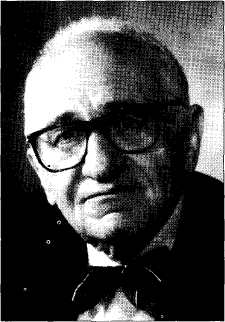
Murray N. Rothbard 1926–1995
First, Rothbard is the latest representative of the mainstream within Austrian economics.1 As in other intellectual traditions, various interconnected branches can be identified within the Austrian School of economics. Rothbard is the latest exponent of the main rationalist branch of the Austrian School, starting with the School’s founder Carl Menger, and continuing with Eugen von Böhm-Bawerk, and Ludwig von Mises. Like Menger, Böhm-Bawerk, and Mises, Rothbard is an outspoken rationalist and critic of all variants of social relativism: historicism, empiricism, positivism, falsificationism, and skepticism. Like his acknowledged predecessors, Rothbard defends the view that economic laws not only exist, but more specifically that they are “exact” (Menger) or “aprioristic” (Mises) laws. In contrast to the propositions of the (empirical) natural sciences, which must be continually tested against ever new data, and thus can never attain more than hypothetical validity, the propositions of economics concern necessary, non-hypothetical relations and assume apodictic validity. According to the Austrian mainstream, all economic laws can be derived deductively from a few elementary facts of nature and man (Menger), or from a single axiom (Mises), i.e., the proposition “man acts,” which one cannot dispute without running into a performative contradiction, and which is, thus, indisputably true, and a few empirical—and empirically testable—assumptions. Like his predecessors, Rothbard considers it neither necessary nor indeed possible to test economic propositions by studying data of experience. Experience can illustrate the validity of an economic theorem, but experience can never refute or falsify it, because ultimately its validity rests solely on the indisputable validity of the axiom of action, and on the validity (and correct exercise) of the rules of deductive reasoning and logical inference. Indeed, trying to “empirically test” an economic law involves a category mistake and is a sign of confusion. Further, like Menger, Böhm-Bawerk, and Mises before him, Rothbard adheres firmly to epistemological and methodological individualism. Only individuals act; consequently, all social phenomena must be explained—logically reconstructed—as the result of purposeful individual actions. Every “holistic” or “organicist” explanation must be categorically rejected as an unscientific pseudo-explanation. Likewise, every mechanistic explanation of social phenomena must be discarded as unscientific. Humans act under conditions of uncertainty. The idea of a social mechanical equilibrium is useful only insofar as it enables us to grasp what actions are not, and in what respect they are fundamentally different and categorically distinct from the operations of machines and automatons.
Second, Rothbard is the latest and most comprehensive system-builder within Austrian economics. Only among rationalists does a constant desire for system and completeness exist. While they contributed much to its foundation, neither Menger nor Böhm-Bawerk accomplished this ultimate intellectual desideratum. This feat was accomplished only by Mises, with the publication of his monumental Human Action.2 “Here at last,” Rothbard wrote about Human Action, “was economics whole once more, once again an edifice. Not only that—here was a structure of economics with many of the components newly contributed by Professor Mises himself.” Since then, only Rothbard has accomplished a similar achievement with the publication of Man, Economy, and State and its companion volume Power and Market.3 Modeled after Mises’s magnum opus, and even more comprehensive and complete, what Rothbard stated about Mises and Human Action can be said of himself and Man, Economy, and State. In fact, no less of an authority than Mises himself did so in reviewing the book for the New Individualist Review. Mises hailed Rothbard’s treatise
as an epochal contribution to the general science of human action, praxeology, and its practically most important and up-to-now best elaborated part, economics. Henceforth all essential studies in these branches of knowledge will have to take full account of the theories and criticisms expounded by Dr. Rothbard.4
Today Mises’s Human Action and Rothbard’s Man, Economy, and State are the two towering and defining achievements of the Austrian School. No one can be considered seriously today, whether as a student of Austrian economics or as its critic, who has not read and studied Human Action and Man, Economy, and State.
Third, Rothbard is the latest and most systematically political Austrian economist. Just as rationalism implies the desire for system and completeness, so it implies political activism. To rationalists, human beings are above all rational animals. Their actions, and the course of human history, are determined by ideas (rather than by blind evolutionary forces of spontaneous evolution and natural selection). Ideas can be true or false, but only true ideas “work” and result in success and progress, while false ideas lead to failure and decline. As the discoverer of true ideas and eradicator of false ones, the scholar assumes a crucial role in human history. Human progress is the result of the discovery of truth and the proliferation of true ideas—enlightenment—and is thus entirely in the scholar’s hands. The truth is inherently practical, and in recognizing an idea as true (or false), a scholar cannot but want it to be implemented (or eradicated) immediately. For this reason, in addition to pursuing his scholarly ambitions, Menger served as personal tutor to the Austrian Crown Prince Rudolf, and as an appointed life-member of the Austrian House of Lords (Herrenhaus). Similarly, Böhm-Bawerk served three times as Austrian minister of finance, and was a lifetime member of the Herrenhaus. Likewise, Mises was the nationally prominent chief economist of the Vienna Chamber of Commerce and advisor to many prominent figures during Austria’s first Republic, and later, in the U.S., he served as advisor to the National Association of Manufacturers and numerous other organizations. Only Mises went even further. Just as he was the first economic system-builder, so was he the first to give the Austrian activism systematic expression by associating Austrian economics with radical-liberal-libertarian-political reform (as laid out in his Liberalism of 1927). Only Rothbard, who likewise served in many advisory functions and as founder and academic director of several educational organizations, accomplished something comparable. Proceeding systematically beyond even Mises, Rothbard accomplished—in his Ethics of Liberty5—an integration (via the concept of private property) of value-free Austrian economics and libertarian political philosophy (ethics) as two complementary branches of a grand unified social theory, thereby creating a radical—Austro-libertarian—philosophical movement.
In the area of theoretical economics, Rothbard contributed two major advances beyond the standards set by Mises’s Human Action. First, Rothbard provided systematic clarification of the theory of marginal utility, and then advanced a new reconstruction of welfare economics and, entirely absent in Mises’s system, an economic theory of the state.
Building on the foundations of a strictly ordinalist interpretation of marginal utility laid out by Mises as early as 1912 in his Theory of Money and Credit,6 Rothbard explained that the word “marginal” in marginal utility does not refer to increments of utility (which would imply measurability), but rather to the utility of increments of goods (and thus has nothing to do with measurability). The good to which utility is attached, and the increments in its size, can be described in physical terms. The good and its increment extend in space, and thus can be measured and counted in unitary quantitative addition. In distinct contrast, the utility attached to a physical good and its unitary physical increments is a purely intensive magnitude. It does not extend in space, and hence is immeasurable and intractable by unitary counting and the rules of arithmetic. All attempts to construct a cardinal measure of utility are in vain. Qua intensive magnitude, utility can be treated only ordinally; that is, as a rank order on a one-dimensional individual preference scale (and every economic phenomenon, in particular monetary calculation and “objective” cost accounting, must ultimately be reducible to and explained as the simple outcome of ordinal individual rank order judgments). Apart from their placement on one-dimensional individual preference scales, no quantitative relationship between different goods and different quantities of the same good exists. In particular, no such thing as total utility—conceived of as the addition or integration of marginal utilities—exists. Rather, “total” utility is the marginal utility of a larger-sized quantity of a good, and, Rothbard explained,
[t]here are, then two laws of utility, both following from the apodictic conditions of human action: first, that given the size of a unit of a good, the (marginal) utility of each unit decreases as the supply of units increases; second, that the (marginal) utility of a larger-sized unit is greater than the (marginal) utility of a smaller-sized unit. The first is the law of diminishing marginal utility. The second has been called the law of increasing total utility. The relationship between the two laws and between the items considered in both is purely one of rank, i.e., ordinal.7
Graphically, Rothbard illustrated, the relationship can be represented thus8:
Ranks in Value
- 3 eggs
- 2 eggs
- 1 egg
- 2nd egg
- 3rd egg
The higher the ranking on this individual value scale for eggs, the higher the value. By the second law, 3 eggs are valued more highly then 2 eggs and 2 eggs more highly than one. By the first law, the 2nd egg will be ranked below the first on the value scale, and the 3rd below the 2nd. No mathematical relationship exists between, for instance, the marginal utility of 3 eggs and the marginal utility of the 3rd egg except that the former is greater than the latter.
As Lionel Robbins, influenced by Wicksteed and Mises, had first brought home to mainstream economics, from the ordinal character of utility it follows logically that every interpersonal as well as intrapersonal comparison of utility must be regarded as impossible (unscientific), and hence every social welfare proposal involving any such comparison is arbitrary.9 While mainstream welfare economics was thrown into disarray upon full realization of this conclusion, Rothbard provided a radically new strictly ordinalist reconstruction of welfare economics based on the twin concepts of individual self-ownership and demonstrated preference.10
Self-ownership simply means this: every individual owns (controls) his own physical human body. “Man’s nature,” explained Rothbard, “is a fusion of ‘spirit’ and matter.”11 Every living human body is appropriated and controlled by a single independent (autonomous) conscious mind and will—a self or ego. Accordingly, as long as it is alive, we refer to a human body as a persona (rather than a corpus). (Mainstream welfare economics also accepts the concept of self-ownership, even if only implicitly, by virtue of the fact that it speaks of separate individual utility maximizers.) The concept of demonstrated preference is implied in that of self-ownership. It simply means “that actual choice reveals, or demonstrates, a man’s preferences; that is, that his preferences are deducible from what he has chosen in action.”12 Every action involves a man’s purposeful use of his physical body, and thus demonstrates that he values this body as a good. Furthermore, in using it in one way rather than another, he simultaneously demonstrates with every action what he considers the most highly valued use of this good at the time of his acting. In accordance with the ordinal character of utility, actions reveal only the existential fact of preference orders and ranks. They do not reveal anything about the “differences” or “distances” of ranks or the “intensity” of preference, nor do they ever demonstrate “indifference.” Indeed, both “differences” of rank and “indifference,” i.e., value-equality, presuppose cardinal utility.
Based on the concepts of self-ownership and demonstrated preference, and in accordance with Pareto’s strictures concerning the possibility of meaningful ordinalist welfare statements, Rothbard deduced the following set of propositions: If a man uses his body (“labor”) to extend his control over (appropriate) other nature-given things (unowned “land”), as he must if only in order to stand, this action demonstrates that such things are also goods for him. Hence, he must have gained in utility by appropriating them. At the same time, his action does not make anyone else worse off, because in appropriating previously unowned resources nothing is taken away from others. Others could have appropriated these resources, too, if they had considered them valuable. Yet, they demonstrably did not do so. Indeed, their failure to appropriate them demonstrates their preference for not appropriating them. Hence, they cannot possibly be said to have lost any utility on account of another’s appropriation. Proceeding from the basis of acts of original appropriation, any further act, whether of production or consumption, is equally Pareto-superior on demonstrated preference grounds, provided only that it does not affect the physical integrity of the resources appropriated or produced with appropriated means by others. The producer-consumer is better off, while everyone else is left in control of the same quantity of goods as before. As a result, no one can be said to be worse off. Finally, every voluntary exchange of goods proceeding from this basis is a Pareto-superior change as well, because it can only take place if both exchange parties expect to benefit from it, while the supply of goods controlled in action (owned) by others remains unchanged.
Based on these propositions, Rothbard proceeded to advance an entirely new Austrian theory of the state. While every act of original appropriation, production-consumption, and exchange (the free market) always and necessarily increases social utility no act of expropriation (the non-consensual-unilateral-taking of goods from their original appropriator and producer-consumer) can possibly do so. Obviously this is true of all acts typically considered criminal, such as physical aggression, invasion, robbery, theft, and fraud. While the criminal controls a larger quantity of goods and is thus better off, his victim controls a correspondingly smaller quantity of goods and is made worse off; hence, no criminal act fulfills the Paretian strictures and can ever be said to increase social utility. While criminal acts are typically considered illegal and man is permitted to defend himself against them, the same conclusion about utility is true of all acts of government agents: “no act of government whatever can increase social utility.”13 Yet, they are considered legal and one is not permitted to defend oneself against them.
Rothbard’s conclusion concerning the rejection of the institution of government on welfare-economic grounds is based on the standard and non-controversial definition of the state
as that organization which possesses either or both (in actual fact, almost always both) of the following characteristics: (a) it acquires its revenue by physical coercion (taxation); and (b) it achieves a compulsory monopoly of force and of ultimate decisionmaking power over a given territorial area.14
As for its first pillar, it is clear that government agents benefit from acts of taxation; otherwise, they would abstain from them. Just as clearly the subjects of taxation—the original appropriators-producers of the goods taxed—cannot be said to benefit from such acts; otherwise, they would pay the same quantity of goods voluntarily and no compulsion would be necessary.
Similarly, it is clear that government agents gain in utility by achieving a territorial monopoly of ultimate decisionmaking (jurisdiction). Most importantly, in doing so the question of whether taxes are justified or not becomes moot and is decided from the outset in favor of government. However, just as clearly, every subject of government’s ultimate decisionmaking power is thereby made worse off. By virtue of his acts of original appropriation and production, a man demonstrates his preference for exercising exclusive control (jurisdiction) over the appropriated and produced goods. Unless he abandons, sells, or voluntarily surrenders them to someone else (in which case this person would demonstrate his preference for gaining exclusive control over them), he cannot possibly be said to have changed this evaluation. If, contrary to his demonstrated preference for not giving up his privately appropriated and produced goods, the state attains a territorial monopoly of ultimate decisionmaking (jurisdiction), this is only possible as the result of an act of expropriation. If the government is the ultimate decisionmaker, then by implication no single man has exclusive control over his own appropriated and produced goods. In effect, the state has assumed ownership of all goods appropriated and produced by “its” residents, and has reduced them to the rank of tenants. Whereas the government’s range of control is enlarged, every private owner’s range of control regarding his own appropriations and products, and their value, is correspondingly reduced. Most importantly, as a tenant no one can exclude the government from access to his privately appropriated and produced goods; that is, everyone is left without means of physical defense vis-à-vis possible government intervention or invasion.
Consequently Rothbard concluded, if all government action rests on expropriation, and no expropriation can be said to increase social utility, then welfare economics must call for the abolition of the state. Scores of political philosophers and economists, from Thomas Hobbes to James Buchanan and the modern public-choice economists, have attempted to escape from this conclusion by portraying the state as the outcome of contracts, and hence, a voluntary and welfare-enhancing institution. In reply to such endeavors, Rothbard agreed with Joseph Schumpeter that “the theory which construes taxes on the analogy of club dues or of purchase of services of, say, a doctor only proves how far removed this part of the social sciences is from scientific habits of mind.”15 From Hobbes to Buchanan, statists had tried to overcome the apparent contradiction in the idea of a “voluntary” state equipped with compulsory judicial monopoly and the power to tax by recourse to the intellectual make-shift of “implicit” or “conceptual” agreements, contracts, or constitutions. Rothbard explained that all of these typically tortuous attempts ultimately only lead to the same inescapable conclusion: “implicit” and “conceptual” contracts are the very opposite of contracts, i.e., no contracts. Hence, it is impossible to derive a welfare-economic justification for the state. No one can possibly—demonstrably—agree to permanently surrender jurisdiction over his person and private property to someone else unless he had sold or otherwise given all of his current possessions away and subsequently committed suicide; likewise no one who is alive, can possibly—demonstrably—enter a contract that permits someone else—his protector—to determine forever unilaterally, without the continued consent of the protected, the tribute that the protected must pay for his protection.
In particular, Rothbard scorned the idea of a “limited” protective state as self-contradictory and incompatible with the promotion of social utility. Limited government always has the inherent tendency to become unlimited (totalitarian) government. Given the principle of government—judicial monopoly and the power to tax—any notion of restraining government power and safeguarding individual life and property is illusory. Under monopolistic auspices, the price of justice and protection will rise and the quality of justice and protection will fall. A tax-funded protection agency is a contradiction in terms—an expropriating property protector—and will lead to more taxes and less protection. Even if a government limited its activities exclusively to the protection of pre-existing property rights, the further question of how much security to produce would arise. Motivated (like everyone else) by self-interest and the disutility of labor, but with the unique power to tax, a government agent’s answer will invariably be the same: to maximize expenditures on protection—and almost all of a nation’s wealth can conceivably be consumed by the cost of protection—and at the same time to minimize the production of protection. Moreover, a judicial monopoly will lead to a deterioration in the quality of justice and protection. If one can only appeal to government for justice, justice and protection will be perverted in favor of government, constitutions and supreme courts notwithstanding. Constitutions and supreme courts are government constitutions and courts, and whatever limitations to government action they might contain or find is determined by agents of the very institution under consideration. Predictably, the definition of property and protection will be altered and the range of jurisdiction expanded to the government’s advantage.
Instead, in accordance with the “one ethical judgment” that “even the most rigorously wertfrei economists have been willing to allow themselves . . . (of feeling) free to recommend any change or process that increases social utility under the Unanimity Rule,”16 Rothbard reached the same anarchist conclusion as the French–Belgian economist Gustave de Molinari before him: defense, protection, and judicial services
would therefore have to be supplied by people or firms who (a) gained their revenue voluntarily rather than by coercion and (b) did not—as the State does—arrogate to themselves a compulsory monopoly of police or judicial protection. . . . [D]efense firms would have to be as freely competitive and as noncoercive against noninvaders as are all other suppliers of goods and services on the free market. Defense services, like all other services, would be marketable and marketable only.17
Every private-property owner would be able to partake of the advantages of the division of labor, and to seek better protection of his property than that afforded by self-defense, through cooperation with other owners and their property. That is, anyone could buy from, sell to, or otherwise contract with anyone else concerning protective and judicial services, and he could at any time unilaterally discontinue any such cooperation with others and fall back on self-reliant defense or change his protective affiliations.
Rothbard’s other major advance was in the theory of monopoly and competition. Here too, Rothbard recalled the French tradition of radical laissez-faire economics of Jean-Baptiste Say and his followers (to which Molinari belonged). Rothbard’s positive doctrine of competition and monopoly is plain and simple (as a theory should be). Competition is defined as conduct within the framework of the described rules of Pareto-superior action: of original appropriation, production-consumption, and voluntary exchange and contract. More specifically applied to entrepreneurial action, competition means the existence of unrestricted “free entry.” Every individual is at liberty to employ his own property in any way he sees fit, and to enter any line of production deemed profitable. As long as this free-entry condition is met, Rothbard concluded, all product prices and production costs tend to be minimum prices and minimum costs. In distinct contrast, monopoly and monopolistic competition are defined by the absence of free entry, i.e., as the presence of exclusive privilege. The state, defined as the compulsory territorial monopolist of jurisdiction and protection, is thus the prototype of a monopoly. Every individual—except the agents of the state—is prohibited from using his property for the production of self-defense and justice, and thus from competing with the state. All other monopolies go back to this originary state-monopoly of jurisdiction (legislation and regulation) as their ultimate source. Every other monopoly involves “a grant of special privilege by the State, reserving a certain area of production to one particular individual or group.”18 Entry into the area is legally restricted to other actual or potential producers, and this restriction is enforced by state police. As long as free entry is restricted or absent, concluded Rothbard, whether in the production of justice and security or that of any other good or service, product prices and production costs will be higher than otherwise, i.e., too high. (Thus, to Rothbard the notion of government anti-monopoly or antitrust policy was a contradictio in adjecto. Competition required instead the abolition of the state’s very own territorial monopoly of jurisdiction.)
Moreover, Rothbard refuted every alternative theory as nonsense, nonoperational, or false. It is nonsense, for instance, to define a monopolist as someone who has control over his price (a “price-searcher”). Every businessman has perfect control over his price (and no control at all over the quantity bought at that price by consumers). Hence, under this definition, no one exists who is not a monopolist. Likewise, it is nonsense to define a monopolist as “the only seller of any given good,” for in an objective sense, every seller of every product is always the only seller of his own unique product (brand). Thus, everyone is a monopolist with a one-hundred-percent market share of one’s own product. Yet, this circumstance does not affect in the slightest that each entrepreneur must compete at all times with every other entrepreneur for consumer spending, regardless how unique or different one’s goods may be. On the other hand, in a subjective sense, no seller of anything can ever be established definitely as a monopolist. According to this interpretation, the term “given good” means “a good as defined by consumers.” Thus, the determination of whether or not the seller of something is its only seller, or of how large his market-share is, depends on the consumers’ definition of what this good is; that is, on their classification of particular physical objects into various groups of homogeneous goods. Not only can such classifications continually change, but different consumers can classify the same physical objects differently. Hence, in this sense the term monopolist becomes practically useless and non-operational, and all attempts to measure a product’s market-share must be considered futile.
Finally, Mises’s theory of monopoly price is untenable. Mises had argued that
[m]onopoly is a prerequisite for the emergence of monopoly prices, but it is not the only prerequisite. There is a further condition required, namely a certain shape of the demand curve. The mere existence of monopoly does not mean anything in this regard. . . . Not every price at which a monopolist sells a monopolized commodity is a monopoly price. Monopoly prices are only prices at which it is more advantageous for the monopolist to restrict the total amount to be sold than to expand his sales to the limit which a competitive market would allow.19
As Rothbard explained, this argument is fallacious. First off, it will have to be noted that every restrictive action must, by definition, have a complementary expansionary aspect. The factors of production which the monopolist releases from employment in some production line A do not simply disappear. Rather, they must be used otherwise: either for the production of another exchange good B, or for an expansion in the production of the consumer good of leisure for its owner. Thus, even if monopoly prices existed, this would have no negative welfare-social utility-implications. From the monopolist’s act of not-selling, it follows that he must believe himself to be better off keeping rather than selling his goods, and no one else is made worse off because of his act (because everyone else still controls the same quantity of goods as before). Consequently, Mises’s monopoly price and the shape of the demand curve facing a monopolist cannot be operationally or conceptually distinguished from any other price and demand curve facing any other seller.
Production, explained Rothbard, precedes the sale of final products, and production costs must be incurred before consumers can demonstrate their preference for one’s products. Hence, it is nonsense, for instance, to define a monopoly price as a price above marginal cost (or of marginal revenue higher than marginal cost) because the cost curves on the one hand and the demand and revenue curves on the other do not exist simultaneously. The only curves that exist simultaneously with cost curves are entrepreneurially estimated future demand and revenue curves. However, in deciding on the quantity of goods to be produced, every producer will always set his output so as to maximize his expected money earnings, ceteris paribus. That is, in the monetary calculations leading to his output-decision, expected price and marginal revenue are never equal to marginal cost. No one will produce anything unless he expects its price to exceed its cost; and no one will expand his output, unless he expects marginal revenue to be higher than marginal cost. Thus, every entrepreneur assumes in his calculations that in the future he will be facing a downward sloping demand curve, with elastic and inelastic stretches. Likewise, at the subsequent point of sale when all costs have been incurred by the producer and the only relevant demand is that of consumers for existing stocks of produced products, every entrepreneur will assume a downward sloping demand curve. That is, every entrepreneur will set his price at such a height that any price higher than the actually chosen one will encounter an elastic demand, and thus lead to lower sales revenues.
If the actually chosen sale price coincides with the original estimation, and if the market clears at this price, the entrepreneurial forecast has been correct. On the other hand, the actual demand can differ from the initial projection, and one or another type of entrepreneurial forecasting error may be revealed. At the point of sale, the entrepreneur can come to the conclusion that he mistakenly produced either “too little” or “too much.” In the first case, actual demand (prices and revenue) is higher than expected, yet profits could have been still greater if production had been further expanded. The entrepreneur originally estimated demand beyond a specific output-point to be inelastic (such that a larger output would lead to lower total revenue), while it is now revealed as being elastic beyond this point. In the second case, the actual demand (prices and revenue) is lower than expected. Losses could have been avoided if less had been produced. The entrepreneur estimated demand beyond a certain output-point to be elastic, such that a larger quantity could be sold for a higher total revenue, while it is now revealed as inelastic.
In any case, whether or not his original forecast was correct, every entrepreneur must subsequently make a new output decision. Under the assumption that they regard their past experience (present demand) as indicative of their future experience (demand), three possible decisions exist. Entrepreneurs whose initial forecasts had been correct will produce the same quantity as before. Entrepreneurs who had initially produced “too little” will now produce a larger quantity, and entrepreneurs who had previously produced “too much” will restrict current sales and future production. How, asked Rothbard, can this latter entrepreneurial response to earlier overproduction be distinguished from Mises’s alleged “monopoly price” situation? He answered that in fact it could not.
Is the higher price to be gained from such a cutback necessarily a “monopoly price”? Why could it not just as well be a movement from a subcompetitive price to a competitive price? In the real world, a demand curve is not simply “given” to a producer, but must be estimated and discovered. If a producer has produced too much in one period and, in order to earn more income, produces less in the next period, this is all that can be said about the action. . . . Thus, we cannot use “restriction of production” as the test of monopoly vs. competitive price. A movement from a subcompetitive to a competitive price also involves a “restriction” of production of this good, coupled, of course, with an expansion of production in other lines by the released factors. There is no way whatever to distinguish such a “restriction” and corollary expansion from the alleged “monopoly-price” situation. . . . But if a concept has no possible grounding in reality, then it is an empty and illusory, and not a meaningful, concept. On the free market, there is no way of distinguishing a “monopoly price” from a “competitive price” or a “subcompetitive price” or of establishing any changes as movements from one to the other. No criteria can be found for making such distinctions. The concept of monopoly price as distinguished from competitive price is therefore untenable. We can only speak of the free-market price.20
In addition to these major innovations, Rothbard contributed many new theoretical insights. Two examples will have to suffice here. For one, Rothbard utilized the well-known Misesian argument concerning the impossibility of economic calculation (cost-accounting) under socialism in order to demonstrate, even more generally, the impossibility of one big cartel on the free market.21
T]he free market placed definite limits on the size of the firm, i.e., the limits of calculability on the market. In order to calculate the profits and losses of each branch, a firm must be able to refer its internal operations to external markets for each of the various factors and intermediate products. When any of these external markets disappears, because all are absorbed within the province of a single firm, calculability disappears, and there is no way for the firm rationally to allocate factors to that specific area. The more these limits are encroached upon, the greater and greater will be the sphere of irrationality, and the more difficult it will be to avoid losses. One big cartel would not be able rationally to allocate producers’ goods at all and hence could not avoid severe losses. Consequently, it could never really be established, and, if tried, would quickly break asunder.22
The second example, likewise inspired by Mises, is from the area of monetary theory. Mises, stimulated in turn by Menger’s work, had demonstrated that money qua medium of exchange must originate as a commodity money (such as gold). Rothbard complemented Mises’s theory of the origin of money—his famous “regression theorem”—with a theory of the destruction or devolution of money by government, or what might be termed a “progression theorem.” He demonstrated, most succinctly in his What Has Government Done to Our Money?,23 the praxeologically necessary sequence of actions taken by government in order to achieve—as its ultimate goal—complete money counterfeiting autonomy. Having of necessity to begin with a market-provided commodity money such as gold, a government will first monopolize the minting; next, it will monopolize the issue of money substitutes (titles to money, ready redeemable banknotes); subsequently, it will engage in fractional reserve banking and issue money substitutes in excess of actual money; and finally as the inevitable result of the bank crisis (bank run) brought about by fractional-reserve banking, it will suspend the redeemability of its notes, cut the tie between paper (title) and money (gold), confiscate all privately owned money, and institute a pure fiat money.
Yet, Rothbard’s achievements go far beyond his innovations in economic theory. They go far beyond even his accomplishment of integrating these innovations into a grand, comprehensive and unified system of Austrian economics. Although an economist by profession, Rothbard’s work encompasses also political philosophy (ethics) and history.
Unlike the utilitarian Mises, who denied the possibility of rational ethics, Rothbard recognized the need for an ethical system to complement value-free economics so as to make the case for the free market truly watertight. Drawing on the theory of natural rights, in particular on the work of John Locke, and on the genuinely American tradition of anarchistic thought of Lysander Spooner and Benjamin Tucker, Rothbard developed a system of ethics based on the principles of self-ownership and the original appropriation of unowned natural resources through homesteading. Any other proposal, he demonstrated, either does not qualify as an ethical system applicable to everyone qua human being, or it is not viable, for following it would literally imply death while it requires a surviving proponent, and thus leads to performative contradictions. The former is the case with all proposals which imply granting A ownership over B and resources homesteaded by B, but not giving B the same right with respect to A. The latter is the case with all proposals advocating universal (communal) co-ownership of everyone and everything by all, for then no one would be allowed to do anything with anything before he had everyone else’s consent to do whatever he wanted to do. And how could anyone consent to anything if he were not the exclusive (private) owner of his body? In The Ethics of Liberty, his second magnum opus, Rothbard deduced the entire corpus of liberal-libertarian law—from the law of contracts to the theory of punishment—from these first axiomatic principles; and in his For A New Liberty,24 he applied this ethical system to a diagnosis of the present age and the proposal, and economic analysis, of the political reforms necessary to achieve a free and prosperous commonwealth.
Furthermore, although first and foremost a theoretician, Rothbard was also an accomplished historian, and his writing contains a wealth of empirical information rarely matched by any empiricist or historicist. In fact, it is Rothbard’s recognition of economics and political philosophy (ethics) as pure aprioristic theory, and of theoretical reasoning as logically anteceding and constraining every historical investigation, which makes his empirical scholarship superior to that of most orthodox historians, and has established him as one of the outstanding “revisionist” historians. Particularly noteworthy in the area of economic history is his book America’s Great Depression,25 which applies the Mises-Hayek business-cycle theory to explain the 1929 stock-market crash and the ensuing economic depression. In political history, there is his four-volume history of colonial America, Conceived in Liberty,26 and in the field of intellectual history there is his posthumously published monumental if uncompleted two-volume history of economic, social, and political thought, Economic Thought Before Adam Smith and Classical Economics.27 In these and other books and countless articles, Rothbard provided integrated economic-sociological-political analyses of almost every critical episode in American history: from the panic of 1819, the Jacksonian period, the War for Southern Independence, the Progressive era, World War I and Wilsonianism, Hoover, FDR and World War II, to Reaganomics and Clintonianism. With an eye for the minutest detail of history’s byways, time and again Rothbard challenged common wisdom and historical orthodoxy and provided his readers with a vision of the process of history as a permanent struggle of good against evil: between truth and falsehood, and between forces of liberty and power elites exploiting and enriching themselves at the expense of others and covering their tracks through lies and deceptions.
These amazing scholarly achievements notwithstanding, Rothbard’s academic career, much like Mises’s, was hardly a success by conventional standards. The twentieth century has been the age of socialism and interventionism. Schools and universities are government-funded and government-controlled institutions; hence, the most eminent appointments go either to socialists or interventionists, while “intransigent,” “dogmatic,” or “extremist” proponents of laissez-faire capitalism are excluded or relegated to the fringes of academia. Rothbard had no illusion in this regard, and never complained or appeared to be bitter about his academic fate. His influence did not rest on institutional powers, but solely on the power of his ideas and the force of logic.
Murray Rothbard was born and raised in New York City as the only child of immigrant parents. His father, a chemist, came from Poland and his mother from Russia. Upon winning a scholarship, Rothbard attended private schools and went on to study economics at Columbia University, where, in 1956, he received his Ph.D. with a dissertation written under the economic historian Joseph Dorfman. For more than a decade beginning in 1949, Rothbard also participated in Mises’s private seminar at New York University. After working several years for various foundations, most notably the William Volker Fund, Rothbard taught at the Brooklyn Polytechnic Institute, an engineering school, from 1966 until 1986. From 1986 until his death, he was the S.J. Hall Distinguished Professor of Economics at the University of Nevada, Las Vegas. As one of two economics professors at Brooklyn Polytechnic, Rothbard was a member of the social science department, which fulfilled only a subservient function within the university. In Las Vegas, the department of economics, housed in the university’s Business College, did not offer a doctoral program. Thus, throughout his academic career Rothbard was prevented from claiming a single doctoral student as his own.
Rothbard’s fringe existence in academia did not prevent him from exerting intellectual influence or attracting students and disciples, however. Through the sheer flood of his publications and the unrivaled clarity of his writing, modeled after that of H.L. Mencken, Roth-bard became the creator and one of the principal agents of the contemporary libertarian movement, which in the course of three decades has grown from a handful of proponents into a genuine mass movement (including but extending far beyond a party of this name, the Libertarian Party, to a wide and complex network of groups and associations on into the U.S. Congress and many state legislatures). Naturally, in the course of this development, Rothbard and his theoretical position did not remain unchallenged or undisputed. There were ups and downs in institutional alignments, coalitions, breaks, and realignments in his career. However, in association with the Center for Libertarian Studies, under Burton S. Blumert, and the Ludwig von Mises Institute, under Llewellyn H. Rockwell, Jr., and as founder-editor of their scholarly flagships, The Journal of Libertarian Studies (1977) and The Review of Austrian Economics (1987),28 Rothbard has remained beyond his death without doubt the most important and highly respected intellectual authority within the entire libertarian movement, and to this day his rationalist-axiomatic- deductive-Austro-libertarianism provides the intellectual benchmark in reference to which not only everyone and everything within libertarianism is defined, but increasingly everyone and everything in American politics.
SELECTED READINGS
Block, Walter, and Llewellyn H. Rockwell, Jr. eds. 1988. Man, Economy, and Liberty: Essays in Honor of Murray N. Rothbard. Auburn, Ala.: Ludwig von Mises Institute.
Rothbard, Murray N. [1982] 1998. The Ethics of Liberty. New York: New York University Press.
——. 1997. The Logic of Action. 2 vols. Cheltenham, U.K.: Edward Elgar.
——. 1995. Economics Before Adam Smith. Vol. 1 An Austrian Perspective on the History of Economic Thought. Cheltenham, U.K.: Edward Elgar.
——. 1995. Classical Economics. Vol. 2. An Austrian Perspective on the History of Economic Thought. Cheltenham, U.K.: Edward Elgar.
——. 1995. Making Economic Sense. Auburn, Ala.: Ludwig von Mises Institute.
——. 1990 [1963]. What Has Government Done to Our Money? Auburn, Ala.: Ludwig von Mises Institute.
——. 1983. America’s Great Depression. New York: Richardson and Snyder.
——. 1973. For a New Liberty. New York: Macmillan.
——. 1975. Conceived in Liberty. 4 vols. New Rochelle, N.Y: Arlington House.
——. 1970. Power and Market. Menlo Park, Calif.: Institute for Humane Studies.
——. 1962. Man, Economy, and State: A Treatise on Economics. Princeton, N.J.: D. Van Nostrand; reprinted in 1993 by the Ludwig von Mises Institute, Auburn, Ala.
_______________
29Among academia in general, currently F.A. Hayek is by far the most prominent Austrian economist. It is worth emphasizing, then, that Hayek is not a representative of the rationalist mainstream of Austrian economics, nor does Hayek claim otherwise. Hayek stands in the intellectual tradition of British empiricism and skepticism, and is an explicit opponent of the continental rationalism espoused by Menger, Böhm-Bawerk, Mises, and Rothbard. On this topic see further Joseph T. Salerno, “Ludwig von Mises as Social Rationalist,” Review of Austrian Economics 4 (1990): 26–54; Jeffrey M. Herbener, “Introduction,” in The Meaning of Ludwig von Mises, Jeffrey M. Herbener, ed. (Boston: Kluwer Academic Publishers, 1993); Hans-Hermann Hoppe, “Einführung: Ludwig von Mises und der Liberalismus,” in Ludwig von Mises, Liberalismus (St. Augustine: Academia Verlag, 1993); idem, “F.A. Hayek on Government and Social Evolution,” Review of Austrian Economics 7, no. 1 (1994): 67–93; idem, “Die öesterreichische Schule und ihre Bedeutung für die moderne Wirtschaftswissenschaft,” in Hans Hoppe, Kurt Leube, Christian Watrin, and Joseph Salerno, Ludwig von Mises’s ‘Die Gemeinwirtschaft’ (Düsseldorf: Verlag Wirtschaft und Finanzen, 1996); Murray N. Rothbard, “The Present State of Austrian Economics,” in idem, The Logic of Action (Cheltenham, U.K.: Edward Elgar, 1997), vol. 1. Government and Social Evolution,” Review of Austrian Economics 7, no. 1 (1994): 67–93; idem, “Die öesterreichische Schule und ihre Bedeutung für die moderne Wirtschaftswissenschaft,” in Hans Hoppe, Kurt Leube, Christian Watrin, and Joseph Salerno, Ludwig von Mises’s ‘Die Gemeinwirtschaft’ (Düsseldorf: Verlag Wirtschaft und Finanzen, 1996); Murray N. Rothbard, “The Present State of Austrian Economics,” in idem, The Logic of Action (Cheltenham, U.K.: Edward Elgar, 1997), vol. 1.
30Ludwig von Mises, Human Action, 3rd rev. ed. (Auburn, Ala.: Ludwig von Mises Institute, [1949] 1966).
31Murray N. Rothbard, Man, Economy, and State: A Treatise on Economic Principles (Auburn, Ala.: Ludwig von Mises Institute, [1962] 1993); idem, Power and Market (Menlo Park, Calif.: Institute for Humane Studies, 1970).
32Ludwig von Mises, “A New Treatise on Economics,” The New Individualist Review 2, no. 3 (1962): 39–42.
33Murray N. Rothbard, The Ethics of Liberty (Atlantic Highlands, N.J.: Humanities Press, 1982).
34Ludwig von Mises, The Theory of Money and Credit, H.E. Batson, trans. (Indianapolis, Ind.: Liberty Fund, [1912] 1980).
35Rothbard, Man, Economy, and State, pp. 270–71; emphasis in the original.
36Rothbard, The Logic of Action, vol. 1, p. 222.
37See Lionel Robbins, The Nature and Significance of Economic Science (London: Macmillan, 1932), chap. 6. The impossibility of inter- and intra-personal utility comparisons does not imply that two individuals or time periods cannot be compared objectively, of course. In fact, every individual can determine objectively whether his quantitative supply of any particular good has increased, decreased, or remained the same. And if his supply of one good has increased (decreased) while the supply of his other goods has remained the same, surely it can be said objectively that this individual is better (worse) off and has attained a higher (lower) rank on his individual value scale. Likewise, every individual participating in a monetary economy can determine objectively whether the monetary value of his assets has increased, decreased, or remained constant.
38Rothbard’s contributions to welfare economics are strewn throughout his entire body of work. They begin with his 1956 essay “Toward a Reconstruction of Utility and Welfare Economics,” and reach their completion in 1982 with his Ethics of Liberty. See also Hans-Hermann Hoppe, “Book Review of Man, Economy, and Liberty,” Review of Austrian Economics 4 (1990): 257–58; idem, The Economics and Ethics of Private Property (Boston: Kluwer, 1993), pp. 232–33; Jeffrey M. Herbener, “The Pareto Rule and Welfare Economics,” Review of Austrian Economics 10, no. 1 (1997): 79–106.
39Rothbard, The Ethics of Liberty, p. 31.
40Rothbard, The Logic of Action, vol. 1, p. 212.
41Ibid., p. 243.
42Rothbard, The Ethics of Liberty, p. 171.
43Rothbard, The Logic of Action, vol. 1, p. 247.
44Ibid., p. 244.
45Rothbard, Power and Market, p. 2.
46Rothbard, Man, Economy, and State, p. 591.
47Mises, Human Action, p. 359.
48Rothbard, Man, Economy, and State, pp. 607, 614; emphasis in the original.
49Ibid., pp. 544–50.
50Ibid., p. 585.
51Murray N. Rothbard, What Has Government Done to Our Money? (Auburn, Ala.: Ludwig von Mises Institute, 1990).
52Murray N. Rothbard, For A New Liberty (New York: Macmillan, 1973).
53Murray N. Rothbard, America’s Great Depression (New York: Richardson and Snyder, 1983).
54Murray N. Rothbard, Conceived in Liberty, 4 vols. (New Rochelle, N.Y.: Arlington House, 1975).
55Murray N. Rothbard, An Austrian Perspective on the History of Economic Thought, 2 vols. (Cheltenham, U.K.: Edward Elgar, 1995).
56In 1998 the journal that Rothbard founded became the Quarterly Journal of Austrian Economics, published by Transaction Publishers..
- 1Two recent examples are the review article by Israel M. Kirzner, “Entrepreneurial Discovery and the Competitive Market Process: An Austrian Approach,” Journal of Economic Literature 35, no. 1 (March 1997): 60–85; and Sherwin Rosen, “Austrian and Neoclassical Economics: Any Gains From Trade?” Journal of Economic Perspectives 11, no 4. (Fall 1997): 139–52. Both of these journals are publications of the American Economic Association, indicating the degree to which Austrian ideas are at least recognized, if not embraced, by the profession’s mainstream.
- 2See Leland B. Yeager, “Austrian Economics, Neoclassicism, and the Market Test,” Journal of Economic Perspectives 11, no. 4 (Fall 1997): 153–65, for an insightful discussion on the challenges that an alternative to mainstream ideas faces in the academic marketplace.
- 3See Karen I. Vaughn, Austrian Economics in America: The Migration of a Tradition (New York: Cambridge University Press, 1994), for a good discussion of the development of the modern Austrian School. Also see Murray N. Rothbard, “The Present State of Austrian Economics,” Money, Method, and the Austrian School, vol. 1, The Logic of Action (Cheltenham, U.K.: Edward Elgar, 1997).
- 4The first edition of Menger’s Principles of Economics was published in German in 1871. While it was generally recognized as a landmark contribution in economics, an English translation was not published until 1950.
- 5Murray N. Rothbard, in Ludwig von Mises: Scholar, Creator, Hero (Auburn, Ala.: Ludwig von Mises Institute, 1988), p. 13, notes that Mises’s early work on monetary theory, while controversial, was published in the Economic Journal, one of the leading mainstream economic journals of the time.
- 6Paul A. Samuelson, Economics, 9th ed. (New York: McGraw-Hill, 1973), p. 883.
- 7Diego de Covarrubias y Leyva, Omnia Opera (Venice, 1604),vol. 2, chap.4, p.131.
- 8Luis Saravia de la Calle, Instrucción de mercaderes (1544); republished in Colección de Joyas Bibliográficas (Madrid, 1949), p. 53. Saravia’s book addresses the business entrepreneur (in Spanish mercaderes) following a continental Catholic tradition that can be traced back to San Bernardino de Siena (1380–1444). See Rothbard, Economic Thought Before Adam Smith, pp. 81–85.
- 9Juan de Lugo (1583–1660), Disputationes de iustitia et iure (Lyon, 1642), vol. 2, d. 26, s. 4, n. 40, p. 312.
- 10Juan de Salas, Commentarii in secundam secundae D. Thomae de contractibus (Lyon, 1617), vol. 4, no. 6, p. 9.
- 11Jerónimo Castillo de Bovadilla, Práctica para corregidores (Salamanca, 1585), vol. 2, chap. 4, no. 49. See also the important comments on the scholastics and their dynamic concept of competition written by Oreste Popescu, Estudios en la historia del pensamiento económico latinoamericano (Buenos Aires: Plaza and Janés, 1987), pp. 141–59.
- 12Luis de Molina, De iustitia et iure (Cuenca, 1597), vol. 2, disp. 348, no. 4, and La teoría del justo predo, Francisco Gómez Camacho, ed. (Madrid: Editora Nacional, 1981), p. 169. Raymond de Roover, ignoring the work of Castillo de Bovadilla, acknowledges how “Molina even introduces the concept of competition by stating that concurrence or rivalry among buyers will enhance prices.” See his article “Scholastic Economics: Survival and Lasting Influence from the Sixteenth Century to Adam Smith,” Quarterly Journal of Economics 69, no. 2 (May1955): 169.
- 13Included in Covarrubias, Omnia Opera, vol. 1, pp. 669–710.
- 14Carl Menger, Principles of Economics (New York: New York University Press, 1981), p. 317.
- 15Martín Azpilcueta Navarro, Comentario resolutorio de cambios (Madrid: Consejo Superior de Investigaciones Científicas, 1965), pp. 74–75.
- 16See Jesús Huerta de Soto, “New Light on the Prehistory of the Theory of Banking and the School of Salamanca,” Review of Austrian Economics 9, no. 2 (1996): 59–81.
- 17Luis de Molina, Tratado sobre los cambios, Introduction by Francisco Gómez Camacho (Madrid: Instituto de Estudios Fiscales, 1990), p. 146. Also James Pennington’s memo dated February 13, 1826, “On the Private Banking Establishments of the Metropolis,” included as an Appendix in Thomas Tooke, A Letter to Lord Grenville; On the Effects Ascribed to the Resumption of Cash Payments on the Value of the Currency (London: John Murray, 1826).
- 18However, according to Father Bernard W. Dempsey, if the members of this second group of the School of Salamanca had had a detailed theoretical knowledge of the functioning and implications of the economic process to which fractional-reserve banking gives rise, it would have been described as a perverse, vast and illegitimate process of institutional usury, even by Molina, Lessius, and Lugo themselves. See Father Bernard W. Dempsey, Interest and Usury (Washington, D.C.: American Council of Public Affairs, 1943), p. 210.
- 19Quoted in ibid., p. 214, n. 31.
- 20Mariana, Discurso de las enfermedades de la Compañía, pp. 151–55, 216.
- 21See Leland B. Yeager, “Book Review,” Review of Austrian Economics 9, no. 1 (1996): 183, where he says:
- 22Jaime Balmes, “Verdadera idea del valor o reflexiones sobre el origen, naturaleza y variedad de los precios,” en Obras Completas (Madrid: B.A.C., 1949), vol. 5, pp. 615–24. Balmes also described the personality of Juan de Mariana with the following graphic words:
- 23Ibid., p. 51.
- 24Cantillon laid the groundwork for Turgot and the theory of profit. See Renee Prendergast, “Cantillon and the Emergence of the Theory of Profit,” History of Political Economy 23 (Fall 1991): 429.
- 25Cantillon, Essai, p. 49. His use of the word “naturally” shows that the changes he refers to cause a predictable change in price.
- 26Ibid., p. 53.
- 27Ibid., p. 31. When he refers to well-organized societies, Cantillon seems to be referring to an advanced market economy in which monetary exchange and banking services have been long and thoroughly established.
- 28Ibid., p. 97.
- 29AT THE END of the twentieth century, the Austrian School of economics is exerting a significant influence both on the development of academic economics and on the application of economic theory to public policy. An increasing number of economics professors are sympathetic with the fundamental ideas of Austrian economics, and academic journals are taking more account of the Austrian School. A half century ago, few academic economists would even have been familiar with the Austrian School, except superficially, and among those who were, most would have disagreed with its methods and conclusions. Today, the ideas of Austrian economics are closer to the mainstream of economic thought, not because Austrian economics has changed, but because mainstream economics has moved toward the Austrian point of view. A similar shift has occurred in the public-policy arena. The policy implications of Austrian economics, once rejected as extreme, are now embraced as true. In the process, the Austrian School has become increasingly visible as an intellectual force.
- 30If the ideas of Austrian economics have made such inroads, one might wonder why, in the academic arena, Austrian economics does not play a bigger role. Part of the answer has to do with academic institutions themselves. Most university faculty teach at state institutions, which by itself may bias them toward supporting the state and being suspicious of laissez-faire ideas. Most university faculty have tenure, which slows the turnover of personnel, and perhaps of ideas. Furthermore, academic ideas find their outlets largely in academic journals, and the editorial boards of those journals tend to be controlled by the academic mainstream, further promoting mainstream ideas over alternative schools of thought. Because publication in academic journals is often a prerequisite for promotion and tenure in a university environment, academic survival often pushes young scholars in the direction of the mainstream methods and ideas in their discipline.
- 31Austrian economics has fought an uphill battle for acceptance for several reasons, but at the same time, the Austrian School has been gaining in strength, and is becoming more accepted in academia. A growing number of economics professors align themselves with the Austrian School, and even among those who do not, Austrian ideas are becoming more recognized and respected. Interestingly enough, the late-twentieth-century resurgence of interest in the Austrian School has been concentrated in the United States. This is largely due to Ludwig von Mises’s migration, and his Austrian economics seminar at New York University. One might go so far as to argue that the modern Austrian School would not exist were it not for the influence of Ludwig von Mises on his American students.
- 32Carl Menger is generally regarded as the founder of the Austrian School, but prior to about 1920, Austrian economics was not very different from economics in general. Economic theory had taken a great leap forward in the 1870s when the concept of marginal utility was independently discovered by Léon Walras, William Stanley Jevons, and Carl Menger. Each of these three individuals pushed the concept in different directions, but the integration of the marginal theory of value into economics was a major leap for all of economics. Eugen von Böhm-Bawerk’s capital theory, now seen as Austrian, was viewed more generally as a part of economics when it was published in the 1880s and 1890s, and Ludwig von Mises’s Theory of Money and Credit, published in 1912, established him as a leading authority on monetary economics.
- 33Carl Menger is generally regarded as the founder of the Austrian School, but prior to about 1920, Austrian economics was not very different from economics in general. Economic theory had taken a great leap forward in the 1870s when the concept of marginal utility was independently discovered by Léon Walras, William Stanley Jevons, and Carl Menger. Each of these three individuals pushed the concept in different directions, but the integration of the marginal theory of value into economics was a major leap for all of economics. Eugen von Böhm-Bawerk’s capital theory, now seen as Austrian, was viewed more generally as a part of economics when it was published in the 1880s and 1890s, and Ludwig von Mises’s Theory of Money and Credit, published in 1912, established him as a leading authority on monetary economics.
- 34From its low point in the middle of the twentieth century, Austrian economics has continued to gain visibility both inside academia and out. F.A. Hayek won the Nobel prize in economics in 1974, giving the Austrian School attention and respectability. By then, a small Austrian revival was already underway, led by Kirzner and Rothbard, and Hayek’s Nobel prize gave the revival additional momentum. Still, the Austrian School was branded by being on the losing side of the socialist calculation debate. In 1973, the year Mises died, Paul Samuelson, another Nobel laureate in economics and among the most prominent of mainstream academic economists, argued in his introductory textbook that even though the Soviet Union had roughly half the per capita income of the United States, their superior economic system based on central planning gave them faster growth. Based on this, Samuelson projected that per capita income in the Soviet Union could catch up to that of the United States as early as 1990, and almost surely by 2015. Keep in mind that Samuelson’s projection was in his best-selling introductory college textbook, and was the standard line taught in college classrooms at the time. Clearly, the mainstream had not accepted the ideas of Austrian economics.
- 35We should note how Mariana refers to the fact that the “common estimation” of men is the origin of the value of things, thus following the traditional subjectivist doctrine of the scholastics, which was initially proposed by Diego de Covarrubias y Leyva. Covarrubias (1512–1577), the son of a famous architect, became bishop of the city of Segovia and a minister to King Philip II. In 1554, he set forth better than anyone before the subjectivist theory of value, stating that “the value of an article does not depend on its essential nature but on the subjective estimation of men, even if that estimation is foolish,” illustrating his thesis with the example that “in the Indies wheat is dearer than in Spain because men esteem it more highly, though the nature of the wheat is the same in both places.”
- 36Covarrubias’s subjectivist conception was completed by another of his scholastic contemporaries, Luis Saravia de la Calle, who was the first to demonstrate that prices determine costs, not vice versa. Saravia de la Calle also had the special distinction of writing in Spanish, not in Latin. Its title was Instrucción de mercaderes (Instruction to merchants), and there we can read that “those who measure the just price by the labor, costs and risk incurred by the person who deals in the merchandise are greatly in error. The just price is found not by counting the cost but by common estimation.”
- 37The subjectivist conception initiated by Covarrubias also allowed other Spanish scholastics to get a clear insight of the true nature of market prices, and of the impossibility of attaining an economic equilibrium. Thus, the Jesuit Cardinal Juan de Lugo, wondering what the price of equilibrium was, as early as 1643 reached the conclusion that the equilibrium depended on such a large number of specific circumstances that only God was able to know it (“Pretium iustum mathematicum licet soli Deo notum”). Another Jesuit, Juan de Salas, referring to the possibilities of knowing specific market information, reached the very Hayekian conclusion that it was so complex that “quas exacte comprehendere et ponderare Dei est non hominum” (only God, not men, can understand it exactly).
- 38The subjectivist conception initiated by Covarrubias also allowed other Spanish scholastics to get a clear insight of the true nature of market prices, and of the impossibility of attaining an economic equilibrium. Thus, the Jesuit Cardinal Juan de Lugo, wondering what the price of equilibrium was, as early as 1643 reached the conclusion that the equilibrium depended on such a large number of specific circumstances that only God was able to know it (“Pretium iustum mathematicum licet soli Deo notum”). Another Jesuit, Juan de Salas, referring to the possibilities of knowing specific market information, reached the very Hayekian conclusion that it was so complex that “quas exacte comprehendere et ponderare Dei est non hominum” (only God, not men, can understand it exactly).
- 39Furthermore, the Spanish scholastics were the first ones to introduce the dynamic concept of competition (in Latin concurrentium), which is best understood as a process of rivalry among entrepreneurs. For instance, Jerónimo Castillo de Bovadilla (1547–?) wrote that “prices will go down as a result of the abundance, rivalry (emulación), and competition (concurrencia) among the sellers.”
- 40This same idea is closely followed by Luis de Molina. Covarrubias also anticipated many of the conclusions of Father Mariana in his empirical study on the history of the devaluation of the main coin of that time, the Castilian Maravedí. This study contained a compilation of a large number of statistics on the evolution of prices in the previous century and was published in Latin in his book Veterum collatio numismatum (Compilation on old moneys). This book was highly praised in Italy by Davanzaty and Galiani and was also quoted by Carl Menger in his Principles of Economics.
- 41This same idea is closely followed by Luis de Molina. Covarrubias also anticipated many of the conclusions of Father Mariana in his empirical study on the history of the devaluation of the main coin of that time, the Castilian Maravedí. This study contained a compilation of a large number of statistics on the evolution of prices in the previous century and was published in Latin in his book Veterum collatio numismatum (Compilation on old moneys). This book was highly praised in Italy by Davanzaty and Galiani and was also quoted by Carl Menger in his Principles of Economics.
- 42This same idea is closely followed by Luis de Molina. Covarrubias also anticipated many of the conclusions of Father Mariana in his empirical study on the history of the devaluation of the main coin of that time, the Castilian Maravedí. This study contained a compilation of a large number of statistics on the evolution of prices in the previous century and was published in Latin in his book Veterum collatio numismatum (Compilation on old moneys). This book was highly praised in Italy by Davanzaty and Galiani and was also quoted by Carl Menger in his Principles of Economics.
- 43as can be seen from experience, in France, where there is less money than in Spain, bread, wine, clothing, labor, and work cost much less; and even in Spain, at the time when there was less money, the things which could be sold and the labor and work of men were given for much less than after the Indies were discovered and covered her with gold and silver. The cause of which is that money is worth more where and when it is lacking than where and when it is in abundance.
- 44It is obvious that if Father Mariana had known the economic mechanisms that lead to the credit expansion process generated by banks and the effects of this process, he would have condemned these as robbery. He would have condemned not only the government debasement of coins but also the even more disturbing credit inflation created by banks. However, other Spanish scholastics were able to analyze the credit expansion of banks. Thus, de la Calle was very critical of fractional-reserve banking. He maintained that receiving interest was incompatible with the nature of a demand deposit, and that, in any case, a fee should be paid to the banker for keeping the money under his custody. A similar conclusion is reached by the more famous Navarro.
- 45Molina was sympathetic to fractional-reserve banking and confused the nature of two different contracts, loans and deposits, which Azpilcueta and Saravia de la Calle had clearly differentiated from each other previously. A more relevant aspect is that Molina was the first theorist to discover, in 1597 (therefore much earlier than Pennington in 1826), that bank deposits are part of the monetary supply. He even proposed the name “chirographis pecuniarium” (written money) to refer to the written documents that were accepted in trade as bank money. Our scholastics included, therefore, two incipient schools. The first is a kind of “Currency School,” formed by Saravia de la Calle, Azpilcueta Navarro, and Tomás de Mercado, who were very distrustful of banking activities, for which they implicitly demanded a one-hundred-percent reserve should be held. The second was a kind of “Banking School,” headed by the Jesuits Luis de Molina and Juan de Lugo, who were much more tolerant toward fractional-reserve banking. Both groups were to a certain extent the forerunners of the theoretical developments which were to arise three centuries later in England as a result of the debate between the Currency School and the Banking School.
- 46Molina was sympathetic to fractional-reserve banking and confused the nature of two different contracts, loans and deposits, which Azpilcueta and Saravia de la Calle had clearly differentiated from each other previously. A more relevant aspect is that Molina was the first theorist to discover, in 1597 (therefore much earlier than Pennington in 1826), that bank deposits are part of the monetary supply. He even proposed the name “chirographis pecuniarium” (written money) to refer to the written documents that were accepted in trade as bank money. Our scholastics included, therefore, two incipient schools. The first is a kind of “Currency School,” formed by Saravia de la Calle, Azpilcueta Navarro, and Tomás de Mercado, who were very distrustful of banking activities, for which they implicitly demanded a one-hundred-percent reserve should be held. The second was a kind of “Banking School,” headed by the Jesuits Luis de Molina and Juan de Lugo, who were much more tolerant toward fractional-reserve banking. Both groups were to a certain extent the forerunners of the theoretical developments which were to arise three centuries later in England as a result of the debate between the Currency School and the Banking School.
- 47that future goods are not valued so highly as the same goods available at an immediate moment of time, nor do they allow their owners to achieve the same utility. For this reason, it must be considered that they have a more reduced value in accordance with justice.
- 48Mariana concludes that, when there are many laws, “as not all of them may be kept or known, respect for all of them is lost.”
- 49Indeed, we could say that the greatest merit of Carl Menger was to rediscover and take up this continental Catholic tradition of Spanish scholastic thought that was almost forgotten and cut short as a consequence of the black legend against Spain and the very negative influence on the history of economic thought of Adam Smith and his followers of the British Classical School.
- 50It is not difficult to explain. Being the value of a thing its utility . . . if the number of units of this means increases, the need of any one of them in particular decreases; because being possible to choose among many units, none of them is indispensable. For this reason there is a necessary relation between the increase or decrease in value, and the shortage or abundance of a thing.
- 51The role of the entrepreneur is one of Cantillon’s great contributions to economic understanding. He speaks of the entrepreneur in the classic sense of the undertaker of great business adventures, but Cantillon also has a theoretical distinction between those who work for a fixed return or wages and those who face uncertain returns, including farmers, independent craftsmen, merchants, and manufacturers. These entrepreneurs purchase inputs at a given price to produce and sell later at an uncertain price. In the pursuit of profit, the entrepreneur must bear risks as he faces the pervasive uncertainty of the market. For example, the farmer has fixed expenses but:
- 52The role of the entrepreneur is one of Cantillon’s great contributions to economic understanding. He speaks of the entrepreneur in the classic sense of the undertaker of great business adventures, but Cantillon also has a theoretical distinction between those who work for a fixed return or wages and those who face uncertain returns, including farmers, independent craftsmen, merchants, and manufacturers. These entrepreneurs purchase inputs at a given price to produce and sell later at an uncertain price. In the pursuit of profit, the entrepreneur must bear risks as he faces the pervasive uncertainty of the market. For example, the farmer has fixed expenses but:
- 53The price of these products will depend partly on the weather, partly on demand; if corn is abundant relative to consumption it will be dirt cheap, if there is scarcity it will be dear. Who can foresee the number of births and deaths of the people in a State in the course of the year? Who can foresee the increase or reduction of expense that may come about in the families? And yet the price of the Farmer’s produce depends naturally upon these unforeseen circumstances, and consequently he conducts the enterprise of his farm at an uncertainty.
- 54The unsuccessful entrepreneur will live poorly or go bankrupt, while the successful entrepreneur will obtain a profit or advantage and cause entry into the market, “and so it is that the Undertakers of all kinds adjust themselves to risks in a State.” The entrepreneur brings prices and production into line with demand; in well organized societies, government officials can even fix prices of basic items without too much complaint.
- 55The unsuccessful entrepreneur will live poorly or go bankrupt, while the successful entrepreneur will obtain a profit or advantage and cause entry into the market, “and so it is that the Undertakers of all kinds adjust themselves to risks in a State.” The entrepreneur brings prices and production into line with demand; in well organized societies, government officials can even fix prices of basic items without too much complaint.
- 56Cantillon has a sophisticated understanding of the price system containing most of the elements of modern Austrian analysis. Price is determined by demand and relative scarcity. Demand is a subjective concept based on the “humors” and “fancies” of the people. It is the “consent of the people” along with the relative scarcity of a product that determines the market price, where market price is understood to be the price paid to the seller. Likewise, the market value of metals “varies with their plenty or scarcity, according to the demand.”

