
The Great Austrian Economists
11. Henry Hazlitt: The People’s Austrian
THE PEOPLE’S AUSTRIAN JEFFREY TUCKER
HENRY HAZLITT MADE a distinctive contribution to the history of the Austrian School through his ability to write well and explain economic theory and policy to a broad audience outside academia. He did this in his capacity as a free-market journalist, editorialist, and public intellectual, primarily working to restate Ludwig von Mises’s own theories in popular venues.1 Hazlitt displayed a tremendous analytical competence in making the subtleties and complexities of such a profound thinker as Mises accessible to everyone, and he did so without compromising the theoretical integrity of Mises’s argument.
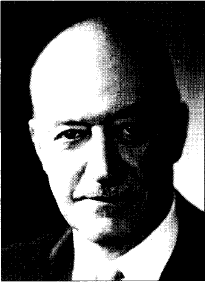
Henry Hazlitt
1894–1993
That alone would have been sufficient to earn Hazlitt’s space in the pantheon of great Austrian economists. But, in fact, Hazlitt also made scholarly contributions of his own to Austrian literature, particularly with his detailed response to John Maynard Keynes’s General Theory, published at the height of Keynesian dominance of the profession. Without Hazlitt’s hard work and his sacrifice of professional status for fixed principles, the history of the Austrian School in America would have been very different indeed.
Hazlitt was born in Philadelphia in 1894. His father died when Hazlitt was only two years old. His schooling began at Girard College, established to provide a good education for boys without fathers. When Hazlitt was nine, his mother remarried, and the family moved to Brooklyn.2 He attended the Boys High School in Brooklyn, where his “great gods” became Herbert Spencer and William James. He studied for a year at the College of the City of New York, but when he ran out of money, Hazlitt had to quit school and seek employment.
After a series of quick jobs, he found a position at the Wall Street Journal as a stenographer.3 He began working on his first book, Thinking as a Science, and, in an impressive accomplishment for a twenty-year-old, found a major publisher for it.4 After a brief stint in the Army Air Corps, he wrote The Way to Will Power, a critique of psychoanalysis, in 1915.5 Next, he became a full-time editorialist with the New York Evening Post (1916–18), the financial letter of the Mechanics & Metals National Bank (1919–20), the New York Evening Mail (1921–23), and the New York Sun (1924–29). It was this last position that established his reputation as a literary critic, and attracted the interest of The Nation magazine, where he served as literary editor from 1930–1933, in addition to writing chapters on literary topics in a number of important books appearing at the time.6
In these years, he met economist Benjamin Anderson. “I used to go to see him about once a week to talk about economic developments,” Hazlitt said. “I read his magnificent book, The Value of Money, which is one of the classics of American economic writing and world monetary literature.”7 Hazlitt continued to write on these two fronts—economics and literary criticism—while working for The Nation, but his anti-New Deal positions were increasingly at odds with the dominant editorial view of the magazine.8
Rather than simply fire Hazlitt, the magazine scheduled a fullblown debate between socialist Louis Fischer and Hazlitt, which ran in the May 24, 1939 issue. Fischer argued the Marxian view that workers were being exploited by owners during the 1920s, and therefore didn’t have the means to consume what they needed; meanwhile the owners of capital, hoarding all the wealth, would not consume the products of industry. Fischer’s solution was to divide the wealth. Hazlitt refuted that theory by pointing to the growing returns to labor during the 1920s. Instead, he offered a version of the Austrian business cycle as explanation. The World War and credit expansion in the 1920s artificially inflated prices and encouraged “colossal real-estate and stock-market speculation.” The 1929 stock-market crash was merely a correction, but the adjustment was impeded by economic controls. Hazlitt recommended complete economic decontrol as the only way out.
The Nation weighed in against Hazlitt and the free-market policies he advocated, and Hazlitt left the magazine. In the meantime, Hazlitt had come to admire and even idolize H.L. Mencken, the legendary editor of American Mercury. As two of the only anti-New Deal intellectuals with high public profiles, they shared a common political and literary bond. Mencken asked Hazlitt to take over as editor, saying Hazlitt was “the only competent critic of the arts that I have heard of who was at the same time a competent economist, of practical as well as theoretical training.” And, Mencken added, “he is one of the few economists in human history who could really write.”9 During the year he spent with the American Mercury—attacking the New Deal at every turn—he also wrote what is surely his least known work, The Anatomy of Criticism. Set in the form of a trialogue, Hazlitt defends the role and function of literary criticism, but also deals directly with a number of theoretical problems in economics. He attempts a reconciliation between the subjective economic value of arts and literature and the objective worth of the work of artists and writers.10
That same year, he published a short monograph called Instead of Dictatorship, in which he argued, somewhat naively, that a council of businessmen should be assigned to restrain executive tyranny, which was then being rubberstamped by a complacent Congress.11 Hazlitt’s independent Council would turn over problems of economics to “5 or 7 trained monetary and banking economists” who would then draft legislation. Later, his interest in political reform led to A New Constitution Now, in which he argued for the U.S. to be transformed into a European-style parliamentary system.12 As Murray N. Rothbard has written,
whether or not one agrees fully with Hazlitt, he made an extremely important point which has taken on far more importance in these days of unbridled executive power. For he argued that the great defect of the American Constitution is that it permits runaway executive power, unchecked by Congress or the public.13
Leaving the American Mercury, Hazlitt was hired by the New York Times as an editorialist, and also as a book reviewer for its influential Sunday book review section. For the daily edition of the newspaper, he wrote against the National Industrial Recovery Administration, union privileges, stock market regulation, inflation, protectionism, industrial planning of all sorts, economic nationalism, curbs in the work week, unemployment insurance, welfare and relief, social security, higher taxes, all inheritance taxes, government spending, and other forms of growing government power.14
Two book reviews in particular had profound significance in the history of the Austrian School. First, there was Hazlitt’s featured review of Mises’s Socialism, written while Mises was still teaching in Geneva. This book, Hazlitt writes,
examines socialism from almost every possible aspect—its doctrine of violence as well as that of the collective ownership of the means of production; its ideal of equality; its relation to problems of sex and the family; its proposed solution for the problem of production as well as of distribution; its probable operation under both static and dynamic conditions; its national and international consequences. . . . [It] must rank as the most devastating analysis of socialism yet penned. Doubtless even some anti-Socialist readers will feel that he occasionally overstates his cases. On the other hand, even confirmed socialists will not be able to withhold admiration from the masterly fashion in which he conducts his argument. He has written an economic classic in our time.15
Hazlitt sent a copy of his review to Mises in Geneva, the two men exchanged letters, and when Mises came to the U.S. two years later, he called Hazlitt, thus beginning a friendship that would last a lifetime. “Hazlitt was one of the first people Lu met in New York,” writes Margit von Mises, “and one of the first to take an active interest in getting Lu established in America. . . . The Hazlitts, well aware of Lu’s situation [no academic position; no savings], were extremely hospitable and kind.”16 A gracious and charitable man, Hazlitt worked to get Margit’s daughter, Gitta Sereny, out of occupied France, by using connections he had with Assistant Secretary of State Breckinridge Long. “Only the mother of a young daughter will understand what this meant to me,” Margit writes. “Hazlitt himself may long have forgotten about this incident; I haven’t and I never will.”17
The second important book review was of F.A. Hayek’s The Road to Serfdom, appearing on the front page of the September 24, 1944 edition of the Times Book Review. Hazlitt described it as “one of the most important books of our generation.” To understand the crucial importance of this review for the huge status this book would eventually achieve, we need only recall that the University of Chicago had only printed up three thousand copies of the book on its first print run. But after Hazlitt’s review, sales boomed, eventually leading to a Reader’s Digest version of the book, which brought the thesis (of the connections between brown, red, and U.S.-style socialism) to millions.
In 1946, while still working at the Times, Hazlitt wrote Economics in One Lesson,18 the book for which he is most well-known. He did so without the slightest expectation that it would become a bestseller.19 Yet, sales would eventually top one million, causing it to rank among the most popular economics books ever written. This is especially ironic considering its orientation is entirely Austrian, and was even refereed by Ludwig von Mises himself, whom Hazlitt thanks in the preface to the first edition.20 It turned out to serve as a key educational tool for several generations of students and businessmen, inoculating them against then-popular Keynesian fallacies.
The book drives home two crucial points about sound economic thinking. First, economics “consists in looking not merely at the immediate but at the longer effects of any act or policy.” Second, “it consists in tracing the consequences of that policy not merely for one group but for all groups.”21 These principles are applied first through retelling Frédéric Bastiat’s “Broken Window Fallacy” (the destruction is fallaciously celebrated by Keynesian-like spectators because it will make business for the glazier), and then applied to a host of economic issues, from taxes and credit expansion to price supports and tariffs. In case after case, he shows that coercive government intervention to help one group is against the interests of most every other group, particularly consumers. And while that intervention may appear to succeed in the short run, it only brings about inefficiencies and lower living standards in the long run.
The publication of Economics in One Lesson, his first solely on economics, marks the beginning of his full-time association with Austrian and free-market causes. He had been working as a highly influential editorialist for the New York Times since June, 1934, but two events conspired to cause him to leave the Times. First, he was being identified more openly with free-market causes at a time when this was an unpopular position to hold, and the authorship of his articles—usually anonymous22—was increasingly obvious to readers, not all of whom approved. Second, Hazlitt had been editorializing against the pseudo-gold standard of the proposed Bretton Woods monetary agreement. “I found myself almost alone, particularly in the journalistic world, in calling attention to” the dangers of the agreement.23 After the monetary pact was signed, editor Arthur Sulzberger called him in and said, “Now, look, Henry. I’ve let you write these editorials. But now that forty-three nations have signed this, we can’t continue to oppose it.” Hazlitt refused to endorse the pact, so he just stopped writing about the issue altogether. “This made for sort of strained relations,” Hazlitt told an interviewer, “but they didn’t fire me.”24
Two years later, with Economics in One Lesson in print, and Hazlitt still in conflict with the editorial board over Bretton Woods, he departed the New York Times. His departure should also be considered in light of the explosion of fury the social democratic left exhibited toward his column, and the sudden crystallization of the fact that Hazlitt was the actual source. “Like a Sunday-school teacher in a slum,” wrote George Soule of Economics in One Lesson,
Henry Hazlitt bids us return to the economic gospel. The world is all but lost; not a nation in it with the possible exception of the United States clings to the faith, and even here false prophets have led us astray. But to Hazlitt the truth is clear and whole. . . . For years newspapers like the New York Times have maddened progressives by bland opposition to economic reforms, and Hazlitt has been the mainstay of the Times in economic opinion.25
Ironically, it appears that Hazlitt himself might have been unaware of how out-of-the-mainstream his ideas were; his last experiences with the left had been with an ideologically-oriented journal, not the mainstream profession as a whole.
When I wrote my Economics in One Lesson in 1946, I didn’t quite realize how socialistic most economic writing had already become. This was a fortunate thing for me because my book was not angry at all; it just spoofed the controllers and the price-fixers. I think that’s one of the things that attracted readers—there was little anger in the book. It just treated the interventionists as if they didn’t really know what they were talking about.26
Having left the Times, his greatest work on behalf of the Austrian School was just beginning. His new role as Newsweek’s “Business Tides” columnist gave him a weekly venue to articulate his positions, and the time and opportunity to devote the remainder of his efforts to Austrian scholarship and journalism. He began with a series of articles on two major postwar economic issues: price control (and the related attempt to “stabilize” the economy through other forms of control), and the growing problem of labor strikes. He argued for an immediate repeal of all price controls, pointing out precisely how they are the very source of economic instability, and for an immediate end to all labor-union privileges, which were preventing wages from adjusting to a new postwar level. His theme was that prices are essential signaling devices that permit businessmen and consumers to assess the value of resources and services. Without freely floating prices, even a nominally capitalist country would experience the bottlenecks, inefficiencies, and economic chaos that afflicted planned economies. He explained, too, how union strikes are not something we would expect to see in a free market; rather they are a consequence of special privilege. Moreover, union strikes were being encouraged by the Truman administration as a political tool.
In 1949, the Truman administration pushed for domestic spending programs to match its international ones. But Hazlitt attacked the growth in the American welfare state in the forms of student aid and Social Security, and the rise of inflationist ideology which purported to solve all macroeconomic troubles through credit expansion. Hazlitt recommended a return to a nineteenth-century convertible gold standard. In a series of landmark columns on isolationism and internationalism, Hazlitt was nearly alone in debunking the Truman administration’s attempt to paint opponents of foreign aid as head-in-the-sand isolationists (an effort that continues to this day). In Hazlitt’s view, true internationalism is not characterized by international bureaucracies and loans, but unfettered world trade (of which neither the Truman nor Eisenhower administrations were true friends). Hazlitt also editorialized against deficit spending, against regarding supposed tax loopholes as subsidies, against the moon shot and agricultural aid, and against soak-the-rich and anti-business policies.
In the same period, and in relatively rapid succession, Hazlitt brought out a series of highly creative books that explain Austrian theory, and use it as the basis for critical analysis of competitive doctrines and interventionist policies. Will Dollars Save the World? and The Illusions of Point Four attack the Marshall Plan and development aid on grounds that they both misconstrue the nature of wealth creation and overlook the importance of market-driven capital investment in laying the foundations for economic development.27 Hazlitt’s criticism of the Marshall Plan, in particular, was cited in later years by the defenders of Marshall as a particularly irritating source of naysayism. In 1951, Hazlitt offered a fictional account of the process of desocialization that would transpire if a benign dictator of a world socialist system began to disassemble the interventionist apparatus piece by piece.28 Murray Rothbard called it “the only novel ever written that exemplifies and explains the Misesian doctrine of the impossibility of calculation under socialism.”29 The novel garnered new attention after the collapse of socialist states in Eastern Europe in 1989, and debate ensued about whether the politics of transition should be gradual or rapid. And in 1956, Hazlitt wrote The Free Man’s Library, a deeply annotated bibliography of works on the libertarian idea, arranged alphabetically. It exhibits the wide reading in philosophy and economics Hazlitt had done, and became a standard reference book for the burgeoning free-market movement.30
His next project was a page-by-page refutation of Keynes’s General Theory, something never before attempted by any economist.31 In fact, as Hazlitt noted, in the vast Keynesian literature, there were precious few commentators on Keynes’s book itself. Most Keynesians wrote what they regarded as elaborations on the great master, while curiously neglecting the master himself. The few who did examine the General Theory began with the assumption that the book is both coherent and deeply insightful, and saw their job as merely discovering precisely what it was that made it so. Hazlitt took the opposite approach. He came at the project with the intention of discovering whether in fact the book is coherent, much less insightful. In area after area, he found mangled theoretical constructs, inconsistencies, failures in logic, incomplete argumentation, syllogisms masquerading as explanations, and untenable policy recommendations. The final product was The Failure of the “New Economics” a four-hundred-and-fifty-eight-page book shredding Keynes, the great economist of that age. As Mises said, “Hazlitt has entirely demolished the Keynesian misconceptions.”32
From the standpoint of the Austrian School, it is this book, more than any other, that has to be considered Hazlitt’s unique contribution to the history of thought. Hazlitt had anticipated criticisms that would emerge in later Austrian literature on macroeconomics. In particular, Hazlitt points out that Keynes discusses the relationship between savings and investment in two contradictory contexts. In the first, he argues for definitional identity between the two. In the second, he argues they are always out of kilter and need to be corrected through some sort of interventionism.33
Rothbard called Hazlitt’s book on Keynes his magnum opus, but Hazlitt himself regarded his book on social ethics to be his greatest work.34 It is an elaboration on Mises’s theory of social cooperation as a normative standard for evaluating public policy (and less so, personal ethics), sometimes called rule utilitarianism. Whereas many authors in the Austrian tradition have followed the path of Rothbard (and even Ayn Rand) in integrating economic theory with a rights-based moral framework, Mises himself insisted that rights claims cannot be rationally established.35 The Misesian alternative postulates the long-run harmony of interests between individuals and society and the ethical obligation of people to evaluate social systems and individual behavior in light of that harmony of interests. Societies should pursue paths that lead to cooperation, prosperity, and peace, and not tread upon those that lead to conflict, poverty, and war. Hazlitt named this view “cooperatism,” and defended it against alternatives.36
From 1964 to the mid-1970s, Hazlitt contributed a number of studies that exploded the myth of the welfare state on economic grounds, and forecast the problems now so well documented in the literature. Man vs. The Welfare State criticized plans for curbing the welfare state that were gradual in nature, especially the negative income tax proposed by Milton Friedman (which eventually became the Earned Income Tax Credit).37 He saw all proposals that curb welfarism as merely introducing new perverse incentives to become and remain poor while imposing artificial disincentives for earning money. Hazlitt favored all-out abolition of the welfare state, the only position he regarded as being consistent with sound economics. The Conquest of Poverty demonstrated that enormous gains in living standards have followed the introduction of free markets throughout history. In contrast, the problem of poverty and economic dislocation has been the result of interventionism throughout human history.
While he concentrated primarily on writing books during these years, he never let up in his journalistic efforts in periodicals. He served as co-editor of The Freeman (1950–53), wrote a nationally syndicated weekly column for the Los Angeles Times (1966–69), and continued through the 1970s and early 1980s to write for The Freeman, Human Events, and National Review. His last printed article appeared in the inaugural issue of The Review of Austrian Economics.
As a brilliant stylist and an indefatigable defender of individualism and the capitalist economy, he accepted the personal sacrifices that were required to take positions that were highly unpopular at that time. Before the war, Hazlitt held high positions in publishing circles, an especially remarkable accomplishment considering his lack of credentials or advanced formal education. Yet, he took the path where he believed truth led him, and that was with deeply unpopular causes. Today, he appears to be far more a mainstream thinker than in his day, partially due to the educational efforts of the free-market movement he helped pioneer.
“When I look back on my own career,” he told an audience in 1964,
I can find plenty of reasons for discouragement, personal discouragement. I have not lacked for industry. I have written a dozen books. For most of 50 years, from the age of 20, I have been writing practically every weekday: news items, editorials, columns, articles. I figure I must have written in total some 10,000 editorials, articles, and columns; some 10,000,000 words! And in print! The verbal equivalent of about 150 average-length books!
And yet, what have I accomplished? . . . The world is enormously more socialized than when I began. . . . Yet in spite of this, I am hopeful. After all, I’m still in good health, I’m still free to write, I’m still free to write unpopular opinions, and I’m keeping at it. And so are many of you. So I bring you this message: be of good cheer; be of good spirit. If the battle is not yet won, it is not yet lost either. . . . Even those of us who have reached and passed our seventieth birthdays cannot afford to rest on our oars and spend the rest of our lives dozing in the Florida sun. The times call for courage. The times call for hard work. But if the demands are high, it is because the stakes are even higher. They are nothing less than the future of human liberty, which means the future of civilization.38
SELECTED READINGS
Hazlitt, Henry. 1984. From Bretton Woods to World Inflation: A Study of Causes and Consequences. Chicago: Regnery Gateway.
——. [1946] 1979. Economics in One Lesson. New York: Crown Trade Paperbacks.
——. 1973. The Conquest of Poverty. Los Angeles: Nash Publishing.
——. 1969. Man vs. The Welfare State. New Rochelle, N.Y: Arlington House.
——. 1964. The Foundations of Morality. Princeton, N.J.: D. Van Nostrand.
——. 1959. The Failure of the “New Economics”: An Analysis of the Keynesian Fallacies. Princeton, N.J.: D. Van Nostrand.
——. 1951. The Great Idea. New York: Appleton; reprinted as Time Will Run Back. London: Ernest Benn.
——. 1942. A New Constitution Now. New York: McGraw.
——. 1933. The Wisdom of Henry Hazlitt. Irvington-on-Hudson, N.Y.: Foundation for Economic Education.
——. 1933. The Anatomy of Criticism: A Trialogue. New York: Simon and Schuster.
——. 1916. Thinking as a Science. New York: E.P. Dutton.
Henry Hazlitt: An Appreciation. 1989. Irvington-on-Hudson, N.Y: Foundation for Economic Education.
Tucker, Jeffrey, comp. Murray Rothbard, annot. 1994. Henry Hazlitt: A Giant of Liberty. Auburn, Ala: Ludwig von Mises Institute.
_______________
Paul Cwik, Roger Garrison, Llewellyn H. Rockwell, Jr., and Joseph Salerno provided very helpful comments. The author alone is responsible for errors.
39On Hazlitt’s crucial role as an Austrian publicist, commentator, and organizer, see John L. Kelley, Bringing the Market Back In: The Political Revitalization of Market Liberalism (New York: New York University Press, 1997), pp. 33, 35, 53, 60, 64; and George H. Nash, The Conservative Intellectual Movement in America (Wilmington, Del.,: Intercollegiate Studies Institute, [1976] 1996), pp. 5, 9, 10, 14, 18–19, 22–25. Murray N. Rothbard, in The Free Market (December, 1987): 4, writes,
In my own case, I was a Hazlittian years before I was a Misesian. In fact, before I had heard of von Mises I knew about Henry Hazlitt. When I was first getting interested in free-market economics, during and just after World War II, Henry was all over the place—in Newsweek, on radio and later television—lucid, sound, brilliant, and decisive, carrying the free-market message. And he was the only one.
40Hazlitt was adopted by his stepfather; he took the name “Piebes,” and changed it back again when he was sixteen, after his stepfather died.
41In an interview with Reason (December 1984): 37, Hazlitt said:
I remember I had no skills whatever. So I would get a job, and I would last two or three days and be fired. It never surprised me nor upset me, because I read the Times early in the morning, went through the ads, and I’d practically have a job that day. This shows what happens when you have a free market. There was no such thing as minimum wage at the time. There was no such thing as relief, except maybe there were places where you could get a soup handout or something, but there was no systematic welfare. You had a free market. And so I usually found myself at a job the next day, and I’d get fired about three or four days after that. But each time I kept learning something, and finally I was getting about $3 or $4 a week.
42Henry Hazlitt, Thinking as a Science (New York: Nash Publishing, [1915] 1969).
43Henry Hazlitt, The Way to Will Power (New York: E.P. Dutton, 1922).
44Among them, “Humanism and Value,” in The Critique of Humanism, Clinton Hartley Grattan, ed. (Freeport N.Y.: Books for Libraries Press, [1930] 1968); “Emerson,” in American Writers on American Literature, Jon Albert Macy, ed. (Westport, Conn.: Greenwood Press, 1931); “Introduction,” to Stephen Crane, Maggie and Other Stories (New York: Alfred A. Knopf, 1931); “Our Greatest Authors (How Great Are They?),” in Essays and Addresses Toward a Liberal Education, A.C. Baird, ed. (Boston: Ginn, 1934); “Literature as Propaganda,” in The Practice of Book Selection, Louis Round Wilson, ed. (Chicago: University of Chicago Press, 1940); and, with Dorothy Thompson and Mark van Doren, “Nietzsche: Beyond Good and Evil,” in New Invitation to Learning, Mark van Doren, ed. (New York: Random House, 1942).
45Henry Hazlitt, “Reflections at 70,” Henry Hazlitt: An Appreciation (Irvington-on-Hudson, N.Y: Foundation for Economic Education, 1989), p. 9. Also during these years, he was commissioned by W.W. Norton to do a biography of Bertrand Russell. “I spent a good deal of time with him, in New York and London, in the period of 1928–1929, until one day, while reminiscing for my benefit, he suddenly said, ‘You know, I have had a very interesting life; I think I’d like to do my own autobiography.’”
46For the full story of this split with The Nation, see Jeffrey Tucker, “Hazlitt and the Great Depression,” The Free Market (September 1993): 2–4.
47The quotation appears on the book jacket of the first edition of Economics in One Lesson, which may or not have been its first appearance.
48Henry Hazlitt, The Anatomy of Criticism (New York: Simon and Schuster, 1933). Hazlitt takes the position that we can gain an approximate understanding of artistic and literary worth by reflecting on the “social mind,” which is the source of the intellectual’s reputation. By using the concept of the Social Mind, we avoid falling into radical subjectivism of the deconstructionist variety (Hazlitt provides a fullblown critique of Marxist deconstructionism as an appendix) and excessive objectivism that denies the role of taste and preference in assessing artistic merit.
49Henry Hazlitt, Instead of Dictatorship (New York: John Day, 1933).
50Henry Hazlitt, A New Constitution Now (New York: McGraw, 1942).
51Murray N. Rothbard, “Henry Hazlitt Celebrates 80th Birthday,” Human Events (November 30, 1974).
52In the book review section at the very same time, he was reviewing books by and about Bertrand Russell, John Dewey, H.G. Wells, George Santayana, and Stuart Chase. His reputation and writing skill meant that he was often featured on the front page of the section.
53New York Times Book Review (January 9, 1938). Excerpt reprinted in Bettina Bien Greaves, Mises: An Annotated Bibliography (Irvington-on-Hudson, N.Y.: Foundation for Economic Education, 1993), p. 159.
54Margit von Mises, My Years with Ludwig von Mises (Cedar Falls, Iowa: Center for Futures Education, 1984), p. 57–58.
55Ibid., p.70.
56Henry Hazlitt, Economics in One Lesson (New York: Harper and Brothers, 1946).
57Interview with the author, October 1987.
58“I am grateful to Professor von Mises for reading the manuscript and for helpful suggestions.” Mises is the only person so thanked. For intellectual influence, Hazlitt names Frédéric Bastiat, Philip Wicksteed, and Mises. See Economics in One Lesson, pp. ix–xi. On Wicksteed in particular, Hazlitt says that upon his first reading The Common Sense of Political Economy, “I caught my first glimpse of the fact—which Ludwig von Mises was later to make much more explicit—that the world of economics is almost coextensive with the whole world of human action and of human decision.” See The Wisdom of Henry Hazlitt (Irvington-on-Hudson, N.Y: Foundation for Economic Education, 1983).
59Hazlitt, Economics in One Lesson, p. 5.
60The question of which editorials were his remained a mystery until 1994 with the publication of a nearly complete bibliography of his writings, listing some three thousand unsigned articles. See Henry Hazlitt: A Giant of Liberty, compiled by the present author from archives mainly held by the George Arents Research Library at Syracuse University.
61Henry Hazlitt, From Bretton Woods to World Inflation: A Study of the Causes and Consequences (Chicago: Regnery Gateway, 1984) p. 10. In his magnanimous introduction to this volume, he does not mention that his anti-Bretton Woods essays led to his dismissal.
62“An Interview with Henry Hazlitt,” Austrian Economics Newsletter (Spring 1984); “Henry Hazlitt,” Reason (December 1984): 38.
63George Soule, “The Gospel According to Hazlitt,” The New Republic (August 19, 1946): 202–05.
64“An Interview with Henry Hazlitt.”
65Henry Hazlitt, Will Dollars Save the World? (New York: Appleton Century, 1947); and idem, The Illusions of Point Four (Irvington-on-Hudson, N.Y.: Foundation for Economic Education, 1950)
66Henry Hazlitt, The Great Idea (New York: Appleton, 1951); reprinted as Time Will Run Back (New Rochelle, N.Y: Arlington House, 1966).
67Annotation in Henry Hazlitt: Giant of Liberty, p. 24.
68Henry Hazlitt, The Free Man’s Library (Princeton, N.J.: D. Van Nostrand, 1956). At one-hundred-and-seventy-six pages, it ironically highlights the dearth of contemporary literature available in 1956. A similar volume today would have to be impossibly huge.
69Henry Hazlitt, The Failure of the “New Economics”: An Analysis of the Keynesian Fallacies (Princeton, N.J.: D. Van Nostrand, 1959).
70Book jacket to The Failure of the “New Economics.”
71See The Failure of the “New Economics,” pp. 217–35. In addition, Hazlitt published a companion volume, The Critics of Keynesian Economics (Princeton, N.J.: D. Van Nostrand, 1960), which included the work of J.B. Say, John Stuart Mill, Jacob Viner, Frank Knight, Etienne Mantoux, F.A. Hayek, Franco Modigliani, Benjamin Anderson, Philip Cortney, R. Gordon Wasson, Garet Garrett, Jacques Rueff, John H. Williams, L. Albert Hahn, Ludwig von Mises, Joseph Stagg Lawrence, Wilhelm Röpke, W.H. Hutt, Arthur F. Burns, Melchior Palyi, and David McCord Wright. In doing so, he provided the anti-Keynesian remnant a crucial source for arguments against the Keyensian view, as well as subtly illustrated that Keynesian fallacies on the inherent flaws of the price system predate The General Theory.
72Henry Hazlitt, Foundations of Morality (Princeton, N.J.: D. Van Nostrand, 1964). One of Hazlitt’s final projects was to put together a compilation of the writings of the Stoic philosophers. Idem, The Wisdom of the Stoics: Selections from Seneca, Epictetus, and Marcus Aurelius (Lanham, Maryland: University Press of America, 1983).
73Ludwig von Mises, Human Action, The Scholar’s Edition (Auburn, Ala.: Ludwig von Mises Institute, 1998), pp. 174–75.
74Leland Yeager, in an interview in The Austrian Economics Newsletter (Summer 1991): 6, cites the Hazlitt book as an inspiration in his own work on social ethics.
75Henry Hazlitt, Man vs. The Welfare State (New Rochelle, N.Y.: Arlington House, 1969); idem, The Conquest of Poverty (Los Angeles: Nash Publishing, 1973).
76Hazlitt, “Reflections at 70,” pp. 14–15.
- 1Two recent examples are the review article by Israel M. Kirzner, “Entrepreneurial Discovery and the Competitive Market Process: An Austrian Approach,” Journal of Economic Literature 35, no. 1 (March 1997): 60–85; and Sherwin Rosen, “Austrian and Neoclassical Economics: Any Gains From Trade?” Journal of Economic Perspectives 11, no 4. (Fall 1997): 139–52. Both of these journals are publications of the American Economic Association, indicating the degree to which Austrian ideas are at least recognized, if not embraced, by the profession’s mainstream.
- 2See Leland B. Yeager, “Austrian Economics, Neoclassicism, and the Market Test,” Journal of Economic Perspectives 11, no. 4 (Fall 1997): 153–65, for an insightful discussion on the challenges that an alternative to mainstream ideas faces in the academic marketplace.
- 3See Karen I. Vaughn, Austrian Economics in America: The Migration of a Tradition (New York: Cambridge University Press, 1994), for a good discussion of the development of the modern Austrian School. Also see Murray N. Rothbard, “The Present State of Austrian Economics,” Money, Method, and the Austrian School, vol. 1, The Logic of Action (Cheltenham, U.K.: Edward Elgar, 1997).
- 4The first edition of Menger’s Principles of Economics was published in German in 1871. While it was generally recognized as a landmark contribution in economics, an English translation was not published until 1950.
- 5Murray N. Rothbard, in Ludwig von Mises: Scholar, Creator, Hero (Auburn, Ala.: Ludwig von Mises Institute, 1988), p. 13, notes that Mises’s early work on monetary theory, while controversial, was published in the Economic Journal, one of the leading mainstream economic journals of the time.
- 6Paul A. Samuelson, Economics, 9th ed. (New York: McGraw-Hill, 1973), p. 883.
- 7Diego de Covarrubias y Leyva, Omnia Opera (Venice, 1604),vol. 2, chap.4, p.131.
- 8Luis Saravia de la Calle, Instrucción de mercaderes (1544); republished in Colección de Joyas Bibliográficas (Madrid, 1949), p. 53. Saravia’s book addresses the business entrepreneur (in Spanish mercaderes) following a continental Catholic tradition that can be traced back to San Bernardino de Siena (1380–1444). See Rothbard, Economic Thought Before Adam Smith, pp. 81–85.
- 9Juan de Lugo (1583–1660), Disputationes de iustitia et iure (Lyon, 1642), vol. 2, d. 26, s. 4, n. 40, p. 312.
- 10Juan de Salas, Commentarii in secundam secundae D. Thomae de contractibus (Lyon, 1617), vol. 4, no. 6, p. 9.
- 11Jerónimo Castillo de Bovadilla, Práctica para corregidores (Salamanca, 1585), vol. 2, chap. 4, no. 49. See also the important comments on the scholastics and their dynamic concept of competition written by Oreste Popescu, Estudios en la historia del pensamiento económico latinoamericano (Buenos Aires: Plaza and Janés, 1987), pp. 141–59.
- 12Luis de Molina, De iustitia et iure (Cuenca, 1597), vol. 2, disp. 348, no. 4, and La teoría del justo predo, Francisco Gómez Camacho, ed. (Madrid: Editora Nacional, 1981), p. 169. Raymond de Roover, ignoring the work of Castillo de Bovadilla, acknowledges how “Molina even introduces the concept of competition by stating that concurrence or rivalry among buyers will enhance prices.” See his article “Scholastic Economics: Survival and Lasting Influence from the Sixteenth Century to Adam Smith,” Quarterly Journal of Economics 69, no. 2 (May1955): 169.
- 13Included in Covarrubias, Omnia Opera, vol. 1, pp. 669–710.
- 14Carl Menger, Principles of Economics (New York: New York University Press, 1981), p. 317.
- 15Martín Azpilcueta Navarro, Comentario resolutorio de cambios (Madrid: Consejo Superior de Investigaciones Científicas, 1965), pp. 74–75.
- 16See Jesús Huerta de Soto, “New Light on the Prehistory of the Theory of Banking and the School of Salamanca,” Review of Austrian Economics 9, no. 2 (1996): 59–81.
- 17Luis de Molina, Tratado sobre los cambios, Introduction by Francisco Gómez Camacho (Madrid: Instituto de Estudios Fiscales, 1990), p. 146. Also James Pennington’s memo dated February 13, 1826, “On the Private Banking Establishments of the Metropolis,” included as an Appendix in Thomas Tooke, A Letter to Lord Grenville; On the Effects Ascribed to the Resumption of Cash Payments on the Value of the Currency (London: John Murray, 1826).
- 18However, according to Father Bernard W. Dempsey, if the members of this second group of the School of Salamanca had had a detailed theoretical knowledge of the functioning and implications of the economic process to which fractional-reserve banking gives rise, it would have been described as a perverse, vast and illegitimate process of institutional usury, even by Molina, Lessius, and Lugo themselves. See Father Bernard W. Dempsey, Interest and Usury (Washington, D.C.: American Council of Public Affairs, 1943), p. 210.
- 19Quoted in ibid., p. 214, n. 31.
- 20Mariana, Discurso de las enfermedades de la Compañía, pp. 151–55, 216.
- 21See Leland B. Yeager, “Book Review,” Review of Austrian Economics 9, no. 1 (1996): 183, where he says:
- 22Jaime Balmes, “Verdadera idea del valor o reflexiones sobre el origen, naturaleza y variedad de los precios,” en Obras Completas (Madrid: B.A.C., 1949), vol. 5, pp. 615–24. Balmes also described the personality of Juan de Mariana with the following graphic words:
- 23Ibid., p. 51.
- 24Cantillon laid the groundwork for Turgot and the theory of profit. See Renee Prendergast, “Cantillon and the Emergence of the Theory of Profit,” History of Political Economy 23 (Fall 1991): 429.
- 25Cantillon, Essai, p. 49. His use of the word “naturally” shows that the changes he refers to cause a predictable change in price.
- 26Ibid., p. 53.
- 27Ibid., p. 31. When he refers to well-organized societies, Cantillon seems to be referring to an advanced market economy in which monetary exchange and banking services have been long and thoroughly established.
- 28Ibid., p. 97.
- 29Hülsmann, “Cantillon as a Proto-Austrian,” p. 3, defends Cantillon by noting he clearly did not think that market prices were determined by cost, in terms of land and labor, and that intrinsic value is merely being used as a measure of the quantity of land and labor. Cantillon thus avoided the errors of later economists who claimed that land and labor were measures of value. His views are similar to Austrian economists who hold that only exchange ratios and market prices permit economic calculation.
- 30Cantillon, Essai,p. 107.
- 31Hayek, “Richard Cantillon,” p. 263.
- 32Cantillon, Essai, p. 115. He does note, however, that a specific intrinsic value is one that does not change.
- 33This point was first suggested to me by Professor Hébert; see Hébert, “Was Richard Cantillon an Austrian Economist?” p. 272. Spengler also hints at this in Joseph J. Spengler, “Richard Cantillon: First of the Modems II,” Journal of Political Economy 62, no. 5 (October 1954): 407; also see Michael D. Bordo, “Some Aspects of the Monetary Economics of Richard Cantillon,” Journal of Monetary Economics 12, no. 2 (August 1983): 235–58.
- 34Cantillon, Essai, p.83.
- 35Brewer, “Cantillon and the Land Theory of Value,” p. 452; and Cantillon, Essai, p. 85.
- 36What Frenchman wouldn’t be concerned with this issue? Cantillon is clearly not against luxury per se, as he defines wealth as consumption on the first page of the Essai, including the conveniences and superfluities of life. What he is concerned with is production. It is not possible to continue to consume, or to consume greater amounts, without production. According to Cantillon, the comparative greatness of States is their reserve stock, which is savings measured in both money and materials in order to improve the State and to offset bad harvests and wars. For the State, gold is the true reserve stock, because with gold you can even buy the implements of war from your enemy. See Cantillon, Essai, pp. 89, 91.
- 37Vincent J. Tarascio, “Cantillon’s Theory of Population Size and Distribution,” Atlantic Economic Journal 9, no. 2 (July 1981): 12–18, is perceptive in noticing that Cantillon’s contribution was lost, and that neoclassical economics did not adopt the classical-population theory because real wages were clearly rising for a long time before the origins of neoclassical economics.
- 38See Cantillon, Essai, pt. 1, chaps. 7 and 8.
- 39AT THE END of the twentieth century, the Austrian School of economics is exerting a significant influence both on the development of academic economics and on the application of economic theory to public policy. An increasing number of economics professors are sympathetic with the fundamental ideas of Austrian economics, and academic journals are taking more account of the Austrian School. A half century ago, few academic economists would even have been familiar with the Austrian School, except superficially, and among those who were, most would have disagreed with its methods and conclusions. Today, the ideas of Austrian economics are closer to the mainstream of economic thought, not because Austrian economics has changed, but because mainstream economics has moved toward the Austrian point of view. A similar shift has occurred in the public-policy arena. The policy implications of Austrian economics, once rejected as extreme, are now embraced as true. In the process, the Austrian School has become increasingly visible as an intellectual force.
- 40If the ideas of Austrian economics have made such inroads, one might wonder why, in the academic arena, Austrian economics does not play a bigger role. Part of the answer has to do with academic institutions themselves. Most university faculty teach at state institutions, which by itself may bias them toward supporting the state and being suspicious of laissez-faire ideas. Most university faculty have tenure, which slows the turnover of personnel, and perhaps of ideas. Furthermore, academic ideas find their outlets largely in academic journals, and the editorial boards of those journals tend to be controlled by the academic mainstream, further promoting mainstream ideas over alternative schools of thought. Because publication in academic journals is often a prerequisite for promotion and tenure in a university environment, academic survival often pushes young scholars in the direction of the mainstream methods and ideas in their discipline.
- 41Austrian economics has fought an uphill battle for acceptance for several reasons, but at the same time, the Austrian School has been gaining in strength, and is becoming more accepted in academia. A growing number of economics professors align themselves with the Austrian School, and even among those who do not, Austrian ideas are becoming more recognized and respected. Interestingly enough, the late-twentieth-century resurgence of interest in the Austrian School has been concentrated in the United States. This is largely due to Ludwig von Mises’s migration, and his Austrian economics seminar at New York University. One might go so far as to argue that the modern Austrian School would not exist were it not for the influence of Ludwig von Mises on his American students.
- 42Carl Menger is generally regarded as the founder of the Austrian School, but prior to about 1920, Austrian economics was not very different from economics in general. Economic theory had taken a great leap forward in the 1870s when the concept of marginal utility was independently discovered by Léon Walras, William Stanley Jevons, and Carl Menger. Each of these three individuals pushed the concept in different directions, but the integration of the marginal theory of value into economics was a major leap for all of economics. Eugen von Böhm-Bawerk’s capital theory, now seen as Austrian, was viewed more generally as a part of economics when it was published in the 1880s and 1890s, and Ludwig von Mises’s Theory of Money and Credit, published in 1912, established him as a leading authority on monetary economics.
- 43Carl Menger is generally regarded as the founder of the Austrian School, but prior to about 1920, Austrian economics was not very different from economics in general. Economic theory had taken a great leap forward in the 1870s when the concept of marginal utility was independently discovered by Léon Walras, William Stanley Jevons, and Carl Menger. Each of these three individuals pushed the concept in different directions, but the integration of the marginal theory of value into economics was a major leap for all of economics. Eugen von Böhm-Bawerk’s capital theory, now seen as Austrian, was viewed more generally as a part of economics when it was published in the 1880s and 1890s, and Ludwig von Mises’s Theory of Money and Credit, published in 1912, established him as a leading authority on monetary economics.
- 44From its low point in the middle of the twentieth century, Austrian economics has continued to gain visibility both inside academia and out. F.A. Hayek won the Nobel prize in economics in 1974, giving the Austrian School attention and respectability. By then, a small Austrian revival was already underway, led by Kirzner and Rothbard, and Hayek’s Nobel prize gave the revival additional momentum. Still, the Austrian School was branded by being on the losing side of the socialist calculation debate. In 1973, the year Mises died, Paul Samuelson, another Nobel laureate in economics and among the most prominent of mainstream academic economists, argued in his introductory textbook that even though the Soviet Union had roughly half the per capita income of the United States, their superior economic system based on central planning gave them faster growth. Based on this, Samuelson projected that per capita income in the Soviet Union could catch up to that of the United States as early as 1990, and almost surely by 2015. Keep in mind that Samuelson’s projection was in his best-selling introductory college textbook, and was the standard line taught in college classrooms at the time. Clearly, the mainstream had not accepted the ideas of Austrian economics.
- 45We should note how Mariana refers to the fact that the “common estimation” of men is the origin of the value of things, thus following the traditional subjectivist doctrine of the scholastics, which was initially proposed by Diego de Covarrubias y Leyva. Covarrubias (1512–1577), the son of a famous architect, became bishop of the city of Segovia and a minister to King Philip II. In 1554, he set forth better than anyone before the subjectivist theory of value, stating that “the value of an article does not depend on its essential nature but on the subjective estimation of men, even if that estimation is foolish,” illustrating his thesis with the example that “in the Indies wheat is dearer than in Spain because men esteem it more highly, though the nature of the wheat is the same in both places.”
- 46Covarrubias’s subjectivist conception was completed by another of his scholastic contemporaries, Luis Saravia de la Calle, who was the first to demonstrate that prices determine costs, not vice versa. Saravia de la Calle also had the special distinction of writing in Spanish, not in Latin. Its title was Instrucción de mercaderes (Instruction to merchants), and there we can read that “those who measure the just price by the labor, costs and risk incurred by the person who deals in the merchandise are greatly in error. The just price is found not by counting the cost but by common estimation.”
- 47The subjectivist conception initiated by Covarrubias also allowed other Spanish scholastics to get a clear insight of the true nature of market prices, and of the impossibility of attaining an economic equilibrium. Thus, the Jesuit Cardinal Juan de Lugo, wondering what the price of equilibrium was, as early as 1643 reached the conclusion that the equilibrium depended on such a large number of specific circumstances that only God was able to know it (“Pretium iustum mathematicum licet soli Deo notum”). Another Jesuit, Juan de Salas, referring to the possibilities of knowing specific market information, reached the very Hayekian conclusion that it was so complex that “quas exacte comprehendere et ponderare Dei est non hominum” (only God, not men, can understand it exactly).
- 48The subjectivist conception initiated by Covarrubias also allowed other Spanish scholastics to get a clear insight of the true nature of market prices, and of the impossibility of attaining an economic equilibrium. Thus, the Jesuit Cardinal Juan de Lugo, wondering what the price of equilibrium was, as early as 1643 reached the conclusion that the equilibrium depended on such a large number of specific circumstances that only God was able to know it (“Pretium iustum mathematicum licet soli Deo notum”). Another Jesuit, Juan de Salas, referring to the possibilities of knowing specific market information, reached the very Hayekian conclusion that it was so complex that “quas exacte comprehendere et ponderare Dei est non hominum” (only God, not men, can understand it exactly).
- 49Furthermore, the Spanish scholastics were the first ones to introduce the dynamic concept of competition (in Latin concurrentium), which is best understood as a process of rivalry among entrepreneurs. For instance, Jerónimo Castillo de Bovadilla (1547–?) wrote that “prices will go down as a result of the abundance, rivalry (emulación), and competition (concurrencia) among the sellers.”
- 50This same idea is closely followed by Luis de Molina. Covarrubias also anticipated many of the conclusions of Father Mariana in his empirical study on the history of the devaluation of the main coin of that time, the Castilian Maravedí. This study contained a compilation of a large number of statistics on the evolution of prices in the previous century and was published in Latin in his book Veterum collatio numismatum (Compilation on old moneys). This book was highly praised in Italy by Davanzaty and Galiani and was also quoted by Carl Menger in his Principles of Economics.
- 51This same idea is closely followed by Luis de Molina. Covarrubias also anticipated many of the conclusions of Father Mariana in his empirical study on the history of the devaluation of the main coin of that time, the Castilian Maravedí. This study contained a compilation of a large number of statistics on the evolution of prices in the previous century and was published in Latin in his book Veterum collatio numismatum (Compilation on old moneys). This book was highly praised in Italy by Davanzaty and Galiani and was also quoted by Carl Menger in his Principles of Economics.
- 52This same idea is closely followed by Luis de Molina. Covarrubias also anticipated many of the conclusions of Father Mariana in his empirical study on the history of the devaluation of the main coin of that time, the Castilian Maravedí. This study contained a compilation of a large number of statistics on the evolution of prices in the previous century and was published in Latin in his book Veterum collatio numismatum (Compilation on old moneys). This book was highly praised in Italy by Davanzaty and Galiani and was also quoted by Carl Menger in his Principles of Economics.
- 53as can be seen from experience, in France, where there is less money than in Spain, bread, wine, clothing, labor, and work cost much less; and even in Spain, at the time when there was less money, the things which could be sold and the labor and work of men were given for much less than after the Indies were discovered and covered her with gold and silver. The cause of which is that money is worth more where and when it is lacking than where and when it is in abundance.
- 54It is obvious that if Father Mariana had known the economic mechanisms that lead to the credit expansion process generated by banks and the effects of this process, he would have condemned these as robbery. He would have condemned not only the government debasement of coins but also the even more disturbing credit inflation created by banks. However, other Spanish scholastics were able to analyze the credit expansion of banks. Thus, de la Calle was very critical of fractional-reserve banking. He maintained that receiving interest was incompatible with the nature of a demand deposit, and that, in any case, a fee should be paid to the banker for keeping the money under his custody. A similar conclusion is reached by the more famous Navarro.
- 55Molina was sympathetic to fractional-reserve banking and confused the nature of two different contracts, loans and deposits, which Azpilcueta and Saravia de la Calle had clearly differentiated from each other previously. A more relevant aspect is that Molina was the first theorist to discover, in 1597 (therefore much earlier than Pennington in 1826), that bank deposits are part of the monetary supply. He even proposed the name “chirographis pecuniarium” (written money) to refer to the written documents that were accepted in trade as bank money. Our scholastics included, therefore, two incipient schools. The first is a kind of “Currency School,” formed by Saravia de la Calle, Azpilcueta Navarro, and Tomás de Mercado, who were very distrustful of banking activities, for which they implicitly demanded a one-hundred-percent reserve should be held. The second was a kind of “Banking School,” headed by the Jesuits Luis de Molina and Juan de Lugo, who were much more tolerant toward fractional-reserve banking. Both groups were to a certain extent the forerunners of the theoretical developments which were to arise three centuries later in England as a result of the debate between the Currency School and the Banking School.
- 56Molina was sympathetic to fractional-reserve banking and confused the nature of two different contracts, loans and deposits, which Azpilcueta and Saravia de la Calle had clearly differentiated from each other previously. A more relevant aspect is that Molina was the first theorist to discover, in 1597 (therefore much earlier than Pennington in 1826), that bank deposits are part of the monetary supply. He even proposed the name “chirographis pecuniarium” (written money) to refer to the written documents that were accepted in trade as bank money. Our scholastics included, therefore, two incipient schools. The first is a kind of “Currency School,” formed by Saravia de la Calle, Azpilcueta Navarro, and Tomás de Mercado, who were very distrustful of banking activities, for which they implicitly demanded a one-hundred-percent reserve should be held. The second was a kind of “Banking School,” headed by the Jesuits Luis de Molina and Juan de Lugo, who were much more tolerant toward fractional-reserve banking. Both groups were to a certain extent the forerunners of the theoretical developments which were to arise three centuries later in England as a result of the debate between the Currency School and the Banking School.
- 57that future goods are not valued so highly as the same goods available at an immediate moment of time, nor do they allow their owners to achieve the same utility. For this reason, it must be considered that they have a more reduced value in accordance with justice.
- 58Mariana concludes that, when there are many laws, “as not all of them may be kept or known, respect for all of them is lost.”
- 59Indeed, we could say that the greatest merit of Carl Menger was to rediscover and take up this continental Catholic tradition of Spanish scholastic thought that was almost forgotten and cut short as a consequence of the black legend against Spain and the very negative influence on the history of economic thought of Adam Smith and his followers of the British Classical School.
- 60It is not difficult to explain. Being the value of a thing its utility . . . if the number of units of this means increases, the need of any one of them in particular decreases; because being possible to choose among many units, none of them is indispensable. For this reason there is a necessary relation between the increase or decrease in value, and the shortage or abundance of a thing.
- 61The role of the entrepreneur is one of Cantillon’s great contributions to economic understanding. He speaks of the entrepreneur in the classic sense of the undertaker of great business adventures, but Cantillon also has a theoretical distinction between those who work for a fixed return or wages and those who face uncertain returns, including farmers, independent craftsmen, merchants, and manufacturers. These entrepreneurs purchase inputs at a given price to produce and sell later at an uncertain price. In the pursuit of profit, the entrepreneur must bear risks as he faces the pervasive uncertainty of the market. For example, the farmer has fixed expenses but:
- 62The role of the entrepreneur is one of Cantillon’s great contributions to economic understanding. He speaks of the entrepreneur in the classic sense of the undertaker of great business adventures, but Cantillon also has a theoretical distinction between those who work for a fixed return or wages and those who face uncertain returns, including farmers, independent craftsmen, merchants, and manufacturers. These entrepreneurs purchase inputs at a given price to produce and sell later at an uncertain price. In the pursuit of profit, the entrepreneur must bear risks as he faces the pervasive uncertainty of the market. For example, the farmer has fixed expenses but:
- 63The price of these products will depend partly on the weather, partly on demand; if corn is abundant relative to consumption it will be dirt cheap, if there is scarcity it will be dear. Who can foresee the number of births and deaths of the people in a State in the course of the year? Who can foresee the increase or reduction of expense that may come about in the families? And yet the price of the Farmer’s produce depends naturally upon these unforeseen circumstances, and consequently he conducts the enterprise of his farm at an uncertainty.
- 64The unsuccessful entrepreneur will live poorly or go bankrupt, while the successful entrepreneur will obtain a profit or advantage and cause entry into the market, “and so it is that the Undertakers of all kinds adjust themselves to risks in a State.” The entrepreneur brings prices and production into line with demand; in well organized societies, government officials can even fix prices of basic items without too much complaint.
- 65The unsuccessful entrepreneur will live poorly or go bankrupt, while the successful entrepreneur will obtain a profit or advantage and cause entry into the market, “and so it is that the Undertakers of all kinds adjust themselves to risks in a State.” The entrepreneur brings prices and production into line with demand; in well organized societies, government officials can even fix prices of basic items without too much complaint.
- 66Cantillon has a sophisticated understanding of the price system containing most of the elements of modern Austrian analysis. Price is determined by demand and relative scarcity. Demand is a subjective concept based on the “humors” and “fancies” of the people. It is the “consent of the people” along with the relative scarcity of a product that determines the market price, where market price is understood to be the price paid to the seller. Likewise, the market value of metals “varies with their plenty or scarcity, according to the demand.”
- 67Cantillon makes an important distinction between price and market price, and between value and market value, that has served as a source of confusion concerning the meaning of his economics. Market price and market value are the real prices that occur in the market based on forces of supply and demand. Price and value are separate and distinct concepts from market prices. They are related to Cantillon’s term “intrinsic value,” and are used to describe the opportunity cost of resources used to produce the particular good in question, the specific land and labor that were sacrificed to produce the good.
- 68in this Essai I have always used the term Intrinsic Value to signify the amount of Land and Labor which enter into Production, not having found any term more suitable to express my meaning. I mention this only to avoid misunderstanding.
- 69What is most significant about Cantillon’s achievement in the field of value and price theory is his down-playing the quest for rules and formulae that might account for the “normal” relationship between the value or price of various goods, and concentrating instead on the forces and mechanisms that are consistently at work in restoring these normal relationships.
- 70Cantillon’s conception of cost as the sacrifice of land and labor foregone is far more advanced than the land theory of cost and value advanced by the Physiocrats, or the labor theory of cost and value advanced by the classical economists. But Cantillon had a far richer understanding of cost than a simple measure of the quantity of land and labor that went into production. Cantillon stressed two important concepts throughout the Essai that provide greater depth to his conception of cost. First, Cantillon viewed all resources as heterogeneous. Each piece of land was of a different quality, and each laborer was also of a different quality. Therefore, while intrinsic value was a measure of cost, it was not possible in fact to simply count the number of hours and acres except in an abstract way or in simple illustrations. In fact, after establishing a preliminary land-and-labor theory of value in part one, he notes at the very beginning of part two that for specific goods in the real economy, it is “impossible to fix their respective intrinsic values.”
- 71The other concept that he stressed was the alternative use of resources. Land could be used to grow corn or to provide hay for horses. Labor could toil on the farm or be trained in a craft. Cantillon clearly saw that when a landlord chose to own more horses, what he was giving up was the production (and sale) of grain, and that if France wished to import fine lace, then she would have to forego a large amount of wine produced from her vineyards. Cantillon understood the concept of opportunity cost, and his Essai was an attempt to construct the concept to explain economic choice. The discovery of opportunity cost by this important precursor of the Austrian School truly marks the origin of economic theory.
- 72Cantillon took a scientific approach to population. He recognized that humans might multiply like “mice in a barn if they have unlimited means of subsistence,” or that population might fall substantially over time. Cantillon even recognized that international trade would affect the level and distribution of population, as land-poor countries could export manufactured goods to land-rich countries in return for food, fiber, and raw materials, and thus support a larger population than otherwise. Here, Cantillon is often mistakenly labeled a mercantilist, but Cantillon remains a value-free economist on the subject of population size. However, he does offer the prince technical advice of a nationalist nature on how to achieve a greater population, which supposedly is good for national defense. For example, he bemoans the export of large amounts of French wine in order to pay the very high market price of a small amount of lace imported from Brussels.
- 73Cantillon took a scientific approach to population. He recognized that humans might multiply like “mice in a barn if they have unlimited means of subsistence,” or that population might fall substantially over time. Cantillon even recognized that international trade would affect the level and distribution of population, as land-poor countries could export manufactured goods to land-rich countries in return for food, fiber, and raw materials, and thus support a larger population than otherwise. Here, Cantillon is often mistakenly labeled a mercantilist, but Cantillon remains a value-free economist on the subject of population size. However, he does offer the prince technical advice of a nationalist nature on how to achieve a greater population, which supposedly is good for national defense. For example, he bemoans the export of large amounts of French wine in order to pay the very high market price of a small amount of lace imported from Brussels.
- 74Cantillon took a scientific approach to population. He recognized that humans might multiply like “mice in a barn if they have unlimited means of subsistence,” or that population might fall substantially over time. Cantillon even recognized that international trade would affect the level and distribution of population, as land-poor countries could export manufactured goods to land-rich countries in return for food, fiber, and raw materials, and thus support a larger population than otherwise. Here, Cantillon is often mistakenly labeled a mercantilist, but Cantillon remains a value-free economist on the subject of population size. However, he does offer the prince technical advice of a nationalist nature on how to achieve a greater population, which supposedly is good for national defense. For example, he bemoans the export of large amounts of French wine in order to pay the very high market price of a small amount of lace imported from Brussels.
- 75Despite this, Cantillon’s analysis is far superior to those he influenced, like Malthus and Smith. They were concerned about population because, in their thinking, economic growth would result in a larger population of miserable people living at the subsistence level. According to Professor Tarascio, “Smith and Malthus do not reflect the spirit of Cantillon’s Essai. Hence the message has been lost to subsequent readers of the later authors.” Smith and Malthus extended the idea of the subsistence wage to industrial workers, while Cantillon recognized that there would be a tendency towards higher wages for trained workers or for those in risky occupations. In fact, Cantillon generally wrote of a maintenance wage that was not a subsistence wage at all, but rather a wage sufficient to maintain the worker in his current job. In his model, economic growth led to higher wages and a better standard of living.
- 76Despite this, Cantillon’s analysis is far superior to those he influenced, like Malthus and Smith. They were concerned about population because, in their thinking, economic growth would result in a larger population of miserable people living at the subsistence level. According to Professor Tarascio, “Smith and Malthus do not reflect the spirit of Cantillon’s Essai. Hence the message has been lost to subsequent readers of the later authors.” Smith and Malthus extended the idea of the subsistence wage to industrial workers, while Cantillon recognized that there would be a tendency towards higher wages for trained workers or for those in risky occupations. In fact, Cantillon generally wrote of a maintenance wage that was not a subsistence wage at all, but rather a wage sufficient to maintain the worker in his current job. In his model, economic growth led to higher wages and a better standard of living.

