
The Great Austrian Economists
13. William H. Hutt: The “Classical” Austrian
THE “CLASSICAL” AUSTRIAN JOHN B. EGGER
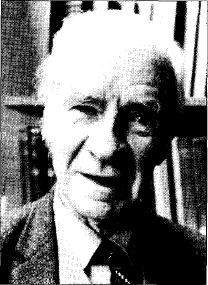
William Harold Hutt
1899–1988
THE AUSTRIAN SCHOOL’S defining precepts, concisely specified by Carl Menger in 1871, were consistent with important doctrines like rivalrous competition that had characterized economics from its earliest days. Though more true of Continental than of British writers hampered by an objective concept of value, Menger’s insights could be folded into an evolutionary tradition that continued to develop—with a few backsliders like Marshall and Pareto—until the 1930s. This decade saw the Austro–Continental–Classical blend torn apart by the domination of microeconomics by mathematics and perfect competition, and by the wholesale overthrow of monetary theory by Keynes’s macroeconomics. The economists whose method and philosophy best qualified them to resist these detours, and to continue the pre-1930s development of economic theory, were those closest to the Austrian tradition. In this sense, it was the mainstream’s descent into mathematical microeconomics and Keynesian macroeconomics that made the Austrian School distinct.
This is the world in which William Harold Hutt found himself at the early stages of his academic career, but understanding his relationship to the Austrian School requires a more detailed look at his formative years. Born in London to working-class parents, Hutt earned a Bachelor of Commerce degree from the London School of Economics (LSE) in 1924. He was favorably impressed by some of his teachers: Lillian Knowles on economic history, H.C. Gutteridge on law, T.E. Gregory and Herbert Foxwell on money and finance, and Edwin Cannan.1 Hutt described Cannan, who taught him elementary economics and then money after Foxwell’s retirement, as “the leading influence to which I was subjected during my first three years at L.S.E. . . . a remarkably wise and independent thinker.”2
From 1924 until 1928, Hutt worked for publisher Sir Ernest Benn, whom he very much respected. Benn was so impressed with Hutt’s first published article—“The Factory System of the Early Nineteenth Century,” written in 1925—that he promoted Hutt to manage The Individualist Bookshop, Ltd. But Hutt continued to take courses informally at LSE, and when his friend from their undergraduate days, Arnold Plant, advertised for a Senior Lecturer for the University of Cape Town, Hutt applied. With strong support from Benn and Professor Cannan, he obtained the post, and arrived in South Africa in March 1928. (John R. Hicks, headed for a temporary post at Witwatersrand, was aboard the same ship.) Two years later, Plant received a professorship at LSE, and Hutt was appointed Chair of Commerce (later Dean of the Faculty of Commerce).
This background suggests much about Hutt’s approach to economics. Austrian by neither birth nor residence, he could know nothing of Mises’s Privatseminars in Vienna. He apparently did not read German, and Mises’s The Theory of Money and Credit was not translated until 1934. Hutt and Hayek were contemporaries, in fact precisely the same age, but differed in country, culture, and language, and while Hayek’s earliest works dated from about the time of Hutt’s “Factory System,” they were not widely known in the English-speaking world until years later. One might hope that Hutt had learned something at LSE of Menger and Böhm-Bawerk, but a strong Jevons and Marshall influence (especially from Foxwell) was more likely, and Hayek discovered in 1930 that Böhm-Bawerk was not well-known at LSE.
In short, until the early 1930s, when The Theory of Money and Credit was translated and Hayek began his flurry of activity at LSE, Hutt had no significant exposure to works that we now identify with the Austrian School. By then, though, Hutt was in Cape Town with heavy responsibilities as the Chair of the Faculty of Commerce. He was always a creative and independent scholar, as even his first article suggests, but his early- and mid-1920s training at LSE help to explain why he later identified himself as a classical economist.
Although Hutt and other critics of the Keynesian Revolution—including Arthur Marget and Henry Hazlitt—considered their work to be in the classical tradition, as the revolution’s stunning popularity through the 1940s and 1950s pushed economists’ memory of earlier monetary theory further into the background, Hutt and Hazlitt (Marget had left academic economics after the World War II and died in 1962) found themselves increasingly sharing perspectives with the School that had most firmly and consistently upheld pre-Keynesian monetary theory: the Austrians. Neither seems to have been attracted much to the aggregative, positivist method of the Chicago School’s monetarism, a reaction to Keynesianism that to some extent shared its method. Hutt considered the Austrians to be the true heirs of the classical tradition with which, understandably, he preferred to be identified.
“The Factory System of the Early Nineteenth Century” was published in Economica (1926) and became more widely known when Hayek included it in Capitalism and the Historians (1954). Hutt’s career change and the duties of shaping a satisfactory business curriculum in Cape Town explain a five-year hiatus, but his return to publishing on academic economics was a blockbuster: The Theory of Collective Bargaining.3 Perhaps partly because his father had been a journeyman printer of modest income, the use of economic theory to understand the wages and employment of labor was one of Hutt’s lifelong primary concerns. This short book—re-issued in 1975 and 1980 with addenda but its 1930 text unchanged—disputed prevailing beliefs that labor was at a “disadvantage” and that the labor market was inherently one of bilateral monopoly that left the wage rate “indeterminate.” Peppered with quotations from British and American economists from Adam Smith onward, Hutt sought to correct others’ views of the classical tradition, to contribute to it, and to offer practical advice on governments’ labor policies. Though he circulated the book widely, its message was out of step with politically powerful doctrines, and it was largely ignored.
When he returned to this theme with The Strike-Threat System in 1973, his more thorough analysis of the impoverishing effect of labor unions and pro-union legislation could draw on four decades of Austrian scholarship unavailable in 1930.4 It enabled him to reinforce his argument that unions gain at the expense of other labor, not capital, and that the transfer reduces total output. The book makes many references to Böhm-Bawerk, Mises, and Hayek. Hutt identified the principal improvement between 1930 and the 1970s as “the emphasis I now place on the composition of the assets stock and the composition of the stock of complementary assimilated knowledge and skills,”5 an insight attributable to the Austrian School’s focus on the complementarities among capital goods and labor skills within particular plans.
Hutt’s perception of the ability of powerful groups—including, but not limited to, labor unions—to use the political process for private gain, despite general impoverishment, led him to the second of his three principal interests in economics, now known as public choice. His first South African article—and his second article on economics—was “Economic Aspects of the Report of the Poor White Commission,” in 1933. (His best known work on the South African sociopolitical system, The Economics of the Color Bar, identified apartheid as a device by which white unions enlisted the force of government to prohibit non-white laborers from competing with them.6) His next few years were productive, especially considering his deanship, with nine articles on competition and monopoly, predatory pricing, and economic legislation.7
But it was his second book that has drawn much praise. Economists and the Public was published in the same year as Keynes’s General Theory, and many economists have wished that Hutt’s thoughtful work had received the greater attention.8 James Buchanan, a Nobel laureate for his own work in public choice who brought Hutt to the University of Virginia after Hutt’s retirement in 1965, called it “one of Hutt’s best works,” and Arthur Seldon wrote that only Hutt’s concern about Keynesianism kept him from being recognized as a public-choice pioneer. Hutt again considered the book a contribution to the British classical tradition, and included many references to it, particularly to John Stuart Mill, whose utilitarianism Hutt found appealing. The work’s principal theme was that economists served the public best by taking a long view, focusing on policies that promoted the wealth-creating competitive market and ignoring whether they were politically feasible at the moment. (He reiterated this in Politically Impossible. . . ?9) He feared that concern with political feasibility would, inevitably, draw economists into the advocacy of politically attractive policies that served special interests to the detriment of society. Perhaps he sensed the need for such counsel during the Great Depression, but Keynes’s work, which appeared in time for Hutt to acknowledge by squeezing in a last-minute paragraph, promoted precisely the destructive but politically irresistible short-run view against which Hutt warned. Keynes’s book shaped decades of policy and teaching; Hutt’s must be swept free of dust from library shelves. No one acquainted with Austrian economics would dispute that we would all be wealthier and smarter if their fates had been reversed.
Some readers will not embrace all of Hutt’s advice. His utilitarian philosophy, which the examples of Mises and Hazlitt show is not objectionable in itself, and his conviction that humanity was best served by competitive institutions with flexible wages and prices, led him to oppose not only government coercion but “economic coercion and private monopoly.” As early as his 1934 “aggressive selling” (predatory pricing) article and at least as late as 1977, Hutt argued for strong antitrust enforcement against private collusion, whether among laborers or producers, because it produced impoverishing and anti-social “contrived scarcities” hindering the market’s ability to address “natural scarcities” (these terms are the title of a 1935 article).10 He coined the term “consumers’ sovereignty,”11 a valuable response to the economically illiterate who identify businessmen with feudal nobility, but fundamentally misleading: as Rothbard responded in 1962, there is only “individual” sovereignty.12
The year 1939 saw Hutt’s publication of The Theory of Idle Resources, a brilliant and creative work motivated by a perceived gap in existing analyses of unemployment, the Depression, and the popularity of Keynes’s General Theory.13 It was reissued in 1977 with Hutt’s extensive addenda. Rewarding reading over a half-century later, its principal point is that one cannot conclude that a resource is “idle”—in the sense of not performing its best economic function—simply by looking at it. One must examine the causal economic process to discern the economic function in which a seemingly idle resource is engaged; sometimes “idleness” is its best use. Job search, for example, is formally considered unemployment (emphatically, however, not by Hutt), but is often a more productive activity for a worker with specific skills than an instantly attainable job flipping hamburgers, and changes in demand expected to be temporary can make a machine’s or factory’s apparent idleness mere “pseudo-idleness,” a more productive “use” than costly conversion to other temporary uses.
In Idle Resources, Hutt continued his criticism of both government and private coercion, envisioning a free market with only “natural,” and no “contrived,” scarcities. Private coercion consisted of service-restricting practices of both labor unions and producer cartels, and it produced forms of idleness that policy can and should address—though only by preventing the activities that created them. Hutt repeatedly warned that the public works and inflation policies advocated by Keynes and his followers, whether a response to coercive idleness best addressed by legislatively rooting out its causes or to a superficial failure to recognize productive “pseudo-idleness” like frictional unemployment, would divert resources away from the productive uses they would find most quickly in an unfettered market. He vigorously retained this theme, which he shared with Hayek and Mises, throughout his life.
By the mid-1950s, Hutt had published about three dozen articles on a wide variety of economic topics. His 1943 book Plan for Reconstruction has been lauded by James Buchanan, and his 1954 contribution to a festschrift to Mises, “The Yield from Money Held,” has been praised by distinguished monetary theorists like George Selgin.14 (It was Hutt’s first significant work in the third of his three economic interests, monetary theory.) By this time, the influence of Mises and Hayek on Hutt’s thinking had become noticeable, though of course much of his earlier work was consistent with Austrian theory. In 1955, the Foundation for Economic Education invited him to a Pennsylvania seminar, his first trip to the United States. Hutt, journalist George Schwartz, and Ludwig von Mises were the three lecturers, and he credits the discussion with the impetus to write the book that is probably his best known: Keynesianism—Retrospect and Prospect.15 His personal recollection of Mises is interesting:
Mises had inspired me for many years before I first met him, through his impressive contributions in articles and books, but it was not until 1955 . . . that I could first greet him face to face. He was physically smaller than I had expected, but I was immediately struck by his really remarkable personality—a magnetism and tenacity created by his deep emotional attachment to a free economy and the institutions on which it had to rely. His lectures, like his writings, were austere, although his verbal expositions were by no means devoid of an informal, natural sense of humor. The warmth of our relations was sustained until his death. But his lectures in 1955 were a powerful inspiration which influenced my own subsequent work.16
Almost inevitably, Hutt’s attention returned to Keynes. Two other economists born in 1899, Hayek and Marget, had devoted much of their productive thirties to attempts to restore pre-Keynesian sanity to the economics profession; neither achieved the slightest short-run success, and each moved on to other things. Hazlitt, a few years older, apparently felt the same pressures as Hutt; virtually contemporaneously, Hazlitt published his The Failure of the “New Economics.”17 Hutt’s Keynesianism and Hazlitt’s Failure are very different in style, but they shared (with the almost universally ignored Marget’s two-volume [1938 and 1942] The Theory of Prices) the observation that, in Keynes’s General Theory, “what is true is not new, and what is new is not true.”
Published at the peak of Keynesian policy and academic influence, and somewhat hampered by Hutt’s idiosyncratic terminology, the fourhundred-and-fifty page Keynesianism had no noticeable effect on the profession. Although its Preface thanks Ludwig Lachmann for valuable discussions, and Mises and Marget for their “courageous and independent work,” the book contains few citations to Mises, and even fewer to Hayek. Nonetheless, younger economists now working in the Austrian tradition will find the book a delight. (The Keynesian Episode18 should be considered its updated and Americanized second edition.) Subtitled “A Critical Restatement of Basic Economic Principles,” it describes the Keynesian doctrine and its appeal, then analyzes the coordinating role of market prices and the natures of money, income, saving, and consumption. Hutt then specifically targets such standard Keynesian fare as “the multiplier,” “the accelerator,” and the liquidity-preference theory of interest.
Again, Hutt produced a magnificent work Austrians would love to claim as one of their own, but which he himself viewed as thoroughly classical in nature. Keynes considered the foundation of his own work his refutation of Say’s Law, for which he coined the phrase “supply creates its own demand” to express; the central theme of Hutt’s Keynesianism was to reassert the validity and relevance of Say’s perceptiveness. Later, he focused precisely on this, with his provocative short study A Rehabilitation of Say’s Law.19 By then, he was delighted to find works by Clower, Leijonhufvud, and Yeager courageously advocating the use of forms of Say’s Law.20
The theme of Keynesianism was one that those unacquainted with Hutt may have learned from Mises or Hayek, but which Hutt seems to have developed directly from Say: depressions and unemployment result from mispricing, not from any supposed deficiency of aggregate demand. Hutt found Keynes’s structure of aggregated concepts so confusing that he declared it “hinders the perception of certain things as well as the saying of them,”21 and he professed great admiration for the brilliant young macroeconomists of the 1970s and 1980s who produced valid insights despite being hobbled with these concepts and language. He viewed Keynes’s theory as an apologia for the basest political goal of power, one that refused to address the institutions hindering price adjustments and instead advocated the use of monetary and fiscal policy. Using macroeconomic policy to resolve microeconomic problems, Hutt pointed out, inevitably conceals and exacerbates the problem by diverting resources into uses other than those which an unhampered market would have produced. Whatever they may do to measurable statistics, which he had noted in 1939 could not measure “idleness,” these policies are impoverishing. By the 1970s, Hutt optimistically perceived the emergence of the economics profession from “the Keynesian episode” (which Leland Yeager, with greater descriptive accuracy, called “the Keynesian diversion”22), and its return to pre-Keynesian methods and truths.
Hutt was an enthusiastic member of the Mont Pèlerin Society, and enjoyed its meetings immensely. He was thrilled when Hayek won the Nobel Memorial Prize in Economics, and attended many Austrian and libertarian conferences into the final years of his life. Many younger Austrians remember him as a kind and courtly man, intellectually sharp and devoted to liberty. Those unfamiliar with his work have a real treat yet ahead. Of his principal works, I would begin with Keynesianism and Idle Resources, then Collective Bargaining and Strike-Threat, and finally Economists. One may wonder how much greater his effect on economics might have been if he had chosen a different career path. Nonetheless, the exciting rediscovery of the Austrian tradition foretells the day when economists widely know and appreciate the works of William Harold Hutt.
SELECTED READINGS
Hutt, William Harold. 1980. The Theory of Collective Bargaining 1930–1975. San Francisco: Cato Institute.
——. 1979. The Keynesian Episode: A Reassessment. Indianapolis, Ind.: Liberty Press.
——. [1939] 1977. The Theory of Idle Resources: A Study in Definition. Indianapolis, Ind.: Liberty Press.
——. 1974. A Rehabilitation of Say’s Law. Athens: Ohio University Press.
——. 1973. The Strike-Threat System: The Economic Consequences of Collective Bargaining. New Rochelle, N.Y.: Arlington House.
——. 1963. Keynesianism—Retrospect and Prospect: A Critical Restatement of Basic Economic Principles. Chicago: Henry Regnery.
——. 1936. Economists and the Public. London: Jonathan Cape.
——. 1930. The Theory of Collective Bargaining. London: P.S. King.
_______________
23See Edwin Carman, The Paper Pound of 1797–1821 (London: King, 1921); and idem, A History of the Theories of Production and Distribution in English Political Economy from 1776 to 1848 (London: Percival, 1917). Also Alan Ebenstein, Collected Works of Edwin Cannon, 8 vols. (London: Routledge/Thoemmes Press, 1999).
24W.H. Hutt, unpublished memoirs, ca. 1984, p. 39.
25W.H. Hutt, The Theory of Collective Bargaining (London: P.S. King, 1930).
26W.H. Hutt, The Strike-Threat System: The Economic Consequences of Collective Bargaining (New Rochelle, N.Y.: Arlington House, 1973). When asked to review this book, Ludwig von Mises said, “Professor Hutt’s rank among the outstanding economists of our age is not contested by any competent critic.”
27W.H. Hutt, The Theory of Collective Bargaining, 1930–1975 (San Francisco: Cato Institute, 1980), p. xviii.
28W.H. Hutt, The Economics of the Color Bar (London: Andre Deutsch for The Institute of Economic Affairs, 1964).
29Hutt’s published articles in these subjects are: “The Significance of State Interference With Interest Rates,” South African Journal of Economics 1 (September 1933): 365–68; “Economic Aspects of the Report of the Poor White Commission,” South African Journal of Economics 1 (September 1933): 281–90; “Economic Method and the Concept of Competition,” South African Journal of Economics 2 (March 1934): 1–23; “Co-ordination and the Size of the Firm,” South African Journal of Economics 2 (December 1934): 383–402; “The Nature of Aggressive Selling,” Economica 2 (August 1935): 298–320; “Logical Issues in the Study of Industrial Legislation,” South African Journal of Economics 3 (March 1935): 26–42; “Natural and Contrived Scarcities,” South African Journal of Economics 3 (September 1935): 345–53; “Discriminating Monopoly and the Consumer,” Economic Journal 46 (March 1936): 61–79; “The Price Mechanism and Economic Immobility,” South African Journal of Economics 4 (September 1936): 319–30.
30Hurt, Economists and the Public (London: Jonathan Cape, 1936).
31Hutt, Politically Impossible. . . ? (London: Institute of Economic Affairs, 1971).
32Cf. Hutt, “The Nature of Aggressive Selling,” pp. 298–320, and idem, “Natural and Contrived Scarcities,” pp. 345–53.
33See W.H. Hutt, “The Concept of Consumers’ Sovereignty,” Economic Journal 50 (March 1940): 66–77.
34Murray N. Rothbard, Man, Economy, and State (Auburn, Ala.: Ludwig von Mises Institute, [1962] 1993), pp. 561–63.
35W.H. Hutt, The Theory of Idle Resources: A Study in Definition (Indianapolis, Ind.: Liberty Press, [1939] 1977).
36W.H. Hutt, Plan for Reconstruction (London: Kegan Paul, 1943); idem, “The Yield from Money Held,” in On Freedom and Free Enterprise: Essays in Honor of Ludwig von Mises, Mary Sennholz, ed. (Princeton, N.J.: Van Nostrand, 1956).
37W.H. Hutt, Keynesianism—Retrospect and Prospect: A Critical Restatement of Basic Economic Principles (Chicago: Henry Regnery, 1963).
38Hutt, “Memoirs,” p. 93. Since Hutt had been involved in the formation of the Mont Pèlerin Society (1947) and had attended the second and many other of its subsequent general meetings, it is surprising that he did not meet Mises until 1955.
39Henry Hazlitt, The Failure of the “New Economics”: An Analysis of the Keynesian Fallacies (New Rochelle, N. Y.: Arlington House, 1959).
40W.H. Hutt, The Keynesian Episode: A Reassessment (Indianapolis, Ind.: Liberty Press, 1979).
41W.H. Hutt, A Rehabilitation of Say’s Law (Athens: Ohio University Press, 1974).
42Ibid., p. 48.
43Hutt, Keynesianism-Retrospect and Prospect, p. ix.
44Leland B. Yeager, “The Keynesian Diversion,” Western Economic Journal 11, no. 2 (June 1973): 150–63.
- 1Two recent examples are the review article by Israel M. Kirzner, “Entrepreneurial Discovery and the Competitive Market Process: An Austrian Approach,” Journal of Economic Literature 35, no. 1 (March 1997): 60–85; and Sherwin Rosen, “Austrian and Neoclassical Economics: Any Gains From Trade?” Journal of Economic Perspectives 11, no 4. (Fall 1997): 139–52. Both of these journals are publications of the American Economic Association, indicating the degree to which Austrian ideas are at least recognized, if not embraced, by the profession’s mainstream.
- 2See Leland B. Yeager, “Austrian Economics, Neoclassicism, and the Market Test,” Journal of Economic Perspectives 11, no. 4 (Fall 1997): 153–65, for an insightful discussion on the challenges that an alternative to mainstream ideas faces in the academic marketplace.
- 3See Karen I. Vaughn, Austrian Economics in America: The Migration of a Tradition (New York: Cambridge University Press, 1994), for a good discussion of the development of the modern Austrian School. Also see Murray N. Rothbard, “The Present State of Austrian Economics,” Money, Method, and the Austrian School, vol. 1, The Logic of Action (Cheltenham, U.K.: Edward Elgar, 1997).
- 4The first edition of Menger’s Principles of Economics was published in German in 1871. While it was generally recognized as a landmark contribution in economics, an English translation was not published until 1950.
- 5Murray N. Rothbard, in Ludwig von Mises: Scholar, Creator, Hero (Auburn, Ala.: Ludwig von Mises Institute, 1988), p. 13, notes that Mises’s early work on monetary theory, while controversial, was published in the Economic Journal, one of the leading mainstream economic journals of the time.
- 6Paul A. Samuelson, Economics, 9th ed. (New York: McGraw-Hill, 1973), p. 883.
- 7Diego de Covarrubias y Leyva, Omnia Opera (Venice, 1604),vol. 2, chap.4, p.131.
- 8Luis Saravia de la Calle, Instrucción de mercaderes (1544); republished in Colección de Joyas Bibliográficas (Madrid, 1949), p. 53. Saravia’s book addresses the business entrepreneur (in Spanish mercaderes) following a continental Catholic tradition that can be traced back to San Bernardino de Siena (1380–1444). See Rothbard, Economic Thought Before Adam Smith, pp. 81–85.
- 9Juan de Lugo (1583–1660), Disputationes de iustitia et iure (Lyon, 1642), vol. 2, d. 26, s. 4, n. 40, p. 312.
- 10Juan de Salas, Commentarii in secundam secundae D. Thomae de contractibus (Lyon, 1617), vol. 4, no. 6, p. 9.
- 11Jerónimo Castillo de Bovadilla, Práctica para corregidores (Salamanca, 1585), vol. 2, chap. 4, no. 49. See also the important comments on the scholastics and their dynamic concept of competition written by Oreste Popescu, Estudios en la historia del pensamiento económico latinoamericano (Buenos Aires: Plaza and Janés, 1987), pp. 141–59.
- 12Luis de Molina, De iustitia et iure (Cuenca, 1597), vol. 2, disp. 348, no. 4, and La teoría del justo predo, Francisco Gómez Camacho, ed. (Madrid: Editora Nacional, 1981), p. 169. Raymond de Roover, ignoring the work of Castillo de Bovadilla, acknowledges how “Molina even introduces the concept of competition by stating that concurrence or rivalry among buyers will enhance prices.” See his article “Scholastic Economics: Survival and Lasting Influence from the Sixteenth Century to Adam Smith,” Quarterly Journal of Economics 69, no. 2 (May1955): 169.
- 13Included in Covarrubias, Omnia Opera, vol. 1, pp. 669–710.
- 14Carl Menger, Principles of Economics (New York: New York University Press, 1981), p. 317.
- 15Martín Azpilcueta Navarro, Comentario resolutorio de cambios (Madrid: Consejo Superior de Investigaciones Científicas, 1965), pp. 74–75.
- 16See Jesús Huerta de Soto, “New Light on the Prehistory of the Theory of Banking and the School of Salamanca,” Review of Austrian Economics 9, no. 2 (1996): 59–81.
- 17Luis de Molina, Tratado sobre los cambios, Introduction by Francisco Gómez Camacho (Madrid: Instituto de Estudios Fiscales, 1990), p. 146. Also James Pennington’s memo dated February 13, 1826, “On the Private Banking Establishments of the Metropolis,” included as an Appendix in Thomas Tooke, A Letter to Lord Grenville; On the Effects Ascribed to the Resumption of Cash Payments on the Value of the Currency (London: John Murray, 1826).
- 18However, according to Father Bernard W. Dempsey, if the members of this second group of the School of Salamanca had had a detailed theoretical knowledge of the functioning and implications of the economic process to which fractional-reserve banking gives rise, it would have been described as a perverse, vast and illegitimate process of institutional usury, even by Molina, Lessius, and Lugo themselves. See Father Bernard W. Dempsey, Interest and Usury (Washington, D.C.: American Council of Public Affairs, 1943), p. 210.
- 19Quoted in ibid., p. 214, n. 31.
- 20Mariana, Discurso de las enfermedades de la Compañía, pp. 151–55, 216.
- 21See Leland B. Yeager, “Book Review,” Review of Austrian Economics 9, no. 1 (1996): 183, where he says:
- 22Jaime Balmes, “Verdadera idea del valor o reflexiones sobre el origen, naturaleza y variedad de los precios,” en Obras Completas (Madrid: B.A.C., 1949), vol. 5, pp. 615–24. Balmes also described the personality of Juan de Mariana with the following graphic words:
- 23AT THE END of the twentieth century, the Austrian School of economics is exerting a significant influence both on the development of academic economics and on the application of economic theory to public policy. An increasing number of economics professors are sympathetic with the fundamental ideas of Austrian economics, and academic journals are taking more account of the Austrian School. A half century ago, few academic economists would even have been familiar with the Austrian School, except superficially, and among those who were, most would have disagreed with its methods and conclusions. Today, the ideas of Austrian economics are closer to the mainstream of economic thought, not because Austrian economics has changed, but because mainstream economics has moved toward the Austrian point of view. A similar shift has occurred in the public-policy arena. The policy implications of Austrian economics, once rejected as extreme, are now embraced as true. In the process, the Austrian School has become increasingly visible as an intellectual force.
- 24If the ideas of Austrian economics have made such inroads, one might wonder why, in the academic arena, Austrian economics does not play a bigger role. Part of the answer has to do with academic institutions themselves. Most university faculty teach at state institutions, which by itself may bias them toward supporting the state and being suspicious of laissez-faire ideas. Most university faculty have tenure, which slows the turnover of personnel, and perhaps of ideas. Furthermore, academic ideas find their outlets largely in academic journals, and the editorial boards of those journals tend to be controlled by the academic mainstream, further promoting mainstream ideas over alternative schools of thought. Because publication in academic journals is often a prerequisite for promotion and tenure in a university environment, academic survival often pushes young scholars in the direction of the mainstream methods and ideas in their discipline.
- 25Austrian economics has fought an uphill battle for acceptance for several reasons, but at the same time, the Austrian School has been gaining in strength, and is becoming more accepted in academia. A growing number of economics professors align themselves with the Austrian School, and even among those who do not, Austrian ideas are becoming more recognized and respected. Interestingly enough, the late-twentieth-century resurgence of interest in the Austrian School has been concentrated in the United States. This is largely due to Ludwig von Mises’s migration, and his Austrian economics seminar at New York University. One might go so far as to argue that the modern Austrian School would not exist were it not for the influence of Ludwig von Mises on his American students.
- 26Carl Menger is generally regarded as the founder of the Austrian School, but prior to about 1920, Austrian economics was not very different from economics in general. Economic theory had taken a great leap forward in the 1870s when the concept of marginal utility was independently discovered by Léon Walras, William Stanley Jevons, and Carl Menger. Each of these three individuals pushed the concept in different directions, but the integration of the marginal theory of value into economics was a major leap for all of economics. Eugen von Böhm-Bawerk’s capital theory, now seen as Austrian, was viewed more generally as a part of economics when it was published in the 1880s and 1890s, and Ludwig von Mises’s Theory of Money and Credit, published in 1912, established him as a leading authority on monetary economics.
- 27Carl Menger is generally regarded as the founder of the Austrian School, but prior to about 1920, Austrian economics was not very different from economics in general. Economic theory had taken a great leap forward in the 1870s when the concept of marginal utility was independently discovered by Léon Walras, William Stanley Jevons, and Carl Menger. Each of these three individuals pushed the concept in different directions, but the integration of the marginal theory of value into economics was a major leap for all of economics. Eugen von Böhm-Bawerk’s capital theory, now seen as Austrian, was viewed more generally as a part of economics when it was published in the 1880s and 1890s, and Ludwig von Mises’s Theory of Money and Credit, published in 1912, established him as a leading authority on monetary economics.
- 28From its low point in the middle of the twentieth century, Austrian economics has continued to gain visibility both inside academia and out. F.A. Hayek won the Nobel prize in economics in 1974, giving the Austrian School attention and respectability. By then, a small Austrian revival was already underway, led by Kirzner and Rothbard, and Hayek’s Nobel prize gave the revival additional momentum. Still, the Austrian School was branded by being on the losing side of the socialist calculation debate. In 1973, the year Mises died, Paul Samuelson, another Nobel laureate in economics and among the most prominent of mainstream academic economists, argued in his introductory textbook that even though the Soviet Union had roughly half the per capita income of the United States, their superior economic system based on central planning gave them faster growth. Based on this, Samuelson projected that per capita income in the Soviet Union could catch up to that of the United States as early as 1990, and almost surely by 2015. Keep in mind that Samuelson’s projection was in his best-selling introductory college textbook, and was the standard line taught in college classrooms at the time. Clearly, the mainstream had not accepted the ideas of Austrian economics.
- 29We should note how Mariana refers to the fact that the “common estimation” of men is the origin of the value of things, thus following the traditional subjectivist doctrine of the scholastics, which was initially proposed by Diego de Covarrubias y Leyva. Covarrubias (1512–1577), the son of a famous architect, became bishop of the city of Segovia and a minister to King Philip II. In 1554, he set forth better than anyone before the subjectivist theory of value, stating that “the value of an article does not depend on its essential nature but on the subjective estimation of men, even if that estimation is foolish,” illustrating his thesis with the example that “in the Indies wheat is dearer than in Spain because men esteem it more highly, though the nature of the wheat is the same in both places.”
- 30Covarrubias’s subjectivist conception was completed by another of his scholastic contemporaries, Luis Saravia de la Calle, who was the first to demonstrate that prices determine costs, not vice versa. Saravia de la Calle also had the special distinction of writing in Spanish, not in Latin. Its title was Instrucción de mercaderes (Instruction to merchants), and there we can read that “those who measure the just price by the labor, costs and risk incurred by the person who deals in the merchandise are greatly in error. The just price is found not by counting the cost but by common estimation.”
- 31The subjectivist conception initiated by Covarrubias also allowed other Spanish scholastics to get a clear insight of the true nature of market prices, and of the impossibility of attaining an economic equilibrium. Thus, the Jesuit Cardinal Juan de Lugo, wondering what the price of equilibrium was, as early as 1643 reached the conclusion that the equilibrium depended on such a large number of specific circumstances that only God was able to know it (“Pretium iustum mathematicum licet soli Deo notum”). Another Jesuit, Juan de Salas, referring to the possibilities of knowing specific market information, reached the very Hayekian conclusion that it was so complex that “quas exacte comprehendere et ponderare Dei est non hominum” (only God, not men, can understand it exactly).
- 32The subjectivist conception initiated by Covarrubias also allowed other Spanish scholastics to get a clear insight of the true nature of market prices, and of the impossibility of attaining an economic equilibrium. Thus, the Jesuit Cardinal Juan de Lugo, wondering what the price of equilibrium was, as early as 1643 reached the conclusion that the equilibrium depended on such a large number of specific circumstances that only God was able to know it (“Pretium iustum mathematicum licet soli Deo notum”). Another Jesuit, Juan de Salas, referring to the possibilities of knowing specific market information, reached the very Hayekian conclusion that it was so complex that “quas exacte comprehendere et ponderare Dei est non hominum” (only God, not men, can understand it exactly).
- 33Furthermore, the Spanish scholastics were the first ones to introduce the dynamic concept of competition (in Latin concurrentium), which is best understood as a process of rivalry among entrepreneurs. For instance, Jerónimo Castillo de Bovadilla (1547–?) wrote that “prices will go down as a result of the abundance, rivalry (emulación), and competition (concurrencia) among the sellers.”
- 34This same idea is closely followed by Luis de Molina. Covarrubias also anticipated many of the conclusions of Father Mariana in his empirical study on the history of the devaluation of the main coin of that time, the Castilian Maravedí. This study contained a compilation of a large number of statistics on the evolution of prices in the previous century and was published in Latin in his book Veterum collatio numismatum (Compilation on old moneys). This book was highly praised in Italy by Davanzaty and Galiani and was also quoted by Carl Menger in his Principles of Economics.
- 35This same idea is closely followed by Luis de Molina. Covarrubias also anticipated many of the conclusions of Father Mariana in his empirical study on the history of the devaluation of the main coin of that time, the Castilian Maravedí. This study contained a compilation of a large number of statistics on the evolution of prices in the previous century and was published in Latin in his book Veterum collatio numismatum (Compilation on old moneys). This book was highly praised in Italy by Davanzaty and Galiani and was also quoted by Carl Menger in his Principles of Economics.
- 36This same idea is closely followed by Luis de Molina. Covarrubias also anticipated many of the conclusions of Father Mariana in his empirical study on the history of the devaluation of the main coin of that time, the Castilian Maravedí. This study contained a compilation of a large number of statistics on the evolution of prices in the previous century and was published in Latin in his book Veterum collatio numismatum (Compilation on old moneys). This book was highly praised in Italy by Davanzaty and Galiani and was also quoted by Carl Menger in his Principles of Economics.
- 37as can be seen from experience, in France, where there is less money than in Spain, bread, wine, clothing, labor, and work cost much less; and even in Spain, at the time when there was less money, the things which could be sold and the labor and work of men were given for much less than after the Indies were discovered and covered her with gold and silver. The cause of which is that money is worth more where and when it is lacking than where and when it is in abundance.
- 38It is obvious that if Father Mariana had known the economic mechanisms that lead to the credit expansion process generated by banks and the effects of this process, he would have condemned these as robbery. He would have condemned not only the government debasement of coins but also the even more disturbing credit inflation created by banks. However, other Spanish scholastics were able to analyze the credit expansion of banks. Thus, de la Calle was very critical of fractional-reserve banking. He maintained that receiving interest was incompatible with the nature of a demand deposit, and that, in any case, a fee should be paid to the banker for keeping the money under his custody. A similar conclusion is reached by the more famous Navarro.
- 39Molina was sympathetic to fractional-reserve banking and confused the nature of two different contracts, loans and deposits, which Azpilcueta and Saravia de la Calle had clearly differentiated from each other previously. A more relevant aspect is that Molina was the first theorist to discover, in 1597 (therefore much earlier than Pennington in 1826), that bank deposits are part of the monetary supply. He even proposed the name “chirographis pecuniarium” (written money) to refer to the written documents that were accepted in trade as bank money. Our scholastics included, therefore, two incipient schools. The first is a kind of “Currency School,” formed by Saravia de la Calle, Azpilcueta Navarro, and Tomás de Mercado, who were very distrustful of banking activities, for which they implicitly demanded a one-hundred-percent reserve should be held. The second was a kind of “Banking School,” headed by the Jesuits Luis de Molina and Juan de Lugo, who were much more tolerant toward fractional-reserve banking. Both groups were to a certain extent the forerunners of the theoretical developments which were to arise three centuries later in England as a result of the debate between the Currency School and the Banking School.
- 40Molina was sympathetic to fractional-reserve banking and confused the nature of two different contracts, loans and deposits, which Azpilcueta and Saravia de la Calle had clearly differentiated from each other previously. A more relevant aspect is that Molina was the first theorist to discover, in 1597 (therefore much earlier than Pennington in 1826), that bank deposits are part of the monetary supply. He even proposed the name “chirographis pecuniarium” (written money) to refer to the written documents that were accepted in trade as bank money. Our scholastics included, therefore, two incipient schools. The first is a kind of “Currency School,” formed by Saravia de la Calle, Azpilcueta Navarro, and Tomás de Mercado, who were very distrustful of banking activities, for which they implicitly demanded a one-hundred-percent reserve should be held. The second was a kind of “Banking School,” headed by the Jesuits Luis de Molina and Juan de Lugo, who were much more tolerant toward fractional-reserve banking. Both groups were to a certain extent the forerunners of the theoretical developments which were to arise three centuries later in England as a result of the debate between the Currency School and the Banking School.
- 41that future goods are not valued so highly as the same goods available at an immediate moment of time, nor do they allow their owners to achieve the same utility. For this reason, it must be considered that they have a more reduced value in accordance with justice.
- 42Mariana concludes that, when there are many laws, “as not all of them may be kept or known, respect for all of them is lost.”
- 43Indeed, we could say that the greatest merit of Carl Menger was to rediscover and take up this continental Catholic tradition of Spanish scholastic thought that was almost forgotten and cut short as a consequence of the black legend against Spain and the very negative influence on the history of economic thought of Adam Smith and his followers of the British Classical School.
- 44It is not difficult to explain. Being the value of a thing its utility . . . if the number of units of this means increases, the need of any one of them in particular decreases; because being possible to choose among many units, none of them is indispensable. For this reason there is a necessary relation between the increase or decrease in value, and the shortage or abundance of a thing.

