
The Great Austrian Economists
10. Ludwig von Mises: The Dean of the Austrian School
THE DEAN OF THE AUSTRIAN SCHOOL1 MURRAY N. ROTHBARD
THOUGH THE PREEMINENT theorist of our time, Mises’s interest, as a teenager, centered in history, particularly economic and administrative history. But even while still in high school, he reacted against the relativism and historicism rampant in the German-speaking countries, dominated by the Historical School. In his early historical work, he was frustrated to find historical studies virtually consisting of paraphrases from official government reports. Instead, he yearned to write genuine economic history. He early disliked the State orientation of historical studies. Thus, in his memoirs, Mises writes:
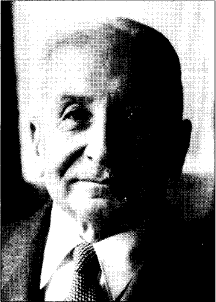
Ludwig von Mises
1881–1973
It was my intense interest in historical knowledge that enabled me to perceive readily the inadequacy of German historicism. It did not deal with scientific problems, but with the glorification and justification of Prussian policies and Prussian authoritarian government. The German universities were state institutions and the instructors were civil servants. The professors were aware of this civil-service status, that is, they saw themselves as servants of the Prussian king.2
Ludwig von Mises entered the University of Vienna at the turn of the twentieth century, and his major professor was the economic historian Karl Grünberg, a member of the German Historical School and a statist who was interested in labor history, agricultural history, and Marxism. Grünberg was a follower of the German economic historian Georg Friedrich Knapp, the author of the major work claiming that money was in its origin and its essence a pure creature of the State. At his center for economic history at the University of Strasbourg, Knapp was having his students work on the liberation of the peasantry from serfdom in the various German provinces. Hoping to create a similar center at Vienna, Professor Grünberg set his students to do research on the elimination of serfdom in the various parts of Austria. Young Ludwig Mises was assigned the task of studying the disappearance of serfdom in his native Galicia. Mises later lamented that his book on this subject, published in 1902, was, because of the Knapp–Grünberg methodology, “more a history of government measures than economic history.”3 The same problems beset his second historical work published three years later, a study of early child labor laws in Austria, which proved to be “not much better.”4
Despite his chafing at the statism and Prussianism of the Historical School, Mises had not yet discovered economic theory, the Austrian School, and the economic liberalism of the free market. In his early years at the university, he was a left-liberal and interventionist, although he quickly rejected Marxism. He joined the university-affiliated Association for Education in the Social Sciences, and plunged into applied economic reform. In his third year at the university, Mises did research on housing conditions under Professor Eugene von Philippovich, and the following semester, for a seminar on criminal law, did research on changes in the law on domestic servants. From his detailed studies, Mises began to realize that reform laws only succeeded in being counterproductive, and that all improvements in the conditions of the workers had come about through the operations of capitalism.
Around Christmas, 1903, Mises discovered the Austrian School of economics by reading Carl Menger’s great Principles of Economics, and thus began to see that there was a world of positive economic theory and free-market liberalism that complemented his empirical discoveries on the weaknesses of interventionist reform.
On the publication of his two books in economic history, and on the receipt of his doctorate in 1906, Mises ran into a problem that would plague him the rest of his life: the refusal of academia to grant him a full-time, paid position. It boggles the mind what this extraordinarily productive and creative man was able to accomplish in economic theory and philosophy, when down to his mid-50s, his full-time energies were devoted to applied political-economic work. Until middle-age, in short, he could only pursue economic theory and write his extraordinary and influential books and articles as an overtime leisure activity. What could he have done, and what would the world have gained, if he had enjoyed the leisure that most academics fritter away? As it is, Mises writes that his plans for extensive research in economic and social history were thwarted for lack of available time. He states wistfully that “I never found opportunity to do this work. After completing my university education, I never again had the time for work in archives and libraries.”5
Mises’s doctorate was in the Faculty of Law at the University of Vienna, and so for several years after 1906 he clerked at a series of civil, commercial, and criminal courts, and became an associate at a law firm. In addition, preparing himself for a teaching career, Mises began to teach economics, constitutional law, and administration to the senior class of the Vienna Commercial Academy for Women, a position which he held until the completion of his first great book in 1912.6
Mises’s major post, from 1909 until he left Austria twenty-five years later, was his full-time job as economist at the Vienna Chamber of Commerce.7 In Austria, the Chambers of Commerce were akin to “Economic Parliaments,” created by the government, with delegates elected by businessmen and financed by taxation. The Chambers were formed to give economic advice to the government, and the center of power was its General Assembly, consisting of delegates from the various local and provincial Chambers, and with the committees of that Assembly. The experts advising the Chambers and the General Assembly were gathered in the offices of the secretaries to the various Chambers. By the turn of the twentieth century, economists working in the secretary’s office of the Vienna Chamber (the preeminent of the various Chambers) had become important economic advisers to the government. By the end of World War I, Mises, operating from his quasi-independent position at the Chamber, became the principal economic adviser to the government, and won a number of battles on behalf of free markets and sound money.
THE THEORY OF MONEY AND CREDIT
In 1903, the influential monetary economist Karl Helfferich, in his work on money, laid down a challenge to the Austrian School. He pointed out correctly that the great Austrians, Menger, Böhm-Bawerk, and their followers, despite their prowess in analyzing the market and the value of goods and services (what we would now call “microeconomics”), had not managed to solve the problem of money. Marginal utility theory had not been extended to the value of money, which had continued, as under the English classical economists, to be kept in a “macro” box strictly separate from utility, value, and relative prices. Even the best monetary analyses, as in Ricardo, the Currency School, and Irving Fisher in the United States, had been developed in terms of “price levels,” “velocities,” and other aggregates completely ungrounded in any micro analysis of the actions of individuals.
In particular, the extension of Austrian analysis to money faced a seemingly insuperable obstacle, the “problem of the Austrian circle.” The problem was this: for directly consumable goods, the utility and therefore the demand for a product can be arrived at clearly. The consumer sees the product, evaluates it, and ranks it on his value scale. These utilities to consumers interact to form a market demand. Market supply is determined by the expected demand, and the two interact to determine market price. But a particular problem is posed by the utility of, and the demand for, money. For money is demanded on the market, and held in one’s cash balance, not for its own sake but solely for present or future purchases of other goods. The distinctive nature of money is that it is not consumed, but only used as a medium of exchange to facilitate exchanges on the market. Money, therefore, is only demanded on the market because it has a preexisting purchasing-power, or value or price on the market. For all consumer goods and services, therefore, value and demand logically precede and determine price. But the value of money, while determined by demand, also precedes it; in fact, a demand for money presupposes that money already has a value and price. A causal explanation of the value of money seems to founder in unavoidable circular reasoning.
In 1906, his doctorate out of the way, Mises determined to take up the Helfferich challenge, apply marginal utility theory to money, and solve the problem of the Austrian circle. He devoted a great deal of effort to both empirical and theoretical studies of monetary problems. The first fruits of this study were three scholarly articles, two in German journals and one in the English Economic Journal in 1908–09, on foreign exchange controls and the gold standard in Austria-Hungary. In the course of writing the articles, Mises became convinced that, contrary to prevailing opinion, monetary inflation was the cause of balance-of-payments deficits instead of the other way around, and that bank credit should not be “elastic” to fulfill the alleged needs of trade.
Mises’s article on the gold standard proved highly controversial. He called for a de jure return in Austria-Hungary to gold redemption as a logical conclusion of the existing de facto policy of redeemability. In addition to running up against advocates of inflation, lower interest rates, and lower exchange rates, Mises was surprised to face ferocious opposition by the central bank, the Austro-Hungarian Bank. In fact, the bank’s vice president hinted at a bribe to soften Mises’s position. A few years later, Mises was informed by Böhm-Bawerk, the Minster of Finance, of the reason for the vehemence of the bank’s opposition to his proposal for a legal gold standard. Legal redemption in gold would probably deprive the bank of the rights to invest funds in foreign currencies. But the bank had long used proceeds from these investments to amass a secret and illegal slush fund from which to pay subventions to its own officials, as well as to influential journalists and politicians. The bank was keen on retaining the slush fund, and so it was fitting that Mises’s most militant opponent was the publisher of an economic periodical who was himself a recipient of bank subsidies.
Mises came to a decision, which he pursued for the rest of his career in Austria, not to reveal such corruption on the part of his enemies, and to confine himself to rebutting fallacious doctrine without revealing their sources. But in taking this noble and self-abnegating position, by acting as if his opponents were all objective scholars, it might be argued that Mises was legitimating them and granting them far higher stature in the public debate than they deserved. Perhaps, if the public had been informed of the corruption that almost always accompanies government intervention, the activities of statists and inflationists might have been desanctified, and Mises’s heroic and lifelong struggle against statism might have been more successful. In short, perhaps a one-two punch was needed: refuting the economic fallacies of Mises’s statist enemies, and also showing the public their self-interested stake in government privilege.8
His preliminary research out of the way, Mises embarked, in 1909, on his first monumental work, published in 1912 as Theories des Geldes and der Umlaufsmittel [The theory of money and credit]. It was a remarkable achievement, because for the first time, the micro–macro split that had begun in English classical economics with Ricardo was healed. At long last, economics was whole, an integral science based on a logical, step-by-step analysis of individual human action. Money was fully integrated into an analysis of individual action and the market economy.
By basing his analysis on individual action, Mises was able to show the deep fallacies of the orthodox mechanistic Anglo-American quantity theory and of Irving Fisher’s “equation of exchange.” An increase in the quantity of money does not mechanically yield a proportional increase in a nonexistent “price level,” without affecting relative utilities or prices. Instead, an increase lowers the purchasing power of the money unit, but does so by inevitably changing relative incomes and prices. Micro and macro are inextricably comingled. Hence, by focusing on individual action, on choice and demand for money, Mises not only was able to integrate the theory of money with the Austrian theory of value and price; he transformed monetary theory from an unrealistic and distorted concentration on mechanistic relations between aggregates, to one consistent with the theory of individual choice.9
Moreover, Mises revived the critical monetary insight of Ricardo and the British Currency School of the first half of the nineteenth century: that while money is a commodity subject to the supply-and-demand determination for value of any other commodity, it differs in one crucial aspect. Other things being equal, an increase in the supply of consumer goods confers a social benefit by raising living standards. But money, in contrast, has only one function: to exchange, now or at some time in the future, for capital or consumer goods. Money is not eaten or used as are consumer goods, nor used up in production as are capital goods. An increase in the quantity of money only serves to dilute the exchange effectiveness of each franc or dollar; it confers no social benefit whatever. In fact, the reason why the government and its controlled banking system tend to keep inflating the money supply is precisely because the increase is not granted to everyone equally. Instead, the nodal point of initial increase is the government itself and its central bank; other early receivers of the new money are favored new borrowers from the banks, contractors to the government, and government bureaucrats themselves. The early receivers of the new money, Mises pointed out, benefit at the expense of those down the line of the chain who get the new money last, or of people on fixed incomes who never receive the new influx of money. In a profound sense, then, monetary inflation is a hidden form of taxation or redistribution of wealth, to the government and its favored groups and from the rest of the population. Mises’s conclusion, then, is that once there is enough for a supply of a commodity to be established on the market as money, there is no need ever to increase the supply of money. This means that any supply of money whatever is “optimal,” and every change in the supply of money stimulated by government can only be pernicious.10
In the course of refuting the Fisherine notion of money as some sort of “measure of value,” Mises made an important contribution to utility theory in general, a contribution that corrected an important flaw with Austrian utility analysis of Menger and Böhm-Bawerk. Although the older Austrians did not stress this flaw as much as Jevons or Walras, there were indications that they believed utility to be measurable, and that there is sense in talking of a “total utility” of the supply of a good that would be an integral of its “marginal utilities.” Mises built on an important insight of the Czech economist Franz Čuhel, a student at Böhm-Bawerk’s graduate seminar, that since marginal utility was strictly subjective to each individual, it was purely an ordinal ranking, and could in no sense be added, subtracted, or measured, and a fortiori could not be compared between persons. Mises developed this theme to demonstrate that therefore the very concept of “total utility” makes no sense at all, particularly as an integral of marginal utilities. Instead, the utility of a larger batch of a good is simply another marginal utility of a large unit. Thus, if we take the utility to the consumer of a carton of a dozen eggs, it is impermissible to make this utility some sort of a “total utility,” in some mathematical relation to the “marginal utility of one egg.” Instead, we are merely dealing with marginal utilities of different-sized units, in one case a dozen-egg package, in the other case one egg. The only thing we can say about the two marginal utilities is that the marginal utility of a dozen eggs is worth more than the marginal utility of one egg. Period. Mises’s correction of his mentors was consistent with the fundamental Austrian methodology of focusing always on the real actions of individuals, and allowing no drift into relying on mechanistic aggregates.11
If the Čuhel–Mises insight had been absorbed into the mainstream of utility theory, economics would have been spared, on the one hand, the tossing out of marginal utility altogether in the late 1930s as hopelessly cardinal, in favor of indifference curves and marginal rates of substitution; and, on the other, the current absurd micro-textbook discussions of “utilities,” nonexistent entities subject to measurement and mathematical manipulation.
What of the famous problem of the Austrian circle? Mises solved that in one of his most important, and yet most neglected, contributions to economics: the regression theorem. Mises built on Menger’s logical-historical account of the origin of money out of barter, and demonstrated logically that money can only originate in that way. In doing so, he solved the problem of the circular explanation of the utility of money. Specifically, the problem of the circle is that, at any given time, say dayN, the value [purchasing-power] of money on that day is determined by two entities: the supply of moneyN and the demand for moneyN, which itself depends on a preexisting purchasing power on dayN-1. Mises broke out of this circle precisely by understanding and grasping the time dimension of the problem. For the circle on any given day is broken by the fact that the demand for money on that day is dependent on a previous day’s purchasing power, and hence on a previous day’s demand for money. But haven’t we broken out of the circle only to land ourselves in an infinite regress backwards in time, with each day’s purchasing power resting on today’s demand for money, in turn dependent on the previous day’s purchasing power, in turn determined by the previous day’s demand, etc.? It is no help to escape circular reasoning only to land in a regress of causes that can never be closed.
But the brilliance of Mises’s solution is that the logical regress backward in time is not infinite: it closes precisely at the point in time when money is a useful non-monetary commodity in a system of barter. In short, say that day1 is the first moment that a commodity is used as a medium of indirect exchange (to simplify: as a “money”), while the previous day is the last day that commodity, say gold, was used only as a direct good in a system of barter. In that case, the causal chain of any day’s value of money, say dayN, goes back locally in time, to day1, and then goes back to day0. In short, the demand for gold on day1 depends on the purchasing power of gold on day0. But then the regress backward stops, since the demand for gold on day0 consists only of its direct value in consumption, and hence does not include a historical component, i.e., the existence of prices for gold on the previous day, day1.
In addition to closing the determinants of the value or purchasing power of money, and thereby solving the Austrian circle, Mises’s demonstration showed that, unlike other goods, the determinants of the value of money include an important historical dimension. The regression theorem also shows that money, in any society, can only become established by a market process emerging from barter. Money cannot be established by a social contract, by government imposition, or by artificial schemes proposed by economists. Money can only emerge, “organically” so to speak, out of the market.12
Comprehension of Mises’s regression theorem would spare us numerous impossible schemes, some proffered by Austrians or quasi-Austrians, to create new moneys or currency units out of thin air, such as F.A. Hayek’s proposed “ducat,” or plans to separate units of account from media of exchange.
In addition to his feat in integrating the theory of money with general economics and placing it on the micro foundations of individual action, Mises, in The Theory of Money and Credit, transformed the existing analysis of banking. Returning to the Ricardian Currency School tradition, he demonstrated that it was correct in wishing to abolish inflationary fractional-reserve credit. Mises distinguished two separate kinds of function undertaken by banks: channeling savings into productive credit (“commodity credit”), and acting as a money warehouse in holding cash for safekeeping. Both are legitimate and non-inflationary functions; the trouble comes when the money warehouses issue and lend out phony warehouse receipts (banknotes or demand deposits) to cash that does not exist in the banks’ vaults (“fiduciary credit”). These “uncovered” demand liabilities issued by the banks expand the money supply and generate the problems of inflation. Mises therefore favored the Currency School approach of one-hundred-percent specie reserves to demand liabilities. He pointed out that Peel’s Act of 1844, established in England on Currency School principles, failed and discredited its authors by applying one-hundred-percent reserves only to bank notes. They failed to realize that demand deposits were also surrogates for cash, and therefore functioned as part of the money supply. Mises wrote his book at a time when much of the economics profession was still not sure that demand deposits constituted part of the money supply.
Not wishing to trust government to enforce one-hundred-percent reserves, however, Mises advocated totally free banking as a means of approaching that ideal. The Theory of Money and Credit demonstrated that the major force coordinating and promoting bank credit inflation was each nation’s central bank, which centralized reserves, bailed out banks in trouble, and made sure that all banks inflated together. The Theory of Money and Credit showed that an individual bank enjoyed very little room to expand credit.
But this is not all. For Mises began, on the foundations of his theory of money and banking, to develop what was to become his famous theory of the business cycle—the only such theory integrated with general microeconomics and built on the foundations of the analysis of action. These rudiments were further developed in the second edition of The Theory of Money and Credit in 1924.
In the first place, Mises was brilliantly able to identify the process as essentially the same: (a) one bank’s expanding credit, soon leading to a contraction and demand for redemption; and (b) all banks in the nation, guided by a central bank, expanding money and credit together and thereby gaining more time for a Hume-Ricardo specie-flow price mechanism to develop. Thus, credit and the money supply expand, incomes and prices rise, gold flows out of the country (i.e., a balance-of-payments deficit), and a resulting collapse of credit and the banks, forces a contraction of money and prices, and reverses specie flow into the country. Not only did Mises see that these two processes were basically the same, he was also the first to see that there was a rudimentary model of a boom-bust cycle, created and driven by monetary factors, specifically expansion and later contraction of “created” bank credit.
During the 1920s, Mises formulated his business cycle theory out of three pre-existing elements; the Currency School boom-bust model of the business cycle; the Swedish “Austrian” Knut Wicksell’s differentiation between the “natural” and the bank interest rates; and Böhm-Bawerkian capital and interest theory. Mises’s remarkable integration of these previously totally separate analyses showed that any inflationary or created bank credit, by pumping more money into the economy and by lowering interest rates on business loans below the free-market, time-preference level, inevitably caused an excess of malinvestment in capital goods industries remote from the consumer. The longer the boom of inflationary bank credit continues, the greater the scope of malinvestment in capital goods, and the greater the need for liquidation of these unsound investments. When the credit expansion stops, reverses, or even significantly slows down, the malinvestments are revealed. Mises demonstrated that the recession, far from being a strange, unexplainable aberration to be combated, is really a necessary process by which the market economy liquidates the unsound investments of the boom, and returns to the right consumption–investment proportions to satisfy consumers in the most efficient way.
Thus, in contrast to interventionists and statists who believe that the government must intervene to combat the recession process caused by the inner workings of free-market capitalism, Mises demonstrated precisely the opposite: that the government must keep its hands off the recession, so that the recession process can quickly eliminate the distortions imposed by the government-generated inflationary boom.
Mises’s career, along with many others, was interrupted for the four years of World War I. After three years at the front as an artillery officer, Mises spent the last year of the war in the economics division of the War Department, where he was able to write journal articles on foreign trade, and in opposition to inflation, and to publish Nation, Staat, und Wirtschaft [Nation, state, and economy] (1919) on behalf of ethnic and cultural freedom for all minorities.
The question of academic posts was then faced fully after the end of the war. The University of Vienna conferred three paid professorships in economics; before the war, they were filled by Böhm-Bawerk, his brother-in-law Friedrich von Wieser, and Eugen von Philippovich. Böhm-Bawerk died tragically shortly after the outbreak of the war, Philippovich retired before the war, and Wieser followed soon after the war was over. The first vacancy went to Mises’s old teacher, Carl Grünberg, but Grünberg went off to a chair at Frankfurt in the early 1920s. This left three vacancies at Vienna, and it was generally assumed that Mises would get one of them. Certainly, by any academic standards, he richly deserved it.
But Mises was never chosen for a paid academic post; indeed he was passed over four times. Instead, the two theoretical chairs went (a) to Othmar Spann, a German-trained Austrian organicist sociologist, barely cognizant of economics, who was to become one of Austria’s most prominent fascist theoreticians and (b) to Hans Mayer, Wieser’s handpicked successor, who, despite his contributions to Austrian utility theory, was scarcely in the same league as Mises.
After interviewing Mises’s friends and former students, Earlene Craver indicates that Mises was not appointed to a professorial chair because he had three strikes against him: (1) he was an unreconstructed laissez-faire liberal in a world of opinion that was rapidly being captured by socialism of either the Marxian left or of the corporatist–fascist right; (2) he was Jewish, in a country that was becoming increasingly anti-Semitic; and (3) he was personally intransigent and unwilling ever to compromise his principles. Mises’s former students F.A. Hayek and Fritz Machlup concluded that “Mises’s accomplishments were such that two of these defects might have been overlooked—but never three.”13
While Mises’s ideas, reputation, and writing—if not his academic post—enjoyed a growing influence in Austria and the rest of Europe in the 1920s, his influence in the English-speaking world was greatly limited by the fact that The Theory of Money and Credit was not translated until 1934. American economist Benjamin M. Anderson, Jr., in his The Value of Money (1917), was the first English-speaking writer to appreciate Mises’s work. The remainder of Mises’s Anglo-American influence had to wait for the early 1930s. The Theory of Money and Credit could have been far more influential had it not received a belittling and totally uncomprehending review from the brilliant young economist John Maynard Keynes, then an editor of the leading British scholarly economic periodical, the Economic Journal. Keynes wrote that the book had “considerable merit,” that it was “enlightened in the highest degree possible” [whatever that may mean], that the author was “widely read,” but that in the end Keynes was disappointed because it was not “constructive” or “original.” Now, whatever may be thought about The Theory of Money and Credit, it was highly constructive and systematic, and almost blazingly original, and so Keynes’s reaction is puzzling indeed. The puzzle was cleared up, however, a decade and half later, when, in his Treatise on Money, Keynes wrote that “In German, I can only clearly understand what I already know—so that new ideas are apt to be veiled from me by the difficulties of the language.” The breathtaking arrogance, the sheer gall of reviewing a book in a language in which he could not grasp new ideas, and then denouncing the book for containing nothing new, was all too characteristic of Keynes.14
MISES IN THE 1920S: SCHOLAR AND CREATOR
The Bolshevik Revolution, as well as the growth of corporatist sentiment during and after World War I, transformed socialism from a utopian vision and goal into a spreading reality. Before Mises turned his great searchlight of a mind on the problem, criticisms of socialism had been strictly moral or political, stressing its use of massive coercion. Or, if economic, they had focused on the grave disincentive effects on communal or collective ownership (often expressed in the gibe, “Under socialism, who will take out the garbage?”). But Mises, addressing the problem in a paper delivered to the Nationalökonomisch Gesellschaft (Economic Society) in 1919, came up with the most devastating possible demolition: the impossibility of economic calculation under in the socialist commonwealth”). It was a verifiable shock to thoughtful socialists, for it demonstrated that, since the socialist planning board would be shorn of a genuine price system for the means of production, the planners would be unable to actually calculate the costs, the profitability, or the productivity of these resources, and hence would be unable to allocate resources rationally in a modern complex economy.
The stunning impact of Mises’s argument came from its demolishing socialism on its own terms. A crucial objective of socialism was for central planners to allocate resources to fulfill the planner’s goals. But Mises showed that, even if we set aside the vexing question of whether the planner’s goals coincide with the public good, socialism would not permit the planners to achieve their own goals rationally, let alone those of consumers or of the public interest. For rational planning and allocation of resources require the ability to engage in economic calculation, and such calculation in turn requires resource prices to be set in free markets where titles of ownership are exchanged by owners of private property. But since the very hallmark of socialism is government or collective ownership (or, at the very least, control) of all non-human means of production—land and capital—this means that socialism will not be able to calculate or rationally plan a modern economic system.
Mises’s profound article had a blockbuster impact on European socialists, particularly in German-speaking countries, over the next two decades, as one socialist after another tried to solve the Mises problem. By the late 1930s, the socialists were confident that they had solved it by using mathematical economics, wildly unrealistic neoclassical perfect competition and general equilibrium assumptions, and—particularly in the schemes of Oskar Lange and Abba P. Lerner—by the central planning board’s ordering the various manners of socialist firms to “play at” markets and market prices. Mises expanded his arguments in journal articles and in his comprehensive critique, Die Gemeinwirtschaft [Socialism] in 1922. The seminal article was finally translated into English in 1935, and his Socialism a year later, and F.A. Hayek also weighed in with elaboration and development. Finally, Mises gave the final rebuttal to the socialists in is monumental Human Action in 1949.
While the official textbook line by the 1940s—when socialism had triumphed among intellectuals—decreed that Lange and Lerner had solved the crucial question posed by Mises, Mises and the free market have had the last laugh. It is now generally acknowledged, especially in Communist countries, that Mises and Hayek were right, and that the enormous defects of socialist planning in practice have confirmed their views.
Mises’s earliest research had taught him that government intervention almost invariably proved to be counterproductive; and his explorations into money and business cycles amply confirmed and reinforced this insight. In a series of articles in the 1920s, Mises investigated various forms of government intervention, and showed them all to be ineffective and counterproductive. (The essays were published in book form as Kritik des Interventionismus in 1919.) In fact, Mises arrived at a general law that, whenever the government intervened in the economy to solve a problem, it invariably ended not only in not solving the original problem, but also creating one or two others, each of which then seemed to cry out for further government intervention. In this way, he showed government interventionism, or a “mixed economy,” to be unstable. Each intervention only creates new problems, which then face the government with a choice: either repeal the original intervention, or go on to new ones. In this way, government intervention is an unstable system, leading logically either back to laissez-faire or on to full socialism.
But Mises knew from his study into socialism that a socialist system was “impossible” for the modern world; that is, it was lacking the price system necessary to economic calculation, and therefore for running a modern industrial economy. But if interventionism is unstable, and socialism is impossible, then the only logical economic policy for a modern industrial system was laissez-faire liberalism. Mises therefore took the rather vague commitment to the market economy of his Austrian predecessors and hammered it into a logical, consistent, and uncompromising adherence to laissez-faire. In keeping with this insight, Mises published his comprehensive work, Liberalismus, on “classical,” or laissez-faire, liberalism, in 1927.
Remarkably, we have by no means exhausted the extent of Ludwig von Mises’s profound contributions to scholarship and to economics during the 1920s. From his earliest days, Mises had confronted and challenged the Historical School of economics dominant in Germany. The Historical School was marked by its insistence that there can be no economic laws transcending mere description of the circumstances of individual time and place, and that the only legitimate economics therefore is not theory but a mere examination of history. Politically, this meant that there were no inconvenient economic laws for government to violate, and to cause counterproductive consequences of governmental measures.
The logical positivists presented their own grave challenge to economic theory, charging that economic law could only be established tentatively and hesitantly, and then only by “testing” the consequences of such laws by empirical (in practice, statistical) fact. Based on their own interpretation of the methods of the physical sciences, the positivists tried to hack away at methodologies they saw as “unscientific.”
The onslaughts of the institutionalists and especially the positivists on economic theory forced Mises to think deeply about the methodology of economics, and also about the basic epistemology of the sciences of human action. He arrived at the first philosophically self-conscious defense of the economic method used by the earlier Austrians and some of the classicists. Furthermore, he was able to demonstrate the truly “scientific” nature of this correct method, and to show that the developing positivist methodology of much neoclassical economics was itself profoundly mistaken and unscientific. In brief, Mises demonstrated that all knowledge of human action rests on methodological dualism, on a profound difference between the study of human beings on the one hand, and of stones, molecules, or atoms, on the other. The difference is that individual human beings are conscious, that they adopt values and make choices—act—on the basis of trying to attain those values and goals. He pointed out that this axiom of action is self-evident; that is (a) evident to the self once pointed out, and (b) cannot be refuted without self-contradiction; that is, without using the axiom in any attempt to refute it. Since the axiom of action is self-evidently true, any logical deductions or implications from that action must be absolutely, uncompromisingly, “apodictically,” true as well. Since this body of economic theory is absolutely true, any talk of testing its truth is absurd and meaningless, since the axioms are self-evident and no testing could occur without employing the axiom. Moreover, no testing can take place since historical events are not, as are natural events in the laboratory, homogeneous, replicable, and controllable. Instead, all historical events are heterogeneous, not replicable, and the result of complex causes. The role of economic history, past and contemporary, then, is not to test theory but to illustrate theory in action, and to use it to explain historical events.
Mises also saw that economic theory was the formal logic of the inescapable fact of human action, and that such theory was therefore not concerned with the content of such action, or with psychological explanations of values and motives. Economic theory was the implication of the formal fact of action. Hence, Mises, in later years, would name it “praxeology,” the logic of action.
Mises began publishing his series of epistemological articles in 1928, and then collected and published them in his seminal philosophical and methodological work, Grundprobleme der Nationalökonomie [Epistemological problems of economics] in 1933.
MISES IN THE 1920S: TEACHER AND MENTOR
Since Mises was under severe restrictions in his teaching post at the University of Vienna, as noted above, his influence at university teaching was severely limited. While such outstanding Misesians of the 1920s as F.A. Hayek, Gottfried von Haberler, and Oskar Morgenstern studied under Mises at the university, Fritz Machlup was his only doctoral student. And Machlup was prevented from acquiring his Habilitation degree, which would have permitted him to teach as a privatdozent, by anti-Semitism among the economics professors.15
Mises’s enormous influence, as teacher and mentor, arose instead from the private seminar that he founded in his office at the Chamber of Commerce. From 1920 until he left for Geneva in 1934, Mises held the seminar every other Friday from seven to approximately ten o’clock (accounts of participants differ slightly) after which they repaired to the Italian restaurant Anchora Verde for supper, and then, around midnight, the seminar stalwarts, invariably including Mises, went on to the Cafe Künstler, the favorite Vienna coffeehouse for economists, until one in the morning or after. The Mises seminar gave no grades, and had no official function of any kind, either at the university or at the Chamber of Commerce. And yet, such were Mises’s remarkable qualities as scholar and teacher that, very quickly, his Privatseminar became the outstanding seminar and forum in all of Europe for discussion and research in economics and the social sciences. An invitation to attend and participate was considered a great honor, and the seminar soon became an informal but crucially important center for postdoctoral studies. The list of later-to-be eminent names of Miseskreis participants, from England and the United States as well as from Austria, is truly staggering.
While most Viennese, including Mises’s friends and students, basked in the Pollyanna view that Nazism could never happen in Austria, Mises, in the early 1930s, foresaw disaster and urged his friends to emigrate as soon as possible.
More alert than any of his colleagues to the ever-encroaching Nazi threat in Austria, Mises accepted a chair in 1934 as professor of International Economic Relations at the Graduate Institute of International Studies at the University of Geneva. Since the initial contract at Geneva was only for one year, Mises retained a parttime post at the Chamber of Commerce, on one-third salary. Mises’s contract was to be renewed until he left Geneva in 1940. While it saddened him to leave his beloved Vienna, Mises was happy during his six years in Geneva. Established at his first (and last) paid academic post, he was surrounded by friends and like-minded colleagues.
Teaching only one weekly seminar on Saturday mornings, and divested of his political and administrative duties at the Chamber, Mises finally enjoyed the leisure to embark upon, and finish, his great masterpiece integrating micro and macroeconomics, the analysis of the market and of interventions into that market, all constructed on the praxeological method that he had set forth in the 1920s and early 1930s. This treatise was published as Nationalökonomie (Economics) in Geneva, in 1940.
The onset of World War II put an enormous amount of pressure on Mises. In addition to depriving the Institute of its non-Swiss students, the war meant that refugees, such as Mises, were increasingly made to feel unwelcome in Switzerland. Finally, when the Germans conquered France in the spring of 1940, Ludwig, prodded by his wife, decided to leave a country now surrounded by the Axis Powers, and flee to the Mecca for victims of tyranny, the United States.
The couple arrived in New York City in August 1940 and, lacking any prospect of employment, lived off meager savings, moving repeatedly in and out of hotel rooms and furnished apartments. It was the lowest point of Mises’s life, and shortly after he landed he began writing a despairing, searing intellectual memoir, which he finished in December, and which was translated and published after his death as Notes and Recollections (1978).16 A major theme in this poignant work is the pessimism and despair that so many classical liberals, friends, and mentors of Mises had suffered from the accelerating statism and destructive wars of the twentieth century. Menger, Böhm-Bawerk, Max Weber, Archduke Rudolf of Austria-Hungary, Mises’s friend and colleague Wilhelm Rosenberg—all had been broken in spirit or driven to death by the intensifying gloom of the politics of their time. Mises, throughout his life, resolved to meet these grave setbacks by fighting on, even though the battle might seem hopeless. In discussing how fellow classical liberals had succumbed to the despair of World War I, Mises then recounts his own response:
I thus had arrived at this hopeless pessimism that for a long time had burdened at the best minds of Europe. . . . This pessimism had broken the strength of Carl Menger, and it over shadowed the life of Max Weber.
It is a matter of temperament how we shape our lives in the knowledge of an inescapable catastrophe. In high school I had chosen the verse by Virgil as my motto: Tu ne cede malis sed contra audentio ito (“Do not yield to the bad, but always oppose it with courage”). In the darkest hours of the war, I recalled the dictum. Again and again I faced situations from which rational deliberations could find no escape. But then something unexpected occurred that brought deliverance. I could not lose courage even now. I would do everything an economist could do. I would not tire in professing what I knew to be right.17
Every other terrible situation faced by Mises in his life was met by the same magnificent courage: in the battle against inflation, the struggle against the Nazis, the flight during World War II. In every case, no matter how desperate the circumstances, Ludwig von Mises carried the fight forward, and deepened and expanded his great contributions to economics and to all the disciplines of human action.
Life began to improve for Mises when his old connection with John Van Sickle and the Rockefeller Foundation led to a small annual grant via the National Bureau of Economic Research, a grant which began in January 1941 and was renewed through 1944. From these grants emerged two important works, the first books of Mises written in English, both published by the Yale University Press in 1944. One was Omnipotent Government: The Rise of the Total State and Total War. The dominant interpretation of Nazism in that era was the Marxist view of Columbia University Professor and German refugee Franz Neumann: that Nazism was the last desperate gasp of German big business, anxious to crush the rising power of the proletariat. That view, now thoroughly discredited, was first challenged by Omnipotent Government, which pointed out the statism and totalitarianism that underlay all forms of leftwing and rightwing collectivism. The other Mises book, Bureaucracy, was a marvelous little classic which delineated, as never before, the necessary differences between profit-seeking enterprise, the bureaucratic operation of nonprofit organizations, and the far worse bureaucracy of government.
Yale University Press published Mises’s first English works in the teeth of an overwhelming dedication to socialism and statism by the major book publishers of that era. The press was secured for publishing Mises by his first new friend in the United States, the prominent economic journalist, Henry Hazlitt, then the lucid editorial writer and economist for the New York Times.
Harold Luhnow, of the William Volker Fund, took up the crusade of finding Mises a suitable full-time academic post. Since obtaining a paid position seemed out of the question, the Volker Fund was prepared to pay Mises’s entire salary. Even under the subsidized conditions, however, the task was difficult, and finally New York University Graduate School of Business agreed to accept Mises as a permanent “Visiting Professor,” teaching, once again, his beloved graduate seminar on economic theory.18 Mises began teaching his seminar every Thursday night in 1949, and continued to teach the seminar until he retired, still spry and active twenty years later, at the age of eighty-seven, the oldest active professor in the United States.
As early as 1942, Mises, dismayed but undaunted by the sad fate of Nationalökonomie, began work on an English-language version of the book. The new book was not simply an English translation of Nationalökonomie. It was revised, better written, and greatly expanded, so much so as to be virtually a new book.19 It was the great work of Mises’s life. Under the care and aegis of Eugene Davidson, the Yale University Press published the new treatise in 1949 as Human Action: A Treatise on Economics.20
Happily, the opening of Mises’s seminar coincided with the publication of Human Action, which came out on September 14, 1949. Human Action is: Mises’s greatest achievement and one of the finest products of the human mind in our century. It is economics made whole, based on the methodology of praxeology that Mises himself had developed, and grounded in the ineluctable and fundamental axiom that human beings exist, and that they act in the world, using means to try to achieve their most valued goals. Mises constructs the entire edifice of correct economic theory as the logical implications of the primordial fact of individual human action. It was a remarkable achievement, and provided a way out for the discipline of economics, which had fragmented into uncoordinated and clashing sub-specialties. It is remarkable that Human Action was the first integrated treatise on economics since Taussig and Fetter had written theirs before World War I. In addition to providing this comprehensive and integrated economic theory, Human Action defended sound, Austrian economics against all its methodological opponents, against historicists, positivists, and neoclassical practitioners of mathematical economics and econometrics. He also updated his critique of socialism and interventionism.
In addition, Mises provided important theoretical corrections of his predecessors. Thus, he incorporated the American Austrian Frank Fetter’s pure time-preference theory of interest into economics, at long last rectifying Böhm-Bawerk’s muddying of the waters by bringing back the fallacious productivity theory of interest after he had disposed of it in the first volume of his Capital and Interest.
Yale University Press was so impressed with the popularity as well as the quality of Mises’s book that it served for the next decade as the publisher of his work. The press published a new, expanded edition of Socialism in 1951, and a similarly expanded edition of The Theory of Money and Credit in 1953. Remarkably, too, Mises did not rest on his laurels after the publication of Human Action. His essay on “Profit and Loss” is perhaps the best discussion ever written of the function of the entrepreneur and of the profit-and-loss system of the market.21 In 1957, the press published Mises’s last great work, the profound Theory and History, his philosophical masterpiece that explains the true relation between praxeology, or economic theory, and human history, and engages in a critique of Marxism, historicism, and various forms of scientism. Theory and History was, understandably, Mises’s favorite next to Human Action.22 However, after the departure in 1959 of Eugene Davidson to be founding editor of the conservative quarterly, Modern Age, Yale University Press no longer served as a friendly home for Mises’s works.23 In its final years, the publishing program of the William Volker Fund took up the slack, and provided the world with an English edition of Liberalismus (The free and prosperous commonwealth), and of Grundprobleme der Nationalökonomie (Epistemological problems of economics), both published in 1962. Also, in the same last year of Volker Fund existence, the Fund published Mises’s final book The Ultimate Foundation of Economic Science: An Essay on Method, a critique of logical positivism in economics.24
During his post-World War II American years, Mises experienced ups and downs from observing the actions and influence of his former students, friends, and followers. On the one hand, he was happy to be one of the founding members in 1947 of the Mont Pèlerin Society, an international society of free-market economists and scholars. He was also delighted to see such friends as Luigi Einaudi as President of Italy, Jacques Rueff as monetary adviser to general Charles De Gaulle, and Röpke and Alfred Müller-Armack as influential advisers of Ludwig Erhard, play a major role in shifting their respective nations during the 1950s in the direction of free markets and hard money. Mises played a leading part in the Mont Pèlerin Society in its early years, but after a while became disillusioned with its accelerating statism and mushy views on economic policy. And even though Mises and Hayek maintained cordial relations until the end, and Mises never spoke a bad word about his long-time friend and protégé, Mises was clearly unhappy about the developing shift in Hayek after World War II away from Misesian praxeology and methodological individualism, and toward the logical empiricism and neo-positivism of Hayek’s old Viennese friend Karl Popper. Mises pronounced himself “astonished” when Hayek, in a lecture in New York on “Nomos and Taxis” in the 1960s, clearly if implicitly repudiated the praxeological methodology of his own Counter-Revolution of Science. And Mises, while generally admiring Hayek’s 1960 work on political philosophy and political economy, The Constitution of Liberty, took Hayek gently but firmly to task for holding that the welfare state is “compatible with liberty.”25
After being in failing health for the last two years of his life, the great and noble Ludwig von Mises, one of the giants of our century, died on October 10, 1973, at the age of ninety-two.
Since 1974, the revival of Austrian economics and of interest in Mises and his ideas has accelerated greatly. Scorned for the last four decades of Mises’s life, Austrian economics in general, and Mises in particular, are now generally considered, at the very least, a worthy ingredient amidst the current potpourri and confusion of economic thought and opinion.
SELECTED READINGS
Mises, Ludwig von. [1949] 1998. Human Action, The Scholar’s Edition. Auburn, Ala.: Ludwig von Mises Institute.
——. 1960. Epistemological Problems of Economics. New York: New York University Press.
——. 1978. Notes and Recollections. South Holland, Ill.: Libertarian Press.
——. 1978. On the Manipulation of Money and Credit. Dobbs Ferry, N.Y.: Free Market Books.
——. 1985. Theory and History. Auburn, Ala.: Ludwig von Mises Institute.
——. 1980. The Theory of Money and Credit. Indianapolis, Ind.: Liberty Classics.
——. 1981. Socialism: An Economic and Sociological Analysis. Indianapolis, Ind.: Liberty Classics.
——. 1984. Mises, Margit von. My Years with Ludwig von Mises. Cedar Falls, Iowa: Center for Futures Education.
_______________
26This article is an edited version of Rothbard’s Ludwig von Mises: Scholar, Creator, Hero (Auburn, Ala.: Ludwig von Mises Institute, 1988).
27Ludwig von Mises, Notes and Recollections (South Holland, Ill.: Libertarian Press, 1978), p. 7.
28Mises, Notes and Recollections, p. 6. Nonetheless, about forty years ago, Edith Murr Link, then at work on a doctoral dissertation on a closely related subject, told me that Mises’s work was still considered definitive. On Grünberg, also see Earlene Craver, “The Emigration of Austrian Economists,” History of Political Economy 18 (Spring 1987): 2.
29The book was entitled A Contribution to Austrian Factory Legislation. Mises, Notes and Recollections, p. 6.
30Mises, Notes and Recollections, pp. 6–7.
31Margit von Mises, My Years with Ludwig von Mises, 2nd ed. (Cedar Falls, Iowa: Center for Futures Education, 1984), p. 200.
32The name of the organization, upon Mises’s joining it in 1909, was the Lower Austrian Chamber of Commerce and Industry. In 1920, it changed its name to the Vienna Chamber of Commerce, Handicrafts, and Industry.
33On Mises’s articles on gold and foreign exchange, on Böhm-Bawerk’s revelations, and on Mises’s decision, see Mises, Notes and Recollections, pp. 43–53.
34Mises’s stress on the utility of, and demand for, cash balances anticipated a seemingly similar emphasis by Alfred Marshall and his Cambridge School disciples, Pigou and Robertson. The difference, however, is that the Marshallian k, the demand for cash balances, was aggregative and mechanistic as the Fisherine V, or “velocity of circulation,” so that the Cambridge k could easily be trivialized as the mathematical inverse of the Fisherine V. Mises’s demand for cash balances, grounded as it is in each individual’s demand, cannot be mathematically reduced in this way.
35When gold or some other useful commodity is money, an increase in the stock of gold does confer a social benefit in its non-monetary uses, for now there is more gold available for jewelry, for industrial and dental uses, etc. Only in its monetary uses is any supply of gold optimal. When fiat paper is the monetary standard, in contrast, there are no non-monetary uses to render palatable an increase in its supply.
36For a discussion of this point, see Murray N. Rothbard, “Toward a Reconstruction of Utility and Welfare Economics” (New York: Center for Libertarian Studies, 1977), pp. 9–15. Franz Čuhel’s contribution is in his Zur Lehre von den bedurfnissen (Innsbruck, 1906), pp. 186ff. Böhm-Bawerk’s attempt to refute Čuhel can be found in Eugen von Böhm-Bawerk, Capital and Interest (South Holland, Ill.: Libertarian Press, 1959), vol. 3, pp. 124–36.
37The presentation of the regression theorem is in Ludwig von Mises, The Theory of Money and Credit, 3rd ed. (New Haven, Conn.: Yale University Press, 1953), pp. 108–23. Mises later answered critics of the theorem in his Human Action (New Haven, Conn.: Yale University Press, 1949), pp. 405–13. For a reply to more recent critics, Gilbert and Patinkin, see Rothbard, “Toward a Reconstruction of Utility and Welfare Economics,” p. 13, and Rothbard, Man, Economy, and State (Princeton, N.J.: Van Nostrand, 1962), vol. 1, pp. 231–37, and esp. p. 448. Also see Rothbard, “The Austrian Theory of Money,” in The Foundations of Modern Austrian Economics, Edwin Dolan, ed. (Kansas City: Sheed and Ward, 1976), p. 170. For the most recent discussion of the regression theorem, including a reply to Moss’s critique of Mises, see James Rolph Edwards, The Economist of the Country: Ludwig von Mises in the History of Monetary Thought (New York: Carlton Press, 1985), pp. 49–67.
38Craver, “The Emigration of Austrian Economists,” p. 5.
39Keynes’s review is in the Economic Journal 24 (September 1914): 417–19. His damaging admissions are in his A Treatise on Money (New York: Harcourt, Brace, 1930), vol. 1, p. 199, n. 2. Hayek’s account of this study characteristically misses the arrogance and gall, and treats the episode as merely a learning defect, concluding that “the world might have been saved much suffering if Lord Keynes’s German had been a little better.” The trouble with Keynes was hardly confined to his defective knowledge of German! See Hayek, “A Tribute to Ludwig von Mises,” in Mises, My Years with Ludwig von Mises, p. 219.
40Karl Popper remembers of Vienna in the 1920s that “It became impossible for anyone of Jewish origin to become a University teacher.” Fritz Machlup, a distinguished student and disciple of Mises, who was Jewish, was prevented from receiving his Habilitation degree, the equivalent of the second half of a doctorate, which was needed to permit one to teach at the University of Vienna as a privatdozent. This contrasted to the receipt of their Habilitations by the three other leading students of Mises, who were not Jewish: Hayek, Haberler, and Morgenstern.
41A decade or so later, after Mises had launched his graduate seminar at New York University, some of us, during a post-seminar snack at Childs’s Restaurant, reacted to some of the marvelous anecdotes Mises told us about the old days in Vienna by suggesting that he write his autobiography. Mises drew himself up, in a rare moment of severity, and declared “Please! I am not yet old enough to write my autobiography.” It was a tone that brooked no further discussion. But since Mises was then in his seventies—a very advanced age to the rest of us—and since this is a country where twerps of twenty are publishing their “autobiographies,” we naturally, though silently, disagreed with the master.
42Mises, Notes and Recollections, pp. 69–70.
43Harold W. Luhnow was head of the William Volker Company, a furniture distributing warehouse in Kansas City, and of the William Volker Fund, which played a vitally important but still unsung role in supporting libertarian and conservative scholarship from the late 1940s until the early 1960s.
For a while, Mises continued to teach his socialism course as well as conduct his seminar. After a few years, the seminar was his only course at NYU.
44I have been so informed by my German-American colleague, Professor Hans-Hermann Hoppe of the economics department of the University of Nevada, Las Vegas, a knowledgeable and creative praxeologist and Misesian.
45A particularly valuable assessment of the importance of publishing an English version of Nationalökonomie was sent to Davidson in January 1945 by Dr. Benjamin Anderson, monetary economist, economic historian, and friend of Mises, and formerly economist for the Chase National Bank.
Nationalökonomie is von Mises’s first book on general economic principles. It is the central trunk, so to speak, of which the subject discussed in his book on money and his book on socialism are merely the branches. It is the fundamental theory of which the conclusions in the books on socialism and money are the corollaries. (Mises, My Years with Ludwig von Mises, p. 103)
46”Profit and Loss” was written as a paper for the meeting of the Mont Pèlerin Society, held in Beauvallon, France, in September 1951. The essay was published as a booklet the same year by Libertarian Press, and is now available as a chapter in the selected essays of Mises, in Ludwig von Mises, Planning for Freedom, 5th ed. (South Holland, Ill.: Libertarian Press, 1980), pp. 108–50.
47Mises, My Years with Ludwig von Mises, p. 106. Unfortunately, Theory and History has been grievously neglected by much of the post-1974 Austrian School revival. See Murray N. Rothbard, “Preface,” in Ludwig von Mises, Theory and History: An Interpretation of Social and Economic Evolution, 2nd ed. (Auburn, Ala.: Ludwig von Mises Institute, 1985).
48 The grisly story of the botched—seemingly deliberately—second edition of Human Action in 1963 can be found in Mises, My Years with Ludwig von Mises, pp. 106–11. The Yale University Press settled Mises’s lawsuit on this horrendous printing job out of court, giving in to virtually all his demands. The rights to publish were transferred to Henry Regnery and Co., which published the third edition of Human Action in 1966, but the Yale University Press continues to take its cut to this day. The worst aspect of the affair was the torment inflicted on this 82-year-old intellectual giant, distressed at the mangling of his life’s masterwork.
49All three works were published by D. Van Nostrand, whose chairman was a Mises sympathizer, and who had a publishing arrangement with the Volker Fund. Grundprobleme was translated by George Reisman, and Liberalismus by Ralph Raico, both of whom started attending Mises’s seminar while still in high school in 1953. On Raico and Reisman, see Mises, My Years with Ludwig von Mises, pp. 136–37.
50Mises, Planning for Freedom, p. 219.
- 1Two recent examples are the review article by Israel M. Kirzner, “Entrepreneurial Discovery and the Competitive Market Process: An Austrian Approach,” Journal of Economic Literature 35, no. 1 (March 1997): 60–85; and Sherwin Rosen, “Austrian and Neoclassical Economics: Any Gains From Trade?” Journal of Economic Perspectives 11, no 4. (Fall 1997): 139–52. Both of these journals are publications of the American Economic Association, indicating the degree to which Austrian ideas are at least recognized, if not embraced, by the profession’s mainstream.
- 2See Leland B. Yeager, “Austrian Economics, Neoclassicism, and the Market Test,” Journal of Economic Perspectives 11, no. 4 (Fall 1997): 153–65, for an insightful discussion on the challenges that an alternative to mainstream ideas faces in the academic marketplace.
- 3See Karen I. Vaughn, Austrian Economics in America: The Migration of a Tradition (New York: Cambridge University Press, 1994), for a good discussion of the development of the modern Austrian School. Also see Murray N. Rothbard, “The Present State of Austrian Economics,” Money, Method, and the Austrian School, vol. 1, The Logic of Action (Cheltenham, U.K.: Edward Elgar, 1997).
- 4The first edition of Menger’s Principles of Economics was published in German in 1871. While it was generally recognized as a landmark contribution in economics, an English translation was not published until 1950.
- 5Murray N. Rothbard, in Ludwig von Mises: Scholar, Creator, Hero (Auburn, Ala.: Ludwig von Mises Institute, 1988), p. 13, notes that Mises’s early work on monetary theory, while controversial, was published in the Economic Journal, one of the leading mainstream economic journals of the time.
- 6Paul A. Samuelson, Economics, 9th ed. (New York: McGraw-Hill, 1973), p. 883.
- 7Diego de Covarrubias y Leyva, Omnia Opera (Venice, 1604),vol. 2, chap.4, p.131.
- 8Luis Saravia de la Calle, Instrucción de mercaderes (1544); republished in Colección de Joyas Bibliográficas (Madrid, 1949), p. 53. Saravia’s book addresses the business entrepreneur (in Spanish mercaderes) following a continental Catholic tradition that can be traced back to San Bernardino de Siena (1380–1444). See Rothbard, Economic Thought Before Adam Smith, pp. 81–85.
- 9Juan de Lugo (1583–1660), Disputationes de iustitia et iure (Lyon, 1642), vol. 2, d. 26, s. 4, n. 40, p. 312.
- 10Juan de Salas, Commentarii in secundam secundae D. Thomae de contractibus (Lyon, 1617), vol. 4, no. 6, p. 9.
- 11Jerónimo Castillo de Bovadilla, Práctica para corregidores (Salamanca, 1585), vol. 2, chap. 4, no. 49. See also the important comments on the scholastics and their dynamic concept of competition written by Oreste Popescu, Estudios en la historia del pensamiento económico latinoamericano (Buenos Aires: Plaza and Janés, 1987), pp. 141–59.
- 12Luis de Molina, De iustitia et iure (Cuenca, 1597), vol. 2, disp. 348, no. 4, and La teoría del justo predo, Francisco Gómez Camacho, ed. (Madrid: Editora Nacional, 1981), p. 169. Raymond de Roover, ignoring the work of Castillo de Bovadilla, acknowledges how “Molina even introduces the concept of competition by stating that concurrence or rivalry among buyers will enhance prices.” See his article “Scholastic Economics: Survival and Lasting Influence from the Sixteenth Century to Adam Smith,” Quarterly Journal of Economics 69, no. 2 (May1955): 169.
- 13Included in Covarrubias, Omnia Opera, vol. 1, pp. 669–710.
- 14Carl Menger, Principles of Economics (New York: New York University Press, 1981), p. 317.
- 15Martín Azpilcueta Navarro, Comentario resolutorio de cambios (Madrid: Consejo Superior de Investigaciones Científicas, 1965), pp. 74–75.
- 16See Jesús Huerta de Soto, “New Light on the Prehistory of the Theory of Banking and the School of Salamanca,” Review of Austrian Economics 9, no. 2 (1996): 59–81.
- 17Luis de Molina, Tratado sobre los cambios, Introduction by Francisco Gómez Camacho (Madrid: Instituto de Estudios Fiscales, 1990), p. 146. Also James Pennington’s memo dated February 13, 1826, “On the Private Banking Establishments of the Metropolis,” included as an Appendix in Thomas Tooke, A Letter to Lord Grenville; On the Effects Ascribed to the Resumption of Cash Payments on the Value of the Currency (London: John Murray, 1826).
- 18However, according to Father Bernard W. Dempsey, if the members of this second group of the School of Salamanca had had a detailed theoretical knowledge of the functioning and implications of the economic process to which fractional-reserve banking gives rise, it would have been described as a perverse, vast and illegitimate process of institutional usury, even by Molina, Lessius, and Lugo themselves. See Father Bernard W. Dempsey, Interest and Usury (Washington, D.C.: American Council of Public Affairs, 1943), p. 210.
- 19Quoted in ibid., p. 214, n. 31.
- 20Mariana, Discurso de las enfermedades de la Compañía, pp. 151–55, 216.
- 21See Leland B. Yeager, “Book Review,” Review of Austrian Economics 9, no. 1 (1996): 183, where he says:
- 22Jaime Balmes, “Verdadera idea del valor o reflexiones sobre el origen, naturaleza y variedad de los precios,” en Obras Completas (Madrid: B.A.C., 1949), vol. 5, pp. 615–24. Balmes also described the personality of Juan de Mariana with the following graphic words:
- 23Ibid., p. 51.
- 24Cantillon laid the groundwork for Turgot and the theory of profit. See Renee Prendergast, “Cantillon and the Emergence of the Theory of Profit,” History of Political Economy 23 (Fall 1991): 429.
- 25Cantillon, Essai, p. 49. His use of the word “naturally” shows that the changes he refers to cause a predictable change in price.
- 26AT THE END of the twentieth century, the Austrian School of economics is exerting a significant influence both on the development of academic economics and on the application of economic theory to public policy. An increasing number of economics professors are sympathetic with the fundamental ideas of Austrian economics, and academic journals are taking more account of the Austrian School. A half century ago, few academic economists would even have been familiar with the Austrian School, except superficially, and among those who were, most would have disagreed with its methods and conclusions. Today, the ideas of Austrian economics are closer to the mainstream of economic thought, not because Austrian economics has changed, but because mainstream economics has moved toward the Austrian point of view. A similar shift has occurred in the public-policy arena. The policy implications of Austrian economics, once rejected as extreme, are now embraced as true. In the process, the Austrian School has become increasingly visible as an intellectual force.
- 27If the ideas of Austrian economics have made such inroads, one might wonder why, in the academic arena, Austrian economics does not play a bigger role. Part of the answer has to do with academic institutions themselves. Most university faculty teach at state institutions, which by itself may bias them toward supporting the state and being suspicious of laissez-faire ideas. Most university faculty have tenure, which slows the turnover of personnel, and perhaps of ideas. Furthermore, academic ideas find their outlets largely in academic journals, and the editorial boards of those journals tend to be controlled by the academic mainstream, further promoting mainstream ideas over alternative schools of thought. Because publication in academic journals is often a prerequisite for promotion and tenure in a university environment, academic survival often pushes young scholars in the direction of the mainstream methods and ideas in their discipline.
- 28Austrian economics has fought an uphill battle for acceptance for several reasons, but at the same time, the Austrian School has been gaining in strength, and is becoming more accepted in academia. A growing number of economics professors align themselves with the Austrian School, and even among those who do not, Austrian ideas are becoming more recognized and respected. Interestingly enough, the late-twentieth-century resurgence of interest in the Austrian School has been concentrated in the United States. This is largely due to Ludwig von Mises’s migration, and his Austrian economics seminar at New York University. One might go so far as to argue that the modern Austrian School would not exist were it not for the influence of Ludwig von Mises on his American students.
- 29Carl Menger is generally regarded as the founder of the Austrian School, but prior to about 1920, Austrian economics was not very different from economics in general. Economic theory had taken a great leap forward in the 1870s when the concept of marginal utility was independently discovered by Léon Walras, William Stanley Jevons, and Carl Menger. Each of these three individuals pushed the concept in different directions, but the integration of the marginal theory of value into economics was a major leap for all of economics. Eugen von Böhm-Bawerk’s capital theory, now seen as Austrian, was viewed more generally as a part of economics when it was published in the 1880s and 1890s, and Ludwig von Mises’s Theory of Money and Credit, published in 1912, established him as a leading authority on monetary economics.
- 30Carl Menger is generally regarded as the founder of the Austrian School, but prior to about 1920, Austrian economics was not very different from economics in general. Economic theory had taken a great leap forward in the 1870s when the concept of marginal utility was independently discovered by Léon Walras, William Stanley Jevons, and Carl Menger. Each of these three individuals pushed the concept in different directions, but the integration of the marginal theory of value into economics was a major leap for all of economics. Eugen von Böhm-Bawerk’s capital theory, now seen as Austrian, was viewed more generally as a part of economics when it was published in the 1880s and 1890s, and Ludwig von Mises’s Theory of Money and Credit, published in 1912, established him as a leading authority on monetary economics.
- 31From its low point in the middle of the twentieth century, Austrian economics has continued to gain visibility both inside academia and out. F.A. Hayek won the Nobel prize in economics in 1974, giving the Austrian School attention and respectability. By then, a small Austrian revival was already underway, led by Kirzner and Rothbard, and Hayek’s Nobel prize gave the revival additional momentum. Still, the Austrian School was branded by being on the losing side of the socialist calculation debate. In 1973, the year Mises died, Paul Samuelson, another Nobel laureate in economics and among the most prominent of mainstream academic economists, argued in his introductory textbook that even though the Soviet Union had roughly half the per capita income of the United States, their superior economic system based on central planning gave them faster growth. Based on this, Samuelson projected that per capita income in the Soviet Union could catch up to that of the United States as early as 1990, and almost surely by 2015. Keep in mind that Samuelson’s projection was in his best-selling introductory college textbook, and was the standard line taught in college classrooms at the time. Clearly, the mainstream had not accepted the ideas of Austrian economics.
- 32We should note how Mariana refers to the fact that the “common estimation” of men is the origin of the value of things, thus following the traditional subjectivist doctrine of the scholastics, which was initially proposed by Diego de Covarrubias y Leyva. Covarrubias (1512–1577), the son of a famous architect, became bishop of the city of Segovia and a minister to King Philip II. In 1554, he set forth better than anyone before the subjectivist theory of value, stating that “the value of an article does not depend on its essential nature but on the subjective estimation of men, even if that estimation is foolish,” illustrating his thesis with the example that “in the Indies wheat is dearer than in Spain because men esteem it more highly, though the nature of the wheat is the same in both places.”
- 33Covarrubias’s subjectivist conception was completed by another of his scholastic contemporaries, Luis Saravia de la Calle, who was the first to demonstrate that prices determine costs, not vice versa. Saravia de la Calle also had the special distinction of writing in Spanish, not in Latin. Its title was Instrucción de mercaderes (Instruction to merchants), and there we can read that “those who measure the just price by the labor, costs and risk incurred by the person who deals in the merchandise are greatly in error. The just price is found not by counting the cost but by common estimation.”
- 34The subjectivist conception initiated by Covarrubias also allowed other Spanish scholastics to get a clear insight of the true nature of market prices, and of the impossibility of attaining an economic equilibrium. Thus, the Jesuit Cardinal Juan de Lugo, wondering what the price of equilibrium was, as early as 1643 reached the conclusion that the equilibrium depended on such a large number of specific circumstances that only God was able to know it (“Pretium iustum mathematicum licet soli Deo notum”). Another Jesuit, Juan de Salas, referring to the possibilities of knowing specific market information, reached the very Hayekian conclusion that it was so complex that “quas exacte comprehendere et ponderare Dei est non hominum” (only God, not men, can understand it exactly).
- 35The subjectivist conception initiated by Covarrubias also allowed other Spanish scholastics to get a clear insight of the true nature of market prices, and of the impossibility of attaining an economic equilibrium. Thus, the Jesuit Cardinal Juan de Lugo, wondering what the price of equilibrium was, as early as 1643 reached the conclusion that the equilibrium depended on such a large number of specific circumstances that only God was able to know it (“Pretium iustum mathematicum licet soli Deo notum”). Another Jesuit, Juan de Salas, referring to the possibilities of knowing specific market information, reached the very Hayekian conclusion that it was so complex that “quas exacte comprehendere et ponderare Dei est non hominum” (only God, not men, can understand it exactly).
- 36Furthermore, the Spanish scholastics were the first ones to introduce the dynamic concept of competition (in Latin concurrentium), which is best understood as a process of rivalry among entrepreneurs. For instance, Jerónimo Castillo de Bovadilla (1547–?) wrote that “prices will go down as a result of the abundance, rivalry (emulación), and competition (concurrencia) among the sellers.”
- 37This same idea is closely followed by Luis de Molina. Covarrubias also anticipated many of the conclusions of Father Mariana in his empirical study on the history of the devaluation of the main coin of that time, the Castilian Maravedí. This study contained a compilation of a large number of statistics on the evolution of prices in the previous century and was published in Latin in his book Veterum collatio numismatum (Compilation on old moneys). This book was highly praised in Italy by Davanzaty and Galiani and was also quoted by Carl Menger in his Principles of Economics.
- 38This same idea is closely followed by Luis de Molina. Covarrubias also anticipated many of the conclusions of Father Mariana in his empirical study on the history of the devaluation of the main coin of that time, the Castilian Maravedí. This study contained a compilation of a large number of statistics on the evolution of prices in the previous century and was published in Latin in his book Veterum collatio numismatum (Compilation on old moneys). This book was highly praised in Italy by Davanzaty and Galiani and was also quoted by Carl Menger in his Principles of Economics.
- 39This same idea is closely followed by Luis de Molina. Covarrubias also anticipated many of the conclusions of Father Mariana in his empirical study on the history of the devaluation of the main coin of that time, the Castilian Maravedí. This study contained a compilation of a large number of statistics on the evolution of prices in the previous century and was published in Latin in his book Veterum collatio numismatum (Compilation on old moneys). This book was highly praised in Italy by Davanzaty and Galiani and was also quoted by Carl Menger in his Principles of Economics.
- 40as can be seen from experience, in France, where there is less money than in Spain, bread, wine, clothing, labor, and work cost much less; and even in Spain, at the time when there was less money, the things which could be sold and the labor and work of men were given for much less than after the Indies were discovered and covered her with gold and silver. The cause of which is that money is worth more where and when it is lacking than where and when it is in abundance.
- 41It is obvious that if Father Mariana had known the economic mechanisms that lead to the credit expansion process generated by banks and the effects of this process, he would have condemned these as robbery. He would have condemned not only the government debasement of coins but also the even more disturbing credit inflation created by banks. However, other Spanish scholastics were able to analyze the credit expansion of banks. Thus, de la Calle was very critical of fractional-reserve banking. He maintained that receiving interest was incompatible with the nature of a demand deposit, and that, in any case, a fee should be paid to the banker for keeping the money under his custody. A similar conclusion is reached by the more famous Navarro.
- 42Molina was sympathetic to fractional-reserve banking and confused the nature of two different contracts, loans and deposits, which Azpilcueta and Saravia de la Calle had clearly differentiated from each other previously. A more relevant aspect is that Molina was the first theorist to discover, in 1597 (therefore much earlier than Pennington in 1826), that bank deposits are part of the monetary supply. He even proposed the name “chirographis pecuniarium” (written money) to refer to the written documents that were accepted in trade as bank money. Our scholastics included, therefore, two incipient schools. The first is a kind of “Currency School,” formed by Saravia de la Calle, Azpilcueta Navarro, and Tomás de Mercado, who were very distrustful of banking activities, for which they implicitly demanded a one-hundred-percent reserve should be held. The second was a kind of “Banking School,” headed by the Jesuits Luis de Molina and Juan de Lugo, who were much more tolerant toward fractional-reserve banking. Both groups were to a certain extent the forerunners of the theoretical developments which were to arise three centuries later in England as a result of the debate between the Currency School and the Banking School.
- 43Molina was sympathetic to fractional-reserve banking and confused the nature of two different contracts, loans and deposits, which Azpilcueta and Saravia de la Calle had clearly differentiated from each other previously. A more relevant aspect is that Molina was the first theorist to discover, in 1597 (therefore much earlier than Pennington in 1826), that bank deposits are part of the monetary supply. He even proposed the name “chirographis pecuniarium” (written money) to refer to the written documents that were accepted in trade as bank money. Our scholastics included, therefore, two incipient schools. The first is a kind of “Currency School,” formed by Saravia de la Calle, Azpilcueta Navarro, and Tomás de Mercado, who were very distrustful of banking activities, for which they implicitly demanded a one-hundred-percent reserve should be held. The second was a kind of “Banking School,” headed by the Jesuits Luis de Molina and Juan de Lugo, who were much more tolerant toward fractional-reserve banking. Both groups were to a certain extent the forerunners of the theoretical developments which were to arise three centuries later in England as a result of the debate between the Currency School and the Banking School.
- 44that future goods are not valued so highly as the same goods available at an immediate moment of time, nor do they allow their owners to achieve the same utility. For this reason, it must be considered that they have a more reduced value in accordance with justice.
- 45Mariana concludes that, when there are many laws, “as not all of them may be kept or known, respect for all of them is lost.”
- 46Indeed, we could say that the greatest merit of Carl Menger was to rediscover and take up this continental Catholic tradition of Spanish scholastic thought that was almost forgotten and cut short as a consequence of the black legend against Spain and the very negative influence on the history of economic thought of Adam Smith and his followers of the British Classical School.
- 47It is not difficult to explain. Being the value of a thing its utility . . . if the number of units of this means increases, the need of any one of them in particular decreases; because being possible to choose among many units, none of them is indispensable. For this reason there is a necessary relation between the increase or decrease in value, and the shortage or abundance of a thing.
- 48The role of the entrepreneur is one of Cantillon’s great contributions to economic understanding. He speaks of the entrepreneur in the classic sense of the undertaker of great business adventures, but Cantillon also has a theoretical distinction between those who work for a fixed return or wages and those who face uncertain returns, including farmers, independent craftsmen, merchants, and manufacturers. These entrepreneurs purchase inputs at a given price to produce and sell later at an uncertain price. In the pursuit of profit, the entrepreneur must bear risks as he faces the pervasive uncertainty of the market. For example, the farmer has fixed expenses but:
- 49The role of the entrepreneur is one of Cantillon’s great contributions to economic understanding. He speaks of the entrepreneur in the classic sense of the undertaker of great business adventures, but Cantillon also has a theoretical distinction between those who work for a fixed return or wages and those who face uncertain returns, including farmers, independent craftsmen, merchants, and manufacturers. These entrepreneurs purchase inputs at a given price to produce and sell later at an uncertain price. In the pursuit of profit, the entrepreneur must bear risks as he faces the pervasive uncertainty of the market. For example, the farmer has fixed expenses but:
- 50The price of these products will depend partly on the weather, partly on demand; if corn is abundant relative to consumption it will be dirt cheap, if there is scarcity it will be dear. Who can foresee the number of births and deaths of the people in a State in the course of the year? Who can foresee the increase or reduction of expense that may come about in the families? And yet the price of the Farmer’s produce depends naturally upon these unforeseen circumstances, and consequently he conducts the enterprise of his farm at an uncertainty.

