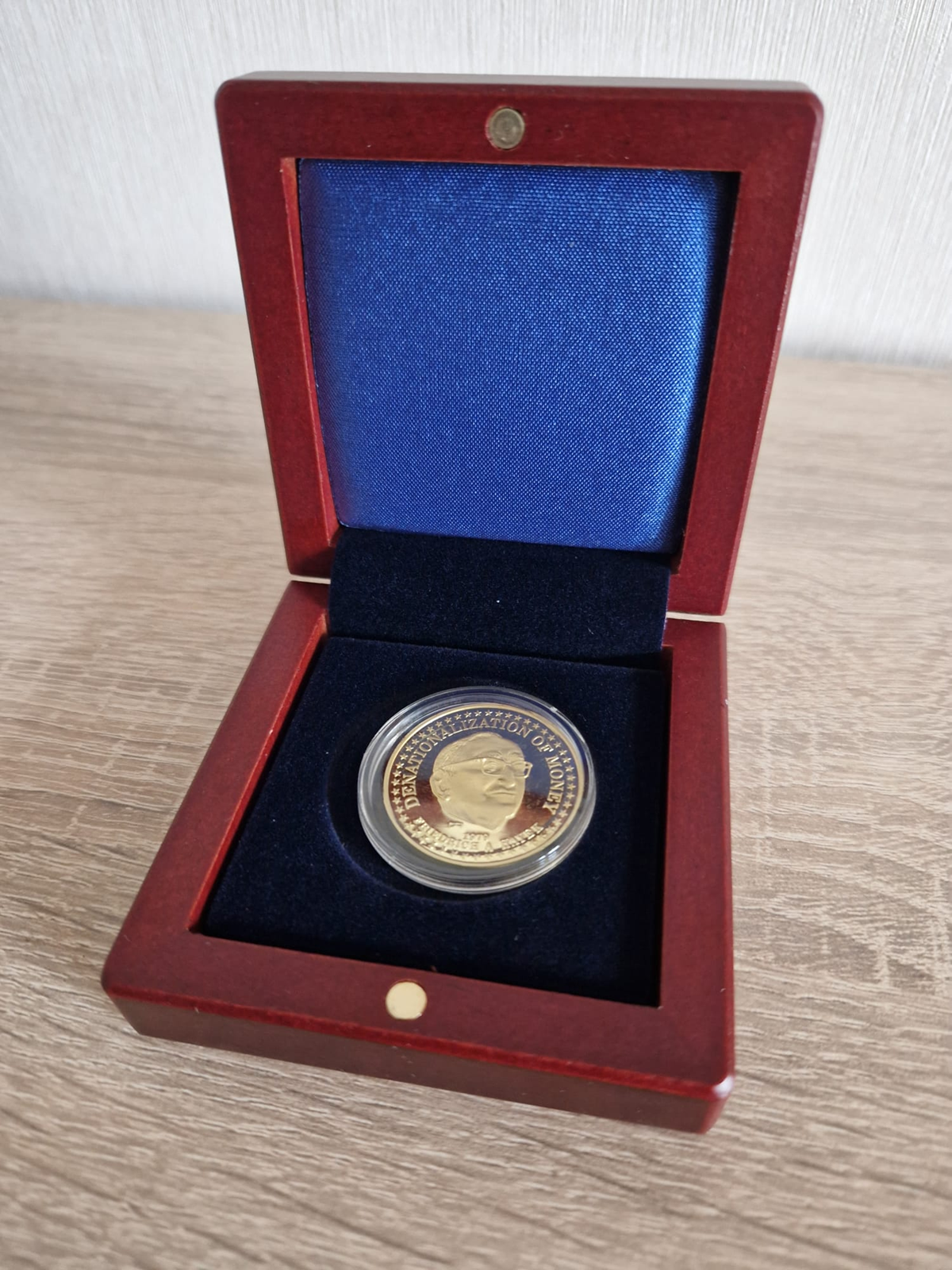
Dr. Ron Paul has received the Hayek Medal 2026, the highest honor awarded by the German Hayek Society at its annual conference that took place in Münster from May 22 to 23. As a board member, I had the honor of delivering the laudatio for Dr. Paul.
Dr. Paul, 90 years of age, could not make the trip to Germany, but he joined our audience over Zoom. After technical checks the day before, when everything worked well, we had a broken cable and were unable to communicate clearly with Dr. Paul. The audience on our side saw him on the big screen and heard his voice loudly and clearly. But Dr. Paul on his side was unable to understand me clearly. For a brief moment that felt too long, I saw this special moment fall apart before my eyes. But Dr. Paul was patient and kind. He waited for me to deliver the keynote and then addressed more than 200 people in the audience. It was the highlight of the conference. The largest annual conference we had so far.
I cannot say how much this meant to me and how grateful I am that Dr. Paul stayed with us, despite the technical problems. He could have dismissed us as unprofessional idiots not worth his time. He did not. He gave a fascinating lecture, remembering his own heroes: Mises, Hayek, Rothbard, and many more. Thank you, Dr. Paul!
In my laudatio, I had a very clear message to our members in the Hayek Society and, indeed, by extension to the liberty movement at large. When it was announced first that Ron Paul will receive the Hayek Medal, there were a few critics who argued that he is too extreme a libertarian and is not an appropriate recipient of the Hayek Medal. I could not disagree more.
In fact, both moderate classical liberals and hardcore libertarians should appreciate their respective roles and acknowledge that they in many ways depend on each other. Without the hardcore libertarian the moderate classical liberal would be completely lost in public debate, because he himself would end up being too extreme for the mainstream. I spoke openly, and I think the message got through. Here is the essence of what I said in my laudatio in honor of Dr. Ron Paul.
Dear Ladies and Gentlemen,
When you look at Dr. Ron Paul’s life and work, one thing is striking: he is clearly not a normal politician.
In fact, he is perhaps especially difficult to understand for us Germans given our own political class in this country. In contrast to our own politicians, Ron Paul actually had a real job – a real profession.
He is a medical doctor trained in obstetrics and gynecology. And before entering politics he helped deliver many thousand babies into this world. This fact may tell you something about the man, but also his political philosophy: He has spent his life helping other people, rather than ruling them.
But of course, we are not honoring Dr. Paul merely because he was an unusual politician.
We honor him, because he remained an uncompromising libertarian in times when libertarian principles were deeply unfashionable.
For decades Dr. Paul has been called names. Names that I won’t repeat here. I will only mention some labels that have been used to describe him – labels I consider to be badges of honor: he has been called radical, unrealistic, and of course extreme.
Yes – maybe Ron Paul is an extremist.
But if history tells us anything, it is that every movement for liberty requires people willing to defend principle without compromise.
If it were not for the principled uncompromising libertarian, the moderate classical liberal would be lost.
It is because of the radical libertarian, that the moderate classical liberal can make is voice be heard in public discourse at all – and that he can occasionally change something for the better.
If it were not for people like Ron Paul, the moderate classical liberal would be labeled the extremist. And believe me: I would not want to live in a world where the moderate classical liberal position is the most extreme deviation from the mainstream in the direction of liberty.
Such a world would be hopeless.
There is one person who understood this very well:
Friedrich August von Hayek knew that political change is always preceded by intellectual change, that is, by a change in ideas.
And intellectual change always requires people courageous enough to challenge the mainstream, to challenge conventional wisdom, to challenge orthodoxies, long before it becomes socially comfortable to do so.
Long before inflation has returned to public consciousness, Ron Paul has warned about the dangers of unconstrained monetary expansion.
He reached millions of young people with his unforgettable appearances in the GOP presidential race.
When I moved to the United States shortly after the Great Financial Crisis to work on my doctoral dissertation at the Mises Institute in Auburn, Alabama, almost all of the students I met there, became interested in the ideas of the Austrian School because of Ron Paul.
He had the audacity to question the very existence of the Federal Reserve System. Not only audit the Fed; the slogan was “End the Fed!” This was also the title of one of his books. If that is not inspiring, I do not know what is.
But his advocacy for individual liberty did not stop at monetary policy and economics.
It extended to all areas, including foreign policy.
Ron Paul was willing to oppose war, again at a time when it was deeply unpopular. And when I say “deeply unpopular” I mean with the foreign policy establishment of both parties.
Because let us face it: The anti-war position has never been unpopular with the American voters.
As Dr. Paul said in one of his most memorable television appearances: The Republicans have been elected into office in 1952 to end the war in Korea, and they have been elected again in 1968 to end the war in Vietnam. And then he added: “Unfortunately we did not end it very quickly… 30,000 more men had to die.”
And this pattern repeats itself with both parties: the Republicans and the Democrats. In 2008, Barack Obama was voted into office on the promise of ending the wars in the Middle East that Bush had started.
More recently, Donald Trump was re-elected into office partly on the promise of ending the “never-ending” wars.
In both cases, military conflict escalated.
Ron Paul has consistently warned about the dangers of military intervention abroad. Of course they bring horror to the countries, where the wars break out. But Dr. Paul has also warned that endless foreign interventions inevitably lead to debt, inflation, executive overreach, surveillance, and the erosion of civil liberties at home.
Many of his predictions became true.
But what makes Ron Paul special is not that he made correct predictions.
Rather it is the reason why he saw so many things so clearly.
His entire world view is rooted in moral clarity.
He knows that stealing, lying, coercion, violence and murder are immoral. And more importantly, he knows that these acts do not turn moral just because a government carries them out.
This libertarian imperative of non-aggression informed Dr. Paul’s entire worldview.
Tonight, the German Hayek Society honors not merely a politician, nor merely an economist, nor merely a presidential candidate.
We honor a man who, over many decades, defended the principles of liberty with courage, decency, intellectual honesty, and unusual personal integrity.
A man who inspired millions of people to think more seriously about freedom, responsibility, peace, and sound money.
Dr. Ron Paul, it is a great honor for the German Hayek Society to award you the Hayek Medal 2026. I cannot think of a more worthy recipient.