

On March 7, 1876, Alexander Graham Bell was granted US Patent No. 174,565 for the speaking telegraph or telephone. Three weeks earlier, on February 14, both Bell and another inventor, Elisha Gray, submitted their respective ideas to the US Patent Office. On March 10, Bell used a liquid transmitter (an early microphone) to call his assistant, Thomas Watson, with the words, “Mr. Watson—Come here—I want to see you.” This is commonly regarded as the first intelligible voice transmission over an electrical wire.
With that in mind, this year not only marks 250 years since the Declaration of Independence, the 100th year of Murray Rothbard, and 40 years of Mises University, but also 150 years since the official invention of the telephone. This provides an opportunity to review the history of how telephone invention, innovation, and entrepreneurship—combined with cronyism, patents, regulations, and monopoly—shaped the landscape of the telephone industry for generations.
Monopoly, Cronyism, & Competition
The historical and non-arbitrary definition of “monopoly” is crucial here: “Monopoly had always been defined, in the popular parlance and among economists, as ‘grants of exclusive privilege’ by the government.” In other words, there is no such thing as monopoly without the element of state power. Without this element, there is no sensible, realistic, and non-arbitrary definition of “monopoly.” Absent the legal apparatus of the state in the definition, “monopoly” can only be defined by the number of producers of a good or service, firm size, or comparison of the real-time, dynamic market with an unrealistic, imagined ideal of economic equilibrium or “perfect competition.”
Next, in order to understand much of American history in general and the expansion of the telephone in particular, it is critical to understand the typical mainstream and progressive narratives of this period of American history (~1880–1920), that is, as Rothbard puts it,
Monopoly could be put over in the name of opposition to monopoly! In that way, using the rhetoric beloved by Americans, the form of the political economy could be maintained, while the content could be totally reversed. (emphasis added)
Instead of government ending monopolies that were naturally created in the unhampered free market, the American state, progressive elites, and willing accomplices in big businesses worked together to create and maintain monopolies and beneficial regulations that could not be achieved on the free market. Writes Tom DiLorenzo regarding the myth of “natural monopoly,” including the telephone, “When monopoly did appear, it was solely because of government intervention.”
Though it does not mention the telephone specifically, Burton Fulsom’s The Myth of the Robber Barons: A New Look at the Rise of Big Business in America makes the useful distinctions between “political entrepreneurs” and “market entrepreneurs” (p. 1):
Those who tried to succeed in [business] through federal aid, pools, vote buying, or stock speculation we will classify as political entrepreneurs. Those who tried to succeed in [business] primarily by creating and marketing a superior product at a low cost we will classify as market entrepreneurs. (emphasis added)
Along similar lines, Patrick Newman defines cronyism in the following way, “government intervention that benefits special interests at the expense of the public interest.” This distinction is critical because it qualitatively differentiates those who succeed through the production-and-exchange mechanism and those who use the political means and cronyism to gain wealth at the expense of the public.
Likewise, in Gabriel Kolko’s The Triumph of Conservatism, Kolko explains that—contrary to the mainstream historical consensus—big business interests explicitly sought legal protection and monopoly through government regulation and the reasons behind this,
Why did economic interests require and demand political intervention by the federal government and a reincarnation of the Hamiltonian unity of politics and economics?
. . .the significant reason for many businessmen welcoming and working to increase federal intervention into their affairs has been virtually ignored by historians and economists. This oversight was due to the illusion that American industry was centralized and monopolized to such an extent that it could rationalize the activity in its various branches voluntarily. Quite the opposite was true.
Despite the large number of mergers, and the growth in the absolute size of many corporations, the dominant tendency in the American economy at the beginning of this century was toward growing competition. Competition was unacceptable to many key business and financial interests, and the merger movement was to a large extent a reflection of voluntary, unsuccessful business efforts to bring irresistible competitive trends under control. . . . As new competitors sprang up, and as economic power was diffused throughout an expanding nation, it became apparent to many important businessmen that only the national government could rationalize the economy. . . . Ironically, contrary to the consensus of historians, it was not the existence of monopoly that caused the federal government to intervene in the economy, but the lack of it. (emphasis in original)
The Telephone: Invention & Patent
Historically, there has been some debate as to whether Alexander Graham Bell was the true original inventor of the telephone or whether Elisha Gray—who filed his patent on the same day—deserves the credit. The Patent Office ruled that Bell’s application had arrived first and the telephone patent was issued to Bell on March 7.
A recent historical article—utilizing correspondence, notes from a Bell associate, and engineering details—concludes that Bell’s idea was first and that neither he nor the Patent Office borrowed key aspects of Gray’s ideas. To be fair, the question, “Who invented the telephone?” is more complicated since there are always prior contributions that set up for an invention, which Bell himself acknowledged. This interesting history notwithstanding, Benjamin Brown writes,
From a historical perspective, emphasizing the many, sometimes parallel, contributions to a pioneering invention is of great importance, but patent law is not so egalitarian. U.S. patent law assigns individual or organizational ownership. This includes accompanying royalties for the duration of the patent unless the invention is too all-encompassing, as it was for the transistor invented at AT&T Bell Laboratories, the great-grandchild of Bell’s attic laboratory.
Patents & Power
In the book Invented by Law: Alexander Graham Bell and the Patent That Changed America, Christopher Beauchamp wrote (pp. 47-48), “Alexander Graham Bell may have received his patents in 1876 and 1877, but the question of what he had ‘invented’ as a legal matter was yet to be determined.” Beauchamp argues further regarding the key role of the state, the law, and patents in the “invention” of the telephone,
Whoever conceived the invention, it was the pioneering companies and their lawyers who truly “made” the fundamental patents: they who secured legal victories against rival claimants; they who shaped the scope of the Bell and Edison grants during litigation—including by emphasizing features that the inventors themselves had not believed to be central. In return, the patents underpinned the companies’ commercial success, with predictable consequences for the historical reputations of the patentees. It was no coincidence that in 1936, when the organizers of the Patent Office centenary chose Alexander Graham Bell as the first great inventor on their roll of honor, the Bell System was the largest business organization in the world. (pp. 206-207)
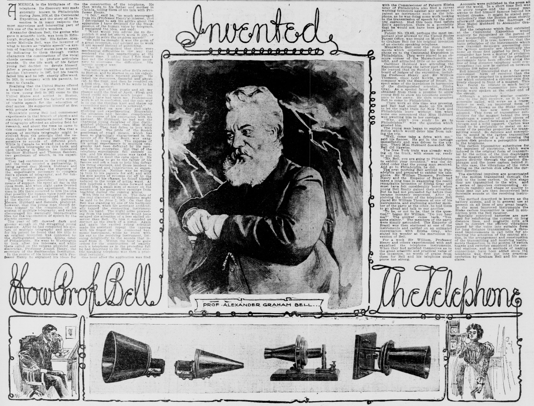
Figure #1—Image 22 of The San Francisco call (San Francisco [Calif.]), July 9, 1899
According to The History Of Computer Communications: 2.6 Alexander Graham Bell and Bell Telephone Co. -- 1873-1878,
Graham’s patent would make for a generation of patent lawyers, for from 1878 to 1888, when the Supreme Court ruled on five appealed cases Graham’s patent legal, Bell had to file over six hundred lawsuits. In every one, Graham’s right to the patent was affirmed.
The Bell Telephone Association was formed on July 9, 1877 to commercialize Bell’s invention. A year later, on July 20, 1878, the enterprise was reorganized as the Bell Telephone Company, with a more substantial corporate organization, personnel, and capital. Albert Paine’s In One Man’s Life: Being Chapters from the Personal and Business Career of Theodore N. Vail (1921) describes the significance of this reorganization, “The new company was really the first Bell Telephone Company; what had previously been known by that name was no more than an association of the owners of the Bell patents. . .” This company—in competition with other companies—would now be better positioned to aggressively use patents and state enforcement to achieve monopoly.
Early on, Western Union was an enormous incumbent in the telegraph industry, and—realizing that the new telephone business could threaten its telegraph business—it established the American Speaking Telephone Company (WU-AST), using its Gold and Stock Telegraph subsidiary. Western Union brought together several inventors—Thomas Edison, Elishay Gray, and A. E. Dolbear—to attempt to compete with Bell. WU-AST acquired or controlled patents relating to telephone technology and aggressively entered the market. WU-AST claimed that it had the “original” telephone and was prepared to compete with Bell, that is, to compete for legal privilege and monopoly, not compete in a free market sense.
In this context, Theodore N. Vail became the general manager of the Bell Telephone Company in 1878 and later became the first president of AT&T in 1885. Vail was also the architect of the modern Bell System and would transform Bell’s entrepreneurial legacy into a vision of “one policy, one system, universal service”—a vision that increasingly depended upon government-sanctioned monopoly. He said,
We have the only original telephone patents. . .we have organized and introduced the business and we do not propose to have it taken away from us by any corporation.
Now more “stoutly organized,” Vail “began a vigorous campaign, not only for business, but against [the company’s] enemies.” One of the first things he did was to send a copy of Bell’s patents to Bell agents in different parts of the country. Amidst protracted legal battles, the rivalry eventually ended in 1879 with a settlement where Western Union acknowledged Bell’s priority in inventing the telephone and agreed to leave the telephone business, Bell obtained rights to Western Union’s relevant telephone patents, Bell agreed to acquire WU-AST’s telephones and exchanges, and Western Union received 20 percent of the royalties/rentals from telephone instruments for the remaining life of the patents.
In The Triumph of Conservatism, Gabriel Kolko writes,
From its foundation in 1877 until 1894, the Bell Telephone Company (A.T. & T.) had a virtual monopoly over the telephone industry. Its position was based on its control of all crucial patents necessary for the industry. . . In 1894, with many of the key patents 110 longer in effect, vast areas of the United States were without service, and local capital was quite ready to finance independent companies. Bell immediately adopted a policy of harassing the host of aspiring competitors that sprang up in 1894 by starting suits against them—twenty-seven in 1894-1895 alone—for allegedly infringing Bell patents.
Regarding the public sentiment toward the patents and monopolized industry that stifled competition, James J. Storrow—a close adviser to the management of the American Bell Telephone Company—wrote to the president of Bell, John E. Hudson (November 17, 1891),
The Bell Company has had a monopoly more profitable and more controlling—and more generally hated—than any ever given by any patent.
Conclusion
It is hard to appreciate and impossible to calculate the unseen opportunity costs of such patents, monopolies, and cronyism. Patents and regulations not only restrict free competition and its benefits in the present but also help set the market-legal landscape and trajectory for the future. Beauchamp (quoted above) explains (p. 208),
A legal monopoly that lasted into the 1890s obviously operated to set the terms of telephone provision and had a powerful restraining effect on the growth of the industry. . . . The networks and systems that defined telephony came accompanied by a whole variety of arguments for centralization and the suppression of competition among telephone companies. But the success of these arguments and the telephone pioneers’ interest in making them depended heavily on the preexisting monopolies created under the patents.
While these patent battles shaped telephony and the industry, the era of cronyism and patent control was briefly interrupted by a period of freer competition after the Bell patents officially expired in 1893 and 1894 (1894–1906). Contrary to the expectations of many—those who assume that start-up costs of competitors would be prohibitive against entrenched imcumbents—DiLorenzo writes, “Once AT&T’s initial patents expired in 1893, dozens of competitors sprung up.” However, that did not mean the Bell company was done fighting for market control via the legal apparatus. In Noobar Danielian’s AT&T: The Story of Industrial Conquest (1974), he writes,
The Bell Company was successful in every contest involving the original patents. There at last came a day, however, when the Bell patents expired and could no longer defend the telephone monopoly. A host of independent telephone companies entered the telephone business in competition with the Bell licenses. The new era, however, found the American Bell Telephone Company prepared to stifle and harass competitors because it had a firm grip on the lesser patents which related to the practical exploitation of Bell’s newly discovered art.
While we cannot speculate counterfactual history with precision, the presence of actual competition in history and how that competitive pressure was limited through patents, cronyism, and monopoly allow us to imagine how the telephone industry and others might have developed on a true free market. Imagine the time and man hours spent in legal battles for patents, privilege, monopoly, and cronyism and how that could have been otherwise directed. Further, imagine how the market might have been shaped and how technologies might have developed faster if other inventors, entrepreneurs, and consumers were free to choose under a regime of genuine competition. As it was, the telephone patents and monopolies shaped and would continue to shape the legal market landscape concerning the telephone for decades, indeed, until this very day.

