
Review of Austrian Economics
Total Repeal of Antitrust Legislation: A Critique of Bork, Brozen, and Posner
Walter Block
The premise underlying laissez-faire capitalism is that the only actions which should be illegal are those which involve an initiation of aggression against another person or his property. Antitrust law is clearly in violation of this principle, because it prohibits business practices no one even alleges constitute such depredations.
The economists mentioned in the title of this paper are widely and properly celebrated for upholding the virtues of the free marketplace. However, there is one lacunae in their defense: antitrust legislation. Although they have done yeoman work in helping us to understand the beneficial effects of much commercial conduct which is prohibited by these enactments, their critique of this law is less than full. They each see a small but important role for the Antitrust Division of the Justice Department. They advocate reduction in the power and scope of this law, but not, unfortunately, total repeal.
It is as if they are a football team which has succeeded in bringing the pigskin to the three yard line, but can make no further progress. This paper is an attempt to help them over the goal line. To continue our football analogy, the present paper will not comment on the 97 percent of their work which is responsible, in large part, for the scholarly contribution to the cause of keeping antitrust law from being even more intrusive than it now is. In focusing on the 3 percent of disagreement, this paper may give the impression that there are large differences of perspective in public policy conclusions between these authors and their present critic. Nothing could be further from the truth.
Robert Bork
Merger
Robert Bork (1978) maintains that some entrepreneurial choices in the market lead to efficiency, while others merely serve to restrict output. His main thesis is that antitrust has thus far insufficiently distinguished between these two situations. This is important, he contends, because if consumer welfare is to be enhanced, the restriction of output must be prohibited, while wealth enhancing activities must be promoted (or at least allowed.)1
This can be shown by a consideration of Bork’s “two vectors” hypothesis, representing, at least in the first instance, a merger. This is depicted in Figure 1.
As Bork explains:
The diagram assumes that the merger reduces the long-run average costs of the two firms from AC1 to AC2 but that the increased market power created by the merger results in a restriction of output so that the rate moves from Q1 to Q2. We then see that consumers have lost output—for which they would have been willing to pay an amount above cost equal to the area labeled A1—and have gained in resource savings an amount equal to the area A2. Obviously, if A2, the cost savings, is larger than A1, the dead-weight loss, the merger represents a net gain to all consumers. If A1 is larger than A2, a net loss results.
This diagram can be used to illustrate all antitrust problems, since it shows the relationship of the only two factors involved, allocative inefficiency and productive efficiency. The existence of these two elements and their respective amounts are the real issues in every properly decided antitrust case. They are what we have to estimate—whether the case is about the dissolution of a monopolistic firm, a conglomerate merger, a requirements contract, or a price fixing agreement. . .
It must also be remembered that there need not always be a tradeoff [between A1 and A2]. In most cases, in my opinion, economic analysis will show that one of the areas does not exist, and a decision of the case is therefore easy. Some phenomena involve only a dead-weight loss and no, or insignificant, cost savings. That is the case with the garden-variety price-fixing ring. Output is restricted so that Q2 is to the left of Q1, creating the area A1, but there is no downward shift of costs, no line AC2, and hence no area A2. (p. 108; material in brackets added by present author)
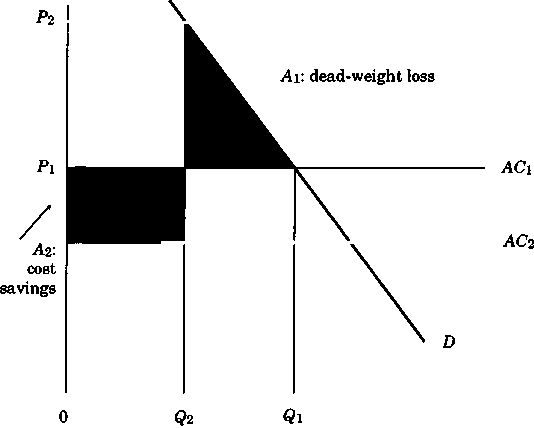
Figure 1
Source: Robert Bork, The Antitrust Paradox: A Policy at War with Itself (New York: Basic Books, 1978), p. 107.
One problem with the foregoing is that it pushes the courts into the role of determining whether or not any particular type of industrial organization or contract is or is not “cost saving.” But the judiciary has no comparative advantage in making any such determinations.2 Its members are not selected on the basis of being able to do so. Their salaries and promotions are not in any way tied to success in distinguishing efficient arrangements from inefficient ones. Failures are not punished with demotions. Achievement is not automatically rewarded with promotion, or with the awarding of bigger, more important or precedent setting cases. Why, then, should we expect this behavior from the courts?
Indeed, if Bork himself is to be believed on this issue, jurists, all throughout the history of antitrust, have made findings which show them to be either unconcerned, or incompetent with regard to this issue. Says the author of this book:
most of the mergers the Supreme Court strikes down and the “price discriminations” the Robinson-Patman Act is intended to stamp out . . . are examples . . . which involve only efficiency gain and no dead-weight loss. (pp. 108–9)
A second difficulty has to do with the interpretation of the demand curve. In Bork’s neoclassical construal, the demand curve is seen as an existing entity. True, this author concedes that “we do not know the location of any of the sides of the triangular area A1,” (one of which is the demand curve), but this is only an inconvenience. “They are what we have to estimate” (p. 108) is the way to get around this annoyance. But this will not do.3 Demand curves are not “out there,” ready to be measured by the modern econometric tools of analysis. Rather, they are, except for one dot (P2Q2, in this case), hypothetical alternatives which never come into play. Demand curves answer the question, Suppose that everything else in the universe were exactly the same as it now is, with the one exception that price, instead of being at P2, is at some other level; then, how much would the customer be willing to buy at that other price. In the event, the price however, was P2 and the consumer wished to purchase Q2. That is all we know, or indeed, can know. The other points on this demand curve never come into play at all. They are contrary to fact conditionals. There is no sense in the notion that we can “estimate” them. There is no doubt that economists can look at other instances (other times, places, people) where different quantities of this item were purchased at different prices (and even attempt to control for the fact that the prices and quantities of substitutes and complements have altered, to say nothing of changing incomes, inflation, employment and even the weather) and in that way trace out a “demand curve.” But this has little or nothing to do with what is depicted in that diagram. The point is, a demand curve is a unique non-repeatable hypothetical “event.” All attempts to “measure” it are thus doomed to failure.
So far, we have been implicitly assuming that it is legitimate to make interpersonal comparisons of utility. It is now time to relax this assumption. In point of fact, this methodology is not tenable. It is perfectly reasonable to maintain that all trade benefits both parties in the ex ante sense. This is the reason they engage in such an activity, and this conclusion is part of the bedrock of the science of economics. It is quite another matter, however, to deduce from the failure of a trade to take place (in the free marketplace, Q1Q2 remains unsold, because it is not offered for sale) that had occurred, the buyer’s welfare would have exceeded the loss to the seller. This contrary to fact conditional implies that interpersonal comparisons of utility indeed can be made—without offering any evidence or reason for such an assertion—and moreover that the consumer’s benefit exceeds the producer’s loss. The latter contention would remain unproven even if interpersonal utility comparisons were valid in the first place. And yet, unless this assertion is true, the value of A1 would be negative, not positive as claimed by Bork. If a “garden-variety price-fixing ring”4 succeeds in raising prices from P1 to P2, there is thus nothing within the strict science of economics that can be used to show that this will reduce social (as opposed to consumer) welfare.
Still another fallacy of the two vectors approach lies behind the very drawing of the cost curves in this diagram, AC1 and AC2. There is nothing untoward about using them for textbook illustration purposes only. Bork, however, is attempting to justify antitrust, a legislative enactment which can fine or even jail businessmen for the “crime” of price fixing, on the basis of this analysis. Under such circumstances it is reasonable to look more closely into these cost curves, an integral part of the analysis.
Cost, in economic theory, is not by any means limited to out of pocket expenses, even including implicit rent. These are part of the concept, but in its most sophisticated interpretation, cost is equivalent to the next best opportunity foregone by making any particular choice. As such, cost can only be a subjective notion (Buchanan 1969; Buchanan and Thirlby 1981; Mises 1963). The next best opportunity foregone by the choice to sell Q1 need not be anywhere close to P1. In any case, it can never be known by a third party, for example by the Antitrust Division of the Justice Department, the government bureau charged with punishing or incarcerating price fixers.
More radically, the cost of all saleable items is actually zero, and therefore can have no effect in any case. States Rothbard (1962, p. 604):
there is no such thing as costs (apart from speculation on a higher future price) once the stock has been produced. Costs take place along the path of decisions to produce—at each step along the way that investments (of money and effort) are made in factors. The allocations, the opportunities foregone, take place at each step as future production decisions must be taken and commitments made. Once the stock has been produced, however (and there is no expectation of a price rise), the sale is costless, since there are no advantages foregone by selling the product (costs in making the sale being here considered negligible for purposes of simplification). Therefore, the stock will tend to be sold at whatever price is obtainable. There is no such thing, then as “selling below costs” on stock already produced.
One can go even further. Not only is the sale costless when it occurs, it may even occur at less than zero costs. For example, if I have piled up a horde of tomatoes, or shoes, or steel, or tires, and I cannot find a customer for them, then, at least in a strictly private property rights-no trespassing world (Rothbard 1973, p. 1082), I will have to pay for their removal. Under such conditions the costs of the sale will be negative. That is, if the disposal costs are $500 (I have to pay $500 to rid myself of this unwelcome stock), then, ceteris paribus, I should be willing to sell it to a customer at any negative price above this level. For example, if I sell at $200, then I make a profit of $300. Even though I have to pay a customer $200 to cart away my merchandise, I am better off by $300 because the private sanitation hauler would have charged me $500.
Sovereignty
Yet another problem arises with regard to the issue of individual versus consumer sovereignty. Let us allow Bork to articulate this thesis in his own words. As far as consumer welfare is concerned, he states it as follows:
(antitrust) can only increase collective wealth by requiring that any lawful products, whether skis or snowmobiles, be produced and sold under conditions most favorable to consumers. (p. 91)
Productive efficiency, like allocative efficiency, is a normative concept and is defined and measured in terms of consumer welfare. (pp. 104–5)
But this rendition of the goal is problematic. Why should the goal of antitrust be to enhance consumer welfare alone? Why, for that matter, should the aim of any public policy be so narrowly defined? If it is taken for granted that some sort of welfare be maximized by legislation, why not attempt to maximize total welfare, that is, the welfare derived by both producer and consumer.
It is possible to employ a reductio ad absurdum in this regard. If we really want to enhance the welfare of consumers only, as opposed to both consumers and producers, all sorts of other enactments become justifiable which would not have been otherwise. For example, if there were any producer’s surplus (economic rents earned by manufacturers) then these should be summarily seized, and handed over to consumers. Needless to say, however, no warrant for any such action has ever been given.
This policy, moreover, is internally inconsistent, for it will tend to counteract Bork’s own goal of augmenting consumer welfare. We cannot safely ignore people as producers if we are attempting to maximize their well-being as consumers. People are people, and typically play a dual role as both consumers and producers. If we hurt them in one role, they are necessarily hurt in the other as well.
Rothbard’s remarks (1962, pp. 560–61) seem to be addressed directly to the Bork hypothesis, although they were written almost two decades beforehand:
We have seen that in the free market economy people will tend to produce those goods most demanded by the consumers. Some economists have termed this system “consumers’ sovereignty.” Yet there is no compulsion about this. The choice is purely an independent one by the producer; his dependence on the consumer is purely voluntary, the result of his own choice for the “maximization” of utility, and it is a choice that he is free to revoke at any time. We have stressed many times that the pursuit of monetary return (the consequence of consumer demand) is engaged in by each individual only to the extent that other things are equal. These other things are the individual producer’s psychic valuations, and they may counteract monetary influences. An example is a laborer or other factor-owner engaged in a certain line of work at less monetary return than elsewhere. He does this because of his enjoyment of the particular line of work and product and/or his distaste for other alternatives. Rather than “consumers’ sovereignty,” it would be more accurate to state that in the free market there is sovereignty of the individual: the individual is sovereign over his own person and actions and over his own property. This may be termed individual self-sovereignty. To earn a monetary return, the individual producer must satisfy consumer demand, but the extent to which he obeys this expected monetary return, and the extent to which he pursues other, nonmonetary factors, is entirely a matter of his own free choice.
The term “consumers’ sovereignty” is a typical example of the abuse, in economics, of a term (“sovereignty”) appropriate only to the political realm and is thus an illustration of the dangers of the application of metaphors taken from other disciplines. “Sovereignty” is the quality of ultimate political power; it is the power resting on the use of violence. In a purely free society, each individual is sovereign over his own person and property, and it is therefore this self-sovereignty which obtains on the free market. No one is “sovereign” over anyone else’s actions or exchanges. Since the consumers do not have the power to coerce producers into various occupations and work, the former are not “sovereign” over the latter.
To this it may be added, in order to bring it into more direct relevance with Bork, that not only do the “consumers not have the power to coerce producers into various occupations and work,” but in the free society they do not have the power to coerce the producers to locate at Q1, as opposed to their preferred point, Q2. How does Bork describe the distance Q2Q1? He claims that this is a quantity of product the consumers are willing to purchase, at a price above the costs of production, and yet, because of nefarious or at least questionable doings on the part of the seller, the customer is disappointed in this desire. The area between Q2 and Q1, above the cost curve AC1 and below the demand curve is defined as A1, the dead-weight loss. This is the amount of welfare that could have been enjoyed by the consumer, but is not.
It is only by focusing on the buyer at the expense of the seller that Bork is able to characterize A1 as a region of dead-weight loss. In order to see this, imagine for a moment that this author had subscribed to the notion of individual, not consumer sovereignty. If so, then how could we most accurately characterize the distance Q2Q1? No longer can we depict this merely as an amount of quantity that the consumer wishes, but is unable to buy. For under our present assumptions, there are two sides to this transaction, not just one. Now we can more accurately delineate Q2Q1 as a quantity that the consumer wishes to purchase, alright, but also as an amount that the manufacturer does not wish to sell. Similarly, our description of A1 can no longer be one of unambiguous “dead-weight loss.” Now, it must be characterized as an amount of welfare contended over by two different parties. If the sale takes place at Q1, yes, Bork is correct5; the consumer will gain this amount of welfare. But the producer will also lose (presumably, he is unwilling to sell any more than Q2 because past that point, his marginal revenue lies below his marginal cost). So, it is by no means an unambiguous dead-weight loss A1 which must be set against a clear gain in cost savings of A2; rather, A1 is a loss only to one side of the trade, but a gain to the other.
It is possible for the Borkian side of this debate to articulate several objections to the Rothbard perspective on individual versus consumer sovereignty. First, it might be maintained, following Hutt (1940), that producers are themselves consumers. For example, whenever a seller acts in a way other than to maximize money returns, he is really “buying” services from himself. Therefore, the concept of consumers’ sovereignty is wide enough to incorporate both producers and consumers.
If we adopt this way of looking at the matter, there are now two sets of consumers. The first, call them the consumer-consumers, are the people for whom Bork drew his demand curve. These are the ones who are purportedly suffering from the output restriction from Q1 to Q2. The second, call them the producer-consumers, the ones engaged in this (unwarranted, improper, according to the neoclassical school) restricting of output. These two sets of consumers, according to Bork, are acting incompatibly with one another.
As Rothbard (1962, p. 562) trenchantly states,
In the aforementioned general sense, “consumption” rules in any case. But the critical question is: which “consumer?” The market consumer of exchangeable goods who buys these goods with money, or the market producer of exchangeable goods who sells these goods for money?
The point is, noticing that the producer, too, engages in consumption does not help one bit in determining whether we should force, through the majesty of the law, the producer-consumer to locate at Q1 instead of Q2, in behalf of the consumer-consumer. Rather, it sets up an infinite regress.
A second possible objection Bork could resort to was used by Hutt. As Rothbard notes (quoting Hutt), this is to distinguish between
when a producer withholds his person or property out of a desire to use it for enjoyment as a consumers’ good . . . in which case it . . . “is a legitimate act, in keeping with rule by the consumer. On the other hand, when the producer acts to withhold his property in order to attain more monetary income than otherwise . . . then he is engaging in a vicious infringement on the consumers’ will.” (Rothbard 1962, p. 563)
This, too, however, has been answered by Rothbard. He notes that it is not difficult, but rather impossible, to distinguish between these two motives. Secondly, the only reason more profit can be earned at P2Q2 than at P1Q1 is because of the inelasticity of demand between the two points. But this arises out of consumer (consumer-consumer, that is) choice! If the consumers were unhappy with this state of affairs, they could
easily make their demand curves elastic by boycotting the producer and/or by increasing their demands at the “competitive” production level. (Rothbard 1962, p. 564)6
Predation
If it is impossible, not merely difficult, to distinguish between psychic income and profitability as motives for “withholding,” this applies as well to that between “deliberate aggression” in order to drive rivals from the market and in order to profit maximize. Here are Bork’s views (p. 144) on the subject:
Predation may be defined, provisionally, as a firm’s deliberate aggression against one or more rivals through the employment of business practices that would not be considered profit maximizing except for the expectation either that (1) rivals will be driven from the market, leaving the predator with a market share sufficient to command monopoly profits, or (2) rivals will be chastened sufficiently to abandon competitive behavior the predator finds inconvenient or threatening.
But the employment of the word “predation” is surely another illegitimate abuse of a metaphor taken from another discipline. Predation is what the lion does to the zebra. Strictly speaking, there can be no such activity in the free economy. For there is not even the hint of a charge, in Bork or anywhere else, that the business firms who have in this way gained the attention of the Antitrust Division have initiated violence against their competitors. If “predation” is to be given a commercial implication, it would be reasonable to confine it to such activities as fraud, theft, extortion, or “making him an offer he cannot refuse” in the parlance of a Mafia Godfather. The contrast between this and the acts of the Borkian “predator” are stark indeed. The latter “deliberately aggresses” against his competitors by offering his customers a better deal than they can obtain elsewhere. If this is predation, then the consumer, for whom Bork seems to have an unlimited regard, would presumably ask for more of it.
Our author lists three forms of predation. They are price cutting, disruption of distribution patterns, and misuse of government processes. Only the second is important to discuss, and we shall concentrate our remarks on it. This is because of the first, price cutting, Bork spends thousands of words (pp. 144–55) showing that neither economic theory nor economic history give support to the contention7 that this is an efficacious way of engaging in predatory behavior.8 As to the third, this is indeed “predation” of the sort mentioned above. Here, Bork properly castigates the initiation of frivolous lawsuits “in order to harm an actual or potential business rival” (p. 159). But the answer is not antitrust; it is the awarding of severe damages to those victimized by this practice. Under this rubric we can also add false and fraudulent advertising. This, too, is a legitimate role for the forces of law and order; but it cannot be used to justify the continued existence of a Federal Trade Commission, most of whose activities are aimed at suppressing legitimate commercial endeavors.
What, then, is “disruption of distribution patterns?” Bork (p. 156) explains:
In any business, patterns of distribution develop over time; these may reasonably be thought to be more efficient than alternative patterns of distribution that do not develop. The patterns that do develop and persist we may call the optimal patterns. By disturbing optimal distribution patterns one rival can impose costs upon another, that is, force the other to accept higher costs. This may or may not be a serious cost increase, but if it is (and the matter can only be determined empirically), the imposition of costs may conceivably be a means of predation. The predator will suffer cost increases, too, and that sets limits to the types of cases in which this tactic will be used for predation. There is a further complication, moreover, in that the behavior involved will often be capable of creating efficiencies. Thus, the law cannot properly see predatory behavior in all unilaterally enforced changes in patterns of distribution.
There are several difficulties here. First, Bork must have in mind an exceedingly static world. That is the only situation in which his scenario could even roughly approximate the truth. Pattern persistence, however, is surely impossible in the modern day, under a regime of even limited economic freedom, where people are able to introduce new products (e.g., computers), implement new selling strategies (e.g., supermarkets), initiate new forms of business organization (e.g., franchising). Further, just because a distribution pattern has “persisted” in the past does not mean that it is optimal today, and certainly not tomorrow (Kirzner 1973).
Second, the “further complication” is problematic. If this pattern of disruptive behavior is “often . . . capable of creating efficiencies” how then can we distinguish between those alterations in business procedure which emanate from “predation,” and those which come about due to enhanced efficiency? The empirical determination called for in this regard is no comfort; without any criterion for distinguishing between these phenomena, number crunching for the sake of number crunching will amount to nothing more than a full employment bill for out of work econometricians.
Third, there is no such thing as a “unilateral” change in the market. The market is no more and no less than the concatenation of all voluntary trades which take place in a given area. But all commercial exchange is, by its very nature, bilateral, not unilateral. It takes two to tango, and it takes two to trade.
Fourth, there are no “enforced” changes in patterns of distribution, or of anything else for that matter with regard to the market. If there is any initiation of physical force or violence, it is necessarily not part of the market (Rothbard 1962).
Another disappointment with Bork’s treatment of this subject is that he offers only two instances of disruption of distribution patterns that can be predatory, and there are difficulties with each. First is the use of exclusive dealing contracts. But he undermines this example with the concession that (p. 156) “it is far more probable that . . . exclusive dealing is more efficient and has (been) adopted . . . for that reason.” Further undermining this case is the statement (p. 157):
The law can usefully attack this form of predation only when there is evidence of specific intent to drive others from the market by means other than superior efficiency and when the predator has overwhelming market size, perhaps 80 or 90 percent.
The problem is not that it is difficult if not impossible to attain evidence of such specific intent. It is, more radically, that all commercial endeavors are, in effect, an attempt to drive others from the market through superior efficiency. The drawback to this perspective is that Bork refuses to define “efficiency” broadly enough so as to include producer’s welfare as well as that of consumers.
The second example vouchsafed to us is that of the board of trade. Boards of trade, it would appear, can act capriciously. But such organizations are, at bottom, only private clubs. They have no special legal dispensations. If members do not like the way that board of trade A is handling its affairs, they are free to set up another, competing, board of trade, B. This threat will usually serve to compel the extant trade board to act reasonably.
Apart from these specific difficulties with Bork’s theory of predation, there is the underlying philosophical problem9 that it attempts to make distinctions where there are no discernable differences. Let us, in order to illustrate this point, attempt to construct several new analogues to economic “predation” in other, unrelated, fields.
The bottom line for Borkian “predation” is that it is legitimate to actively compete in order to earn profits; even “deliberate aggression” is allowed. However, one must act so as to earn profits directly; one may not indulge in business practices that sacrifice present profits, the sole purpose of which is to bankrupt a competitor, in order to earn profits later on, in the absence of the competition which would otherwise have been supplied by it.
Right now, in football, the goal is to move the pigskin in a forward direction, in order to score points. This is analogous to earning profits. If we were to adopt Bork’s philosophy to this context, we would have to ban any and all actions which undermine this end, in the short run, such as the quarterback dropping back (and losing valuable territory) in order to pass. Even the handoff from the center to the quarterback would have to be re-evaluated in the light of this legal philosophy. And what are we to make, in this context, of the sacrifice fly in baseball, or the bunt to advance a base runner. Surely, the purposeful loss of a valuable commodity (one of the three outs) even for the long-run good purpose of scoring an extra run would have to be regarded as illegal. Similarly, the sacrifice of a queen or some other valuable piece in chess would have to be ruled out of court. Is there really that much difference between such short-run counter-productive behaviors in the sporting world and their counterparts in the world of commerce such as local price cutting10 or selling some goods at a loss (loss leaders) in order to attract customers into the store?
Take another case. You are the author (composer, producer) of book (song, movie) A, I am the author of book B. These books are on the same subject; they are rivals, or competitors. I am in this for the money; I have written this book in order to maximize profits. I have been asked to review your book in a newspaper, magazine, or journal. I give it a sharply critical negative review. An implication of Bork’s analysis is that this act of mine ought to be proscribed by law, for it is “the employment of a business practice that would not be considered profit maximizing except for the expectation . . . that [a] rival will be driven from the market.” Surely the implication which arises from Bork’s analysis is intolerable; just as assuredly, it follows the logic of his interpretation. Did I not have a competing book in the market, I would not have so denigrated your effort; thus, my review would not have been profit maximizing but for the expectation that I could thereby entice potential book buyers from you to me.
Generalizing still further, from business to the world of interpersonal relations, what are we to make of the man who denigrates his rival for the affections of a woman? In the ordinary course of events, if Roger tells Elaine that Joe is a cad, a blunderer, a lazy incompetent moocher, we would just write it down to the rights of free speech. But the Borkian perspective applies here as well, provided that Roger would have said no such thing were Joe not competing with him for Elaine’s hand in marriage. But if this scenario applies, again we have a case where there is
deliberate aggression against one or more rivals through the employment of (interpersonal) practices that would not be considered profit maximizing except for the expectation that (1) rivals will be driven from the (marriage) market, leaving the predator with (the object of his desires), or (2) rivals will be chastened sufficiently to abandon competitive behavior the predator finds inconvenient or threatening.
Yale Brozen
Proper targets
Yale Brozen (1982), while not so vociferous in his defence of antitrust as Bork, clearly sees a positive role for this “curious institution.” In his view (p. 14):
The antitrust agencies should be devoting themselves . . . to detecting and prosecuting the types of explicit collusion that restrain output. In devoting investigatory and prosecutorial effort to persistently concentrated industries, increasingly concentrated industries, and dominant firms, the agencies selected exactly the wrong targets. They are themselves restraining output and the growth of productivity.
This statement embodies the theme of the book. The Antitrust Division should not be rescinded. It should not be eliminated, root and branch. Rather, it has a legitimate role to play. If it could but free itself from concern with the red herring of high concentration, and focus instead on “explicit collusion,” and “output restraint,” it could make a positive contribution to society.
The problem with this perspective is not that Brozen has failed to put his finger on an egregious policy (attacking concentration); he has, in a thorough going and incisive way. This course of action has led to a far poorer and less efficient economy than otherwise would have obtained. The difficulty is, rather, that there are good targets that the trustbusters should instead be aiming their fire at, in his view.
We have already discussed the issue of restraining output in the context of interpersonal comparisons of utility. But we can also call into question Brozen’s opposition to “restraining output and the growth of productivity” under the rubric of welfare economics. Why should these goals be the sine qua non of economic public policy? G.D.P., physical output, and productivity growth, however important, are, still, themselves derivable from a principle even more consequential: individual choice. If the economic actor wishes, say, to pursue leisure instead of money income, human welfare will be better enhanced by allowing that decision to stand than by rescinding it, even for the persons “own good,” and by coercively bringing about a situation where there are more goods and services in the economy than are compatible with his initial determination.
This is precisely what has occurred on the part of the those chosen as proper targets for the Antitrust Division by Brozen. They are guilty of no more than explicitly agreeing, among themselves, to produce less than Brozen, an outside observer, would compel them to produce.
Concentration
The next bone of contention to be raised has to do with concentration. There is hardly a commentator more critical with regard to the way in which concentration ratios are used in U.S. jurisprudence than Brozen. For example:
In order to find Alcoa guilty of violating the antitrust laws, Judge Learned Hand had to find that Alcoa “controlled” the secondary aluminum market, despite the production of secondary aluminum by many suppliers, as well as that it had a “monopoly” of primary aluminum. But he never considered whether aluminum competes with galvanized sheet metal, copper, magnesium, zinc, tinplate, glass, tin, and other materials used for some of the same purposes as aluminum. (p. 46)
And again:
The measure commonly used is total shipments from plants “assigned” to an industry by the Bureau of the Census. A plant’s entire output is assigned to the industry whose products make up the plurality of total shipments from the plant. If a plant belonging to a leading firm produces trucks and refrigerators, and more than half the value of its shipments is trucks, all the plant’s shipments are assigned to the motor vehicle industry. That firm will then show a higher share of motor vehicle industry shipments tha[n] its actual share. (p. 50)
Here is a further example:
Industry definitions are generally based on technology or on inputs employed, not on markets. Separate concentration ratios are reported for beet and sugar cane refiners, for example. But since beet and sugar cane refiners compete with each other for the same customers, these ratios mean little in market terms. Their outputs are indistinguishable. In addition, glucose, dextrose, and fructose sugars are produced by the corn wet milling industry. Maple syrup and honey are produced by still two more industries. Artificial sweeteners are produced by still another industry. There is no concentration figure reported for the sweetener market. Although cane refiners compete with beet refiners and both compete with com millers, maple sap boilers, beekeepers and chemical firms, no account is taken of this in measuring concentration. (p. 51)
But the case is even worse than this. For artificial sweeteners also compete against the Jane Fonda Workout Tapes, against vacations at fat farms, and indeed, against just about everything else, such as chess sets, shoes, paper clips and light bulbs, in the sense that the family budget can stretch only so far, and thus any increased expenditure on practically anything means a reduction in spending on virtually everything else.
Unfortunately, Brozen’s criticism of concentration measures is limited to such Census Bureau practice. He does not take the more radical step of condemning the logical coherence of concentration ratios per se.
In order to define a concentration ratio, an “industry,” “line of commerce,” or relevant “market” must first be defined. In the view of Brozen, and indeed, of virtually the entire economics profession,11 this can be accomplished in a non-arbitrary manner through the use of cross elasticities. But these statistics are not objective “facts” of economics; they are not constants, akin to gravity in physics. Rather, they are necessarily limited as to scope and time dimension, and this leads to intractable problems. For example, it is well known that the greater the length of run, the higher the elasticity. If the price of x rises, the quantity demanded of substitutes cannot rise by very much, if at all, immediately; in the short run, it can rise by more; in the long run, and particularly in the very long run, it can increase by a very much greater amount. So, which is the “proper” length of run? Merely to ask this question is to see the utter arbitrariness of any answer, and thus of any such measure.
Even if this objection can somehow be answered, there is still the problem of the limited nature of any and all cross elasticity measures. A spurious objectivity is lent to the whole enterprise by stating that the cross elasticity of y with respect to x is 3.0. A more meaningful way of articulating this information is to say something along the lines of “In Ohio, in 1967, allowing a length of run of one year, the cross elasticity of y with respect to x was found to be 3.0.” The former allows for easy generalizability; not so, the latter.
Conspiracy
On numerous occasions throughout his book, Brozen attacks conspiracy. For example, if express conspiracy occurs, present laws are adequate, and there is no need to outlaw concentration to make this actionable (p. 140).
“Antitrust should focus its attention on improper exclusionary devices rather than on concentration or dominance per se. . . . [I]t should seek out trade restraining, explicit collusion” (p. 405).
This author (p. 147) also characterizes price fixing as “commercial conspiracy.” Apart from being rather excessive, this verbiage amounts to mere emotivism. For a conspiracy is nothing more than an agreement opposed by the speaker. Bertrand Russell once said “I’m firm, you’re stubborn, he’s a pig-headed fool.” Cognitively, these three expressions all mean the same thing; they only have different emotional content. Similarly, we can now say, “I [straightforwardly] agree, you [disreputably] connive, he engages in [criminal] conspiracy.” There’s not a dime’s worth of difference between these three modes of expression on the factual plane; emotionally, they are worlds apart. The point is, every agreement or contract of which the speaker disapproves can be a conspiracy; the term is without intellectual or cognitive merit.
Brozen (1982, p. 151) even goes so far as to describe price fixing as a “defrauding” of customers. But why should this be so? I own a widget; Joe owns a widget. Each of the two widgets is the private property of myself and Joe, respectively. We agree (connive? conspire?) not to sell our own widgets, those over which we each have legitimate control, at less than $1 each. We do not compel other sellers to go along with this plan. Even less do we compel buyers to make purchases at this price. Why should this be considered a fraudulent act—a veritable act of theft—upon our customers?
Perhaps this point can best be made in another context. Our author correctly analyzes advertising, and defends this practice from the charge of being an illegitimate barrier to entry. In the following passage (p. 159), each time the word “advertising” is mentioned in the text, “conspiracy” has been added in parentheses. Try the mental experiment of substituting the latter for the former:
The essence of the argument that advertising (conspiracy) constitutes a barrier to entry is that a new firm finds it difficult to gain customers because advertising (conspiracy) ties them to existing firms. A new entrant, it is argued, faces the “prohibitively” expensive task of advertising (conspiring) to offset the prior advertising (conspiracy) of existing firms. This view is naive and, in some of its renditions, moralistic. Presumably, firms advertise (conspire) because it is in their interest to do so. But advertising (conspiracy) is expensive to existing firms as well as to potential entrants. It must be productive in some way to be justified. It is not a net social loss; if it were, other firms could provide the same service without advertising (conspiracy) and charge less. If a new firm finds it necessary to advertise (conspire), it is because whatever advertising (conspiracy) does, customers want done.
This exercise can also be performed substituting “collude” or “price fix” or “horizontally merge” for “advertise.” If so, the chief conclusion reads as follows: If a new firm finds it necessary to price fix (horizontally merge), it is because whatever price fixing (horizontally merging) does, customers want done.
Richard Posner
Posner’s (1986) contribution to the case for antitrust is truly remarkable. In most instances, authors who favor this public policy content themselves with marshalling the strongest arguments they can in its behalf, usually leave criticism of the points they make to their intellectual opponents. Our present author, in contrast, not only makes as strong a case for government intervention in this regard as anyone else, but, very unexpectedly, also furnishes us with some of the sharpest criticism of it to be found anywhere. At the end of the day, the careful reader is forced to conclude that Posner is indeed an enthusiastic supporter of government meddling with the free enterprise system, but cannot help but wonder exactly why this should be so.
At the outset, however, before we deal with his brief in behalf of government bashing successful business (for that is what, at bottom, antitrust is all about), let us attempt to anticipate Posner’s reaction to our characterization of his work. This will provide a good introduction to his treatment of antitrust, insofar as he employs the same methodology in the one instance as in the other: after stating his thesis, he undermines it himself.
In his view:
Monopoly . . . and other unhappy by-products of the market are conventionally viewed as failures of the market’s self-regulatory mechanisms and therefore as appropriate occasions for public regulation. But this way of looking at the matter is misleading. The failure is ordinarily a failure of the market and of the rule of the market prescribed by the common law. . . . The choice is rarely between a free market and public regulation. It is between two methods of public control—the common law system of privately enforced rights and the administrative system of direct public control—and should depend upon a weighing of their strengths and weaknesses in particular contexts. (p. 343)
In other words, it is improper for the present author to characterize Posner as an interventionist because of his justification of the antitrust system. Why? Because public policy always12 involves one or the other method of public control. Notice how neatly, with this highly unusual definition, Posner retires one of his harshest critics from the field: the economist who insists upon the efficacy of the laissez-faire capitalist system. One in which there is no public control whatsoever, neither in defining the rights of person or property, nor in defending them. (For examples, see Benson 1989, 1990; Friedman 1989; Hoppe 1989, 1992a, 1992b, 1992c; Rothbard 1970, 1973, 1982.)
But this simply will not do. It is one thing to reject a philosophy due to its flaws. It is quite another matter to make it a definitional issue. Despite Posner, we continue to maintain that in addition to his two methods of public control, there is a third option: no public control at all. This is at least a potentially viable option, which should sink or swim based on its own merits. It does not deserve to be ruled out of court, definitionally, before the process of analysis even begins, as Judge Posner would have it.
Our best authority for this stance, somewhat paradoxically, is Posner himself. That is to say, he, on numerous other occasions, does make the more usual distinction between free markets and governmental meddling in them. He allows for a third alternative, apart from the “two methods of public control—the common law system and the administrative system” mentioned above, namely, full free enterprise. He must do so, otherwise government meddling is an impossibility. All intervention must fall into one or the other of these two categories.
Consider the following:
The problem . . . with using one government intervention in the marketplace (subsidizing workplace injuries and illnesses) to justify another (regulating workplace safety and health [through OSHA]) is that it invites an indefinite and unwarranted expansion in government. (p. 312)
[or,] if as generally assumed, the private sector is more efficient than the public. (p. 493)
Based on his statement of p. 343, on monopoly, this is incomprehensible. How can the private sector be more efficient than the public sector (or the reverse) if there is no distinction between public and private because there are, really, only two different kinds of public sectors? How can there be government intervention into the economy, if “this way of looking at the matter is misleading?”
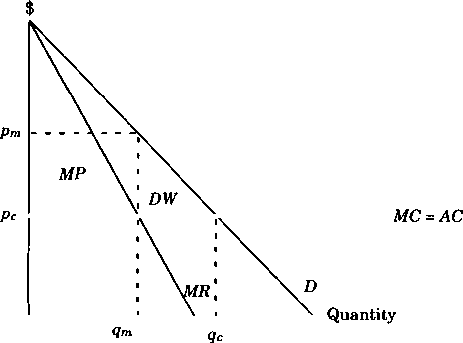
Figure 2
Source: Richard Posner. Economic Analysis of Law, 3rd ed. (Boston: Little Brown, 1986), p. 256.
With this brief introduction, we are now ready to consider the rather weak Posnerian argument for antitrust, and then, paradoxically, his very strong and emphatic intellectual rejection of it, and on the basis of it, somehow, his championing of this public policy.
Our author starts off with the same overused diagram, used by virtually all neoclassical economists. We are treated, once again, to the specter of the downward sloping demand, an MR curve which lies below AR, a flat MC=AC, on the basis of which we derive the dead weight loss due to “monopoly.”13
But no sooner does Posner make this traditional presentation than he begins the process of subtly undermining it. He says one thing in one place, and the contrary in another, sometimes stating the thesis and the antithesis on virtually the same page. At the very outset, even before the introduction of his analysis, Posner states,
the monopoly price . . . is the price that a firm having no competition or fear thereof would charge. Competition would make the price untenable. (p. 252, emphasis added)
The problem with this is that it is the rare businessman, “monopolist” or not, who has not even the fear of competition, let alone some actual competition or other itself. If attainment of “monopoly” price is restricted to such people, it really is an “academic concept” (p. 253) with little or no practical implication. Further, Posner enhances this criticism by conceding that “the establishment of a monopoly price creates an incentive for new sellers to come into the market” (p. 270). However, no sooner has he entertained the point that antitrust may be of only academic interest, but that he reverses field and takes it all back:
The possibility of entry may seem to make monopoly an academic concept. But sometimes entry takes a long time, or is forbidden, or the new entrant is not able to produce at so low a cost as the exiting firm. (p. 253)
For our purposes, we may safely ignore the case where entry is forbidden. In the modern context, entry can only be prohibited by the state, and if this occurs, we are clearly no longer in the realm of laissez-faire capitalism, the institution we wish to defend against the Posnerian attack.14
As well, the worry about entry taking a long time is also without merit. If all Posner wants to do is to show that the market does not always rationally allocate resources,15 he need not resort to “monopoly.” All he need do is point to the fact that the market is rarely if ever in even partial equilibrium, to say nothing of general equilibrium. But unless it is, there are always opportunities for reallocation of resources which are wealth enhancing (Kirzner 1973). If so, then by stipulation the market misallocates resources continuously. The only problem with this approach is that it gives no reason to expect that any system can do better. And indeed, if we have learned anything from the demise of the Soviet Empire, it is clear that some systems do far worse.
But we may be doing Posner an injustice here.16 Assume (as neoclassicals do) that price conspiracy has no redeeming virtues for consumers or for anyone else. Also assume that such agreements tend to fail over time. The issue, then, is: how long does it really take? If the law can put an end to an activity (without redeeming virtue) immediately, then why wait for the “market to work?”
There are two responses to this. First, the less radical argument, which is highly compatible with the neoclassical world view: the market works faster than government. The government typically suffers from bureaucratic and political arteriosclerosis: hearings must be held, rent seeking bribes arranged, sometimes political votes or referenda must be conducted. Even without unusual postponements, the market functions more quickly than the state. If we have learned anything from Hayek (1973), it is that a price system is by far the best communicator known to man.
The more radical response must leave the neoclassical realm and enter that of the Austrian. Here, we must withdraw the previously made assumptions. We can no longer accept the view that “conspiracy” has no redeeming social values. On the contrary, we assert, all commercial agreements between two consenting parties benefit the both of them, at least in the ex ante sense.
Of the three grounds mentioned by Posner, he is on the firmest foundation with regard to cost, the subject to which we now turn. On this subject Posner states: “The conclusion that DW in figure 2 is a net social cost rests on the assumption that a dollar is worth the same to consumers and producers” (p. 256).
Note the position in which this supposition places the analysis. The whole—neoclassical—case against “monopoly” is that it misallocates resources. Deadweight loss is Exhibit A in the brief. But the existence of net social costs rest upon the claim that “a dollar is worth the same to consumers and producers.” But what is the status of this claim? It is a mere “assumption.” Not a scintilla of evidence is given in its behalf. Not only is this claim merely assumed, not proven, it is not even discussed. Further, it is called into question in a different context by its very author, who states, “the shape and height of people’s marginal utility curves are unknown, and probably unknowable” (p. 436).17
Let us be clear on what is being said. We are not claiming that Posner has committed a blatant contradiction here. He is not saying in one place that marginal utility is unknowable, and in another that we know it well enough at least to fashion public policy on the basis of it. Nor does he hold that interpersonal comparisons of utility are, and elsewhere also are not, possible. However, what he does, is, if anything, even more problematic.18 For surely knowledge of interpersonal comparisons of utilities are more risky and difficult than about the size and shape of a single person’s marginal utility function. Posner throws up his hands in defeat at the prospect of obtaining information on the less complex of this pair, and bases his justification of antitrust policy on the more complex. The laws of logic would appear to indicate that if proposition A (interpersonal comparisons of utilities) is less secure than proposition B (the size and shape of a single person’s marginal utility function), and if public policy cannot be grounded on the basis of B, then it certainly cannot be founded on the basis of A.
Nor does this exhaust the incompatibilities between Posner’s defense of antitrust and his statements in other contexts. In the former case, he relies heavily on the existence of an objective, presumably measurable set of cost curves. What then, are we to make of the following quotes:
Yet it would be difficult for a court to compute the firm’s marginal cost. (p. 286)
Suppose a firm makes many different products, and some of the inputs—the time of its executives, for example—are the same for the different products. If the firm cuts the price of just one product, how should executive salaries be treated, in both the short and the long run, in deciding whether the price cut is predatory? (p. 288)
An important but invisible cost of a natural resource such as gas is the foregone opportunity to use it in the future. (p. 338)
These statements present difficulties. This is because foregone opportunities are, by their very nature, subjective. No one can know, judging from actions19 what the next best alternative was to any decision. If a man buys A at the cost of $1, we know he preferred this item to the money he paid for it. But we don’t know his alternative cost: what he would have done with this financial resource had he not just purchased A. Would he have put it in the bank? bought B instead? purchased a stock or bond? placed it under his mattress? Only the man himself can know anything about this contrary to fact conditional.
And yet Posner (and all neoclassicals) makes bold to draw cost curves of other people, purportedly based on their foregone opportunities. But he can never know these even in principle! Does this stop him from weaving apologetics for government intervention on the basis of these curves? Not a bit of it.
States Posner: “Theft is also ‘just’ a transfer payment; the victim’s loss is the thief’s gain.” But this is not true, unless it can be shown that the subjective evaluation placed on the item by the thief and his victim is identical, a manifest impossibility. Given that there are no utils (they are only a figment of the imagination of the neoclassical economists) and thus that there is no way of comparing the satisfaction of two different people, the thief and the property owner, Posner’s statement cannot be true. He asks (p. 258 n. 4), “Is this clearly so when the theft is of a good other than money?” It would appear that the implication here is that it is true that the victim’s loss equals the thief’s gain, when the good is other than money. If this is what Posner has in mind, he is quite correct. If the thief takes a bicycle or an oxygen tent, for example, he and the victim might place quite different evaluations on the good in question. But, contrary to Posner, the same analysis applies to money. Suppose the thief steals $100. Then, to be sure, the victim loses the $100, and the criminal gains an identical amount. But they may have used these funds for very different purposes, and derived very different amounts of satisfaction from this money, for all we know. We as outside third parties are in no position to distinguish between alternative uses. Suppose that the victim (the thief) were to use the $100 for successful cancer research—this $100 is the straw that breaks the back of the problem and uncovers a cure—and the thief (victim) for tying one on. Can we assert that the former brings about more utility than the latter? Not unless there are utils which may be interpersonally compared.
We have seen no reason to suppose that there is anything on the market deserving of the appellation, “monopoly.” The revenue and cost curve argument, and the geometry upon which it is based, has been found wanting. Nevertheless, we must now leave the realm of high neoclassical theory for the moment, and turn to the practical question of how to determine whether “monopoly” power exists in certain specific circumstances. That is, we now assume, just for the sake of argument, that Posner’s analysis of the economics of monopoly was correct, and our own critique either non-existent or fallacious.
The basic answer given to this practical question is elasticities. To put this in biblical terminology, by their elasticities shall thee be able to distinguish the “monopolistic” sheep from the competitive goats. In particular, cross elasticities of demand tell all. They indicate how competitive is one good with another. Thanks to them, we can give a non-arbitrary definition to the extent of an industry, without which concentration ratios, market shares, “monopoly” “power”—and all the other accouterments of modern antitrust philosophy—would all become unintelligible.
There are several problems with this tidy scenario. For one thing, elasticities are slippery characters. It is by no means clear which of the many alternative definitions is reasonable. Once again we are aided in our quest to undermine Posnerian economics by Posner himself, who instructs us as follows: Just as in the case of “the calculation of variable cost and therefore of marginal cost,” elasticities, too, are “highly sensitive to the time period” (p. 287). In the very short run, elasticities are small and hence “monopoly” is easy to perceive. As the length of the run under consideration increases, however, so does the elasticity, and with it the likelihood of finding “competitive” markets.
So which should be used? There are problems for the Posner thesis either way. In the long run then, elasticities are high, and the finding of “monopoly” unlikely. If our interests are confined to the short run, a determination of “monopoly” is attained more easily, but at the cost of relevance. That is, “monopoly” is only a short run or temporary problem. Posner admits as much, in the context of yet another discussion, this one not on “monopoly” but rather “monopsony.” In his view,
monopsony is a problem only where an input consumes resources that would be less valuable in other uses. Normally this condition is fulfilled only in the short run. (p. 292)
And again, “monopsony pricing would have only short run effectiveness.” (p. 293)
We must conclude, then, that either “monopoly” is non-existent, or it presents no serious problem, hardly a ringing endorsement for antitrust policy.
There is yet another criticism of elasticity criterion. It arises even if we could somehow overcome the intractable difficulty of length of run: this measure does not have the attributes of a constant in the physical sciences, such as gravity. Rather, elasticity is merely a shorthand numerical summation of an act which took place in a specific geographical locale and at a certain point in history. In other words, we are never entitled to say that the cross-elasticity of y with regard to x is 4.7. At best, we can only say something along the lines20 of “In Cleveland, in 1991, the cross elasticity of y with respect to x was 4.7.” In Posner’s view, we should fine people, and perhaps haul them off to jail,21 on the strength of a statistic, measurement of which has all the likelihood of success as in nailing jello to a tree.
There is also the problem of a “chilling effect” concerning the victims of the anti-“monopoly” law. These businessmen, who have been more successful in attracting customers than deemed appropriate by the Posnerites, will tend to have diminished enthusiasm for a whole host of economically productive practices.22 Lowering prices, improving product quality, more reliable delivery, better insurance, etc., will all tend to increase consumer satisfaction. But they will also invite the negative attention of the trust busters.
There is also the possibility of mistakes, ordinary human error, either in defining the markets, or calculating the elasticities, or in interpreting them. Again, Posner himself leads the way in pointing out the risks:
As one might expect, errors are frequent in attempting to define the market for antitrust purposes. A good example is the celebrated cellophane monopolization case, in which the Supreme Court held that cellophane was not a relevant market because there was a high cross elasticity of demand between cellophane and other flexible packaging materials. (p. 281)
The courts have often mishandled economic evidence in antitrust cases. For example, in the U.S. Steel monopoly case, the Supreme Court, in ruling for the defendant, was impressed by the fact that U.S. Steel’s market share had declined steadily after the combination of competing steel manufacturers to form the corporation (and that its competitors had not complained about its competitive tactics). The Court failed to recognize monopoly behavior. (p. 270)
One would think that this would give him pause for thought. If we couldn’t rely upon the courts “to do the right thing” in this case, from whence springs the optimism that they will do so in future? And yet, the bottom line for Posner is that upon this foundation of sand it is reasonable, it is responsible, to erect a policy affecting virtually the entire economy of the country. Elsewhere, Posner launches a devastating critique of:
direct regulation—which itself may be radically imperfect. For one thing, it tends to be more costly than common law regulation, because it is continuous; the common law machinery is invoked only if someone actually is hurt. . . . For another thing, direct regulation tends to be more politicized than common law, because it relies more heavily on the public sector and because judges, although public officials, are more protected from political reward and retribution than administrators are. . . . A related point is that regulation involves serious information problems. If accident victims have nothing to gain from bringing an unsafe condition to the government’s attention, the regulators may have difficulty finding out what exactly the problem is. (p. 345)
But why doesn’t Posner realize that antitrust too constitutes “direct regulation?”
As far as information costs are concerned, our author gives an additional reason for preferring “monopoly”:
An individual margarine producer may be reluctant to advertise the low cholesterol content of his product because his advertising will benefit his competitors, who have not helped defray its expense. (p. 349)
Yet another series of Posner’s remarks—this time on the cost reducing proclivities of “monopoly”—undercuts his argument in behalf of antitrust:
Sometimes monopoly will persist without any legal barriers to entry. Maybe the monopolist’s costs are so much lower than those of any new entrant that the monopoly price is lower than the price that a new entrant would have to charge in order to cover his costs. (p. 262)
The conditions of supply and demand in a market may be such that one firm can supply, at lower average cost than two or more firms, the entire output demanded; or one firm may have a superior management in whose hands the assets of all the other firms would be worth more than they now are. Either situation could lead to a monopoly through merger that might generate cost savings greater than the costs of the monopoly pricing that would result. Unfortunately, it is exceedingly difficult to distinguish situations of this kind from the case of a merger to create a monopoly that involves few or no cost savings. (p. 278; emphasis added)
It is hard to base any conclusions on market share alone, even ignoring the substantial probability that if a firm has grown to a large size other than by recent . . . mergers, it probably is more efficient than its competitors, and its lower costs may outweigh the social costs resulting from its charging a monopoly price. Indeed, its monopoly price may be lower than the competitive price would be. (p. 283)
Further argument given by Posner to undermine his antitrust contention concerns potential competition:
We know that the higher the elasticity of demand facing a firm, the less market power it has; and we also know that if an increase in price will evoke new output from other firms, i.e., if the elasticity of supply is positive, then the firm’s elasticity of demand will be higher than it would otherwise be. This suggests, however, that there is no need for a separate doctrine of “potential” competition. All that is necessary is to define markets broadly enough so that they include firms that, although they do not currently sell in the market in question, would do so if price rose slightly. (p. 284)
But no sooner does he call for a way of incorporating potential competition into the antitrust analysis, on the very same page, he offers a succinct and well chosen criticism of it:
since collusion is largely a short run phenomenon, . . . maybe the elimination of such (new entry) threats is not important enough to warrant antitrust concern, especially since it will be difficult to compute market shares for firms that do not yet have any productive capacity. Indeed, it will be quite difficult to identify which firms are likely to build productive capacity to enter the market if the market price rises above the competitive level. (p. 284)
In summary, let us be clear on what is being said here. We do not claim that these quotes from Posner contradict his case in behalf of antitrust. In his own mind, whether antitrust is justified or not depends upon a “balancing” of the grounds for and against; his conclusion is that the former outweigh the latter. The point being made here is that the support he gives for the case against antitrust is so strong, and in its behalf so weak, that despite his own explicit conclusion, the burden of his analysis vitiates this law.
There are two discernible hypotheses concerning antitrust which may be found in the Economic Analysis of Law. First, the neoclassical one given by Posner in those sections of his book dealing with the subject: the market is inefficient, veering off to “monopoly,” in all too many cases. The function, purpose, motive, and result of antitrust is to negate this market failure, thereby increasing wealth, efficiency and economic welfare.
Despite the overwhelming popularity of the foregoing thesis in the journal and especially textbook literature, there is actually a second perspective which has some currency within the profession, that of rent seeking.23 This alternative, in the tradition of the public choice school, tends to be somewhat underplayed by Posner, at least in those sections of his book dealing with “monopoly.” It would be unfair to claim, however, that he is unaware of it. Consider the following:
The deficiencies of public utility regulation viewed as a method of regulating profits, the degree to which it seems deliberately to maintain inefficient rate structures, and the frequency with which it has been imposed in naturally competitive industries and also used to discourage competition in industries that have some, but not pervasive, natural monopoly characteristics (railroads, for example) may lead one to wonder whether the actual purpose of public utility regulation is to respond to the economist’s concern about the inefficient consequences of unregulated natural monopolies. Maybe instead regulation is a product, much like other products except supplied by the government, that is demanded by and supplied to effective political groups. Under this view there is no presumption that regulation is always designed to protect the general consumer interest in the efficient supply of regulated services. (p. 339)
No, the problem with Posner is not that he is unaware of the public choice thesis; it is, rather, that he chooses not to apply it to antitrust policy. As we have seen, he has waxed eloquent about the court’s many shortcomings in this regard (e.g., U.S. Steel, cellophane, etc.). One would think, then, that he would apply the same public choice analysis to antitrust law in general, as he does to public utility regulation, one particular aspect of this legislation. Tragically, he does not.
Why not apply this insight not only to public utility regulation, where it is very apropos, but also to antitrust, where it is equally applicable? Indeed, there is an important literature which views anti-“monopoly” legislation, and the attendant law suits, as nothing but the despoilization of, or takings (Epstein 1985) from, private property owners (Kolko 1963).
Posner, instead of calling for the repeal of antitrust, recommends that cartel contracts not be enforced (p. 266). Actually, he goes further than that, characterizing this as an inadequate remedy, and advocates even more stringent controls. Nevertheless, he may have overlooked a better means to the end he favors. It is possible, that is, that strict enforcement will do more to undermine cartel agreements than non-enforcement.24
Consider the following. Suppose that the cartel fixes its price, through contract, at a level higher than “normal.” This will necessitate an agreement to cut back on quantity, according to some agreed upon formula. If this plan is enforced by law, all will be well for the cartel provided that no outsider comes in. (The cheating cartel member is now little or no problem because, we may suppose, there are very stiff penalties for such behavior written into the contract.) But if one does, and can bribe at least one of the members of the cartel to insist that its cutback provisions be adhered to,25 all members of the cartel can be put into serious jeopardy of bankruptcy. For if newcomers enter, even without undercutting the price, the first instinct of the cartel will be to produce more, thus lowering prices, in order to meet the competition. But if they are prevented from doing so by one “Trojan Horse” member of the cartel, the new entrants may be able to sweep all before them.
But this scenario will be anticipated by all firms thinking of signing on with a cartel. It will put a serious crimp in all such arrangements. These organizations may still spring up, but an extra cost will clearly be imposed upon them. They will be disadvantaged by having to act so as to exclude the “Trojan Horse,” or any member who can be converted into this status by being bought out.
Conclusion
We have discussed the works of three eminent, conservative, “free market” oriented economists. Certainly, they constitute a reasonable sample of this universe of discourse. We have found that however profoundly they defend market institutions in other contexts, they fail to do so in the case of antitrust. Why this lacunae should exist on the part of people otherwise concerned with economic freedom is for another day’s analysis. But that this is so is the only conclusion that may be fairly drawn from the discussion above.
References
Armentano, Dominick T. 1972. The Myths of Antitrust. New Rochelle, N.Y.: Arlington House.
———. 1982. Antitrust and Monopoly: Anatomy of a Policy Failure. New York: Wiley.
———. 1991. Antitrust Policy: The Case for Repeal. Washington, D.C.: Cato Institute.
Benson, Bruce L. 1989. “Enforcement of Private Property Rights in Primitive Societies: Law Without Government.” Journal of Libertarian Studies. 9: 1–26.
———. 1990. The Enterprise of Law: Justice Without the State. San Francisco: Pacific Research Institute for Public Policy.
Block, Walter. 1977. “Austrian Monopoly Theory—A Critique.” Journal of Libertarian Studies 1, no. 4 (Fall): 271–79.
Bork, Robert H. 1978. The Antitrust Paradox: A Policy at War with Itself. New York: Basic Books.
Brozen, Yale. 1982. Concentration, Mergers, and Public Policy. New York: Macmillan.
Buchanan, James M. 1969. Cost and Choice: An Inquiry into Economic Theory. Chicago: Markham.
———, and G. F. Thirlby. 1981. L.S.E. Essays on Cost. New York: New York University Press.
Friedman, David. 1989. The Machinery of Freedom: Guide to a Radical Capitalism. La Salle, Ill.: Open Court. 2nd ed.
Hayek, F. A. 1973. Law, Legislation and Liberty. Chicago: University of Chicago Press.
High, Jack. 1984–1985. “Bork’s Paradox: Static vs Dynamic Efficiency in Antitrust Analysis.” Contemporary Policy Issues 3: 21–34.
Hoppe, Hans-Hermann. 1989. A Theory of Socialism and Capitalism. Norwell, Mass.: Kluwer Academic Publishers.
———. 1992a. A Theory of Socialism and Capitalism: Economics, Politics and Ethics. Boston: Dordrecht.
———. 1992b. “The Economics and Sociology of Taxation.” In Taxation: An Austrian View. Llewellyn H. Rockwell, Jr., ed. Norwell, Mass.: Kluwer Academic Publishers.
———. 1992c. The Economics and Ethics of Private Property: Studies in Political Economy and Philosophy. Norwell, Mass.: Kluwer Academic Publishers.
Hutt, W. H. 1940. “The Concept of Consumers’ Sovereignty.” Economic Journal (March).
Kirzner, Israel M. 1973. Competition and Entrepreneurship. Chicago: University of Chicago Press.
Mises, Ludwig von. 1963. Human Action. Chicago: Regnery.
Posner, Richard. 1976. Antitrust Law: an Economic Perspective. Chicago: University of Chicago Press.
Rothbard, Murray N. 1962. Man, Economy, and State. Los Angeles: Nash.
———: 1970. Power and Market: Government and the Economy. Menlo Park, Calif.: Institute for Humane Studies.
———. 1973. For a New Liberty. New York: Macmillan.
———. 1982. The Ethics of Liberty. Atlantic Highlands, N.J.: Humanities Press.
Stigler, George. 1968. The Organization of Industry. Homewood, Ill.: Richard D. Irwin.
Telser, Lester. 1987. A Theory of Efficient Cooperation and Competition. Cambridge, England: Cambridge University Press.
Walter Block is associate professor of economics at the College of the Holy Cross and executive editor of the Review of Austrian Economics. The author wishes to thank two anonymous referees for helpful suggestions, many of which are incorporated here into this paper. The usual caveat of course applies. I have liberally footnoted this paper with the writings of Murray N. Rothbard on the topic of monopoly and antitrust, but these few citations are far from adequate to express the degree to which I rely on his pathbreaking work in this field.
The Review of Austrian Economics Vol. 8, No. 1 (1994): 35–70
ISSN: 0889–3047
- 1Historical Statistics of the United States, part 1 (Washington, D.C.: 1975), series D-86 for unemployment rates and series F-32 for gross national product. Throughout this article, the standard data series for unemployment rates are used, with recognition that there has been a challenge to the validity of those data during the Great Depression years. See Michael R. Darby, “Three-and-a-Half Million U.S. Employees Have been Mislaid: Or An Explanation of Unemployment, 1934–1941,” Journal of Political Economy 84, 1976.
- 2A.C. Pigou, Industrial Fluctuations, 1st ed. (London: Macmillan, 1927), p. 176.
- 3A.C. Pigou, Theory of Unemployment (London: Macmillan, 1933), p. 252. Pigou makes his arguments in a variety of other places. For example, see his “Real and Money Wage Rates in Relation to Unemployment,” Economic Journal 47, 1937, and “Money Wages in Relation to Unemployment,” Economic Journal 48, 1938.
- 4It is perhaps something of an exaggeration to ascribe this position entirely to Pigou. A number of other economists espoused similar views. Recognizing that the list is incomplete, we cite a few, beginning with Jacob Viner, Balanced Deflation, Inflation, or more Depression (Minneapolis, Minn.: University of Minnesota Press, 1933), especially pp. 12–13. See also W.H. Beveridge, Causes and Cures of Unemployment (London: Longmans, Green and Co., 1931), p. 25, and Unemployment, A Problem of Industry (London: Longmans, Green and Co., 1930), chapter 16; Wilford I. King, The Causes of Economic Fluctuations (New York: Ronald Press Co., 1938), chapter 8; and Lionel Robbins, The Great Depression (New York: Macmillan, 1934).
- 5John A. Hobson, The Economics of Unemployment (New York: Macmillan, 1923), p. 84.
- 6W.T. Foster and W. Catchings, Profits (Boston: Houghton Mifflin, 1925) and Business Without a Buyer (Boston: Houghton Mifflin, 1927); and C.H. Douglas, Credit-Power and Democracy (London: C. Palmer, 1920) and Warning Democracy (London: C.M. Grieve, 1931). A more recent interpretation of the Great Depression with underconsumptionist overtones in John Kenneth Galbraith, The Great Crash, 1929 (Boston: Houghton Mifflin, 1976).
- 7Murray N. Rothbard, America’s Great Depression (Princeton, N.J.: Van Nostrand, 1963), p. 45.
- 8Henry Ford, The New York Times, November 22, 1929, p. 2.
- 9The New York Times, November 22, 1929, p. 1. It is interesting to note that Hoover’s inclinations toward underconsumptionism were recognized and, of course, approved, by trade unionists. Witness a statement by the AFL’s John P. Frey in 1929 relating to a public works scheme of Hoover’s. In effect, Frey argued that the president was in agreement with the AFL’s position that depressions were the result of underconsumption and low wages. See Joseph Dorfman, The Economic Mind in American Civilization (New York: Viking Press, 1959), vol. 4, pp. 349–50. See also Ronald Radosh, “The Development of the Corporate Ideology of American Labor Leaders, 1914–1933” (doctoral dissertation in history, University of Wisconsin, 1967).
- 10Rothbard, America’s Great Depression, chapter 8. Not to be ignored is the fact that ideas such as those that enamored Hoover were not as unorthodox among professional economists as sometimes claimed. See J. Ronnie Davis, The New Economists and the Old Economists (Ames, Iowa: Iowa State University Press, 1971). Davis presents an interesting array of statements by economists and other academics relating to the issue of the impact of wage reductions on the economy (pp. 94–99).
- 11John M. Keynes, The General Theory of Employment, Interest and Money (London: Macmillan, 1936).
- 12Abba P. Lerner, “Mr. Keynes’ ‘General Theory of Employment, Interest and Money,’” International Labor Review 34, 1936. See also W.B. Reddaway, “The General Theory of Employment, Interest and Money,” Economic Record 12, 1936. A systematic description of the thought of this time is contained in Lawrence R. Klein, The Keynesian Revolution (New York: Macmillan, 1947). For a taxonomic description of the various views of the aggregate demand schedule for labor, see Sidney Weintraub, “A Macroeconomic Approach to the Theory of Wages,” American Economic Review 46, 1956.
- 13Paul M. Sweezy, personal letter to John B. Shelley, dated February 11, 1977, cited in Dana C. Hewins and John B. Shelley, “Sweezy’s Kink: Macro Foundations of a Micro Theory,” Economic Inquiry 17, 1979.
- 14For a description of the various dimensions of the Keynesian critique of classical economics, see Alvin H. Hansen, A Guide to Keynes (New York: McGraw-Hill, 1953). More recent appraisals and restatements of the total thrust of Keynesianism are Abba P. Lerner, “From ‘The Treatise on Money’ to ‘The General Theory,’” Journal of Economic Literature 12, 1974; and Hyman P. Minsky, John Maynard Keynes (New York: Columbia University Press, 1975).
- 15Peter Temin, Did Monetary Forces Cause the Great Depression? (New York: Norton, 1976), p. 140. Temin also attempts to demonstrate that the Great Depression was brought on by an autonomous shift in the consumption function. That view has been challenged (successfully, we think) by Thomas Mayer, “Consumption in the Great Depression,” Journal of Political Economy 86, 1978.
- 16Keynes, The General Theory. In chapter 2, Keynes is very explicit. In reference to the principle that real wages and employment are systematically related, he says, “I am not disputing this vital fact which the classical economists have (rightly) asserted as indefeasible.”
- 17Ludwig von Mises, The Theory of Money and Credit (New Haven, Conn.: Yale University Press, 1953). Permission granted by Mrs. Margit von Mises. Quotes from 1981 Liberty Classics, Indianapolis, edition.
- 18Milton Friedman, “The Role of Monetary Policy,” American Economic Review 58, 1968.
- 19In particular, see Jerome Stein, Monetarist, Keynesian, and New Classical Economics (Cambridge, United Kingdom: B. Blackwell, 1982).
- 20The key assumptions are constant returns to scale and neutral disembodied technical progress.
- 21The underlying statistical models are moderately complex. They are described briefly in the statistical appendix. The logic and structure of the models are more fully developed in Lowell Gallaway and Richard Vedder, The “Natural” Rate of Unemployment, staff study, Subcommittee on Monetary and Fiscal Policy, Joint Economic Committee, Congress of the United States (Washington, D.C.: 1982).
- 22Federal Reserve Bulletin, various issues.
- 23Historical Statistics, series D-86.
- 24The productivity-adjusted real wage rate on a quarterly basis is calculated by dividing the manufacturing wage bill by the product of Federal Reserve Board (not the wage bill) and the index of average labor productivity (not total output) should be used. However, converting the wage bill and the index of industrial production to wage rate and productivity measures involves dividing both of them by the same quantity of labor (L). Since L appears in both the numerator and denominator of the expression for the adjusted real wage rate, it cancels out and can be ignored.
- 25As calculated from Historical Statistics, series D-688.

