
Review of Austrian Economics
The Preferred Tax Type Comment on Herbener
Alexander Tabarrok
A standard theorem in neoclassical public finance holds that income taxes are preferred to equal revenue excise taxes.1 Herbener (1988) rejects this theorem because the proof is (a) based upon methodologically suspect indifference curves and (b) must follow a certain conceptual ordering—namely the excise tax must first be placed upon consumers who are then given the option of facing an equal-revenue income tax and not vice versa. This comment demonstrates that indifference curves are not required to prove the theorem nor must the proof of the theorem follow a specific order.
It is an easy job to prove the theorem without using indifference curves, as has been done many times.2 The proof requires only the idea of revealed (or demonstrated) preference. Consider figure 1: there are two goods, money (M) and a good X; AA represents the initial budget line, AC is the new budget line after an excise tax has been placed on good X.3 Let us say that the consumer chooses the consumption bundle at point D which is on his budget constraint AC.4 The budget constraint when an equal revenue income tax is imposed must pass through point D and is labelled BB. The consumer now has the option of staying at D (his most preferred position under the excise tax) or consuming anywhere along BB. If the consumer switches, this demonstrates his utility has increased and proves the theorem. We now show that the consumer will switch.
Consider line segment BD. The consumer had enough income to consume anywhere along BD before the income tax was introduced. In fact, the consumption bundles along line segment AD contain more of both types of goods than those along BD and the consumer could have chosen any of these bundles. By choosing not to consume along AD the consumer has demonstrated that he prefers bundle D to any other point along line segment AD and a fortiori line segment BD. Now compare line segment DB with DC. More of both types of goods are available to the consumer along line segment DB than DC. Since more of a good is preferred to less we can state with assurance that the consumer will choose to change his consumption from D to a point somewhere along DB such as F.5 The fact that the consumer voluntarily changes his consumption bundle demonstrates that his utility increases.
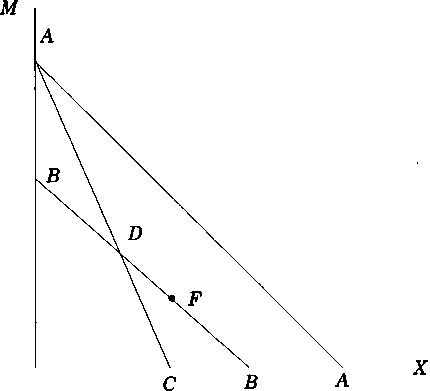
Figure 1.
It has now been shown that following the traditional sequence the preferred tax theorem can be proven without the concept of indifference. We have needed only the idea of revealed/demonstrated preference and the law that more is preferred to less.6
Herbener’s second critique of the preferred tax theorem is that the proof requires a certain sequence of events: (1) the excise tax is placed on good X, (2) the amount of tax revenue is measured, (3) an equal-revenue income tax is levied. He argues that the sequence cannot begin with an income tax followed by an equal-revenue excise tax because the government does not know the preferences of individuals and therefore cannot compute the equal-revenue excise tax. According to Herbener the first scheme is the one that is presented “because only it allows the government to conduct the postulated experiment.” But as Herbener himself notes, the neoclassical method (at least the part required to prove the theorem) is axiomatic and deductive. The theorem is a conclusion of theory and not a description of how to conduct an experiment.7
For a theory to be correct it need not be experimentally testable. But it must have true premises and sound reasoning. The preferred tax theory is presented the way it is because this is the only method which guarantees that one of the implied premises is true. The implied premise which must be true for the theory to hold is that there exists an excise tax capable of generating revenue equal to that of an income tax. The sequence of the first proof guarantees that this premise is true because the excise tax is placed first followed by an equal-revenue income tax.8 The alternate sequence, proposed by Herbener, cannot guarantee that this statement is true. No excise tax on toothpicks could raise the same amount of revenue as does the present income tax of the United States. This is the problem which the first sequence avoids.
If we make the implied premise explicit, then the proof follows as before. Referring to figure 1, AA is the original budget constraint, BB is the budget constraint after an income tax. Let us assume, so as not to clutter the diagram, that the consumer chooses bundle F. We now assume that an excise tax exists which raises revenue equal to that of the income tax. In general we do not know exactly how high this tax must be but this is irrelevant as far as the theory is concerned.9 We do know by assumption that such a tax exists; assume that it is AC. If AC is the equal revenue excise tax then we know that the consumer must be consuming at point D (any other point along AC would raise too much or too little revenue). But point D was available to our consumer before the excise tax was imposed and he, chose not to consume at that point. His action demonstrated that he preferred to consume at point F. We therefore know that this consumer’s utility has been unambiguously decreased by the switch from an income tax to an excise tax.
Concluding Comments
It has been shown without the use of indifference curves and using either sequence that an income tax is preferred to an equal-revenue excise tax. As Herbener notes, and is widely recognized, this type of analysis is only partial in nature. Taxes also have effects on the production side of the economy.
References
Herbener, Jeffrey M. “Austrian Methodology: The Preferred Tax Type.” Review of Austrian Economics 2 (1988): 97–111.
Hicks, J. R. [1939] 1946. Value and Capital, 2nd ed. Oxford: Clarendon Press.
Rothbard, Murray N. 1956. “Toward a Reconstruction of Utility and Welfare Economics,” in Sennholz, Mary, ed. On Freedom and Free Enterprise: Essays in Honor of Ludwig von Mises. Princeton, N.J.: Van Nostrand, pp. 224–49.
Samuelson, Paul A. 1948. Foundations of Economic Analysis. Cambridge, Mass.: Harvard University Press.
Alexander Tabarrok is a graduate student in economics at George Mason University.
The Review of Austrian Economics, Vol. 5, No. 2 (1991): 107–114
ISSN: 0889–3047
- 1Historical Statistics of the United States, part 1 (Washington, D.C.: 1975), series D-86 for unemployment rates and series F-32 for gross national product. Throughout this article, the standard data series for unemployment rates are used, with recognition that there has been a challenge to the validity of those data during the Great Depression years. See Michael R. Darby, “Three-and-a-Half Million U.S. Employees Have been Mislaid: Or An Explanation of Unemployment, 1934–1941,” Journal of Political Economy 84, 1976.
- 2A.C. Pigou, Industrial Fluctuations, 1st ed. (London: Macmillan, 1927), p. 176.
- 3A.C. Pigou, Theory of Unemployment (London: Macmillan, 1933), p. 252. Pigou makes his arguments in a variety of other places. For example, see his “Real and Money Wage Rates in Relation to Unemployment,” Economic Journal 47, 1937, and “Money Wages in Relation to Unemployment,” Economic Journal 48, 1938.
- 4It is perhaps something of an exaggeration to ascribe this position entirely to Pigou. A number of other economists espoused similar views. Recognizing that the list is incomplete, we cite a few, beginning with Jacob Viner, Balanced Deflation, Inflation, or more Depression (Minneapolis, Minn.: University of Minnesota Press, 1933), especially pp. 12–13. See also W.H. Beveridge, Causes and Cures of Unemployment (London: Longmans, Green and Co., 1931), p. 25, and Unemployment, A Problem of Industry (London: Longmans, Green and Co., 1930), chapter 16; Wilford I. King, The Causes of Economic Fluctuations (New York: Ronald Press Co., 1938), chapter 8; and Lionel Robbins, The Great Depression (New York: Macmillan, 1934).
- 5John A. Hobson, The Economics of Unemployment (New York: Macmillan, 1923), p. 84.
- 6W.T. Foster and W. Catchings, Profits (Boston: Houghton Mifflin, 1925) and Business Without a Buyer (Boston: Houghton Mifflin, 1927); and C.H. Douglas, Credit-Power and Democracy (London: C. Palmer, 1920) and Warning Democracy (London: C.M. Grieve, 1931). A more recent interpretation of the Great Depression with underconsumptionist overtones in John Kenneth Galbraith, The Great Crash, 1929 (Boston: Houghton Mifflin, 1976).
- 7Murray N. Rothbard, America’s Great Depression (Princeton, N.J.: Van Nostrand, 1963), p. 45.
- 8Henry Ford, The New York Times, November 22, 1929, p. 2.
- 9The New York Times, November 22, 1929, p. 1. It is interesting to note that Hoover’s inclinations toward underconsumptionism were recognized and, of course, approved, by trade unionists. Witness a statement by the AFL’s John P. Frey in 1929 relating to a public works scheme of Hoover’s. In effect, Frey argued that the president was in agreement with the AFL’s position that depressions were the result of underconsumption and low wages. See Joseph Dorfman, The Economic Mind in American Civilization (New York: Viking Press, 1959), vol. 4, pp. 349–50. See also Ronald Radosh, “The Development of the Corporate Ideology of American Labor Leaders, 1914–1933” (doctoral dissertation in history, University of Wisconsin, 1967).

