
Review of Austrian Economics
Comment on Preferred Tax Type: Reply to Tabarrok
Jeffrey M. Herbener
I appreciate the opportunity to respond to the criticisms made by Alexander Tabarrok of my preferred-tax-type article since it provides a forum to clarify and elaborate on what is wrong with this neoclassical “theorem,” as he calls it.
Before addressing the critique, I would like to make two historical clarifications. J. R. Hicks did not originate indifference curves as my critic claims (p. 107n). That “honor” goes to Francis Edgeworth, who gave a complete mathematical description of this technique in his Mathematical Psychics, published in 1881.1 Vilfredo Pareto’s extensive development and use of indifference-curve analysis also predates the work of Hicks in this area.2 Hicks even gives credit to these two authors at various places in his Value and Capital.3
Second, I expended considerable effort at the beginning of the original article to establish the fact that I am an unabashed Misesian economist, and thus my major complaint against the neoclassical economists approach to the preferred-tax-type question is their failure to correctly employ the axiomatic-deductive method. Tabarrok seems to imply that my point about the government’s inability to conduct the postulated experiment concerning equal tax revenues concerns the empirical problem of the testability of an hypothesis. But I wholeheartedly agree with him when he states, “For a theory to be correct it need not be experimentally testable. But it must have true premises and sound reasoning” (p. 109). The major argument of my original article was precisely that the neoclassical theory had false premises and unsound reasoning and was therefore false. The problem of conducting the experiment that I referred to was the mental experiment necessary to the praxeological method.4
Tabarrok makes two criticisms of my original article: indifference curves are not required to prove the “theorem” and the proof does not depend on a specific sequence. By dropping indifference curves, Tabarrok has dramatically changed the conditions of the analysis and thus, his criticisms do not affect my original results, derived assuming a well-behaved set of indifference curves. This is not much consolation, however, if his assertion is true that indifference curves are not necessary for the proof. Let me demonstrate the difficulty of proving the “theorem” without them, or at least some additional restrictions on preferences beyond Tabarrok’s “more is preferred to less” assumption.5
Consider figure 1, a reproduction of Tabarrok’s figure 1. The individual begins by choosing point A with no taxation. Now the government imposes an excise tax on good X, at some fixed rate per unit (they do not fix the amount of the tax revenue, the individual’s choice determines his tax payment), causing the budget constraint to rotate inward to M0XE. The individual chooses point B with an amount of tax extracted of M0M1. Now he is offered another opportunity; pay the same amount of tax and choose any combination along M1X1. Given the expanded range of choice, he can assuredly find a preferable point, say C. But note carefully, he prefers C to B because, by assumption, it is his most preferred point on his entire income tax budget line. From a tax-payment standpoint, when he compares C to a point along M0XE, say D, he prefers it because it involves a lower tax payment. It has nothing to do with comparing equal tax revenues extracted in two different forms. By construction, his choice is between a fixed income tax payment and a fixed excise tax rate. With the latter, point B is the only point on M0XE that extracts the same amount of tax, M0M1, as the income tax. With the excise tax option, the individual must stay at point B, in order to pay the same tax, while the income tax option he can select from various combinations of M and X. The individual’s choice of the income tax is not based on his preference concerning tax types but on the fact that the analysis allows him no effective choice with the excise tax option.
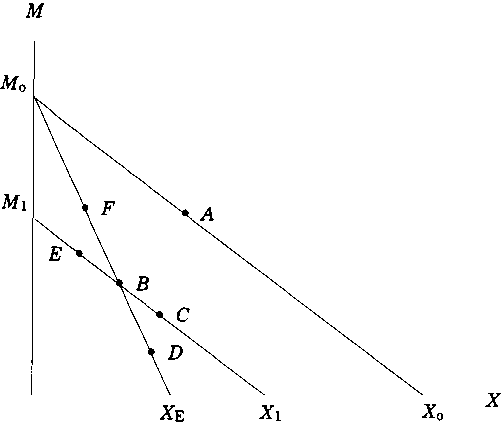
Figure 1.
Let me make this point from a different angle. What if his most preferred point on M1X1 was point E? With indifference curves this would be impossible but without them, or some added restriction beyond more is preferred to less, this can not be ruled out.6 Then what he would prefer to do is move to some point on M0B to the left of point B. He may prefer point B to any other point on M0XE, but he prefers, say, point F, to point E because it involves a lower tax payment. The analysis only allows the comparison of a fixed excise tax rate with a fixed income tax payment.7 Equalizing tax payments forces the individual to consider only one combination of M and X with the excise tax against many such combinations with the income tax.
Only one way exists to make the two tax types render the same tax payment (while not eliminating the individual’s choice under the excise tax): allow the individual to freely select the excise tax rate. (The original excise tax rate is arbitrary and no specific rate is necessary to extract a given sum of tax revenue; it depends on the individual’s choice.) Otherwise, one is comparing a fixed excise tax rate with a fixed income tax payment, which, as I stated in the original article, is not the postulated question.8 If the individual picks the excise tax rate, without indifference curves to bind him, he will pick the rate so that the excise tax budget line will go through point C, allowing him to continue to consume his most preferred combination on M1X1. (With indifference curves this is impossible since they cannot intersect). Such a rate is the only one that allows the question of comparing the two tax types to be answered. And the answer is: He will be, dare I say it, indifferent between the two tax types.9 This result stems from posing the correct question: The government will take M0M1 in income from you regardless of the collection method; which do you prefer? Without indifference curves to obscure the analysis, this question can finally be meaningfully asked,, but the result is to reveal the two tax types as a lump-sum tax from the individual’s perspective collected in two different ways (we are ignoring the other diverse effects of the two taxes). As I mentioned in the original article, the individual cares much more about how much he is forced to pay than in what manner the tax is collected.10
Tabarrok’s quip about an excise tax on toothpicks not being a source of tax revenue equivalent to an income tax is erroneous (p. 109). As long as the individual continues to purchase at least one toothpick the government could indeed raise an equal amount of tax revenue by applying a very high excise tax rate. And why should it matter to the individual if the government forces him to pay $5000 in income tax by sending a check payable to the IRS or $5000 in excise tax by sending a check to Tom’s Toothpick Outlet which Tom sends on to the IRS? This is the only plausible meaning of the phrase “equal tax revenue,” i.e., the only way in which the government can conduct the postulated (mental) experiment.
But this result is not what an individual unbound from indifference curves will accept under the sequence of excise tax then income tax options. Without indifference curves, the individual would do the following (remember, he prefers point A to all others): Offered the excise tax option at the fixed rate, he would choose point M0, i.e., he would consume no X (zero tax payment); then, offered an income tax of the same amount, he would move back to point A, paying nothing in taxes. This result does not require shifting preference rankings. His rankings would be: (1) point A with no tax, (2) point M0 with the threat of excise tax, (3) point C forced to pay the tax of M0M1, (4) point B forced to pay the tax of M0M1 and forced to buy the amount of X at point B. Indifference curves prevent this subjective maneuvering, making it appear that the analysis is answering the posited question.
For further clarification, let us explore the alternative sequence. Without indifference curves and forced to pay the income tax of M0M1, the individual selects point C, which, by construction, must be his most preferred combination on M1X1. Now he is offered the excise tax option that renders the same tax payment, but not a given excise tax rate, and asked to choose. Because point C is his most preferred combination, he will continue to choose point C, not some point to the left of C as Tabarrok contends, asking for an excise tax rate such that the budget line runs from point M0 through point C. (Otherwise the analysis is comparing a fixed income tax payment with a fixed excise tax rate.) Again he is indifferent between the two tax types. This result is impossible with indifference curves since the indifference curve tangent to the excise-tax budget line at point C would intersect the one tangent to the income-tax budget line at point C. The use of indifference curves obscures the analysis, making it appear to answer the question that it cannot even meaningfully ask. Tabarrok notwithstanding, the “theorem” cannot be proved without indifference curves or at least some restrictions on preferences beyond “more is preferred to less.”
Tabarrok’s second criticism, that the proof of the theorem need not follow a specific sequence (if indifference curves are removed), depends upon how one poses the question to be answered. If the government offers what the original question appears to ask, both tax types simultaneously, then the choice is: You must pay M0M1 regardless but you can select to pay either by income tax or by an excise tax on X, and the individual will not prefer one tax type to the other. If the government offers the excise tax first (at a fixed rate, for how else can it offer this option?), the individual (not bound by indifference curves) will substitute away from X to avoid the tax payment, then given the income tax alternative (with a zero tax payment), the individual will choose the income tax option and consume at the original point. If the government offers the income tax first (at a fixed amount, for how else can it offer this option?) the individual will adjust accordingly, then given the excise tax option (allowing the individual to choose the rate else the analysis is comparing a fixed excise tax rate with a fixed income tax amount), the individual will not prefer one type to the other. Sequence still matters, only now, without indifference curves, the solution is different.
Finally, Tabarrok failed to mention the most obvious result of the analysis (with or without indifference curves): The individual prefers not to be taxed. By extension, an individual will prefer a tax offering that provides ceteris paribus, more chances to avoid so as to lower his tax payment. In the real world, where the government cannot enforce equal tax payments for different tax types, an excise tax on one good tends to be more easily avoided and thus preferred to an income tax, ceteris paribus. However, in the real world governments rarely allow citizens to make such choices. Instead they impose broad-based taxes for the very purpose of extracting greater tax revenues and search for theories they can use to pacify the long-suffering taxpayer.
Jeffrey M. Herbener is assistant professor of economics at Washington and Jefferson College.
The Review of Austrian Economics, Vol. 5, No. 2 (1991): 111–116
ISSN: 0889–3047
- 1Historical Statistics of the United States, part 1 (Washington, D.C.: 1975), series D-86 for unemployment rates and series F-32 for gross national product. Throughout this article, the standard data series for unemployment rates are used, with recognition that there has been a challenge to the validity of those data during the Great Depression years. See Michael R. Darby, “Three-and-a-Half Million U.S. Employees Have been Mislaid: Or An Explanation of Unemployment, 1934–1941,” Journal of Political Economy 84, 1976.
- 2A.C. Pigou, Industrial Fluctuations, 1st ed. (London: Macmillan, 1927), p. 176.
- 3A.C. Pigou, Theory of Unemployment (London: Macmillan, 1933), p. 252. Pigou makes his arguments in a variety of other places. For example, see his “Real and Money Wage Rates in Relation to Unemployment,” Economic Journal 47, 1937, and “Money Wages in Relation to Unemployment,” Economic Journal 48, 1938.
- 4It is perhaps something of an exaggeration to ascribe this position entirely to Pigou. A number of other economists espoused similar views. Recognizing that the list is incomplete, we cite a few, beginning with Jacob Viner, Balanced Deflation, Inflation, or more Depression (Minneapolis, Minn.: University of Minnesota Press, 1933), especially pp. 12–13. See also W.H. Beveridge, Causes and Cures of Unemployment (London: Longmans, Green and Co., 1931), p. 25, and Unemployment, A Problem of Industry (London: Longmans, Green and Co., 1930), chapter 16; Wilford I. King, The Causes of Economic Fluctuations (New York: Ronald Press Co., 1938), chapter 8; and Lionel Robbins, The Great Depression (New York: Macmillan, 1934).
- 5John A. Hobson, The Economics of Unemployment (New York: Macmillan, 1923), p. 84.
- 6W.T. Foster and W. Catchings, Profits (Boston: Houghton Mifflin, 1925) and Business Without a Buyer (Boston: Houghton Mifflin, 1927); and C.H. Douglas, Credit-Power and Democracy (London: C. Palmer, 1920) and Warning Democracy (London: C.M. Grieve, 1931). A more recent interpretation of the Great Depression with underconsumptionist overtones in John Kenneth Galbraith, The Great Crash, 1929 (Boston: Houghton Mifflin, 1976).
- 7Murray N. Rothbard, America’s Great Depression (Princeton, N.J.: Van Nostrand, 1963), p. 45.
- 8Henry Ford, The New York Times, November 22, 1929, p. 2.
- 9The New York Times, November 22, 1929, p. 1. It is interesting to note that Hoover’s inclinations toward underconsumptionism were recognized and, of course, approved, by trade unionists. Witness a statement by the AFL’s John P. Frey in 1929 relating to a public works scheme of Hoover’s. In effect, Frey argued that the president was in agreement with the AFL’s position that depressions were the result of underconsumption and low wages. See Joseph Dorfman, The Economic Mind in American Civilization (New York: Viking Press, 1959), vol. 4, pp. 349–50. See also Ronald Radosh, “The Development of the Corporate Ideology of American Labor Leaders, 1914–1933” (doctoral dissertation in history, University of Wisconsin, 1967).
- 10Rothbard, America’s Great Depression, chapter 8. Not to be ignored is the fact that ideas such as those that enamored Hoover were not as unorthodox among professional economists as sometimes claimed. See J. Ronnie Davis, The New Economists and the Old Economists (Ames, Iowa: Iowa State University Press, 1971). Davis presents an interesting array of statements by economists and other academics relating to the issue of the impact of wage reductions on the economy (pp. 94–99).

