
Review of Austrian Economics
Ethics, Efficiency, Coasian Property Rights, and Psychic Income: A Reply to Demsetz
Walter Block
The Debate over Property Rights
The purpose of the present article is to continue my part in the debate over property rights in which I have become enmeshed with Harold Demsetz. It all began with the publication of my piece (Block 1977a), which was critical of Coase (1960) and of Demsetz (1966, 1967). The second round consisted of Demsetz (1979), in which he replied to my critique (Block 1977a).
Ronald Coase
In his seminal article, Coase (1960) turned the world of economics upside down. It might even be said that with one (longish) stroke of the pen, he created the entirely new sub-discipline of Law and Economics; and that he did so out of the ashes of at least one part of the traditional field as it stood before his onslaught: that occupied by Pigou (1932).
Previously, the view of the profession regarding invasions against another person or his property was the classical liberal one of cause and effect. A was the perpetrator, B the victim. To be sure, there was some equivocation amongst the Pigovians as to whether the proper public policy response to this was to tax A in an effort to force him to stop his depredations, or to give him a subsidy so as to entice him toward this end (ibid., p. 184). But the idea of property rights was maintained intact: there was always a clear cut distinction maintained between the violators of that institution and those who suffered thereby.
As well, in the more traditional perspective, wealth maximization was the byproduct of private property rights, rather than the progenitor. In other words, economic considerations was the tail, and property rights was the dog. Locke (1955, 1960), for example, did not ask whether the homesteader was the most efficient utilizer of virgin territory. For this philosopher, it was enough that a person was the first to “mix his labor with the land”; this, and this alone, would suffice to make him the legitimate owner. Following in the footsteps of Locke, libertarian philosophers (Rothbard 1962, 1970, 1982a; Hoppe 1989, 1993; Nozick 1974; Epstein 1985) did not attempt to determine who was the Coasian “most efficient user” of a good, or “least cost avoider” of an accident as a means of assigning rights, blame or punishment. Instead, resort to property rights and strict liability was made.
But all this changed with Coase and his adherents. In this new view, property rights became the handmaiden of so called economic efficiency. The very determination of private property became dependent on cost considerations. Another way to put this is that in the pre-Coasian days, property rights were exogenous to economics. Thanks to Coase and his followers (Demsetz 1966, 1967; Posner 1986; Landes 1971, 1973, 1979),1 this is no longer true. Now, if anything, economics is the independent variable; property rights have become indigenous on it.
Further, reciprocity was nominated to take the place of previously sacrosanct causal relationships. It was no longer true that the factory that emitted sparks which set ablaze the farmer’s crops was at fault.2 The latter became equally blameworthy, or rather, since it became no longer appropriate to relegate blame to anyone, responsible. Had the farmer not planted in that spot, no harm would have befallen him. Says Coase (1960, p. 37), “[it] is not that the man who harbors rabbits is solely responsible [for damage to neighboring farms]; the man whose crops are eaten is equally responsible.”
And what was the advice to the judiciary which emanated from this new outlook? Judges were to rule in such a way as to maximize the value of economic activity. Under a zero transactions cost regime, it really wouldn’t matter—as far as the allocation of resources was concerned—which of two disputatious parties received the rights in question. If they were given to the person who valued them more, well and good. If not, the loser would be able to pay off the winner so as to enjoy their use. But in the real world of significant transactions costs, in contrast, the juridical determination was absolutely crucial. Whatever the judge decided would endure; there could be no opportunity for mutually beneficial exchange, ex post.
From these deliberations emerged, especially in the writings of his followers, the “Coasian” public policy recommendation. The jurist must ignore tradition, property rights, ownership, and the niceties of Lockean homesteading theory upon which all were based, and instead make his award solely in order to maximize wealth. That is, he should find in favor of the disputant who values the rights in question more strongly; the one who, had he lost the court battle in the zero transactions cost world, would have successfully bribed the winner.3
Demsetz (1967), for example, went so far as to apply this to matters of freedom. In his view, it doesn’t matter—for purposes of resource allocation—whether the army hires the recruit (the volunteer military) or commandeers him (the draft), but then allows him to buy his way out of this predicament.
There is an alternative way of characterizing Coase’s very interesting contribution to economics. He maintained, contrary to the prevalent (Pigovian) belief at the time,4 that under certain circumstances a judicial decision concerning property rights would not affect the allocation of resources.
Take the case of the sparks from the factory which set afire the farmer’s flowers. The farmer sues, demanding among other things that the factory add a smoke prevention device, so as to protect his private property rights. Coase argues that under zero transactions costs assumptions, resource allocation—whether or not the smoke prevention device is used—will not depend upon the court’s finding. If the factory values the right more, it will use that right if its suit finds favor with the judge. That is to say, it will not install the smoke prevention device. Under a negative ruling to it, the factory will purchase these rights from the farmer.
To be sure, the decision from the bench would have some effect. States Coase (1960, p. 488), it “would not affect the allocation of resources, but would merely alter the distribution of income as between the two parties, plaintiff and defendant.” (Henceforth, I shall refer to this as statement “A.”) In other words, the property rights finding of the court may be irrelevant to resource allocation, but it would be of great importance to the wealth positions of the two legal opponents.
Walter Block
The next installment in this brief history of the debate concerns my criticism of Coase and Demsetz (Block 1977a). In that article I attempted to distance myself from Coase on several points. I took the position that not only was Coase required to assume zero transaction costs in order to reach his conclusion, he also needed to make a supposition about the form in which the wealth was held. I maintained that as long as the values of both sides in the legal dispute were real, or general,5 that Coase’s Theorem was correct. However, if these values were psychic or not general across at least a few people, it was incorrect. Alternatively, I took the position that yet another assumption was required by Coase in order to defend his Theorem; namely, that the values could not be psychic or specific to one particular person.6
The question to be emphasized is this. How does the farmer bribe the factory, in the case where the farmer values the crop more than the factory, and the court decides against the farmer? With collateral, real, objective, general wealth at stake, there is no problem. That is, if the crop is worth something to the factory, or to someone else, the bribe is easy to finance. The farmer can give part of this crop to the factory. But if this is not true, the bribe cannot occur.7
My response (Block 1977a) to Coase and Demsetz made the following points:
(1) It does matter for resource allocation purposes who wins a property rights lawsuit—even under zero transaction costs conditions, even ignoring the wealth effects of the judicial decision. This is because there is no guarantee that the loser will have the requisite funds with which to bribe the victor, even if he indeed values the bundle of rights under contention to a degree greater than his opponent. Coase had supposed that the payment could be financed out of the greater value; but if this took the form of mere psychic income, it would be unable to do any such thing.
(2) The Coasian advice to the judge is arbitrary, and counterproductive. Due to the subjectivity of costs and evaluations (Buchanan 1969; Mises 1963; Rothbard 1977) and to the impossibility of interpersonal utility comparisons (Rothbard 1977), it is inconceivable for anyone, even a magistrate, to know who is the most efficient user, or the least cost accident avoider. It is extremely difficult to foretell, under the zero transaction costs assumption, who would end up bribing whom. To place such a burden on our court system moreover would be to saddle it with the same task so dismally acquitted by the communist central planning boards in the former U.S.S.R., Eastern Europe, and all throughout the third world.
(3) It is morally problematic to overturn property rights, surely a bedrock of western civilization, even if the purpose is benevolent—to promote utility. It is morally questionable to make legal findings not on the basis of justice but rather wealth maximization.
(4) Yes, a tort is reciprocal, or mutually determined, in the narrow sense that if the victim were not present, it could not have occurred. But by that token, there could never be any real crime. It takes “two to tango,” so to speak, and without one of the participants, the dance cannot occur. Where is the murderer, rapist or thief who could not make use of this unique legal defense? All he has to do is plead that but for the presence of the victim, the crime could not have taken place; therefore, the victim is actually a contributor to the villainy. Cause and effect, then, not mutual determination or reciprocity, is the only proper basis for settling disputes over personal or property rights.
Harold Demsetz
The third chapter in this tale was written by Demsetz (1979).8 In it, he accused me of failing to take into account one of Coase’s explicitly made assumptions. Were I to have done so, Demsetz challenges, I would not have been able to write my critique of Coase, or at least a large part of it.
In Demsetz’s own words (p. 98), “The substantive issue has to do with whether or not the assignment of right ownership will alter the mix of output when ‘bargaining transactions . . . are costless [and] changes in the distribution of wealth . . . can be ignored.’ Coase and I [with a proviso about ‘free riders’] say no; Block says yes. Block then presents some examples that appear to refute our analysis, but which really only violate our explicitly made assumption” Henceforth, I shall refer to this statement as “B.” The first thing to notice about B is that it appears without benefit of citation.9 This makes it difficult to evaluate, because there is no context available in which it can be embedded.
Secondly, A and B are by no means equivalent, although Demsetz appears to treat them as such. The fact that they are not may have led him astray. It is important to realize that Block (1977a) was written in response to a paper which contained A (Coase 1960) not B (Demsetz 1979). Therefore, if A and B are different, while it is of course legitimate and permissible to criticize Block (1977a) for attacking Coase (1960) while violating an explicitly made assumption A, it is by no means permissible to do so with regard to Demsetz (1979), e.g., B.
So we arrive at the issue of whether A and B are equivalent or not. On the face of it, B seemingly undermines the validity of the criticism I launched against Coase (1960), while A does not. This is because B assumes away the possibility of wealth or income effects while A makes no such stipulation.10 On the contrary, A specifically mentions that the distribution of wealth will change.
Thus Block (1977a) does not violate an assumption made by Coase (1960)—the only article it was criticizing on these grounds.11 My 1977a article is entirely innocent of Demsetz’s charge that it attacked Coase on a ground from which he had explicitly absolved himself. In 1977a I claimed merely that under certain circumstances (the farmer has only psychic assets which are specific to him and are thus not attractive to the factory, or anyone else, as would be general assets which are of value to all or many persons) the farmer will not be able to bribe the factory into using the smoke prevention device in the zero transactions cost world, even though he (subjectively, specifically, psychically) values his flowers or crops more than the cost of the smoke prevention device.
In A, Coase merely states that while different court decisions will imply different states of wealth distribution between the farmer and the factory, the use of the smoke prevention device (resource allocation) is invariant with regard to the juridical finding, again, assuming zero transaction costs. Coase is wrong in this contention, as I claimed in 1977 and still maintain; and my utilization of the distinction between general and specific wealth in no way violates any strictures set up by this author, certainly not in statement A.
Let us put this in other words. In A and B there are two different articulations of what may be roughly called “wealth effects.” In A, it involves “the distribution of income as between the two parties.” In B it concerns the claim that “there are no wealth effects on the demands for the commodities being discussed. . . . and that changes in the distribution of wealth can be ignored.” Although these expressions are interchangeable for Demsetz, they are actually quite different.
Wealth distribution
The first case carries a clear implication. It is that Coase and Demsetz are conceding, for the sake of argument, that there may well be changes in the distribution of wealth depending upon whether the judge rules in favor of plaintiff or defendant. However, since they have made no claim one way or another on this matter, no allegation, or even proof—that a change in the distribution of wealth from this source actually occurs—can be counted against their hypothesis.
Coase actually does make such a concession. He does so several times in the course of his 1960 article. Clearly, were any critic, such as the present writer, to have upbraided Coase with the fact that changes in the distribution of wealth would result from different court decisions, Demsetz would be correct in asserting that “Block then presents some examples that appear to refute our analysis, but which really only violate our explicitly made assumption” (p. 98).
Now consider the second case referred to by Demsetz: that “there are no wealth effects on the demands for the commodities being discussed” (p. 98). The meaning of this, in contrast to the first case, would appear to be that both plaintiff and defendant will spend whatever additional monies awarded to them by the Coasian judge in exactly the same manner. Therefore, no matter which one wins, the same goods and services will be purchased. Thus, there will be no wealth effects on the demands for the commodities being discussed. Here we find the elements of a completely different charge against Block (1977a). In this case I am not guilty of violating the explicit assumption of Coase and Demsetz that changes in the distribution of wealth would result from different court decisions. Rather, I violate their very different explicitly made assumption that both plaintiff and defendant will spend whatever additional monies are awarded to them by the Coasian judge in exactly the same manner.
Let us now turn to Block (1977a) to see which one (or both) of these violations can be found therein.
In my view, neither error is committed. Paradoxically, the best source of this claim is none other than Demsetz himself. Let us quote him in full on this matter:
[Block] considers a case involving “psychic income” wherein a smoke prevention device can be installed for $75,000 by a factory which, in the absence of such a device, will ruin a neighbor’s flower bed because of smoke pollution. The flower bed is worth nothing to anyone else, but to the neighbor it is worth $100,000 because of sentimental value. The factory would not be willing to pay its neighbor more than $75,000, the cost of the smoke cleaning device, for his permission to pollute the air, so, if the neighbor has a right to a soot-free garden, the factory owner would elect to install the smoke cleaning device rather than pay the $100,000 demanded by its neighbor. But if the factory owner has the right to use smoke-producing fuel, the neighbor, being so poor, would be unable (unwilling) to pay the factory owner the $75,000 required to install the smoke cleaning device. With the first assignment of rights, there is a flower garden and no smoke (and there also is less factory output). With the second, there is smoke (more factory output) and no flower garden. The mix of output is contingent on the assignment of rights. True, but only because of the income effect, as can be seen with the aid of figure [1]. (pp. 98, 99)
But Demsetz has misdescribed the case. The flower bed owner is not “unwilling” to pay the $75,000 required to install the smoke cleaning device. Why should he be unwilling? By stipulation, the garden is worth fully $100,000 to him. Surely—in the case under discussion where the court assigns the right to pollute to the factory owner—if the farmer had such an amount of funds available to him, he would gladly pay the $75,000 in order to forestall damage to his property valued at $100,000. In this way he could earn a profit for himself of $25,000, the difference between what he must pay to protect his flower bed, and its value to him.
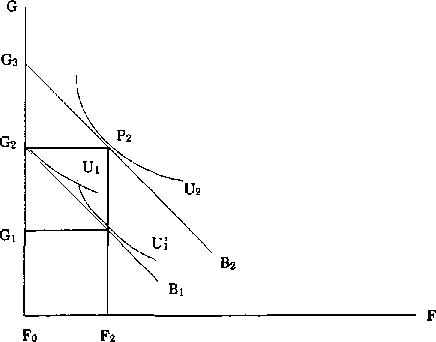
Figure 1
Rights Assignments and Income Effects
Source: Harold Demsetz, “Ethics and Efficiency of Property Rights Systems,” in Time, Uncertainty and Disequilibrium: Explorations of Austrian Themes, Mario Rizzo, ed. (Lexington, Mass.: D. C. Heath, 1979), p. 99.
Income effect
Let us now discuss the income effect. A careful reading of Block (1977a) indicates not that there is an income effect (which might conceivably violate the Coase-Demsetz explicitly made assumption), but that there is not. After all, the flower bed owner starts out with no income, and never gets any, at least in the situation where the court awards pollution rights to the factory owner. It is difficult to see how an income effect can be constructed out of such paltry raw material.
Nevertheless, we can try. What of the “income effect” that can be construed to take place between the situation where the court awards pollution rights to the factory owner, and the one where these rights are awarded to the owner of the flower bed? In the former case, the florist has absolutely nothing. He loses his $100,000 flower bed, because he lacks the $75,000 with which to bribe the proprietor of the factory. In the latter case, he retains the use of this $100,000 flower bed.
One could conceivably call this an “income effect.” There are reasons for and against. On the pro side is the fact that the flower lover gains a value, to himself, of $100,000, as between the cases where he is not, and is, awarded the requisite rights. On the con side is the fact that there is no real income or money or wealth involved. It is all a psychic value.
But it is not really important whether one chooses to call this an income effect or not. The issue between Demsetz and myself is whether or not Coase anticipated this sort of “income effect,” in which case Block (1977a) has indeed violated explicitly made assumptions. And, as we have seen, this charge cannot be substantiated.
Coase stipulated only that wealth effects as a result of court decisions be ruled out of consideration. I didn’t consider them. Instead, I focussed on something entirely different: that one of the parties not have sufficient funds with which to make the requisite bribe. Demsetz conflates the two. That is the substantive issue between us.
Obstacles
Now for an even greater challenge. We have seen that Block (1977a) can pass muster with regard to A. Can it do so even for B?
At first glance, this is an impossible task. We have seen that B demands that we ignore wealth distribution changes, while my 1977a article depends intimately upon certain states of the distribution of wealth. These are dependent on court decisions which, in turn, are intimately associated with wealth effects. Nevertheless, from this rather unpromising beginning, it is still possible to reconcile B with Block (1977a).
It can be done by realizing that B is not a statement about comparative statics, as Demsetz seems to think. For him, the problem with Block is that it compares two states of the world: one where the farmer has the right to impose a smoke prevention device on the factory, and one where he does not. Since there is indubitably a change in the wealth position of the farmer when he goes from one of those states of the world to the other, Demsetz sees a violation of B (changes in the distribution of wealth cannot be ignored) and cries “foul!”
But Demsetz misinterprets Block. This article does not require any dependency on changes in wealth. All it says is that—by use of psychic or specific wealth—a scenario can be concocted in which the Coasian Theorem no longer holds true. No change in wealth is required for this scenario to obtain. All that is necessary is that there be an otherwise penniless farmer who derives more value from his flower bed than the cost of installing a smoke prevention device, and cannot bribe the factory to install it, even though he inhabits a zero transaction costs world. He cannot do so, to repeat, because even though his psychic income is $100,000, and the smoke prevention device costs a mere $75,000, this psychic income is specific to him and him alone. It does not translate into a value recognized by anyone else, particularly including the factory owner. He cannot sell this flower bed to a third party, and use the proceeds to bribe the factory owner. This is because the flower bed, his only possession, is not valued by anyone else besides himself.
It is impossible for him to “give up $75,000 of the other goods” (as claimed by Demsetz in his indifference curve analysis) because he simply does not have such funds available to him. We conclude that property rights determinations are relevant to resource allocation. That property rights are irrelevant depends upon the loser being able to bribe the winner of the lawsuit; if he is unable to do so, the entire scenario does not arise.
The geometry
This is why Demsetz in figure 1 (p. 99) is misdirected. It depends, crucially, on a nonexistent income or wealth effect. How else can one explain the move in budget lines from G2B1 to G3B2? But there are additional problems with this diagram, and with the analysis that accompanies it.12 It clearly indicates that Demsetz has not applied the difference between general and specific wealth. Consider his statement:
If the neighbor has the right to soot-free air, he consumes P2 containing F2 of flowers and G2 of other goods. But since he can sell the right to pollute the air for $75,000, he also can consume no flowers, F0, and G3 of other goods, where G3 - G2 equals $75,000 worth of other goods. He therefore confronts a budget line, B2, that passes through P2 and G3.
The second rights assignment alters the budget line on which he can operate. Given his income and no right to soot-free air, he can consider G2 of other goods and enjoy no flowers or he can give up $75,000 of the other goods, consuming only G1 of these but increase his garden to F2. The second rights assignment, therefore, has reduced his budget line to B1. (p. 99)
The first rights assignment G3B2 is straightforward. As we have seen, I do not criticize Coase only with regard to his case where the farmer is given the right to clean air. He need not do any bribing, here, so no problem arises. The second rights assignment, G2B1, however, is highly problematic. The difficulty is that my assumption (Block 1977a) is that the farmer has no other income, wealth or goods. It is impossible, then, for him to “give up $75,000 of the other goods,” because he simply does not have any amount of goods available to him (apart from his flower bed), let alone an exalted amount such as $75,000. I therefore continue to maintain that property rights determinations are relevant to resource allocation, at least under present assumptions. The Coasian claim to the contrary depends, once again, upon the loser of the judicial decision being able to bribe the winner of the lawsuit; since he is unable to do so, the situation described by Demsetz does not occur.
On the assumption, just for argument’s sake, that indifference curves have a legitimate role to play in economics, how can Demsetz’s figure 1 be altered so as to be consonant with the analysis of the situation? It is very straightforward. G2P2 should be converted into the x axis. All else on the diagram would simply disappear. My assumption is that the farmer has no money at all and only one flower bed, for which no one else will give anything at all in trade. Therefore, there is no budget line. There are no terms of trade offered to the farmer. U2 remains, only the part of it above G2 (now the x axis) depicting a “corner” solution at P2: flowers, but no money.
Twist and turn as one may, it cannot be denied that property rights are relevant to resource allocation. Even with zero transaction costs, the entire bribery scenario can never take place, and it is this upon which the Coasians rely in order to maintain the contrary position.
Let us summarize to this point. We have claimed that Demsetz makes two mistakes. First, he falsely ascribes to me the obligation of overcoming objection B against Block (1977a). But I meant this article as a criticism of the Coasian A, not the Demsetzian B. Second, more radically, he fails to show that even B can be used, successfully, to disparage that article. He seems unwilling to apply the distinction between general and specific wealth, and between comparative statics and an unchanging static situation, to this case.
Contrary to fact conditional
This is a rather complex issue. In order to further clarify, let me attempt yet another way of explicating my side of this debate. What would I have had to have said were Demsetz to be correct in his criticism that I was attacking Coase on a point of which he was fully aware, and indeed had specifically assumed away in his analysis? To reiterate, Coase said that assuming zero transactions costs, resource allocation would be invariant with regard to the way in which the judge decided nuisance cases (statement A).
Demsetz would have been correct had I attributed to Coase the following: that it doesn’t matter, as far as matters of equity are concerned, which conclusion the judge reaches; that the economic welfare of each litigant is the same whether the judge finds in his favor or not; that litigants are indifferent to judicial decisions. But for Coase’s specific assumption, that Chicago economist would have left himself open to such an interpretation. However, because of the fact that this Nobel prize winner did indeed make this assumption, he is guiltless of this charge.
I would have had to have said something along these lines in order to be guilty of the charges leveled against me by Demsetz. In actual point of fact, however, I said no such thing. Instead, I claimed that Coase’s mental experiment couldn’t work because it depends upon the farmer or the factory having an income or wealth with which to bribe its opponent, should it find itself on the losing side of the courtroom battle. If it is only psychic income that the loser can rely upon, no bribe can be financed. But as the Coasian insight depends crucially upon this bribe, the whole scenario falls apart in the absence of the necessary funding.
Even though mistaken, one can readily discern why Demsetz should have confused these two very different concepts. After all, both employ wealth, or income. But we must not lose sight of the fact that they are, at the end of the day, very different. One, Coase’s, deals with questions of equity. The other, mine, deals with Coase’s major and paradoxical finding, that under the assumption of zero transaction costs, court decisions do not affect resource allocation. Coase, unfortunately, needs one more assumption in order to make good on his discovery: that the benefits to both parties in the dispute must be real; they cannot consist of psychic income alone. But this was precisely my point in Block (1977a).
Background
It is now time to consider several aspects of Demsetz’s article apart from those relating to the flower bed-psychic income example. But before we begin, a little bit of context might be in order.
There are several issues separating Demsetz and myself (more broadly, these distinguish from one another the Chicago positivist School of Coase, Posner, Demsetz, et al., and the Austrian-Libertarian School led by Murray Rothbard).
A crucial one is how property rights should be defined, in general and in particular in the (real world) situation where transaction costs make post definitional bargaining difficult or impossible. Demsetz’s suggestion is that they be defined in such a way as to maximize total wealth. My contention is that the rules of homesteading and voluntary trade be employed instead.
But this is merely my own way of characterizing the dispute. Demsetz sees the matter quite differently. In his view, my discussion rests on “emotionalism,” and “strong ethical feelings as to how property rights should be defined” (p. 100). Instead of using reason, my views are supported by little or nothing more that the “definiteness with which they are held” (p. 100). In contrast, he is not “emotional,” nor given to normative “should” statements. He has far more in his intellectual arsenal than mere definiteness. Further, and perhaps even worse, I employ easy examples to buttress my views, particularly the right to be free of the draft.13 The remainder of Demsetz’s (1979) essay is devoted to correcting my many errors and oversights. Let us consider his objections in some detail.
Competition and sports
He starts off by approvingly quoting Frank Knight. According to Knight, there is a strong similarity between “competitive business” on the one hand, and “the sporting view of life” on the other. Both have “a detectable impact on our basic psychological drives” in that in a society earmarked by them, people go out and emulate, or copy others, goal of getting ahead, or succeeding.
But the Knightian analogy between business competition and sports is mistaken. Business competition is a positive sum game, while sports are a zero sum game. Business consists of the concatenation of trades (purchases, sales, hirings, etc.) in a given society. As such, both participants who engage in any particular business arrangement gain, at least in the ex ante sense. That is, neither would have agreed to commercially interact with the other did he not expect to improve his condition thereby. In the sporting arena, in contrast, benefits for one do not necessarily benefit the other.14 On the contrary, when one team scores a goal, for example, far from the other team also gaining an advantage, it actually loses out.15
There is a second error as well. Citing sociobiological findings, Demsetz is led to assert that basic inner drives cannot “be modified significantly by the choice of institutional environment” (p. 97). However, unless “significantly” is used tautologically to deny that different economic arrangements can ever alter people’s psychological states, it would appear that there is ample evidence to the contrary. After 70 years of communist rule, for example, the tendency of people in the former U.S.S.R. to “barter and truck,” in Adam Smith’s felicitous terminology, has been vastly attenuated. At the very least, it has been perverted into something very different than what once it was, or, better yet, what it might otherwise have been. Consider also the different psychological states regarding commercial risk and endeavor that now—in 1995—exist in East and West Germany. Before 1945, the inhabitants of these two areas were one virtually homogeneous people. After experiencing the Sovietization of their economy, there are few in the east of this country who retained the entrepreneurial spirit that characterized the original population, but this still prevails to a great degree in the West.
There is yet another difficulty in Demsetz’s introduction: he pays insufficient attention to the distinction between the normative and the positive. It might be too harsh to charge that he totally conflates the two; on the other hand, he seems to think that “ethical judgments about economic organization” are inextricably connected to the “Austrian economics [which] centers on the praxeology of human action” (p. 97). The truth of the matter, however, is that “the simplistic faith of a few libertarians” (p. 98) is totally a normative concern, while, in contrast, the economics of the Austrian school is totally positive (Egger 1979, p. 119; Rothbard 1973a; Block 1975). Also, Demsetz uses his introduction to take a gratuitous swipe at religion (p. 98); but the less said about this the better.
Austrian Pure Snow Trees
Demsetz offers the case of the Austrian Pure Snow Trees, which are owned by a religious sect. This resource is the only cure for cancer, but these islanders will not allow it to be used for that purpose, reserving it instead for religious worship.16
Demsetz then asks what I consider to be a very misleading rhetorical question. His challenge: Is it really “‘evil and vicious’ to believe it would be preferable for someone else to own the right to this ingredient?” (p. 100).
But it is not at all my contention that this state of the world would not be preferable. On the contrary, given his highly emotional example, it is indeed hard to resist the notion that it would be preferable if the trees were used as a cancer cure.
Emotionalism can be a double edged sword, however. As long as our intuitive imagination has been unleashed by Demsetz in this creative way, why not push the envelope a bit? Consider, then, the case where the views of this religious sect are absolutely correct! That is, if the trees are torn down for so idolatrous and unimportant a purpose as curing cancer, then we’ll all be consigned to Hell forever. Wouldn’t it then be “intuitively appealing” to allow the islanders to continue their ownership of these trees?17
But this is all somewhat beside the point. For my contention had nothing to do with preferability. Rather, it focussed on what the law should be.18 It held, specifically, that private property rights are sacrosanct, and should not be overturned, even for “good” purposes. Even though he does not state the issue in this manner, it will be interesting to interpret Demsetz as if he were making the claim not merely that it would be preferable to divert the Pure Austrian Snow trees from prayer to curing cancer, but that the law should be employed in this manner; or, at the very least, that seizing the trees is permissible, and should not be interfered with.
It is “interesting” to interpret Demsetz in this way, even though he might resist, for the alternative renders his position totally unintelligible. If all he wishes to assert is that it would be preferable that the Austrian Pure Snow Trees be allocated to curing cancer, then we can perhaps agree with him if the religious fanatics have a mistaken theology, and disagree if they are correct. But all the preferring in the world will not change reality in Demsetz’s health oriented direction,19 For this, the forces of law and order must swoop down on the recalcitrant zealots,20 and compel them to yield their Austrian Pure Snow Trees to the medical profession. That is to say, Demsetz must claim that the law should be written so as to attain this result, if that is his actual goal.
But if he does so, he is just as un-value-free, and “emotional,” as he accuses me of being, Demsetz would then be revealing himself as a person with “strong ethical feelings as to how property rights should be defined in such cases” (p. 100).
Even mere preferability, let alone legal justice, runs into problems of interpersonal comparisons of utility. As we have seen, there is no warrant, anywhere within the corpus of value-free economics, for us to compare the utilities of one group of people—e.g., “worshippers” with another, “cancer patients”—and to claim that one outweighs the other. Demsetz as a private citizen may engage in all the preferring he wants; but it is impermissible for him to do so qua economist.
In his view, “the instrumental nature of property rights is made clear in this Austrian Pure Snow Trees example” (ibid.). Perhaps. A better description for property rights in his philosophy would be “provisional.” That is to say, when a “better” use for someone’s property is found—curing cancer instead of worshipping—there is at least a prima facie case for re-ordering the relevant property rights. He states, “A question of the ownership of this ingredient, unavailable elsewhere, arises” (ibid,). Interesting word, “arises.” How is this to be distinguished from advocacy of theft? Can we in this vein say that during the Los Angeles riots of 1992 the question of the legitimate ownership of all of those looted television sets “arose?”
Ethical superiority?
Consider now my claim that “It is the gardener who should have the right to soot free air, and the potential [military] recruit who should have the right to his freedom” (p. 100). Demsetz is highly critical. He states: “One is entitled to an explanation of why these assignments of property rights are ethically superior to their alternatives” (ibid.). We already know of the ethical perspective from which Demsetz chooses between these options: pick that which maximizes wealth or utility, or income. And as we have seen the Achilles heel of his vision—it founders on the rock of interpersonal comparisons of utility—we do well to follow Demsetz’s advice and to offer an explanation of our own.
At one level, the most unsophisticated and commonsensical, we have the right to our freedom, and to not have our lungs invaded by soot particles, because of Adam Smith’s “Obvious and natural and simple system of liberty” ([1776] 1965). If a woman “owns her own body,” as most people would concede, then so, too, do men. If this is true, then slavery, or the draft, is illegitimate. For it means that outside forces can dictate to the supposed owner of the body in question.21 At another level, people should be free and secure in their persons, at least in the U.S., because our constitution guarantees this.
But perhaps the most powerful basis on which this claim to freedom can be defended is the philosophical. The freedom philosophy is ethically superior to all alternatives because is it necessitated by the laws of logic. Demsetz’s position, in contrast, is untenable because it commits a logical contradiction.
This UCLA economist considers himself to be a rational man. He is willing to argue his differences with me. Were this not so, instead of writing an article critical of my own, he would have sought to physically abuse me. But in taking this eminently sensible, legal and moral tack, he has necessarily associated himself with certain positions. When the implications of these are elaborated upon, it will be seen that the arguments he uses to refute me are rendered invalid by his very decision to employ argumentative methods against me in the first place.
By engaging in only verbal fisticuffs, and eschewing physical ones, he has conceded my right to my own body; to be secure in my person; to be free of physical invasion. In a word, by the choices Demsetz has made, he has left himself open to the interpretation that he respects the freedom of others. Since “actions speak louder than words,” we are entitled to discount his anti-freedom verbiage, and to focus on his pro-liberty behavior.
Hoppe explains:
First, it must be noted that the question of what is just or unjust—or, for that matter, the even more general one of what is a valid proposition and what is not—only arises insofar as I am, and others are, capable of propositional exchanges, i.e., of argumentation. The question does not arise vis-à-vis a stone or fish, because they are incapable of engaging in such exchanges and of producing validity claiming propositions. Yet if this is so—and one cannot deny that it is without contradicting oneself, as one cannot argue the case that one cannot argue—then any ethical proposal, as well as any other proposition, must be assumed to claim that it is capable of being validated by propositional or argumentative means. . . . In fact, in producing any proposition, overtly or as an internal thought, one demonstrates one’s preference for the willingness to rely on argumentative means in convincing oneself or others of something; and there is then, trivially enough, no way of justifying anything, unless it is a justification by means of propositional exchanges and arguments. But then it must be considered the ultimate defeat for an ethical proposal if one can demonstrate that its content is logically incompatible with the proponent’s claim that its validity be ascertainable by argumentative means. To demonstrate any such incompatibility would amount to an impossibility proof; and such proof would constitute the most deadly smash possible in the realm of intellectual inquiry.
Secondly, it must be noted that argumentation does not consist of free-floating propositions, but is a form of action requiring the employment of scarce means; and furthermore that the means, then, which a person demonstrates as preferring by engaging in propositional exchanges are those of private property. For one thing, obviously, no one could possibly propose anything, and no one could become convinced of any proposition by argumentative means, if a person’s right to make exclusive use of his physical body were not already presupposed. It is this recognition of each other’s mutually exclusive control over one’s own body which explains the distinctive character of propositional exchanges that, while one may disagree about what has been said, it is still possible to agree at least on the fact that there is disagreement. And obvious, too: Such property right in one’s own body must be said to be justified a priori. For anyone who would try to justify any norm whatsoever would already have to presuppose an exclusive right to control over his body as a valid norm simply in order to say “I propose such and such.” And anyone disputing such right, then, would become caught up in a practical contradiction, since arguing so would already implicitly have to accept the very norm which he was disputing.
Furthermore, it would be equally impossible to sustain argumentation for any length of time and rely on the propositional force of one’s arguments, if one were not allowed to appropriate next to one’s body other scarce means through homesteading action, i.e., by putting them to use before somebody else does, and if such means, and the rights of exclusive control regarding them, were not defined in objective physical terms. For if no one had the right to control anything at all except his own body, then we would all cease to exist and the problem of justifying norms—as well as all other human problems—simply would not exist. Thus by virtue of the fact of being alive, then, property rights to other things must be presupposed to be valid, too. No one who is alive could argue otherwise.
And if a person did not acquire the right of exclusive control over such goods by homesteading action, i.e., by establishing some objective link between a particular person and a particular scarce resource before anybody else had done so, but if, instead, latecomers were assumed to have ownership claims to things, then literally no one would be allowed to do anything with anything as one would have to have all of the late-comers’ consent prior to ever doing what one wanted to do. Neither we, our forefathers, nor our progeny could, do or will survive if one were to follow this rule. Yet in order for any person—past, present or future—to argue anything it must evidently be possible to survive then and now. And in order to do just this property rights cannot be conceived of as being “timeless” and non-specific regarding the number of people concerned. Rather, they must necessarily be thought of as originating through acting at definite points in time for specific acting individuals. Otherwise, it would be impossible for anyone to first say anything at a definite point in time and for someone else to be able to reply. Simply saying, then, that the first-user-first-owner rule of libertarianism can be ignored or is unjustified, implies a contradiction, as one’s being able to say so must presuppose one’s existence as an independent decisionmaking unit at a given point in time.
And lastly, acting and proposition-making would also be impossible, if the things acquired through homesteading were not defined in objective, physical terms (and if, correspondingly, aggression were not defined as an invasion of the physical integrity of another person’s property), but, instead, in terms of subjective values and evaluations . . .
By being alive and formulating any proposition, then, one demonstrates that any ethic except the libertarian private property ethic is invalid. Because if this were not so and late-comers were supposed to have legitimate claims to things or things owned were defined in subjective terms, no one could possibly survive as a physically independent decisionmaking unit at any given point in time, and hence no one could ever raise any validity claiming proposition whatsoever . . .
As regards the utilitarian position, the proof contains its ultimate refutation. It demonstrates that simply in order to propose the utilitarian position, exclusive rights of control over one’s body and one’s homesteaded goods already must be presupposed as valid. And, more specifically, as regards the consequentialist aspect of libertarianism, the proof shows its praxeological impossibility: the assignment of rights of exclusive control cannot be dependent on the—“beneficial” or whatever else—outcome of certain things; one could never act and propose anything, unless private property rights existed already prior to any later outcome. A consequentialist ethic is a praxeological absurdity. Any ethic must, instead, be “a prioristic” or “instantaneous,” in order to make it possible that one can act here and now proposing this or that, rather than having to suspend acting and wait until later. Nobody advocating a wait-for-the-outcome ethic could be around anymore to say anything if he were to take his own advice seriously. And to the extent that utilitarian proponents are still around, then, they demonstrate through their actions that their consequentialist doctrine is, and must be, regarded as false. Acting and proposition-making requires private property rights now, and cannot wait for them to be assigned only later. (Hoppe 1993, pp. 204–7)
What Demsetz does in speaking out against freedom and property rights, but acting in a manner compatible with them, is to engage in a performative contradiction. This is logically identical to a person stating “I am unconscious.” Here, behavior belies a mere verbal claim. Demsetz’s view of property rights, is, of course, a utilitarian one. As he sees things, one cannot define matters in this regard “a prioristically.” Rather, they must be defined in terms of beneficial consequences; in his case, wealth maximization.
You got to have heart
Let us extend the Demsetzian argument in yet another dimension. Suppose that it was not the islanders’s trees that could cure cancer, but rather their hearts. That is, the only way to save the sufferers from this disease would be to kill, not the Austrian Pure Snow Trees, but their owners, the members of this religious sect, and then to take their hearts, chop them up, and feed them to cancer victims. Would Demsetz (“emotionally”) support this “modest proposal” to do just that? It is hard to say. From his perspective, he would have to ascertain the answer to a series of empirical questions before he could vouchsafe us an answer: What is the rate of transformation between dead cultists and live cancer patients; e.g., how many islanders would have to be murdered (killed? final solutioned? homesteaded? harvested?) in order to save how many cancer victims? Which group has higher incomes? Which has more members? Would this act set up anti-wealth precedents for the future? Who are more productive—wealth maximization is the criterion—the heart “donors” or recipients? The only constant in the world of Demsetz (the writer, that is, who ideologically contemplates the justification of theft, enslavement, murder; not the man whose actions show he refrains from engaging in initiatory violence) is the overwhelming need to increase wealth.22
Ultimately, there are only two ways of settling such problems. All others are merely combinations and permutations of these two. On the one hand, there is a provisional or instrumental property rights system. Here, holdings are secure only as long as no one can come up with a plausible reason for taking them away by force. Under this system, either dictators or majorities (or dictatorial majorities) hold the key to property rights. The difficulty is that there are no moral principles which can be adduced to derive any decisions. Presumably, utility or wealth or income maximization is the goal; but due to the utter impossibility of interpersonal comparisons of utility, this criterion reduces to arbitrariness.
On the other hand is a thoroughgoing and secure property rights system. Here, one owns one’s possessions “for keeps.” The only problem here is the temptation to overthrow the system in order to achieve some vast gain, such as the cure for cancer.23 But these temptations are easily resisted as they are inevitably imaginary and artificially constructed. We have yet to be presented with a real world example where there is a clear cut case for massive property rights violations.24
Note how far from reality Demsetz must remove himself in order to manufacture an example that is intuitively consonant with his support25 for what in any other context would be considered murder (hearts) or theft (trees) or slavery-kidnapping (draft).26 It is perhaps possible—in the sense that it would not be logically contradictory—to cite an actual case where a great boon to millions of people is denied by a recalcitrant minority, on seemingly frivolous grounds.27 In very sharp contrast indeed, resort need not be made of fanciful examples to defend the libertarian vision.
Here is another problem. It is Demsetz’s view that in the world of zero transaction costs, it doesn’t matter (for resource allocation purposes, not for the distribution of wealth) who gets the cancer cure trees. Surely in this case transaction costs are very low. There are very few worshippers. It is just a small cult. They are all located on one small island. (If nothing else, the world wide publicity attendant upon the discovery of the magic trees would undoubtedly reduce transactions cost to near zero.)
If we wish, we may even suppose that there is only one worshipper (to get closer to the case of the single farmer with the flowerbed). Under these conditions, Demsetz is logically obliged to maintain that if the Deity is more important than physical health, the Pure Austrian Snow trees will (and should) continue to be utilized for prayer; on the other hand, if the cure is worth more than the worship, the trees will (and should) be used for medicinal purposes. In any case, there is no case for forcibly transferring these trees from the cultists to those afflicted with cancer. The “market” will tend to ensure that the Austrian Pure Snow Trees will come to be owned by those who value them most.
By use of this example we have furnished ourselves with yet another refutation of the Coase Theorem. If under zero cost conditions the sale from islanders to doctors does not take place on its own, this is prima facie evidence for the claim that the trees are worth more to the worshippers than to the victims of cancer. A cancer cure, after all, can only improve the body. Worship aims higher, at the soul.
To be sure, Demsetz asserts that “the religious sect will in no way, for any compensation, allow that ingredient to be extracted” (p. 100). So what? On his own premise, this just shows that the worshippers value the Austrian Pure Snow Trees more than alternative users. If true, this cuts against his own claim that resource allocation is invariant with respect to decisions as to property rights, given zero transaction costs.
In contrast, the libertarian need ask none of these questions. For this philosophy it is sufficient that the religious fanatics, not the cancer victims or their agents, own the curative hearts, or the Austrian Pure Snow Trees. And it really doesn’t matter whether it is body parts, trees, or anything else that is the property in question.
There is yet another problem with Demsetz’s analysis of the Austrian Pure Snow Trees. And this difficulty is pinpointed by no less an authority on property rights theory than Richard Posner (1986). According to him as long as there are zero transaction costs, there is no warrant for seizing the property of another. On the contrary, this is the purpose of markets: to transfer goods from those who value it less to those who value it more.
He states:
The landowner’s right to repel a physical intrusion in the form of engine sparks is only a qualified right. The intruder can defeat it by showing that his land use, which is incompatible with the injured landowner’s, is more valuable. But if your neighbor parks his car in your garage, you have a right to eject him as a trespasser no matter how convincingly he can demonstrate to a court that the use of your garage to park his car is more valuable than your use of it.
The difference between the cases is, at least on a first pass at the problem, the difference between conflicting claims and conflicting uses. In general, the proper [because cheaper and more accurate] method of resolving conflicting claims is the market. If your neighbor thinks your garage is worth more to him than to you, he can pay you to rent it to him. But if he merely claims that he can use your garage more productively, he thrusts on the courts a difficult evidentiary question: Which of you would really be willing to pay more for the use of the garage? In the spark case, negotiation in advance may be infeasible because of the number of landowners potentially affected, so if courts want to encourage the most productive use of land they cannot avoid comparing the values of the competing uses. (Posner 1986, pp. 48–49)
So there we have it. If Posner, another Coasian traditionalist, is correct, Demsetz’s critique of my article cannot be sustained. For the garage and the snow trees examples are directly analogous. One must, according to Posner, convince the garage owner to rent it to the would be user. If one cannot do so, one must do without the services of the garage. The clear implication is that this applies as well to the cancer victims. If they can convince the religious sect to sell them the Austrian Pure Snow Trees for medicinal purposes, well and good. If not, and Demsetz posits this, then, at least according to Posner, the religious group has the “right to eject [the cancer victims] as a trespasser no matter how convincingly [they] can demonstrate to a court that the use of the [snow trees to cure cancer] is more valuable than your use of it” for purposes of prayer. Demsetz’s argument, then, is not only with me. It is also with Posner.
Tennis, Anyone?
Next, consider Demsetz’s analysis of the tennis game. Here, he attempts to show that my philosophy cannot reconcile the demand for noise on the part of tennis players with that for peace and quiet on the part of would be sleepers, while his Chicago Law and Economics perspective can accomplish this task.
As he sees this matter, there really is no debate at all. The only way to settle the dispute between tennis players and sleepers is through the use of the Coase-Demsetz insights. All that needs to be done is to determine the value to each side of daytime and evening accommodation, and (on the assumption of high transaction costs which preclude rearranging property rights) have the judge rule in such a way that the group which benefits more attains the property rights in question. In that way wealth will be maximized, and resources used “efficiently.”
Since, in Demsetz’s opinion,
the dollar value of benefits of assigning rights over noise levels during nighttime hours to would-be sleepers plausibly exceeds the dollar value of costs thereby imposed on would-be nighttime tennis players (p. 101, emphasis in original),
the decision is easy and straightforward. Only an Austrian Pure Snow Tree cultist could fail to see this: grant the after dark noise rights to the sleepers.
Similarly, the assignment to tennis players during daytime hours of the right to control noise levels yields a dollar value of benefits that exceeds the dollar value of costs imposed on neighbors. (ibid.)
So, give the nod to the netmen during the day.
But there are problems with this. First is the issue of information. How is the judge supposed to know who values which asset more highly?28 We have stipulated that there are no possible markets, given out of reach transaction costs. In their absence, such a determination is impossible.
Yes, it seems reasonable to suppose that people would rather sleep at night and play tennis during the day. But is this always so? Might there not be “night people” who prefer the exact opposite? If so, wouldn’t Demsetz’s advice to the court lead to wealth reduction, and inefficiency?
Note that when discussing the night situation, Demsetz only goes so far as to say that it is plausible that the sleepers value the midnight hours more than the jocks. However, when it comes to the hours of sunlight, there is no modifier at all. Demsetz in this case contents himself with the claim that during these hours the right to control noise “yields” more to the racket wielders than to the pillow wielders. Why the difference? Is it that Demsetz mentions the evening case first, and is tentative about this somewhat dubious position, as well he should be, but then gets into the “rhythm” of the thing, and by the time he reaches the daylight hours, has picked up some momentum, and is therefore now more sure about who values what to a greater degree? If so, this seems rather a weak foundation on which to base the edifice of property law. Sure, it is “plausible” to make the Demsetzian supposition; but the very opposite is “plausible” as well. Out of such raw material it is rather difficult to construct an edifice that will withstand the rigors of everyday events.29
Not content to criticize my tennis game, Demsetz throws his racket at Rothbard as well. He castigates his views about homesteading and original ownership as “hopelessly superficial and vague.” He claims that “such a criterion (could not) be applied to the conflict over decibel levels between would-be tennis players and sleepers” (p. 107).
How would Rothbard’s philosophy work in the present case? Simple. Whoever “got there” first would decide whether tennis could be played at night or not.
For example, consider town A, which was first settled by night owls. They sleep all day long. But when the sun sets, the inhabitants come sailing out of their homes, ready to do battle across the tennis net. Sleep? Not in town A—at least not at night. There must be a vampire gene in there somewhere.
The point is, from the Lockian-Rothbardian perspective, the after dark athletes have homesteaded the rights to make noise during the evening. But not any old noise. Only the decibel levels appropriate to tennis. If a normal person moves into town A and complains about nighttime tennis playing, he will have no recourse at law, nor should he. This is because the right to play ball at all hours of the evening is owned by the tennis buffs. However, if these people suddenly escalate, and begin playing steel drums at night, or turn their “ghetto blasters” onto high gear at 3:00 a.m., it is they who will be guilty of a rights violation, since the night sleepers in town A are entitled to the limited peace and quiet afforded them by tennis, but no less than that.
As well, tennis playing would be strictly prohibited during the day, when the inhabitants of A take to their beds. This is because, by assumption, it is the sleepers who have homesteaded the rights to peace and quiet during daylight hours.
Town B, in contrast, is more “normal.” They sleep at night, and work and play while the sun still shines. Anyone engaging in an act of tennis there at night would and should be forced to cease and desist, because he would be trespassing on the property rights of the sleepers who had homesteaded quiet evening hours.
We can now return to the Demsetz critique of my analysis. In his view,
Both rights assignments are equally private and both seem equally productive of individual freedom. Neither exhibits any obvious ethical superiority over the other even when one’s preferences are highly weighted in favor of individual freedom. (p. 101)
But it is clear that under the homesteading assumptions we have made, Demsetz is in error. It is not true that both rights assignments are compatible with the libertarian code. On the contrary, only one is appropriate for town A, and a very different one is appropriate for town B.
Demsetz claims that “Neither exhibits any obvious ethical superiority over the other even when one’s preferences are highly weighted in favor of individual freedom” (p. 101). But in this he is again mistaken. The Lockean system is far more heavily weighted in favor of individual freedom than is that which emanates from the Chicago Law and Economics tradition. In the former case, property rights are “for keeps,” as we have seen. Once they are established, through homesteading, no court can trifle with them. All justification of property titles is traceable to this original ownership, plus a legitimate process of transfer (Nozick 1974). In contrast, in the latter case the courts can always break into the voluntary chain of market transactions, and render them asunder. Harking back to the Posner insight, freedom consists of keeping your own garage if you wish, despite the claims of others, no matter how plausible. In my philosophy, this is guaranteed. In Demsetz’s there is at best a presumption in this direction. But the door is always open. The judge must decide cases on their “merits,” with, presumably, little “favoritism” in the direction of extant owners.
Property Rights Definitions
Another of Demsetz’s parries reads as follows:
Once a private property rights system is defined . . . it can be expected that subsequent negotiations will tend to tolerate only efficient uses of scarce resources. (p. 101)
This, it must be allowed, makes perfect sense. Once property rights limitations are clearly made, the market is perfectly capable of “bartering and trucking” them around in a way that pleases all parties to any agreements. But the key, here, is that property rights be clearly delimited, and reliably be expected to endure. If not, it is extremely unlikely that any deals will be made on the basis of them.
But this is something that Demsetz, at least during his Austrian Pure Snow Trees example, steadfastly refuses to do. There, he eschews “for keeps” property rights systems. If he did so in that context, however, he cannot logically utilize them in the tennis example.
Demsetz dismisses as “hopelessly superficial and vague” Rothbard’s eminently sensible view that
every man has the absolute right of property in his own self and the previously unowned natural resources which he finds, transforms by his own labor, and then gives or exchanges with others. (p. 107)
In particular, Demsetz casts aspersions on the contention that this dictum could be applied to the tennis at night conflict.
However, the libertarian theory of private property rights most certainly can be applied to this case, as to every other. Of course this does not
mean that everyone has the right to use his person as he pleases, for the very question of defining private property rights is that of determining what can and what cannot be done by one’s self. (ibid.)
But Rothbard in the above quoted statement certainly does answer “the very question of defining private property rights.” He agrees, moreover, “that [it consists] of determining what can and what cannot be done by one’s self.” Demsetz in contrast is simply not open to even consider the common sense notion that homesteading, trade, exchange, etc., can serve as a rule by which boundaries can be placed between one person’s fist and another’s chin.
Now it is one thing to assert that the libertarian property rights rule is inferior to his own. Demsetz, however, is not merely claiming this. In this section of his paper, he attempts to maintain that the homesteading rule is incoherent; incapable, even, of unambiguously—albeit wrong headedly—settling boundary disputes. But surely this is erroneous. The Lockean-Rothbardian method, whatever its flaws,30 is after all buttressed by hoary tradition. It, not the Coasian vision, is the established order, at least outside of the economics profession.
Interpersonal Comparisons of Utility
In this section of his paper Demsetz launches a blistering attack on Murray Rothbard. Specifically, Demsetz31 takes issue with Rothbard’s claim that “the free market always benefits every participant, and it maximizes social utility ex ante” (p. 105), His criticism is that Rothbard relies on interpersonal comparisons of utility, “a notion fraught with pitfalls and arbitrariness” (ibid.). This is rather remarkable, emanating as it does from a person, Demsetz that is, who advocates allocating property rights on the basis of their divergent values to different people. This, it would appear, is a paradigm case of the pot castigating the kettle for being black.
But even if Demsetz himself relies on interpersonal comparisons of utility, that does not mean that Rothbard is guiltless of this serious charge. Is he? At first glance, the case against Rothbard seems strong. He does resort to the problematic phrase “social utility,” and Demsetz, reasonably enough, maintains that “The maximization of ‘social’ utility implies interpersonal comparisons of utility” (ibid.).
The problem, here, is that Demsetz has not carefully read this quote. He fails to take cognizance of the import of the phrase “every participant.” Strictly speaking, there are only two participants in every trade. (The free market is no more than the concatenation of all such trades.) And surely, at least in the ex ante sense, both parties to the commercial interaction benefit. That is, “the free market always benefits every participant” or all participants. It is in this sense, and this sense alone, that the market maximizes “social utility.” Interpersonal comparisons of utility simply do not enter the picture. If I buy a newspaper for $1.00, then both the vendor and I benefit. We (the two of us, that is) all gain. Every one of the two of us is better off. Social utility increases. That is, the total utility of myself and the vendor rises. This is not due to a comparison of his utility and my own, but rather to the fact that the utility of each of us, in the ex ante sense, is enhanced by the trade. In this sense, also, there is unanimity: all of the trading partners, me and the newsdealer, the totality of the two participants, unanimously agree to interact in this manner in the expectation of gain.
Demsetz sees matters very differently. For him, the market yields both “beneficial and harmful effects” (p. 105). The beneficial effects are easy enough to discern, but from whence spring the harmful ones? For Demsetz, it is not true that there are only two participants in each market engagement. Rather, there are, at least potentially, thousands of third parties: competitors, buyers and sellers of complements and substitutes. As well there are the external32 diseconomic effects, which give rise to people for whom the traders’ utility enters their utility functions in a negative direction,33 Demsetz correctly sees that if the views of all of these people have to be considered before any trade could take place, that is, if the market prohibited such “harmful effects,” commercial activity would quickly grind to a halt, an abrupt one. In his view, a system that did prohibit such harmful effects, “such as one based on the unanimity principle, would be . . . intolerably impractical” (ibid.).
So there we have it. For Rothbard, unanimity is the guarantee that trade will maximize the social utility of the market. For Demsetz, unanimity is the hangman’s noose of the business; once give it credence, and there can be no market.
How can we decide between these two starkly contrasting views? I propose that we do so based upon the one principle that both these economists claim to hold firm: the impermissibility of interpersonal comparisons of utility. One of their views is compatible with this stricture, and one is not. We will reject the one that is inconsistent with this agreed upon doctrine.
On this basis, it is clear that Demsetz is in logical hot water. On the face of it, his views cannot be reconciled with the impermissibility of interpersonal comparisons of utility. Remember that for him the market is the source of both “beneficial and harmful” (p. 105) effects. If we are to be able to sustain the claim that the market, on net balance, is utility enhancing (let alone maximizing) we must claim that the beneficial effects outweigh the harmful ones. But to do any such thing would surely be an instance of interpersonal comparison of utility. Remember also that it is impossible to apply this criticism to Rothbard. For in his view it is not true that there are beneficial and harmful effects which must be weighed, one against the other, thus giving rise to interpersonal comparisons of utility difficulties. On the contrary, the market for him is the unambiguous locus of utility enhancing activity (always in the ex ante sense.)34
Demsetz tries an end run around this objection. Although valiant, and even brilliant, it unfortunately fails. He argues that his perspective doesn’t need to rely on interpersonal comparisons of utility because the market itself will determine whether or not the harm outweighs the benefit. As an example he mentions the introduction of a new product which benefits customers, but hurts their previous suppliers:
The open market will allow the innovation to succeed only if customers and new product producers . . . are benefitted more than competitive sellers are harmed. If the customers experience a gain worth $100 by shifting their trade to the innovator while the sellers they leave suffer a loss of only $80 as a result, then these sellers will be unwilling to cut prices sufficiently to hold their customers. Whereas, if these sellers suffer a loss of $150 if customers switch, they would be willing to cut prices sufficiently to retain patronage. The innovation succeeds only if the gains it confers, measured in dollars, exceed the cost it imposes. (pp. 105–6)
The problems with this are manifest. The first is based on my original criticism of Coase in terms of psychic income. Consider the situation of the seller who suffers a loss of $150. According to Demsetz, this person would in effect bribe the fleeing customers to return to the fold. But suppose that their loss takes the form of psychic income, and that they do not have the wherewithal to make the bribe. Under these conditions, the scenario falls apart. Second, we must assume perfect competition,35 in that Demsetz mentions “competitive sellers.” But under perfect competition, profits are assumed to be zero, and full employment of all land, labor and capital is a given. Why, then, under these weird and exotic conditions, would anyone even notice the departure of customers, much less offer to do anything about it? Third is the problem that Demsetz here covers only pecuniary externalities. But what about real externalities? What about soot pollution, for example? How is the market going to determine whether the benefits are greater than the costs, without engaging in the odd sport of interpersonal comparisons of utility? Demsetz tosses about figures such as $80, $100, $150; this is all well and good as a hypothetical example. But when push comes to shove, interpersonal comparisons of utility are required if we are to determine real world values. In contrast, the Lockean-Rothbardian position36 clearly need not rely on interpersonal comparisons of utility. The first settler is entitled to either clean or dirty air, whichever he established before the advent of the second settler. The latter must accept the situation as he finds it.37 The issue of interpersonal comparisons of utility does not arise.
Fourth, Demsetz is in effect arguing that we don’t really need extraneous doctrines such as the homesteading principle to determine property rights. Instead, the market can do this for itself without resort to interpersonal comparisons of utility via the principles adumbrated to us in the case of the introduction of the new product. But this is a serious mistake. The market is merely the totality of all trades. Before any commercial interaction can properly take place, the issue of legitimacy must be faced. I may give you $1 for a newspaper, but if this arrangement is to be part of the free market, it must be assumed that each of us has valid title to that which we are giving up. For example, if I stole the $1, or you the newspaper, this contract, however described, cannot be considered part of the free enterprise system. To deny this is to argue in a circle. It is to say that market activity can be based, ultimately, upon market activity.
This circularity is too much for even Demsetz to incorporate into his philosophy Indeed, he states:
The definition of rights by the legal system, which precedes market negotiations, of course, does not have the benefit of market-revealed information when ownership decisions are made. (p. 106)
But if this is so, how can he logically maintain that the market is sufficient unto itself to define property rights?
Stability of Property Rights
In the libertarian philosophy rights are stable. Indeed, totally so. This holds true in the sense that theft is strictly forbidden, and so is the law of eminent domain. The only way that property can change hands is through voluntary, e.g., market activity: trade, barter, purchase, gift, gambling, inheritance, etc. Nozick (1974) called this the theory of legitimate entitlements. In this way, all legitimate property titles, at least in principle, can be traced back to the homesteading stage.
The Law and Economics perspective is very much the opposite. Here, stability of property titles is instrumental at best, certainly not intrinsic. Demsetz specifically does not:
endorse frequent involuntary reassignment of such [private property] rights . . . Frequent involuntary reassignment would destroy confidence in the longevity of property rights and all long-run consequences of resource use will tend to be neglected, at least in a world of uncertainty and positive transaction cost. Efficiency calls for a high degree of stability in property rights definitions, but it does not necessarily forbid all involuntary reassignment, especially when high exchange cost or free-rider type problems reduce the efficacy of allocations through the market. (p. 106)
No Marxist, he, but this is hardly a ringing endorsement of property rights. Happily, one supposes, we live in an era of “uncertainty and positive transaction cost.” If not, one would shudder at the prospect of leaving the determination of property rights to the Chicagoans. On the other hand, this is scant comfort, for we most certainly do live in a “high exchange cost” world, and in which, moreover, people like Demsetz see “free-rider type problems” under every bed.
The Panglossian Demsetz arises again when he asserts:
The producer of a new product receives the right to offer it for sale to all potential buyers; producers of rival old products are denied the right to the trade of their customers, and these producers therefore suffer an uncontemplated loss. [There is good reason for this rights assignment. It would be too costly to ascertain who is harmed by how much, or who would be harmed by how much, when a new product is to be introduced.] (p. 106)
But this account is problematic for several reasons. First of all, whenever one hears of government having solved a problem, no matter how simple, one should check one’s wallet; extreme suspicion is the only appropriate response to such claims. Imagine: the very same government which brings us the U.S. Post Office, minimum wage, rent control, tariffs, and thousands of other wealth destroying institutions, has finally “got it right.” It has somehow thrust itself forward into the breach, and come up with a rational property rights determination. If so, it is probably despite its best efforts.
Second, while Demsetz’s account of present law is indubitably correct in some particulars, this state of affairs did not always exist. During medieval times, for example, it was by no means true that people with new products were free to offer them for sale. On the contrary, the guild system was then in place, and monopoly powers were often enjoyed by these government sanctioned cartels. Even nowadays some vestiges of this system still endure. Medical and other occupational licensure laws (Friedman 1962; Williams 1982) prohibit people who wish to, from offering services to customers. In effect “producers of rival old products are not denied the right to the trade of their customers,” at least vis-à-vis doctors and taxi cab drivers who would like to offer their wares, but are prohibited by law from doing so. If the government is so gloriously efficient, how does Demsetz explain these counter-examples?
Third, why “uncontemplated?” Surely every person who ever conducted a business fears the possibility that one day his customers will desert him in favor of a better offer. Indeed, the nightmares of businessmen probably consist of little else. Not that this is relevant to legitimate property rights determination, a normative question. Whether loss is or is not contemplated determines on the positive issue of whether these considerations are capitalized into prices.
Rear End Collision
Demsetz next seeks to buttress his “law is wonderful” thesis by use of the rear end collision case. “The driver of the second car is liable,” he tells us, “‘because’ in the general case the driver of the second car can avoid such accidents more cheaply than the driver of the first car” (p. 108), According to Demsetz, the system works this way for slow speed congested traffic. But for “high speed expressways” where “the driver of a second car has a more difficult time avoiding rear end collisions, . . . we often observe minimum speed limits” (ibid.).38
The implication, here, is that some modicum of efficiency has been attained as far as road and highway operation, legislation, and institutions are concerned. The judiciary is flexible enough to be able to function in two very different kinds of situations: slow and fast speeds. Not only does state law call down penalties on the correct party in rear end collisions at slow speeds (the second car), it even focuses on the correct party at higher speeds (the first car, by forcing it to travel above a minimum speed level.) Its functioning has nothing to do with so philosophical a notion as causation, responsibility, guilt. On the contrary, it is tightly calibrated enough to be able to maximize wealth under, seemingly, all conceivable conditions. Just let it loose, let “the law be the law,” and watch it avoid accidents as “cheaply” as possible.
But there are serious reservations which must be registered about this optimistic scenario. If it is true, why, then, are people being slaughtered like flies on the nation’s highways? Surely, unnecessary deaths cannot be completely irrelevant to wealth maximization. On the contrary, life is the very basis of wealth. Without people to enjoy them, goods and services are just so many wasted molecules and actions.
If the law is so efficient, why does it allow for road socialism, that is, government ownership and management of highways? This is the cause of 40,000 plus traffic fatalities per year, more than two million serious injuries, and untold loss of property values (Block 1979; Woolridge 1970; Rothbard 1973b). If leaving auto travel to the tender mercies of the state is such a good idea, why do commuters in large cities face congestion that virtually strangles movement? We all know that socialism is inefficient.39 What Demsetz does not seem to realize is that this applies not only to steel mills, trains and foodstuffs, but also to motor vehicle transportation arteries. It pertains to both slow speed city traffic and high speed expressways. Judges, in interpreting the law40 so as to allow road socialism, are thus inefficient, contrary to Demsetz. For every penny possibly saved by holding the second driver responsible for accidents on city streets, and placing minimum speed limits on freeways, much more is lost by prohibiting roads from being run on market based private property right principles.
There is a second argument against the position staked out by Demsetz. Take slow speed crashes. How does he know that “the driver of the second car can avoid such accidents more cheaply than the driver of the first car?” Where is his proof? The problem is that in order to adduce any evidence, Demsetz would have to violate the strictures of interpersonal comparisons of utility, something we have seen him on record as opposing.
Third, there is an asymmetry in Demsetz’s analysis. He maintains that in slow traffic the second car must be held liable because he can avoid the accident more cheaply. He states that things are different in fast traffic. Here, logically, we are entitled to deduce that the first driver can more cheaply avoid the accident, and hence must be held liable. But Demsetz never reaches this point. Instead, he contents himself with the comment that “we often observe minimum speed limits on expressways.” But why only “often?” Why not “always,” or at least “almost always?” Could it be that the government sector is not the cheapest conceivable option, as is mandated by the system of socialist law which undergirds it? Why not carry through on the logic of this claim and call for holding liable the first car in a rear end collision on the highway? Alternatively, he could have inverted things; adopted the speed limit policy he uses in high speed cases for local traffic. That is, he could have claimed as efficient a maximum speed limit under congested traffic conditions—rather than a finding of liability.
There is yet another difficulty: the alternative hypothesis has by no means been refuted by Demsetz, The commonsensical notions of cause, blame, fault, come into play here. The reason the second motor vehicle operator is found liable is not that he could have more cheaply avoided the accident, but rather that he caused it. He crashed into the first automobile, not the other way around. He is at fault. This is shown by the fact that if the party of the first part suddenly jammed on his brakes for no reason at all, or, worse, put his gear into reverse and rammed into the party of the second part, no one in his right mind would find the latter liable, despite their relative positions.
Demsetz, himself, of course, would have to agree with this latter point. After all, he states only that “there is a prima facie case that the driver of the second car is liable” (p. 108), not that he always is, or necessarily is. But if so, we arrive at a reductio. How does a Demsetzian determine, in a particular rear end collision, who is liable? He cannot rely merely on the positions of the two vehicles. He has to look beneath this superficiality, to the underlying causal relationship. Namely, he must look to cause, to negligence, to choice, in short, to all the common sense notions he is so anxious to throw out in favor of cost calculations and mutual determination.
Factory vs. Laundry
By his comments on this subject, Demsetz shows himself not so much in disagreement with Rothbard, as unable to comprehend the latter. In Demsetz’s view,
If the owner of a factory considers locating next to an existing laundry, and the owner of that laundry protests in court that soot from the factory will raise the cost of laundering, the factory owner is more likely to be held liable for damages than if it is the laundry that contemplates locating next to an existing factory. (p. 108)
And why is this? It is due
to the generally correct judgment that he who has not yet located his business can move his business to another location at less cost than he who has already fixed his assets into a particular location. (p. 108)
Demsetz castigates Rothbard for eschewing this wealth maximization based analysis, and instead determining the property rights in this case on the ground “that every man has the absolute right of property in the previously unowned natural resources which he finds” (p. 108).
If this is the best Demsetz can find in Rothbard as an answer to this question, he is dealing with a straw man. To be sure, Demsetz’s is an accurate portrayal of a view Rothbard has expressed. But Rothbard did so in another context. In this context, Rothbard would say nothing of absolute property rights. Instead, he would utilize the homesteading principle. If the factory was located there first,41 it would have homesteaded the right to spew forth soot into the area under contention, in Rothbard’s view. That is why the Johnny-come-lately laundry would have to take the air as it found it, not because of absolute property rights in virgin territory. Alternatively, if the laundry were the original homesteader, it would be deemed by Rothbard to have established rights to enjoy the same air quality it found upon arrival, namely, pure.42 This firm would be granted an injunction against the late arriving factory polluter not because of the costs of moving people before they establish themselves, not because of the notion of absolute property rights in hitherto unowned resources, but because of the homesteading maxim: first come, first served. The first arrival gets the right to interact with nature as he sees fit.43 Demsetz, in other words, has not succeeded in achieving “real disagreement” with Rothbard, He does not even understand the view of the latter, a necessary precondition.
Nor is his own perspective in this regard above reproach. Based on his statements, one would expect symmetry from Demsetz. It shouldn’t matter who locates in the given area first; the newcomers should always have lower relocation costs than the established firm—before, that is, he has put down roots. Therefore, the property rights nod should always be given to the business concern with assets fixed into the geographical space.
In the event, however, we are disappointed. This works just fine when the soot creating factory owner is the new kid on the block. However, when it is the laundry’s turn to play newcomer, this no longer holds. Nor are we vouchsafed any explanation as to why not.
Boat Dock
Nothing daunted, Demsetz next illustrates his philosophical perspective with a case in which a boat and a moving dock collide, leaving the latter damaged. In his view, it is nonsense to think that the former caused the harm and is thus liable, while the latter was the recipient of the harm and is thus the victim. Why? Because “all motion is relative” (p. 108). One could with equal reasonableness say that the boat bashed the dock, or vice versa. And attempt to discern blame or fault would be foolish.
Demsetz’s alternative scenario fairly leaps off the page at us. Whoever “could have prevented the damaging interaction at least cost . . . is viewed as ‘causing’ the accident” (ibid.). He does not explicitly state that this party should be held legally responsible for the accident, but this is the clear implication.
We have already seen that the impossibility of interpersonal comparisons of utility could bar the court from making a non-arbitrary determination of least cost. In the economic sense cost is the next best opportunity foregone by taking any action. This, by its very nature, can only be known by the economic actor himself, and not by anyone else, such as a Coasian-Demsetzian judge.
Let us however explore not the economic notion of cost, but rather Demsetz’s stipulative definition. One possible tack he could have taken would have been to maintain that if a boat and a dock crash together, and this causes damage to either, the owner of the one who failed to put in place protective barriers (e.g., rubber tires) should be found liable.44 This appears to be the logical conclusion, since “an ounce of prevention is worth a pound of cure,” and Demsetz is, if nothing else, an avid proponent of wealth maximization. The problem, here, though, is that it all depends upon one’s level of time and risk preference. The old adage applies, clearly, if the boat/dock owners are risk avoiders or even risk neutral, and have a low time preference. But if their preference for risk is intense enough, and their time preference rates are high enough, it may, paradoxically, be cheaper to “go full speed ahead and damn the possible, later, interactive damage consequences.” That is, the rational course of action is to gamble: to use no protection at all.
Let us now abstract from objections based on time or risk preference and consider the case in which, for some reason, neither the boat or dock owner uses such protective devices. One could maintain that cost45 is proportional to the length of the side of the edifice, and that since the dock is larger than the boat, the latter is the least cost avoider, and should hence be penalized for any crash. However, even though this is true, the precise area where the two may come into contact with each other is precisely the same. That is, a 100 foot boat may only hit 100 feet of a 1,000 foot dock, no more, no less.46 So this is no solution to the problem, since the cost of installing rubber tires is identical.47
Now let us assume that the costs of tire installation (for any given perimeter) is cheaper for the dock than for the boat because the former is more stationary, is located closer to the land (where used tires may more cheaply be found), is closer to sources of cheap labor, etc. Here, at last, we would have a relatively clear cut non-arbitrary judicial decision48: the owner of the dock, not the boat, is the least cost accident avoider, and hence should be legally liable.
There are still problems, though, even in this “clear cut” case. It is always possible to ask the following questions: The dock owner is the least cost avoider of the accident, but is he responsible for it? Is it just to penalize someone, given that he didn’t cause an accident, merely because he could have avoided it more cheaply than someone else? The answer that springs to mind is No, it is not just to penalize a person who has not caused an accident,49 even though he could have more cheaply avoided it.
Demsetz’s thinking, however, does not lie in this direction. Instead of speculating about different cost scenarios, he focusses on one: “the dock was rotten for want of maintenance” (p. 108). But why would this make it cheaper for the dock owner to invest in taking ameliorative action? To be sure, it would presumably be easier for the dock owner to repair his own dock than for the boat owner to do this for him (at the very least, the latter would have to undergo the expense of obtaining permission from the former in order to do this). The question is, why would it be less expensive for the dock owner to repair his facility than for the boat owner to take defensive measures? One possibility leaps to mind. Suppose that the dock’s state of disrepair consisted of protruding material sticking out into the water with a sharp point at the end of it. For example, if there were a knife edged pole which extended off the dock 20 feet into the water, this would require that the boat come equipped with a 21 foot thick coating of rubber tires. As this is clearly more expensive50 than repairing one protruding 20 foot sharp pole, Demsetz’s case is made: the dock owner should have ordered and paid for the necessary repairs. Since he didn’t, and he could have done it more cheaply than bedecking the boat with a thick layer of tires, he should be liable for any resulting accident.
Demsetz reckons without one point however. What renders this example intuitively obvious is this sharp pole, sticking out into the water as it does. That is why it is proper to hold the dock owner liable for the accident. That protuberance offends our sense of justice; without it, we would be outraged by holding the dock owner responsible, merely because he was the least cost avoider.
This pole also makes the case for the alternative hypothesis based on blame. If the pole (attached to the dock) and a boat ram into each other, it is no longer true that “all motion is relative.” On the contrary, it is now clear that one person caused the accident, and the other was the victim. Even more telling, it is by no means clear that the incident should still be labelled an accident. Surely, a dock with an extending pole is more like an accident waiting to happen (e.g., a threat of initiatory violence) than a normal accident. When one goes walking down the street waving a big pole around, if it connects with an innocent person the result is not so much an accident as it is assault and battery.
There is a much more basic attack to which Demsetz opens himself. Just as he is a road socialist, he is also a water socialist.51 The point is that the whole problem of boat vs. dock liability arises because the water upon which both sit is an unowned resource. According to the Lockean—Rothbardian theory with which we are contrasting Demsetz’s Law and Economics perspective, this state of affairs is unnatural and improper. In this view, the law should allow for the private ownership of bodies of water, such as lakes, rivers, streams, seas, oceans, etc.52 If it did, problems of the sort mentioned by Demsetz simply would not arise.
For example, suppose I owned a lake. And on this lake there appeared the Demsetzian dock and the Demsetzian boat. I, as owner of the body of water in which they both sit, would have the legal right to determine the liability rules for accidents. Just as the private owner of the highway sets the rules of the road, so too does the private owner of the body of water determine the laws which shall prevail on the lake or ocean.53 Under these conditions, in one fell swoop, the whole problem would disappear. Now it may well be that if I set up the wrong liability rules I will go bankrupt. After all, I will be competing with every other lake owner in the area for customers, and if any part of my service is found wanting—cleanliness, fish stock availability, access roads, or liability rules—I will face the threat of Chapter 11 reorganization. And this is where Demsetz comes in as a force for good. It may well be that his least-cost-avoider principle—however much wanting we have found it to be on purely economic grounds—may be of some service to lake owners. If so, we may wish Demsetz Godspeed in his entrepreneurial task.
In other words, Demsetz’s Law and Economic perspective serves a putative economic role under water socialism. Someone must advise judges on liability rules from an economic perspective, and his theory, no matter how problematic, at least serves this role. But under water freedom, the perspective reduces to a mere managerial technique. Here, Demsetz can take his place alongside biologists who advise the lake owner on fish stocks, sanitation engineers who recommend policies on water cleanliness, etc.
Why do the Demsetzians of the world spend their time on endless ruminations about least cost avoiders? One possible explanation arises from the insight of water socialism. There is a long socialist tradition of blaming the market for what are really problems of interventionism, or the lack of markets based on private property rights. For example, they castigate free enterprise for unemployment, without realizing that this problem stems from unions, wage legislation and the lack of a one-hundred-percent gold standard; they tax capitalism with the housing (homelessness) crisis, which is actually caused by a plethora of interventions, such as rent control, welfare, zoning, urban “renewal,” etc. They hold the market responsible for crime, not the government with its mismanagement of welfare, prisons, education, drugs, etc. Road and water socialists make a similar mistake. They see numerous externality and liability problems. Not realizing that these are the result of interventionistic elements in the economy, they do not see markets and private property rights as the solution. Instead, they propose further government incursions, this time judicial ones.
Of course there is an “externality problem” with street lights on sidewalks, but not in shopping malls. This is because the one does not benefit from the institution of private property while the other does. In the latter case, but not the former, the externality is internalized. In similar manner, there is a problem assigning liability to boats and docks which sit on unowned bodies of water; but this problem would not occur under privatization.
Economists see externality problems as widespread, but not within restaurants. Yet they exist there, too, at least potentially. If the tables are located too close to one another, each customer will be a negative externality to the others under the resulting crowded conditions. Management consultants are needed to give locational advice to restaurant entrepreneurs. These problems are widespread, but tend to be ignored by “welfare” and “public administration” economists, because they do not appreciate that the market tends to internalize these externalities, when (and only when) private property rights are allowed.54
Last Clear Chance Rule
Let us now consider Demsetz’s comments on the railroad killing a trespasser by running him over. As usual, this economist is concerned entirely with least cost avoidance efficiency and wealth maximization; rights and wrongs never enter the picture, except for his view that there is nothing more to ethics than efficiency: “It is difficult to ever describe unambiguously other criterion for determining what is ethical” (p. 109) apart from efficiency.
The libertarian answer to the trespasser is rather straightforward. The trespasser is a thief (of services) and should be dealt with the fullest extent of the law. Certainly, there would be no question of holding the victim of this act, the railroad, guilty for going about its legal business of transferring people and goods. If the trespasser is hurt or killed by the train, the blame rests with him, not the victim of the trespass.
Demsetz, in contrast, regards the trespasser who is hit by the train on its own property as the victim. His rendition of his opponents’ point of view is of great interest:
Since the trespasser could avoid the accident at less cost than the railroad, it would seem that efficiency would call for liability to rest on the trespasser even if the railroad made no attempt to warn. (pp. 108–9)
Demsetz dismisses this view as “superficial.” Before proceeding with his analysis in detail, I must note that this is more than passing curious. All during the course of his article (1979), efficiency has been defined in terms of least cost avoidance. Now, however, when Demsetz wishes to defend the last clear chance rule (unless the railroad engineer attempts to warn the trespasser, the railroad is held liable for hitting him) all bets are off. In this case, efficiency is now defined in terms of “the likelihood of saving a man’s life and the value of doing so” (p. 109).
Human life is of course valuable, although this should be at least somewhat attenuated in the case of trespassers. Demsetz, however, is a neoclassical economist, one who lives or dies by the falsifiability principle. If one case can be cited where least cost accident avoiding should not in his opinion entail liability status, he must in all conscience give it up, at least as an absolute maxim. Here, he himself furnishes us with just such a case. However, instead of admitting, or even acknowledging that this concession has shot his own thesis in the foot, so to speak, he blithely moves on.
His concern, now, is with saving the trespasser’s life, and with deterring anything that militates against that goal. The story now becomes more than a little difficult to follow. First, Demsetz avers that the trespasser could have avoided the accident at less cost than the railroad. (He gives no reason to suppose this, but let that pass; this is not the first time he has merely assumed the costs at issue to be greater on one side than the other.) This would seem to imply trespasser liability, at least for him. Then, he reverses field and concludes that the life of this tortfeasor is worth more than the inconvenience to the legitimate owner of the private property in question. (Again, no explanation for this calculation is offered, but let that pass, too.) Clearly, Demsetz is tailoring the rules to arrive at a conclusion he wishes to reach on other grounds.
Judicial Equity
Professor Demsetz does not claim perfection for his system. He freely concedes the possibility of error. Not for him are the niceties of perfect competition, purchased at the cost of irrelevance to the real world. He states
I do not mean to miscalculate the difficulty of the problem, to suggest that mistakes are not made, or to underestimate the complexity of the real institutions used to resolve the problem. (p. 109)
This is all well and good, and certainly imparts a measure of moderation to the proceedings. The only problem is, given the exigencies of interpersonal comparisons of utility, how can Demsetz determine, even in principle, that a blunder has been made in any given case? The same difficulties that face the court in comparing the necessarily subjective costs of one person with another also make it impossible for the analyst open to the possibility of judicial error, such as Demsetz, to be aware of it. For example, let us suppose that a judge rules in favor of a tennis player vis-à-vis a would-be sleeper, because he thinks that the benefits of athletics during the afternoon are worth $100, while the costs foregone by the wannabe sleepers, because there are so few of them at that hour, are only $40. In his opinion, the decision “saves” society $60. Along comes Demsetz, ever ready to find “mistaken” judicial decisions. He pounces upon this one as being in error. To do this, he must make a claim along the following lines. Namely, that the benefit to the racketeer has been overestimated by the judge and in point of fact is only $70, while the costs to the insomniac have been underestimated by the jurist and are actually $90. The point is, the same necessary arbitrariness that faced the judge in his initial determination now casts its baleful countenance upon Demsetz, in his attempt to second guess the member of the court. If the first had no objective considerations upon which to base a decision, then neither does the second (e.g., Demsetz), in his attempt to check for “mistakes.” Whether these miscalculations can be recognized or not, Demsetz thinks there is a force which can overcome this possible lacuna:
There is reason to believe that a series of common-law type decisions will tend to converge on efficient definitions of rights because a legal decision that generates inefficiency is more likely to set in motion a stream of appeals and new cases designed to upset that decision than would be the case had the decision been correct from the viewpoint of efficiency. “Losers” generally have more to gain from upsetting a decision than “winners” have in defending that decision when it has produced an inefficient allocation of resources, and just the reverse when it has produced an efficient allocation. (p, 109)
Even at first glance this seems to be a weak foundation upon which to base the entire Law and Economics edifice. It appears especially flimsy compared with the profit and loss weeding-out system of free enterprise which tends to ensure that extant businesses are the best of an imperfect lot. It suffers in comparison to the economic market in that while the loser of what Demsetz is pleased to call an inefficient decision can indeed launch an appeal, whether it is acted on, or accepted, is entirely at the discretion of the judiciary, the very institution which putatively created the error in the first place. In contrast, under the free market system, the dissatisfied customer can patronize a firm other than the one which initially failed to please him.
In the case of markets, moreover, the firm that fails to satisfy consumers loses out, necessarily so. In comparison, judicial error first cannot be recognized, and second, even if it could, the tendency for mistake making judges to be shorn of their judicial robes on this ground is very weak. Judges are elected, or appointed by a relatively non-responsive political system.55 This is hardly a recipe for accountability.
There is, however, a possible rejoinder open to Demsetz, but I am inclined to doubt that he will wish to make it. What if judges, too, were part of the market? That is, consider a system verging upon free market anarchy (D. Friedman 1989; Rothbard 1970, 1973, 1982a; Benson 1989, 1990) where judges are not appointed through the political process, but are instead market participants, forced to rely upon voluntary payments for their financial sustenance. Then, only the first of these problems would exist.
There is another theoretical difficulty. If it is true that losers have more to gain from challenging an inefficient decision than winners, it is equally true that they will have fewer resources with which to do so. Whether one effect swamps the other is impossible to say. But the upshot should yield little comfort to advocates of judicial equilibrium tendencies such as Demsetz.
Then, too, there is the practical problem. Business concerns which survive the market test of profit and loss are more or less efficient—no matter which criterion is used to make that determination. The same, alas, cannot be said for the political-legal-judicial process. Rather than “efficiency,” the word that springs to mind is the very opposite. Furthermore, if there is an inexorable tendency for good laws and sensible court decisions to emanate from Washington, D.C. and the state capitals, why are they centers of graft and corruption? Apologetics of this sort takes a particular brand of courage, and we can indeed credit Demsetz for showing far more than his fair share of this quality.
As well, there is the legal doctrine of “stare decisis,” a cornerstone of our existing judicial system. This implies a rather slavish respect for precedent, which tends not only not to weed out bad decisions, but rather to entrench them,56 If one ill conceived finding is rendered, all similarly aggrieved parties will not be motivated to re-litigate the issue, as their probability of success is now lower than it was in the first instance. In a monopoly justice system, poor decrees discourage those with valid complaints from litigating.
Private vs. Community Property Rights
Demsetz now returns to a discussion of public goods, free riders, externalities and high transaction costs. It is on the basis of these phenomena that he tries to “rationalize a role for the state” so as to solve the problem of national defense, foreign policy and clean air. His discussion leaves much to be desired.
Demsetz starts off his call for “communal property rights,” i.e., government control, by citing situations “when the gains or costs associated with particular interactions are not confined to a few parties, but, instead, are spread thinly over large numbers of individuals” (p. 110).
William F. Buckley Jr. once described the conservative movement as an entity sitting athwart history, and yelling “No!” It would appear that economists who point out the illegitimacy of making interpersonal comparisons of utility perform a similar role. The problem is, this way of putting the issue runs afoul of interpersonal comparisons of utility prohibitions. How do we know when gains or costs are confined narrowly or spread thinly? Yes, we can note trespass (of people or runaway soot) and, as a result, the problem of dirty air can easily be solved by private property rights institutions. Demsetz allows that
it is difficult to see how costs and benefits can be internalized at practical cost, as would be true with regard to air pollution in any private property rights system that I have been able to envisage. (p. 110)
The problem here, however, is not the market. Rather, it is Demsetz’s lack of imagination. Perhaps some new scenarios would present themselves if he perused some of the libertarian environmentalist literature (Block 1990; Rothbard 1982b; Horwitz 1977). Here, he would learn that the reason we have dirty air is that for decades government judges refused to uphold the trespassing laws against errant soot particles—and that this has nothing to do with externalities, neighborhood effects, costs, etc. Rather, it was a philosophical failure. The point is, interpersonal comparisons of utility present no difficulties to he who seeks property rights violations as the source of air pollution problems; in contrast, it sets up insuperable barriers to the Law and Economics high-transaction-cost hypothesis.
As to national defense, the obvious rejoinder is that “one man’s meat is another man’s poison.” Defense may well be a value to most people in the U.S.—at least as shown through public opinion polls.57 But what about pacifists, for whom a national defense would presumably be a disutility? Unless one is willing to state that either there are no pacifists in the U.S., or that the benefits they receive are somehow outweighed by the losses suffered by the majority—in blatant contradiction to the strictures against interpersonal comparisons of utility—one cannot even talk about the “gains” accrued by national defense. On the contrary, this argument is incoherent (Hummel 1990).
Then, too, there is the misuse of language. By the phrase “communal private property rights” Demsetz does not refer to the decision of individuals to voluntarily pool their legitimately owned resources. Examples of such cooperation which merit the term “private property rights” include the kibbutz,58 the monastery, churches, firms, cooperative and condominium housing developments, stock companies, partnerships, etc. In contrast, Demsetz uses this term to refer to the government’s seizure of private assets for its own purposes. The proper appellation in this case is not the contradiction in terms “communal private property rights,” but rather “lack of property rights,” or “theft.” To assert that a group of people has communal property rights is to imply the notion that they have a right to use the property in any (non-invasive) way they wish, and to exclude others from using them at all. But if the way the property came to the community in question was against the wishes of its original and legitimate owners, then this group of people most certainly does not have their right to use these resources as they wish respected. On the contrary, the rightful owners are forced to give up their property; it is then used in a manner determined by the government, or by a majority of those deemed to be members of the “communal” or “cooperative” group.
This democratic philosophy is not without its flaws. Suppose that a friend of mine and I break into your home, and you catch us in the act of absconding with your bicycle. You protest that this is theft. We criminals, being of a philosophical turn of mind, are willing to debate this issue with you. To prove our point (that this bike is now “communal private property”) we hold an election. First we ask “how many people think the bicycle should be left right where it is, under the control of its [previous] owner, that is, you?” One hand goes up. Yours. Then we ask “How many think it ought to be taken away, and used for communal private property purposes, to be determined by the majority?” Two hands go up. Ours.59 Would such a justification satisfy Demsetz? Hardly.
Ethics
With this as a jumping off point, Demsetz now begins his analysis of ethics. In the case of the familiar public goods, given high transaction costs and the free rider problem, he asserts:
government intervention may be thought to be clumsy, costly, and misdirected, but it is seldom thought to be unethical. Similarly, the opposition to the government’s use of defense forces may be based on its involvement in an immoral war, or its use of an immoral draft, but it is seldom based on the immorality of the principle of using the government to provide for the “common” defense. But when a government confiscates property rights that could have been obtained through the market, as with condemnation proceedings, the military draft, or the nullification of gold clauses during the recession of the 1930s, there is more than a hint of belief that an unethical theft of rights has been perpetuated. (pp. 110–1)
But why is the good professor so sure that none of these things can be justified on Law and Economics grounds? Surely, if we take him at his (interpersonal comparisons of utility) word, these are all empirical questions. Their answers can only be determined after a thorough and exhaustive cost-benefit analysis has been concluded. As it stands now, however, the text makes Demsetz appear as if he has adopted “religious and intuitive faith” (p. 98). After all, in his own view, condemnation of private property and gold clause nullification are not objectionable in principle. How, then, has he come to the conclusion that these acts (even if proven inefficient through empirical interpersonal comparisons of utility calculations) are an “unethical theft of rights?” This would surely surprise his Chicago colleagues.
Demsetz is clearly uncomfortable with the language of ethics. And this should occasion little surprise; after all it is he who took the view that there is no more to morality than economic efficiency. However, there is one exception to this generalization. He pulls no punches with regard to the military draft. Demsetz is on record as equating ethics and economic efficiency. If so, why resort to the language of morality at all? Why not stick to what for him is the tried and true world of wealth maximization?
A Walk Around the Block
Demsetz and I once took a long walk together around the block (as it happens, it was during a break at the meeting of the Mont Pelerin Society in Munich). As we proceeded, a lost man approached us, asking for directions. Demsetz’s comment to me afterwards (since we were both strangers, we could not help him) was that this person was properly allowed by law to break into our conversation to ask directions since the information we could possibly have rendered him would likely be more valuable to him than would the trivial loss of time, and the interruption of the flow of conversation, be costly to us. My reply was that this was properly allowed by law only because it did not constitute an invasion of person or legitimately held property rights.
Several other thoughts now occur to me. First, there were two of us and only one of him. If we make the heroic assumption of equal value placed on time for the three of us, then it is likely that our loss was twice his gain. If there were 5 or 10 of us walking along and talking, then on this account the man almost60 certainly should have been legally penalized for reducing wealth.
Second, I could probably specify conditions under which it would be improper or illegal for one person to break into the conversation of another, except, perhaps, under the most extreme of circumstances. This is a point in Demsetz’s favor, as the criterion appears to depend upon to whom is the interruption more important and valuable: the interrupter or interruptee. But the problem with this is that ex ante, it is extremely difficult to tell. Here private property rights, contrary to Demsetz, can come riding to the rescue. In symphony halls, hospitals, during lectures, movies, the owners can specify “quiet please” rules, which prevent, or at least reduce, the incidence of vocal interruptions. Those who do this and thereby satisfy their customers, will prosper. Those who do not will not. This is why people feel free to break into conversations or not. On the public street, in contrast, this institution cannot work, because the streets are unowned and there are thus no legitimate private property rules which obtain there (street socialism). People are therefore forced to employ the mores learned in other contexts, with sometimes unfortunate results. For example, it is by no means unknown for young males in the inner city to kill people who have merely looked at them. This occurs on the street and in public parks, but more rarely on relatively more well guarded private property.
Paternalism
Our author now enters into a train of thought which might be seen as peripheral at best to Block (1977a) the article he is presumably debating. We shall nevertheless pursue him on these grounds since, as it turns out, there is some relevance to matters of mutual concern after all.
He starts out, reasonably enough, defining paternalism as the “coerced denial of normal contracting rights” (p. 111). One might expect that as an economist concerned with wealth maximization, he would eschew paternalism as contrary to the interests of people involved in mutually beneficial trades. If so, one would be disappointed: “it is not clear . . . that there should be no paternalism, nor how far paternalism may be carried” (p. 111). But this, to say the least, is surely incompatible with wealth maximization, assuming that we are not dealing with children or madmen. After all, if ordinary people cannot be trusted to know their own interests, who can be?
At this point Demsetz goes off into a disquisition on sociobiology. This, it would appear, is an effort to uncover people who can be trusted to act paternalistically, but to do so in the best interests of others, their wards.
The libertarian must look at this entire enterprise with a certain amount of equanimity, since he rejects paternalism right off the bat, on principle. Not so for the benevolent interventionist, such as Demsetz. To him, it is a matter of no little concern that the person assigned the paternalistic role actually carry it out for the benefit of his ward, despite the well known Acton axiom about the corruptibility of power.
Who, then, can be trusted with this delicate task? Sociobiology, according to Demsetz, offers a recommendation: “To a large extent, altruism is limited to kinship relations” (p. 111). Say what you will about this initiative, his defense of “kinshipocracy” is at least novel and inventive. The problem is, there is much more that can be said about Demsetz’s view of it, none of it too positive. From a libertarian point of view the notion of paternalism must be completely negative; but it is even problematic from his own Law and Economics perspective. Where is the argument that paternalism will actually promote wealth maximization? If anything, the reverse should be apparent. Setting aside a man’s decision because his brother, or all five of his siblings together will it, is hardly a guarantee of welfare improvement in his behalf. Nor is there even an expectation that this goal would be attained. If is of course likely that a stranger, or any five people picked at random from the general population, would do far worse than the man’s kin. Sociobiology does give strong evidence for that contention. But so what? Demsetz’s self-claimed brief is to improve economic welfare, not to advance policies that disrupt wealth creation less than even worse alternatives.
There is his positive claim in this context: “Paternalism is, in fact, largely limited by natural selection to intrafamily relationships” (p. 112). Stuff and nonsense! The biggest paternalist the world has ever known, the most thoroughgoing, and, as it happens, the most vicious and depraved, is of course that very institution Demsetz seems so intent on defending: the government. George Washington may have been called the “Father of our country,” but this is meant only in a figurative sense. He and his successors are certainly no kin to the rest of us. And yet, particularly in the last 100 years or so, governments have been exercising more and more paternalistic powers over the entire citizenry.
How else can we interpret the actions of Stalin or Hitler? Each was doing what he thought was his level best for his “kinfolk” (respectively, proletarians and Aryans). Of a more benevolent variety, the actions of such leaders as F.D.R., Kennedy, Johnson, Bush and Clinton may also be interpreted as paternalistic. Yet it is hard to see how the reductions of economic freedom they brought about were actually beneficial.
Competition
If any further evidence of Demsetz’s moral myopia were needed, his discussion of competition more than fills the bill.
He begins by describing the phenomenon:
There are a multitude of methods for competing, ranging from a brick through a rival’s place of business to a reduction in price to the introduction of a superior product. (p. 112)
Even at this level, objections must be registered. In economics, competition is a way of cooperating. Paradoxically, even though business rivals may go “hammer and tongs” at each other, their activity is part and parcel of the market, and such commercial interactions are a cooperative endeavor melding together the goals of millions of people. Its reach is limited only by the extent of the division of labor. Many people think that professional athletic teams are only competing with one another. But economically speaking, they are in a deeper sense engaged in mutual cooperation, putting on a show for the paying customers. For all of the fabled rivalry which occurs in this venue, they cooperate with each other precisely as much as member of other large firms which entertain the public: symphony orchestras, movie companies, etc.
The point is that they refrain from aggression; competition, at least in the economic sense, is limited to non-invasive acts. This even includes boxing. Superficial appearances to the contrary, no aggression takes place in the ring (apart from purposeful head butts, hitting below the belt, and other such rules violations). The ordinary right cross, which in most other contexts would count as aggression, does not qualify as such in this context. For both pugilists, agreeing to take part in this athletic contest, have mutually rendered what would otherwise be considered assault and battery into voluntary, “cooperative” behavior.
Paradoxically, the more competitive is the athletic contest, the more economic cooperation occurs. No one would regularly pay good money to see games with scores like 150 to 0. Thus, without a fiercely battled contest, where the identity of the winner is not a foregone conclusion, little if any economic cooperation will take place.
Given that competition is at bottom a cooperative effort,61 we can immediately see that there is no “multitude” of competitive models, at least not along the lines sketched out by Demsetz. Lowering prices and introducing better products? Yes, of course. But throwing a brick through a rival’s plate glass window? How can that be competitive? If it isn’t cooperative, it cannot be competitive either, at least not in the legal and economic sense. What is it then? It is a private property rights violation, pure and simple. It doesn’t deserve to be listed alongside such peaceful activities as price and quality competition.62
Demsetz does concede that “social scien[tists] and the humanist philosophers” (p. 112) make an ethical distinction between the tossed brick and the lowered price. But biologists do not. Even apart from his glowing rendition of sociobiology, it is clear where Demsetz’s loyalties lie, academic discipline-wise: with the latter.
Am I being unfair to Demsetz? He does, after all, allow that “there is a strong correlation between the efficiency consequences of various forms of competition and the degree to which they are judged to be proper or ethical” (p. 113). He could scarcely make that point if he absolutely refused to draw ethical distinctions between the brick and the lowered price. However, he takes this all back (and more) when it comes to his analysis of monopoly:
The securing of monopoly through legislated protection, however, seems much less likely to yield these gains than the securing of monopoly through superior products. It is difficult for me to see how to distinguish these two sources of negatively sloped demand curves other than by judging their likely contributions to real wealth, and it is only when judging that ethical considerations become relevant. (p. 113)
Here he is, back at the same old ethics-consists-of-no-more-than-efficiency lemonade stand. If he can’t see a moral difference, over and above “likely contributions to real wealth” between attaining single seller63 status by legislative fiat and by satisfying customers, it is hard to see how it can be claimed that he has any moral faculty at all.
There are those, moral relativists, who think that by definition every society, every culture, and even every individual absolutely must64 have a moral faculty. Even the Nazis and Communists, who killed millions of innocent people, are defended in some quarters as having a moral sense. To the query “How can this be?” they reply “They just have a different sense of morals.”
But there is a fallacy here. Suppose we come across a new breed of creatures, who speak an entirely different language.65 Our first task in setting up relations with them is to create and English - X language dictionary. We begin by pointing to an object, and saying “cup.” They are accommodating, and point to various cup like objects, and say “plunk” as they do so. They apply “plunk” to glasses, bowls, pots and pans and wastepaper baskets. They refuse to apply it to apples, bananas, bicycles and pencils. We conclude the “plunk” and “cup” are rough translations. Next, we point to the appendage at the end of our leg, and say “foot.” They point in the same direction on themselves and say “garr.” We say to ourselves, “aha, ‘foot’ and ‘garr’ are equivalents in our two languages.” But then, rather to our dismay, they point to a rock, a rowboat and a giraffe and use the same word “garr.” What are we to make of this? Are we to still maintain that “garr” and “foot” are the same, only that their understanding of “foot” is different than ours? Not a bit of it. We must, reluctantly if need be, conclude that they simply do not have a concept of “foot” in their language, at least not commensurate with our own.
Now suppose we meet a “Martian.” We are trying to determine whether this creature has a concept of morality or ethics. Thanks to our previous considerations, this is by no means a foregone conclusion. Like good logical positivists, on the contrary, we are going to test this proposition. We start out well enough. We maintain what we take as a paradigm case of morality: “It is wrong to kill an innocent baby.” Now we invite the Martian, who we have reason to believe speaks the same language, to give us another instance of an ethical statement. He starts off on a good note with “a thrown brick . . . and . . . a reduction in price . . . [are] not viewed as equally ethical” (p. 112). At least this Martian is clearly making the crucial distinction. However, then he goes and ruins it by saying:
Efficiency seems to be not merely one of the many criteria underlying our notions of ethically correct definitions of private property rights, but an extremely important one. It is difficulty even to describe unambiguously any other criterion for determining what is ethical. (p. 109)
In other words, “ethical” is exhausted completely by “efficient.” Alternatively, “ethical” means no more than “efficient.” Are we to say that the Martians have a perfectly reasonable, coherent, sensible understanding of the moral realm, it just happens to be somewhat different than our own? Not at all. The plain fact of the matter is that Demsetz lacks an understanding of ethics, in the same way an atheist does not have an appreciation of God, or a color blind person of color, or a tone deaf person of music. Even his distinction between brick throwing and price reducing can now be understood in this vein. He means by it (or at least denotes) no more, and no less, than that bricks are far less efficient in an economic sense than are price alterations. The logical implication is that if this situation were somehow reversed, that is, that brick throwing became a better means to achieve wealth maximization than diddling with prices, then Demsetz would line up behind the former and eschew the latter. Nor would it be a matter, for him, of balancing the moral against the efficacious; reluctantly accepting the wealth maximization goal, but regretting the loss of morality. In the Demsetz world view, the two are precisely the same. There is nothing to regret. There is no trade off. If brick throwing gets us out onto the highest indifference curve possible, well by gum and by golly, that is the very meaning of ethical behavior.66
Conclusion
This way of interpreting Demsetz is buttressed by his concluding remarks. Here we are treated to yet another version of ethical relativism: “The ethical weight accorded efficiency in property rights assignments is thus dependent on the ethical properties of prevailing tastes and preferences” (p. 114).
These tastes and preferences, in turn, are determined by survival. “Life styles that promote survival come to be viewed as ethical. . . . Our present preferences and tastes must reflect in large part their survival promoting capabilities” (ibid.). This means that survival, a sort of “super efficiency,” is what ethics amounts to.
Now, there is a good bit of truth to this. Our moral codes hardly amount to a recipe for mass suicide. On the contrary, the rules of the Bible, the Talmud, and other religious documents have passed the test of time; those societies living in at least rough accordance with them have prospered to a far greater degree than those which have not. However, this is no warrant for equating human survival with morality. Suppose, just suppose, that there were hundreds of intelligent species besides our own in the universe, and that for some perverse reason our survival depended upon killing them all, even though they did not in any way directly threaten our survival. (For example, a Super Being such as “Q” in the Star Trek series demanded that we kill everyone else, or he would kill us.) Here is a case where no facile equation of morality and human survival could pass muster.
Demsetz imparts a morally relativistic “spin” to his understanding of the relationship between survival and ethics. It depends on time, or place, or war, or peace, or population size, or the degree of wealth or poverty. He states:
what has survival capability in one environment, or century, may not do so well in another. A command social structure is likely to do better in small tribal societies than in large complex societies. War and peace are likely to bring forth different ethical precepts. A society of plenty can tolerate more altruism toward special hardship cases than can a society of poverty. We are bound to view the proper resolution of legal problems from the perspective of what presently seems efficient. (p. 115)
Yes, yes, different things may be required for survival in different contexts, but this doesn’t make what is moral in one case immoral in another. It doesn’t matter that a command economy can do more harm in large complex societies than in small simple ones. It is wrong in both cases to violate economic freedom. It is simply not true that rape, theft, brutality, etc., which are far more prevalent in war than in peace become moral on that ground. Charitable giving is easier to finance (and less needed) under general affluence than poverty, but it is still a moral act in both cases.
In contrast to the amoralism emanating from Demsetz, Knight is a pillar of objectivist rectitude on this matter. Says he:
The conditions of survival are merely the laws of biology. It may well be the part of prudence to act in accordance with them, assuming that one wants to survive, but it can hardly be associated with the notions of right or duty, and if these have no meaning beyond prudence the realm of ethics is illusory. (p. 115)67
Needless to say, the present author warmly supports this view. The problem is, Demsetz offers this citation only to criticize Knight. His criticism amounts to little more than a rehearsal of sociobiology, only applied, now, to ethics itself: “it is the set of ethics that does survive and prosper that will identify what is efficient and what is not” (p. 115).
Demsetz ends his essay on what can best be described as an uncertain note. On the one hand, he seems to see the present debate—between he and Coase on the one hand and Rothbard and myself on the other—as wasteful:
Those who value freedom highly would seem to be wasteful of their efforts and those of others to issue a call to debate where no substantial issue of freedom is involved; the choice between alternative private property definitions would seem a case in point. (p. 116)
But this is unacceptable. It is not true that no substantial issue of freedom is involved in this disagreement. On the contrary, there is a chasm as large as the Grand Canyon separating the two sides. In my own view, what Demsetz is pleased to call his “alternative private property definition” is no such thing. Rather, it is almost a complete abnegation of property rights. Moreover, it is a chimera. It is an attempt to define property not in terms of past accomplishments—homesteading, trade, etc.—but on the basis of supposed future consequences. It is based on a judge’s arbitrary opinion as to who can best utilize a given resource. Demsetz, for his part, is equally critical of the Locke-Rothbard view. He cannot paper over this dispute in the last paragraph of his essay after devoting all of his efforts to a critique.
On the other hand, appearing to take this all back, he seems to find some value in debate, “as in arguing for deregulation” (p. 116). This, too, is hard to follow, as the entire Demsetzian edifice is based on a call for regulation of markets, albeit by judges, not by politicians, bureaucrats, licensing boards, wages and price controllers, and other more typical regulators.
Consider the counterargument: Demsetz doesn’t at all call for regulations; he merely favors a different kind of decision in property rights disputes. However much one may disagree with his views, it is improper to call them akin to a defense of economic regulation.
The problem with this defense is that regulations, too, are “merely a different kind of decision in property rights disputes.” Take rent control for example, the very paradigm case of an economic regulation. Is it not true that this is “merely a different kind of decision in property rights disputes?” The landlord wants to charge $500. The sitting tenant thinks that it would be more fair for him to pay only $300. Is this not a property rights dispute?
But couldn’t this also be said of the free enterprise answer to the dispute—to which undoubtedly Demsetz would agree—namely, that the landlord should be able to set whatever rent he wishes for his property? No. It would be a travesty of language to maintain that defending the landlord’s right to own his property, and to demand whatever rent he wishes for it is tantamount to regulating his business.
As it happens, it is inconsistent with his general philosophy for Demsetz to take an anti-rent control stance, however much he may wish to do so in other contexts. For if he is to remain true to the Coasian Law and Economics doctrine, he cannot blithely condemn all rent controls. On the contrary, he must first determine whether the landlord’s use of the rental fee of $500 will benefit him more than the loss of this money will negatively impact on the tenant. Who says, after all, that the landlord is the “rightful” owner of the property in question? For the Demsetzes of the world, this should always remain an open question or perhaps a meaningless one. It is for the judge to decide upon this, and he should do so, as we have seen, based upon which decision will maximize total wealth. There is absolutely no reason to suppose that this always implies that landlords should be allowed to keep their property, let alone unilaterally set the rent level. It must of course be conceded that Demsetz and his colleagues have been in the forefront of the effort to marshall evidence showing the deleterious effects of rent control. However, as a consistent Demsetzian, he cannot universally condemn this law.
Our author ends his essay with a ringing call for freedom. But what can this possibly mean, if freedom consists of no more than wealth maximization? I would find his well spoken call for freedom far more eloquent if for Demsetz there were some difference between freedom and economic efficiency.
As I see matters, far from there being no real disagreement between us, we have only begun to scratch the surface of disputation. What we sorely need is more debate, not less. I therefore invite Demsetz and other devotees of the Law and Economics philosophy to continue the discussion. It is the only hope of attaining the truth on these very interesting and important matters.
References
Anderson, Terry. 1983. Water Crisis: Ending the Policy Drought. Washington D.C.: Cato Institute.
Armentano, Dominick T. 1982. Antitrust and Monopoly: Anatomy of a Policy Failure. New York: Wiley.
———. 1972. The Myths of Antitrust. New Rochelle, N.Y.: Arlington House.
Armstrong, Don. 1982. Competition us. Monopoly. Vancouver, Canada: Fraser Institute.
Benson, Bruce L. 1989. The Enterprise of Law: Justice Without the State. San Francisco: Pacific Research Institute for Public Policy.
———. 1990. “Enforcement of Private Property Rights in Primitive Societies: Law Without Government.” Journal of Libertarian Studies 9: 1–26.
Block, Walter. 1975. “On Value Freedom in Economics.” American Economist 19 (Spring): 38–41.
———. 1977a. “Coase and Demsetz on Private Property Rights.” Journal of Libertarian Studies 1, No. 2 (Spring): 111–15.
———. 1977b. “Austrian Monopoly Theory—a Critique.” Journal of Libertarian Studies 1, No. 4 (Fall): 271–79.
———. 1979. “Free Market Transportation: Denationalizing the Roads.” Journal of Libertarian Studies 3, No. 2 (Summer): 209–38.
———. 1983. “Public Goods and Externalities: The Case of Roads.” Journal of Libertarian Studies 7, No. 1 (Spring): 1–34.
———, ed. 1990. “Environmental Problems, Private Property Rights Solutions.” Economics and the Environment: A Reconciliation. Vancouver, Canada: Fraser Institute.
———. 1991. Economic Freedom: Toward a Theory of Measurement. Vancouver, Canada: Fraser Institute.
———, ed. and et al. 1992. “Institutions, Property Rights and Externalities: The Case of Water Quality.” Agriculture and Water Quality: Proceedings of an Interdisciplinary Symposium. Guelph Centre for Soil and Water Conservation. Guelph, Ontario: University of Guelph Press, Pp. 191–208.
Becker, Gary. 1964. Human Capital. New York: National Bureau of Economic Research.
Buchanan, James M. 1969. Cost and Choice: An Inquiry into Economic Theory. Chicago: Markham.
Coase, Ronald H. 1960. “The Problem of Social Cost.” Journal of Law and Economics 3: 1–44.
———. 1974. “The Lighthouse in Economics.” Journal of Law and Economics 17: 357–76.
Cordato, Roy E. 1992. Welfare Economics and Externalities in an Open-Ended Universe: A Modern Austrian Perspective. Boston: Kluwer.
———. 1989. “Subjective Value, Time Passage, and the Economics of Harmful Effects.” Hamline Law Review 12, No. 2 (Spring): 229–44.
Demsetz, Harold. 1966. “Some Aspects of Property Rights.” Journal of Law and Economics 9 (October).
———. 1967. “Toward a Theory of Property Rights.” American Economic Review 57: 347–59.
———. 1979. “Ethics and Efficiency in Property Rights Systems.” In Time, Uncertainty and Disequilibrium: Explorations of Austrian Themes, Mario Rizzo, ed. Lexington, Mass.: D. C. Heath.
Egger, John B. 1979. “Efficiency is Not a Substitute for Ethics.” In Time, Uncertainty and Disequilibrium: Explorations of Austrian Themes. Mario Rizzo, ed. Lexington, Mass.: D. C. Heath.
Epstein, Richard A. 1985, Takings: Private Property and the Power of Eminent Domain. Cambridge, Mass, and London, England: Harvard University of Press.
Friedman, David. 1989. The Machinery of Freedom: Guide to a Radical Capitalism. 2nd ed. La Salle, Ill.: Open Court.
Friedman, Milton. 1962. Capitalism and Freedom. Chicago: University of Chicago Press.
———, and Rose Friedman. 1980. Free to Choose. New York: Harcourt, Brace, Jovanovich.
Hamowy, Ronald. 1978. “Law and the Liberal Society: F. A. Hayek’s Constitution of Liberty.” Journal of Libertarian Studies 2, No. 4. (Winter): 287–293.
Hayek, F. A. 1960. The Constitution of Liberty. Chicago: University of Chicago Press.
———. 1989. The Fatal Conceit: The Errors of Socialism. Chicago: University of Chicago Press.
Hoppe, Hans-Hermann. 1989. A Theory of Socialism and Capitalism: Economics, Politics and Ethics. Boston: Dordrecht.
———. 1993. The Economics and Ethics of Private Property: Studies in Political Economy and Philosophy. Boston: Kluwer.
Horwitz, Morton J. 1977. The Transformation of American Law: 1780–1860. Cambridge: Harvard University Press.
Hummel, Jeffrey. 1990. “National Goods vs. Public Goods: Defense, Disarmament and Free Riders.” Review of Austrian Economics 4: 88–122.
Knight, Frank H. 1935. The Ethics of Competition. New York: Harper.
Krecke, Elisabeth. 1992. “Law and the Market Order: An Austrian Critique of the Economic Analysis of Law.” Paper presented at the Ludwig von Mises Institute’s Austrian Scholar’s Conference. New York City, October 9–11.
Landes, William M. 1971. “An Economic Analysis of the Courts.” Journal of Law and Economics 14.
———. 1973. “The Bail System: An Economic Approach.” Journal of Legal Studies 2.
———, and Posner, Richard A. “Adjudication as a Private Good.” Journal of Legal Studies 8 (1979): 235–84.
Locke, John. 1960. An Essay Concerning the True Origin, Extent and End of Civil Government, Vol. 27–28. In Two Treatises of Government. P. Laslett, ed. Cambridge: Cambridge University Press.
———. 1955. Second Treatise of Civil Government. Chicago: Henry Regnery.
Mises, Ludwig von. 1963. Human Action. Chicago: Regnery.
———. [1969] 1981. Socialism. Indianapolis, Ind.: Liberty Fund.
North, Gary. 1992. The Coase Theorem. Tyler, Texas: Institute for Christian Economics.
Nozick, Robert. 1974. Anarchy, State, and Utopia. New York: Basic Books. Pigou, Arthur, C. 1912. Wealth and Welfare. London: Macmillan.
———. 1932. The Economics of Welfare. 4th ed. New York: St. Martin’s Press.
Posner, Richard A. 1986. Economic Analysis of Law. 3rd ed. Boston: Little Brown.
Rothbard, Murray N. 1962. Man, Economy and State. Los Angeles: Nash.
———. 1970. Power and Market: Government and the Economy. Menlo Park Calif.: Institute for Humane Studies.
———. 1973a. “Value Implications of Economic Theory.” American Economist 17 (Spring).
———. 1973b. For a New Liberty. Macmillan, New York.
———. 1977. “Toward a Reconstruction of Utility and Welfare Economics.” San Francisco: Center for Libertarian Studies, Occasional Paper #3.
———. 1982a. The Ethics of Liberty. Atlantic Highlands, N.J.: Humanities Press.
———. 1982b. “Law, Property Rights, and Air Pollution.” Cato Journal 2, no. 1 (Spring).
Samuelson, Paul A. 1976. Economics. New York: McGraw Hill, 10th ed.
Smith, Adam. [1776] 1965. An Inquiry into the Nature and Causes of the Wealth of Nations. New York: Modern Library.
Williams, Walter, E. 1982. The State Against Blacks, New York: McGraw-Hill.
Woolridge, William C. 1970. Uncle Sam the Monopoly Man. New Rochelle, N.Y.: Arlington House.
Walter Block is associate professor of economics at the College of the Holy Cross. The author wishes to thank Gary Anderson, Michael Levin, Murray Rothbard, Karen Selick, and two anonymous referees for helpful comments and suggestions. The usual caveats apply.
The Review of Austrian Economics Vol. 8, No. 2 (1995): 61–125
ISSN: 0889–3047
On the other hand, “indifference” is a perfectly good English word, and it must refer to something in order to be used coherently. In ordinary language, it refers to cases where we just don’t care very much which of two alternatives we choose. But once we act, we demonstrate, by that very fact, that we preferred the option we took to the one we renounced. In common parlance, Buridan’s Ass was indifferent to the two bales of hay. However, once he headed off in one direction, as a technical matter of economics we are entitled to say that he preferred the bale toward which he moved to the one he spurned; that there is no way that he, or anyone else for that matter, can demonstrate indifference. Even standing equi-distant between the two haystacks, and starving to death, does not demonstrate indifference. It shows only that the stupid animal preferred death to picking one of the bales, either of them.
However, to be fair to Demsetz, we must realize that he wrote in the late 1970s, long before the advent of modern “greenism.”
On the other hand, the situation in very hot climates would seem to cut against Demsetz’s supposition. There, the only practical time to play tennis is at night, since it is somewhat cooler then. One might as well sleep (take a siesta) during the day, for this reason. (I owe this point to Karen Selick.) Are we then to have one set of property rights for the northern climes, and a different one for the southern? Suppose that the temperature changes, due to global warming, or cooling. Should we then change the previous set of property rights?
Crime, in contrast, is an attack on the person or property of the new settler. These are objects over which he has clear title before he came to inhabit the new area. For example, his own body. As a self owner, he has a right not to be murdered. If this happens to him, he (his estate) has the right to the fullest compensation allowed by law, even if the “reasonable man” would not have ventured there in the first place. If he brings property such as a car with him, and people trespass upon it, they have no right to do so even if this is the practice common in Harlem. Presumably, Posner would rise to the defense of anyone victimized in such a manner.
- 1Historical Statistics of the United States, part 1 (Washington, D.C.: 1975), series D-86 for unemployment rates and series F-32 for gross national product. Throughout this article, the standard data series for unemployment rates are used, with recognition that there has been a challenge to the validity of those data during the Great Depression years. See Michael R. Darby, “Three-and-a-Half Million U.S. Employees Have been Mislaid: Or An Explanation of Unemployment, 1934–1941,” Journal of Political Economy 84, 1976.
- 2A.C. Pigou, Industrial Fluctuations, 1st ed. (London: Macmillan, 1927), p. 176.
- 3A.C. Pigou, Theory of Unemployment (London: Macmillan, 1933), p. 252. Pigou makes his arguments in a variety of other places. For example, see his “Real and Money Wage Rates in Relation to Unemployment,” Economic Journal 47, 1937, and “Money Wages in Relation to Unemployment,” Economic Journal 48, 1938.
- 4It is perhaps something of an exaggeration to ascribe this position entirely to Pigou. A number of other economists espoused similar views. Recognizing that the list is incomplete, we cite a few, beginning with Jacob Viner, Balanced Deflation, Inflation, or more Depression (Minneapolis, Minn.: University of Minnesota Press, 1933), especially pp. 12–13. See also W.H. Beveridge, Causes and Cures of Unemployment (London: Longmans, Green and Co., 1931), p. 25, and Unemployment, A Problem of Industry (London: Longmans, Green and Co., 1930), chapter 16; Wilford I. King, The Causes of Economic Fluctuations (New York: Ronald Press Co., 1938), chapter 8; and Lionel Robbins, The Great Depression (New York: Macmillan, 1934).
- 5John A. Hobson, The Economics of Unemployment (New York: Macmillan, 1923), p. 84.
- 6W.T. Foster and W. Catchings, Profits (Boston: Houghton Mifflin, 1925) and Business Without a Buyer (Boston: Houghton Mifflin, 1927); and C.H. Douglas, Credit-Power and Democracy (London: C. Palmer, 1920) and Warning Democracy (London: C.M. Grieve, 1931). A more recent interpretation of the Great Depression with underconsumptionist overtones in John Kenneth Galbraith, The Great Crash, 1929 (Boston: Houghton Mifflin, 1976).
- 7Murray N. Rothbard, America’s Great Depression (Princeton, N.J.: Van Nostrand, 1963), p. 45.
- 8Henry Ford, The New York Times, November 22, 1929, p. 2.
- 9The New York Times, November 22, 1929, p. 1. It is interesting to note that Hoover’s inclinations toward underconsumptionism were recognized and, of course, approved, by trade unionists. Witness a statement by the AFL’s John P. Frey in 1929 relating to a public works scheme of Hoover’s. In effect, Frey argued that the president was in agreement with the AFL’s position that depressions were the result of underconsumption and low wages. See Joseph Dorfman, The Economic Mind in American Civilization (New York: Viking Press, 1959), vol. 4, pp. 349–50. See also Ronald Radosh, “The Development of the Corporate Ideology of American Labor Leaders, 1914–1933” (doctoral dissertation in history, University of Wisconsin, 1967).
- 10Rothbard, America’s Great Depression, chapter 8. Not to be ignored is the fact that ideas such as those that enamored Hoover were not as unorthodox among professional economists as sometimes claimed. See J. Ronnie Davis, The New Economists and the Old Economists (Ames, Iowa: Iowa State University Press, 1971). Davis presents an interesting array of statements by economists and other academics relating to the issue of the impact of wage reductions on the economy (pp. 94–99).
- 11John M. Keynes, The General Theory of Employment, Interest and Money (London: Macmillan, 1936).
- 12Abba P. Lerner, “Mr. Keynes’ ‘General Theory of Employment, Interest and Money,’” International Labor Review 34, 1936. See also W.B. Reddaway, “The General Theory of Employment, Interest and Money,” Economic Record 12, 1936. A systematic description of the thought of this time is contained in Lawrence R. Klein, The Keynesian Revolution (New York: Macmillan, 1947). For a taxonomic description of the various views of the aggregate demand schedule for labor, see Sidney Weintraub, “A Macroeconomic Approach to the Theory of Wages,” American Economic Review 46, 1956.
- 13Paul M. Sweezy, personal letter to John B. Shelley, dated February 11, 1977, cited in Dana C. Hewins and John B. Shelley, “Sweezy’s Kink: Macro Foundations of a Micro Theory,” Economic Inquiry 17, 1979.
- 14For a description of the various dimensions of the Keynesian critique of classical economics, see Alvin H. Hansen, A Guide to Keynes (New York: McGraw-Hill, 1953). More recent appraisals and restatements of the total thrust of Keynesianism are Abba P. Lerner, “From ‘The Treatise on Money’ to ‘The General Theory,’” Journal of Economic Literature 12, 1974; and Hyman P. Minsky, John Maynard Keynes (New York: Columbia University Press, 1975).
- 15Peter Temin, Did Monetary Forces Cause the Great Depression? (New York: Norton, 1976), p. 140. Temin also attempts to demonstrate that the Great Depression was brought on by an autonomous shift in the consumption function. That view has been challenged (successfully, we think) by Thomas Mayer, “Consumption in the Great Depression,” Journal of Political Economy 86, 1978.
- 16Keynes, The General Theory. In chapter 2, Keynes is very explicit. In reference to the principle that real wages and employment are systematically related, he says, “I am not disputing this vital fact which the classical economists have (rightly) asserted as indefeasible.”
- 17Ludwig von Mises, The Theory of Money and Credit (New Haven, Conn.: Yale University Press, 1953). Permission granted by Mrs. Margit von Mises. Quotes from 1981 Liberty Classics, Indianapolis, edition.
- 18Milton Friedman, “The Role of Monetary Policy,” American Economic Review 58, 1968.
- 19In particular, see Jerome Stein, Monetarist, Keynesian, and New Classical Economics (Cambridge, United Kingdom: B. Blackwell, 1982).
- 20The key assumptions are constant returns to scale and neutral disembodied technical progress.
- 21The underlying statistical models are moderately complex. They are described briefly in the statistical appendix. The logic and structure of the models are more fully developed in Lowell Gallaway and Richard Vedder, The “Natural” Rate of Unemployment, staff study, Subcommittee on Monetary and Fiscal Policy, Joint Economic Committee, Congress of the United States (Washington, D.C.: 1982).
- 22Federal Reserve Bulletin, various issues.
- 23Historical Statistics, series D-86.
- 24The productivity-adjusted real wage rate on a quarterly basis is calculated by dividing the manufacturing wage bill by the product of Federal Reserve Board (not the wage bill) and the index of average labor productivity (not total output) should be used. However, converting the wage bill and the index of industrial production to wage rate and productivity measures involves dividing both of them by the same quantity of labor (L). Since L appears in both the numerator and denominator of the expression for the adjusted real wage rate, it cancels out and can be ignored.
- 25As calculated from Historical Statistics, series D-688.
- 26Ibid,, series D-683 and D-688.
- 27Ibid., series D-724 and Paul A. David and Peter Solar, “A Bicentenary Contribution to the History of the Cost of Living in America” in Paul Uselding, ed., Research in Economic History, vol. 2 (Greenwich, Conn.: JAI Press, 1977), pp. 59–60.
- 28Broadus Mitchell, Depression Decade, vol. 9, The Economic History of the United States (New York: Rinehart, 1947), p. 84; and Arthur Schlesinger, Jr., The Age of Roosevelt: The Crisis of the Old Order, 1919–1933 (Boston: Houghton Mifflin, 1957), p. 249. Interestingly, though, some observers of the period disagree with this assessment. For example, Leo Wolman, Wages in Relation to Economic Recovery (Chicago: 1931) notes, “[I]t is indeed impossible to recall any past depression of similar intensity and duration in which the wages of prosperity were maintained as long as they have been during the depression of 1930–1931.” Similarly, Don Lescohier, “Working Conditions,” vol. 3, History of Labor in the United States, 1896–1932, John R. Commons and Associates, eds. (New York: Macmillan, 1935) states:
- 29Historic Statistics, series D-802, D-813, D-818, and D-824, respectively.
- 30Robbins, The Great Depression, p. 224.
- 31Geoffrey H. Moore, ed., Business Cycle Indicators, vol. 2, Basic Data on Cyclical Indicators (Princeton: Princeton University Press, 1961), p. 129.
- 32Benjamin M. Anderson, Economics and the Public Welfare (New York: Van Nostrand, 1949), p. 72.
- 33Historical Statistics, series D-839.
- 34Anderson, Economics, p. 220.
- 35Without the productivity adjustment, real wages in manufacturing (in 1923 prices) rose from 58.9 cents an hour in December 1929 to 62.5 cents an hour in December 1930. After that, they continued to rise to 66.3 cents an hour in January 1932. Wilford I. King, Causes of Fluctuations, pp. 182–83. See also Sol Shaviro, “Wages and Payroll in the Depression, 1929–1933” (unpublished M.A. essay, Columbia University, 1947).
- 36Milton Friedman and Anna J. Schwartz, A Monetary History of the United States, 1867–1960 (Princeton, N.J.: Princeton University Press, 1963).
- 37U.S. Bureau of the Census, National Income and Product Accounts of the United States, 1929–1976 (Washington, D.C., Department of Commerce, Bureau of Economic Analysis, 1981), p. 308.
- 38Moore, Business Cycle Indicators, p. 106.
- 39Harold Barger, Outlay and Income in the United States, 1921–1938 (New York: National Bureau of Economic Research, 1942), appendix B, table 28. A smaller profit decline is reported in a less comprehensive survey conducted by the Federal Reserve Bank of New York. See Irving Fisher, Booms and Depressions: Some First Principles (New York: Adelphi, 1932), p. 98.
- 40Robbins, The Great Depression, p. 205. The data were originally published in Commercial and Financial Chronicle.
- 41This is based on the Standard and Poor’s index, which fell 32.9 percent from September to November 1929. The second decline actually began in April 1930. A similar pattern is observed using the Dow-Jones index, which fell 39.7 percent from April to December 1930, compared to 37.0 percent from September to November 1929. The recovery in stock prices after November 1929 was robust; the April 1930 Dow-Jones index was the eleventh highest recorded in history, exceeded only in the first ten months of 1929. See Moore, Cyclical Indicators, pp. 108–9.
- 42Ben Bernanke, “Nonmonetary Effects of the Financial Crisis in the Propagation of the Great Depression,” American Economic Review, June 1983, p. 261.
- 43Ibid., p. 262.
- 44Federal debt declined about $700 million in both 1929 and 1930, but rose more than $600 million in 1931. See Historical Statistics, series Y-493.
- 45If one uses the consumer price index to measure price changes, real interest rates on bank loans in 1929 averaged about 6 percent, rising to about 7.7 percent in 1930, and to about 13 percent in 1931. This is based solely on current year price changes. A real interest rate model using weighted averages of past price changes would show a smaller rise. Interest rate data are based on Federal Reserve System reports. See Moore, Cyclical Indicators, p. 154.
- 46Historical Statistics, series F-54.
- 47Friedman and Schwartz, A Monetary History, table A-1, pp. 712–13.
- 48Ibid., table B-3, p. 803.
- 49Ibid. The deposit/currency ratio fell from 11.57 in October 1929, to 4.44 in March 1933, a decline of 7.13 points, with 3.87 points (54 percent) of that decline occurring between October 1930 and October 1931.
- 50Ibid., pp. 308–13.
- 51The price would fall to $750 only for a consol, a bond with no maturity. Short-term bonds would sell at a small discount from face value because the owner of the bond would receive the face value at maturity.
- 52Historic Statistics, series X-581.
- 53Capital accounts were $10,372 million. Ibid., series X-587.
- 54Most nominal interest rate series show little change in the early years of the Great Depression, and, indeed, many show some decline. This masks two phenomena, however. First, declining commodity prices during the period led to rising real interest rates over time. Second, most interest rate series report actual transactions, probably ignoring a growing number of customers who were crowded out because of sharply rising risk premiums. It is possible that interest rates demanded of some average potential borrower rose, even though actual interest rates reflected in transactions did not rise.
- 55Data from U.S. Bureau of Economic Analysis, Fixed Residential Business Capital in the United States, 1929–1973 (Washington, D.C.: Department of Commerce, 1974), reported in Historical Statistics. The exact data series employed is F-484 for producers’ equipment valued at 1958 prices. This series falls from a 1929 level of $74.1 billion to $59.2 billion in 1933. Simon Kuznets, Capital in the American Economy (Princeton, N.J.: Princeton University Press, 1961), table R-5, p. 492, concludes that net capital formation was almost zero in 1931, and decidedly negative in the years 1932–34.
- 56Use of the consumer price index yields lower-bound measures of the extent of wage disequilibrium. This index fell substantially less than did the wholesale price index during the Great Depression. Consumer prices (Historical Statistics, series E-135) fell 24.3 percent, while wholesale prices (Ibid., series E-23) declined by 30.8 percent.
- 57The codes in question were the blanket codes introduced pending the development of the specific industry codes. See David A. Shannon, Between the Wars: America, 1919–1941 (Boston: Houghton Mifflin, 1965), pp. 154–55. See also Michael M. Weinstein, “Some Macroeconomic Impacts of the National Industrial Recovery Act, 1933–1935,” chapter 14, pp. 262–81, in Karl Brunner, ed., The Great Depression Revisited (Boston: Kluwer/Nijhoff, 1981) and Recovery and Redistribution under the NIRA (Amsterdam: North-Holland Publication Company, 1980).
- 58Historical Statistics, series D-802.
- 59Section 7(a) of the National Industrial Recovery Act was added to allay the fears of labor leaders that industry would act cooperatively against labor. It required that every industry code developed under the act include provisions guaranteeing the right of employees to organize and bargain collectively and that employees could not be required as a condition of employment to either join a company union or refrain from joining a union of their choice.
- 60After the National Industrial Recovery Act was declared unconstitutional by the Supreme Court, the provisions of section 7(a) were reenacted in a more detailed fashion, including the establishment of an administrative machinery to police the law, in the National Labor Relations Act of 1935.
- 61Probably the best known study of this question is H. Gregg Lewis, Unionism and Relative Wages in the United States (Chicago: University of Chicago Press, 1963). Also worth noting are John Maher, “Union, Non-Union Wage Differentials,” American Economic Review 46, 1956; and Adrian W. Throop, “The Union-Non-Union Wage Differential and Cost-Push Inflation,” American Economic Review 58, 1968.
- 62The basic data employed in these calculations are taken from Lowell E. Gallaway, “Trade Unionism, Inflation, and Unemployment” in George Horwich, ed., Monetary Process and Policy: A Symposium (Homewood, Ill.: R.D. Irwin, 1967), pp. 60–66. At first blush, the indication of a significant change in what we call the union/nonunion wage differential appears to conflict with Lewis’s findings in Unionism and Relative Wages, which suggest a stable union/nonunion differential over time. However, we have defined our differential in terms of traditionally organized industries compared to traditionally unorganized ones. Actually, there are substantial numbers of nonunion members in the work force of what we have called the unionized industries. For example, in 1920, when trade union membership peaked at over five million, only about one-fourth of the work force in our unionized industries were union members. See Leo Wolman, Ebb and Flow in Trade Unionism (New York: National Bureau of Economic Research, 1936). They made up about 90 percent of union membership, though. By contrast, on the eve of World War II, when union membership had recovered to over ten million (compared to its 1933 low of less than three million), union workers were approaching accounting for one-half the work force in our unionized industries. In fact, what our wage differential measure attempts to capture is the impact of the changing volume of unionism on the interindustry wage structure and, ultimately, on the average wage rate. Actually, we feel that we may have underestimated the union impact by employing a relative wage differential measure rather than focusing on the absolute differential (in real terms) between the unionized and nonunionized areas. For a theoretical discussion of why the relative wage criterion may not be appropriate, see Gallaway, “Trade Unionism.” If we had used the absolute differential for purposes of this evaluation, the effect of increases in union membership on the interindustry wage structure would have been even more dramatic.
- 63The detailed statistical analysis is described in the statistical appendix to this article.
- 64This is done by estimating the impact of growth in union membership on wage levels and then translating the unionization-induced wage shifts into changes in unemployment.
- 65Total supplements are from Historical Statistics, series D-893. Average annual earnings from ibid., series D-722. See also Albert Rees, New Measures of Wage-Earner Compensation in Manufacturing, 1914–1957, occasional paper 75 (Princeton, N.J.: National Bureau of Economic Research, 1960).
- 66Detailed supplement data are from Historical Statistics, series D-907 and D-908. The percent increase in the total wage bill attributable to the increase in a particular supplement is calculated and the impact of such an increase on unemployment is estimated using the statistical relationships reported in the statistical appendix to this article.
- 67The strongest proponents of a monetary explanation for the recession of 1937–38 are Friedman and Schwartz, A Monetary History.

