
Lectures on Political Economy
IV. The Exchange Value of Money
BIBLIOGRAPHY.—In view of its central importance in a rational theory of money, the problem of the exchange value of money and its fluctuations may well be said to have received scanty treatment in the literature of the subject. The most important writings on the subject date from the first half of the nineteenth century, especially Ricardo’s famous pamphlet, High Price of Bullion, Reply to Mr. Bosanquet, etc., to some extent also Senior’s Lectures on the Cost of Obtaining Money and On. the Value of Money, as well as the polemics occasioned by Peel’s second Bank Act of 1844, especially Tooke’s Enquiry into the Currency Principle (also Newmarch’s History of Prices) and Fullarton’s On the Regulation of Currencies, both directed against Peel. The writings of Peel himself and of his followers are of less scientific interest. A very good account of the whole of this dispute is given in Wagner’s most readable work Geld und Kredittheorie der Peelschen Bankacte. In more recent times the problem has scarcely advanced towards a solution. On the contrary, its known difficulties have led most writers to ignore the problem as far as possible and have occasioned the most fantastic and nugatory attempts at explanation. Perhaps the most interesting work of recent times on this problem is the Report of the Gold and Silver Commission, 1887 (3 vols.).
On the other hand the statistical aspect of the problem of measuring changes in the value of money by a general index number has occasioned innumerable writings of varying quality, C. M. Walsh’s exhaustive work The Measurement of General Exchange-Value (New York 1901, 580 pp.) contains an account of all the proposed methods of measurement as well as a complete bibliography.
The history of inconvertible money, which is so important for a proper appraisal of the various theories of the value of money, is presented in a fascinating and exhaustive manner by Subercaseaux in his El papel moneda (Santiago de Chile, 1912). Finally we may refer to Irving Fisher’s The Purchasing Power of Money (1912) and “A Compensated Dollar”(Quarterly Journal of Economics, 1913). The former is an interesting attempt to confirm the quantity theory statistically. The latter contains an account of the author’s much discussed proposals for the regulation of the value of money, which in my opinion are built on insufficient grounds.
1. What is understood by the exchange value of Money? The Value of Money and Commodity Prices
So soon as money becomes a general measure of value and is made legal tender, the avoidance of all violent and unexpected fluctuations in its value is of the utmost importance. In essence this desideratum is expressed in the very term “measure of value”, for if this definition is to have any real meaning or to bear any analogy to other physical units of measurement, then we must assume that that which is to measure all other things must itself remain constant. But this is not the same as saying that the measurement of value must be such a simple mechanical process as that of length, area, or cubic content. Even in the physical world we are often forced to content ourselves with purely hypothetical measurements, until more precise ones have been discovered. For example, when heat is measured by degrees of the thermometer, it does not follow that every rise in the column of mercury means a proportionate rise in the volume of heat itself, but the latter must be made the object of special exhaustive research. Yet we require of a good thermometer that under given conditions it will always register a certain temperature, e.g. 0° when water freezes and 100° when it boils.
All practical proposals for the improvement of currency systems actually proceed, though more or less consciously, from the desire to guarantee this stability of value. When it is said that Governments or banks should seek to provide enough money of full value, or a monetary system at once sound and flexible, all that is really meant is that the value of money should be protected against violent fluctuations, either downwards in the form of the depreciation of money or upwards in the form of a fall in commodity prices: this includes a demand for the preservation of the stability of value of money in space, i.e. the maintenance of the currency unit of one country at the same level as that of another.
Sometimes, it is true, we hear it said that certain changes in the value of money, especially a gradual decline or a progressive rise in commodity prices, might be preferred under certain circumstances to complete stability. Rising prices would act as a stimulus to enterprise and a falling value of money would free debtors from the burden of obligations thoughtlessly incurred. This view is, however, evidently naïve. It need only be said that if this fall in the value of money is the result of our own deliberate policy, or indeed can be anticipated and foreseen, then these supposed beneficial effects will never occur, since the approaching rise in prices will be taken into account in all transactions by reasonably intelligent people. What is contemplated is, therefore, unforeseen rises in price. The result of this would seem to be that we should cross our arms and wait in order not to frustrate the beneficial workings of nature. But nature does not always guarantee rising prices; falling prices also occur.
The first step towards a rational regulation of the value of money must obviously be a thorough study of the laws and causes of the fluctuations in the value of money. In this study, however, we encounter serious difficulties both of a theoretical and a practical nature. The first and not the least difficulty is in determining what exactly we mean by a constant value of money. For ourselves we mean by the value of money exactly the same thing as the exchange value of money, its purchasing power as against goods and services. To us, therefore, the value of money and the price level are synonymous, or, more correctly, correlative ideas. Where we have spoken of the intrinsic value of money we have meant only the exchange value of the unminted metal when, as in the case of token money or the limited minting of standard money, it is essentially different from the nominal value of the minted money. In the real sense there does not exist any intrinsic value of money with which, as is sometimes supposed, the inherent value of commodities can be compared and measured. The subjective value of money, its marginal utility, is, as we have already pointed out in the introduction, mainly dependent on its objective value, its purchasing power. Of course, like any other object of consumption, the metal itself, employed for industrial purposes, has its use and its marginal utility, but under present conditions this only plays a secondary part and, being in its nature variable and of too little economic importance, should not determine the value of money.
In recent times, attempts have been made to make a certain aspect of the exchange value of money the criterion of stability, i.e. its purchasing power in terms of Labour. In such a case the value of money would be regulated in such a way as to maintain wages of ordinary simple labour constant in terms of money. This is in reality a survival of the Adam Smith-Ricardo conception, subsequently adopted by Karl Marx, that labour alone is the measure of all exchange values. According to Ricardo, a quantity of goods which is the product of a constant amount of labour should always have the same value, even if it increases physically in consequence of the increased productivity of labour. If the wages of labour, the price of labour in money, remains unchanged, then we may say that the real intrinsic element of value, which in itself is essentially always the same and which has the same personal significance to us, has remained unchanged. That this view is one-sided scarcely needs proof: labour is only one factor of production among others, and therefore only one source of value among many. But even if it were correct, what practical conclusion are we to draw from it? Can it be maintained that a person who has borrowed a certain quantity of goods in natura should at the time of repayment, say in ten years, be legally bound to procure twice as much because his labour during the intervening ten years has become twice as productive? To put it another way, if commodity prices remain unchanged, whilst the wages of labour are doubled, ought he to be obliged to pay, in addition to interest, double the amount in money? There may be some element of justice in this, but scarcely full justice, for it will be the creditor who will harvest the whole profit from the change, whilst at present it is the debtor.
Moreover, such a system would scarcely be feasible in practice. Not only do the various kinds of labour stand in perpetually changing relation to each other, but both real and money wages for the same kind of work, are in fact different in different countries and even in different places in the same country. If, despite this, we were to endeavour to enforce equal money wages everywhere it would only make commodity prices more variable and could not be realized without customs duties, for it is absurd that one and the same commodity should have different prices on both sides of a duty free frontier. That wages should exercise a certain influence on the average level of prices is, on the other hand, indisputable, for directly consumable services, such as domestic labour, play the same part in consumption as other necessaries. But this is quite a different story. At bottom, all this talk of the desirability of a stable value of money as against labour is only the argument by which in default of better reasons the gold monometallists sought to turn aside the objection of the bimetallists that the limited minting of silver would cause—till the middle of the nineteenth century, when increased output of gold began to have its effects, it did in fact cause—a fall in commodity prices, i.e. a lack of stability in money in the usual sense; whereas wages had certainly not fallen, but rather risen.
The special, and from the present point of view independent, circumstance that in this period real wages rose, while money wages remained more or less unchanged despite falling commodity prices, was also advanced as a counter argument. For, it was said, the value of money in the sense of its purchasing power as against human labour, which was the major consideration, remained constant.
The only really scientific measure of monetary value would, as Edgworth emphasized, be its indirect marginal utility, i.e. the increase in welfare we could obtain if our income is conceived as being increased by one unit of money, say a shilling, for a certain period of time, e.g. by an increase of weekly or daily wages. Unfortunately this amount is never the same for two persons and still less so for persons of different classes of income. Such a measure therefore is of no use for the regulation of the value of money in practice. But there is no doubt that it is what most people have in mind when they consider whether the exchange value of money has risen or fallen.
2. The Average Level of Prices and its Measurement
Let us abandon these speculations and consider only the conditions for a stable purchasing power of money in the ordinary sense, i.e. as against goods and services. In the solution of this problem we shall encounter equally great difficulties, some of them insurmountable. If everything has risen (or fallen) in price by the same percentage, then we may assert that the purchasing power of money has fallen (or risen) by the same percentage. This would be the case, at least approximately, if, for example, the whole production of society remained otherwise unchanged, but the discovery of rich goldfields enabled the owners to ship year after year greater quantities of gold than usual—always on the assumption that the change in the value of money did not occasion any change in the relative prices of other goods which would to some extent be the case. In actual fact, however, the internal exchange values of goods will repeatedly undergo changes which will find direct expression in fluctuations in their money prices. Thus if we compare two points of time, the prices of various goods may perhaps have risen in quite different degrees, or the prices of some may have risen and of others fallen. How shall we decide under such circumstances whether or to what extent the purchasing power of money has in reality fallen or risen? This is one of the most important problems underlying price statistics. Attempts have been made to solve it by calculating an average price level by means of so-called index numbers. Of course it is not possible simply to take the average of the commodity prices quoted at any moment, for these prices relate to purely arbitrary quantities, 1 kg. for one commodity, 1 ton for another, and probably 1 grain for another. Sometimes the quantity is measured by the weight, sometimes by the piece. For this reason it is usual to take the average of the percentage changes in these prices from one date to another. The price of one unit at a given time is represented by the same figure, e.g. 100, and the corresponding prices at all other times, which are usually somewhat above or below 100, are called the index numbers of the various commodities and represent the percentage rise or fall in their prices in the intervening period. The average (usually the arithmetic mean) of all these index numbers is called the general index number. The divergence from 100 is then supposed to represent the changes in the general price level. If this figure is the same as 100, or near it, no change will have taken place in the general price level and money will have retained its average purchasing power as against goods, however the prices of individual commodities may have varied during the period.
It need scarcely be observed that this method is also very imperfect; it does not take into account the fact that some goods have a very large, and others an extremely small, significance in general economic activity. A 10 per cent increase in the price of a commodity consumed in large quantities, such as grain, meal, cotton, leather, coal, timber, iron, etc., is not counterbalanced by a price decrease in some dyestuff or spice. This weakness is also shown by the fact that under certain circumstances the method may lead to positively contradictory results. Assume, for example, that we are only dealing with two articles, coffee and sugar, and that one has doubled in price during a certain period whilst the other has fallen to half its former price in the same period. Let us, further, take the first year of the period as our starting point, when the price of both commodities for the year is represented by 100, and the average, the arithmetic mean, is, of course, also 100. In the last year of the period again, coffee, of which the price is assumed to have doubled, will have an index number of 200, whilst the corresponding index for sugar will be 50. The arithmetic mean of these two figures is 125 and should indicate that the price of coffee and sugar, taken together, has risen by 25 per cent or, what is the same, the average purchasing power of money in terms of these goods has fallen by 20 per cent.
But we might equally have taken the last year of the period as our starting point. In that case we should have had to represent the price of the commodities for that year by 100 and for the first year of the period the index number for coffee would have been 50 and for sugar 200, and their general index number, the arithmetic between the two numbers, would have been 125. This figure would clearly indicate that both commodities taken together had fallen in price by 20 per cent, so that the purchasing power of money in terms of these two commodities would have risen by 25 per cent.
The Englishman, Stanley Jevons, who was, I believe, the first to point out this contradiction, suggested, in order to avoid it, that instead of the arithmetic mean the geometric mean of the index numbers should be used, in which case the result would be the same, whether the base-year was an earlier or a later year. In the present case the geometrical mean would be the square root of the product of the index numbers, 100, indicating however, one calculates, that the average price of the two commodities had undergone no change at all. But this is scarcely an improvement of method: the error indeed lies not in the selection of the arithmetic mean as such but in the fact that any average calculation must be meaningless if the actual quantities of goods consumed are not taken into consideration. If we substitute concrete terms in the above example it will indicate that in the first year of the period, say 1900, a certain amount, say 1 kg. of coffee cost 100 öre, and a certain amount, say 1 kg. of sugar, also cost 100 öre, or both together 200 öre. At the later date, say 1910, 1 kg. of coffee cost 200 öre, whilst the price of sugar fell to 50 öre. Thus 1 kg. of coffee and 1 kg. of sugar combined cost 250 öre, and if we assume that the total consumption of the country at both points of time was, say, 10 million times that amount, then undoubtedly at the latter date the country would have to spend 25 per cent more than at the former date on coffee and sugar. If, on the other hand, we wish at the latter date to set the price of coffee or of sugar at 100 öre, there is nothing to prevent us, but the unit of quantity would in that case be ½ kg. of coffee and 2 kg. of sugar, and there is no contradiction whatever in the fact that the combination of ½ kg. coffee + 2 kg. of sugar (or some million times those quantities) has fallen in price, whilst the combination 1 kg. coffee + 1 kg. sugar has risen in price. The choice of the geometrical mean, again, excludes the possibility of giving a concrete meaning to the calculations and therefore in reality yields a result which is meaningless though formally free from contradiction.
Doubtless the only right thing to do is to include in the calculation the quantities consumed or, in technical terms, to adhere to the weighed average of the prices. This procedure has also been attempted with some success (by Palgrave and others) although it involves various difficulties in the present state of commercial statistics. In the usual published index numbers, such as those of The Economist and the English statistician Sauerbeck, and those begun by Soetbeer in Germany and continued in Conrad’s Jahrbücher, some attempt is made to satisfy this requirement by including various qualities or grades of the most important goods, so that they are in fact counted several times in the calculation.
The method goes astray, however, even in its most satisfactory theoretical form, as soon as the consumption of the various commodities at the times which are compared have undergone appreciable relative changes—i.e. have not merely increased or decreased in the same proportion. This is in reality nearly always the case, being itself a consequence of the changes in the relative price or exchange value of the commodities. Various attempts have been made to remedy this defect. In particular there is the much discussed, apparently very complicated, but actually quite simple, method proposed by the German economist, J. Lehr (the calculation of so-called units of consumption).1 But both his and all other similar attempts merit no special consideration, for a real solution of the problem is and will remain an impossibility, as can most easily be seen if we make the extreme assumption that a certain commodity has been entirely supplanted by another, e.g. rye and oats for bread by wheat, wood as fuel by coal, and as a building material by bricks and iron, oil by paraffin or gas, etc. In such a case in order to institute any comparison whatever we must first know to what extent two such substitute commodities are able to satisfy one and the came human demand, i.e. their respective nutritive value, calorific effect, tensile power and durability, illuminating power, etc., and also the more subsidiary qualities, better taste, greater convenience in use, etc.,2 which are yet of importance in consumption.
The simplest way in practice, and one which would be entirely satisfactory if it were attainable, would be the following. If at two different points of time we know the amounts of all kinds of goods produced and consumed in a country or in the whole world then we can note the amounts at one of these two points and multiply them, each separately, in the first place by the price prevailing at the same point of time, and in the second place by the prices ruling at the other point of time. The totals thus obtained clearly represent on the one hand the amount of money spent on, or at least corresponding in value to, these goods at the two points of time if the same quantities of goods had been produced and consumed. The relation between these two sums of money undoubtedly constitutes a sort of measure of the rise and fall of prices during the period in question, and it would constitute an exact measure if consumption had in fact remained unchanged or had only undergone a purely proportional increase or decrease. If we indicate the quantities of goods consumed by m1, m2, m3, etc., we shall obtain the equation:
m1p1 + m2p2 + m3p3 + . . .: (m1p11 + m2p22 + m2p33 + . . .)= 100 : (100 + x)
in which the value of x indicates the average percentage increase or, if x is negative, decrease between the two points of time.
One would then follow the same procedure for the quantities of goods involved at the later date. If we call these quantities m11,+ m22,+ m33, etc., we shall obtain the following equation:
(m11p1 + m22p2 + m33p3 + . . .): m11p11 + m22p22 + m33p33 + . . . = 100: (100 + y)
and the value of y thus obtained evidently constitutes as correct and as in itself reliable a measure of past rises and falls in prices. If, then, these two calculations lead to the same or approximately the same result, which often happens if the two selected points of time are not too remote, x will equal y and we can properly regard this identical result as definitely correct. If, on the other hand, the values of x and y are different, then we must be satisfied with the fact that the general price level has risen in one sense and fallen in another, or risen more in one respect than another. For practical purposes we might take a mean between the two different values, but it would have a purely conventional significance. It is not possible, in the nature of things, to advance further.
Neither need this occasion any surprise if only we clearly understand the nature of the question to which the general index number is expected to give an answer. What is aimed at is in fact such an average of prices as will, if it remains stable, have an unchanging economic significance for society however much the relative in prices of commodities may change. But such an average does not exist, or, more correctly, the calculation of such a figure would require a knowledge of altogether different, more fundamental data than the mere quantities consumed at various dates and their prices. It is obvious that its meaning cannot be the same for different individuals and classes of society; this is a defect which attaches to all averages and cannot be avoided.
Another difficulty inherent in all such statistics is the question as to which goods or utilities should generally be included in a calculation of this kind: whether only finished consumption goods or also raw materials: whether only goods in the strict sense or also the services of durable goods, such as rent of houses: and in particular whether the wage level should play a part in such a calculation. A complete answer can scarcely be given to this question. If one only wants to know to what extent the “cost of living “has become dearer or cheaper, the most obvious thing to do is to include all commodities, both material and immaterial, which can be directly consumed, and these only: and therefore wages would enter only in so far as they directly affect the price of those personal services which can be directly consumed. The problem is quite different if considered from other angles. In a country whose main products consist of raw materials which are shipped abroad in exchange for manufactured commodities, the price of the former plays as important a part as the combined prices of all the manufactured goods. Or again, it seems somewhat onesided to take into consideration as some writers do, only the great staple commodities of world trade, because only these prices are of major importance in business life: it is not only business men in the narrower sense who are interested in the level of prices.
The commonest index numbers, such as those of The Economist, suffer from yet another defect; they only take the prices in bond at the ports, i.e. the price of goods without the duty or tax, whereas the consumer must pay for the goods with the addition of customs and other duties and taxes, as well as the cost of transport within the country. But if, for example, high import duties are imposed, other things being equal, in a number of countries, then, at least from the point of view of the Quantity Theory, this would effect no difference in the average price of the goods finally consumed, duty free or not, for the quantity of money as well as the volume of transactions would still be the same. The result would then appear as a fall in the price of the goods still in bond, though in reality they would not have become cheaper. It must be asked whether precisely this considerable increase in protective duties in most European countries since the end of the’seventies has not been one of the causes of the well-known fall in prices of staple commodities in the world market since. Yet it should be observed that such a change in prices is only of a formal nature and leaves the relative exchange value of the commodities apart from duties unchanged. It should therefore not be confused with the real pressure on prices which a great country can sometimes exercise on imported goods by imposing import duties.
Similarly, an increase in the international exchange of commodities would have the same effect if customs duties remained unchanged. Let us assume for the sake of simplicity that two countries impose duties on each other’s products equal to the original value of the products, and that after this step has been taken one country (or both) imports one-tenth of its consumption goods from the other. If the value of money has not changed, then—always assuming that the particular producers of the goods which are now dutiable do not content themselves with a smaller profit than the producers of those goods which are produced and consumed in the country itself and are therefore duty-free—the results will be that the prices of all goods produced within the country and of those which are in bond and on which a duty has not been paid in the country will fall 10 per cent and those subject to duty will rise 90 per cent; for only in this way can the internal price level remain unchanged. If, with unchanged import duties, imports are increased to two-tenths of the total consumption of the country, then the result must be a further fall of 10 per cent in the price of all internal goods and foreign goods not subject to duty, and consequently in the index number calculated as above.
Although the example is highly artificial and leaves out of account many factors of importance, it nevertheless shows that the much discussed fall in prices between 1878–1893 (or 1873-1895) was in part only apparent, whereas the subsequent rise was in all probability greater than the changes in the index number indicate. It also explains why calculations using index numbers based on market prices actually paid show a greater rise for Protectionist countries than for Free Trade countries. So far as I can see, any great increase in the international exchange of commodities would necessarily have the consequences indicated above.
But from the recognition of all these imperfections it is a big step to the rejection of all attempts to measure changes in the purchasing power of money, for it would involve even more decisively the rejection as impossible of all efforts to stabilize this purchasing power. Certain changes such as those which arise from a continuous large production of precious metals under otherwise unchanged economic conditions, are on the contrary too obvious to escape anybody’s attention or to be generally in dispute. Nor must it be forgotten that the present method of compiling price statistics as a basis for an index number is certainly capable of great improvements which would surely be of benefit in any practical attempt to regulate the value of money; at present these calculations have in the main only a theoretical interest. The price statistics already published in England and elsewhere are certainly far from valueless; their mutual agreement is great, much greater than one would expect, as they comprise different groups of commodities. And the attempts made by Palgrave and others to revise existing index numbers by basing them on the amounts of goods produced and consumed have shown that thereby only a modification in detail would be involved, and not a radical reconstruction of the general course of the price level previously calculated. That some artificiality must always attach to calculations of average is inevitable, especially if they are to apply to all countries simultaneously. But in so far as price statistics are to be made the foundation for the regulation of the value of money, it is necessary, unless we wish to sacrifice the most important advantage of the present system, to have a common measure of value for the whole world. There is, moreover, nothing to prevent each country compiling its own price statistics and suitably expressing its general price level in a general index number which would be extremely useful for a number of internal problems, such as wages, taxation, etc. In order to assess the general fluctuations in the value of money and to establish the primary conditions for its eventual regulation, it would then become necessary to compile year by year from the general index numbers of the various countries a world-wide or universal index number based on an accepted norm.
But even with such a perfected measurement of the value of money and its fluctuations only one-half of the problem, and that theoretically the easier, has been solved. There remains the difficult question of the causes of these changes and the means of preventing them.
3. The Different Theories of the Value of Money. The Quantity Theory
The only specific theory of the value of money which has been propounded, and perhaps the only one which can make any claim to real scientific importance, is the Quantity Theory, according to which the value or purchasing power of money varies in inverse proportion to its quantity, so that an increase or decrease in the quantity of money, other things being equal, will cause a proportionate decrease or increase in its purchasing power in terms of other goods, and thus a corresponding increase or decrease in all commodity prices. All other theories—and there are not many—are in reality no more than generalizations of the general theory of value applied to money; to that extent, therefore, even if they were otherwise tenable, they cannot be called specific.
Since, however, it is true of all commodities than an increase in supply in itself tends to lower their exchange value, there is nothing unusual in the quantity theory nor anything peculiar in money as such. The special peculiarity of the Quantity Theory consists in the proportionality required between the quantity of money and commodity prices. Whereas with other goods a diminished supply may now produce a violent, now a slight and hardly perceptible fluctuation in their exchange value, according to the different elasticities of demand, yet only in the case of money do these two factors always stand in this simple relation to one another. Let the abscissa of our curve be the supply, and the ordinates the exchange value as against all other goods in their mean. Then on the assumption of stable demand, this curve will, in the case of ordinary commodities, fall sometimes slowly, sometimes rapidly, towards the x axis, and the rest of the curve can as a rule only be indicated hypothetically. For money, on the other hand, we should obtain a determinate mathematical curve, in the form of a rectangular hyperbola asymptotic to the two axes.
It is here that we find the purely formal character of money, its quality of performing a single social function, that of a medium of exchange and store of value: for we may regard these two concepts as different aspects of one and the same function. Money evidently only performs this function to the extent that it possesses exchange value, and since the general economic principle undoubtedly tends to the utmost possible employment and efficiency of every economic factor, we must assume—at any rate, for the purpose of the Quantity Theory—that the inconveniences of too small a quantity of money will be gradually and as it were automatically corrected by money acquiring a correspondingly higher purchasing power, and the inconveniences of too large an amount of money will be neutralized in the same way by a corresponding fall in the value of money, since some part of the money will lie idle in individual hands.
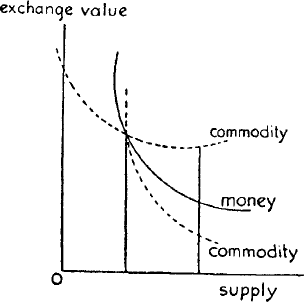
Naturally we must not suppose that a sudden increase or decrease in the quantity of money immediately produces an equally large rise or fall in commodity prices. In the first place the latter would presumably remain as high or as low as before, and the whole change would be noticeable as a retardation or acceleration in the circulation of money, or, the same thing, an increase or decrease of average individual cash holdings. Only gradually would the excess or deficiency in the holdings lead to increased demand (and diminished supply) for goods, or vice versa (cf. p. 157).
It is also clear that the theory in its pure form can only apply to money as such, and therefore—if only metallic coin is used or is regarded as money—to minted metal alone. With free minting, however, the limits between minted and unminted metal are very indefinite and variable. It is therefore tempting to apply the theory to the whole of the existing stocks of gold. But in that case it must be somewhat modified, since gold fulfils two functions, that of money and that of an industrial raw material: even if all the assumptions for the correctness of the quantity theory were satisfied, our curve would more or less deviate from the simple form of a hyperbola because of the hitherto little studied laws concerning the dependence of the industrial demand for gold upon the value of gold and its influence upon the amount of gold available for minting purposes.
In reality, of course, it is very rarely possible to establish such precise mathematical relations as theory demands. Both the advocates and the opponents of the quantity theory therefore content themselves with asserting or denying that an increase or reduction in the relative quantity of money will cause a corresponding change in the commodity price level and a reverse change in the value of money. It may seem strange that even in this modified form the theory can be in dispute, for it states nothing more, after all, than what is true of all other goods, namely that an increase or reduction of supply in itself leads to a consequent fall or rise in price. However, the conceptions of supply and demand have no direct application to money, and those who consider that the velocity of circulation, or the use of credit instruments as a substitute for money, is automatically regulated according to the need for a means of turnover, must naturally and logically reject the conclusions of the quantity theory a limine. It will readily be seen that the whole dispute turns ultimately on this last point: whether the velocity of circulation of money is of autonomous or merely subordinate significance for the currency system; for that the quantity of money, multiplied by the velocity of circulation—the latter in the widest sense of the term used here—must always coincide with the total value of the goods and services turned over against money in a given period of time, is not a theory at all; it is an axiom.
The originator of the Quantity Theory is usually held to be the Italian writer Davanzatti, who lived in the sixteenth century. The theory, however, became widely known through the writings of Locke and Hume. From the latter it was taken over by the classical economists. It is possible, however, to discover traces of it as far back as in the ancient world; at any rate the seed would appear to have been sown so soon as people observed—as they must often have done during the Roman Empire—that money struck exclusively for the State might for long periods maintain a value considerably higher than that of its metallic content, but sank in value when it was minted in too large quantities. In more recent times the Quantity Theory has arisen rather as a reaction against the mercantile theory, which regarded money itself as the essence of wealth and not merely its external expression, and which consequently had to attribute to it an inherent value independent of its exchange functions. Diametrically opposed to this is the view that money as such has no value; it acquires full value only by serving as a medium of exchange, and it acquires just that value which is necessary for its satisfactory performance of this function. In this way the Quantity Theory arose in its fully developed form.
The difficulty of testing the theory empirically lies, as with all economic doctrines, in isolating from concrete reality just those elements of which it consists. In fact, an increase—or when it occurs, a decrease—in the volume of money always coincides with a number of other economic changes which tend to cancel out or to conceal its effects on the price level and the value of money. Population increases and production expands as a result of technical improvements, so that the amount of goods annually consumed increases not only to the same, but to an even greater extent than the increase in population. The turnover may increase to an even higher degree than production owing to the national and international division of labour and to the resulting transition from barter and payment in kind to business based on exchange and money wages. All these factors bring it about that an absolute increase in the volume of money may very well be accompanied by no change or even by a reduction in its quantity relatively to the needs of turnover and thus be followed by a fall instead of a rise in the level of prices.
In an article in Ekonomisk Tidskrift (1904, p. 113) Professor Cassel, bearing this circumstance in mind, makes an interesting attempt to compare changes in the supply of gold and commodity prices in the nineteenth century. The attempt suffers greatly, however, as F. Brock has rightly pointed out, from the fact that he has not extended his remarks to the changes in quantity of silver also, even at a time when the commercial currencies of the world consisted mainly of silver.
On the other hand, commercial progress also acts in a contrary direction, increasing the physical or virtual velocity of circulation, effecting, by the use of credit, a more intensive use of existing money with the consequence that the maximum efficiency in the medium of exchange which the Quantity Theory requires and presupposes is raised to a higher level. A relatively smaller quantity of money need not necessarily involve a proportionately increased exchange value in order to perform the same services as media of exchange and as cash holdings as a larger one, if the same purpose can be achieved by a more intensive use or an increased velocity of circulation of the smaller quantity.
It is very common, though of course entirely illogical, to find these circumstances, or their actual effects adduced as a conclusive argument against the Quantity Theory, almost as illogical as it would be in the case of the upward movement of a balloon to say that it disproved the general validity of the law of gravity. If we merely wish to assert that the Quantity Theory, owing to all these disturbing factors, cannot give us any practical guidance in the consideration of the currency systems of our own day, we may perhaps be right—although the experience of the last decades is indisputable evidence against it—but to invalidate it completely we require something more, we must show either that it is impossible to maintain the presuppositions on which it is based or that its logical structure is inadmissible.
4. The Cost of Production Theory
It is not enough, however, to rest content with this purely negative or suspended judgment. On the pretence that the Quantity Theory is refuted by experience, attempts have been made to invent other explanations, all of which, however, suffer from the defect that they ignore the circumstances which are peculiar to money, and at bottom only consist of an attempt to apply the economic laws pertaining to goods in general to a field in which they are in the nature of things incapable of application. Since the naive idea was abandoned that money possesses an inherent value it became necessary to discover the grounds of this value in something outside money, and in accordance with the theory of the classical school it was supposed to be found in the costs of production of money, i.e. of the precious metals, relative to the costs of other goods. The less the effort and sacrifice required for the production of a certain quantity of gold in comparison with the production of a certain quantity of other goods, the larger the quantity of gold must be which will exchange for one unit of those other goods. In other words, their price rises and the exchange value of gold falls. This is the so-called cost of production theory, or, more correctly expressed, the theory of the comparative cost of the value of money, which was brought to a high degree of theoretical perfection by Senior. Senior maintained that in the case of countries not producing silver and gold to an appreciable extent the costs of procuring, i.e. the costs of producing and transporting not the metals themselves, but the goods for which the desired quantities of the precious metals were to be exchanged, played the same role as the actual costs of production in the mines. He thus found a natural explanation of the fact—very striking in earlier times when communications were still undeveloped —that in the interior parts of a continent commodity prices were habitually much lower than on the coasts. In Germany one used to speak of “thaler” countries and “gulden” countries, i.e. North Germany on the one hand and South Germany and Austria on the other, in the sense that a thaler in the former was not regarded as having greater purchasing power than a gulden in the latter, although containing 50 to 100 per cent more silver. Even to this day we encounter the same phenomenon in those parts of the world not yet provided with railways. In the interior parts of Germany’s African colonies, wages as late as 1915 are said not to have been more than a few pfennigs a day, which must have corresponded to the cost of provisions for a workman or rather a workman’s family for one day.
The well-known text-book writer, Ch. Gide, has completely overlooked this when he says that the low cost of transport of gold should result in one gramme of gold having almost the same purchasing power over goods everywhere. This is, of course, false reasoning: it is not possible to obtain gold without sending goods in payment and it is these, usually much larger, transport costs that matter.
There can be no question, as we shall soon see, of a direct relation or exact parallelism between the costs of production of the precious metals and the value of money. Senior also admits this and gives striking examples of how the production of the precious metals has on occasion been made difficult, or even impossible, without any marked change in prices, a circumstance clearly due to the fact that this production, especially in earlier times, was extremely small in proportion to the total stocks of money and precious metal. In contrast to Senior, Karl Marx and his school who generally carry the classical theory of value to its extreme, and consequently to the point of absurdity, adhere to the cost of production theory as a simple and tangible explanation of the value of money and oppose it to the Quantity Theory, which Marx calls an illusion based on the “insipid hypothesis that goods without a price and money without a value enter into the process of circulation, for which reason an aliquot part of grain is subsequently exchanged for an aliquot part of metal”. Yet it is not difficult to show that, even from the point of view of the cost of production theory, goods “enter into the process of circulation without price and money, i.e. gold, without value”, and that they acquire their relative exchange values just by this process of circulation. Karl Marx is himself compelled to admit that labour is wasted and cannot be counted if it produces nothing useful or if it exceeds the amount of socially necessary labour-time. We only need to carry the argument one stage further to realize that labour, or rather the productive forces in combination, will be rewarded by exactly the market value of its product; in other words that costs of production and price mutually control each other. If, therefore, more gold is produced than the process of circulation can absorb at ruling prices, then the value of gold will fall and the producers of gold will have to content themselves with a smaller income—in other words the costs of production of gold are reduced—unless they prefer to abandon their work.
Moreover, in the case of extractive industries such as gold mining, the costs of production, in the sense of amounts of labour and capital employed, are very different for different parts of the product, owing to the abundance or scarcity of gold in the mines or river beds in which the production of gold is profitable at all. Attempts have also been made to improve upon the theory by substituting for the words “costs of production” the words “marginal costs of production”, i.e. those incurred in the production of a certain quantity of gold in the least profitable mines or goldfields, which leave no profit after payment of wages and possibly interest on capital. But this margin is itself highly variable; a rise in the value of gold, e.g. due to increased demand for minting or to improved technique of production, may cause mines and goldfields previously regarded as too poor to be worked, again to be exploited; old slag heaps will be gone over again, etc., in other words the margin of production will be extended. On the other hand, a fall in the value of the metal, such as we have seen in our own time in the case of silver as a result of its demonetization, will necessarily cause labour and capital—in so far as the latter can be released at all—to be withdrawn from the less profitable fields of production, and the margin of production will contract.
On the whole, therefore, the influence of the conditions of production of the precious metals, and nowadays particularly of gold, on the value of money—an influence which is certainly not slight, but in the long run predominating—is to be found in the relative increase or decrease they bring about in the existing quantity of money, in so far as greater ease of production of gold has a tendency to increase the available quantity at a pace more rapid than that of the ever increasing demand for a medium of turnover, whereas increasing difficulties in the production of gold tend to slow down the tempo of the increase in the supply of gold. The cost of production theory is thus fully justified as constituting an element in the Quantity Theory. But only one element. Since the annual production of gold, even in the most favourable circumstances, can only increase the existing stocks of gold coin by a few per cent, changes in output will only gradually, and as a rule very slowly, exert their influence, whilst an increase in the production and turnover of goods occasioned by technical improvements, or still more the transition of one or more countries to a gold standard, may sometimes increase the demand for the medium of exchange in a much higher degree. And on the other hand a more intensive employment of the gold stocks available in the banks, whether by means of banknotes, cheques, bills of exchange, current accounts, or by the general development of the credit and banking system, may produce a much greater increase in the media of exchange than the simultaneous production of gold; on the other hand it may for long periods neutralize the effects of a decrease in gold production. Were this not so, it would be impossible to explain the rapid rise in commodity prices which usually occurs in times of business prosperity and the even more violent setbacks in times of crisis.
The latter circumstances—the physical and virtual velocity of circulation of money which the Quantity Theory is accused, though wrongly, of having overlooked—can, however, find no place in the cost of production theory and is in fact rather cold-shouldered by its consistent advocates. To Marx the velocity of circulation of money is simply an automatic process whereby the existing supplies of money always spontaneously reach equilibrium with the requirements of turnover at a given commodity price level, whilst that price level itself is determined by the comparative costs of production of goods and gold. “One piece of money,” he remarks in his picturesque, though precisely on that account unscientific language, “becomes so to speak responsible for another; if it increases its velocity of circulation it cripples that of the other or else it completely vanishes from the sphere of circulation,” since the latter at existing prices can only absorb a given quantity of gold. In proof of this, he remarks, it is “only necessary to throw a given number of one pound notes into circulation in order to throw out an equal number of sovereigns—a trick well known to every bank”.
This language is very vague. We need not dispute that up to a point the velocity of circulation of money can sometimes be automatically acclerated or retarded, but the idea that this will always happen to the desired extent leads to absurd results, for it presupposes that merchants and bankers would quite passively submit to seeing their safes filled to overflowing when gold is plentiful, and exhausted when it is scarce, perhaps to the last sovereign, without taking any steps to restore the normal position. As regards the money driven out of circulation, Marx completely forgets to tell us whither it is driven, though he cannot possibly imagine that it is stored up in money-boxes.
As regards the banks’ “well-known trick” of “throwing a certain number of one pound notes into circulation in order to throw out an equal number of sovereigns (or metallic money),” we must carefully distinguish between two different points of view. If for one reason or another the banks desire to strengthen their gold reserves, then certainly the issue of banknotes of small denomination is a useful means to that end, as was shown, for example, by the German Reichsbank when it issued 20-mark notes in addition to the 100-mark notes which it had previously issued alone. The public accepts and uses these as willingly as, or even more willingly than, metallic currency, and the banks can then retain the gold which flows into them in daily payment of debts or deposits, while on the other hand they pay out banknotes against discounted bills or their other loans. All this, however, has nothing to do with our immediate problem, since the whole process is nothing more than the substitution of one medium of exchange for another.
It is quite certain that an increased issue of notes, especially of small denomination, tends to drive metallic money out of circulation, not because more money cannot be absorbed, but because the increased supply of the means of turnover will lead to a rise in prices, so that the balance of trade becomes unfavourable and metallic money flows out of the country—all in complete accordance with the Quantity Theory, but in conflict with what Marx wishes to prove. I am assuming here that the notes are issued by the banks by way of loan and as a result of extended or cheap credit, for if the banks should restrict themselves to exchanging notes for gold, so that gold accumulated in their own vaults, then their “trick” would only involve them in losses, since they must themselves provide for and maintain the note circulation.
Of course, the cost of production theory is still more blatantly inadequate when it comes to explaining the exchange value of purely conventional money such as token money, standard money with limited coinage, inconvertible notes, etc. Those who wish at all costs to maintain an “inherent” value of money dependent on its metallic content or costs of production as the basis of its exchange value are driven in this case to the most perverse and fantastic explanations. At one moment it is the image of the actual metallic currency into which the notes were at one time convertible before they were declared legal tender which remains in the mind of the public and thereby to some extent maintains the value of the notes, at another moment it is the hope of the future convertibility of the notes into metal. Support has been sought for the latter view in the fact that the mere announcement of the resumption of convertibility of notes at a certain future date, and also external circumstances, such as political and military success, whereby confidence in the Government is increased, are sufficient to give paper currency a considerably higher value and to diminish the discount against metallic money, although the notes continue to circulate in amounts as great as before, and should thus according to the Quantity Theory maintain their value unchanged.
During the Union War in the United States it was necessary to declare dollar notes inconvertible, and their value sank, so that between 1863-4 the gold premium rose 40 per cent, although- the number of notes issued was only increased by 16 per cent. During the Battle of Gettysberg the premium on gold rose to 45 per cent, but owing to its victorious conclusion and to the Battle of Vicksburg, it sank in a few days to 23⅓ per cent (Laughlin).
In fact, however, under such circumstances notes no longer circulate in the same quantities as before or, at any rate, no longer circulate with the same average velocity. The hope of convertibility in the early future at face value affects notes in the same way as an increased bill discount rate in the country of payment affects long-term bills: they are converted (in part) from means of payment into capital investments. Many people hoard banknotes in the hope of gain from an expected conversion at par value, which gain possibly represents a high rate of interest. In this way the average velocity of circulation, and therefore the amount of money actually circulating at any particular time, is retarded, and the increase in value is in complete agreement with the Quantity Theory. It is moreover probable, for various reasons, that it will operate more strongly or at least more rapidly on metallic money in reducing the premium on the latter or the discount on notes than on a lowering of commodity prices proper reckoned in notes. But we need not discuss this question further.
The position will be reversed in times of political instability, when an increased note issue and an ensuing fall in their value is to be feared. Nobody will then hoard notes, but everybody will exchange them for goods or other real wealth as soon as possible (and at practically any price), so that the circulation of money will be accelerated beyond the normal. In extreme cases paper money may under such conditions lose practically all its value—as happened in the case of the French assignats—to the extent that business will begin to employ foreign money or revert to pure barter. But this also, as will clearly be seen, is not contrary to the Quantity Theory, for in this case the volume of the purchases effected by the depreciated paper money will be correspondingly reduced.
It may be observed en passant that the history of the French assignats affords an interesting contribution to the theory of the funding of banknotes or paper money. In order to maintain the value of these assignats the Government accepted them in payment of the purchase of “national property” (confiscated church property, etc.). Had this been done at a definite predetermined price, e.g. per acre, this object could certainly have been achieved. For if the assignats had then begun to fall in value a number of people would have retained them in order at a later date to transact profitable business by purchasing national property. In that way the value of the assignats could have been kept almost unchanged and the Government which permitted the payment of taxes in assignats might without loss have cancelled the notes which flowed in in payment for purchases.
In fact, however, the national property was sold at auction to the highest bidder, i.e. for the largest sum in assignats which it could command. Thereby the brake (which would have existed in the hoarding of these for speculative purposes) on a heavier fall in the value of the assignats was obviously removed; since the Government then received payment of taxes in money which had lost its value, it found itself compelled not only to reissue the assignats which it received in payment for national property but also to issue large additional quantities with the inevitable consequence that they soon became valueless.
5. Modern Theories
The view of this problem which is nowadays advanced even by writers who claim to be rigorously scientific is still less scientific, if possible, than the Marxist and kindred theories.
The cost of production theory does at least, though one-sidedly, find the cause of the change in the value of money in something directly affecting money. But in modern reasoning on general commodity prices, money is not infrequently regarded as a kind of amorphous, infinitely elastic, or plastic mass which adapts itself without any pressure to any price level and is therefore entirely passive in relation to the pricing mechanism, whilst the latter is regulated only by circumstances concerning the commodities themselves. If there occurs such a general and enduring fall of prices as was witnessed in the last three decades before 1890, at any rate as regards world prices, this is found to be sufficiently explained by reference to the progress in the technique of production and transport: goods are produced more cheaply and are transported more cheaply, therefore they are cheaper. If, on the other hand, there is a rise in prices, as in the years immediately before the War, then it is the higher standard of living and increased enterprise which produces an increased demand for goods, unless we also take refuge in the supposed screwing up of prices by cartels and trusts, the greed of middlemen, trade union claims for higher wages, etc.; or else the cause is found in import duties—even though no increase in such duties occurred during the period in question. To such an extent have people accustomed themselves to seeing in the modern credit and banking system a means of satisfying any demand whatever on the part of society for a medium of exchange that they cannot conceive of money influencing prices in one direction or the other. The many apparent inconsistencies between the Quantity Theory (and also the cost of production theory) and the actual facts have completely discredited that theory in the eyes of most people. Some other explanation is sought and the first available one is chosen. But in reality nothing is explained. The reasoning contains an inadmissable generalization; for arguments which are valid only when it is a matter of relative prices are applied without qualification to a field in which they no longer possess any meaning, i.e. to the absolute prices of commodities, expressed in money. That a commodity which can be manufactured more easily will fall in price is at bottom a corollary of the obvious fact that labour and capital, in so far as they can be readily transferred from one branch of production to another, must always tend, each for itself, to obtain an equal return in all branches of production. There is clearly nothing else in the theory of the dependence of relative prices on the cost of production. But how meaningless it is to seek to apply this to concrete prices, to the relation of goods to money, if the conditions of production, or other conditions influencing money are not taken into consideration at all!
From the point of view of the Quantity Theory there is no doubt that increased production tends to depress prices unless it is accompanied by a corresponding increase in the medium of exchange, simply because the velocity of circulation of money cannot be increased at will to any degree whatever. If we believe this possible, then evidently there is nothing to prevent the increased productivity finding expression in a rise along the whole line instead—in wages, rent, and interest on capital, expressed in money—whilst general prices remain undisturbed or even rise. In other words, the relative cheapening of a certain group of commodities owing to easier conditions of production would not produce a perfectly equal fall in its money price but would consist partly of a small increase in the price of all other goods, so that the average price level might perhaps remain unaltered, or, in any case, would not fall.
As regards a fall in the cost of transport, it is quite forgotten that this has a twofold effect: a fall in price in the place of destination, the importing country, and a rise in price in the exporting country, or country of production, in consequence of the increased demand from other places. Thus on the whole there is a levelling up rather than a fall in prices. In Senior’s view, which as far as it goes is quite correct, lower transport costs have the further result that the non-goldproducing countries can obtain their requirements of gold at a lower cost in goods than before. But this would be the same thing as a fall in the exchange value of gold, i.e. a rise, and not a fall, in commodity prices. In the interior of continents and in remote places improvements in transport have certainly brought about a considerable rise in the general price level. By the great increase of production, exchange and turnover in general which improved transport produces it certainly creates a tendency, on the other hand, to lower prices, if the amount of money is unchanged. But this again takes us back to the Quantity Theory.
The same is true of the other alleged causes of a rise in prices. Import duties and taxes on consumption undoubtedly lead to higher prices of the commodities so taxed, but it is by no means certain that other goods will remain unchanged in price and that therefore the general price level will rise. In any case, there is nothing to prevent the possibility of a simultaneous pressure on and fall in the prices of other goods—as the Quantity Theory would lead us to suppose—so that the average price level would remain unchanged unless there existed some monetary cause for their change. The reader is referred to pp. 138–9 for the effects of a customs union or increased international trade on the prices of duty-free goods and on the commonest index numbers. Trusts and rings, and even middlemen, may undoubtedly raise their price by the monopolization of one commodity or other, though as a rule, demand is reduced thereby, in full accordance with the Quantity Theory. In proportion as trustification extends, however, this procedure would become quite purposeless, as may easily be seen, for the trusts would rather seek to profit by reduced overhead costs, which should result in lower rather than higher prices. Middlemen are as a rule only links in the social division of labour and should consequently assist in lowering the prices of the goods in question. There are, of course, exceptions to this rule, as we have shown in the treatment of retail prices in an earlier section (Vol. I, pp. 86–8). But even superfluous middlemen cannot raise the general price level. The contrary is more probably the case, since goods would then pass through more hands and the same quantity of money would effect a greater number of exchanges.
As regards rises in wages Ricardo, and later John Stuart Mill, have clearly shown that a general rise in wages cannot possibly increase the price of goods produced by the same labour. In this connection it should be sufficient to point out that if more highly paid labour makes all goods more expensive, it must also make gold dearer, since it also is a product of labour. Since, however, gold is the measure of prices, it cannot itself either rise or fall in price. If, therefore, the producers of all other goods could indemnify themselves for increased wages by a higher price for their products, whilst the producers of gold alone could not do so, this must result in a decline in the production of gold. A rise in money wages along the whole line is therefore either equivalent to a fall in the share of the product of the two other factors of production, land, and capital, which must leave the prices of commodities on an average unchanged, or else the general rise in money wages is caused by easier facilities for producing gold, in which case the rise is purely nominal and is only one link in the general rise in the prices of goods which occurs when in accordance with the Quantity Theory or the cost of production theory the production of gold becomes cheaper.
However, this does not prevent a rise in wages caused by an increased (money) demand for labour—a fact which the classical economists perhaps overlooked. This rise in wages in its turn causes a rise in the prices of the goods already on the market and thus establishes a higher price level, which will be maintained through the force of inertia even in the future. On the whole, this remains true even if the increased demand for labour originally proceeded from the increased production of gold. If, on the other hand, it has proceeded from extended credit facilities a further inquiry will be necessary, to which we shall return later.
Increased prosperity need not, of course, lead to higher prices. On the contrary the additional well-being may find expression in a greater cheapness of everything, with unchanged income. The view which was formerly so often held—even by a writer such as Ricardo—that a higher standard of living in a country was always combined with a high price level, was an illusion, fostered no doubt by the fact that prices in England, compared with other countries, were unusually high, especially at the beginning of the last century. This, again, was due to the fact that at that time England exported few bulky raw materials, but imported considerable quantities, such as grain, timber, etc., whereas this position is now altered to a large extent, in so far as England exports large quantities of coal, so that it obtains a large part of its imports at low return freights in collieries. And yet perhaps just for that reason the welfare of the great masses of the population of England is incomparably greater than a hundred years ago. Similarly England’s free trade has contributed to the lowering of its prices in comparison with those of protectionist countries. Broadly speaking the price of the same commodity cannot vary in two different countries by much more than the import duty and the freight. A factor which certainly tends to raise the cost of living in prosperous countries is the high level of wages and the ensuing higher prices for all personal services and all work done by hand. But this does not appreciably affect commodity prices, or at any rate the prices of those commodities entering into commercial statistics.
Finally, as regards the statement that increased entrepreneurial activity may lead to higher prices, this is often true, but only on the assumptions which we have already indicated and which we shall examine more in detail at a later stage. In itself the increased “spirit of enterprise”, i.e. the increased employment of capital in the service of production, only creates an increased demand for certain raw materials which are necessary for the creation of almost all fixed capital, especially iron and steel, bricks, timber, etc., and these are in fact the goods which at the beginning of so-called “good” times first rise in price.3 But whether this rise in prices will be followed by a rise or a fall in the prices of other commodities cannot be determined in advance. It depends on whether the money market itself has participated in stimulating the spirit of enterprise. If the moneys from which the increased demand for fixed capital, or its components, proceeds are the fruits of present savings, then there will be a corresponding decrease in the demand for ordinary consumption goods, and their price should accordingly fall. The case is quite different where the necessary money capital is partly supplied from metallic reserves which were accumulated and lay idle during previous “bad” times or where they are created by extended credit, in other words, by an accelerated velocity of circulation of money.
6. The Defects of the Quantity Theory. An Attempt at a Rational Theory
In the foregoing I have merely wished to point out the folly of supposing that circumstances in which, as in the case of concrete commodity prices, there is an essential relation between two things—goods and money—can ever be satisfactorily explained from the point of view of the changes undergone by only one of them, in this case goods, without reference to the other, money. It is, moreover, evident that it would be useless to dwell on the question at all if this view were not in fact so widespread, not only in business jargon but also in scientific literature, especially German.
In one respect, however, this view is justified and serves a purpose in more detailed investigations into the causes of price changes. Every rise or fall in the price of a particular commodity presupposes a disturbance of the equilibrium between the supply of and the demand for that commodity, whether the disturbance has actually taken place or is merely prospective. What is true in this respect of each commodity separately must doubtless be true of all commodities collectively. A general rise in prices is therefore only conceivable on the supposition that the general demand has for some reason become, or is expected to become, greater than the supply. This may sound paradoxical, because we have accustomed ourselves, with J. B. Say, to regard goods themselves as reciprocally constituting and limiting the demand for each other. And indeed ultimately they do so; here, however, we are concerned with precisely what occurs, in the first place, with the middle link in the final exchange of one good against another, which is formed by the demand of money for goods and the supply of goods against money. Any theory of money worthy of the name must be able to show how and why the monetary or pecuniary demand for goods exceeds or falls short of the supply of goods in given conditions.
The advocates of the Quantity Theory have perhaps not sufficiently considered this point. They usually make the mistake of postulating their assumptions instead of clearly proving them. That a large and a small quantity of money can serve the same purposes of turnover if commodity prices rise or fall proportionately to the quantity is one thing. It is another thing to show why such a change of price must always follow a change in the quantity of money and to describe what happens. Nor is this so easy; especially with our modern and extremely complicated monetary and credit systems. Nevertheless, in what follows we shall attempt to do so. In accordance with what has been said above we shall first describe the probable effects of a relative increase or decrease of the quantity of metallic money, and also the analogous phenomena associated with the issue of a State paper currency or inconvertible banknotes. We shall then consider in more detail the conditions of acceleration or retardation of the velocity of circulation and the influence of both on the value of money. In both respects the literature of currency, otherwise so voluminous, leaves much to be desired as regards detail and clearness.
Hume’s well-known fiction of our waking up one morning to find double the number of shillings and sovereigns in our pockets, whilst everything else remains unchanged, may seem quite appropriate, but suffers from the defect that it is not a simplification of reality—which is permissible—but relates to a purely paradoxical case, which in the nature of things never can occur. Moreover it is clear that such an eventuality would in no way cause us immediately to begin to offer or demand double prices for what we require or can sell. Only gradually would the superfluity of cash dispose us, for example, to effect a purchase earlier than otherwise or to retain our goods longer than usual. In other words, the demand for goods would be stimulated and the supply diminished, whilst at the same time commodity prices would gradually rise until they reached a level corresponding to the increased quantity of money. But since the whole idea contains an assumption contrary to reality, we may perhaps add that the rise in prices required by the Quantity Theory from an increased supply of money is in fact not reached in this manner.
The matter becomes simpler if we consider the effect which a sudden large increase in gold output would have, and has in fact sometimes had in our own times, on world price conditions. The discovery of rich goldfields or gold mines in, say, a colony immediately attracts a very large part, perhaps the largest part, of an already scanty population to the goldfields and induces it to abandon its usual occupations. The first result will be not only a great superfluity of gold but also a scarcity of goods. The existing stocks will soon be in demand and exhausted, and the consequence will be a rapid rise in prices, often to fantastic heights. Tooke and Newmarch in their History of Prices relate how in California in the glorious days of 1848–9 everybody was a buyer at any price, an egg cost a dollar, a pair of boots 100 dollars, medicine such as opium was retailed at 6d. a drop, and fine iron pins which the gold diggers were accustomed to use to secure the strips of cloth with which they covered the walls of their log cabins were, to make matters simpler, paid for by their weight in gold. If this were the final result it is clear that it would check or even render impossible the further production of gold. Indeed the inhabitants of such a country would soon come to look upon the lumps of gold scattered about the country with the same indifference as did the nations of America at the time of the first discovery of gold. This preliminary stage soon merges, however, into another. Rumours of the newly discovered wealth attract not only new gold diggers but also consignments of goods from all quarters in order to profit by the high prices, with the result that prices soon revert to normal and at the first shock possibly fall below normal. As early as the year 1851, according to the above authors, bales of valuable goods were scarcely worth the cost of storage in California. What happened and what might have continued to happen for many decades had certain striking features, among which the most important characteristics were the following. Owing to the fall in prices occasioned by the heavy influx of goods, the production of gold again became extremely profitable, but since most of the goldfields had passed into private ownership they no longer attracted an unlimited amount of labour, but continued on more or less the same scale year after year. The prices of most commodities remained at a level, apart from transport costs, somewhat, though not much, higher than the corresponding level in the non-goldproducing countries, and so they remained during the changes which they subsequently underwent and of which we shall shortly speak. The balance of trade of the country will therefore be passive or unfavourable and gold will continue to flow out, which is quite natural and necessary since it is produced in much larger quantities than the turnover of the country requires.
Meanwhile the constant flow of gold to the non-goldproducing countries causes a progressive increase in prices there, although, owing to their vastness and populousness, this may for a long time not be noticeable or may even be counterbalanced by other causes such as a change of monetary standard or an increased demand for gold. Normally prices would rise in the following manner: exporters of goods whose claims abroad had previously been met either by the sale of bills of exchange drawn by them on their foreign debtors, or by the remittance from abroad of bills drawn on importers of foreign goods, will now be paid partly in gold, and this gold will constitute an addition to what was already in the hands of the public (or was deposited in the banks) for the purchase of goods. If we now revert to our simple schematic example of two commodities, butter and coffee, the imports and exports of which balance, even among those who ultimately produce and consume them—then on the assumption here made this would no longer be the case. At first, the increased demand for and diminished supply of goods from the gold countries causes, directly or indirectly, a rise in the price both of our butter and of the coffee we import, but although the price of commodities rises, yet imports and exports no longer balance. On the contrary, if formerly Sweden imported coffee to the value of forty million crowns and exported butter to the same amount, our butter exports will now rise to, say, forty-two million crowns and our coffee imports to forty-one million crowns, as the remaining million would enter in the form of bullion. In order to make the matter clearer we will assume that the rise in price of both butter and coffee in the first year is 3¾ per cent, so that the increased export value of exported butter is caused partly by an increase in the volume of exports (about 1¼ per cent). For the same reason imports of coffee will be less than before (also 1¼ per cent) in spite of the increased purchase prices. On the whole, this must happen, since a part of the coffee harvest now goes to the gold producers. Since, then, the Swedish population (producers of butter) does not fully satisfy its need for coffee, though it has more than sufficient money income to do so, its demand will immediately lead to a further rise in the price of coffee, and when this increase has reached the producers of coffee through the agency of importers here and exporters in the producing countries it will create among them an increased monetary demand for imported goods (in addition to that which has developed spontaneously there for the same reasons as here). This will directly or indirectly stimulate a further rise in the price of our butter, which will again raise the price of coffee, etc., until the production of gold, which becomes less profitable with every such rise in prices, either ceases or is restricted until it is exactly sufficient for the normal demand for new gold. Again, so long as the extra demand for goods by the gold countries continues, the rise in prices can never cease, for the price equilibrium in our and other markets presupposes, in the main, that imports and exports balance, and that can never happen so long as one part of our exports is paid for in gold beyond the normal requirements of turnover. It is quite different if from the beginning we require gold, e.g. to adopt a gold standard in place of a silver standard, or of paper currency. We should then be in a position either to offer silver abroad or to take up a loan, or to acquire the means by additional taxation, so that consumption within the country would be correspondingly decreased. In all these cases, as will easily be seen, there could be no stimulus to higher prices from our side and gold would simply take the place of silver or paper in business and banking, whereas in the former case it constantly increased the existing supplies of the medium of exchange.
If, on the other hand, the production of gold falls below the normal requirements for new gold, similar phenomena occur, but in the opposite direction: commodity prices constantly fall until the production of gold, which thereby becomes more profitable, is again sufficient for ordinary requirements, or possibly new gold mines are discovered.
This account of the course of events, if correct, may possibly modify the views commonly held of the effects of an increased or diminished production of gold. It is frequently supposed that the newly imported gold only gradually, after arrival, causes a rise in prices. In the meantime, it is supposed to lie idle in safes or in the vaults of banks and the normal consequence of this should be that the sums available as loans would increase beyond requirements. Since the excess of gold is always maintained by continued imports, the result must be that the rising prices would be caused by an unusually low rate of interest, and only when prices had reached the maximum and the turnover absorbed the increased volume of money would interest rates rise again to the normal. And vice versa in the case of a shortage of gold and falling prices.
Experience shows, however—and the opponents of the Quantity Theory have not been slow to point it out—that the position is rather the reverse: periods of rising prices are usually characterized by high interest rates, while falling prices and low interest rates usually coincide. In what follows, when we come to speak of the influence of credit on prices, we shall find what I believe to be a fully satisfactory explanation of this fact. It will be sufficient to say here that even if price fluctuations were caused exclusively by changes in the production of gold—which is certainly not the case—then the contradiction would perhaps not be as great as it appears at first sight. A rise in prices may be conceived as due to increased demand even before the cases of gold have been received in payment for exported goods, perhaps even long before, since even the preparations for gold mining require large amounts of labour and capital, i.e. of goods which will only be paid for in the future by the newly mined gold, and the capital perhaps may only be partly created by actual savings (and thus by a diminished demand for goods) the rest being brought into being by claims on bank credit.4 Meanwhile a rise in prices becomes possible and may perhaps be caused in the first instance by a freer use of credit, and interest rates will have a tendency to rise rather than fall. The increasing gold stocks would then act as a kind of buttress to the price movement, preventing it from falling back, as it would otherwise sooner or later have to do in consequence of the contraction of credit, i.e. as a prop introduced later for a rise in prices which has already started, rather than as its prime cause.
The contrary would be true in the case of diminished gold production if we supposed that the diminished demand for goods from the goldfields led to a fall in prices, for which the existing supplies of the medium of exchange would possibly be quite sufficient. We should then find the curious coincidence which attracted so much attention in the ’seventies and ’eighties and was thought to defy any explanation: diminished gold production and falling commodity prices, but at the same time an excess of loan money and falling rates of interest.
I only mention this, in passing, as a conceivable hypothesis; the phenomena in question have been studied in too little detail for us to be able to express any definite opinion, and in any case the picture is too incomplete if we do not take into account any other cause of the rise in prices than the magnitude of the gold stocks. The very fact that a continuous large increase or decrease of those stocks must ceteris paribus have a dominating influence on prices must surely be obvious and will scarcely be disputed by any economist, to deny it would lead to absurd results.
We might explain the heavy fall in the value of money which is usually the consequence of successive issues of paper money in very much the same way. For example, a Government requires the money for heavy expenditure, usually on armaments, and obtains them either by a loan from the Central Bank, which is granted the right to increase its note issue, or by putting into circulation paper money on its own account, which, either from the beginning, or later when metallic money has been withdrawn, is declared legal tender at a compulsory rate. The immediate consequence is that some labour and capital is withdrawn from the production of ordinary consumption-goods for the production of war material, or is directly absorbed by men being conscripted. If, instead, the money required had been obtained by high taxes, then the diminished production of those goods would have coincided with a diminished demand for them by the taxpayers. In that case no rise in prices need occur. But now there is an undiminished monetary purchasing power against the diminished supply of these goods and services, and all prices must rise. In consequence of the rise in prices the normal needs of the Government for money will increase also. If it then issues still more paper we get the endless chain by which paper money may sometimes fall in value until it is worthless.
The somewhat monotonous and unedifying history of paper money in various countries has recently been written by Subercaseaux, whose book is mentioned in the bibliography. It appears that the reason for the issue of paper money, both in earlier and later times, has nearly always been the need of Governments for money in war time. Especially on the outbreak of civil war, when no Government has sufficient authority successfully to levy new taxes, or enjoys sufficient credit to take up bona fide loans, disguised taxation in the form of inconvertible gradually depreciated paper money is the only escape, even though it is an extremely dangerous one. What interests us most is the question to what extent experience of paper money tends to confirm the theory of the value of money which seems a priori most tenable, i.e. a more or less modified version of the Quantity Theory. Supported by the statistics prepared by Subercaseaux (El papel moneda, p. 126 et seq.) we may assume that, in so far as the issues of paper money are kept within reasonable bounds, the economic forces which resist too violent a decline in its value and which are partly invoked by this very decline operate so strongly that only a slight tendency to depreciation of the paper money is discernible, a tendency which nevertheless appears more marked the more the effort is made to use paper money for foreign payments or to acquire the precious metals. The need for a medium of exchange which grows with the increase in population and volume of transactions, the driving of hard money out of the country and its replacement by paper money, and finally the hoarding of paper money itself in the speculative hope that it will at some future time become convertible at its face value—all these are forces tending to resist the depreciation of the currency.
On the other hand there is no doubt that large and continuous issues of paper money lead to a corresponding fall in the value of the paper money, which, as might be expected, is in exact accordance with the principles of the Quantity Theory. A recent and very striking example is afforded by the Republic of Colombia in South America, whose Government in 1855–1905, and especially during the Civil War in 1899–1902, issued constantly increasing quantities of inconvertible paper money, which fell pro-progressively in value. The first issue, in 1886, amounted to something over three million pesos (= dollars) only, and the gold premium, i.e. the additional value of gold over paper money of the same denomination, amounted to only 35–40 per cent. During the following years the quantity of paper money was increased, and the gold premium rose without interruption—with the single exception of the year 1896—so that when the Civil War broke out in 1899 the total of paper money in circulation amounted to about 50 million pesos and the gold premium to 218–320 per cent. During the war the amount of paper money was multiplied tenfold to 638–6 million pesos in 1903, and the gold premium rose during the war to 20,000–25,000 per cent, i.e. the paper peso had only 1/200th to 1/250th of its gold value. After the war this issue continued, but on a moderate scale, so that in 1905 the amount was 847.2 million pesos. With the return of peace to the country the gold premium sank, it is true, a little, so that during those three years the quotation was 10,000 per cent, i.e. the paper peso stood in relation to the gold peso as 1 : 100. Unless we demand a pedantically complete agreement, these developments in every respect confirm the expectations of the Quantity Theory.
Thus here also the rise in prices is, strictly speaking, primary and the increase of credit media secondary, and it is at least conceivable that under such circumstances any real superfluity of paper money, with a resulting fall in interest rates, will never occur. It actually happens, as Subercaseaux observes, that an inconvenient shortage of money often arises in countries with depreciated paper money, and business men besiege the Government with demands for increased note issues. We must, however, bear in mind that business men and manufacturers as a rule profit, or believe they profit, by a falling value of money, since during the period of a fall they can buy in a cheaper and sell in a dearer market. A fact which complicates this problem still further, and which in connection with a depreciated currency may be of practical importance, is that a rise in prices, when it begins to be regarded by the public as an habitual phenomenon, becomes itself the cause of a rise in interest rates, though at bottom only an apparent one, for 5 per cent interest on money which falls in value or purchasing power by 1 per cent per annum is quite the same as 4 per cent on a currency with a constant value both to the lender and to the borrower. In the same way an expected fall in commodity prices on the occasion of a withdrawal or rehabilitation of paper money will cause an (apparent) fall in interest rates.
7. The influence of Credit on Commodity Prices. The Dispute between the Currency and the Banking Schools
We have hitherto only concerned ourselves with the influence exercised by a change in the actual amount of money—principally, but not exclusively, metallic money—on the value of money or commodity prices. Every change in the normal velocity of circulation of money must, however, be regarded as acting in essentially the same way. The best proof of this is the fact that the different kinds of credit used in the course of business, bills of exchange, cheques, banknotes, may be regarded either as real money, competing with or replacing hard cash, or as merely a means of increasing the velocity of circulation of money in the real sense, in so far as we extend the term to include what we have called the virtual velocity of circulation. Inconvertible paper money also is sometimes regarded as an instrument of credit (one speaks of the paper currency debts of a Government), though incorrectly, since its conversion belongs to an uncertain future or often never occurs at all and therefore does not as a rule influence its exchange value. It would be more correct to regard it as purely artificial money like token money, or still better like debased silver currency without free minting—what G. F. Knapp calls the “epicentric” medium of payment. On the other hand, paper currency and banknotes are very closely related and may sometimes imperceptibly merge into each other when the convertibility of notes is interrupted or resumed.
It is now our task to examine more closely the effects of credit, the great and principal agent in accelerating or retarding the velocity of circulation, and especially to ascertain to what extent the banks or the Government of a country are in a position to regulate the value of money by it, or by similar means, i.e. materially to modify the fluctuations in value which are the consequence of changes in the output of the precious metals. This is admittedly one of the most important questions in the whole of monetary theory, and at the same time the most difficult. It may be said that this question more or less consciously underlies all the controversies in monetary theory which have divided even competent economists, and particularly those of the last century, into radically different camps.
In one respect, however, it may be said that no serious difference of opinion exists, at least among the leading economists, concerning such paper money as is issued by Governments themselves or is placed at their disposal by the banks and which is legal tender side by side either with metallic money, or with any substitutes which may have driven the latter out of circulation or out of the country. It is true that with regard to the functions of paper money and the factors which influence its value in relation to the precious metals and to the currency of other countries, there are certain obscure and disputed points; but that a large issue of paper currency progressively depreciates in value and thereby raises the prices of all other commodities, calculated in paper money, has been proved too often in history to be open to doubt. Similarly there are some, though by no means many, examples of a successive withdrawal of paper money rehabilitating its value and causing a fall in commodity prices, in terms of paper money. The rise in price in the former case and the fall in the latter is also easily explained and has already been discussed above. As regards the calling in of paper money, we need only add that it can be effected in the main in two ways, either directly by an increase of taxation, by which the revenue of the State is raised above its expenditure, in which case the notes can be partly withdrawn as they flow into the State treasury in payment of taxes, or the State may issue a loan, by means of interest-bearing bonds, and commit to the flames the notes received from subscribers. In the former case the taxpayers, in the latter the subscribers to the loan, will have less purchasing power and consequently there will be a reduced monetary demand for goods, so that commodity prices will directly begin to fall pari passu with the decreased supply of money. In any case, however, the diminished amount of money will ultimately produce a fall in the prices of all goods, though this may be counteracted, and indeed in many cases is counteracted, by the increased use of bank and other credit, i.e. in effect by an increased velocity of circulation, physical and virtual, of the smaller amount of paper money.
An interesting recent example is afforded by Austria, whose Government paper currency has for decades been regulated at a more or less fixed rate on gold by a periodical issue of interest-bearing State bonds, so-called “Salinenscheine” (because the State salt mines were the original security) and a corresponding withdrawal of paper currency, alternating with the repurchase of “Salinenscheine” in the market, i.e. a reissue of the paper currency withdrawn.
As regards instruments of credit proper, and especially the issuing of bank credit to the public, either in the form of notes or fictitious deposits, their influence on price formation has been much more in dispute. This dispute constitutes the real essence of the discussion concerning the most suitable form of banking organization, which occupied a large part of the nineteenth century and which can still not be said to have terminated. According to one theory, the so-called Currency Theory, which had in Ricardo its most distinguished protagonist in the beginning of the nineteenth century and which subsequently found practical expression in Peel’s Bank Act of 1844, the banks possess, by the granting of credit, and especially by the issue of notes, an unlimited power to increase the circulating medium and therefore to raise commodity prices. This must especially be the case if the banks, as was the case with the Bank of England in Ricardo’s time, are not required to redeem their notes in metal. If, on the other hand, this obligation exists—the only demand Ricardo himself not quite consistently put forward as a condition of a good banking system, and which was established in England by the first Bank Act of Peel in 1819—then naturally a powerful brake is applied to the banks, simply because commodity prices in such a country can no longer rise materially above the price-level in all other countries having the same metal as a measure of value, for this would involve the loss of metal to the country, thus compelling the banks to restrict credit facilities. But, on the other hand, as Ricardo also pointed out, it does not prevent the banks in a number of countries from following the same policy and from issuing a number of notes side by side with the metallic money. The general price level might then rise to any height, and since there would then be no reason why metallic money should flow in any particular direction, the convertibility of the notes would no longer constitute a check on the rise of prices, unless it had proceeded so far that the industrial demand for gold began appreciably to diminish the banks’ reserves. To this extent Peel’s Bank Act, which, as is well known, requires full metallic cover for all notes over a certain fixed amount, and which has been more or less faithfully copied in the banking laws of other countries, represents a consistent adoption of Ricardo’s principles.
This measure, however, is of course very imperfect in its social aspects as a means of stabilizing commodity prices, even from the point of view now under discussion. Note issues are only one of the means which the banks have at their disposal for increasing the total amount of exchange media or the velocity of circulation of money and of thereby raising prices, and the example of England shows best to what extent other means may be increasingly employed when the issue of notes is too severely restricted. Of the business transacted through the English banks only a small portion is discharged by notes or cash, by far the greater part consists of payment by cheques on current account. The same developments are to be observed, though to a less extent, in other countries, such as Germany and the U.S.A. But if, on the one hand, current banking law is for this reason unable to prevent an incipient rise in prices as a result of inflationary credit policy—to say nothing of the rise which would be produced by an increase in the supplies of coin itself—on the other hand it imposes unnecessarily severe restrictions on an increase of the note issue at times when such an increase is desirable in order to avoid a heavy fall in the prices of goods and commodities, as, for example, in crises when other credit instruments refuse to function in consequence of a general lack of confidence between individuals. That Peel’s Bank Act has not for this reason given rise to greater commercial misfortunes is entirely due to the fact that the banks, and especially the Central Banks, have more and more adopted the practice of keeping in reserve large amounts of unused loan money, a practice which was not contemplated in the original plan of Peel’s Bank Act, for which reason it had to be suspended several times during the first period of its operation.
The other view, which usually goes under the name of the Banking principle—a vague name for an essentially vague thing—originated among the opponents of Peel’s Bank Act, among whom the most prominent was Thomas Tooke, famous for his great work The History of Prices. We cannot here discuss much of the excellent criticism directed by Tooke and Fullarton against the bias of Peel’s Bank Act as a practical control of the banking system and especially their emphasis upon the supreme importance of bank reserves, which had been too much neglected by Ricardo and his disciples. We can only consider their view of the influence of bank credit, and more especially of note issues, on prices. This school, or at least its most consistent representatives, denies any such influence so long as the banks only grant credit to the public in the form of loans on absolutely sound security. Even if the banks are not compelled to redeem their notes in gold they cannot, says Tooke, under such conditions either increase or diminish the total amount of credit instruments in circulation. Whatever the transaction of business requires in this respect is drawn from the banks in the form, for example, of loans, and whatever is not required is returned to the banks in the form of deposits or repayment of loans. This assertion may appear paradoxical, for the banks are theoretically free to call in all their notes and all their loans; but if they did so they would also refuse to satisfy the legitimate demand for loans—which is contrary to the initial assumption.
Tooke based his views on comprehensive statistics, which appeared to show that a large note issue had practically never preceded, but always followed, rising prices. This fact would then prove, in Tooke’s opinion, that the volume of exchange media is never the cause, but on the contrary always the effect, of fluctuations in prices and of the requirements of turnover for the medium of exchange. Both Tooke and Fullarton emphatically assert the essential difference, in their opinion, between State paper money, including advances by the banks to the Government in the form of notes, and banknotes proper regularly issued in the form of loans. In the one case, they say, the notes are issued in direct payment for goods and services and do not return to the bank of issue but remain in the hands of the public; in the other they only come into circulation as loans with strict reservations as to repayment and therefore always return to the banks of issue after the lapse of some months. In this respect, however, it may be observed that the return of the banknotes, upon which Fullarton, and many other economists with him, laid such great stress, cannot be of predominant importance if the banks continuously reissue the notes as they are paid in; Government paper money also frequently returns to the issuer in the form of tax payments, and if it remains in the hands of the public, it is because the Government continues to reissue its notes in order to meet its current expenditure. Again, as regards the return of banknotes to the banks in the form of deposits, this can, and often does, occur in the case of paper currency also. In both cases the deposits are made because the public obtains interest (or corresponding advantages) on the money deposited. That the banks give such interest is in turn due to the fact that they intend to release the notes as soon as possible, or as large a part of them as possible, at a higher rate of interest.
Tooke’s arguments were developed in a modified form by John Stuart Mill, of whom Marx says, somewhat maliciously, that in his monetary theory he succeeded in simultaneously holding the opinion of his father, James Mill, Ricardo’s friend, and the contrary opinion of Tooke. Mill considered that Tooke’s view of the innocuousness of the banks as regards price movements was quite correct in normal, tranquil times, when everybody only borrows for his business requirements and only expands his business in proportion as the growth of his own capital or that of the persons associated with him permits it. Under such conditions an increased supply of loan money by the banks would be useless, and even if, by offering a lower rate of interest, they were able to induce borrowers to borrow more than usual the borrowed money would sooner or later come into the hands of somebody who did not require it and would then flow back to the banks as a deposit. On the other hand, in troubled times, when a crisis is approaching, and business men, who have hitherto, by mutual credit, bills of exchange or ordinary credit for goods, succeeded in artificially keeping up prices, must by reason of the loss of confidence, begin to seek other and safer instruments of credit and turn to the banks for loans, the banks, according to Mill, would undoubtedly be in a position by too generous an issue of banknotes or granting of credit, to maintain for a time, and even to add to the artificial rise in prices and thus retard a crisis which is nevertheless inevitable and also necessary if sound business conditions are to be restored. This view held by Mill was accepted by the Germans Nasse and Adolf Wagner and may be said to prevail at the present day among German economists. The practical conclusion from these teachings would be that all restrictions upon banking activity are really an evil, or at any rate can only have reference to banking activity during such times of crisis as are referred to above. The convertibility of banknotes into cash must of course be insisted upon in the interests of the international foreign exchange and for this reason the banks must always be provided with sufficient reserves. As regards note cover proper, ordinary bank commercial bills or other easily realizable securities, should be fully adequate and are most desirable because they combine security and elasticity. In tranquil times the banks must also hold a considerable reserve in gold or notes in order to meet the increased demand for loans when a crisis sets in.
So far as the practical organization of the banking system is concerned the difference between these two schools is not of special importance, and existing banking systems may be said to be the result of a compromise between them, especially if we remember that the right to issue notes, under severe restrictions and regulations, is only a part, and in many countries a very small part, of modern banking activity, which otherwise enjoys almost complete freedom. But as regards the problem which immediately concerns us here—the influence of money and credit on prices under normal conditions—the contrast between the two views is as complete as possible, and this divergence of opinion persists even to-day, despite discussion which has lasted for almost a century.
8. A Criticism of the Theories of Ricardo and Tooke
This depressing result is of course due to the fact that neither of the parties has been able to penetrate to the bottom of the questions at issue or to present its views in a manner at once so comprehensible and free from contradiction as completely to silence its opponents by sheer force of logic. That neither of them did so is due to a number of external circumstances. Ricardo, from whose incomparable acumen we should certainly have expected an exhaustive treatment of this subject, only mentions it in passing. He was primarily concerned with showing that the difference between the value of unminted gold and inconvertible notes—in fact, The high price of bullion, as his famous first treatise is called—which appeared in the latter part of the period of bank restriction in England, proved beyond a doubt that notes had fallen in value, and that this in turn was caused by too liberal an issue of notes and too generous granting of credit by the note-issuing banks, especially the Bank of England. At a time when even leaders of commerce and statesmen were advancing the vaguest conceptions of units of money, measures of value, exchange rates, etc., the first part of this statement was by no means so axiomatic as it is now. The argument of his opponents was that, on the contrary, gold had risen in value, which of course fundamentally amounted to the same thing. Ricardo’s clear and definite examination of this conflict of views, conducted in a language which contrasts favourably by its freshness and directness with his later and much heavier style, is for all time a precious pearl in the literature of political economy. Even the latter part of his thesis could scarcely be disputed, and was not disputed, by Tooke and his school, who emphasized, with Ricardo, the now generally accepted view that the banks, when confronted with a falling rate of exchange and a threatened outflow of gold, and therefore still more with a depreciated paper currency, must as a remedy restrict credit.
Ricardo’s exposition was, however, only completely convincing on the question of the relation of notes to gold, i.e. with the possibility of their being at a discount. Their relation to goods, or the changes in the commodity price level, is not necessarily the same thing. Too liberal credit on the part of the banks by means of lower discount rates may cause a flight of domestic capital and consequently, as we may well assume, an outflow of gold, even if, meanwhile, the domestic price level does not simultaneously undergo any fluctuations. It has indeed been fully proved, among other things by Tooke’s inquiry into prices, that during that period there really occurred a great rise in commodity prices in England, both in terms of gold and, naturally, also in terms of notes. But this rise in prices had begun before any premium on gold had appeared and in those days of permanent war it may very well have had many other causes, such as high freights, which constituted, in consequence of the composition of England’s imports and exports at that time, a very important factor in the balance of payments. Ricardo’s proof on this point is all too slender, and even superficial. He wishes to show that an excessive issue of notes and a real excess of gold have the same effect on commodity prices, and for this purpose he has recourse to the picture of an imaginary goldfield discovered in the vaults of the Bank of England (in the “Reply to Mr. Bosanquet”). Just as this hoard of gold, either minted, or in the form of notes based upon it, would within a short time circulate in the hands of the public and there produce a rise in commodity prices, so also, he thinks, it must be possible for the banks to circulate these inconvertible notes or unbacked notes to an unlimited amount, if only they are willing to issue them. To the objection of his opponents that there must be an essential difference between notes—and, they might have added, the gold coinage originating from the Bank’s imaginary goldmine—which were only loaned and must be repaid, and the actually freshly produced gold which belongs ab initio to the holders and is mainly used for the purchase of goods, Ricardo answers that there is no difference, since it is the function of even the freshly produced gold to be loaned out. If this is not done immediately by the owner of the gold, the gold will sooner or later come into the possession of persons who will lend it. This answer is not satisfactory. The gold which reaches Europe from the countries of production does not as a rule arrive in the form of capital to be loaned, but in payment for goods, and it therefore continues to function directly for the exchange of goods just as other remittances do. Even if the pieces of gold were lodged in a bank in corpore, they would immediately release for circulation a corresponding amount of notes or cheques, the former exchanged for gold and the latter drawn on these gold deposits. Here therefore we find the obvious and indisputable tendency to higher prices, though not in the case of money which primarily leaves the banks in the form of loans.
Ricardo assumes, as we have just done, the case of a number of countries which have previously only had metallic currency, instituting banks with the right to issue notes “on the same principles as the Bank of England”, i.e. with the right to issue unbacked notes (but payable on demand). If this occurred at the same time, he says, the metallic money could not be driven out, since it would have nowhere to go, and the banks would accordingly be able to add to an already adequate circulation a further amount of credit instruments. If this is admitted, he continues, the problem is solved; if it is denied he asks how unbacked banknotes could ever originate and come into circulation. But this argument is not quite conclusive either. Banknotes might, after all, have been issued at times when the supply of currency was not adequate for business, because an increase of population or a growth of turnover required more unless prices fell. Or they might have been issued to Governments, without any liability to redeem them, and their influence on rising prices in that case is not disputed by anybody. It is remarkable that Ricardo never examined in detail by what means the banks could succeed in putting a larger amount of their stocks of money or notes into circulation and especially what effects the lowering of the loan rate would have on the demand for credit instruments and on the level of prices. This is probably due to the fact that in his day interest rates were legally fixed at a maximum of 5 per cent. As soon as the banks reached this maximum they could not restrict their credit facilities by raising the rate of interest but had to do so directly by refusing facilities to certain customers, even though they offered first-class security. During the eighteenth century, when the Bank of England was obliged to redeem its notes in gold, this measure was often resorted to if for one reason or another the bank’s gold reserves were threatened with exhaustion. Once freed from the obligation of note redemption, however, the banks no longer needed to refuse facilities to their customers and on principle did not do so if sufficient security was offered. It was precisely in this circumstance that Ricardo found the principal cause of the depreciation of the banknotes.
It appears, however, from one passage in his work that he was himself not entirely clear as to the effect of changes in the rate of interest on prices. Those who denied that a surfeit of paper money was the cause of the depreciation of banknotes insisted, among other things, that if such a surfeit existed it would show itself in an abnormally low rate of interest. Against this Ricardo rightly insists that a fall in money interest can only take place so long as the surfeit of money has not led to a corresponding increase in prices. As soon as this occurs there no longer exists any surfeit of money, relatively to the requirements of turnover, and consequently there is no reason to keep interest rates below the normal level, which, he remarks, is regulated by the supply of and demand for real capital.
So far so good. But in order further to emphasize the impossibility of a permanent lowering of interest rates he attempts a further proof by a reductio ad absurdum which is much less convincing. If such a permanent lowering were possible, he says, “then the banks would be powerful engines indeed. By printing paper money and lending it at 2 or 3 per cent below the open market rate the banks would reduce business profits in the same proportion and if they were patriotic enough to lend their money at so low a rate of interest that it only sufficed to cover the costs of printing, profits would be still further reduced. No nation could then compete with us, except by adopting similar measures; we should absorb the whole trade of the world. To what absurdities,” he continues, “would not such a theory lead us; the profits of capital can only be reduced by competition with the capital which does not consist of media of exchange (real capital), but as the increase of banknotes does not increase this kind of capital, since it adds neither to the volume of our exports, machinery, or raw materials, it cannot add to our profits or lower the rate of interest.”
Even the form of this argument is peculiar, for at the beginning, and subsequently, he refers to a lowering of business profits, but at the end he seems to be referring to the possibility of raising them. This may, however, be due to inaccurate expression, though the whole argument that the forcing down of business profits would improve the competitive powers of a country in general is superficial and is in complete conflict with the well-known theory of international trade which Ricardo himself later adopted and which bears his name. Nobody has shown more clearly than Ricardo that the exchange of commodities between nations is regulated not by the absolute but by the relative costs of production. A country which by reason of its technical or natural resources can produce all commodities with less labour than other countries and is therefore technically superior at every point will nevertheless be commercially inferior in the fields in which its technical superiority is relatively least. And especially as far as the effect of increased accumulation of capital and the resulting reduction in rates of interest and profits on capital are concerned, this certainly produces a cheapening of those articles for the production of which an especially large amount of capital is required, but also eo ipso an increase in the cost of articles which require comparatively little capital. Excluding the rent of land, a fall in the profits of capital is, as Ricardo so clearly shows elsewhere, the same as an increased share of labour in the product, i.e. an increase of wages; but higher wages make all those goods dearer which are mainly the product of manual labour and do not require the employment of much capital. A fall in the rate of interest caused by increased capital wealth thus causes fluctuations in the relative prices of both these groups of commodities, but cannot exercise a depressing influence on the general price-level except in so far as it increases the actual volume of goods, the value of money remaining stable, and possibly gives rise to a slower circulation of money. From the point of view of the comparative cost theory of the value of money, a fall in the rate of interest would only tend to lower prices if the production of gold required less capital proportionately to labour in other branches of production, but it would tend to raise prices in the opposite case. We need not for the moment consider which of these assumptions accords best with the facts.
Much less can a fall in the loan rate which had its sole origin in increased credit facilities on the part of the monetary institutions have such an effect. This would conflict with the whole conception of currency and of price formation which Ricardo defends elsewhere, and not least in these works. Let us take the extreme and drastic example of the discovery of a gold mine within the Bank of England. In order to bring into circulation the increased volume of money, which, be it noted, would still be done by means of loans, the Bank must, temporarily at least, lower its loan rate or its discount rate on bills below the previous level. This is admitted by Ricardo. If, now, this reduction in the rate of interest should result in lower costs of production and consequently lower prices, then the need for credit instruments would be diminished and not increased, a part of the money already in circulation would flow back to the banks, and from them to the Bank of England, and a fortiori it would be impossible for the banks to bring even the smallest part of their excessive gold stocks into circulation among the public. If this point of view is not to be self-contradictory we must assume that a spontaneous lowering of the loan rate by the banks—i.e. a lowering not caused by a fall in the real rate of interest—will produce higher costs of production and higher prices, so that the ability of the country to export abroad will be diminished and not increased. And this is in full accord with Ricardo’s general view, which can scarcely be disputed, that an increased issue of notes, whether by the Government or through a lowering of the discount and other loan rates by the banks, leads to an outflow of metal and an inflow of foreign goods in payment for it. But Ricardo’s argument by no means explains why, how, and to what extent a lower rate of interest has this effect, which is the essence of the whole problem. In his zeal to provide a striking proof of a fundamentally self-evident thesis Ricardo advanced a vague and partially erroneous argument, which could not fail to exercise an unfavourable influence on the subsequent discussion of the subject.
When restrictions on the rate of interest were removed, as happened in England in 1833, and the banks acquired a big instrument for increasing or decreasing their loans at will by being able to raise or lower their rate of interest, the question of the influence of interest rates on commodity prices came more into the foreground, and one of the chief arguments in favour of Peel’s Bank Act was precisely that it would compel the banks to raise their rates in good time when commodity prices became too high and a resultant adverse trade balance was threatened. Tooke had, indeed, shown by what were regarded as irrefutable statistics that high commodity prices were scarcely ever a consequence of inflated note issues, but as a rule preceded them. This, however, did not really prove much, since, as Tooke himself explains, big business at that time mainly made use of other media than coin or notes. If, therefore, the banks contributed by too low a loan rate to a rise in prices they themselves thus created the increased demand for the medium of turnover which might eventually lead to an increased demand for notes also, especially when the rise in prices became general and penetrated into those branches of business (in England, the live-stock business among others) which prefer to use notes.
Tooke, however, absolutely denies that a lowering of interest rates tends to raise prices. As usual, he starts in the first place from empirical reality and points out that rising commodity prices usually coincide with high and rising interest rates, and not vice versa. The correctness of this observation is beyond disputes; later statistics have frequently fully confirmed this fact, though how it is to be correctly interpreted we shall see later. But Tooke goes still further and maintains that the effect of a lowering of interest rates would be the exact contrary to what the original defenders of Peel’s Bank Act supposed. “A general reduction of the rate of interest,” he says,5 is equivalent to, or rather constitutes, a reduction in the costs of production; this is in particular, and quite evidently, a necessary effect where much fixed capital is employed, as in the case of manufactures. But it is also true in all cases where capital expenditure is required owing to the time which usually elapses before the commodities, whether raw materials or finished articles, are brought to market. The resulting lower costs of production should by the competition of producers inevitably cause a fall in the price of all those articles into the cost of which interest on money entered as a factor. We must therefore assume,” he adds, “that the considerably lower rate of interest which has prevailed during the last two years has been a contributory cause of the great reduction in price of some of our most important factory goods which has occurred simultaneously with the reduction of interest.”
The final conclusion may be quite correct if we emphasize the words “factory goods”, i.e. if the goods in question are such as required an especially large amount of (in this case fixed) capital. In general, however, Tooke’s thesis is certainly wrong; it is of exactly the same kind as the view put forward by Ricardo, which we have just criticized, with the difference, however, that whereas in Ricardo it appears as a hasty interpolation and has no connection with his general point of view, in Tooke it is the foundation and forefront of his theory. The argument is based on the inadmissible, not to say impossible, assumption that wages and rent would at the same time remain constant, whereas in reality a lowering of the rate of interest is equivalent to a raising of the shares of the other factors of production in the product. Indeed, as Ricardo (and more recently Böhm-Bawerk) proved, and as experience has often shown, a rise in wages or rent constitutes ceteris paribus just the necessary condition for the profitable employment of more capital in the service of production. A fall in loan rates caused by increased supplies of real capital (increased savings) should thus in itself cause neither a rise nor a fall in the average price level.
In the present case, however, there is no question of an increase of real capital, at any rate not at the outset—but of artificial capital created by bank credit, an increased purchasing power against which there exists for the moment an unchanged quantity of goods and labour: a combination which can scarcely fail to produce a general rise in prices. All this will, I hope, become clearer in what follows.
In certain situations, however, it is not impossible for a lower loan rate, due to whatever cause, to be the occasion of a fall in prices—not indeed of present prices, but of future prices calculated at present; such would be the case where an entrepreneur has undertaken to execute certain work, such as a building, to be finished within a year or two at an agreed price. If he calculates his own costs on the assumption that wages and the price of materials will remain unchanged, then a lower rate of interest will more easily induce him to undertake the work at a lower price than he would otherwise have done. But frequently he will discover to his sorrow that he has calculated wrongly if at the same time an increased demand from other entrepreneurs has caused a rise in the price of labour and materials, as will presumably happen.
Tooke was of course not unfamiliar with the common argument that a low bank rate is an “inducement to speculation” and consequently to higher prices, but he attempts to blunt its point by the objection that speculation in goods is scarcely ever effected on the basis of borrowed capital save when the expected rise in prices is so great, and the profit can be realized in so short a time, that a higher or lower interest rate or discount rate is a matter of quite secondary importance. In another connection he argues that the increased purchasing power which under such circumstances merchants must employ need not be provided by the banks at all. Ordinary commercial credit may under such conditions afford speculators the opportunity of providing themselves with quantities of goods in glaring disproportion to the amount of their own capital. He advances some very striking and often quoted examples from England’s tea and grain trade at the end of the ’thirties and beginning of the ’forties.
Tooke has, however, confused two essentially different phenomena. The examples which he gives of speculation in goods are those in which, owing to political events, failure of harvests etc., a future rise in price can be foreseen with more or less certainty. That in such cases a rise in present prices through the competition of speculators should occur is not surprising, and for such speculation the inducement of low interest rates is certainly quite unnecessary. On the contrary, speculators of this kind, if they are not afraid of the risk of miscalculation, are usually in a position to offer a rate of interest much higher than the normal in order to procure a short term credit. The influence of interest rates on prices is quite a different matter, however, as regards the element of speculation which necessarily enters into all business transactions and into all capitalistic production. Business men as a rule do not count on rising prices in the future, but, on the contrary, normally proceed on the assumption that present prices of commodities will remain constant. If, nevertheless, present goods and services, for which payment need only be made in the future, fetch on the average a higher price corresponding to the level of loan interest—and this is the essence of every loan transaction and every advance of money—this is due simply to the ordinary laws of interest or to the fact that labour and land, if their fruits are not to be consumed immediately, may assume such forms as give to them a greater (marginal) productivity, a greater yield in consumable commodities, than in their present form. If banks or lenders generally demand exactly the higher price corresponding to this difference in value (= the marginal productivity of waiting) then equilibrium will be attained and the cash price of goods and services will remain, at any rate under otherwise stationary conditions, unchanged year after year. If, again, they offer cheaper loans, then evidently the entrepreneurs, even with current prices as the foundation of their calculation of future prices, will be able, without encroaching on the usual profits of enterprise, to pay a somewhat higher price for raw materials, labour, and land, and by competition among themselves they will be more or less compelled to do so: in this way the present price level will be raised indirectly and therefore the future price level also. Thus there is no question of rousing such more or less speculative enterprise as is occasioned by the blasts of the trade cycle, but of a slow and continuous pressure on normal economic developments in a certain direction. One business is, let us say, on the point of expanding its activities and is stimulated to do so by the availability of capital at cheaper rates than usual; another is perhaps about to restrict its activities or to close down altogether, but is kept going by the low loan rate of interest. A tendency to increased enterprise, to an increased demand for goods and services, and therefore directly and indirectly to rising prices, thus undoubtedly underlies every spontaneous lowering of the loan rate, whether caused by increased supplies of money or merely by the increased employment of bank credit.
But, of course, this is not the only factor. Exactly the same effects would be visible with an unchanged, or even a higher, rate of interest, if meanwhile the expected profit on capital had considerably increased, owing, for example, to technical improvements in production or increased demand for capital (i.e. a general increase in the marginal productivity of waiting). It is by neglect of the complex nature of this phenomenon that what are essentially different phases of the same thing have been represented as irreconcilable opposites. It is clearly a support for Ricardo’s theory, and a stumbling block for Tooke’s, that the banks always lower their loan rates when money is abundant and raise them when it is scarce, and especially that a flow of the precious metals abroad regularly leads to a raising of the discount rate. If Tooke’s view were correct we should be confronted by the curious situation, used as an argument against him even in his own day, that in order to improve the discount rate and the balance of trade, the banks would take steps which, on his theory, would lead to higher costs of production and higher prices and to a further restriction of the already too limited export of goods. Tooke’s reply to this is that the raising of the discount rates in such cases is usually of too short a duration to influence the cost of production of goods; and that, on the other hand, it creates an immediate credit stringency, with the usual consequence of failures and forced sales, as well as falling prices, so that exports are encouraged, the demand for credit instruments is decreased, and gold flows back to the banks.
This reasoning is certainly somewhat distorted—forced sales and failures are at best only one element in the forced offers of present goods caused by a high loan rate. It would surely have been better to argue that a high discount rate leads to the influx of foreign capital and a prolongation of commercial debts outstanding as well as an improvement, even if only fortuitous, of the balance of trade, even with no change in the price level. But nevertheless the contrast remains, as we have already observed when speaking of the inconsistencies in Ricardo’s theory. A persistent low discount rate on the part of the banks would, according to this theory, lead to a reduction, and not an increase, in the demand for loans by business people, money would flow into the banks and would cause a further reduction of interest rates, and so on, until the rate fell to nil. On the other hand, if interest rates which are too high remained long in operation, they would, by increasing the cost of production and commodity prices, create a continuously increasing demand for money, and in the vain attempt to maintain their reserves and their gold holdings the banks would force up rates of interest ever higher. In other words, the money rate of interest would be in a state of unstable equilibrium, every move away from the proper rate would be accelerated in a perpetual vicious circle.
None of Tooke’s disciples has, so far as I know, devoted himself to this side of his reasoning. They have been content to insist on the supposed powerlessness of the banks as regards commodity prices and the demand for credit instruments. Thus Nasse in his earlier monetary writings (in his later work he has, though somewhat inconsistently, tended to the opposite view) and Adolf Wagner in his well known work Geld- und Credittheorie der Peel’schen Bankacte. Nasse relies mainly on experience, according to which low interest rates have often proved incapable of increasing turnover and bringing the available resources of the banks into circulation. Wagner, again, seeks to strengthen his position by the following lines of argument. He remarks that the requirements of business for credit instruments is a somewhat vague conception, and he admits that an increased offer of credit by the banks, e.g. by a discount rate lower than usual in relation to the rate of the open market, may itself create an increased demand for bank credit and especially for notes. But, he says, “the corrective lies at hand; a bank which continues to make advances on a large scale below the market rate will soon find its notes returning to it for redemption,6 partly because the volume of the note issues soon awakens distrust and partly because the turnover in all probability does not require the increased number of notes.” This argument is clearly erroneous: a run on the banks caused by distrust of their power to redeem their notes in gold is nowadays an exceptional occurrence and may be regarded as a thing of the past. Again, the view that business men, if they do not require such an amount of credit instruments, will exchange them for gold coin involves, unless the balance of payments has meanwhile become worse, a contradiction, for gold coin would then take the place of the superfluous notes. Rather would the superfluous notes flow back to the banks in the form of deposits; but if this occurred in the bank of issue it would suffer no injury; it could reissue them, profiting meanwhile by the difference between the deposit rate and loan rate.
But what is of greater importance, as Wagner proceeds to add, is that if among a number of note-issuing banks in a country one or more endeavoured to increase the amount of their loans by lowering their own loan rate, then their notes would soon reach the other banks and be presented by them for payment or give rise to interest-bearing claims on current account. This is undoubtedly true, not only of note-issuing banks but also of banks in general. A single bank cannot discount at materially lower rates than other banks; it would thereby acquire a number of borrowing customers but no (real) deposits to a corresponding amount. It could not clear its cheques with the other banks and would therefore soon be insolvent, or at any rate illiquid. But this applies only to each individual bank as against the others, and not to the whole banking system of a country, if all the banks simultaneously observe the same discount policy.
What is it then which ultimately regulates the money-rate and which prevents banks in one country from arbitrarily lowering their rates of interest by common agreement? If we accept the view that this would lead to a continuous rise in commodity prices in that country, then the answer is clear: where there are no notes of small denomination and where metallic money is used in business, then on this assumption the increased demand for gold for internal business would soon empty the bank’s vaults. In addition, and this applies also to countries which only use notes, the position with respect to foreign countries would soon be rendered untenable by an unfavourable movement in the balance of trade. If, on the other hand, we deny the effect of low money rates on commodity prices it is possible that a reaction might conceivably occur, in so far as the low interest rates would drive domestic capital out of the country; bank deposits would be withdrawn in gold, or notes would be cashed for gold, which would be sent abroad for capital investment. This, of course, is only to evade the whole question. If we go further and suppose a simultaneous reduction of the money-rate by all the banks in the whole of the commercial world, it is difficult to see where and how, according to this view, the reaction would arise. On the contrary we must assume, nolens volens, that such a reduction might be effected to any extent whatever without having any unbearable consequences. The dissatisfaction of depositors with such an arrangement would actually be great, but at the same time they would be impotent, for since they could nowhere obtain a higher rate of interest on their money than that which pleased the banks, they would have no reason to withdraw their deposits. And even if they did so in order to use their money in some way or other themselves it would on the assumption that turnover could not absorb more of the medium of exchange, soon flow back to the banks. The beneficial consequences to all non-capitalists would on the other hand be evident: business would have the advantage of operating with extremely cheap capital; the rewards of enterprise, and wages, would rise, and production would increase to the maximum, the highest degree of prosperity would be attained, and all in consequence of the alteration of a few figures in the books of the banks. Proudhon’s ideal, le crédit gratuit, would be realized!
9. The Positive Solution
It is not easy to find the right solution in this chaos of vague conceptions, in which diametrically opposed and sometimes self-contradictory views are defended by the most famous writers. A solution is perhaps in some respects at present impossible, at any rate, if it is expected to be directly verifiable by experience. Concrete reality is altogether too shifting and complex for us to be able directly to appeal to its testimony: an isolation of the phenomena is both difficult and doubtful. The only experimental proof which would be really satisfactory would be for all the banks of the world after common agreement, in the interests of pure theory to initiate a heavy rise or fall in their interest rates and continue these rates in operation for some years at least, so that the effects on commodity prices might reveal themselves. But we shall have to wait a long time for such an experiment. The only immediate escape, therefore, is to appeal to generally accepted economic principles: in order to be believed, a view which is in evident conflict with them, will require much greater support than one which is in full agreement with them. The latter can, if it is itself free from contradiction and is not manifestly refuted by experience, lay claim to be a working hypothesis and a provisional theory capable of guiding us in a more detailed investigation of the facts.
It is a well recognized principle of this kind that in the last analysis the money rate of interest depends upon the supply of and demand for real capital, or, as Adam Smith, and later Ricardo, expressed it, that the rate of interest is regulated by the profits from the employment of capital itself and not by the number or quality of the pieces of metal which facilitate the turnover of its products. This is, on the whole, incontrovertible, and the reasons are known to everybody. Money does not itself enter into the processes of production: it is in itself, as Aristotle showed, quite sterile. He who borrows money at interest does not as a rule intend to keep it, but to exchange it at the first suitable opportunity for goods and services, by the productive use of which he hopes to be able to acquire not merely the equivalent of their price, but also a surplus value, which constitutes the real rate of interest and more or less corresponds to the interest on the loan which he must himself pay.
In simple credit between man and man the connection between interest on capital on the one hand and interest on money on the other is easy to understand. The lender also has the alternative of employing his money productively, and if the borrower fails adequately to satisfy him he may prefer to do so. As a rule, it is true, the borrower’s ability, or opportunity, is in this respect greater than the lender’s, because often the latter cannot, or is unwilling, to run the risk attached to every productive undertaking. Indeed, this is the reason why a loan transaction which is otherwise sound must be of mutual advantage. But the difference in this respect need not be very considerable: a person who is himself unable to administer a concern has nowadays opportunities for participation as a shareholder, debenture holder, etc. In addition there is another circumstance which makes the real and loan rates more or less coincide, i.e. the competition among entrepreneurs for loan capital.
A complete correspondence is of course not to be expected, if only for the reason that profit on capital is far from being a uniform conception, but varies greatly in different undertakings according as they are more or less successful. In addition there is the difference between interest on short and interest on long dated loans, of which only the latter corresponds to the real rate. In many private accommodation loans no interest is usually paid, partly because the borrower can only secure a minor advantage from it, and partly because the lender frequently cannot find any productive use for his money in the meantime. This difference is to a large extent levelled out by the credit market, though not completely, as is to be seen from a comparison of the ordinary discount rate and the interest on mortgages and debentures. Yet it may be remarked that the so-called private discount rate (open market rate) by no means corresponds to the average rate, even on short loans. It is there a question of first class securities, bills with a banker’s acceptance or endorsement, etc., which, since they can be converted into ready money at any time, are more readily employed as cash reserves than as the medium for the investment of capital in the real sense.
That loan rate, which is a direct expression of the real rate, we call the normal rate. In order more precisely to grasp and to define this conception we must first clearly understand the term real capital. Of course, we are not here primarily concerned with capital which is more or less fixed or tied up in production, such as buildings, ships, machinery, etc., for its yield has only an indirect influence on interest rates in so far as it can attract or repel the employment of new capital in production. It is the latter mobile capital in its free and uninvested form with which we are concerned.
But of what does this capital consist? In this connection it is usual to think of the stocks of goods in the warehouses of merchants and manufacturers’ stocks of articles ready for consumption, or of raw materials, or semi-manufactured goods. But this is not correct. The magnitude of stocks of goods is of little importance to the real phenomenon of capital, although in certain circumstances it may become so (cf. p. 251). On the contrary, on a first approximation we may completely ignore the existence of stocks and assume that all products, consumption goods, raw materials, and machinery find a market as soon as they are ready either for consumption or for further processes of production. Under such circumstances free capital will not really have any material form at all—quite naturally, as it only exists for the moment. The accumulation of capital consists in the resolve of those who save to abstain from the consumption of a part of their income in the immediate future. Owing to their diminished demand, or cessation of demand, for consumption goods, the labour and land which would otherwise have been required in their production is set free for the creation of fixed capital for future production and consumption and is employed by entrepreneurs for that purpose with the help of the money placed at their disposal by savings. Of course, this process presupposes an adaptability and a degree of foresight in the reorganization of production which is far from existing in reality, though this is as a rule of secondary importance in comparison with the main phenomenon.
The rate of interest at which the demand for loan capital and the supply of savings exactly agree, and which more or less corresponds to the expected yield on the newly created capital, will then be the normal or natural real rate. It is essentially variable. If the prospects of the employment of capital become more promising, demand will increase and will at first exceed supply; interest rates will then rise and stimulate further saving at the same time as the demand from entrepreneurs contracts until a new equilibrium is reached at a slightly higher rate of interest. And at the same time equilibrium must ipso facto obtain—broadly speaking, and if it is not disturbed by other causes—in the market for goods and services, so that wages and prices will remain unchanged. The sum of money incomes will then usually exceed the money value of the consumption goods annually produced, but the excess of income—i.e. what is annually saved and invested in production—will not produce any demand for present goods but only for labour and land for future production.
What has been said applies, however, only to credit as between man and man, and even so with many exceptions in reality. In certain cases a great rise in prices may, in fact, be maintained by private credit alone, i.e. by the substitution of credit on goods for money transactions. At bottom this phenomenon also comes under the general rule which we are now beginning to develop. A person who procures goods or services on credit might for one reason or another offer a higher rate of interest without loss, if the chances of profit have increased. If, however, the seller only demands the usual interest, or, in the case of a short loan, no interest at all, then the buyer might instead offer a higher price for purchased goods; indeed, he will more or less be forced to do so owing to competition from other buyers. If to this we add organized credit, and especially the activity of the banks, the connection between loan interest and interest on capital will become much less simple; indeed, it will then only exist at all by virtue of the connecting link of price movements, as we shall now see. Banks are not, like private persons, restricted in their lending to their own funds or even to the means placed at their disposal by savings. By the concentration in their hands of private cash holdings, which are constantly replenished by in-payments as fast as they are depleted by out-payments, they possess a fund for loans which is always elastic and, on certain assumptions, inexhaustible. With a pure credit system the banks can always satisfy any demand whatever for loans and at rates of interest however low, at least as far as the internal market is concerned. But the same would apply even under the existing monetary system, in so far as the assumption is correct that a lowering of the bank rate does not exercise any influence on commodity prices (and naturally still more so if its influence were exercised in the manner supposed by Tooke). This assumption must therefore be wrong, and it is not difficult to prove directly that it really is wrong. If the banks lend their money at materially lower rates than the normal rate as above defined, then in the first place saving will be discouraged and for that reason there will be an increased demand for goods and services for present consumption. In the second place, the profit opportunities of entrepreneurs will thus be increased and the demand for goods and services, as well as for raw materials already in the market for future production, will evidently increase to the same extent as it had previously been held in check by the higher rate of interest. Owing to the increased income thus accruing to the workers, landowners, and the owners of raw materials, etc.,7 the prices of consumption goods will begin to rise, the more so as the factors of production previously available are now withdrawn for the purposes of future production.
Equilibrium in the market for goods and services will therefore be disturbed. As against an increased demand in two directions there will be an unchanged or even diminished supply, which must result in an increase in wages (rent) and, directly or indirectly, in prices.
It is, of course, not impossible for the rise in prices to be counteracted to a certain extent by an increase in production, for example if previously there had been unemployment, or if higher wages had induced longer working hours, or even by the increasing roundaboutness which is undoubtedly invoked by a fall in interest rates, even if it occurs artificially. But all these are secondary considerations. As a first approximation we are entitled to assume that all production forces are already fully employed, so that the increased monetary demand principally takes the form of rivalry between employers for labour, raw materials and natural facilities, etc., which consequently leads to an increase in their price, and indirectly, owing to the increased money income of labour and landlords and the increased demand for commodities, to a rise in the price of all consumption goods in addition to that which arises from diminished savings.
How great this rise might be in a certain period, say during the first year after the fall in the rate of interest, is difficult or even impossible to determine a priori. Neither is it distributed uniformly over the whole range of commodities, at any rate not at first. It evidently becomes greatest in respect of goods and services intended for capital investments of longer duration, such as the building of railways, houses, shops, etc., though on the other hand it is necessary that the reduction of interest rates by the banks should be for a sufficiently long period to influence the rate on long term loans also, as will sooner or later be the case. A fall in the discount rate on three-months’ bills from four to three per cent per annum would, as will easily be seen, directly raise the price of goods purchased by one-quarter per cent at the most, but if this low discount rate persists and gradually brings about a reduction in the rate on mortgages and debentures from, say, five to four per cent, then builders, railway companies, etc., would be able to offer up to twenty-five per cent more for wages and raw material, since four per cent on 125 Kr. is the same as five per cent on 100 Kr. What is still more important is that the rise in prices, whether small or great at first, can never cease so long as the cause which gave rise to it continues to operate; in other words, so long as the loan rate remains below the normal rate. If a rise in prices has occurred over the whole range of goods and services, then a new price level will be created, which in its turn will constitute the foundation and starting point for all economic calculations and agreements. Entrepreneurs who see their expected additional profits vanishing owing to the rise in price of raw materials and labour will wholly or partly realize these profits, thanks to the rise—which has already taken place—in the prices of the goods they produce, whereas workmen and landlords whose incomes are apparently increased only to a small extent will derive no benefit because the stocks of the commodities in demand are limited. The gains they actually reap correspond in this case principally to the positive losses suffered by the other consumers, borrowers, pensioners, and others, whose money income has not been increased at all in the process. On the basis of these new prices the future is judged. Entrepreneurs who until how have been able to offer workmen, owners of raw material, etc., higher prices simply because they are themselves able to borrow money at cheap rates without expecting more than normal prices for their products, will now, even if bank rate reverts to the normal natural rate, on an average be able to offer the same high price, because they have reason to expect the same increased prices for their own products (or rents or freights, etc.) in the future. If, therefore, the banks maintain the lower rate of interest, it will act as a tempting extra profit to entrepreneurs and by competition between them will force up still further the price of labour and materials and indirectly of consumption goods, and so on. Thus the great and decisive difference between relative commodity prices on the one hand and the general price level on the other is, as I have already explained in my book, Geldzins und Güterpreise, that the equilibrium of the former is usually stable and is to be likened to a freely suspended pendulum, or a ball at the bottom of a bowl. If by an accident they are driven out of the position of equilibrium they tend themselves, i.e. through the force of gravity, to resume their former position. The general price level on the other hand is, on the assumption of a monetary system of unlimited elasticity, in a position of, so to speak, indifferent equilibrium of the same kind as that of a ball or cylinder on a plane, though somewhat restricted, surface: the ball does not move itself further, but from inertia and friction remains where it has been placed; if forces of sufficient strength to drive it from its position of equilibrium are brought into play, it has no tendency to resume that position, but if the forces which set it in motion—i.e. in this case the difference between the normal or real rate and the actual loan rate—cease to operate they will remain in a new and also indifferent position of equilibrium.
One consequence is that a rise in prices brought about in this manner must in the long run necessarily outweigh the tendencies to lower prices which may exist, in certain goods and in certain cases, with a low money rate, since these at least operate only once for all and are not cumulative. A general tendency of this kind, as pointed out, among others, by Mangoldt, is that with low interest rates, especially in primitive conditions, a number of people, for reasons of convenience or fear of taking risks, prefer to have large sums of money idle rather than to lend them, so that the velocity of circulation is retarded. The truth of this observation can scarcely be disputed, but even this circumstance could only exercise a pressure on prices up to a certain point, whereas the pressure we are now discussing tends to raise prices without limit, so long as the difference between the bank and the normal rate continues.
This conclusion may appear surprising, and even artificial and improbable, but we should not forget that it is in full agreement with what would occur if prices rose in consequence of an actual superfluity of gold, if the new gold came into the hands of the public in the form of loans from the banks. This is certainly not usually the case, for gold flows into the country from abroad to some extent directly in payment for goods. In such a case it should immediately give rise to an increase in commodity prices, and this increase may even precede the arrival of the gold, so that in relation to the continually rising price level there may be no excess of gold and consequently no reason for lowering the rate of interest. But to some extent also the new gold enters the country and finds its way to the banks as “capital”, i.e. the owner of the gold has not purchased goods for the amount and has no immediate intention of doing so, but wishes to lend the money out at interest. If we now assume, as we may, that large quantities of this gold are deposited in the banks by domestic and foreign capitalists, then the banks, in order to put it—or an equal amount of notes—in circulation must inevitably lower their loan rate, and in accordance with our argument we may further assume that they will succeed in their object, i.e. all commodity prices will rise and business will thus require more media of exchange. As soon as that happens there will be an end to the relative excess of money, the banks will again raise their rates to the normal, i.e. to correspond with the real rate, and at that rate the prices already raised will be maintained. The gold which has once left the bank will in reality not return there, but will remain in the hands of the public. The condition on which the banks could maintain a rate of interest permanently below the real rate would therefore be an incessant flow to them of new gold, and under such circumstances commodity prices would also rise continuously. If this be admitted, there can scarcely be any difference if for gold we substitute banknotes, fictitious deposits, or other bank credit. The causa efficiens, the direct and active cause, is in both cases the same, namely a rate of loan interest below the normal, and in both cases the consequences must be the same.
The objection has been raised to the whole of the above reasoning that a lowering of the loan rate must also depress the real rate so that the difference between them is more and more levelled out and thus the stimulus to a continued rise in prices is eliminated. This possibility certainly cannot be entirely rejected. Ceteris paribus a lowering of the real rate unconditionally demands new real capital, i.e. increased saving. But this would certainly occur, even if involuntarily, owing to the fact that higher prices would compel a restriction of consumption on the part of those people who had fixed money incomes, such as civil servants, unless they were able to secure increases in their salaries corresponding to the rise in prices. Against this, however, would have to be set the decrease in voluntary saving which a lowering of interest rates tends to produce. But if the former influence prevails, and if production is unable to absorb unlimited quantities of new capital without a reduction in net yield, then the incipient rise in prices, though it would certainly not recede, might yet be arrested, unless the banks reduced their rate still further. Professor Davidson has suggested a further objection. He thinks that the same things might happen if the lowering of the rate of interest were caused by an excess of metallic currency of the same nature.8 He remarks that if the output of production has grown by reason of new discoveries and inventions such as would increase the yield of real capital, pressure will be felt on the prices of all, or almost all, commodities—unless one assumes unlimited elasticity in the currency system. Thus the profits of entrepreneurs will remain at the old level and no increase whatever in the real rate of interest will actually occur. To this it may be answered that increased production belongs, in the nature of things, to the future, whereas the increased demand for raw materials and labour belongs to the present. For that reason an increased supply of goods will at most counteract in the future the cumulative rise in prices which has already begun. But even if the effects of such an increased supply of commodities were immediately visible, the disappearance of the extra profits of entrepreneurs, in spite of increased productivity, would, broadly speaking, necessarily presuppose a corresponding rise in real wages and therefore in the real capital from which these increased wages are paid. If, however, real capital has increased, no matter how, and the real rate has consequently fallen, then there would exist from the beginning no difference between the lower real rate and the banks’ loan rate, which is contrary to our assumption.
In spite of the difficulty of satisfactorily isolating phenomena which both in reality and in the public mind are so clearly connected with each other as real capital and its money value on the one hand and interest on capital and loan interest on the other, we may assume that the above-mentioned counteracting forces may be referred to what we have described as the secondary factors of the problem. In practice, moreover, it is of no importance if one conceives a price movement as continued infinitely in one direction or another, if it is caused by the difference between the two rates of interest. What is alone of importance is that it is strong enough to explain actual price fluctuations which manifestly cannot be due to variations in the quantity of gold and to guarantee the possibility of regulating the price level by the interest policy of the banks, if metallic gold ceases, as at present, to be the measure of prices.
Professor Davidson has also adduced in his essay a very interesting example (overlooked by me) from Ricardo (Principles, ed. 1888, ch. xxvii, p. 220) which is very much on the same lines as the theory I have developed.
In the same way the banks can theoretically bring about an unlimited fall in prices by maintaining a rate of interest above the normal rate. It is true that they must at the same time raise their rate on deposits in a corresponding degree, as they would otherwise, even under a pure system of credit, lose all lucrative business, because private loans would take the place of their own. (The paying out of metallic money would not be essential, and all money transactions could still be effected by book entries; the greater part of the deposits, however, would be withdrawn and loans paid in, so that bank balances would merely correspond to the amount of the ready cash necessary. Credit obligations which had previously been effected by the banks would remain between private individuals and would therefore bring no profit to the banks.) As has been shown in the preceding section, it is sometimes also necessary even for the Central Banks to give interest in one form or another on deposits when it is necessary to control the loan market and to improve the balance of trade.
If we take as our starting point the view that a lowering of the loan rate below the normal rate (determined by the existing demand for capital and the volume of saving) in itself tends to bring about a progressive rise in all commodity prices, and a spontaneous rise in loan rate a continuous fall in prices, both of which would go beyond all limits in practice, then all monetary phenomena would be extraordinarily clear and simple and at the same time the obligation of the banks to maintain the rate of interest in agreement with the normal or real rate of interest would be obvious. Not only would an arbitrary raising or lowering of the discount rate lead to an untenable shifting of the balance of payments through the medium of price changes (unless foreign banks followed suit), but it would also prove impossible for internal trade, especially when gold continues to be used on a large scale as is the case in most of the great trading countries. A raising of interest rates, with a consequent lowering of prices, would cause some gold to flow out of circulation and into the banks, and on this money the banks could not refuse to pay interest if they wished to avoid the loss of their bill-discounting. In a word, they would be forced to pay I interest on money which they could not lend out, and the only remedy would clearly be to reduce loan rates. Again, too low a rate would lead to successively rising prices and the cash requirements of business for smaller payments would soon withdraw all gold from the banks or cause the statutory limit for note issues to be exceeded, a contingency only to be met by a raising of interest rates.
We sometimes hear it stated that the banks of the great trading countries are comparatively insensitive to withdrawals of gold so long as this gold only appears to be needed for internal requirements, but are much more sensitive to an outflow of gold abroad. In this connection, however, what is thought of is only the movements of gold in the internal market which are the result of periodically recurrent but transient increases in the requirements for business at certain times, such as quarter-days. No bank, however, can be indifferent to a progressive and continuous increase in the internal demand for gold. (Cf. Helfferich’s remarks, quoted on p. 122, on the increases of the discount rate of the German Reichsbank.)
On the other hand, it appears from the above that the compulsion laid upon the banks in respect of their interest rates depends mainly upon purely conventional circumstances, such as the prohibition of notes of small denomination in certain countries, so that the public is compelled to use coin, and in general the legislation regarding the issue of notes. This may be considered a good thing so far as it prevents the banks from causing unwelcome fluctuations in the price level by an arbitrary interest policy, but it is just the opposite if it also hinders them in preventing such fluctuations as are a consequence of changes in the demand for gold or in the conditions of its production. We shall shortly return to this question.
There still remains, however, the most important objection to this theory—an objection which the members of the Tooke school have triumphantly produced at every opportunity as a support for their theory and which the Ricardians have hitherto passed over in silence. It is the fact, which we have already met with in dealing with the influence of the amount of gold on prices, that rising prices very rarely coincide with low or falling interest rates, but much more frequently with rising or high rates.
It has, it is true, been objected that rising prices usually begin when interest rates have reached their maximum, and vice versa. But this rather indicates that either Tooke’s theory, by which rising or falling rates of interest are the cause of rising or falling commodity prices, is right, or that changes in the rate of interest are caused by those of commodity prices, and not vice versa. For in both cases the lowest points of both these movements should coincide in time, whereas it might appear as if according to our theory the maximum of the one would coincide with the minimum of the other, or vice versa.
A careful study of Fig. 4, which explains itself, shows that the parallelism under discussion is by no means complete. But the general rule should be the one we have given.
But this apparently crushing objection loses all its significance, indeed it becomes a support for the view which it pretends to refute, if we ask ourselves on what do the changes in the banks’ loan rates actually depend. If it were a fact that such changes generally spring from the banks themselves; that, in other words, the latter quite arbitrarily raise or lower their rates without being forced to do so by market conditions, then there would certainly be reason to expect rising commodity prices after a lowering of interest rates, and vice versa. But this is apparently not the case. The banks are always more or less bound in their interest policy, and even if this policy presumably could, through common action on the part of the banks which is nowadays becoming more prevalent, move within somewhat elastic limits, yet there predominates in the field of banking, more perhaps than elsewhere, precisely because of the great sums at stake, a procedure built up upon custom and tradition, in a word—routine. It may, indeed, be said that the banks never alter their interest rates unless they are induced to do so by the force of outside circumstances. They raise the rate when their gold stocks are threatened with depletion or their current obligations are so great that their disparity in relation to their gold holdings is regarded as dangerous, or, still more, where both of these things occur together, as is often the case. They lower their rates of interest under the reverse conditions: increased gold holdings or diminished commitments, or both. It is probable, of course, that such an increase of the banks’ gold holdings may be due to the receipt of gold from the countries of production or from foreign countries, if this gold is deposited in the banks from the beginning as capital, and in such case there can be no doubt that the consequence will be a fall in the money rate and a consequent rise in prices, though naturally the banks will successively raise their rate to the level of the normal rate in proportion as prices rise. But this is not the necessary consequence of increased gold production. Higher market prices may, on the contrary, be the primary factor and the flow of gold the secondary; and a matter of equal importance for the actual price structure is that an increased quantity of gold may in general have no influence on prices if the demand for money has simultaneously increased owing to the growth of population or to a more widespread social division of labour or a more extended use of money.
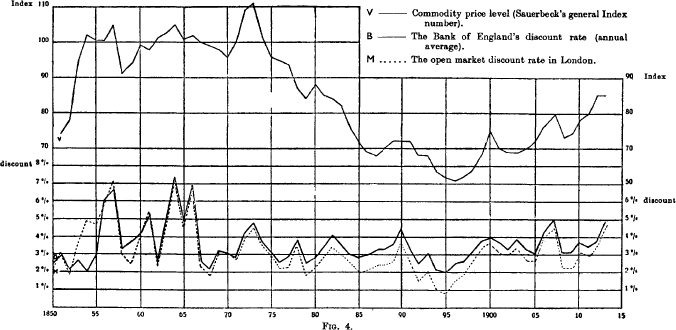
The fluctuations in commodity prices which are not directly caused by changes in gold production must therefore have another cause in many cases, namely the changes which occur from time to time in the real rate of interest. This is not to be understood as meaning that the level of this interest makes commodities on the average either cheaper or dearer, for that, as we have seen is generally not the case, but because the loan rate does not adapt itself quickly enough to these changes, so that the influence of the banks on commodity prices is in fact a consequence of their passivity, and not of their activity, in the loan market. In other words, the difference between the actual loan and normal rates, which we have already designated as a major cause of fluctuations in commodity prices, arises less frequently because the loan rate changes spontaneously whilst the normal or real rate remains unchanged but on the contrary because the normal rate rises or falls whilst the loan rate remains unchanged or only tardily follows it. In the discussion of these questions this consideration has been almost entirely overlooked, probably owing to the fact that the theory of interest has hitherto remained in a rudimentary stage and has only in our own days been placed on secure foundations by the epoch-making work of Böhm Bawerk. The natural rate of interest, the real yield of capital in production, is, like everything else, exposed to changes—sometimes very strong. It falls when, other things being equal, capital increases by continuous saving, for as it becomes more and more difficult to find profitable employment for the new capital, competition with existing capital lowers the rate of interest whilst wages and rents rise in consequence. We must not forget, however, that even if, ceteris paribus, the rate of interest exercises a determining influence on the volume of saving, it is also affected by a number of other causes, such as increasing prosperity, increased legal security, increased forethought and a higher level of civilization. In some cases, too, a lower rate of interest may even stimulate saving, though this must be regarded as an exception to the rule.
Conversely, the rate of interest rises when the amount of capital diminishes, either relatively, for example, through an increase of population and the resulting increased demand for capital in excess of current savings,9 or absolutely, as the result of a destructive war or some catastrophe of nature. But the rate of interest may also rise for a time in consequence of some technical discovery which opens up a hitherto unknown profitable employment for capital and which at the same time usually requires more capital for its realization. If, for any of these reasons, or for all together, a change occurs in the natural rate, what will be the consequences? The money rate should, in accordance with general economic theory, undergo a corresponding change, but there exists, at least in our complex modern monetary system, no other connection between the two than the variations in commodity prices caused by the difference between them. And this link is elastic, just like the spiral springs often fitted between the body of a coach and the axles. An increase in the real rate does not therefore immediately cause a corresponding rise in the bank’s rates, but the latter remain unchanged for a time and with them the loan rates between individuals. The money rate therefore becomes abnormally low in relation to the real capital rate, and this naturally has just the same effect as if the money rate had been spontaneously reduced with an unchanged interest on capital—which seldom happens. Frequently commodity prices therefore rise continuously, business requires greater cash holdings, bank loans increase without corresponding deposits, bank reserves, and often bullion reserves, begin to fall and the banks are compelled to raise their rates somewhat, though this does not prevent the continuous rise in prices, until the interest rates have reached the level of the normal rate. Indeed, if the rise in prices itself gives birth to exaggerated hopes of future gains, as often happens, the demand for bank credit may far exceed the normal, and in order to protect themselves the banks may be forced to raise their rates even above the level of the natural rate or the normal loan rate. Still more is this true if signs of a crisis have already appeared; confidence begins to be shaken and the credit of the big monetary institutions is the only credit accepted. The converse will naturally occur with a falling natural (or real) rate which is only followed gradually and at a distance by a corresponding fall of the banks’ rates. Our conclusion is that rising prices are accompanied by high and rising rates of interest, and falling commodity prices by low rates of interest—which is in full agreement with our theory, and yet adduced as the main disproof of the connection between the money rate and commodity prices which we have assumed.
It is a common experience that “good times”, when business is active and everybody is earning, or believes or hopes he can earn, a good profit, are also times of rising prices. Good times and a generally hopeful tone in the business world are created by the prospects of gain, and the real foundation is doubtless the gain already obtained in certain enterprises, as a result, for example, of technical or commercial progress. The real rate of interest, therefore, is high, and is expected to remain so in the immediate future, whilst the loan rate remains for the moment unchanged. The element of a rise in prices is therefore present, according to our theory, but it is equally clear that sooner or later the banks will be induced to raise their rates, since the technical discoveries have not brought them any additional supplies of money and neither the velocity of circulation of money nor the perfection of banking technique can be raised to an unlimited extent. Higher prices and an increased volume of business, on the contrary, require a larger amount of hard cash or banknotes in circulation. And the contrary is the case in “bad times”.
It might therefore be supposed that the fluctuations in the bank or money rate of interest are sometimes the cause of fluctuations in commodity prices and sometimes, more frequently, caused by them. In this view, which is actually held by many writers, there is nothing essentially unreasonable, for it is not surprising that the movements of prices and the interest rate occur in the same direction in the latter case and in opposite directions in the former case; there are parallels to be found in many other economic phenomena which merely illustrate the general law of effect and counter-effect. Thus, for example, an increased demand for a commodity may sometimes be associated with a rising, and sometimes with a falling price, according to whether the change in price is caused by the increased demand or itself caused the latter. What is unsatisfactory, however, is that the very cause of a rise or fall in the general price level is still unexplained in the case, extremely important in practice, where it is not due to a change in the supply of gold or to an increased demand for goods from the gold countries. From what has been said, however, it should be clear that both phenomena, the influence of prices on the money rate and the influence of the money rate on prices, follow the same law. The primary cause of price fluctuations in both cases is the same, namely the difference arising no matter how, between the normal and actual money or loan rates. A lowering of interest rates by the banks causes rising prices, and a raising of them causes falling prices, only when the loan rate thereby falls below or rises above the normal rate which in its turn is connected with the natural rate. In the same way the fluctuations in the latter, which we regard as the essence of good and bad times so-called, influence prices only so long as they are not accompanied by a corresponding modification of interest rates. If on the other hand changes in the loan rate take place simultaneously and uniformly with corresponding changes in the real rate of interest then—apart from the direct influence of gold production—no change in the level of commodity prices, and least of all a progressive, cumulative change, can occur.
Note on Trade Cycles and Crises.
The above views, so far as they relate to price movements in “good” and “bad” times, are connected with a view of the nature and causes of trade cycles which I have not had the opportunity of developing further since I put it forward in a lecture to the Norwegian Statsökonomiska Förening (Economic Club), published in Statsökonomisk Tidskrift, 1907. The lecture does not claim to give a definitive explanation of the puzzling phenomena of the trade cycle, but does point out a necessary and hitherto often neglected clue to a full explanation. Moreover my view closely agrees with that of Professor Spiethoff. Its main feature is that it ascribes trade cycles to real causes independent of movements in commodity price, so that the latter become of only secondary importance, although in real life they nevertheless play an important and even a dominating part in the development of crises.
Since rising prices almost always accompany prosperous times and falling prices times of depression, it is natural—though in my opinion wrong—to regard such a rise in prices as the cause of good times, and falling prices as the cause of depressions, just as according to Clement Juglar—who may well be right here—the cause of crises, or rather the crises themselves, consist of the sudden cessation of the rise in commodity prices.
A consistent statement of this point of view is contained, for example, in Sombart’s well-known assertion that, historically, prosperous times are always associated with increased gold production.
That such a general rise in prices, or rather a rise caused in such a way, may act as an incentive to increased business activity and thus to conversion on a large scale of liquid capital into fixed capital, which, as all agree, is the outstanding characteristic of good times, need not be disputed. But if the formation of the real capital which is then absolutely essential is only based on the rise in prices itself, i.e. is due to diminished consumption on the part of those persons or classes of society with fixed money incomes, then the increased prosperity could scarcely be very great or enduring. Moreover, the constant parallelism between largely increasing gold production and boom periods which advocates of this view have observed is disputed, and in my opinion rightly, by others, for example by Spiethoff.
Still less can we accept the view first put forward by Tugan Baronowski, and later adopted by Lescure (in his work on crises) according to which both a rise in prices in good times and a fall in prices during and after a crisis have no relation to the currency system and are caused exclusively by the phenomena of production and of the market. Thus, for example, in this view increased production and the resulting increase in the supply of certain kinds of goods, especially of those for which the demand is not very elastic, such as foodstuffs, would lead to a heavy fall in the prices of such goods, and since sellers would then obtain smaller amounts of money with which to demand other goods, the fall in prices would extend to these also and depression and crisis would result (surproduction généralisée in contrast to surproduction générale, formerly the commonest theoretical explanation of crises, but now mostly abandoned).
Clearly the fact is here overlooked that the purchasing power which on this assumption would be reduced in the case of the sellers of the former goods would be increased to a corresponding degree in the case of the buyers. If the latter only have to offer a smaller part of their income in order to satisfy their needs for the goods or classes of goods in question, then they have a correspondingly greater amount left for their demand for other goods, and it is not impossible that these other goods—quite contrary to the theory—would rise in price and thereby perhaps compensate for the fall in price of the cheapened goods.
On the whole it is vain here, as in the general theory of prices, to explain any particular movement without regard to the one thing which constitutes a basis of comparison in all price-formation, namely money and its substitutes, or the means of hastening its velocity of circulation, credit. In pure theory we are at liberty to invent any measure of prices we please. Let us suppose, for example, that instead of 0.4 grammes of gold, as in Sweden, we select as our unit of money value one kg. of pig-iron. Then, since of all commodities pig-iron usually shows the most violent fluctuations in price before and after a crisis, the choice of this measure of value would mean that the prices of all goods (except pig-iron, which would remain constant) would fall in good times and rise in the subsequent depression. That price movements in fact occur in the opposite direction can only be explained by the choice of the measure of prices—gold, and not pig-iron. Yet the difference does not consist in the fact that gold as a commodity, i.e. in industrial use, is less in demand in good than in bad times—the opposite is certainly true—but in the fact that its quality as a commodity remains in an indifferent relation to the other factors influencing its value. The utility of gold in its technical employment is, unlike that of pig-iron, at any rate during the short periods here under consideration, of too little importance to be able to offer any resistance to the changes in its exchange value which are caused by an acceleration or retardation of the velocity of circulation of minted gold or by the expansion or contraction of credit.
It is true, of course, that the last-mentioned factor is of some influence between individuals, apart from any measures taken by the banks. The general tone of confidence produced by a boom no doubt has the effect of considerably expanding the volume of claims and debts on ordinary current account between merchants—and vice versa in times of depression—but in the main and especially nowadays it is probably the banks who by their discounting of bills and other credit facilities regulate the amount of circulating medium. And after what we have said above we may take it for granted that that which primarily determines the extent to which this bank credit is taken must be its price, its relative price, the bank rate, in relation to the yield or expected yield of capital employed in production and turnover.
Our conclusion is therefore that the changes in the purchasing power of money caused by credit are under existing conditions certainly ultimately bound up with industrial fluctuations and undoubtedly affect them, especially in causing crises, though we need not assume any necessary connection between the phenomena.
The principal and sufficient cause of cyclical fluctuations should rather be sought in the fact that in its very nature technical or commercial advance cannot maintain the same even progress as does, in our days, the increase in needs—especially owing to the organic phenomenon of increase of population—but is sometimes precipitate, sometimes delayed. It is natural and at the same time economically justifiable that in the former case people seek to exploit the favourable situation as quickly as possible, and since the new discoveries, inventions, and other improvements nearly always require various kinds of preparatory work for their realization, there occurs the conversion of large masses of liquid into fixed capital which is an inevitable preliminary to every boom and indeed is probably the only fully characteristic sign, or at any rate one which cannot conceivably be absent.
If, again, these technical improvements are already in operation and no others are available, or at any rate none which have been sufficiently tested or promise a profit in excess of the margin of risk attaching to all new enterprises, there will come a period of depression; people will not venture to the capital which is now being accumulated in such a fixed form, but will retain it as far as possible in a liquid, available form.
It is not difficult to understand that in the former case such goods (raw materials) as serve in the construction of fixed capital—bricks, timber, iron, etc.—would be in great demand and rise in price, and that in a period of depression they would be in slight demand and fall in price. But this rise or fall in price should under ordinary conditions be accompanied by a movement in the opposite direction of the price of other goods, so that the average level of prices would remain unchanged. This would probably be the case if the banks at the beginning of a boom raised their interest rates sufficiently and on the other hand finally lowered them at the beginning of a depression. In that case presumably the real element of the crisis would be eliminated and what remained would be merely an even fluctuation between periods in which the newly formed capital would assume, and, economically speaking, should assume, other forms, of which we shall now speak, but which have been almost completely ignored in all previous theories of the trade cycle.
Since the demand for new capital in an upward swing of the trade cycle is frequently much too great to be satisfied by contemporaneous saving, even if it is stimulated by a higher rate of interest, and since, on the other hand, in bad times this demand is practically nil, though saving does not nevertheless entirely cease, the rise in rates of interest and commodity prices in good times and their fall in bad times would presumably be much more severe than now, if it were not that the replenishment and depletion of stocks in all branches of production producing durable goods, acted as a regulator or “parachute”. When demand falls, manufacturers, unless they wish to dismiss their workers or work half-time, have no alternative but to work for stock, and usually they do so, since wages have generally fallen and the rise in prices which they expect to occur later on will more than cover the loss of keeping goods in stock even for several years. (In some years the price of bricks has varied from 25 to 40 Kr. per 1,000. If rent and warehousing are estimated at 10 per cent per annum for the whole output—which is an exaggeration—then the holding of stocks for even five years would be economically possible, if the higher price were assured at the end of the period.) The accumulation of stocks is probably the most important form of fresh capital accumulation in bad times. In subsequent good times the largely increased demand for raw materials and finished goods for production and consumption is largely satisfied from these stocks, both directly and by exchange for the products of other countries.
Clearly, working for stock would be much facilitated if the banks offered sufficient cheap credit. Manufacturers would then not need to wait for a fall in wages or in the prices of raw materials, but even a moderate fall in the prices of their own products would, in combination with low loan rates, make it profitable for them to increase .their stocks in order to reduce them after some years by selling at normal prices.
Earlier theory has in my opinion turned the whole matter as it were upside down in so far as it assumes that stocks are increased in good times and are depleted in bad times (the so-called theory of over-production). It is not easy to understand whence the surplus in the former case or the shortage in the latter case should come. In point of fact consumption increases in good times and much labour and land is withdrawn from the production of present commodities. Nor can we understand why practical business men should habitually choose such a topsy-turvy procedure as to complete their stocks when costs of production are high in order to sell them when prices are low. Not even the assumption of widespread unemployment (or short time) in depressions suffices as an explanation, for, quite apart from the fact that this argument is exaggerated, unemployment itself implies greatly reduced consumption.
Unfortunately here also we lack the detailed commercial statistics which alone can finally solve this problem. Yet from inquiry among business men I have learned that it is just in periods of depression that they are forced to work for stock, and that they can never do so in good times, since they are then often not in a position fully to meet the demand for their goods. And this appears probable a priori. If we ask when a manufacturer may reasonably describe loans as good and take steps to expand his output, the answer must be when the demand for his goods begins to exceed his production capacity. But that is the moment at which his stocks, which he had previously enlarged, begin to be depleted, that is, mathematically, when they have reached their maximum, and not their minimum dimensions. An apparent argument against this is the heavy fall in prices which usually accompanies a crisis, but the cause of this need not be sought in the accumulation of stocks. No manufacturer is disposed to sell his wares at a slump price just because his warehouses are full. But if he is refused credit and if he is compelled to obtain ready cash, then he will be compelled to dispose of his goods at any price at all, whether his stocks be large or small.
In the absence of comprehensive statistics, however, we must content ourselves with a weighing of arguments. Spiethoff (in his discussions in the transactions of the Verein für Sozialpolitik, 1903) mentions as a well-known fact that in bad times manufacturers’ stock rooms are filled from floor to ceiling. Herkner (in the article “Krisen” in the Handwörterbuch der Staatswissenschaften, 3rd ed.) disputes this fact by reference to Esslen and Merovich. Esslen’s work, however, gives no information on this point and Merovich’s work is still, so far as I know, unpublished. How little this important point has hitherto been considered may be seen from the fact that the comprehensive questionnaire which the Verein für Sozialpolitik at one time sent out, and which is the foundation of the inquiry into the crisis of 1900, did not contain any question as to the magnitude of stocks.
10. Conclusions. The Practical Organization of Currency
If we sum up what has been said, it will be found that there are two essential causes of change in the commodity price level.
Firstly the demand for goods from the countries producing the precious metals, especially gold, followed by shipments of gold in payment thereof, a demand which, if it is greater than that corresponding to the demand of the non-goldproducing countries for new gold at ruling commodity prices—whether for industrial purposes or by reason of increased population or the increased use of money—must necessarily cause a rise in prices, and if it is less than that demand a fall in prices in the latter countries. Both are accompanied by an absolute and usually increased quantity of money and therefore of money in circulation, but relatively to turnover it is increased in the former case and decreased in the latter.
Secondly, the fact that interest on borrowed money is for one reason or another either below or above the level which would normally be governed by the real rate ruling at the time, a circumstance which, so long as it lasts, must cause a progressive rise or fall in prices and during which the medium of turnover is adapted to the changed demand, not by an increase or decrease in the quantity of money (gold), but by an increase or decrease in the (physical or virtual) velocity of circulation of money through the agency of credit.
It is not possible to subsume these two causes under a common cause (as I tried to do in my earlier work, Geldzins und Güterpreise, following Ricardo’s example), since the quantity of money and the velocity of circulation of money are two different things, even if they both have an influence on the price level. Only in so far as new gold is deposited in the banks in the form of “capital”, i.e. without being drawn out in cheques and notes soon after, can it give rise to a lowering of interest rates and in that way affect prices. But this need not happen, and, contrary to Ricardo’s view, does not happen as a rule. Rather most of the gold flows in in payment for goods and should then, in proportion as it exceeds the demand for new gold, have a direct influence in raising prices without lowering interest rates. Indeed, this effect may, on the hypothesis we have developed above, even precede the inflow of gold, in which case its influence on interest rates will rather be in the contrary direction.
We evidently possess no control of this cause of price change so long as gold production remains in the hands of private enterprise and the free minting of gold for private account is retained. The only possibility of a rational control of the price level must lie in another direction, in the proper regulation of the interest policy of the banks. Theoretically such steps should under all circumstances be sufficient, for a spontaneous raising or lowering of the discount rate should in the long run have a more powerful influence on prices than any other cause. But in practice, nevertheless, it encounters under existing conditions almost insurmountable difficulties.
This method is comparatively simple in those cases which in times gone by caused economists the greatest difficulty, namely in cases of a diminished flow of gold from the producing countries and a threatened shortage of gold. An adequate lowering of interest rates should successfully counteract the otherwise inevitable pressure on prices; the only obstacle to its realization would be the fact that the banks’ supplies of gold would no longer suffice to fill the vacuum in the circulation of gold among the public which would be caused by the diminished production of gold. But the proper remedy for this is to be found partly in the issue of notes of lower denomination even in the larger trading countries, as was proposed in several places in the ’eighties, when the shortage of gold was threatened, and as could probably have been effected if the shortage had continued,10 and partly in an increased use of bank credit, in proportion as the habit of keeping a banking account spreads more widely among the population. So much as regards the needs of internal business. As regards international payments, the necessity of maintaining large gold reserves for eventual payment abroad might be reduced to almost any extent if, instead, the banks held deposits in foreign banks, a development which is already in progress and which is quite natural in itself in so far as foreign payments are concentrated in the hands of the banks. In a country such as Sweden in particular, and in general where the gold reserves are not employed in the transaction of internal business, there is no doubt that foreign bills might take the place of gold without any danger to the legally prescribed note cover, The higher price which these bills would command in the market with an unfavourable balance of payments and also the interest which the banks themselves would be obliged to pay for the credits by which they would strengthen their foreign holdings in case of need, or the falling values of the scrip which they must export in order to obtain such holdings, would make it as compelling a necessity for the banks to raise their interest rates in order to restore equilibrium as the threatened outflow of gold, unless foreign countries achieved the same effect by lowering their interest rates.
The only real limit to the substitution of credit for gold would appear when gold production had fallen so low that it did not meet the demand of industry for gold, which would then turn to the remaining stocks in the banks and would soon decimate them. In this case, in so far as it is still desired to prevent commodity prices from falling, nothing else would avail but a removal of the obligation of the banks to redeem their notes in gold, in other words, the introduction of an inconvertible paper currency; this is a step to which we shall shortly return, but which for the moment and in the immediate future need not be regarded as likely.11
On the other hand, the position is much more difficult when there is an excessive supply of gold and a consequent rise in prices for all goods and services. It has not been discussed much, though from all appearances it must have been imminent in 1906. A correction might exist in a contraction of bank credit, but this is much more difficult to effect than an expansion, as it runs contrary to the developments which economic forces are seeking to bring about. In the countries which have notes of small denomination a withdrawal of such notes would certainly leave room for gold in general circulation, but naturally at the sacrifice of the profit which in such countries nowadays usually goes to the State, and with a resulting extra burden on the tax-payer. In the chief European countries, again, this remedy is not possible, since gold is already largely in circulation there. A withdrawal of the English five-pound note and the German 100-mark notes, so that the lowest denomination would be £10 or 200 marks, would only inconvenience business and would perhaps have no effect, since notes, especially in England, are being more or less replaced by cheques. As regards the proposal sometimes made to demand of the non-issuing banks the maintenance of large gold reserves as a guarantee for their deposits and current accounts, such a measure, if it were not required by a real need for increased security and soundness of the banks (which would be difficult to prove), must be regarded as an unnecessary and costly restraint.
Therefore, unless we are prepared to accept the consequences as regards commodity prices, since they must ultimately adjust themselves to an equilibrium with the demand for gold, though at a considerably higher price level, there is scarcely any other fully satisfactory remedy against a great and persistent increase in gold production than the one which has been applied almost everywhere in the past with regard to silver, namely the cessation of free minting on private account.12 There can scarcely be any reasonable doubt that such a step would be fully effective for the maintenance and preservation of the present price level and purchasing power in goods and services if we look at the influence which the cessation of free minting in Holland and British India—in which countries most of the hard cash consists of silver—has had on the value of money in those countries. Without any difficulty whatever silver is held at parity with gold, in Holland at the old ratio of 1:15½, in India at the new ratio 1: 22, and consequently any other variations in terms of goods than those which gold undergoes, and therefore such as might have been caused by the subsequent heavy fall in the value of silver are eliminated. From an economic point of view this measure would constitute a great saving and would be much preferable to an attempt to maintain the value of money at its present level by contracting credit, whilst retaining free minting, for in that way, as Davidson rightly observes, the production of gold would also be maintained on its present excessive scale and might even be increased. That would be wasteful of capital and labour, which might from the point of view of economy be more profitably employed.
The only people who could complain would be the shareholders in the gold mines, whose vast capital sunk in them would no longer give the expected yield: in some cases, indeed, it might yield nothing at all. This, however, is a secondary consideration. The interest of gold-producers cannot, or at least should not, be decisive in this question, nor should it set aside much more important and more comprehensive interests any more than the interests of the owners of silver mines in keeping up silver prices were allowed to prevent the abolition of the free minting of silver or the repeal of the Bland and Sherman Bills in the U.S.A.
We now come to the main question. Is such a step possible without sacrificing the advantages of gold monometallism with free minting and especially the advantages of an international medium of exchange which it now possesses and which is, rightly, valued highly? A single nation, however important, which on its own account introduced such a measure would of course cut itself off from the existing fixed currency parity and the relative stability of foreign exchange rates. Its currency, gold coinage with no free minting on private account, would as a rule have a higher, perhaps much higher value than the gold currency of other countries, but at the same time it would be an unstable value. With an occasional unfavourable balance of payments abroad, the gold coin of the country could not be used as a medium of payment abroad, or at least only in a case of extreme need and after a heavy fall in its internal value; in order to effect payment it would be necessary to use first stocks of unminted gold and foreign coin held by the banks or by private individuals who had acquired it in speculation for this purpose, and second, and most important, existing holdings abroad, such as securities, etc. Indeed, this method of payment is finding wider employment even under present conditions, and experience has shown that both old silver countries, after the abolition of free silver minting, and paper currency countries, such as Austria in recent times, have been able, by a rational use of minting, note issue, and discount policy, successfully to maintain their conventional money at parity with the gold currency of other countries. There could therefore be no special difficulty in maintaining it in a country which, by the abolition of free gold minting, had already imparted a higher value to its gold currency than its metallic value, i.e. in preventing occasional and unnecessary disturbances. Of course it would never remain quite stable in relation to the currency of other countries, for the purpose of the abolition of free minting was just to prevent the value of money from following foreign currency in the anticipated fall in value of metallic and free minted gold. That would be an inconvenience which the country in question would have to submit to for the benefit of possessing within the country a fixed measure of value and an average price level for commodities and services which is as constant as possible.
If other nations should follow this example—though at first gradually—and the value of gold should meanwhile continue to fall, then there would be the inconvenience that we should possibly have a whole series of gold currencies in different countries whose value in relation to goods, and therefore their internal value, would depend on conditions quite other than their weight and fineness. This is more or less what happened to the silver currencies of various countries, such as the French 5-franc piece, the German thaler, the old Austrian silver gulden, the Russian silver rouble, the Indian rupee, and the Mexican dollar; they all had different values in relation to their silver, content. Undoubtedly the simplest and best course would be for the abolition of free minting of gold—assuming sufficient reason for this measure existed—to occur simultaneously by agreement between the principal Great Powers, in which case the remaining countries would certainly follow suit. In such case there would seem to be no insurmountable obstacle to retaining all the advantages of the present system whilst avoiding its inconveniences, by combining, as it were, a constant value of money in space with that in time.
As regards the first half of our problem—the maintenance of a constant internal value between the gold currencies of different countries, the relation of which would be the same as the relation between their gold content, even if they had all risen above the value of the metallic gold, one might at first suppose that it might be done by an international agreement similar to that of the Latin Union in regard to silver, so that the gold currency of the various countries would be legal tender, or would at any rate be accepted by the public treasuries in each country. But this would scarcely be feasible, for it would require common regulations as regards the minting, of gold, which could only be permitted up to a certain maximum, related in some way, for example, to the population. Otherwise some State might avail itself of the low price of gold to mint large quantities of money and to flood other countries with it in payment for goods—an extremely profitable business. But restrictions of this kind are difficult, and even impossible to introduce, as the requirements of currency per head differ so much in different countries and at different times. The best thing would therefore seem to be to leave the regulation of international monetary values to the institutions which at present control them, namely the discount policy of the great banks, though so long as metallic money remains the measure of value it must be supported by the currency policy of the Governments. Nothing is more absolutely necessary than agreements between the central banks of the various countries, of the kind which we have described—and which have actually existed between the central banks of the Scandinavian countries—to redeem at par each other’s drafts and notes (and of course each other’s gold currency, though this would not then be of major importance) in their own currency and notes. It would then be the banks’ own affair to determine how they would exchange or account for these notes and drafts and to what extent and at what rate of interest they would accord each other credit for longer periods. In this way the currency and notes of each country would continue to be legal tender only in the country itself, but they could nevertheless be used for foreign payments, along with the drafts of the banks, and, like them, without any loss on the exchange, as they would always be redeemed at par by the central banks and their branches, and in all probability very soon by other banks also.
There remains the much more difficult problem of the maintenance of a constant value of money in time, a stable purchasing power of money in terms of goods. It is evident that this could not be achieved by any country alone if the mint parity between countries were maintained the whole time. It must be achieved rather by common measures on the part of all countries and more particularly on the part of their central banks—though from what has been said it is difficult to say of what kind. We have already seen that the system here proposed would by no means release the central banks of the various countries from the necessity of making changes from time to time in their interest rates in order to counteract movements either occasional or more persistent, in the balance of foreign payments. This necessity would remain, though the fact is often overlooked, under any system, however intimate the monetary unions into which the different countries may enter, and even if the proposal for a common world paper currency, issued by one central bank, were adopted. But such rises and falls in interest rates are by nature relative; they are always made on the basis of foreign interest rates. The same result may therefore be obtained in two different ways: by raising the discount rate in the country which has an unfavourable balance of payments and by a lowering of it in those countries which have a favourable balance at the same time. The system has, therefore, to borrow a term from mechanics—two degrees of freedom: side by side with the interest policy of the banks with reference to each other, which has the function of producing equilibrium between the debits and credits of the various countries, there should be a common policy, a raising or lowering of bank rates throughout the world from time to time in order to depress the commodity price level when it showed a tendency to rise and to raise it when it showed a tendency to fall. Such an arrangement would in reality be less artificial than one would suppose, for the point round which interest rates in the various countries would oscillate and to which they would be more or less anchored would, as has already been shown, be just the normal or real rate ruling on any particular occasion in any particular country. There is in addition another reason for leaving this function to the interest policy of the central banks instead of, as one might imagine, to a common currency policy of Governments. So long as the production of gold continues to be abundant, the Governments are, it is true, able by restricted minting to raise the value of their coinage to any height whatever above its metallic value. But if the gold mines and the goldfields at some future time should again be exhausted and metallic gold rise to the same value as that of minted gold, or even above it, then a rise in the value of money and a fall in commodity prices could not be prevented by any such measure. The prohibition of the melting down of gold is practically useless, as history shows, and for good reasons. In such a case it would ultimately be for the banks, by an increased note issue or some other expansion of credit to counteract the shortage in the medium of turnover in order to raise prices, and it would only be beneficial if by mutual agreement and the habit of common action they were prepared for all eventualities. From a higher economic point of view, moreover, the use of such a costly material as gold is pure waste. The minted gold of the world, calculated at 40 milliards of kronor, would naturally be used to greater advantage if it were placed at the disposal of industry, and even if from a purely commercial point of view gold would then have to be sold at a loss it would be an economic advantage to be rid of it. As an independent measure of value, independent of material substance, whether gold or silver, and kept stable in value both in space and time in the manner described above, the banknote, or in more general terms bank money, is undoubtedly the ideal which currency systems should endeavour to approach.
Finally, as regards the technical difficulties of introducing such reforms, there is no reason either to underestimate or to exaggerate them. That existing price statistics are not sufficiently developed for a precise or reliable calculation of the fluctuations in prices is only too true, and even if they were as complete as is conceivable a regulation of prices and exchanges, especially if it is to be effective throughout the whole world, can only be approximate and to a certain extent purely conventional. But such difficulties must, here as always, be measured and weighed against the urgency of the need which it is proposed to satisfy and the evils which require a remedy. If gold production should again be reduced, or the excess of gold is absorbed—as happened in the ’nineties—by the countries which have not yet found it necessary to acquire large stocks of gold, and if in consequence commodity prices in the immediate future only show a small or uncertain change, then perhaps it would be folly to attempt to reform the existing monometallic gold system, which is without doubt theoretically the most simple and has great and real advantages in practice. But if we are confronted with a real plethora of gold, if the future price level shows an unmistakable and persistent upward trend with all the resultant social inconveniences, and even if the reverse—a great shortage of gold—should happen, then the need for reform of the existing currency system will presumably be so clearly felt that it will be impossible to reject it, and the practical means for its achievement will be discovered, even if they do not at the beginning reach the height of perfection.
Note on Irving Fisher’s Proposal for the Regulation of the Purchasing Power of Money13
A proposal for the regulation of the value of money which has lately been much discussed is that of the American professor, Irving Fisher, which he first indicated in his The Purchasing Power of Money, and later in articles in various journals, especially The Quarterly Journal of Economics, March, 1913, where he develops a plan for a “compensated dollar”. Under this plan the free minting of gold is retained, though not, as now, with the deduction only of the costs of minting (brassage), but with the introduction of a more or less significant seignorage, which at any given moment would in principle be so determined that the metallic gold actually exchanged for a minted dollar (or other gold coin or notes of gold denomination) would stand in inverse proportion to the current purchasing power of gold in terms of other goods. In this way, according to Irving Fisher, we should retain a stable purchasing power in terms of goods, and the average level of commodity prices, calculated in minted gold, would therefore remain stable. On the other hand national treasuries would be under an obligation to redeem gold coins or notes on demand for as much metallic gold as corresponded at any given time to their purchasing power. The profits which would be made by the treasuries in times of rising prices, calculated in metallic gold, i.e. from a falling value of gold, would form a fund which would assist them, without sacrifice, to fulfil their obligation to redeem in case the demand for metallic gold should exceed the quantities simultaneously offered to the State for minting. In order to prevent speculation in rising and falling values of gold the seignorage would, according to Irving Fisher, be altered successively by such small degrees that these changes would be counterbalanced by the loss in interest to those who otherwise might be inclined to hold either gold coin (or notes) on speculation for a future profitable conversion into metallic gold or coin or notes.
It is evident, and this is admitted by Fisher, that this method could only be employed on the assumption that metallic gold remains lower in price than at the time of the introduction of the reform, so that the seignorage would always be positive. In the opposite case the State would be compelled to mint money of greater weight than corresponded to the metallic gold offered to the State for minting, which is inconceivable, since it would soon lead to a smelting down of coin and new offers of gold to the mint for minting.
But apart from this disadvantage the method has another drawback, which neither Fisher nor the majority of his critics appear to have noticed. It clearly assumes that the exchange value of the metallic gold in terms of goods is not materially affected by the seignorage. As far as a particular country of the size of the U.S.A. is concerned, this assumption may be made, up to a point, but in that case the whole measure would only amount to a kind of limited minting within that country, and metallic gold as a whole—or in proportion as it was not absorbed for industrial purposes—would flow to those countries where it could still be freely minted at the old ratio, i.e. without seignorage. In other words, the country would then have solved the problem of maintaining the purchasing power of money in terms of goods within the country itself—or what we have called constancy in time—but by sacrificing constancy in space, i.e. as against the currency of other countries.
The conditions would be quite different if all countries should adopt the same plan, which is, of course, Fisher’s purpose, or, what amounts to the same thing, if it is conceived as being introduced in an isolated country producing its own gold. In that case, of course, the exchange value of metallic gold would also be influenced by the seignorage, which to that extent would constitute an obstacle to the intended raising of the purchasing power of minted gold.
Fisher does not altogether deny this, but he assumes, without further reason, that a fall in the value of metallic gold would only constitute about half of the seignorage, so that the remaining half would in any case produce a corresponding rise in the purchasing power of minted gold. This, however, is only a guess, and an improbable one at that. If, as Fisher always does in other places, we take the point of view of the Quantity Theory, then it is clear that this measure can only influence the level of commodity prices in proportion as it successfully brings about a diminution, or prevents an otherwise impending increase, of the whole quantity of money in existence in the country. Now the annual quantity of gold produced, and still more the quantity available for minting purposes, is only a small fraction of the existing quantity of coin. The seignorage, therefore, when it is first imposed or altered, would have a very slight influence indeed on the total quantity of money. Its influence on the total quantity of coin or notes, and consequently on the price level, would be limited to a fraction of a fraction, or in practice it would be nil; for which reason the value of metallic gold would presumably fall by practically the whole amount of the seignorage when imposed or changed.
On the other hand this pressure on the exchange value of the metal would of course make the production of gold less profitable in the long run and at the same time increase the industrial consumption of gold. In the long run therefore Fisher’s method would doubtless prove effective, i.e. it would achieve somewhat earlier equilibrium between production and consumption which sooner or later, though more slowly, the unchecked rise in commodity prices would itself have produced. But the idea that in this manner anything like a stable price level could be achieved must be rejected as illusory.
In crises, as the Belgian, Ansiaux, has pointed out, the Fisher method might have fatal results. In the upward swing of the trade cycle, when commodity prices are rising by means of the granting of credit, the State and the central banks would, on Fisher’s plan, endeavour by successive increase of the seignorage to counteract this rise in prices, though certainly only with partial success. When the crisis occurred and credit was contracted, and there came into being an increased demand for gold coin and notes, the banks would have cut themselves off from the possibility of issuing sufficient quantities of them, since the rate of seignorage already levied could only be slowly altered. The crises might thereby become even more acute.
Various other observations of a practical and technical kind may be made, and have been made, against Fisher’s plan, but its theoretical foundations are, if the above criticism is accepted, much too weak for us to attribute to it any real importance.
At most it may be admitted that the plan is a step in the right direction, though even this is of doubtful advantage if, as seems to be the case here, the step or steps in question are so small that they effect little or nothing of what is required, whilst on the other hand their effects are prolonged into a period when contrary measures are indicated.
The real advantage of Fisher’s method is that, externally, everything would continue as at present, so that the general public would not even notice the change.14 Such an argumentum ad ignoratum seems, however, of doubtful value. The very substance of the proposed reform is to raise something else to the position of a measure of value, and not gold, as is now the case. Why not, therefore, go the whole way, and choose something different by which the goal in view, a stable price level, may be secured with reasonable certainty?
THE END
In modern society the concentration of the population in towns contributes to the maintenance of the rate of interest more than the actual increase in the population, because the development of the town and everything pertaining to it, such as new buildings and means of communication, absorbs the greater part of freshly accumulated capital.
- 1This expression is perhaps not entirely suitable, since, as will easily be seen, the essence of the argument is in both cases the same. It is therefore also possible that I ought to have endeavoured to combine sections II, 2, C and D in a single uniform presentation. I have found myself unable, however, for various reasons, to do this. As they now stand, these two collateral presentations may materially support and explain each other.
- 2Some of the matter included in this book had been published in Conrad’s Jahrbücher in the preceding year.
- 3Some of these contributions are now available in one or other of the world languages. The article on Professor Bowley’s Mathematical Economics, with its discussion of the theory of Bilateral Monopoly, appears in the Archiv für Sozialwissenschaft, Bd. 58, pp. 252-281. Professor Hayek has included a celebrated article on Prices and the Exchanges in his Beiträge zur Geldtheorie, and two others on Dr. Gustav Åkermann’s Realkapital und Kapitalzins and Prof. Cassel’s “Theory of Social Economy” appear in English as appendices to the present volume. But an English translation of a comprehensive selection of these papers is still urgently to be desired.
- 4A short list of Wicksell’s principal contributions to foreign periodicals is given by Professor Ohlin, op. cit., p. 512.
- 5See, e.g., Schumpeter, “Knut Wicksell,” Archiv für Sozialwissenschaft, Bd. 68, pp. 238-257.
- 6In this connection a comparison between Wicksteed’s article on Jevons’ “Theory of Political Economy” (Works, vol. ii, pp. 734–754) and the sections on Capital Theory in Uber Wert, Kapital und Rente is very instructive.
- 7But not all. I should be very sorry to be thought to lend any countenance to the view, now apparently gaining ground in somewhat unexpected quarters, that in undergraduate teaching or in advanced studies we are yet in a position to dispense with the most thorough study of Marshall’s Principles. It would be a sad thing if the uncritical acceptance of this great work, which so long tended to stiffle the development of other lines of thought in this country, were to be succeeded by an equally uncritical rejection of all the wisdom and the path-breaking intuitions that it contains.
- 8He must have been aware of Über Wert, Kapital und Rente, for it was reviewed together with his own Co-ordination of the Laws of Distribution in the Economic Journal for June, 1894.
- 9Finanztheoretische Untersuchungen, p. 176 seq. Wicksell’s views in this spect have been developed with great ingenuity by his pupil, Professor E. Lindahl, in his Die Gerechtigkeit der Besteuerung,
- 10Theory of Wages, p. 233.
- 11“The Ricardian Theory of Profits,” Economica, February, 1933, pp. 51–74.
- 12Prices and Production, chapter i, passim. “A Note on the Development of the Doctrine of ‘Forced Saving,’” Quarterly Journal of Economics, vol. xlvii, pp. 123–133.
- 13See Hayek, Monetary Theory and the Trade Cycle, chapter v, and Prices and Production, chapter i; also G. Myrdal, “Der Gleichgewichtsbegriff als Instrument der Geldtheoretischen Analyse,” in Beiträge zur Geldtheorie, ed. Hayek.
- 14Etudes d’économie politique appliquée, p. 466.

