
Lectures on Political Economy
I. The Theory of Value
BIBLIOGRAPHY.—The three works which, appearing almost simultaneously but quite independently, put forward for the first time the main features of the modern theory of value are Carl Menger’s Grundsätze der Volkswirtschaftslehre1 (published after his death in a new and enlarged edition), Stanley Jevons’ Theory of Political Economy, and Léon Walras’ Éléments d’économie politique pure (both of which appeared in several editions). The simplest, and perhaps fullest, presentation of the theory, from Menger’s point of view, and without the use of mathematical symbols, is given by Böhm-Bawerk in his famous essay Grundzüge der Theorie des wirtschaftlichen Güterwerts2 (Conrads Jahrbücher, vol. xiii (1886)). An adaptation of this, in which some portions of interest have been omitted, is to be found in the same author’s Positive Theorie des Kapitals. Among the many works in which the theory was subsequently developed may be mentioned Marshall’s Principles of Economics, published in many editions; Wicksteed, The Common Sense of Political Economy; Pierson, Principles of Economics; Pareto, Cours d’économie politique and Manuel d’économie politique (1909); my own work, über Wert, Kapital und Rente3; and, in Swedish, Johan Leffler’s essays in Ekonomiska Samhällslifvet, vol. i, pp. 4–37 and 48-80. Although supplemented and corrected by the modern theories of value, the writings of the classical economists on value and price have by no means lost their importance. The well-known works of Adam Smith, Ricardo, and John Stuart Mill still provide, in this field, a number of instructive investigations and observations. A kind of reaction in the direction of the earlier point of view, though more apparent than real, is to be seen in G. Cassel’s Theoretische Sozialökonomie (1918, 4th ed., 1927), also published in English (1923 and 1932).
In this part we have first to examine the qualitative aspect of human needs and the differing significance which we attach to the available means, material, or otherwise, of satisfying those needs. In modern communities this significance finds its most striking and objective expression in the exchange value or price of the various objects, goods or personal services.
The theory of value and price has an importance which is not limited to systems where there is highly developed division of labour, with money and credit and more or less free competition. Even in a self-contained economy (e.g. in the administration of national or communal finance), indeed in every individual productive enterprise or consumption unit, valuation constantly takes place. And we find exchange, too, when that is understood in the wider sense of the term, i.e. a choice between the various uses of the same means of production or finished commodity; or between various means of achieving the same end. This would still be true if free competition ceased to exist, and gave way to some form of collectivism. Hence the theory of value is of fundamental and universal importance in economics.
Modern investigations in the theory of value have led to the setting up of a principle—or rather to the generalization and establishment of a principle already known and applied—called the marginal principle, whose application extends far beyond the actual province of the exchange of goods into the fields of production, distribution, and capital. In other words, it governs every part of political economy.
This so-called marginal principle is, in reality, only an adaptation of the fundamental idea from which higher mathematics and mathematical physics have developed; namely, the idea of regarding given magnitudes as variable (as a rule continuously variable) quantities, and of regarding their rates of change as new quantities (the Newtonian fluxions, the differential co-efficients of Leibniz). It was, therefore, very natural that the refined terminology and symbols of the infinitesimal calculus should be applied to the modern theory of value. Yet, in the nature of things, it is only the fundamentals of the calculus that can be used, so that no more of it need be known than is taught in schools.
There is ample reason, therefore, for inserting at this stage in our exposition a thorough examination of the theory of value, though only in general outline and from a theoretical point of view. The realistic study of value or prices presupposes, in the first place, a knowledge of the theory of money and credit, the treatment of which is postponed to the second volume; and, in the second place, an investigation into trade and marketing—which belongs to a special division of economics.
For reasons of space we must omit many of the details and abstruse borderline cases, in which the theory of value abounds, and refer the reader to other more exhaustive accounts, especially to Böhm-Bawerk’s essay in Conrad’s Jahrbücher, mentioned in the bibliography, and to the works of Marshall, Wicksteed, and others.
1. Exchange Value and its Causes. Earlier Explanations
The means of satisfying our needs we call utilities or commodities—this last signifying utilities of a material kind. Immaterial utilities are called personal services, and these may include services rendered to oneself; for example, a walk, or gymnastic exercises. Even rest and sleep are such personal services and are just as important to the individual as those performed by someone else. By goods we mean objects, many identical units of which are available and which are the object of trade.4
The word “utility” is related to useful, a term which has many meanings: a thing may be useful in contrast to another which is merely pleasant, i.e. which has a lesser and more transitory use. More important, however, is the fact that most things may have either beneficial or injurious ulterior effects; the latter may even predominate, but, being more remote, they may be disregarded. Since, however, economic theory primarily describes and explains human economic activity as it is, and not as it should be, we must naturally include among utilities those objects which, from a philosophic point of view, might be considered harmful (e.g. many stimulants) so long as they are objects of widespread production and consumption. The Italian, Pareto, in his Cours d’économie politique, suggested that instead of the word “utility” we should use “ophélimité” (from the Greek ώϕέλιμоς—useful). But this seems unnecessary, because there does not appear to have been any serious ambiguity or misunderstanding in economic science concerning the various meanings of the terms “use” or “utility”.
Unfortunately, the same cannot be said of the closely related concept of value. Economists have disputed for over a century—and are still disputing—about its correct meaning, or rather about the relation between its different meanings. Happily, the dispute has now lost most of its acerbity and seems on the point of being abandoned. The definition of exchange, value or price offers no great difficulty and gives rise to no special ambiguity. By exchange value we mean the ratio in which goods, commodities or services are exchanged for other goods, commodities or services, i.e. the quantity or number of units of every other kind of goods which may be exchanged for a given quantity, or a given unit, of the first-mentioned good. Thus, strictly speaking, a commodity has as many exchange values as there are other goods, commodities, and services for which it can be exchanged; in this way, the conception becomes indefinite. If, however, in exchange for a unit of one commodity, one obtains, or must be satisfied with, a smaller amount of all other goods, then we can reasonably say that the exchange value of the first-named commodity has fallen. We are accustomed in practice to use this expression as soon as a rise or fall has occurred in the exchange value of a commodity in relation to the majority of other more important commodities, even if its exchange value in relation to one or more less important commodities has moved in an opposite direction.
The word price is sometimes used with exactly the same meaning as exchange value; but most commonly the price of a good (and often its exchange value too) is supposed to be measured in the general standard of values or prices for all goods, which is called “money”. From the various values of goods in terms of money, their money prices—or, if we so prefer, their money values—we can directly deduce, by division, their relative exchange values. The problem of the theory of value is to explain why one commodity has, either permanently or temporarily, one price and another commodity (or service) quite a different one.
At first sight it might appear that this valuation must be due to differences of utility—so that exchange value and usefulness would be one and the same thing—or at least proportional to each other. And, in fact, it frequently is the case that exchange value stands in a more or less direct relation to usefulness. This is always true wherever two utilities can replace one another and where both, even though more or less effectively, can satisfy the same need. If, for example, we look at our commonest fuels: beech, birch, pine wood, etc., it might be argued that their varying prices or exchange values in the market depend almost exclusively on their fuel value—on the amount of heat obtainable from a given volume or weight of each. Conditions are somewhat different with coal. In comparison with an equal weight of wood, coal has great thermal efficiency, but the various inconveniences and discomforts connected with the use of coal as fuel for a long time hindered its use for that purpose, so that it had little exchange value. And its exchange value is still low as compared with wood. The same is probably true of lignite, peat, etc. Conditions similar to those prevailing in regard to the above-mentioned three kinds of wood also prevail between the various animal foodstuffs, such as pork, beef, mutton, veal; between the vegetable foodstuffs, such as wheat, rye, oats, and potatoes, and to some extent also between textiles—silk, wool, linen, and cotton, etc. But, as these examples show, the relation between usefulness and exchange value is not, even under this assumption, quite evident and clear. In many cases it does not appear to exist at all. Where, on the other hand, two commodities cannot replace each other in consumption, but either wholly or in part satisfy different needs, it becomes a question whether their relative utilities can be measured or compared by any common standard. Experience also proves that the prices of two commodities often vary in quite different degrees (and their relative exchange values thus change) without there being any corresponding change in their physical properties.
At the very beginning of the history of economic science, attention was directed to this distinction.5 One of the best-known passages in Adam Smith is that in which he explains that the word “value” has two meanings, so that at one time it expresses the usefulness of an object (or what he calls its value in use), and at another its purchasing power over other utilities (i.e. its exchange value). Adam Smith also pointed out that those things which have the greatest value in use often have little or no exchange value—for example, water; and, on the other hand, the things which have the greatest exchange value frequently have little or no value in use, e.g. diamonds. But he stopped at this point. He speaks afterwards only of exchange value and never returns to the concept of value in use. And at this point science stood still, one may say, for almost a hundred years without it being noticed that Adam Smith’s statement was really a striking paradox and involved a problem which necessarily demanded a solution. There were plenty of commentaries and disquisitions on this statement in the subsequent literature of political economy, but practically no criticism, no examination of its obvious contradiction. In what follows, we shall endeavour to make such an examination. But, before doing so, we must say something of the consequences which this uncritical reception of Adam Smith’s statement occasioned to political economy.
Since, as was assumed, utilities and exchange values did not always coincide, but frequently diverged, exchange value must either depend upon something entirely different from utility, or upon utility and something else as well. The latter explanation was generally accepted (though the Socialists, with Karl Marx at their head, advocated the former). The result was the concept of relative scarcity: in order to have exchange value an object must, it was said, necessarily be useful, but, in addition, it must exist in limited quantities. If the supply is unlimited in proportion to the need for it (air, writer, and the so-called free goods in general— in contradistinction to economic goods, which do not exist in unlimited quantities and with which we are, for that reason, economical), then the exchange value falls, in spite of the great utility, to zero. On the other hand, great scarcity can impart a high exchange value to objects of little usefulness (though some usefulness must always be present), e.g. rare stamps, animals, plants, precious stones, etc. With a slight modification, this point of view developed into the well-known proposition that if utility creates and regulates the demand for a thing, its scarcity or the difficulty of producing it regulates and controls its supply. Its price is, therefore, determined, as we are accustomed to say, by the relation between demand and supply. With a given supply, a large demand leads to higher prices, and a small demand to lower prices. And vice versa, if the demand is fixed and the supply varies. If utility, and with it demand, falls to zero, or if it becomes negative (so that people wish to get rid of the commodity), then, of course, the price or exchange value will also be zero or negative—people will pay to get rid of it (e.g. rubbish, slag, and formerly even sawdust, etc.). Yet the same can also happen, it was said, to useful objects if the supply becomes superabundant—e.g. water in floods or cloudbursts, air when it comes in too large quantities or too rapidly. Dwelling-houses, after all, are principally designed to keep out an excess of air and water. Again, if a relatively large demand encounters a small supply, the exchange value may become very great, as, for example, in the case of the demand for gold and jewels, which, even ignoring the use of gold as a medium of exchange, are not without use—even if only of a limited kind. They are, therefore, eagerly sought for, but they can only be procured in small amounts.
All this is, doubtless, in the main perfectly correct and even obvious. But it is not the purpose of science to describe the obvious in elaborate terms. If we examine the matter a little more closely, the principle of the determination of value by supply and demand does not, in reality, throw much light on the real nature of the phenomena under discussion. It is obvious, for example, that only so-called effective demand influences prices. The demand of persons who are not in a position to pay the price asked for any particular commodity evidently has not the slightest influence on price, however great that demand may be. It may be compared to the longing glances of the numerous, though impecunious, persons who gaze at the precious objects in a jeweller’s shop window. But the effective demand—in other words, the quantity of the goods that can be bought at the prevailing price—is, on the average, neither great nor small in relation to the supply, but is in fact exactly the same. Indeed, it is only on this condition that the market can be in a state of equilibrium. If the demand is greater than the supply the price will rise; if it is less the price will fall—but it cannot continue to rise or fall for ever. Since, therefore, supply and demand are equal where there is economic equilibrium and a stable price, whether that price be high or low, we must further ask: Why does the demand for and the supply of this particular commodity achieve equilibrium at one particular price, and that of another commodity at a totally different price? The classical analysis of exchange values gives no direct answer to this question, though this drawback was felt by the classical economists themselves.
It may be pointed out that, in Adam Smith, the expression “effective demand” has a somewhat different meaning. It means the demand of those persons who are willing to pay the “natural price”, i.e. the costs of production and transport; if supply in the particular case were accidentally greater or less than this demand, then the price would fall below or rise above the “natural price”.6
F. J. Neumann, in his essay on “Value” in Schönberg’s Handbuch, entirely rejects the concept of supply and demand (offer and demand) whenever these are regarded as merely quantities. That, in his view, is extremely one-sided. On the contrary, in his view, supply and demand represent a whole complex of qualities: extensity, intensity, purchasing power on the part of those who demand, etc.; for which reason it is absurd to say that demand is as great as, greater or less than, offer or supply. The obvious reply to all this is that the circumstances enumerated by Neumann doubtless affect the magnitude both of supply and of demand, and the total result must be that, when a certain price is quoted in the market, a certain definite quantity of goods of this kind will be offered and an equally definite quantity will be demanded. For my part, I cannot see the one-sidedness of such a view.
Without entirely abandoning the formula of supply and demand, to which they always resorted in case of need, attempts were made by the classical school to provide a more definite explanation of the exchange value of at least one group of commodities (in practice the most important), i.e. those which, as it was usual to say, could be produced in unlimited quantities. The explanation related to their cost of production or eventually, according to a subsequent variation of terminology, to their cost of reproduction. If a commodity is not, generally speaking, an object of production in the ordinary sense (as, for example, certain natural products), or cannot be produced or reproduced (pictures by old masters), or if, finally, its manufacture is the result of a natural or legal monopoly, then we must still content ourselves with the thesis that the price is determined by supply and demand. For the majority of goods, on the other hand, which can in practice be reproduced in unlimited quantities under free competition, costs of production would, as has been said, determine the average or “natural” price, about which the market price always oscillates.
It is quite evident that, under free competition, the price of a commodity cannot be either above or below its cost of production if this includes everything required for bringing the commodity to market, including a “reasonable” (i.e. customary) compensation to the last seller for his labour and trouble. If it were otherwise, the commodity would either not be manufactured, or it would be manufactured in such large quantities that the price would necessarily fall owing to the increase in supply. But if this is to be a valid explanation of reciprocal (relative) exchange values, then the costs of production must evidently be something definite, something arising from independent (absolute) causes; they must not be dependent on the exchange values themselves. Herein lies the weakness of the classical theory of value. If we analyse more closely the conception of costs of production, we shall find that the latter resolve themselves into a reward or compensation for the use of the various factors of production, usually divided into the three main categories of land, labour, and capital. If, for example, the manufacture of two quantities, a and b, of two different goods requires the same amount of the same kind of labour, the employment of the same quantity of land of the same quality and the same quantity of capital for the same period of time, then we can say without fear of contradiction that both quantities of goods will be sold in the market at the same price. That is, after all, nothing more than saying that all labour of the same kind, all land of the same quality, and all capital employed for the same period of time will receive the same reward, which is a natural and necessary consequence of free competition. If, on the other hand, as is nearly always the case, the production of these commodities requires land, labour, and capital in different proportions, e.g. more land, but less labour and capital, for a than b, then some means must be found for reducing the quantities of these various factors of production employed to a common measure, though, of course, no direct means of doing this is available. In order to express them in common units, we have to refer to the remuneration they demand, i.e. the relative magnitude of wages, rent, and interest. These, however, are not given, and the determination of them constitutes a problem of the same kind as our original problem, and one which can only be solved in connection with it.
The method adopted by economists of the classical school (particularly Ricardo) to escape from this dilemma shows considerable ingenuity; but as has been seen already from our consideration of the connection between the market price and the costs of production of a commodity, and as we shall show in further detail later, the attempt was foredoomed to failure. In the first place, they attempted to simplify the problem as much as possible. The various kinds of labour, such as skilled and unskilled, might, they thought, be reduced to a common standard in so far as labour of a higher quality was regarded as representing an extra number of working days, corresponding to the higher wages paid for it, and to the time which the workman had previously spent on his technical education. As regards capital, they found its chief rôle in production to lie in advancing wages or the necessities of life to labourers and providing necessary tools and raw materials. They assumed in consequence that capital (or the capitalists) in all branches of production would receive approximately the same share or percentage of the exchange value of the product (profits of capital). Ricardo expressly admitted that this rule was subject to important exceptions in consequence of the unequal proportions of fixed and circulating capital in the various branches of production. Finally, they thought that land could be disregarded and that rent could therefore be excluded from costs of production. They only regarded labour and capital employed at the margin of production as contributing to costs—either on marginal land, the least fertile (which is superabundant and, therefore, pays no rent) or, in more intensive cultivation, on land which is already employed—where an addition to output can pay no extra rent for similar reasons. In this way, the factors of production governing exchange value were reduced practically to one only—labour. According to Ricardo, the exchange values of various goods should stand in more or less direct relation to the quantities of labour required to produce them under the most unfavourable conditions which are necessary for their production, i.e. on the margin of production. So great was the satisfaction felt with this result, which is formally so brilliant, that J. S. Mill in the introduction to his theory of value declared the classical theory of value to be “complete”, so that there remained nothing for him. or for subsequent writers, to add.
Ricardo makes another simplifying assumption, which must be borne in mind in reading his works, if we are not to misunderstand them. He assumes that gold, the measure of value and prices, is always produced with the same labour costs, and also that profits on capital employed in the production of gold constitute the same percentage of wages or of the total product as in any other branch. From this he is led to the conclusion that the amount of labour employed in the production of a certain unit of goods directly expresses the number of ounces or grammes of gold for which this unit of goods is habitually exchanged in the market; in other words its price measured in gold. On this assumption, on the other hand, the general level of wages can never have the least effect on prices, as in that case they would also affect the price of gold (in money, i.e. reckoned in gold), which is an obvious contradiction. A rise in wages (money wages) can, moreover, according to Ricardo, take place only in combination with a corresponding fall in the profits of capital, where commodity prices remain unchanged; a change in commodity prices, again, necessarily presupposes that the amount of labour employed in their production has—owing to new inventions or to increased difficulties in production—become greater or less than previously.
By these various simplifying assumptions Ricardo greatly facilitated his analysis. In his work, the structure of economic theory appears, for the first time, as a coherent, logical system. But his conclusions thereby frequently assume an abstract and even unreal character. In this respect, he compares unfavourably with Adam Smith.
Even if we admit all these generalizations and simplifications for what they are worth, we are still faced with the fundamental error of the classical theory of value. Their margin of production is not a fixed limit, given a priori, but is variable and itself depends, among other things, upon the actual exchange value of the goods in question and, to that extent, upon what it has to explain.
Thus, for example, there are certain manufactured goods (especially articles of clay) for which the raw materials exist already mixed in nature in practically unlimited quantities, so that, for them, there is no margin of production: they can be produced with unchanged labour costs (per unit of goods) in any desired quantity. In the case of other commodities, on the other hand—particularly the means of subsistence—in any given state of technique, increased labour costs per unit are necessary if they are to be produced in larger quantities than before. If, therefore, any economic unit must itself provide for the production of these two kinds of goods, their relative exchange value or price will clearly depend, to a high degree, on the relative magnitude of the demands for them; for the extension of the margin of production and the costs of production at that margin for the latter commodity are only thereby determined.
Let us take another example. Suppose that an economic unit (a district or a whole country) is compelled by natural circumstances to restrict its production to two staple articles only, say corn and linen, the prices of which we will suppose, for the moment, to be determined by the world market. If the price of linen goods is relatively high, the community will devote itself principally to their manufacture and will cultivate corn only in proportion to its domestic needs; if, on the other hand, the price of corn is relatively high, then it will expand its production of corn and restrict its manufacture of linen to the minimum. Since, however, the production of linen requires little land in proportion to the labour employed, it is clear that, in the former case, when linen is the chief manufacture, the demand for land will be small, and agriculture will be restricted to the best land or will become less intensive. In both cases the result will be that the labour employed in the production of raw materials will become, even on the margin of production, inconsiderable. And, since this labour in the case of corn constitutes the whole, and in the case of linen only a minor part, of the necessary labour, the portion of labour employed per unit of linen will be great in relation to that employed in the production of a unit of corn. On the other hand, if the production of corn, owing to changed price conditions, becomes predominant, the production of the raw material must be extended to inferior land, or else the cultivation of the better land must become more intensive. Whichever happens, the result will be that the amount of labour which is employed on the inferior land (or, in general, on the margin of production) in the production of the raw material will be very great. From this it will follow further that the total labour employed under the most unfavourable circumstances in the production of one unit of corn will be relatively great in relation to the labour employed in the production of one unit of linen, As illustrations we may mention the economic conditions in Northern Russia, Ireland, and, to some extent, certain Swedish provinces, at the time when the increasing cheapness of cotton goods began to oust the native linen products of those countries.
A third, and very important, example is the exchange value or purchasing power of gold itself in terms of goods, which—as even Adam Smith realized, though Ricardo purposely ignored it—is by no means constant, but depends on the labour costs in the mines on the margin of production. Naturally, however, this margin is itself variable. It expands when commodity prices are low and the purchasing power of gold is high, but it shrinks in the contrary case; so that production is restricted to the richer mines or river beds, and the maximum labour employed in the production of a given quantity of gold becomes less.
In such cases, Ricardo’s thesis that the exchange value of the product is proportionate to the quantity of labour required for its production at the margin is verified—if in each case, as we have done, we do not take into consideration the varying proportions of capital employed. Yet obviously, under such circumstances, it is not the costs of production which govern the exchange values. That, indeed, would be impossible if, as is assumed in the above example, the latter are fixed and determined beforehand by the world market. On the contrary, it is the exchange value of the goods which governs their costs of production—i.e. which determines how much labour shall be employed in the production of one unit of corn and in one unit of linen goods. Again, if we look at the matter more generally and observe either an isolated economic unit or the whole of the world’s production and exchange, then it is clear that costs of production and exchange values cannot stand in the simple relation of cause and effect which Ricardo supposed. As we shall see later, they are mutually conditioned like the various elements in a single economic system in equilibrium. But, in that case, it is also clear that reference to costs of production, even under the simplest imaginable assumptions, is impossible as a theoretical explanation of the exchange value of goods, however useful it may often be as a practical rule.
No doubt, the classical economists failed to realize this because, in the case of one of the most important groups of commodities, the means of subsistence, they regarded demand, or consumption (and therefore also the extension of the margin of production), as given by the size of the population. Statistics have not confirmed this: largely owing to indirect methods of use, the demand for and consumption of corn and other foodstuffs is almost as elastic and variable as that of other goods.
There is this further point. It happens in many cases, even where a commodity is manufactured under competitive conditions, that its costs of production cannot be separated or imputed because its production proceeds simultaneously and in combination with that of other goods, e.g. where one commodity is a by-product in the manufacture of another. Such cases, which have been given by Marshall the technical name “joint supply”, are mentioned also by Mill in his chapter, “Some peculiar cases of value,”7 but, as the chapter heading indicates, Mill regarded them as exceptions to the rule. In reality (as Jevons remarked) they occupy a large, perhaps the largest, part of the field of production. We shall return to this subject in greater detail, but it may be pointed out here that all branches of agriculture fall within the category of joint supply: the cultivation of cereals and livestock, no less than that of textile materials and other commercial crops, are mutually determined in any well-ordered system of agriculture. Here the only question which arises is whether the total selling value of the products will cover the total costs of production, for the separate costs cannot be imputed. When, for example, before the introduction of corn duties in Sweden, some agriculturists maintained that the growing of rye at the low prices prevailing “did not pay”, they nevertheless continued to grow it and proved by so doing that this crop constituted a necessary element in an agricultural system which must have paid as a whole, or else it would have been abandoned.
Here also, it would be possible, by an artifice resembling that of Ricardo for the elimination of rent from the costs of production, to impute the costs of various goods by supposing that one or other of them entered in varying degrees into the total output—which is in fact in full correspondence with actual conditions. Thus, for example, a breeder of sheep produces, at one and the same time, wool and mutton, but he can, as required, specialize on one breed of sheep or another, the wool-producing or the mutton-producing, and in that way obtain either more meat and less wool or vice versa. The possibility of transporting fresh meat in refrigerating chambers from Australia or the Argentine to Europe in fact compelled European sheep farmers to abandon the merino breed, with its fine wool, in favour of breeds yielding more meat. This, in its turn, gave rise to a crisis in the European clothing industry towards the end of the nineteenth century.
In the same way, in the manufacture of coal gas, coke is obtained, if desired, as.a by-product. But here, too, the proportion between the two products is neither given nor determinate, for some coal yields more gas and less coke, and vice versa. If coking is the principal objective, as at iron works, more attention will be paid to the latter kind of coal, and vice versa if the production of gas is the more important. In this way, we obtain a kind of margin of production in which an increased production of one of the commodities corresponds to a definite increase in the costs of production. But even here it will appear that the costs of production are by no means pre-determined; they may vary in a high degree with the variations in the relative prices of the goods. In other words, the relation between costs of production and exchange values is, in this case also, not one of cause and effect, but of interdependence.
In reality, the classical theory of value did not give general satisfaction. The celebrated Proudhon included, though on somewhat confused grounds, the theory of value among his Contradictions économiques, and Bastiat, his opponent, introduces the chapter on value in his work, Harmonies économiques, with the significant words “Dissertation ennui: dissertation sur la valeur, ennui sur ennui”. A theory which one has fully mastered does not, however abstract, normally give rise to ennui. The modifications which these men and the schools to which they belonged effected in the theory of value were, however, by no means improvements. On the contrary, both of them expanded the classical attempts at generalization to exaggerated paradox. In the hands of the Socialists (especially Rodbertus, and Marx still more so) the theory of value became a terrible weapon against the existing order. It almost rendered all other criticism of society superfluous. Labour was conceived by them—Ricardo never meant or said any such thing—to be the sole creator of value—in other words, the source of value; and thus all other factors of production existing in private hands were to be regarded as parasites on production, and their rewards a robbery at the expense of labour, which is alone entitled to remuneration. The fallacy of this reasoning will be made clear in what follows. The harmony economists, Carey, Bastiat, and their numerous disciples in different countries, believed, on the contrary, that they had found in the principle of labour as the only creator of wealth a highly effective weapon for the defence of the existing order of society. They attempted, indeed, to reduce all the shares in the product, even including the rent of land, to wages of labour (i.e. wages for the labour which had been employed on the land or in production in days gone by).
The absurdity of such arguments is obvious and has perhaps contributed more than anything else to the charge of dishonesty and subservience to the interests of the powers that be which has been levelled against scientific, or quasi-scientific, economics. In Karl Marx’s theory of value the Socialists believed that they possessed a theoretical foundation as good as that which was offered by the harmony economists, and both sides considered that they were fighting, with as much or as little justification, under the banner of classicism.
The establishment of a new and better-founded theory of exchange value was, therefore, not only of abstract theoretical importance, but also of eminent practical and social interest, and the three men who almost simultaneously and independently succeeded in doing so—the Austrian, Carl Menger, the Englishman, Stanley Jevons, and the Frenchman, Léon Walras8 —thereby paved the way, more than is usually supposed, for mutual understanding even in the social field.
2. The Concept of Marginal Utility
A presentation of the modern theory of value may, as has already been indicated, conveniently proceed from a revision and analysis of Adam Smith’s thesis relating to the divergence between value in use and value in exchange—which he exemplified by water and diamonds (cf. p. 18). Literally interpreted, this thesis appears to be either meaningless or a contradiction in terms. In the first place, which value in use has he in view? Evidently it cannot be the utility of water or diamonds in their totality, for even if it were at all possible to exchange all the water for all the diamonds in the world it would soon become clear that the former had an infinitely greater exchange value than the latter; of course, the comparison must relate to manageable quantities, e.g. a litre of water or a diamond weighing one gramme. But, even in such a case, as Mill remarks, the value in exchange cannot possibly be greater than the value in use (though it may be less, according to Mill), for we should otherwise be confronted by the absurdity that a person would dispose of a more useful for a less useful commodity. In other words, the value in use, according to Mill, constitutes the upper limit of value in exchange. But on further consideration it appears that the value in exchange cannot be lower than the value in use either, for exchange presupposes two exchanging parties, and while no one will buy a commodity which has a value in exchange higher than its value in use, no one will sell a commodity whose exchange value is lower. We thus seem to arrive at the remarkable result that value in use is, at one and the same time, the upper and the lower limit of exchange value; or, in other words, is its exact equivalent. This, however, is contrary to experience; neither is it easy to understand how, under such circumstances, any exchanges whatever could be effected. The obvious explanation is the well-known fact that the same thing may possess different degrees of utility for different persons, so that the relative values in use can, at the same moment, be greater or less than the relative exchange values for one or other of the exchanging parties respectively. If we follow up this train of thought, we shall easily see that a thing may have quite different degrees of utility for one and the same person under different conditions. The most important circumstance in this connection is evidently, at least in a primitive economy, the quantity of the commodity in one’s possession—or of other commodities which can, to a greater or lesser degree, replace it. In a more advanced economy, the determining condition will be the possession, or accessibility, of a certain quantity of the medium of exchange—that is, of the commodity in exchange for which, as experience shows, other commodities can be obtained. But what sets the standard in both cases is, in the last resort, the quantities of the various commodities which the person in question is in a position to consume in a given unit of time.
Value in use is, therefore, by its very nature, something variable. Value in exchange, on the contrary, is always, or always tends to be, constant and invariable for each commodity throughout the market. The question then becomes: which of these possible, or conceivable, degrees of value in use determines (or, to express ourselves more cautiously, is related to) the actual exchange value of the commodity? The answer must evidently be: the degree of utility which it possesses for the exchanging parties at the moment the exchange is effected, whether that utility arises from their present or future needs. That, however, is evidently hardly ever the maximum utility which the commodity in question might, under certain circumstances, possess, nor even the average utility which such a commodity usually possesses, but rather the minimum utility which the commodity, or one unit thereof, under the given circumstances, will possess or may conceivably possess. This degree of utility is what is called the marginal (or final) utility of a commodity, and corresponds, therefore, to the least important of the needs satisfied by the acquisition of that commodity—and that is the same as the most important of the needs which are not satisfied if the commodity is not acquired, or is acquired in lesser quantities. As regards the commodities given in exchange, their marginal utility will correspond to the least pressing of the needs which will be satisfied if they are not offered in exchange, though as regards very small quantities this cannot be distinguished from the least pressing of the needs which, after a completed exchange, remain unsatisfied. The result is that, after an exchange has been effected, the marginal utilities of both commodities for each of the exchanging parties stand in the same relation as their common exchange value. If this were not the case then, as we shall show later, one of the parties would desire to exchange further and, by offering a somewhat more advantageous price, would induce the other party to consent.
An easily comprehensible example of the variability of value in use is the well-known one given by Böhm-Bawerk (originally given in almost the same form by Menger). A colonist living alone in the virgin forest by agriculture has just harvested five sacks of corn (excluding that set aside for seed) which constitute his entire supply of foodstuffs until the next harvest. If he disposes of this stock in accordance with his previous consumption, every sack will have a different use and will therefore be of different importance to him, although physically they are all identical. The first sack is absolutely necessary for the maintenance of life and is therefore as valuable to him as life itself. The second sack is still of the greatest importance to him, because with it he can eat his fill and preserve his health and bodily strength. The third sack he will no longer consume directly but will use to keep fowl and thus procure a necessary change in an otherwise purely cereal diet. The fourth sack he may use for making spirits. For the fifth sack he can find no better use in his simple mode of life than to employ it for his own amusement in providing for a few parrots. If, by some accident, he should lose one of his sacks of grain, then it is clear that, under such circumstances, it would be the fifth sack which he would sacrifice, i.e. the least important from the point of view of the satisfaction of his needs. If he lost another it would be the one used in the making of spirit, but not one of those which was required for his real sustenance; and so on. Strictly speaking, there also exists a certain gradation within the sphere of each of these utilities: it is quite possible that he would renounce a little of the satisfaction of the more important needs before he entirely abandoned those which, regarded as a whole, rank lower in the scale of utility. But we shall soon return to this point.
By means of this simple conception, the theory of value has obtained the clearness and coherence which it formerly lacked. The dualism inherent in the traditional conception of exchange value as requiring two qualities, utility and scarcity—though it was never clear in what relation they stood to each other—now disappears, in so far as marginal utility actually represents a synthesis of utility and scarcity. Marginal utility becomes the degree of utility at which the consumption of a commodity must cease precisely because of its scarcity. The term scarcity (rareté) was used by Walras as exactly equivalent to marginal utility (his father, Auguste Walras, had earlier employed the same word); for he regarded a commodity as scarce only when it exists in insufficient quantities in relation to the need or demand for it—so that the degree of scarcity is indicated by the marginal utility. This is, of course, a matter of taste; but Walras’ terminology is somewhat forced and has not found general support.
Thus, if a relatively scarce commodity (e.g. a choice wine) has a high exchange value, it is due to the fact that consumption must cease at a point where the least important of the needs satisfied and the most important of the unsatisfied needs or degrees of need (of choice wine as refreshment or as a stimulant) are still of great significance; whilst common commodities, such as bread, are usually consumed in such large quantities that the need which one more unit per consumption period could satisfy is of relatively little significance, or of none at all (as is usually the case with the free goods, air, water, etc.). It is of no importance, in this connection, that the category of needs which bread satisfies (the maintenance of life) is, as a whole, much more important than the category which is satisfied by wine, namely, the need for refreshment and the satisfaction of more refined appetites. The same conditions apply here—to use, once again, a simile from Böhm-Bawerk—as in the case of two mountain heights. One of them is, absolutely, much higher than the other, but this does not prevent a climber at a given moment from being situated much higher up on the lower mountain than another climber on the higher mountain.
It was this relation which Adam Smith overlooked. The value in use on which his gaze was fixed, and which in his view might often stand in inverse relation to exchange value, was evidently the maximum utility which the commodities compared (water and diamonds) could respectively attain under given conditions. But the parties to the exchange have nothing at all to do with this; they are, of course, only concerned with the actual or prospective utility which the commodities possess for them at the moment of the exchange. Bearing this in mind, one is almost tempted to turn Adam Smith’s thesis upside down and to say that those commodities which have a high exchange value thereby prove themselves to possess great value in use or high utility—i.e. high marginal utility. Yet such a formulation would not be quite accurate, for the individual differences among consumers, and especially their different financial positions, here play an important rôle. To the rich man, who can fully satisfy practically all his needs, all commodities must have a very low marginal utility: if a rich man spends hundreds of pounds on a single diamond, that does not prove that it has a higher value in use for him than for others. In most cases it only means that the commodities, the consumption of which he forgoes in order to procure the diamonds, possess for him little or no value in use. Indeed, as we shall see later, we find, in arriving at the laws of price formation under free competition, that the degrees of utility—the relative marginal utilities—of the same thing to two different persons are never compared, but only the marginal utilities of different commodities to a single individual. If, however, property and income were more equally divided, it would no doubt appear that the scale of values in use for most persons would more or less coincide—and this would produce the result that diamonds and many things now highly esteemed would fall in exchange value, and their production would decline—perhaps sufficing merely for the provision of enough diamonds for glass cutting and drilling. There was a striking example of this in the world crisis of 1907, when the world-wide reduction in profits led to a special crisis in the Dutch diamond industry.
A question which has, perhaps, already occurred to the thoughtful reader and to which we will not postpone the answer, is the following. It seems clear that marginal utility determines exchange value so long as it is only a question of obtaining, or disposing of, a small quantity of a certain commodity in exchange for a similar small quantity of another; and so far as one is already provided with a sufficient, or nearly sufficient, quantity of both. But actually, in a modern economic society, based on division of labour, we obtain practically all commodities, or at any rate a large proportion of them, exclusively by exchange. Thus those commodities in fact satisfy all our needs—even those of the highest degrees of intensity. How then does it come about that exchange value as a whole is only regulated with reference to the last and least important of these degrees of need?
This observation is fully justified. In actual fact, exchange value is by nature just as variable as value in use or utility. In isolated exchange there exists, as we shall soon see, fundamentally no such thing as a uniform exchange value. The more or less fixed proportions in which, as we know by experience, goods are exchanged for each other in the market, and which have given rise to the name and concept of exchange value, are something peculiar to the market as such or to the influence of the market—and not to individual exchanges independently of the market. That something is free competition on the part of either or both parties to the exchange. As Jevons expressed it, there is operating in the market “the law of indifference”. It is a matter of indifference to buyer and seller alike with whom they do business provided that they obtain the same goods or the same price, as the case may be. For this reason there can be, roughly speaking, only one price in the market, for a given commodity at any moment of time.
Fundamentally, marginal utility and exchange value or price will stand in the same reciprocal relation of dependence as that which we have already found to exist between exchange value and marginal costs of production. If the exchange values are given beforehand, e.g. as they are given in a small economic unit, by the influence of the world market, then the marginal utilities will be regulated by them; for the various goods will be consumed up to the point where, for each and every consumer, their respective marginal utilities stand in the same relation to each other as the exchange values or prices. If the exchange values are not given in advance, but are determined by the market proper then marginal utilities and prices will mutually determine each other in a single system of equilibrium and they can be symbolically or hypothetically expressed by a system of equations, in which the goods available in the market, or for the period of consumption, constitute the known quantities in the problem. But actually even these quantities are not given; goods are in most cases constantly being produced and consumed and can, according to circumstances, be brought to market or withdrawn from the market in larger or smaller quantities. The final problem of equilibrium, the problem of equilibrium between production and consumption by means of exchange, therefore includes among the unknowns the quantities produced and consumed and the relative exchange value of the goods, as well as the proportional marginal utilities for each particular individual. On the other hand, the definitely known quantities are the means of production existing at each particular moment: labour, land, and capital (and if the process extends over a longer period, factors affecting the accumulation of capital), as well as the individual dispositions of consumers. The exchange value must then be fixed at a level such that the forces on the two sides balance; i.e. the desire to consume (the utility or satisfaction of consuming) on the one hand, and the difficulty of producing, the inconvenience or discomfort of manufacture (sometimes called negative utility or disutility), on the other. That the marginal utility or disutility should be the decisive element is quite in accordance with a number of other apparently paradoxical phenomena of equilibrium (cf. the so-called hydrostatic paradox); but, at the same time—though this is unsatisfactory from the ethical and social points of view—it shows the purely mechanical character of the economic phenomena which occur under conditions of free competition.
We shall now endeavour to explain in more detail the complicated phenomenon of exchange equilibrium, following the principle strictly pursued throughout this book (as in Walras’ work) of proceeding successively from the simple to the complex.
3. Free Exchange and Market Value
A. The Different uses of a Single Commodity
In the market, we observe a double phenomenon: the determination both of the magnitude of the volume of goods exchanged, and of the ratio in which they are exchanged. If there are only two commodities, this ratio is, as a rule, a direct consequence of the quantities of the goods exchanged; but not if there are more than two. But for the present we shall make the assumption that the ratio (or ratios) of exchange are for some reason given and fixed, so that it is only a question of determining the absolute quantities exchanged; if there are only two goods, their relative magnitude is thus already given.
The simplest conceivable form of exchange is that in which one and the same person chooses between different uses of a single commodity. Let us, for example, return to Böhm-Bawerk’s colonist in the virgin forest and his stock of five sacks of corn (see p. 31). But now suppose that he had only two uses to choose between: either direct consumption in the form of bread or cereal food, or indirect consumption in the form of meat which he obtains by using a part of his stock of corn for poultry breeding. For the sake of simplicity, we shall ignore the additional trouble and inconvenience which he incurs in following the latter alternative. We may then conceive his operations as a sort of exchange, in which the exchange value is determined by technical circumstances: by sacrificing the direct consumption of so many kilograms of corn he can, if he wishes, obtain one kilogram of eggs or fowl. The only question is what quantities of his original stocks will, economically speaking, be offered in exchange.
If we were to think of the utility (or value in use) of each article of consumption as a fixed quantity, we should arrive at the absurd conclusion that he must convert either all or none of his corn into fowl or eggs, according as the utility of the latter is greater or less than the utility of the former. The case is quite different if, in accordance with reality, we suppose the utility of a unit of goods to be a variable quantity, which, ceteris paribus, is reduced when the number of units available for consumption increases. The colonist had no need at all for the last sacks of corn as food; their utility for direct consumption was thus zero—or even negative. But the addition to his comfort and well-being resulting from the consumption of the first portions of animal food per unit of time—e.g. an egg or a roast chicken a week—is very considerable. Thus, if he converts the last sacks of corn into poultry, he adds considerably to the utility which would otherwise have been attainable. If he sacrifices another sack for the same purpose, his gain on the exchange will still be considerable, though not as great as from the first, because he might have derived a positive advantage from using this sack for direct consumption, and also because the desire for animal food is not so strong when it has already been partially satisfied. The same is true in an even higher degree of the third sack. The sacrifice of a part of this sack for poultry breeding might possibly increase its utility, but for the other part he would presumably prefer the direct use and would consider that he had lost on the exchange if he used it for conversion into animal food. Economy demands a line of demarcation between the portion of the original stock of corn which is given up and that which is retained; and this evidently lies—at least if we assume that the quantities in question are continuous variables—at the point where the last kilogram of corn has the same or about the same utility, whether it is consumed directly or converted into animal food. In other words, the marginal utility, the utility of the last kilogram consumed directly and of the last converted into animal food, must, in economically-regulated consumption, be the same. Or, in other words, if we assume that 5 kilograms of corn are required for the production of 1 kilogram of chicken or eggs, then the utility of the last kilogram of animal food would be five times as great as the utility of the last kilogram of cereal food, so that the marginal utility would be proportional to what we may here call (though not altogether appropriately) the exchange value.
The position would naturally be exactly the same if, instead of only two uses for the original stock of corn, there had been three, four, or more. However different the significance of the various uses—to sustain life and health, to improve diet, to provide enjoyment or trivial diversion—may be, one thing is certain: that, of the portions used for each of these different purposes, the last kilogram will procure for its owner, at any rate approximately, the same amount of satisfaction or utility. Otherwise it would be inexplicable why he did not, from the beginning, either use that portion for a purpose which would bring him greater advantage, or, if he had made a mistake from lack of foresight, did not rearrange his plan of consumption for the ensuing year accordingly. If, instead, we measure the various methods of consumption by their own particular units—1 kilogram of corn, of meat or of eggs, 1 litre of spirit or one parrot—then, obviously, their marginal utility will, in every case, be proportional to their relative “exchange values”.
This provides the answer to some of the objections which were raised to the theory of marginal utility when it was first propounded, and which one still sometimes hears. To the ordinary mind, the utilities or values in use of various goods appear as something incapable of comparison, as incommensurate quantities; they were thus described by Ricardo and, after him, by Karl Marx. To compare hypothetically the utility, or marginal utility, of various commodities, as the modern theory does, seems a priori absurd; and to try to measure utility exactly—to maintain that the marginal utility of an object or of a class of goods is so many times greater than that of another—is, at first sight, as absurd as to say, with F. J. Neumann, that “one person is one and a half times as polite as another”. And yet, as the above example shows, we all make such a comparison at almost every moment of our life. Neither does the idea of exact measurement really involve an absurdity; if we can generally say that a certain unit gives a utility equal to, or somewhat large or smaller than, that of a different unit, then we can also say the same of two, three, four, or more units of the one kind in comparison with one or more units of the other. And, in fact, we meant nothing else but this when we said, in reference to corn and animal food, that the marginal utility of the latter was about five times as great as that of the former. It is true that one assumes that each of the 5 kilograms of corn, which are compared with 1 kilogram of poultry, has the same utility. But this assumption can be made without any risk with reference to small portions of a large stock, as indeed is often done in corresponding cases, in the natural sciences, when it is a question of continuous variables. Indeed, the arguments used in the theory of marginal utility strikingly resemble those by which, a couple of centuries ago, mathematical precision was given to previously vague ideas such as mass, force, velocity, acceleration, mechanical work, etc.—a precision which was only achieved for measures of heat, light, and electricity in quite modern times.
It should be observed, however, that the more or less precise comparisons which we are accustomed to make nearly always relate only to small quantities; precisely, in other words, to the marginal utility of the various commodities or goods. To determine whether the consumption of a particular commodity as a whole is productive of more or less utility, or how many times greater or less that utility is than in the case of another kind of commodity, is of course much more difficult—if not impossible: a fact which can best be proved by the many mistakes which we make when a more violent change in our habits of life is in question. Sometimes this comparison is even, to a certain extent, self-contradictory, as when the consumption of a number of (commodities such as meat and corn in the above example) forms an inter-related whole—so that, strictly speaking, one can only speak of a certain total amount of welfare which is achieved by the combined consumption of a number of different commodities.
Graphical Version.—If there are only two ways of using the given stock of goods, then it is simple to illustrate the above argument graphically.
Let the horizontal line AB represent the original stock of corn. On each of the successive unit lengths along this line, counted from left to right, we erect a rectangle; the areas of these rectangles represent the additional amounts of utility or satisfaction accruing to the colonist if his direct consumption of corn, during the period of consumption in question, is increased to one—from one to two—from two to three, etc.—units or kilograms. The upper limits of these rectangles form a stepped line, and for this, without introducing any material error, a continuous curve may be substituted. The area bounded by this curve, by the vertical line drawn through the point A, by the horizontal line and by a variable vertical line (or ordinate) represents the whole utility when the consumption of grain is restricted to that part of the horizontal line which is cut by the variable vertical line. Ex hypothesi, the curve gradually approaches the horizontal line and will, sooner or later, intersect it; for every consumption of corn over and above a certain quantity does not produce any extra utility.
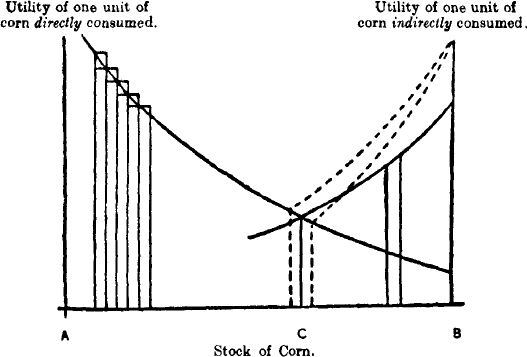
FIG. 1.
It is clear, however, that the portions of this curve (or surface) which are furthest to the left do not really exist, for the colonist would starve to death if his annual ration were limited to only a few kilograms of corn. The curve only acquires real significance in the case of an increase or decrease of the stocks annually consumed. With every increase or decrease by one unit, there is a corresponding increase or decrease of utility, which is represented in the diagram by a narrow rectangle, or—since the base of this rectangle is one unit—by its height reckoned in linear units; i.e. by the ordinate of this curve. This, then, will be the geometrical representation of the marginal utility of the corn when its consumption per unit of time or period of consumption is indicated by the corresponding section of the horizontal line, measured from A.
Let us now suppose that, on the horizontal line, we construct a similar figure, from B, going from right to left, and draw a curve, of which the enclosed surface and the ordinate represent the total and marginal utility respectively, of indirect consumption of corn (in the form of meat and eggs). One unit of length on the horizontal line will still represent one kilogram of corn, and the narrow rectangle (or trapezium) constructed upon it and bounded at the top by the curve—or alternatively the height of the rectangle, the ordinate of the new curve—will indicate the increased utility which would arise if the quantity of corn employed in feeding poultry were increased by one kilogram, supposing the colonist obtained it without cost. Since, however, it must be taken from the stock otherwise available for direct consumption, the actual increase of utility will correspond to that part of the rectangle, or of its height, which is bounded by the two curves. The new curve will obviously fall from right to left, and should, therefore, sooner or later, intersect the old curve. It is now easy to see that the most advantageous use of the original stock of corn will be found by dividing the line AB at a point C, which lies vertically below the point of intersection of the two curves. Here the two curves have a common ordinate, which is equivalent to saying that the marginal utilities of the corn consumed directly, and of the corn used as animal food, are the same.
Strictly speaking, however, our diagram only has this significance in so far as it relates to two kinds of consumption which are independent of each other—the utility or satisfaction derived from consuming a certain quantity by one method being equally great whether much, little, or nothing is consumed by the other method. This is never wholly the case—least of all as regards two such closely related kinds of consumption as vegetable and animal food. Consequently, the first curve represents the utility and marginal utility of the direct consumption of corn on the assumption that there exists no other use for it. But the righthand curve would certainly have an entirely different shape if it really represented a consumption of meat without a simultaneous consumption of corn. It may be regarded as representing the utility and marginal utility of a consumption of meat which is carried on while, at the same lime, the remaining stock of corn is consumed directly. Naturally, we might also have regarded the meat consumption as primary and the corn consumption as secondary. The two curves would then have assumed very different forms, but the result, i.e. the division of the original stock of corn, would remain the same on the supposition that, in this case, there is only one equilibrium position. But this assumption—as we shall see later—is by no means always true. (For an algebraic treatment of the problem, see p. 47 seq.)
A question of great interest, not only in relation to this special case, but for all that follows, is to what extent the division of the original stock (of corn) among various uses is altered if, for technical reasons, the quantity of the original commodity required for the production of a unit of the second commodity is also altered. Let us assume, for example, that, for the production of 1 kilogram of chicken or eggs, not 5 kilograms but (in consequence of more rational methods of feeding or of breeding) only 4 kilograms are necessary. In such a case, it is evident that the quantities of corn set aside for poultry food will yield a greater utility than previously. In other words, the curve of meat consumption (cf. Fig. 1) will begin higher up on the vertical axis than before. But, on the other hand, the demand for meat will, for the same reason, be satisfied relatively more rapidly since every unit of corn used will bring a greater increase of meat than previously. For this reason the curve of meat consumption will fall more steeply than before, and it is, therefore, not difficult to see that it may just as well intersect the curve of corn consumption to the right as to the left of the former point of intersection. In other words, the technical improvements by which more meat is obtained from every unit of corn may, according to circumstances, lead either to an increased or to a diminished direct consumption of corn, and thus to a decrease or increase of the quantity of corn consumed in the form of meat.
On the other hand, it may be thought that, in such circumstances, the consumption of meat must necessarily be increased. For if it remained unchanged or were reduced, then in both cases more corn would be consumed than formerly, and the marginal utility of corn would fall; whereas the marginal utility of meat, one would suppose, would remain unchanged, or rise. Consequently, the marginal utility of the latter would rise in relation to that of corn, whereas equilibrium requires that it should fall, since more meat is now obtained per unit of corn than formerly. However, this conclusion is only justified on the assumption that the consumption of corn and meat are independent of one another. If we make the contrary (and more realistic) assumption, that they influence each other to a high degree, then it is conceivable that an improvement in the production of meat might lead to a diminished consumption. If, for example, as we have assumed, the consumption of meat remained unchanged and the consumption of corn rose in consequence, then, in reality—since human needs for sustenance are limited—the marginal utility of both corn and meat would fall, and it is, a priori, not impossible (though in this case improbable) that the latter would decline more rapidly than the former. We see from this what are the complications which may emerge from analysis of the simplest possible case of exchange, and how careful one must therefore be not to draw hasty conclusions in the much more complicated cases arising in a developed system of trade which will be the subject of examination in the following pages.
The relations between two or more commodities as regards consumption may, as Pareto remarks,9 be of two essentially different, indeed contrary, kinds. They may be complementary— so that an addition to the one requires for its effective utilization an addition to the other, or others. Or they may be competitive— so that an addition to the one renders a part of the other, or others, superfluous. This distinction is perfectly valid and has various interesting consequences, though the second type is seldom found in complete purity. In the case discussed above, the animal and vegetable foods are largely substitutes for each other, but, on the other hand, each also increases the satisfaction derived from the other. Perhaps some day the physiologists will succeed in isolating and evaluating the various human needs for bodily warmth, nourishment, variety, recreation, stimulation, ornament, harmony, etc., and thereby lay a really rational foundation for the theory of consumption.
B. Exchange at Given Prices
In the actual exchange of goods between individual buyers and sellers—and frequently enough in a larger economic unit, or even a whole country—the given market price, or the world price; has the same function as the technical rate of exchange in the examples discussed above. It is true that the individual who desires to make an exchange, himself exercises a certain influence on prices by virtue of his supply or demand, but, in most cases, this influence is, in itself, inappreciable and therefore, from his point of view, without significance. He plans his economic behaviour exactly as he would do if the exchange value of the goods was unalterably given and predetermined. Consequently, his offer of his own goods and his demand for those of others—assuming the exchange to take place within a given consumption-period—are determined in exactly the same way as in the previous case, in which it was a question of alternative uses of the same goods. If, for example, he has agricultural goods for sale but wishes to buy coffee, sugar, fish, manufactured goods, etc., he must regulate his offers and his demands in such a way that consumption in the period in question, both of the goods he gives up and of those he receives, will yield a marginal utility proportionate in each case to the given exchange value in the market for the goods in question. If, as is usual, the price is expressed in money and if the marginal utility of each commodity is compared with the price, then these ratios, or what are usually called the weighted marginal utilities (weighted according to the price) will always be equal. Hence the last shilling which our farmer expends, whether on coffee, sugar, clothes, or shoes, and also the last shilling’s worth of corn, meat, bacon, eggs, linen, wool, etc., which he retains for his own consumption—all taken on a given consumption-period, say one year—will bring him the same amount of utility or satisfaction; for otherwise economy necessarily demands that he increase his consumption of one or more of these goods, and reduce that of others.
Moreover, this is exactly the same condition as in the preceding case and can, especially if we restrict our observations to two commodities only, be represented by exactly the same diagram as before, in which, by the horizontal line AB (see Fig. 1), we now represent the quantity of goods in hand at the beginning—or, what amounts to the same thing, their exchange value (e.g. in money)—whilst the marginal utility of the goods, partly for direct consumption and partly in the “converted” form assumed by exchange—or the utility of the last shilling’s worth of each commodity—is represented by the ordinates of the two curves.
Now we discover in this new case exactly the same peculiarities and apparent paradoxes with regard to the effect exercised by an alteration in the exchange value of goods, as determined in the market, on the supply and demand of the individual consumer. For example, suppose that a person has a stock of corn and wishes to exchange a part of it for coffee beans. If the market rate at some moment of time is 10 kilograms of corn for 1 kilogram of coffee, he will acquire the quantity of coffee he needs for a year, or half-year, by exchanging 100 kilograms of corn for 10 kilograms of coffee. But what will happen if the relative price changes so that for 1 kilogram of coffee he need only give, say, 9 kilograms of corn? In the present case, which relates to goods which cannot really replace each other in consumption, it seems probable that the change in price must lead to an increased consumption of coffee. On the other hand, it is uncertain at the outset whether it will lead to an increased or diminished supply and, consequently, to a decreased or increased consumption, of corn. For if, in consequence of the lower price, he increases his consumption of coffee by more than one-tenth to, say, 12 kilograms, then he will increase the quantity of corn which he must give in exchange for coffee to 9 X 12 = 108 kilograms; and consequently he will have 8 kilograms of corn less for direct consumption. But if he increases his consumption of coffee by less than one-tenth—say only to 10·5 kilograms—then he need only offer 94·5 kilograms of corn, and will consequently have 5·5 kilograms more than formerly to consume directly. Each is consistent with the law of marginal utility, which only requires that the marginal utility of coffee in relation to that of corn shall fall until it accords with the new relative exchange value, and this condition may perfectly well be satisfied in either case. Indeed, it is even conceivable that the new price situation might possibly lead to a diminished consumption of coffee, in so far as an increased consumption of foodstuffs, such as corn, might perhaps reduce the need for coffee and thereby in itself reduce the marginal utility of coffee even although all other circumstances remain unchanged. This is, of course, as we have already pointed out, still more true of goods which can completely replace each other in consumption, such as the various kinds of animal and vegetable foodstuffs, etc.
The above conclusion, which is theoretically irrefutable, viz. that the supply of a commodity may be either increased or diminished when the price rises in relation to that of other goods, and vice versa when it falls, is seldom encountered in reality, because a rise in price nearly always leads to an increased, and a fall in prices to a diminished, production of the commodity in question. If this change in production cannot be effected with sufficient rapidity, or not at all—or if, as we shall show later, the two commodities are made from wholly different factors of production—then there is nothing to prevent such a result, though it is generally regarded as unexpected and paradoxical. Thus, for example, a chance rise in the price of agricultural products may very well induce farmers who had previously been compelled to deny themselves necessaries in order to pay interest and taxes to increase their consumption of the produce of the land, with the result that, in spite of the rise in price, less of those products, instead of more, will be offered on the market. If I am not mistaken, this actually happened in the later years of the world war.
Another very interesting case is that of the supply of labour, in so far as the regulation of hours of labour lies in the hands of labour itself. An increase in wages may cause more labour to be offered in the market, but it need not necessarily do so. As we have already pointed out in connection with the consumption of goods, both possibilities accord with the principle of marginal utility: the labourer, if free to choose, extends his working day up to the point at which the effort of the last hour of labour approximately corresponds to the gain he expects from the wages offered for that hour. If wages are raised, it might be supposed that the prospect of increased well-being would be an inducement to greater effort; but, on the other hand, since the wages for each hour are raised, the whole standard of living of the labourer is changed. He can now satisfy his usual needs by less work than formerly, and the increased well-being which is now available to him can be realized in part by allowing himself more leisure and recreation than formerly. The vehement disputes often heard, as to whether a workman is made “more diligent” or “more lazy” by higher wages, cannot therefore be settled a priori either way. On the other hand, there can be little doubt that a percentage increase of wages for overtime leads to an increased supply of labour. For, in this case, the economic position of the workman remains essentially the same, and the increased wages for the last hour of work (overtime) will therefore have their full effect. This method of stimulating the worker to increased effort is, therefore, just as popular among employers as it is regarded with suspicion by the workers, because at first it is a temptation to over-exertion and then later it leads to periods of unemployment. A quite different question, of great practical importance, though we cannot pause to discuss it now, is whether higher wages may lead to greater intensity of work, by enabling the labourer to procure for himself better nourishment and a better technical education for his children, etc.
Algebraic Version.—It is now many years since the first attempts were made to express economic quantities and their relations in algebraic terms. After a period of poor success, the method has now become fairly well established in economic theory—chiefly as a result of the work of Jevons, Walras, and their followers. In what follows, we shall apply this method side by side with our ordinary discussion, and shall introduce it here for the first time.
If we suppose the consumption of each particular kind of commodity to be independent of every other simultaneous line of consumption, then we may regard the utility to a consumer arising from the consumption of a given quantity, a, of the commodity (A), during a given period of consumption as a function/f(a) of the quantity, a function about which one can only say a priori (i.e. without a special investigation of each particular case) that it increases simultaneously with a but less than proportionately. If the quantity consumed is increased by a small addition, Δa, then the total utility or satisfaction is increased by a corresponding amount, which we may designate Δf(a). The additional utility which arises when the quantity of the commodity is increased by one unit, i.e. the marginal utility, will then be expressed by the ratio  . If we now suppose these quantities to become infinitesimal, the ratio will, as a rule, have a determinate limit which is the differential coefficient, or the first derivative of the function, f(a), with respect to a. The latter, which is usually indicated by
  or by f’(a), is itself a function of a, and, in the present case, has the characteristic peculiarity of being a diminishing function of its variable, i.e. it diminishes when a increases. All this is, of course, only a symbolic expression of the theoretical argument already developed that the marginal utility falls—whilst the total utility obviously continues to grow, though in a diminishing degree—when the quantity consumed, per unit of time, increases.
If we now apply the above argument to all the other kinds of commodities, (B), (C), (D), etc., some of which the consumer possesses at the outset, and the remainder of which he acquires by means of exchange at market prices, then we can express symbolically the conditions of equilibrium for the economy of the individual which have been described above; on the one hand, the marginal utility of each commodity is proportionate to its price, and, on the other, the total exchange value of the commodities given up is identical with the total exchange value of the commodities acquired. If the market prices of a unit of each of the various goods (calculated, for example, in money) are pa, pb, pc, etc., and if the quantities of these goods, which the person in question possesses after the exchange, whether he has acquired them or has possessed them from the beginning are expressed by x, y, z, etc., then, if ϕ ( ) and ψ ( ) indicate utility functions analogous to f ( ), the first condition will be expressed as follows:—
f’(x): ϕ’(y): ψ’(z): . . . = pa: pb: pc: . . .
This is evidently equivalent to a system of equations whose number is one less than the number of goods dealt in. The second condition we may simply express by the equation
pa.x + pb.y + pc.z + . . . = pa.a + pb.b + pc.c + . . .
in which a, b, and c are the quantities of the various kinds of goods possessed at the beginning (some of which may, of course, be equal to zero). In other words, the value, in money, of the possessions of the person in question is the same before and after the exchange. Consequently the number of equations is equal to the number of unknowns—x, y, z, etc., and the problem should be capable of a mathematical solution if the forms of the functions—f( ), ϕ( ), ψ( ), etc.—which express total utility, and whose derivatives express the marginal utility for a given consumption of each and every kind of goods by the person in question, are precisely known. A closer study of the forms of these functions falls within the province of experimental psychology and of statistics of consumption; it may perhaps be of great importance in the future. For the present, we are only concerned with the attempt to investigate the inter-connection between the phenomena of consumption and exchange, and for this purpose we may be content with a general knowledge of these functions derived from our daily experience.
In reality, as we have frequently pointed out, the position is that the utilities and marginal utilities of the various kinds of goods are not independent but, on the contrary, influence each other in a greater or lesser degree. The only really rational procedure is, therefore, to regard the total satisfaction or well-being as a function of all the quantities of goods consumed simultaneously per unit of time, or during a certain consumption period, so that, if these quantities are a, b, c, etc., the function can be symbolically represented by F (a, b, c . . .). Of this function it may generally be asserted that it increases as soon as any of the goods consumed increases in quantity, the other quantities remaining unchanged, although, of course, in this case a fortiori the function increases in a much smaller proportion than the quantity of the single commodity. If, for example, the increase consists of one unit of the commodity (A), then the increase in utility (or marginal utility) of commodity (A) should be symbolically expressed by the first partial derivative of the function F( ) with respect to a, i.e. F(a, b, c,) or, as it is frequently written, Fa (a, b, c), which will thus be itself a function not only of the quantity a, but also of all the quantities of goods consumed. The same applies to the marginal utility of the goods (B),(C), etc. Thus, according to this view, the conditions of equilibrium would be that the partial derivatives of the total utility functions with respect to the quantities x, y, z, etc., available for consumption, should after exchange be proportional to the prices of the goods. Thus:—
Fx: Fy: Fz: . . . = pa: pb: pc . . .
to which must be added the same equation as above:—
Pa.x + Pb.y + Pc.z + . . . = Pa.a + pb.b + pc.c + . . .
which means that the total money value of the goods in the possession of the person is the same before and after the exchange.
C. Isolated Exchange
Before proceeding to show how the exchange values of goods, which we have hitherto regarded as data, are in reality determined by the competition of buyers and sellers in the market, we shall refer briefly to a kind of exchange whose direct practical importance is not as great as its theoretical interest: exchange between two isolated individuals. In reality, an exchange between two individuals is almost always effected under the influence of the market, even if not in the market itself. For the moment, however, let us abstract from this, and assume that, during the period of consumption in question, neither of the parties has any opportunity of trading with anyone but the other party. The problem of price formation in this case is far from being as simple as it may at first sight appear. We shall not treat it in more detail than is necessary to show by contrast the influence of competition on prices.
Let us suppose that a peasant from the plains and a peasant from the forest meet on the way to town. The former has a sack of corn which he has so far been unable to dispose of, the latter has half a load of wood which he intends to sell. Since each needs the goods of the other, they agree to exchange, and each of them is thereby saved an extra journey to the town. It may be that, if necessary, the peasant from the plains would give his sack of corn for a quarter of a load of wood; and the peasant from the forest, on his part, his half-load of wood for only half a sack of corn. Thus, if they exchange only with each other, they both consider that they have made a considerable gain on the exchange; but they might equally well have exchanged their stocks if the one had possessed 1½ sacks of corn or if the other had had three-quarters of a load of wood, and so on. Again, if we suppose that the stocks in their possession had been greater and that they had only this one opportunity for exchange during a longer period of consumption—e.g. for a whole year in advance—then it is quite clear that the question how large a quantity of their respective goods they could and, from an economic point of view, should, exchange with each other is quite indeterminate. Within certain more or less wide limits, the question may be answered in an infinite number of ways, since it is only a question of satisfying the condition that the exchange shall benefit both parties; and here there is no other necessary condition. So much only is certain, that if the exchange continues until equilibrium is reached for both parties, the relation between the marginal utilities of the corn and of the wood must be the same on both sides:—

(for the peasant from the plains) (for the peasant from the forest)
Otherwise—at least theoretically—the exchange would proceed further; or, alternatively, it would already have proceeded too far—in which case it would be to the advantage of both to re-exchange a certain portion. If, for example, after the peasant from the plains has exchanged a certain quantity of corn for a certain quantity of wood, it is more or less a matter of indifference to him whether he obtains two more logs of wood of ordinary size in exchange for 1 litre of corn, whilst the peasant from the forest still considers it advantageous to obtain in exchange a few more litres of corn at three or four logs of wood per litre, then the latter should, by offering this price, or one near it, be able to induce the other party to continue the exchange; and so on.
But this is by no means the same thing as saying that the relation between the marginal utilities of the two commodities (which, in equilibrium, should be the same on each side) will be also the same as the proportion in which the whole quantities exchanged stand to each other and which, therefore, constitutes the average ratio of exchange of these goods. In fact, this ratio can, within certain limits, vary indefinitely, and in each particular case the relation between the marginal utilities of the goods at the margin of exchange will be different, though always the same on both sides for the persons exchanging.
It is a pretty mathematical problem—which we will not pursue here—to investigate the law which these variations follow.10 Here we shall content ourselves with establishing the fact that price determination in isolated exchange is an indeterminate problem; i.e. it cannot be solved solely on the assumption that both parties desire the greatest possible profit. This is a point whose great importance—even in practical affairs—we shall subsequently realize. Whenever isolated exchanges occur in practice, the actual determination of price will depend in a high degree on the personal characteristics of the contracting parties, their cunning and coolness, or on mutual goodwill, all of these being things intrinsically too complex and variable to be embodied in the schematic presentation of economic theory to which we must here confine ourselves. Certain related or at least analogous cases (where not two individuals, but two great organizations of buyers and sellers, or employers and employed, are opposed to each other) are evidently of the utmost practical importance; and it is, therefore, essential that the economist should clearly understand the extent to which his science can afford him any guidance in answering these questions.
One of the greatest difficulties with which the arbitrators between employers and employed have to contend is the absence of any scientific standard for the amount of wages or profits in a big conflict. What is usually called a reasonable wage, or a reasonable profit, proves on investigation to be not so much reasonable as usual, to be in fact the wage or profit determined by free competition under the prevailing conditions of time and place. If, therefore, the conflict only extends over a small area, such as a single factory, then the arbitrator has sufficient basis for his decision in the wages and conditions prevailing in other establishments in the same industry. But this is not the case if, as is more and more common in modern collective bargaining, a wage dispute rages simultaneously throughout the whole of an industry, or even a connected group of industries.
D. Price Formation in the Open Market. Exchange of two Commodities
The more or less fixed ratios at which goods are exchanged on the market (usually by means of money) are not, as is often supposed, due to qualities inherent in the goods themselves; nor, at least directly, to their normal costs of production. As we have already indicated, they spring from the nature of exchange on a market (as opposed to isolated exchange); from what Jevons called “the law of indifference”, which is, fundamentally, nothing else than the old “free competition”.
According to this law, there cannot theoretically be more than one price in the market for the same commodity at the same time, or more than one ratio of exchange between two commodities. But in that case, it may be asked, could not the “sellers” (the holders of a particular commodity) hold back their supply at the beginning, thereby forcing up prices, and then afterwards lower them in order to dispose of the remainder of their goods, or so much of them as they do not wish to retain? Of course they could, and they often do. But there is always the risk that some sellers may succeed in disposing of the whole of their stocks while the price is still high, so that the others will either not be able to sell their goods at all or will have to be satisfied with a price much lower than they would have got if the equilibrium price had been fixed by competition from the beginning; since the purchasing power of the buyers who had already partially satisfied their needs at the higher price would then be less than it would have been if, from the beginning, they had bought the same quantity at a lower price; or since as a rule there would then remain fewer buyers able to purchase the goods. This is presumably the reason why so-called rings or cartels of producers or other sellers so often fail, when the participants have only agreed to maintain a high price, but have nothing else in common and have no organization controlling output and individual sales. If, on the other hand, organization has reached the point of forming a cartel or trust in the real modern sense, so that the maximum quantity of goods which each of the members may offer is determined beforehand; or if the members agree to compensate each other for possible losses, or to divide their profits or simply to set up joint production or a joint selling organization under single control, then price formation will more or less approximate to monopoly conditions—of which we shall have more to say later.11 Assuming that buyers (i.e. holders of the other goods) also combine, form trusts, cartels or rings, then there is no longer any purely economic law of price-formation—no law based on mutual desire for the greatest possible gain—and we revert to isolated exchange, in which, as has been said already, all possible rates of exchange are, within certain limits, conceivable.
If, however, we disregard this possibility and assume universal free competition, then, so far as genuine market transactions are concerned, the relative prices of commodities will more or less rapidly approach a certain equilibrium position, or else oscillate about it. At this equilibrium position, all holders of goods will be able to exchange up to a point of relative satiety, that is to say, they will continue to exchange so long as there is any advantage in doing so at that market price. We may assume, for the sake of simplicity, that this equilibrium price will be reached at the very outset. For the individual desiring to exchange his goods, the price relationships thus reached in the market will have exactly the same significance as the given prices in the case we discussed above.12 He will regulate the supply of his own goods and his demand for other goods in such a way that the marginal utility of each commodity will be proportional to its price, or that the weighted marginal utility is everywhere the same (in other words, that for the last shilling he spends he will obtain the same additional utility from each commodity). To every price relationship, therefore, there corresponds for each individual a determinate combination of supply and demand, and of quantities of goods retained and acquired. The sum of the individual demands for each particular commodity evidently makes up the total market demand for the goods and, in the same way, the sum of the individual supplies constitutes the total supply of these goods. Market equilibrium is thus only possible with a price relationship at which the demand and supply are equal for each particular commodity. If we include in the demand for a commodity the quantities which a seller wishes, at a given price, to retain for his own use, then it may be said that equilibrium is to be found in a system of prices which, for each commodity, makes the demand equal to the stocks in the market, or to the total supply of that commodity. Thus, on the assumption that the market gravitates quickly enough towards equilibrium, it should be possible—if the given quantities of goods on the market for a certain period of consumption, and if the personal dispositions of all consumers, were known—to establish a system of logical relations (or what in mathematics is known as a system of equations) from which both the quantities of goods acquired or given up by each individual and also the relative equilibrium prices, would be determined. It is, however, in no way excluded—as we shall soon see—that the problem may, under otherwise identical conditions, have more than one solution.
Formally, indeed, this doctrine is only a repetition of the old thesis that the market price of goods is regulated by an equilibrium between supply and demand. In reality we have advanced considerably, for we have found in marginal utility the general principle which governs supply and demand under any price system. We are, therefore, in a position to carry the discussion of price formation in the open market considerably further than the earlier economists were able to do.
In accordance with our method of proceeding from the simpler to the more complex, we will begin with the case in which only two commodities are exchanged in the market. This case, moreover, is not so abstract and unreal as may at first sight appear. It is true that two particular commodities are very seldom exchanged directly. Nearly all actual exchanges are effected indirectly, through the mediation of money. Every commodity, or group of commodities, has its special market, in which it is exchanged for money, and the market price of this commodity is determined there with more or less regard to the simultaneous market prices of other commodities. But if we look at the problem broadly and consider, for example, the economic interests of a particular class of society, of a district, or country, as compared with those of other classes, districts, or countries, then it not infrequently happens that, omitting intermediate links, we must regard as decisive the exchange of only two commodities, or of two related classes of commodities, whose price-ratio is determined almost without reference to other goods on the market, which are of comparatively minor importance. This is true where the interests of an agricultural population are opposed to those of an industrial population; where the commodity “labour” is confronted with the commodity “means of subsistence”; or where the economic welfare of a district or of a whole country depends on the price of its staple commodity in foreign markets in comparison with the price of its imports taken as a whole.
From the theoretical point of view, the exchange of two commodities has this peculiarity—that it is the only form of exchange which can normally take place by the direct barter of goods against goods. Not that two holders of the different commodities could always satisfy one another’s needs by themselves—for this, in fact, occurs only in exceptional cases. As a rule, at least one of the parties to the exchange is compelled to deal with more than one holder of the commodity he wishes to acquire. But, nevertheless, it should in this case be possible to exchange goods for goods without the mediation of either money, credit, or any other intermediary; that being usually—as we shall soon see—an essential condition for the achievement of equilibrium as soon as the number of goods in the market exceeds two.
We assume, for the sake of simplicity, that at the outset the two commodities are held by different parties, so that no one at first possesses more than one commodity. Let us suppose the prices of the two commodities (A) and (B) offered in the market to be expressed in terms of one of them, (A), so that the price of a unit of (A) is, consequently, invariably equal to 1, and the price of a unit of (B) (which we indicate by p) is variable; it then follows, from what has been said above, that an arbitrary price (p) quoted in the market will call forth from each holder of the community (A) a certain demand (x units) for the commodity (B), and a corresponding supply of the commodity (A), which will then clearly equal p.x units. The sum of all these demands (x) constitutes the total demand X for the commodity (B), which implies a corresponding supply, p.X, of the commodity (A). In the same way, the holders of the commodity (B) offer, at the price p, a total supply, Y, of the commodity (B) and demand a corresponding quantity, p.Y, of the commodity (A). The condition of p being the equilibrium price is that the supply of and demand for the commodity (B) are equal, so that Y = X; from which it follows that demand for and supply of the commodity (A) will also be equal, for it follows that p.Y = p.X. Further, let all conceivable values of p, which, as we have explained, must be treated as a variable, be represented by distances from a fixed point (the origin) along the horizontal axis, and through each of these points draw a vertical line, on which are marked off two lengths, one representing the total demand for (B) on the part of the holders of (A), and the other the total supply of (B) by the holders of (B). We shall then obtain two connected curves, one of which represents the demand for (B) and the other its supply for every conceivable price-ratio. If these two curves intersect and so have an ordinate in common, then at that point demand and supply are equal; and the corresponding distance along the horizontal axis (the abscissa of the point of intersection) represents the desired equilibrium price.
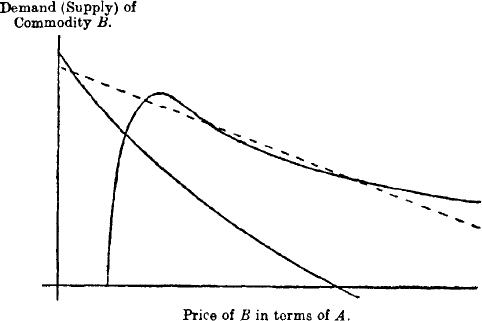
FIG. 2.
If we begin by assuming that (A) and (B) cannot in any way replace each other in consumption, we can then describe the general course of these curves in the following way. If p = 0—i.e. if (B) can be obtained for nothing or for a purely nominal amount of (A)—every holder of (A) will demand (B) up to the point of complete satiety—i.e. until its marginal utility has fallen to zero. For this to happen, as a rule, only a finite, though sometimes a quite considerable quantity of (B) is required; hence the demand curve leaves the vertical axis at a finite distance above the origin. If p rises, the demand falls continuously; since the marginal utility of (B), relative to that of (A), must fall pari passu with its price. The curve therefore falls continuously towards the x-axis (though it may be convex or concave to the x-axis or alternately the one and the other) and finally meets it at a point corresponding to the price at which (B) ceases to be demanded by the holders of (A). This point may possibly be so remote that it does not, in practice, exist—in the case when (B) is an absolute necessity of life which would be in demand at any price.
The supply curve of (B) follows an entirely different course. If the price of (B) is zero, or very low, then there is no inducement for holders of (B) to offer their goods, and when they do begin to do so it will, at first, be only in very small quantities. The supply curve will thus begin at a point on the horizontal axis which is at a certain distance from the origin and will gradually rise pari passu with the rising value of p. But the increase in supply will not continue indefinitely; sooner or later a point will be reached at which an increased price will no longer induce holders of (B) to offer any more, but will, on the contrary, make them offer less, because at this higher price they can obtain with less sacrifice of (B) so much of (A) that its marginal utility will fall until it is equal to the marginal utility of (B), notwithstanding that the latter will also sink when the quantity of (B) retained is increased. The supply curve thus reaches a maximum, from which it falls again towards the horizontal axis; however, it never cuts the horizontal axis, but moves towards it asymptotically; for however high a price a person is offered for the commodity in his own possession, he will always be prepared to give up some small part of it in order to acquire other goods.13
If we now remember that, on our assumption, the two curves are entirely independent, since the demand for and supply of (B) proceed from different persons—the supply curve is determined exclusively by the availability of (B) and the demand curve by the availability of (A)—then it is clear that there are as many possible kinds of equilibrium as there are possible kinds of intersection, for two curves drawn in the manner we have described. The point of intersection may lie to the left of the highest point of the supply curve; this is the case which was considered almost exclusively by the older economists. In such a case equilibrium is necessarily stable, for a slight increase of price would increase supply and simultaneously decrease demand; a slight fall in price, on the other hand, would increase demand and decrease supply, so that, if the price were by chance to be disturbed, it would automatically revert to its former position.
But the point of intersection—for the moment we may assume that there is only one—might also lie to the right of the highest point of the supply curve, so that equilibrium in the market would only be reached when supply had begun to be restricted by the rising price. This equilibrium is also stable; if in this case the price rises, then supply will indeed be reduced, but demand will be reduced even more, so that it will be less than supply—with the result that the price must fall again. If the price falls, then supply will increase but demand will increase more rapidly, for which reason the price will soon revert to its former level.
That the older economists so generally neglected this case—except occasionally in regard to foreign trade—is all the more remarkable, since it is evidently in full agreement with the well-known and frequently observed fact that the demand for a commodity which has risen in price (e.g. a necessity) may frequently fall in a lesser proportion than the actual rise in price. As against this particular commodity all other commodities constitute a group whose relative price has fallen. Their supply (in exchange for the former commodity) has, on the other hand, clearly risen; it thus rises with a falling price and falls with a rising price of that group of commodities (expressed in terms of the former commodity), and in one of these positions equilibrium between demand and supply will be reached.
Finally, there is nothing to prevent the two curves having several points, and (if so) at least three, in common. In this case, the curious position arises that both the point of intersection to the extreme right and that to the extreme left indicate a stable position of equilibrium, whereas at the intermediate point of intersection a so-called unstable equilibrium prevails; the equality of supply and demand at this price is merely accidental. A disturbance of the price equilibrium in this case has no tendency to an automatic restoration but, on the contrary, produces an uninterrupted shifting of the price in one direction or another until stable equilibrium is reached at one of the two extreme points of equilibrium either to the left or the right.
This very remarkable phenomenon was first pointed out and analysed in detail by Walras.14 Walras himself, however, seems inclined to under-estimate its practical importance, and appears to be of opinion that, under actual conditions, where a large number of articles are exchanged for each other, only one position of equilibrium would really be possible in the same market. But in that he is mistaken. We have already seen examples, derived from exchanges between employers and employed and between farmers and industrialists—and we shall later add a famous case of international exchange—which show that equilibrium may very well occur under circumstances where a price increase would cause a reduction and not an increase of supply, and vice versa a reduction of price an increase of supply. From this it is only a short step to the admission of several possible equilibrium prices in the same market, as a glance at Fig. 2 will show.
We arrive at still more remarkable results if we assume, in accordance with what often occurs, that the two commodities may, to a greater or lesser degree, be capable of acting as substitutes. In that case, as we have already indicated, the demand curve of either commodity may also have both a rising and a falling section and the chances that both curves will have several points of intersection, or even that they may approximately coincide over small stretches, are quite considerable. It is not impossible that puzzling disturbances in the market, which frequently occur without any known cause, may be properly attributed to the hitherto neglected fact that a particular state of equilibrium may not be the only one which is possible under the given conditions, and that a state of equilibrium chosen at random can just as well be unstable as stable, or may for some insignificant reason be converted from one into the other.
An admittedly artificial example of this (cases more or less similar to which are, perhaps, not so rare in reality) is the following:—
A person, A, possesses a stock of wheat, another person, B, a stock of rye. For the sake of simplicity we will assume that rye and wheat have the same nutritive value per pound (this, however, is not essential to our argument). We assume, however, that wheat (owing to its better taste) is preferred by both parties; yet each of them endeavours primarily to obtain the maximum nourishment; but only up to a certain limit, say a thousand pounds, beyond which any additional nourishment cannot in general be utilized and is, therefore, without value. If A at the beginning had 800 lb. of wheat, then, as the price of rye varied, his demand for rye would clearly be determined in the following manner. If the price is zero, i.e. if rye can be obtained for nothing, he will provide himself with 200 lb., neither more nor less, because this will fully satisfy his requirements for this kind of nourishment. If the price rises above zero he will be compelled, in order to acquire the necessary nourishment, to dispose of a part of his stock of wheat, but in that case he will evidently be forced to consume more rye than before. In other words, his demand for rye will increase when the price of rye increases. If p is the price of rye, expressed in wheat (or in the money price of wheat as a unit), then, as will easily be seen, his demand x will be such that it satisfies the equation
800 + x — p.x = 1,000,
so that

The limit is reached when p equals  , when he will have to exchange the whole of his stock of wheat, 800 lb., in order to get a sufficient amount of nourishment, i.e. 1,000 lb. of rye. If the price of rye rises still further he cannot in any way acquire full satisfaction, but will endeavour to obtain as much as possible, which he will do by continuing to offer the whole of his wheat for as much rye as the market determines. His demand for rye will thus now =
  . Only when p = 1, and rye consequently commands the same price as wheat, would an exchange be purposeless for him. At this point he ceases to demand rye.
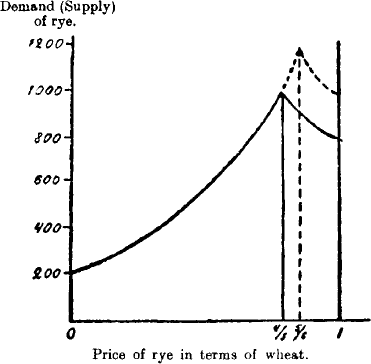
FIG. 3.
His individual demand curve will thus assume the following form: it begins at a point on the vertical axis, the distance of which from 0 corresponds to a demand for 200 lb. of rye. It then describes an hyperbola which has for its asymptotes (a) the horizontal axis and (b) a vertical line which intersects the horizontal or price axis at a distance of one unit from the origin. This hyperbola, however, terminates at a point whose distance from the horizontal and vertical axes corresponds to a demand of 1,000 lb., or a price of rye, p = . The demand curve next describes a descending hyperbolic curve, whose asymptotes are the horizontal and vertical axes. At a distance, along the horizontal axis the curve suddenly descends from a height, corresponding to a demand of 800 lb. rye, towards the horizontal axis.
The amount of rye offered by B will clearly depend on the size of the stock he holds. We will assume that it is exactly 1,200 lb. If the price of rye is zero he will, of course, have no inducement to exchange; but as soon as rye, expressed in terms of wheat, is worth something, however little, he will immediately exchange the whole of his worthless surplus, 200 lb., of rye in order to obtain at least some wheat. If the price of rye is raised, he will be in a position to acquire more and more of the desired commodity wheat, and in order to obtain as much as possible he will still continue to offer so much rye that his total stock of food will amount to exactly 1,000 lb., neither more nor less. If we call his supply of rye y we shall arrive at the equation:—
1,200 + p.y - y = 1,000
where y =  —or exactly the same as we previously found for A’s demand for rye. The only difference is that B’s supply of rye will continue to increase, even after the price reaches ; for so long as wheat can be obtained in the market there is no reason why B should not procure more than 800 lb. of it. Only when the price of rye has risen to
  of that of wheat can B, who at that price will offer the whole of his stock, 1,200 lb., no longer increase his supply, and indeed has no reason for doing so, since at a higher price he could obtain the necessary 1,000 lb. of wheat even for a fraction of his stock of rye.
In this case, the curious fact emerges that the supply and demand curves of the two individuals coincide for a large part of their course. In other words, for every price of rye between zero and , A’s demand for rye and B’s offer of it are exactly the same—and consequently, for the same reason, their respective supply of and demand for wheat.
This example should show to what a large extent the simple scheme of the variations of supply and demand with which economists have hitherto contented themselves, requires to be developed and completed in order to correspond with the varying phenomena of reality.
E. Continuation. Exchange of Three or More Commodities
As soon as there are more than two commodities on the market, complete equilibrium cannot as a rule be reached by direct exchange alone, but indirect exchange must supplement it. This is seen in its simplest form in the extreme case where direct exchange is altogether excluded. A country (say Sweden) has timber for sale and sufficient corn for its own needs, but must buy fish. Another country (Norway) can supply fish and has sufficient timber, but must buy corn. Finally, a third country (Denmark) has a surplus of corn and sufficient fish, but lacks timber. Evidently no direct exchange can take place here, but an indirect exchange may; if, for example, Denmark as an intermediary buys up Norway’s surplus of fish in exchange for its own surplus of corn, in order, in its turn, to sell the former to Sweden and thereby satisfy its own requirements for timber. Or the same result might have been achieved by the use of a special medium of exchange, money or credit, as we shall soon see.
But even if, in a three-cornered exchange, each party was a purchaser of the products of both the others (so that, up to a point, direct exchange could take place) even then, so far as the exchange values of the goods were regulated only by mutual supply and demand in direct exchange, a final price equilibrium would not, as a rule, be reached. As between each pair of commodities, the price ratio would be determined in a separate market, isolated from the other two, and the resultant three relative prices would not usually be correlated, i.e. they would not be such that each would be the ratio (or product) of the other two. If, for example, in a direct exchange of the commodity (B) (fish) for the commodity (C) (corn) the equilibrium price were such that one unit of (B) were exchanged for two units of (C), and on the market for (C) and (A) (wood) the price is four units of (C) for three of (A), then if the prices are correlated, two units of (B) must be exchanged for exactly three units of (A). It may, however, happen that, in the direct exchange of (A) for (B), a different equilibrium price would obtain, so that either less (say one and a half) or more (say two and a half) units of (B) would be exchanged for three units of (A). Whichever occurred, it would then be profitable to enter into a so-called arbitrage transaction. Thus, in the latter case, a holder of (A) desiring to acquire (C) would first buy a suitable quantity of (B) and subsequently exchange that (B) for (C). In this way he would obtain five units of (C) for three of (A), whereas by direct exchange he would only have obtained four units of (C), and similarly if the price of (B) in direct exchange for (A) had been lower than the correlated price. If, therefore, full equilibrium is to be reached in such cases, at least a part of the commodities in the market must necessarily be the object of indirect exchange.
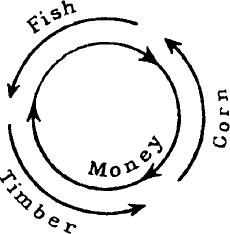
FIG. 4.
The commonest procedure in such cases is for the exchange to be effected with the assistance of a special medium of exchange, money, which only formally appears in the market as an object of exchange. In the extreme case which we mentioned by way of introduction, Sweden, for example, buys fish from Norway for money; Norway uses this money to buy corn from Denmark, and Denmark in turn uses it in payment for timber from Sweden, so that in the end Sweden gets its money back. We can visualize the position by means of a diagram in which each commodity moves one-third of the circumference of an outer circle, whilst money makes a whole revolution in the opposite direction in an inner circle, and thus finally returns to its starting point. The result is, or may be, that after the conclusion of the business only the goods have changed hands, whilst the sums of money employed are in exactly the same hands as at first. Thus, in fact, goods have been exchanged for goods, not directly, but, in part at least, indirectly. The law of marginal utility has been none the less effective. Under ideal market conditions, in which the final price equilibrium is established from the very beginning, the exchange values and the marginal utilities of all commodities must be proportional for each of the exchanging parties taken separately. As far as money is concerned, as we have said, its rôle is purely formal—or may theoretically be conceived as such. Indeed, a sum of money, however small, may effect an indefinitely large exchange of goods, if it circulates frequently between the exchanging parties. The importance of this observation will become clear when we come to treat of the functions of money. However simple and commonplace the above consideration may appear, it constitutes in reality the master-key to a proper understanding of the peculiar problems of money.
It is not easy to give a graphical version of this problem—exchange that, in part at any rate, is indirect. If there are only three commodities, then it is possible to represent the position by a three-dimensional figure—if we want to do so—but even this method breaks down when the number exceeds three.
On the other hand, we can easily express the conditions of equilibrium by algebraic symbols and thereby set out the logical relations or equations which determine the equilibrium price. It is simplest to conceive demand in the wider sense already indicated, including the quantities of the various goods which the original holder wishes to retain for his own consumption at a given system of prices. In equilibrium, demand in this sense must be equal, not to the amount offered in exchange, but to the whole of the stocks available in the market for consumption in a given period. Of course, we might have used this method for two commodities; and this would have given us a more satisfactory expression of the position where, for example, one person is in possession of both of the traded commodities from the start, and appears according to circumstances as a buyer or seller of either. But the discussion of that case was simplified in other respects by using the more limited conception of demand.
For every conceivable system of prices, in accordance with the law of marginal utility, each person in the market will have a certain demand for each commodity; indicating either that he wishes to acquire, or if he possesses it already, to retain, a particular quantity. If his total utility function is expressed, as before, by F(x, y, z . . .), then we have the equations, already set forth on page 49:—
F’x: F’y: F’z: . . . = pa: pb: pc: . . . and
pa.x + pb.y + pc.z + . . . = pa.a + pb.b + pc.c + . . .
altogether n equations in which all the letters have the same meaning as before except that the commodity prices pa, pb, etc., are no longer to be regarded as given, but as unknown quantities. These prices may also be regarded as expressed in terms of one particular commodity selected as a unit of value: in which case pa (say) is constant (= 1), or else in terms of a measure of value, such as money, which takes no part in the real exchange. In both cases, if the form of the function F( ) is assumed to be known, all the n unknown quantities of goods x, y, z, etc., can be obtained from this system of equations; if one of the commodities is itself the standard of value, the quantities are expressed in terms of the n—1 prices of the remaining commodities, still unknown for the present; otherwise they are expressed in the n—1 ratios between the money prices of the n commodities. For each person in the market there is an analogous system of n equations, from which the quantities of all goods demanded may be expressed in terms of the n—1 relative prices of the commodities.
We have now to describe the position of equilibrium, where the sum of all the demands for the commodity (A) must equal the total quantity in the market, A, and the same as regards (B), etc. Thus, if we treat each of the parties to an exchange in the same way, and mark them out by the suffixes 1, 2, 3, etc. (x1, x2, x3 . . . a1 a2, a3, etc.), which for precision we ought to have used before, we obtain the equations:—
∑(x) = A, ∑(y) = B, ∑(z) = C . . .
in which ∑(x) stands for x1 + x2 + x3 + . . ., etc.
The number of these equations is n; but only n—1 of them are really independent; one of them can always be derived from the others by means of the equations already set out. Thus if we add together the equations (on p. 66),
pa.x + pb.y + pc.z + . . . = pa.a + pb.b + pc.c + . . .
and all the corresponding equations relating to the other persons in the market, we shall obtain:—
pa.∑x + pb.∑y + pc.∑z + . . . = pa.A + pb.B + pc.C + . . .
And since this equation could also have been found by the addition of the corresponding members of the equations Z(x) = A, E(y) = B, etc., after multiplying each of them by pa, pb, etc., the above assertion becomes obvious. It is also deducible a priori, for if goods are only exchanged for goods (so that money, if it is used at all, functions in a merely formal manner) then, if the demands for all the commodities with one exception are equal to the existing supplies, the same must apply to the last commodity (what the holders do not wish to retain has, of course, already found purchasers). But these n—1 equations are sufficient for the solution of the problem, for all the quantities involved—x1 y1 z1 . . . x2, y2, z2 etc.—can, as has been shown, be expressed in terms of the n—1 relative prices of the commodities, so that finally we shall have as many equations as unknowns. Thus the problem is perfectly determinate.
If, on the other hand, we had imposed the further condition that the exchange must only take place directly, in other words, that the quantity of commodity (B) which is demanded by the holder of (A) should pay in full for the quantity of (A) demanded by the holder of (B), then the problem would have given us more independent equations than unknowns and would thus have become over-determined; unless at the same time we had foregone the demand for correlation between the commodity prices, in which case the possible exchange ratios between n goods would be not n—1 only, but ½n (n—1), i.e. for three commodities 3, for four 6, etc.
In any case, by the method we have followed, we can only arrive at the relative exchange values of the goods or their relative prices—not at their actual money prices, which must remain quite undetermined; this is obvious so long as we regard the functions of money as purely formal. If, after the exchange is over, all the money employed has returned to the hands of its first owner, it is a matter of complete indifference to him, as to everybody else, whether in the actual exchange transaction, one unit of goods was exchanged for more or less units of money; in other words, whether, in order to effect the transaction, the money circulated a greater or lesser number of times among the parties in the market before it ultimately returned to its starting-point. In reality, of course, this is never a matter of complete indifference. In every market, there are persons for whom money is something more than this; who exchange goods for money or money for goods in order to obtain at a later date new goods for the money they have acquired. To them, clearly, the exchange value of money—and especially its fluctuations—are by no means unimportant; and the function of money in any particular market transaction becomes, in actuality, not merely formal but also real. In other words, money prices, as such, have their laws and their conditions of equilibrium; but we cannot develop them here because they are very closely connected not only with the nature of money as a commodity and with the conditions of its production, etc., but also with the time-element whose importance in human economy we have not yet considered—in other words, with the theory of capital and interest.
4. Objections against the Theory of Marginal Utility.
Exceptions to the Theory
The objections which were made in various quarters against the theory of marginal utility when it was first propounded, were largely due to a misunderstanding of its real meaning and may, for that reason, be ignored. In the main, they were based on the fact that its advocates held too one-sided a view of the continuity of economic quantities, of the simplicity and flexibility of the economic system, etc.; on the other hand, the critics exaggerated the discontinuity of the quantities and the complexity of their interaction, and also exaggerated the power of economic friction. That, in fact, discontinuity occurs at many points, and must occur, scarcely any adherent of the theory of marginal utility has denied; it exists, after a fashion, whenever the price of a commodity is so high that some buyers cease to purchase it or some sellers dispose of the whole of their stocks; or when the price is so low that some sellers will not dispose of any of their stocks, whilst not yet appearing as purchasers, etc. In such circumstances, of course, marginal utility has ceased to regulate the quantities of goods demanded or supplied by such persons. Yet the mathematical treatment of the problem raises no difficulties, for these quantities now enter into the equations as constants. A still more obvious case of discontinuity arises when the commodity which is the object of exchange only occurs in large indivisible units—such as houses, ships, etc. In some of these cases, the determination of a market price in the ordinary sense is impossible, and business is reduced more or less to isolated exchange, in which, as we have seen, the price is, from the point of view of abstract theory, indeterminate. In others of them, as in Böhm-Bawerk’s often-quoted example of a horse market (cf. Positive Theory of Capital, pp. 203–13), an equilibrium price will be reached, at any rate approximately, which will be determined by the marginal pair of buyers and sellers. But it is only for these that the marginal utility (which in this case is roughly equal to the total utility) will correspond with the price. All other buyers and sellers will acquire the commodity at a price more or less below—or sell at a price above—its utility to the person in question.
In reality, however, there is one circumstance which, even in these cases, imparts to the law of marginal utility a wider and more individual application than one would at first sight suppose, namely, that most goods on the market are supplied in a number of different qualities. At a horse fair, for example, there is usually not merely one kind of horse, but horses of the most varied kinds as regards age, strength, swiftness, endurance, etc. For example, suppose a buyer has to choose between three horses, at 500, 550, and 575 shillings. At these prices he may prefer the second horse to both the cheaper and the dearer one: in other words he values the difference in quality between the first and the second at more than 50s., but that between the second and third at less than 25s. If every conceivable price and quality were to be found in the market, every buyer would certainly extend his demand up to the point at which a further addition in quality would exactly correspond to the additional price asked. If we conceive this difference of quality (looked at subjectively) as being the marginal utility of the commodity “horse” (which would be in full accordance with the genesis of the concept) then, here also, the marginal utility, at least for buyers, would be approximately the same as the price or, at any rate, proportional to it. (Something similar also applies to sellers if they deal in horses on a large scale, so that each of them has several horses to sell.) On the other hand, the total utility will not, as is usually the case, stand in any definite relation to it. For the horse which the buyer now considers too dear at 575s. he would gladly pay 6–700s., perhaps 1,000 if it were the only one in the market and he had to have a horse. And the same applies to a number of similar cases.
On the other hand, it often happens, even in the case of goods which are physically perfectly divisible, that individual consumption is not expanded or contracted by every change in price. A very important case is the consumption of necessities. Adam Smith remarked that the human need for food is limited by the size of the stomach, and subsequent investigations have shown that a person under given conditions, doing ordinary manual work, consumes almost constant quantities of the principal foodstuffs—namely, about 120 gr. of albumen, 50–60 gr. of fat, and about 500 gr. of carbohydrates. With exhausting work (e.g. soldiers on the march, etc.) more is consumed, especially more fat. Any material reduction of these quantities would produce the most serious consequences15 and would sooner or later render the person in question unable to carry on his work. An excess, on the other hand, has no value at all and would, in the long run, cause sickness and discomfort instead of added strength and well being. Here, evidently, is a case in which consumption essentially lacks elasticity; or, what comes to the same thing, in which the total utility and the marginal utility are themselves discontinuous quantities, so that the latter falls rapidly, from a very high value to zero, or even becomes negative. If each of the three foodstuffs were only found separately in one kind of commodity, then, no doubt, there would be striking peculiarities in the price-formation of articles of food. In reality, all three are to be found, though in different proportions, in most edible commodities, and in addition, as everybody knows, even the commonest foodstuffs exist in different qualities, according to the degree of digestibility, taste, perishability, etc. Hence there is room for the law of marginal utility to operate in individual consumption. Moreover, as we have already pointed out, foodstuffs not only serve directly as human nourishment, but also have indirect uses—especially as fodder for animals, etc.
Two objections mentioned above are of greater weight. It is only too true that concrete economic phenomena are infinitely too complex to be adequately explained by any theory—including the theory of marginal utility; for, in addition to purely economic forces, such as the quest for the greatest possible personal gain, there are others of a different kind: mutual goodwill, general philanthropy, social considerations, etc., which nearly always play some part. As a first approximation, however, we are justified, as we have said, in ignoring all other factors. It is by no means certain that, with the adoption of the principle of marginal utility, even (for example) the altruistic elements in social life would not also permit of analogous treatment, to the extent to which they must be regarded as relevant to the question of price-formation. The attempts made by recent writers to give a rational account of the theory of public finance seem to show that this is really the case.
On the other hand, what is called economic friction (caused by habit and inertia) so far as its effects extend—and they are very significant—constitutes an exception to our conclusions. It is indeed true that habit is, with most of us, the fruit of economic observation or instinct. It arises because, under given conditions, it proves the best means of achieving a desired end; but these conditions often originate in the remote past and have, perhaps, now given way to something quite different. During periods of great material progress all institutions based on custom may, therefore, easily appear as anomalies and even as non-economic phenomena, injurious both to the individual and to society, and yet persisting. The Italian economist, Pareto, in his earlier work, Cours d’Economie politique (vol. ii, p. 9 et seq., and p. 281 et seq.) gives an interesting, though somewhat incomplete, theoretical analysis of economic friction—or, more correctly, of economic inertia, which plays much the same part in relation to other economic forces as does the so-called principle of inertia in mechanics.
But the most important objection to the theory we have so far developed is no doubt the fact that our assumption of free competition is, and can be, only incompletely realized in actual life. The field in which it particularly prevails is, as everybody knows, that of wholesale trade; but consumers and owners of goods do not then, as we have assumed, come into direct contact with each other, and consequently the interests of consumers in price formation only become effective at a later stage, and are not direct. On the other hand, in the field in which consumers appear directly (i.e. in retail trade) the law of free competition only operates with certain limitations. Still more striking exceptions are afforded, of course, by industrial monopolies in the narrow sense.
Before we pass on to a more detailed consideration of these exceptions, some of which are of the greatest interest, we shall consider a question, the real significance of which can only be understood after detailed inquiry in the social section of our work, but which, even from a purely theoretical point of view, is of such importance that it cannot be entirely ignored at this point. I refer to the question of the economic advantages of free exchange or of free competition in general—a question which is beloved of writers on the theory of value, but of which, unfortunately, not very much has actually been made.
5. The Gain from Free Exchange
It is a corollary of the economic principle which underlies all our studies, that we only exchange for the purpose of gain and, under given conditions, we always endeavour to exchange in such a manner, and in such quantities or proportions, as will yield the greatest possible gain. The doctrine that marginal utility is proportional to price; that the subjective utility of the last unit acquired is equal to that of the last unit disposed of; and that the increase in utility at the margin of exchange is zero, are all different ways of expressing this postulate, and closely correspond with the criterion which indicates a maximum or minimum value in mathematics. It is easy—though it would involve a serious confusion of ideas—to cite this as a proof that free exchange brings a maximum satisfaction of needs to all participators; that is to say, as great a measure of satisfaction as is generally consistent with the prevailing conditions of property or ownership—from which, of course, we must proceed in a theoretical consideration of price-formation. As we know, it was not the advocates of the theory of marginal utility who first advanced this view. It is rather the fundamental principle and dogma of free-traders—the physiocrats and their descendants of the so-called Manchester school—both in the field of production and of trade proper. The well-known saying, “laissez-faire, laissez-passer”—actually “laissez nous faire” (“let us manufacture our products freely and without restraint”) and “laissez passer les merchandises” (“let our goods freely pass the boundaries of the province or the state”), which epitomized the principles of industrial liberty and free trade—became, as we know, the motto of this school, which was guided by precisely the above argument. If anybody may freely dispose of his possessions and his productive powers, he will undoubtedly seek to make the best possible use of them; it was assumed, therefore, that both the individual and society will be guaranteed the greatest possible advantage—always, of course, with the very important qualification: so far as existing proprietary rights permit. The harmony economists, who endeavoured to extend the doctrine so that it might become a defence of the existing distribution of wealth (itself a product of free competition and consequently the best possible distribution), cannot, in this respect, be regarded as representative of the views of the physiocrats and the classical free trade school.
Although the propounders of the theory of marginal utility were certainly not responsible for this all-too-optimistic view of the advantages of free trade, yet some of them cannot be entirely absolved from the charge of having helped to maintain faith in it by their support, and their apparently logical proof, of its doctrine. This is especially true of Léon Walras and his immediate disciples. Walras himself relates16 that, in his youth, he was once helpless in the face of an onslaught on the foundations of free trade theory made by the Saint Simonist, Lambert Bey, who maintained that the exchange values arising from free competition were neither the only ones, nor the best. Walras realized that the theory, if it was to be maintained at all (which he himself never seems to have doubted), must be proved more satisfactorily than had hitherto been done. “Il faudrait prouver que la libre concurrence procure le maximum d’utilité.” And this view was in fact the starting-point of his own work in economics. It is almost tragic, however, that Walras, who was usually so acute and clear-headed, imagined that he had found the rigorous proof, which he missed in the contemporary defenders of the free trade dogma, merely because he clothed in a mathematical formula the very arguments which he considered insufficient when they were expressed in ordinary language.
In the following words—which he italicizes—Walras sums up his investigations into free exchange, especially exchange of two commodities: “Exchange of two articles in a market where free competition prevails is an operation by which all holders of either of these two articles, or of both, can obtain”—in the first edition he wrote only “obtain” and not “can obtain”—“the greatest possible satisfaction of their needs consistent with the condition that they must dispose of the goods they sell, and accept those that they buy, in one and the same proportion for all”.17 Although it is possible that this somewhat vague formulation may be interpreted in a way which can be defended, yet in fact both Walras and his disciple and successor, Pareto (in his earlier work already quoted18) employ it precisely in the sense that, under free competition, and under the existing laws of property, each of the exchanging parties obtains the maximum amount of satisfaction for his needs, with any system of uniform prices in the market. The latter condition must, of course, not be forgotten. The objection which has sometimes been made to this theory—namely that if free competition produced the maximum satisfaction of needs, it would be impossible to increase the available sum of this satisfaction by gifts—does not, at least in Walras’ opinion, affect the essence of the argument. The “exchange conditions” which prevail in the case of gifts, where one party receives no material compensation, could not in general prevail in the market—not even by the strictest orders of the authorities; for the holders of the goods for which only thanks would be received in payment would, as a rule, prefer to retain them for themselves.
Nevertheless, Walras’ theory, as generally understood, and even as applied by himself, is undoubtedly wrong; and it is the more incomprehensible that he should have propounded it, since he himself had proved a few pages earlier that, in the exchange of two commodities, many equilibrium positions are possible. In the sense in which the word is here used, all of these cannot simultaneously represent positions of maximum satisfaction. What distinguishes prices fixed by free competition from all other prices, the thing which finds a mathematical expression in Walras’ formulæ, is simply and solely this: that, under competition, each of the exchanging parties can and does go on exchanging up to the point of what we have called relative satiety—relative, that is, to the existing system of prices—so that at those prices none of them wishes to exchange any more. But this cannot be the case where, for example, by decree of the authorities, some other uniform price system is established in the market—which was formerly very common. There will then always be persons who, on ceasing to exchange, have not yet reached the point of satiety, though at these prices they would gladly exchange more of their own goods for a corresponding amount of other goods, if only these could be obtained at the established price; and what is more—they might even be inclined to lower the price of their own commodity or to offer higher prices for the commodities they desire, if this were not forbidden by the authorities. Further reflection shows that this must occur to all those who are so favoured by the official regulation that they obtain a higher price than they would have obtained under free competition. On the other hand, those who are handicapped by the prescribed prices, in so far as they might have obtained better prices under free competition, will continue to exchange to the point of satiety. However, if the owners of goods who are favoured by the prescribed prices are obliged to discontinue selling their goods sooner than they would wish, because they can no longer find purchasers, there is nothing to prevent them receiving in payment a larger quantity of other goods than they would have received under free competition, even though, under competition, they would have found purchasers for a larger quantity of goods. In this case it is clear that their gain from the exchange—even though it may be unequally distributed, so that some of them get very little whilst others are able to satisfy their needs fully—would, on the whole, be greater, perhaps much greater, than under free competition. Moreover, this is a fact which scarcely anyone who has considered the matter will doubt. For a high price fixed by authority has, in this case, the same effect as a general agreement between sellers not to go below a certain price, and there is no doubt that such an agreement, if it is loyally adhered to, and the profit divided among the sellers with any degree of uniformity, may, at least at first, be of great advantage to them.
Walras (and Pareto), if we take them literally, thus go further than the free traders themselves, for the latter have not denied that a restriction of free competition might be most advantageous to a small privileged minority. On the other hand, the classical free trade school regarded it as self-evident that the loss in such cases would be much greater than the gain; in other words, that the great mass of the population would always suffer by measures of this kind, and that consequently they could only benefit a relatively small number.
In this form, the principles of the free traders often gain acceptance even by those who, in practice and policy, are their opponents. “In principle,” “in theory,” “in the abstract,” and so on, these doctrines are regarded as indisputable. Objections are made—ostensibly at any rate—only on “practical” grounds, which economic theory “does not take into consideration”:the beneficial effects of protection on “infant industries”, the necessity for a country to be self-supporting in case of war, and so on.
Nevertheless, however plausible it may appear, the doctrine of maximum gain under free exchange cannot in strict theory be defended even in this form. In reality there are, as people are now generally beginning to realize, several important exceptions. In the first place, it is clear that if we are to compare the advantages or disadvantages to different persons in order to obtain from their algebraic sum what is called the economic gain or loss of a certain mode of action, then the basis of comparison must be determined. If there is no such basis, or if it is incapable of exact formulation, then it is impossible to determine whether a particular economic distribution is advantageous or otherwise. That a purely external equality cannot in all cases be satisfactory is evident. If, for example, we were to deprive a violin virtuoso of his instrument, a genuine Stradivarius, in order to give it to somebody else who could only use it as fuel, it is clear that the economic gain and loss, however high we might rate the need of the latter for fuel, could scarcely be equal. Broadly speaking, however, we can make an abstraction from individual differences and assume that, in their capacity for enjoying the good things of life and in the strength of their desires, men are by nature the same. On the other hand, there is one inequality from which we can never abstract, without making a serious mistake, namely social differences and the unequal distribution of property. If we assume that the rich man carries his consumption so far that the marginal utility, the utility of the last unit, is little or nothing to him, whilst on the other hand, the poor man must discontinue his consumption of practically all commodities at a point at which they possess for him a high marginal utility, then it is not difficult to imagine, as Böhm-Bawerk remarked in his Grundzüge (attacking Schäffle), that an exchange between a rich man and a poor man may lead to a much greater total utility for both together—and therefore for society as a whole—if it is effected at a suitable price fixed by society, than if everything is left to the haphazard working of free competition. And what is here true on a small scale is just as true on a large scale. Thus, for example, the fixing by society, or by a union of workers, of a minimum wage or a maximum working day would, within certain limits (which may sometimes be very narrow), be of distinct advantage to the workers and consequently to the most numerous class of society. The same effect might be obtained, especially in undeveloped countries, by a system of tariffs if it prevented too pronounced a flow of labourers to agriculture and a consequent increase of rent at the expense of wages. Broadly speaking, there is a contradiction in categorically denying this possibility, whilst on the other hand admitting that a changed distribution of property might be to the advantage of the most numerous class in society. For, in reality, property only exists for the sake of the advantages, or income, which it yields; if these are changed by influencing commodity prices, then an attack has really been made on the distribution of property, or at any rate on the effects of this distribution.
The theoretical aspect of this somewhat difficult problem will be made clearer if we begin by taking a concrete example; for which purpose we will select the commodity “labour” and its corresponding price “wages”. We assume that the supply, demand, and price of labour have hitherto been determined by free competition, and that the average working day has been fixed at 10 hours and the average wage at Is. 8d. per hour. Even if this equilibrium position were the only one and therefore necessarily stable, so that a fortuitous rise in wages would cause the supply of labour to exceed the demand, and so on, we may assume that the workers by means of their organizations, or the help of legislation, succeed in forcing a reduction of working hours by half an hour to 9½ hours per day. This will inevitably have the same effect on the market as a diminished supply of labour,19 and will result in a rise in wages per hour. If time-wages rise more rapidly than working hours are shortened, for example 1½d. 2d. or 2½d. (which is conceivable, though not very probable), then it is clear that the workers would reap a distinct advantage from the change. If, on the other hand, the rise in wages stopped at 1d., or even ½d. per tour, it might at first sight be thought that the workers would lose by the change—for their daily wages would fall to 16s. 7½d. or 16s. 3d. instead of 16d. 8d. Here it should be remarked, however, that if the original working day, as we suppose, was established under free competition, then the labour and inconvenience of the last half-hour must have approximately corresponded to the wages offered for it, i.e. 10d. If not, it is difficult to see why, at that wage, the worker did not voluntarily prolong his working day. We may, therefore, assume that the half-hour of leisure gained for the worker has a value of about 10d. (in any case it has at least the money-value which the worker, by virtue of reduced muscular exertion, saves on his daily expenses). The slight reduction in his daily wages is therefore more than compensated by the increase of leisure time; in other words, the increase in wages of 9½d or 4¾d. respectively which the worker now obtains for his 9½ hours’ work per day is to be regarded for him as a pure net gain.
As may be seen, this reasoning is general. There is no doubt that sellers of any commodity whatever can, by common agreement, obtain an economic advantage; but it should be noted that we can only definitely assert this on the two assumptions we have made: that the previous price relations are determined under free competition, and that the new price or supply does not vary too much from the old. Otherwise, we cannot always assume that the quantity of goods (in this case increased leisure) which the seller himself retains as a result of a decreased supply (or in consequence of higher prices, if this was a primary cause) has for him even approximately the same value as their price.
On the other hand, to what extent this undoubted gain for one class of society is a gain for society as a whole naturally depends upon whether it is greater than the loss which falls upon other classes of society—in this case primarily the employers, and through them the consumers; and, in the last resort, the other factors of production: land and capital. For them also marginal utility and price are equal under free competition, and their net loss is therefore simply the higher price which they must now pay for the labour which they demand. They lose, in other words, exactly as much in exchange value as the workers gain, and the only question is whether a penny or two more per day in the hands of the workers is of greater advantage than a penny or two in those of the propertied classes—a question which must certainly be answered in the negative, if we are to maintain the dogma of the unqualified social utility of free competition. The further objection which might be made, that a decreased profit in the hands of employers would lead to a decrease in capital accumulation, and would thereby indirectly injure the workers, will be examined at a later stage.
Treated generally, in algebraic form, the problem presents itself in the following manner. Let ϕ(x, y) be the total utility which one of the parties to the exchange, who originally possessed the quantity b of the commodity (B) can count upon after a completed exchange; it is expressed as a function of the quantity acquired, x, of the commodity (A) and of the quantity y of (B) disposed of; or respectively of the quantity (b—y) of the commodity (B) retained. The price p of the latter commodity we suppose to be expressed in terms of (A), so that x = p.y.
A slight change, Δp in the price p would thus produce the corresponding changes Δx and Δy in the quantities x and y exchanged, these being connected by the relation Δx = y.Δp + p.Δy in which Δx and Δy evidently have opposite signs. As an expression of the change which the total utility undergoes we obtain

But in consequence of the fundamental condition of free exchange we obtain:—
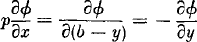
in which ϕ is, of course, a function which diminishes with respect to y. The above formula may therefore be simplified to
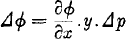
which indicates that, with a sufficiently small change in price, the seller obtains practically the whole of the increase in price (of his own commodity) as a net gain.20 If we now add the analogous expressions for all parties to the exchange and count the quantities of (A) sold (and consequently the quantities of (B) acquired) as negative, we obtain
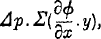
in which by the summation sign we understand a summation of the bracketed expression for each of the indices 1, 2, 3, etc., so that the  with the appropriate index indicates the marginal utility of (A) after exchange to each of the exchanging parties taken in order. The sum in question is evidently independent of Δp and in general is not equal to zero. As we can give Δp either a positive or a negative value, the whole expression can always be made positive—which proves that in normal cases there can always be found a system of uniform prices at which exchanges will produce a larger sum of utility than at competitive prices.
If, on the other hand, after exchange is completed, the marginal utility of one commodity (and consequently also of the other) were the same for all the parties to the exchange, then the above expression can be reduced to
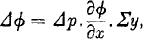
and this is always zero, since ∑y, the algebraic sum of the total quantities of the commodity (B) disposed of or acquired by the parties to the exchange, must be equal to nothing. This condition of equal marginal utilities implies—approximately, but not exactly—a position of economic equality between persons; and in that case—though not otherwise—free competition would secure a maximum satisfaction to all parties to the exchange.21
There is no need to emphasize the fact that an encroachment on free competition, if it is to yield the above result, must be effected in the right direction. Unrestricted liberty is in general infinitely to be preferred to a misguided system of restriction and compulsion. In so far as the government of a country is based on democratic principles, there is a certain, though not always reliable, guarantee that such measures will be introduced only when they are to the advantage of the vast majority; whereas when commercial and industrial policy are in the hands of a privileged minority there is a strong presumption to the contrary.
It may also be observed that a restriction of free exchange, of freedom to enter into labour agreements and of the right to free disposal of property—either by means of government intervention or by mutual agreement between buyers and sellers, employers and employees, etc.—is nevertheless a retrograde step, in so far as it usually tends to reduce the sum total of the means of satisfaction physically attainable—even if, under certain circumstances, it may lead to a socially more desirable distribution. We shall return to this important and difficult question at a later stage (p. 142 seq.).
In a word, free exchange in economics may be compared to the method of “trusting to nature” in medicine—when the doctor really does nothing, but leaves nature to effect its own cure. The term “physiocracy” means precisely this. In a state of perfect health, which corresponds to a system of economic equality, this is certainly the only correct treatment. Even in ill-health it certainly has a great advantage over bad treatment and dubious medicines. On the other hand, it cannot compare with a really scientific treatment which assists nature in a reasonable manner. And, in the last resort, the effects of even the most brilliant cure cannot be compared with those of rational hygiene, which aims at preventing disease and preserving health The application of the first part of the simile should be clear from what has been said; the latter will be elucidated when we come to deal with the social section of political economy.
In his last work, the Manuel d’économie politique, as well as in various earlier essays in the Giornale degli Economisti, Pareto returned to a detailed consideration of the problem of the “maximum d’ophélimité”, as he calls it, which would result from free competition. He defines this maximum as the point or position, from which it is impossible to move while ensuring a gain in utility or ophélimité for all participators in the market.
With such a definition it is almost self-evident that this so-called maximum obtains under free competition, because if, after an exchange is effected, it were possible by means of a further series of direct or indirect exchanges to produce an additional satisfaction of needs for the participators, then to that extent such a continued exchange would doubtless take place, and the original position could not be one of final equilibrium. The same would also be true of production. As soon as a change in production is more profitable both for producers and for their customers—or, from one point of view, for all owners of the means of production, workers, landowners and capitalists—then it is difficult to understand why, assuming general mobility, it should not happen. But this is not to say that the result of production and exchange under free competition will be satisfactory from a social point of view or will, even approximately, produce the greatest possible social advantage.
Hence, even in this new guise, Pareto’s doctrine contributes nothing. And—what is worse—it tends to obscure the fact, which we have already pointed out and which we shall develop, that social production under free competition (with certain reservations) does really lead to a maximization, in the usual and proper sense, of the means of satisfying human wants. In this respect, therefore, and of course disregarding the distribution of the product, it achieves as much, or almost as much, as we can imagine under rationally organized production in a collectivist society.
6. Pricing under Imperfect Competition
A. Joint Supply and Joint Demand
We must now give an account of the principal cases in which perfect competition between the holders of a particular commodity does not exist, either because of natural circumstances or legislative regulation; and of the effect on pricing of such restrictions. We may begin with the case already mentioned, in which two commodities are bound together, either on the demand side (where the consumption of a certain quantity of one is a necessary condition for the consumption of a certain quantity of the other); or on the supply side (where the technical conditions of production are such that the one must always be produced simultaneously with the other in more or less definite proportions). The former, which Marshall called joint demand, may, however, without difficulty be treated as a special case of the laws governing market prices which we have already formulated; and may, therefore, be passed over. Well-known examples of such a demand occur in the case of commodities dependent on each other either in consumption or individual production, such as nails and wire; knives and forks; lamps, wick, and oil; ink, pens, and paper, etc. Because of this relation, the consumption of ink depends in a much higher degree on the price of writing paper and postage than on the actual price of ink—and so on. Actually, as we have already observed, nearly all demand is joint in the sense that different commodities affect each other and are therefore, to some extent, mutually conditioned. That they should be demanded in absolutely fixed proportions may be regarded as a special case, which is of minor importance.
The second group of phenomena, which has been called (also by Marshall) joint supply, really belongs to the theory of production, and the regulation of exchange values under the influence of production, which we have still to describe. But it seems to be desirable to touch upon this question here because the related phenomena have been taken by some economists as a pretext for an attack on the whole classical theory of exchange—not so much with the object of criticizing it in the manner we have done in the preceding pages, but of replacing it by a very peculiar theory of pricing, which has never been very clearly formulated. Thus, the series of supposedly new price categories, which F. Neumann set up in his articles on value and price, in Schönberg’s Handbuch, are really nothing but various examples of joint supply. If, before the advent of lifts, town flats commanded a lower price the higher up they were, then according to Neumann this would constitute an exception to the principle that prices must correspond to costs of production. Costs of production, he says, are higher for the upper storeys since, in building them, the material must be carried to a greater height, and the weight of these storeys renders it necessary to make the supporting walls thicker than would otherwise be the case. But the obvious explanation is that, in addition to floors, walls, and ceiling, a house must have land on which to stand and a roof to cover it—of which the former, particularly, is usually very expensive to buy (or, as in England, to lease). These costs, or the interest on them, must be distributed over the rent of all the flats and it is not possible to determine a priori by what principle this should be done. As we have already indicated in an analogous case, the rent of the different flats is simply regulated by demand, that is to say, mainly by their respective comfort and suitability for various purposes; or, in the last resort, by their marginal utility. All that really matters is that the total rent should be sufficient to pay interest on all the costs of building, including the cost of the site. The high cost of building sites in towns has led, as is well known, to the erection in recent times of lofty steel and glass structures on the model of the American skyscrapers; otherwise all buildings would presumably be erected only one or at most two storeys high—as in country districts. It is the same with all other examples adduced by Neumann. As an example of “joint price”, he describes how the shares in the cost, which are borne by the participants in a common drainage scheme, are not proportional to the actual cost of cutting the ditch through their respective plots of land. This is true enough up to a point, but it is entirely due to the fact that the latter costs cannot be ascertained or imputed, for the ditch might have had exactly the same length, breadth, and depth, whether one or more of the interested parties had participated in the enterprise or not. If, on the other hand, the individual costs can be ascertained—if, for example, in order to satisfy the wishes of some particular landowner, it is necessary to follow an otherwise unnecessarily circuitous route in the construction of the ditch, or if the enterprise is involved in other special costs which would not otherwise have arisen—then it is clear that these would usually have to be defrayed by those who cause them. Usually, however, such an imputation of costs is impossible, and in that case there is no other way out than to see that the total costs of construction correspond to the total contributions and to distribute the latter equitably. The generally accepted principle (for example, that of the Swedish Ditching Law of 1879) that each shall contribute in proportion to the objective utility, i.e. the increase in yield or rent which the enterprise brings to him, is by no means the only conceivable one—or even the best or most reconcilable with economy and justice. If, for example, one of four interested parties has gained a capital value of £1,000 and the three others only £100 each, whilst the total cost of the enterprise was £500, then the first would gain more than any of the others—more than all of them combined—if he paid the whole cost himself and the others did not contribute a farthing.
In this case—unlike the preceding one—there is no automatic economic law of price formation; for it is really a case of isolated exchange. Nevertheless the discussion which springs from such a price-problem is full of interest. An analogous case of the widest implications is presented in a field which may at first sight seem far removed, namely, in the theory of equity in taxation.
B. Pricing in Retail Trades
Retail prices are frequently regarded as exceptions both to the law of costs and generally to every rational process of price formation, which is all the more remarkable since these prices are the only ones which are of direct interest to the consumer and which are directly influenced by consumption. Yet the laws of retail prices are perhaps not so difficult to ascertain and do not seem, in the main, to depend on any other factors than those which we have already treated, except that they are more complex and more difficult to unravel. To a considerable extent, the apparent divergence of retail prices from the law of costs and from wholesale prices is to be regarded as an example of the phenomenon of joint supply—which we have just considered. Unlike the wholesaler, whose general costs for his whole business constitute only a small part of his annual turnover, the retailer’s general costs for premises, heating, lighting, advertisement, wages for his assistants and for his own labour, etc., are very considerable. The first item in particular assumes large proportions since, for the convenience of his customers and for purposes of advertisement he must seek to acquire business premises which are as central as possible. What proportion of these general costs shall be apportioned to each parcel of goods, over and above the purchase or wholesale price, cannot be determined a priori, but depends upon a number of variable circumstances. It is of great importance in this connection that certain kinds of goods require much more expert knowledge for their valuation than others; the latter, such as sugar, flour, etc., the quality of which anybody can easily judge, yield, if I am not mistaken, a comparatively small profit. With the former goods, on the other hand, the buyer, if he is not exceptional in possessing such knowledge, will, in order not to be sold inferior goods, deal with a seller in whom he has confidence. The service which the retailer thus renders him is that of an expert buyer, and the customer quite reasonably has to pay him a relatively higher price.
The desire for stable retail prices must also be taken into account. For many customers it is of great importance to be able to determine their household expenses well in advance. Retailers, who usually have a fixed circle of customers, therefore endeavour to afford this advantage of approximately fixed prices, which they calculate so that the profit and loss of good and bad times to some extent cancel out. Naturally, greater and more permanent variations in wholesale prices are ultimately reflected in retail prices—though, as a rule, later and in a modified form—just as a thermometer buried deep in the ground responds slowly to changes of temperature on the surface.22
In conclusion, we should not forget that practically every retailer possesses, within his immediate circle, what we may call an actual sales monopoly, even if, as we shall soon see, it is based only on the ignorance and lack of organization of the buyers. He cannot, of course, like a true monopolist, raise prices at will—only in places remote from trade centres can a considerable local rise in prices occur—but if he maintains the same prices and qualities as his competitors, he can almost always count upon his immediate neighbourhood for customers. The result is not infrequently an excess of retailers, apparently for the convenience, but really to the injury, of the consumers. If, for example, two shops of the same kind are situated at different ends of the same street, it would be natural that their respective markets would meet in the middle of the street. Now if a new shop of the same kind is opened in the middle of the street each of the others will, sooner or later, lose some of its customers to the new shop, since the people living round the middle of the street believe that if they get the same goods at the same price they are saving time and trouble by making their purchases at the nearest shop. In this, however, they are mistaken, for the original shops which have now lost some of their customers without being able to reduce their overhead expenses to a corresponding degree, will gradually be compelled to raise their prices—and the same applies to the new competitors who have been obliged from the beginning to content themselves with a smaller turnover. This should explain the observation which is said to have been made on the abolition of the octroi—the tax on the entry of goods into a town, common on the continent—that the expected reduction in prices never took place, though the number of retailers considerably increased. The correct remedy, unless one of the competitors (such as a great store) manages to overshadow all the others, is clearly the formation of some form of organization among buyers. But so long as such an association does not exist—and between persons in different positions in life and without more intimate bonds it is extremely difficult to establish—the anomaly must remain that competition may sometimes raise prices instead of always lowering them, as one would expect.
C. Monopoly Prices
A still more pronounced divergence from the formation of prices under free competition is provided by monopoly prices proper. Monopoly involves the absence of competition, either absolute for a certain class of goods, such as a state fiscal monopoly (of liquor, tobacco, salt, etc.), patents of industrial inventions, etc.; or only relative, in a definite geographical area and within certain price limits. Every limitation of supply or of productive power does not necessarily create a monopoly—for in that case every price would, strictly speaking, be a monopoly price, since none but free goods occur in unlimited quantities. The ownership of land, for example, is certainly the privilege of a more or less limited class, but so long as active competition exists between landowners, this possession is not a monopoly and does not lead to monopoly prices for the product of agriculture, either individual or collective. The difference lies in the fact that a commodity or factor of production, whose supply is limited, but which is not the subject of a real monopoly, is offered as a whole at the price it can fetch, or at any rate up to the point at which the owners themselves prefer to retain it for their own use. The monopolist, on the other hand, artificially restricts the available market supplies of the commodity or factor of production in his possession. His supply is not regulated by the coincidence of marginal utility and price. If, indeed, it should happen that he were to offer the whole of his stock of goods or means of production, up to the limit determined by this condition, he might nominally have a monopoly, but the price would not be monopolistically determined, but would follow the ordinary laws of supply and demand. His profit would then depend solely upon the natural scarcity of the commodity. Frequently, however, the monopolist’s stocks are unlimited—as in the case of a patent the use of which might be extended without special expense to all consumers who would in any way profit by it. But if this is to happen, either some customers must pay more than others, or there must be a zero price for all; i.e. the invention would be on the same footing as a free good—which is actually the case when patent rights run out. The high price of patented goods is therefore due exclusively to an artificial restriction of output, as Adam Smith remarked.
In exceptional cases, as has been said, competitive prices may prevail under an actual monopoly. Thus the Standard Oil Company of America, which has absorbed practically all the petroleum refineries of the U.S.A., fixes its prices, by measuring the yield of the wells during the preceding days or weeks, at the level at which consumption is expected exactly to equal production. Generally speaking, in a case of this kind, it would often be possible to obtain a larger profit—perhaps a much larger profit—if the price were raised, in spite of the fact that this would reduce consumption. But in that case, the wells already opened would have to be partially closed down, or their contents allowed to run to waste—which would presumably cause dissatisfaction among the public, and might lead to the intervention of the authorities.
If no such considerations exist, it will be to the advantage of the monopolist to fix his prices so high that he will obtain the maximum net profit. Every rise in price causes, we may assume, a falling off in demand. But so long as the falling off in demand is less than proportionate to the increased profit per unit of the commodity resulting from the higher price, the total net profit (the product of these) will increase. But when the decrease in sales is more than proportionate to the increased profit per unit, any further increase in price will be disadvantageous. The ideal monopoly price is thus to be found precisely at the meeting point of both these tendencies—the point at which demand is reduced in the same proportion as the net profit is increased in consequence of the higher price.
We shall endeavour to represent the position by an arithmetical example in tabular form. Suppose that a monopolized commodity costs the monopolist £2 a unit to manufacture. And assume for the sake of simplicity that the relation between price and sales is such that, with a price of £12, 1,000 will be sold in a unit of time; and that every increase or decrease in price by £1 causes a decrease or increase in sales by exactly 100 units. We may then set out the following table:—
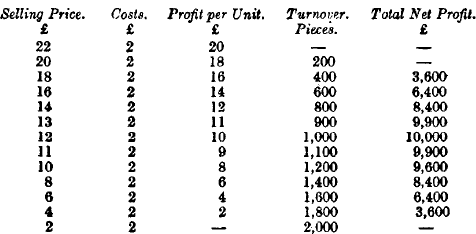
In this case, a price of £12 is, therefore, the most advantageous to the monopolist. He would get less profit if he either raised or lowered the price.
It is easy to represent the fundamental features of monopolistic pricing graphically, or algebraically. It we mark off the various unit prices, p on the horizontal axis and the corresponding quantities y, sold per unit of time, on the vertical axis, then the locus of these points will generally describe a curve y = f(p). The rectangle y.p represents the gross receipts, and that part which lies to the right of a line at the distance a from the vertical axis—where a is the unit cost of production, i.e. y(p - a) represents the net profit.
The expression is maximized when its first derivative with respect to p is zero. We thus obtain
(p - a)f’(p)+f(p) = 0,
a condition which is satisfied, as will easily be seen, when that part of the tangent to the curve which lies between the above–mentioned vertical line and the horizontal axis is bisected at the point of contact. If y = f(p) is a straight line, as with our figures, we have simply to take half the maximum net price, where sales will be half the maximum which can be marketed without a loss. Other questions relating to monopoly prices are similarly capable of an easy mathematical solution. Thus, inter alia, there can be deduced from these figures, or formulæ, answers to such questions as the various influences of general and special costs, various forms of taxation, etc., considered on p. 72.
It is important to note that the amount of overhead costs (i.e. costs which remain constant whether output is large or small) has no influence whatever upon the level of the most advantageous monopoly price. Whether, for example, a private railway company has to pay a large or a small amount of interest on the capital invested in construction, the height of its charges cannot be affected, so long as these are fixed on the principle of maximum net profit. This is obvious: if, in the table, p. 90, we deduct a fixed amount per unit of time (say £1,000) from the monopolist’s net profit, then all the figures in the right-hand column will be reduced by 1,000. Obviously, even after this reduction, the previous maximum profit would still be a maximum; so that the most advantageous selling price would still be exactly £12. It is evident that this would still apply if, for any reason (say income tax), the net profit were reduced in proportion to its size—and even if the deduction (as in the case of progressive income tax) increases more than proportionately to net profit, so long as the rate of progression is such that the residue (after deduction) continues to increase wherever the profit (before deduction) would have increased.
But different considerations apply in the case of prime costs—which increase with the output. For the sake of simplicity we will assume that the increase of costs is exactly proportional, so that every new unit of commodity increases costs by as much as the preceding unit; and so on. If, for any reason, the cost of a unit now increases—as for example by reason of a consumption tax, or excise duty on the quantity manufactured or offered for sale—then in our table the net profit per unit will be reduced by the amount of the additional cost, and it is obvious that this will cause the monopolist to raise his price in order to obtain the maximum total profit. The increase will not be as great as the additional costs of production but usually less. With a simple linear law of demand (on which our table is based), the most advantageous increase in the monopoly price would be exactly half the increased cost per unit, so that if, for example, the increase were £2 and the monopolist’s cost of production were thus to become £4 per unit, the best selling price Would be £13.
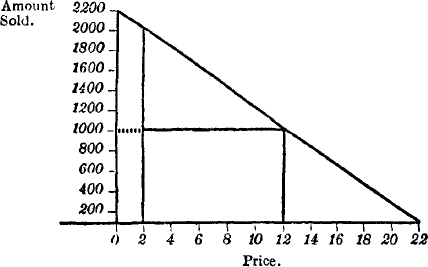
FIG. 5.
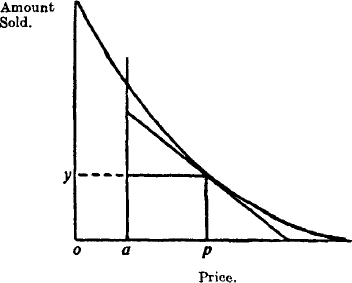
FIG. 6.
These propositions, which are due originally to Cournot,23 but have been developed subsequently by Pantaleoni, Marshall, Edgeworth, and others, are of great interest both for the theory of taxation and for the solution of the pressing problem—which is daily becoming more important—of a rational regulation of industrial monopolies, whether legal or merely de facto.
The mathematical treatment of monopoly profits and their taxation abounds in interesting and often very surprising features. Suppose, for example, that a railway company which has a monopoly in passenger traffic, with only two classes, second and third, is taxed on the basis of the number of second class tickets sold. Who would suppose, at first sight, that this taxation might make it economically advantageous for the company to reduce the price of both second and third class tickets? And yet Edgeworth has fully proved24 that, on certain assumptions, this can be the case.
This can, if necessary, be understood without the use of higher mathematics. For the sake of simplicity we shall assume—an assumption very far removed from reality—that ceteris paribus the number of second class passengers is determined exclusively by the price difference between the two classes; in other words, the passengers would travel in any case, though the difference in price decides whether they will travel second or third class. In such a case it is in the interest of the railway company to increase this difference in order to force some passengers to go over from second class to third class—and thereby save in taxation. That this can always happen without a corresponding reduction in the total revenue is implied in the very concept of maximization—at least in most cases. A slight change in the most advantageous price combination produces a relatively very small reduction in traffic revenue, whereas the corresponding saving in taxation is considerable. Now a given increase in the price difference can be brought about in three different ways:—
(a) by a moderate increase in second class fares and a reduction in third class fares;
(b) by a greater increase of the former and a slight increase (or, at any rate, no reduction) in the latter; and
(c) by a slight reduction (or, at any rate, no increase) in second class fares and a greater reduction in third class fares.
By all three methods the railway company makes an equal saving in taxation. It remains an open question, therefore, which of the three will produce the least decrease in the traffic revenue. As a rule it would be the first method, but in special cases the second and even the third may be preferred, in that order.
Thus, if second class traffic is very considerable and third class traffic not particularly elastic, it may happen that the most profitable course would be to increase both fares (although, apart from taxation, this increase must always reduce the traffic revenue, since it alters the combination of prices existing before the imposition of the tax, which must be assumed to be, in those circumstances, the most advantageous). But if third class traffic is very elastic—so that reduced fares would attract a number of new passengers (to the third class)—and the second class traffic is not very great, then, however paradoxical it may at first sight appear, the last of the three methods will be the most advantageous to the railway company.
Alternatively, we might approach the problem in the following way. Let us draw up a series of combinations of prices which, apart from taxation, would yield the company a certain given net income slightly less than the maximum. Geometrically, this series could be represented by a closed curve (roughly elliptical in shape) enclosing the maximum point; we have then to find the point on this curve at which the difference between the co-ordinates (the difference between second and third class fares, and consequently the saving in taxation) is a maximum. This point is clearly the point of contact of the upper of the two tangents to the curve which make an angle of 45° with the axes (cf. Fig. 7). The same construction may then be repeated with a succession of new curves (new series of price combinations) the process being continued so long as the saving in taxation increases more than the traffic revenue decreases. If the maximum point is taken as the origin (with the direction of the axes retained) it will easily be seen that the new point of equilibrium may be situated in the first, second, or third quadrant—but of course never in the fourth—according to the form and position of the curves, of which nothing is previously known.
It must, however, not be overlooked that the study of monopoly is peculiarly liable to be disturbed by great differences between “theory” and “practice”; and that for many reasons.
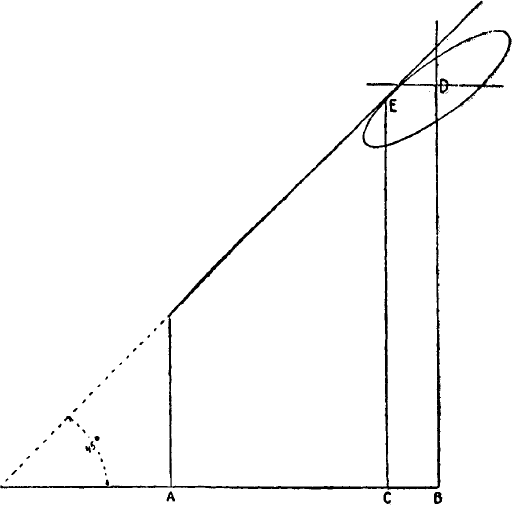
FIG. 7.
AB = Price of III class tickets before taxation.
BD = „II „ „ „ „
AC = „III„ „ after „
CE = „II „ „ „ „
The monopolist is not obliged to keep so close a watch on prices as a seller or producer working under free competition, especially since most monopolies are in the hands of great companies, or corporations, or States, and are managed by salaried officials who are usually much more anxious to avoid loss by incautious experiments than to increase their profits. Another circumstance, which should not be overlooked, is that the growth or decline of net profit in the immediate neighbourhood of the theoretically most advantageous selling price is very small. This feature is common to all real maximization, and we may easily convince ourselves of its correctness here by reference to the above table.25 It is, therefore, largely a matter of indifference to the monopolist whether his price is a little above or a little below that which is theoretically the best—however important the matter may be to the consumer.
Finally, it may be pointed out that the sharp distinction between monopoly prices and competitive prices which we (in common with other economists) have drawn here scarcely ever exists in reality. Not infrequently, two or more monopolists in the same branch of production, or in closely-related branches (e.g. owners of various patents in the same industry) actually compete with each other.26 We have already pointed out that there also exists in the ordinary free competitive market a sort of monopoly for each individual producer, and even for every consumer—dependent upon their various geographical positions relatively to each other and to the centres of business activity, with consequently differing transport costs. But economic theory has paid very little attention to this aspect of the problem of pricing.27
If there are two equally powerful monopolists in the same branch of production then, if they operate independently, they will doubtless depress prices, but, as Cournot observes, only up to a certain limit—namely, the point at which each obtains the maximum profit, under the assumption that the other neither increases nor decreases his output beyond that limit. This new equilibrium position can be determined without difficulty, if a is the cost of production, by the equation
2(p – a).f’(p) + f(p) = 0,
where p is the common selling price and f(p) the combined sales of the two monopolists. The tangent referred to above (Fig. 7) will be divided at a point one–third of the way along it, and in our table (p. 90) the selling price would be reduced to £(2 + ⅓ X 20) = £8.67 a unit with a total sale of 1,333 units—or 666 to 667 for each monopolist. In the same way, if there are three or more monopolists, the price will fall further, until it finally sinks to the bare cost of production (p = a) as in free competition. The public will, therefore, gain by the competition of the monopolists, but the monopolists will lose. Their own interests compel them to combine and divide the profits—in which case monopoly prices and sales will again be the same as when there is a single monopolist.28
7. Pricing under the Influence of Production
Transition to Part III
Although hitherto our purpose has been to describe the origin of market prices, on the assumption that goods exist in given quantities for a certain consumption period, yet we have on several occasions touched upon the effects of production on pricing; or rather on their influence on one another. We shall now concern ourselves directly with this problem, and shall consider it in detail in the next section. The older economists drew a distinction between market price, regulated solely by demand and supply, and “natural price”, about which the market price always oscillated, and which is itself determined by the cost of production of the commodity. In actual fact, the formation of prices is essentially the same in both cases, except that the relation between supply and demand, effective on the market, is replaced in the latter case by the relation between production and consumption. If price equilibrium in the market demands equality of supply and demand, then in the long run the prices of the various commodities will be stationary at, oroscillate about, the point of equilibrium between production and consumption—in other words the point where production exactly covers consumption. We may add, in passing, that this simple relation is all too often overlooked as, for example, when we speak of a .permanent over-production or under-consumption of some, or even all, commodities. If this means that production permanently exceeds consumption—and what else can it mean?—then it is manifestly absurd. After all, the capacity of our warehouses is limited!
If it were true that the manufacture of a commodity always required a certain definite quantity of each factor of production (i.e. a certain quantity of homogeneous labour, a certain area of land of given physical properties and finally a certain use, and corresponding using-up of capital goods—factories, railway material, ships, tools, machinery, etc.), and that production did not require any time (or, more correctly, that the time actually required need only be regarded, economically speaking, as quantities of services of labour and land, which could just as well be supposed to be applied simultaneously as successively) then we should have every reason to agree with Walras’ assertion that the determination of prices, taking production into account, constitutes essentially the same problem as the formation of prices in the market; or is, as it were, only a variant of it. Anyone who demands a given quantity of a given commodity will implicitly demand a given determinate amount of each of the factors required for the production of that commodity. On the other hand, each owner of these factors—the labourer, the landowner, and the capitalist—offers a certain quantity, the amount of which depends ceteris paribus partly on the market price (i.e. on the rate of wages, rent and interest, etc.) and partly on the prices of the goods which the owners of the factors wish to acquire in return. Or, in accordance with what we have already said, we may regard the problem from a somewhat different point of view: the owner of a factor of production has himself a certain direct use for it, so that what he wishes to retain for himself may be regarded as his contribution to the general demand for that factor. The supply must then be regarded not as the amount which he and other owners offer, but as the whole quantity in existence—for example, in the case of labour, the whole twenty-four hours of the day—which in extreme cases might find productive employment. If we start from a hypothetically given system of prices of all the factors of production, then, in the first place, we can on our assumption deduce the corresponding prices of the finished goods (if we regard their costs and selling prices as equal). For every such system of prices we can then obtain, directly or indirectly, a determinate demand for and supply of each particular factor; and it only remains to state that, in equilibrium, demand and supply must coincide, or—if we take the word demand in its wider sense as including the quantity which the owners of the factors wish to consume directly at the given price—that demand exactly equals the quantity available.
Working under this assumption, we should actually have to deal with two factors of production only, land and labour, since machinery and other capital goods can ultimately be reduced to products of land and labour. If time did not play any economic rôle, the employment of, and demand for, capital could be regarded as an indirect demand for labour and land. But it is precisely at this point that the weakness of the argument appears; for, since the indirect productive services must be rewarded in the same way as the direct, the share of capital in production would consist only of successive repayments of the capital itself, and not of any addition in the form of interest. This agrees with the Socialist view, according to which the remuneration of capital consists exclusively of “unpaid labour” i.e. is an economically unjustifiable robbery of the fruits of production. We must either accept this view—which, however, Walras and his school refuse to do—or we must admit that the reasoning which leads to this result (which really ignores the existence of interest) overlooks an important element in the explanation of the phenomena of the real world.
This view of the position is evidently far too imperfect to be even an approximation to reality. In the first place, the proportions in which the various factors of production contribute to the manufacture of any commodity are by no means given or determinate, but may vary within certain (sometimes wide) limits; or, as it is sometimes expressed, one factor of production can always, to some extent, be substituted for another. This is particularly true of the production of foodstuffs, which are obtained, in a fairly uniform quality, either by extremely extensive agriculture (for example in the “robbery cultivation”—rightly or wrongly so called—of the Western States of America or in the practice, common in Sweden, of burning off woodland in order to secure arable land) or else by a highly developed intensive cultivation as in China, Belgium, and the plains of Lombardy. But, even in manufacturing industry, the various factors of production, such as human labour and machinery, may be substituted for each other to almost any extent. That is to say, direct human labour is replaced by natural forces (in combination with the employment of capital) and vice versa. A further factor, which at bottom has a close connection with the above, is that the time-element in production, so far from being a matter of indifference from the economic point of view, is of the very greatest importance. We cannot—at least in the last analysis—conceive the commodity market, on the one hand, and the market for factors of production or productive services, on the other, as lying alongside one another, so that they could theoretically be regarded as one. In point of time the latter always precedes the former, and this circumstance—as we can easily understand a priori, and as we shall show in more detail soon—is of the greatest importance in actual pricing. Before we can hope for a final solution of the pricing problem we must first consider both sides of it more carefully: the ability of the different factors of production to replace each other, and the time-element—or, what amounts to the same thing, the economic significance of capital. We shall consider these matters in the next part and shall, at the same time, endeavour to solve the problem of distribution under free competition—a problem which would already be solved if the shares of labour, land, and capital could be determined as simply as has been indicated above. That such is not the case, and that the time-element plays a decisive part in distribution, and especially in the determination of wages, was what John Stuart Mill wished to express by his statement, “Demand for commodities is not demand for labour”—a statement which, though fundamentally correct, has been widely challenged and frequently misunderstood.
[—f’(a—x) + f’(x)]Δx + [ϕ’(y)—ϕ’(b—y)]Δy = 0. . . . . . . .(1)
But in equilibrium we have

where p is the price of (B) in terms of (A). Thus the above equation is satisfied, and consequently Launhardt concludes, the equilibrium price determined by free competition is the one which, among all uniform prices, produces the greatest additional utility for the two (or for all) parties to the exchange.
The proof is evidently false. If we desired to discover the absolute maximum of N we should have made x and y independent and would then have obtained
f’(x) = f’(a—x) and ϕ(y) = ϕ’(b—y)
These equations are clearly satisfied by the values x =  and y =
  ; in other words, the parties should simply exchange half their stocks. Since this result is not generally consistent with exchange at a uniform price (and is perhaps outside the possibilities of free exchange) we must impose the condition that one of the parties (the one who is at a disadvantage in regard to price) continues to exchange to the point of satiety. We thus obtain the equation
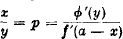
By differentiation of this equation and elimination of Δx and Δy with the help of (1) we obtain, according to circumstances, a maximum or a minimum of N, but in neither case an exchange at an equilibrium price.
By way of further proof, Launhardt tries to show, by means of an arithmetical example, that a price which would produce the greatest possible gain for either of the parties would, nevertheless, yield to them both a smaller surplus utility than would the equilibrium price. But a close examination will show that this result is due simply to the fact that he has unconsciously gone beyond the right maximum.
- 1This expression is perhaps not entirely suitable, since, as will easily be seen, the essence of the argument is in both cases the same. It is therefore also possible that I ought to have endeavoured to combine sections II, 2, C and D in a single uniform presentation. I have found myself unable, however, for various reasons, to do this. As they now stand, these two collateral presentations may materially support and explain each other.
- 2This expression is perhaps not entirely suitable, since, as will easily be seen, the essence of the argument is in both cases the same. It is therefore also possible that I ought to have endeavoured to combine sections II, 2, C and D in a single uniform presentation. I have found myself unable, however, for various reasons, to do this. As they now stand, these two collateral presentations may materially support and explain each other.
- 3This expression is perhaps not entirely suitable, since, as will easily be seen, the essence of the argument is in both cases the same. It is therefore also possible that I ought to have endeavoured to combine sections II, 2, C and D in a single uniform presentation. I have found myself unable, however, for various reasons, to do this. As they now stand, these two collateral presentations may materially support and explain each other.
- 4Some of the matter included in this book had been published in Conrad’s Jahrbücher in the preceding year.
- 5Some of these contributions are now available in one or other of the world languages. The article on Professor Bowley’s Mathematical Economics, with its discussion of the theory of Bilateral Monopoly, appears in the Archiv für Sozialwissenschaft, Bd. 58, pp. 252-281. Professor Hayek has included a celebrated article on Prices and the Exchanges in his Beiträge zur Geldtheorie, and two others on Dr. Gustav Åkermann’s Realkapital und Kapitalzins and Prof. Cassel’s “Theory of Social Economy” appear in English as appendices to the present volume. But an English translation of a comprehensive selection of these papers is still urgently to be desired.
- 6A short list of Wicksell’s principal contributions to foreign periodicals is given by Professor Ohlin, op. cit., p. 512.
- 7See, e.g., Schumpeter, “Knut Wicksell,” Archiv für Sozialwissenschaft, Bd. 68, pp. 238-257.
- 8In this connection a comparison between Wicksteed’s article on Jevons’ “Theory of Political Economy” (Works, vol. ii, pp. 734–754) and the sections on Capital Theory in Uber Wert, Kapital und Rente is very instructive.
- 9But not all. I should be very sorry to be thought to lend any countenance to the view, now apparently gaining ground in somewhat unexpected quarters, that in undergraduate teaching or in advanced studies we are yet in a position to dispense with the most thorough study of Marshall’s Principles. It would be a sad thing if the uncritical acceptance of this great work, which so long tended to stiffle the development of other lines of thought in this country, were to be succeeded by an equally uncritical rejection of all the wisdom and the path-breaking intuitions that it contains.
- 10He must have been aware of Über Wert, Kapital und Rente, for it was reviewed together with his own Co-ordination of the Laws of Distribution in the Economic Journal for June, 1894.
- 11Finanztheoretische Untersuchungen, p. 176 seq. Wicksell’s views in this spect have been developed with great ingenuity by his pupil, Professor E. Lindahl, in his Die Gerechtigkeit der Besteuerung,
- 12Theory of Wages, p. 233.
- 13“The Ricardian Theory of Profits,” Economica, February, 1933, pp. 51–74.
- 14Prices and Production, chapter i, passim. “A Note on the Development of the Doctrine of ‘Forced Saving,’” Quarterly Journal of Economics, vol. xlvii, pp. 123–133.
- 15See Hayek, Monetary Theory and the Trade Cycle, chapter v, and Prices and Production, chapter i; also G. Myrdal, “Der Gleichgewichtsbegriff als Instrument der Geldtheoretischen Analyse,” in Beiträge zur Geldtheorie, ed. Hayek.
- 16Etudes d’économie politique appliquée, p. 466.
- 17L’echange de deux marchandises entre elles sur un marché régi par la libro concurrence est une opération par laquelle tous les porteurs, soit de l’une des deux marchandises, soit de l’autre, soit de toutes les deux, peuvent obtenir (obtiennent) la plus grande satisfaction de leurs besoins compatible avec cette condition de donner de la marchandise qu’ils vendent et de recevoir de la marchandise qu’ils achètent dans une proportion commune et identique. (Élémente d’économie politique pure, 4me éd. l0me Leçon.)
- 18Concerning his later views on this question, cf. pp. 82–83.
- 19As it is only our intention here to illustrate a theoretical principle, we ignore the otherwise important circumstance that shorter hours of labour usually give rise to a greater or less increase in the efficiency of labour.
- 20y is the quantity of his own commodity (B) which he originally sells; y.Δp is consequently the additional quantity of the commodity (A) which he would obtain as a result of the increase in price if he could continue to sell the same quantity y of his own commodity; is the marginal utility of (A) and hence .y.Δp is the gain in utility derived from the increase in (A).
- 21As an example of how even an experienced mathematician may be led to erroneous conclusions in this field, we may mention the argument of Launhardt (Mathematische Begründung der Volkswirtschaftslehre). He assumes two parties to an exchange, one of whom from the beginning possesses a units of the commodity (A) and the other b units of the commodity (B) and, for the sake of simplicity, he supposes the total utility derived by each person from the commodity (A) to be expressed by the same function, f( ); and similarly ϕ( ) for the commodity (B). If they then exchange the quantities x and y the total utility received after exchange by both parties together is expressed by N = f(a—x) + ϕ(y) + f(x) + ϕ(b—y). In order that this expression should be a maximum we must have:—
- 22In an essay in Ekon. Tidskrift, October, 1908, and also in his work, Den ekonomiska fördelningen och Kriserna, Brock has sought to prove that the above conception of the relation between retail and wholesale prices is not correct. Retail prices, in his view, show a strong tendency to follow wholesale prices upwards, but very little tendency to follow them downwards. The statistics (from America) on which Brock bases this assertion would seem to show merely that of recent years retail prices have, on the whole, risen as compared with wholesale prices; a fact which, owing to the great relative increase of retailers, is in itself probable and is quite in accordance with what we are about to say. As a general doctrine, Brock’s view (and that of Lexio and others) is clearly absurd; it would imply that retail prices would diverge more and more from wholesale prices at each cyclical fluctuation—which would lead to absurd consequences. Obviously, we do not attribute any altruistic motives to retailers when we speak of their endeavour to keep prices as steady as possible for their customers’ convenience. It is well understood that it is in the interest of every business man to satisfy his customers.
- 23See Principles mathématiques de la théorie des richesses. This work was first published in 1838, but was not generally known until much later. Translations into English and various other languages are now available.
- 24Papers relating to Political Economy, vol. i, pp. 143–151, and Economic Journal, 1899, p. 286.
- 25Cf. also my Finanztheoretische Untersuchungen, p.12, et seq.
- 26The theory of pricing under “duopoly” or “polypoly”, as they were formerly called, was developed by Cournot (see below) and deserves attention.
- 27A. Weber’s Der Standort der Industrie may be described as such an attempt.
- 28Edgeworth, in his Mathematical Psychics (1885) and in an essay in the Giornale degli Economisti, 1897 (and also the mathematician, Bertrand, in the Journal des Savants, 1883), criticized Cournot’s reasoning, but, in my opinion, on insufficient grounds. It is certainly true that the problem, as Edgeworth says, will to some extent be indeterminate in the case of two, or generally of a limited number of monopolists, whether in the same or in different branches of production. But Cournot’s further assumption, quoted above, seems to me much more reasonable than the one selected by Bertrand and Edgeworth. The latter involves the assumption that each monopolist aims at the maximum net profit on condition that the other does not change his price—an assumption which seems to me quite unjustifiable where they both produce the same commodity. [See Wicksell’s review (Economisk Tidskrift, 1925) of Professor A. L. Bowley’s Mathematical Groundwork of Economics; a German translation of this review subsequently appeared in the Archiv für Sozialwissenschaft, 1927.]

