
Lectures on Political Economy
II. The Theory of Production and Distribution
BIBLIOGRAPHY.—There still exists no exhaustive presentation of this subject on modern lines; at least, not in an elementary form. Walras in his Éléments once and for all correctly formulated the solution to the problems of production, distribution, and exchange as a whole, but his treatment of the economic function of capital is hardly satisfactory. Böhm-Bawerk, on the other hand, whose work Kapital und Kapitalzins1—and especially its latter part, Positive Theorie des Kapitals2—is the chief source for the modern theory of capital, did not concern himself with the synthetic treatment of the problem of production and distribution as a whole. An attempt to combine the work of both these writers into a single whole is to be found in my essay, Über Wert, Kapital und Rente; and also in the elegant but unfortunately unfinished articles of Enrico Barone, “Studi sulla Distribuzione” (Giornale degli Economisti, 1896). P. H. Wicksteed’s succinct Co–ordination of the Laws of Distribution3, 4 (London, 1894) is interesting and rich in ideas—but not easy to read. Jevons’ Theory of Political Economy contains many instructive, though scattered, remarks on production. The most exhaustive treatment of the subject in English, from the modern point of view, is to be found in Marshall’s Principles of Economics, an abridgment of which was published under the title Elements of the Economics of Industry.
An original writer, unfortunately to a large extent self-taught, is the German, Effertz, who in several works (of which the earliest is contemporary with the Positive Theorie des Kapitals) develops views similar to those of Böhm-Bawerk; they are often very well stated.
We have hitherto examined, as far as it has been possible to do, the process of valuation of the material objects or direct personal services with which we satisfy our needs. We shall now consider how the available stocks of goods (and, strictly speaking, personal services also, in so far as the supply of services presupposes a supply of consumable goods) are maintained, renewed, and replaced. In other words, we shall now consider production.
As has already been indicated, the problem of value and exchange cannot be finally solved unless attention is simultaneously paid to production. Production, on the other hand, as it actually takes place, cannot be understood except in association with the laws of exchange and exchange value. In reality, exchange, and consequently valuation, enter into all production. Even in an individual’s production with his own resources for his own needs there is always, at least in the wider sense of the word, an exchange (or choice); the resources can be used either in direct consumption or in indirect consumption—through the medium of production. Thus, for example, anyone who has labour available, so long as he is a free human being, has the choice of using his working hours either for rest or diversion, or for productive employment in the ordinary sense. The element of exchange naturally appears even more clearly in production which is carried on in association with outside labour or other factors; or when the product is intended for consumption by others, as is the case nowadays with the vast majority of goods produced. In the former case, there is, of course, a direct exchange of factors of production—land, labour, and capital—against their necessary remuneration—wages, rent, and interest. In the latter case, production proceeds with constant reference not only to the volume of the output which can be obtained, but also to the exchange value anticipated or already determined on the market. In the majority of practical cases, both of these considerations are present.
Production and exchange can only be separated by a process of abstraction; but such abstraction is an invaluable aid in the survey and examination of what at first sight appear to be hopelessly complicated phenomena. For this reason, we have hitherto assumed, in our examination of the principles governing market values, that the supplies in the market to meet the needs of consumers in a given period are given in advance; although, naturally, these supplies are continuously affected in reality by new production—especially in modern times with highly developed communications. In the same way we can, and shall for a while, in our treatment of production and distribution, ignore the changes in the exchange value of goods which are constantly brought about by relative changes in production and consumption. In other words, we assume, in the first instance, that for the society in question these exchange values are given—as they approximately are in reality for every individual producer, in his relation to the market as a whole. A concrete case of this kind would arise if a country or some smaller area produced only one or a very few staple commodities and imported everything else it required; so that all exchange values could be assumed to be determined in advance by the market of some larger area, or even the world market.
For a first approximation, we may also introduce another important simplification. As we have already said, every owner of a factor of production can choose between two methods of employing it: directly or in the service of production. Even if the relative exchange values of goods are given in advance, the need will constantly arise for the individual to weigh up against one another, on the one hand, the goods which he obtains, or can obtain, in return for his productive services and, on the other hand, the enjoyment he obtains from being able to dispose of them freely on his own account; as, for example, by having more leisure. We shall, however, assume for the present that the utility of the various factors of production, after a certain amount has been set aside for the owner’s direct consumption, becomes so insignificant for this purpose that it need not be taken into account in comparison with the indirect utility derived from their productive employment. And this assumption may be made without danger in the case of several factors of production. Private owners of building sites in cities do not usually leave any part unoccupied in order to retain it as a promenade ground. No landowner—unless he were a very exceptional person—would allow arable land to lie waste or would use it as a hunting ground. Still less has the owner of capital any choice in this respect; in order to obtain any yield from his capital he must employ it productively or, what generally amounts to the same thing, lend it to someone else. The personal, unproductive use of capital would almost necessarily be tantamount to its partial destruction. Dwelling-houses occupied by the owner constitute no exception to this rule, for the only possible productive use for such capital goods is that they should be occupied as dwellings.
Hence it is approximately true of land and capital—that is to say, of the capital existing at any given moment of time—that they enter as a whole into production. On the other hand, we cannot reasonably say the same thing about labour. It is a physical impossibility to work regularly for the whole twenty-four hours of the day, and even if working hours were limited to the maximum time which can be devoted to work in the long run, the labourer’s position would still be so miserable that only the most acute necessity would keep him from converting a little of his working time to leisure purposes. To the older economists, who generally held that the natural and average wages of labour exactly corresponded to the minimum of subsistence of the labourer and his family, it was natural to regard individual labour and hours of labour as a fixed and definite quantity, the limits of which were set only by the physical powers of the labourer. It is characteristic that when Adam Smith discusses the problem whether labourers are likely to respond to a rise in wages, by devoting more time to leisure he only does so in order to absolve them from this charge. Nowadays, when wages have fortunately risen somewhat above the subsistence level and when the limitation of working hours in order to give the worker an opportunity for educational and cultural activities has become one of the most eagerly sought objectives, especially on the part of the workers, this assumption, is no longer permissible. Our use of it here will be only provisional, in order to simplify the argument. We must also remember that, in certain occupations (particularly the manufacturing industries), the amount of time devoted to production (especially the length of the working day) is largely determined independently of the individual worker, by collective agreements—which may be denounced collectively, but not individually, excepting in so far as an individual may occasionally “take a day off”.
We also ignore here the practically very important circumstance that the mental and physical health and strength of the worker, and consequently the efficiency of labour, are largely dependent on the wages received and, within certain limits, rise and fall with the wage.
Changes in the supply of labour due to movements of population—natural increase, emigration, immigration—are quite different in kind from these and may be disregarded here. For the most part, they are due to other than purely economic causes and only rarely do they cause the supply of labour available at a given moment, or in the near future, either to increase or decrease.
In the long run, of course, not only the total supply of labour, but also that of capital, and indeed of land also—or at any rate the available supply—will be subject to more or less extensive changes. The same is also true of labour on the qualitative side, in so far as changes in the manner of living, improved education, and upbringing may cause considerable changes in the efficiency of the available supply of labour. In a complete analysis of economic phenomena, these changes must of course be duly noted; for the moment, however, we shall content ourselves with what has been called the static aspect of the problem of equilibrium, i.e. the conditions necessary for the maintenance, or the periodic renewal, of a stationary state of economic relations.
If the country or area which was mentioned above were a unified economic unit, in which everything was produced and exchanged with the outside world on common account, the whole problem of production would be a purely technical one. Given the supply of factors, it would merely be a question of maximizing the production of the particular commodity produced by the country. If several commodities were produced—all of which were, in some measure, sold abroad at given prices—the object would be to maximize exchange value. Again, the distribution, whether of the direct output or of its equivalent obtained by exchange, would be an independent question and would be regulated by other than purely economic considerations.
The problem is different, at least at first sight, when production proceeds, as it does in reality, under free competition and private enterprise. In this case it is everyone’s business to produce, not as much as possible, but as cheaply as possible, i.e. in such a way as to maximize his net profit. This again depends upon his costs of production or, in other words, on the share of the product demanded by the factors of production. It is therefore bound up with the problem of distribution. For example, suppose a man has a large landed estate, but no capital. If he were to farm the land without capital—by his own labour and that of his family—then of course the product, relatively to the size of the estate, would be extremely small. He therefore borrows capital and employs labour. But the extent to which he does so obviously depends upon the remuneration demanded by capital and labour in the form of interest and wages. If he can get both for nothing, or for next to nothing, then he will carry on his farming more intensively, using more capital and more labour than he would do if the share in the product demanded by capital and labour were so great that—as a result of the law of diminishing returns, which we shall shortly consider—they gradually absorb the whole surplus and perhaps leave him almost nothing. Rents would have a similar significance to a person who possessed capital, and possibly skill at farming, but had insufficient land to be able to make use of them.
Again, if the producer can choose between the manufacture of various kinds of goods—whose market prices are given, but whose manufacture demands different proportions of land, labour, and capital—then it will be his object to select the branch of production which is most profitable; and here again the relative levels of rents, wages, and interest will, of course, be decisive. Only when, by the influence of supply and demand, these have reached such a relative position that two or more of these commodities are equally profitable to manufacture, will they be simultaneously produced. In practice, as we have already emphasized, the problems of production and distribution cannot be separated, but are essentially one; production is not a technical problem only, but technical and economic at the same time.
Another question of great interest—which we propose to examine later—is whether (as has often been maintained by Socialists) collectivist production would, in a physical sense, be superior to individualist production—leaving aside the question of distribution; or whether we should not, from a technical point of view, regard both systems as leading to essentially the same result.
The agents of production have usually been divided into three main groups—land, labour, and capital—of which the first denotes the external natural forces at the service of man. In a narrower sense, however, “land” may be taken to include only those natural resources which renew themselves continually, for the actual ingredients of land (such as clay, ore, peat, coal, etc.) in so far as they are employed in production and consumption have rather the characteristics of capital. By labour, again, we mean exclusively human labour, whether manual or mental. The concept of capital requires a closer analysis—and we shall return to it later. Further, there exist important factors of production, essentially of an immaterial kind, which cannot well be subsumed under any of these categories, but which are sui generis, even though labour, capital (and land) are required for their production. To this class belong technical inventions, so long as they are patented or are trade secrets (otherwise they become free goods) and also—if the term production is taken in the wider sense, to include the distribution and marketing of products—well-known trade marks, the goodwill of a business, and so on. For the sake of simplicity, however, we will keep to the three main groups—especially since all the others, strictly speaking, presuppose a restriction of free competition. In accordance with our usual method we shall postpone discussion of the difficult problem of capital; and shall at first concern ourselves only with land or natural resources—assumed to be in private possession—and human labour; their co-operation in production and their shares in the product, under free competition.
Marshall, in his Principles, has endeavoured to set up a fourth class of agents of production, beside land, labour, and capital, namely organization, to the important functions of which in the modern mechanism of production he has devoted several long and suggestive chapters of his book. But, however important it may be to determine the economic rôle of intellectual progress and of inventions and discoveries (which earlier economists not infrequently confused with capital itself), this classification suffers from the inconvenience that the new agency thus introduced, unlike the old, lacks quantitative precision, except in some special cases. Such a case would arise when organizing talent or technical discovery is incorporated in certain individuals of outstanding gifts or specialized education. But in that case, “organization” cannot be distinguished from “labour”; it is only a special form of labour, and has always been so treated. Further, if inventions exist, like a treasure of new knowledge and experience which, by their very nature, are accessible to all, then they can only acquire economic significance if they are preserved as trade secrets or are protected by patents, etc.; or unless they have given rise to an actual monopoly for the first user—as happens in certain cases in large-scale manufacture. In the contrary case, they are to be regarded, as we have said, as free goods—such as air, water, sunlight, etc. These enhance the whole of production and, thereby, ceteris paribus, raise human well-being to a higher plane, whilst themselves making no claim to a share in the product. They have, therefore, no influence on prices.
It seems to me not altogether impossible that this defect in scientific classification is associated with certain somewhat hasty conclusions of Marshall which we shall discuss later.
1. Non-Capitalistic Production
Let us assume, in the first place, that production is non–capitalistic—without implying that there is no capital whatever in existence. As a rule, production without the use of any capital is impossible, though the most primitive form of production—mere collection of wild fruits—is a possible exception. For our purpose it is sufficient to assume that on account of a lack of technical knowledge, very little capital can be employed; but, that it is available in such large quantities relatively to the state of technical knowledge, that, as a first approximation, its share in the product can be ignored. (We shall examine later the exact conditions under which this can happen.) We might assume, for example, that all production—as was probably roughly the case in the earliest agriculture in primitive clearings—is carried through in the course of a single year, during which the few simple tools and utensils employed are also made and completely worn out. For the sake of simplicity we will also assume that finished products only become ready at the end of the year, that all wages are paid at the end of the year, and that the workers maintain themselves during the whole of the succeeding year on their wages so acquired. (It might be argued that they themselves must, therefore, be regarded as a sort of capitalist class, but on our assumption the advantage thus gained is so small that it need not be taken into consideration.) All agreements between workers and landowners, or between these two and a third party as entrepreneur, are thus based on a division of the product at the end of the current production year. On what principles will this distribution take place?
We have here two opposing groups of contracting parties—the owners of labour, and the owners of land—who, on our assumption, are on a footing of equality when making a business agreement between themselves or with a third party. The landowner, it is true, has hands; but he may be unable to use them for labour, owing to old age or from his being unaccustomed to manual work. And, in any case, if the land is considerable in extent, his own work may well be insufficient to produce enough even to repay him for his trouble and to meet the taxes on the land. He is therefore not less dependent on labour than labour on him. Neither are the labourers dependent on any other entrepreneur, since, on our assumption, they are able to maintain themselves during the whole period of production. We may, therefore, assume either that the landowner will hire labourers for a wage, paid, let us say, in kind at the end of the period of production, or that the labourers themselves will hire the land for rent which again will only be paid when the product is completed; or, finally, that a third person, an entrepreneur, hires both labour and land—but still on condition that wages and rent shall only be paid after the completion of production.
In order to prevent any misunderstanding, it may be pointed out that this device is simply a logical construction without any counterpart in reality, either at the present day or at any previous time. On the contrary, it is reasonably certain that individual ownership of moveable property (i.e. capital) and the possibility in one form or another, of interest, preceded historically the private ownership of land and, therefore, the possibility of (private) rent. However insignificant the quantities of capital-goods may have been, which could find employment with a primitive technique of production, yet probably capital accumulation and saving were, for many reasons, even less developed. Thus, a superfluity of capital, even a relative superfluity, seldom occurred. On the contrary, there was, as a rule, a marked shortage. The fact that usury was forbidden in the Middle Ages did not prevent interest from being taken in some disguised form. Moreover, loan interest is only one of the many possible forms of interest.
If we revert to modern times, we shall find that nearly every square yard of land in most countries is in private possession (or if in public hands is no longer available for free use), and rents are, on the whole, steadily rising even though they fluctuate. At the same time, however, interest is nowadays probably a greater source of income than rent. Technical inventions, combined with a rapid increase in population, still prevent the rate of interest from falling below a certain amount and this yield has to be multiplied by a quantity of capital which has grown enormously—even in proportion to the simultaneous increase of population.
Nevertheless, the above assumption of production without capital, or rather of production in which capital is to be regarded as a free good, is logically conceivable and is, therefore, an abstraction which is permissible for purposes of exposition—in much the same way as it is permissible in Ricardo’s theory of rent, of which we shall shortly speak, to regard cultivation as proceeding from “better” to “worse” land, even although, historically, the development may in many cases have been in the opposite direction.
A. The Landowner as Entrepreneur.
We will first assume that the landowner is the entrepreneur. The conception “landowner” presupposes that all land—or at least the more fertile land and land more favourably situated for trade—is already in private ownership, which is nearly always the case in older countries. But, at the same time, the limit has long been passed within which every new labourer will produce the same additional product, or possibly even, by better organization of labour (i.e. division of labour) a larger product than that produced, on the average, by the labour already employed on the same area of land. So long as this remains the case—even with private ownership of land, and on the assumption of active competition between landowners—there could scarcely be any rent, properly so called, and landowners would only receive a wage for their personal participation in production, for example, as managers of labour. It is quite otherwise where, as is usual in modern society, agriculture and its related industries have already, owing to the growth of population, reached such a degree of intensity of production that every additional labourer employed on the same area of land can only produce an additional product which is smaller than the average.
The fact that the total product of the same area of land increases more slowly than the number of workers employed has been put forward as a law which applies especially to agriculture and the production of raw materials: the law of diminishing yield, or diminishing returns. Yet this law is universal in its application as soon as one or more of the factors of production necessary for any particular manufacture is increased beyond a certain limit, while the other factors remain unchanged. That it has been possible to establish a contrary law of increasing returns, valid for at least some branches of industry, is entirely due to the implied assumption that the raw materials required are to be found in practically unlimited quantities at an unchanged, or almost unchanged, price. If the same assumption were made with regard to agriculture—in other words, if there were a superabundant supply of the best quality of land—then the law of “increasing”, or at any rate of “constant” returns would apply there too.
To claim, as Marshall does, that the former of these two “laws” applies to nature and that the latter is characteristic of the contribution of human labour to production seems to me to be hardly logical. The two contributions can never be separated altogether, but can only be differentiated at the margin of production, as we shall show later on. The so-called law of increasing returns is, fundamentally, another way of looking at the advantages of large-scale production over small-scale or isolated production, and it applies, in general, to all fields of production, though in varying degrees. The law of diminishing returns is even more universal in its application, as soon as we assume a one-sided increase of some of the factors of production only. In a conflict between these tendencies, therefore, “increasing” returns may well prevail for a time, though “diminishing” returns will prevail in the long run.
To the landowner, it can evidently never be economically advantageous to pay an additional labourer more in wages than the additional product obtained from employing him. But since there is free competition between labourers, and since (as we assume for the sake of simplicity) one labourer is as good as another, none of the labourers previously engaged can claim higher wages than the last one engaged; for in that case it would be more advantageous for the landowner to dismiss him and fill his place by the new labourer, who must be satisfied with the lower wage. On the other hand, if there is perfect competition between employers, wages cannot sink materially below the amount by which an additional labourer employed would increase production; or (which is much the same thing if the number of labourers is large) below the amount which would be lost if one of the labourers already employed were dismissed and his work distributed over the remainder. So long as the landowner, by engaging one more labourer, obtains a greater increase in production than the amount by which wages are increased, it will be to his advantage to do so, and the dismissal of a labourer already engaged will be, a fortiori, a disadvantage. But if the same applies over the whole range of producers, their competition for labourers must force up wages until the difference between the additional product obtained and the wages paid for the last labourer engaged eventually disappears. One may therefore say, in theory, that the additional product of the last labourer engaged will, in general, regulate wages; which can neither rise above it nor fall below it. At the same time, it may be assumed that, owing to competition, this additional product will be the same in all branches of production, either in the physical sense, if only one commodity or one particular group of commodities (such as agricultural products) is produced in all undertakings—or, if several different kinds of commodities are simultaneously produced at given prices, then the values of the additional products must be equal. And, theoretically, at these wages all the labour in the market will just find employment.
It is easy to see that what has been said above is, fundamentally, an application of the principle which has already guided us in the determination of market values. Here also, there is a sort of exchange between the product and the wages of labour—though not an exchange in the strict sense, since the latter are a condition of the actual production of the former. And the correspondence between wages and the additional product of the last worker—or, as we shall henceforth call it, the marginal productivity of labour—is evidently analogous to the equality of marginal utilities for each of the parties to an exchange—which regulates market price. But they are not quite the same thing; the difference being that, in the case of wages, the equality is objective, but, in the case of direct exchange, the equality of marginal utilities is subjective only.
After the payment of the wages so determined (an analogous remuneration for the employer’s own work being supposed to be included) there remains, as a rule, a surplus for the landlord, which is greater or less according to the quality and size of his holding. This surplus, whether we regard it as pure rent or as rent and entrepreneurial profit combined—of which more later—will thus, on the given assumption, be the share of land, or of its owner, in the product. In modern terminology: after the share of one factor of production, labour, has been independently determined (by its marginal productivity), the second factor of production, land (or the landowner), is the residual claimant who has a claim on what is left.
All the labourers are regarded as possessing the same skill and strength. A merely quantitative difference in physical strength, however, can easily be taken into account, if we treat a particular labourer as equal to 1·1, 1·2, etc., or 0·9, 0·8, etc., of the average labourer. On the other hand, a higher quality of labour cannot, as was once supposed, be reduced to terms of simple unskilled labour; in fact, at least at any given moment, the different classes of workers represent distinct groups, each of which is paid according to its own marginal productivity.
In order to emphasize this we will take a concrete, though somewhat artificial, example. We will assume an area of 10,000 square miles—about the area of Wales—entirely devoted to agriculture, and with a working population of 160,000 adult men. Suppose this territory divided up into 10,000 estates of 1 square mile each, all equally good, i.e. containing in about the same proportion the usual kinds of land: fields, meadows, Woodlands, etc. It will then be clear that, in equilibrium, exactly sixteen men must find employment on each one of these estates. This distribution of labour, however obvious from the data, comes about in reality as the result of competition on two sides, in the way described above. So long as wages are materially lower than the marginal product of the sixteenth labourer, it will be to the advantage of every landowner to employ more than sixteen labourers. But all the landowners cannot simultaneously succeed in this object, and consequently their endeavour must result in a rise of wages. Again, if wages are higher than the marginal product, each of the landowners will content himself with less than sixteen workers, which will result in unemployment and a fall in wages through the competition of the unemployed. The final wage, equal for all the labourers, must therefore lie somewhere between the marginal product of the sixteenth and that of an imaginary seventeenth labourer on any one of the estates in question.
Everything now depends upon the size of this marginal product—on the law of variation of the total product of an estate of a given area, when the number of labourers and the intensity of agricultural work increases or decreases. Unfortunately, this law is practically unknown and its mathematical expression is certainly very complicated. If, however, as is nearly always the case in practical economic questions, it is only a question of small variations, we can, as a rule, content ourselves with a comparatively simple expression; we may therefore begin by supposing the product to vary as a root (e.g. the square root) of the number of labourers. If experience showed that, with the actual labour force of sixteen workers per square mile the average harvest was 1,600 hectolitres of corn, and the price per hectolitre 10s. then we can draw up the following table:—
HARVEST PER SQUARE MILE
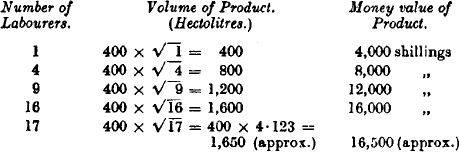
Naturally, one would not expect that this simple relation would, in reality, apply throughout the table. But that it does not lead to absurd results seems to be shown by those parts of the world where good land is still employed in very extensive agriculture, as in newly settled countries. According to a writer in Schmoller’s Jahrbuch (1902), in Santa Fé and Cordoba (in the Argentine), a colonist employing only one labourer was able to plough and sow about one square mile and to harvest about 1,000 decitons of wheat annually. For this case our table would give (400. =) about 570 hectolitres (per square mile) as the total product. But, of course, in this case no small part of the product would be deducted as interest on capital in the form of machinery, transport, buildings, etc.
If we now assume that wages are determined by the imaginary 17th worker’s additional product, which according to what has been said would, under these circumstances, be the minimum, then there would be 500s. per annum per worker, or 8,000s. per sixteen workers; so that the landowner’s remainder would also be 8,000 and the rent 80s. per hectare. This equality between the total shares of the product of the workers and the landowners is no accident, and would be the same with any degree of intensity as soon as the law of returns has the particular form assumed. (See p. 116.)
The following is a simple way (and one often used nowadays) of showing the mutual dependence of rent and wages, and the determination of their relative magnitudes: the successive labourers employed on a given area of land are represented by units of length on the horizontal axis measured from the origin, and on each unit is constructed a rectangle, whose area or height (in units of length) represents the addition to the previous product made by the labourer in question. If the number of labourers is large enough, the upper limit of these rectangles may be replaced without serious error by a continuous curve—the curve of productivity or gross yield. The area under this curve (bounded by the axes and a variable ordinate) represents the whole of the gross product secured as the number of labourers increases. The additional product of the last labourer is represented by the last rectangle to the extreme right, or by its height; and since this additional product determines both the wages of the last labourer and those of all others, the total sum of wages is represented by a rectangle of the same height and with a base consisting of the whole distance from the origin (the total number of labourers). The remainder of the gross yield, or the upper portion of the area under the curve, represents the rent of the whole area cultivated.
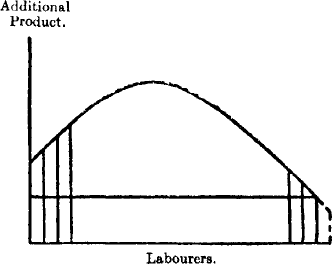
FIG. 8.
If the number of labourers is a, then the gross product P may be represented algebraically as a function, f(a) of the number a. The wages of the last labourer, as of every other labourer, is then represented approximately by the differential coefficient f’(a). We then obtain as an expression for the rent:—
R = f(a) — af’(a)
If, in addition, we were to assume, as in the numerical example above, that this production function was simply a fractional power of the number of labourers, so that P = f(a) = k.aα in which k is a constant and a < 1 then the expression for rent is reduced to
R = P. (1 — α)
that is to say, the index α also expresses the relation in which the gross product is divided between labourers and landowners. If, for example, as we have assumed, a = ½, then both would receive equal shares; if a = ⅔ the labourers would receive two-thirds of the product and the landowners would keep only a third.
The above theory of the relation of wages to the rent of land was developed (so far as its fundamental principle—the determination of wages by the marginal productivity of labour—is concerned) as early as the beginning of the nineteenth century by the German economist and landowner, von Thünen. But even earlier there had been propounded by Anderson (an English contemporary of Adam Smith) and afterwards, quite independently, by Malthus and West, a theory of rent, which was adopted and developed by Ricardo in his Principles, and which is usually associated with his name. All these theories are fundamentally the same. In spite of the remarkable simplicity of von Thünen’s theory, it coincides completely, at least as regards the explanation of the origin of rent in the narrower sense, with Ricardo’s theory. The latter is based, as is well known, on two assumptions: either that agriculture is extended successively to less fertile or less advantageously situated land, so that the owner of the better land retains the difference in productivity in the form of rent; or that the land already under cultivation is more intensively worked by the employment of increased amounts of labour and capital, so that a similar differential rent arises from the diminished return (marginal product) of the labour and capital later employed. In Ricardo, however, capital is taken as representing a certain quantity of labour, directed and maintained by this capital. He makes no mention, at least in this connection, of increase or decrease in the length of the period of production, which, as we shall see later, is of decisive importance in determining the share of capital in the product. We may, therefore, regard this part of his theory as identical with that of von Thünen.
Fundamentally, however, the same applies to the first part of Ricardo’s theory, for whether the additional product of the last worker engaged arises from the cultivation by him of poorer land previously uncultivated, or by more intensive cultivation of land already in use, is a matter of indifference in theory. Which of the two occurs may be regarded in reality as the sole concern of the entrepreneur. If the estate in question, as often happens, includes both good land and inferior land he will in each case select the method which is technically most advantageous; with essentially the same result, namely, that every new labourer engaged, employed in the best possible manner, will produce a smaller addition to the product. Differences of situation with regard to marketing can, as von Thünen clearly shows, always be reduced to differences of costs of transport, that is say, to costs of production, since production must not be regarded as finished until the goods have been brought to the market where they are to be sold.
A Closer Examination of Ricardo’s Theory of Rent
Ricardo assumes for the sake of simplicity that wages, reckoned in products or means of subsistence, are constant; because if they should happen to rise the number of labourers would increase to such an extent that wages would again fall either to the absolute minimum of subsistence or to the standard which the labourers regard as their normal standard. At that wage, the capitalist-farmer—whom, in accordance with English conditions, he assumes not to be identified with the landlord—hires labour as far as his capital permits. On the other hand, the product becomes his property and constitutes, after the deduction of the capital paid out in wages, his (gross) profit. If there is a superfluity of good land, then owing to competition among landowners, there cannot be any considerable rent. But as soon as capital, and consequently also the working population, increases to such an extent that poorer land must be taken into cultivation, rent immediately appears; for this poorer land yields a smaller product to the same capital, and consequently (since wages, reckoned in the product, remain the same) also a smaller profit. But, owing to competition among capitalists, all capital, even that which is employed on the better land, must now be satisfied with this smaller profit, and the remainder will accrue to the owners of the better land.
Simultaneously with the progressive cultivation of poorer land and the consequent rise in the rent of the better land (i.e. of all land under cultivation except the very worst) it will usually be profitable to employ more labour (and capital) on the better land already in cultivation. But since every additional quantity or “dose” (as James Mill called it) of labour and capital yields a smaller and smaller product, and the new capital must thus content itself with a lower rate of interest, interest will fall all round, even on capital previously invested and still employed, and the surplus product which thereby arises will go to landowners as rent.
As will be seen, the rôle of capital, in Ricardo’s opinion, is mainly to advance wages (and to provide the necessary agricultural implements, etc.). But since we have assumed that the labourers are able to maintain themselves during the period of production (and to prepare the necessary implements), it is clear that the theory we have advanced above as regards the landowner’s share in the product is exactly the same as Ricardo’s. How the share of the product which does not pass to the landowner is in fact divided between the labourers and the capitalists is a question with which we shall deal later. On the other hand, Ricardo and the classical economists in general pay no regard at all to the fact that capital in many cases also advances rent. A farmer who breeds cattle for meat, for milk, or for draught, must pay rent for his pasturage for many years before he can employ or advantageously dispose of the animals in question. The same applies to an even greater extent to a person who engages in viniculture or fruit-growing on rented land. It may therefore be said, on the one hand, that Ricardo’s theory of rent is too complex in relation to the single principle which it seeks to explain, and, on the other hand, much too simple when compared with reality. Nevertheless, his theory marked immense progress as compared with the obscure ideas on the subject previously extant—even in Adam Smith.
The objections which were raised against this remarkable theory in various quarters, especially in earlier times, scarcely deserve notice. The best known is the objection of the American economist, Carey, that, historically, cultivation did not proceed from better to poorer land, but, on the contrary, from the poorer to the better, i.e. from higher and therefore more easily cultivated, though less fertile land (as for example a sandy tract) to lower land more difficult to work, but more loamy and therefore more fertile. This may to some extent be true, but it has no bearing on the theory in question; for Ricardo was only concerned with the land which is cultivated or which can be profitably cultivated at a certain stage in the development of cultivation. Technical improvements, discoveries in agricultural chemistry, and so on, may well completely revolutionize an older system of agriculture and cause what was formerly the best land to decline in value, or perhaps even to be abandoned altogether. But the law of rent retains its validity, even although the assumptions under which it operates may have changed. The curve of returns referred to above assumes a new form, but retains its characteristic features.
We need not waste many words, either, on the attempt of the German, Rodbertus, the predecessor of Karl Marx, to replace Ricardo’s theory of rent by a better one. Like Marx later, and partly on the basis of the theory of value he inherited from Smith and Ricardo, Rodbertus assumed that the value of the product was wholly determined by the amount of labour employed in its production. According to this theory, labour “as itself a commodity” only obtains as a reward under free competition “its costs of production”, i.e. the minimum of subsistence for the labourer and his family; the remainder—which Marx calls “unpaid labour “—is taken by the capitalist, With free competition among employers, says Rodbertus, the degree of exploitation will be about the same. In industry proper, however—and this is the essence of Rodbertus’ theory—the capitalist-entrepreneur considers his profit as interest on two amounts of capital: that needed for the maintenance of his labourers, and that needed for the raw materials which he must purchase—the value of which he has advanced for the period of production. But the producer of raw materials (the landowner) has no material expenditure of the latter kind. With an equal amount of “unpaid labour” he therefore obtains a larger amount of interest on his actual capital, since it only consists of the maintenance of his labourers. If, however, he only reckons on that capital the same amount of interest as does the industrial capitalist, there will be a surplus, which he will consider as the rent of his land. The most obvious objection to this theory, which appears at once extremely artificial, is that it implies that interest and rent must always move in the same direction, must rise or fall together—which is contrary to all experience. That this may sometimes appear to be the case is simply due to the fact that, with falling interest, land, other things being equal, is capitalized at a higher value than previously and consequently, with unchanged rent, has a lower yield per cent on its capitalized or selling value; but naturally this is an entirely secondary phenomenon.
In point of fact, Rodbertus’ theory of rent argues in a circle. There is no reason why the “degree of exploitation” in different trades between employers under free competition should be the same, other than the assumption that the value of the product is always proportional to the quantity of labour employed. But this in its turn presupposes precisely this—that the degree of exploitation is the same. In reality, the so-called “degree of exploitation” is very different in different trades, in accordance with the different amounts of capital invested relatively to the number of labourers employed, or (which comes to the same thing, as we shall see) the difference in the average period of the investment of capital. The same applies to the value of the product in relation to the amount of labour employed in its production.
It is evident that the Ricardo-von Thünen theory of rent described above is too abstract for us to be able to expect any direct verification of it by studying the world of reality. In addition to all other simplifying assumptions, the part played by capital in production, and its share in the product, find no place in the theory as presented by von Thünen; and Ricardo’s treatment of the capital aspect is too rudimentary and incomplete. In addition, we must bear in mind that the assumptions of perfect competition and mobility and divisibility of the factors of production only very imperfectly correspond to reality. In small-scale agriculture, for example, the “last” worker employed is, frequently enough, the only one—for the simple reason that the area of land is so small that it does not permit the employment of more than one labourer in addition to the owner, and sometimes not even one. On the other hand, of course, we must not forget the heterogeneity of human labour and the possibility of some substitution of the labour of women and children for that of men.
Nevertheless, experience seems to show that the range of applicability of von Thünen’s law of wages is considerable, even in industries other than agriculture. Nothing is more common than for employers to reply to an increase of wages forced upon them by a labour organization by sooner or later dismissing some of their labourers, because it is no longer profitable for them to carry on at full strength. If the labourers do not support their unemployed comrades at the union’s expense—as is common, in such cases, among English trade unions, though it is possible only up to a certain point—then their competition must undoubtedly force wages down again to the previous level—i.e. to equality with the marginal productivity of labour as it is when all labourers are employed.
Further, as far as this “law of wages” is operative, the growth of population will obviously exercise a most damaging influence on the position of labour and of the propertyless classes as a whole. Particularly will this be the case under the existing system of private ownership of land. The consequence of an increase in the number of labourers is not only that the new labourers will find it more difficult to earn a livelihood than the old ones, but also that there will be a lowering of wages all round owing to their mutual competition; so that the landowners’ share of the product will be correspondingly greater. It may be thought that experience often runs counter to this view: wages sometimes remain unchanged, or even rise, despite a considerable increase in population. But the real cause here is that the conditions of production have been materially changed, in consequence of technical or scientific progress, and not least under the influence of capital accumulation, which we have not yet considered. Similarly, entirely new sources of supply may have been discovered. If, under such circumstances, population remained unchanged, the marginal productivity of labour, and consequently wages, would normally rise very considerably. If population increases, however, both will sink to their original level. In other words, technical progress, so far as the labourers are concerned, only protects them against the absolute fall in wages which would otherwise be inevitable, whilst at the same time in increasing, frequently to a high degree, the surplus accruing to the landlord.
The principle on which the whole theory of rent is based—the decline in the average yield of labour when the number of labourers is increased (the so–called law of diminishing returns)—has, at all times and not least in our day, been vigorously disputed. From the point of view of pure theory this is a matter of indifference; for those who deny the existence of the law must, if they are consistent, deny the existence of rent, which they often do when they assert that the landowners’ share of the product is only a compensation for the labour and capital invested in the land by them or their forefathers and is therefore interest on capital—possibly in part a repayment of that capital—and not rent of land. The existence of rent would still remain, even on this view, a proof of the applicability of the law. Owing to the extreme practical importance of the question, however, we will proceed to examine it in greater detail.
It may be thought that nothing could be easier, once attention has been drawn to it, than to verify such a simple rule as the relatively diminishing return of land under more intensive cultivation—if in fact it is valid. It must, indeed, be quite easy to prove it by direct experiment, and in so far as such experiments have been made—unfortunately all too few and on too small a scale—the results undoubtedly tend to confirm the law. On the other hand, it is very difficult, if not quite impossible, to confirm the law by observing the actual yield of agriculture on different estates. If one estate is as fertile and as rationally cultivated as another, then the intensity of cultivation in both will be carried to the same point, and both will naturally yield the same return. On the other hand, every difference in the fertility of the two estates under rational cultivation must give rise to a difference in intensity of cultivation; but the result of this differentiation will be in apparent contradiction to the law of diminishing returns. Thus if, in equilibrium, the last dose of labour and capital on the better land yields about the same return as perhaps the first and only dose on the poorer land (and previous doses on the better land therefore yield a higher return), then on the average the more intensive cultivation will yield a higher return for each unit of labour (“labour and capital”) than the more extensive. It may consequently appear as if the law of diminishing returns had ceased to operate and had been reversed, although this result is really a consequence of the law. The same applies to a comparison of the yield of an estate at different points of time if, in the interval, more intensive cultivation has been introduced, in consequence of technical progress in agriculture, or of a rise in the price of the product.5
It is very common, even among professional economists, to confuse the relative yield of agriculture with its profitability. They are, however, two entirely different things. The former is the ratio between the gross yield and the amount of labour (or labour and capital) employed; the latter is the difference between that yield and the amount of wages paid (or of wages and interest). They may therefore vary in quite different ways, and even in opposite directions. For example, with the law of productivity which we took as an example, according to which the gross product increases as the square root of the number of labourers, or P = k.  , the relative yield would be P:a = k: , and would thus continuously decline as the intensity of cultivation increases, while the rent, as we have seen, would be equal to ½P = ½k., so that the profitability to the landowner would continuously increase with increasing intensity.
As regards the point at which the law of diminishing returns begins to operate, we must distinguish between the individual and the collective, or social, points of view. From the individual point of view, the law presumably operates from the beginning, or at any rate from the time when the spontaneous products of nature, such as meadows, trees, etc., obtain an exchange value. For these products, which are obtained without labour, represent in proportion to the labour employed an infinitely great value, and in comparison with them every product obtained by labour will represent a diminishing return. In other words, for the person who has at his disposal a certain area of land, it must always be possible by the employment of a small quantity of labour to obtain a relatively greater return than by the employment of a larger quantity of labour.
From the collective point of view, on the other hand, the services which pioneers in newly settled countries can render each other by co-operation in defence against wild animals or Hostile tribes, by the building of roads, and by the establishment of schools, and the advantages to be derived from combination and division of labour must, with an increasing population, outweigh the inconvenience of a smaller average allocation of land to each individual. The point at which the two opposing influences are balanced, and consequently the optimum density of population, can of course only be determined in each particular case after consideration of the total resources of the country.
B. The Labourer (or a third party) as Entrepreneur. The Profits of the Entrepreneur.
We might equally well have begun by regarding the labourers themselves as entrepreneurs. The circumstance which in reality prevents them from assuming this function, namely, their lack of capital, would, on our assumption, be absent, since we suppose every labourer to be provided with the means of maintaining himself during the current period of production, and nothing more is required. They are therefore free to enter, either singly or in combination, into agriculture or any other productive enterprise by hiring the necessary land from the landowners against payment in kind at the end of the period of production. The process by which equilibrium would finally be reached in this case is fully analogous to the process described above; or rather it is its exact counterpart. The more land the labourers procure, the greater will be the product; though it will not increase proportionally to the land taken into cultivation, but more slowly, so that each newly-acquired acre will yield, with an unchanged supply of labour, a smaller and smaller return. In other words, the law of diminishing returns applies to a one-sided increase in the amount of land. The labourers must, therefore, if they act economically, extend their demand for land to the point at which the additional return of the last acre exactly corresponds to the rent demanded for it. We must, however, assume here—as we did in the case of labour—that all land capable of employment is of equally good quality. This assumption would not, indeed, be of much importance if we could assume that the different kinds of land could be regarded as of the same quality, whatever is the degree of intensity of labour, so that better land could always be represented by a particular multiple of the poorer land. As, however, this is not the case, the various kinds of land must be treated in the same way as the various qualities of labour, i.e. as so many different kinds of means of production. “Land” and “labour” are only to be taken as types of two independent factors of production. This method is valid, at least, for any given moment; the possibility of converting one kind of land into another is a question that must be kept separate: in the same way as we keep separate the conversion of one kind of labour into another, by training and education.
If all the land is not at once taken into cultivation, or if, conversely, the demand of all the groups of labour for land is not satisfied, then it is clear that competition, in the former case between landowners and in the latter between labourers, would cause a fall, or a rise, in rent until complete equilibrium was restored. In a word, rent is here determined by the marginal productivity of land, and conversely wages are determined by the surplus product divided among all the labourers in the group—the labourer becoming the residual claimant.
For the analysis of this problem, it is possible to employ exactly the same diagram as in Fig. 8 with the difference that the units on the horizontal axis (abscissae) now represent the number of acres of land successively taken into cultivation by a constant number of labourers, and the corresponding ordinates (or rectangles) the marginal products obtained. The ordinate to the extreme right thus represents the return of the last acre (the marginal productivity of the land) or, what comes to the same thing, the rent of land per acre. The large rectangle represents the total rent and the upper part of the area under the curve the total wages; just the reverse of the previous case.
If the number of acres is b, the total gross product P = ϕ(b),the rent per acre is ϕ’(b); then the total share of labour in the product will be
L = ϕ(b) - bϕ’(b).
If, for example, the function P = ϕ=k ,in which k is a constant, then L=½k=½P,or the same result as we obtained on the assumption that the gross yield varies as the square root of the number of labourers. The reasons for this agreement will soon be made clear.
An interesting question now arises, to which we may turn our attention: will the distribution of the product between landowners and labourers be the same on each of our assumptions? Or, putting the same question in another way, if the entrepreneurs are a third category of persons who hire labourers and land, and pay both in accordance with the law of marginal productivity, will the total of rent and wages swallow up the whole of the product, so that nothing is left over for the entrepreneur as such?
This may seem evident, at least in abstract theory; and most economists who have employed marginal productivity as the foundation of their theory of distribution have thought so. On our assumptions, both labourers and landowners are free, as they prefer, to employ their labour or land on their own account or to hire it out to others. If the share of labour in the product is different in the two cases, the difference, it may be thought, will soon be cancelled out by competition, and similarly for the share of land. At the same time, it will be obvious that the profits of entrepreneurs as such must always tend towards zero. For the work and thought which the entrepreneur devotes to the management of production he must, of course, receive his wages like any other mental worker. If, in addition, he also employs property in the service of production (property which may be land or capital, though we are not yet concerned with the latter), then he will of course, for that reason, obtain his share of the product (rent or interest) like any other landowner (or capitalist). If, on the other hand, he could obtain a share of the product merely in his capacity of entrepreneur (a share not based on either labour or land) then it might be thought that everybody would rush to obtain such an easily earned income.
But on the other hand, as has been sufficiently demonstrated, the marginal productivities of labour and land do not stand in any definite relation to the total product or to each other. If, nevertheless, they possess this peculiar property that the wages and rent thus determined together add up to the whole product, then clearly some other condition must be satisfied. Such a condition exists, and is of the utmost importance, although it has been somewhat neglected by economists. This condition may be either that large-scale and small-scale operations are equally productive, so that, when all the factors of production are increased in the same proportion, the total product also increases exactly proportionately; or at least that all productive enterprises have already reached the limit beyond which a further increase in the scale of production will no longer yield any advantage. Were it otherwise, we could no longer invoke, as we have done, the levelling influence of competition; for under such conditions, as we shall soon see, free competition cannot exist.
That the first condition is sufficient (though not necessary) for the operation of the law we will first show by means of an example. Imagine a firm, say an agricultural enterprise, in which 100 labourers are engaged on an area of land which we will imagine to be divided into 100 units—no matter of what size. We represent the annual product by P and proceed to examine what addition to this product will occur if we successively increase the volume of production by adding first one more labourer and then one more unit of land. The first additional product is the marginal productivity of labour, in so far as we may regard the additional product created by the 101st labourer on the given area of land as roughly the same as that created by the 100th labourer—a product which would be lost if one of the 100 labourers were dismissed or gave up working. We represent this quantity by l since, on our assumption, it would determine the amount of wages paid. If the land under cultivation is now increased by one unit of equally good land, so that the 101 workers may be spread over 101 units of land, then evidently the product will be increased, and this increase is just what we have called the marginal productivity of land; for just as with labour, we can see that the increased return which arises when the area of land worked by 101 labourers is increased from 100 to 101 units does not materially differ from the increase which would have taken place if the area of land worked by 100 labourers had been increased from 99 to 100 units. But since the yield of the last unit would, on our assumption, determine the rent of the land, i.e. constitute the rent of one unit of land, we will represent it by r and then l + r will represent the sum of the additional product. On the other hand, the total production has been uniformly expanded both as to the area of land and the number of workers, and on the above assumption the product should consequently have been finally increased by exactly l/100th, so that we obtain:—

In other words, the wages of 100 workers and the rent of 100 units of land together exactly correspond to the original total product.
A more general proof is the following. If we regard the product P as a function of the number of labourers, a, and of the number of units of land, b, both a and b being regarded as continuous, then the marginal productivities may be expressed by the partial derivatives of P with respect to a and b; therefore, if the condition is to be satisfied, we must have
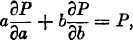
a partial differential equation, the general integral of which is known to be:—
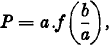
in which f( ) is an arbitrary function, i.e. P must be an homogenous and linear function of a and b. Among the infinite number of functions which satisfy this condition, we may give as an example P = aα.bβ, in which the indices α and β are two constant fractions whose sum = 1. If we substitute ma for a and mb for b, then P becomes mP, i.e. large-scale and small–scale production are equally productive.
If, on the other hand, P retained the same form, but α + β >1, so that P was a homogenous function of a and b but of a higher degree than the first, we should obtain
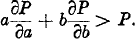
In other words, if, in an enterprise which becomes more productive the larger the scale of operations, the labour and land employed were both paid in accordance with the law of marginal productivity, then the sum of their shares would exceed the whole product, so that the entrepreneur would suffer a loss.
This result is connected with the circumstance that under such conditions equilibrium is impossible. Large scale operations, being more profitable than small scale, can here offer better terms to landowners and labourers (or cheaper goods to the consumer); and if the smaller entrepreneur seeks to compete, his profits will in fact be negative; that is, competition will drive him out. But the same will also happen in the case of the large-scale enterprise as soon as another on a still larger scale is established.
The converse will be the case if α + β <1, in other words, if an enterprise is more profitable the smaller the scale of its operations. We shall then obtain
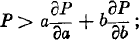
that is, the entrepreneur as such will necessarily obtain a profit, but for that very reason everybody will want to be an entrepreneur, with the result that all enterprises will ultimately be split up into small individual units.
The first assumption, that the relative yield of production is independent of the scale of operations, is, of course, very seldom realized as a general principle in a given branch of production; the scale on which an enterprise operates nearly always has some influence on its average product. This is not to say, however, that its influence always works in the same direction. On the contrary, as a rule the best returns are obtained at some particular scale of operations for the firm in question; if this is exceeded, the advantages of centralization are outweighed by the increased costs which are encountered when larger areas must be exploited for the provision of raw or auxiliary materials, or else for the marketing of the product. This scale of operations is, under the given circumstances, the “optimum” towards which the firm must always, economically speaking, gravitate; and as it lies at the point of transition from “increasing” to “diminishing returns” (relatively to the scale of production) the firm will here conform to the law of constant returns.6 Wages and rent will continue to be determined by the law of marginal productivity and the profits of the entrepreneur must tend towards zero—all on the assumption that the enterprises in question, in one and the same branch of production, are sufficiently numerous to compete with each other effectively.
Let a and b represent respectively the number of units or labour and land employed in the enterprise in question, and l and r the wages and rent actually paid, expressed either in money or product; and let P represent the annual product expressed in the same unit of value. Then, the ratio, k, between returns and costs of production in this enterprise will be:—
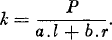
If an additional labourer is employed, this equation will be changed to:—
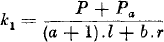
where Pa is the marginal productivity of labour in a firm of this particular size. If the supply of land is now increased in its turn by one unit, we obtain:—
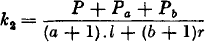
where Pb is the marginal productivity of land. So long as this fraction can be continually increased by the introduction of one more labourer or one more unit of land (so that k <k1< k2, etc.), the enterprise has evidently not yet attained its optimum size. The latter is first reached when k can no longer be increased—which clearly occurs only when the numerator and the denominator of the fraction are increased in the same proportion, i.e. when:—

where Pa and Pb represent the additions to the product P which arise from the employment of one more labourer, or one more unit of land—in other words, the (variable) marginal productivities of labour and land. Even if there is a profit for the entrepreneur (k > 1) wages and rent must be proportional to the marginal products; as is evident, since labour and land are assumed to be substitutable at the margin.
If, even when the firms have reached the optimum scale, they are still numerous enough for perfect competition to be maintained, then wages and rent must be forced up to the point where the entrepreneur’s profit becomes zero, either because new entrepreneurs enter the industry, or because those already engaged in it will establish more than one concern each. Indeed, strictly speaking, this must take place whenever there appears the smallest possibility of a profit. (This change will not affect the most profitable size of the firm, for since P, Pa and Pb are functions of a and b only, the same values a and b will satisfy the equations (1) even if l and r are increased or diminished in the same proportion. Full equilibrium is thus only reached when k = 1 and when, consequently, l = Pa and r = Pb; when further
P = a.l + b.r.
This is the result previously obtained on the assumption that the average product was entirely independent of the scale of production. With the firm at its optimum size, the entrepreneur no longer receives a profit; but he is secured against the loss in which he would be involved if he were to expand beyond that size, or not to expand up to it.7
If, on the other hand, the law of increasing returns applies without qualification—or, what amounts to the same thing in practice, if the optimum scale of the enterprise is so high, and the number of such enterprises consequently so small, that the owners can easily combine in a ring, trust, or cartel; then there no longer exists any equilibrium of the kind we are here considering. The whole industry will be dominated by a more or less completely monopolistic association and all smaller concerns will disappear.
In reality this is not exactly what happens, but for several reasons, and especially because of the local character of the firm and its market, a small firm situated, it may be, in some geographically remote place, may sometimes exist alongside much larger firms in other places. This, however, will not prevent the larger firm from enjoying advantages due to its better organization and division of labour, which the smaller firm lacks, and from yielding on that account, in addition to wages and rent (as well as interest) a true profit, or perhaps more correctly, a monopoly profit. The large firm cannot be deprived of this profit, because any attempt on the part of the smaller enterprise at effective competition outside its own local area would be fruitless. If, on the other hand, the smaller enterprise, by a great economic effort, were to establish itself on the same, footing as the large enterprise, this would only lead to the ruin of both, since there would be no room in the market for two such large concerns in the same industry. Thus the large enterprise has an actual monopoly simply because it came first on the scene, and this monopoly may be as good as a monopoly which is legally established.
We must not forget that the modern development of communications necessarily increases the advantages of large-scale operations and tends to hasten their ascendency. Agriculture is the industry which, both in the past and in the present, has offered most resistance to this tendency, though there are some indications that future developments in this industry may also be in the direction of large-scale operation.
The objection which has been raised to the effect that small farming on co-operative lines—by the establishment of buying and selling associations, co-operative dairies, the use in rotation of expensive machinery hired or purchased by the association—is a means of overcoming these difficulties is rather an argument in favour of the above assumption; for these associations in fact bring about a kind of large-scale operation, and this first step towards association, once taken, will, in all probability, soon be followed by others.
But, although more or less monopolistic enterprises constantly gain ground, there still remain fields of activity in which free competition prevails—either where large and small-scale operations are approximately equally profitable or where the most profitable scale of production is, on the whole, fairly small. In such fields our theory applies fully; there is normally no entrepreneur’s profit in the narrow sense. In production without capital, wages and rent would alone share the product and their respective shares would be determined by the marginal productivity of labour and land—whether labourers, landowners, or anyone else, act as entrepreneurs. And, so long as such a field of activity of any considerable dimensions exists, it will set the standard of wages and rents in the whole field of production, since the entrepreneurs who enjoy monopolistic advantages will not give to labourers or landowners more than they would be forced to give under competition. In the latter concerns, moreover, the law of marginal productivity still applies, in the sense that the shares of labour and land remain proportional to their marginal productivity (cf. the paragraph in small print on p. 129).
Between rent and wages there is thus, in every case, a practically complete parallelism. No special theory of rent is necessary, but every acre of land may be treated in just the same way as a labourer; the owner of land under a system of private ownership of land must be rewarded for its contribution to production just as the owner of slave labour would be paid if slave labour were hired in the market. Almost all production is the result of land and labour combined; neither, at any rate not land, can wholly be dispensed with in production, but either can, at the margin of production, replace the other; and it is true of both that a one-sided increase of one, with an unchanged quantity of the other, will lead to an ever smaller and smaller increase in the product.
With these reservations and limitations, this additional product will determine the magnitude of both wages and rent. The total contribution of labour or of land to the product cannot be ascertained. But this total contribution has no real importance, since, as has been said, neither of them, and certainly not labour, can be productive alone. Only at the margin of production, that is to say, at the point where equilibrium is reached, does the contribution of either assume an independent character, and it then determines not only the reward of those factors which begin to participate in production at that point, but also, owing to the law of indifference or competition, wages (and rent) as a whole.
It need only be said that the above applies, as will easily be seen, both individually and generally—according as we consider the additional product created by an individual productive enterprise when it employs one more worker or one more acre of land, or as we consider the addition to the whole social product when the total amount of labour-or of cultivable land is increased by a small amount. Yet we must not forget that the law of “increasing returns” also applies to some extent to society as a whole. If a uniform increase both of the land and population of a country were to occur, say by a political union of two countries of much the same natural conditions, or simply by the removal of a tariff wall between them, then it is certainly not impossible, but even very probable, that the increased social division of labour would enlarge the combined product more than proportionately to the growth in the size of the society. Still more would this be the case, of course, if conditions had been different in the two areas; but that is, in part, a different question. With this last reservation, however, the diagrams and formulae which we have used above apply, if the quantities taken represent the whole of the labour and land existing in the society. The importance of this observation will become clear in what follows.
C. The Influence of Technical Inventions on Rent and Wages.
We are now in a position to make a theoretical examination of a subject of the greatest practical importance—the influence of technical and mechanical inventions on the distributive shares of the factors—especially wages. Naturally, we cannot give a complete answer to this question until we have discussed the rôle of capital in production. Machinery, however, in addition to having the quality of being, or representing, capital (which we shall define in greater detail later), also possesses the quality of modifying the conditions under which labour and land replace each other at the margin of production. In other words, it may alter their relative marginal productivities and thereby, according to our theory, their shares in the product. It is with this characteristic of machinery that we shall now concern ourselves. For the time being, we shall not permit this complex problem to be further complicated by allowing the third factor of production, capital proper, to enter. In other words, we shall regard machinery as indirectly employed (not as saved or “stored up”) labour and land.
The most striking feature of machinery is that it replaces human labour, i.e. allows us to produce the same quantity of goods as before with less labour; and consequently, as a rule, more goods with the same labour. On the one hand, it may be thought that the greater productivity of labour ought to bring about, or at least render possible, the payment of higher wages; on the other hand, it is commonly supposed to render a number of labourers superfluous, so that competition among the unemployed would depress wages. It would seem, therefore, that two opposing tendencies come into operation simultaneously, and that, according as one or the other predominates, the introduction of machinery will benefit labour or injure it. Opinions on this point have varied in the course of time. Formerly, under the influence of the mercantilist theory, no doubt at all was felt that labour-saving machinery took the bread from the mouths of the workers, and not only they, but also the authorities, stubbornly resisted the introduction of machinery in one or other branch of manufacture. The victory of the physiocratic school produced a sudden change, for according to its theory, especially as formulated by J. B. Say, goods must always ultimately exchange against, and therefore constitute a demand for, other goods; an increased productivity of labour should of itself lead to an increased demand for goods hitherto not consumed, or consumed only on a small scale, and therefore for labour to produce them. Hence, machinery would, at most, cause temporary unemployment and inconvenience to certain groups or labourers. In the long run it would be beneficial, would lead to increased opportunities for labour, and would raise and not lower wages. However, this optimistic view received a set-back when Ricardo, in a special chapter on “machinery”, in the third edition of his Principle, proved irrefutably, as it was thought, that the introduction of machinery and other labour-saving methods may be economically advantageous to employers even when it does not involve an increase, but on the contrary involves a decrease, in the size of the product; provided that the net profit of the entrepreneur simultaneously becomes greater. In such a case the labourers could not be compensated by an increased demand for other commodities.
The question has remained in this somewhat unsatisfactory position until the present time. The theory of marginal productivity will enable us, I believe, to put it on a firmer foundation, and to substitute something better for this vague, and even in parts erroneous, analysis. Indeed, the expression “productivity of labour” has no comprehensible meaning when it is applied to production as a whole, for this is, as we have seen, always the combined result of labour and land. It is, therefore, the common productivity of labour and land which is increased by machinery. How much of the increase is to be ascribed to the action of one or the other factor cannot be ascertained, and is further of no importance in regard to their respective shares of the product. In this connection, marginal productivity alone is the determining factor. But an increase in the total product as a result of technical changes in the processes of production need not by any means lead to an increase—and certainly not to a uniform increase—in the marginal productivity of both factors of production. It may be that the marginal product of one of the factors decreases whilst the marginal product of the other increases all the more; either the marginal productivity of labour may increase at the expense of land, and consequently wages at the expense of rent, or conversely rent may increase at the expense of wages. Examples of the former kind are perhaps to be expected where, owing to some invention, the existing supply of natural energy is, as it were, increased; certain hitherto neglected sources of energy, such as coal or water-power, find new uses; formerly useless land is rendered fertile, with or without preliminary treatment; forestry is replaced by market gardening, and so on. In such cases it is possible, or at any rate conceivable, that rents will fall both absolutely and relatively, so that the whole profit from increased production, and even more, will accrue to labour. It may, perhaps, be objected that the introduction of such changes, being contrary to the interests of the landowners, would never be allowed to take place; but this objection, as we shall soon see, cannot be maintained. The contrary result might be feared where an invention prima facie renders labour superfluous without calling into existence any new natural forces—as, for example, in the case of certain agricultural machinery for sowing, harvesting and threshing, etc., which replace human labour on a large scale by draught animals, or other non-human forces, without changing the actual method of tilling. Here, too, an increase in the total product is not excluded—we shall see later that in theory it must always occur. If, for example, the same product is obtained with a smaller number of labourers, then the displaced labourers must, nevertheless, always be able to produce something, so that the final result is an addition to production. But this result may none the less co-exist with a decrease, and even a considerable decrease, in the marginal productivity of labour, and consequently in wages.
The objection has been made, it is true, that under such circumstances the landowners neither would, nor could, consume their increased rents directly, in kind. They would therefore direct their consumption towards luxury articles and thereby increase their demand for human labour, so that wages would again rise. But this circumstance is, as will easily be seen, only of secondary importance. It may more or less modify the first probable result but can scarcely reverse it. And the objection clearly has no force if we maintain the assumption made above, of an economic society which, from its natural circumstances, only produces one or a few staple articles—and which must consequently procure all other commodities from other places or countries at exchange values which are determined in the world market, independently of anything they may do. If, for example, the landowners obtain, in exchange for their increased rent in corn, the most elaborate manufactures from other places or countries, this will benefit their own labourers, more or less bound to the soil, just as little as if they had consumed it in kind—as fodder for racehorses, hounds, and so on. In neither case can there be any question of compensation to the workers in the form of another demand for labour.
On the other hand, it appears on closer examination—and the fact seems to me of great interest—that the objection raised by Ricardo is theoretically untenable. A diminution in the gross product, or in its value (assuming, as before, that prices of commodities are given and constant), is scarcely conceivable as a result of technical improvements—under free competition. This appears to be self-evident; for in that case anybody would be able, with the given means of production, to bring about at some point an increase of the product and thereby reap a profit as entrepreneur. Ricardo has here failed to draw the final conclusions from his own assumptions. It is true that in the passage referred to his starting-point is capital—which he divides into circulating capital (or wages-fund) and fixed capital. But his reasoning is, as he himself says, equally applicable under our simplifying assumption of production without capital, and in both cases it is open to the same objections.
Let us assume that the introduction of labour-saving agricultural machinery (haymaking machines, horse-harrows, etc.) has made a predominantly pastoral agriculture more profitable, other things being equal, than arable farming; so that the value of the product, though certainly less, produces a larger net yield, owing to the saving of labour. The direct consequence must then be that one or more farmers will go over to the more profitable form of production. If all were to follow their example, there would certainly be a more or less considerable diminution of the total product (or of its exchange value), but this does not happen. For as soon as a number of labourers have been made superfluous by these changes, and wages have accordingly fallen, then, as Ricardo failed to see, the old methods of production—in this case the old arable farming—will become more profitable; they will develop, using labour more intensively and absorb the surplus of idle labourers. It can be rigorously proved that equilibrium in this case necessarily presupposes a division of production between the old and the new methods so that the net profits of the entrepreneur will be equally great in both branches of production and the total product, or its exchange value, will reach the maximum physically possible, and will thus finally increase, and not decrease.
We shall first show this by means of an example. Assume ten large estates, all of the same size and with the same natural advantages and each employing by the old methods 100 labourers. Wages are, say, 500 shillings, the gross product of each estate 100,000 shillings, and the net profit of each owner consequently 50,000 shillings.
Let us now assume that one of the landowners adopts the new method. He-dismisses 50 labourers, but with the help of the remaining 50 he obtains a gross yield worth 77,500 shillings, so that his net profit is 77,500—(50 X 500) = 52,500 shillings.
Of the 50 unemployed labourers, let us assume that 45 are absorbed into the nine other estates, or five in each, and that of these additional five workers:—
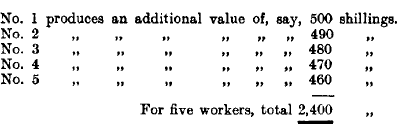
At the same time, the consequence must be that wages will fall all round, let us say to 450 shillings, in which case the owner of the first estate may find it advantageous to re-employ, say, five of his previous employees. We will assume, for the sake of simplicity, that their additional product will be equal to the above, or 2,400 shillings. The final result will be:—
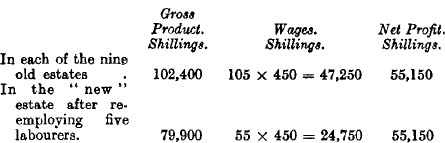
The total gross product, which was formerly exactly 1,000,000 shillings, will now be:—
(9 x 102,400) + 79,900 = 1,001,500 shillings.
Thus the result is that the total gross output has been increased and not diminished, and since the old estates, which employ more labourers, are more favoured by the fall in wages, they will finally have the same profit as the “new” estate, so that there no longer remains any inducement to go over to the new methods.
In a more general form the proof is as follows: Let Fig. 9 represent the old method of cultivation and the Fig. 10 the new, in which a smaller number of labourers are employed on an equal area of land, and in which the gross product is also smaller; the net profit, however (the upper part of the area under the curve), is greater. Let us suppose that one or more landowners go over to the new method of cultivation. A number of the dismissed labourers will then seek employment in the estates working on the old methods. As they are so few, they will produce on each of these estates an additional product almost equally as great as that of the last of the labourers previously employed, and since the net product of the estates adopting the new method is greater than previously, the total gross product must consequently have increased. At the same time, marginal productivity and wages have fallen somewhat, so that the landowners’ share, even in the old estates, becomes somewhat greater than before. The same process will repeat itself each time an estate goes over to the new method of cultivation, and since falling wages in themselves bring a larger profit to the owners of the old estates, as the number of labourers is greater in them than in the new, then sooner or later a point will be reached at which the net profit will be exactly the same in both, and every inducement to a further transition from the old to the new will therefore disappear. At this point, too, the total gross product will have reached the maximum.
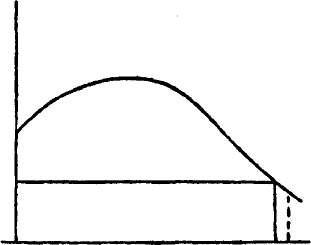
FIG. 9.
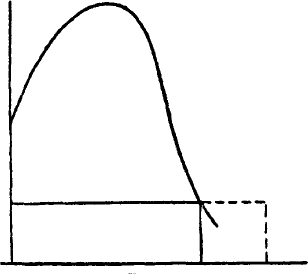
FIG. 10.
This really follows directly from what has been said, but it can also be directly proved in algebraic form. If x and y are the number of labourers per acre on the first and second methods of cultivation respectively, and the productivity function in the one case is f(x) and in the other ϕ(y); and if we assume that m acres are cultivated on the first method and n acres on the second, then we must look for the conditions under which the expression
mf(x) + nϕ(y)
reaches its maximum value if, at the same time,
m + n = B
and
mx + ny = A
where B is the number of acres and A the number of labourers available for the industry in question (here agriculture) as a whole. By differentiation and elimination (the partial derivatives of the first expression being put = 0) we can easily obtain the two equations
f’(x) = ϕ’(y)
and
f(x) - xf’(x) = ϕ(y) - yϕ’(y),
of which the former indicates that when the gross product is a maximum the marginal productivity of labour, and therefore wages, will be the same in both types of production, The second equation gives the same condition for rent per acre.
Thus, although at first sight the going-over of some firms to the new method of cultivation seems to diminish the total product, actually the total product is maximized; but at the same time wages necessarily fall, so long as we assume that the gross product is less in the estates cultivated by the new method than in those cultivated by the old.
Nor is the result any different if we assume that wages are already at the subsistence level (and cannot, according to the usual view, fall lower). In reality, wages can not only be forced below it for a little, but can remain below it indefinitely, if the labourers and their families can make up the difference by poor relief, as happened in England to a great extent at the end of the eighteenth and the beginning of the nineteenth centuries. If we assume that the available supply of labour must, under any circumstances, be somehow supported by the landowners, it would in fact be more advantageous for them to reduce wages to the point to which they would tend to fall as a result of free competition, and to add, by charity, enough to bring up their incomes to the necessary minimum; it would be better to do this than to insist that every labourer employed should earn the subsistence wage. Especially after the discovery of a technical improvement of the kind in question, such minimum wage regulation might have the result that many labourers would be unemployed and, with their families, would become entirely dependent on poor relief.
Although we have so far only concerned ourselves with some of the forces at work, we may nevertheless proceed on the provisional conclusion that free competition is normally a sufficient condition to ensure maximization of production. But this maximization may very well be associated with, and even be conditional upon, a reduction in the distributive share of one of the factors of production—in this case, labour. This shows the serious error of those who see in free competition a sufficient means for the maximum satisfaction of the needs or desires of all members of society.
It might further be supposed that a result which led to a reduction in wages could not at any rate arise with the labourers as entrepreneurs; and, on the other hand, a change in production that led to a reduction in rents would never be acceptable to landowners as entrepreneurs; both of these results are, however, quite possible under free competition. To the individual entrepreneur who encounters a certain market rate of rent or wages, a technical improvement which increases his net return is in itself always economically advantageous. That it should have the contrary effect when all entrepreneurs follow suit does not, in general, affect the manner of procedure of the individual, unless agreements, cartels, etc., take the place of free competition. In any case it is to be noticed that production (so far as our assumptions hold) reaches its maximum, from a technical point of view, with universal free competition. Co-operation between workers to raise wages and between employers and landowners to lower wages (in the course of which some land must remain uncultivated) would both lead to a diminution of product, and only if co-operation results in social collectivism could the maximum product, physically and technically possible, again be reached.
An interesting example of this is afforded, if I am not mistaken, by conditions in Swedish forest districts, for example, Norrland or Smalônd. If forest products rise in value, it may very well be that farming, which had previously been possible in such areas on occasion, will no longer be profitable, and from the point of view of the landowner it will be better to abandon farming and to plant trees on his fields. And this despite the fact that forestry obviously cannot support nearly so many men on a given area as even the poorest farming. That the owners of the land may acquire great and unearned wealth in this way, whilst wages are at the same time forced down by the superfluity of labour is a grievous wrong which should certainly be righted. But the supposed conflict between a private and public economic interest, which some people have found in these circumstances and which they have even sought to remedy by legislation, does not, if our observations are correct, exist. Indeed, the total national product will probably be greater if forestry is everywhere free to expand wherever—from the point of view of private economic interests—it is most profitable; and the superfluous labour (in so far as it cannot be absorbed into the industries based on forestry) seeks employment in those districts which continue, by reason of their natural advantages, to practise farming.
In other words, the evils here requiring a remedy relate exclusively to the problem of the social distribution of income, and not to that of the economically most advantageous method of production.
Exactly the same is true of the “parasitic” occupations much discussed in recent years, those in which the labourers, usually women and children, do not receive a living wage, but are partially supported by others (parents, relations, etc.). It is said that, in the interests of society, such occupations should be forbidden where the employers will not, or cannot, offer full wages. Yet the only result of doing so would probably be that those now employed in them, far from having their position improved, would have to rely entirely on the support of others.
On the whole, it is a mistake to regard as obvious—as is so often done—that all healthy persons capable of work must be able to live by their labour alone, unless the country is (in the vulgar sense) overpopulated. On the contrary, it is quite conceivable that the total output of a society may be large enough for all, but that the marginal productivity of labour is none the less so small that labour has only a slight economic value. Even in a socialist state, under such conditions, the wages paid would only correspond to a part of necessary expenditure, whilst the rest would have to be found from the rent and interest of the society.
This, of course, does not exclude the possibility that the great majority of inventions and technical improvements may be beneficial in both directions; i.e. may in themselves tend to increase the marginal productivity of both labour and land, together with their share in the product. According to the ordinary rules of probability there is, indeed, an overwhelming probability that they will do so, as soon as the increase in total productivity becomes sufficiently general. If the colossal advance in all fields of production during, let us say, the last two centuries, has nevertheless brought only a relatively slight, and in many cases very doubtful, improvement in the conditions of labour, whilst rent has successively doubled and redoubled, the primary cause, as we have said, is to be found in the one-sided increase in one factor of production, namely labour, owing to the great increase in population during that period. Such an increase must, other things being equal, continually reduce the marginal productivity of labour and force down wages; or—what comes to the same thing, though the connection is easily overlooked on a superficial view—prevent the otherwise inevitable rise in wages due to technical progress. Unfortunately, collectivism cannot provide a remedy for this evil created by the labourers themselves—at any rate not in the long run.
It is scarcely possible to discover a simple and intelligible criterion which will indicate whether a change in the technique of production is in itself likely to raise or to lower wages. But in accordance with what we have said in our criticism of Ricardo’s theory, it may be asserted that, whenever the primary effect of a change in production is to cause employers to reduce the number of their employees without their having been compelled to do so by a rise in wages, it is a sign that the marginal productivity of labour has fallen and a larger or smaller ultimate reduction in wages will probably ensue. On the other hand, a technical improvement which favours labour must reveal itself from the beginning in an increased demand for labour and higher wages in much the same way as if, in the example on p. 137, technical improvements had tended to make arable farming more profitable than pastoral, instead of vice versa. But what we have said here applies mainly to wages and rent, in relation to each other. The appearance of capital in the field of production introduces, as we shall see below, certain modifications in our conclusions, without, however, rendering them invalid as a whole.
2. Capitalistic Production
A. The Concept of Capital.
We now come to the third group of factors of production—those which are commonly included in the term “capital”. To give an account of the real nature of capital, its rôle in production and the grounds upon which its owners, like the owners of land and labour, claim a share in the product, is considerably more difficult than with the other two factors and has led to innumerable controversies among economists. One of the chief difficulties has been the varied and changing forms which productive capital assumes in reality. In the ordinary sense of the term, it includes all auxiliaries to production, with the exception of natural forces in their original form, and direct human labour. Thus, in the first place, it includes the houses and buildings in which work is carried on or which are otherwise necessary to business8; the implements, tools, and machinery with which it is conducted, and also a further very important group—livestock. Capital also includes the raw materials which are worked up, and finally—not the least important category—the provisions and other commodities which must be saved up or otherwise held ready, if labour is to be supported during the period while work is in progress. This, of course, is the commonly accepted sense of the term. Some writers, such as Stanley Jevons, go so far as to regard the last item as fundamentally including the whole of capital—that is to say, all capital in its form of free capital, before it is invested in production. This is, however, as we shall soon see, too one-sided a view of the matter.
At first sight all these requisites have only one quality in common, namely that they represent certain quantities of exchange value, so that collectively they may be regarded as a single sum of value, a certain amount of the medium of exchange, money. This also appears to be the reason for the name capital, for the word was originally understood to mean a sum of money lent, capitalis pars debiti—the principal of a loan as opposed to the interest. But, since the yield of production is also measured in value terms, capital, like loaned money, has the peculiarity that its share in the product—interest—is the same kind of thing as capital itself; interest is an organic growth out of capital, a certain percentage of capital, whereas wages as against labour, and rent as against land, are quite heterogeneous things. Land certainly has, especially in our day, a capital or money value, of which rent may be said to be a certain percentage, say 3, 4, 5, or more per cent, but this is, as we have already said, something derivative and secondary. Rent would remain essentially the same even if legislation forbade all purchase and sale of land, and land could consequently not acquire any exchange value; just as is nowadays the case with labour which, in contrast with earlier times, can no longer be bought or sold in the form of slave labour.
In this connection, there is another peculiarity which is common to all, or at least to most, of what we call capital; namely, that it is itself a product (“produced means of production” is a common, and in a sense very good, definition of capital). Here again, it is contrasted with labour and land; or, at any rate, with unskilled labour and virgin soil. Man is born, but he is not produced—except in “slave breeding”—and the sum of natural energy, like the sum of matter, cannot be either increased or diminished by man.
The above circumstance, together with the indisputable fact that capital greatly increases productivity, was long regarded as a sufficient explanation and defence of interest. Capital represents, it was said, “previously-done” labour (in fact, it represents, as we shall soon see, not only “previously-done” labour, but also the previously performed services of the land), and this, like all other labour, must have its reward; hence interest. Thus argued McCulloch, Bastiat, and others. In this simple manner they believed that they had discovered both a philosophical and an ethical foundation for the phenomenon of interest. The latter was especially necessary since, as is well known, all real interest, at least if it took the form of interest on borrowed money, was long forbidden in the Catholic, and to some extent in the Protestant world (though much less objection was raised, or none at all, to a landowner taking rent, even if he did not cultivate his land at all),
This explanation, however, is evidently very defective. The previously-done labour must, of course, have its wages; but these wages are not paid from interest, but from capital itself. If anybody makes a spade, a plane, or any other capital good, he obtains, by its use, compensation for his work—and he has no obvious claim to anything more. What is enigmatic is that the possession of capital, apparently at least, does procure something more, namely a permanent income in the form of interest, either without sacrifice of capital or while capital is constantly being replaced.
It is indeed true that, as a rule, the total product is increased by the employment of capital, by more (i.e. by a greater quantity—or value—of product) than corresponds to the capital used up in production. But this circumstance in itself requires an explanation. We may, with Böhm-Bawerk, ask why competition does not either reduce the value of the product or raise the value of capital goods9 to such a point that the former exactly corresponds to the latter, without leaving anything over for interest. We must not simply take it for granted that capital can claim the whole of the surplus.
Strictly speaking, capital is necessary for all production in its absence the product would be more or less negligible. But can capital on that account claim the whole, or the greater part, of the product? This is impossible; for, with as much justification labour could demand the whole—and land also. There must be a division, but on what principle? The above argument gives no answer at all.
Among earlier writers von Thünen was certainly the most advanced in his conception of the nature and origin of interest. Just as he regarded the addition to the product made by the “last worker” as determining wages, so interest was determined by the “yield of the last increment of capital”, but he did not follow out this thesis very far, and, indeed, it is not exactly correct. Still clearer was the light thrown on the subject by Jevons in his Theory of Political Economy, though unfortunately his theory of capital is still only a fragment of a complete theory. It was not until Böhm-Bawerk published his great work that we acquired a theory of the nature and functions of capital, and of the origin and determination of interest, which, in clearness and exhaustiveness, satisfies even the most exacting demands. But in spite of his brilliant style, Böhm-Bawerk’s exposition is marred by a rather excessive diffuseness; its wealth of examples is sometimes confusing to the reader. On the other hand, in my opinion, his logical analysis of the subject was, in one important respect, not carried as far as would be desirable from an expository point of view. I propose, therefore, to present here Bohm-Bawerk’s principal ideas in an abridged and, if possible, clearer and more comprehensible form.
B. The Marginal Productivity of Capital. Investment for a Single Year.
If for the moment we leave aside the question of the origin of the productivity (or value-creating power) of capital, and regard it as an empirical fact, we may readily apply to capital the theory developed above—that the share of the product going to any particular factor of production is determined by its marginal productivity. Actually this is what von Thünen attempted to do. Just as the additional product of the last worker regulates wages, so, according to von Thünen, the rate of interest on all capital is regulated by the yield of that portion of capital which is last employed.10 This may seem obvious, for so long as an entrepreneur obtains a larger return on the capital employed in his production than he need pay in interest for borrowed capital—or can himself obtain by lending his own—he will, of course, be inclined to increase his employment of capital. Conversely, if the interest on borrowed capital is higher than the return on the capital employed in production, or on the last portion employed, then he will, as far as possible, curtail his employment of capital to the most necessary purposes or to the more profitable branches of his production.
Further investigation, however, shows that this analogy between interest, on the one hand, and wages and rent, on the other, is incomplete. With labour and land, as we have already pointed out, the law of marginal productivity applies, with certain reservations, both to the economy as a whole and to every private undertaking. If there exists, in any place or country, a superfluous labourer or an acre of ground which are only capable of making an addition to production less than that which corresponds to the prevailing level of wages or rent, then wages and rent must tend to fall. (The fact that there may be a limit below which wages physically cannot fall, or on social grounds, cannot be allowed to fall, is a matter for separate consideration.) But this theory only applies to capital, as usually conceived, when we look at it from the point of view of the individual entrepreneur, to whom wages and rent are data, determined by the market. If we consider an increase (or perhaps a decrease) in the total capital of society, then it is by no means true that the consequent increase (or decrease) in the total social product would regulate the rate of interest. In the first instance, new capital competes with the old and thereby results, in the first place, in a rise of wages and rent, possibly without causing much change in the technical composition of the product or the magnitude of the return. For this reason, interest must certainly fall; but it need not fall to zero, or anything like it, even if the additional product of the new capital is almost nil. The increase in wages and rent may absorb the superfluous capital, so that the latter is now just sufficient for the needs of production, in spite of the fact that production has in reality scarcely expanded at all.
The explanation of this curious divergence is quite simple. Whereas labour and land are measured each in terms of its own technical unit (e.g. working days or months, acre per annum) capital, on the other hand, as we have already shown, is reckoned, in common parlance, as a sum of exchange value—whether in money or as an average of products. In other words, each particular capital-good is measured by a unit extraneous to itself. However good the practical reasons for this may be, it is a theoretical anomaly which disturbs the correspondence which would otherwise exist between all the factors of production. The productive contribution of a piece of technical capital, such as a steam engine, is determined not by its cost but by the horse-power which it develops, and by the excess or scarcity of similar machines. If capital also were to be measured in technical units, the defect would be remedied and the correspondence would be complete. But, in that case, productive capital would have to be distributed into as many categories as there are kinds of tools, machinery, and materials, etc., and a unified treatment of the rôle of capital in production would be impossible. Even then we should only know the yield of the various objects at a particular moment, but nothing at all about the value of the goods themselves, which it is necessary to know in order to calculate the rate of interest, which in equilibrium is the same on all capital. Again, it is futile to attempt—with Walras and his followers—to derive the value of capital-goods from their own cost of production or reproduction; for in fact these costs of production include capital and interest, whereas our analysis of the laws of the cost of production has hitherto proceeded on the assumption that production is non-capitalistic. We should, therefore, be arguing in a circle.
We can, however, escape from this difficulty if we refer to the common, or at least similar, origin of the various kinds of capital. We have already pointed out that capital itself is almost always a product, a fruit of the co-operation of the two original factors: labour and land. All capital-goods, however different they may appear, can always be ultimately resolved into labour and land; and the only thing which distinguishes these quantities of labour and land from those which we have previously considered is that they belong to earlier years, whilst we have previously been concerned only with current labour and land directly employed in the production of consumption-goods. But this difference is sufficient to justify the establishment of a special category of means of production, side by side with labour and land, under the name of capital; for, in the interval of time thus afforded, the accumulated labour and land have been able to assume forms denied to them in their crude state, by which they attain a much greater efficiency for a number of productive purposes—as Böhm-Bawerk, better than any other modern writer, has analysed and demonstrated in such a masterly manner.
In this circumstance is also to be found the whole explanation of the value-creating power of capital, or its so-called productivity. What emerges is simply the importance of the time-element in production. In the real sense, of course, only living human beings, and self-perpetuating natural forces, especially the sun and the earth’s physical and chemical forces, are productive; only the original factors—man and nature. But the productivity of both becomes, or at any rate may become, greater if they are employed for more distant ends than if they are employed for the immediate production of commodities. As has been said, this increase in efficiency is a necessary condition of interest; it is the source from which it flows (just as the fruitfulness of the earth is the source of rent and the productivity of labour the source of wages); but it does not, on that account, regulate the rate of interest. Some part of this increase in productivity accrues, and must accrue, to the other factors of production, for their co-operation is essential and is indeed itself a part of the application of capital.
We may thus regard capital as a single coherent mass of saved-up labour and saved-up land, which is accumulated in the course of years. The addition of land is of importance; English political economy has suffered throughout from overlooking the fact that one part of capital consists of the saved-up services of land. John Stuart Mill flatly denied it. And yet this part of capital is without a doubt as important as the other. The more elaborate tools and machines may owe their existence principally to human labour; but domestic animals, raw materials, and so on, are types of capital-goods which come into being mainly through the resources of the land incorporated in them. Trees, game, fish, and so on, when wild and uncultivated, are the sole product of natural forces (if, for a moment, we abandon the usual terminology and extend the term product to include also purely natural products). The great majority of capital-goods consist of saved-up labour and saved-up land in combination; but if these two elements are not separable in reality, we may separate them in theory, as we do in respect of labour and land as factors of production. In what follows we shall therefore speak of labour-capital and land-capital as conceptually distinct elements of the whole mass of physical capital and we shall mean by them labour and land already applied—if applied by others, bought and paid for: labour and land which have not yet ripened into finished products—not present or current labour and land now available.
A special position is occupied, as we have already remarked, by the stored-up energy derived from earlier periods of vegetation and found in coal and in ore deposits. They represent, if anything does, stored up resources of the land of much greater antiquity than any others employed in production. But since nobody has owned them from the beginning, they may be treated economically as stocks of raw material or semi-manufactures which are spontaneously available. In contrast to the fertility of the soil, it is largely true to say that these resources may be used up now, or left unused, according as we desire; but, on the other hand, they cannot be renewed. From the latter point of view they cannot, strictly speaking, be included in the scheme of a stationary economy.
We have now to consider the stratification of this volume of capital through time. Here also, we shall proceed gradually to our goal; we shall assume in the first place that, side by side with the resources of labour and land directly available for the current year’s production, there exist, in the form of capital-goods, saved-up resources of the same kind from a single preceding year; and that these capital-goods are entirely consumed in the production of the current year. Naturally, this would bring about a considerable increase in the total product if the whole available supplies of current resources in labour and land were now used in the production of commodities intended for direct consumption. But, in that case, the advantage will obviously be quite transitory and will be obtained only by the sacrifices of the preceding year and by leaving production in subsequent years in the same primitive non-capitalistic state as before. Consequently, we must suppose that a corresponding part of the resources of the current year is saved in the form of capital for next year’s production, and so on. As has already been pointed out, we shall assume stationary conditions as the foundation of our observations. This will not prevent us from considering changes in the quantities concerned, provided that we do not take into account the actual transition stage, which is a much more complicated problem, but assume that these changes have already become final, so that “static equilibrium” (a stationary state) is again restored. We shall accordingly assume that the amount of labour and land, saved up in every year, is always the same. This presupposes a previous adjustment—which we assume to have been made—between these two quantities; for—as we shall soon see—it may be advantageous, under given conditions, for the capitalist to save a larger amount of labour resources and a smaller amount of land resources; or vice versa. As soon as capital has once been formed, then just as much labour and land will go to provide each year’s production and consumption as was originally employed in the non-capitalistic state. But since a part of these resources has been saved from the preceding year, in the form of capital, the total product will, as a rule, be considerably greater than before—at any rate up to a certain limit; and it will be greater in proportion as the part of the resources of labour and land thus employed in a saved-up form is increased.
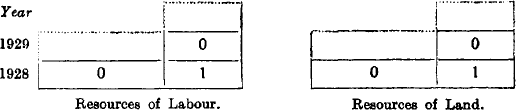
FIG. 11.
This may be more easily understood by means of the above diagram, which represents production in the current year 1928. The amount of labour and land employed, either directly or in the form of capital, for the production of this year’s supply of commodities is represented by two rectangles, of which the left-hand divisions (0,0) represent the productive resources of the year itself, i.e. that portion which is directly employed in the course of the year. The right-hand divisions (1,1) represent the saved-up labour and land which are used in consumption this year, and the upper rectangles of the same size (0,0) that part of the current year’s resources which are not employed in consumption till next year.
The dotted rectangles represent partly that portion of 1929 resources which, together with those saved up this year, will be used for the direct production of commodities next year, and partly those portions of the productive resources which will then be saved up and capitalized for the needs of the following year; and so on.
We shall—as before—assume free competition, at least in the main part of the field of production. In such circumstances, the problem of production will be essentially the same as before, except that the factors of production are now increased by two, namely the saved-up resources of labour and land. And it is still true that the total contribution of each particular factor of production cannot be ascertained a priori and does not even exist analytically. Its share in the product must therefore be determined by something else, and that something else is, for the same reason as before, marginal productivity. Now since experience shows that the replacement of a certain quantity of current labour and land by an equal quantity of stored-up resources of a similar kind tends in many cases to increase productivity, and since we assume that the quantity saved is only sufficient for use in these cases (and not even for all of them) it follows that the marginal productivity of the saved resources of labour and land is greater than that of the current resources—at any rate up to a certain point, not yet actually reached. This marginal productivity, and the share in the product which it determines, provides in the first place, a recompense for the actual capital used up in production, but it also provides something more. Under stationary conditions the exchange value of goods and services necessarily remains unchanged year after year, so that a person who, in one year, purchases labour and land in order to convert them into capital, intended for production in the following year, can always count upon obtaining more product, or value, than he has himself paid out. This surplus is what is called interest. We thus arrive at the following definition:—
Capital is saved-up labour and saved-up land. Interest is the difference between the marginal productivity of saved-up labour and land and of current labour and land.
If conditions are not stationary, then of course we have to take into account changes in the value of similar commodities (even labour or goods of the same kind) which may occur in the course of production—and which may easily make the actual rate of interest earned negative rather than positive. That, however, is self-evident. Nothing is more common than for a large inflow of capital into a certain industry to cause so great a reduction in the price of the product that capital is employed for a while at a loss instead of a profit. The real theoretical difficulty is rather to explain how, under stationary conditions, the possession of capital can remain a permanent source of income. The application to non-stationary conditions offers no difficulty in principle.
So far as I can see, everything which can be said in explanation of this phenomenon is said in the italicized passage above. Of Böhm-Bawerk’s three main grounds why “present” goods possess a higher value than future goods (or past goods higher than present goods), the first refers to the difference between wants and their satisfaction in the present and in the future; the second to the subjective undervaluation of future needs and overvaluation of future supplies. These considerations, however, are only indirectly significant for the productive employment of capital. Those who borrow capital for the purpose of production will not, because of anticipated future supplies or of subjective overvaluation, pay more in interest than they actually obtain themselves by the technical employment of capital. (They may well be induced in this case to use some of the borrowed money unproductively for their own consumption and, to that extent, diminish the supply of capital and thus raise the rate of interest.)
On the other hand, these considerations play a very important rôle in the actual accumulation of capital; and in its converse, the unproductive consumption of capital, as in loans for consumption purposes. Both logically and for purposes of exposition it would seem right to begin by examining the effects of a given supply of capital already accumulated, and then to inquire the causes which influence, and eventually alter, this supply. Thus there remains only the third of Böhm-Bawerk’s main reasons, namely the technical superiority of the commodities or means of production available from an earlier stage over those which will only become available at a later date. His reasoning in this connection essentially coincides with that which we have already advanced and which we shall develop further; but it is, as a comparison will show, considerably more complicated, and therefore probably not so intelligible as our own. This is mainly due to the fact that Böhm-Bawerk neglected to base his argument on the fundamental simplifying assumption of stationary economic conditions, though he did not really achieve any greater degree of generality. Moreover, he cannot be entirely absolved from the charge of trying to prove too much when he maintains that a “present” means of production, e.g. a month’s labour available now, would be, under all circumstances, technically superior to one available in the future. That, of course, is not the case. There are a number of cases in which current labour and land must, from technical necessity, be employed in their original form and cannot in any way be replaced by stored-up productive power. But this is not the point; it is rather that the marginal productivity of the latter is greater, simply because current labour and land exist in relative abundance for the purposes for which they can be employed, whilst saved-up labour and land are not adequate in the same degree for the many purposes in which they have an advantage. This again is to be explained by the circumstances which limit the accumulation of capital.
It is also clear that interest, at any rate within the limits of the single year’s investment here contemplated, must, according to our definition, be the same in all enterprises and all kinds of employment, and especially that the marginal productivity (and the share in the product) of saved-up land must stand in the same relation to that of current land as does saved-up labour to current labour. Otherwise it would be profitable to save more labour and less land on the next occasion, or vice versa. We may remind the reader, in passing, that the technical renewal of capital from year to year, which is here assumed, by no means excludes the accumulation and maintenance of capital by the individual for possibly remote future use. Such an individual need only buy up labour and land in the market in one year in the form of implements, slaughter animals, etc., sell them in the following year, and thus repeat the same operation. In other words, the duration of “private capital”, or, more correctly, of the ownership of “private capital”, has nothing to do with the technical period of turnover of “social” capital.11
If we assume that the whole of the accumulated capital—in the form of tools and implements, domestic animals, raw materials, etc.—consists of A labour years and B acre years, i.e. of the total production in the last year of A labourers and B acres, and if l represents wages per labourer and r rent per acre then the value of capital in money or products will clearly be A.l + B. r. If, in the current year, there are employed in a particular business a workers and b acres of the current year, and a1 labour years and b1 acre years of the preceding year, turned into capital in one form or another, then the total product during the year may be regarded as a function of all these quantities, i.e. F(a, b, a1,b1).
The partial derivatives of this function with respect to each of the variables will be on the one hand, Fa = l, Fb = r, i.e. wages and rent for current labour and land, and, on the other hand, Fa1 = l1(>l), Fb1 = r1(>r), or what may be called wages (including interest) for the saved-up labour and rent (including interest) for the saved-up land. Equilibrium clearly demands that l1: l = r1: r. The two equal quantities
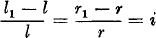
will then each represent the rate of interest on the investment of capital for one year. Interest, or that part of the product which falls to capital, thus equals in the particular business (a1 .l + b1.r). i; and the interest on the total accumulation of capital will equal (Al + Br)i—on the assumption that, under free competition, and in equilibrium, all capital will receive approximately the same return.
If we now compare two otherwise similar stationary states, both investing capital for a single year, but in one of which there is more capital employed, that is to say, in each year more labour and land are saved up for the following year than in the other case, a difficult, but extremely important, question will arise; what influence will the increased employment of capital exercise on wages and rent or, in other words, on the share of the product accruing to labour and land in the current year?
The fact that their marginal productivity is, normally (as we have seen) less than that of saved-up labour and land does not, indeed, prevent it from being increased by the increased use of capital. This may well appear obvious; for, in any particular year, current labour and land participate in the direct production of commodities in smaller and smaller quantities, the more the capitalistic method of production is extended; and it might be supposed that this would necessarily imply a relatively increased marginal productivity of those factors of production. But the matter is not quite so simple. Of course, ceteris paribus, a relative reduction in the supply of a factor should cause an increase in its marginal productivity; and the increase in the product due to capital would thus accrue in part to capital, and in part to the other factors of production. But if the accumulation of capital coincides, as is usually the case, with technical discoveries and technical progress, it is quite conceivable that, despite increased employment of capital and increased production, the marginal productivity and the distributive share of current labour and land will be less instead of more. Only in so far as production in given technical conditions is saturated with capital, is it certain that wages and rent—usually both—will rise, whilst interest falls. Translated into our terminology, this means that the marginal productivity of labour and land in the last case gradually increases whilst the marginal productivity of saved-up labour and land decreases—so that the difference between them is successively reduced and may finally disappear altogether; interest falling to nothing and the capitalists’ share in the product consisting only of compensation for the saved-up labour and land employed, i.e. for the capital itself.
In the following section, we shall apply this conclusion to the more complex case of capital investment over a period of years.
C. Capital Investment over a Period of Years.
Before an excess of capital caused interest to fall to nothing, investment for a single year would in reality have given place, for the most part, to investment for a period of years. We shall now examine how this comes about. It is sufficient for our purposes to suppose labour and land to be saved up for no more than two years; investments is thus to be either for one year, or for two. What we have to say in this connection can easily be extended to processes of production and capital investment over any period whatever. We shall also ignore for the present the period of transitión, during which capital is accumulated for the first time and is suitably distributed over the period of production in question; we shall only concern ourselves with conditions as they are after full equilibrium has been restored.
Each particular year’s production is now due (1) to current labour and land, (2) to resources which have been saved and capitalized during the two preceding years. But on the other hand, if conditions are to remain stationary, two quantities of labour and land (exactly corresponding to these) must be withdrawn from the production of consumption goods during the current year and devoted (1) to production of goods which will only be used in the following year, (2) to goods which will only be used in the year after that. Even this does not exhaust the list of capital goods existing at the moment; for there exists at the same time a group of services of labour and land saved up during the immediately preceding year and intended for employment only in the production of the next succeeding year. For this reason, they are to be regarded in the current year only as items to be carried forward—as it were, goods in transit. (Of course, in reality, the various annual groups of saved-up labour and land are not always so strictly separable, but are often combined in the same capital-goods—of which more later.) In the same way, if resources were saved up for three years, the labour-capital (and land-capital) available at any moment would fall not merely into 3, but into 3 + 2 + 1 = 6 distinct groups (cf. the following paragraph); and so on, mutatis mutandis, for more extended capital investments. Thus the number of capital groups grows, as it were, both in height and breadth, or as the square of the number of years. This, as we shall see, is a circumstance of great importance.
The following diagrams, which represent the supply of current and saved-up labour and land, at the present moment, (1) in capital investment for one and two years, (2) in capital investment for one, two, and three years, explain themselves. The figures 1, 2, 3 indicate that the capital groups concerned are 1, 2, or 3 years old, i.e. originate in 1927, 1926, or 1925. By 0 are represented the current resources of labour and land, whether used in direct production for the year or saved and capitalized for the production of succeeding years. The years marked on the left are to be conceived as representing the year in which the existing capitalized productive forces on the same horizontal line are employed for the production of consumption-goods, and this naturally presupposes that they will co-operate partly with current labour and land of the same year, and partly with those saved-up and capitalized during preceding years for use in a future year.
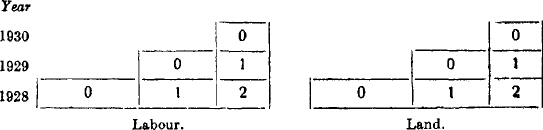
FIG. 12.
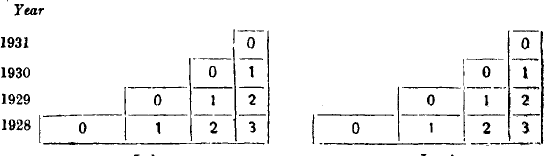
FIG. 13.
The sum of the rectangles indicated by 1, 1, and 2 (Fig. 12), or 1, 1, 1, 2, 2, and 3 (Fig. 13) represents the total supply of capital-goods in existence at the beginning of the present year, although only a part of them is employed—or, which amounts to the same thing, is consumed—during the course of the year. The rectangles one step higher up, identical in size and number, indicated by 0, 0, and 1 (Fig. 12), or 0, 0, 0, 1, 1, and 2 (Fig. 13), represent the supply of capital at the end of the year.12
If we return to our one-two year capital investment, it is clear that the labour and capital saved-up for two years will be remunerated in. accordance with its marginal productivity. If we consider the extremely primitive nature of the implements, domestic animals, etc., which are possible with investment for a single year, and the enormous improvement in the technique of production which would be possible in many fields with investment for two years, we shall easily see that the marginal productivity of two-year-old capital must, within very wide limits, be greater than that of one-year-old capital and a fortiori than that of current labour and land. But it should be carefully noted that this does not mean that, in all such cases, investment for two years would be profitable. For that to occur the three above-mentioned quantities must stand in a certain determinate relation to each other, corresponding to that which exists in a calculation with compound interest. In other words, if the marginal productivity of one-year-old capital (i.e. labour and land saved-up for one year) is related to that of current resources as, for example, 1·05 to 1, so that one-year-old capital yields 5 per cent interest, then the marginal productivity of two-year-old capital must necessarily be related to that of one-year-old capital at least as 1·05 to 1; and consequently to current resources of labour and land as (1·05)2 to 1, so that two-year-old capital will yield at least 10¼ per cent interest for its two years. This is obvious, for otherwise anybody who wished to save capital for two years or more would prefer to split up the hypothetical two-year capital investment into two successive one-year investments—so that the technical period of turnover of capital would still be only one year.
On the other hand, it may be asked whether the interest on two-year investments could not be permanently more than double, say three of four times, that of one-year investments. A levelling in the opposite direction cannot take place so directly, since those who desire the return of their capital after the lapse of one year have no other choice, it might be supposed, than a one-year capital investment. But, in an advanced economic system, credit enters at this point as a levelling factor. So long as the total amount of social capital remains unchanged year after year (and of course still more if it continuously grows), the technical period of investment is a matter of indifference to the individual capitalist. As against those persons who, in the course of the year, desire to call in and consume all or some of their capital, there would (at least) be an equal number simultaneously desiring to build up new capital to the same amount. The transfer of capital from the former to the latter, and of the corresponding exchange values in money or consumption goods from the latter to the former, might be effected by a simple credit operation without the necessity for the simultaneous liberation of any real capital in the technical sense. Interest rates for long and short periods do, in reality, tend to be equal; the difference which actually exists should be regarded partly as an increased risk premium for long-term loans, partly as due to the fact that, under existing economic conditions, short-term debts on good security are largely used as cash (money substitutes), a fact with which we cannot here concern ourselves. Thus, in the supposed circumstances, one-year capital investments in the technical sense would be exchanged more and more for two-year investments until interest on the latter became slightly more than double, or, calculated per annum, as great as the former. If this levelling has been achieved and full equilibrium restored, it is easy to see that the surplus marginal productivity of all the groups of capital employed during the year, i.e. the total profit on capital of the year, constitutes one year’s interest on the whole value of the total capital, each capital group being regarded as representing the value of the labour and land employed, together with the accrued interest. The same naturally applies to longer capital investments, so that there is complete agreement between theory and practice.
The whole available capital will now be distributed between one-year and two-year investment—since, for the moment, we ignore the possibility of longer dated investments—and in a definite proportion; so that the above relation between the marginal productivities will obtain. If capital increases, i.e. if the accumulated quantities of labour or land, or of both, are increased, we may suppose that new capital, and consequently ultimately the whole volume of capital in existence, will also be distributed in the same proportion as the old capital between these two periods of investment. Yet this does not usually happen. Such an increase must of itself, in view of what we have said, and apart from simultaneous technical inventions, etc., reduce the marginal productivity of saved-up resources and, at the same time, increase the marginal productivity of current resources. Excepting for the case where a uniform increase of both has a specially marked tendency to reduce the marginal product of resources invested for two years, so that we may suppose the marginal product of each to fall in about the same proportion, then it may easily be seen that the relation between the yields of the two forms of capital will be necessarily disturbed to the advantage of the longer-term investment; the interest on both one-year capital and two-year capital has fallen, but that on two-year capital is now somewhat more than double that on one-year (perhaps two and a half to three times as high). Investment for two years is thus relatively more profitable than before and extends to fields which it had previously not entered; whilst one-year investment expands relatively little, or may even contract. Thus, in the end, the relative marginal products of both are brought back to the right relation. In addition to this, investments for three, four, or five years, etc., which have previously been unremunerative, in spite of their higher marginal productivity, now yield a profit and will therefore be made.
If we represent the marginal productivity of two-year labour and land by l2 and r2, respectively; then, in equilibrium, we must have
l2 : l1 = l1 : l= r2 : r1 = r2 : r.
If we represent this common ratio by 1 + i, then
l1 = l(1 + i), l2 = l(1 + i)2 = about l(1 + 2i),
and similarly for r1 and r2. Now if l2 and l1 are reduced in the same proportion relatively to l (for example in the ratio 1 : 1 –  where is a proper fraction which is not too small) we obtain
l1 = l(1 + i)(1 – ) or, approximately, = l(1 + i–).
But, on the other hand,
l2 = l(1 + 2i – ) > l(1 + i – )2.
If, in this case, > i then one-year capital investment would show a loss and would certainly be contracted; if > 2i, the two-year investments must also contract and the centre of gravity of capital investment would shift to longer investments; and so on. If, as in the above example, the rate of interest is 5 per cent per annum, and if, owing to the accumulation of new capital, the marginal productivity of one- and two-year capital goods is reduced relatively to that of current labour and land by, say, 1 per cent, then one-year interest will consequently fall to 4 per cent, but two-year interest to only about 9 per cent instead of what it should be in equilibrium—namely (1-04)2—1, or rather more than 8 per cent. Two-year capital investment thus becomes (absolutely less but) relatively more profitable than before. Under certain simplifying assumptions, such as those made by Böhm-Bawerk and by ourselves in the next chapter of this work, this fact, which is of fundamental importance for the whole of the theory of capital, and whose significance was already recognized by Ricardo, can be proved mathematically as a universal principle.
This has important consequences for the remuneration of current labour and land, i.e. wages and rent. An increased investment of capital itself tends, as we have seen, to reduce the quantities of current labour and land available for each year’s direct production, and consequently to raise their marginal productivity. If, however, a relatively larger share of this capital than before is placed in two-year investments, and the capital is thus divided into two different parts, one of which is only used in the next year, then clearly there will be a reduction, at any rate relatively, in the quantities of accumulated labour and land employed each year; but, at the same time, there will also be a reduction in that part of the current labour and land which must be saved and capitalized each year to renew that which is consumed. A larger part will remain over for the current year’s direct production of consumption goods, whilst, at the same time, its marginal productivity will fall. It is the peculiarity of capital that, when it grows, it grows in height as well as in breadth, and in this there is a counter-weight to the tendency for an increase of capital to raise wages and rents.
Other things being equal, however, this last tendency can never be entirely overcome. Inevitably wages and rents (or at any rate one of them)13 will finally rise—though not so much as one might at first suppose—as a consequence of the increase of capital as such. But the position is different where, as may easily happen, some technical invention renders long-term investment, even without a simultaneous growth of capital, more profitable (absolutely) than previously. The consequence must necessarily be—so long as no further capital is saved—a diminution in the “horizontal-dimension” and an increase in the “vertical-dimension”, so that the quantity of capital used in the course of a year will be reduced; an increased quantity of current labour and land will consequently become available for each year’s direct production; and, although this need not necessarily cause their marginal productivity and share in the product to be reduced—since the total product has simultaneously been increased by the technical discovery, yet a reduction may clearly result. The capitalist saver is thus, fundamentally, the friend of labour, though the technical inventor is not infrequently its enemy. The great inventions by which industry has from time to time been revolutionized, at first reduced a number of workers to beggary, as experience shows, whilst causing the profits of the capitalists to soar. There is no need to explain away this circumstance by invoking “economic friction”, and so on, for it is in full accord with a rational and consistent theory. But it is really not capital which should bear the blame; in proportion as accumulation continues, these evils must disappear, interest on capital will fall and wages will rise—unless the labourers on their part simultaneously counteract this result by a large increase in their numbers.
That the transformation of circulating into fixed capital, i.e. the change from short-term to long-term capital investments, may frequently injure labour is beyond doubt. But Ricardo was mistaken in his belief that this consequence was due to the fact that the gross product is simultaneously reduced. This is, as may easily be proved, theoretically inconceivable. The gross product under free competition (where such is at all possible) always tends in the main towards the maximum which it is physically possible to obtain with the existing means of production.
In my work, Über Wert, Kapital und Rente (Jena, 1893), p. 104, I pointed out the easily-intelligible fact that, if capitalist employers by common agreement extend the period of production, and thereby the period of capital investment, beyond the point consistent with their interests under free competition, their profits will rise, because, with an unchanged quantity of capital, wages and rents calculated in money or goods must necessarily fall.
But, at the same time, the annual product would, up to a certain point, increase—a fact which may appear to conflict with the general principle that free competition brings about the maximum return from production.
If, however, we regard capital, as we should do, genetically (i.e. as the total of a number of years’ accumulation of labour and land) then it is clear that, in this case, there has actually been an increase in the volume of social capital—that is, an accumulation of real capital—at the expense of labourers and landowners, who do not receive its fruits unless, by co-operation, they succeed in obtaining better conditions in the future, by profit sharing, and so on. A somewhat similar phenomenon may occur as a result of the operations of entrepreneurs in the money and credit markets—as we shall see in the next volume.
But the assumption underlying the principle outlined above was that all the factors of production had a given and constant magnitude and, to this extent, it holds good, even though it may be difficult—if not impossible—to define this concept of social capital with absolute precision, as a definite quantity. In reality, it is rather a complex of quantities.
We have now completed the foundation of our static theory of capital. The complications which we must still take into account in passing from abstract theory to the concrete phenomena of reality are not questions of principle, and present only difficulties of detail in mathematical treatment. The most important among them is that, on the one hand, labour and land of different years are incorporated in one and the same capital-good; and, on the other, that a capital-good is not, as we have hitherto assumed, consumed in one year’s (direct) production, but often serves for many, sometimes for a long succession of years—so that the productive forces embodied in that good only come into employment successively. What exactly is consumed in each particular year cannot, as a rule, be determined. But even in this case, the law of marginal productivity must be fully satisfied in equilibrium, for otherwise it would undoubtedly be profitable, at some point in production, to transfer resources, either by simultaneously decreasing—or increasing—the factors employed at some other point in the period of production, or by increasing or diminishing the value of the capital-good. For example, suppose that a machine has been constructed in the course of three years and is afterwards used for twelve years before it becomes necessary to scrap it. If, in the construction of the machine, an additional quantity of labour, say one day’s labour, had been added in the first year of production, then the utility of the machine might possibly have been increased by, let us say, the value of three consecutive days’ work during the last year of its use. This day’s labour would yield an interest of about 8 per cent; for (1·08)14 = 3 approximately.
This rate of interest must agree with the rate prevailing elsewhere, for, if it were higher, it would be profitable (in future production) to employ more labour on this kind of machinery; if it were lower it would be advantageous, in the future, to content oneself with machines of inferior quality and utility, which cost less in labour or land for their production.
It is, of course, another matter that some forms of capital (such as houses, railways, certain forms of improvements of land, etc.) normally last so long that the quantitative and qualitative adjustments, theoretically necessary for attaining equilibrium, become impossible in practice. Unless we wish to extend our observations over periods of time in which centuries are mere episodes, we must content ourselves with noting that there is always a tendency, perhaps very incompletely realized, working in the direction indicated above. Of especial importance is the reservation regarding periods of great industrial development, in which equilibrium is usually conspicuous by its absence. We shall consider certain questions of this kind in greater detail in a later section.
Note on Böhm-Bawerk’s Theory of Interest
What has been said above modifies and completes Böhm-Bawerk’s theory—a theory which has been the object of more or less acute criticism by numerous economists. The great majority of the objections raised are, in my opinion, based entirely upon misunderstanding or on an inadequate appreciation of his reasoning. But some, or rather one, of them does not entirely lack justification, although, as far as I can see, it by no means destroys the foundations of his theory. I shall, therefore, give a brief résumé and criticism of Böhm-Bawerk’s theory of interest as he presented it.14
The first part of his main work, Geschichte und Kritik der Kapitalzins—Theorien (Capital and Interest), I must omit. In my opinion, Böhm-Bawerk was entirely successful in showing how untenable are all the earlier attempts at explanation which emphasize inadequately, or not at all, the importance of the time-element in the phenomena of production and value.15 With earlier writers, such as von Thünen, Senior, and others, who really do consider this element, it seems to me that Böhm-Bawerk’s criticism is carried much too far and is sometimes merely hairsplitting. In particular, I agree with Cassel16 (while profoundly disagreeing with his general opinion of Böhm-Bawerk) that he scarcely did full justice to Ricardo. However fragmentary Ricardo’s theory of interest may be, it appears to be quite correct so far as it goes. Among other things, it contains, in a somewhat different form, one of the corner stones of Böhm-Bawerk’s own theory. The passage in Ricardo to which I refer is to be found in chapter i, part v, of his Principles. Ricardo there raises the question why the employment of labour-saving machinery is always more profitable with high than with low wages, although at first sight it might appear as if machinery, being itself a product of labour, would rise in price with a rise in wages. With great acumen Ricardo shows that this cannot be the case: the price of machinery includes interest as well as wages, and if wages as a whole have risen, then, other things being equal, interest must fall. (The purchaser who uses the machinery must, for the same reason, reckon a lower interest on the purchase price of the machinery.) This is fundamentally the same reasoning as that with which Böhm-Bawerk proves (as we have done above) that a rise in wages must lead to a lengthening of the period of production or of capital investment.
It also follows from what has been said, that a rise in wages may lead to increased use of machinery for another reason: machinery is used as a means of replacing labour by land, if rent has not risen to the same extent as wages.
The second part of Böhm-Bawerk’s work, his Positive Theorie des Kapitals, will always retain its place as one of the finest achievements of economic theory; but even there he did not succeed in unifying his theory completely. It seems to rest on two (or even three) different and imperfectly co-ordinated foundations.
Already in his Introduction we find the brilliant suggestion that we should regard the capitalistic process of production (“the adoption of wisely-chosen round-about methods”) as the primary concept and capital itself as the secondary—“the complex of intermediate products emerging at the various stages of the round-about process of production taking time”. This idea, which renders all further discussion of the nature and content of the capital concept unnecessary, is subsequently developed in the masterly book ii, “On the rôle of capital in production and on the accumulation of capital.” The theory is only finally completed, however, in the chapters on the origin of interest and the height of the rate of interest17—particularly in the second section of the latter chapter, on the determination of the rate of interest on the market. In these, for the first time in the literature of economics, a proper account is given of the relation between wages and interest and, to that extent, a solution is advanced to the problem of distribution under free competition, albeit on greatly simplified assumptions and with the deliberate exclusion of land as a factor of production. These parts of his work may be read by themselves, and constitute a complete whole of the very greatest scientific importance and value. And yet, here also, Böhm-Bawerk was not entirely consistent, for in his account of the quantitative factors determining interest he reverts, probably for reasons of exposition, to the earlier Jevonian conception of capital as a subsistence fund, a sum of (potential) wages; so that capital again becomes the primary, and the capitalistic process of production the derivative, concept.
The long section of the book which lies between these two portions is of an essentially different character; and it is this section which has received by far the most attention from his critics. After an exhaustive account—excellent for the purpose—of modern theories of value and prices (in their “Austrian” form) he proceeds (under the heading “Present and Future in Economic Life”) to his well-known theory of interest in its widest sense. He here puts forward the doctrine that interest is originally an exchange phenomenon (and thus no longer exclusively the result of production and distribution)—it is the agio which arises in the exchange of present against future goods. This treatment may be justified, in so far as interest is undoubtedly a broader concept than productive capital itself. It can arise in a mere exchange of present against future goods or services without any intervening production and thus without any real accumulation or employment of capital. But the proof is not quite convincing. In Böhm-Bawerk’s opinion, the difference in value between present and future goods which comprises this agio, originates, like all other exchange values, in their different margnial utilities. But at an earlier stage, Böhm-Bawerk himself had denned marginal utility as “the significance of the least significant of the concrete needs or partial needs which are satisfied by the available supplies of the commodities of the kind in question”, and we may add, in full agreement with the whole trend of his reasoning, “during a given consumption period.” But if we seek to apply this directly to present and future goods, the difficulty clearly arises that both the supply (of future goods) and the period of consumption are quite indeterminate. This difficulty is not overcome by comparing, as Böhm-Bawerk sometimes does, present and past goods. In that case, of course, the supply of the latter is known (it is the quantity of available capital-goods), but the period of consumption remains indeterminate; for it is far from true that all existing present and past goods are to be employed in the consumption of the current year.
Böhm-Bawerk endeavours to circumvent this serious difficulty, for he clearly asserts that, in all possible cases—or, at any rate, in the great majority (“in aller Regel”)—the utility of present goods is greater absolutely than that of future goods (and less than that of past goods) of the same kind and quantity; from which it must follow that their marginal utility, and consequently their value and price, must also be greater. But this position is evidently untenable. His argument is relatively most successful when applied to the second of the three grounds cited as causing the superiority of present goods, namely the subjective undervaluation of future needs and the overvaluation of future resources—due to lack of imagination or weak will. This phenomenon is undoubtedly general, and so long as it exists it creates a (subjective) over-stress on present goods. But even the first of the main grounds—the existence of an, objectively, more abundant future satisfaction of needs—is evidently not general in its application. The circumstance adduced by Böhm-Bawerk that those who expect a less abundant satisfaction of their needs can always hoard existing commodities (especially the precious metals and other durable goods) cannot, in itself, be a guarantee of a positive rate of interest, but only implies that interest cannot fall lower in a negative direction than would correspond to the risks and costs associated with the storing of these objects.
Equally unsatisfactory is the treatment of the third main ground; the technical superiority of present goods—including present agents of production—over future goods. This part of Böhm-Bawerk’s exposition is, indeed, the one which is most open to criticism. Proceeding from his general theory of the profitability of round-about methods of production, he argues that a certain quantity of present factors of production—for example, a labour-month—must inevitably have a greater value than an equal amount which is available at a future date, say next year; the former can be employed as a link in a longer process of production than the latter and must consequently be more fruitful, whatever point in the future is regarded as the final point of production. This is undoubtedly wrong, for the principle of the advantage of round-about methods of production by no means implies that the productive process might be successfully prolonged for an indefinite time. In order to avoid the absurd argument that, in such a case, all production might be infinitely prolonged, Böhm-Bawerk refers to the “first and second main ground”, as bringing the “economic centre of gravity” to a nearer date; but this is merely a last resort, not to be taken too seriously. What really limits the length of productive processes—as Bohm-Bawerk himself quite clearly points out later, in book iii, chapter 518—is not this, but simply the circumstance that a longer period of production, even if technically more productive, would yield to entrepreneurs (whether capitalists, labourers, or a third party), with the available supplies of labour and capital, a smaller profit than the productive processes actually begun. This has already been shown in the foregoing.
Böhm-Bawerk’s real error—his cardinal error, as Bortkiewicz calls it—is that at this point in his exposition he seeks to solve the problem of the existence of interest—as distinct from its actual rate—without referring to the market for capital and labour. This error had already been pointed out by Walras and is, indeed, the only one of major importance which can be attributed to Böhm-Bawerk.19
In a subsequent part of his work, Böhm-Bawerk himself completely rectified this error. It may therefore justly be said that the work contains, albeit in a somewhat imperfect form, the real and definitive theory of capital, whereas Walras and his successors (Pareto, Barone, and others) still continued to hold a theory of interest which contains both formal and material defects and which is seriously incomplete. Walras’ formula for interest, as may easily be seen (cf. the preface to the second and subsequent editions of his Elements d’economie politique pure) reduces itself, on the assumption of stationary conditions, simply to the equation F(i) = 0, in which F(i) is the amount of annual savings conceived as a function of the rate of interest i. In other words, it expresses the truism that, in the stationary state, the inducement to new savings must have ceased; but it affords no answer to the question why a given amount of existing social capital gives rise to a certain rate of interest, neither higher nor lower. The importance of the time-element in production was never properly appreciated by Walras and his school. The idea of a period of production or of capital-investment does not, as we have said, exist in the Walras-Pareto theory; in it capital and interest rank equally with land and rent; in other words, it remains a theory of production under essentially non-capitalistic conditions, even though the existence of durable, but apparently indestructible instruments, is taken into account. In the same way, Barone, who, in the essays in the Giornale degli Economisti cited above, approached the views of Böhm-Bawerk, appears, from a later essay in the same journal, to have reverted to the earlier unsatisfactory point of view.20
D. An Alternative Treatment of the Problems of Interest and Distribution.
The following method of considering interest is designed to bring out the importance of the time-element, which is the real kernel of the capital concept.
Let us begin with the simplest conceivable case of the employment of capital; this undoubtedly occurs in that form of production where the original factors, land or labour (or both), are used only once, as it were in an indivisible moment of time, after which their fruits are spontaneously matured by free natural forces. A concrete example of this kind (at any rate approximately) is to be found in the laying down of wine for consumption—a copybook example rightly favoured by economists; or alternatively in the planting of trees on barren land (where no question of rent need enter during the period of growth) and so on. In such cases, the function of capital is merely to preserve, for a longer or shorter period, the services of the labour and land in question; or, where hired labour or land is used, to advance wages or rent for the corresponding period. If the total supply of labour and land is given, the length of time will thus be the only variable dimension of capital. If, in such a simple case, we are able to deduce the general laws of capital and interest, this deduction may be regarded as an essential ingredient in the explanation of all the more complex phenomena of actual employment of capital.
Let us imagine a country or district which, as far as its land, labour, and capital are concerned, is a closed economy and which by reason of the nature of the land and climatic conditions, produces only a single commodity—let us say a certain kind of wine—in exchange for which it obtains all other commodities from neighbouring countries or districts.
Let us further suppose the price of the matured wine to be determined in advance on the market in such a way that, within certain limits (not reached in practice) it increases continuously with the age of the wine. The annual vintage, say one million hectolitres, we regard as the product of land and labour only; and for the sake of simplicity we ignore the capital employed in the viniculture itself—though in practice this is very important. The price of the grape juice V0 (per hl.) may thus be entirely resolved into wages and rent. How it will be divided between them (since we ignore the labour required in later stages) is a problem of exactly the same kind as we have considered in the previous section (ii, 1) and with which we need not further concern ourselves. We might even assume, without violence to the general applicability of our principle, that the whole value of the raw product consists of wages only, by assuming that the use of the land is free.
The price V0 is still an unknown quantity and must be carefully distinguished from the price W0 which the new wine would command if it were now offered for consumption. But we shall assume that the latter alternative is not in question, as it would be too uneconomical. Rather the whole vintage will be stored, either by the producers or by other entrepreneurs, for a number of years—in order that it may be sold to greater advantage. How long it will be stored depends, as we shall soon see, exclusively upon the amount of the existing capital, which, on our assumption of a closed economy, can neither be increased by additions from outside nor diminished by export. The whole of the circulating capital of that society will consist of stored wine, though it can at any time be wholly or partially converted into money; we still make no definite assumption about the value of this capital in terms of money, but we assume that it just suffices for each year’s vintage to be stored for a particular period (say four years).
In that case, as a rule, the 4-year storage period must be the one which is the most profitable from the point of view of the individual vine growers. For if, at the current price of grape juice, or, in other words, at the current rate of wages (or wages and rent combined), a 5-year storage period would be more profitable (would yield a higher rate of interest) it would be preferred by some or all owners of the wine; but since the total capital is not sufficient for that, the consequence would be that at subsequent harvests a smaller amount of money would be available for the purchase of grape juice, so that the price of grape juice, and consequently wages and rents, would fall. If, however, the price of the new wine was lower (as our arithmetical example below will show) it can easily be proved that a shorter storage period would be more profitable than the one which had previously yielded the best return.
Again, if the price of new wine (on the home market) were so low that a storage period of only three years was the most profitable from the individual point of view, then, on our assumption, there would now be an excess of capital, so that more than the sum previously available each year from sales would be devoted to the purchase of new wine. The price of new wine would thus rise, and the storage period most profitable from the individual point of view would become longer. Equilibrium therefore requires an equal storage period for all—and a period of such length that the whole of the capital in existence finds employment in the only productive use which is open to it on our assumption—the storing of wine. All this is true as a general rule. We shall later consider a not unimportant exception (though it is more apparent than real).
We now further assume that the price of the matured wine, which is definitely fixed in the world market, is such that, when sold for consumption abroad, 3-year wine commands a wholesale price of 90s. per hl., 4-year wine 100s., and 5-year wine 110s.
We have now all the data which are necessary to determine (approximately) the unknowns of the problem, which are:—
(1) The equilibrium rate of interest in the community.
(2) The price of grape juice, or what comes to the same thing, the sum of wages plus rent (the division between these two, as we have said, being each determined by the law of marginal productivity in the non-capitalistic production of new wine, which we have postulated).
(3) The amount of capital in the community, reckoned in terms of money.
First of all, it is evident that the equilibrium rate of interest must be greater than 10 per cent, since 5-year storing would otherwise be at least as profitable as 4-year—if not more so; for the conversion of 4-year wine, with a selling value of 100s., into 5-year, with a selling value of 110s., would yield interest at exactly 10 per cent per annum.
In the same way, the prevailing rate must necessarily be less than 11 per cent (or to be exact, less than 11·11 per cent), for it would otherwise be equally profitable, or more profitable, to sell out the wine after three years; for the maximum rate which can be obtained by leaving the wine for another year is about 11 per cent on its price at that time of 90s. (its price after four years being 100s.). The actual rate of interest must, therefore, lie between these two limits—say at 10½ per cent; for a more exact determination we should have to know the selling value of the wine when it was between three and four and between four and five years old.
The rate of interest being known, it is easy to solve the rest of the problem. It is clear, for example, that the price of the 3-year wine in transactions between holders themselves (which we may call V3) must be such that, when capitalized for one year at the current rate, it equals the selling price of the 4-year wine. In other words, we obtain the following equation:—
V3 = (1·105)-1 x 100s. (per hl).
This price, which we may call the capital value of the 3-year wine, is, as calculation shows, a little more than the 90s. which the wine would have fetched if sold for consumption, which agrees with the fact that, in those circumstances, such a sale would not be profitable. In the same way, the capital value of the 2-year wine must be (1·105)–2 X 100s., and that of 1-year wine (1·105)–3 x 100s., and, finally, the 0-year wine or new wine in the home market must fetch an amount represented by the equation:—
V0 = (1.105)–4 x 100 = 67s. (per hl).
This will therefore be the sum paid out in wages (and rent) for the production of 1 hl. of new wine. The total wages and rent per annum will consequently be 67,000,000s.
Apart from the supply of cash to effect transactions and certain other requisites, the circulating capital of the community—as we have already said—consists entirely of the stored wine of four successive vintages. Consequently, its money value at the beginning of each year of account, when the mature wine has been sold, or exchanged for commodities from abroad, and a new vintage has just been laid down is:—
K4 = [(1·105)–4+(1·105)–3+(1·105)–2+(1·105)–1]
x 100 million shillings, or, what amounts to the same thing:—67 million shillings x [1 + 1·105 + (1·105)2 + (1·105)3] = 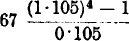 million shillings = 314 million shillings.
At the end of a year of account, shortly before the next sale, the whole stock of wine has become a year older. Its value has thus increased to

The difference between these amounts, 33 million shillings, is the remuneration of capital for the year, and may clearly be regarded either as four years’ interest on the purchase price of new wine, i.e.
67 [(1·105)4 – 1] = 100 – 67 = 33 million shillings,
or as one year’s interest on the whole of the capital existing at the beginning of the year, i.e.
314 x 10½% = 33 approximately.
Now if, by continued saving, the capital of the community is increased so that it just suffices for 5-year storing, then (with the same reservations which we shall discuss in detail later) this storage period must necessarily be the most profitable from the individual point of view. In order to calculate the approximate rate of interest under such conditions we must also know the selling price of 6-year wine, which we will assume to be 120s. per hl. In equilibrium the rate of interest must then be less than 10 per cent, but more than  (about 9 per cent). We will assume it to be exactly 9½ per cent. The price of new wine must consequently be V0 = 110 x (1·095)-5 = 69·88 or 70s. nearly. Thus wages and rent will now amount to nearly 70 million shillings. The remuneration of capital will thus be just over 40 million shillings per annum and the community’s total capital at the beginning of each year of account:—

This considerable increase in capital has thus somewhat increased wages plus rent, whilst at the same time lowering the rate of interest. Nevertheless, the share of capital in the annual product has increased, since 40: 70 > 33: 67—a relation which, with a continued increase of capital, must finally be reversed, so that the relative, and ultimately the absolute, share of capital in the product will be decreased when capital has increased sufficiently.
The rate of interest here appears clearly in its simplest form as the marginal productivity of “waiting”. By prolonging the period of storage (i.e. the period of production or capital investment, which here coincide) by one year—from four to five years—the annual product has been increased from 100 to 110 million shillings, or 10 per cent; if it were prolonged yet another year it would increase from 110 to 120 million shillings, or about 9 per cent. Between these two lies the real rate of interest for exactly five years’ storage.
On the other hand, we find from this reasoning that von Thünen’s doctrine of the determination of the rate of interest by the yield of the last portion of capital applied, gives, when taken with reference to the whole capital of the community—reckoned in money (or consumption goods)—too low a value. Capital was increased by 422 – 314 = 108 million shillings and gave rise to an increased annual yield of 10 million shillings, which, on that basis of calculation, would correspond to a rate of not quite 9¼ per cent. A further increase of capital, bringing the period of production up to six years, would in the nature of things produce a still smaller increase in the relative yield; and between these two lies the yield of the last portion of capital when the period of production is exactly five years. Thus it is in any case less than 9½ per cent, on which basis we have calculated the money value of capital. This relation appears to be general, and the difference may be of any magnitude whatever.
In the example here selected it may, of course, easily happen that the capital of the community may become too great for 4-year storage and yet not great enough for 5-year. In that case, wages (the price of new wine) will simply rise until 4-year and 5-year storing are equally profitable, and capital is distributed between them. But it might also happen that one or more vintages (e.g. 5- or 6-year wine), although more valuable than newer wine, may fetch a market price relatively so low that it does not pay to sell for consumption wines of these ages. As capital increases, the storage period will then rise in discontinuous jumps from four to seven years. This is the exception to the rule, which we have already mentioned.
In fact, such cases are not infrequent. In the same industry (it happens in shoe manufacture in Sweden) there may exist side by side two or more methods of manufacture, perhaps requiring entirely different amounts of capital and with different production periods (e.g. hand-made and machine-made shoes). Only in proportion as capital (and with it wages) increases will long-period capital investment finally supplant short-period investment (except possibly for certain specialities).
We refer the reader to the following pages for a more exact deduction of the above principles, as well as for a treatment of the more general case in which the application of labour and land is not (as we have here assumed) simultaneous, but made at different times.
In an algebraical treatment it is simplest to start with a continuous production and sale; that is, the production of so many hectolitres of grape juice per day and the sale of an equal amount of matured wine every day, on the assumption that these two operations are separated in time by a period of t (years).
If we again represent the price of one hectolitre of grape juice as V0 and the price of the mature wine, treated as a function of its age, as Wt or W (as distinct from Vt by which, as before, we represent the capital value in the home market of wine t years old), we shall clearly have
W=f(t)=V0(l+i)t,
in which i is the rate of interest; or, as it is more convenient to write it

in which e (= 2.718) is the base of natural logarithms and p the rate of interest at a moment of time (Verzinsungsenergie). The individual capitalist cultivator has now, with a given value of V0, to maximize i or, what comes to the same thing, p. This requires that

where W’ represents the first derivative of W with respect to t. This is Jevons’ well-known formula for interest: “the rate of increase of the produce divided by the whole produce.”
The further condition for a maximization of p can be written:—

where W” is the second derivative of W with respect to t. This may also be written:—
W’: W > W”: W’,
and it is consequently always satisfied if W increases less than geometrically when t increases arithmetically; this must always be the case in the long run, since the contrary assumption would lead to absurd consequences, though it need not, of course, hold for every value of t.
By the elimination of p between (1) and (2), we obtain the value of t which maximizes p for the given value V0. If, instead, we had assumed the value of p to be known, then the same formulae would have given the value of t which maximizes V0, i.e. the storage period which the cultivators themselves would adopt, if they could borrow money at the rate of interest p for their current expenses.
Let us now assume that the capital of the community is just sufficient for a storage period of t years—t being assumed to be known. The equations then give us the values of V0 and p, which correspond, when the community is in equilibrium, to wages (or wages plus rent) and the rate of interest.
If the grape harvest comes in once a year and if V0 is the total value of this annual harvest, Wt having a corresponding significance, then the money value of the social capital will clearly be:—
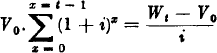
On the other hand, with production, storage and sale, all going on continuously, the result will be:—

If the social capital is exactly equal to this there will be equilibrium. If it is greater or less, the equilibrium will be disturbed; the value of V0 will rise or fall and the storage period most advantageous from the individual point of view will be altered, until a new equilibrium is reached. It is clear that, with an increase in K, there must be an increase in V0, in t, and in W, but a fall in p. By logarithmic differentiation of (1) and applying (2) we obtain:—

and since the determinant in the last expression is assumed to be negative δV0 and δt will clearly have the same sign, while δV0 and δp, as well as δt and δp, will have opposite signs. That δK and δt must have the same signs, is inherent in the nature of the case, but can easily be directly proved. By differentiating (4) with the help of (5) we obtain:—

Since, in accordance with the above, p’ is always negative and W = V0ept > V0(1 + pt), the coefficient of δt clearly > 0 so long as W increases with t.
In the same way we obtain:—

Now since dp: dK is always negative and K is always > V0t (from (4) since the function under the integral sign is always > 1 so long as p > 0), clearly dW: dK is always less than p. This proves that the above-mentioned theorem of von Thünen is not correct, if by “the last portion of capital” is meant an increase in the social capital. The divergence may in point of fact be of any magnitude whatever, since K–V0t, and also dp: dK may have any values whatever.
If we desire to represent these conclusions graphically, it is simplest to take the natural logarithm of the productivity function, y = ϕ(l)= loge (Wt) as the ordinate of a curve whose abscissa is the time t. Similarly we take W0, i.e. the fixed price of new wine on the world market (as distinct from the variable V0) as a unit for measuring Wt, so that log W0 = 0.
The curve must then pass through the origin.
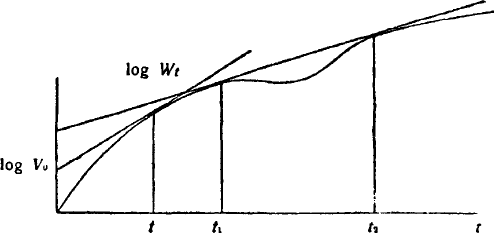
FIG. 14.
If loge (V0) is called y0, then for any value of t, p =  , so that p becomes the trigonometric tangent of the angle of inclination of a straight line connecting the point y0 on the y-axis with the corresponding point on the curve y = ϕ(t) = loge, (Wt) and p will be a maximum when this line becomes a tangent to the curve. In accordance with what has been said, the curve must be roughly parabolic—i.e. it must be concave to the t-axis, since a rise in y0 and t always leads to a fall in p. If, in exceptional cases, the curve should at some point bend downwards, then this point will be bridged over by a double tangent to the curve; capital will be divided between two equally profitable periods of investment (or production) t1 and t2, different in length; while p and V0 remain unchanged until the community’s capital increases to such an extent that it more than suffices for the whole of investment to be made for a period t2, after which V0 will again begin to rise and p to fall.
We may consider briefly the somewhat commoner case in which labour and land are still employed, once and for all, in what is practically an indivisible moment of time, but when they are employed at different points of time, during the period before the completion of the commodity; as for example it would happen if the grapes themselves were a spontaneous gift of nature, for which no appreciable wages, though some rent, need be paid, and the actual labour is employed in the making of the wine at a later time not definitely predetermined. In an individual firm, the value W of the finished product available during a given unit of time (say one year) would clearly be a function of the quantities of labour and land employed (a and b) and also of the periods of time (t and τ) for which each was invested in production:—
W=f(a, b, t, τ).
Out of this value W must be paid wages, rent, and accumulated interest. If l represents wages and r rent we thus obtain:—
W = f(a, b, t, τ)= a.l.eρt + b.r.eρτ (1)
where e and ρ have the same significance as before. If ρ is to be maximized, we can differentiate partially (1) keeping ρ constant. By partial differentiation of (1) we then obtain:—
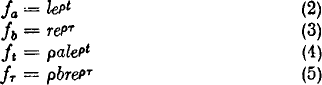
From these five equations the unknowns a, b, t, τ, and ρ can generally be determined. From (2) and (3) we readily obtain:—
afa+bfb=f( )=W.
This equation, however, is an identity so long as W = f( ) is a homogeneous and linear function in a and b and is thus of the form b. in other words, if large and small-scale production (at any rate after a productive capacity, which is not too great, has been reached) are equally profitable.21 In that case the number of independent equations is reduced to four, but we can still determine t, τ, and ρ as well as the ratios between a and b since (1), when divided by b, gives:—

If the whole production of the community is of one and the same kind we may, on the above assumption, simply replace a and b by the total annual services of labour and land (A and B). These, however, are to be regarded as given and constant; but the above five equations (1) . . . (5) can, after this substitution, serve for the determination of l and r (as well as t, τ and ρ). Since, however, only four of them are independent, a further equation is required, which may be obtained either by supposing t or τ (or some particular relation between them) to be given, or else by some supposition as to the money value of the social capital, which in this case will be equal to the sum of t years’ wages and τ years’ rent plus interest accruing at the rate of ρ (or i).
From (4) and (5) we clearly obtain, by addition,

which corresponds with the above-mentioned formula of Jevons and, on special assumptions, coincides with it.22
In the same way it is easy to see the significance of equations (2) and (3). The partial derivatives with respect to a and b (or A and B) no longer correspond (as in the case of non-capitalistic production) to the actual wages and rent paid, but rather to the amount which labourers and landowners would receive, if they could wait until their product was finished; which must otherwise be discounted at the rate ρ for the period t or τ
At this point we cannot enter into a detailed discussion of these formulae. We have already remarked that an increase in capital need not in this case necessarily lead to an increase in both wages and rent; one may sometimes remain stationary, or even decline, whilst the other correspondingly increases when capital is increased, and vice versa. On the other hand, it appears inconceivable a priori that an increase of capital could, ceteris paribus, coincide with a decrease of both wages and rent—though the question should perhaps be further investigated.
We must now try to solve the problem of production and distribution in the general case, where the original factors are employed not merely at one or more discreet points of time, but are distributed over the whole period of production. This distribution—which varies within very wide limits—is only partly determined by the technique of the different industries—and is actually modified in the effort to maximize profit.
It is evident that the solution would be impossible, even from a purely mathematical point of view, if it necessitated a precise treatment of the production and distribution of the community as a whole. But the only questions of practical importance which economists have to answer relate rather to the recurrent, relatively small, changes in a scheme of production, the elements of which are known from experience; and of foreseeing the probable effects of such changes on production and distribution, within the community. (Even the revolution which would follow the introduction of the socialist state would probably only be relevant to the question of the ownership of the means of production, with which we are not concerned here; it might affect the technico-economic side of production and distribution to a much smaller degree.)23
Even with this reservation, the problem must probably be regarded as incapable of solution at present—chiefly owing to the lack of reliable industrial statistics. On the other hand, the mathematical aspect should not present any insurmountable difficulties once the principle is established.
The problem is considerably simplified if the period of production, or the rate of interest, or both, are so small that we can use simple interest without risk of serious error (as Böhm-Bawerk does in his illustrations). In such circumstances the average investment-period of both labour- and land-capital will be independent of the rate of interest and will simply be equal to the (weighted) arithmetic mean of the individual periods of investment. We may then regard the productivity function f( ) as merely a function of these two average investment-periods t and τ (as well as of a and b or A and B) and everything can be reduced to the simple formula on p. 181, in which the exponential functions on the right-hand side of the equation are replaced by the expressions 1 + i.t and 1 + i.τ.
This is not without practical importance, since in a more or less stationary society—as we shall proceed to show—one can completely ignore the longer periods of investment; for capital-goods already in existence (such as houses, railways, etc.) will stand in a similar relation to circulating capital and labour as land itself. The investment period of circulating capital, therefore, is reduced to a few years, and it will thus be sufficient to employ simple interest in its capitalization. The line of demarcation between fixed and circulating capital must, of course, be drawn more or less arbitrarily, but in such questions we can never achieve more than approximately valid conclusions.
It should perhaps be pointed out here that the assumption that the average period of investment is independent of the rate of interest (i.e. of simple interest) only applies, strictly speaking, where several different capital investments relate to one and the same future act of consumption (as in Böhm-Bawerk’s example). In the opposite case, where one (or more) factors of production are invested in a single capital-good or durable consumption-good, it may easily be seen that the average investment-period will be dependent on the rate of interest, even with simple interest.
On the whole, the theory of the coincidence of the rate of interest and the “marginal productivity of waiting” is only applicable as an exact mathematical formula on certain abstract assumptions. This is quite natural, for waiting on the part of society as a whole—and frequently also on the part of the individual—is not a simple quantity, but is, as we have just pointed out, a complex; “average waiting” as a rule exists only as a mathematical concept, without direct physical or psychic significance. But it should, nevertheless, be retained as a concise general principle, reflecting the essence of productive capital.
E. Controversies Concerning the Theory of Capital.
Before proceeding, we may turn to consider, in the light of the theory we have now developed, some of the controversies concerning capital which have for a long time past engaged, and are still engaging, the attention of economists. If we succeed in throwing new and clearer light on these questions, this will be the best proof that the new theory really makes some scientific progress. In this case—as in so many others—a closer examination will show that the difficulty is, to a large extent, purely formal, and is due only to an imperfect formulation of the point at issue.
(1) This is probably true of most questions concerning the content of the capital concept itself, and especially of the question whether or not land should be included under the designation of capital. There is no doubt that we can give to the word capital a meaning wide enough to include land also. Here, as in practically all economic definitions, we are concerned with a more or less conscious extension of a concept whose meaning was originally more restricted. Such an extension can be taken as far as we like in view of the question in hand—nothing in principle need be excluded. If we contrast capital (as being equivalent to material means of production) with labour, then of course it also includes land. One might, though the practice is unusual, go further and, with Walras and Pareto, consider man himself (human skill and ability) as capital. The latter concept will then be equivalent to the sources of productive power in general, or, from another point of view, to the concept of a source of income, of any kind, in contrast with income itself. There is nothing to prevent us from speaking of “capital in the wider sense” as well as of “capital in the narrower sense”, so long as no misconception arises. We believe, however, that we have already given good reasons for the tripartite division of the factors of production into land, labour, and capital, which is commonest among economists. The almost complete analogy between land and labour, from an economic point of view—which has so long been overlooked by economic science—appears very clearly from the modern theory of marginal productivity; in contrast with these two original, current, present or direct productive forces, capital appears as a combination of accumulated labour and land.
It is admittedly difficult to determine where the line is to be drawn between capital and non-capital, indirect and direct productive forces. The human labour employed on land, and the resources of the land accumulated from earlier ages and employed for the same purpose (e.g. the work of beasts of burden in improving the land; manure; timber for roads; agricultural and other buildings, etc.) are undoubtedly to be regarded as capital, when the measures and expenditures in question are taken in order to yield interest at a future date—as in the case of all other capital. Such improvements to the land often leave a permanent residual benefit. This happens, for example, in the case of major blasting operations to secure water in mountain regions, the building of roads, protective afforestation, etc. These new qualities which, once acquired, the land retains for all posterity, cannot of course be distinguished either physically or economically from the original powers of the soil; in the future they are to be regarded not as capital, but as land. Very much the same applies, moreover, to human skill: a manufacturer who enlists skilled foreign labour in order to introduce a new industry into the country makes a capital investment which may perhaps repay him to the full in a few years. But the skill in this industry, which perpetuates itself within the country, will be a future asset for labour and not for capital.
It may be further pointed out that nearly all long-term capital investments, nearly all so-called fixed capital (houses buildings, durable machinery, etc.) are, economically speaking, on the border line between capital in the strict sense and land. We have already said that the operation of the laws of capital depends upon the assumption of a constant adjustment of concrete capital goods in an endless repetition of the same process of investment and production. But this is only of practical importance in capital investments of relatively short duration.
If, therefore, our analysis is only applicable within a fairly short period, then, strictly speaking, only short period capital-goods (in other words, circulating capital) can be regarded as capital proper. The volume of fixed capital, on the other hand, can, in the long run, be increased by the conversion of circulating into fixed capital—in so far as this is generally profitable—but it cannot be appreciably diminished—the reverse operation being usually impossible. Hence it is, in most respects, on the same level as the unchanging original productive factors, labour and land. This circumstance is sometimes in evidence during booms, when large quantities of circulating capital are converted into fixed capital, and it is not possible to replace the former quickly enough. In the subsequent depression the conditions are usually reversed: there is plenty of circulating capital, but it is no longer profitable to convert it into fixed capital.
(2) Similarly, the question of the inclusion of necessities of life for the labourers within productive capital is—at least in part—of merely formal importance. They have long been considered as a part of circulating capital; while Jevons considered that, fundamentally, all capital—especially in its original free form—consisted of the means of subsistence. In apparent opposition stands Böhm-Bawerk, who would entirely exclude such commodities from productive or social capital; for, in his view, the latter consists rather of the sum of the intermediate products appearing in the course of production and right up to the final stages—whereas the labourers’ means of subsistence are finished products and direct objects of consumption. It might be thought that this almost direct contradiction indicated a deep-seated difference in the capital concepts of the two writers. Yet they are fundamentally in agreement and both may be described as thorough-going representatives of the modern theory of capital. The whole controversy is, in reality, merely formal; if we regard the selling process as a stage in production, the finished products may also be regarded as intermediate products, in the technical sense, until they pass into the hands of the consumer. Since, in our day, almost all labour—at any rate in industry—is hired labour, the means of subsistence, in proportion as they are consumed by the labourers (in other words real wages) may be regarded as the price of the labour which the capitalist acquires in their stead, and which he adds to his stock of capital-goods, in the form of saved-up labour of one kind or another. The cases in which the labourers themselves are entrepreneurs may be regarded in a similar way—the labourer’s wages being considered as a quantity of goods equal to that which he would obtain in the market if he hired out his labour. If we look at the problem in this way, there is no real difference between the views of Jevons and Böhm-Bawerk.
The fact that Jevons’ definition of capital is too narrow, since he proposes to reduce it merely to labour and its means of subsistence, is quite another matter. In so doing, he takes account of only one part—though usually the larger part—of capital; whereas in reality another part, and certainly a very important part, consists not of saved-up labour but of saved-up land—not of wages advanced but of rent advanced. But this part—which cannot be physically separated from the other—permits, as we have seen, of exactly the same treatment.
Hence, when Böhm-Bawerk observes, in support of his case, that if labour’s means of subsistence are reckoned as capital the consumption-goods of landowners and capitalists must also be so reckoned, the first part of this observation (concerning landowners) is undoubtedly true. The capitalists’ means of subsistence evidently constitute a part, not of capital, but of the interest on capital. Nor are they advanced—for who could advance to the capitalist? On the contrary, they are obtained subsequently, when the production of commodities, with the help of capital, is concluded.24
(3) Of more real substance is the dispute, which still continues, whether capital is really the source of wages or whether the source is not rather to be found in the annual product— in the results of production. The former is the classical view, to which Böhm-Bawerk subscribes, and, in reality, also Jevons—although he appears to be in opposition to it. The latter view has been zealously advocated by Socialist writers—also by the American, F. A. Walker and, even more pointedly, by his fellow-countryman, Henry George. Among noted European economists, Charles Gide tends more or less to this point of view Those who hold it point to the obvious fact that finished products are consumed by the workers, and by everybody else, in proportion to their production, and that there exists beforehand no fixed and insuperable barrier between those which are consumed by the labourers (and therefore should, in accordance with the classical theory, be regarded as capital) and those which are consumed by the other classes of society.
The foregoing observations concerning this keenly-contested dispute should show that the truth is not to be found entirely on either side, though it is nearer to the classical view. In so far as the product of labour is consumed directly, no capital is required for the payment of labour—and this is largely true of labour even in the most capitalistic societies, especially of all personal services and of labour engaged in the final phase of actual production—e.g. of the baker, and still more of the shopkeeper who sells his bread. Wages may be said to arise here by a simple, though indirect, exchange of the commodities consumed by the worker for the product of his work, which is more or less simultaneously consumed by the employer or his customers. Indirectly, it is true, these labourers benefit by the existence of capital, for when the marginal productivity of labour is raised, as happens almost invariably with the advent of capital, this applies, owing to the operation of competition, to all work performed—even to that for which wages need not be advanced by capital for any appreciable period of time. There is, however, no division of the product between labourer and capitalist—i.e. the owner of the circulating capital from which wages are paid—but the labourer enjoys his product undiminished. Or, if it be preferred, he has to share it only with the landowner and the owner of fixed capital. (The baking of bread requires, inter alia, an oven; the sale of bread, a specially equipped shop, and so on.) It is, of course, not always so easy to determine the value of a piece of work which is the last of a long series in production; we must have recourse to the same criterion which has guided us throughout, namely marginal productivity. By the exercise of greater care in the baking of bread—for example, by the employment of one more labourer in the bakery in question—the daily selling value of the product may, ceteris paribus, be increased by, let us say, five shillings. After making deductions for increased wear and tear of implements and machinery, cost of increased space, etc., this will constitute the marginal productivity of the labour concerned and will determine, in equilibrium, the wages of this labour—and of all labour of a similar kind.
In most phases of production, however, there is a longer or shorter interval between the employment of labour and the final production of an article for sale. Since the labourer does not usually wait for his wages for the whole of this period, but more usually obtains them soon after he has performed his work, it must be evident that he does not obtain them from the product of his labour, either directly or by the exchange of the product for other products. Strictly speaking, moreover, the time must be reckoned from the performance of the labour to the moment when a finished product, ready for consumption, is brought into being. If, for example, a labourer is employed in the manufacture of a harvesting machine, the product of his labour is not really finished when the machine is ready for sale, but only when the crop harvested with the help of the machine has been sold and converted into bread. And it should also be remembered that the same machine will be used for several harvests and consequently for several years’ baking. Some other person or persons must thus advance the wages—and this, as the above example shows, for a much longer time than is generally supposed. It should also be observed that the advancing may, in the interval, be transferred from one capitalist to another, as when the harvesting machine leaves the possession of the manufacturer and passes into the hands of the agricultural capitalist. That wages (real wages) are paid in products more or less simultaneously produced signifies nothing from an economic point of view. The modern labourer has, as a rule, nothing to do with manufacturing these products; they are the final result of a series of processes whose various phases of labour have, as a rule, been paid for. The fruits of these productive processes belong—with a right which may be disputed by other labourers, but not specially by the labourer at present engaged—to the capitalist entrepreneur, and may be employed as he chooses, either for new production—in which case he maintains, or even increases, his capital—or for his own consumption. If this consumption, either of his own products or of products obtained in exchange, is direct, then, of course, the labourers (i.e. those seeking work in the market this year) will be deprived in a corresponding degree of an opportunity for consumption. If it is indirect—by exchange for a new, directly consumable service of labour, e.g. personal services—the labourer will, it is true, still receive his wages, and it may accordingly appear indifferent to him whether capital is accumulated and maintained or not—provided that there are sufficient products in the market to pay his wages. But this is a great mistake and to act upon it would be fatal. For if capital is not maintained by renewal, then, as it is consumed, the longer processes, which are characteristic of the present technique of production, must be curtailed or interrupted one by one; thus the whole of production, including the marginal productivity of labour and wages, would return to the small dimensions of primitive times. Or, more correctly, the working population—which could not possibly support itself in its present numbers, if we returned to primitive conditions—would, for the greater part, starve to death.
We do not wish to deny that consumers as such can, to some extent, influence rates of wages by a suitable selection of articles of consumption. This appears from what has already been said, as well as from what follows. But their power in this direction is certainly more strictly limited than is commonly supposed. Broadly speaking, even if not in detail, we must recognize the truth of Mill’s well-known principle that demand for commodities is not the same as demand for labour—unless it results in the accumulation of new capital.
In conclusion, it may be observed that what has been said concerning the relation of labour to capital applies in exactly the same way to land. Rent also is advanced by the capitalist (who may often be the landowner himself) in so far as the final product—the product ready for consumption—is brought into being at a later date than that of the use of the land—as is usually the case. This is evident from what has been said, but it is almost always overlooked in economic reasoning—an error which has contributed in no small degree to a lack of clearness as to the place of the factors, especially that of capital, in production.
Such an oversight may easily lead to paradoxical results—as in the following example, which, for the sake of simplicity, has been based upon Ricardo’s theory of rent and capital.25
A capital of 1,000,000s. gives employment in one-year production to 1,000 labourers on land for which no rent need yet be paid. Wages would thus be 1,000s., and if the returns per labourer are 1,100s. there remains interest for the capitalists at a rate of 10 per cent per annum. Assume now, however, that the number of labourers is increased—capital remaining unchanged—to 1,111 men. Wages consequently fall to about 900s.—whereupon one-tenth of the old capital employed on the land becomes superfluous and must seek investment on new land. But there only remains (we assume) “worse land”, from which the yield per labourer is only 900s. We should then obtain the remarkable result that interest, despite reduced wages, would fall to zero, not only on the worse land, but all along the line, in consequence of the competition of capitalists. The whole of the gain would accrue to the owners of the better land, which would now receive the difference in the yield between the better and the worse land 200s. per labourer, or 200,000s. in all.
If, however, we consider that rent is also advanced from capital, the result Will be quite different. Wages and rent together will then correspond to the existing capital, or 1,000,000s., and since the value of the whole return is 1,100,000 + (111 X 900), or 1,200,000s., interest will really have risen to nearly 20 per cent. Rent will continue, in this case also, to be the difference between the returns from the better and the worse land, but discounted by one year’s interest (i.e. 200 ÷ 1·2 = 167) for the area employing one man; wages, however, will fall to about 750s. Of course, this example is too simple to have any counterpart in reality and is only intended to emphasize the principle set forth above.
On the other hand, Böhm-Bawerk is probably mistaken in the assertion which he makes in the third edition26 in reply to an objection of mine, that the advance of rent from capital tends to raise interest—in the sense that interest would be lower if land were obtained gratis. The exact opposite would happen. Both rent and wages—or their equivalents in land and labour—constitute a part of the productive capital on which interest is paid from the surplus yielded by production. If it were at all conceivable that all land were free, then all capital would be paid out in wages and they would thus rise. If in the process there were no change in the period of production, the surplus product, and consequently the rate of interest, would be exactly the same as before. In reality, however, a lengthening of the period of production would prove economically profitable, and such a lengthening would, according to Böhm-Bawerk’s own argument, lead to a larger surplus product and a higher rate of interest. If, on the other hand, the landowners did not receive their rent in advance, but only when production was completed, the rate of interest would certainly fall, but such a change in the rent demanded would be equivalent to new capital accumulation by the landowners, concerning which we refer the reader to the conclusion of the next section, IV, and especially to p. 213 et seq.
(4) Our present analysis may also serve to guide us to a true view of the famous wage-fund theory—once so highly esteemed, later denied even by its former advocates, then interred but not yet quite defunct. We have already indicated that we cannot, strictly speaking, refer to a fund for wages alone, but only to a wage-and-rent fund. Capital in its free form is employed to advance both wages and rent; how much falls to wages and how much to rent depends upon the circumstances which determine the present marginal productivities of labour and land—which, in equilibrium, correspond to wages and rent and therefore absorb without any residue, the capital which is for the moment free—i.e. the wage-fund. But does such a fund really exist? That it does not exist in reality, as a fixed and unchanging quantity, follows from the fact that capital in all its parts may either increase or decrease, to a larger or smaller degree, at any given moment. This, however, has not escaped the defenders of the wage-fund theory. If we imagine a society under more or less stationary conditions, in which a given capital in the possession of the propertied classes is employed year after year without appreciable increase or decrease, then each year about an equal part of that capital will be set free. That part (together with the consumable direct products of labour and land) constitutes the whole production of finished commodities and services of the year. When the capitalist class has taken the surplus, corresponding to interest on its capital, it must, in order to maintain its capital, reinvest the remainder—which it does by hiring labour and land for new production. This part, therefore, is what might be called the annual wage-fund (more correctly, wage-and-rent fund).
But there can be no doubt that little is gained in the explanation of economic phenomena by the introduction of this term; and the simple process by which it was attempted to determine wages (dividing the wage-fund by the number of workers) was certainly too elementary. In the first place, as we have said, the proportion in which the common fund is divided into remunerations for the services of labour and land is by no means given and determined a priori; and, moreover, with a change in the amount of capital, the wage-fund may undergo considerable changes, in so far as the average period of turnover of capital is lengthened or shortened. As we have already shown, there would inevitably be a shortening if by reason of a diminished supply of labour (due perhaps to emigration on a large scale) wages rose, other things remaining the same. In other words, a reduction in the divisor would itself bring about a reduction in the dividend, though not quite in the same proportion. But, on the other hand, a reduction in the number of labourers would increase the distributive share of labour, not only at the expense of the capitalists, but also—perhaps to a greater extent—at the expense of the landowners. Hence the advice which the advocates of the wage-fund theory gave to the labourers, namely to limit the supply of labour in the market in their own interests, was in itself, good advice, even though based upon inadequate reasoning.
It would also be possible to regard all capital, as Böhm-Bawerk does, as wage-fund. But this amounts to the same thing; for in any case it is only the part annually set free which can purchase labour (or land).
The real error in the classical wage-fund theory was, as Böhm-Bawerk pointed out, that it frequently identified the wage-fund with capital as a whole, although it conceived the wage-fund to be invested for only one year. A very striking example of this is Senior’s “last hour”, immortalized by Karl Marx.27 Senior thought he could prove that a shortening of working hours per day by about one-eleventh would reduce the profits of capital from 10 per cent to nothing. He based this conclusion on the absurd assumption that all capital, including that invested in factories and machinery, has a one-year turnover, which did not prevent him from calculating, in addition, annual depreciation for wear and tear on buildings and machinery. If we calculate correctly, with the figures advanced by Senior, we shall obtain for fixed capital a period of turnover of about 8 years (sixteen depreciation allowances) and, for capital as a whole, 7 years. Ceteris paribus, a reduction in the hours of labour would certainly reduce the profits of capital, but only from 10 to about 8 per cent, and with somewhat greater intensity of work not even by so much as this.
It is curious that Marx himself does not seem to have observed the yawning gap in Senior’s argument, to which he devotes a prolix refutation. Or perhaps he hesitated to point out an omission the revelation of which would inevitably have exposed the weakness of his own “exploitation theory”.
Another criticism which has been made against the wage-fund theory is that it is correct only on the assumption that the labourers take their wages in kind at the same time as they render their services. If, on the other hand, they wish to take their wages partly or wholly “in capital”—in other words, to wait for their wages until their own product is ready for market—then wages may, within the limits of what is produced, rise to any height whatever and be independent of the size of the wage-fund or capital. This is of course quite correct, but it is scarcely a proper objection to the wage-fund theory, except in its most rigid form; for, by such a procedure, the workers would themselves become capitalists and would build up capital, so that the fruits of their labour which were not exchanged for products, i.e. for a part of the existing capital, would constitute a real addition to it.
This method of paying wages is the essence of the profit-sharing system, and if it has occasionally had beneficial results this may perhaps be most simply explained by the fact that the system stimulates the workers to accumulate capital, whose future fruits are usually sweet, even if its roots in the present are bitter.
Later on, we shall discuss the accumulation of capital—which is an important element in the theory of capital. But we will first return to the theory of exchange and see how this appears when it is linked up as it ought to be with the theory of production outlined above.
3. The Interdependence of Production and Exchange. The Theory of Exchange Value in its Final Form
Hitherto we have been reasoning on the assumption that production is carried on at given prices for all products. We must now drop this assumption and approach the real world—in which production and exchange mutually affect each other. Whilst we thus obtain a more complete theory of distribution, modified in some respects from that set out above, we shall also have an opportunity of resuming and completing our discussion of the theory of exchange value, which we were compelled to interrupt at the point at which its dependence upon, and connection with, the theory of production and distribution became clear. We shall, however, restrict our observations to the problem of the production and exchange of only two articles; the argument is much facilitated by such a simplification and there is no theoretical difficulty in subsequently extending it to all the infinitely varied products which are actually exchanged. In spite of this simplification, however, the problem resolves itself into two essentially different questions, which are best surveyed and treated separately. On the one hand, we may assume that the two articles exchanged are produced in different countries or districts, between which there is no transfer of labour or capital, so that all the resources available in each community are engaged in the production of one article. On the other hand, we may assume that the production of both articles takes place in a closed economy in such a way that land, labour, and capital can be transferred from one industry to the other. The former case is typical of what is usually called in economics the theory of international trade and international values; the latter of the theory of internal exchange under free competition. It is unnecessary to add that neither of these abstract assumptions corresponds to the phenomena of the real world. Perfect mobility of labour and capital within one country is just as improbable as is the complete absence of such mobility between countries.
Let us first assume that each country, owing to natural conditions, is compelled to produce one commodity only. It is then clear that under free competition every producer will endeavour with the available means to obtain the maximum net profit, which, in equilibrium, must cause the whole production of the country to reach its maximum. It is true that we have only proved this on the assumption of production without capital, but it will easily be seen that its essence remains unchanged, like the objection of Ricardo, which it was our purpose to refute, even if the argument is applied to capitalistic production.28 What has been said will by no means apply if production and exchange are effected co-operatively, or if the producers are otherwise associated in trusts or cartels; the country would then have to be rega ded more or less as a monopolist with respect to the commodity in the production of which it has greater natural advantages than other countries. Production would therefore be carried on with reference to the most advantageous monopoly price; a contraction of production might be to the advantage of the country even if all the available factors of production were not employed. If each of the two countries monopolizes the production of one commodity, then pricing is theoretically indeterminate; we have in fact reverted to isolated exchange, with the further complication that not even the quantities available are given beforehand, since they are the objects of production. If there is free competition, then, in accordance with the law of production and exchange, each country will produce as much as possible of its own commodity and exchange will be effected at the price which will normally equate supply and demand. It might well be that a restriction of the production of one commodity would, if simultaneously undertaken by all, be to the advantage of all producers of this commodity29; but restriction by an individual producer must, ceteris paribus, do him harm, since his supply does not appreciably affect prices. This would also be the case if the country manufactured several commodities, whose relative exchange values must be taken as given for the individual producers.
We have, therefore, simply to combine the foregoing laws of production for a single commodity (or for several commodities whose relative prices are given) and the laws of market value of a given stock of goods. The former determines the quantity of goods which accrues to each individual in each country in the form of wages, rent, or interest; the latter then determines the quantities of goods which will be mutually exchanged, and the relation between them—which constitutes international exchange value. The theory of international trade—or, more correctly, the abstraction so called—is therefore much simpler in principle than the problem of exchange in the internal market, in which the free transfer of the factors of production from one commodity to another must be presupposed. That the earlier economists thought otherwise was due to their erroneous idea that costs of production, which were assumed to regulate exchange value in the home market, could be determined on grounds independent of exchange value itself.
If l, r, and i represent the rate of wages, rent, and interest in one country, and A, B, and C the available quantities of labour, land, and capital, then A.l, B.r, and C.i are the total quantities of wages, rent, and interest in the country, expressed (like capital itself) in terms of the one commodity produced in the country (or in one of them if there are several). Personal distribution will depend on the labour performed, or upon the land or capital owned by each individual. In the other country, the annual supply of the product of each person will be determined in the same way, and since the personal dispositions of all the individuals as regards consumption must be taken as given, we thus possess all the necessary determining factors for establishing the price and the quantities exchanged.
A close comparison between the above theory and Mill’s treatment of the theory of international trade30 is of great interest and affords, at the same time, a striking proof of the need for a more carefully-developed theory. In the first two editions of the Principles, as in an earlier treatise on the same subject, Mill set up a theory which, so far as it goes, fully accords with the assumptions made above. The various factors of production cannot, on these assumptions, pass from one process of production to another; and consequently, says Mill, the necessary prerequisite for determining the relative prices of goods by their relative costs of production is absent and we must fall back on the more general law of supply and demand. If there is equilibrium between supply and demand under such conditions that the supply of each commodity always increases when its price rises (and vice versa) then equilibrium will be stable. A relative increase in the price of one commodity would lead to an increased supply but, on the other hand, to a decreased demand31 for it; a lower price would similarly lead to diminished supply and increased demand, so that, in both cases, prices would tend to revert to the original level. So far so good. But in this connection, Mill considered the case in which an increase in the relative price of one commodity (A), and consequently a decrease in the relative price of the other commodity (B), does indeed lead holders of (A) to increase their demand for (B), but at the same time it causes them to decrease their offers of (A) because their need for (B) now rapidly approaches satiation; thus equilibrium between marginal utilities is achieved before the offers of (A) have reached the same level as before. One of his critics, W. Thornton (who by his later criticism induced Mill to abandon, somewhat too hastily, his wage-fund theory), pointed out that, under such circumstances, equilibrium between supply and demand would, even when other things were equal, be possible at more than one price. If, at first, 17 units of (B) exchange for 10 units of (A), but the price of (B) happens to fall, so that 18 units of (B) must be given in exchange for 10 units of (A), then, on Mill’s assumption, it might happen that holders of (A) would reduce their offers of (A), though at the same time holders of (B) would certainly diminish their demand for (A); and it is quite conceivable that equilibrium between demand for and supply of (A)—and eo ipso of (B)—would also occur at this new price. To us there is nothing remarkable in this. The case considered by Mill is, in fact, exactly the same as the one we have considered above, in which the supply and demand curves intersect when the former begins to fall; and we know that when this happens it is quite possible that the curves will intersect at more than one point. Mill, however, without further examination, derived from Thornton’s remark the unfortunate conclusion that equilibrium between supply and demand would occur under such circumstances at any price—which can only be so in quite exceptional cases. In other words, he assumed that the problem is essentially indeterminate, so that more than the above data would be required to determine international exchange values.
He therefore undertook to complete his theory in this direction, but without success. It has justly been remarked that the latter part of Mill’s chapter “On International Values”, which he added to the third and subsequent editions of his Principles, really contains only a repetition, in a new form, of what he had already said elsewhere. Besides reciprocal demand, there is, in his opinion, another relevant factor—the means of satisfying this demand, set free in each country by the re-orientation of its industry. What he really adds, however, is only a particular arbitrary assumption as to the relation between the price of a commodity and its supply and demand. He assumes that the supply of each commodity is entirely independent of its price and that demand is in inverse proportion to the price of the commodity; as though each economy first satisfied its need for the commodity which it manufactured itself and then disposed of the surplus at any price.
Graphically represented, this would mean that the supply curve of each commodity would be a line parallel to the price axis and the demand curve a rectangular hyperbola. On this assumption, it is clear that the two curves can only intersect at one point and that the price equilibrium is stable. But in that case we should find no expression for the fact that a rising price of either commodity might lead its owners to reduce, instead of increasing, their supply. In reality, Mill neglects the whole of this question, which was, after all, the very starting-point of his investigation, and begins instead to inquire which of the two countries would profit most by a change in price caused by different conditions of production for one of the commodities. But in this way he finds no use for the new determining factor which he wishes to introduce, and he is finally forced to the almost pathetic confession that “the new element, which for the sake of scientific correctness we have introduced into the theory of international values, does not seem to make any very material difference in the practical result”. But, as we have said, he has not really introduced any new element at all; not only the practical results of his inquiry, but the theoretical results too, are entirely unchanged.
On our assumptions of free competition and immobility of the factors of production there are, indeed, no determinants of price except equilibrium between supply and demand. This is sufficient for a theoretical solution of the problem, although the possibility of several solutions, usually only a finite number, is not excluded.
Somewhat more complicated, at least at first sight, is the other problem, of ascertaining the relation between production and exchange in the “home market”, i.e. on the assumption that the available factors may be freely transferred from the production of one commodity to that of the other. And yet the main lines of the solution are simple enough even here, although—as the history of the science shows—they are not so easy to discover. If we suppose, for a moment, that a given proportion of the available labour, land, and capital—i.e., in the last resort, given quantities of original factors of different years—is always used in the production of the one commodity and the remainder in the production of the other commodity, then the problem of equilibrium price and the quantities exchanged would be exactly the same as in the preceding case. In other words, for every such hypothetical distribution of factors of production we should have one or more possible solutions. Now, in this case, the distribution of the factors is precisely one of the quantities required for the solution of the problem, though we find instead three new conditions, or logical relations, which must be satisfied: namely, the requirement that rent and interest shall be the same in both branches of production, which cannot be assumed where two countries are concerned.32 Every conceivable distribution of the factors gives rise, in each branch of production, to certain rates of interest, wages, and rent—expressed, in the first instance, in terms of one of the goods produced but also expressible in terms of the other since there is an exchange relation between the commodities, which follows from the same assumption; it is clear, therefore, that the problem is completely determinate by the equation of these three quantities individually. It should be capable of mathematical solution as soon as all the other data (the total productivity of land, labour, and capital, their distribution among individuals, and personal preferences in consumption) are exactly known. In reality, this problem of equilibrium may also be solved by trial and error; so long as wages, rent, and interest are greater in one branch of production than in the other, labour, land, and capital will flow into the channel where they reap the higher reward and there will be a simultaneous adjustment of relative exchange values, so that equilibrium will finally be achieved as far as is generally possible.
In order to avoid any misconception, one more observation should be made. The fact that the form of capital may change, that labour-capital (i.e. saved-up labour) may be, to a certain extent, replaced by land-capital (i.e. saved-up natural resources) and, vice versa, that capital investments (or capital-goods) of shorter duration may be exchanged for those of longer duration—these do not introduce any element of indeterminateness into the problem; for, in each particular branch of production, they are all governed by the general economic principle which we have already developed in the treatment of production. It may well be questioned what importance we are to attach to the claim that, under stationary conditions, the amount of capital must remain constant from year to year. But here we must distinguish two different things. In equilibrium, the capital employed in production has already assumed a certain technical dimension and composition, as well as a certain exchange value (expressed in terms of one of the commodities). It can now be asserted that, so long as capital of this magnitude and composition, or even of this exchange value, is maintained and utilized from year to year, equilibrium cannot be disturbed if, from the beginning, the other conditions of stability are fulfilled. But it would clearly be meaningless—if not altogether inconceivable—to maintain that the amount of capital is already fixed before equilibrium between production and consumption has been achieved. Whether expressed in terms of one or the other, a change in the relative exchange value of two commodities would give rise to a change in the value of capital, unless its component parts simultaneously underwent a more or less considerable change. But even if we conceive capital genetically, as being a certain quantity of labour and land accumulated in different years, a change in the value of commodities would also alter the conditions of their production and thus necessitate a larger or smaller change in the composition of capital.
This indeterminateness—which was inherent in our first main example,33 and even in the pure problem of production—is, of course, primarily due to the fact that capital, unlike labour and land, is not an original factor of production which can exist (even hypothetically) independently of, or antecedently to, production. Its origin and maintenance inevitably presuppose that production is taking place. But it also has another, more deep-seated, cause. In reality, the amount of capital is not determined by physical conditions, but by the equilibrium between psychical forces which, on the one hand, drive us to save and accumulate capital and, on the other, to consume already existing capital. In other words, the accumulation of capital is itself, even under stationary conditions, a necessary element in the problem of production and exchange. We have now reached a point in our exposition at which this new factor forces itself upon our attention. We shall, therefore, consider this subject in our next chapter—though the laws of capital formation have been too little studied for a treatment of the subject in its entirety to be of much real use.
We consider the total amount of a commodity produced as a function (homogeneous and linear) of all the quantities of labour and land employed (i.e. annually consumed) both current and saved up. We then obtain for one commodity
P = ϕ(A0, A1, A2 . . . B0, B1 B2 . . .)
in which A0 and B0 indicate current services of labour and land, A1 and B1 services one year old, etc. The partial derivatives of this function with respect to each of the quantities included gives us the wage (l), and the rent per unit of land (r), payable in this industry, expressed in units of the product, and also the marginal productivities of all the constituents of capital. From these we can deduce the rate of interest which is payable (i). With the relation which must exist in equilibrium between the yields of capital-goods of different duration and between the yield of land-capital and of labour-capital, we are now in a position to express all the above quantities in terms of three of them (e.g. A0, B1, and A1). In the same way, we obtain for the other commodity:—
P1 = ψ(A10, A11, A12. . . B10, B11, B12 . . .),
from which we can determine the values of l1, r1 and i1, for this industry, l1 and r1 being expressed in units of the second commodity; and can similarly express all the quantities included in terms of three only—A10, B10, A11.
The number of unknowns is thus reduced to six only. To determine them we have the following additional relations. In the first place, under stationary conditions, the sum total of the quantities of labour annually consumed—current or saved up—must be equal to the supply of labour annually available in the country; and the same applies to the land which is employed either in its original or capitalized form. If the country has at its disposal A units of labour and B acres of land, we therefore obtain:—
A0 + A1 + A2 + . . . + A10 + A11 + A12 + . . . = A
and
B0 + B1 + B2 + . . . + B10 + B11 + B12 + . . . = B.
By means of the other data we can also express the exchange value of the two commodities as a function of the above quantities and therefore finally in terms of our six unknowns. If we represent this exchange value (e.g. the price of the latter commodity, expressed in terms of the former) by ρ, and if wages and rent are identical in both industries, then:—
l = p.l1 and r = p.r1.
The rate of interest must also be the same in both; thus i = i1.
We have thus obtained five independent relations, but we still require a sixth. This can be obtained from our assumption concerning the amount of capital. The quantities A1, A2 . . . B1 B2 . . ., etc., are only those parts of capital which are annually consumed. Corresponding to them, under stationary conditions, there must exist other parts of the total social capital, whose amounts can be exactly determined. There must be one more element corresponding to A2, two more elements corresponding to A3, three to A4, etc., and similarly as regards B2, B3, B4 etc. (cf. Fig. 12). In equilibrium, the composition of the sum total of capital is thus definitely fixed. All its parts can be expressed separately either in the first three or in the last three of our six unknowns. If, for example, we now wish to impose the condition that in equilibrium the sum total of capital shall have a certain exchange value, measured in terms of one of the products, we need only calculate the exchange values of all parts and add them. These exchange values are (in accordance with the above) the original exchange values of the portions of capital concerned, plus accumulated interest. Thus, for example, the present portion of capital indicated by A3 has the exchange value A3.l.(1 + i)3. The two identical portions also represented quantitatively by A3, since they represent equal quantities of saved-up labour, have, on the other hand, the values A3.l.(1 + i)2 and A3.l.(1 + i), respectively. The portion of capital represented by B3 has the exchange value B3.l1.p.(1 + i)3 = B3.l.(1 +i)3, etc.
If these values are summed and are put equal to a certain given quantity—the total exchange value of the capital employed in the two industries together, expressed in terms of the first commodity, we shall then obtain the necessary sixth relation, and the problem will at last be completely determinate.
If it were permissible to calculate with simple interest, the problem would be simplified in so far as the accumulation of capital through time need not be taken into consideration—though its distribution as labour-capital and land-capital, advanced wages and advanced rent, must; we should then only have to deal with the average period of investment.
It may perhaps be asked whether, in a case such as this (in which both commodities are manufactured in the same country), more than one relative equilibrium price is possible. This is quite conceivable if—as is usually the case—wages, rent, and interest enter into the manufacture of the two commodities in different proportions. If the prevailing equilibrium persists, and a higher relative price is paid for one commodity, then, obviously, that factor (or factors) which enters into the production of the commodity in relatively large amounts is favoured at the expense of the others.
As will easily be seen, there is no difficulty in extending the above reasoning to any number of commodities. Under the designation of commodity we may also include the factors of production themselves when they are directly employed by their owners. We can therefore abandon the simplifying assumption hitherto made—viz. that all factors of production on the market are available in given determinate quantities, which are offered in their totality by their owners, irrespective of the price they will fetch. This is very important, especially for labour, for we can now consider the case in which the hours of labour are variable and determined by the workers themselves, on the basis of the equality of the indirect marginal utility of work and the direct marginal utility of leisure.
Just as exchange and exchange value thus assume their final form by their connection with production, so, of course, exchange for its part considerably modifies the production and distribution of the product. Each producer—labourer, landlord, and capitalist—receives a substantial increase in utility from the possibility of exchanging the commodities, in the production of which he participates, for others (production in the modern sense would indeed be inconceivable without this possibility, for nowadays production is carried on almost solely for exchange). And further, the relative distribution of the product between the three classes of producers becomes quite different, when there is a possibility of exchange with other districts or countries. A well-known example of this is the fall in rents, to the advantage of the landless classes, which has occurred in parts of Europe, as a result of the importation of foodstuffs from extra-European countries. Another is the more doubtful, but perhaps equally real, case in which the workers, or the great masses of the population in the latter countries, have suffered from the supply of cheap manufactured goods from Europe, to the advantage of the landowners.34
- 1This expression is perhaps not entirely suitable, since, as will easily be seen, the essence of the argument is in both cases the same. It is therefore also possible that I ought to have endeavoured to combine sections II, 2, C and D in a single uniform presentation. I have found myself unable, however, for various reasons, to do this. As they now stand, these two collateral presentations may materially support and explain each other.
- 2Some of the matter included in this book had been published in Conrad’s Jahrbücher in the preceding year.
- 3Some of these contributions are now available in one or other of the world languages. The article on Professor Bowley’s Mathematical Economics, with its discussion of the theory of Bilateral Monopoly, appears in the Archiv für Sozialwissenschaft, Bd. 58, pp. 252-281. Professor Hayek has included a celebrated article on Prices and the Exchanges in his Beiträge zur Geldtheorie, and two others on Dr. Gustav Åkermann’s Realkapital und Kapitalzins and Prof. Cassel’s “Theory of Social Economy” appear in English as appendices to the present volume. But an English translation of a comprehensive selection of these papers is still urgently to be desired.
- 4A short list of Wicksell’s principal contributions to foreign periodicals is given by Professor Ohlin, op. cit., p. 512.
- 5See, e.g., Schumpeter, “Knut Wicksell,” Archiv für Sozialwissenschaft, Bd. 68, pp. 238-257.
- 6In this connection a comparison between Wicksteed’s article on Jevons’ “Theory of Political Economy” (Works, vol. ii, pp. 734–754) and the sections on Capital Theory in Uber Wert, Kapital und Rente is very instructive.
- 7But not all. I should be very sorry to be thought to lend any countenance to the view, now apparently gaining ground in somewhat unexpected quarters, that in undergraduate teaching or in advanced studies we are yet in a position to dispense with the most thorough study of Marshall’s Principles. It would be a sad thing if the uncritical acceptance of this great work, which so long tended to stiffle the development of other lines of thought in this country, were to be succeeded by an equally uncritical rejection of all the wisdom and the path-breaking intuitions that it contains.
- 8He must have been aware of Über Wert, Kapital und Rente, for it was reviewed together with his own Co-ordination of the Laws of Distribution in the Economic Journal for June, 1894.
- 9Finanztheoretische Untersuchungen, p. 176 seq. Wicksell’s views in this spect have been developed with great ingenuity by his pupil, Professor E. Lindahl, in his Die Gerechtigkeit der Besteuerung,
- 10Theory of Wages, p. 233.
- 11“The Ricardian Theory of Profits,” Economica, February, 1933, pp. 51–74.
- 12Prices and Production, chapter i, passim. “A Note on the Development of the Doctrine of ‘Forced Saving,’” Quarterly Journal of Economics, vol. xlvii, pp. 123–133.
- 13See Hayek, Monetary Theory and the Trade Cycle, chapter v, and Prices and Production, chapter i; also G. Myrdal, “Der Gleichgewichtsbegriff als Instrument der Geldtheoretischen Analyse,” in Beiträge zur Geldtheorie, ed. Hayek.
- 14Etudes d’économie politique appliquée, p. 466.
- 15L’echange de deux marchandises entre elles sur un marché régi par la libro concurrence est une opération par laquelle tous les porteurs, soit de l’une des deux marchandises, soit de l’autre, soit de toutes les deux, peuvent obtenir (obtiennent) la plus grande satisfaction de leurs besoins compatible avec cette condition de donner de la marchandise qu’ils vendent et de recevoir de la marchandise qu’ils achètent dans une proportion commune et identique. (Élémente d’économie politique pure, 4me éd. l0me Leçon.)
- 16Concerning his later views on this question, cf. pp. 82–83.
- 17As it is only our intention here to illustrate a theoretical principle, we ignore the otherwise important circumstance that shorter hours of labour usually give rise to a greater or less increase in the efficiency of labour.
- 18y is the quantity of his own commodity (B) which he originally sells; y.Δp is consequently the additional quantity of the commodity (A) which he would obtain as a result of the increase in price if he could continue to sell the same quantity y of his own commodity; is the marginal utility of (A) and hence .y.Δp is the gain in utility derived from the increase in (A).
- 19As an example of how even an experienced mathematician may be led to erroneous conclusions in this field, we may mention the argument of Launhardt (Mathematische Begründung der Volkswirtschaftslehre). He assumes two parties to an exchange, one of whom from the beginning possesses a units of the commodity (A) and the other b units of the commodity (B) and, for the sake of simplicity, he supposes the total utility derived by each person from the commodity (A) to be expressed by the same function, f( ); and similarly ϕ( ) for the commodity (B). If they then exchange the quantities x and y the total utility received after exchange by both parties together is expressed by N = f(a—x) + ϕ(y) + f(x) + ϕ(b—y). In order that this expression should be a maximum we must have:—
- 20In an essay in Ekon. Tidskrift, October, 1908, and also in his work, Den ekonomiska fördelningen och Kriserna, Brock has sought to prove that the above conception of the relation between retail and wholesale prices is not correct. Retail prices, in his view, show a strong tendency to follow wholesale prices upwards, but very little tendency to follow them downwards. The statistics (from America) on which Brock bases this assertion would seem to show merely that of recent years retail prices have, on the whole, risen as compared with wholesale prices; a fact which, owing to the great relative increase of retailers, is in itself probable and is quite in accordance with what we are about to say. As a general doctrine, Brock’s view (and that of Lexio and others) is clearly absurd; it would imply that retail prices would diverge more and more from wholesale prices at each cyclical fluctuation—which would lead to absurd consequences. Obviously, we do not attribute any altruistic motives to retailers when we speak of their endeavour to keep prices as steady as possible for their customers’ convenience. It is well understood that it is in the interest of every business man to satisfy his customers.
- 21See Principles mathématiques de la théorie des richesses. This work was first published in 1838, but was not generally known until much later. Translations into English and various other languages are now available.
- 22Papers relating to Political Economy, vol. i, pp. 143–151, and Economic Journal, 1899, p. 286.
- 23Cf. also my Finanztheoretische Untersuchungen, p.12, et seq.
- 24The theory of pricing under “duopoly” or “polypoly”, as they were formerly called, was developed by Cournot (see below) and deserves attention.
- 25A. Weber’s Der Standort der Industrie may be described as such an attempt.
- 26Edgeworth, in his Mathematical Psychics (1885) and in an essay in the Giornale degli Economisti, 1897 (and also the mathematician, Bertrand, in the Journal des Savants, 1883), criticized Cournot’s reasoning, but, in my opinion, on insufficient grounds. It is certainly true that the problem, as Edgeworth says, will to some extent be indeterminate in the case of two, or generally of a limited number of monopolists, whether in the same or in different branches of production. But Cournot’s further assumption, quoted above, seems to me much more reasonable than the one selected by Bertrand and Edgeworth. The latter involves the assumption that each monopolist aims at the maximum net profit on condition that the other does not change his price—an assumption which seems to me quite unjustifiable where they both produce the same commodity. [See Wicksell’s review (Economisk Tidskrift, 1925) of Professor A. L. Bowley’s Mathematical Groundwork of Economics; a German translation of this review subsequently appeared in the Archiv für Sozialwissenschaft, 1927.]
- 27Das Kapital, i. Third edition, p. 206 et seq.
- 28[A mark against this passage in the author’s copy of the second edition indicates that he wished to recast it.]
- 29Hours of labour may be influenced by the possibility of exchange.
- 30J. S. Mill, Principles, book iii, chap, xviii.
- 31Strictly speaking, this applies only it the two commodities cannot substitute each other in consumption.
- 32In the article “Handel”, in Schōnberg’s Handbuch (cf. Ekonomiska Samhällslivet, ii, p. 478), W. Lexis has been guilty of a serious omission in relation to this point, which makes his argument deceptive.
- 33That of International Trade.
- 34See my Finanztheoretische Untersuchungen, pp. 63 ff. (Jena, 1896).

