
Lectures on Political Economy
III. The Velocity of Circulation of Money Banking and Credit
BIBLIOGRAPHY.—Since the following exposition will be primarily theoretical in character, we must necessarily refer to the works which describe more or less exhaustively the actual working of the money market, especially in our own day. Among them, in the Scandinavian languages, we must note W. Scharling’s extremely well-written Bankpolitik; Aschehoug’s already cited work, ch. 62 et seq.; J. Leffler, “Krediten och Bankväsendet” (in Ekonomiska Samhällslivet); Davidson, Europas Centralbanker and essays in Ekonomisk Tidskrift; Goschen, Foreign Exchanges. Among the many foreign works on the subject, the English are especially remarkable for richness of content and concise treatment. The English money market remains the model for other countries. We will only mention here the smaller textbooks by Clare, A Key to the Money Market, Money Market Primer and The ABC of the Foreign Exchanges; Withers, The Meaning of Money, Stocks, Shares and Debentures, and Money Changing, and particularly Bagehot’s Lombard Street— a work which, although not up to date, is unsurpassed from the point of view of exposition.
For a deeper study of practical banking and stock exchange questions there are numerous relevant articles in Conrad’s Handwörterbuch, in which guidance is given to the literature of the subject.
1. On Velocity of Circulation in General. Cash Balances and Credit
Unlike goods, which, with every purchase and sale, advance one step further on the road from producer to consumer, and which usually leave the market when a transaction is completed, money (to use the common expression) remains in the market. As we have already pointed out, however, this is not entirely true, unless the seller who has received the money remains there also, and in turn becomes a purchaser. If he withdraws from the market or remains there only as a seller, then the purchasing power and the exchange function of the money will be latent; it will, for the moment, cease to function as a medium of exchange, but will remain in his safe as a store of value. The period during which any piece of money is on an average retained in the safe, between a sale and a subsequent purchase, may be called the average period of idleness; and the inverted value of this period of time, expressed as a unit (say a year) will be the average velocity of circulation. In other words, if a piece of money on an average lies untouched for a month at a time, then it will circulate (change owners) twelve times a year. This velocity of circulation is twelve (times per annum) when its period of idleness is one-twelfth (year). Included in the circulation of money is, of course, the transfer of money from one person to another by means of loans or advances. In dealing with certain questions, however, it is necessary to treat exchange and loan transactions separately and to consider the circulation of money in the narrower sense as relating only to the former. Which usage is meant will, as a rule, be clear from the context without special reference.
Theoretically, therefore, the concept of velocity of circulation is a very simple one. But in practice its investigation is one of the most difficult problems in economics, because, among other things, the velocity of circulation varies so enormously with each portion of the monetary stock of a country; and even with every single coin. Unfortunately, a number of economists, including the otherwise admirable James Mill and John Stuart Mill, have tended to obscure the problem by the assertion that time has nothing to do with the velocity of circulation of money: it consists rather of the number of times a certain quantity of money must change hands in order to effect the turnover of a certain quantity of goods. But with this thesis the whole concept vanishes: in order to determine the velocity of circulation in this sense we must know the actual prices of the goods (or, what comes to the same thing, the exchange value of money); and the average velocity of circulation would only be another name for that. On the other hand, if we regard velocity of circulation in the sense we have described above, it really becomes an important independent factor in the regulation of the prices of goods. That the velocity of circulation really has, or at least can have, entirely independent significance it is not difficult to show. If, for technical reasons, purchase and sale could only be effected every half-year by the same person—e.g. if rural products were offered only in the autumn, urban products and colonial products only in the spring, and credit were unknown—then money would evidently lie idle every time for half a year. It would therefore have to be sufficient in quantity to equal one-half of the total value of the goods offered in a year, and either commodity prices or the quantity of money available and necessary, or the extent of money transactions relative to transactions in kind—or all three simultaneously—would have to be regulated in accordance with this fact. That the velocity of circulation of money, under present conditions, is somewhat variable is a separate matter. But of course it does not destroy the conception, even though it affects the influence of velocity of circulation as a factor in the determination of value.
The longer the average period during which a piece of money lies idle before it is used, the greater, obviously, will be the cash holdings relative to the annual turnover. It might even be said that the magnitude of the cash holdings relative to the total annual turnover is in inverse proportion to the average velocity of circulation of money. On the other hand, the absolute amount of cash necessary for each individual will clearly depend on the magnitude of his individual turnover. For the economy as a whole, the absolute total of cash holdings will be the same as the quantity of money in the country, and therefore constant if the latter quantity undergoes no change.
Example.—A wholesaler in a northern seaport purchases his stocks of coffee, spices, grain, herrings, American bacon, etc., annually, and sells them again in small parcels to retailers. On the average throughout the year, his cash holdings will then be—or rather should be in a cash business—about half as great as his turnover. The retail trader, again, who perhaps replenishes his stocks once a month, only requires a maximum cash holding of one-twelfth of his turnover—if sales are gradual, on an average only one-twenty-fourth of it. In the same way, the owner of a sawmill who ships the whole of his annual output at once and then pays his workmen week by week would require (assuming cash transactions) an average cash holding of about half his annual turnover; whilst the workmen would, as a rule, use up their wages in a few days and would therefore, on the average, have very small cash holdings in relation to their total annual expenditure. If we assume for the sake of simplicity that these two businesses balance each other—the wholesaler buys up the timber exporter’s foreign bills of exchange and the workmen make their purchases from the retailer—then it is easy to see that, during the course of the year, every piece of money will change hands four times—and has consequently been idle, on the average, a quarter of a year between each transaction. The whole of the money in circulation, which we will call a, corresponds partly to the value of all the timber exports, partly to total wages and partly to imported goods, but when this is bought and sold twice the total turnover will be 4a. With more exact calculation, it will be easy to see that, under our assumptions, the cash holdings of the wholesaler during the twelve business months will be successively, 0,  a,
a,  a,
a,  a and for the last month
  ½a, or on the average ½¼a; the retailer’s
  a, the sawmill owner’s similarly
  a, and the workmen’s combined,
  a; corresponding to an average period of idleness of the money they hold of (11 + 10 + 9 . . . + 2 + 1) ÷ 12 = 5½ months (
 ½ of a year) for the wholesaler, ½ a month for the retailer, 25½ weeks for the sawmill owner, and ½ a week for the workmen. The total of the cash holdings will be unchanged (= a) and the total period of idleness 1 year, thus on an average for the four groups ¼ year.
An increase in the velocity of circulation might occur if, for example, the timber exporter lent the importer his bills of exchange against weekly payments, according as the latter received payment from the retailer, who in his turn would repay as and when he received payment from the workmen. In that case the necessary volume of money might be reduced to  a, and since the total turnover remains the same (4a) the velocity of circulation would be 208 (times per annum). The average period of idleness would therefore now be one-quarter of a week. And this is correct, for, under these conditions, the money would pass in one week from the timber manufacturer to his workmen, from them to the retailer, from him (by payments for goods delivered) to the wholesaler, and back again to the timber manufacturer in repayment of his loan.
Other things being equal, therefore, the more the individual succeeds in reducing the volume of his necessary cash holdings, the more he has contributed to increasing the velocity of circulation of money, and the less will be the part of the existing stocks of money which he will require for his own turnover. If his example is followed by many others, the monetary needs of the whole country will be reduced in a corresponding degree. From the individual’s point of view, each step involves a saving both of capital and interest, and the same is true of a particular country as against other countries. For the world as a whole, the principal advantage of such a saving of money is that the production of the precious metals, which now absorbs a not insignificant part of the labour and capital of the human race, may be restricted, and the productive power thus set free employed for more useful purposes.
In the above example, the timber manufacturer was compelled to advance the value of the whole of his annual production, a, in goods or money, and the importer was forced to engage capital in his business in the form of goods or money to the amount of a. By the credit operation referred to above the amount of both of these capital sums is reduced to about a half. The manufacturer now requires for his business only the minimum and indispensable amount of capital = ½a (corresponding to the average time between each employment of labour and the sale of the completed goods). The remainder of the capital he transfers, at interest, to the importer, whose minimum requirements for capital are in fact also only ½a (corresponding to the average time between the harvest or the importing of goods and their sale) and who need not now provide his own capital. The gain to both is the interest on the whole of the money, a, which can now (except for an insignificant part) be employed abroad, and which was at one time imported into the country against a final sacrifice of capital goods to the value of a.
To a certain extent, changes in the velocity of circulation are undoubtedly purely automatic, as a result of superfluity or shortage of money, by which the existing stocks adapt themselves to the changing needs of trade. Everybody who happens to be short of money will, as far as possible, postpone his purchases until the time when he has money—and must do so unless he can procure credit—or he may, perhaps, be driven to forced sales of his goods or other assets in order to procure money. He may call upon a customer where otherwise he would have waited for the customer to call on him, etc. In the latter case, there will be an immediate increase in the velocity of circulation. In the former case, owing to his postponement, the owners of the goods which he would otherwise have bought will also become short of money and must postpone their own purchases. If, finally, the first in this chain of interdependent persons obtains some money, then in quick succession A will buy from B, B from C, C from D, and so on. The circulation of money has obviously been quickened. The opposite would be the case if money became too plentiful and tended to lie longer than usual in the form of cash holdings. But evidently this automatic regulation of the velocity of circulation of money has a definite, though elastic, limit. Every postponement of an essential or desirable purchase occasions some discomfort or loss; every premature or untimely sale occasions a pressure on prices corresponding to the purchaser’s less pressing need for the goods—a pressure which the seller of course tries to avoid.
A partial remedy for a shortage of money—using the term in its real sense and not as synonymous with a general absence of means—has been sought from earliest times in arrangements by which buyers and sellers must meet in larger numbers, especially at fairs and markets, where the circulation of money is automatically stimulated; and in the use of credit. A person who wants to buy, but has no money for the moment, asks for postponement of payment—buys, as the expression is, on credit. Or else he borrows money for his purchases in order to avoid postponement, and, not least, in order to be able to retain his own goods until a suitable purchaser is found. In this manner there is constantly being formed, on a larger or smaller scale at various points in the community, a credit nexus: A has bought on credit from B, B from C, C from D, and so on. If, by selling his goods for cash or by an advance from a third person, A obtains money, the nexus is rapidly dissolved. A pays B, B C, C D and so on, all with the same result—an increase in the velocity of circulation. Thus, as we have several times remarked, credit is a very powerful, indeed the most powerful, means of quickening the circulation of money. This fact has perhaps not been sufficiently emphasized by economists. As a rule, they take into consideration only the extreme cases in which credit renders money superfluous by making a transfer of receipts for payments and debts do service as a medium of payment. In the numerous cases, again, in which a credit obligation is discharged by a cash payment, it is often said that credit does not reduce the need for money, but only postpones its use to a later date. Yet, as a rule, that is the same thing as diminishing the need for money. So long as the credit obligation lasts, the need for money is actually less than it would have been because, if the purchase had been made for cash, the seller, other things being equal, would have had the money lying in his safe until he himself wished to make a purchase; whereas now the same amount of money can circulate elsewhere. We shall shortly return to those cases in which the use of credit makes hard cash quite superfluous.
If we now suppose that the various forms of credit were used only as a corrective to an occasional shortage of the medium of exchange, even then changes in the velocity of circulation would be in effect automatic, self-regulating, and would tend to cancel out fluctuations in the amount of money (either absolutely or relatively to the turnover requirements) which might arise for one reason or another in a country. The available money, in the widest sense—i.e. the quantity multiplied by the velocity of circulation—would be constant; or, more correctly, would vary in proportion to the volume of transactions, so that prices would not, on this account, undergo any change. But, as everybody knows, this does not happen. The gain, individual and social, obtained from every saving in the medium of exchange or of future payment constitutes a spur to invention and habitual use of a number of forms of credit which finally become an integral part of the mechanism of trade. At every stage in commercial progress, therefore, we note a new, and generally higher, average velocity of circulation of the medium of exchange, which does not subsequently decrease, and which cannot be increased without inconvenience. The practical consequences, as regards the need for money and the exchange value of money, are counteracted partly by the fact that economic progress is accompanied by an increase in the total turnover, partly by increasing population and prosperity, and particularly because trade in natura is more and more replaced by trade based on exchange and the division of labour.
We need not discuss the truth of the contention that the use of credit in its various forms is more pronounced in times of monetary shortage than at other times, and that, therefore, it is more active in maintaining an already existing price-level than in raising it. The difference need not in the end be great, since periods of shortage and superfluity usually alternate, and if here, as elsewhere, necessity is the mother of invention, it is scarcely probable that when once the credit system has been expanded during a period of shortage of money, a subsequent superfluity would lead to a return to the more primitive system of cash payment. Whether a higher standard of living would itself create a tendency to maintain larger cash reserves is quite another matter. This Helfferich maintains to be true of France—whose stocks of money are notoriously enormous, and where money bags and bundles of notes (for which full metallic cover is kept at the banks) play the same role as bills of exchange, letters of credit, cheque books and notes with ordinary banking cover in other countries. To a certain extent this may be the case, but it is probable that we are here concerned with some national peculiarity, probably strengthened by the unfortunate experiences in the field of banking and credit which that country has so frequently had in the past.
A part from the steady underlying progress in the direction of a more rapid circulation of money, there have occurred periodic fluctuations arising out of the exaggerated use of credit and followed by a reaction known as a credit or money crisis, which arises from a lack of confidence between individuals, rendering difficult or impossible the use of even ordinary credit instruments. But these occasional disturbances, however serious they may sometimes be, must not be allowed to distract our attention from the progressive development in the use of credit and the economizing of metallic currency.
2. Virtual Velocity of Circulation
We have already remarked by way of introduction that the influence of credit on currency may, under all circumstances, be regarded as accelerating the circulation of money. This point of view should be kept clearly in mind, for it imparts to an otherwise somewhat complicated subject a high degree of simplicity. The occasions on which credit actually replaces money and thereby renders it superfluous may, quite simply, be regarded as special cases of the general acceleration of circulation; for instead of a purely physical transfer of money we have a virtual, i.e. a merely imaginary or possible transfer, but of the same effectiveness. We shall illustrate this point by some examples.
Suppose a person buys goods to the value of 10s. and pays with a ten shilling note. It is said here (and quite correctly) that the note functions as a means of payment instead of money, by which we mean only hard cash. This, however, is not the only, or even the most important, function of the note in this case. The actual payment might very well have been made in hard cash and the notes might still have found useful employment if, for example, both parties had gone to the issuing bank and the buyer had exchanged his note for a half-sovereign and paid the seller with this. The seller would then pay in the gold piece over the counter and receive the same note in exchange. However inconvenient and unnecessary this procedure may appear, it was in fact the earliest method of using banknotes. And, what is more important, it is precisely in this way that banknotes perform essentially the same service as they now do in economizing cash; in both cases, in the interval between purchase and sale they lie in pocket-books or safes as cash reserves or as a store of value in place of hard cash. The half-sovereign, which only left the bank’s till for a moment, might immediately have circulated to and fro across the counter again. It would thus have had an extremely rapid actual circulation, consisting of: (1) the discharge of the bank’s obligation to pay, as expressed on the note; (2) the discharge of a payment for goods between buyer and seller; (3) a new deposit in the bank against the obligation to repay on demand, etc. The circulation of the notes outside the bank may thus be regarded as a virtual, i.e. imaginary, but in any case physically, or at least logically, possible circulation of one or more coins lying in the bank’s keeping.
A current account at the bank is equally important, payments being effected by transferring deposits at the bank. The transfer in the bank’s books, which is the only visible record of the transaction, might equally well have been accompanied by the actual circulation of money, i.e. by a withdrawal of hard cash from the bank, a subsequent discharge of a debt in cash, and a further deposit in the bank. That this does not actually happen is of secondary importance. The real saving of currency lies in the circulation of business at the bank, so that, as we shall soon see, its cash may be considerably less than the amount of its obligations.
Or let us look at an ordinary three-months trade bill, which instead of being discounted at a bank circulates as a medium of payment among merchants; this practice was much more common in the past than it is now. If the bill of exchange, or some corresponding credit instrument, had not existed, then clearly the amount of money which it represents would have lain in the safes of the successive holders for a total length of three months. That is now unnecessary. In other words, the quantity of money which now suffices for the total circulation during these three months would have been insufficient but for the existence of the bill of exchange. Actual payments might, however, still have been made with ready money and the bill would have served the same uses as now. We can conceive, for example, that the drawing and endorsing of the bill (which, before payment was made, did not absolve absolutely from liability) constituted not the transfer of a claim but a promise of cash payment on the date of maturity. The result would have been that, on this date, the acceptor would have paid the drawer, the latter the first endorser, he the second endorser, and so on, so that the money would remain with the last holder—just as does in fact happen. The saving of money during the three months, and the importance of the bill as a security and as a cash reserve, would have been equally great in both cases
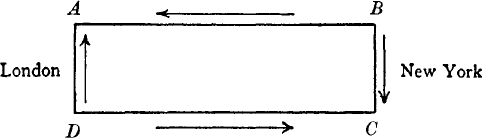
Finally, we may take the case mentioned above, in which buyer and seller are in different places, or different countries. Here payment (in ready money) requires a considerable time and, apart from the risk and trouble of actual transport, demands the withdrawal of a sum of money from circulation for a corresponding period. The real function of credit here is to create claims which, being immaterial, can be transferred from place to place unimpeded by limitations of space. For example A in London has a claim for £1,000 against B in New York, and C in New York has a claim for an equal amount against D in London. Instead of allowing two payments of the same amount to cross each other in mid-Atlantic, A and C, with the consent of B and D, exchange their claims, so that the money in question only needs to traverse the shorter distance between two business houses in London; and similarly in New York. In actual life this is accomplished, as we know, by a bill of exchange. B buys a bill which C has drawn on D—by which C is paid—and sends this bill in payment to A, who on the due date recovers payment from D. Here also it may be said that the velocity of circulation has been virtually accelerated since two payments at a shorter distance have been substituted for two at a longer distance.
All these cases relate to a series of obligations to pay which can be surveyed by the interested parties themselves and which can be replaced by one or more simpler transactions, just as in mechanics a polygon of forces or a corresponding series of transfers in space is replaced by the diagonal of the polygon. Thus in mechanics also it is usual to speak of virtual transfers; and just as mechanical equilibrium is achieved when the virtual transfers yield a resultant of nil, so economic equilibrium can be said to exist when debit and credit between two persons or within a group exactly balance, so that the money which would cancel these claims would revert to its starting point. If in such cases the use of ready money becomes quite superfluous, whilst metallic money still remains a measure of value for the payments in question, it may be regarded as an infinitesimally small amount of money circulated with infinite velocity in accordance with the formula 0 x ∞ (nil multiplied by infinity), which according to circumstances may signify any quantity whatever.
3. Forms of Credit
We shall now consider the various forms of credit and their importance for money. It is clear that simple credit, as between individuals, has only a very limited influence as a substitute for money tending to accelerate the velocity of circulation. Here the discharge of claims or debts as well as the exchange or transfer of claims is only the exception. Credit for goods is certainly very common between individuals, but it is combined, especially over longer periods, with difficulties and risks. Finally, loans of money between individuals, as we shall show, can never occur to such an extent that they make cash holdings superfluous. The functions of cash holdings, as has been pointed out, are twofold; or, more correctly, every cash holding consists of two parts, (1) cash in the literal sense, ready cash, for meeting foreseen but not immediate expenses, and (2) reserves for unforeseen expenses. In the latter may also be included money saved and awaiting profitable investment. Obviously I can only lend the former if I am certain of getting my money back at the right time, when my anticipated need for the money arises. But this period is usually too short to be of any advantage to the borrower. Still less, of course, can I lend my reserve unless I am confident of my ability to borrow at the same or even better terms in case of need. In addition there is the risk that I may not recover my money at all, a risk which cannot be measured by the mathematical law of probability; a loss of Kr. 1,000 for a person of small means is undoubtedly more than one hundred times as great as a loss of Kr. 10. The former might bring him into great distress, indeed ruin his economic position. Compensation by way of interest, even if, objectively, it fully covers the risk he runs, or thinks he runs, can therefore not cover it subjectively. For these reasons then, in countries where organized credit, banking, and stock exchange facilities are comparatively undeveloped, the necessary cash holdings will be many times greater and the turnover will require large quantities of money.
In civilized countries this is especially the case. In France P. Leroy-Beaulieu estimated some years ago the whole metallic currency of France at 8½ milliard francs, whilst the whole national income, corresponding to the total value of the goods and services annually consumed, were estimated at 25 milliard francs. Even if we assumed, with Leroy-Beaulieu, that these values, i.e. of the necessaries represented by income, including raw materials and depreciation were turned over three or four times, which seems to me excessive, then the average velocity of circulation of money would scarcely exceed one purchase and one sale per month for each coin. In Great Britain the volume of money is much less, certainly not half as great—even though the English banks have recently kept much larger gold reserves than was formerly customary—and the total amount of business considerably greater, so that the velocity of circulation is much higher owing to the highly developed organization of credit.
Organized credit tends to reduce risks by spreading them over a wider area; the subjective element of risk disappears in proportion as the wealth which affords the guarantee is great in relation to the amount at stake, so that only the mathematical risk remains. In this way, and also through the centralization of credit facilities, it helps to make loan transactions safe and convenient. The very documentation of credit transactions in the form of credit instruments, their transfer to others and eventual conversion into claims for payment, valid in the hands of each holder, creates a powerful organization which it has required thousands of years to develop. Every recipient of such a credit instrument usually takes over at the same time the risk of non-payment, though perhaps only for a shorter period, since he counts on passing on his claim at an early date to another. In ordinary business transactions security, and therefore its range of application as a means of credit, is increased partly by quicker execution, partly by the fact that each new endorsement, each new name on the bill, is as a rule a new guarantee for the regular honouring of the bill. In this way not only is the risk of the recipient of the bill reduced, but he is enabled at any moment to dispose of or to obtain money for it. In other words, the bill of exchange, if it bears good names, serves almost as well as a cash reserve as actual ready money. In this manner, especially in earlier times, bills of exchange drawn for business transactions between the great trading houses were used during the period before maturity in ever widening circles as a common medium of payment, whilst being successively covered with a mass of names, for which there was often not enough room on the back of the bill, and which were guarantees that the last holder, whoever he might be and whatever happened to the acceptor, would certainly get his money.
4. Banking. Some historical notes on the origin of banking
The highest forms of credit organization, however, are the stock exchange and banking system, especially the latter. Here we shall make no more than occasional reference to stock exchange activities. The real concern of the Stock Exchange is with long term credit, fixed capital investments, government stocks, shares, etc., whereas the credit directly associated with money as a medium of exchange is short term credit, and is the immediate concern of the banks. Yet it should be noted that the boundary line between the two is fluctuating. Just as it is the function of the banks to consolidate short credit, in other words, to create as it were one long credit out of a number of short credits, so, on the other hand, it is the function of Stock Exchange speculations, which are so often misunderstood, to mobilize fixed capital by creating a permanent market for long term capital investments, and, like every other credit organization, in the dual form of centralization and insurance against risk. In our days banking and stock exchange activities merge into one another more and more as a medium of exchange and payment, especially in international settlements.
We must, therefore, devote all the more attention to the banks, which are in fact the heart and centre of modern currency systems.
The origin of banks is not known with certainty. We may take it for granted that banking operations, i.e. the combining of the borrowing and lending of money, have been conducted by wealthy persons since the earliest times. A speech of Demosthenes (Phormio) is often quoted, from which it appears that such banking operations were conducted by wealthy people in Athens. Similarly, in The Captive of Plautus we read,
“subducam ratiunculam quantillum argenti mihi apud trapezitam siet.”
A “trapezita” (trapeza = table) was a person who received money on deposit, though it does not appear from the passage whether he paid interest on it. In the Middle Ages such movements of money were frequently associated with the functions of the money-changers, of which the name (bill of) exchange is a survival. In London the goldsmiths were the first bankers and dealt extensively in money at the time of the foundation of the Bank of England. On the other hand, the large banks which arose in the Middle Ages in Italy and in Northern Europe at the beginning of the seventeenth century (in Venice, Genoa, Amsterdam and Hamburg) had, initially at any rate, quite different functions from those of modern banks. Their chief task was to provide for a full-weight currency of guaranteed metallic content, or in other words a medium of exchange. Thus as regards the Hamburg Bank (1609–1873), the Hamburg mark banco was an ideal coin, of a certain weight of fine silver, which did not circulate, and which individuals deposited in the bank, and which the latter undertook to repay in the same weight of fineness. The great Hamburg merchants made it a condition of their sales that all payments to them should be made in this currency, and they discharged their debts to each other by means of drafts on their deposits at the bank. Such a bank was called a giro bank (giro = circle, in their case a circle of customers), but as it did not (in its original form, at least) lend out its deposits, it could therefore not pay interest, but on the other hand made a small charge on the deposits. These operations, therefore, did not lead to any economy in the use of hard cash. The sole function of the banks was, as has been said, to maintain the value of the currency; and this was difficult enough in times of incessant currency debasement, especially in the case of such a conglomeration of States as existed in Germany, where each one claimed the right to mint its own money. The other older giro banks had operated in the same manner. But one of the results of this system was that masses of money lay idle and useless. It frequently happened, therefore, that Governments utilized these assets in times of monetary difficulty by borrowing them from the banks, thus causing the money to return into circulation, either in corpore or in the form of deposit certificates which did not correspond to actual deposits in the banks. In effect, and contrary to the original plan, the banks became credit institutions, instruments for increasing the supplies of a medium of exchange, or for imparting to the total stock of money, an increased velocity of circulation, physical or virtual. Giro banking continued as before, though no actual stock of money existed to correspond with the total of deposit certificates. So long, however, as people continued to believe that the existence of money in the banks was a necessary condition of the convertibility of the deposit certificates, these loans had to remain a profound secret. If they were discovered the bank lost the confidence of the public and was ruined, especially if the discovery was made at a time when the Government was not in a position to repay the advances.
The history of the Amsterdam bank is remarkable in this respect. It was founded in 1609 and was intended from the beginning to be a pure giro bank, without the right to lend any of its deposits. Gradually, however, the curious custom mentioned by Adam Smith arose, by which the bank issued against deposits of metallic money or bullion receipts on the production of which the money could be recovered, and documents which certified a credit at the bank, bank money so-called, which could be used in all payments to the bank and consequently circulated between individuals as a means of payment throughout the country. The receipts, again, had to be renewed every six months and the prescribed commission paid, otherwise they lapsed and the money deposited became the property of the bank. The “bank money”, on the other hand, retained its character as a bank liability and therefore continued to circulate throughout the country. Consequently many merchants sold their deposit receipts or let them lapse and carried on equally well with “bank money” alone. Only when payment in metal became necessary, e.g. to foreign countries, were they obliged to procure valid deposit receipts, which could usually be obtained on the market at prices varying with demand and supply. The bank, again, regarded the lapsed money as its own property and considered itself free to lend it without any restriction. But in this way a corresponding amount of “bank money” was converted into mere credit notes without any metallic cover. It appears to have been the obscurity in this arrangement—especially uncertainty as to the bank’s obligation to redeem in regard to the amount of “bank money” in excess of the deposit receipts still valid—rather than real insolvency which brought about its downfall in 1795, when in consequence of political events its status became known for the first time.
The discovery that money deposited on a guarantee to repay on demand could be partially loaned without endangering the liquidity of the institution in question constituted, however, an important advance in banking technique, which in its turn led to the discovery of the credit note. For just as simply as deposits of money were accepted against a certificate of deposit and were then lent out to others, whilst the certificate of deposit might continue to be used by the owner as a medium of payment and be transferred to others, so also such certificates of deposit might be issued against ample security to persons who had not deposited any money in the bank. The result remained the same, both to the public and to the bank, provided that the solvency of the borrower and his credit status were the same in both cases. And yet in reality the latter method constitutes a further advance. If, for example, experience has shown that an amount corresponding to one-half the deposits or other credit certificates payable on demand and issued by the bank, is sufficient cover for them, then by the first method out of (say) Kr. 10 millions deposited in the bank, Kr. 5 millions might be lent and the virtual velocity of circulation would thereby be increased in the proportion of 1:1½. By the second method, again, the bank might issue credit notes for Kr. 10 millions for the whole cash reserve, Kr. 10 millions would remain in the bank, and would on our assumption be sufficient cover for payments of both the Kr. 10 millions deposit certificates and the Kr. 10 millions credit notes; in other words the velocity of circulation would be increased in the proportion of 1:2. Indeed, the gain would be still greater, for, other things being equal, the requirements of the banks grow relatively less in proportion as their business and their circle of clients increase.
The first use of the credit note is sometimes attributed (though its use is probably older) to the Palmstruch bank in Stockholm in 1656, which later became the Swedish Riksbank.1 What created the bank here was a need for some substitute for the clumsy copper which, except for an interval at the end of the reign of Charles XI and the beginning of the reign of Charles XII, remained the standard money of the country. The copper plates were deposited in the bank in exchange for certificates of deposit, which from the beginning were only valid against the bank when presented by the depositor, but which might subsequently be transferred to another person with the endorsement of the possessor—the so-called transfer notes. The difficulty in lending the copper itself probably directly led to the bank’s issuing credit notes instead, i.e. deposit certificates without any corresponding deposit. If this had only been done to substantial individuals under an obligation to repay, no inconvenience might have arisen, but since the State constantly borrowed from the bank without repaying, difficulties arose which even if not responsible for the insolvency of the bank a few years after its formation, subsequently in the “Age of Liberty” led to the necessity of absolving the bank from its obligation to redeem its notes, a suspension which lasted until 1776, when they were redeemed at one-half of their face value.
It was only some years later that the Bank of England was founded. It began its career in 1694 by lending to the State the whole of its wealth, £1,200,000. In exchange for this it obtained a privilege, which at first consisted in the right to deal in money as a joint stock company with limited liability. After repeated loans to the State it was in 1708 granted the right, as a company with more than six members, to issue notes. Smaller companies and private persons had already possessed this right in England. The loans to the State have never been repaid, and the Bank’s claims in this respect still constitute a considerable portion of its capital. In the strict sense of the word this bank has never been insolvent, but its metallic reserves fell so low at the beginning of the Anglo-French war that the Government saw fit in 1779 to forbid the redemption of its notes in cash. This was the beginning of the restriction period, which continued until 1821, when redemption of the notes at the full value was resumed by the bank.
On the other hand the banking institution which was founded on such fantastic principles by the famous Scot, John Law, under the regency of the Duke of Orleans in France in 1716, and which for a long time brought every kind of banking enterprise into discredit in that country, came to a quick end.
As in the case of the English bank, Law obtained this privilege by making loans on a large scale to the French Government, but when the bank’s means were insufficient, he endeavoured to obtain further capital by founding, at the same time, large business houses, of which the first was a trading company for the colonization of the Mississippi area. State bonds were accepted in payment of shares in this company at par, or 6 per cent above the actual rate at which they were then dealt in. The bonds were then handed over to the Treasury for cancellation. In this way the Company was almost entirely without working capital and was compelled to resort to a further issue of shares, for which payment was obtained by the bank lending money on the shares and issuing new notes to the amount of the loans. It is obvious that such procedure must soon come to a terrible end, for though the circulating metallic money of a country can be replaced by paper money, yet for the conduct of real business enterprise it is necessary to have real capital, acquired by real saving. The chief cause of the crash was, however, as in other countries at the same time (and not least in Sweden), the immoderate appetite of Governments for money and the contempt with which they placed themselves above ordinary business morals.
The only bank which carried on without severe misfortune was the Hamburg giro bank. Leroy-Beaulieu praises it in high terms and blames Bismarck for suppressing it in 1873. This praise does not, however, seem to us entirely in place. A bank conducted on such principles would be quite impossible as a modern central bank, as it is devoid of all elasticity. This proved to be the case in a fateful manner in the world crisis of 1857, which affected Hamburg severely. During the crisis the bank was bursting with metal, for everybody who possessed money or succeeded in acquiring it hastened to deposit it there, as all were afraid, under the prevailing general lack of confidence, to lend it out. Yet under its own statutes the bank was unable to assist the depressed business world by lending it.2
In a word, the early history of banks is the history of vague liberal principles, sometimes too narrow, sometimes absurdly exaggerated, but the bitter lessons which their history teaches us have not been in vain. Nowadays we are agreed on at least a number of points, though not on all, and we understand the real functions of these important, though sometimes dangerous, institutions.
5. Modern Banking
It is not my intention to give a detailed account of the technique and special forms of modern banking in different countries, but to refer the reader to the bibliography on those points. My purpose is rather to attempt to describe the theory of money, still so greatly neglected by political economists, and the great principles underlying the variable complex of monetary phenomena. We are also concerned here with banking and the system of credit, but only in so far as they influence monetary phenomena, velocity of circulation, the demand for money, the level of prices, and so on. The great part which, in addition to this, the banks play as promoters of credit, a function which may influence the whole of industrial life to a very high degree, will only be touched upon in passing.
We have already said that the old giro banks in Hamburg and Amsterdam did not originally provide credit. Lending operations were conducted by private capitalists or smaller companies, who received the capital of others for profit. In the course of development, the deposit or giro banks began to lend out deposits, and the private bankers combined in larger groups, so far as the law permitted. In both cases there developed the modern type of bank, whose most characteristic feature is that it accepts deposits both for repayment on demand (money at call, account, current, etc.) and on notice, whilst lending as large a part of these deposits as is consistent with safety, sometimes with, and sometimes without, the concurrent issue of their own banknotes.
Another important feature is that bank deposits and bank loans are almost always short dated, e.g. three to six months. Loans for a longer period are not supposed to be part of a bank’s activity—“a bank should only give the same kind of credit as it accepts” says Wagner; frequently it is forbidden by law to make long-term investments. This, however, is still a much disputed question, but without entering into the practical questions involved, it may be said that one of the most important functions of the banks is precisely to prolong credit, i.e. to assemble the credit which in the nature of things can only be given for a short or uncertain period of time and then because of the Law of Large Numbers, which we shall shortly consider, to convert them into more stable credit in the interests of borrowers and producers. The banks borrow sums of money repayable on demand, but they do not as a rule lend on such terms, or if they do, as in the case of the English joint stock banks, they do so only to a special class of credit middlemen, i.e. bill brokers, who themselves carry on a sort of banking business, and who in case of need can turn to the central bank, the Bank of England, to have their bills rediscounted. And even if the greater part of the loans is normally for a short period, the discounting of bills, for instance, yet in reality credit relations are made more stable by the prolongation of the bills or by the discounting of new bills for the same persons. After all, it is the rule that the bank turns away a customer whom it considers deserving of credit only if it is compelled to do so. If, on the other hand, a lender is in a position to lend his capital for a longer period, he does not require the assistance of a bank in the same degree, if at all. The borrower and the lender then have a better opportunity of getting to know each other, and the lender especially is able to inform himself concerning the nature of the business of the borrower, so that the risk is diminished or at any rate easier to estimate. Even longer dated loans, especially if they are very large, may require intermediaries, as when a State loan is floated—although it may be, and often is, effected by direct subscription—or when landowners over a larger or smaller area combine mutually to guarantee each other’s loans and thereby obtain better terms (mortgage associations and mortgage banks), or when large amounts of capital, especially from abroad, must be acquired for some branch of industry, such as town building plans, etc. But all these do not enter into banking in the narrower sense. Frequently enough, however, short date borrowing and lending by banks leads to stable credit relations between individuals which are subsequently maintained without the banks’ assistance. A builder, for example, with the assistance of a bank credit, may build a house which he later sells or mortgages in order to repay the loan. The persons who buy the house or grant a mortgage may perhaps previously have had money on short deposit at the same bank. In such a case they might be regarded as lenders or part owners, with the bank as an intermediary, in this transaction. The credit relation is then dissociated from the bank and becomes an independent one. In connection with bank investments the savings bank movement should be mentioned. The savings bank book, it is true, serves to some extent as a current account, but its chief purpose is to accumulate small savings which cannot be suitably invested separately in profitable enterprises, State loans (post office savings banks), mortgages on land or buildings, etc.
However important these various forms of credit may be, more important perhaps than the actual banking system, they are nevertheless far from having the same influence on currency. Credit will be created with or even without the intervention of a credit institution and will then remain possibly for decades. The money which has once effected a transaction, if indeed the latter was effected with ready money, has long since returned into circulation. But not so with short-dated loans. A person who can only dispense with his money for a few months cannot usually find a suitable borrower during that time and can still less investigate his reliability. The risk, especially the subjective risk, becomes too great, and the terms of the loan would therefore be too onerous. Without an organized regulation of credit such sums of money would therefore lie idle. A central organization where money can be borrowed at any time with the best security and at the same time where deposits are accepted at any time, then becomes of the utmost advantage. All money which can be dispensed with for however short a time ceases to be idle and credit relations (more or less indirect through the mediation of the banks) are introduced instead. For example, A, a merchant, requires goods but does not expect money for three months, when the retailer will pay him. B, a manufacturer, possesses goods, but requires money immediately for the payment of his workmen. A third person, C, possesses money but has no use for it for three months. Then A will buy goods on credit from B against a three-months bill; simultaneously C has deposited his money in the bank for three months. B discounts his bill at the bank and then obtains the money deposited by C, whom he has probably never seen or heard of before. He distributes this money among his workmen in wages and they gradually make their purchases from the retailer, who pays A in three months. A then pays the bank and the bank pays C. If, on the other hand, the bank had not existed, then either A or B would have been compelled to retain the amount in his safe and a corresponding amount would have lain idle with C. The saving in the circulating medium is, if possible, even greater when those parts of the cash reserves retained for unforeseen or current expenditure are confined to the bank. B in our example probably did not withdraw the whole sum derived from his bill of exchange, but left some standing on current account, so that one part of his money, lent by the banks at three months, also served its purpose in circulation.
At first sight it might appear that the borrowing of money which may be, and is often, reclaimed at any moment would be somewhat pointless. What can the banks do with it? it is asked. Experience shows, however,—although it has taken centuries to acquire and interpret this experience—that if the ready money of a number of individuals is aggregated in the vaults of a bank, it will lie there unused to a large extent unless the bank lends it out or makes some other use of it. The explanation of this apparent paradox is twofold. In the first place there is the Law of Large Numbers. Even if the bank’s customers were entirely independent of each other, the simultaneous withdrawals of their funds by all of them, or by the majority of them, would be one of the rarest of occurrences. The rule is that, apart from certain seasonal fluctuations, withdrawals and deposits roughly balance each other from day to day, and still in accordance with the same law, the difference becomes, in proportion to the volume of the turnover, relatively less and less, even if absolutely greater, the more extensive are the bank’s activities.
Starting from a simple hypothesis, incapable of proof, but confirmed by experience in the most varied fields, it has been possible to embrace all these phenomena in a mathematical law, the Law of Large Numbers, which lays it down that purely accidental variations from a certain highly probable average—e.g. an equal number of odd and even numbers in a continuous guessing of “odds and evens”—certainly increase absolutely the more often the experiment is made, but diminish relatively in proportion to the number of experiments, so that the variations increase only in the progression, 1, 2, 3, 4, 5, etc., when the number of experiments is increased in the progression 1, 4, 9, 16, 25, etc.; i.e. they increase as the square root of the number of experiments. Even with 100 such experiments the betting is even that the number of even figures will not exceed 53 or be less than 47. With 1,000 experiments there is the same probability that they will not exceed or be less than 500 ± 34.
Thus if experience shows that a business man must have a certain amount of money in hand in order to be reasonably sure that his reserves will not be exhausted within a year, then if 100 independent merchants had an account at the bank, the latter need only retain  of its total deposits in hand to be insured with the same degree of probability against the exhaustion of its reserves during one year. If again the bank, for greater security, retains two, three, or four times this amount, i.e. ⅕ — ⅖ of the total deposits, then the calculation shows, and experience fully confirms it, that the probabilities against exhaustion rise quickly in an enormous degree. If, for example, the betting is even that cash holdings to a certain amount will not be exhausted in a year, one can bet more than 4½ to 1 against a holding twice as large, and 142 to 1 against a holding four times as large, being exhausted under similar conditions. In the latter case, therefore, it would not occur once in a century.
In the second place, and if possible to an even greater extent, there is the operation of the fact that the customers of a bank frequently have direct or indirect business with each other, so that a withdrawal by one of them for the purchase of goods necessarily leads within a short time to a deposit by another after the sale. If the customers are in direct business contact the money need never leave the bank at all, but payment can be made by a simple transfer from one banking account to another. If we suppose for the sake of simplicity that all such business is concentrated in a single bank with branches in all business centres throughout the country and that the keeping of a bank account has become universal, a situation rapidly being realized in Scotland, for instance, where for many years at least a fifth of the adult population possessed banking accounts, then the position in the money market will be as follows. The whole monetary stock of the country will be collected in the vaults of the bank and will be, so far as internal turnover and business activity are considered, absolutely idle. All payments will be made by cheques drawn on the payer’s banking account, but these cheques will never lead to any withdrawals of money from the bank, but only to a transfer to the payee’s account in the books of the bank. On the other hand, the bank cannot lend in concreto a farthing of the money deposited with it, because it would flow back to the bank in the form of deposits as soon as it had been used. The lending operations of the bank will consist rather in its entering in its books a fictitious deposit equal to the amount of the loan, on which the borrower may draw, whilst the actual documents, e.g. a discounted bill, will be added to the bank’s securities; this is the so-called English system. Or it might open against real security or sureties a direct credit on which the borrower may draw cheques at will up to a maximum amount (the Scotch system, common also in Sweden). Thus in both cases payments will be made by successive drawings by the borrower upon his credit in the bank, and every such cheque must naturally lead to a credit with another person’s (seller’s) account, either in the form of a deposit paid in or of a repayment of a debt. The obligation of the bank to the public will thus still exceed its claims by the whole amount of these cash holdings, less the bank’s own capital. It is true that the banks need pay little or no interest on a large part of its debts to the public, as otherwise the money would have lain idle, yet nevertheless in its own interest it will be driven to seek a useful and profitable employment for the money lying idle year after year. This cannot be done within the country, however, except possibly for the gold industry, to which we shall return later, but we may assume that the bank succeeds in lending its surplus at interest abroad. This interest, which, if the bank were a Government institution, would naturally benefit the public, will of course be the only real economic gain on the whole transaction. If subsequently, in consequence of growing population and production, or the more extended use of money, more of the medium of exchange were required, this would be obtained quite simply by the bank increasing its discounting of bills or its lending in general, by which a corresponding amount of deposits would automatically flow in. The virtual velocity of circulation would thus tend to increase to infinity. A very small quantity of money would suffice for a very large business turnover.
To avoid misunderstanding it must be observed here that the above remarks only apply to a bank or a co-ordinated system of banks which has absorbed all the monetary transactions of the country. And even so it only applies to the internal turnover. If, on the other hand, the banks are more or less isolated from each other, as is actually the case, then each bank must be very careful not to extend its credit too far. Even if every payment in the country were made by drawing on bank accounts, customers of one bank would, as a rule, have business with customers in other banks. The cheques drawn by them would thus soon pass into the hands of those other banks and would be presented by them for payment in gold, or at best the bank would obtain on its current account with the other banks the same, or a higher, rate of interest than it had itself obtained on its loans. But simultaneously the other banks would thereby have an excess of demand and might with impunity expand their credit to the public further than before. Very much the same applies to the banking system in a country taken as a whole, as against the foreign money market, as we shall soon see.
E. Jaffé in his work, Das Englische Bankwesen (2nd edition) makes a sharp attack on the statement of the English writer Withers that the great majority of deposits in the banks arises from the loans granted by the banks, an opinion which in Jaffé’s view shows a confusion between “money as a medium of turnover” and “money as capital”. Yet formally Wither’s opinion can be easily defended. Even so-called fictitious deposits are real deposits; the borrower has acquired the right to withdraw the whole amount of the loan, and if he allows a part of it to remain in the bank, then clearly that part is obviously just as much a deposit in the bank as if it had been made by a third person. If the borrower had withdrawn the whole amount in order, for example, to purchase goods, and the seller of the goods had paid the money into his current account, everybody would have regarded this deposit as “real”, though in reality there is no difference between the two sums of money. Moreover, on the whole, bank deposits and bank loans must always march together. Which of them occurs first in time is of no importance, since the difference in time is only a few hours, or at most a few days.
On the other hand, the difference is great between deposits which are based on money saved, and are therefore intended for long date capitalization, and those deposits which consist of occasional surpluses of bank credits. Even if in the former case the savings are deposited in the bank for a shorter time only in order to be more permanently invested later, they reduce in a corresponding degree the current demand for loans, i.e. a corresponding portion of bank claims is thereby finally paid in—as in the case of the builder above, who can now sell his house or obtain a mortgage on it—so that the money would lie in the bank as though withdrawn from circulation and therefore would not influence prices unless the bank itself resolves to make this increase of its cash the foundation of further lending. In the two other cases, again, the occasional deposits will stimulate a much quicker turnover, the virtual circulation of money will be accelerated, and prices within the country will rise to a height which will affect unfavourably the balance of trade and the foreign exchanges, so that the banks may find themselves compelled to raise their interest rates to prevent gold from leaving the country.
This process will be made clear in the following pages.
6. The “Ideal Bank” and the Obstacles to its Realization
The ideal banking system sketched above has in recent times engaged the attention of many writers under the name of “universal comptabilism”, and various proposals for its realization have been made. That developments tend in this direction is clear. We need only look at the English, German, and American banks with their “clearing houses” and the extensive cheque business of the Austrian post office savings banks throughout the country, etc. Theoretically this imaginary system is of extraordinary interest, in so far as it provides a very important means of appraising the factors influencing the value of money, with which we shall be concerned in the following main section of our work. What prevents its realization in practice, and must continue to do so, under existing conditions, is not so much the difficulties of effecting a centralization, for these might be progressively overcome, but rather the following three circumstances: (1) the special requirements of small payments for wages, retail trade, etc.; (2) international payments; and (3) the circumstance, with which we have so far concerned ourselves very little, that the precious metals, in addition to their use for currency, are also the raw materials of certain industries. This function, which is at present of subordinate importance, might, in proportion as the metals ceased to be used for currency, become of primary importance and dominate the situation, with the result that the precious metals, and especially gold, would become unsuitable as measures of value. We shall consider these points separately in the following pages.
A. Small Payments. Banknotes.
Not all payments can be made by cheque. Some are too small for the purpose, though for them token money usually suffices, so that they do not affect the question of standard money. More important is the fact that the majority of purchasers have not sufficient credit or are not sufficiently known to the sellers for the latter to accept their cheques without inquiry, even if we assume the system to be so highly developed that even the poorest have a banking account. This difficulty might be overcome if cheques were in such a form that they themselves carried a guarantee that the sum in question was actually deposited in the bank. For this purpose they should be issued for round sums by the banks themselves and should be so designed that they could not easily be imitated or forged. Such cheques have, in fact, been in existence for more than two hundred and fifty years. They are called banknotes. In reality a banknote is nothing else but a cheque, a certificate of deposit of a certain amount in the bank. Whether it is a question of an actual deposit or a fictitious one, in other words, whether the banknote was originally exchanged for hard cash or was issued in the form of an advance to a customer is here, as in the case of cheques, of no importance, since in both cases the bank is responsible for payment or redemption of the note, which as a rule is sufficient for the receiver. Indeed, it is as a rule more than sufficient, for the certainty that other people will accept the note in payment is good enough. That banknotes are not made out to order is also of no importance, for the guarantee lies in the note itself. In some countries, England for example, it is quite customary for the person tendering a note to give a further guarantee to the receiver by endorsing his name. When the note is accepted in payment and remains in the possession of the recipient its significance is, as we have said already, virtual, i.e. it has the same force and effect as it would have had if he had himself deposited the amount in question in the bank against the receipt of the note, or rather had allowed the sum to remain there on his account instead of immediately withdrawing it.
The fact that a cheque and a banknote are in essence the same has recently been noted by several writers on money who, not without reason, have pointed out the inconsistency of the numerous restrictions recently imposed on their note issues by States who have, on the other hand, taken no special steps to secure the prompt payment of cheques in currency.
It must be admitted, it is true, that there is a not unimportant difference between cheques and notes. Notes, especially those of lower denomination, remain in circulation for indefinite periods and are largely in the hands of persons not in a position to inquire into the solvency or liquidity of the bank in question; and to that extent it is natural that the public should watch more carefully over the convertibility of notes than of cheques. But the principal explanation of the differences in legislation in the two cases is historical. Severity as regards the issue of notes is to be regarded as a reaction against the fatal abuses of earlier times, for which abuses the State itself was nearly always chiefly responsible, not least in our own country. On the other hand it should be said that cheques, or, more correctly, those deposits (“repayable on demand”) which give rise to cheques, are more dangerous than banknotes, at any rate if the latter are guaranteed by the State. For if a bank fails the owners of deposits in the bank will find themselves in difficulty, and will at least be unable to make immediate use of their deposits. Banknotes, on the other hand, may be given a forced currency, i.e. may be declared legal tender instead of money—our own Riksbank notes are legal currency whether or not they are redeemable by the bank—and retain, as experience shows, at least a part, and frequently the whole, of their value. This happened, for example, in France in the years 1870–4, when the French notes were made legal tender. Moreover the use of cheques presupposes a certain amount of confidence between individuals, for which reason it has been shown that in times when confidence is lacking, as in crises, the demand for a medium of payment turns more than otherwise towards hard cash and banknotes.
Without entering any further into the questions of banking technique to which we have here referred, it may be asserted that in a country such as ours, where notes of lower denomination may be issued, and where in consequence the standard money, gold, scarcely circulates at all in ordinary business, the metallic stocks of the bank are used exclusively as a reserve for eventual payments abroad and, so far as the normal demand for a medium of exchange is concerned, might with impunity be restricted to as small an amount as desired.
The position is quite different where the lower denominations of notes are expressly forbidden by law, as in England and France and Germany (with the exception of a limited amount of State Reichskassenscheine).3 Not only does this compel the employment in ordinary business of quantities of hard cash (gold), but also bank reserves are drawn upon to satisfy the internal demand (cf. p. 14). If commodity prices rise, or the turnover of money is increased, then internal settlements require more hard cash, which must in the first instance be met by the withdrawal of deposits, without any corresponding payments into the bank from other sources. And since private stocks of cash, though small, amount in the aggregate to many times the amount lying in the banks, it follows that even a small percentage increase in the public demand for hard cash must lead to a relatively much greater strengthening of the metallic reserves of the banks. In addition, however, not only is more hard cash required in such periods, but also more notes and more of the media of exchange in general. However strict the regulations for the redemption of notes may be, therefore, they will be of little use. What is really of importance is that the banks should possess sufficient reserves of the medium of exchange for use when required, as we shall demonstrate later on. In expert circles the view is becoming more and more widely held that the various systems of note convertibility are only of value in so far as they compel the maintenance of such a reserve. If notes of lower denominations were permissible, then for all internal requirements this reserve might without any risk be composed only of notes, i.e. of unused bank credit, whereas in the countries mentioned it must necessarily and essentially consist of hard cash. The note reserve of the “banking department” of the Bank of England can at any time be converted into gold in the “issue department”. In writings on money from the middle of last century we not infrequently find it laid down as a condition of a sound currency that large amounts of hard cash must be in circulation, yet it is difficult to understand the foundations of this reasoning. It would perhaps be truer to say that under present conditions this would be a source of weakness and disquiet, and there can scarcely be any doubt that if a country has at its disposal a certain quantity of gold currency, its currency will be much more sound if that gold is collected in the vaults of the bank than if it were distributed among individuals; for in the former case it is incomparably more accessible, for example, in case of necessity for payment abroad.4
We shall now pass on to the second of the above-mentioned obstacles to a currency without metallic money, i.e. the need for the precious metals in international settlements and the maintenance of a standard of value common to all countries.
B. International Payments. Balance of Trade and Balance of Payments.
There are in a country at any given time a number of persons who have claims abroad and who have debts abroad. represent personal business transactions and consequently do not affect that country as a whole any more than do internal business transactions of the same amount, yet they nevertheless sometimes affect the currency of the country and have to some extent the same effect as if the country as a whole had these claims or debts abroad. The relation between the total of payments claimed and the total of debts due, at a certain moment or within a certain period, is called the balance of payment. It is said to be favourable if the claims exceed the debts, and unfavourable in the contrary case. Most of these claims or debts arise, of course, from trade, from the import or export of goods. For that reason it has long been customary to regard the total of a country’s foreign relations arising from current trading as a unit by itself under the name of balance of trade, and this is said to be favourable or unfavourable according as the value of exports exceeds that of imports or vice versa. In considering practical questions involved, however, we must remember that the balance of trade only constitutes one part, though usually the most important, of the balance of payments. Indeed, as it is usually drawn up it does not even include certain obligations arising directly from that trade, in particular the earnings of shipping. Imported goods become more expensive because of freight costs, but exports are usually taken up in a country’s statistics at their value at the port of shipment, or f.o.b., though the foreign country must, of course, also pay the freight on them. Thus, if a country has carried about one-half of its imports and exports in its own vessels, whilst the other was carried in foreign bottoms, then its total debts abroad on merchandise account fall short of the declared value of its imports by one-half the cost of their freight5; and conversely, its total claims on foreign countries for goods exported exceed the declared value of those exports by one-half their cost of freightage. From this arises the apparent paradox, frequently commented upon, that the combined imports of all countries considerably exceed the combined exports in value; for even if a country’s claims and debts abroad on merchandise account actually balance, they will nominally exceed the debts by about the total gross profit of the country’s outward shipping.
In the year 1912 this amounted in Sweden to Kr. 106 millions, of which Kr. 40 millions were from freights between foreign ports. Imports and exports in the same year were Kr. 783 and 760 millions respectively. We should therefore in that year have had a real export surplus in the balance of trade. Moreover, we must not forget that the statistics of trade are themselves still very imperfect, despite all improvements. In particular, export statistics, for obvious reasons, leave much to be desired and are as a rule probably underestimated in value.
It was, in fact, a gross misunderstanding of this kind with regard to our trade turnover with Norway which lay behind the argument of those who zealously advocated and finally achieved the annulment of the so-called inter-State law, thus contributing more than anything else to the dissolution of the Union.
But in addition there are a number of other items necessary for drawing up a complete balance of payment, some of them on the debit side and some on the credit, which can here be mentioned only in passing. If a country has large capital investments abroad, e.g. in foreign Government securities, bonds, shares, or other direct capital investments, then naturally the annual interest accruing is an item of credit from abroad, and that country can for years continue to import far more than it exports without injuring its position relative to foreign countries. It may even improve it—Great Britain is, or at any rate has been, a conspicuous example—in so far as a debtor country may have an apparently very favourable balance of trade and yet become year by year more heavily indebted. If, as is usually the case, shipments of the precious metals, or of coin, are not included in the balance of trade, the latter must of necessity be somewhat misleading. A gold-producing and gold-exporting country habitually has an apparently unfavourable balance of trade, for as a rule it exports less of other goods than it imports. Most countries, on the other hand, which normally import gold always have on that account a relatively favourable balance of trade on an average since the gold must be paid for year by year with goods, so that a surplus of goods flows out and gold flows in. Finally we should include the sums which travellers take with them or have remitted abroad and spend there—and vice versa. A special category is the money taken out or sent home by emigrants—a not inconsiderable sum in the case of Sweden—also inheritances and testamentary bequests, as well as loans, to and from foreign countries.
The inclusion of the Nobel estate had the same effect on our balance of trade as if we had in that year borrowed some thirty millions from abroad. The prizes therefore which are now annually distributed, mostly to foreigners, from this fund are similar to the annual interest on such a loan.
All these items combined constitute the foreign balance of payments. If it is unfavourable, then either (1) the excess claims of foreign countries must be prolonged for a shorter or longer period, which is tatamount to the contraction of a debt to a foreign country, or (2) a corresponding amount must immediately be shipped, for which purpose the accumulated stocks of precious metal can be used. Banknotes can also be used as a means of payment and in fact are so used on a large scale by countries with an inconvertible paper currency—an example was the well-known rouble exchange in Berlin, now extinct—but, whether convertible or not, they cannot be accepted at their full face value, since as they are not legal tender there, they must be taken by the foreign receiver as a speculation until they can be employed in payment of goods imported from the issuing country; and meanwhile they carry no interest.
This protraction or consolidation of outstanding trade debts occurs daily in various forms, usually with the assistance of the banks. The banks nowadays take the lead in all international business, and they are doing so more and more. If there is a shortage of suitable bills, some bank will sell to the importer of goods a draft or cheque on its account with some foreign bank, and when its account there is exhausted it will replenish it by borrowing or by the sale abroad of securities, all of which, from the point of view of the country as a whole, is the same as a new debt abroad, an increase in the difference between the outstanding debts and current claims on foreign countries. Or a direct foreign loan may be negotiated, often with bodies not engaged in international trade, such as the State, mortgage banks, etc., and ultimately for quite different purposes, but with the immediate result that a breathing space is gained in respect of the payments falling due, until exports are increased or imports decreased. For example, Swedish coffee importers accumulate large stocks of coffee, but in consequence of bad times, low prices for timber and so on, less coffee is consumed than usual. At the same time, perhaps, the State raises a railway loan abroad; the railway workers, paid by the State, buy milk, bread, potatoes, etc., as well as coffee, in the neighbouring villages. The rural population thus acquires money for the purchase of coffee, and the coffee importers can now, with the assistance of the banks, obtain drafts on the amounts which, in consequence of the loan, the State has to its credit in foreign countries, i.e. on the portion of the loan not yet called up. The real result will be that foreign countries have given us credit in the form of coffee, and we have used this coffee for productive purposes, i.e. for the direct (or indirect) payment of railway workers. When the railway is finished the population of the interior may be enabled to sell butter to foreign countries, exports will increase, and in the meantime coffee dealers may perhaps have prudently reduced their imports, so that all will be well again.
It is only when such a protraction of external debts cannot suitably or rapidly be effected that shipments of metallic money come into question. In order to appreciate the conditions, as well as the process and effects of such action, it is important to bear the following in mind. Vis-à-vis the goods imported from abroad there is always alternatively a consumer who, in order to obtain possession of the goods, offers an equivalent value, i.e. goods of the same exchange value saleable directly or indirectly to the foreign country. To pursue our example further: the coffee importer sells to the rural trader, the latter to the farmers, who in order to obtain money for the purchase of coffee sell cream to the dairies, whereupon the latter sell butter to a butter agent or exporter.
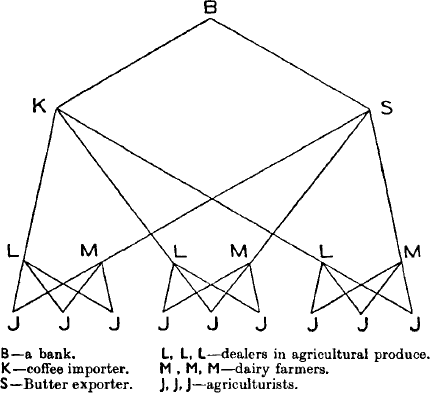
The money which facilitates all these exchanges circulates incessantly within the country. For the coffee importers regularly hand over the money they receive from the rural traders to one or more banks in exchange for the drafts or bills: and similarly the banks obtain foreign bills from the butter exporters, who receive in exchange the money equivalent with which the latter pay the dairies. The coffee indebtedness to Hamburg is paid all the time by butter bills drawn on London or Newcastle and these bills are subsequently used for payments as between Germany and England.
Therefore, since people as a rule endeavour to improve, or at any rate to maintain, their economic position, a surplus of debts or of claims outstanding can really only be conceived on one of the following assumptions. A public calamity or an adverse crisis may occur as a result of which the goods saleable abroad are available in smaller quantities or at lower prices than usual, or else the customary imports rise in price considerably, as recently happened in the case of coal, or finally, consumption goods such as grain, usually produced within the country, must be imported to a larger extent than usual owing to a bad harvest or other circumstances. The simplest and most obvious result would then be, in the first two cases, that the consumption of foreign goods, and consequently their importation, would be correspondingly reduced, or, in the last case, that the extra imports of grain now necessary would be counterbalanced by a decreased importation of other articles. In consequence of persistent drought, for example, the production of milk is less than usual, the dairies reduce their output of butter, and the farmers therefore receive less money with which to buy coffee; or the price of timber falls, and with it the wages of the timber workmen who are forced to consume less of the agricultural products of other parts of the country than usual and possibly obtain them at a lower price, all with the same result to the farmers: reduced capacity to buy their usual articles of consumption, including coffee. If the rural traders and the importers of coffee had been able to foresee these results, their imports of coffee would have been counterbalanced by a diminished demand for remittances for coffee imports. But it so happens that they already have their stocks for the immediate future; the result is a demand for additional means of payment abroad, which must be found in one way or another. But by the following year the disparity will already have corrected itself automatically, in so far as the inflated stocks will lead to diminished imports, whilst the export of butter, under favourable circumstances, resumes normal proportions, or timber fetches normal prices. With a normal supply of bills, therefore, there will be a decreased demand for remittances in the following year, the position relative to foreign countries will improve, shipments of precious metal abroad, if they have been made, will cease, and give way to the import of metallic money, and everything will resume its normal course. It may indeed happen that the demand for foreign goods, such as grain, is so great during a famine year that a restriction in the use of other imported goods cannot fully make up the difference. In such a contingency, of course, individuals must obtain credit for consumption purposes, which in this case has the same effect as if they had consumed their own capital. Directly or indirectly the increased demand for credit is satisfied by the great credit institutions, and since the money thus lent is soon returned to the banks, to be exchanged for foreign currencies, the position in relation to foreign countries will be the same, i.e. unfavourable. But even a credit for purposes of consumption will in the nature of things be of short duration. The worsening of the individual’s business position must be remedied, and is remedied, partly by diminished consumption and partly also, no doubt, by greater intensity of work in the immediate future, the more so if the State or other great corporations are able to employ their foreign credits for the future benefit of industry, whilst at the same time assisting in the correction of the increased requirements of consumption and the balance of payment.
Our purpose here is merely to point out the fact which is often forgotten that an unfavourable balance of trade or payments undoubtedly corrects itself automatically in most cases by the steps taken by individual consumers and producers and this, too, without any serious disturbance of the price or credit structure, or, indeed, any influence on the currency other than, at most, a temporary shipment of a part of the gold reserves. A raising of the bank rate would only tend to hasten a process which would occur automatically in any case, even though more slowly.
But an unfavourable balance of payments may also develop under conditions which will render necessary the direct influence of the banks on the money market in order to restore equilibrium, because disturbances have been occasioned by abnormal conditions in the money market. This may occur especially during periods of exaggerated speculation and large capital investments for productive purposes, and it is connected with the peculiar circmstance that productive capital is nowadays almost always transferred in the form of money through the monetary institutions. As was shown in the first volume, practically all production requires, in addition to labour and land, capital, which is really so much saved up labour and natural resources. If capitalistic production is increased or the capitalistic character of production is intensified, in the last analysis it means that an additional amount of labour and land is withdrawn from the current production of immediate necessities in order to be employed instead in production intended for consumption in a more or less remote period. But if the accumulation of real capital, i.e. actual saving and the restriction of present consumption, accompanies the increased demand for labour and land intended for future consumption, then no immediate disturbance of the relation between the supply of, and demand for, the means of production and especially no occasion for an unfavourable foreign balance of payment will arise. In the contrary case the capital which cannot be obtained in sufficient quantities within the country must be obtained abroad. This is often done directly. The person desiring to start a capitalistic enterprise first borrows money from abroad, which means that in reality he obtains from abroad partly tools, machinery, and raw materials on credit and partly certain necessities which directly or indirectly pass to the workmen employed in the enterprise and to the owners of the necessary land. For example, the State raises a foreign loan for railway construction, or a private railway company does the same thing, or such a company obtains a loan from the State, which itself isues its bonds abroad, or neighbouring landowners subscribe for shares in the enterprise and obtain the necessary means by a mortgage, which we will assume ultimately to come from abroad. If this is done there will be no immediate debt due abroad and consequently no disturbance of the equilibrium of the balance of payments until the enterprise is complete. If it does not come up to expectations, the consequence will be either bankruptcy, in which case the foreign country will have to write off its claims, or else private persons within the country, for example taxpayers as against the State, will have to economize in order to procure the necessary means for the interest and amortization of the loan. Even in that case, therefore, there need not necessarily be an unfavourable balance of trade or payments.
But it may also happen that the enterprise was started with no means other than a bank loan; the entrepreneur perhaps submitted a debenture loan, which the home banks took up at a certain price with the object of issuing it themselves, though they have not yet succeeded in doing so. Or, what amounts to the same thing, the shareholders have obtained the money for their subscriptions by a loan from the bank, or else deposits have been withdrawn from the banks in order to be converted into shares or debentures in the new enterprise, these deposits being deposits on the retention of which the banks had counted and with which they had granted loans to other persons. In other words, the money or credit to be used in effecting the transfer of the necessary capital comes into circulation and exercises its purchasing power without any corresponding accumulation of real capital. A larger portion of the available land and labour than usual is employed for future production, and a lesser part than usual remains for supplying the present demand for necessaries, though the demand for them has increased rather than diminished, since the increased demand of the entrepreneur for land and labour has presumably led to an increase of wages and rent. If the country had been isolated, then, as we shall show later on, economic equilibrium would finally have been achieved notwithstanding a more or less pronounced rise in the prices of all necessaries. Entrepreneurs would have had to pay more for their raw materials, machinery and tools, etc., and future creation of the means of production they contemplated would be kept within narrower limits than the purchasing power of the money they had obtained might at first lead them to believe; but at the same time the price of all consumption-goods would also rise considerably, all incomes would buy less than usual and everybody irrespective of his income, would be compelled to restrict his consumption, and this enforced restriction would in fact constitute the real accumulation of capital which must under all circumstances be achieved if the total means of production for future consumption are to be increased. In reality, however, this is not exactly the process, but the superfluous money purchasing power goes abroad instead, whither it is directed by a relatively slight rise in prices in the home market. Raw materials, machinery, and some necessaries of daily consumption are drawn from abroad; but since no simultaneous decline has occurred in the otherwise normal imports from abroad and no increase in the exports to foreign countries, but if anything the reverse, the balance of trade will necessarily soon turn to the disadvantage of the home country.
Even so, serious inconvenience need not arise. The banks may possibly be able to borrow capital abroad on favourable terms or induce foreigners to deposit their capital here. If the foreign rate of interest is considerably lower than at home, then the procuring of foreign credit is indicated and is nearly always effected automatically. In that way the balance of payments reaches equilibrium for the time being, in spite of the “unfavourable” balance of trade. The effects, good or bad, only appear in the future, according as the enterprises requiring increased capital prove profitable or not.
But if the home banks have lent money at about the same, or even a lower, rate of interest than they themselves can borrow abroad, so that in consequence a prolongation of the surplus of trade debts becomes economically impossible or disadvantageous, then by means of the mechanism which we shall now proceed to examine, money, bullion, will necessarily begin to flow out of the country, and in that case it will not return of itself, for there exists no direct reason for the public to restrict its consumption. The reversal of the flow of gold requires special measures on the part of those who control the currency of the country and who have brought about what has happened through their own imprudent credit policy.
C. The Foreign Exchanges.6
The first symptom of an outward flow of gold is a rise in the rate of exchange on foreign countries. The great majority of international purchases and sales are made on long or short term credit, and so long as the claims arising from them balance each other international payment is made, directly or indirectly, by a cancelling out of claims. Considered in greater detail payments abroad may be made in one of two ways. Either the debtor allows the creditor to draw a bill on him, which the latter can subsequently use to effect payments in our market, though he usually sells it to persons in the foreign market who have debts to pay in Sweden, and obtains money for it. Or the buyer can undertake to send to the seller abroad a corresponding value, either in gold or bills of exchange payable in the country of the creditor, and which consequently have a fixed value there, at any rate up to the time on which they fall due. The former is called payment by acceptance and the latter by remittance. There is also a third method, which is really a combination of the two and which is much employed for payments at a great distance, namely reimbursement or indirect acceptance. A person in Sweden desiring to purchase goods from the Argentine arranges with a bank or a large business house in London for the Argentine merchant to draw on it for the amount of his claim; before the bill falls due the Swedish purchaser must reimburse the acceptor, e.g. by bills payable in England which he purchases in Sweden. Such bankers’ intervention also occurs, and to a steadily increasing extent, in the exchange of goods between neighbouring countries. If, for example, a person who enjoys no credit abroad has ordered goods there, payment is usually made by sending invoice and bill of lading to a bank here for payment, and after the purchaser has deposited the agreed amount the banker sends the seller a draft drawn on its credits abroad.
The essential difference between acceptance and remittance is obviously that in the former the purchaser has only bound himself to pay at home in the currency of his own country, whilst the seller accepts the risk and the trouble of transporting the money. With remittances, on the other hand, the purchaser undertakes to pay abroad in the currency of the seller, and the cost and risk of transport now fall on him. Sometimes, of course, a bill may be drawn in the currency of a country other than that in which it is drawn, but in that case it is usually to be regarded from the acceptor’s point of view as a promise to remit. According to the Swedish Exchange Law, Section 35, he must pay in Swedish currency according to the current rate of exchange, which is the same as saying that he must purchase bills of exchange on the foreign country to the agreed amount.
If there is equilibrium between the claims and obligations of a country abroad, this difference between acceptance and remittance is of no importance. If, for example, the merchants in one country are accustomed to make all their debts abroad payable by acceptance, and all their claims by remittance—as is very largely the case in England—then creditors abroad simply sell their acceptances to those who have to make payments to the country in question; this is the procedure in international bill of exchange transactions usually laid down in the textbooks. The procedure is the same if on both sides some claims have given rise to bills of exchange and some to promises of remittance. If, on the other hand, all, or the major portion, of the debts in both countries is payable by bills of exchange, then in both countries there will consequently be a number of sellers of bills, but no, or at most a few, buyers, for most buyers have undertaken to pay their own acceptances at home in their own offices, or at a home bank, on the date they fall due; and they therefore have no need to buy bills. This, however, does not cause a fall in the rate of exchange, but the matter is so arranged that some sellers in order to obtain their money, send their bills abroad for payment, or, if they are not due, have them discounted at the bank. In this way the supply and demand for bills soon reach equilibrium. If, on the other hand, all or most of the debtors in both countries undertake to pay by remittance, which might easily happen in countries which have only just entered into business relations with each other, and in which mutual knowledge and credit as between merchants is not extensive, then the immediate effect will be that a number of buyers of bills will exist on both sides; the sellers, on the other hand, will then have no bills to offer, for they have instead the promise of payment at home in their own currency. But in such a case a debtor here (an importer) can find a friend abroad to draw a bill (so-called accommodation bill) on him or on a bank here, which he will reimburse. This bill will then be in demand abroad, and will be sold at a profit. The original creditor abroad will receive payment of the sale price, and when the debtor at home pays his accommodation bill or reimburses the bank he will have definitely discharged his debt.
If there should be an excess or shortage of bills in our market, this will not affect the rate of exchange if at the same time there is an excess or shortage abroad of the bills drawn on us, for the remedy is very simple. If there is an excess we can cash the bills abroad and purchase bills drawn on Sweden. If there is a shortage, we can draw accommodation bills or reimbursements. If, on the other hand, there exists a shortage in one place, say Sweden, and an excess in foreign countries, the matter becomes more serious; no merely formal credit operations can be of use, because there is a real deficit, and if this is not met immediately by securing a loan abroad for a longer period, i.e. a prolongation of the debt, the necessary consequence will be that the demand for bills at home will begin to exceed the supply and, conversely, abroad the supply of bills drawn on one country will exceed the demand; the rate of exchange for foreign bills will rise here and the rate of exchange for our bills abroad will fall simultaneously and, when this has gone far enough, it will be more to the advantage of a debtor in Sweden to obtain gold and send it abroad then to buy bills at the high rate of exchange; and our creditors abroad rather than sell their bills below face value will send them here to be cashed or discounted and have the proceeds sent in gold, since the purchase of foreign bills in our market would also be too costly. Thus gold will begin to flow out of the country. Frequently gold shipments are made to persons who make it their profession and who draw bills on foreign countries for the amount sent and sell these bills in the home market.
A country threatened with this fate is said to have an unfavourable balance of payments. Before we proceed further we shall consider for a moment the meaning of this term, which is often misunderstood. It is clear that a high rate of exchange is in reality only unfavourable to those who have debts to pay abroad, and that only when they have contracted to pay by remittance. If, on the other hand, they have allowed themselves to be drawn upon abroad, they are more or less unaffected by fluctuations in the exchange. Similarly the rate of exchange is unfavourable to those who presently intend to purchase from abroad, since the seller, in view of the difficulty abroad of disposing of his bills drawn in our country, must demand payment by remittance or demand a higher price for his goods. On the other hand, the same rate of exchange is clearly favourable to sellers, especially if they themselves have drawn on foreign countries bills which they can now advantageously dispose of in the home market. If, on the other hand, they have stipulated for payment by remittance they will also be unaffected by fluctuations in the exchange. So also the exchange is favourable for the person who presently proposes selling his goods to a foreign country, as he will receive more for the bills which he draws on foreign buyers. In former days, when exchange rates fluctuated much more than they do now, and even to-day as between countries with a different standard (bullion or paper), the above circumstance constitutes an important corrective tending to restore the balance of payments. Between countries with the same metallic standard, on the other hand, the fluctuations of the exchange can nowadays amount only to a fraction of one per cent and therefore play a very unimportant role; but in any case the gain or loss falls only on the individual contracting parties, whilst the country as a whole is not affected.
This is at any rate the position if, as often happens, payments by acceptance and remittance are so distributed that takers of bills drawn on foreign countries are present in sufficient numbers in the country itself. If, on the other hand, as in one of the two cases mentioned above, all sellers have drawn on foreign countries and at the same time all buyers have allowed foreign sellers to draw on them, it is clear that the latter cannot lose anything by a rise in the exchange, since they are only bound to pay in their own currency in their own country. The former, again, who sold abroad, can under such circumstances advantageously send their bills abroad to be cashed in order to buy up bills drawn on the home country, which have simultaneously fallen in exchange. They therefore make a profit which does not correspond to any loss within the country, so that the latter as a whole has profited by the supposed unfavourable rate of exchange and has thereby reduced its ultimate foreign debt. In the exactly opposite case where all sellers have stipulated for payment by remittance and all buyers have undertaken to pay by remittance, then in the event of an unfavourable balance of payments and of rate of exchange the buyers will clearly suffer. The accommodation bills which, as we have shown, they must get their friends to draw on them for effecting payment will be sold at a loss abroad. The sellers, on the other hand, will neither gain nor lose, for they will simply await payment at the due date at home in their own currency. The country as a whole, therefore, will suffer a total loss, so that the deficit on the balance of payments will be increased further. Cournot took the former case as the foundation of a whole theory of foreign exchanges, which he thought would be regulated in such a way that credit and debit would cancel each other out if the difference between them was not too great from the start. This hypothesis is, however, entirely without foundation and assumes a combination of conditions of payment which probably does not occur in reality.
As regards the consequences of a higher rate of exchange, i.e. the outflow of metallic money, this need not necessarily be regarded as disadvantageous to the country in question. In a gold-producing country, as we have seen, the balance of trade, and consequently the rate of exchange, is normally unfavourable, since a country which exports precious metals will naturally import more of other goods than it exports and therefore always has a relative shortage of bills of exchange payable abroad. The shortage is made good by exports of metal, but even here this cannot be effected until the rate of exchange has risen so far that the export of metal is commercially profitable. But even in countries which do not themselves produce gold, but import it, there always exist accumulated stocks of gold intended when necessary for the discharge of debts abroad. These stocks must at some time be drawn upon and when this happens it need no more, in itself, be regarded as a misfortune than when a private person spends his money in order to procure necessary goods for himself. The expressions “unfavourable balance of trade” and “balance of payment” are in fact an inheritance from the mercantile school with its well-known over-estimation of money, qua money, in comparison with goods. Nevertheless, a high rate of exchange with its consequent outflow of gold is always a serious matter for a country, for if it goes too far the banks will be compelled, as we shall shortly see, to restrict the granting of credit, which may lead to disturbances in the whole economic life of the country.
D. Exchange Parity and Gold-points.
Under normal conditions, when foreign debits and credits are approximately equal, the price of a foreign bill falling due for payment will be roughly such as to correspond to the relation between the gold content of home and foreign currency. In Sweden the price of a 900-Rm. bill payable at sight or otherwise falling due will be Kr. 8,000, of a 1,000-franc bill Kr. 720, and of a £100-bill Kr. 1,816.
The rate of exchange will, and does, oscillate round the parity either in one direction or the other, according to supply and demand, but nowadays it does so only within narrow limits. Whoever buys a bill in order to settle a debt abroad saves in the first place the cost of transmitting money, which may be an expense over great distances, though never a heavy one, for it is really no more than the cost of insurance or payment for special care in transport. And if the gold is to be converted into a currency acceptable abroad there are added the costs of melting down and reminting or the corresponding deduction which the central banks make when exchanging bullion for coin and notes. But there is the additional circumstance that the home currency may be, and often is, worn down to the legal minimum. Whoever presents notes to the bank for payment, or withdraws a deposit in gold, will therefore not obtain the full value of gold corresponding to the nominal gold content of the coin. For all these reasons the remitter of money will be inclined to pay a price higher than the par value of the bill—for the bill can be sent by post, either registered or ordinary—and he may even go so far as the limit set by the three charges mentioned above.
An exchange rate for foreign bills which would make it as cheap to ship gold as to buy the bill is called the gold-point, or, more exactly, the upper gold-point.
On the other hand the person in possession of a foreign bill who wishes to receive the amount in gold here must also submit to the same deductions; he will therefore prefer to sell his bill here, if necessary below par, to the limit at which it will pay him to send the bill abroad for payment and receive the gold here after deduction of the costs. This rate of exchange, which is below par and which is the lowest possible, is called the ‘lower’ gold-point. When it is passed, gold flows into the country.
These are the main factors: minor considerations which also influence rates of exchange and gold-points cannot be taken into consideration here. We refer the reader in this connection to the special literature, such as Goschen’s work. One of these considerations is that the banks frequently accept foreign coin at a higher value than their metallic content (after deducting minting costs), as they can use it sooner or later for payments to the country in question, so that the limits of the rates of exchange are somewhat reduced in both directions. It may also be observed that gold shipments to and from a country are not entirely excluded even when, in theory, the prevailing rate of exchange does not require them to be made. If, for example, the currency of one country becomes very worn and must be reminted, or if a country is about to adopt the gold standard, then in one way or another it must procure the necessary gold and is sometimes obliged to procure it from abroad, even when commercially speaking it might be profitable to export gold. As a rule, of course, such operations are postponed to a time when the rate of exchange is favourable and gold flows in of itself or can be obtained at as low a cost as possible.
E. The Central Banks’ Discount Policy, when there is an Efflux of Gold.
If a country’s rate of exchange reaches the upper gold-point, or, what is the same thing, and in fact usually occurs at the same time, the exchange on that country falls in foreign countries to the lower gold-point, so that shipments of gold abroad begin, what should the country do? The simplest thing would be to let matters right themselves and permit coin, whether melted down or not, to flow out in the expectation that sooner or later it will return by itself, unless the actual quantity is superfluous for the turnover of the country and the necessary reserves, in which case there is no desire to see it return. We have already attempted to show that in many, indeed in most, cases such a return occurs automatically, simply because excessive imports for one or two years necessarily lead to relatively diminished imports during the following years. According to the classical school this would occur in any case, owing to the fact that the diminished supplies of hard cash within the country would lead to a fall in all internal prices, tending to check imports and stimulate exports. In my view the abstract truth of this thesis cannot be denied, but its practical importance, especially under modern commercial conditions, is not so great. A fall of the commodity price level in one country is not in itself desirable unless the level was previously abnormally high, which may possibly, though not necessarily, be the case with an unfavourable balance of trade. It is not impossible that as a result of a heavy fall in our export prices, total money receipts, in spite of larger sales, might be less than before and therefore counterbalance these effects. The function of the bullion reserves may therefore be said to consist in the prevention, as far as possible, of disturbances in the commodity price level; for this purpose, however, either the reserves must be enormously great or else measures must be taken to replace them as soon as they begin to be exhausted. Our own annual imports amount to about eight times the total reserves in minted and unminted gold in the Riksbank. Consequently only a very inconsiderable percentage increase of the value of imports would be necessary to affect our gold reserves very sensibly, if the difference had to be met by hard cash.
Since, in addition, it is difficult to determine beforehand to what extent the change in the balance of trade will be of a kind to correct itself quickly by diminished consumption, or will, on the contrary, continue and cause a continued outflow of gold, it is not strange that at the first indication of gold shipments the banks should seek for means to prevent it and reverse the movement.
The simplest and, as is generally recognized, the most efficacious method is for the banks to raise their discount and other loan rates simultaneously with their rates of interest on deposits, when such exist. Every reduction in the gold stocks creates a more unfavourable relation between the banks’ metallic reserves and their obligations to pay on demand, and, if the reduction occurs by the presentation of notes (for the shipment of gold), it also diminishes the amount of the medium of exchange in the hands of the public, thereby increasing the demand for loans: in consequence, a tightening of loan conditions in these circumstances occurs almost spontaneously as long as the banks are under an obligation to redeem notes on demand and to pay out deposits in gold. If, in addition, the unfavourable balance of trade is actually due to excessively cheap credit, i.e. to excessively low rates of interest on loans, then a raising of this rate is immediately indicated, and the higher rate must be maintained until the conditions of production and the state of the capital market have changed. But even if the unfavourable balance of trade is of a transitory nature, an occasional raising of the interest rates may be the means to a much desired respite and may avoid the causes of unrest and lack of confidence in business which in any case exist with a falling cash reserve under the existing banking law.
The ways in which a higher loan rate tends to improve the balance of trade and the rate of exchange and to reverse the direction of the flow of gold are numerous, but have all the same origin, namely that they postpone the payment of our outstanding debts to foreign countries or stimulate the recall of our deposits abroad for a longer or shorter period. With higher rates of interest at home foreigners are more willing to lend us money (unless the sharp rise in interest rates has itself undermined confidence, as happened in the crisis of 1866 in England), and whether the form it takes be the opening of credits, the deposit of money in our banks, or the purchase of domestic securities which owing to higher interest rates have sunk in value at home—though not abroad—the first result for us will always be larger volume of foreign deposits on which bills may be and are drawn, so that the rate of exchange will fall and gold shipments will become unnecessary or even imports of gold may become profitable. The same effect will attend the recall from abroad of domestic capital invested in foreign securities, which must also follow the higher loan rates in the home market. A special method of extending a country’s outstanding debt is connected with the difference between long- and short-term bills of exchange. Most commercial bills are drawn for a comparatively long period, two, three, or even six months. Other bills, especially bankers’ drafts, run only for a few days, short-term, or are payable on demand (à vista). As a rule, of course, a bill which is only due for payment after a period of time is less valuable than a bill of the same amount payable at sight by the discount rate which determines the difference in value in the first place and which the holder of the bill has to pay if he wants to obtain money at a bank; in this way it becomes the rate of interest in the country on which the bill is drawn. There are, however, certain important qualifications to this rule. If, for example, the discount rate is 4 per cent per annum, then a £100-bill drawn abroad and maturing in three months will be worth £99 at par (or its equivalent in foreign currency). If England’s balance of trade becomes unfavourable then the exchange rate both for bills payable at sight and long-term bills will fall but the difference between the two remains about the same, i.e. £1. If, however, the English market raises its discount rate to, say, 6 per cent then the long-term bills, if they should now be used for payments to England, would be worth 10s. less. The direct effect of the higher rate, therefore, is that the long-term bills fall still more on the exchanges. For the holder of such a bill who does not immediately require his money, this will be a reason for keeping the bill in his portfolio until the date when it falls due instead of selling it immediately, for it will later be worth its full face value, at any rate in England. For the same reason the banks and other monetary institutions find it profitable to buy up such bills in the market, since in this way they obtain better interest on their money than they could obtain elsewhere. Therefore the long-term bill rate rises more or less above its minimum, i.e. it does not fall quite as much as it would do, if the factor mentioned above alone were operating, and, since such bills obviously become useless for remittances, the whole of the demand for them is directed towards short-term bills or bills payable at sight, the exchange rate on which will also begin to rise, possibly as high as the upper gold-point, so that gold exports to England will become profitable instead of the reverse. On the other hand in England, in consequence of the rise in the foreign exchange, the long-term bills on foreign countries, which may be held by banks or individuals as means of capital investment, and which would otherwise be retained until the date of maturity, will immediately be thrown onto the bill market, so that England’s stocks of means of payment abroad will increase whilst those of other countries on England will diminish.
At the same time it is clear that all these measures are by themselves only palliatives. As soon as interest rates in England revert to the old level, foreign capital will again be withdrawn and to the normal supply of English bills on foreign markets will now be added those which, for reasons mentioned above, are retained until maturity, so that the position will again grow worse. But meanwhile the balance of trade may itself have taken a turn more favourable to England, so that no steps need be taken to prevent gold shipments.
A high discount rate, however, especially if it has persisted for some time, so that it has begun to affect interest rates on long-term loans, has also other effects of a more serious nature, though they are more difficult to establish and are therefore very controversial. A high rate of interest encourages saving, and saving is, be it remembered, equivalent to diminished present consumption. On the other hand a high rate of interest discourages new enterprises and the expansion of old ones requiring new capital, so that the productive forces in the country are employed to a greater extent than before in the production of commodities for immediate consumption. In addition the difficulty of borrowing money leads to forced sales of stocks in hand, etc. In other words, the demand for goods and services decreases whilst the supply increases; prices fall, imports are checked, and exports are stimulated. But a fall in prices is not an unmixed blessing for a country and should not be resorted to unnecessarily. As a rule, such a fall does not occur, for a brief raising of the discount rate should suffice to reverse the flow of gold before the increased rate has had time to influence commodity prices. If for one reason or another they have risen too high in comparison with foreign prices, their lowering is indispensable to the restoration of equilibrium; in other words, the higher rate must continue somewhat longer than would otherwise be desirable. Here an important factor is that whilst normally the increased foreign credit will be withdrawn as soon as the special inducement of a high rate of interest is removed, the fall in prices caused by the higher rate will remain, even when the interest rate has returned to its previous level, as we shall show in the next section. But if the interest rate had previously been abnormally low, so that it was itself the cause of a progressive increase in prices in the country, this would not, of course, apply. There would be no occasion for a return to lower rates in the immediate future, and the new higher rate would then be just the correct normal rate. We shall examine later what is meant by the normal rate of interest.
The foregoing applies directly only to the great trading countries which only occasionally use foreign capital and in which, consequently, interest is usually as low as in neighbouring countries, or even lower. In a country such as Sweden, where capital is relatively scarce, and must be borrowed in large quantities from abroad, and where interest rates are generally higher than in larger countries, the situation is perhaps not quite the same. In order to induce foreigners to lend us their money when we need it, it is perhaps not so much a question of raising the rate of interest as of overcoming the reluctance to invest, despite the already high rate of interest. If this can be achieved by substituting the better credit of the State, the mortgage banks, etc., for individual credit, then the flow of foreign capital, with the consequent improvement in the balance of trade and rate of exchange, may be possible without any further raising of the interest rate. This would be all to the good, assuming always that the borrowed money found productive employment. If it only served a momentary need and added to future burdens which ought to be borne by the present generation, then it should be rejected. Moreover, it is questionable whether a high rate of interest, by stimulating new saving in the country, would not in the long run have been better.
In the appendix to the Swedish translation of Goschen’s Theory of the Foreign Exchanges, I. Heckscher raises the question whether a raising of the rate of interest by the Swedish banks would not to some extent drive out foreign capital. He assumes that at a time when the rate of exchange in England stands unusually high, we might succeed in inducing English capitalists to deposit capital in Swedish banks by raising our discount rate. Since such capital would be transferred by bills drawn on England, the immediate consequence would be that the exchange rate on England would fall. But, says Heckscher, “as soon as the sterling exchange falls below the limit which for the moment corresponds to the value of sterling bills in German currency, the Hamburg banks will appear as buyers of sterling; in that way the demand for sterling will increase on the one hand and possibly part of the German capital in this country will leave it in the form of English bills on Germany. These factors will again cause the sterling exchange to rise and will deprive the country of a certain amount of foreign currency, thus counteracting the effects of the higher interest rates.”
It is natural that Hamburg financiers should avail themselves of a low rate of exchange here for profitable arbitrage business, so long as the exchange in German bills does not sink at the same time. But the position in our market is not made worse, since for every English bill leaving the market there is created a corresponding credit for us in Germany. On the other hand it appears paradoxical that German capitalists who had left their money here at the lower rate of interest should withdraw it when the rate is raised. It is certainly true that a low rate of exchange here may in itself facilitate and accelerate the withdrawal of foreign capital, in just the same way as it checks foreign investments here; but if the lowering of the rate of exchange is itself caused by a raising of the discount rate, this may create a certain reaction against, though it cannot completely offset, the natural attraction of foreign capital which a high rate of interest causes.
Heckscher himself admits that an unusually low rate may disadvantageously affect the balance of trade and the bill rate, in so far as long-term bills drawn abroad on Sweden which are usually retained until maturity, will often be presented before they fall due. But this is perhaps of lesser importance, since our rate is lower than, or is as low as, rates abroad.
F.Coins of Small Denomination. Gold Premiums. The Loan Policy of the Central Banks.
If raising the loan rate is an almost indispensable means of improving a country’s balance of payments and of lowering the rate of exchange, it is not on that account a particularly pleasant one. The high rate of interest creates difficulties for the business world, not so much in itself as in the fact that securities and forms of wealth which gave a definite yield will tend to fall in value when the loan interest in the country is high. In particular securities which are pledged against a bank loan frequently become insufficient cover in consequence, and if the borrower is unable to offer further security, he is refused credit and may perhaps have to stop payment. A persistently high discount rate in the banks is therefore a signal that business as which have with difficulty kept their heads above water will go bankrupt. If the rise in the rate of interest is caused by radically changed economic conditions such as too high a commodity price level or a relative shortage of real circulating capital, then such catastrophes are inevitable. A form of wealth which under given circumstances possesses a certain capital value cannot retain that value unchanged in different conditions, but if the outflow from the banks’ gold reserves has been of a more casual nature, then the higher rate will, on the contrary, produce difficulties that could have been avoided. Consequently in recent times attention has been directed to certain other measures, such as the use of coins of small denomination, which are employed by some central banks when an outflow of gold is threatened, and especially to the gold premium policy of the French and English banks. In France the silver currency (the 5-franc piece) is legal tender to any amount—though it is no longer freely coined—and the French banks are not obliged to redeem their notes in gold unconditionally, but may equally well do so in silver. The bank avails itself of this privilege when large withdrawals of gold, especially for foreign account, are imminent; it refuses to deliver its own gold coin but demands a larger or smaller premium over and above par value for bullion and foreign gold coin in its reserves (it is legally forbidden by law to demand such a premium for its own gold coins). Since as a rule only gold, and not debased silver currency, can be used for foreign payments, the consequence will be, so far as the necessary amount of gold is not available in ordinary circulation, that the French upper gold-point, which is the highest point for foreign exchange in France, will change its position; for the cost of shipping gold will rise—in terms of French gold—by the amount of the premium imposed. This additional rise in the exchange rate will now have the same effect as a rise in interest rates would otherwise have had; it will make imports more difficult, stimulate exports, and lead to a demand for foreign credit, all of which will improve the balance of payments. But at the same time, so it is said, it will leave internal business untouched; the inconvenience of the higher exchange-rate will only affect those who have brought the gold reserves of the country into danger by excessive imports. The gain from this step will, however, be somewhat doubtful from the national point of view. The import of goods from abroad is in itself a praiseworthy and useful business; if it has been carried too far, the importers will inevitably suffer by having to sell their goods at a lower price. To make them suffer still more by preventing them from obtaining on the usual terms a means of payment acceptable abroad seems ill-advised and must in the long run necessarily restrict our export trade. As regards the stimulation of exports, this will certainly benefit exporters, but for the country as a whole such forced sale of goods to foreign countries is not always advantageous, indeed, it is often the exact reverse. That imports and exports must in the long run balance each other is true, but this would also happen if the banks did not demand a premium on gold. It is the possibility of shipping gold or other means of payment abroad in case of need, instead of goods, which is just what prevents forced exports or an excessive restriction on imports at times when such measures would be disadvantageous to the country as a whole.
The Bank of England also occasionally makes use of the gold premium in two ways. In the first place with a strong demand for gold on foreign account it takes a higher price than usual for bullion and foreign gold coin, though within narrow limits, for the price is limited by the legal minimum weight of English coins, or their permissible degree of wear and tear. For the Bank, unlike the French Bank, cannot refuse to redeem its notes or pay out deposits in gold. In the second place the Bank of England, when in need of gold, pays a premium on unminted gold. Its legal purchasing price is £3 17s. 9d. per ounce mint gold, but sometimes it pays the full mint price of £3 17s. 10½d. and even £3 18s. or more. In this case also, the limit is obviously determined by the degree of wear of the English gold currency.
Of these two measures the latter is a natural consequence of the former, but it operates as though it were a deposit rate paid by the Bank of England itself. The stocks of bullion continually flowing into Europe from the producing countries are directed, under the influence of the high price of gold, to the Bank of England where they remain until the removal of the premium makes it profitable to withdraw them and send them elsewhere. The premium acts therefore as a small rate of interest. This leads us to another question which deserves attention, though it has not been much discussed in the literature of money, namely the advantage which the central banks themselves have in allowing interest on deposits under certain circumstances. As we know, this is usually done, though frequently in a disguised form. When, for example, the Bank of England is compelled to raise its discount rate, but cannot induce the other banks and the discounting houses—the so-called open market—to do likewise, it endeavours to diminish the supply of loan money in the open market by selling some of its large holdings of English government bonds and consols. This is usually done in the so-called terminal market. The Bank sells securities for cash but repurchases them at the same time for delivery in, say, a month’s time at a somewhat higher price. This operation is in effect merely the lending of its consols at a rate of interest corresponding to the difference between the selling and repurchasing price. But it seems to me that the same, or a better, result would be achieved if the Bank of England and other central banks gave direct interest on deposits when they wished to attract money.7 The reasons advanced against this seem to me to be unconvincing: that a central bank should not compete with other banks may or may not be true, for the essense of all banking activity is really concentration,8 and all the banks in a country do in virtue of their clearing house system constitute a much more unified system than exists-in most other branches of business. But if in addition the central banks restricted themselves to allowing interest on deposits at times when they raise the discount rate above the normal and when it is a matter of inducing the other banks to restrict, in the public interest, their lending operations, it is scarcely possible to speak of unsound or improper competition. It seems to me that in this way the present violent fluctuations in discount rates might to some extent be avoided just as a closer approximation of the deposit to the loan rate would prove the banks’ best means of concentrating and controlling the whole currency system of the country, even though it might not be as profitable to them as the existing system.
G.The Regulation of International Payments without Bullion.
The foregoing observations relate in large part to well-known matters. I have nevertheless not felt justified in omitting them because they are a necessary preparation for an answer to the question which really concerns us here, namely, to what extent can the maintenance of large gold reserves for payments abroad be regarded as inevitable from the point of view of modern banking developments? It would seem that the answer to this question should be in the negative. Already attempts are being made, with growing success, to render as superfluous as possible international trans-shipments of gold, and the manner of avoiding them is fundamentally the same; the mutual credits of the great monetary institutions and of States themselves—for the export of government securities as a means of payment is nothing else but a use of State credit—are called in whenever the ordinary merchant bill credit is insufficient. It is true that every year even larger sums of gold pass from one country to another, but they consist largely of the necessary movement of newly produced gold from the producing countries to all other countries, according to their need for, or capacity to absorb, gold. Or it may be due to the fact that certain countries are about to pass over from an inconvertible paper or a silver standard to a gold standard and therefore desire to attract larger amounts of gold. Since the actual costs of transport of gold are very low, they are of little importance, whether the necessary stocks are derived from the countries of production or not. Frequently trade relations and the position of the foreign exchanges may make it cheaper to procure gold direct from a neighbouring country, which will recoup itself again from other countries or directly from the gold-producing areas. These gold movements are therefore an effect and not a cause of the maintenance of large gold reserves. Again, as far as the regulation of the balance of trade by means of gold is concerned, presumably only a slight further advance on the developments already achieved in international banking is required in order to render entirely superfluous the meaningless shipments of cases of gold to and from the central banks. All that is required is an agreement between these banks to sell to the public bills payable at sight on each other, disregarding any difference in the rate of exchange, i.e. at par. A more radical step would be for the central banks to agree to redeem each other’s notes—and also the gold currencies of their various countries, though this would not often be necessary—in the notes and currency of their own country, also at par. If this were done there would, of course, still exist a difference in value between long- and short-term bills (or bills payable at sight) of the same nominal amount, but the rate for the latter would always remain at par or very near it, as otherwise it would be possible to purchase bank drafts or to send notes by registered post. Gold shipments under such conditions would never be profitable unless the receiver desired gold for some reason and was willing to pay transport costs, i.e. for industrial purposes or for the banks’ own use if they were compelled to strengthen their gold reserves. It would be difficult to maintain that such an agreement is impossible even at the present moment. It existed between the Scandinavian central banks until 1905. In 1885 they agreed to sell bills payable at sight on each other without any difference in exchange rate, a step which according to the view of Heckscher mentioned above “contributed greatly to a greater general stability of the exchange rate on foreign bills between the three countries; was of advantage to wholesale trade in so far as the market for the purchase and sale of bills was extended, and indirectly to consumers, though possibly not to the bankers, who lost the opportunity for profitable arbitrage transactions”. After a number of years this agreement was supplemented by another, by which the three northern central banks expressly bound themselves to redeem each other’s notes free of charge, so that remittances of gold on private account between the Scandinavian countries need never be necessary. If such an agreement became universal, then, of course, the exchange of these notes and the balancing of the amounts drawn upon each other would be the banks’ affair and could be facilitated by such a common “world clearing house “as has often been projected.
It is clear that the sums which the banks of the different countries, and especially the central banks, would under such circumstances have to keep on account with each other would be considerably larger than now, although in any case they would be a trifle compared with the colossal sums of various kinds of credits which now exist between countries. Settlement of such current accounts in gold would certainly be very seldom necessary. But since as soon as they reached a certain magnitude they would, of course, yield interest, then clearly there would be just the same need as now for each country’s banks to provide, by raising the internal rate of interest, for the restoration of equilibrium in the balance of payments as soon as it became unfavourable; though the rise in the rate of interest would be effected with far less disturbance and excitement than is now often the case. It should, however, be mentioned that the violent fluctuations in interest rates nowadays, as K. Helfferich points out in his Zur Erneuerung des deutschen Bankgesetzes, are perhaps more often occasioned by the fluctuating demands of the internal market for means of payment and especially for gold, where it is in circulation, than by a demand for gold for foreign account.
H.The Final Obstacles to a Pure Credit System and the Possibility of their being Surmounted.
If we summarize the conclusions to which we have come in the preceding section, the result will be, at least theoretically, that gold could easily be replaced by credit, both for internal needs and for international payments of any amount, and that the great and ever-increasing stocks of gold in minted form, accumulated with so much toil and trouble, are useless and superfluous. And this applies not only to the state of affairs in ordinary normal conditions; even as a safety reserve for unforeseen circumstances, these reserves of gold would be entirely unnecessary. The distrust of banknotes, even of those of central banks, which so often appeared in former days in times of unrest, has now completely vanished, especially since the secrecy surrounding banking operations has given way to periodic public reports on their position, and the unfortunate mixing up of State finances with currency policy has become a thing of the past. What the business world is afraid of nowadays in times of crisis is that the banks’ credit facilities will be exhausted and credit thereby become stringent, and not that their instruments of credit will lose their value and their purchasing power. Nowadays we never hear of a “run” on gold by the public, but frequently of a run by business men and bill brokers to get their bills discounted at the Central Bank, in case the bank reserves or the unused portion of the statutory note issue falls unusually low and the private banks begin to restrict credit in consequence. The famous panic in the U.S.A. in 1907 was clearly connected with the peculiar banking conditions in that country, and no repetition of the occurrence is likely since the American banking system has been reorganized on a more rational basis. The conditions might perhaps be somewhat different in a political upheaval such as the outbreak of war. But even there real capital plays a most important part directly in the supply of subsistence goods, horses, weapons, etc., and to a greater extent, indirectly, through the general wealth and the Government credit which is based on it. The idea that a modern State without credit could successfully wage a war because it possessed a few hundred millions in gold is too naïve. The well-known German war-hoard of 120 million marks in the Julius Museum at Spandau was largely a curiosity, even after it was increased in 1913. For the purpose of a German mobilization nowadays it is a mere drop in the ocean.
Are we then justified in the conclusion that gold as a means of payment and a standard of value could be entirely or largely dispensed with and that the currency as a whole could be based on credit alone? If this were the case, there would undoubtedly be a very great national saving. The whole of the stocks of minted gold, amounting to over forty million kronor, could be placed at the disposal of industry and in future the production of gold, of which at present only about one quarter can be used for industrial purposes, would be entirely available for that purpose, or rather, three-quarters of the immense amount of capital and labour employed in its production, or even more, would be available for other and more useful purposes. Some authors, both earlier and more recent, have leaned to this view, among others no less than Wagner, who in his famous work Geld und Kredittheorie der Peelschen Bankacte expresses the opinion that mere “bank cover”, i.e. the holding of bills and securities in the portfolios of the banks as the sole basis of note issues and cheques would be the ideal, from the point of view not only of cheapness but also of maintaining the stability of the value of money.9
But it is just this conclusion that is premature and even incorrect under present conditions. So long as gold remains a standard of value, i.e. so long as the free minting of gold for private account is the foundation of the currency system, the holding of large stocks of gold, however sterile it may be from other points of view, is an unpleasant necessity. This ought to be obvious, and becomes even more so if we try to imagine how the transition to a pure credit system would be effected under existing conditions. By the issue of notes of smaller denominations, down to that of the smallest gold coin possible in ordinary use, and even lower—as in Sweden—or by a corresponding development of the use of cheques and current accounts the gold coinage would no doubt be entirely forced out of use, but only, in the first instance, to be deposited in the banks, whose stocks would thereby become swollen. With the same price level it would have become physically impossible for the banks to dispose of this new gold or to prevent the steady increase of stocks which would result from the continuous production of gold. For if they attempted to sell their gold at the current mint price, e.g. against securities or other forms of wealth, where would they find purchasers? It would be equally impossible to sell bullion below mint price, so long as the banks are themselves obliged to purchase at that price, or slightly below it, all gold offered to them; in fact, so long as free minting on private account is allowed. Not even if the banks wanted to give away their gold would they finally succeed in getting rid of it, for most of it would soon return to them in exchange for banknotes or in the form of deposits.
Only by using the power, which we shall assume them to possess and which we shall discuss in the next section, of considerably raising prices by lowering interest rates and at the same time lowering the exchange value or purchasing power of both minted and unminted gold, as against goods and services, could the banks succeed in their object. This raising of prices would act as a brake on gold production, the cost of which would thus be increased and would stimulate the industrial uses of gold, and when this industrial consumption equalled, or began to exceed, production, the bank reserves would gradually become exhausted by withdrawals for industrial use. But simultaneously the seeds would be sown of severe future fluctuations in the value of money, because as the banks’ supplies continually depleted by the industrial demand they must sooner or later consider how to replenish them—for they still remain under the compulsion to supply gold for their convertible notes or to depositors who withdrew their deposits in gold—and this they could only do by forcing prices down again in order to check the industrial uses of gold and at the same time make the production of gold more profitable. The more the gold reserves shrank the more violent and the more frequent these price fluctuations would be. In a word, the exchange value of money would be subject to fluctuations similar to, though perhaps not as great as, those which prevailed when copper or iron was the standard.
On the other hand the existence of large stocks of coin is no guarantee of the stability of monetary values. They do indeed tend to act as shock absorbers to the changes which occasional disturbances in the volume of production or of industrial consumption would otherwise cause; but accumulated stocks are quite powerless against persistent and radical changes in those spheres, such as the discovery of great new goldfields, or the exhaustion of existing ones. If the experience of the last seventy years does not seem to confirm this to the degree that one might expect, it is due entirely to the fact that the great discoveries of gold and silver in the latter part of the nineteenth century occurred simultaneously with a great increase in population in most countries and a transition from trade in kind to trade in money, whereby the demand for gold was considerably increased, in spite of rapid developments in the credit system; and, more important still, these discoveries were accompanied by the almost universal adoption of the gold or some cognate standard, whilst silver became a mere commodity. These factors, however, are of a more or less accidental nature and their combination in the desired direction cannot always be counted upon, as the much higher price level during the decade 1893–1913 clearly shows. The excellence of our present monetary system is therefore largely an illusion, and the danger of basing the whole of our economic system on something so capricious as the occurrence of a certain precious metal must sooner or later come to light. Indeed, our modern monetary system is afflicted by an imperfection, an inherent contradiction. The development of credit aims at rendering the holding of cash reserves unnecessary, and yet these cash reserves are a necessary, though far from sufficient, guarantee of the stability of money values. Moreover, we must reckon with frequently considerable variations of the general price level, the immediate cause of which is the expansion and contraction of credit in good and bad times.
Only by completely divorcing the value of money from metal, or at any rate from its commodity function, by abolishing all free minting, and by making the minted coin or banknotes proper, or more generally the unit employed in the accounts of the credit institutions, both the medium of exchange and the measure of value—only in this way can the contradiction be overcome and the imperfection be remedied. It is only in this way that a logically coherent credit system, combining both economy of monetary media and stability in the standard of value, becomes in any way conceivable.
At this point we are directly confronted with the question: on what, in the last analysis, does the exchange value of money depend? How can this value be regulated in time and space, assuming an ideal banking system and pure capitalism, and how is it in fact regulated under the present system of mixed cash and credit operations? We shall now concern ourselves with these questions. It should be clear from what has been said that they are of the utmost importance not only in theory, but also in practice.
- 1This expression is perhaps not entirely suitable, since, as will easily be seen, the essence of the argument is in both cases the same. It is therefore also possible that I ought to have endeavoured to combine sections II, 2, C and D in a single uniform presentation. I have found myself unable, however, for various reasons, to do this. As they now stand, these two collateral presentations may materially support and explain each other.
- 2Some of the matter included in this book had been published in Conrad’s Jahrbücher in the preceding year.
- 3Some of these contributions are now available in one or other of the world languages. The article on Professor Bowley’s Mathematical Economics, with its discussion of the theory of Bilateral Monopoly, appears in the Archiv für Sozialwissenschaft, Bd. 58, pp. 252-281. Professor Hayek has included a celebrated article on Prices and the Exchanges in his Beiträge zur Geldtheorie, and two others on Dr. Gustav Åkermann’s Realkapital und Kapitalzins and Prof. Cassel’s “Theory of Social Economy” appear in English as appendices to the present volume. But an English translation of a comprehensive selection of these papers is still urgently to be desired.
- 4A short list of Wicksell’s principal contributions to foreign periodicals is given by Professor Ohlin, op. cit., p. 512.
- 5See, e.g., Schumpeter, “Knut Wicksell,” Archiv für Sozialwissenschaft, Bd. 68, pp. 238-257.
- 6In this connection a comparison between Wicksteed’s article on Jevons’ “Theory of Political Economy” (Works, vol. ii, pp. 734–754) and the sections on Capital Theory in Uber Wert, Kapital und Rente is very instructive.
- 7But not all. I should be very sorry to be thought to lend any countenance to the view, now apparently gaining ground in somewhat unexpected quarters, that in undergraduate teaching or in advanced studies we are yet in a position to dispense with the most thorough study of Marshall’s Principles. It would be a sad thing if the uncritical acceptance of this great work, which so long tended to stiffle the development of other lines of thought in this country, were to be succeeded by an equally uncritical rejection of all the wisdom and the path-breaking intuitions that it contains.
- 8He must have been aware of Über Wert, Kapital und Rente, for it was reviewed together with his own Co-ordination of the Laws of Distribution in the Economic Journal for June, 1894.
- 9Finanztheoretische Untersuchungen, p. 176 seq. Wicksell’s views in this spect have been developed with great ingenuity by his pupil, Professor E. Lindahl, in his Die Gerechtigkeit der Besteuerung,

